




Abstract
As stated by UNESCO, cultural heritage (CH) (tangible and intangible) plays an important role in inheriting, maintaining and passing the values and knowledge from past generations to the next ones. To create an interest and raise the awareness of CH, variety of media sources (i.e., maps, text, 3D models, virtual reality) are exploited. These multimedia sources are brought together on web platforms that preserve and disseminate tangible and intangible CH information, with the aim to reach to large audiences. Although there are many examples of these multimedia web platforms, there is little research on understanding people’s willingness to use such multimedia web platforms and which media type people prefer for understanding and learning about CH. This is important to address since the success and sustainability of such platforms lies on their acceptance by the target audience in terms of data representation and the ease of information provision. To address this problem, this research applied a stated choice experiment to represent a hypothetical multimedia web platform to respondents. Different media types were tested for the description of CH (spatial content and historical content). The collected data from 630 respondents was analysed by a mixed logit model in order to determine the preference towards different media in a given hypothetical multimedia web platform to increase awareness of CH. The results indicate that people prefer multiple media rather than a single medium. Especially, adding dynamic media (i.e., 3D models and videos) to static media (i.e., 2D map and text) increase people’s willingness to use the multimedia web platform. The results help to formulate a new multimedia web platform and can help representatives of heritage sites to create a more sustainable way to broadcast information about CH to the public.
Introduction
As defined by UNESCO World Heritage Centre (2005): ‘cultural heritage (CH) is the legacy of physical artefacts and intangible attributes of a group or society that are inherited from the past generation, maintained in the present and bestowed for the benefit of future generations’. Sustainability of CH not only involves protecting and conserving tangible heritage, but also passing on the knowledge from generation to generation (Sadowski, 2017; Srivastava, 2018; Tweed & Sutherland, 2007; Yilmaz & El Gamil, 2018). Van Zanten (2004) states that CH is only sustainable if people understand, enjoy and recreate them. Since, CH, tangible or intangible, should be accepted and recognized by the society for its continuity (Mourato & Mazzanti, 2002, p. 51). Therefore, raising awareness of CH is the first step to its sustainability. However, internal and external barriers prevent the public’s awareness of CH, such as the funding limitation, social discrimination, hardly physically access and insufficient knowledge of CH (Fatorić & Seekamp, 2017; Jigyasu, 2016; van der Borg & Russo, 2005; Wang et al., 2018). Among them, lack of knowledge of CH is an essential factor which causes misunderstanding or loss of CH values within the society (Chen et al., 2018). Providing information of CH can pass knowledge to the public, raise their awareness of CH and prevent the loss of CH values (Calvo-Iglesias et al., 2006). Therefore, it is vital to increase the public’s awareness by supplying information to ensure knowledge and hence the sustainability of CH (Wang et al., 2018).
CH is the link between the past and our future, and the media (i.e., text, images, maps) is one of the sources that can carry the information from the past to the future (Giaccardi, 2012b), in addition to people’s experiences and stories. In the past, it was difficult for the public to have immediate access to information on CH. Moreover, it was also demanding for the public to observe and understand the given information on CH through traditional media (i.e., text) when they are visiting the CH (Ashworth, 2011; Kaddu, 2015). Recently, the emergence and widespread use of the World Wide Web presents an opportunity to enhance access to detailed information on CH (Garau & Ilardi, 2014). The Information Communication Technology (ICT) enabled platforms to broaden the way to acquire information on CH (Panagiotopoulou et al., 2018). Therefore, new www platforms and technologies enable raising awareness of CH by providing multimodal ways to produce, transmit, communicate the CH information (Zhu et al., 2001). In last year, there have been extensive applied studies on web-based platforms for raising awareness of CH, such as Portal of Culture of Latin America and the Caribbean, the Digital Culture Centre and the CIP (CDMX Heritage Information Centre). These platforms are concentrated on delivering information more for the intangible CH, such as the local custom, events but ignored providing information on the tangible heritage and its relevant spatial content. In addition, these studies did not take into account more recent media types, such as the 3D models and virtual reality (VR). There are also several platforms using such more recent media types such as KnossosAR, ARmuseum and TripAdvisor AR (Galatis et al., 2016; Yovcheva et al., 2012). For instance, de Asís López-Fuentes and Ibañez-Ramírez (2018) developed a multimedia platform for the creation, edition and dissemination of historical CH in Mexico, but the respondents were not enthusiastic about the platform because the media type did not satisfy their preferences. Besides, Liang et al., (2021) describe the online platform is geo-free, which creates more opportunities and breaks the occupational boundary for collaboration between local communities and professionals. But the online platforms are controlled by the governmental authorities, lack inviting citizens to participant. So, it cannot reflect exactly the real history. These applications show that research is needed to test users’ multimedia platform preferences for representing the content of CH, especially before implementing a new platform.
For creating and developing a multimedia platform to disseminate information on CH, (Cucchiara et al., 2011; Desouza & Bhagwatwar, 2012, 2014; Tomor et al., 2019; Young et al., 2020) mentioned that users together with the developers should be involved from the beginning to the (co)creation process in order to identify the functions and boundaries of the platforms. However, most of the current CH platforms (i.e., KnossosAR) (Kasapakis et al., 2016) were developed with a focus on their technological framework or architecture to achieve the aimed functionality without much consideration of users’ preferences. For example, some applications focus on testing one specific medium, such as augmented reality (CorFuAR) or voice (Voices of Oakland), for conveying CH information (Kourouthanassis et al., 2015; Suh et al., 2011). The developers of project SNOPS invited the users to understand users’ emotions and satisfaction after using the prototype (Amato et al., 2012). Some studies (i.e., Cultural Entertainment System) collected data about users’ expected adoption and perception of newly developed CH application prototypes (García-Crespo et al., 2016; Ho & Siu, 2012). These studies include few and homogenous samples for the observations (i.e., students), which are usually not representative of the potential users. In addition to this, in most of the aforementioned research works, only basic statistics were used to measure people’s observed or expected attitude focusing on a specific communication medium. However, this cannot capture the trade-off of people’s preferences towards different communication media as can be provided by state-of-the-art multimedia platforms.
Research Aims
This article investigates the preferences of people for a variety of media to represent the content of CH, based on a hypothetical multimedia web platform. Multimedia web platforms can increase public’s awareness of CH by making relevant information accessible to a large public. Because mobile devices are now a part of our lives and changing how we retrieve and perceive the information. Moreover, technology users’ behaviour also changes constantly. For instance, users dedicate short time to a topic and prefer short text and videos (Rizvic et al., 2017). However, the existing multimedia web platforms for CH are not used regularly or they are abandoned by the public after the test phases. In order to take into account technology users’ changing behaviour and providing them information in a way that they can proceed is important for the usability and sustainability of such platforms (Dane et al., 2020). Usually, the preferences of the users on the multimedia platform for CH are not taken into account in the design phase. Therefore, taking into account people’s preferences regarding their choice of multimedia representation of different CH types and contents can increase users’ engagement with the platform and therefore raise their awareness of CH. This would also enable relevant information on CH to reach to a wider public and increase their awareness of CH. Within this context, this research aims to explore the most valued media representations for different CH types (i.e., buildings, sites, events, lifestyles) and other additional interactive functionalities (i.e., timeline feature, experience upload) by users that can be presented on a multimedia web platform for CH, before it is designed and implemented.
To analyse people’s preferences for different media and functions, we conducted a survey that included a stated choice experiment. A stated choice experiment survey was sent to a panel of respondents. Respondents firstly filled out their socio-demographic information (e.g., gender, age, etc.). Next, attribute levels of the different combinations for CH type, possible media representations and platform functionalities were varied, and respondents were asked to choose one of the two given options or none of them. Using a mixed logit model, this article estimates the preferences of people for different combinations. The results can give directions to the development of new multimedia platforms for raising people’s awareness of CH.
Related Work
This section discussed the existing literature concerned with the main concepts of this study. First, studies related to the content of CH in terms of its physical and non-physical nature are reviewed. The second part of the literature review focuses on the influence of media on disseminating information for CH.
Cultural awareness mainly focuses on immaterial heritage, including the language, customs, traditions, spiritual beliefs, folklore and rules of behaviour in a society, without forgetting the influence of past events on that society (Mortara et al., 2014). The awareness is essential for one city, if the citizens have no value of their own heritage, the city can hardly have a bright future. To increase the public’s awareness, the more information about CH should be acquired. Creating awareness is a decisive subject to make the general public understand the pressing need for knowledge acquisition, promotion and dissemination of CH (Shimray, 2019). In these regards, the multiple media platform has the potential to broadcast not only the physical settings but also the historical stories to the public. The media can offer an immersive, realistic way to learn the architectural, artistic or natural values of a site, and offer them a motivation to understand CH.
The Content of Cultural Heritage
In this research, the content of CH in the built environment is divided into two parts: spatial and historical content. Spatial content is related to the physical or tangible CH, such as historical landscape and buildings. Historical content is related to non-physical or intangible CH, such as events, significant people in history. As Janowicz (2009) argued, spatial information could be used to structure geographic knowledge and to display heritage first impression easily. It provides an opportunity to confirm or contradict the established historiography judgments concerning heritage development (Bushmakina et al., 2017). Historical buildings, public spaces and landscapes with their spatial content represent the architectural history of its time and also the history of its usage. In time, one heritage could have different versions of names, often changes in size, style, use and functions (Alani et al., 2000), and these changes are visible to the public through the spatial existence of a heritage. Today, some of them are protected, while some are reused for other functions. No matter what changes, these places are still a landmark in a city. In addition to historical buildings, historical public spaces and landscapes are essential elements for the CH of a city (Hołuj, 2017; Milan, 2017). In cities with a long and interesting history, these spaces contain tangible CH, and the citizens connect their personal meaning and feelings with this spatial information (Hołuj, 2017; Zawilińska & Szpara, 2016). Heritage places are crucial in terms of transferring cultural identity and history to new generations (Misirlisoy & Günçe, 2016). Comprehending the changes allows people to see the difference from past to present, and encourages them to find out the reasons for the changes and methods to preserve CH in the future (Wascher, 2005).
Besides spatial information, historical content also occupies a vital position in CH information. Because the historical content of a CH reflects and identifies the community’s history, cultural and social identity and social values (Wendland, 2006). The historical knowledge of CH is considered as one of the main assets of a city (Assem & El-sayed, 2016; Ismagilova et al., 2015). Historical content is an important part of life and literature, and without it, memories, stories and characters have less meaning. A strong understanding of the historical content behind a CH can give us a better understanding of and appreciation for the heritage. It also provides the local population to be proud of the unique heritage and gives opportunities to share it with tourists (Ismagilova et al., 2015). Therefore, it was clear that the value of the knowledge deemed important to the public (Brown et al., 2010; Rajapakse, 2017; Vasavada & Kour, 2016).
The Media on Cultural Heritage
The visitors of historical places need informational support before their visits begin (Barile et al., 2014). Normally, they plan to travel and gather information from their families and friends (Richards, 2011). Recently, especially due to the rise of World Wide Web technologies, the public can access more information through different media, such as text, images and videos. With these media, tourists are better informed and they arrive at the destination owning more knowledge and skills than in the past, and with higher expectations (Surugiu & Surugiu, 2015; Xue et al., 2019). To acquire information more comprehensive, single and traditional media cannot satisfy users’ needs. Lange-Faria and Elliot (2012) concluded that 3D virtual technologies, which can increase attention and experience of CH, could influence the attitudes and perceptions of visitors towards a heritage. Moreover, the traditional media lack of participation with users, the public not only gather information through media, they also want to generate their own cultural products (Månsson, 2011). They desire to introduce their own experience with CH and share with others (Buhalis & Law, 2008). These personal experiences could deliver the public’s preference and attitude to one heritage, which can help the government enrich cultural database and heritage content (Khoshkam et al., 2016).
A most commonly used medium of acquiring spatial content is a 2D map. Besides displaying the location, transportation routes and points of interest (POI) to the tourists, (Jenny & Hurni, 2011) maps are a potential source of information for historical studies. Maps contain heterogeneous landscape information, which is represented as graphic signs and texts (Vuorela et al., 2002). Moreover, the historical map is also popularly used in CH, for instance, it shows which parts of a heritage changed in the time and how they changed (Bitelli et al., 2014; Cano Viktorsson, 2015; Panagiotopoulou et al., 2018; Swensen & Jerpåsen, 2008; Tucci et al., 2010). Although maps are common and useful, they rely on 2D top-down views and lack information from the third dimension (Lucas, 2012; Morello & Ratti, 2009). Images are also used in spatial information presentation because it allows the public easily to acquire appearance information (Hammer et al., 2018). When comparing the historical image with reality, people can observe the significant changes from past to present. However, sometimes images or paintings are ambiguous and unclear (Garduño Freeman, 2010). Koramaz and Gulersoy (2011) argue that visualization technique efficiency is important for the perception of spatial content. Therefore, next to 2D maps, it is important to add images and 3D models for displaying spatial information. A particular advantage of the use of these 3D models is that they provide information on vertical variations in building heights (Kurakula & Kuffer, 2008). 3D model can be used to restore, monitor, research, communicate and represent a realistic CH (Dimoulas et al., 2014; Kolivand et al., 2018; Núñez Andrés & Buill Pozuelo, 2009). From this, the public could derive more spatial information, and thereby a better and comprehensive understanding of CH. This technique allows the possibility to make accurate representations of objects, surfaces and structures, replicating not only their morphology, but also their texture and colour.
Historical content is captured and distributed through different media. In the past, the text was the primary choice to disseminate the content of history. Recently, large amounts of texts about CH are available online, which allows people to find the information source that fit his/her needs (Picchi & Sassolini, n.d.). Photos can pass visual information directly to people in a limited time and at a low cost. It also provides a creative and multisensory alternative to conventional text-based approaches for conveying historical knowledge (Matteucci, 2013). Video can contain even more content than text and still images. With the popularity of smartphones and high-speed internet, video is beginning to play a more critical role in passing knowledge about CH to the public. In some countries, media platforms like YouTube are used to protect and broadcast the intangible CH (Pietrobruno, 2009) by the government.
The existed social media platforms, such as YouTube, Facebook and Flickr, support users to browse and share their interesting information for CH (Surugiu & Surugiu, 2015; van Dijck, 2010). However, these platforms do not concentrate on the CH field (Terras, 2011). Most of the information in these media is composed of the public instead of the government or experts. Also, they mainly focus on historical content and ignore spatial content. It weakens their authority and expertise, which cannot convince the public to choose them as a priority media platform.
Description of Hypothetical Platform
This section discusses the components of the hypothetical multimedia web platform, and also illustrates the different attributes of the platform. The multimedia web platform is researched in three aspects: spatial content, historical content and functions.
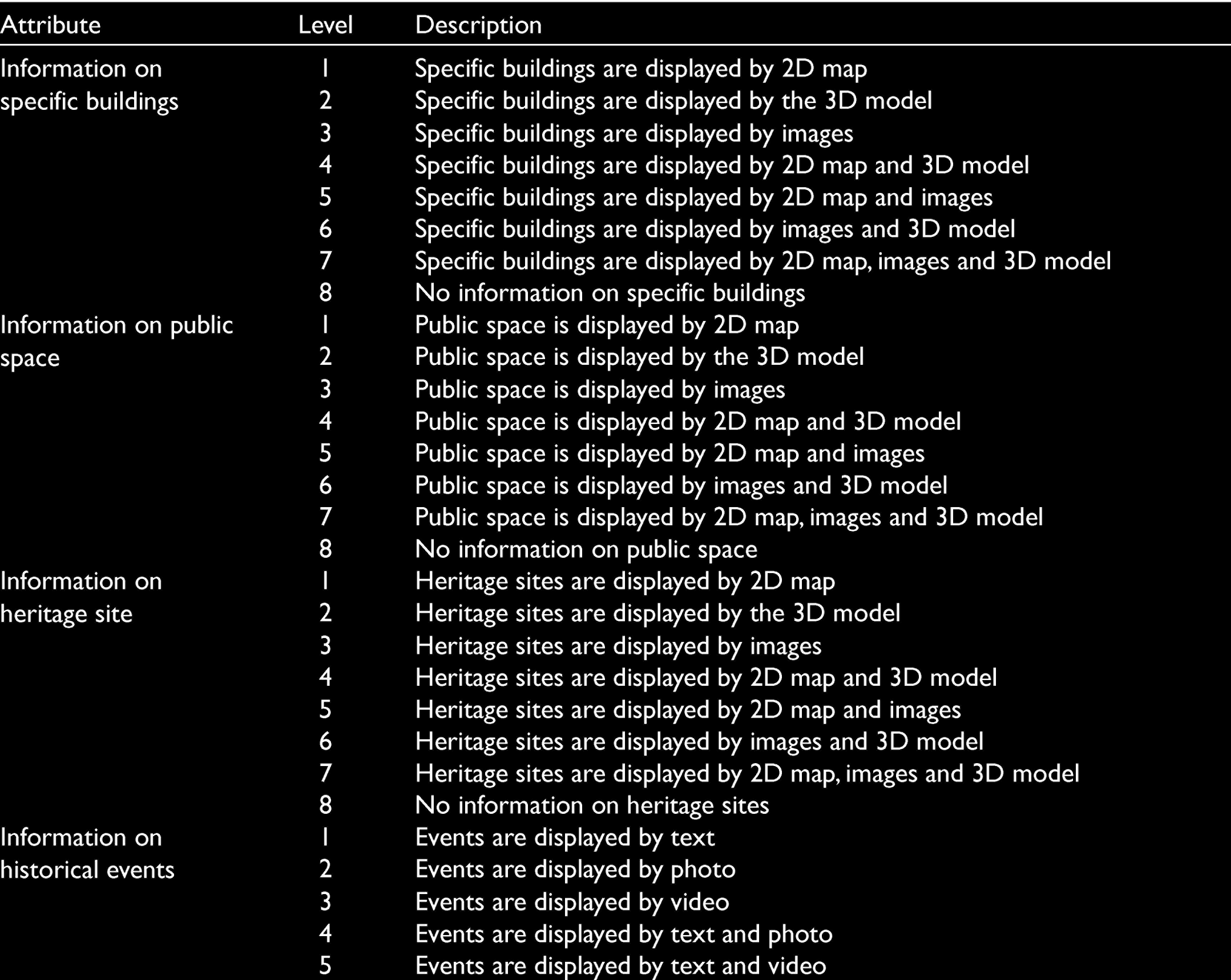
The spatial content in the hypothetical multimedia web platform is composed of specific buildings, public space and heritage landscape. These contents are essential for one heritage and cover the majority of spatial information for the public’s awareness. In this platform, we select the 2D maps, images and 3D models to display the spatial content. Each of the content includes eight different media combinations, which are single media (2D maps, images and 3D models) and media group (2D maps & images, 2D maps & 3D models, images & 3D models, 2D maps & images & 3D models and nothing). Table 1 describes an example of specific buildings.
Example of a Description of Attributes and Levels
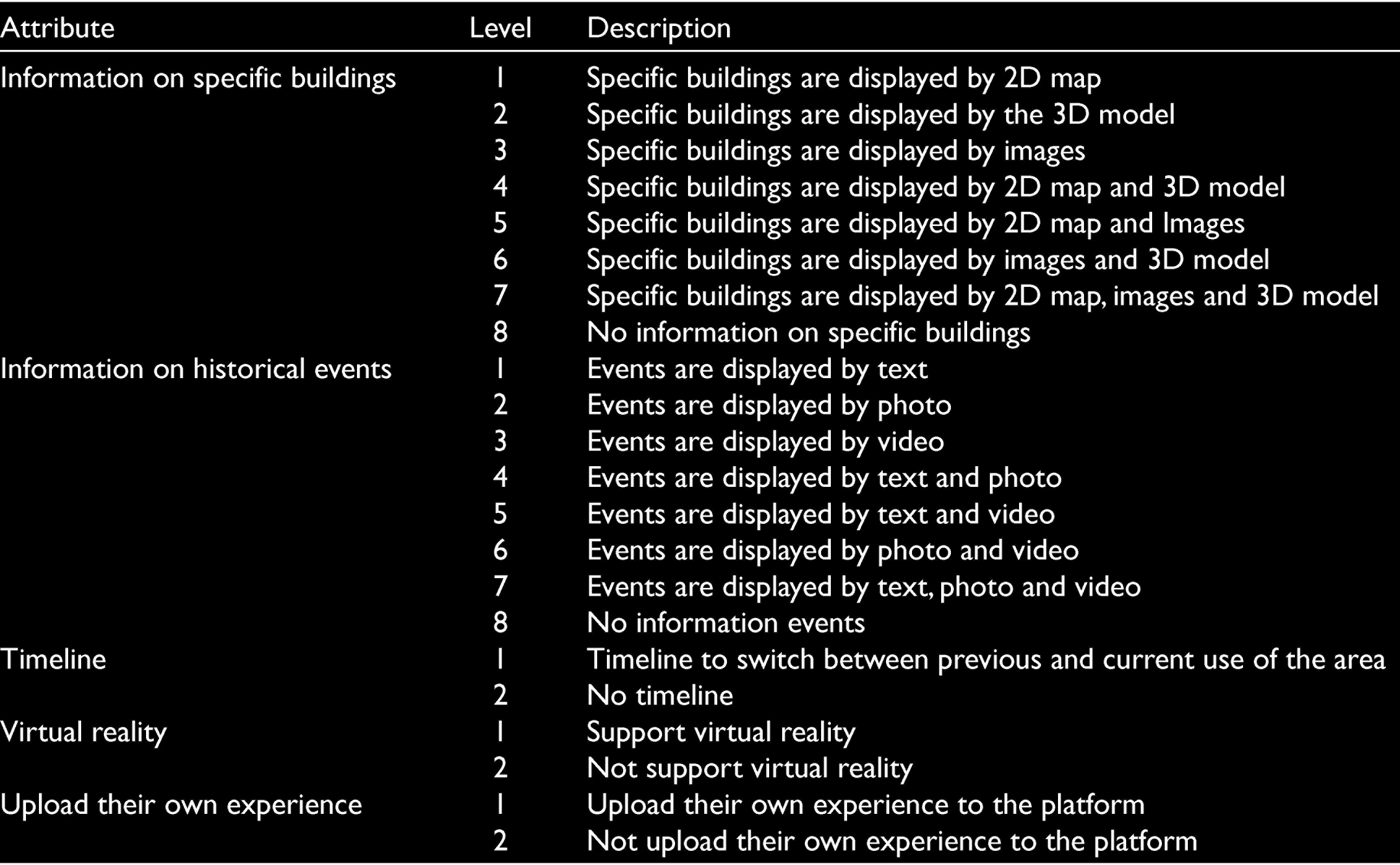
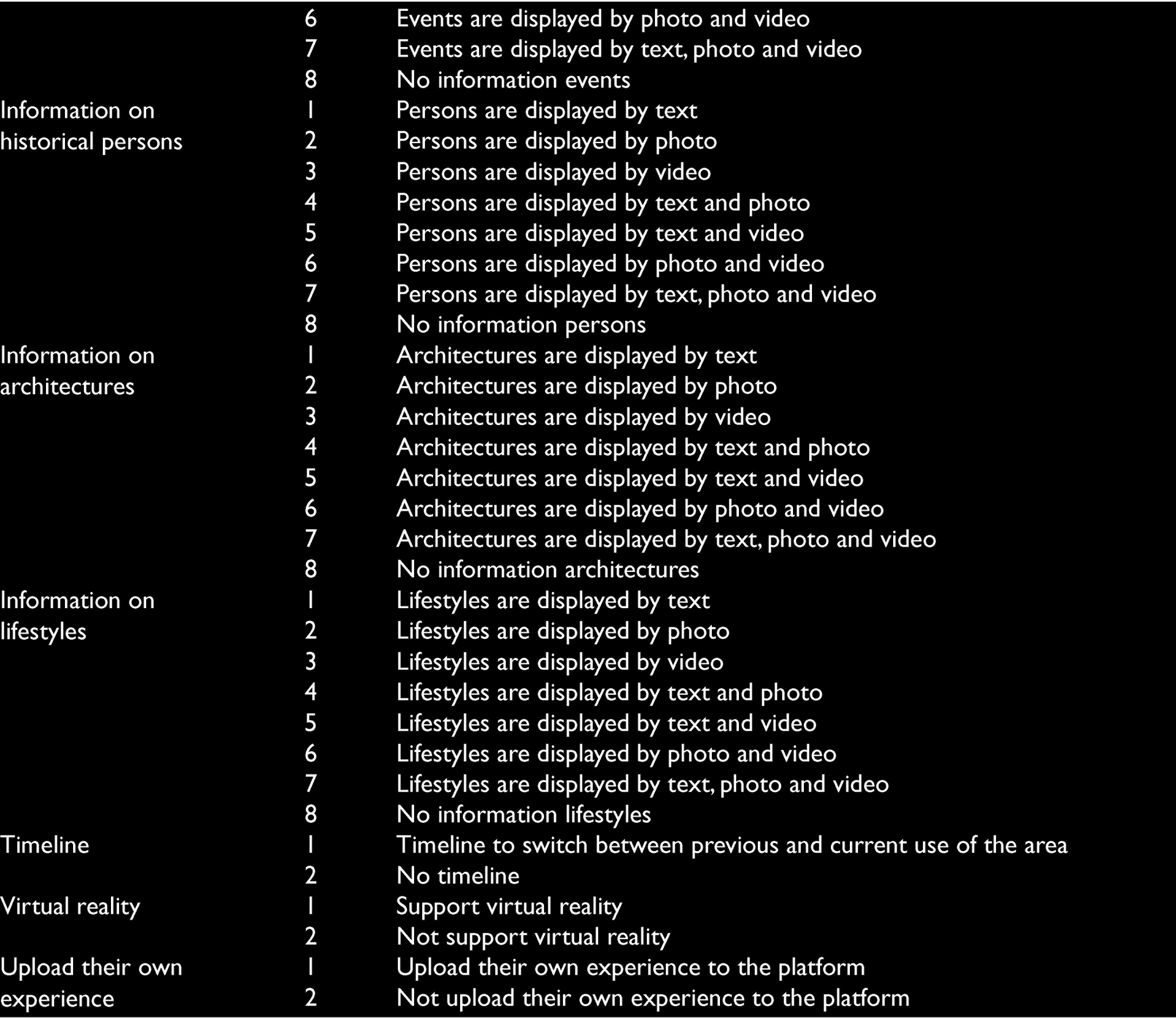
The historical content includes significant events (i.e., wars), persons (i.e., King), architectures (i.e., The Great Wall) and citizens’ lifestyle (i.e., custom) in the hypothetical platform. In this platform, text, images and video are selected to display the historical information. Similarly, as spatial content, each of the historical content contains eight different kind of media combinations. There are single media (text, images and video) and media group (text & image, text & video, image & video, text & image & video and nothing). Table 1 also lists one example of significant events.
According to the literature, multimedia web platform can also provide three functions: timeline, VR representation and personal experience sharing. VR, as advanced technology has been maturely used in city planning (Evans et al., 2006), which also has potential in the CH field (Mah et al., 2019; Yano et al., 2007). Based on the blueprint scanning from the images and other recorded information, VR can be used to reconstruct the tangible CH completely. With this technology, people can visit tangible heritage in the virtual space, but also can be immersed in the virtual environment, increasing the sense of identity. Today people are used to receive information on CH from official institutions run by the government, but sharing own experience and memories can enhance the impression to CH. It can also break the distance that often exists between public and the official institution, but also complements content between them (Gaitan, 2014; Giaccardi, 2012a). It can also raise people’s awareness of CH in their cities and stimulate that they take ownership and pride in the development of their respective cities (da Costa Liberato et al., 2018; Djabarouti, 2020). Time is a fundamental dimension for making sense of digitized CH collections, and timeline visualisation can support analysis, exploration and presentation of these datasets (Vane, 2019). Through the timeline, the users can find the difference and evolution between past and the present immediately.
In this section, a short example of attributes and levels description for the hypothetical multimedia platform can be seen in Table 1. The full table can be found in the Appendix.
Experiment Design and Data Collection
Developing a new web platform is a time-consuming project. In this study, in order to avoid developing a system that in the end is not appreciated by the intended users, a stated choice experiment based on the online questionnaire was conducted to find out respondents’ preference for different media combinations per CH content. This method has been maturely used to understand users’ preferences in the urban planning, travel behaviour and consumer behaviour research fields (Louviere et al., 2000).
Stated Choice Experiment Design
Stated choice experiments are used to measure an individual’s preferences through their choices among various options in a given hypothetical situation. In this experiment, individuals were asked to select their most preferred alternative from several choices in each situation.
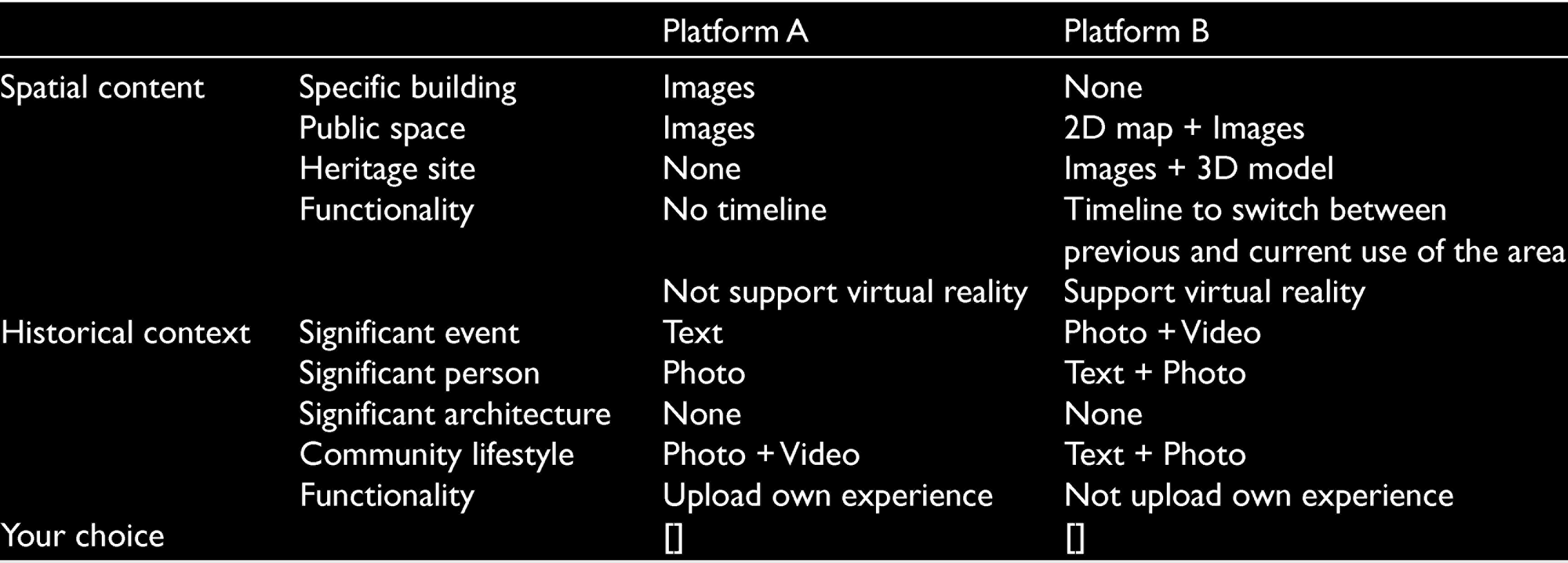
The application of stated choice experiments involves the creation of an experiment design that combines attribute levels (Appendix) in a specific choice set. For spatial content, specific buildings, public space and heritage site/landscape are considered as attributes, while for historical content, significant events, persons, architectures and community lifestyle are selected as attributes. These attributes have eight different media combinations. The functions part includes three attributes: timeline, VR and uploading experience, which have two levels. In this study, the seven attributes with eight levels, and three attributes with two levels result in 87 × 23 different profiles in a full factorial experimental design that involves all possible combinations of attribute levels. To reduce the profile number, an orthogonal fractional factorial experiment design involving a subset of 64 attribute profiles was selected. Choice sets were created by randomly combining these 64 attribute profiles, thereby creating choice sets of two unlabelled alternatives. The ‘None of both’ option was added to each choice set to allow for the possibility that both alternatives fall below some choice threshold. To reduce the respondent’s burden, the 64 choice sets were so organized into 4 blocks of 16 sets of choice sets. Each respondent received a selected block randomly. At each choice set, the respondents were required to choose the multimedia platform profile they like the best for acquiring information about CH, or to indicate they do not like any given option by choosing the ‘none of both’ option. An example of a choice set for the hypothetical platform is shown in Table 2.
An Example of a Stated Choice
Data Collection
Questionnaire Design
The questionnaire consisted of two parts. The first part included questions about the socio-demographic variables, which were gender, age, education level, income level, living situation and how many times a CH was visited before. The second part of the questionnaire included the 16 stated choice sets about the hypothetical multimedia platform. Before asking respondents to complete these 16 tasks, an example choice set and an explanation of all attributes and their levels were presented.
The questionnaire was issued from August to October 2019. To avoid the responses are bound to a specific place (Yu, 1995), the experiment was carried out both in China and the Netherlands. In the Netherlands, we collected data via the LimeSurvey system, which is an online survey. The respondents were recruited via a company called PanelClix, which had an available paid paned in the Netherlands. Our online survey was sent to the selected panel of respondents from across the Netherlands in October 2019. As for the survey in China, the questionnaire was sent by social media—WeChat. This online survey was issued in China in August 2019. For statistically appropriate data collection, a sample resembling the overall Dutch and Chinese population in terms of age, gender and occupation were required. A total of 630 respondents completed the questionnaire. Among the respondents, there were 399 from China and 231 from The Netherlands.
Sample Characteristics
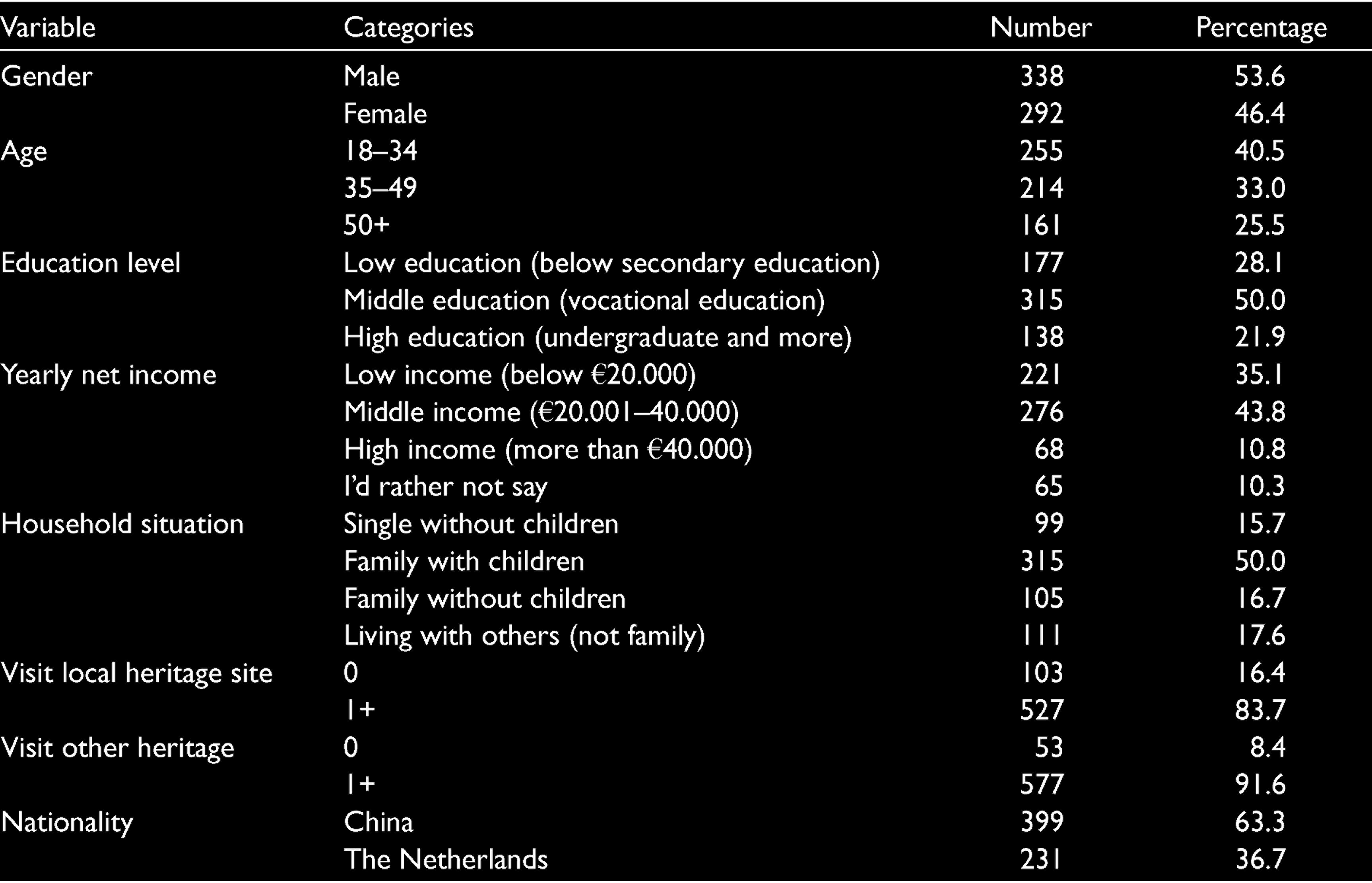
The distributions of respondents’ socio-demographic characteristics are shown in Table 3. It showed that the number of females was slightly higher than males. As for the age, young people (18–34) and middle age (35–49) were over-represented, 40.5 per cent and 33.97 per cent respectively. The respondents who had vocational education constitute half of the sample, people who had a bachelor’s and higher educational degrees were 21.91 per cent of the sample. Around 43 per cent of the respondents had a gross annual income between 20,001 and 40,000 euros, while 10.79 per cent had a higher income. Regardless of the people who would rather not say their income, about 35 per cent had relatively low income (below 20,000 euros/year). Half of the respondents were married and living with child(ren). The percentage of single without children, family without children and living with others (not family) were similar, 15.71 per cent, 16.67 per cent and 17.62 per cent, respectively. In total, 16.35 per cent of respondents never visited a local heritage in their own city, while only 8.41 per cent never visited other cities’ CH. The Chinese respondents made up the majority of the sample, which is 63.3 per cent, the rest of them were Dutch respondents.
Distribution of Socio-demographic Information
Estimation Method
The mixed logit model was applied in this study because it overcomes three primary limitations of standard multinomial logit by allowing for random taste variation, unrestricted substitution patterns and correlation in unobserved factors (Train, 2003). The alternatives in the logit model include two visualizations and the ‘none’ option. The utility of alternative i for respondent n in choice situation t can be written as follows:

where Uint is the utility of alternative i for individual n in choice situation t,
Results and Discussion
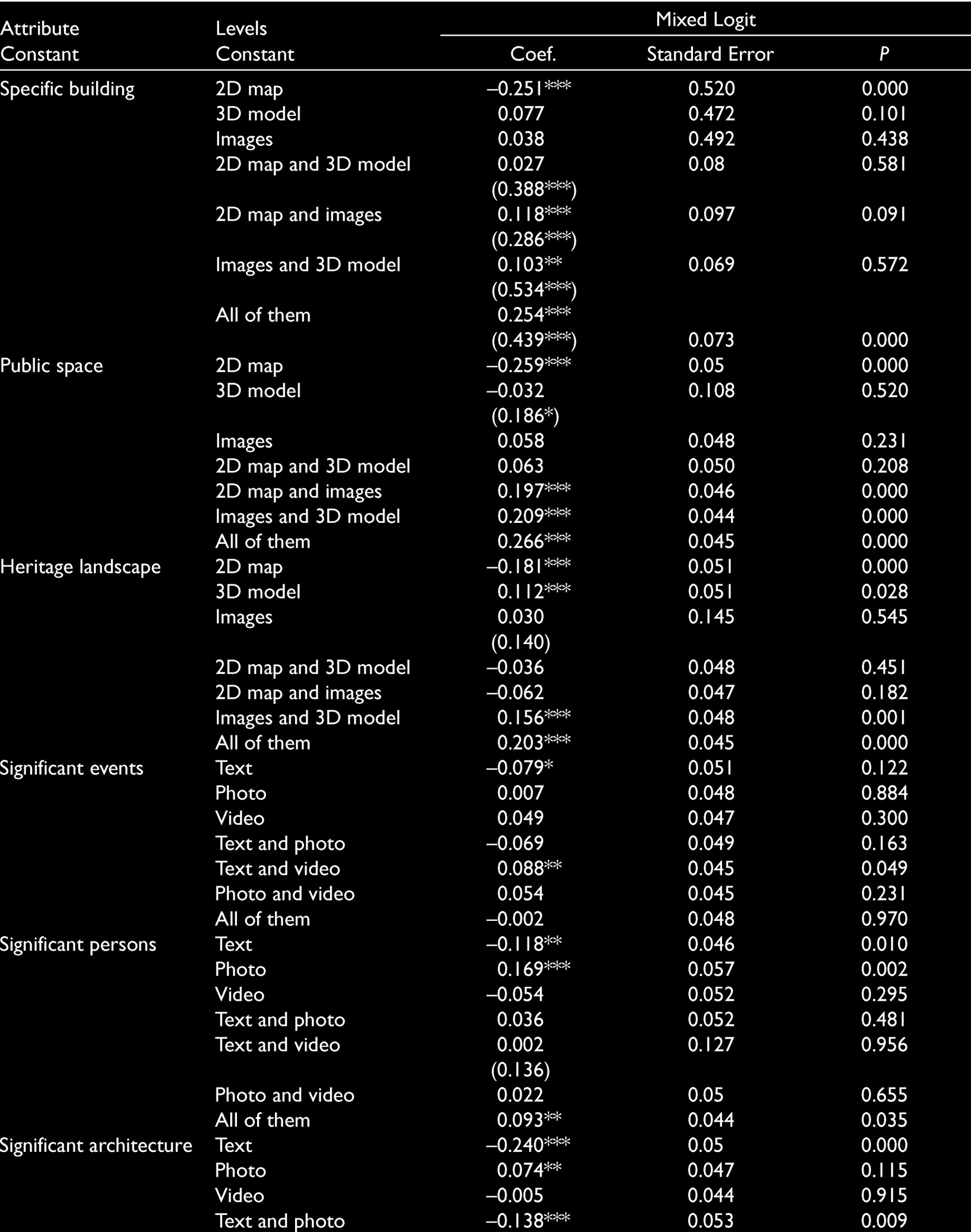
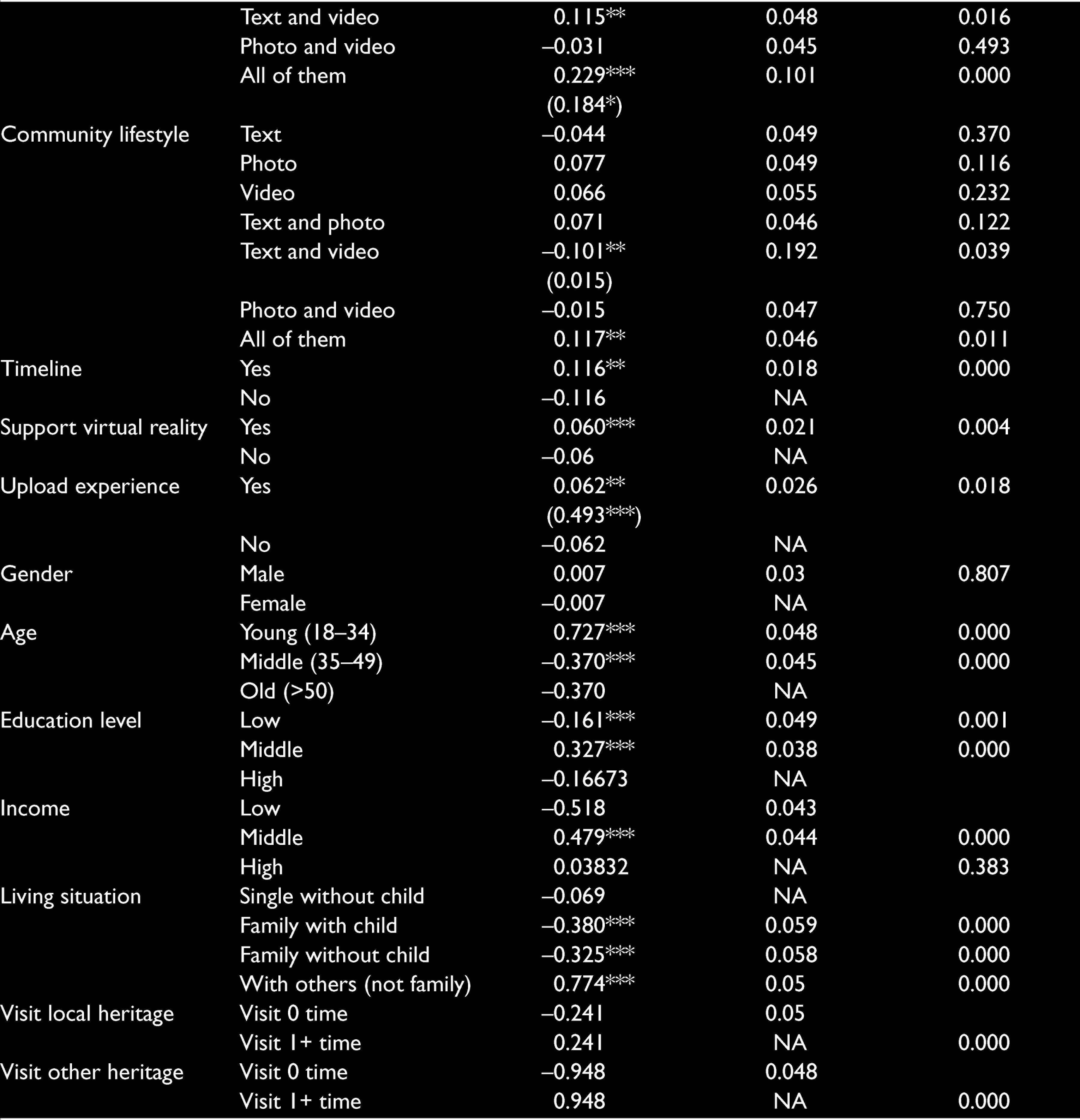
A mixed logit model was applied in this study. Some of the parameters were added to the estimation model as random parameters, following a certain probability distribution, these random parameter distributions were assumed to be continuous over the sampled population (Hensher et al., 2015). This is done in order to explain the taste variation in the sample among the parameters. In this study, the chosen random parameters were specific buildings (2D map & 3D model, 2D map & images, images & 3D model and 2D map & images & 3D model), public space (3D model), heritage landscape (images), significant person (text & video), significant architecture (text & photo & video), lifestyle (text & video) and uploading experience. The alternatives in the logit model included two visualization options and the ‘none’ option. The estimation was carried out by using maximum simulated likelihood procedures in NLOGIT econometric software, with 1,000 Halton draws for the simulation (Greene, 2009). According to the estimation, ρ2 was found to be 0.157, which showed a decent model fit (Hensher et al., 2015).
As shown in Table 4, when specific buildings were visualized by all media combinations, people were more willing to use the proposed multimedia web platform. Only a 2D map was the least preferred type of representation for the description of buildings. For the public space, people were more willing to use the web platform if it contained 2D maps or 3D models. The respondents also tended to prefer the combination of the images & 3D models for the description of public space in order to use the proposed web platform. The results also illustrated that people tended not to prefer to use the proposed web platform if the visualization of heritage landscape included only 2D maps. The type of visualization people preferred was the combination of images & 3D models. These results described that only 2D maps could not attract people’s interest. This might be because it was 2D and cannot show the 3D spatial information adequately. Also, the information on the map was monotonous and simple, which cannot leave respondents a strong impression. However, when 2D maps were combined with images and 3D models, people were more willing to use the proposed web platform. Because combination of media has more visual power than maps, they can strengthen the heritage impression rather than after reading maps.
Estimated Parameters of Mixed Logit Modes
***, **, * significance at 1%, 5%, 10% level.
Table 4 also listed the estimated results for the historical content of the multimedia platform. In order to use the proposed web platform, people tended not to prefer single text visualization for significant events. The respondents tended to prefer text & video representation for the significant events. As for the visualization of significant persons, people did not show interest in text and video, while they were attracted by only photo representation or combination of text, photo and video representation. The result for the visualization of significant architecture illustrated that the respondents preferred to see photos, combination of text and videos or combination of text, photos and videos to acquire information. For the community lifestyle people preferred combination of text, photo and videos. These results demonstrated that text representation was preferred when it was combined with photos and videos for visualizing CH historical content. People did not embrace text because they consider it a tedious medium, losing patience after reading a few lines (Fairclough et al., 2008).
The estimated results for the functionality of the platform were also showed in Table 4. All the functions had a positive effect on the proposed web platform, which means that people prefer to use these functions on one platform. VR showed the highest positive estimate, which can illustrate the respondents’ preference for advanced technology to understand CH.
For the specific buildings attribute in spatial content, the levels of 2D maps & images and 2D maps & images & 3D models were significant both in the mean parameter and the standard deviation. These results suggested that the attributes significantly affected people’s willingness to use this visualization combination to acquire spatial information. The mean parameter of uploading experience level was not found to be significant, but its standard deviation was estimated to be significant. This result indicated that although on average this attribute did not play an important role in explaining individuals’ choices regarding the function, the taste for this attribute varied significantly across individuals.
For the socio-demographic variables, the results showed that the preference for the multimedia web platform would decrease with increasing age. Probably young people had more curiosity and interest in using different and advanced technologies (Livingstone & Helsper, 2007). The education level also had a significant impact on respondents’ preferences. People with low and high education levels had a negative impact on the hypothetical web platform, while the middle education level showed a positive interest. These results could be explained by the fact that the number of respondents who had middle education made up more than 50 per cent. In addition, higher-income people preferred to use the platform to understand CH. Moreover, people who visited CH before (both locally and in other cities) were more interested in the platform compared to people who did not visit CH before. This is probably because they know what kind of information they preferred to find and which media they liked to use.
Discussion and Conclusion
Disseminating information on CH content enables protecting the cultural wealth of society that is vital to strengthen its identity (de Asís López-Fuentes & Ibañez-Ramírez, 2018). Learning about CH and passing on the information is essential for CH preservation and sustainability (Psomadaki et al., 2019). Therefore, in this research, people’s preferences for a multiple media web platform to broadcast CH knowledge to increase public’s awareness is conceptualized.
The main aim of this study is to provide more insights on people’s preferences for different media types and combinations of a hypothetical multimedia platform. To that end, a stated choice experiment was designed and administered in both China and the Netherlands. A mixed logit model was estimated to analyse the influence of the different media attributes of the platform and its functionality. The results indicate that people prefer multiple media rather than a single medium, both in spatial and historical contexts, as expected. Secondly, the visualization of CH information has a significant positive effect on people’s perception of the platform. Still and static media, such as 2D map and text attract less attention than dynamic media, like 3D model and video.
In general, the results indicate that people are less interested in acquiring CH information only through 2D maps. The map can provide a heritage location and visitation route, it is necessary but cannot satisfy people’s needs alone for acquiring information on CH. The platform developer should link maps to different media as much as possible. For the specific building content, people are attracted by the 3D model, which means the developer could build the platform based on the 2D maps and 3D models. The 3D model has a negative impact on people’s preference for the platform in the case of public space heritage, probably because the respondents consider a 3D model is not necessary to display the geographic information for public space (e.g., parking plot). What they only need to know is the location, route and appearance, so a map and images are satisfactory. The 3D model and images show a positive impact on the heritage landscape, because they can allow people to comprehend the site better. The developer could link more image and 3D model resource to the heritage site/landscape.
For the historical content, the text can be considered as an effective and traditional media to learn CH, but people tended not to prefer only text to access this information. Therefore, a short and clear introduction could be a start, following with other vivid and dynamic media. For the significant event, besides the text, the platform should link more video resources because it can capture important events clearly and vividly. People are more willing to see photo & text to understand a significant historical person, as probably they want to know what he/she looked like. The platform could put the photo in an obvious position, following with a brief introduction. The architecture contains much professional information, one media cannot satisfy people’s needs. The result shows respondents are interested in the visualization of text and video because the video could describe the information more detailed and comprehensive. As for the community lifestyle, the developer could link more text & photo resources, while also add some video to display the intangible heritage. Also, the CH platform should support VR because the respondents embrace this advanced visualization technology. Moreover, respondents show interest in sharing their personal experiences with others, which can aid in extending CH knowledge dynamically. Therefore, social media applications, like Instagram, Facebook and Flicker can be embedded in the platform (Chen et al., 2018; Tieskens et al., 2018).
A potential limitation of a stated choice experiment is the included list of attributes. Based on the literature review, we have covered the most important ones. However, there is still a risk that other attributes, such as the visualization with other advanced media, such as augmented reality, should be included. Containing many levels for each attribute is another limitation in this research. Even though the online survey can display different visualization, the respondents still need to spend time to image the platform in their mind. They could not understand the different combinations clearly. The responders could have a better experience if there is a simple mock-up in front of them. Moreover, in the Chinese sample, students made up a major percentage of the samples, which caused a significant impact on the populations’ income level and education level. Therefore, the sample should be covered by different ages and occupations in the next survey.
The main contribution of this research is to investigate people’s preference for different visualization contribution of one hypothetical multiple media platform to increase the public’s awareness of CH. When the representatives of heritage institutions would like to create a multiple media platform to broadcast the heritage information, they can rely on these results to design the platform structure before implementing it. In this way, it can help the platform developer to avoid wasting human resources and save time.
Footnotes
Declaration of Conflicting Interests
The authors declared no potential conflicts of interest with respect to the research, authorship and/or publication of this article.
Funding
The authors received no financial support for the research, authorship and/or publication of this article.
Description of Attributes and Levels
| Attribute | Level | Description |
| Information on specific buildings | 1 | Specific buildings are displayed by 2D map |
| 2 | Specific buildings are displayed by the 3D model | |
| 3 | Specific buildings are displayed by images | |
| 4 | Specific buildings are displayed by 2D map and 3D model | |
| 5 | Specific buildings are displayed by 2D map and images | |
| 6 | Specific buildings are displayed by images and 3D model | |
| 7 | Specific buildings are displayed by 2D map, images and 3D model | |
| 8 | No information on specific buildings | |
| Information on public space | 1 | Public space is displayed by 2D map |
| 2 | Public space is displayed by the 3D model | |
| 3 | Public space is displayed by images | |
| 4 | Public space is displayed by 2D map and 3D model | |
| 5 | Public space is displayed by 2D map and images | |
| 6 | Public space is displayed by images and 3D model | |
| 7 | Public space is displayed by 2D map, images and 3D model | |
| 8 | No information on public space | |
| Information on heritage site | 1 | Heritage sites are displayed by 2D map |
| 2 | Heritage sites are displayed by the 3D model | |
| 3 | Heritage sites are displayed by images | |
| 4 | Heritage sites are displayed by 2D map and 3D model | |
| 5 | Heritage sites are displayed by 2D map and images | |
| 6 | Heritage sites are displayed by images and 3D model | |
| 7 | Heritage sites are displayed by 2D map, images and 3D model | |
| 8 | No information on heritage sites | |
| Information on historical events | 1 | Events are displayed by text |
| 2 | Events are displayed by photo | |
| 3 | Events are displayed by video | |
| 4 | Events are displayed by text and photo | |
| 5 | Events are displayed by text and video | |
| 6 | Events are displayed by photo and video | |
| 7 | Events are displayed by text, photo and video | |
| 8 | No information events | |
| Information on historical persons | 1 | Persons are displayed by text |
| 2 | Persons are displayed by photo | |
| 3 | Persons are displayed by video | |
| 4 | Persons are displayed by text and photo | |
| 5 | Persons are displayed by text and video | |
| 6 | Persons are displayed by photo and video | |
| 7 | Persons are displayed by text, photo and video | |
| 8 | No information persons | |
| Information on architectures | 1 | Architectures are displayed by text |
| 2 | Architectures are displayed by photo | |
| 3 | Architectures are displayed by video | |
| 4 | Architectures are displayed by text and photo | |
| 5 | Architectures are displayed by text and video | |
| 6 | Architectures are displayed by photo and video | |
| 7 | Architectures are displayed by text, photo and video | |
| 8 | No information architectures | |
| Information on lifestyles | 1 | Lifestyles are displayed by text |
| 2 | Lifestyles are displayed by photo | |
| 3 | Lifestyles are displayed by video | |
| 4 | Lifestyles are displayed by text and photo | |
| 5 | Lifestyles are displayed by text and video | |
| 6 | Lifestyles are displayed by photo and video | |
| 7 | Lifestyles are displayed by text, photo and video | |
| 8 | No information lifestyles | |
| Timeline | 1 | Timeline to switch between previous and current use of the area |
| 2 | No timeline | |
| Virtual reality | 1 | Support virtual reality |
| 2 | Not support virtual reality | |
| Upload their own experience | 1 | Upload their own experience to the platform |
| 2 | Not upload their own experience to the platform |