



Abstract
Basic services are a critical nexus point for the realisation of sustainable cities. In South Africa, the failure to realise adequate and equitable basic services cements apartheid and colonial power relations, reproducing violent inequalities and relations of unsustainability. Water inequality has a disproportionate impact on women, who are often responsible for the labour involving water use. Thus, approaches to urban water management that centre life-making and the common good become critical. In this article, we present and discuss a research process for mapping household water use. This process was co-designed and implemented by water organisers in Cape Town and its surroundings. The organisers come together through the African Water Commons Collective, a women-led collective that supports self-organisation around water struggles in urban communities. We argue that water mapping as a process enables people to share and analyse their lived realities, and reimagine urban water management. Such an approach to research and learning reveals the complexity of the urban, raises political questions about water use and distribution and begins to imagine alternatives to existing systems of water distribution.
Introduction
Household water mapping is a useful research tool for community-based activists to build understanding, co-create knowledge and work towards just, sustainable water access. Embedded in an ecofeminist, popular education approach and working in collaborative and participatory ways, household water mapping can help produce an evidence base that social movements for water justice could use to engage with decision-makers, build connections across urban housing struggles and develop better water policy. Within the context of increasing water privatisation that disproportionately affects poor households (Ledger, 2021; Mckinley, 2007) and puts water commons at risk, this research tool attempts to establish a responsive understanding of water use among people in municipalities grappling with inequality and austerity.
In this article, we 1 discuss a water mapping tool developed by the African Water Commons Collective (AWCC). The AWCC is an established social movement that connects community organisers and organisations who are struggling to access water in working-class and marginalised communities in the city of Cape Town, South Africa. AWCC also works with water movements internationally (Benson & Karunananthan, 2023). Since 2015, a key tool in the AWCC’s political education work has been the process of household water mapping through which people map out their basic water needs. This tool enables people to see, in terms of amounts, whether they are able to access the water they need (Murray et al., 2023). The results from the mapping provide a basis from which to question whether existing water distribution policies fulfil the basic human right to water. This struggle at the neighbourhood level is connected to wider political ecologies of water use in South Africa and ‘feed[s] into local organising work to build political consciousness and organisational capacity’ (Murray et al., 2023, p. 12).
As part of the Transforming Education for Sustainable Futures (TESF) project, the AWCC’s water mapping tool was developed into a research and data-gathering process. Contributing to the work on water undertaken by movements, non-governmental organisations and researchers (Enqvist et al., 2020; Murray et al., 2023; Pereira & Wilson, 2012), this process sought to have people document their water use for a fuller understanding of obstacles to water access. In recent water justice campaigns, the AWCC faced the challenge of knowing anecdotally that the ‘free basic water’ allocations—prescribed by the national government and implemented at the municipal level—are not enough for the size of families living in backyard shacks, government housing, township rental stock and informal settlements. There is little data to point to the exact amount of water needed or the various uses of this water. Nor is there any documentation of how people innovate in the face of what we call ‘financial drought’. Existing quantitative studies on water use in Cape Town rely on water bills, meaning that the water use of people living in informal settlements and shared flats is excluded (Cook et al., 2021). A national study on water access in informal settlements revealed that water access is dependent upon dimensions of socio-economic status such as education level and employment (Oskam et al., 2021). In addition, a mixed methods study of informal settlements in the Western Cape showed that sanitation practices are informed by a variety of factors, suggesting that sanitation solutions require contextual specificity if they are to achieve their aim (Muanda et al., 2020). These findings demonstrate that access to water is locked into social inequalities and our policies for addressing them require a deeper engagement with the vastly diverse housing contexts in which they play out. In this regard, water mapping holds great potential as a process that directly involves the affected people and communities at the stage of problem definition.
Underpinning this research, both in terms of education and organising, is the concept of water as a commons. Globally, water supply systems are increasingly becoming targets for private investment (Barlow, 2019; Muehlebach, 2023), a trend that leads to people living without access to water and, over time, a failure to maintain public infrastructure (Lawrence, 2023; Swyngedouw et al., 2002). Water commons is understood not only as the material substance of water but also the infrastructure that carries it, the social relations surrounding it (Muehlebach, 2023, pp. 52–53) and the processes of ‘commoning’ that serve to govern it (Kashwan et al., 2021; Lotz-sisitka, 2017). This extends the idea of sustainability into dimensions of governance and democratic participation. As water resources were enclosed and stolen from people during the colonial and apartheid periods, the notion of the commons resonates with the ideals of the anti-apartheid movement: of the right to water regardless of race or class. This has since been taken up in commitments following the 1994 democratic elections (Mckinley, 2007; Moyo, 2016). However, after 1994, when water policies were implemented, they were done so with the intent of cost recovery and in 1996, basic services were managed within a market-driven neoliberal framework (Mckinley, 2007, p. 182). Thus, we see the failure to realise equitable water services (Scheba, 2022a; Socio-Economic Rights Institute of South Africa [SERI], 2020) to be not only a question of science and engineering but also a social question relating to the distribution of resources in the face of failing infrastructure. Through this article, we reach for understandings and practices of education that might address this question.
While mainstream education fails to respond to urban challenges (Bazaz & Parnell, 2021), educational practices have always been crucial in shaping urban life. In South Africa and across the world, popular education movements have emerged in urban contexts, often led by those excluded from or exploited by the economic system, including anti-privatisation movements (Cooper & Luckett, 2017; Di Chiro, 2006; Salleh, 2018). Ecofeminist popular education brings an analysis of the fundamental linkages between capitalism, racism, patriarchy and environmental and urban struggles (Salleh, 2018; von Kotze & Walters, 2023), while recognising that personal experience is impacted by decisions at the political level (Davis, 2016, p. 142). In relation to water, ecofeminism makes the connection between the lack of access to water by people without income, the particular ways in which this impacts women in a patriarchal society and the excessive and irresponsible use of water in other arenas such as mining or the production of fruit for export (Salleh, 2018). This work is in the spirit of the broader TESF project, which explores how education and knowledge production can be mobilised towards more sustainable and socially just futures (Lotz-Sisitka et al., 2023).
Embedded in the popular education approach is the entanglement of learning and knowledge production, which underpins the research process narrated in this article. People start with what they know—the local and lived experience rather than an abstract imaginary of reality—to build further knowledge towards action. Popular education enables people to work with their experiences and counter false dominant narratives. For example, this may include narratives emphasising ‘individual choice and behaviours as “solutions” to environmental issues while neglecting possibilities for collective decision making, and community-based, grassroots actions’ (Bellino & Adams, 2017, p. 273). In the context of urban water policy, people are increasingly framed as ‘customers’ and ‘irresponsible water users’, while services are outsourced to private companies and water infrastructure goes unmaintained (Swyngedouw et al., 2002, p. 19). The popular education approach driving this research aims to have active participation at all phases of the research/learning process by engaging with people’s lived experiences and staying connected to their material realities (Fenwick, 2006, p. 46). This encourages dialogue for further meaning-making about present and possible water commoning practices.
In this article, we outline the context of Cape Town, South Africa, where the household water mapping took place. We then turn to the water mapping process conducted by the AWCC over 12 months in 2022, describing the development of the mapping tool and how the participating AWCC organisers made sense of what they were documenting. This is followed by an analysis of the research process (i.e., the mapping) and a discussion of the research outcomes. In the conclusion, we discuss the methodological significance of this research and what it revealed about household water use.
Context of South Africa and Cape Town
South Africa faces a situation where water systems are near collapse. Urban water systems are expanding rapidly without sufficient attention to their maintenance (Public Affairs Research Institute [PARI], 2021). While the number of South Africans with access to water has increased since apartheid, the proportion (~65%) of people with reliable access to water has decreased (Scheba, 2022b; SERI, 2020). Most South Africans are living through an affordability crisis, with an estimated 60 per cent of the population unable to afford water priced at full cost recovery (Tshililo et al., 2022, p. 2). Municipal systems are struggling to fund themselves on terms dictated by the central government and institutes of international finance (Cirolia, & Robbins, 2021, cited in Scheba, 2022b). A recent additional pressure is the demand on municipalities to respond to climate change, which conflicts with attempts to redress apartheid inequalities (Millington & Scheba, 2021).
Cape Town’s main water supply comes from three large dams, Theewaterskloof, Voëlvlei and Berg, situated outside the city (Ziervogel, 2019, p. 16). Cape Town is characterised by high inequality, which is mirrored in its water system. Research has found that 13.7 per cent of the population (elite and upper-middle-income households) ‘use[s] more than half (51%) of the water consumed by the entire city’, while 61.5 per cent of the population (informal and lower-income households) ‘consume[s] a mere 27.3% of the city’s water’ (Savelli, 2023, p. 3). This is evidence of a situation where water is used according to who can pay for it, which is neither equitable nor responsible. In response to the 2017–2018 drought, wealthy residents drilled private boreholes, despite the uncertainty of impacts on the sustainability of the aquifer and the possibility of mismanaging a critical alternative water resource (Savelli et al., 2021, p. 17; Ziervogel, 2019, p. 18). Boreholes become a form of water commodification when they are drilled at high cost on private land with uncertain structures for regulation, putting the sustainability of the aquifer at risk. As a result, unequal water distribution through commodification puts water resources at risk. Given the possibility of climate change–induced drought that is predicted for the region (Ziervogel, 2019, p. 2), addressing the connection between water inequality and the devastation of the ecological water reserve is urgent.
As per the Water Services Act 108, 1997, South African municipalities are obliged to provide free basic services to those who cannot afford them. However, this is failing in practice. PARI (2021) reports that only 20 per cent of indigent grant support to municipalities from the national government was received by indigent households. This is a particularly concerning failure to redistribute resources to where they are needed, especially in the context of worsening inequality and poverty (Valodia, 2024). The city of Cape Town offers indigent households 15,000 litres of water per month (i.e., 500 litres per day). If water usage exceeds this amount for three months, the household will have a disc installed, resulting in a ‘trickle flow’ (CoCT, 2021). Like the water management device that was in use earlier, which cut water off after 350 litres had been used (Pereira & Wilson, 2012), this system appears legal on paper (providing the basic amount of water) but fails in practice: firstly, a dripping tap makes daily water use impossible; and secondly, households that cannot pay are often also overcrowded, meaning the amount of water allocated is not enough to cover all members of the household. Previous research in Cape Town has shown that people living in underserved neighbourhoods are unable to get help when they report an issue (Enqvist & Ziervogel, 2019). Meanwhile, municipalities are increasingly required to operate on a revenue-generating basis, which prioritises services for those neighbourhoods paying high rates (Scheba, 2022b, p. 5). The result is that the poor and historically dispossessed are unable to access their basic needs.
The specific context of this article is the neighbourhoods in which the AWCC is organised. These are working-class neighbourhoods located in the peripheries of Cape Town, characterised by high levels of unemployment and poverty. Historically, these neighbourhoods were created due to forced removals during apartheid and remain racially segregated according to the apartheid classifications of ‘Black African’ or ‘Coloured’. A neighbourhood-level analysis of the 2011 National Census confirms that race and class are tightly correlated in present-day South Africa. These neighbourhoods, occupied by people of colour, 2 continue to experience inferior services and lesser access to food, education and employment, among other critical social services (Turok et al., 2021). They include housing types of government housing (Reconstruction and Development Programme [RDP] houses), rented flats, backyard dwellers and informal settlements. These areas are densely populated and significantly underserved, in stark contrast to affluent neighbourhoods in the city that are historically White and characterised by high levels of formal education and employment.
Method: A Collaborative Research Approach
From January to December 2022, the AWCC embarked on a mapping process to document and collect evidence about household water use and to write up a training tool on water mapping (AWCC, 2023). The method of documentation took the form of participatory action research in which those affected ‘shaped the research agenda’ and the research questions were resonant for the co-researchers (WoMin, 2017). The AWCC members who conducted and participated in this research were all organisers. Water Action Committees (WACs) from 15 working-class neighbourhoods across the city nominated representatives who would attend coordination meetings. These representatives would then provide feedback to their WACs. For the purposes of this article, we refer to the representatives as lead organisers. The authors had an additional role of overall coordination, with the second and third authors assisting the lead organisers in their WAC meetings. The WACs were purposively selected, based on the existing relationship of these areas with the AWCC and from which the impetus to gather evidence for their water struggles emerged. The process took place in four phases: introducing the research aim; co-designing the tool; implementing the tool; and analysing the results (see Figure 1). In total, 106 organisers across all the WACs spent one week in May 2022 observing and documenting their water usage in terms of how much water they use and for what.
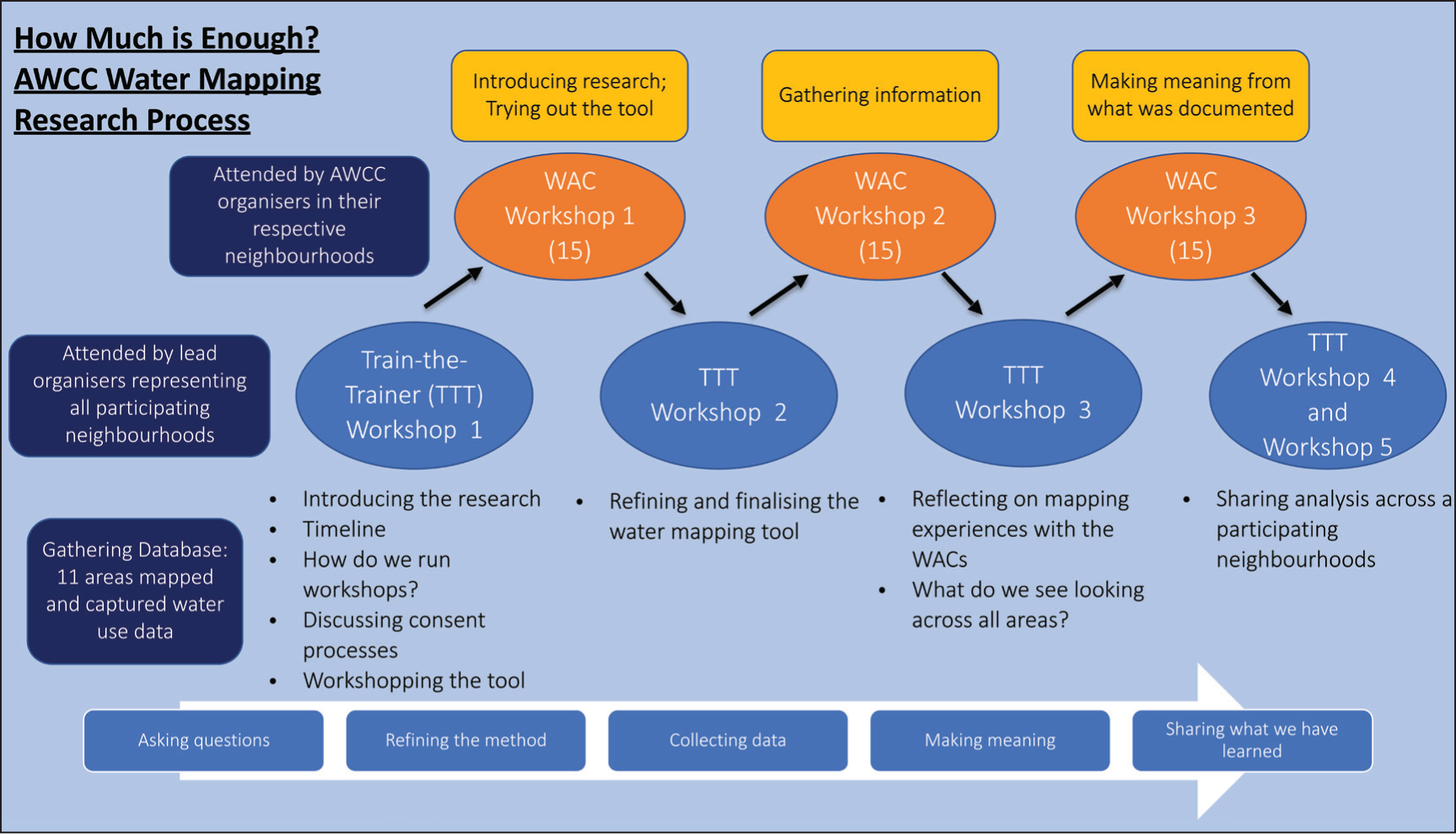
The structure of the co-designing process can be seen in Figure 1. The organisers took part in a series of train-the-trainer workshops, facilitated by the authors of this article. In these train-the-trainer workshops, the water mapping tool was drafted and piloted (Workshop 1 3 ), refined (Workshop 2), implemented and reflected upon (Workshop 3), with a final workshop looking at the collected data and reflecting on the process (Workshops 4 and 5 4 ). Between each of these workshops, the lead organisers facilitated mirror workshops with organisers in their respective WACs in order to engage, test and refine the tool, which was then fed back into the meetings of the group of lead organisers, ensuring knowledge sharing across the different areas. This structure allowed for information to flow between different WACs, who would otherwise not be in contact, for a meta reflection in how the process unfolded as well as analysis about what surfaced during the water mapping. This process ensured that the tool was responsive to the lived realities on the ground.
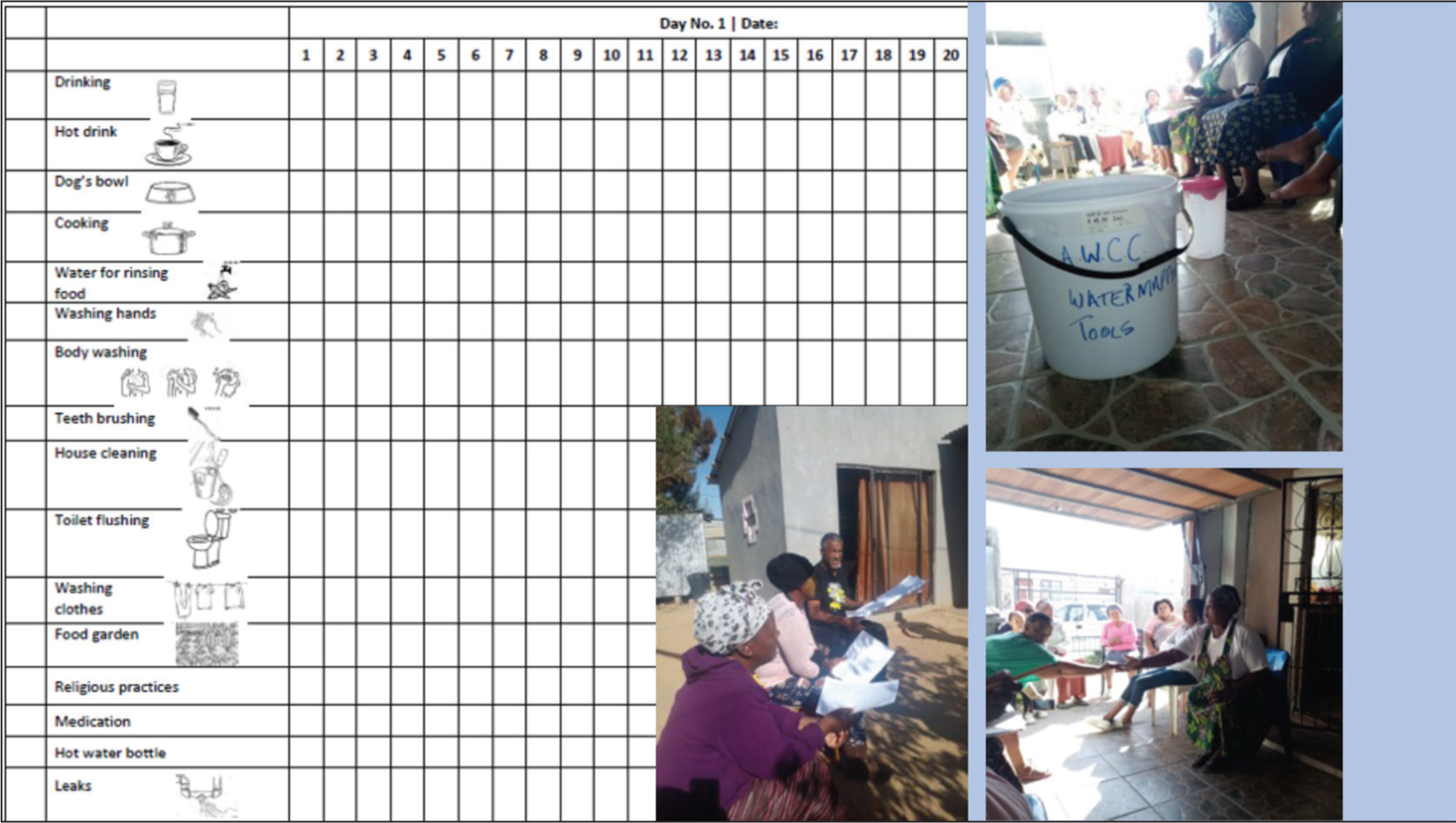
Supported by this process, WAC members mapped their water use for seven days (a full week) but sometimes less than this. 5 Most of the members participating (86%) were women. The second and third authors were present at all the WAC workshops. The water mapping tool is illustrated in Figure 2, showing the chart for noting the amounts of water used for various activities. Alongside this was a page to note daily reflections on the experience.
The Co-designed Mapping Tool and Photos from the Water Mapping Meetings with WACs.
Of the 15 participating WACs, four areas did not complete the mapping process, and their data were not captured. Reasons for this included volatility in the neighbourhood at that time, which made it unsafe for the process of mapping or circumstances that interrupted the process. However, organisers from these areas continued to hold workshops, reflecting on what it meant that they were unable to map their water use. Organisers from these areas were also represented in the lead organiser workshop. So, they were part of the research in a broader sense but could not capture data in the process of mapping.
The material that was gathered throughout this process includes documented amounts of household water use, daily reflections on the process and notes from dialogues in workshops. Each water diary also included a questionnaire with basic socio-economic data. The dialogues in Workshops 3 and 4 constituted an initial layer of analysis in which WAC organisers reflected on the use of the tool, sharing across areas via the 15 representatives. The quantitative data were summarised by the first author and collectively reflected on in the final workshop. All three authors were also AWCC organisers in this project and sat with the material gathered; daily reflections of WAC members were inductively analysed and explored for themes relating to household water use and the experience of doing the research.
By sharing the process of research as well as the qualitative and quantitative results, this article shows that household water use is an open system (Price, 2016); it is not observable in a lab but impacted by unpredictable factors and subject to changes in the act of researching it. Thus, our findings of water use must be read alongside the social context in which the water use is measured. Our intention was to produce knowledge from a particular position rather than to present abstract findings from nowhere (Haraway, 1988).
Results and Discussion: Unpacking Knowledge Production with Attention to Process
The results and discussion are presented in two parts: first, the themes emerging from the data collected on the experience of water mapping and the research process, and second, the insights gained on household water use from the data collected.
Research as an Experiential Process
In this subsection, we discuss how the WAC members experienced the research process and what they learned through their participation.
Creating Conditions for Popular Education
As the water mapping process unfolded, AWCC organisers had to field several challenges and work creatively. Various WAC members described the mapping process as ‘challenging’, ‘stressful’ and ‘very exhausting’. Organisers reported that the mere presence of pen and paper invoked anxieties about ‘getting it right’. The workshops provided the space and time to share these experiences, enabling individuals to work with their fears invoked by the research process towards owning the process of learning research. Daily written reflections by organisers revealed a sense of achievement as they ‘started to understand’ and ‘the process became easier’.
Another challenge was the fear of showing one’s water use, as shared by an organiser: ‘I was scared that I used too much water’. More common than expressions of fear were expressions of insistence on what water was needed for, as shown in the following written reflection. ‘Water is an everyday use. Without water you can’t do anything. [I]t is important to have water. We need water for a lot of things, especially for our bodies and for our health and for cooking and the kids need to have drinking water as well’ (Eastridge [ER], Household 12, Mapping Day 3). The reflection meetings provided the opportunity for AWCC organisers to address anxieties about saving water, with the concrete question of how much water is required for their basic needs, which was aided by referring back to the data collected by the organisers themselves. From the initial experiences of the AWCC’s water mapping, the notion that ‘people are wasting water’ has been a common utterance that conflates water use for basic needs and water waste (Murray et al., 2023, p. 9).
As the lead organisers had tested the process themselves and experienced similar concerns, they were able to support the broader group of organisers, through the workshops, in owning their knowledge and being critical of the recurring false narrative that people are wasting water when they are in fact using it for their basic needs. This is an element of popular education, where concrete experience is engaged to grapple with false narratives. What made it feminist popular education was the way AWCC organisers facilitated discussion about making the personal political by shifting the organiser’s perspective: that access to water is a political and social concern relating to distribution rather than a matter of wise individual use. What made it ecofeminist was the questions raised about the connection of urban municipal water supply to the larger water commons and the discussion that placed Black women, who are often responsible for household water use, in the larger context of the political ecology of water use.
Learning Enabled by Mapping
One of our research questions aimed to gauge the distance to the water tap. A lead organiser reported that after measuring this distance, ‘One of the families came back to say thank you for the mapping, because now they understand how far they need to walk… now the husband is helping them to carry the water’ (Workshop 3, 25 June 2022). In this manner, the mapping process drew awareness to the inequalities of water labour and initiated conversations about equality within the household.
One WAC organiser reflected that ‘I never knew how much water I used till I started measuring my water [usage]’ (Beacon Valley, Household 13, Mapping Day 3, May 2022). A lead organiser reflected, ‘I think everyone learned about litres and millilitres and now know how much water more or less they use for different things’ (Workshop 3, 25 June 2024). Organisers reflected on how the mapping made visible, for the first time, the water they were ‘really using’. ‘Het ek baie geskrik want as ek net dink hoe baie water ons gebruk by hande en by die toilet ka nek dit nooit geglo het nie’ [I got a fright because I just realised how much water we use to wash our hands and to flush the toilet. I could not believe it] (PA Hamlet, Household 5, Mapping Day 6, May 2022). The knowledge of how much water one is ‘actually’ using extended as far as to challenge the municipalities’ billing system. ‘Nou ka nek terug gaan en vir die municipaliteit se Jammer, de brgrag op my rekening is nie reg nie van ek het soveel water gebruik’ [Now I can go back to the municipality and say sorry, the amount on my bill is not correct because I have used so much water] (PA Hamlet, Household 15, Mapping Day 7, May 2022). Urban water systems are obscure to the public (Apple, 2010). An AWCC organiser observed that it is rare that someone understands the amount of water they need per day. This is a significant obstacle to meaningful engagement when municipal proposals for basic amounts are suggested. Learning to measure water becomes a critical literacy in the context of water access and basic needs.
Learning to measure water led to significant reflection amongst organisers about the value of water. Reflections relating to seeing ‘how much water we are really using’ were accompanied by a paradox: that water is vitally important and because of this importance it cannot be withheld through a requirement to pay. One WAC member wrote, ‘Without water we will surely die, so we should really appreciate it and try to teach [our] neighbours and friends about it. But water should also be free for anyone to use and not be measured and limited to a certain amount’ (Beacon Valley [BE], Household 12, Mapping Day 7, May 2022). The notion that measuring is useful sits alongside the reflection that water should ‘not be measured and limited to a certain amount’. This is in line with anti-privatisation movements around the world that call for water to be ‘priced in ways that would allow it to remain radically accessible, especially to those in need’ (Muehlebach, 2023, p. 4, with reference to Ballestero, 2019). It is powerful to see the value of water in relation to basic needs, rather than in terms of how much can be saved or used for profit.
Learning how to measure water reveals to people the process by which water is limited or charged for and allows for critical engagement. Similarly, thinking about the distance walked to fetch water makes visible the labour related to accessing water. Such an engagement with processes of measuring constitutes critical literacy with potentially far-reaching implications in water management and policy. At its core, this process centred dialogue about our relationship to water. One lead organiser reflected on the process: ‘To take time to attend to one’s personal experiences with their relationship to water, specifically one’s water usage, and to engage in it, was and is an individual and collective learning that informs one’s life’ (Lead organiser written reflection, November 2022).
Research as a Process of Knowledge Production
In this subsection, we present the results of the water mapping and discuss the themes that emerged from the data and the workshops. Specifically, we look at how water usage differs across households and household types and the ways in which water establishes relationships between households. We also consider some of the meaning-making that emerged when this data was workshopped in dialogue with AWCC members (see Workshops 3 and 4 in Figure 1).
Diverse Water Usage Across Households
Several factors impact access to water in working-class neighbourhoods. They disrupt the assumption that all households are neatly individualised and have the ability to pay the municipal rates for water (Scheba, 2022b). Specifically, these include assumptions, such as a household has an average of six people; a household’s water is used only by those who live in that household; or people are not already conserving water, thereby increasing the burden of labour on women who must ensure that sufficient water is available for necessities. One WAC organiser’s reflection captures several of these complexities:
I do not have a toilet. I use the bucket. I clean it with water and make a hole. It takes 11 steps to get to water each day for me and I have to do it. The kids has to take water to school every day. Twenty past six I fill up the bucket up for tomorrow morning. (Southern Suburbs [SS], Household 3, Mapping Day 3, May 2022)
This reflection touches on three significant elements of water use in underserved neighbourhoods. Firstly, the absence of good sanitation infrastructure requires greater effort in cleaning and maintaining hygiene, for which the water allocated to the household must be used. Secondly, labour is involved in both sourcing water as well as disposing of it. Thirdly, this participant shared an experience where the school does not provide water to learners, once again, household water allocation is used so that learners can stay hydrated while learning. The struggle to access water ricochets into aspects of life that are not accounted for in the mainstream policy and produces an exponential cost to those who live in these conditions.
One household detailed the water used and also noted how much was ‘left over’ or ‘carried over’ to the next day. This household had a water management device and their findings revealed the need for meticulous care in monitoring water use. Another organiser wrote, ‘Due to [the fact] that I am not on free flow. I know how to manage my water everyday’ (East Ridge [ER], Household 7, Mapping Day 3, May 2022). The organisers’ reflections detailed the significant effort that goes into managing water in a household and the mental and physical pressures of working with a limited amount of water. ‘We know we have to think about our water use, but as you can see, that with five people it is too much’ (Clark Estate [CE], Household 7, Mapping Day 3, May 2022). Two WAC members wrote about how their water supply was turned off. ‘Today I used quite a lot of water. I washed [the] washing. I have [an] automatic machine which uses a lot of water. My water went off’ (ER, Household 14, Mapping Day 3, May 2022). One household reported that their supply was disconnected three times during the mapping week; in one instance, for as long as 13 hours. Households also reported that illnesses such as diarrhoea required additional water for cleaning. These written reflections reveal that household water use varies on different days for different reasons, including laundry loads, changes in the weather or the presence of illness in the house, requiring attentive and ongoing monitoring in contexts where water is limited.
Borrowed Water
When access to water is limited, people seek ways and means to find water. The first draft of our water mapping tool did not include an option of ‘giving to neighbours’ but after the experience of the pilot (Workshop 2 in Figure 1), all the lead organisers felt that the inclusion of such a category was required. Four WAC members reflected on sharing water with their neighbours. In one case, a WAC member opened her home to children who were in need of water and food. Of the 106 households that documented their water use, 30 indicated that some water was given to neighbours during the mapping week. Out of the 106 households that answered the mapping questionnaire, 40 indicated that when they run out of water, they borrow from their neighbours or a standpipe from a nearby informal settlement. Seven households indicated that they buy water: ‘I had to buy two cans of five litre water’ (ER, Household 14, Mapping Day 3, May 2022). Two households reported that they go entirely without water in the face of shortage. The burden of limited water access extends beyond the household when water is used by neighbours or when people spend the little money they have on purchasing water. This burden is, thus, not restricted to an individual household but affects the larger community.
Our research reveals situations where accessing water is challenging socially and economically; if household water access is limited, it is often the women who ‘manage the water’ as they do their daily chores. Women also incur the additional work of managing relations with neighbours when there is not enough water for the household. These reflections reveal a situation where limited water access fuels social tensions.
Quantitative Analysis of Water Mapping
A summary of the quantitative analysis of the water mapping can be seen in Table 1. 6 On average, households reported that they used 58 litres per capita per day (lpcd). However, 55 households reported using less than 42 lpcd. These amounts fall within the ‘health risk’ band defined by the World Health Organization (WHO). 7 The numbers reported for drinking water are also low: half the households reported that less than 0.5 lpcd of water was consumed for drinking. This is well below the WHO recommendation of 5 lpcd for a healthy and dignified life (Moyo, 2016).
Summary of Daily Water Use.
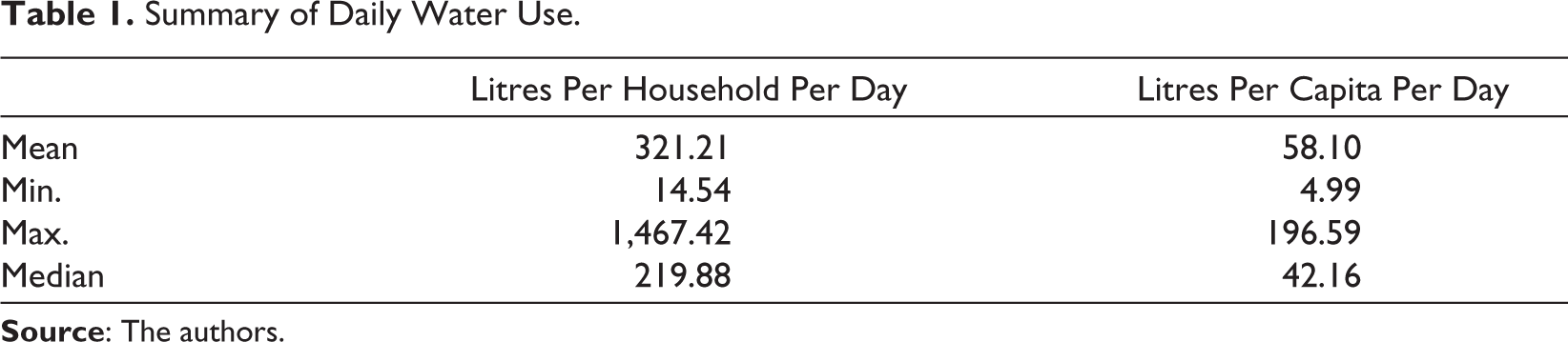
Looking closely at what the water is used for reveals suboptimal use in key basic needs. For instance, the 24 households that reported using above 500 litres per day (i.e., the city-allocated amount) were not necessarily using it for their basic needs. These households reported that large amount of their tap water was used for gardening, sharing with neighbours and toilet flushing. When the aforementioned types of water use were taken into account, 8 17 of the 24 households report using less than 100 lpcd for drinking, cooking and bathing. This shows that gardening, sharing water and toilet flushing can distort the amount of water used for basic needs. We also saw that reports of high water use generally correlated to RDP (formal) houses while low water use correlated with informal dwellings, confirming the findings above that housing conditions play a role in household water use.
These findings support the AWCC experience that the conditions of working-class communities make water use highly challenging. In some cases, the allocated amounts are exceeded not for reasons of waste but for sharing water with neighbours or for critical activities such as food provision.
Looking at the Data in Context
Once the data had been captured and summarised, our findings were shared with the AWCC educator organisers. One person said, ‘For me, it’s shocking that people don’t drink water…we flush more than what we drink’. AWCC members reflected on how important drinking water is for combating diseases as well as for mental health. ‘The numbers make me think: we can incorporate what we see in the numbers in the campaign. We need to encourage people to drink water. We need to ask why we are using fresh water to flush. Why can’t we use grey water?’ (Workshop 5, 18 November 2022).
As we looked across the different housing types (informal, government, backyard dwellers and flats), a comment was made about the nature of urban water management policies having one standard approach:
It’s becoming clearer that we can’t have one solution; our needs for water are different. We live in overcrowded spaces [and] everyone’s conditions are different. The response is we do not have a blanket solution. How we use water is different and how people access it is also different. (Workshop 5, 18 November 2022)
Together, we looked more closely at the pieces of data gathered (the numbers, the reflections and the surveys). In our workshop discussion, people spotted ‘gaps’ in the data. ‘I see this household says [their water is] cut off sometimes, but they say they always have water in their toilet. Based on that I assume they recycle water for their toilet’ (Workshop 5, 18 November 2022), suggesting the presence of water-saving innovations. Another comment was made that ‘this household has six women… There is going to be one week when those women have their periods, and the water use will increase dramatically’ (Workshop 5, 18 November 2022). These observations pointed to the power of considering the data gathered in ways that are not separate from knowledge of the context.
The collected data prompted critical reflections on the lack of water used for basic needs such as drinking but also the contradiction of flushing drinking water down the toilet. Engaging with the spread of data, quantitative and qualitative, AWCC members reminded each other of the contexts from which these numbers emerged, pointing out gaps and bringing a feminist lens to the water needs of women in the household. This process of looking directly at pieces of data enabled the analytical shift from the personal lived experience to political questions of how water is used and shared. This knowledge base presents a starting point for imagining alternative water solutions.
Conclusion: Seeing the World Through Water
Water access is worsening in South Africa (PARI, 2021; Scheba, 2022b). Increasingly, access is dependent upon privilege, putting our commons at risk, which further increases with predictions of climate change–related drought (Savelli, 2023). The water mapping project confirms what is already known: that working-class neighbourhoods occupied by people of colour face severe struggles to access the water they need. The mapping approach enabled these communities to voice, frame and discuss their struggles with contextual nuance. While this is not sufficient for addressing water access, enabling collective dialogue is critical in dealing with a complex problem. A recent analysis of municipal water provision in South Africa (Ledger, 2021) recommended that ‘mechanisms for more effective community participation in both the definition of problems and the development, implementation and oversight of solutions’ are required to address the water and sanitation needs of the country. Educational processes can support meaningful participation across all phases of service provision, and some of the processes from the water mapping may be helpful in this regard.
This article has described and analysed the water mapping process organised by the AWCC as a form of education and knowledge production of relevance to a key urban sustainability concern: water services. The process resonates with ecofeminist popular education as it was created and refined collectively by the communities struggling to access water—mostly women—and established connections between their lived experience and the systems shaping that experience. In this case, the learning objective was household water use, which is tied up with reproductive labour usually done by women in existing societal power relations and often made invisible in masculinist approaches to water management (Finewood & Holifield, 2015, p. 88). As such, we engaged with a sustainability issue that was not separate from us but flowed through everyday life.
On a methodological note, accounts of the research experience suggested that the documenting process was challenging. Not all households mapped the entire seven days and in some cases the amounts needed to be estimated. As a result, over/under estimations of daily averages were worked out throughout the week, depending on whether heavy or light water-use days were missed. We consider these to be not so many errors as part of the reality of household water use. Beyond precise measurement, the quantitative data collected were still useful in that these enabled us to see some patterns across areas and provided a basis for further dialogue about how water should be used and what people should have water for. The process of measuring revealed contextual factors that dictated the conditions of water use. Additionally, when the quantitative data are engaged in dialogue and in relation to daily quantitative reflections, they form part of a further story. Household water use, an inconsistent, unpredictable phenomenon that can be affected by the act of measuring it, is thus understood more richly through mixed methods and reflective dialogue with those directly affected.
The AWCC connects knowledge to action through continued engagement with the information gathered. This takes the form of ongoing organising, educating and knowledge building in relation to water services, and building a campaign against prohibitive bills and water-limiting practices that penalise the many people who cannot afford to pay for water. Members made connections with the data collected and furthered campaign efforts; for example, by highlighting the concerningly low amounts reported for drinking water use.
Emphasising the importance of ecofeminist research and learning is not sufficient for its incorporation into concrete action towards deep and just urban sustainability. For situated and experiential knowledge to be taken seriously, epistemological shifts in the structures that organise our options are required (De Sousa Santos, 2014). Seen in the larger context of organising for water justice, the possibilities and limitations of household water mapping as a research and learning methodology should be deliberated and discussed further.
In the context of urban water management, notions of ‘urban sustainability’ appear in support of well-being but are often a repackaging of existing inequalities (Finewood & Holifield, 2015). ‘Sustainability’ is often invoked in an ahistorical manner to justify limiting water to households who cannot pay without bringing into question the unrestrained water usage of households and industries with wealth, resulting in a threat to the water commons through over-exploitation and pollution. This contradiction is at the heart of our planetary emergency. Critically considering the ways in which sustainability has arrived in the African context, Dei (2010) argues that the notion of sustainability is contested and value-laden, and must be reclaimed with stronger connections to local contexts. Insisting on the prioritisation of a water commons for living that does not put a burden on poor households is a deeper framing of sustainability that could foreground progressive action. The exercise of household water mapping resonates with the vision of a systemic shift from ‘water extractivism’ to ‘water commoning’ which requires a move away from ‘corporate water marketing and state managed technological fixes’ and turning instead to localised responsive solutions to water struggles (Salleh, 2018). Household water mapping as popular education and engaged research should be harnessed towards localised responsive shifts towards deep and just sustainability.
Footnotes
Acknowledgements
This article is an account of a collective effort by organisers and water action committees who are connected through the African Water Commons Collective. We acknowledge these significant efforts made towards learning and knowledge production about household water use. We thank Koni Benson for her guidance and contribution to the process and the final version of the article.
Declaration of Conflicting Interests
The authors declared no potential conflicts of interest with respect to the research, authorship and/or publication of this article.
Funding
The authors disclosed receipt of the following financial support for the research, authorship, and/or publication of this article: The support of the Economic and Social Research Council (UK) is gratefully acknowledged by TESF. Award title: UKRI GCRF Transforming Education Systems for Sustainable Development (TES4SD) Network Plus (Grant Ref: ES/T002646/1).
Ethical Approval
This research was awarded ethics approval by the Rhodes University Education Faculty Research Ethics Committee (EF-REC), application number: 2021-5361-6450, and included processes of informed consent for all who participated.
Data Availability Statement
Project data belong to the research project Household Water Mapping for the Water Commons undertaken by the African Water Commons Collective and Rhodes University. Anyone who has worked on the project can continue to access and use the data beyond the end date but must have approval from the project PI and share drafts of the work produced.