




Abstract
Since 2008, the call to ‘remunicipalise’ water resources has become a key strategy for water movements across Europe. Remunicipalisation aimed at opposing the new wave of privatisation programmes and water commodification incentivised under austerity frameworks. However, the water movements’ lack of direct engagement with questions of re/commoning resulted in under-explored links, in practitioner and scholarly arenas, between demands for water remunicipalisation and practices of commoning. This article brings into dialogue the bodies of literature on commoning and remunicipalisation. It examines the conditions which enable crossing the paradigm threshold from municipal governance, towards more collective and situated models of water governance rooted in practices of commoning. The article operationalises the concept of recommoning water to capture this process, and proposes an analytical definition grounded in a case study of water remunicipalisation in Terrassa, Spain. In 2019, Terrassa achieved remunicipalisation to create a citizen water observatory. The empirical findings demonstrate that water activists in Terassa’s Observatory are reclaiming and reproducing the commons on a daily basis through a process of experimentation with institutional bricolage and (re)negotiation of power and autonomy. This citizen-led observatory is ensuring that resources are shared in common, are used for the common good and are reproducing the commons. The study concludes that water remunicipalisation can act as an important step for enabling processes of recommoning. Nevertheless, the institutionalisation of recommoning water under a public management regime is confronted with multifaceted tensions that merit attention from both activists and policymakers.
Introduction
‘Commons’, often understood as common-pool resources (CPRs) managed under common-property regimes, have been at the centre of Ostromian theory which prevalently focused on how institutions are designed by users to ensure a resource’s biophysical sustainability (Ostrom, 1990: 58). Critical commons scholars have proposed examining power dynamics in institutional design under a neoliberal paradigm (e.g. Clement, 2013; Dell’Angelo et al., 2017; Kashwan et al., 2019; Nieto-Romero et al., 2019; Velicu and García-López, 2018). A few authors have also made the link between urban social movements and processes of commoning (Asara, 2020; Clark, 2019; Stavrides, 2015; Varvarousis, 2020; Villamayor-Tomas et al., 2022; Villamayor-Tomas and García-López, 2021) or new municipalism and the commons framework (Russell, 2019; Thompson, 2021). Yet literature that specifically juxtaposes water remunicipalisation movements and re/commoning theory is sparse.
Commoning is the practice of a community ensuring that resources are shared in common, are used for the common good and are (re)producing the commons (Fournier, 2013). Several authors have written about commoning as the act of expanding or reproducing the commons, drawing attention to the everyday practices of where and how people gather, build relational bonds and make collective decisions pertaining to stewarding a common resource (Bollier and Helfrich, 2014; Caffentzis and Federici, 2014; De Angelis and Harvie, 2014; Linebaugh, 2007; Varvarousis, 2020).
Expanding the notion of commoning, we propose recommoning water as a concept that better captures and emphasises the process of reclaiming such everyday practices of social organisation and reproduction around water politics and management, especially in complex urban terrains. A process of recommoning must by necessity transcend the configurations of property and power that had enclosed the water commons in the first place. It involves creative crafting of new processes and institutions that can permit citizens to reclaim custodian practices and access to decision-making over water resources, thus re-politicising water governance. Micciarelli’s (2022: 122) work is important in elucidating that what distinguishes urban commoners is their understanding of collective ownership not from the perspective of property-sovereignty, but from the perspective of citizens as custodians. This perspective is coherent with Ribot and Peluso’s (2003) ‘theory of access’, which by focusing on ‘ability’ goes beyond the rights-based limits of property theory. In turn, this different understanding generates a new set of relations for collective caring with citizens, not only for citizens, enabling the city to become an emancipatory project as a hydrosocial territory (Boelens et al., 2016).
While in most literature the spheres of the public and the commons are posited as binaries, we aim to bring them into dialogue. Remunicipalisation is a process of bringing water back under public control. It is a sub-set of policy reform associated with reverse privatisation (Clifton et al., 2019: 3), and a process of transition from water as a public service to complete public management and ownership, under democratic control (Lobina, 2015). Recommoning water, by contrast, goes beyond a paradigm that enshrines public control, to one where citizens (not state actors and officials) reclaim resources from public/private enclosure by creating spaces and processes that allow continuous agonistic social relations in order to ensure that resources are shared in common, are used for the common and are reproducing the commons (building on the definition by Fournier, 2013).
The water movements’ limited engagement with questions of recommoning is reflected in the gap in the academic literature, with some notable exceptions. Distinctly, three authors make this link. The first, McDonald (2019), cautions against ‘a growing fetishisation of “communitisation” in the commons literature’ while connections between the commons and water remunicipalisation remain under-conceptualised (McDonald, 2019: 72). The second scholar, Bagué (2017), asks how the re-formulation of the theory of the commons can be adapted in urban settings. Bagué frames water remunicipalisation in Terrassa as advocacy for the commons through a reconfiguration of the public where ‘the common belongs to all, and therefore, must be managed by all’ (Bagué, 2017: 438). The third scholar who brings these two literatures together is Bianchi (2022), looking at Naples’ remunicipalisation of its water utility as a transformation of state institutions inspired by values of the commons.
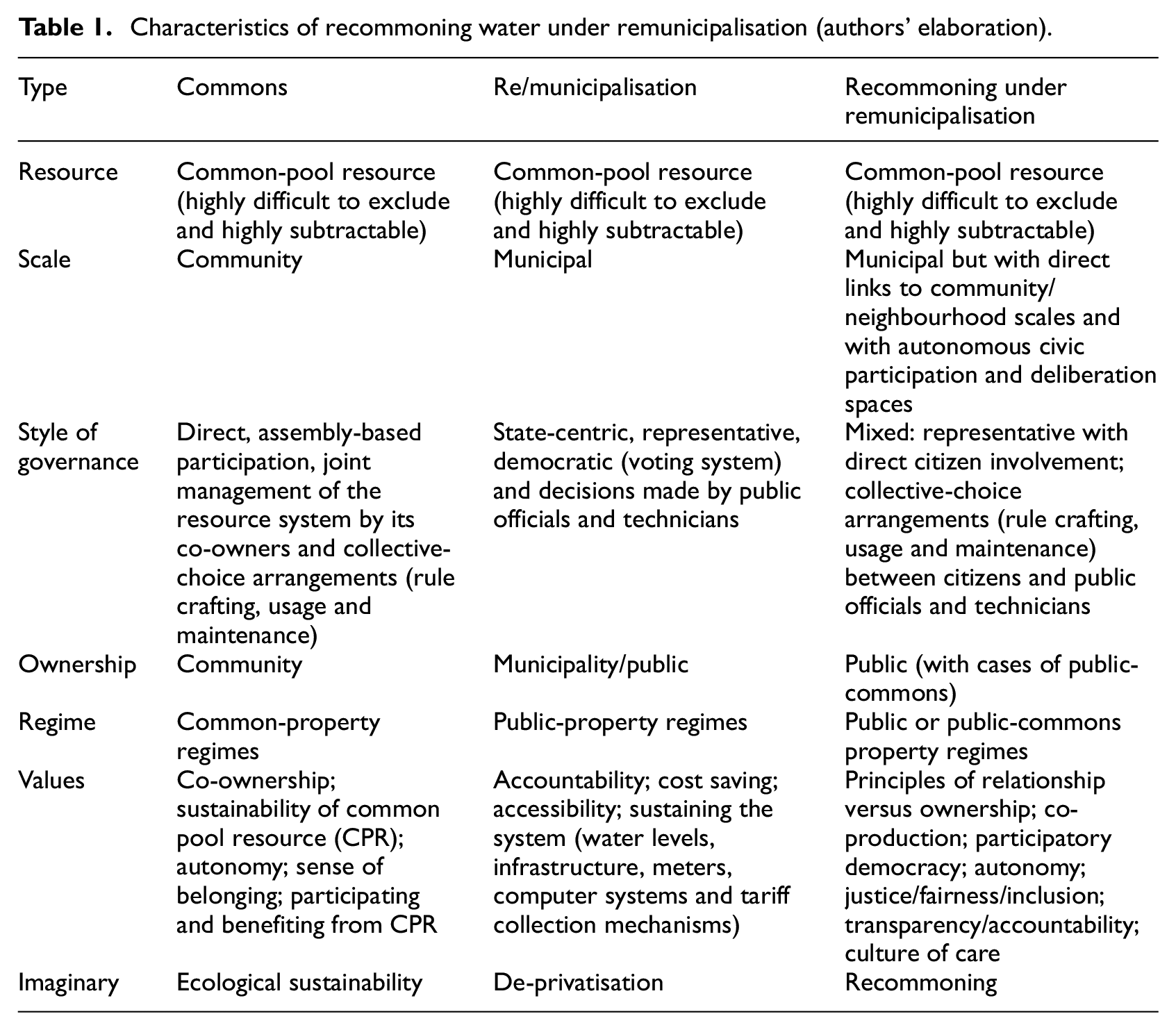
Our novel contribution is to investigate the conditions under which remunicipalisation processes can lead not only to symbolic mechanisms for citizen participation, but more importantly to designing institutional set-ups that enable citizens to practise recommoning water under remunicipalisation (see Table 1). Investigating the case of Terrassa, we address a broader set of theoretical questions and issues around the conditions that can facilitate (and constrain) crossing a paradigm threshold: from remunicipalising to recommoning. In the next section, we describe the methods employed for conducting this case study research. The following section situates Terrassa geographically and historically, outlining the specific conditions that enabled its successful remunicipalisation. We then proceed by deconstructing Terrassa’s Water Observatory’s (Observatori de l’Aigua de Terrassa – OAT; www.oat.cat/en/observatory) structure, and investigate the paradigm thresholds it crosses. In the discussion section, we analyse the tensions of institutionalising recommoning practices within existing structures of water governance that continuously threaten the sustainability of this model. We conclude that recommoning is confronted with resistance to power dismantling and redistribution in entrenched hierarchies, threats of cooptation by neoliberal tendencies and strategic delegitimisation tactics, all of which merit more attention by scholars, activists and policymakers.
Characteristics of recommoning water under remunicipalisation (authors’ elaboration).
Methodology
Based on Flyvbjerg’s case study selection criteria (see Flyvbjerg, 2006), the case of Terrassa, Spain has been selected as ‘extreme’ with particular outcomes that have not been observed elsewhere. Its citizen-led water observatory (OAT) has marked differences from other notable water observatories such as that of Paris (by which it was inspired), which does not receive financial support from the municipality and is consultative in its role. It has distinct differences also from other citizen participatory models/assemblies that are located ‘outside’ the municipality (as in the case of Naples), or are based on a ‘client/citizen representation’ model on the board of directors of the water utility (Sevilla, Berlin), or as cooperatives (Olesa de Montserrat). Terassa can also be depicted as an ‘influential’ case, as it is a vanguard in going beyond the remunicipalisation of water services that other cities are learning from. In the case of Terrassa, we observe changes in the governance model and the institution of an autonomous body whose activities are financially supported by the municipality, while all members are volunteers. The uniqueness of the case study lies in the fact that this body (OAT) is actively involved in shifting power dynamics to establish a model of co-production of public politics around water in the city, between citizens, the municipality and the water utility.
In-depth semi-structured interviews were conducted in Spain by the lead author, over the duration of three months of fieldwork in 2021 with 22 informants, and two weeks of follow-up fieldwork specifically in Terrassa in 2022, involving a focus group with nine members from Terrassa’s water observatory. Interviewees were selected from Terrassa’s water actors ranging from the OAT’s President and Vice President, to currently active and past members of the observatory, including the city councillor for water in Terrassa and a manager from the water utility. Additional interviews were conducted with activists from key organisations in the Spanish water movement (i.e. AEOPAS, Red Agua Publica, Enginyeria sense Fronteres, Confederación Sindical de Comisiones Obreras, UN Special Rapporteur on the Human Right to Water and Sanitation).
Through an inductive process, the investigation drew on the themes that emerged from the interviews to refine the research question (Glaser and Strauss, 1967). Interviews were analysed using two techniques: (1) inductive coding based on critical grounded theory (Belfrage and Hauf, 2015) and (2) deductive coding based on content analysis. Coding was conducted using the digital software Atlas.ti, and analysed through thematic analysis to identify and cluster (sub)themes. Results of the interviews were cross-referenced with secondary sources from archived historical records and complemented by information publicly available on websites and in news articles.
Terrassa’s successful water remunicipalisation
Terrassa has a complicated history with water. As Catalonia’s third largest city, and home to 224,114 inhabitants (Idescat, 2022), Terrassa is located at the bottom of the Prelitoral mountain range, and gets its water from Llobregat River and alluvial wells, with its own treatment plant, and from Aguas Ter Llobregat when needed (S.A. company of Generitat de Cataluña). To become the industrial city it is known to be, Terrassa had to change its waterscape over the years to meet increasing levels of production, particularly in the water-intensive textile industry. In Terrassa, one can still see the structures of modernity, with factories represented by concrete towers (a symbol of Terrassa). In the name of modernity, Mina Pública d’Aigües de Terrassa, S.A. (Mina), the old water company, was established in 1842 by the wealthy local business owners, with a contract renewed in 1941. The last concession alone covered 75 years of Mina running Terrassa’s water system, and was coming to an end in 2016 (Escritura de Concession, 1941).
It is important to first situate Terrassa’s water remunicipalisation struggle within the Spanish context. The struggle gained momentum across Spain partly as a form of resistance in response to the post-2008 financial crisis, which resulted in staunch austerity frameworks (‘austericide’ as labelled by an interviewee) that severely limited public spending and incentivised privatisation. The Montoro Law, passed in 2012 and named after the Spanish Minister of Finance at the time, enforced that no public administrative unit may incur a structural deficit (La Moncloa, 2012). As a result, municipalities had to tighten their spending budgets and many were pushed to hand concessions of citizen services (i.e. healthcare, banks, energy, public works, etc.) to private companies. This phenomenon also affected the most essential services like the water supply (Bieler, 2021). By 2015, more than half of the Spanish population was served by private water companies (Pacto Social por el Agua Publica, 2015).
Citizens’ discontent with the extensive water privatisation programmes reached Catalonia in 2010. This was marked by the creation of Aigua és Vida (Water Is Life) in 2011, a platform comprising a wide variety of civil society organisations including Ecologistas en Acción and Enginyeries Sense Fronteres, aimed at advocating for citizens to ‘be able to participate in strategic decision-making, in promoting community ownership of the [water] public service and its collective improvement’ (Aigua es Vida, 2022).
Inspired by Aigua es Vida, in 2013, a local initiative formed in Terrassa under the name of Taula de l’Aigua de Terrassa (Terrassa’s Water Roundtable). This collective of social activists played a key role in influencing Terrassa’s decision to remunicipalise water in 2015 (as will be discussed below, see also Bagué, 2017, 2019). By 2018, the service had been transferred to Taigua, the new public water utility (Satorras et al., 2020). Remunicipalisation was not unique to Terrassa; similar processes in other cities across Spain have also successfully remunicipalised water provision, such as in Valladolid and Alcázar de San Juan. However, Terrassa’s water movement went beyond remunicipalisation. It proposed and lobbied for an ‘autonomous’ citizen water observatory – Observatori de l’Aigua de Terrassa (OAT). Gaining the support and vote of the City Council, this Observatory started operating in 2019.
It is through the coupling of international water struggles with the anti-austerity (15-M) movement in Spain that the creation of the national water remunicipalisation network (Red Aqua Publica) was instigated. This further led to local water movement networks forming in Catalonia and Terrassa. The latter rippled into a series of local drivers highlighted below, tipping political buy-in to be in favour of remunicipalising and establishing Terrassa’s Water Observatory (see Figure 1).
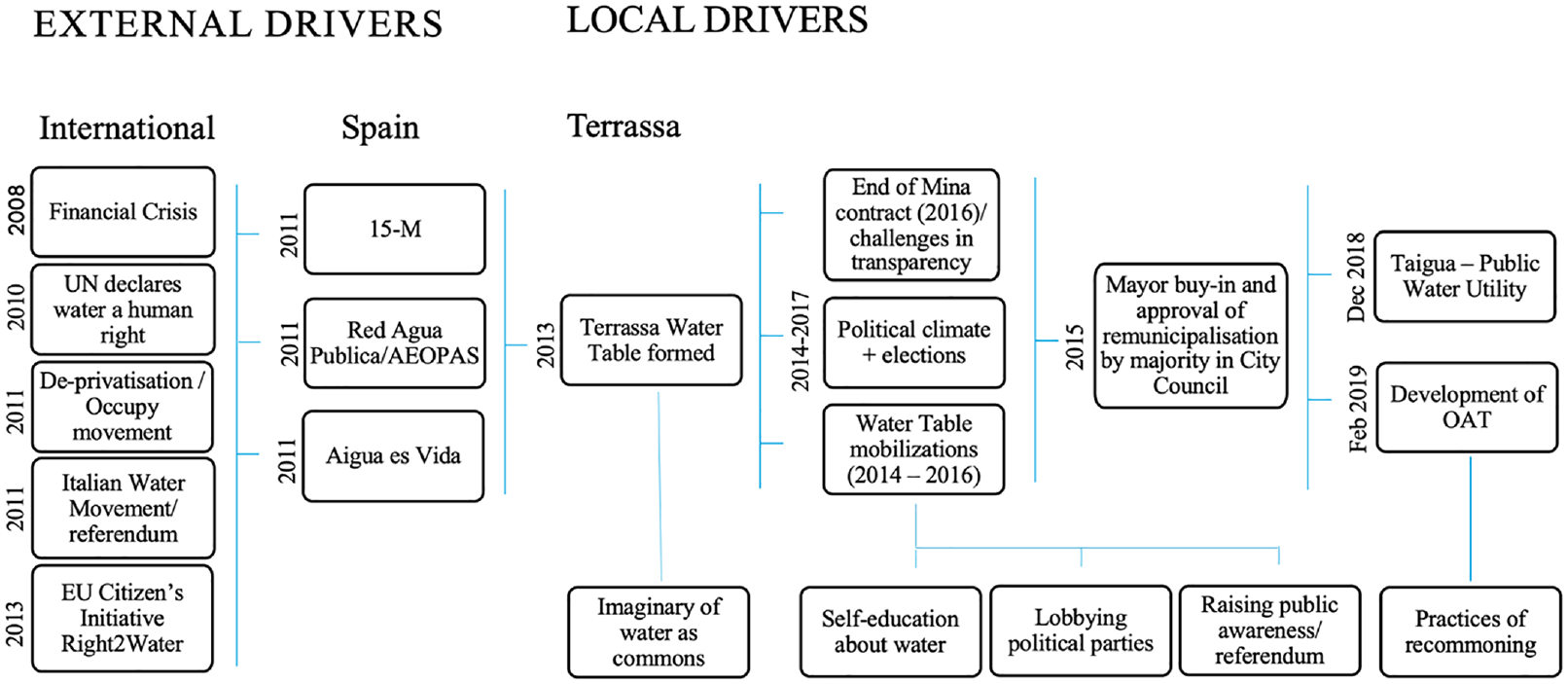
External and local drivers (factors and actors) for Terrassa’s successful establishment of OAT (authors’ elaboration).
As in many other parts of the world, the post-2008 austerity crisis seriously affected the living and economic conditions of people in Terrassa. Increasing unemployment coupled with welfare cuts was accompanied by increased public budget deficits which put many essential public services under threat (Periodico, 2014). This process had a positive side effect, however. Many citizens became politically engaged, particularly those who were retired or nearing retirement, who came from a generation who had to ‘fight for everything’ under the Franco regime, which only ended in 1975 (focus group, 22 September 2022). During the focus group, Terrassa’s activists explained that they were inspired by the 15-M and the anti-privatisation movements across the country and internationally, though they did not have prior experience in the water struggle (themselves). When they learnt – that their city’s water concession would end in 2016; they ‘saw an opportunity for change that could start with water’ (Interviewees 14 and 15).
The eight original members who formed Taula de l’Aigua de Terrassa were notably all men – except for one woman. Half of them were retired or retiring and had families or grandchildren; and six of them had prior experience of political activism (Bagué, 2019: 306). They proactively looked to the examples of Paris and its water observatory, to Berlin’s water charter and to Italy’s water movement and its slogans for inspiration on a course of action (Bagué, 2019). They started working on three fronts: self-training on water issues; social awareness-raising on the differences between public and private management; and political lobbying by putting the benefits of direct service management for the city on parties’ political agendas (Interviewee 15).
Strong vision: Proposing beyond contesting
Taula de l’Aigua had a very strong vision as a movement of not only protest but also of proposals. They drafted a seminal proposal called ‘The Remunicipalisation of Water in Terrassa’ that put forward strong arguments debunking the myth of the benefits of privatisation, including ones on financial returns, to convince the government to remunicipalise (Taula de l’Aigua de Terrassa, 2017). The Taula de l’Aigua members recognised, however, that remunicipalisation alone was not a guarantee for a socially just water governance, protected from market interests (Interviewees 14, 15, 21 and 22). As it transpired from the interviews, activists were self-educating on an ongoing basis, particularly with involvement from an action-researcher from Catalonia who introduced them to the commons framework (Bagué, 2017, 2019; Interviewees 4 and 15). As a result, with a commons lens – lo común – they proposed an autonomous civic-deliberative space in this abovementioned seminal document.
Within this remunicipalisation proposal, activists included forms of direct management that are regulated under local law (Law 7/1985 of Bases de Régimen Local), including a list of cases from cities in Spain that directly manage their water service (Taula de L’Aigua de Terrassa, 2017). This presentation of precedents set the context for imagining what the direct citizen-led participation component of the new water governance model could look like, once Terrassa’s remunicipalisation was successful.
End of concession and political buy-in
Another critical factor was the end of the concession. The 75-year-old concession was contractually coming to an end in 2016, liberating the City of Terrassa from incurring any financial penalty for breaking the contract prematurely. Additionally, the local water company Mina had been in its shareholding with the multinational Agbar for some years (Sociedad General de Aguas de Barcelona, S.A.), which had been a subsidiary company of Suez since 2014, meaning that the company’s policy was no longer decided in Terrassa and did not respond to the interests of local businesses (Grau-Satorras, 2018). The management of the Mina-Agbar company operated in an opaque manner and refused to provide data when requested by the City Council (Interviewee 20A). Under the pressures of a national movement demanding for water remunicipalisation, and a local water movement strongly leveraging political support, the mayor found it an opportune moment politically to support the decision to remunicipalise the service (Interviewees 3, 14, 15, 20A and 20B).
Terrassa’s citizen water observatory: A site of ongoing experimentation
The success of Terrassa’s activists in changing institutions in the governance model itself is best explained through the concept of ‘institutional bricolage’ (Cleaver, 2018; De Koning, 2011, 2014). Institutional bricolage posits that institutions cannot be rationally created, as they are the result of adaptive processes through which actors apply creativity in drafting different arrangements (Cleaver and De Koning, 2015; Nieto-Romero et al., 2019). The insistence of Terrassa’s water activists on changing the model through bottom-up collective actions led to a ‘bricolage’ of new institutional set-ups which in turn led to the alternative model.
Such set-ups shift water management from models based on private consignments to ones deemed even more democratic than conventional ‘municipalism’. This is what Thompson (2021) and Russell (2019) speak of as new municipalism (see also Janoschka and Mota, 2021; Pinto et al., 2022). What distinguishes new municipalism in Catalonia is that it is infused with anarchist and federalist traditions in response to post-2008 austerity (Bernat and Whyte, 2019; Blanco et al., 2019; Davies and Blanco, 2017; referenced in Thompson, 2021: 325). Such anarchist tendencies can explain why Terrassa’s activists strongly believed that remunicipalisation alone is not sufficient: an autonomous body for civic deliberation in the decision-making on water needs to be reinstated (Bagué, 2019: 312, 324; Interviewees 14 and 15). The vision is to shift from the bureaucratic state logic of resource allocation to models and processes that permit collective decision-making by the very ‘users’ themselves.
After actively learning from the successes and failures of other cities that remunicipalised and experimented with different civic models (mainly Naples, Paris and Berlin; and Olesa de Montserrat and Cadiz in Spain), the activists in Terrassa developed a proposal for a citizen water observatory whose role goes beyond mere ‘consulting’. The role of the new body, the OAT, was to form an essential component in a triangular (but not hierarchical) governance model between the municipality, the new public water utility Taigua and citizens. On paper, the OAT has the role not only to ‘observe’ but also to submit and review proposals by involving citizens in ‘defining policies and strategic decisions to ensure that the [water] service operates properly’ (Interviewee 14; Planas and Martínez, 2020: 156).
In other words, the OAT’s mission is one of re-establishing citizen participation, power and autonomy inside local water governance – what they speak of as the ‘co-production’ of the public politics of water in the city (Jornada de Reflexió, 2022). Bagué (2019: 150) notes that the new approaches to water are based on a concept of the common as a principle from which to organise the social, political and economic system through the state. In Terrassa’s narrative, the municipality (as a state actor) was a necessary actor to liberate water as a common good from private enclosure, and to place it in the public sphere for further deliberation and engagement of the water movement.
According to a public official who closely accompanied both the remunicipalisation process and the setting up of the OAT, various changes had to be made to the existing municipal frameworks regarding what a participatory body is, to enable the OAT to (1) be autonomous (i.e the presidency of this participatory body is not chosen by the mayor but is elected democratically by the members of the Observatory) and (2) receive a set yearly budget (of €20,000–30,000) for its activities. A paid coordinator from the municipality staff would also be assigned to support the OAT presidency (Interviewee 20A). Micciarelli (2022: 118) refers to this process as ‘hacking the legal’; making creative use of the law to produce selective changes within legal frameworks.
Still, legal hacks for distributing power have their limits, as will be explored further in the sections below. For instance, the OAT’s decisions are legally non-binding. The City Council can request a mandatory and binding report from the observatory, and informally, a public staff explains, agreements can be made such that decisions are not finalised by the council prior to the OAT’s approval (Interviewee 20A). This allyship permits revision of the role of the state from controller to enabler of civic-deliberative spaces for experimenting with recommoning, despite legal limitations.
Bottom-up structure: Situated and collective mechanisms
The OAT’s structure has evolved since its inception (in 2019), attesting to its experimental nature. Currently there are six working groups which are open to direct citizen participation (see Figure 2). It continues to have a permanent commission which consists of the President, Vice President and a paid city staff member in the role of Coordinator, all of whom report to the 36 members in the plenary. The 36 members of the OAT represent social groups, unions and workers, universities, schools, political groups, economic groups and government representatives, including all those leading and participating in the six working groups. Important to note is that the plenary, which is an open civic-deliberation space for all members and non-members to participate in, is the highest decision-making authority in the OAT and operates on consensus and voting mechanisms.
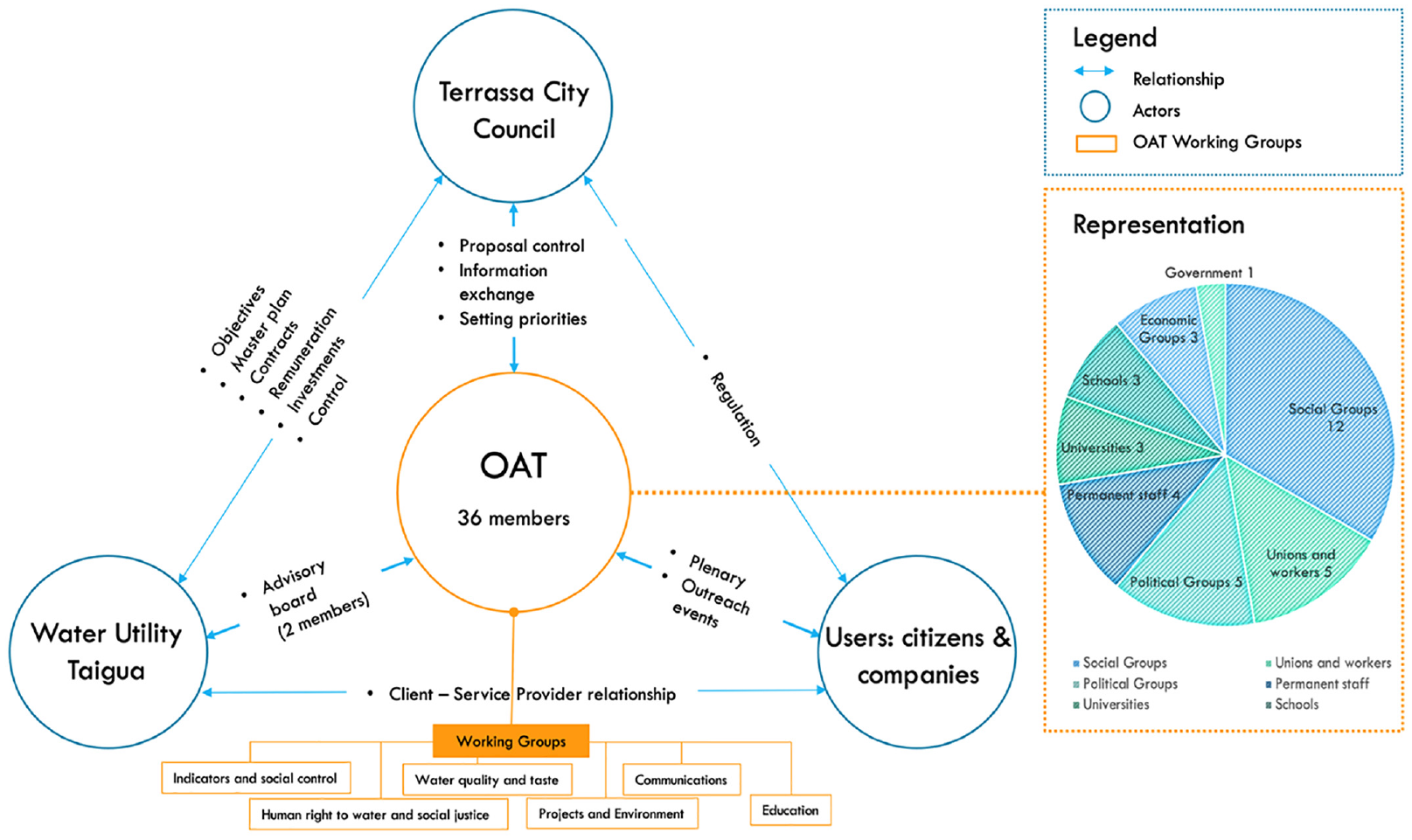
Terrassa’s water governance model.
The working groups are the ones that propose their focus and work plan – these bottom-up decisions inform the strategy of the OAT for the year. They are tasked with the co-production of knowledge through research and proposals, building relationships with relevant partners, dissemination and outreach, among varying tasks depending on the nature of the group. For example, some groups work more closely with the water utility, others with the municipality, while others with universities for research, or with the public for gathering opinions.
Different from predecessor water observatory models such as that of Paris, two members of the OAT sit on the Board of Directors of the water utility with voting rights. As such, a right to vote on the board presents a legal responsibility – one that the OAT decided will not be carried solely by the representatives, but rather will be shared through collective decision-making at the plenary (focus group, 22 September 2022).
Crossing thresholds from remunicipalising to recommoning
This section will demonstrate that remunicipalisation in Terrassa enabled what Stavrides (2010) calls a threshold – for recommoning water. Stavrides (2010: 81) defines thresholds as interruptions that create an ‘in-between space’ that marks a process of transformation of social identity (Stavrides, 2010: 19). Thresholds are particularly important for instigating re/commoning processes. The city, as in the case of Terrassa, can be the space where thresholds enable envisioning alternative forms of governing water. Moreover, exceptions like Terrassa are helpful to see the potentialities for spaces of encounter beyond the dominant urban model of a ‘city of enclaves’ – one that separates and encloses (Stavrides, 2010: 19). These thresholds have marked three transitions: (1) from a public to a commons paradigm; (2) from old and hierarchical ways of doing to co-production; and (3) from enclosed spaces to ones aimed at intersectionality.
Public to commons
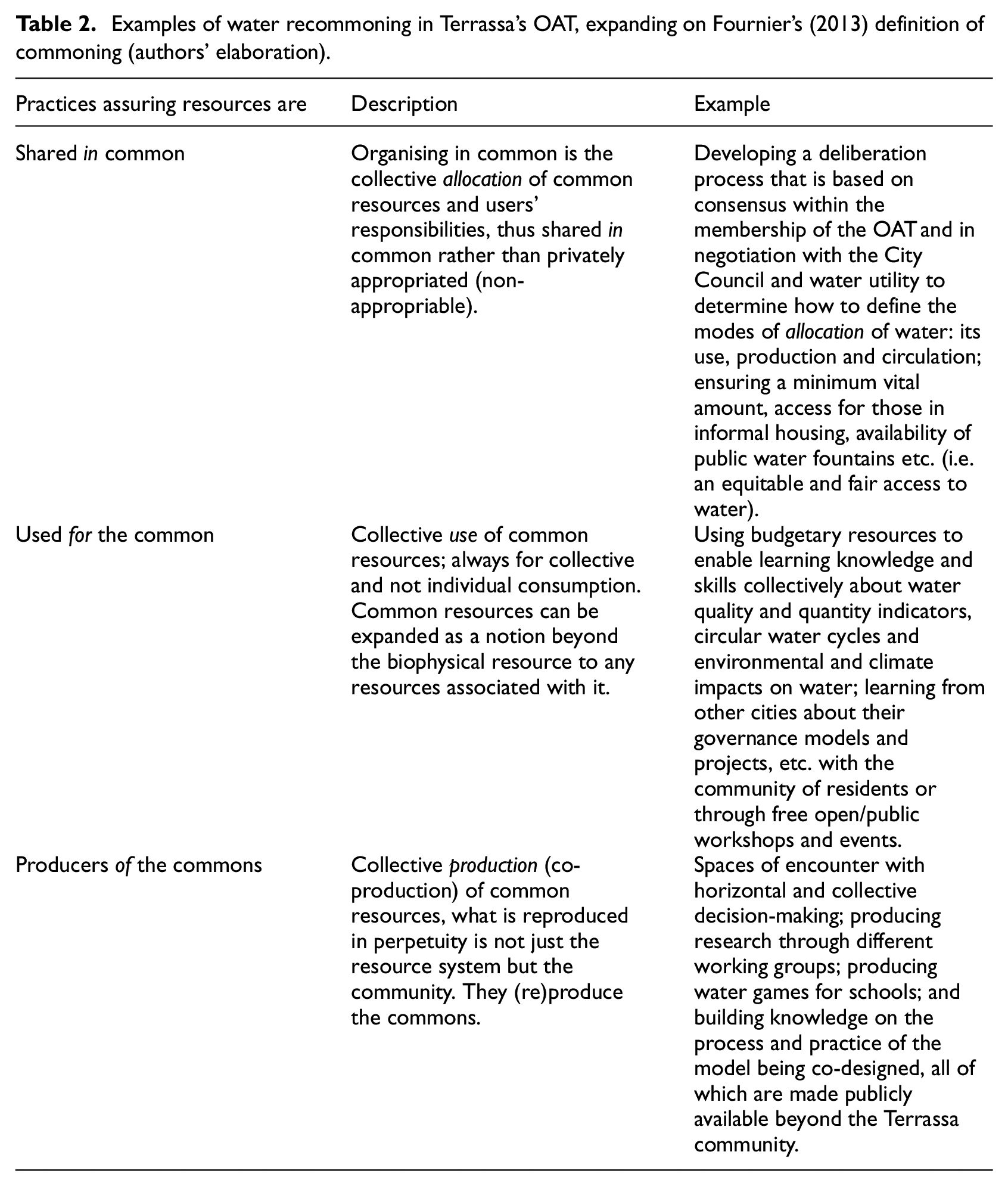
Bagué (2019: 146) describes the municipality as an entity that has also been enclosed. Fournier (2013: 448) advances this idea by emphasising that ‘opening up’ public spaces is achieved through collective use, ‘for it is only through collective use that such public spaces acquire their use value’. The case of remunicipalisation in Terrassa is one where the vindication of the ‘public’ was the necessary but not sufficient condition to protect water from private interests (Interviewees 21 and 22; Bagué, 2019). In Terrassa, activists ‘opened up’ public spaces for collective use by institutionalising an autonomous citizen-led space for recommoning water through daily praxis, with the state mainly as an interlocuter. This shifts thinking from enshrining a public paradigm towards experimenting with a commons-orientated paradigm. Concrete examples of the OAT’s approach to recommoning water are outlined in Table 2.
Examples of water recommoning in Terrassa’s OAT, expanding on Fournier’s (2013) definition of commoning (authors’ elaboration).
As previously noted, this recommoning-in-practice is what distinguishes Terrassa from other cities that successfully remunicipalised and stopped at that achievement (such as Valladolid or San Juan de Alcázar in Spain) or that have other forms of assemblies outside the formal system (such as Berlin or Naples), and from models of observatories that only have a ‘consultative’ role (such as in Paris).
Challenging old ‘ways of doing’: Towards co-production
A characteristic of institutions of expanding commoning are mechanisms that prevent the accumulation of power (Stavrides, 2015: 15). The OAT is designed by rotational involvement as a strategy to disperse power. From a managerial perspective, this may seem to limit efficiency; however, it offers learning opportunities for those involved in community self-governance (Stavrides, 2010: 126). This same approach is used in relation to challenging reproducing centres of power accumulation in either the municipality (policy and political power) or the water utility (technical power). Such mechanisms aimed at ‘co-production’ models through open assembly and dispersed initiatives of action enable a movement to re-produce situated and collective tools for expanding the commons.
As presented in Table 2, recommoning water is a collective effort to reproduce not only the resource system but also the process of decision-making and the community itself. This would imply that involved actors must have the same weight and power. In an effort to redistribute power, the OAT introduced the concept of ‘co-production’ (essential to recommoning water) to its counterparts. This concept seemed foreign to the water utility that does not consider a citizen body technically adept to be involved in the day-to-day decision-making about water in the city. The OAT’s intention is to break this operating scheme. OAT members are proving themselves technically knowledgeable through brokering partnerships with universities, and express that they would like to develop solutions together with the city and the water utility, rather than be simply ‘informed’ of decisions (focus group 22 September 2022).
The difference in ways of doing is particularly evident when speaking with the ‘administration’ – public staff – or with managers of the water utilities. The managers tend to have a private concept of the utility as a ‘water company’. Taigua, having recently been de-privatised, is operating much more transparently than its private predecessor; however, OAT members expressed that ‘its genes continue to be private’ since its director comes from the private sector (focus group, 20 September 2022). While the administration, operating under a public paradigm, is more likely to recognise citizens’ rights to participate, it is limited by bureaucratic procedures and short deadlines that complicate integrating and reporting to yet another actor, particularly one such as the OAT designed to deliberate over its decisions.
From enclosure to intersectionality
Commoning, if founded on the homogeneity of its community, can become exclusive (Kubaczek and Avraham, 2020). In order to remain an open process outside the pressures of enclosure (replicating patterns of racism or classism), recommoning water as a practice has to invite newcomers. Here, the Latin concept of ‘communitas’ offers value, as an ‘always-in-the-making community of participating commoners’ where the success of these spaces is only when they remain ‘infectious’, expanding egalitarian values beyond their boundaries (Stavrides, 2015: 12–13).
It is noteworthy that the OAT plenary is predominantly run by women, who constitute 62% of the membership, including its president. Beyond gender, however, equal representation remains a concern. Reflecting on the issue of class or race, members recognise that they are among the white, working or retired social strata who have time to volunteer –while a duty, volunteering is also a privilege (focus group, 22 September 2022). To sustain the process of recommoning water, mechanisms must be designed to open up the space to all those ‘othered’ in the city of Terrassa. The OAT’s working group on the Human Right to Water played an important role during the COVID-19 pandemic to ensure those not formally connected to the water system could maintain access to water (Satorras et al., 2020). They are also engaging those affected by the mortgage crisis by visiting their ‘squatting’ communes. Nevertheless, leveraging direct participation is essential. Just as they have bridged entry points into the city hall and the utility, the OAT must bridge the racial and class divide by reducing barriers to joining. This can reduce homogeneity and strengthen inclusive participation.
The OAT also aspires to cross a generational threshold with youth participation, which is lacking in the plenary. It emphasised that the work it is doing in schools is essential for a change in mentality and an early invitation to younger generations to start caring about water. If children learn at a young age what it means to participate, ‘they will not allow politicians of [a corrupt] type to lead them’ (focus group, 22 September 2022). The Maleta d’Aigua – an always-in-development water toolbox designed and curated by the OAT’s Education Working Group – offers a collection of stories, about Terrassa and beyond, that in partnership with schools and cultural centres is made available to teachers. Similarly, in engaging other actors, like local universities and researchers from outside Terrassa, the OAT is expanding commoning to academic spaces that have arguably been enclosed, and can co-produce both empirical and technical knowledge through this exchange (focus group, 22 September 2022).
Tensions in instituting recommoning
Turning the public into commons is not a panacea, and the struggle to create experimental spaces for recommoning within a public regime is a process teeming with tensions. It requires ongoing (re)negotiation on the part of social movement actors, who must remain engaged. Kaika and Karaliotas (2016: 556) point out that blending movement demands into a practice of democratic politics is ‘a matter of continuous and persistent struggle and effort’. If activists hand over agency to the state (or to a water operator) once their demands become institutionalised into the system, they risk failing the experiment.
Stavrides (2015: 13) warns that an institution – as a tool of social organisation – ‘tends to circumscribe a community as a closed world of predictable and repeatable social practices’. Our analysis reveals that in institutionalising the OAT, a disciplining relationship developed with the municipality and water utility, where the observatory is expected to perform in a way that respects the very hierarchies of power it is trying to break down. The OAT’s ethos – one of horizontality and co-production driven by assembly principles and consensus-building – is met with tensions around (1) being disciplined through power dynamics, (2) threats to its autonomy and (3) delegitimisation tactics.
Power negotiation
Power dismantling and redistribution is a challenge in entrenched hierarchies. The implications of this are such that the utility’s technicians and representatives of political parties have not participated in the OAT working groups, which was an aspiration. To remedy this clear demarcation of power, the OAT initiated stand-alone sessions with the water utility and the municipality whereby each party writes their priorities for the year, and they collectively agree on ‘axes of work’ (Interviewee 14). This process permits cross-cutting strategies for areas where co-production can be implemented. While the OAT is employing a counter-power to challenge enclosed and hierarchical ways of operating, opening these spaces up to engage with its practices of recommoning water is consistently met with resistance.
Pressure is placed on the observatory to ‘measure’ its results, which reminds its members that they are operating in a system where proof is required to validate their value (Interviewee 14). Stavrides (2015: 102) warns that ‘in disciplinary society, power classifies, shares out, defines, demarcates and controls the compliance of people’. An OAT member best expressed this sentiment as ‘being too ambitious’ in the beginning and having to ‘lower expectations and go more slowly, otherwise [the OAT] will burn’ (Interviewee 14). Becoming ‘disciplined’ poses risks to the extent to which the OAT can experiment with breaking capitalist modes of production towards further expanding the recommoning of water.
Threats to autonomy
While it seems that the City Council is committed to the goals of the observatory (Interviewees 5, 20A and 20B), it wishes the latter to appear as one more service of the municipality (Interviewee 19B). Boelens et al. (2016: 7) caution about tactics of the state with ‘incorporating and disciplining local territorialities, through “participatory” strategies that recognise the “convenient” and sideline “problematic” water cultures and identities’. Institutionalising the OAT within the municipality can be seen as compromising its autonomy and enclosing it at the risk of making it seemingly less accessible to those in the community who may not wish to interact with ‘state’ apparatuses due to a history of marginalisation.
On the other hand, its counterparts – the municipality and utility – may seem to use the OAT to legitimise their decisions as accountable and transparent. During the focus group, a sentiment of feeling ‘used’ surfaced, which is increasingly problematic considering the gender distribution of this group (focus group, 22 September 2022). The OAT is sustaining the recommoning of water through committed time involvement, on a voluntary basis, resisting a capitalist logic, with the largest participation being women (62%). It is important to problematise that in ‘recognising’ the value of the work that can be produced by the OAT, there is an increasing downloading of extra work onto ‘free labour’. For instance, the responsibility to produce or revise extensive proposals is being passed onto the OAT working groups. OAT members expressed dedicating vast hours to this process, through weekly internal meetings, working group projects and attending the plenary sessions on a regular basis. This raises questions about the sustainability of the OAT’s volunteer-led model, embedded in a larger capitalist system demanding it to ‘prove’ its value, potentially driving it to burn out.
Delegitimisation tactics
Despite the water councillor strongly acknowledging the value of the OAT (Interviewee 5), delegitimisation tactics continue to present themselves through other actors questioning its authority. A manager of the water utility sceptically speaks of double standards with this new model, ‘when the controller and controlled are the same’, questioning where the OAT draws its legitimacy from; its members are not voted for in the same way as City Council members are (Interviewee 13). Similarly, a need for the observatory to rally more equal representation is flagged by others, who are convinced that participatory democracy can only reinforce representative democracy and not be a substitute for it (Interviewee 1). The role of sceptics in the system flags the fragilities of an experimental model in recommoning. These critiques can be leveraged as motivation for the observatory to improve its processes. Contrarily, such critiques can place further pressure on its members, diverting their attention from doing their work towards needing to continuously defend their role and values.
Terrassa’s case study highlights the necessity to recognise public institutions' disciplining tactics that limit activists from expanding projects of recommoning water. While expanding their commoning practices, activists are cautioned against letting the municipality institutionalise their efforts into existing ‘neoliberal’ and market-logic set-ups (Oosterlynck and González, 2013: 1081), that in turn would delegitimise alternative experiments for collective action.
Conclusion
Combining and confronting theoretical perspectives on remunicipalisation and the water commons, we proposed recommoning water as a concept that captures the act of citizens reclaiming and reproducing the politics of water through collective decision-making processes in common, for the common and that continue reproducing the commons. Water recommoning thus presents a narrative grounded in principles of relationship versus ownership. Our analysis reveals that particularly under conditions of bottom-up struggles to remunicipalise water, thresholds can be crossed, from which threshold entities – citizens desiring change – are able to envision and bricolage situated and collective water governance models that better serve their needs.
Our empirical findings demonstrate that Terrassa’s observatory presents a case of recommoning water under a public regime. Through an ongoing process of citizen-led experimentation via institutional bricolage and (re)negotiation of power and autonomy, actors in the observatory are crossing thresholds. These thresholds permit its members to revise, evolve and innovate on the relational dynamics between actors in water governance, moving water to the political sphere of ongoing recommoning. Thresholds have marked crossing (1) from a remunicipalising to a recommoning paradigm; (2) from hierarchical ways of doing to co-production; and (3) from enclosed and centred spaces of power to ones open to equal representation and collective action.
Social movements are key to expanding water recommoning to new sites. Terrassa has become a generative model, creating a precedent for other cities in Spain like Barcelona, Girona, Osona, Valencia and Madrid to consider developing their own observatories. Transforming urban water governance models into processes of water recommoning, as noted earlier, is nevertheless a complex undertaking confronted with (1) resistance within entrenched hierarchies to power dismantling and redistribution, (2) cooptation by neoliberal tendencies and (3) delegitimisation tactics.
This model is certainly not a panacea; therefore, documenting more cases of alternative possibilities in urban water governance that are working for their local communities is a necessary field of investigation within the water and urban studies literature. Escobar (2020: ix) insists that ‘another possible is possible’, and that only by imagining undisciplined possibilities can the city, where the water commons has been historically enclosed, become the site of an emancipatory project towards reclaiming the commons.
Footnotes
Acknowledgements
Special thanks to Dr Nuria Hernandez-Mora for support during fieldwork and for revision of this article. Thanks also to the citizen water observatory of Terrassa (OAT) for its generous provision of information and review of details to ensure accuracy. All the interviewees who contributed data for this research as well as the anonymous reviewers merit a special thanks.
Declaration of conflicting interests
The author(s) declared no potential conflicts of interest with respect to the research, authorship, and/or publication of this article.
Funding
The author(s) disclosed receipt of the following financial support for the research, authorship, and/or publication of this article: The authors acknowledge funding from the European Union’s Horizon 2020 research and innovation programme under the Marie Skłodowska-Curie Innovative Training Network NEWAVE – grant agreement no. 861509.
