




Abstract
The COVID-19 migrant crisis was a watershed moment for internal migration, driving home the importance of inclusionary frameworks and action. Despite the lack of an omnibus migration policy, several disparate policy initiatives have emerged at multiple levels of government, across various sectors and involving multiple stakeholder types. This article traces and analyses internal migration policy in India over time, particularly how the COVID-19 pandemic reshaped responses. In doing so, it builds on the idea of ‘mainstreaming’, a reflexive approach to policymaking that Peter Scholten proposed to address such complex policy areas as migration. The article argues that a nascent framework for migration governance is evolving in India and offers suggestions on how mainstreaming can help streamline research and policy design for enhanced migrant inclusion.
Introduction
In 2020, during the nationwide COVID-19 lockdown, the Indian state faced a unique administrative challenge when millions of migrants left cities to return to their homes in rural areas. The migrant crisis showed that despite the constitutional guarantee for freedom of movement throughout the territory of India, interstate migrants were treated differently by the source and destination states. Whereas the former treated them as citizens, the latter regarded them as workers, according them few rights and services.
Deshingkar et al. (2022) point out four interlinked issues that exacerbated the migrant crisis. First, compared to local workers, migrants are disadvantaged by labour market segmentation and exploitative recruitment and employment processes, along with the reproduction of social hierarchies and prejudices, especially along the lines of caste, class and gender. Second, owing to the poor governance capacities of cities, migrants struggle for adequate housing and access to social welfare, relying excessively on their social networks in the destination state. Third, migrants are not eligible for social welfare schemes because they are unable to meet documentation requirements such as proof of local residence. Fourth, seasonal and circular migrants remain invisible in official data sets; this too denies them universal social entitlements.
Crises can potentially produce windows of opportunity for policy change by acting as tipping points for governance actors to introspect and find common ground (‘t Hart & Tindall, 2009). For instance, since 2015, the European Union (EU) was compelled to urgently address the Syrian refugee crisis by introducing policy changes to accept and integrate refugees. In India, the COVID-19 migrant crisis catalysed a number of migrant-friendly initiatives, including the creation of a nationwide database for unorganised workers, a national urban rental housing scheme and the strengthening of several state-level initiatives.
Conversely, crisis conditions often disrupt governance by challenging the legitimacy of existing political systems (Boin et al., 2021). During the pandemic, this happened in several ways in the Indian context when (a) internal migrants’ defiance of the national lockdown was perceived to threaten sociopolitical order (Srivastava, 2020); (b) media discourses of migrants’ suffering subjected politicians to additional scrutiny (Raj et al., 2021); and (c) the inability to anticipate and respond to the migrant exodus questioned the legitimacy of existing policies and institutions (Srivastava, 2020). Similarly, in Europe, most countries faced severe political backlash against immigration despite their humanitarian obligations as signatories to international agreements like the 2008 European Pact on Immigration and Asylum (Lesińska, 2014).
These contradictory approaches demonstrate how migration governance is challenged by conflicting political perceptions, values and positions by actors in the policy ecosystem. In fact, migrant integration is well recognised as a ‘wicked’ or ‘intractable’ policy issue (Boswell et al., 2011; Scholten, 2013, 2019). These are issues where contending parties hold different structures of belief and perception and where facts cannot, by themselves, yield consensus or direction (Schön & Rein, 1994).
This is also the case in India, where, despite a long-standing acknowledgement of migrant vulnerabilities and the barriers they face in accessing existing welfare schemes and rights-based entitlements (Deshingkar & Akter, 2009; International Labour Organization, 2020; Srivastava, 2011), there has been no overarching policy or political emphasis on the social, economic and political inclusion of internal migrants. The policy discourse on internal migration suffers from several contradictions. For example, even as Indian legislation protects the rights of migrant workers, the policy discourse privileges sedentarism and seeks to prevent rural–urban migration via initiatives like the Mahatma Gandhi National Rural Employment Guarantee Scheme (MGNREGS). Similarly, while the Constitution grants the right for Indians to work anywhere in the country, in practice, states impose knowledge of language and proof of local residence as barriers to employment (Centre for Policy Research [CPR] & UNICEF, 2021).
This article posits that the sharp visibility of migrant vulnerabilities during India’s COVID-19 migrant crisis produced a window of opportunity to re-examine internal migration policy, triggering many disparate initiatives by the union and state governments. Building on ongoing research, policy engagement and analysis (Naik, 2020, 2023), it attempts a broad categorisation of migration governance policy initiatives as a response to the COVID-19 migrant crisis and evaluates their significance for an emergent ecosystem for internal migration governance in the country.
To do so, it builds on the concept of ‘mainstreaming’, which Peter Scholten (2019) proposed as a reflexive approach to address the complexity of migration policy. Mainstreaming is an approach where actors do not see migration as a stand-alone policy area; instead, they seek to understand the root causes and effects of policy problems and solutions and make adjustments over time. Since complex policy issues are best resolved in multi-level and multi-scalar settings, where local, provincial, national and supranational governments and affiliated governance actors play varied roles (Scholten, 2013), mainstreaming eschews an issue-specific approach and, rather, seeks to broadly embed migration into policies, institutions and structures across horizontal governance layers (such as sectors and departments within government or between state and non-state actors) and vertical layers (i.e., those between different levels of government).
The findings suggest that, despite persistent intractability, the will to address the vulnerabilities of migrants has emerged in response to a migrant crisis. Even though a broader migration policy could not emerge, the article outlines how responses to migrant vulnerability have emerged at multiple levels of government, and across various sectors and stakeholder types. It argues that there might be potential to mainstream internal migration into a broader policy and governance discourse. It suggests how mainstreaming can help streamline policy design while embedding India’s experience into globally accepted frameworks for migration governance that recognise and respond to the complexity of migration as a policy issue.
The theoretical framework of mainstreaming is outlined in the subsequent section. This is followed by sections describing the pre-pandemic migration policy scenario and responses to the COVID-19 migrant crisis across sectors and levels of government. Finally, the article analyses these from the mainstreaming lens and concludes by proposing future directions.
Mainstreaming as an Analytical Framework
Migration is not only intractable but also exhibits variations in terms of duration of stay, frequency of movement and spatiality. Nor does migration pertain to a particular sector, but is embedded in almost every facet of development. Keeping these in mind, Scholten (2019) applies literature on complexity governance and policy dynamics to the governance of migration. He identifies three aspects from complexity literature as particularly relevant: first, to develop policies that cut across traditional policy sectors and levels of governance; second, to use approaches involving a broad set of actors within and outside government and involving diverse populations, especially non-migrants; and third, to focus on flexible, contingent and emerging processes rather than specific models or policy outcomes.
Mainstreaming is therefore proposed as a reflexive approach to policymaking, which involves policy actors understanding the underlying causes and effects of policy problems and solutions, and making iterative adjustments over time. Mainstreaming is most appropriately understood within the collaborative governance framework, where state and non-state actors engage in consensus-oriented decision-making that responds to pre-existing mutual interests or generates new mutual interests (Ansell & Gash, 2008). Here, migration is not a stand-alone policy area. Instead, actor networks engage with evolving processes and adjust responses continually and, over time, they embed migration into mainstream policies, institutions and structures in a broad-based rather than an issue-specific manner. In the context of migrant integration, Scholten and van Breugel (2017) highlight the importance of both kinds of migration governance processes: horizontal, that is, between government departments and non-state actors, and vertical, that is, between different levels of government.
In India, migration policy formulation is distributed across the union and state governments, while local bodies have implementation responsibilities, which are highly dependent on state–society relations and the ability of local governments to manage these (Naik, 2020). Therefore, a mainstreaming approach that examines multi-level as well as multi-sectoral and multi-actor processes is useful to understand migration policy. In this article, mainstreaming is leveraged as a framework to analyse policy initiatives that emerged in India as a response to the COVID-19 migrant crisis.
Migration as Reflected in Indian Policy before COVID-19
Policy responses to internal migration have emerged in the context of India’s federal governance system, where the duties of the union and the states are specified in the Constitution. The union government is responsible for matters related to interstate migration and is thus empowered to coordinate between the states. However, labour welfare, trade and social security fall in the concurrent list, which the union and the states must jointly address. Other policy areas such as education and health, which Indian citizens are universally entitled to, are usually addressed through centralised schemes designed and (at least partially) funded by the union government, with the states acting as implementers. States can also have their own schemes, but usually within a centralised statutory framework.
In Indian policy, migration is strongly linked to work and is therefore governed by the Ministry of Labour and Employment through national legislation, of which the most crucial is the Inter-state Migrant Workmen (Regulation of Employment and Conditions of Service) Act, 1979 (ISMWA). Labour-centric governance regards migrants as a subset of informal employment but has not yet resolved the challenges of delivering social protection to unorganised workers. For this purpose, the National Commission for Enterprises in the Unorganised Sector (NCEUS) has, over time, recommended the registration of migrant workers by local governments (Kannan, 2020). Additionally, the MGNREGS, introduced by the Ministry of Rural Development, seeks to reduce rural–urban migration by improving livelihood opportunities in source areas.
Other policy areas have also addressed migration. Areas related to human development like education, health and nutrition are designed for universal access. Under the Right to Education Act, 2009, the Samagra Shiksha Abhiyan (SSA), India’s overarching public education scheme, accords priority to migrant children and provides for seasonal hostels and residential schools at source of migration, worksite schools at destination of migration, peripatetic education volunteers and tracking of children through migration cards to improve continuity in education. The National Education Policy 2020 also explicitly recognised migrants among the disadvantaged groups that require attention and concurred with the SSA’s emphasis on alternative and innovative education facilities for the children of migrants. Similarly, the Integrated Child Development Services (ICDS) scheme, which is inclusive of all children up to the age of six, specifically provides for migration certificates so that children can avail continued services at destination locations (CPR & UNICEF, 2021).
However, migrants’ access to social welfare is uncertain because the logics of universalisation and eligibility contradict each other in practice. Localised political considerations introduce eligibility requirements like documentation to prove domicile (i.e., local residence status) for many government schemes. These too vary in design and implementation across levels of government, and rural and urban jurisdictions. Welfare schemes formulated and funded by the Government of India tend to be more universal, while state schemes tend to include domicile as eligibility criteria (CPR & UNICEF, 2021). For example, even though created under the centrally legislated Building and Other Construction Workers (Regulation of Employment and Conditions of Service) Act, 1996, state government–run boards for such workers prefer to register only their own residents for social welfare benefits and often render interstate migrants ineligible (Roy et al., 2017). Until very recently, access to the public distribution system (PDS) was also dependent on location, and beneficiaries could take rations only from specific fair price shops (Government of India, 2017a). At the same time, policy has been focused on preventing migration by strengthening rural development (Deshingkar et al., 2008). Questions around how cities can be more inclusive towards migrants remain inadequately addressed (Kundu & Saraswati, 2012).
In 2016–17, soon after UN Habitat put out the New Urban Agenda, and in response to the growing momentum on implementation of the Sustainable Development Goals (SDGs), the Ministry of Housing and Urban Poverty Alleviation (now merged with the Ministry of Housing and Urban Affairs) constituted an inter-ministerial Working Group on Migration to ‘address the impact of migration on housing, infrastructure and livelihoods’. 1 Affirming the right to free movement within India, the Working Group Report, submitted in 2017, emphasised the need for an overarching legislative framework that would include migrants as regular and contractual workers rather than distinguishing them as a specific category. The report proposed a comprehensive law for unorganised workers along the lines of NCEUS recommendations. Additionally, the report made a number of specific suggestions to extend social protection to migrants and facilitate access to services, especially food security, healthcare, education, skilling and employment, and financial inclusion. It suggested augmenting rental housing and hostels to address housing issues, and strengthening of data systems to measure internal migration (Government of India, 2017a). The Economic Survey of 2016–17 also included a chapter on internal migration and labour mobility, which it considered central to the policy objective of leveraging India’s demographic dividend (Government of India, 2017b). However, these recommendations and publications did not translate into substantive policy shifts.
Policy and Governance Responses to the COVID-19 Migrant Crisis
The COVID-19 migrant crisis did not spur a cohesive policy response to internal migration. The NITI Aayog convened a subgroup on the issue of migrant labour and drafted a policy document, which was not finalised. The union government’s efforts to condense a large number of labour legislations into four comprehensive labour codes on occupation safety, health and working conditions, wages, and industrial relations, were also completed during the pandemic. These codes are intended to simplify access to justice. While they do expand social security to all organised and unorganised workers, including interstate migrant workers, they have been criticised for reducing protections for migrants by excluding intrastate migrant workers and raising threshold limits to exempt smaller units (Varma et al., 2020). However, though they have been notified, the new labour codes are yet to come into effect.
Besides these, numerous other policy reactions emerged as a result of the crisis. These built on existing schemes and frameworks and were located at multiple levels of government and across various sectors.
Registration and Tracking
Benefits under the ISMWA, the main legislation for interstate migrants, are dependent on a system of registration for migrants. Even though is it now subsumed under the Code on Social Security, 2020, the necessity for systems to register and enumerate migrants is well understood in the policy imagination. This notion was strengthened when stakeholders were unable to enumerate, locate and deliver relief to vulnerable migrants during the COVID-19 crisis. Several state governments relaxed criteria for registration under the Building and Other Construction Workers Act, which was a key conduit for direct cash transfers during the pandemic.
At the central level, the Ministry of Labour and Employment’s e-Shram digital portal for self-registration of unorganised workers became operational in August 2021, with the capacity to link individual beneficiaries. At present, the website shows that nearly 293 million workers have registered on the portal (Government of India, 2024). While the portal is expected to ease the process of welfare delivery, it is not yet clear how interstate migrants will be specifically identified and serviced. Detailed migration tables from the 2011 Census are not available, the 2021 Census is delayed, and the National Sample Survey Organisation does not collect regular data on migration. Without a reliable statistical database, registration information cannot be triangulated.
At the state level, several source states have intensified efforts to register migrants at source through panchayat-level registers. For example, Jharkhand has institutionalised this in its Safe and Responsible Migration Initiative (SRMI) that uses registries to connect migrant households to social schemes. States like Jharkhand, Chhattisgarh, Uttar Pradesh (UP), Bihar and Odisha also capture skills data about return migrants during the pandemic in order to design responses for livelihood support and skilling. Though it is not yet clear how this data is being specifically utilised, capturing the magnitude of return migration has helped craft politically astute policies for source states to reduce interstate migration. A notable example here is UP’s emphasis on local employment generation through industrial revival policies like the UP Industrial Investment and Employment Promotion Policy 2017, the UP Micro, Small and Medium Enterprises Promotion Policy 2017, and the One District One Product Policy, which extends the national Make in India policy.
Beyond the purview of work and employment, in Maharashtra, the Women and Child Development Department (WCD) has developed a Migration Tracking System (MTS) that tracks seasonal women and child migrants from vulnerable source areas to their work destinations to provide continued service delivery for schemes related to maternal and child health and nutrition. This system was piloted in six districts and is now being scaled up across the state. Distinctively, it reverses the state’s response from a demand-driven system to an accountable supply-driven system.
Portability
Labour migration experts have long recommended that all rights-based benefits and entitlements to Indian citizens must be portable, that is, access to welfare must be ensured regardless of location. The COVID-19 pandemic increased public awareness about the benefits of universally accessible health and nutrition services. This became particularly evident when government officials and civil society personnel engaged in relief operations realised that a large proportion of return migrants were women and children, shifting their perceptions away from the image of the single male migrant that had hitherto dominated the internal migration discourse.
In response, tracking systems evolved to provide a practical mechanism to ensure portability in delivering universal public services. Similar mechanisms for portability are needed to ensure that children migrating with parents can access education. While SSA provisions have been used by states like Odisha to run seasonal hostels for left-behind children of migrants to continue education, past efforts by states like Maharashtra and Gujarat to issue education cards to enable continuity in education across source and destination locations require revival and streamlining (CPR & UNICEF, 2021).
Since 2021, the WCD in Maharashtra has been exploring how the MTS can help improve schemes run by other state government departments and has shared learnings with the Ministry of WCD at the central level to improve the Poshan Tracker, an app that helps monitor anganwadis under the ICDS scheme. Such efforts demonstrate how the pandemic provided an impetus for experiences from new initiatives to travel across horizontal and vertical governance layers.
During the pandemic, food security for unorganised workers who had faced livelihood losses was an urgent concern, and within this group, migrants were particularly affected. Previously, PDS rations, which a large number of poor Indians depend on for nutritional sustenance, could only be accessed at the specific fair price shop to which a household’s ration card was linked. Seasonal and circular migrants suffered from food shortages during the pandemic because of this lack of portability; moreover, the scheme did not account for households being split across locations. Initially notified in 2019, the implementation of the One Nation One Ration Card (ONORC) scheme was accelerated during COVID-19 as an important initiative to improve PDS access to seasonal migrants by addressing portability as well as enabling individual household members to access rations separately from households.
The central government directed the states to distribute free foodgrains as part of its pandemic relief package. By using Aadhaar, a biometric-enabled unique identification system, as the backbone, state governments were directed to seed ration card databases with Aadhaar information. This was a precursor to implementing the ONORC scheme, whereby ration card holders could access supplies at any fair price shop in the country. At present, the scheme has been adopted by all 36 states and union territories in India, and as of March 2023, over a billion transactions have taken place under it. 2 Evaluations show that these numbers are still minuscule and the scheme faces logistical challenges, though Delhi has emerged as a state where a large number of interstate migrants have been able to access rations (Dalberg, 2022). Despite its teething troubles, ONORC is a big step towards removing mobility-based exclusion.
Facilitation
Before the pandemic, many civil society organisations had been running migrant resource centres (MRCs), where reliable information and networks were provided to migrant workers. The Odisha government ran MRCs in destination locations. In Tirupur, Tamil Nadu, civil society organisations partnered with employers and local governments to do the same. The pandemic has revealed that the MRC model can address problems like information asymmetry and facilitate delivery of services to migrants. Additionally, common service centres (CSCs) were set up to connect citizens to government services through agents.
A different model for facilitation is being piloted in Ranga Reddy district of Telangana, where 9,000 migrants from Odisha working in brick kilns are being delivered a coordinated package of services through collaboration among the departments of education, health and family welfare, women and child welfare, labour, civil supplies, and law and order at the district level, with the support of corporate social responsibility (CSR) funding and civil society organisations. 3
Another robust example of facilitation is the Government of Odisha’s provision of a cadre of Odia teachers to accompany seasonal migrant households to destination states like Telangana and Tamil Nadu. These teachers ensure that children can continue education in their mother tongue. Such facilitation, in which non-governmental organisations (NGOs) play a significant role, goes a long way in ensuring uninterrupted education.
Housing
Recognising the need for cities to cater to seasonal migrants, the Ministry of Housing and Urban Affairs announced the Affordable Rental Housing Complexes (ARHC) scheme in 2020. The scheme invited private concessionaires to retrofit unoccupied public housing for rental purposes and build new affordable housing stock. Nearly 30 retrofitting projects and one greenfield project are in the pipeline, according to the scheme’s official website. 4
Analysis
Prima facie, the above emergent policy responses seem to exhibit some characteristics of ‘mainstreaming’ (see Table 1). First, the perception of migration as a multifaceted policy problem has deepened. Even before COVID-19, though migration was located under the purview of labour and employment, several policy areas like education and health were responding to internal migration as a policy issue, but this was not frontally acknowledged in the policy system. The aftermath of the pandemic has seen renewed focus on health, as well as the emergence of new focus areas like nutrition and food security in response to the migrant crisis, re-emphasising migration as a broader developmental problem.
The Multi-level Multi-sectoral Nature of Migration Policy Response.
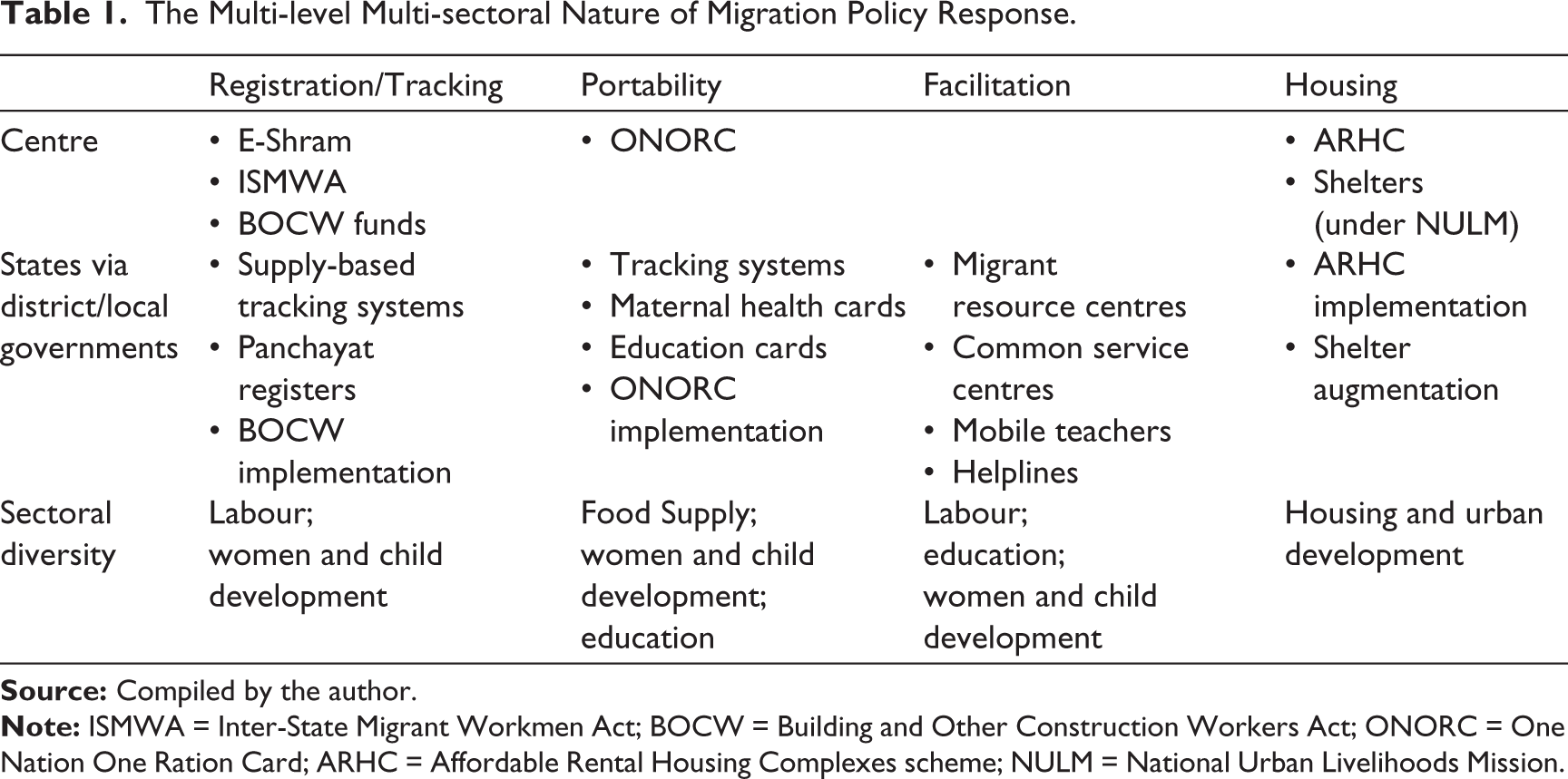
Second, the experiences of various stakeholders like bureaucrats, frontline workers, NGO staff and volunteers highlighted the importance of horizontal collaboration in overcoming the fragmented nature of governance structures. Even before COVID-19, collaborations between governments, NGOs and employers were common, but during the lockdowns, bureaucrats also coordinated intensively with their counterparts in other departments and even other state governments. The amplified use of registries and databases to connect migrants to schemes demonstrates horizontal convergence and a more holistic approach within the government. Complex collaborative arrangements between state actors, NGOs, citizen volunteers and private corporations also provided relief to migrants.
Third, we observe a particular form of multi-level governance. Responding to the pandemic, migration policy appears to be getting a bottom-up push, with state governments building on their unique experiences to address migrant issues. Thus, we see that Maharashtra has focused on intrastate seasonal migrants, Delhi has fared well on ONORC portability to accommodate interstate migrants, and source states like UP, Jharkhand and Odisha have strengthened policies for those who migrate seasonally to other states for work. While the union government responded proactively in many areas, like the portability of food security entitlements, rental housing and registration of unorganised workers, it has not articulated a comprehensive policy regarding internal migration, nor has it played a proactive role in facilitating interstate collaboration.
Lastly, post-COVID-19 migration policy initiatives exhibit reflexivity. Many initiatives are built on older experiences. Jharkhand’s SRMI strengthened pre-existing efforts at village-level registration and the MTS built on existing systems of tracking. Formal and informal modes of sharing information and experiences between policy actors allowed for the rapid adoption and replication of solutions across jurisdictions, between departments and among different levels of government during the pandemic. The mixed composition of returning migrants during the lockdown helped policy actors realise that apart from individual migrant workers, policy approaches must include migrant households as a whole and also recognise the existence of split households with migrant and left-behind members. These changes in perception at the ground level travelled up through the bureaucracy and garnered support for increasing portability measures in delivering social welfare through state and central policies such as e-Shram and ONORC. The emphasis on portability and registration solutions shows that governance actors are aware of the importance of optimised last-mile delivery and feedback loops in delivering social welfare to migrants. All these examples show how policy actors are starting to see experiences of migration policymaking as a contiguous process of learning and adaptation. Collectively, they are indicative of early signs of mainstreaming.
Yet, despite initial enthusiasm, there are signs that many initiatives have lost steam, as other policy issues have taken centre stage. For example, despite the success of e-Shram registrations, it is still not clear how migrant workers will be identified and what benefits they might receive. Limited state capacity inhibits continued implementation of localised initiatives like maintenance of village-level registers and implementation of rental housing projects. Especially in destination states, sustained initiatives for the welfare of migrants were not possible beyond immediate relief activities because they would have required political buy-in.
Such practical difficulties in adoption and implementation of mainstreaming have been recognised in areas other than migration as well. For example, Beveridge et al. (2018) point out, in the context of gender mainstreaming, that because mainstreaming operates in the political sphere, it can offer practical pathways to change, but also be limiting as an instrument for shifting political interests and informing better political choices. Therefore, though the COVID-19 pandemic produced a window of opportunity and generated several policy actions towards including migrants, it failed to create adequate common ground to become a ‘tipping point’ for sustained policy action.
Way Forward
Despite the lack of an articulated migration policy, several spontaneous policy initiatives during the COVID-19 migrant crisis demonstrate the emergence of a migration governance landscape which broadly resonates with Scholten’s (2019) notion of mainstreaming. Building on the analysis, a few future directions for migration governance and policy are articulated in this section.
Since migration initiatives can originate across sectors, a mainstreaming approach would urge the consideration of the impacts on migrants and sensitivity to migrants’ needs in all policy approaches. Like gender and environmental concerns, this should be a standard addition to checklists that evaluate policy ideas and governance approaches. Platforms for stakeholders to communicate concerns and discuss emergent initiatives would be useful to sustain momentum. Governments at the central, state and local levels must periodically map the ministries/departments where migration initiatives are emerging so that appropriate steps can be taken towards streamlining and convergence. This will help in fiscal and human resource efficiency and improve impact. Further, multi-stakeholder collaborative approaches, like the one being piloted for brick kiln migrant workers in Telangana, must be developed into models that can be replicated and adapted. These models can build on the existing literature on state–society collaboration and co-production.
Given the emerging focus on households rather than individuals, migration governance policy must be attentive to the connections between source and destination initiatives, impacts on migrating and left-behind women and children, and aspects of safety and security. The union government must facilitate these connections for interstate migration. While this article has not addressed intrastate migrants, addressing the needs of this group, whose inclusion is relatively easy owing to stronger social networks and less political resistance, is a low-hanging fruit for states.
Lastly, policy must pay attention to the kind of digital technology needed to manage complex migration databases and enable tracking, supply chain management and other measures. India’s migration governance frameworks must take into account global concerns around privacy and securitisation and ensure that technology does not impinge on human rights and dignity.
The progress of migrant-inclusive policy may be empirically measured through migration indices like Determinants of International Migration (DEMIG), 5 Global Migration Barometer, 6 Migrant Integration Policy Index (MIPEX) 7 and Migration Governance Indicators (MGI) 8 that were developed for international migration but can be adapted for internal migration (Aggarwal et al., 2020). The Interstate Migrant Policy Index (IMPEX) in 2019, an exante policy evaluation exercise, ranks and compares the destination states of India based on their migrant integration policies. Such iterative indices can help track migrant integration policy and help understand the process of mainstreaming over time.
If the momentum on migration policy is retained, it will likely create an enhanced understanding of migration processes among decision-makers, implementers and influencers in the policy ecosystem. This article provides a brief analysis of mainstreaming as a potential policy framework for India to evolve its migration governance and policy agenda going forward. Despite the intractability of migration as a policy issue, and despite the differences in context between global and internal migration, mainstreaming offers a collaborative, multi-level, iterative and reflexive framework that recognises the complexity of migration as a policy issue and allows for the constant evolution of diverse solutions and frameworks. India’s experiences with developing migration governance frameworks can contribute significantly to the global understanding of how national and sub-national governments can collaboratively address the problems posed by migration.
Footnotes
Acknowledgements
This article builds on research on access to social protection for migrant women and children in five Indian states, conducted by the Centre for Policy Research (CPR) in collaboration with UNICEF India. It also uses insights from round tables conducted with policy actors during the course of this research. The author would like to thank collaborators at India Migration Now and CPR colleagues for their insights and comments while writing this article. The article was presented at IIMAD’s Second Annual International Conference on ‘Internal Migrants in the Cities: Entangled Lives’ held in December 2022 and benefited greatly from feedback at the conference, and later from S. Irudaya Rajan and Amrita Datta, editors of this Special Issue.
Declaration of Conflicting Interests
The author declared no potential conflicts of interest with respect to the research, authorship and/or publication of this article.
Funding
The author received no financial support for the research, authorship and/or publication of this article.