




Abstract
This article follows the emergence and growth of a brick kiln cluster in Khanda village on the periphery of the Delhi’s National Capital Region agglomeration. Khanda’s landscape and ecology have been profoundly altered and shaped by brick kilns in what can be taken as a manifestation of extended urbanisation. This urbanisation is not only bound up with the urban demand for bricks but is also mediated by various situated processes that are not city-centred. The article draws attention to a number of these processes—Khanda’s history of agrarian decline as a condition of possibility for the kiln cluster, the upscaled metabolism of the soil with changing forms of commodification and the emergence of new labour processes that alter as well as reproduce historical relations of production particular to brick kilns. The article establishes dialogue between the fields of agrarian urbanism and urban political ecology to develop a situated critique of the metabolism of brick kilns. It also brings brick kilns into Marxist debates on the interrelationship between nature and labour within capitalist production through a discussion on the changing modes of appropriation of soil and its relation to everyday practices of working the soil.
Introduction
Fifty years ago, Henri Lefebvre (2003 [1970]) described an already exploded urban reality, capturing the sprawl of urban infrastructures, labour markets and resource extraction far beyond city limits. The call was to look beyond the ‘city’ as a defined, self-contained sociological object, and focus instead on a critique of the urban as an ongoing process. Lefebvre’s call was later reflected in David Harvey’s (1996) framing of urbanisation as being constitutive of and constituted by social processes that articulate various specific but heterogeneous spatio-temporalities, from that of financial markets and transport networks to the lives of immigrant populations and so on. For Harvey, the process of urbanisation is epistemologically more fundamental than the socio-organisational entity called the city, and the challenge is therefore to ‘understand how urbanisation produces, sustains, and dissolves individual cities in historically and geographically specific ways’ (p. 56). These are just two among the various Marxist, post-modernist, feminist, post-colonial interventions that have, as a heterogenous but continuing project, pushed urban studies to mainstream process-based epistemes of the urban.
This article builds upon such a legacy to follow the emergence and growth of a prominent brick kiln cluster on the rural periphery of Delhi’s National Capital Region (Delhi-NCR) agglomeration. The cluster of around 70 medium-to-large-sized brick kilns is located within and around Khanda village, making it the second-largest brick-kiln cluster servicing the construction boom of Delhi-NCR. By examining the formation and operation of brick kilns in Khanda, the article gives an account of the ways in which agrarian landscapes are reconfigured to industrial hinterlands. Khanda’s landscape and ecology have been profoundly altered and shaped by brick kilns in what can be taken as a manifestation of extended urbanisation (Lefebvre, 2003 [1970], p. 14). The urbanisation process, however, is bound up not only with the circulation of capital and commodities for the ongoing production of the city but also within the situated politics of nature and labour around the extraction and production processes in Khanda.
This article seeks to diversify the social science literature on brick kilns, and to push beyond an empirical focus only on the conditions of workers and the relations of production—especially problematic analyses that reproduce brick kilns as a pre-capitalist or feudal system of work (see Agarwal, 2019). It explores the historical geography of the emergence of kilns in Khanda as the expression of a distinct form of extractive capitalism—one with important intersections with the agrarian character of its site, as well as one where the commodified metabolism of nature is dialectically related to labour regimes within the production process. The article’s theoretical intervention is to develop on two conversations between bodies of knowledge, treating them as entry points to capture the political ecological presence of the kilns and using insights from the brick kilns to highlight opportunities for bridging different literatures.
The first intervention is to establish a dialogue between the ‘urbanisation of nature’ thesis (from urban political ecology [UPE]) and agrarian urbanism, an emergent field of research on the urbanisation of the Global South. This engagement extends the scope of agrarian urbanism, which is primarily interested in the intersection of urbanisation and agrarian regimes, from an empirical focus mainly on land and property relations at urban peripheries to incorporate questions of labour and commodified nature at an extraction frontier. By advancing agrarian contexts as important conditions of possibility for metabolic flows and as being actively entangled within the everyday politics surrounding labouring processes, the article seeks to further contribute to UPE’s rich repertoire of situated critiques of urban metabolism.
The second intervention is to understand the interrelationship between two larger processes. First, the ‘modes of appropriation of nature’, which involve examining the different dynamics within the commodified metabolism of soil from farmlands in Khanda that make bricks. Second, the ‘labour regime’ that refers to the structures regulating the everyday lives and labours of thousands of brick-kiln workers. Labour regimes and appropriation of nature are inextricably bound up within a Marxist view of capitalist production. This article discusses the key debates within different bodies of Marxist literature that consider the two processes relationally. The developments within the two processes are traced through changes in the organisation of labour, contractual arrangements in procuring soil, technological means of extraction and everyday practices of production in the kilns. Labour regimes and the appropriation of nature serve as entangled and co-constituted axes for articulating the historical geography of brick production in Khanda as well as for an analysis of its political ecology.
Qualitative research for this article was carried out as part of my doctoral fieldwork for 11 months between October 2018 and December 2019 in the village of Khanda. Through this period, I conducted numerous open-ended interviews with migrant brick workers (of various occupations within the kilns), local villagers (particularly agricultural landowners selling soil to the kilns), kiln owners and labour contractors, amongst others. A vast majority of my respondents were male, and I could only interview a few female respondents where an intervening man did not co-opt a question and take over as the respondent. For cultural reasons, I would often not persist in seeking the woman’s answer in such a situation. Open-ended interviews alongside participant observation were crucial to the inductive methodology of my research and enabled the study to be reflexive to findings and develop theories ‘grounded’ in the qualitative data (Charmaz, 2006). Brick kilns in Khanda are open and visible spaces dispersed across the village’s farmlands, where much of the production process, the work of moulding bricks in acres of open fields around the kiln oven/chimney, takes place. There were hardly any difficulties related to access in conducting interviews. My presence as an outsider and elite, upper-caste researcher was not always conspicuous because of the constant movement of various outsiders within the kiln space (villagers, kiln owners, customers and vendors). In approaching workers, my introductions were initially made through kiln supervisors or other villagers (often through contacts from my research assistant, a local youth). As my focus narrowed to two broad areas (with a total of six kilns), I could use key sites such as the nearby small shops (which mostly sold alcohol), where male workers would leisurely stroll through, to make introductions. After this, I would often be invited or would otherwise approach them at their work-site while they were free or even as they were working without hindering their work.
Context
Khanda village is located in Sonipat district, a part of Delhi-NCR, with an official population of 9,209 (2011 Census). While Sonipat city and areas along highway corridors linked to Delhi are quite urbanised and industrialised through manufacturing zones, Khanda is located in a largely rural part of the Sonipat district. The 70 or so brick kilns in the farmlands around Khanda convey the stark presence of a particular form of urbanisation in what is otherwise an average village in a prosperous part of Haryana. The kilns are not only immediately visible as clear or foggy chimneys in the landscape but they are also manifested through the constant presence and movement of non-locals through the main streets of Khanda as well as the many shops and services that cater to their needs. The kilns across Khanda host 30,000 migrant workers for the duration of the kiln season, which is eight months, from November to June.
Although brick kiln work is a complex of many occupations, an overwhelming majority of workers in the kilns (around 80–90%) are moulders or pathers. The empirical section of this article deals exclusively with the natural processes and politics surrounding the work of moulding. There are other categories of workers such as jalaaiwalas (firemen working the oven), buggiwalas (horse-cart drivers transporting unbaked bricks), beldars (workers who stack unbaked bricks into the oven) and nikasis (workers who unload baked bricks from the oven). These categories of workers are associated with different caste groups, and though their work is also mediated by diverse material processes of non-human nature, an exploration of such processes and the politics of work within other occupations is outside the scope of this article.
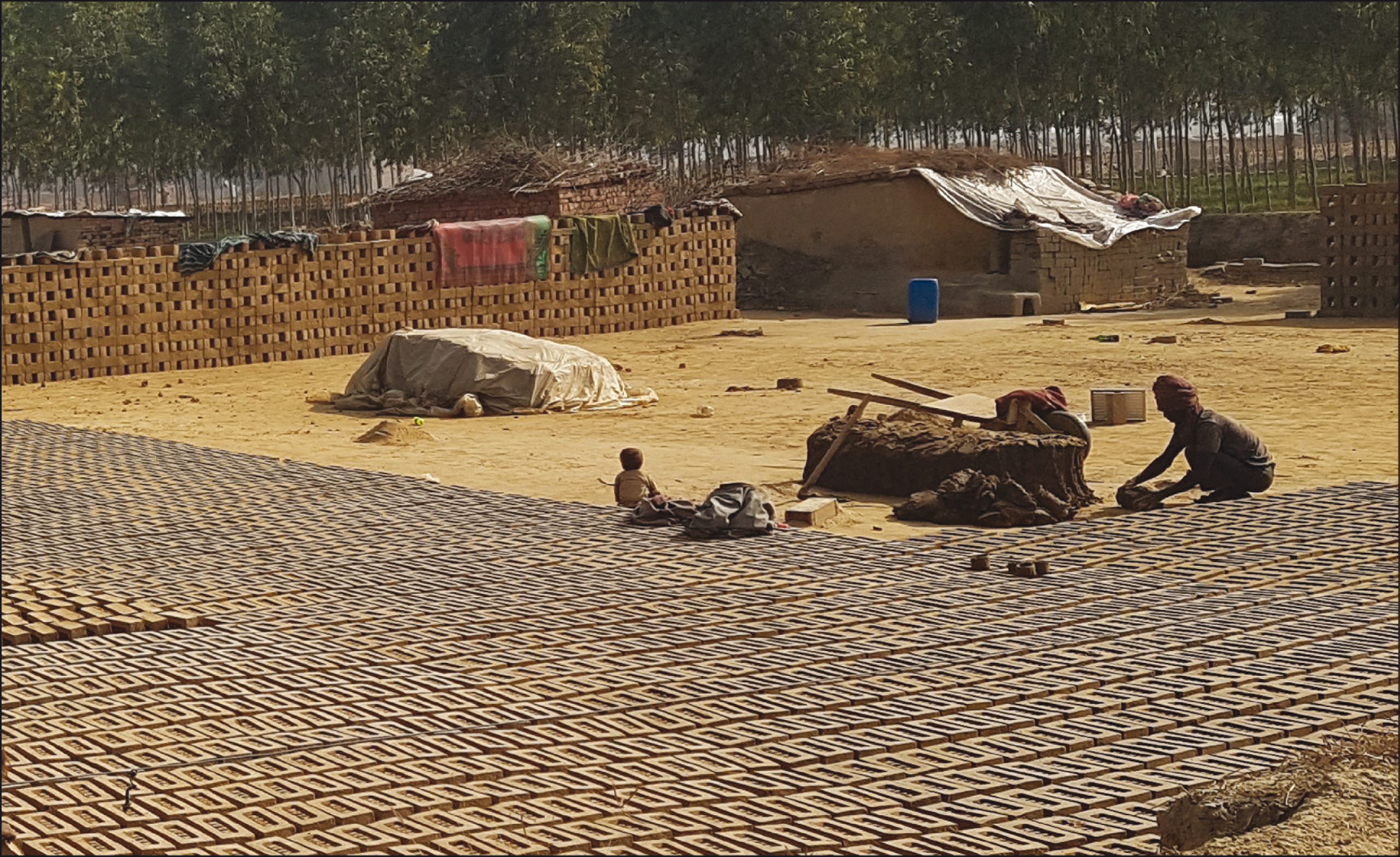
Pathers usually migrate as a family, erecting temporary jhuggis or tin-roofed shanties in a day or two after arriving. The space in front of the jhuggi is the pashar, a work area of flat land for moulding and drying bricks (see Figure 1). The moulders thus participate in a decentralised production process, spending most of the brick season within these two adjacent spaces. The workers are predominantly from landless and stigmatised Dalit or Scheduled Caste communities from Bihar, Chhattisgarh and Uttar Pradesh. In Khanda, the majority of workers are from a caste group known as Musahar from Bihar, which is among the most socio-economically backward and ostracised castes in India, even among Dalits. Moulders in Khanda also comprise of members of other castes such as Kewat and Chamar from Bihar, Chamar from Uttar Pradesh, and Satnami and Rohidas from Chhattisgarh.
Moulding is generally understood as a form of ‘unfree labour’ because of its wage relation that binds the migrant worker to the kiln site for the full duration of the work season. Workers are recruited through a system of labour contractors and are initially advanced a lump sum amount that puts workers in a relationship of debt to the kiln owner, a ubiquitous practice that is otherwise illegal under the Bonded Labour System (Abolition) Act 1976. Moulders are remunerated on a piece rate basis per thousand bricks moulded that, at the time of fieldwork, was paid at the Haryana state-mandated minimum wage for this labour, which was ₹550 for 1,000 bricks (the workers in Khanda actually received ₹450 per 1,000 bricks since they made bricks out of machine-made clay in a system called pakmel, which this article discusses later). Instead of full wages, only a small stipend for expenses was paid on a fortnightly basis to workers, which, like the advance amount, was deducted from their final wages. The final wage minus these deductions was only paid to a worker at the end of the brick season in June when the kilns stopped production for the monsoons and the workers departed.
The Literature on Brick Kilns
Brick kilns all over India employ between 2.1 million (NSS 68th Round, 2011–2012) and 10 million workers (ILO estimates cited in PCLRA, 2012, p. 10). The appearance of clusters of kiln chimneys on the landscape while travelling on a highway or a train indicates the peri-urban nature of an area and signals the presence of a city nearby. Studies on brick kilns within the social sciences have been few and generally one-sided, centred on the relations of production and the condition of workers. Most focus on the waged/unwaged relationships of bondage (Breman 2008, 2010; Guerin & Venkatasubramaniam, 2009; Kumari, 2018), on caste-centred occupational divisions and systems of recruitment (Guerin et al., 2012; Kumari & Bannerjee, 2018) and on recurrent instances of human rights abuse (Hawksley, 2014) as well as conditions of modern slavery (Anti-Slavery International, 2017). While it is very important to address the horrific cases of violence and human rights abuse in some brick kilns, there is a need to avoid broad-brushing the issue to kilns everywhere; for instance, to Khanda, where physical violence is, if present, very rare or of a low level (slapping, pushing) or is diffused within the hazardous conditions of everyday work. Scholars have criticised anti-slavery NGOs for their arbitrary framing of diverse systems of work, including brick kiln bondage, into the umbrella term of ‘modern slavery’ (Davidson, 2015, 2016). This is because the term is loaded with political and moral assumptions that often misdirect policy by curbing the workers’ freedom of choice and rehabilitating them against their wishes (Davidson, 2015). Purportedly unfree labour systems like bondage should be seen along a continuum of labour relations (Lerche, 2011). Though much serious scholarly work has contested this framing, the reputation of brick kilns as oppressive sites and their conceptualisation in a pre-capitalist feudal idiom are prominent in discourse, and the project of unmaking this is still incomplete.
Further, grounded studies have highlighted kilns as spaces of sexual liberation (Shah, 2006) as well as the spiritual mediation of work (Parsons & Brickell, 2020), as nodes for migrant circulations in and out of the city (Mishra, 2020), and as temporary sites of work towards more durable rural futures (Natarajan et al., 2019a) and navigation of climate change precarity (Natarajan et al., 2019b). The exploration of the lived space and the everyday rhythms of work within brick kilns are still very underdeveloped. Thus, while accounts of modern slavery obscure the treatment of brick kilns as a system of capitalist production, and aspects of capitalist social relations, especially relations of social reproduction in the kilns, have been inadequately theorised, an even more glaring gap is the almost absent consideration of brick kilns from the perspective of political-ecological dynamics as a form of extractive capitalism. Cullen (2020) is a recent exception as her work articulates brickmaking as being set in motion through different ecological circulations as well as labouring processes. However, her work does not give adequate focus to the organising role of capital and processes of commodification. This article adds another dimension to brick kiln literature through the development of the agrarian and urbanisation extraction links of kilns alongside a discussion of the labour regime.
Agrarian Urbanism and UPE
In the opening paragraph, I mention the mainstreaming of the process-based epistemes of the urban. Such an understanding is crucial because it lays the foundation through which a discussion on the metabolism of soil in a purportedly rural Khanda and the regimes of labour that structure the conditions of life and work for rural-to-rural migrant brick workers can be assimilated within a study of urbanisation. Towards this end, I develop a conversation between two fields of urban geography that are at the forefront of undermining urban–rural boundary-drawing, and bring in multiple geographies at different scales as embodiments of urbanisation. The two fields, UPE and agrarian urbanism, have many affinities that are particularly relevant to the study of an industrial-agrarian landscape like Khanda. I outline below some of the convergences between both bodies of literature as well as the opportunities for productive engagement.
UPE pioneered the understanding of the city as a process of flows, training its metabolic lens on the historical-geographical process of the urbanisation of nature (Swyngedouw & Kaika, 2000). The urbanisation of nature, UPE’s flagship theory, opens up the continuous and contested processes by which ‘all types of nature are socially mobilised, economically incorporated (commodified), and physically metabolised/transformed in order to support the urbanisation process’ (Swyngedouw & Kaika, 2014, p. 462). UPE’s critical edge derives from revealing not only how metabolic circulation through the urbanisation of nature shapes the material form of cities but also its role in stabilising or disrupting relations of power, capital-centred or otherwise. Thus, Kaika (2005) investigates through a historical-geographical account of water in the city, the infrastructural and discursive construction of the modern home as ‘space [that] envelopes independent from natural and social processes’. Earlier, Gandy (2002) examined New York City’s urbanisation across geographies of water supply, park spaces, transportation and waste to highlight how conceptions of nature drawing upon technological modernism and a fetishisation of the urban landscape transfer the differential impact of metabolisms ‘elsewhere and invisibly’, protecting elite interests. Works within UPE have thus sought to understand a multiplicity of processes—the reproduction of capitalist social relations, the racialisation of uneven urban environments, the stabilisation of state ideological power and the discursive construction of modernity among other processes—through the urbanisation of nature.
While early UPE literature derived from Marxist framings of metabolic circulation (Marx’s notion of metabolism with nature), there have been challenges to this approach. The first is a purported bias towards Global North-centred ‘universalist’ frameworks within the study of diverse cityscapes. The second criticises this approach as an ‘overly deterministic emphasis on the production and meaning of urban nature, and in some cases, weakly conceptualised readings of nature itself’ (Gandy, 2012, p. 735). Situated UPE, therefore, calls for a provincialising approach to knowledge and for mobilising a Global South perspective. Situated UPE has furthered the analytical range in studies of urban metabolic relations by refocusing attention on everyday practices (Loftus, 2012), notions of relational and diffuse power (Lawhon et al., 2014) and relations of race and gender (Simpson & Bagelman, 2018; Truelove, 2011) while also incorporating postcolonial, feminist and queer perspectives.
In comparison to UPE, agrarian urbanism is a smaller, more recent project. Nested largely within post-colonial agrarian Marxist studies, agrarian urbanism is a heterogenous but influential South-centred formation that situates the classic agrarian question of capital, its reconstitution within Bernstein (2006) as the question of labour, and emergent questions of land and livelihood within contemporary moments of capitalist urbanisation. It focuses on finding explanations for the highly differentiated urbanisation processes happening across several cities (particularly in India) in relation to agrarian histories and ongoing transformations, incorporating within its analyses a thick politics of social difference articulated through class-caste-land-place-ecology (Gururani, 2019). Agrarian urbanism already shares many affinities with UPE, particularly situated UPE. This could be further developed for agrarian urbanism to address a much wider (non-urban/suburban) geography and more diverse set of processes (such as extraction) than its current focus.
Within the limited volume of scholarship concerned with agrarian urbanism, there are two dominant concerns. The first concern, continuous with the project of post-colonial agrarian Marxism, is an interrogation of the social content of capital and differentiated logics of capitalist accumulation. The emphasis is on understanding capitalism as a system of social relations and cultural configurations so as to recognise that capitalist accumulation, according to Gidwani (2008), is always ‘shot through with supplementary energies that both enable and confound’ (p. xxii). For Sanyal (2007), urban India is shaped through ‘postcolonial capital’ that is constituted by a complex of a stable, dispossession-centred capital and a distorting and marginalised non-capital. The second concern of agrarian urbanism has been the heterogeneous politics of land and geographies of spatial values within many key texts of agrarian urbanism. The modes through which sedimented agrarian histories are translated into legible urban property relations as well as the uneven processes of agrarian transformation in cities are key empirical processes that have been mobilised to articulate the differentiated urbanisation processes taking place across expanding cities in the Global South (Gururani & Dasgupta, 2018). This concern also conjoins agrarian urbanism with analyses of peripheral urbanisation.
The geographies of agrarian urbanism as well as their situated concerns have been varied and flexible—from urban villages within the city where agrarian and developmental histories produce an uneven urbanisation (Cowan, 2018; Gururani, 2019) to urbanising villages on the periphery with a focus on value struggles over land and accumulation processes (Anwar, 2018; Dubey, 2018), to further apart commuter villages, where rural dispossession and landlessness push women to pursue livelihoods as domestic work or vending in the city (Roy, 2002). Chari’s (2004) work on the making of an industrial town where agrarian communities remake themselves as a fraternity of decentralised capital as well as mobilise gendered divisions within a politics of production is also noteworthy here. Agrarian urbanism has always treated the rural–urban continuum as amorphous. Gururani and Dasgupta’s (2018) statement is representative of this approach: ‘The rural does not just continue into the urban or that the urban just meets and encompasses the rural but that the agrarian and the urban are materially and symbolically co-produced’ (p. 42). Despite this flexibility, agrarian urbanism’s focus has so far not been extended to potentially fruitful engagements with relations of extraction in resource hinterlands of the city. Notwithstanding the small volume of agrarian urbanism scholarship, a reason for this neglect is the evolving understanding of geographies of urbanisation.
Non-city geographies have come to be increasingly assimilated into analyses of urbanisation. The most prominent of such projects has been through planetary urbanisation, a theoretical premise that builds upon Lefebvre’s conception of the urban as ‘a multiscalar process of sociospatial transformation (Brenner & Schmid, 2015; Lefebvre, 2003[1970]). Planetary urbanisation refers to the urban as a planetary condition without an outside that produces the city as only one of its landscapes, a formulation that has faced strident critiques from multiple standpoints. 1 One of the valuable outcomes of this project, though, has been its centring of spaces of extraction as operational landscapes where urbanisation is a key driver of socio-spatial change. Arboleda’s (2016) work in the Huasco Valley of Chile is prominent for its deployment of Lefebvre’s dialectics of homogenisation and fragmentation within an extraction landscape (focusing on processes of governance and capital flows) for understanding how urbanisation produces nature and space.
A more radical call for decentring the city within UPE and moving beyond core–periphery binaries is proposed in a recent article by Tzaninis et al. (2020). The authors respond to criticisms of the persistence of the rural–urban divide in UPE writings but advise that corrective interventions must go beyond just the inclusion of the periphery or the suburban within analyses. They call for scholarship that engages seriously with the dynamics of diverse suburban geographies, and which does not reduce what goes on outside of cities to processes that emanate unidirectionally from cities. This distinction is particularly useful for this article. Khanda’s transformation does not emanate only from the urban demand for bricks but is mediated by various situated processes that are not city-centred. The historically sedimented agrarian structures of the village or the regional, historical relations of production particular to brick kilns are prominent systems that precede urbanisation and mediate it.
Agrarian urbanism has much to offer to an understanding of commodified metabolisms as well as capital–labour relations within Khanda. The capitalist process within brick kilns in Khanda is entangled with locally articulated meanings and experiences of agrarian change that are important to flesh out. The process of urbanisation of nature in Khanda also highlights the mediation of regimes of power bound up in land and capital as well as the concrete labouring acts engaged in the production of nature/landscapes. Drawing upon connections across the fields of agrarian urbanism and UPE is therefore productive to developing a situated critique of the metabolism of brick kilns in Khanda.
Interrelationship between Appropriation of Nature and Labour Regimes
This section discusses three major analytical frameworks within Marxist discussions on the interrelationships between nature and labour regimes. The succeeding empirical sections of the article take a thin slice of the complex relations of extraction and production in the brick kilns as a means to operationalise the connections across modes of appropriation of nature and labour regimes. The theoretical and empirical discussion within this article is restricted to a relational understanding of these processes. A discussion aiming to comprehensively capture either of these processes for an elaborate enterprise like brick kiln is not possible within the length of this article.
The first body of literature includes debates around value within Marxism, specifically the source of use value, exchange value and surplus value inhering in labour or nature. Marx’s privileging of labour as the source of all value has been misread by some scholars to mean that Marx understood nature as a valueless and limitless ‘free gift’ and failed to recognise its ‘intrinsic value’. This reading has been challenged through the works of various scholars (Burkett, 1999; Huber, 2017), who point to the dialectical unity of labour–nature within Marx’s understanding of value.
Marx (1981 [1894], p.647) deliberately locates all use values of nature as being realised only at the point of appropriation where nature is transformed by labour (even primary appropriation like breathing and seeing). This is because ‘value’ for Marx represents a principle for organising a society of exchange that regulates the distribution of profits and is the source of class struggle and capital accumulation (Harvey, 1982) and so is not a cultural construction of worth, as may be taken colloquially (Huber, 2017). To say that, nature has no value unless mediated through labour is the basis of an ecological critique of capitalism that is unable to value much of the natural processes that sustain life (Burkett, 1999; Huber, 2017). Use values also do not directly determine exchange values in capitalism, which refer to the quantity of congealed labour time (Marx, 1976 [1867], p. 39) within commodities and the focus of Marx’s analysis.
The ‘free gift’ of appropriated nature is combined with the exploitation of labour to generate surplus value. Under Marx’s conceptualization of value as socially necessary labour time, specific socio-natural conditions can enhance labour productivity without paying the full costs of their reproduction (Walker, 2016). 2 For Moore (2015, p. 93), this work performed by nature is embodied in surplus labour time, and so nature is central to the ‘production of surplus value’. The capitalist economy, in its drive to generate surplus value, relentlessly moves outwards to draw upon cheap inputs of nature in zones of high ecological surplus (while also seeking cheaper labour outside the boundaries of normal capitalist reproduction; Moore, 2015; Moore & Walker, 2018). Surplus values in nature are not inherent properties and can only be extracted within the means of technology and labouring inputs available. It follows then that further value can be discovered or extended through cutting-edge technological improvements and socio-technical innovations in the labouring process (Baglioni & Campling, 2017; Moore, 2010, p. 228). As the ecological surplus is progressively exhausted, capital may seek a new frontier or intensify appropriation in an existing frontier, which has implications for the labour regime (Moore, 2010, p. 228).
The second set of discussions concerning the nature–labour relationship revolves around the ‘production of nature’ thesis by Neil Smith. Smith (1984) centres his argument on a denaturalising approach that might better see the nature–society division as an ideological separation within capitalism and thereby reveal the social production of nature through the labour process. For Smith, the production of nature under capitalism is transformed from a process necessary for survival to one that is animated by the need to produce exchange values. Within Smith’s text as well as within further work (Castree, 2002; Ekers & Loftus, 2013; Mitchell, 1996), labour is held as central to understanding how nature is produced.
Smith’s abstract formulation has since been given a concrete character through studies of different material landscapes that address his call for historicising and geographically situating the specific forms of production of nature. Don Mitchell (1996) wrote on the production of the California landscape through a detailed discussion of the concrete labouring acts of farm workers. His historical geography of farm workers in California examines the growing dependence of the state’s agriculture on Mexican and Filipino farm workers, who were kept seasonal and low-paid, as well as their social reproduction and visibility, as contained within the spatial mechanism of labour camps. A key feature of this scholarship has been to address the question of difference (of race, gender, class) and its differential bearing on the production of nature. Carney and Watts’s (1990) study in Gambia of a period of changing nature of farm work—transformations in farm technology and economic arrangements towards contract farming—reveals how the culturally dominant representations of work and labour obligations negotiated these changes. The study also reveals how gender became a key determinant in the differential experience of new labour processes, as the traditionally gendered basis of production, specifically female labour’s role in on-farm operations, was intensified along with the rise of intra-familial conflicts that put gender relations at stake. A socially textured treatment of labour and embodied practice of labouring is now explicit within many grounded studies of the production of nature (Ekers & Loftus, 2013, p. 241).
The final body of literature relevant to this article derives from agrarian political economy and draws attention to the obstacles posed by nature to capitalist agriculture. Foundational to this is Mann and Dickinson’s (1978) research, which seeks to explain why some branches of agriculture become capitalist more rapidly than others. According to them, the turnover time of capital in agriculture can be quite long and inflexible, as value is not created at the time of maturation of the crops, when there is little to no application of labour (p. 473). This temporal disjuncture as well as rigid production schedule has led to the development of a hyper-flexible and marginalised labour force. The short-term, migratory nature of labour hired for this work means that the costs of labour’s reproduction are not covered by wages and are externalised significantly onto family labour farms and women’s unpaid domestic labour.
Natural forces are not inert and are always at work in visible and invisible ways through the labour process (Walker, 2016). The notion of indeterminacy is central within labour process theory, which states that the unequal social relations of production are expressed in antagonistic relationships between employers and employee (Taylor et al., 2015). For natural resource industries, Baglioni and Campling (2017) project this property onto nature as ecological indeterminacy, which can greatly affect the social indeterminacy of the labour process and shape the antagonism between employers and employees. Prudham’s (2005) study of the timber industry in Oregon examines the geographically expansive work area as well as the extremely lengthy turnover time in tree-cutting alongside the lack of regularity and predictability. The impossibility of direct labour control organises the labour process through flexible and piece-work contracts that shift many of the production risks onto workers. Similarly, studies on labour control in mining industries reiterate how geological and physical barriers shape the labour process in specific and significant ways. The social and cultural segregation of miners from surface workers in upstate New York (Gouldner, 1964), and the spatially and racially confined mining camps of South Africa (Bezuidenhout & Buhlungu, 2011) attest to how the isolated character of work in underground mining is reproduced as a social character of work within labour regimes.
The Agrarian Present and Past of Khanda
‘Khanda has good and healthy soil, it’s just that we have an ocean of khaara paani (briny water) under the village’ (interview with a farmer).
Khanda is currently sparsely agricultural, with bricks being the major crop on a large part of its farmland. Most farmlands are dug through and are low-lying from the extraction and sale of soil to the kilns. Some that have been dug to the stony subsoil lie fallow while others with remnant soil cover are reclaimed with the help of gypsum to grow the single wheat crop of the year. The different gradations of land around the village, which have been sold by landowners depending upon the height of soil, unevenly distribute the surface runoff from the rains, rendering some high farms devoid of water and minerals while adjacent low-lying fields turn into puddles. Black carbon and particulate matter from the burning of coal and illegal fuels such as powdered rubber tyres are released from high chimneys and settle on the crops as black dust that blocks photosynthesis and reduces growth, while also affecting the produce. 3 Khanda’s agricultural problems did not begin with the kilns, and it was actually a previous round of agrarian decline that opened the way for the kiln cluster to emerge and to exacerbate the poor conditions for agricultural production (this will be discussed in detail later).
Khanda village was established at some point in the thirteenth or fourteenth century. The oral history of Khanda is articulated as the history of the Dahiya Jats, and the making of the Dahiya Khap. That this history is told from a caste lens is not surprising given that Khanda village and Sonipat district both have a demographic majority of Jats (above 50% of Khanda’s population). The Jats also exercise a cultural hegemony (Jodhka, n.d.) in this region on the basis of their landed capital as well as political power at the local and state levels. According to the story, a large family-group of Jats from Pilani in Rajasthan came to the village of Barona (the oldest village in the region) in the first wave of migration. This group was led by four brothers, who then split with their families to establish four major villages—Sashana, Khanda, Nara and Sheri. The descendants of the brother who established Khanda branched off to establish 11 other villages that fall within the Khanda region. In total, the brothers and their descendants settled in 40 villages that make up the region of the Dahiya Jats, administered by the Dahiya Khap. The writ of the Dahiya Khap, which is framed as a paternal community institution performing a cultural and quasi-judicial role for the villages, extends to all 36 castes (including Dahiya Jats) in the 40 villages. The Khap and most of the local bodies vested with power in the region are dominated by the Jats. The Jats are also the dominant land-owning caste in Khanda and are thus the major beneficiaries of soil sales and land rents from brick kilns.
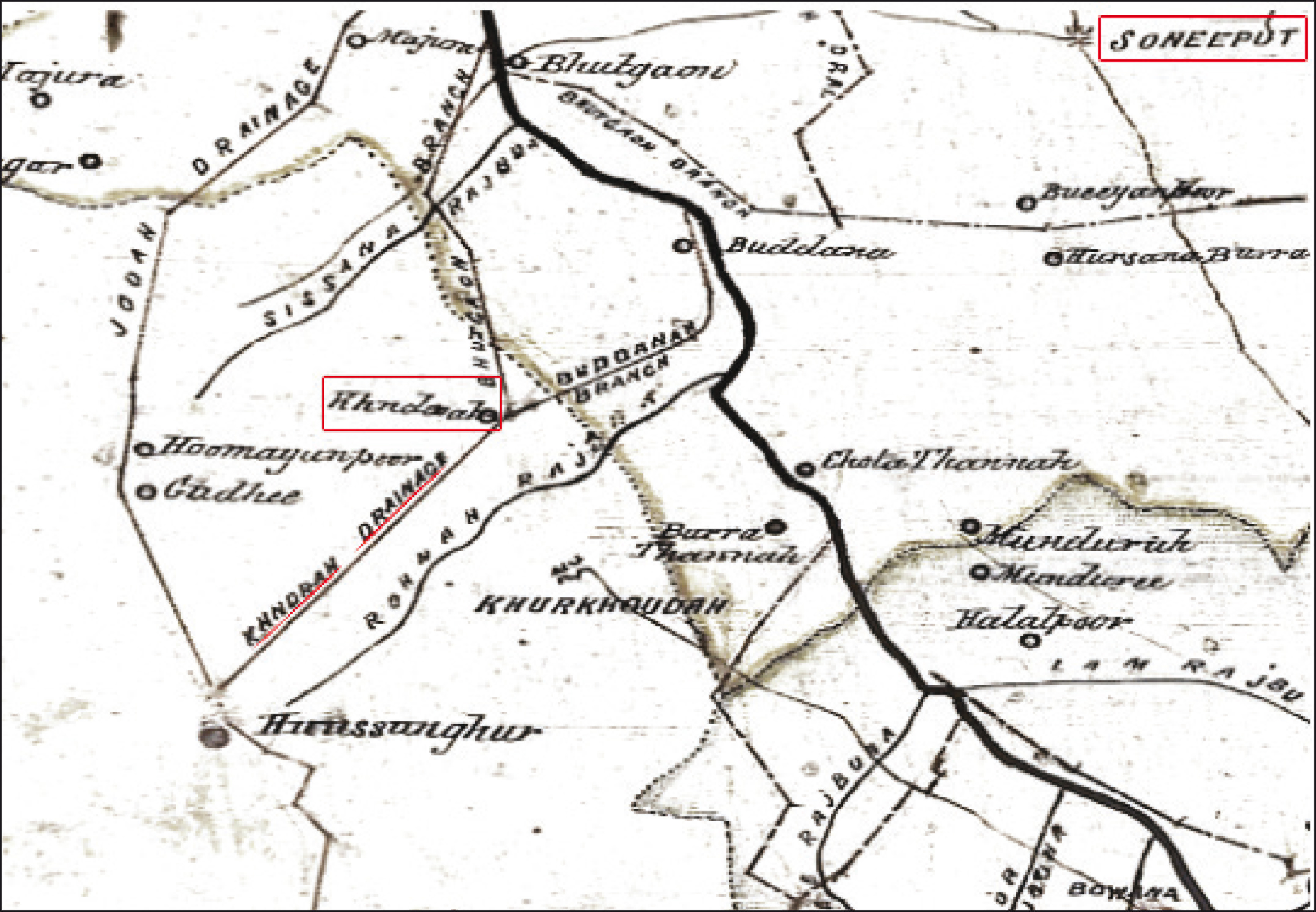
Khanda’s economy in pre-colonial times was based on a mix of agriculture of millets and pulses and animal husbandry (cattle). Despite poor groundwater, Khanda’s agriculture benefitted from irrigation through the Western Yamuna Canal, 4 which had a separate Khanda drainage section (see Figure 2). The presence of canal irrigation is an exception in the broader Haryana region, which has struggled with a lack of water and little irrigation, even with a number of wells, and has been prone to recurring droughts. In the colonial period, agricultural backwardness became policy as authorities actively sought to develop Haryana as a breeding ground for draught cattle for the agriculturally prosperous Punjab and deprived it of the irrigation facilities available elsewhere (Chowdhry, 2011, p. 4). Khanda, however, received further sources of irrigation from the construction of the Jharothi canal and the Sheri Minor in nearby villages in 1937 (oral account) and the building of two minor outlets (A and B) from Sheri Minor that intersected with the farmlands in Khanda. The presence of adequate irrigation and the focus on Haryana within the agricultural Green Revolution of the 1960s intensified wheat cultivation in Khanda and introduced the cultivation of paddy and even sugarcane.
Just as agrarian prosperity in Khanda was historically linked to the canals, so was agrarian decline. During the late 1980s (a period referred to by respondents as the second Bansi Lal government in Haryana), perhaps as the culmination of declining water resources under intense exploitation or because of the diversion of water to other constituencies, there was a major cutback in water supply. Water released into the Sheri Minor and the minor outlets, which used to flow every alternate 15 days, got restricted to one week of flow every 42 days, and the canals remained dry otherwise. Not only was there a change in schedule, the height of water in the canals dropped sharply so that the water only ever flowed at less than half of the canal’s height. Khanda’s agriculture floundered under these circumstances and production fell sharply for those who did not have the capital to dig deep borewells to extract pockets of sweet water from under the ‘ocean of brine’ in Khanda.
The Coming of Kilns and Commodification of Soil
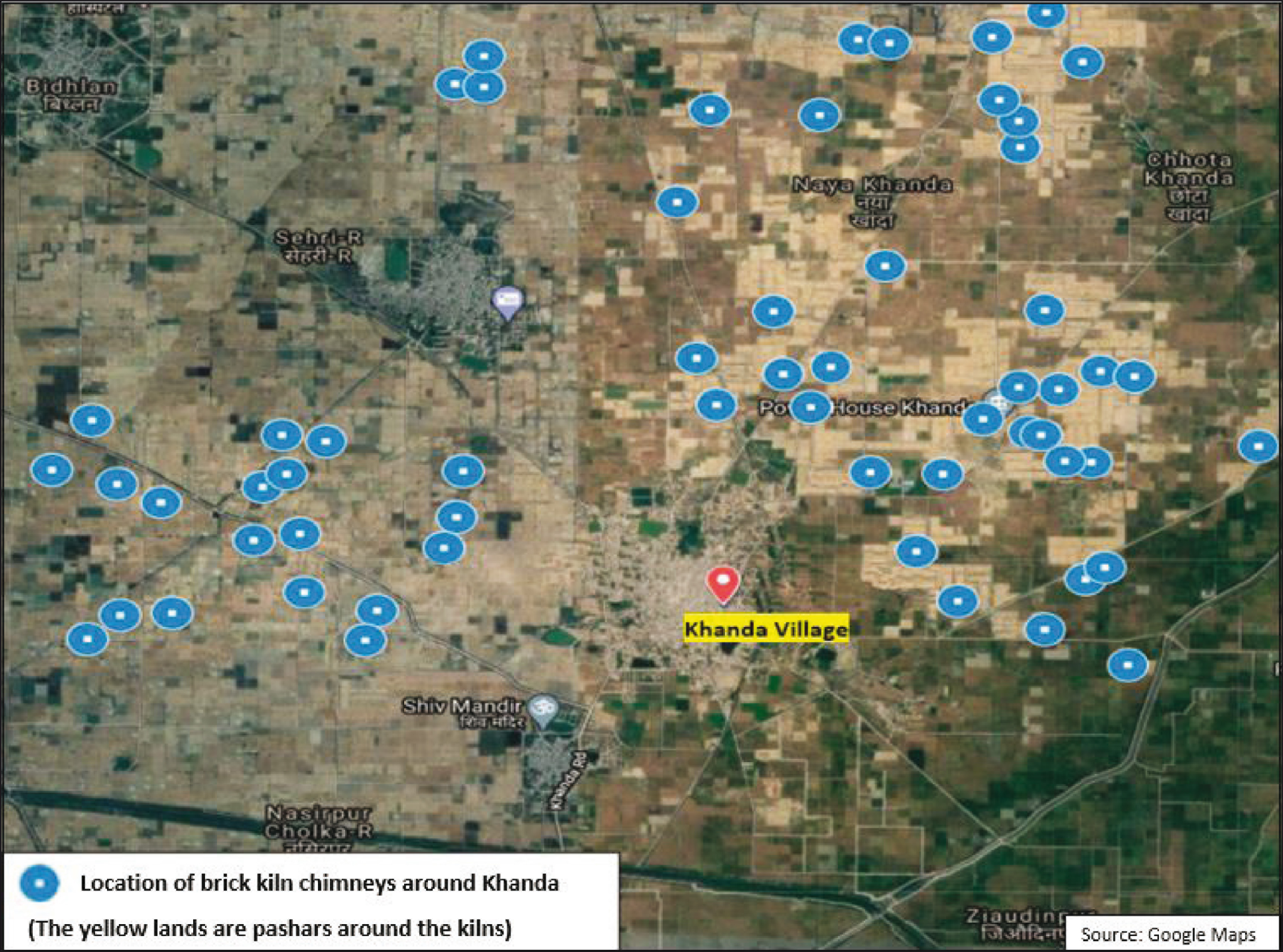
Brick kilns have a complex, often antithetical relationship with agriculture. This is not limited to the effect of brick kilns upon crops, but also within the conditions that enable kilns to replace agriculture as alternative users of the soil. The soil demands of the two are largely similar—the fertile topsoil without many pebbles or stones is ideal for making bricks. The quality of soil in Khanda is classified into various vernacular categories (dakar, dahar, bangar and khadar). The best soil for agriculture among them, khadar, is not as good for kilns because it is water-retentive, and bricks made from it do not dry properly. Bricks are best made with dakar soil, which is a not-too hard, not-too sandy soil that is also good for agriculture. The map of brick kilns in Khanda (Figure 3) shows their distribution on three sides of Khanda (particularly the west and northeast) with none towards the south. This distribution of kilns reflects where most of the dakar lands are around Khanda, primarily to the northeast where the bigger kilns are located. In the lands to the south of Khanda, the water supply is augmented by the high water-table around a perennial drinking water canal, the NCR canal, which takes water to Gurgaon and Delhi. The opportunity for profitable agriculture prevents much soil sale from happening in this area. This geography reveals how the advent of brick kilns into Khanda was predicated on agrarian decline.
Brick kilns, for all their fixed investments in ovens and tall chimneys, are, in a sense, a nomadic enterprise. Brick kiln clusters usually emerge from the demand from large cities and prefer to locate in their periphery to reduce transportation costs to the market, given the heavy materiality of bricks. However, the city’s growth, enabled through a steady supply of bricks, proves to be its undoing. Kilns are often pushed outwards by planning and regulatory fiat to make space for urban land use and to protect city dwellers against the air pollution and noxious environment (see Sharan, 2014). A kiln cluster also cannot sustain in an area beyond 10–20 years; either the usable soil in the area tends to exhaust or the remaining plots of soil become expensive, making production less economical than moving to another village as a new commodity frontier.
This situation is epitomised within Khanda, where many of the brick kilns are relocated enterprises from the Kundal village in Sonipat, which was the major kiln cluster in Sonipat district prior to Khanda. While Kundal village became part of the site for a manufacturing zone, the planned Industrial Model Township Kharkhoda (IMT Kharkhoda) pushed brick kilns out around 2005, during which time many kilns had already been leaving the village because of the rising soil costs. When the first medium-sized brick kilns of the FCBTK design 5 started in Khanda around 1997, soil was not properly a commodity with an exchange value. Some farmers were willing to give it away for free—they were the ones with lands adjacent or close to the minor outlets in Khanda. The fall in water level in the outlets had left their lands too high to effectively divert and irrigate with the water. The kilns extracting soil on their own labour costs provided an opportunity for these farmers to get their lands at level with water in the outlets for easy irrigation. Where farmers sold soil, the prices were nominal, at ₹5,000 for 1 foot of soil over 1 acre. The lack of irrigation (as a socio-natural condition) had rendered nature (topsoil) cheap and was a crucial condition that led to the kiln cluster emerging in Khanda.
Today, the value of 1 foot of soil over 1 acre in Khanda is roughly around ₹150,000. This exponential rise in value of soil is marked by a condition of soil scarcity in Khanda (now a mature soil frontier) and is mediated by the history of commodification of soil in several phases. While soil sales were always a part of kiln operation in Khanda, the mode of extraction in the initial period after 1997 was through leasing farmland where the payment for soil was subsumed within the cost of leasing. As mentioned, around 70 per cent of a kiln’s area consists of the houses and the adjacent work sites of moulders called pashaar, which is a patch of land where brick moulders mould the bricks and lay them out to dry. The kiln owners lease land for the chimney and the oven (collectively called the garand) under a 10-year agreement. For the moulders, the owners leased farmland around the kilns, initially under a 3-year agreement. Moulders would use soil out of the same land from around the pashaar; the soil would be prepared every morning in the traditional method called lathganja, in which moulders dig a pit and put a mix of soil, water and sand in it and then stand inside the pit and use their legs (lath) to work the clay and make it pliable for brick moulding. When the farm’s soil was exhausted, the owner would lease and convert farmlands on another side of the kiln or in close vicinity to new pashaars.
The system of 3-year agreements was initially taken up to incentivise farm owners with the higher lump sum advance that accrued of a 3-year contract. While new kilns slowly emerged in the early 2000s, the boom in brick kilns really began after 2005; most of the present brick kilns in Khanda were set up between 2010 and 2015. The dynamics of competition for soil and the rise in soil rates had already begun in the 2000s as landowners negotiated to switch to a 1-year contract for leasing land so as to not be locked in while prices rise. This too soon became obsolete as lands in the immediate vicinity of the kilns were exhausted, and the sale of soil as a commodity took over.
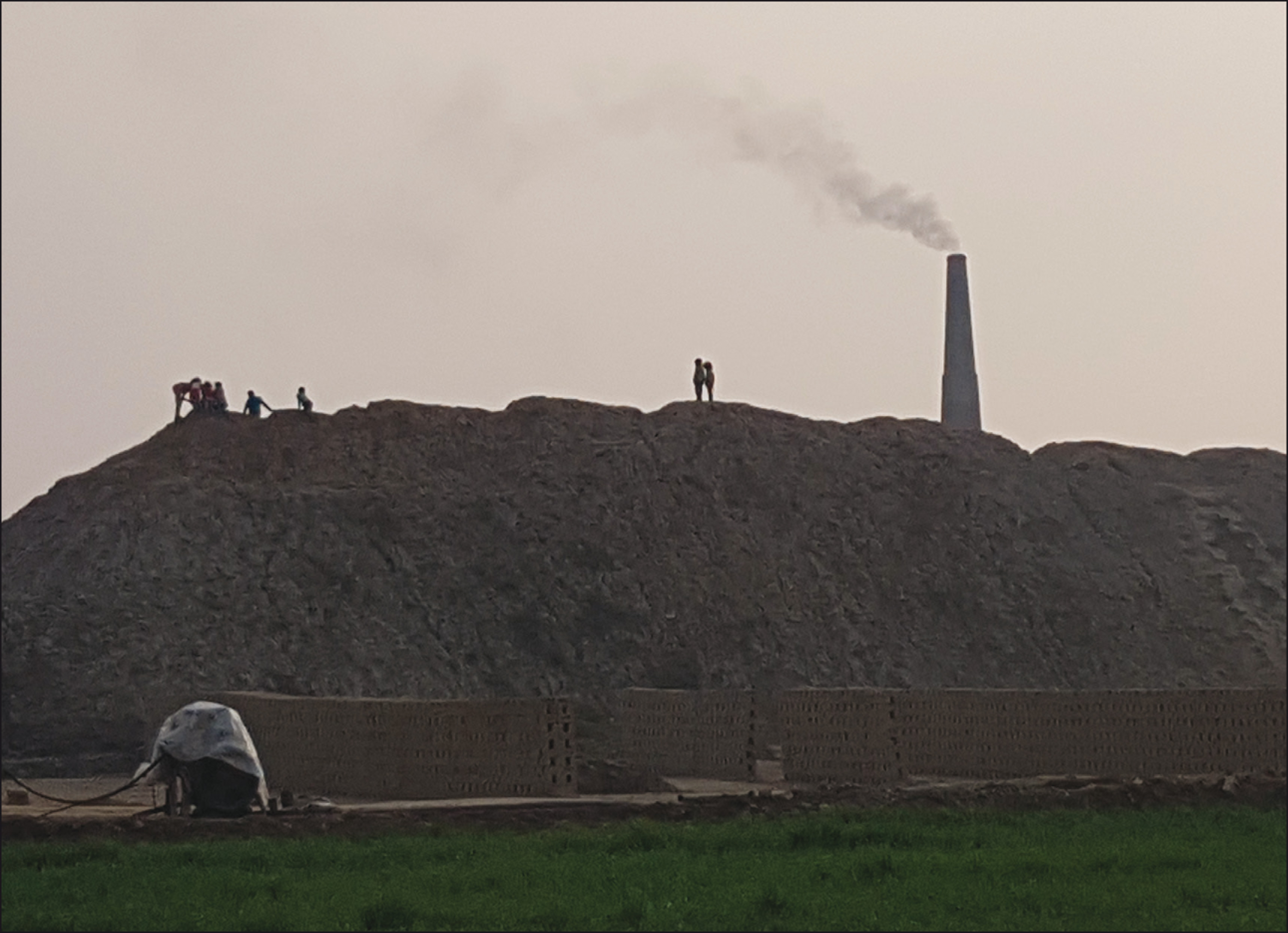
With the decoupling of soil from land and its transfer from farther off farms becoming the norm, a new phase of upscaled accumulation began in Khanda. The period after the harvest of wheat in April marked the buying season for soil, when kiln owners would negotiate to buy soil from empty farms. Kiln owners who had surplus capital started buying soil as reserves in anticipation of a future price rise. The soil would accumulate in imposing small mountains near the kilns, making up tens of acres of farmlands (see Figure 4). The going rate for soil is never standardised across kilns. An interesting observation I made from the lengthy negotiations over soil that I witnessed between the landowner and the kiln owner was that soil’s value as a commodity is not intrinsic but always subject to its location and accessibility for the owner alongside assessments of quality. In one meeting, the landowner asked for a higher price because his land was close to the kiln, but the kiln owner argued that there is no direct road from the kiln to his land so he would have to take a longer route. The transport cost for soil is significant. Usually, a soil deal is made for 3 feet of soil from the farmland at a go. So, under current prices, the price for 3 feet of soil from an average one-acre farm in Khanda would be ₹450,000; the cost of transporting that soil over 8 km would be ₹140,000 and a further ₹40,000 would be added to the transportation cost for every extra kilometre. It takes 250 trips for a dumper truck to transport all that soil. I use 8 km here because it was the standard price quote being used by an entrepreneur in Khanda who owns and runs vehicles for transporting soil.
About 80 per cent of Khanda’s topsoil is already mined. Khanda is no longer the major soil source; nearby villages (Sheri, Khedi, Bidran and Nirthan) have become the new soil hinterlands to Khanda. The price of transportation of soil is offset by the lower price that kiln owners are able to negotiate for the soil there because of the distance from the kiln. Instead of drawing soil from adjacent lands, now the brick kilns draw soil from 8 km away (on average) from other villages. There is an economic limit to the radial distance from which soil can be transported into Khanda and the same transport entrepreneur estimated this to be 12 km. Beyond that, the cost of transportation will force kiln owners to relocate out of Khanda, onto another frontier.
The Labouring Process under the New Soil Regime
A moulder’s work is long, mundane and repetitive. The predominant task in this process is a short sequence executed over a few seconds while squatting on the ground—taking a lump of soil, pushing it on to the empty mould, tapping the mould on the ground and cutting with a wire or one’s hand to remove the extra soil and then laying the now rectangular block of clay on the flat soil to dry. This is repeated 2,000 times in a day by a skilled worker. This description is however not only reductive of the many other tasks in a day of brickmaking, but it also risks reducing it to an unthinking activity, whereas it is often performed through a deep knowledge of the soil. Experienced moulders have shared, over the course of many interviews, a plethora of situated and embodied knowledge about the qualities of soil that are outside the scope of this article to explore. It is obvious, then, that the changing modes of appropriation of soil documented above would have significant bearing on the labouring processes of moulders in Khanda.
A major aspect of changes in the labouring process has been a technological change in the treatment of soil that allows the kilns to maintain production at a high level. This change was the switch from the lathganja method of manually preparing clay for moulding to the pakmel method, denoting the use of machines in preparing the clay. The widespread use of pakmel started 3 years back in Khanda, and now almost all the kilns have switched to this technology of using a mixing truck to prepare the soil with water and sand and then delivering the clay separately to different pashaars by tractor. The owner’s cost of preparing the clay through pakmel is offset by reducing the piece-rates for the workers (the rates for lathganja is ₹650 for a thousand bricks, whereas for pakmel is ₹550). Despite this, workers can use the time saved to produce more bricks, so pakmel is marginally more beneficial for them. The change is also not unpopular as most workers are happy to forgo the labour-intensive process of preparing soil. The task of lathganja usually fell to the men within a family, while women used this time to assist the men and do household duties. The change brought by pakmel has partially deprived women of this time for household work and even rest, though these changes have never been articulated as major issues by the few women moulders I interviewed. Both male and female workers, however, often resent the lack of independence in the pakmel process and its ruse of turning all the hours in a day into potential production hours. The embodiment of labour is also different within pakmel. A male worker stated, ‘Brick moulding is a job where you are squatting throughout the day, lathganja allowed us to free our bodies, warm it up and gave us strength as it was a more wholesome activity. It was good for the body. Now our work is boring and even more tiresome’.
The control over the supply of soil within pakmel allows owners greater control over the labour process and easier shifting of production risks (already inherent in a piece-rate system). A major risk in brick making is rainfall. Rain not only damages bricks that have been laid to dry on the pashaar, but also makes the pashaar damp, so workers have to wait for it to dry before they can begin work again. The damp pashaar soil would otherwise just stick to the wet clay brick left to dry. Pakmel production combined with weather forecasts through mobile apps allows owners to block brick production two days in advance of expected rain. Any brick that has been moulded and then damaged by rain is liable to be counted into the moulder’s wage. Blocking supply avoids this loss and thus shifts the weather risk further onto workers. In my fieldwork year of 2019, this risk was acutely felt as on-again, off-again rainfall throughout February and March blocked work for already low-paid workers during a very productive time of the brick season. Regulating work was much more difficult within the decentralised lathganja system where workers would often exploit the opportunity to make bricks that would only later be spoilt in the rain, thus avoiding taking on the risk.
A consequence of Khanda becoming a mature soil frontier has been the depletion of the ideal dakar soil and kilns turning to sub-standard bangar (hard/tight soil) both out of scarcity and to manage costs. More crucially, the surface soil on most fields of 1–2 m have been sold off, and now kilns are buying the stony sub-soil; some farms are excavated up to 10 ft till the soil is too rocky to use. The burden of bad soil or soil ridden with roda (stones and gravel) falls disproportionately upon moulders. The task of removing stones from the clay mixture during moulding can sharply reduce the speed of making bricks. Ignoring large stones within the clay would crack the brick inside the oven, so owners insist on removing fragments and discipline workers who neglect this by docking pay.
Soil quality is a big concern for moulders. In their fortnightly trips to the block-town market (in Kharkhoda) to buy rations, brick workers from different kilns find opportunities to meet each other and gossip about work. They use these opportunities to collect and share dispersed knowledge on the experience of working in different kilns, so that they may shift to a better kiln next season. While trustworthiness of the owners, behaviour of supervisors and other aspects figure into this conversation, a major factor in the reputation of a kiln is the quality of soil. The workers try to find out which kilns are able to source good soil so that they may shift there. Also in the only occasion of overt collective action I witnessed among moulders, workers in a kiln, frustrated with the quality of soil, refused to work unless they were paid an extra ₹100 per 1,000 bricks to make up for the time lost in dealing with stones.
Conclusion
The article narrated a historical geography of brick kilns in Khanda, drawing attention to several situated processes. Alongside being located near the city and endowed with good-quality soil for bricks, Khanda’s history of agrarian decline, from a fall in irrigation water availability, became a crucial condition of possibility for the emergence of the kiln cluster. Soil could be acquired cheaply or even freely in the initial phases when there were only a few kilns and soil use was tied with agricultural land leases. The upscaled metabolism of soil, set in motion by the increasing density of brick kilns and the dynamics of competitive accumulation, decoupled soil as a commodity from the land and exponentially raised the price of soil in Khanda. Khanda is now a mature soil frontier, where most of its own reserves are depleted and soil is extracted from nearby villages. The large-scale extraction of soil could be productively put into use by a simultaneous intensification of the production process, which was partly achieved through the change in technology from manually preparing clay for moulding to machine-mixed clay. The moulders in the brick kilns experienced this technological change as a radical reconfiguration of their everyday labour processes, their social relations and embodied experiences of work and in the distribution of weather and production risks as machine-made soil accorded kiln owners greater control over the production process. The moulder’s work, being intimately connected to the soil, was affected by the change in the quality of soil; Khanda’s deterioration as a soil frontier became disproportionately a burden upon them.
The metabolic interplay of labour and nature within the production process comes alive within the operation of brick kilns in Khanda. The kilns also function as an agrarian-urban complex where agrarian context and relations mediate and are mediated by the metabolism of soil within the (extended) urbanisation of Khanda through brick kilns. This presents an opportunity for bridging the literatures of agrarian urbanism and UPE. The article finally diversifies existing literature on brick kilns to examine it as an extractive industry engaged in the production and urbanisation of nature.
On a financial scale, brick kilns are a quite limited capitalist operation. But they are expansive in their spatial and ecological footprint upon their place of operation and their connections to other geographies of labour and commodity circulation, which are interspersed with relations of nature and sociality inhering in other spheres. In Khanda, the brick kilns are an expression of capitalism and urbanisation writ large upon the landscape.
Footnotes
Acknowledgements
I take this opportunity to thank my research assistant, Dharmvir Singh, whose resourcefulness as well as friendship and motivation was very valuable to my fieldwork. I would like to also like to thank my supervisor at King’s College London, Alex Loftus, and friends in the Contested Development Writing Group, whose valuable feedback to a draft of this article made its much-improved final version possible. Any errors or inadequacies in the article are mine to be answerable for.
Declaration of Conflicting Interests
I hereby declare no potential conflicts of interest with respect to the research, authorship, and/or publication of this article.
Funding
The author received no financial support for the research, authorship, and/or publication of this article.