




Abstract
Global interest in enhancing accountability and community participation has led many governments to engage socio-spatially marginalised populations left behind by urban development. This article examines an emergent example of these efforts: Ghana’s Ministry of Inner City and Zongo Development (MICZD). The MICZD’s objective is to improve the social and infrastructural development of zongos, or ‘stranger’s quarters’, which have historically housed Hausa migrants and are associated with slum-like conditions. The study draws on 38 interviews with government stakeholders, community organisations and local leaders as well as on four focus groups with zongo residents. The results reveal four key findings. First, the MICZD’s engagement with zongos is perceived as politically motivated, with this viewed negatively by some and positively by others. Second, the MICZD’s timeline is perceived differently depending on who is being asked. Third, respondents differ in their prioritisation of physical versus social improvements, with the MICZD focussing on physical interventions and zongo residents focussing on social and economic development. Finally, different groups have varied visions of success for the MICZD. The article concludes by identifying two paths towards more empowering state–society engagement—more continuous engagement and counterbalancing powers—and proposes how lessons from the MICZD can inform engagement with marginalised populations more broadly.
Introduction
This article examines efforts to redefine the ‘state-society interface’, where government priorities and socio-spatially marginalised communities interact. It does this through a case study of a new government agency in Ghana, the Ministry of Inner City and Zongo Development (MICZD). The stated objective of the ministry, founded in January 2017, is to ‘promote inclusion and integration of minorities and marginalised groups’ by improving the social and infrastructural development of zongos. Zongos—‘stranger’s quarters’ in Hausa—are areas in Ghanaian cities that have historically housed northern Hausa migrants and have experienced government underinvestment and land tenure insecurity throughout the past century (Pellow, 2002; Schildkrout, 1978). Drawing on the literature on state–society engagement, community participation, and urban citizenship in the Global South, this article addresses several related questions. First, how is the MICZD understood by staff, partners, and zongo community leaders and residents? Second, how does it engage with and pursue projects for zongo communities, and how do communities perceive these efforts in turn? Finally, how do these findings relate to the MICZD’s goal of inclusion, and what can be learned for similar initiatives focussed on socio-spatially marginalised groups in African cities and beyond? Since the MICZD is still relatively new, much of the analysis focusses on perceptions of, and expectations for, the ministry and its early work, rather than on a detailed post-hoc evaluation of the MICZD’s projects to date.
Ghana’s MICZD provides a useful case to better understand efforts to engage with socio-spatially marginalised groups, a phenomenon observed across a wide variety of geographic contexts. While nearly all urban environments include spaces that are spatially peripheral or marginal, an added layer of complexity arises when this spatial marginalisation is compounded by social marginalisation. Physically marginal sites are often home to people with distinct ethnicities, religions, national origins, or socio-economic status. While these areas often demonstrate strong cultural identities and community bonds, they may receive fewer resources or be isolated from decision-making processes, with governments viewing residents as ‘a burden, a blight, or a mere vote bank’ (Appadurai, 2012, p. 641). Diverse examples include Zabaleen communities in Cairo, former townships in South Africa, and favelas in Brazil (see Bénit-Gbaffou, 2011; Buire, 2011; Caldeira & Holston, 2015; Fahmi, 2005; Owusu, 2010).
Over the past two decades, many governments have engaged marginalised populations, previously given limited consideration in development efforts (Booth, 2011). Examples include the creation of Namibia’s San Development Department in 2005; India’s Ministry of Minority Affairs in 2006; Strasbourg, France’s, Roma Mission in 2011; and Canada’s ministerial portfolio for Indigenous Services within its Ministry of Indigenous and Northern Affairs in 2017. In each example, governments have created bureaucratic institutions with close connections to the president or prime minister’s office, ostensibly to better engage with and provide services to socio-spatially marginalised groups. In an urban context, such rights-granting, top-down approaches to transforming the state–society interface have taken place simultaneously with marginalised communities claiming their ‘right to the city’ through everyday activities and practices of urban citizenship (Holston, 2008; Millstein, 2017). This research focusses on the spaces where top-down and bottom-up approaches meet.
The MICZD is a useful case study in part because zongos represent an instance of extreme marginalisation with limited opportunities for public participation in governance decisions (Pellow, 2002; Schildkrout, 1978). Approximately 400 zongos, with hundreds of thousands of total inhabitants, exist throughout Ghana today. They tend to have largely Muslim populations in a predominantly Christian country, are home to relatively poorer residents than other urban areas, have less access to education, and have inferior infrastructure, including that for water provision and sanitation (Owusu, Agyei-Mensah, & Lund, 2008). Zongos also suffer from negative public perceptions that they are dangerous ‘slums’ (Owusu, 2010; Owusu et al., 2008).
Upon assuming office in January 2017, President Akufo-Addo pledged over US$50 million in seed funding, an unprecedented sum, to a Zongo Development Fund to support the MICZD’s work. Yet, the ministry’s agenda and methods have so far remained relatively unknown. In its examination of the MICZD, this article situates the ministry within the history of zongo-state engagement and within the context of literature on state–society engagement in the Global South. It identifies some of the key challenges associated with this process of institutional change, including perceptions of political logics behind the ministry’s creation, varied perspectives on its timeline of work and engagement, and disparate understandings of zongo needs. Finally, the article discusses how these findings relate to the broader literature on state–society engagement and concludes by drawing lessons for developing more inclusive and empowering approaches to state–society engagement that can better benefit socio-spatially marginalised populations.
A Brief History of Zongo–State Engagement in Accra
While many zongos in Accra trace their roots back to the early 1900s, zongos have existed across West Africa for centuries as northern traders settled along commercial routes in the south (Quayson, 2014; Schildkrout, 1978). Although commonly associated with the Hausa ethnic group, Yoruba, Fulani, Wangara, and other groups have also been categorised as ‘strangers’ in the south and resided in zongos. Over time, Islam, the Hausa language, strong bonds of kinship, and patron–client bonds emerged as components generally associated with zongo identity (Pellow, 2002). While these remain cultural touchpoints, zongos in Accra have become more heterogeneous over time, with a diversity of religions and ethnic groups represented (Owusu et al., 2008).
In the early 1900s, conflicts in northern Ghana brought greater numbers of ‘strangers’ to Accra. At the time, most land within Accra fell under the stewardship of the Ga Mashie stool (the stool, or wooden throne, is a symbol of chiefly authority in Ghana). Zongo leaders negotiated with the stool to gain residency rights on Zongo Lane, situated near today’s Tudu neighbourhood, in exchange for allegiance, gifts, and ceremonial honours for the stool, such as formal processions on festive occasions (Allman, 1991; Ntewusu, 2011). This early episode foreshadowed an enduring dynamic. As Allman observes, ‘The position of the zongo community with regard to the traditional structures of power has always been one of patronage and protection’ (Allman, 1991, p. 4).
The consolidation of British colonial rule in Ghana during the nineteenth century added another tier of power to the relationship between zongo residents and local authorities, particularly with the relocation of the colonial capital to Accra in 1877 (Pellow, 2002). The colonial government instituted British planning theories and practices, reshaping the urban environment along segregated lines, resulting in areas—including zongos—that were unsupported by public services. Cities in colonial Ghana were segregated—between colonial agents and indigenous populations, between higher and lower social classes, and between ethnic groups—to provide ‘ease of control in the supervision of “native affairs”’ (King, 1976, p. 39). The colonial government’s Public Lands Ordinance of 1876 and the Town Council Ordinance of 1895 defined public service provision in the zongos as being outside the government’s purview. Left largely unregulated and unsupported by the municipality, zongos increasingly reflected the ‘separateness and powerlessness of component populations, who are treated as culturally different’ (Pellow, 2002, p. 38).
Following a plague outbreak in Accra in 1908, the colonial government started encouraging lower population densities in the city centre. This led to the dispersal of some zongo residents to new settlements on the then outskirts of the city, beginning with the transfer of about 100 zongo residents to Sabon Zongo (Ntewusu, 2011; Slum Dwellers International, 2016). Sabon Zongo was situated 2 miles northwest of Zongo Lane, divided by a lagoon from the city centre (Pellow, 1991). As northern arrivals continued to move to the city, more zongo settlements emerged. In 1931, zongo leaders negotiated with the government for the use of land northeast of the city which would become Nima zongo (Quayson, 2014). Not yet incorporated into Accra’s city limits, Nima resultantly experienced little government scrutiny and evolved into a melting pot of residents in a densely settled, largely unplanned neighbourhood that continues to exist today (Allman, 1991). It is these two zongos—Sabon Zongo and Nima—that serve as the study sites for this article.
With the emergence of national political parties in the early 1950s, zongos began to be perceived by politicians as a key voting bloc. The Muslim Association Party (MAP) in particular worked to mobilise zongo residents with promises of improving community amenities (Allman, 1991; Hanretta, 2011). While the MAP was short-lived and ultimately banned by President Nkrumah as a religious-based party, it opened a five-year window of political negotiations between zongos and the government, with MAP advocating for educational reforms, religious institutions, and restoring zongo chieftaincies to their ‘ancient dignity’ (Hanretta, 2011, p. 204).
Economic challenges in post-independence Ghana during the 1960s and 1970s engendered hostility towards perceived foreigners, including zongo residents (Kobo, 2010). In 1968, the governing party, which would become today’s ruling New Patriotic Party (NPP), passed Legislative Instrument 533, which required non-indigenous residents to seek permits before participating in commercial activities (Kobo, 2010). This was followed by the 1969 Aliens Compliance Order, which gave all aliens without residence permits in Ghana two weeks to obtain them or leave the country (Peil, 1974). It is estimated that thousands of zongo residents left Ghana for Nigeria and neighbouring countries, while many of those ‘non-indigenous’ individuals who remained were pressured to sell or hand over their businesses to those with stronger claims to citizenship (Kobo, 2010). The rhetoric around the compliance order of 1969 continues to influence both public perceptions of zongos and zongo residents’ perceptions of the government. While revised citizenship rights granted by the 1992 Constitution provided greater security to zongo residents, zongos continue to be perceived as a space apart.
In recent years, civil society organisations, the local government (the Accra Metropolitan Assembly) and the national government have attempted a range of initiatives to reduce disparities between zongos and the rest of the city. Overall, the efforts have been viewed as piecemeal and unintegrated (Osman, 2017). The complex, informal character of zongos often complicates such initiatives. The term ‘informal settlement’ is frequently applied to zongos in Ghana, and, in a wide variety of print and online documents, multilateral organisations, government officials and researchers refer to zongos as informal settlements [Hallegatte & Erman, 2018; Kumasi Metropolitan Assembly (KMA), 2009]. The definition of an informal settlement adopted by UN Habitat (2015) refers to three key dimensions of informality: tenure, services and compliance with building and zoning regulations. However, the term is often applied loosely and used interchangeably with ‘slum’ to describe areas of relative poverty and limited infrastructure (Gilbert, 2007; Jones, 2017). The two cases under study have been defined by Paller (2015) as belonging to a particular category of informal settlement, namely as ‘purchased’ informal settlements, which are viewed by the government as legitimate in terms of tenure, but nonetheless exhibit physical informality and limited service provision.
Entering into this complex history, the MICZD was created in January 2017 after the election of the centre-right NPP leader, Nana Akufo-Addo, who promised in his campaign to establish a Zongo Development Fund. The ministry was established upon his inauguration with the following mission: ‘To coordinate, collaborate and facilitate critical interventions through affirmative action that progressively addresses economic and infrastructure deficits, and promote socio-economic development of the Inner City and Zongo communities’ (Awuni, 2017).
The MICZD has four focus areas: economic empowerment, infrastructure investment, social development and cultural promotion. The ministry’s briefing documents highlight its hope to focus on areas with higher concentrations of poverty and to ‘promote inclusion and integration of minorities and marginalised groups’ (Alhassan, 2018). To inform its understanding of zongos, the MICZD contracted with a local NGO, People’s Dialogue, to undertake an enumeration, which was supposed to begin in 2018. People’s Dialogue has extensive experience working with urban poor groups (including in zongos) in Ghana and is affiliated with the Slum Dwellers International movement. At the time fieldwork for this study was conducted in 2018, it remained unclear how the ministry might accomplish its goals and how it would collaborate with People’s Dialogue.
State–Society Engagement
The literature on state–society engagement in the Global South is characterised by dichotomies: between spaces of formality and informality (Roy, 2009); between ‘invited’ and ‘invented’ participation (Miraftab, 2004); and between ‘top down’ and ‘bottom up’ planning (Roy, 2009; Simone, 2004). In one important strand of this literature, the state is portrayed as a controlling or oppressing force (Amoako, 2016; Davis, 2006), ‘sanitizing spaces’ to the detriment of the poor (Amster, 2003). In this view, even when the state’s motives may not be chiefly oppressive, it nonetheless grants rights and services in a technocratic, top-down manner that often pays little attention to the needs of local residents (Jones et al., 2014; Scott, 1998). Scott (1998, p. 191) argues that government rhetoric promoting ‘orderly development and social services’ is often ‘misleadingly silent about the manifold ways in which [such] orderly development serve[s] important goals of appropriation, security, and political hegemony’.
A second thread in the literature focusses on grassroots movements and their fight for ‘insurgent citizenship’, wherein communities make demands of the state, claiming rights and services through the everyday practice of city life (Holston, 2008; Lefebvre, 1996). Examples of how residents of poor and marginalised communities have united to demand rights and services from the state can be found in Holston’s (2008) research on Brazil’s favelas, in Appadurai’s (2001) study of pro-poor civic organisations in Mumbai and in McFarlane and Silver’s (2016) examination of protests for better sanitation in former townships of Cape Town, South Africa.
While both ‘state control’ and ‘concessions to insurgent citizenship’ have been commonly argued as motives for state–society engagement, more intermediate understandings of state–society relations have also been proposed (Millstein, 2017). Moving beyond binary understandings of state–society engagement permits a more nuanced, fluid and negotiated treatment of this interface. In her review of pro-poor and participatory urban planning policies in the Global South, Watson (2009) argues that we need to understand better the nature of the interface between institutional systems and the poor: ‘It is at the “interface” between… politicized technical and managerial efforts to direct human conduct towards particular ends, and the messy and complex reality of human efforts to survive and thrive…[that] Effective new ideas about planning are most likely to arise’ (Watson, 2009, p. 187). In its effort to understand diverse perspectives on the state’s efforts to engage with marginalised groups, the research reported here follows in the footsteps of other scholars, including Corbridge, Williams, Srivastava, and Veron (2005), who have examined the poor’s multiple and complex ‘sightings’ of state interventions in India.
This article responds to Watson’s call for research on the state–society interface by focussing on an emergent effort, in the form of the MICZD, to redefine state–-zongo engagement in Ghana. Building on the above summary of top-down versus bottom-up relations between state and society, it is helpful to consider alternative logics that may inform both the ministry’s efforts and the community’s perceptions of them. The two factors that this research suggests may play a role are clientelism and state legitimacy.
Clientelism is a social order that depends upon ‘the granting (by politicians to voters) of public goods based on personal networks and influences rather than on a well-established and clear set of principles and rights’ (Bénit-Gbaffou, 2011, p. 455). Ghanaian newspaper accounts and public discourse argue that clientelism, and particularly efforts to win votes in Ghana’s predominantly Muslim north and highly populated zongo communities in the south, may be an important part of why the MICZD was formed (Awal, 2017). Although clientelism is generally viewed negatively, some authors contend that clientelist efforts to engage with communities can nonetheless provide ‘a form of public accountability: [where] the state and the party are finally obliged to take into consideration local residents’ claims’ (Bénit-Gbaffou, 2011, p. 459). Drawing on her research with poor communities in Johannesburg, Bénit-Gbaffou (2011) argues for a blurring of conceptual boundaries between decentralisation/participation and clientelism. Similarly, Auyero (1999) explored the nuanced, often contradictory, ways in which clientelist party brokers are perceived by poor communities in Argentina (1999). Such examples attempt to move past the automatic labelling of clientelist motives as negative, to instead see how they could also open opportunities for advancing the interests of marginalised groups.
A second factor that may help better understand the creation of the MICZD relates to state legitimacy. Fung defines legitimacy as follows: ‘A public policy or action is legitimate when citizens have good reason to support or obey it’ (2006, p. 70). Efforts to increase governmental accountability or perceptions of ‘good governance’ are often pursued to bolster legitimacy (Corbridge et al., 2005). States have undertaken legitimacy-enhancing efforts through urban development projects (Miraftab, 2004), from urban renewal projects along Warwick Avenue in Durban, South Africa (Grest, 2002) to slum-upgrading projects in Kerala, India (Williams et al., 2015). Legitimacy-enhancing efforts can be directed at a variety of internal and external audiences, including voters, donors, other states and the international community (Katomero, 2017).
Legitimacy-focussed ‘good governance’ efforts have increasingly emphasised bolstering the participation of poor or marginalised communities (Brett, 2003; White, 1996). In pursuing such development initiatives, government agencies ‘create many of the spaces within which “poorer people” are bound to see “the state”’ (Corbridge et al., 2005, p. 47). The rich literature on public participation in governance and urban interventions (Brett, 2003; Goldman & Abbot, 2004; Wakeford & Singh, 2008) argues that the degree and types of participation within these spaces can influence project outcomes (Farouk & Owusu, 2012; Mitlin, 2008). While ‘community participation has become synonymous with legitimate governance’, participation also risks becoming a ‘mere ceremonial presence’ (Williams, 2006, p. 203) within which engagement is structured in such a way ‘to manufacture consent’ (Benjamin, 2008, p. 5). A community’s history of engagement with the state can also influence participation, as Corbridge et al. (2005, p. 120) highlight: ‘The state’s attempts to present itself as a new agent of participatory development are read by poorer people against their previous and possibly negative experiences of “participation”’. Even with the best of intentions, participatory projects ‘can be undermined by opportunism, information failure, and conflicting interests’ (Brett, 2003, p. 12).
Participation frameworks such as Arnstein’s (1969) ‘ladder of civic participation’ and Fung’s (2006) ‘democracy cube’ offer tools for understanding the degree to which projects offer meaningful and transformative participation opportunities. While Arnstein characterises participation on a linear scale, Fung’s cube employs three axes to describe any instance of participatory engagement: scope of participation (describing who participates), mode of communication (describing how participants exchange information and make decisions), and extent of power and authority (describing how discussions link to public action) (Fung, 2006, p. 66). Both frameworks illustrate that the nature of participation can influence the outcomes and public perception of interventions. For this reason, this study not only examines diverse perspectives on why the MICZD was established, but also how this initial stage of the ministry’s existence has unfolded in terms of engagement with zongo residents.
Methodology
This article adopts a single case study methodology, triangulating data gathered from 38 key informant interviews, 4 focus group discussions and detailed site observations, as well as drawing on the broader academic and popular literature on the MICZD and Accra’s zongo communities. Interviews, focus groups and site observations took place over three weeks of field research in January 2018. The article considers two of Accra’s seven zongos: Nima and Sabon Zongo. Both zongos are designated as legal neighbourhoods but also exhibit some physical informality. Nima has over 160,000 residents (Slum Dwellers International, 2016) while Sabon Zongo has approximately 42,000.
Thirty-eight semi-structured key informant interviews were conducted. Interviewees consisted of three MICZD staff and nine representatives of MICZD partners, which include those organisations listed by the Zongo Development Fund Bill as liaising Ministries, Zongo Fund Trustee organisations or implementing partners like People’s Dialogue. Additionally, 26 zongo leaders were interviewed, including 11 community leaders (such as chiefs, imams and other influential individuals), 11 business owners and 3 community-based organisation (CBO) representatives (Figure 1). All interviewees were selected through a combination of snowball and purposive sampling. Interviews ranged in duration from 20 minutes to one hour. Figure 1 presents a breakdown of study participants.
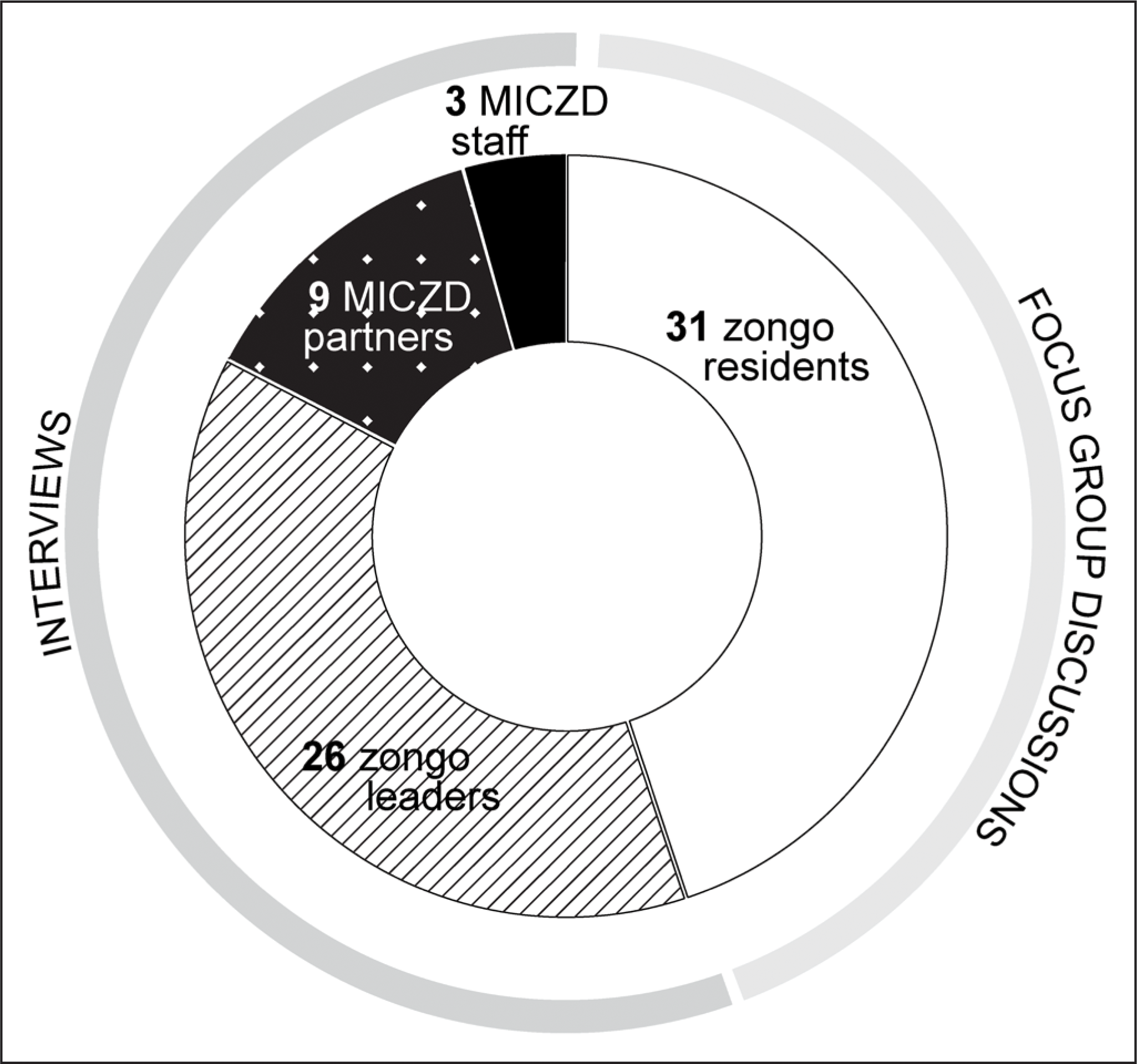
Four semi-structured focus group discussions, involving 31 participants, were held with residents of Nima and Sabon Zongo. Participants were identified through snowball sampling. Local leaders were asked to suggest people who represented a range of ‘everyday residents’ of their communities, while ensuring representation of women and youth. Participants included 18 men (58 per cent) and 13 women (42 per cent). They also included 12 youth (39 per cent), ranging in age from 18 to 25 years. Across all 69 study participants, including the 38 key informant interviews and 31 focus group participants, 29 (42 per cent) were from Nima, 24 (35 per cent) were from Sabon Zongo and 16 (23 per cent) worked across multiple zongos as leaders or with community organisations or government agencies. All interview and discussion group contributions are presented anonymously throughout the article.
Detailed observations were also made of both Nima and Sabon Zongos. These involved over 17 hours and 40 kilometres of walking. During these walks, the following details were recorded: street and sanitation conditions, visible public works projects and public buildings, political signage and posters, the level of vehicular and foot traffic and types of economic activities.
The interview and focus group data was analysed using thematic content analysis. Not all interviewees responded to all questions; thus, throughout the article, the number of respondents (n) is reported for each question. Data from the interviews, focus groups and observations were triangulated with existing academic literature on Ghana’s zongos, as well as 72 news articles published from January to March 2018 on the zongos and the MICZD. Given the relatively small sample size, this article’s findings are not meant to be definitive, but rather offer insights into how the motives for, and practices of, the MICZD have affected how the ministry’s efforts are perceived.
Results
The analysis of the data yields four main findings, which are summarised in brief here before further details are provided on each. First, the MICZD’s engagement with zongos is broadly perceived as being politically motivated. ‘Politically motivated’ implies being related to the interests, ideas or strategies of parties or groups engaged in government and public affairs (Oxford Living Dictionaries, 2019). These political motives are viewed negatively by some and positively by others. Second, while the MICZD has achieved some legal and administrative milestones in its engagement with zongo communities, this timeline is perceived very differently depending on who is being asked. Third, while there is agreement between the MICZD and residents that the zongos’ needs are central to the ministry’s work, actors differ in their prioritisation of physical versus social improvements. Finally, the ministry’s approach is understood as novel in several ways, but, perhaps as a result, different groups have varied visions for its success.
Perceptions Around the Ministry’s Creation
Participants reported different interpretations of the MICZD’s reason for existence and underlying motives. Responses to the question ‘In your opinion, why was the ministry created?’ were coded into mutually exclusive categories and reveal a range of answers (Figure 2). Across all categories, 37 per cent of respondents explicitly cited political motivations, including the MICZD being the fulfilment of a campaign pledge (14 per cent), an attempt to garner votes (13 per cent) or an effort by the NPP to improve its reputation within zongo communities after decades of distrust following the 1969 compliance order (10 per cent). While not all of these political motives were explicitly interpreted as traditionally ‘clientelistic’ vote-garnering efforts, one zongo community leader described how various political motives underlying the MICZD’s creation might overlap: ‘The idea of the zongo administration…was fixed in the party manifesto. So, in the first place, you might say when it finds expression in the party manifesto that it was intended also to improve the chances of votes for one political party.’
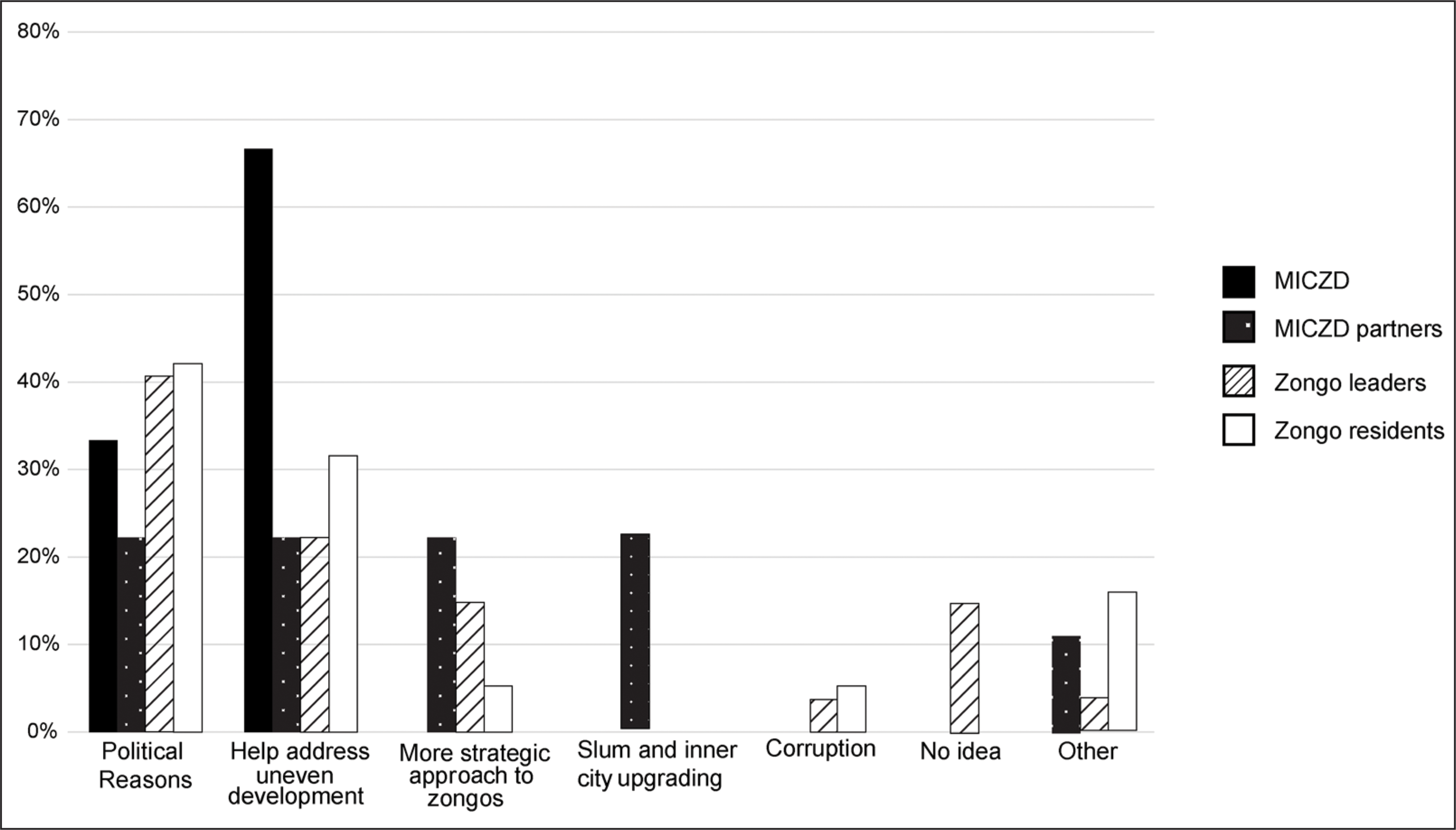
Zongo leaders and residents most commonly cited political motives (41 per cent and 42 per cent, respectively). For these respondents, the second most frequently reported reason was to address uneven development, an answer given by 22 per cent of leaders and 32 per cent of residents. In all, 4 per cent of zongo leaders and 5 per cent of residents suspected the MICZD to be somehow benefiting corrupt officials personally, while, uniquely, 15 per cent of zongo leaders reported they had ‘no idea’ what motivated the ministry’s creation.
Respondents who stated that the ministry was created ‘just to get votes’ were exclusively zongo community leaders, business owners and residents. As one Nima business owner said, ‘They came here for votes but when they’re in power, they just spend money, thank us, and that’s it.’ A focus group discussion reprised this theme of temporary interest in zongos, with one participant sharing a representative statement: ‘They asked us with motorbikes to escort them and show support during the campaign. They made a lot of promises but nothing happens.’ Five zongo residents and community leaders directly mentioned the 1969 Compliance Order and described how it left a widespread perception that the NPP was an anti-zongo party. They suggested that the MICZD served as a symbolic and strategic break with this history, working to address perceptions of ongoing anti-zongo sentiment.
In contrast, interviewees from the MICZD most frequently (67 per cent) stated that the reason for the agency’s creation was to address uneven development, followed by political motives (33 per cent). For MICZD partners, the most frequent responses were evenly split between political reasons, helping to address uneven development and adopting a more strategic approach to zongos (22 per cent each). Several interviewees from the MICZD and MICZD partners stated that the ministry served to fulfil a campaign pledge, a sentiment aligned with the MICZD’s public statements. They also argued that the ministry was a strategic effort to address differences in development in zongo communities. For example, in a representative quote, an MICZD interviewee stated the ministry was ‘born out of the desire of the current government to have a more focused approach to that set of marginalised people in communities’. The interviewee went on to say the ministry would accomplish this by:
Planning and promoting interventions aimed at ensuring that zongos and inner cities, which are considered the most deprived localities or communities in our setting, become prosperous. In short, by prosperity, we mean people will have decent jobs and incomes that enable them live comfortably within the limits of the law.
Varied Perspectives on Project and Engagement Timelines
As of late 2018, the MICZD has kept to its planned timeline for engaging zongo communities and launching projects. This engagement has taken a variety of forms: informal engagement on the campaign trail; dozens of media interviews and press releases; the Minister’s national zongo tour in June 2017; a rapid assessment in February 2017 and stakeholder engagement (particularly public meetings and consultation meetings with key stakeholders) with approximately 11,500 participants for the Zongo Development Fund Bill. During their first year, MICZD staff reported having focussed on establishing legal and bureaucratic frameworks for their work: hiring staff, passing the Zongo Development Fund Law and building partnerships to launch two projects in late 2017 and early 2018. This progress was positively portrayed by representatives of the MICZD and its partners. One partner spoke of the ministry’s relative speed in achieving these legal and bureaucratic milestones: ‘They are moving fast—they want to achieve results in four years, ahead of the next election’.
During interviews, MICZD representatives indicated that they were still in the planning process, ‘just in the process of starting’ and would look to ‘strategically’ incorporate zongo residents and the public throughout their work. One ministry official shared plans to ‘determine carefully when the people can meaningfully get involved, for example, when it comes to collecting data and accessing the issues, [identifying] the problems that they have, we will work on these with them’. Notably, this and other interviews with MICZD staff suggested that much of the involvement of zongo communities would take place in the future. In addition to emphasising future participation, MICZD staff spoke of how their plans would remain flexible and may need to change given community feedback.
Zongo leaders and residents held a broader range of perceptions on the MICZD’s timeline. Of the 23 zongo residents and leaders responding to the question ‘What do you know about the ministry’s work to date, or what they have planned ahead?’, six (26 per cent) shared that they were unsure what the ministry had done to date or was planning to do in the future. Of the remaining 17 respondents, just over a quarter (26 per cent) echoed the MICZD partners’ positive sentiments, mentioning accomplishments such as passing the Zongo Development Fund law, community engagement or their enthusiasm for an upcoming toilet construction campaign. Some of these community members understood that the ministry was working at ‘solving some problems and bottlenecks’ and that ‘it will take a while for the zongos to feel that, but they’re going on as planned’. Others, however, found the lack of visible progress more suspicious and concerning. According to a resident of Nima:
I heard of the fund, but I don’t see the effects, maybe later they’ll build a bridge, towards the end. They’ll show support later in the programme, to cover up, explain the time that’s lapsed. Now it’s ‘We’re working on…’ or ‘We’re in the planning stage’ …but when voting comes, that’s when they’ll act.
Over half of the interviewed zongo residents, community leaders and CBO representatives (57 per cent) held negative sentiments regarding the ministry’s timeline of work and engagement. For example, several local chiefs expressed frustration that they had yet to be consulted regarding their zongo’s priorities. One of them said, ‘you have to go to people and listen to what they want. As a Chief, if I sit in my palace and wait, no one will come. You have to go around and meet people to help the community’.
Ultimately, interviewees generally viewed the ministry as being in its planning stages. What was presented as a methodical and measured preparation by officials was frequently viewed as opaque or incomplete engagement and progress by some community members. While all participants agreed that community engagement and listening to community needs are important, government officials and communities appeared to hold differing views of the ideal timing of such involvement, with communities generally desiring earlier engagement.
Projects and Perceptions of Community Needs: Physical versus Social Projects
At the time fieldwork for this study was conducted, 12 months into the ministry’s existence, relatively few of its activities had begun. Interviews and focus groups thus focussed principally on expectations for the ministry’s future projects and work, rather than the impact of their work to date. The MICZD’s Medium-Term Expenditure Framework for 2018 outlined intended projects for 2018–2021, including school rehabilitation projects; youth vocational trainings; building access roads, bridges and improved homes; constructing parks and publishing a dossier of heritage assets (Ghana Ministry of Finance, 2017). The few activities that had begun varied in scale and intent. One involved hiring 3,000 Arabic teachers, particularly in zongos. A second project, an AstroTurf playing field in Madina zongo, was announced in early 2018.
All respondents were asked what they understood to be the top needs facing zongos, as well as the kinds of projects they believed the MICZD could pursue to best address these needs. The most commonly mentioned priorities by all participants included sanitation (20 mentions), education (18 mentions), employment opportunities (15 mentions), infrastructure (11 mentions), drainage and gutters (9 mentions) and hospitals and health (7 mentions). Housing, crime, poverty, dirty environment, flooding, lack of seed funding and waste management all received fewer than five mentions each. Notably, all these priorities fall within the MICZD’s purview.
Though some needs were stated by all participants, marked differences arose in terms of which groups mentioned certain needs (Figure 3). All participants mentioned employment opportunities and healthcare almost equally. However, a higher percentage of MICZD and its partner interviewees stated a need for physical infrastructure upgrading, including improvements to sanitation, roads and drainage systems. In contrast, zongo community leaders, residents and CBO representatives most frequently mentioned social needs, most notably education.
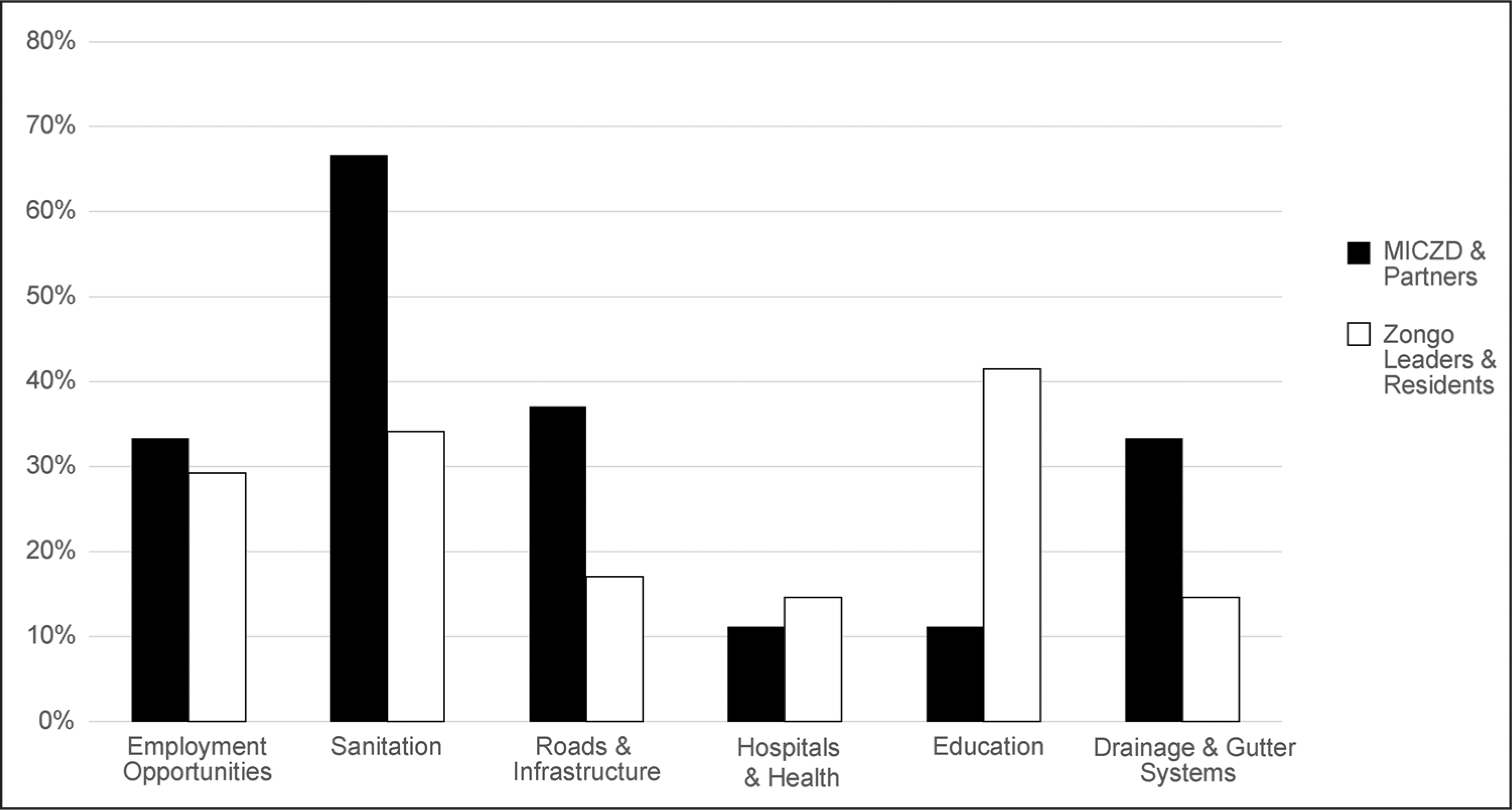
Many interviewees from the MICZD and its partners suggested that addressing physical infrastructure would have a cascade effect, improving social outcomes in the long term. One partner summarised this physical focus:
There is a lot of rubbish and toilets; floods are easily seen around the gutters because the small gutters and people find it easy to dump some things. But once it is well-paved, they will ensure that the community is clean and managed. So the ministry’s best achievement would be to improve infrastructure in inner cities and the zongo communities.
By contrast, many zongo leaders, residents and CBO representatives argued for a combined approach that goes beyond infrastructure alone. One interviewee shared how past approaches to zongo development had failed by limiting themselves to physical improvements, saying, ‘The focus has always been on the physical environment: the beautification of poverty’. Zongo leaders and residents overwhelmingly cited the need for education as a foundation for further development. ‘Without education, we can’t do anything’, said one zongo leader. ‘Without that piece, development can’t come’. The specific aspects of education most commonly mentioned by interviewees were upgraded educational institutions, better teacher quality and improved access to education for poor families.
A New Approach to Zongos? Innovations and Future Visions of Success
As the MICZD characterises itself as an innovative approach to zongo communities’ needs, this research examined the extent to which interviewees felt it was a continuation of past approaches or something new. While the MICZD’s work was viewed as thematically similar to past zongo development efforts, respondents cited differences that led them to view the MICZD more positively than past engagement with government officials. These differences include the MICZD’s coordinating role, the legal framework provided by the Zongo Development Fund and the potential for different approaches to zongo challenges.
While zongos remain part of their local Member of Parliament’s larger constituency, interviewees noted that the new ministry was specifically targeted towards zongo concerns. One interviewee from an MICZD partner noted, ‘If you have the Ministry of Local Government or Municipal Assemblies, [they] will draw a scale of priorities and you can’t see where you fit in in the timeline’. Contrastingly, the MICZD focusses entirely on zongo and inner city areas which have historically slipped through the cracks of, or been marginalised by, local government interventions. This possibility for more targeted attention gave some community interviewees hope that the MICZD would serve their needs better than past efforts.
An additional difference cited by all respondent groups is the ministry’s legal framework as enabled through the Zongo Development Fund Law. This legal framework is important in a context where opposition parties are rarely keen to continue prior governments’ flagship programmes. Ghanaian presidents possess significant leeway in creating or disbanding ministries through presidential directives. However, eliminating a law would require the cooperation of the legislative branch (Prempeh, 2008). The legal structure of the Zongo Development Fund therefore suggests it is less likely to be disbanded with a change in government. Three zongo residents specifically articulated that by creating both the ministry and its own legally designated fund, the government had ensured zongo priorities would remain a consistent concern, irrespective of which party is elected.
Finally, ministry representatives shared efforts to innovate on past zongo development efforts through new kinds of interventions that simultaneously tackle multiple challenges, such as the AstroTurf project in Medina. The MICZD describes this project as innovative due to its combination of approaches, combining youth development activities with public health opportunities and infrastructural upgrades. However, negative responses from zongo leaders to this project suggest the path towards multipronged approaches may not be without controversy. Speaking out against the project, the spokesperson for the national zongo chiefs’ association stated, ‘It is important our priority is considered. I have mentioned all the problems we have, [and] currently stadium[s], hockey pitch[es] and those things are not a priority to us’ (Ansah, 2018).
Finally, all respondents were asked, ‘looking forward, what would it look like for the ministry to be a success?’ Answers varied widely, as shown in Figure 4. Of the 43 respondents, the greatest percentage (37 per cent) hoped to see visible changes from the MICZD’s work, including improved living conditions related to housing, roads or sewage. Twenty-three per cent of respondents envisioned increased education opportunities for zongo children. Other commonly described visions of success included ‘meeting indicators for improvements in socio-economic or infrastructural development’ (16 per cent) and ‘laying the foundation for future progress’ (16 per cent).
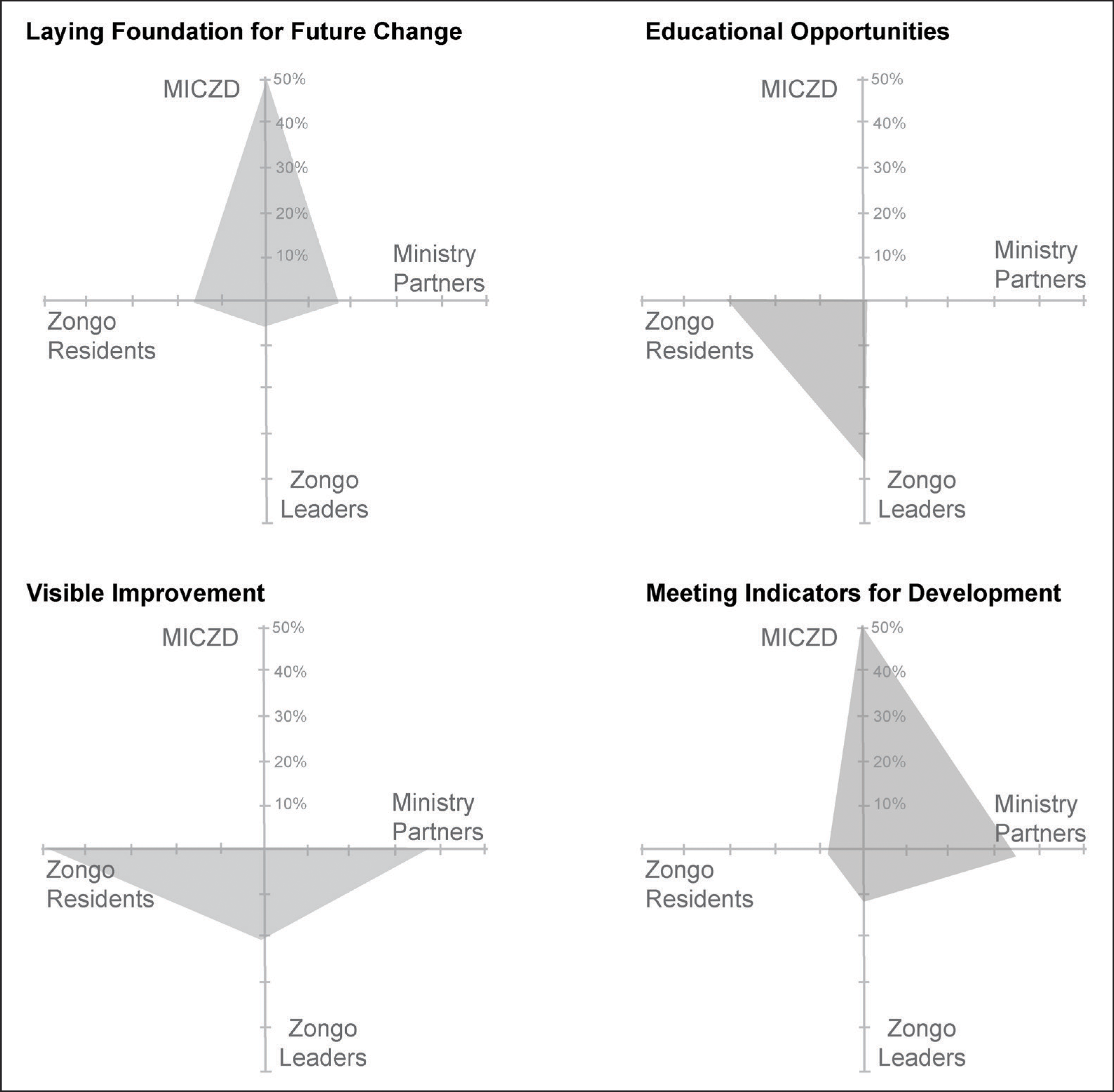
MICZD partners, zongo residents and zongo leaders all reported wanting to see visible improvement in the lives of zongo residents. Of the respondents, 44 per cent of MICZD partners, 57 per cent of zongo residents and 22 per cent of zongo leaders spoke specifically about this theme. For instance, one MICZD partner clarified that success would involve ‘seeing decent structures, access to water and sanitation. Nothing extraordinary: but something decent that people can afford’. MICZD staff and ministry partners were more likely than others to refer to success as meeting indicators for progress or establishing a framework for future improvements. Educational opportunities were most commonly mentioned as an element of success by zongo leaders (33 per cent) and zongo residents (29 per cent). One leader shared, ‘I’m not enamoured by the idea of a bridge here, or pavement there…. There’s a need for social capital, for upward social movement.’ Some interviewees provided grand visions for success. In this vein, a MICZD interviewee shared:
Success would be an empowered zongo community where the basic services are over and above the minimum standards that even our body of laws permit for any community, where communities are fully mobilised, are very articulate, are able to negotiate with both service providers and political leaders whether they be local government level or central government level.
Many zongo residents, however, articulated more modest visions, such as one student who stated, ‘I know that Honourable Boniface [the Minister] is not a god, that not everything can be accomplished, but even something would be progress.’
Discussion
The study’s findings show the MICZD’s motives, approach to engagement and work thus far have been perceived in distinct ways by different groups. This section seeks to understand the reasons for, and implications of, these disparate perceptions, drawing on the broader literature on state–society engagement, community participation and urban citizenship in the Global South. It then proposes potential paths towards more empowered engagement with socio-spatially marginalised communities in Ghana and beyond.
The Problem and Potential of Political Motives
Participants’ widespread understanding of the MICZD as politically motivated presents both problems and potential for the ministry’s greater goal of inclusion. Thirty-seven per cent of all respondents believed the MICZD’s creation was politically motivated and 17 per cent of zongo residents explicitly described it as an exchange for votes. These residents’ perceptions can be understood in terms of clientelism, which is generally viewed negatively (Bénit-Gbaffou, 2011). The pattern of governments catering to marginalised communities for votes, as many respondents in this study believe is the driving force behind the MICZD, has been observed worldwide. Appadurai (2001), Lindell (2008) and Booth (2011, p. 15) describe examples across the Global South, documenting how highly clientelistic, vote-banking behaviour by governments ‘undermine[s] the ability of public administrators to perform as they are supposed to’. However, an examination of how these political motives have played out in Accra’s zongos suggests the MICZD could be the basis for what Bénit-Gbaffou (2011, p. 7) terms collective clientelism, wherein ‘individuals join their voices within a group to fight…and later to support the party that has granted them a favour’.
Bénit-Gbaffou argues that, despite the negative associations of clientelism, collective clientelist politics can nonetheless provide an opportunity for long-term responsiveness to marginalised communities’ needs. Drawing on the example of Johannesburg, she describes how collective clientelism can provide ‘a form of public accountability: [where] the state and the party are finally obliged to take into consideration local residents’ claims’ (Bénit-Gbaffou, 2011, p. 459). As in Johannesburg, such motives may potentially provide incremental opportunities for zongo communities, particularly when residents believe ‘even something would be progress’. Collective clientelism can thus provide a forum where ‘the voices of the poor are heard and translated into some form of benefit and access to public goods’ (Bénit-Gbaffou, 2011, p. 459). The creation of the MICZD can likely be understood simultaneously as an attempt to garner votes and as the government making itself accountable to the needs of zongo residents. Furthermore, the passage of the Zongo Development Fund Bill into law provides one mechanism for communities to ensure that the actions undertaken by the MICZD will, despite their likely political genesis, continue to benefit zongo communities in the future. The widely positive views of the Zongo Development Fund Bill held by zongo communities may reflect its role as a commitment device that can help lock in gains made through more routine modes of clientelistic engagement. The case suggests that other socio-spatially marginalised groups could potentially benefit from lobbying for similar kinds of legal commitment devices that could help secure what may otherwise be more transient benefits extended by governments.
Timelines of Work and Engagement
This study shows that the MICZD has pursued an engagement campaign, including holding public meetings with residents. However, many community members feel left out or that engagement is taking place too late. Fung’s (2006) democracy cube helps explain these perspectives. The MICZD’s engagement efforts, which particularly focus on public meetings, fall towards the more inclusive end of the cube’s ‘participation’ axis, where all participants who are aware of meetings can self-select to attend. However, on the axis related to ‘communication and decision-making modes’, this engagement approach offers relatively limited opportunities for community empowerment. Holding public meetings that anyone can attend is a broad-based participation approach, frequently adopted by governments. The appeal of public meetings is that they can be ‘applied and replicated widely and offer opportunities for roll-out within the resources of government’ (Goldman & Abbot, 2004, p. 7). However, this top-down approach creates ‘invited’ spaces of participation, where self-selected participants listen passively and express their preferences on decision-makers’ terms (Miraftab, 2004). These invited spaces of participation create discrete instances of engagement, limiting the ability of participants to disseminate, discuss and respond to information conveyed (Haq, 2008).
The timing dimension of engagement may further contribute to zongo residents’ sense of marginalisation and detachment. The periods between engagements are moments of waiting and anticipation, which Kornienko (2017, p. 40) describes as conveying a sense of ‘powerlessness brought about by this state of limbo of waiting and unfulfilled promises’ and ultimately result in ‘an erasure of hope’. The alienation that discontinuous approaches to participation can engender is problematic because it can lead to disempowerment (Zimmerman & Rappaport, 1988), precisely the opposite outcome to that espoused by MICZD officials. This article’s findings suggest that it will be important for the MICZD to turn from more standard, broad-based and discontinuous modes of participation towards both more empowering and continuous forms of engagement with zongo communities.
Priorities, Power and Who Decides
The results of the study highlight differences in the projects preferred by the MICZD and zongo communities. Here, as elsewhere, the government tends to emphasise physical interventions over the kinds of social and educational programmes often preferred by communities. Government representatives often envision that infrastructure investments will trickle down to improve economic outcomes (Ansar et al., 2016). The MICZD may believe that physical interventions represent a tangible, concrete outcome that can be celebrated through ribbon-cutting ceremonies or events (Hillman, 2004). However, this research shows that zongo communities’ past experiences with infrastructure-focussed government development efforts in their communities have engendered a continuing sense of scepticism. Instead, residents hope to move beyond the physical to create more opportunities for social change through educational and economic interventions.
Such a disconnect in priorities may become particularly problematic when the MICZD begins implementing projects. While reiterating aspirations to design customised projects for each zongo, the MICZD’s Medium Term Expenditure Framework has already designated funding allocations for programmes through 2021, with infrastructure receiving 1.5 times as much funding as economic and social development interventions (US$10.9 million versus US$7.2 million). 1 Establishing funding priorities and allocations well ahead of implementation reflects the top-down nature of how budgets are traditionally developed by governments worldwide. In response, Fung (2006) has argued for a need to ‘increase justice in public governance by changing the actors who are authorized to make decisions’ (p. 18), endowing community members with greater power over priorities and budget allocations. The different perspectives on the MICZD’s mode of engagement and zongo priorities suggest there is a strong chance that, despite considerable effort and financial expense, the ministry’s work could still leave communities feeling left out, with their needs unmet. For historically socio-spatially marginalised groups, new interventions must consistently and proactively strive to move towards ‘an empowering hope derived from action’ (Kornienko, 2017, p. 47). Empowering zongo communities to decide the priorities that get addressed and, importantly, how funding is allocated, represents one potentially important step in this direction.
Potential Paths towards Greater Inclusion
To address the challenges posed by negative perceptions of political motivations, misaligned priorities and conflicting understandings of timelines, this article presents two potential paths forward: facilitating more continuous community participation and creating counterbalancing forces to bureaucratic power. Practitioners from contexts as diverse as Brazil, Mali and the UK have identified these as among the key components of empowered participation (Wakeford & Singh, 2008). Concerns about perceived political motives and slow progress of new development efforts, like the MICZD, in marginalised communities could be addressed by creating platforms for more continuous engagement with zongo residents. The longer a participatory space can be maintained, the more empowering it has the capacity to become (Wakeford & Singh, 2008). As an example, Millstein (2017, p. 257) documents how residents of Delft, South Africa, gained agency in their efforts to secure government housing allocations through ‘everyday negotiations’ with the state, which took the form of networking, organising and information exchange. Lessons from citizens’ juries in England and online engagement platforms highlight the importance of maintaining engagement over time, creating ‘mechanisms whereby community leadership [can] emerge from among participants across long time horizons (Haq, 2008, p. 94; Mergel, 2012). The emergence of widespread internet access has introduced new opportunities to enhance the continuity and duration of engagement. Engagement platforms such as ‘SeeClickFix.com’, an online system that allows citizens to communicate with local government around non-emergency services, can allow communities to easily provide feedback to government and make participation more continuous (Mergel, 2012). For the MICZD, expanding opportunities for zongo engagement and discourse beyond discrete public meetings and needs assessments could combat perceptions that the MICZD’s engagement efforts are opaque and politically motivated and, ultimately, could promote greater empowerment and inclusion of zongo residents.
Counterbalances—‘structures that can act to counter the weight of a principal sponsoring body’ (Wakeford & Singh, 2008, p. 8)—can include steering committees, citizen’s juries or standing panels of residents. Vested with decision-making abilities or veto rights, such a counterbalance could potentially promote stronger alignment between MICZD and zongo community priorities. Drawing on community-specific local knowledge, counterbalancing bodies fit within Watson’s (2014) concept of co-production, which focusses on ‘skilling and empowering marginalised communities…to deal effectively with state structures and to structurally advance citizen control over state resources and political power’ (Watson, 2014, p. 71). Co-productive approaches, such as divesting meaningful decision-making power to zongo communities themselves, could potentially help better align MICZD projects with community priorities.
Together, fostering more continuous participation and creating counterbalancing structures could move state–society engagement in Accra’s zongos towards what Fung (2006) describes as a ‘justice-enhancing’ participatory space, heightening zongo residents’ sense of inclusion in the MICZD’s work. For organisations like the MICZD, ostensibly working to redefine the interface between state and society, there is an urgent need to adopt more nuanced and thoughtful forms of engagement with marginalised communities. In the zongos studied here, as in similar cases worldwide, the participatory processes of the past will need to be transformed if governments truly seek meaningful inclusion of socio-spatially marginalised communities.
Conclusion
Creating new institutional responses to socio-spatial marginalisation, as in the case of Ghana’s MICZD, is no small endeavour. It is also an effort being undertaken by an increasing number of governments. While the lessons documented in this study cannot be directly mapped from the Ghanaian context to others, they can hopefully inform the conceptualisation of such efforts elsewhere. This article has identified four challenges facing Ghana’s nascent effort to engage with and advance the needs of zongo communities. First, it documents the challenges and possible opportunities associated with widespread political perceptions around the ministry’s creation. Second, it highlights how the MICZD, ministry partners and community members differently perceive the ministry’s work and timeline of engagement, with residents generally preferring earlier opportunities for engagement. Third, it identifies diverging trends in the projects prioritised by the MICZD and community members, including zongo leaders and residents, with government respondents focussing on physical interventions. Finally, it highlights that, while the ministry is understood as novel in several ways, perspectives vary on what it would mean for it to be successful. Unifying this study’s findings are zongo community members’ historic distrust and scepticism concerning government interventions, along with cautious optimism for future improvements through the MICZD. Community scepticism towards state-led efforts at inclusion, as found in this study, has been documented in a variety of contexts across the Global South (Kornienko, 2017), and can be addressed by moving beyond the limited forms of participation used in the past (Fung, 2006). This article argues that, to date, the MICZD has not yet created the kinds of sustained, empowered decision-making fora that will likely be necessary to achieve their and the communities’ visions of successful engagement. It offers two potential paths forward—fostering more continuous platforms of engagement and creating counterbalancing bodies to government decision-making powers—which could create opportunities for both government and zongo community perceptions and preferences to be voiced, negotiated and, ultimately, better aligned. The kinds of deepened participation efforts this article calls for would redefine the nature of state–society engagement, moving towards an empowered approach which could truly tackle the needs of socio-spatially marginalised communities.
Footnotes
Declaration of Conflicting Interests
The authors declared no potential conflicts of interest with respect to the research, authorship, and/or publication of this article.
Funding
The authors thank Harvard University’s Center for African Studies, the American Planning Association’s International Planning Division, and the Harvard Graduate School of Design’s Paul M. Heffernan International Travel Award for research grants which supported the field work for this article.