



Abstract
Small and marginal farmers face intersecting challenges related to food security, environmental risk and structural disadvantage. Agricultural extension has historically played a central role in supporting these farmers, with evolving approaches that increasingly emphasise participatory learning, farmer agency and ethical knowledge exchange. As artificial intelligence (AI) technologies begin to enter the agricultural advisory landscape, their potential to support smallholder learning remains both promising and contested. This article explores the intersection of AI and agricultural extension by proposing a typology of learning based on two key dimensions: the locus of knowledge production and the orientation of agricultural knowledge and innovation systems (AKIS). Using this framework, we assess the extent to which current AI applications in agriculture align with ethical and participatory extension goals. Our analysis is grounded in a detailed case study of Farmer.Chat, a generative AI-powered advisory tool developed by Digital Green and Microsoft Research, and deployed in four countries. Drawing on mixed-methods data, we examine how AI can support or limit different types of learning, trust-building and knowledge co-creation. We find that while Farmer.Chat enhances access and personalisation, it still leans towards individualised, one-way communication. Its full potential depends on embedding it within trusted social infrastructures, enabling feedback loops and aligning with double-loop learning and participatory extension ethics. We conclude with a research agenda to guide the development of AI tools that support more inclusive, adaptive and democratic agricultural knowledge systems.
Introduction
Global agriculture is under pressure. Climate instability, biodiversity loss, land degradation and persistent rural poverty create immense pressure to transition towards more sustainable, resilient and equitable food systems. This transformation is especially urgent in the Global South, where the majority of the world’s small and marginal farmers operate under deep structural constraints, facing insecure livelihoods, limited access to markets, inputs and information and high vulnerability to environmental and economic shocks (Dev, 2012; Graeub et al., 2016; Maja & Ayano, 2021).
The policy response, over many decades, has been to improve productivity, food security and sustainability through a blend of structural measures, regulations and knowledge-intensive support. For small producers, agricultural extension systems have played an important role in accessing research and connecting with new knowledge and technologies. Yet, many extension systems (particularly those in low- and middle-income countries) have difficulties delivering personalised, timely and context-specific support at scale. In India, for instance, extension officers often face a dual burden: managing input subsidies and administrative tasks while trying to support farmer learning (Rasheed, 2012). This kind of goal displacement (Kalshoven, 1978) is not uncommon and compromises the ability of extension agents to engage meaningfully in knowledge co-creation and problem-solving.
Small farmers operate in diverse, complex environments where knowledge is often tacit, situated, relational and co-produced (Ingram et al., 2018; Leeuwis & Pyburn, 2002). In this context, learning and innovation are not just desirable; they are essential. Supporting their capacity to adapt and thrive demands extension systems that go beyond top-down dissemination and embrace mutual learning, reflection and responsiveness. This requires attention to how different kinds of learning are supported and what kinds of change they make possible. Argyris and Schön (1996), for example, distinguish between single-loop learning, which focuses on doing existing things better and double-loop learning, which questions goals and assumptions to enable more transformative change. Many scholars argue that the challenges faced by small farmers (ranging from climate risk to market volatility) require precisely this kind of deep, system-level learning and innovation (Ingram et al., 2018). For smallholders and agroecological producers, transformation requires not only new technologies but also new forms of knowledge production, circulation and validation.
Extension systems cover a range of institutional forms, including state, private sector and civil society provision (Rivera & Alex, 2004) as well as hybrids between these. The search for more efficient and effective systems to deliver agricultural extension has driven research and development in terms of organisational forms, professional training and certification of agents, linkages to other production chain actors and so on. In the midst of this experimentation, there has been a sustained interest in the role of information and communication technology (ICTs) (Khatri et al., 2024; Spielman et al., 2021) to support extension. Governments and civil society organisations have increasingly turned to digital tools and ICT-enabled approaches to support learning and bridge capacity gaps. These range from ICT kiosks and mobile helplines to participatory video (PV) and community radio. For example, Chowdhury et al. (2010, 2015) show how locally produced videos have been used to effectively communicate complex agroecological practices in Bangladesh. Van Campenhout (2013) describes how mobile technologies enabled peer support and knowledge sharing in Ugandan farming communities.
There is evidence that the opportunities for ICT to make a difference are growing rapidly (Barber et al., 2016). At the same time, smallholders often face barriers to adoption, including limited connectivity, low digital literacy and scepticism about the trustworthiness or relevance of automated advice (Gumbi et al., 2023). Many of these systems remain constrained by static content, generic messaging and limited adaptability to fast-changing agroecological conditions. There is, therefore, considerable interest in the opportunities afforded by novel ICTs such as generative artificial intelligence (AI) to make knowledge more accessible. While AI is often associated with commercial agriculture (precision farming, predictive analytics and supply chain optimisation), it also holds significant potential to support small-scale producers. Tools based on large language models (LLMs), image recognition and retrieval-augmented generation (RAG) could help deliver personalised, timely and locally relevant information, especially in settings where human resources are limited (Singh & Jain, 2022; Suwaied Al Bakri et al., 2024; Xing & Wang, 2024).
This article examines both the promise and the limits of AI-enabled extension through a case study of Farmer.Chat, a generative AI-powered advisory platform developed by a US-based international NGO, Digital Green. While Farmer.Chat builds on Digital Green’s earlier work with PV and embedded extension systems; our focus here is on its design, implementation and performance as a contemporary case of AI-enabled agricultural knowledge mediation. Our analysis draws on a learning theory framework situated within the agricultural knowledge and innovation system (AKIS) literature (European Commission, 2018) and further developed through typologies of agricultural learning. We examine two key dimensions: the locus of knowledge production (individual, relational or social) and the AKIS orientation (knowledge-first, farmer-first or interactive).
Literature Review: Ethics and Learning in AKIS
AKIS and Agricultural Extension
Agricultural extension services were developed to bridge the gap between scientific understandings of agriculture and the perspectives of practising farmers (Kalogiannidis & Syndoukas, 2024). Extension began in the research and policy environment of late nineteenth-century Germany and Britain (Jones & Garforth, 1997) and early twentieth-century USA (Lowe, 2010). It had an explicit mission to apply knowledge produced in universities to the challenges of agriculture and rural development under conditions of modernisation and urbanisation. Internationally, there is now a huge diversity of extension provision, drawing in a variety of state, private and civil society actors in different countries and at different levels of governance.
Across this diversity, there has been considerable change in ideas of how to organise extension to better benefit farmers with new understandings of the opportunities and barriers to effective extension. Cook et al. (2021) point to the social embeddedness of extension systems, arguing that extension systems have struggled to take into account socio-political factors and power, while recognising that individual expert extensionists are able to humanise agricultural extension. Sewell et al. (2017) argue for the importance of basing new models of extension around evidence-informed pedagogies known through educational research to promote learning and practice change. Increasingly, such observations are made with a framing of the practice of extension within a broad framework of AKIS.
The AKIS perspective has developed from an examination of the movement of knowledge between different actors within R&D and agriculture. Up until the 1980s, this was generally understood in terms of a linear transfer of technology (cf Demiryurek, 2014). As information systems became more important with the ICT revolution, both information technology and interaction began to feature (Rolls, 1990). The broader AKIS concept was popularised when Rivera et al. (2005) made an analytical and comparative review of country studies from across the world, using AKIS as a lens to compare them. The resulting synthesis was subsequently taken up in EU policy and research, where AKIS is defined as ‘…describing how people and organisations join together to promote mutual learning, to generate, share and use agriculture-related knowledge and information’ (European Commission, 2018). The AKIS concept has also been applied and adapted in various countries outside of the EU. In Turkey, the concept has been used to compare conventional and ecological raisin farming systems (Boyaci, 2006), in Iran to analyse research-extension linkages (Malekmohammadi, 2009), and in Ukraine to understand the alignment of Ukrainian agriculture with the norms of the European Union’s Common Agricultural Policy (Krykunenko et al., 2024). The idea of AKIS continues to evolve, and researchers have noted the need for a more flexible and context-specific approach to AKIS, moving away from one-size-fits-all models (Labarthe et al., 2013).
The AKIS paradigm began as an analytical framework, but it is also used normatively, emphasising a participatory ethic and promoting the idea of farmers and other stakeholders as active knowledge producers. Such participatory approaches take account of farmer knowledge and worldviews (Chambers, 1989), ceding them positions as experts in their own lives, embedded in a local heuristic system (Nemes & High, 2005), with its own rhythms and rationality. There is, therefore, considerable attention paid to how farmers learn (Ingram et al., 2018), with successful learning linked to effective agricultural extension programmes (Sewell et al., 2017). Innovation is no longer the exclusive preserve of external experts, but a vital capacity amongst farmers, to be valorised and supported (Bunch & Lòpez, 1996; Chambers, 1989; Crawford et al., 2007; O’Flynn, 2017).
Along with supporting and seeking to enhance the learning and agency of individual farmers, collective agency and capacity for organising are highlighted by AKIS. Where small farmers are able to effectively coordinate themselves, many of the structural disadvantages that they face can be overcome, resulting in increased profits and time saved, as well as social harmony and the sustainability of farming systems (Baruah et al., 2022). Choudhary et al. (2015) suggest that farmers who are embedded in stronger organisations can upgrade their positions in the value chain, through better bargaining power, and are better able to succeed as entrepreneurs. This takes support: Millar and Curtis (1997), for example, argue that farmer knowledge can remain dormant unless critical factors in group learning and development are addressed. Such Capacity development seeks to offer novel livelihood opportunities to individuals, as well as changed social landscapes in which new practices make sense. Thus, the type of learning promoted within extension under the AKIS paradigm embeds ethical considerations of respect for the worldview and expertise of farmers, seeking to reinforce rather than subjugate their agency, and support for collective action. The participatory ethic of the AKIS approach is reinforced by an argument that highly interactive forms of AKIS are ultimately more effective than mere information sharing and knowledge dissemination.
A Typology of Learning
Capturing the many different ways that farmers learn and adapt requires attention to a broader concept of learning than unidirectional knowledge transmission. Although many farmers receive some kind of formal training or are at least potentially influenced by those who have, there is a need for concepts that allow us to distinguish between different kinds of learning and their effects in practice. There have been several attempts to synthesise what is known about farmer learning in different ways in the literature (Cerf et al., 2000; Ingram et al., 2018; Pretty & Chambers, 1994). The difficulty is that learning is an intrinsically human activity, and there is a vast breadth of different approaches to draw on. Ison et al. (2000), for example, identify no less than 10 different traditions that have informed efforts to understand farmer learning and how to foster it, and in many ways, this just scratches the surface.
In Table 1, we outline a framework for discussing farmer learning, based on two dimensions of learning that relate directly to the review of AKIS above. The motivation for using these dimensions is the claim that if we are to understand the ethical underpinnings of the applications of AI, then it is helpful to pay attention to the theories-in-practice (Argyris & Schön, 1974) about learning that are evident in those applications. In the framework, the first dimension emphasises the social context of learning. Does knowledge arise through changes to individual cognition, or in interaction within the cultural context of a social grouping? Is learning embedded in relationships and cultural contexts, and does it promote knowledge circulation through fostering trust, community spirit and sharing? The AKIS perspective and many real-world examples of farmer learning in agricultural extension centre on farmers as social beings, learning from one another and taking their cues from the wider social systems they are embedded in.
Learning Dimensions Framework.
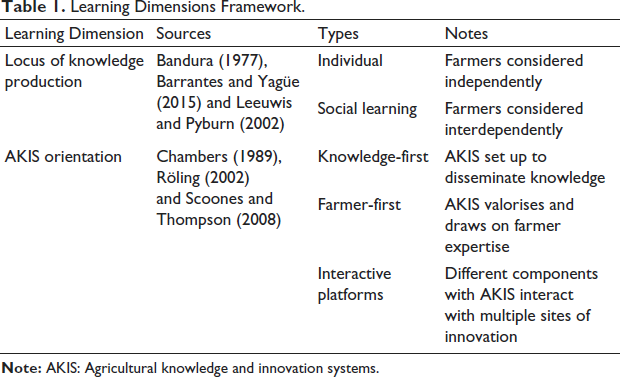
In the second dimension, the AKIS orientation reflects a concern in the literature with the relationship between innovation and application. Traditional AKIS approaches start from knowledge and ask how it can be shared and implemented (push models). Farmer-first approaches start from the needs of groups of farmers and seek to mobilise research and innovation within AKIS (pull models). Interactive platforms arise where there is intentional effort to foster co-operation in both directions (integrated models). Thus, integrated models not only conceive of farmers and researchers as in dialogue but also consider the role of farmers as researchers, generating knowledge of interest to the wider AKIS systems. Within this extension, the focus is not only on what farmers can learn, but also what they can teach.
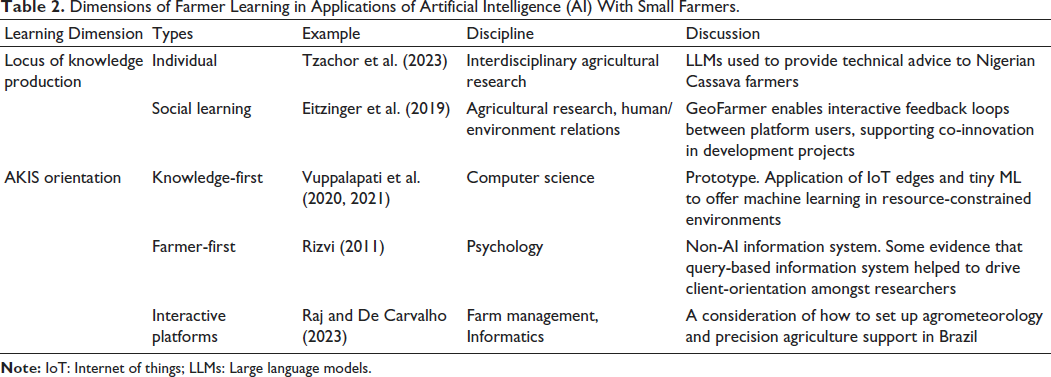
The framework can be applied to real-world applications of ICTs in agricultural extension to distinguish between underlying notions of how learning is organised that are embedded in the application (see Table 2 for examples). Reviewing the rapidly growing literature on AI for agricultural extension (High et al., 2024), several observations can be made: (a) Most of the articles reviewed either deal with more hypothetical applications of AI or more established non-AI ICT applications; (b) the AI applications are concentrated amongst more simplistic forms of learning in the typology and (c) the models of farmer learning assumed by research in information technology and computing tends to be simpler than in other disciplines, emphasising individual, efficiency-focussed learning, with innovation arising from researcher interests rather than farmer needs. This is an ethical issue, as more reflexive, relational and change-oriented modes of learning are seen as the core of an AKIS that enables small farmers to flourish.
As applications of AI gain traction in agriculture and digital connectivity increases, a critical question therefore arises in relation to extension: Can a holistic learning approach be embedded in the development of novel applications of AI to small farmer agriculture? Can AI technologies be used to support (rather than undermine) transformational learning for smallholders? This potential is far from fully realised. In practice, most AI applications in agricultural extension reflect knowledge-first, expert-driven paradigms, which marginalise local knowledge, lack meaningful feedback loops, and struggle to adapt to diverse user contexts (Sambasivan & Holbrook, 2018). In the next section, we discuss the case of Digital Green’s Farmer.Chat to examine the extent to which an example of current practice addresses these questions.
Dimensions of Farmer Learning in Applications of Artificial Intelligence (AI) With Small Farmers.
Case Study: Digital Green, Small Farmers and AI Innovation
Farmer.Chat AI
Farmer.Chat is a generative AI-powered agricultural advisory tool developed by Digital Green and Microsoft Research. It is a generative AI-powered advisory tool, designed to respond to longstanding structural constraints in traditional extension systems; most notably, the chronic shortfall in human resources. In many low- and middle-income countries, the ratio of extension agents to farmers often far exceeds the recommended 1:400, with some contexts reporting ratios as low as 1:1,000 or higher. As a result, the capacity of extension officers to offer regular, personalised support to individual farmers is severely limited.
Governments and development organisations have long sought to address this capacity gap by experimenting with a range of in-person and digital interventions. These have included farmer field schools, lead farmer networks, community radio, PV and mobile phone-based advisory services. While these methods have extended the reach of extension systems, they remain constrained by two major limitations: first, the content requires careful curation and is static, making it difficult to update in real time; second, the communication remains top-down and generic, often failing to respond to the diverse and dynamic needs of individual farmers operating in different agroecological and socio-economic contexts.
The emergence of Generative AI offers a potentially transformative response to these challenges. With its capacity for real-time, multimodal interaction, AI enables the creation of tools that respond to farmers’ specific information needs as they arise, providing on-demand, localised and adaptive guidance. Farmer.Chat is a pioneering attempt to operationalise this potential in a way that aligns with the needs of smallholder farmers in resource-constrained settings. The design of Farmer.Chat is grounded in human-centred and inclusive design principles, tailored for users with low literacy and limited digital experience. The system supports multilingual interactions, allowing farmers to ask questions in a variety of local languages and dialects. Moreover, it accommodates multiple input and output formats (including text, voice and images), thereby addressing the digital literacy and accessibility barriers that often constrain marginalised users.
Under the hood, Farmer.Chat employs an RAG architecture. This combines a curated and regularly updated knowledge base (composed of both structured and unstructured documents) with an LLM chatbot that generates natural language responses based on user queries. The knowledge base includes content vetted by government organisations, including the Ministry of Agriculture in the respective countries where the app is used. For example, in Kenya, the content was provided by the Kenyan Ministry of Agriculture. The curation ensures that recommendations are not only linguistically and culturally appropriate but also locally specific, trustworthy and responsive to rapidly changing conditions. The system also includes personalisation features, which allow for the tailoring of advice based on user location, farm size, crops grown and other contextual variables. This marks a departure from earlier digital advisory tools, which often relied on generalised recommendations that lacked relevance at the farm level.
As of 2024, Farmer.Chat has been deployed in four countries: India, Kenya, Nigeria and Ethiopia. In each country, the rollout has involved collaboration with local extension agencies, lead farmers and service providers, ensuring alignment with existing institutional frameworks. Farmer.Chat supports a diverse set of users (including frontline extension workers, lead farmers, agripreneurs and general farmers), each engaging with the system in different ways depending on their role in the local agricultural knowledge system.
The launch of Farmer.Chat builds on Digital Green’s longstanding work in community-based, participatory extension, particularly its globally recognised PV model (Afroz et al., 2014; Gandhi et al., 2007). Rather than replacing traditional systems, the organisation has consistently sought to amplify and augment them by embedding digital tools within existing social and institutional networks. This legacy has proven instrumental in enabling the uptake of Farmer.Chat, by ensuring a foundation of trust, institutional legitimacy and user familiarity with Digital Green’s participatory ethos.
Methodology
The case is based on data from the first year of implementation of Farmer.Chat, with a focus on deployment in Kenya, the country with the largest current user base. The study uses a mixed-methods approach, combining quantitative platform analytics with qualitative user research to assess usage patterns, user experiences and the learning implications of AI-driven extension.
Quantitative data include: Platform logs covering over 300,000 user queries across 15,000+ users in four countries. Analysis of query content, complexity, clarity and interaction frequency, including LLM-based scoring for query articulation and response accuracy. Response performance metrics such as latency, topic coverage and unanswered query categories.
Qualitative data were collected through: 14 focus group discussions (FGDs) involving 199 participants (116 women, 83 men) across two counties in Kenya (Nyeri and Meru), and 1 FGD with 20 women lead farmers in Uasin Gishu county. In-depth interviews with seven users selected by engagement levels and gender. Usability tests with the same seven participants to observe interaction with the platform in real time. Bi-weekly phone surveys with two rounds of 20 users each (balanced by gender), gathering real-time user feedback from across seven counties.
In addition, shadowing sessions of 6–8 h were conducted with selected users to understand contextual factors influencing platform engagement and trust. These findings were triangulated with system analytics and conversational logs, which were also used to iteratively update the knowledge base and interface design. The data have been interpreted through a learning theory lens using the AKIS framework and typologies of learning (e.g., locus of knowledge production, AKIS orientation). This allowed for an integrated assessment of how Farmer. Chat supports or limits different forms of knowledge exchange, trust-building and user empowerment in agricultural extension.
Learning and Relationships
Farmer.Chat represents not only a technological innovation, but also a form of social and institutional innovation. By embedding generative AI into existing extension systems, Digital Green is actively working to reshape the relationships between farmers, advisors and knowledge systems. The intention is not to replace traditional actors, but to redistribute learning opportunities, reduce burdens on extension personnel and create new pathways for interaction and trust-building.
In many of the countries where Digital Green operates, public extension systems are well-established but chronically overstretched. Extension officers (EAs) face major constraints in delivering personalised advice at scale, often due to high farmer-to-agent ratios and competing administrative responsibilities. Digital Green addresses this challenge by building the capacity of existing extension agents and helping them introduce Farmer.Chat to farmers through local social infrastructure, such as self-help groups, cooperatives and farmer organisations. By identifying and supporting ‘lead’ or ‘model’ farmers within each community, the project enables peer-based support for those without smartphones or digital literacy.
This strategy reflects a shift in the locus of learning. In earlier phases, Digital Green’s PV model enabled relational and social learning, as EAs facilitated group screenings of locally produced videos featuring community members. The medium (familiar faces, local dialects, visible results) encouraged a ‘if my neighbor can do it, so can I’ mindset. The format built trust, and the shared viewing experience enabled discussions and peer validation, moderated by trusted intermediaries.
Farmer.Chat, by contrast, introduces a more individualised learning experience: a farmer can consult the chatbot directly, at any time, to receive personalised advice in their preferred language and format. While this enhances access and autonomy, it can potentially reduce opportunities for shared interpretation, negotiation and feedback, which are key components of social learning. However, Digital Green is actively working to reintroduce relational elements: experimenting with community video content embedded within the chatbot, facilitating village-based Communities of Practice and exploring app-based forums where users can discuss, validate or critique advice received from the chatbot. These emergent structures aim to combine the accessibility and personalisation of AI with the trust and accountability of peer-based learning networks. For example, future iterations may allow farmers to view videos of nearby peers addressing similar challenges or participate in local groups that share feedback on the practical utility of different advisories.
The AKIS orientation of the system (at least in its initial implementation) can be described as predominantly knowledge-first. Content is derived from vetted sources, curated into a structured database and used to generate automated responses. While there is an option for farmers to provide feedback on chatbot answers, uptake has been limited. In practice, few farmers use the feedback feature, and early-stage inputs often revealed gaps in the knowledge base, such as overly technical language, references to unavailable products or recommendations constrained by government regulations (e.g., prohibitions on using commercial brand names).
To address this, Digital Green has shifted focus towards indirect feedback mechanisms: analysing the types of questions asked to detect farmers’ emergent needs, local knowledge gaps and content priorities. This data is now being used to help agricultural departments develop more localised, responsive advisories, for example, by prioritising pest and disease issues that dominate farmer queries.
The evolving use of Farmer.Chat highlights a hybrid model of learning and advisory work. Extension agents continue to play a central role, helping farmers access and interpret advice when needed, and focusing their time on higher-level problem-solving rather than repetitive information delivery. Meanwhile, AI-enabled tools allow farmers to take more initiative, access knowledge directly and even participate in shaping future content.
While the chatbot currently supports mainly individual learning, Digital Green’s future vision is clearly relational and interactive. The ambition is to build a system that integrates diverse forms of knowledge (from research, field practice and community innovation), and creates mechanisms for peer-to-peer exchange, social proof and collaborative problem-solving. In this sense, Farmer.Chat is more than a chatbot; it is an attempt to reimagine the architecture of agricultural learning, using cutting-edge digital tools to support longstanding principles of participatory and trust-based extension.
Outcomes
Early experiences with Farmer.Chat suggest both significant promise and persistent limitations. The platform has shown clear potential to increase the reach, responsiveness and personalisation of agricultural advisory services, while raising new questions about the ethics and sustainability of AI-supported learning systems in smallholder contexts.
One of the most notable achievements of the system is its multilingual, multimodal interface, which has enabled access among farmers with low literacy and limited digital fluency. By allowing users to ask questions and receive answers via voice, text and images, Farmer.Chat has lowered the technical barriers to participation, particularly for those who had previously relied on intermediaries to access advisory services. This is especially important in rural regions where farmers may not read or write in dominant national languages, but can engage verbally in local dialects.
In terms of gender inclusion, the platform’s flexibility has created new opportunities for women to engage directly with extension systems. In many of the deployment regions, cultural norms or household responsibilities restrict women’s participation in group-based extension activities. By enabling private, on-demand access to information, Farmer.Chat has offered an alternative route to agricultural knowledge, one that accommodates time constraints, privacy concerns and mobility limitations. However, persistent gendered access to mobile phones and digital literacy gaps continue to influence who benefits most from the tool, pointing to the need for complementary interventions such as shared devices or facilitated group sessions for women farmers.
Preliminary user experience data collected during the pilot phase revealed generally high levels of satisfaction with the responsiveness and clarity of the platform. Farmers appreciated being able to ask highly specific questions (about pest identification, dosage of treatments or crop selection and so on) and receive timely answers in their own language. Frontline extension workers also reported that Farmer.Chat reduced their burden, especially in answering routine questions, allowing them to focus on more complex or interpersonal challenges.
At the same time, the platform has revealed several important limitations, particularly in its orientation towards one-way communication. While the chatbot is able to simulate conversation, the communication remains largely unidirectional, with limited mechanisms for genuine feedback, reflection or collective discussion. Early efforts to incorporate user feedback through the chatbot interface encountered obstacles, including low rates of response and difficulty interpreting open-ended input. This reflects broader challenges in building AI systems that support relational and social learning, rather than merely delivering personalised information.
Moreover, while the system is designed to scale rapidly, its current success still relies heavily on human facilitation. In practice, farmers often encounter Farmer.Chat through lead farmers or extension agents, who introduce and explain the tool during group meetings or one-on-one sessions. These intermediaries are essential in building trust, interpreting outputs and encouraging repeated use. Without this support, the uptake of the tool (especially among older, less digitally literate or socially marginalised farmers) can be uneven.
These insights raise important ethical considerations. First, they underscore the need for equitable access: not all farmers have the same capacity to interact with AI, and without careful attention, new tools may reproduce or even deepen existing inequalities in access to knowledge. Second, they highlight the importance of accountability: when advice is generated by a machine, who is responsible if it is misunderstood, inapplicable or even harmful? Finally, they point to the limits of technological fixes: while AI can expand reach and responsiveness, it cannot (and should not) substitute for the relationships of trust, care and mutual learning that characterise the most effective agricultural advisory systems.
In sum, Farmer.Chat offers valuable functionality and real impact, particularly in expanding the range, flexibility and timeliness of advisory services. But its success depends not only on algorithmic sophistication, but on its integration into social systems, commitment to inclusivity and alignment with participatory extension ethics. As the platform evolves, its designers and partners must continue to grapple with questions about who learns, who benefits and who decides; and how to ensure that digital tools support not just access to information, but meaningful participation in knowledge creation and use.
Discussion
The Farmer.Chat case study illustrates how AI technologies, if embedded in trusted institutional and social infrastructures, can support learning in smallholder agriculture. However, it also reveals the limitations of current AI-driven models, particularly with regard to feedback, co-creation and ethical inclusion. In this discussion, we reflect critically on the learning theory framework and the ethical dimensions of digital trust, co-production and systemic change. We also identify avenues for future research and development that could support more participatory and transformative uses of AI in extension.
AI to Support Social Learning and Trust
One of the foundational questions raised by Farmer.Chat is: What does it take for smallholder farmers to trust and use AI systems in meaningful ways? Figure 1 presents an example of a hierarchy of trust relationships in agriculture: from family and neighbours (deep, personal trust) to institutional actors such as extension agents and government sources (competence-based or affiliation-based trust), to low-trust, generic media like YouTube or SMS broadcasts. Farmer.Chat enters this landscape as a new actor, attempting to simulate expertise and responsiveness while leveraging pre-existing trust in Digital Green and local extension networks.
Sources of Trust in Rural Kenya.
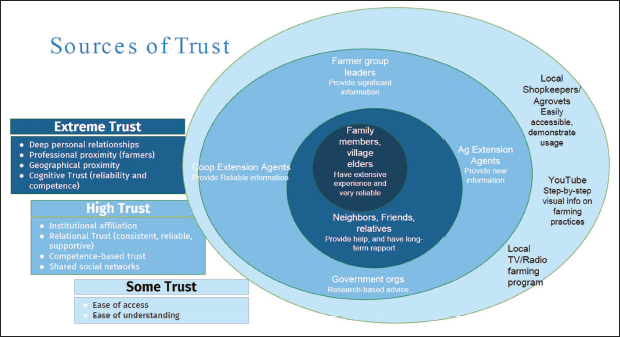
The early success of the platform demonstrates the importance of relational and institutional trust. Farmers are more likely to adopt and return to the tool when introduced by known actors (such as lead farmers or trusted advisors) and when they perceive the advice as relevant, reliable and understandable. The use of local language, multimodal input and culturally proximate examples strengthens cognitive and social legitimacy. However, trust remains fragile, particularly when the system gives unclear advice, uses unfamiliar terminology or fails to account for context (e.g., local availability of inputs).
From a learning theory perspective, this reflects a shift in the locus of knowledge production; from traditional relational and group-based learning, towards individualised access to information, mediated by AI. While this shift enables greater flexibility, it also introduces the risk of isolating farmers from the social processes of learning, such as discussion, peer validation and collective interpretation. To realise the full potential of AI in supporting social learning, systems like Farmer. Chat should be intentionally designed to build in opportunities for dialogue, feedback and co-evaluation both among farmers and between farmers and extension systems.
Institutional and Social Infrastructure for AI-enabled Extension
Farmer.Chat’s early success owes much to the institutional groundwork laid by Digital Green over the past decade, particularly through its PV model. The trust, local presence and digital familiarity established through this earlier work have provided a critical foundation for the introduction of a more complex AI system. Rather than being deployed in isolation, Farmer.Chat is embedded in a web of social relationships and support mechanisms, including training sessions, peer groups and facilitated introductions by lead farmers.
This reflects a broader lesson: AI in agricultural extension cannot succeed without human infrastructure. Advisors, community organisers and farmer networks play crucial roles not only in onboarding users but in sustaining usage, interpreting outputs and encouraging reflection. Without this scaffolding, AI tools risk being perceived as alien, untrustworthy or irrelevant, particularly among farmers with limited formal education or digital literacy.
The Farmer.Chat case also shows how institutional actors can benefit from AI integration. For example, analytics drawn from the system’s usage patterns (e.g., most frequently asked questions, geographic clustering of issues) can help extension officers prioritise content development, monitor emerging issues and tailor interventions. This suggests a future where extension systems and AI platforms operate in mutual feedback loops, each enhancing the other’s responsiveness.
However, this vision remains aspirational. At present, most systems (including Farmer.Chat) are still knowledge-first in orientation. They push out curated advice based on pre-approved content, but struggle to incorporate bottom-up learning, farmer feedback or localised innovation in any systematic way. Moving towards interactive AKIS models will require not only technical adjustments but also organisational and governance shifts; to value farmer knowledge, enable feedback to circulate and incentivise learning beyond mere compliance.
Risks and Opportunities for Developing AI for Smallholder Extension
AI offers powerful new tools for improving agricultural extension, but it is not a silver bullet. The risk is that in a rush to deploy advanced systems, we revert to old paradigms: linear, top-down knowledge dissemination, repackaged in more sophisticated formats. This concern is echoed in our empirical case where farmers often struggle to provide feedback to the system, and where the chatbot’s responses sometimes mirror the same limitations as conventional extension: generic advice, inaccessible language or supply-side assumptions. In Farmer.Chat, the first two (generic advice and inaccessible language) were relatively easy to improve over time; however, supply-side assumptions remain a significant problem.
To avoid this, we emphasise the design of feedback mechanisms that feed into the broader knowledge ecosystem. One promising avenue is the analysis of aggregated user queries, which can highlight emerging issues and support adaptive content development. Another is the creation of peer-learning spaces, whether digital or in-person, where farmers can reflect on the advice received, share experiences and propose improvements. AI systems can facilitate such interactions, but only if they are built with the capacity to observe, learn and mediate relationships, not just serve content.
On the positive side, AI has the potential to transform extension into a more inclusive, responsive and dialogical process. The ability to ingest and synthesise vast, diverse data sets (from scientific research to field-level observations and community knowledge) can support a much richer understanding of farmer needs. Used ethically, machine learning could support early detection of crop threats, geo-located matching of farmers facing similar problems, or even micro-level climate advisories. But these innovations require a commitment to co-creation, governance and shared ownership, and a clear rejection of extractive models that treat farmers as data sources rather than as partners.
As Europe and other regions look to digitise their extension systems, lessons from Farmer.Chat are instructive. The challenge is not merely one of infrastructure or algorithmic accuracy, but of ethics, trust and learning. AI should not just do old things better, it should help us reimagine what extension is for, how knowledge is produced and who gets to participate in shaping the future of agriculture.
Conclusion and Research Agenda
This article has explored the potential and limitations of AI-driven advisory systems in supporting learning and innovation among smallholder farmers. Through the case of Farmer.Chat, we have argued that generative AI tools (when embedded within trusted institutional and social infrastructures) can significantly improve the reach, relevance and personalisation of agricultural extension. Yet, we also suggest that without careful design and ethical grounding, such tools risk reinforcing top-down, extractive and one-way models of knowledge dissemination. While Farmer.Chat improves access to information and automates repetitive advisory tasks (efficiency-focused learning), its true potential lies in helping farmers not just to do things better, but to rethink what should be done (transformational learning) in light of their own goals, values and lived contexts. Moving from information delivery to facilitating learning requires an AI system that supports dialogue, co-creation and reflection.
Crucially, the ethics of such systems are not just a matter of data privacy or algorithmic bias. They concern the democratisation of knowledge production; who defines what is valid knowledge, who contributes, and how feedback and adaptation are enabled. Trust, peer relationships and social infrastructure remain central. But they matter for more than easing pathways for adoption, they are essential for building a richer and more diverse AKIS, where AI-based chat can operate as a medium for relational and social learning as well as individual interaction.
To realise the full promise of AI in agricultural extension, future research and system design could address the following questions: How can continuous feedback from farmers be embedded into AI-agriculture interfaces, and how can this feedback be used meaningfully by extension systems? How can AI tools better support relational and social learning, enabling collective sense-making, peer dialogue and shared adaptation? What mechanisms and governance models are needed to include farmer-generated and community-based knowledge in the training and updating of AI systems? How can these participatory and ethical models be adapted and scaled in other contexts, including European extension systems, where digital infrastructure may be stronger but a grassroots collective ethos often remains underdeveloped?
By addressing these challenges, we propose to move beyond a narrow focus on technological efficiency and towards a vision of AI as a tool for inclusive, adaptive and farmer-centred knowledge systems.
Footnotes
Acknowledgements
The authors would like to thank Vineet Singh, Chief Technology Officer at Digital Green, for the quantitative data and analysis used in the case study that we present, and Zsuzsanna Artner for her assistance with compiling the references for this article from the different draft materials.
Declaration of Conflicting Interests
The authors declared no potential conflicts of interest with respect to the research, authorship and/or publication of this article.
Funding
The authors disclosed receipt of the following financial support for the research, authorship and/or publication of this article: The authors would also like to acknowledge support through funding from NKFIH, Hungary, for the project ‘Embodied leadership for improving supply chain performance and relationships’ and a research travel grant from the Centre for Social Studies at Linnaeus University.
