




Abstract
The idea of education being a transformative force is central to the discourse of education. But with the evolution of societies at a rapid pace, the idea of education being a ‘public good’ stands challenged and needs to be further analysed in relation to contemporary societies. This article argues that the understanding of public goods stemming from the discipline of economics is inadequate to define the needs of the contemporary education systems. The article highlights that the idea/element of ‘social justice’ is central to understand the concept of education as a ‘public good’, and even though Indian policies on education have an element of social justice, the practice of it needs reimagining. Building on evidence from the ‘Bihar Mentorship Project’, which was an action research project at the Centre for Budget and Policy Studies, Bengaluru, the article establishes that ‘critical pedagogy’ can become a vital tool to actualise the idea of social justice in education systems and, hence, is at the core of imagining education as a ‘public good’.
Context and Background
Education has often been conceptualised as a transformative force for both individuals and society (Williams, 2016). Owing to the transformative nature and acknowledging the state’s responsibility in ensuring such transformation, education has been conceptualised as a public good by many scholars and international organisations (Locatelli, 2018). Since the 1990s, international organisations such as UNESCO reaffirmed the idea of education being a public good by highlighting the humanistic vision of education, the SDG 4 of the 2030 Agenda for Sustainable Development also aims at the same and once again highlights the role of the state in providing education to its citizens (Locatelli, 2018).
The discourses prevalent in the field of education, especially post the neoliberal era, are in direct contestation with the idea of education being a public good. This is because although the public good argument of education has multiple interpretations, it is largely structured around the idea of state’s responsibility of providing education (Locatelli, 2018). But with the rising privatisation of education, the state’s shrinking role has been under scrutiny and, therefore, requires closer attention. The field of economics is often used as a reference point to explain the idea of ‘public good’. This article takes the argument of public good as defined in the field of economics and looks at its applicability to education in the case of India, especially in the context of the increased segregation in education, where students belonging to the most marginalised sections can afford (both monetary and cultural capital) to go to only public educational institutions and schools, while the choice between private and public is more readily accessible to the more privileged sections. The article problematises the idea of education as a public good from the economic perspective and how it can be extended to a more humanistic definition to include some of the key elements like social justice. The last part of the article focuses on how critical pedagogy can act as a tool for furthering social justice, especially in the government schools of the country where students from marginalised backgrounds are concentrated. The case of an action-research programme called Bihar Mentorship Project (BMP) is used to illustrate this.
The Discourse on Education as a Public Good
The economic understanding of public good is based on two key principles, a good can be classified as a public good if it exhibits ‘non-rivalry in consumption and non-excludability in access’ (Anomaly, 2018), meaning that no one can be restricted from consuming them and the consumption by one individual does not lead to the reduction for someone else’s consumption. Scholars argue that with the rise of neoliberalism, the idea of education as a public good has eroded significantly as the aim has become to maximise economic gains which in turn lead to the entry of many businesses based performative measures such as the ranking system of schools, cost reductions in education which turns education rivalrous and, hence, deviating from the idea of education being a ‘public good’ (Broom, 2011). While, on the one hand, increased privatisation leads to exclusion and challenges the idea of ‘public good’ by creating a problem of ‘choice’ where the choices to avail education are expanded, but only for those who are in a position to afford that choice and excluding those on margins, adding to further marginalisation.
We argue that the need to unpack the idea of public good in education is essential and in doing this, the idea of public good needs to expand beyond what is defined traditionally in economics. We build on the arguments by Samuelson (1954) and Olson (1965), who addressed the characteristics of public goods and stated that a general optimal economic solution to the problem of public goods does not exist; an ‘ethical and political judgement’ rooted in the analysis of the socio-political dimensions is, therefore, essential to understand the conception of a public good (Ver Eecke, 2008, p. 113, as cited in (Locatelli, 2018)). In connection to this, it, therefore, becomes essential to define the constituents of education as a public good, which goes beyond the debate between public and private.
Broom puts the concept of public good in a rather interesting fashion and argues, ‘The public good is, in short, an “imagined” space and conceptual structure that is constructed through discussion and that is fostered through developing awareness, actions and belief within it’ (Broom, 2011, p. 5). We argue that the idea of education as a ‘public good’ should have principles of humanity and social justice at its core with an evolved understanding of the role of the state-sponsored educational institutions. Derived from the humanistic approach towards education, this idea places people and their relative positions in society at the centre of education, ensuring enhancement of human development, well-being and dignity as the ultimate goal of education as a ‘public good’ (Siddiqui, 2018). Therefore, the State has a fundamental role to play in ensuring that there are ample educational opportunities for everyone, especially in countries where inequality is rampant (Locatelli, 2018); in addition, the state also ensures that the conception of education as a public good is also intrinsically linked to the idea of social justice.
Ensuring the availability of education to all citizens then becomes an important aspect of social justice and is a critical element in the conception of education as a ‘public good’. Education if approached from the lens of social justice should then look at equitable distribution of both the resources and the opportunities to everyone, while acknowledging the cultural and social contexts of the citizens so that the inequalities in the society can be tackled.
Education as a Public Good in India
The concept of social justice is even more significant for a country like India owing to the existing inequalities. The Constitution of the country puts social justice in its framework; Article 46 of the Indian constitution states that, ‘The State shall promote, with special care, the education and economic interests of the weaker sections of the people and, in particular of the Scheduled Castes (SC) and Scheduled Tribes (ST), and shall protect them from social injustice and all forms of social exploitation’ (Lalengkima & Ralte, 2021). Recent developments, like the Right to Education Act, 2009, and New Education Policy (NEP) 2020, have reiterated the state’s perspective on education and its central role in ensuring social justice. The Right to Education Act (RTE), 2009, makes education a fundamental right of every child between the ages of 6 and 14 and makes it an obligation of the state to ensure that every child between the ages of 6 and 14 receives compulsory, quality and free education (RTE, 2009). Similarly, the most recent policy document on education in India, i.e., NEP 2020, states that
Education is the single greatest tool for achieving social justice and equality. Inclusive and equitable education – while indeed an essential goal in its own right - is also critical to achieving an inclusive and equitable society in which every citizen has the opportunity to dream, thrive, and contribute to the nation.… (Govt of India, 2020, p. 24)
Education as envisaged by the Indian policies definitely reflects elements of social justice, but the reality seems to be far from this. Various studies have highlighted that despite the rights-based policies of education in India, there remains high levels of inequality even to access basic education among several social groups, religious groups, economic groups and girls (Borooah, 2017; Saluja, 2022; Tilak & Choudhury, 2021). The educational attainments among the social groups, ST, SC and Muslim populations still lag behind as compared to other backward class (OBCs) and upper caste Hindus (Varughese & Bairagya, 2020). Exclusion is also seen in the experience of education by the marginalised communities which goes beyond access. Even for those who find access to these institutions, the practice of education, especially in terms of its quality and inclusive parameters, often excludes people from marginalised identities to meaningfully participate, share ideas, drive discourses and take their learning forward, thus hindering the basic idea of social justice education (Bhatty et al., 2014). This exclusion is further exasperated by the increasing privatisation that the Indian education system has been witnessing over the past few decades. Contrary to the idea that privatisation should expand educational choices for all, the unregulated for-profit private sector within the education domain in India has led to a further restriction on choices, as ‘choice’ is not just a function of financial capital, but also socio-cultural capital which restricts most (especially the deprived sections) from accessing and benefitting from private educational institutions in India (Jamil et al., 2012).
In the context of this discussion, one thing which becomes evident is that ‘social justice’ finds its place in the education policies of the country, but the practice of it needs to be re-imagined. The role of the state remains crucial to ensure that the practice of social justice in education is actualised not only in state-provided education but also education imparted by private providers. The next section takes the practice of critical pedagogy as a tool and argues how critical pedagogy can help in achieving the goal of social justice in education.
Linkages Between Education as Public Good and Critical Pedagogy
The discussion regarding the characteristics of education as a public good can be extended to explore the potential of critical pedagogy as a mechanism for ensuring that the most crucial aspect of education as a public good, namely social justice, is actualised. This is particularly salient in the Indian context, where social hierarchies play a significant role in determining access and the experience of education, and where historically marginalised communities, such as Dalits and Adivasis, continue to face exclusion and marginalisation (Mander, 2021). But before delving more into the relevance of critical pedagogy as a tool for fostering social justice in the Indian education system, we discuss the linkages between social justice and critical pedagogy, borrowing heavily from the discourse on social justice education.
Social justice is a multifaceted concept that has been defined and interpreted by various scholars and social theorists. At its core, social justice seeks to address and redress social inequalities and injustices, particularly those that stem from systemic discrimination and oppression (Young, 1990). In connection to this, Amartya Sen’s work on social justice is of particular interest, as he defines social justice as the removal of ‘unfreedoms’ that prevent individuals from realising their full potential and living a dignified life (Sen, 1999). Sen strongly advocates for a more enabling role of the state to foster capabilities in individuals, especially those belonging to the less privileged sections, in order to enable them to access and reap the benefits of the upward developmental trajectories that countries like India have been party to. When capabilities of such individuals and communities are enhanced and paid attention to, it can pave the path to social justice.
Social justice, therefore, can be seen as a framework for addressing social inequalities and promoting fairness and equal opportunities for all individuals in society. Although the path to do this involves challenging systemic discrimination and oppression, removing unfreedoms and barriers that prevent individuals from realising their full potential, and promoting basic human rights. In identifying this path, critical pedagogy becomes an important tool, especially when we talk about social justice in education. Social justice through education, thus, involves ensuring that all students have equal access to quality education, regardless of their caste, race, ethnicity, socio-economic background, gender or other factors that may disadvantage them. It also entails creating an environment that fosters equity, inclusion and respect for diversity.
Critical pedagogy is intimately linked with social justice, as it seeks to challenge systems of oppression and inequality by empowering learners to become agents of social change (see Figure 1). As Freire (1970) notes, critical pedagogy aims to ‘discover how to participate in the transformation of the world’. By creating a student-centred, collaborative and culturally responsive learning environment, critical pedagogy seeks to promote equity and social justice both inside and outside of the classroom. By promoting critical reflection on the social and political context of education, critical pedagogy can help learners to challenge dominant discourses that reproduce inequalities and discrimination (Kumar, 2015). This is particularly relevant in the Indian context, where the education system is often shaped by dominant cultural and social norms that exclude certain communities and reinforce social hierarchies (Chakrabarti, 2017).
Conceptual Framework on the Linkages Between Education as a Public Good, Social Justice and Critical Pedagogy.
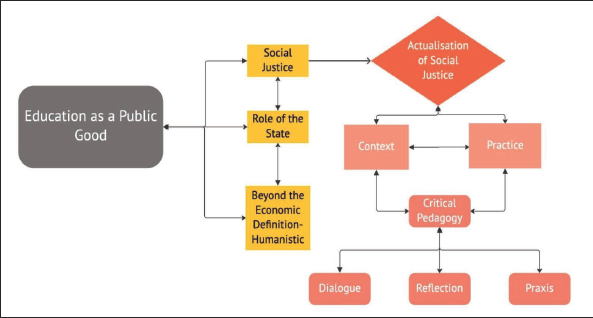
In critical pedagogy, dialogue is an essential part of the learning process. According to Paulo Freire, dialogue is a means of actively involving students in their own education by limiting teacher talk and encouraging learner voice (Freire, 1970). In addition to this, a dialogical classroom can also create a sense of belongingness amongst the participants (both learners and teachers). This in turn enables the co-creation of a safe space and comradery which is crucial for learning. The goal is to create dialogue that is based on relationships between individuals and their communities. This means that the context in which the dialogue takes place is as important as the dialogue itself. Dialogue establishes a symbiotic relationship, knowledge is co-created where the teachers listen to their students and learn about their problems and encourage questions that raise the learners’ understanding of these problems from a societal perspective (Degener, 2001). Dialogue is, therefore, intrinsically connected to both reflection and praxis because by following classroom processes where learners can share ideas and experiences, question assumptions and challenge dominant narratives, dialogue encourages critical thinking and reflection. Reflection in critical pedagogy is a method of critical inquiry and self-examination that allows individuals to question their assumptions and beliefs in order to find meanings of their lived experiences and to develop a deeper understanding of themselves, others and the world around them. It is, therefore, a process of active engagement with the world, in which individuals critically examine the social, cultural and political contexts in which they live. By reflecting on their experiences, learners can identify the ways in which these contexts shape their knowledge systems, beliefs, values and actions. While reflection and taking action are at the core of critical pedagogy, it is praxis that bridges the gap between the two. In simple words, praxis is the process of applying critical thinking and analysis to one’s experiences and then taking action to effect change.
Contextualising the Implementation of Critical Pedagogy for Social Justice: A Case Study of the Bihar Mentorship Project
This section employs dialogue, reflection and praxis as analytical tools of critical pedagogy to explain how the BMP—an action-research programme implemented in government schools in Bihar—not only effectively implemented critical pedagogy but also demonstrated positive impact on the two fundamental systemic barriers to social justice and quality education in India, namely caste and gender. To fully comprehend how BMP managed to work towards this, it is imperative to first understand the context in which BMP was implemented because on whom the methodology of critical pedagogy was ‘practiced’ is extremely relevant to the subject. The foundations of critical pedagogy (as mentioned above) as a tool for social change lies in the principle of providing a platform to those who have been previously excluded to think about their situations, contribute to the discourse and actively participate in social change, and BMP sought to do exactly this by working with marginalised children in rural and peri-urban government schools of India.
Bihar Mentorship Project and the Context of Implementation
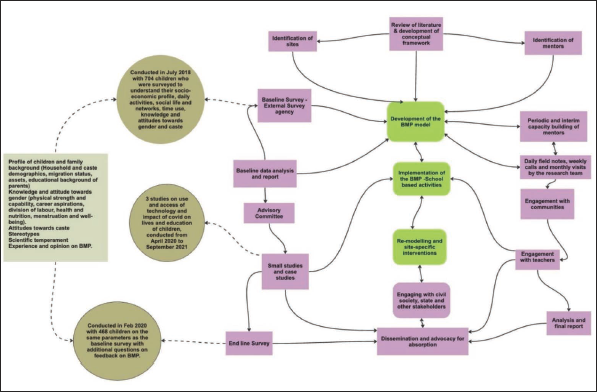
The Centre for Budget and Policy Studies (CBPS) undertook the implementation of an empowerment-based mentoring model for adolescent girls and boys in eight government secondary schools, one government senior secondary school and one NGO-run secondary school located in one peri-urban block of Patna and one rural block of Muzaffarpur, Bihar. This was a four-year (2018–2021) long action research which consisted of three modules that were specifically curated for around 755 children studying in grades six to nine as well as training of teachers on various aspects of critical pedagogy like contextual learning, the importance of dialogue, to name a few. Focus was given to understanding the familial and social backgrounds of the students with whom the action research was practiced, and, therefore, building community relationships was at the core of the BMP framework and pedagogy. In order to implement this, two mentors were employed to visit and work in 5 schools each. The mentors were extensively trained on the pedagogical underpinnings of BMP, which was based on critical pedagogy with strong leanings towards feminist pedagogies and on the context of the learners and the school environment. In 2019, when schools were closed due to Covid, BMP translated from a school-based action research to a distance-based intervention called ‘Learning through Letters’ (LtL). The reason why the framework of an action research was adopted was that the research would be able to enable an understanding of the process of change, the successes and the failures in addition to measuring any impact of the programme. Perhaps, most importantly, the research was designed to inform the direction of the modules and related interventions.
The research methods (see Figure 2) used were both qualitative and quantitative tools. Before the work in school started, there was a baseline survey of all children, which was followed by an endline 1 survey at the end of year three of the programme. The mentors practiced thick descriptions by taking extensive notes based on a framework that allowed them to describe the actions and processes undertaken along with critical observations related to the process and the impact of BMP. Researchers who were trained in not just research methods, but also had a deep understanding of the intersection of critical pedagogy with social justice, visited the schools and neighbourhoods at regular intervals (every week) extensively documenting their experiences through field notes.
Description of Research Methods and Processes Followed in BMP.
The selection of co-ed government schools in BMP was a deliberate choice made by the research team because most children enrolled in these schools belonged to socio-economically marginalised sections, with a high population of girls. This reflected the ghettoised nature of the Indian education system where families with even marginal disposable income prefer sending their children to private schools, and this preference is more often than not, shown to only boys. The schools themselves had a resource-poor environment and often struggled with shortages of infrastructural and human resources. It was not unusual to see classrooms without enough chairs and tables for children or multigrade classrooms due to shortages of both classroom space and teachers.
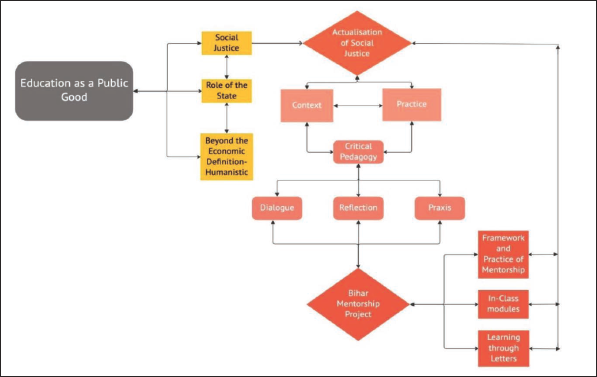
Therefore, from the lens of social justice and context of implementation, these schools and children provided an ideal space to practice BMP for several reasons. Firstly, the marginalised socio-economic backgrounds of the children who were mostly girls and first-generation learners established the need for critical pedagogy in classroom processes and their experience of education. Secondly, these were adolescent children who had just started to think about social norms around caste, gender and its intersectionalities; and thirdly, there was a need for the schools and teachers to witness and participate in pedagogic practices that were primarily inclusive in nature. The practice of BMP, therefore, was fundamentally rooted in the practice of dialogue, reflection and praxis through the tools of mentorship, the in-class modules and the intervention of ‘learning through letters’ (see Figure 3).
Conceptual Framework on the Linkages Between Education as a Public Good, Social Justice and Critical Pedagogy in Relation to BMP.
The Framework and Practice of Mentorship
The very idea of choosing mentorship over teaching can be seen in connection to Freire’s critique of the traditional view of education, which he calls ‘banking education’. The banking system of education, as the name suggests, views and treats learners as passive receivers of knowledge and creates a hierarchy of authority within the classroom, where the teachers are the sole repository of knowledge, and, hence, their primary task is to impart knowledge, while it is the student’s task to receive without questioning. Freire argues that the banking system of education reinforces the status quo, perpetuating social hierarchies and preserving the power of dominant groups. It also creates a culture of silence in which students are discouraged from questioning authority or challenging dominant ideologies. In this sense, the banking system of education serves to maintain the subjugation of the oppressed. On the other hand, mentorship when based on the tools of dialogue, reflection and praxis can serve as an alternative as it allows for education to be a truly collaborative process in which both teachers and students are active participants, engaging in critical thinking and reflection through dialogue and praxis. This was especially relevant for BMP as the classrooms consisted of students who were mostly girls from Dalit, OBC and Adivasi backgrounds as mentioned above.
The mentorship framework employed in BMP aimed to establish an environment conducive to fostering positive relationships. It sought to facilitate a form of learning that extended beyond academic accomplishments, while also nurturing individual and collective identities for both students and teachers. This approach intentionally differed from conventional and prevalent social norms. Through the mentor–mentee relationship, both parties engaged in an interactive process that fostered exchange of ideas and perspectives, rooted in the concept of a dialogical classroom. In order to facilitate this, the mentors in the classroom encouraged questions, debates, disagreements and allowed students to co-create the classroom as a safe space where they could freely express themselves and their emotions. Right from the start of BMP and as the programme matured, it was clear that the strength of the mentorship lay within the relationships of trust that the mentors built with the students and this could be done only when the mentors understood the backgrounds of the students and their points of view, thus again re-establishing the critical link between context and practice in critical pedagogy when done from a social justice perspective. Therefore, the mentors were encouraged to spend time in the neighbourhoods where the students came from, interacting with their parents and members of their communities. The idea was for the mentors to be invested in the values of social justice that formed the soul of this entire process and relationship of mentor and mentee.
Care was also taken within BMP for mentorship not to be seen as something that was completely opposed to teaching but as a pedagogical tool that could be assimilated within the teaching–learning processes of these schools. This enabled the teachers to see the mentors as allies and made them more amenable to adopting some of these aspects of mentorship within their classrooms which added to the process of assimilation. This was most eloquently described by one of the teachers who said that it was through BMP that he learnt that an ideal classroom is one where the teacher speaks the least and the students speak the most (CBPS, 2022). He connected this to his classroom where most of the girls belonged to marginalised and minority backgrounds and were often subjected to a culture of silence both at home and school.
The In-class Modules
Three in-class modules were developed for BMP. The first module was on communication and communication skills, the second module was on knowledge and caste and the third module was on gender and inequality. We will restrict discussions only to the first two modules as the third module could not be implemented due to the disruptions caused by the pandemic. But before we do that, it is important to note that all three modules were not developed at once, or even at the beginning of the programme. This was done deliberately to abide by the principles of co-creation of knowledge, which ensure that learners are not just active participants in the creation of knowledge but also agents that drive the need and direction of knowledge production. Therefore, the data from the research, i.e., the baseline survey, classroom observations and reflections on the classroom processes by the mentors and researchers, were all triangulated to decide the main thematic area, content and the mode of delivery of all the modules.
The first BMP in-class module was around the theme of communication. This was also informed by the need to inculcate the practice of dialogue within the classroom space which was not just essential for critical pedagogical practice, but also for the successive modules to be implemented. Therefore, the content of the first module was centred mainly around activities that encouraged children to get to know each other better, be comfortable with themselves and the mentor, and develop a sense of collaboration through group activities. Once children were oriented towards these, the module gradually progressed to more critical reflections like—what is communication? What is the importance of communication in different situations? The activities also moved towards a mix of praxis and reflection, where students were asked to interview their teachers and share their thoughts regarding it. In another activity, the students were given questions that needed to be answered through conversations with their friends and family members regarding how their close ones perceived them. The idea behind this activity was to enable students practice structured conversation, but also for them to get an understanding and reflect upon how others perceive them and how that forms a part of their self-image and identity. This activity was consolidated through a self-reflection exercise where children had to either think, discuss or write about the things they liked and disliked about themselves. Communication of emotions was also seen as critical in BMP, and children were encouraged to learn not just how to communicate their emotions but also reflect upon their emotions through various self and group-based activities.
The second module which was on caste and knowledge systems was again developed on the basis of the baseline survey, classroom observations and interactions with children which showed that there was a need for children to not just reflect and question the norms within which they functioned, but to also gain an understanding of the systemic oppressive structures like caste and its close association with the manner in which they are implicated in the construction of particular knowledge systems. Informed through the rigorous research, it was clear that if students were to be oriented to question the existing form of knowledge that they possessed and held to be the only truth, they had to first understand what knowledge was, how it is created, who holds knowledge and how it is controlled by and for the dominant communities. This was done gradually, BMP classes in this module started with activities and discussion on how the senses work and how the brain processes visual and non-visual cues, how memory is constructed and how the mind works. This was taken forward by content that made children reflect upon the ways in which we associate knowledge with people and their identities, and how that can be challenged to new ways of thinking about sources of knowledge, the hierarchy of knowledge and the access to knowledge. Understanding and questioning stereotypes and understanding the concept of facts and opinion also formed an important component of this module, and through this, the connection between caste, gender and knowledge systems was introduced in BMP classes. In terms of praxis, apart from the class-based activities, this module allowed students to conceptualise, direct and present a play based on caste discrimination to the entire school. The students were given a few scripts based on the theme of caste, but the ending of the story/narrative was absent from the script. The students had to take the script forward, re-write it in ways that they wanted, collaboratively work towards choosing and distributing the various roles required in the production of the play and then present it to their peers and teachers. This activity was designed as a culmination of all the dialogues, reflections and activities that the children were exposed to on knowledge, caste and the intersectionality of gender.
The practice of this module was particularly interesting because it offered children several things: (1) the space to think about their own lived experiences of dealing with gender-based discriminations and marginalisation associated with their caste and class, (2) understand or even start a conversation regarding social norms and (3) most importantly, gave them a sense that a thinking practice is connected to both social action and social justice.
Experience, Reflection, Action and Consolidation (ERAC)
All three modules of BMP and also the postcards for LtL were structured around a delivery model called ERAC. 2 In its expanded form, ERAC stands for experience, reflection, action and consolidation, and this is the same order in which the BMP classes were structured and delivered. The decision to use ERAC as the framework for delivery of BMP was made after the first module was implemented and qualitative data from observations and field notes were analysed; this led to two critical conclusions: (i) the children even if coming from homogenous socio-economic backgrounds had varied learning levels, interests and abilities; therefore, there was a need to make BMP more relevant for them if we were to build the foundations of a participatory space which children can use for their expression and emancipation; (ii) children were not used to engaging in the process of knowledge creation, at least within the classroom space. In other words, because the children were habituated to being instructed by the teachers, they saw themselves as mere receivers of knowledge and never thought about questioning it. Keeping this in mind, BMP had the tough task of getting children to be engaged in the classroom processes as equals and not as obedient objects to authority. Therefore, there was a need for classroom processes that would facilitate more active participation and questioning.
The framework of ERAC allowed for this. All classes would start with a small primer, which would orient the children to understand what the rest of the class would be like. At the stage of the primer itself, children were encouraged to ask questions, share their experiences and link what they had learnt in previous BMP classes. This was followed by a session on experiences. The experiences that were evoked during these sessions were mostly connected to the theme/topic for that day; for example, if the topic was nutrition, then children were asked to talk about what they had eaten for breakfast, lunch, what their favourite foods were. This was to ensure that children could relate to the topic, and also get a sense of confidence that they were not coming in empty handed. The idea was to assure them that they had some existing knowledge about the topic and they had things to contribute to the class based on their experience. The next stage was to make children reflect upon their experiences; this was usually done through what Freire calls ‘problem posing’. To trigger the process of reflection, the mentors would pose certain questions to children based on the experiences shared by children and ask them to think about it. Again, if nutrition was the topic, and the experiences shared by children were around foods that are consumed during festivals or special days, they were asked to reflect upon why certain kinds of foods are consumed on those days, who eats what and why, who eats first, who eats last, who serves the food to whom. Once students had time to reflect, they were asked to perform particular actions, based on their reflections; this in a way was again guided by the idea of ‘praxis’ in critical pedagogy. The action also differed from student to student, based on their inclination towards the ways they wanted to express and need for expression. So, children would either talk about what they thought, have a group discussion, write about it or draw about it. The classes ended with consolidation, which could also take various forms, like debates, songs, dance, write-ups, but it was driven by the idea that the last part of the class would allow students to really think through what they learnt, how was it relevant for them, how could they take the learning forward. In sum, consolidation sessions allowed for children to really unpack the entire BMP class and take what was most relevant for them.
BMP, therefore, was a mix of structured and unstructured learning, as the objectives or the learning objectives were never pre-defined. As a result, even though the classes were on the same topic in a particular week in all schools, the structure of the classes and the key takeaways for children and mentors always differed. The mentors were not asked to treat the modules as curriculum or syllabus, they were trained to respond to the needs of the children and, therefore, even if a particular topic was advised to be finished within two classes, it was at the discretion of the mentors and the children if they wanted to extend it. This not only allowed for contextual learning but also participatory learning, which is at the heart of critical pedagogy and connected to social justice as it offered children the opportunity to break away from the banking system of knowledge production to co-create the knowledge that was relevant and of interest to them.
Learning through Letters (LtL)
The LtL initiative was a response to the school closures during the pandemic. Much like the in-class modules, LtL was also guided by the research and understanding of the contexts and needs of students. Initial research done during the first phase of the pandemic had clearly shown that the children had very little access to technology like mobile phones, and the girls had the least access. Moreover, the children and their parents had also expressed concerns regarding learning loss, and lack of support for learning. While the need to continue the mentoring for children was clear, the team also realised that the same module that was prepared for classrooms would not work in distance mode, and thus started the process of designing ‘learning through letters’.
These letters were in the form of postcards that were sent twice a week to all children and their teachers. The postcards were written in such a way that even though they were common for all, the language was made to seem personal and in first person. Since mentors were most familiar with the children, the cards were sent in their names. The content of the cards was designed in a way that would allow for contextual learning and also enabled the children to take the learning forward in ways that they wanted. The ERAC framework was extensively used in the postcards as well. The team, through its experience on working in open and distance education, knew that learner motivation and reduction of transactional distance were essential. Since the children were not trained in self-learning, the concept had to slowly be introduced to learners. The content also needed to be based on the needs of the children. Therefore, the mentors also started calling the children regularly (whoever was accessible through phones) to understand what the children wanted to learn about. This process enabled to curate content that was relevant, based on the needs and interests of children, but which also had other elements of critical pedagogy such as reflection, dialogue and praxis. For example, the team found that the children were overwhelmed by the pandemic and understandably so. They were also flooded with misinformation around Covid. In order to respond to this need, the first set of cards were created to understand the science behind viruses and bacteria.
Dialogue was encouraged in multiple ways; children were asked to hold conversations with their families and friends regarding various topics. For example, one activity asked the children to have conversations with older members of their families regarding epidemics that they had witnessed. The idea was that it would enable children not only to understand these phenomena better, but it would also foster a sense of security and a history of these phenomena. Other ways in which dialogue took place were through regular calls with mentors, WhatsApp groups 3 and, most importantly, through the postcards themselves. All children received a blank pre-stamped card along with the learning card. The CBPS address was printed on the card and, therefore, children were asked to respond by writing or drawing whatever they felt like expressing. The team received several of these cards in which children expressed themselves differently, some sent their drawings, some wrote songs and poems, while some just wrote a simple ‘thank you’.
Similar to the modules, the cards were not pre-designed but had a spiralling, transdisciplinary approach. Once the children were used to receiving and learning from the weekly cards, the content of the cards also started to introduce and reintroduce concepts and topics such as gender, epistemology of knowledge and environmental justice to name a few. Children were encouraged to take action through dialogue and critical reflection. For example, to highlight the fact that all women and men are not the same, and that all women and men do not have to dress similarly, pursue similar ambitions or even conduct themselves in similar ways, were challenged through short stories and poems. Once this was done, the next set of cards asked children to draw themselves using various colours in the ways they saw themselves. The diverse ways in which children imagined and represented themselves through the drawings showed that they had started to engage with the idea that not all individuals are similar by virtue of their gender and, therefore, social norms that restrict and compartmentalise ‘ways of being’ should be reflected upon. This was again a small step towards social justice through the critical pedagogy used in BMP. We talk more about the impact of BMP in the next section by taking two critical areas of impact which also had high resonance with social justice—gender and caste.
Impact 4 of the Bihar Mentorship Programme (BMP)
We use the data collected through the baseline, endline surveys in addition to the qualitative data from the notes written by mentors and the research team to demonstrate the impact of the programme on gender and caste.
Impact on Understanding and Attitudes Towards Gender
The impact on the ways in which children thought about the construct of masculinity and femininity and the social norms that guide these constructs was visible not only through the quantitative data collected but also during the classroom processes. To present one instance, in one of the classrooms, mentors noticed an intense conversation amongst the girls regarding the use of lipstick. The girls had clearly taken two sides, one which policed the other girls for wearing lipstick on the grounds of morality and good character, while the other group asserted their independence to choose and express themselves in ways that they desired. While it might seem that the girls had started to capitulate to the social norms around beauty, the differential positions that the girls took against authority figures banning displays of ‘make-up’ also indicated the complicated relationship between preference, choice, identity and voice that was starting to be obvious in these spaces.
The impact of these critical reflections and dialogues was visible when the baseline data were compared with the endline data on questions related to gender and the knowledge of gender-related issues. When asked if the statement that only fair women were beautiful, more than half of the children (girls a little more than boys) said that the statement was false. The data also showed a greater awareness of children regarding topics of gender that were critical but considered taboos, like menstruation and menstrual superstition. In fact, about 70% of boys during the baseline said that they did not know what menstruation was; this number had reduced to about 30% during the endline.
A strong shift was also witnessed in the ways in which children thought about gender roles. Children were often seen to debate the role of men in household chores or the ways in which women should or should not dress. Questions around gender roles in the endline survey also showed a change in perspective. When asked about the suitability of non-traditional occupations based on gender, like playing professional cricket for girls or being a nurse for boys, the endline data showed a more open and supportive perspective from both boys and girls. While in the baseline, more than 60% of boys and 40% of girls were opposed to the idea of a man taking nursing as a career choice; this number reduced to 40% for boys and 30% for girls during the endline.
In terms of gender capabilities, like academic performance and physical strength, a change was seen in the perception of students, as more students stated that men and women were both capable of academic excellence and physical endurance. Interestingly, this trend was mainly driven by the changes in perception that the girls shared. More significantly, mentors documented conversations with girls who wanted to delay their marriages because they wanted to study further, and had started communicating with their families better when it came to self-expression.
Impact on Understanding and Attitudes Towards Caste
The impact on attitudes towards caste was clearly visible when children were asked if, after the age of 18, girls were free to marry whoever they wanted irrespective of caste, religion and class. A significant shift in this belief was seen from baseline to endline, where a majority of the boys (67%) during baseline said that women did not have a choice in marriage, but during the endline, about 54% of boys agreed that women were free to marry irrespective of caste considerations. Interestingly, the responses of the women largely remained the same during baseline and endline, although minor shifts were also seen in their responses. About 62% of women during the baseline said that women do not have such freedoms, and this number remained at 52% during the endline also, perhaps reflecting a larger reality of restrictions that are imposed on women when it comes to marriage exogamies and caste. This also indicated that the girls were largely aware of the kinds of backlashes that they could be subjected to if they adhered to such beliefs, and, therefore, the fact that these girls had shown significant changes in the ways in which they thought about their gendered existence, as illustrated in the previous section, can be seen as being significant for social justice.
Another question that was asked to the children was based on the practice of untouchability, where children were asked if people from the so-called ‘lower’ caste should not be touched, an overwhelming majority of the students, irrespective of gender did not agree with the statement, and these numbers had significantly increased (10 percentage points for boys and 15 percentage points for girls) during the endline. To better understand the student’s perception and understanding regarding knowledge and caste, they were asked to respond true or false to the statement that people belonging to the so-called ‘upper caste’ were smarter than people from the so-called ‘lower caste’, here again, a major shift was seen from the baseline to endline, where increasing numbers of students (a majority of both boys and girls) said that the statement was ‘false’.
Conclusion
The BMP indicates that critical pedagogy can be a powerful tool in bringing about changes in the perspectives of children and, hence, could potentially serve as a critical tool to actualise the idea of social justice through education, which is at the core of the conception of ‘education as a public good’. The linkages between critical pedagogy and social justice as practiced in BMP can be seen as particularly significant for several reasons. The programme was implemented in government schools that lacked resources and reflected the common school environments found throughout India. The majority of the children involved were first-generation learners from disadvantaged socio-economic backgrounds, who were further marginalised by the pandemic. For these children, schools were essential avenues for growth, learning and socialisation, making it crucial to engage them in critical thinking, reflection and action to better understand themselves and their lives. Thus, the choice of the participants in BMP can be seen as an essential step towards meeting the needs of a particular kind of education that fits the criterion of public good by its humanistic definition.
Secondly, the changes in attitudes of the girls who participated in the programme are of particular importance. Studies have shown that when women take action to change their lives, it has an intergenerational impact (Jha et al., 2019). Thus, the changes in the girls’ attitudes towards gender roles, their capabilities and their aspirations to delay marriage and pursue a career can be seen as a significant move towards freedoms and the enhancement of capabilities, thus garnering immense potential for social justice.
Education that is transformational and emancipatory, leading to social justice and high social returns, is at the core of the concept of education as a public good. The BMP provides pointers towards the direction of how critical pedagogy can serve as an effective tool for this. The adoption of a framework of mentorship and its practice of ensuring learning which transcends academic achievements, the creation and execution of in-class modules which not only pushed children to engage and question the norms within which their lives exist but also enabled them to engage with the larger systematic oppressive structures like caste became the fulcrum through which critical pedagogy and social justice were linked in BMP. The practice of critical pedagogy in the context of BMP was done through these elements which enabled a space for dialogue, reflection and praxis. The ‘Public Good’ nature of education can only be attained if it strives to tackle the existing inequalities; critical pedagogy rooted in the ideas of social justice has the potential to do this as demonstrated by the changed attitudes and understanding of the children towards caste and gender in BMP.
It should also be kept in mind that in the current context, especially with increased privatisation in education, the idea of the public good can quickly become murky if accountability towards the most marginalised and the role of the state in establishing this is not emphasised upon, especially in developing countries like India with vast inequalities. This is also relevant because the practice of critical pedagogy is not easy, and needs high investments on the part of the states to ensure quality teaching–learning resources that can facilitate an inclusive environment where critical pedagogy can be practiced effectively. The role of the private, which caters to a vast population in India, becomes important here.
An understanding of education as a public good and the need for critical pedagogy as a tool for social justice in education are important from a policy perspective. This perspective needs to be informed by empirical research and evidence building which outlines the pathways in which critical pedagogy can be practiced throughout public and private educational institutions in India and the ways in which accountability mechanisms towards the idea of education as a public good can be practiced.
Footnotes
Declaration of Conflicting Interests
The authors declared no potential conflicts of interest with respect to the research, authorship and/or publication of this article.
Funding
This paper has been developed based on an action research project called ‘Bihar Mentorship Project’ funded by the Malala Fund.
