



Abstract
Teaching radical economics requires a pedagogical approach that challenges the existing status quo. Most critical pedagogy studies in economics teaching focus on political economy, economic principles, and macroeconomics. We argue that critical pedagogy praxis can also be implemented in quantitative methods education. This article reports the application of critical pedagogy in teaching econometrics, using a case study of a year 3 undergraduate module in the United Kingdom. Grounded in a problem-posing education philosophy, we discuss collaborative learning and democratic classroom practices. We use comparative data from before and after the implementation of critical pedagogy praxis, as well as students’ and educators’ perceptions. We find that critical pedagogy is likely to increase students’ grades, attendance, and engagement and could potentially foster action beyond the quantitative training.
When education is not liberating, the dream of the oppressed is to become the oppressor. If you are not concerned with social justice, with who pays the bill, you are not a serious economist—you are a technocrat.
1. Introduction
In economics, critical pedagogy approaches are usually described in political economy, principles of economics, and macroeconomics modules, where education is seen as a vehicle for social change through discussions on discrimination, capital allocation, and democratic classroom practices. However, we find little discussion about how critical pedagogy praxis could be implemented in an econometrics module despite its widespread teaching in university-level degrees (Johnson et al. 2012). Existing discussions on econometrics education focus on different tasks, such as invention activities (McKee and Orlov 2021) and technological platforms (Stiefenhofer and Zhang 2023). More recently, Wolfe (2023) reports incorporating more relevant socioeconomic topics, such as racial justice, in econometrics courses. Yet, the study does not place its initiative under a critical pedagogy framework.
In critical pedagogy, learning should involve student autonomy and a democratic environment so that they can critically navigate the world (Freire 1996). Whereas traditional schooling focuses on a “banking” model of education—where the lecturer “owns” all the knowledge and passes it on to students—a critical pedagogy approach assumes that lecturer and student can learn from each other (Freire 2000).
Within the field of economics, however, modules such as statistics and econometrics can be considered standard banking teaching subjects. As quantitative methods have a set of rules that need to be initially transferred from the teacher to students, these modules are often perceived as unable to discuss and challenge the status quo.
In this article, our main research question is whether econometrics can incorporate a critical pedagogy praxis. We argue that it can by adopting a problem-posing education instead of a banking approach, which allows for a democratic and collaborative learning environment. Furthermore, acknowledging that quantitative methods are not value-free, we present the case that econometrics can also be effective in discussing political economy topics.
To address these questions, we use a year 3 Applied Econometrics module case study to discuss how critical pedagogy could be implemented through teaching mathematics for social justice and establishing a democratic educational environment. We compare students’ outcomes with the same module from the previous year in order to discuss the effectiveness of a critical pedagogical approach. We analyze the use of critical pedagogy in this module, drawing on anonymized student data and feedback and reflections from the teaching team.
In the following sections, we first engage with the existing literature on critical pedagogy and its application to quantitative methods. This review sets the stage for understanding how critical pedagogy can reshape the teaching of econometrics. We then introduce the case study of the Applied Econometrics module, detailing the key elements of its design and implementation. Drawing on the comparative results from this case study, we demonstrate how critical pedagogy was applied in practice, with attention to both the challenges and successes. Finally, we conclude by offering recommendations for advancing critical pedagogy in econometrics and proposing future directions for developing more inclusive and socially engaged teaching practices in the discipline.
2. Literature Review
Critical pedagogy is a philosophy of education that considers teaching not to be value free, besides potentially reinforcing oppressive structures, such as class hierarchies, racism, sexism, and colonialism. In turn, critical pedagogy adopts particular praxis, such as a democratic learning environment and problem-posing approaches, aiming to empower oppressed groups to challenge their situation and act upon social changes.
According to Freire (2000), a banking education is one in which the teacher “deposits” knowledge upon the students who mechanically receive, memorize, and repeat concepts without developing a critical consciousness. Such passive learning alienates students and mirrors oppressive societal structures through an authoritarian student-teacher relationship, the preconceived notion that students are ignorant, and the suppression of questioning reality.
In this article, we follow Freire’s work to adapt his discussions and experiences about literacy education to quantitative methods. Literacy in itself is not an ability that automatically empowers individuals. In fact, literacy is a necessary skill to be applied to work processes, which can replicate current oppressions. Likewise, mathematics can be considered a “double-edged-sword-competence” (Skovsmose 1994: 39), as it can be perceived as a value-free method in order to justify socioeconomic injustices.
However, as for literacy, Freire (2000) argues that technical-scientific training is not inconsistent with critical pedagogy. Yet, a revolutionary society should not use science and technology to reduce the oppressed to the status of “things.” Instead, such knowledge needs to serve the permanent liberation of the people in which, through praxis, individuals can overcome their dominated state toward becoming the subjects of their own history.
2.1. Critical pedagogy in economics teaching
Critical pedagogy is not new to economics and has been extensively adopted and discussed in radical approaches to teaching. Beyond implementing a pluralist curriculum, counterhegemonic pedagogies can challenge neoclassical economics and neoliberalism through the selected topic, method, and praxis (Spotton Visano 2019).
Based on Freirean concepts, Dorman (2002) defines the classroom as a social setting where teachers should be open to learning from students and foster a collaborative environment so students can also learn from each other. Schneider (2010) also deconstructs the educator’s authority by allowing students to select the format of assignments and topics for discussion for a course on the political economy of South Africa. Where individualist and competitive values reflect the capitalist workplace, adopting a collaborative learning space can empower and motivate students (Beckman 1990), as well as when discussing the role of markets in a collaborative classroom (Kramer 2007).
Rose (2005) presents a case study of a political economy module. The classroom was mainly composed of working-class students, which led to the selection of relevant socioeconomic topics, such as low-wage jobs and affirmative action, as part of the assessment. Similarly, Spotton Visano (2018) introduced student-led discussions about fairness in resource distribution. Finally, Lautzenheiser and Yasar (2005) provide an example of how to add Marxian economic theory into an undergraduate macroeconomics module despite the constraints of existing textbooks and short time spans to deliver all the necessary content. Overall, these experiences seem to have a positive effect on students’ engagement and critical thinking.
However, not all experiences seem constructive, highlighting the contradiction between liberating education and what students might consider the “right” type of teaching, that is, banking education. Resnick (1975) shares the experience of teaching principles of economics using a critical pedagogy praxis. Feedback from the group, which was mainly composed of working-class students, showed they were unhappy with the teaching format, asking for more authority and less independence. Likewise, Spotton Visano (2018) received some negative feedback regarding recurrent student discussions, a perceived lack of structure, and not enough math teaching. Therefore, implementing critical pedagogy praxis in economics might have unexpected outcomes that need to be considered.
In economics, critical pedagogy is more present in political economy, principles of economics, and macroeconomics, whereas mathematics and econometrics are sometimes associated with neoclassical economics, given the strong reliance on mathematical and statistical analysis. Nonetheless, as in Fine (2023), we argue that mathematics can be an instrument of criticism of orthodoxy and contribute to discussions on political economy. Moreover, quantitative methods education can also incorporate critical pedagogy praxis, as already achieved in other economics and quantitative subjects.
2.2. Mathematics for social justice
Mathematics, statistics, and econometrics are often overlooked as potential subjects for implementing critical pedagogy praxis. Existing initiatives frame it as teaching mathematics for social justice, in which students should read and write the world with mathematics, that is, using math to understand power relations, resource inequalities, and discrimination (Gutstein 2003, 2006). Stemming from Freire’s approach to pedagogy, mathematics for social justice is a process of helping students to identify, analyze, and challenge oppressions (Bartell 2011; Kwako 2011).
Mathematics for social justice has expanded from school-level mathematics to statistical courses in higher education. Lesser (2007) presents aspects to be included in introductory statistics, such as questioning the definitions of variables like unemployment and the poverty line. Dimella (2019) applies a quasi-experimental design to assess whether critical pedagogy can improve students’ grades in statistics courses in community colleges. The study finds mixed results. In one of the colleges, grades improved substantially; in the second institution, no significant improvement was noted.
Including statistics as part of critical pedagogy strategy is essential to understanding and challenging data and conclusions arising from it. To Frankenstein (1983: 315), “statistics is usually abandoned to ‘experts’ because it is thought too difficult for most people to understand. . . [and] is also considered value-free,” which can reinforce and replicate existing oppressive structures. Thus, teaching mathematics for social justice can provide the necessary quantitative literacy for marginalized groups to liberate themselves.
Within the economics teaching context, Dorman (2002: 490) briefly describes an activity that aims to “deconstruct the authority commonly possessed by mathematical models.” However, to the best of our knowledge, the present study is the first to describe an attempt to implement critical pedagogy or mathematics for social justice in an econometrics course.
3. Methodology
In our teaching, we implemented aspects of critical pedagogy in an econometrics module, going beyond the generalized concept of critical thinking. Mainstream critical thinking focuses on achieving logical and analytical skills to detect flawed arguments, ambiguous concepts, and lack of evidence for common-sense arguments in people’s daily lives. In contrast, critical pedagogy focuses on enabling students, through collaboration and democratic learning, to develop skills to challenge injustice, dominant ideologies, and unequal powers in society (Burbules and Berk 1999). Our methodology follows the latter approach.
Our case study, the module Applied Econometrics, was not designed with research output in mind but to improve student performance, engagement, and attendance, besides promoting critical analysis. Thus, the evaluation methods we utilized were those available to us, provided by the university. We present a case study of a finalist undergraduate module in which we analyze quantitative data on attendance and grades, quantitative and qualitative feedback from students, and reflections from the teaching team.
This article focuses on three components of critical pedagogy praxis. First, we redesigned the module from an online teaching format to a face-to-face workshop, allowing us to shift from a banking education to a problem-posing one and introduce a collaborative environment. Second, we integrated democratic participation where possible. Finally, we challenged students by discussing whether quantitative methods are value free and by applying them to nonmainstream economic theories. In figure 1, we visualize the relationship between our conceptual framework, our praxis, and observed results.
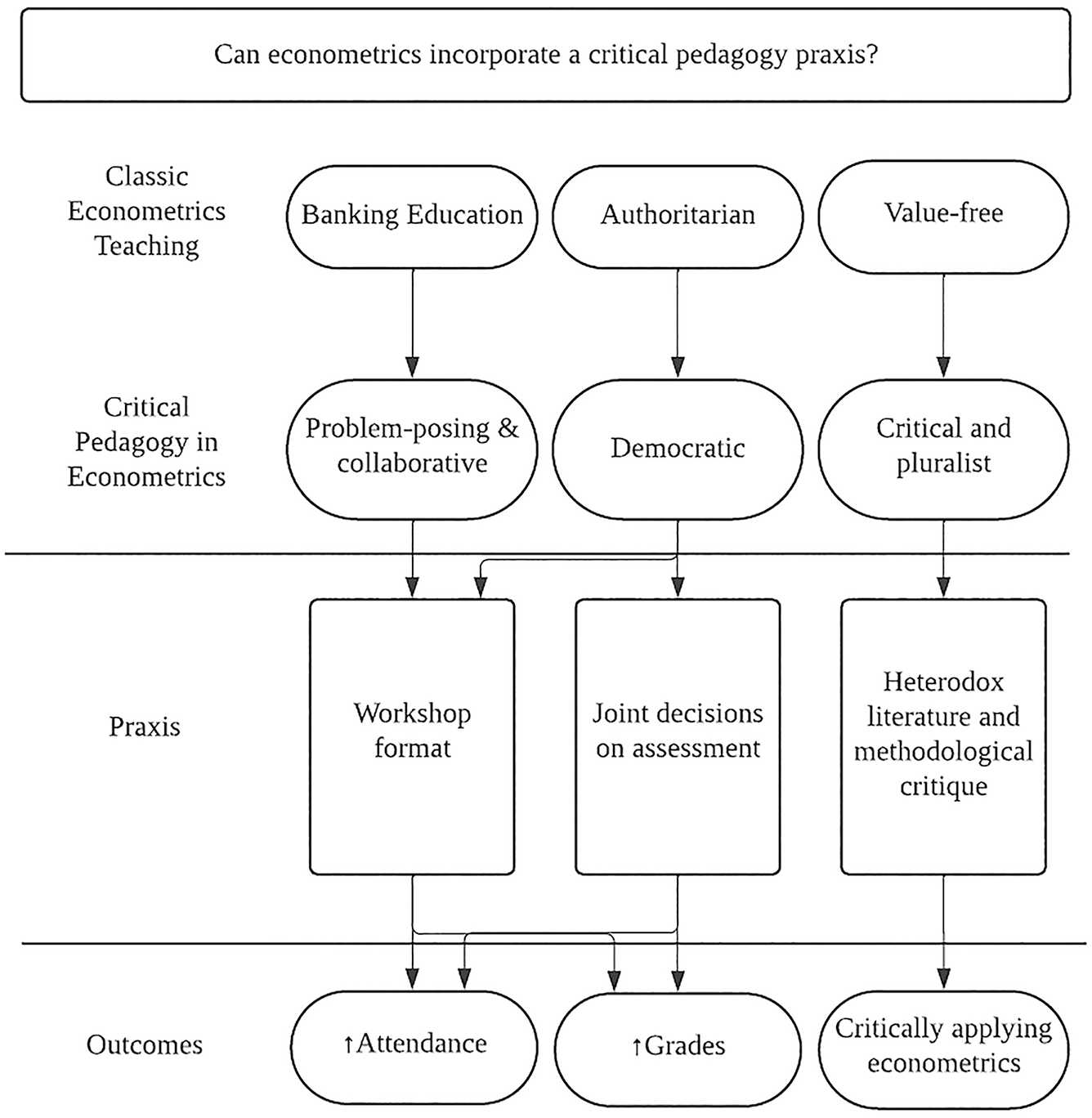
Operationalization of critical pedagogy praxis adoption.
4. Case Study: Applied Econometrics
This section discusses our attempts to introduce critical pedagogical praxis in an econometrics course. The case study is based on a year 3 (Y3) optional module Applied Econometrics, which focuses on advanced econometric topics, such as time series and panel data analyses. In addition to core econometrics concepts, students also learn how to code and conduct statistical tests using R, an open-source software. Assessments comprise a report and a take-home exam, where econometrics concepts must be applied using R to interpret regression results.
The module is built on a year 2 (Y2) Econometrics module, where students learn the basics of cross-sectional and time-series analyses, besides the elementary functions of R. This module is mandatory for students pursuing a Bachelor of Sciences (BSc) in Economics but optional for those enrolled in other degrees, such as the Bachelor of Arts (BA) in Economics, Development Economics, and BA Economics and another subject (e.g., Politics or Japanese). In 2022–2023, Y2 Econometrics had eighty-eight enrolled students, of which fifty-two were BSc, thirty-two were BA, one from Development Economics, and three from BA Economics and another subject. From those, only twenty regularly attended Y3 Applied Econometrics—seventeen BSc and three BA—in 2023–2024, which is introduced below.
4.1. Teaching delivery
The Applied Econometrics module is structured as a weekly two-hour workshop with two educators present in the classroom. This change in delivery was implemented for the cohort 2023–2024 as, previously, the delivery was one hour of prerecorded lectures and one hour of in-person activities with the teaching assistant. As presented in sections 5 and 6, this decision was taken after poor attendance, participation, and grades.
In the workshop, the lecturer is mainly responsible for explaining new concepts, tests, and coding, and the teaching assistant supports students during the in-class activities. These activities are student-led, in which students attempt to replicate an example that has been previously presented. Typically, the workshop is divided into two parts with a five- to ten-minute break in between. Each part consists of twenty to thirty minutes of lecturer presentation of new content, including the meaning of the R codes, another ten to twenty minutes for replication of examples with the support of the lecturer and teaching assistant, and a final ten-minute discussion on students’ interpretation of their own tests and output results. At the beginning of each workshop, the session’s structure is introduced with a clear indication of topics and learning outcomes. The workshop finishes with slides summarizing what we learned today and showing what to do next.
As an example, workshop 5 covers structural breaks in time series regression. We start with the concept, why it might become an issue, and how to visualize it (Enders 2014; Zeileis et al. 2002). We provide only a short explanation of the dynamic programming algorithm to detect structural breaks (Bai and Perron 2003) and, instead, focus on the real-world representation of potential structural breaks and their causes. We provide an example of the unemployment rate in the United States (1948–2023) (US Bureau of Labor Statistics 2023). Students are then challenged to discuss the important events that occurred during the software-suggested structural breaks—August 1974, December 1985, April 1997, and August 2008. We also discuss the role of the researcher in selecting the breaks according to the potential hypothesis they would like to test (e.g., we just want to analyze changes before and after the Volcker shock). The students are then able to learn a more rigorous definition of structural breaks for data analysis as well as to link the results to real-world events.
4.2. Assessments
The module evaluation consists of two assessments. The first assessment (AS1) is a 1,500-word report, weighted 60 percent, in which students must use real-world data and R coding to estimate a dynamic linear regression model. The topic varied depending on students’ interests, 1 and, given the student numbers, they were split into seven groups. In this case study, students needed to estimate the effect of the unemployment rate on the household debt ratio, and each group was assigned a different country. 2 Students receive their assignment task two to three weeks before the deadline and are encouraged to work in groups in the coding process.
The second assessment (AS2) is a take-home exam. Students have 48 hours to answer questions related to econometrics concepts and interpretation of outputs, which accounts for 40 percent of their final mark.
4.3. Student profile
Out of eighty-eight students from Y2 Econometrics, only twenty-one students started Y3 Applied Econometrics. During the first few weeks, one student dropped out because they did not have the prerequisite, so they could not follow the content, while another student joined midterm but only attended class twice.
The socioeconomic characteristics of students can be found in table 1. As we note, the uptake of women, low-income, and ethnic minorities 3 in the module is above the national average for undergraduate economics students in the United Kingdom. Data from 2020–2021 show that only 32.3 percent of women undertake a first degree in economics despite being 50 percent of the population (Costa-Dias et al. 2023). Furthermore, in the United Kingdom, 58.9 percent of economics students are white, 8.1 percent are black, and 19.6 percent come from an Asian background (Paredes Fuentes et al. 2023). Instead, our students come from a more diverse background than the average economics student in the United Kingdom, including 65 percent of first-generation students in higher education, potentially implying that our teaching techniques might need adjustments in other contexts.
Socioeconomic Characteristics of Students (N = 21).

Because of a lack of income data, we use students’ address to capture the English index of multiple deprivation. Quintile 1 is the most deprived and quintile 5 the least deprived (Ministry of Housing, Community and Local Government 2019). Note one student did not appoint their primary address in the United Kingdom, so there are no data on their correspondent index of multiple deprivation.
5. Application: Critical Pedagogy in Teaching Econometrics
In implementing critical pedagogy in our econometrics module, we shifted from a banking education to a problem-posing approach by changing the teaching delivery, considering the classroom arrangement, collaboration, and democratic learning. We incorporated real-world data and political economy discussions to explain econometric outcomes and explore potential policy implications of quantitative results.
5.1. The classroom, problem-posing education, and collaboration
The first component of our critical pedagogy strategy was changing the teaching delivery from online prerecorded videos followed by a weekly seminar with the teaching assistant to discuss the homework to a two-hour workshop where both the lecturer and teaching assistant are in class. The previous structure resulted from the school’s decision to include more blended learning initiatives in the curriculum. From a Freirean perspective, this format represents a traditional banking education, where technical content is prerecorded and delivered without interaction between students and teachers or among the students themselves. Moreover, the “authority” of the lecturer is also firmly present, as there is little opportunity to question the teaching content. In this delivery model, students are expected to watch the videos, complete the homework, and attend the in-person seminar to ask questions if something remains unclear.
In contrast to a banking approach, we implemented a workshop format that adopts a problem-posing education (Freire 2000). In this approach, dialogue between teachers and students creates new knowledge for everyone in the classroom. We aimed to follow the approach in which “the teacher is no longer merely the-one-who-teaches, but one who is himself taught in dialogue with the students,” as “no one teaches another, nor is anyone self-taught. People teach each other, mediated by the world” (Freire 2000: 80).
In Applied Econometrics, problem-posing education is particularly relevant given the software we use. As R can be user-defined, that is, users can create functions and codes for the existing platform, different approaches and solutions were raised during in-class exercises. It is not uncommon for the same code in R to work on one computer but not another, as students occasionally forget to install a package or have different computer configurations. Sometimes, the same error would occur on different laptops, and if the issue was not sorted during the class, students would attempt to fix it at home and bring the solution to their colleagues afterward. This would also allow the teaching team to learn new shortcuts, error-solving, and new commands from the students, creating a less hierarchical learning setting.
The workshop delivery from a critical pedagogical approach also fosters a more empathic and less hierarchical environment, where both teachers and students can cocreate the teaching space (Skelton 2024). As a collaborative classroom is a key element of critical pedagogy in which teachers and students learn from each other (Rose 2005), the workshop delivery allows for such interactions.
To create a collaborative environment, we first adjusted our learning space. Because of the small-group nature of our module, we were given a room with flexible rearrangement of the sitting space instead of the large auditorium with 250 seats used in the previous year. This allowed us to organize the room into a semicircle, thus allowing students to interact more directly with the teachers and each other. The semicircle arrangement and the workshop delivery model encouraged students to work collaboratively, showing each other their codes and results as a way to support and teach each other.
Students also noted the classroom change, claiming, through an anonymous end-of-term questionnaire, that the “teaching room is also great this year” and that “the interactiveness of the workshop” was the most positive aspect of the module to them.
By creating such an environment, we stimulate a less hierarchical learning process often present in a classic quantitative methods class. We believe that this allowed students to feel more comfortable with what can be considered challenging material. We noticed that questions were more frequent than in the previous year’s econometrics module, and students were more open to discussing their findings and conclusions with each other and the teachers.
5.2. Democracy in the classroom
Throughout the term, students are encouraged to actively participate in the module. This is related not only to engagement in the classroom (Spotton Visano 2019) but also through selecting assignment topics and submission dates and including students’ requests throughout the term. Although there are some restrictions in our institution (e.g., assignment structure must be approved one year before), we noticed that providing agency allows them to become more committed and participative and be able to engage in higher-level discussions as in Schneider (2010).
As introduced in section 4, for one of their assignments, students needed to write a 1,500-word report. Initially, students were asked if there was any particular topic they were interested in, and one of them stated that they were happy with whatever theme as long as we no longer discussed the “effects of education on wages” as we had extensively done in the previous year using a common textbook example. A few vague suggestions emerged, but no final decision was made by the group. The following week, the teaching team decided to offer students the opportunity to select one of the following topics:
4
The effects of unemployment on household debt, The effects of GDP per capita on pollution, Or the effects of productivity on disposable income (at the London borough level).
The majority voted for the first topic, which could be potentially related to their own socioeconomic conditions, as shown in table 1, where eighteen of twenty-one had student loans. Based on that choice, we then started preparing the adequate reading list and discussions for the following workshops. Yet, besides our recommended readings, students also introduced other interesting material, such as a qualitative review (du Toit et al. 2018), and other heterodox studies (Minsky 1982) to discuss the policy recommendations.
Once the assignment was set, students asked if they could do a peer-marked “mock” trial. A mock trial refers to a practice task designed to simulate a real assignment. It often serves educational purposes, helping students prepare for upcoming assessments. For this module, participating students were asked to submit a written piece and were paired up for peer evaluation. The task was voluntary and in addition to their weekly activities. Such an option was provided in Y2 Econometrics as many students struggled to write their results and findings in a formal academic format. We used a simplified 500-word version of the previous year’s assignment in which students had to investigate the inflation phenomenon in Brazil (1981–2022) and suggest policy changes.
Seven students participated in the mock trial, which meant they also had to provide feedback on one of their colleagues’ essays. One student did not provide feedback on time. The teaching team provided best practices and marking criteria, which were later used for their final assignment so that students could guide themselves and their colleagues throughout the process.
Overall, the mock allows students not only to practice the writing style but also to identify potential improvements in their own work and support each other. An example of a helpful student comment on a mock essay was:
Overall, a well-structured and written essay. Clear explanations of the tests and justification behind them. To improve, potentially dive deeper into the context of inflation in the region. Also, create more of a definitive summary of findings and what the report will entail in the introduction. There were no policy suggestions provided. (Anonymous student’s comment on a mock essay, November 2023)
This comment on the lack of policy recommendations was acknowledged by the student in their final report on household indebtedness in Germany, in which they suggested the following:
One effective policy suggestion for Germany, used in over 80 countries, is the implementation of a “Debt Moratorium” program (Fiorin et al. 2023). This innovative initiative offers temporary respite to households in financial distress due to unemployment by suspending specific debt payments during economically challenging times. (Anonymous student’s comment on a mock essay, November 2023)
Thus, we aimed to create a democratic classroom in three ways. First, by fostering ownership of the material by allowing students to select their preferred topic for the assignment; second, by taking students’ suggestions on the creation of a mock report to support their learning; and finally, through a collaborative marking task, so they can also understand the process of reviewing and grading from the teaching team lenses, as well as providing each other helpful feedback.
5.3. Heterodox literature and challenging value-free econometrics
Besides the core econometrics content, we attempted to include more critical material for discussion in class—first, from a political economy perspective, and second, to challenge the subject itself.
First, by selecting a topic that was of more interest to them, we were able to introduce further heterodox readings into the program, including post-Keynesian and Marxist analyses of household indebtedness (e.g., Lapavitsas 2009; Stockhammer 2015; dos Santos 2012; Kohler et al. 2019). These articles discuss the increasing indebtedness of the working class in different countries, considering the process of financialization and neoliberal policies.
Our key reading was Moore and Stockhammer’s (2018) “The Drivers of Household Debt Reconsidered” from the Journal of Post Keynesian Economics. In it, the authors use a panel data analysis to examine the different macroeconomic determinants of household debt in the Organization for Economic Co-operation and Development (OECD) countries. Topics such as income inequality and declining wages are tested as potential contributing factors to household debt’s increase over time. This study was particularly interesting to students as Moore was an alumnus of the institution, which gave students the curiosity and a role model to attempt to replicate their work.
Our theme selection was somewhat different from the current literature on mathematics for social justice, which focuses on marginalized groups within society, such as Latins and African Americans in the United States (Gutstein 2006; Wolfe 2023; Bartell 2011). Instead, we used country-level aggregate data so that the discussion could also benefit from learning materials from other degree-related subjects, such as macroeconomics and political economy.
Whereas many students focused only on the interpretation of the econometrics results, others were able to integrate their results with more critical material, such as the following essay, which focused on indebtedness in the United States:
After a period of low interest rates from the Federal Reserve, banks kept taking on large amounts of risk and giving out loans to borrowers from increasingly low-income backgrounds (Lapavitsas 2009).. . . Additionally, Stockhammer (2015) argues that another reason for rapid increase in household indebtedness was the working-class aiming to keep up with consumption despite real wages decreasing. (Anonymous student’s AS1, December 2023)
Second, throughout the course, we attempted to deconstruct the preconceptions that the econometrics results are always correct and that we must find statistical significance for valid research. Frequently, mathematical education falls within the positivist paradigm where knowledge is neutral, value-free, and objective, which goes in the opposite direction of Freire’s epistemology (Frankenstein 1983). To stimulate an initial critical view of the subject, we include articles such as “Storks Deliver Babies (p = 0.008)” (Matthews 2000) and “Alchemy or Science?” (Hendry 1980) in order to discuss spurious correlations and potential researcher bias or errors. Additionally, in our session about stationarity processes, we reviewed together a Financial Times article that states that “few processes can be counted on to be stationary in the world of economics and investing” (Marks 2022).
In our praxis, we aim to show students that econometrics can be an important tool for understanding certain economic phenomena, including those under discussion in critical studies. Moreover, by including discussions on challenging econometrics as a subject, our practice aligns with the critical pedagogical approach by encouraging students to evaluate the underlying assumptions and ideologies that might be embedded within econometric practices and result interpretation.
6. Results: Effectiveness of the Critical Pedagogy Approach
This section discusses the observed changes in attendance and grades after implementing elements from critical pedagogy praxis. We compare information from the previous cohort (2022–2023) to the current one (2023–2024). We find that the workshop format, collaboration, and democratic initiatives seem to positively affect grades and attendance. Yet, the peer-marked mock activity requested by students presented puzzling results.
6.1. Attendance
Attendance sharply increased compared to Applied Econometrics 2022–2023, which employed a banking teaching approach. Table 2 shows that eight out of nineteen students never attended the sessions of the in-person seminars that followed the online videos in 2022–2023. In the first week, only four students showed up, while the largest group was in weeks 6 and 7—just before the assignment submission—when six students attended. Moreover, videos often had fewer than ten unique viewers weekly. In turn, almost all students were present in the ten weeks of the 2023–2024 cohort. On average, attendance was at 70 percent overall, with four students reducing the group’s consistency by only being present four times or fewer. Furthermore, there were fourteen absences in the final week as the deadline for several assignments was approaching, and the lecturer had to be substituted.
Student attendance by number of students.

Note: In 2022–2023, the University and College Union called for several strike days. We calculated attendance over the seven weeks of teaching delivery, as the teaching staff was on strike on the other dates.
6.2. Grades
When comparing the grades of students who participated in the mock assignment with those of the entire class, it was observed in table 3 that those who submitted their mock assignments tended to achieve lower grades 5 for the actual assignment by 1 point on average. There could be a self-selection bias when comparing the average grades of the entire class with those who participated in the mock assignment, as only those who feel less confident in their abilities but are motivated to improve tend to voluntarily opt for additional tasks. Indeed, of the six students who participated in the mock assignment as well as completed the other coursework and exam, four managed to improve their performance in their final grade.
Student Grade for AS1 by Number of Students.

Note: We exclude nonsubmissions from the mean calculation.
Despite acknowledging the potential for self-selection bias and the limitations of a straightforward grade comparison, we deemed it valuable to offer this activity for open discussion and peer feedback on academic writing. It could also be that students who undertook the mock would have performed worse without this opportunity. However, more robust conclusions would require further detailed analysis.
Student participation was also reflected in their effort in the assignments. In terms of grades, students excelled in their household debt report but less so on the take-home exam (table 4). A possible reason for such differences was the strongest focus on the report both by students and the teaching team. For the report, we discussed result interpretation several times, created the peer-marked mock report, and also had a session dedicated to discussing relevant heterodox literature and its approach to econometrics. The exam, instead, was a regular assessment that students seemed less engaged in and concerned about.
Grade Distribution by Assessment Type.

Note: We exclude nonsubmissions from the mean calculation. Moreover, the AS2 (2022–2023) was not marked by the teaching team.
The comparison with the previous year is somewhat trickier as, because of national strike action, the school hired external staff to mark by March–April 2023. This action caused grade inflation overall, including in this module’s AS2, where 50 percent of the class received a grade of 70 or higher—a very uncommon result in econometrics. Yet, on average, final grades were higher in 2023–2024, and nonsubmissions and failures were lower despite the module having the same content and assessments as the year before.
Beyond the improved grades, we noticed a strong positive correlation between attendance and grades, which was 64.2 percent in 2023–2024, as well as in-class participation and grades. Those students who often asked and answered questions during the workshop, in addition to attending office hours to go over codes and concepts, seemed to have better outcomes. This would suggest that moving from a banking education to a problem-posing and democratic classroom can improve students’ engagement and attendance, reflecting in better grades.
Finally, students showed the ability to independently implement what was learned in applied econometrics beyond the module. In 2023–2024, for the degree final research project, five students decided to apply their econometrics learning to discuss economic issues that were not covered in class. They selected their preferred topics, which included the effects of renewable energy on price formation and the impact of labor market institutions on job security and income inequality. Their marks ranged from 63 to 86, suggesting that they were able to not only conduct the tests and regression analysis but also explain the results and provide a good analysis stemming from their knowledge of econometrics and macroeconomics.
6.3. Students’ perception
In our institution, students can also provide feedback to lecturers by the end of the term. A comparison between the two cohorts shows that students were also more satisfied with teaching in 2023–2024 (table 5). Only two students provided feedback in the previous cohort, and the outcomes were only satisfactory. The main difference between cohorts was the change in delivery. The content and assessments remained the same for both cohorts. This might explain the similar rating regarding whether the module was intellectually stimulating and useful for future careers.
End-of-term student feedback.

Note: In the survey, all core statements require a response based on a 5-point Likert scale (1 = strongly disagree, disagree, neutral, agree to 5 = strongly agree.).
Student interaction and the material received low marks in 2022–2023, but this significantly improved after changing the module’s delivery. How well the subject was explained also received higher marks, from 3.0 to 4.5, as did peer interaction, from 3.5 to 4.3. Finally, student overall satisfaction jumped from 3.0 to 4.6, suggesting that students also appreciate the new delivery.
Overall, we noticed students were very receptive to the workshop delivery style. They stated that the most positive aspects of the module were, for instance, “the tutor being in the same class and the two-hour workshop. It is so helpful to work on a topic continuously for longer while applying R,” and “having both a lecturer and teaching assistant in the workshop was very effective.”
7. Discussion
Adopting a critical pedagogy praxis in an econometrics module is not only rewarding to the teaching team but it seems to have positive outcomes regarding attendance, grades, engagement, and applications of quantitative methods beyond the course.
Besides our own perception of student progress, engagement, and collaboration in class and throughout the term, we measured some potential quantitative outcomes from our efforts in delivering this module, particularly regarding attendance and grading. Whereas, as econometrics educators, it is difficult to conclude causality from the inputs we provided for the ten weeks, we observed a strong attendance change after moving from a banking education to a problem-posing one: the attendance average of the online-based course was 22 percent, while the workshop delivery reached an average of 70 percent.
This teaching approach may be one way of improving attendance, a common issue in higher education. Currently, pedagogical discussions acknowledge the positive relationship between attendance and outcomes (Gough et al. 2021; Credé et al. 2010), but everyday discussions on how to boost attendance often go in a disciplinary direction—such as preventing students with low attendance from taking exams or sending out email reminders after a few missed classes. Instead, adopting critical pedagogy praxis might have a positive effect on attendance as students might be more engaged and participate more actively in their own learning.
Furthermore, we also argue that a democratic classroom benefits the overall learning process. We allowed students to select their preferred topic for the assessment, which gave them more responsibility and agency and raised the level of the in-class discussions and their assignments. Given that the selected topic, household debt, was relevant to their condition as indebted students, we suggest that this might lead to further engagement and curiosity, also providing better learning outcomes.
From a broader perspective, critical pedagogy’s incorporation into an econometrics course creates outcomes that extend beyond the technical training typical of traditional statistical modules. Students not only engage with technical content but also question dominant ideologies that are often embedded in economic models and data (Spotton Visano 2019). This shift from passive absorption of knowledge to active participation (Aslan Tutak et al. 2011) allowed students to take ownership of their learning and coconstruct knowledge with peers and instructors, mirroring the experiences observed by Stinson et al. (2007) in critical mathematics classrooms.
Despite the successes of integrating critical pedagogy into the econometrics module, challenges persist within the neoliberal higher education system. Within the context of the neoliberal UK higher education system, critical pedagogy may have little space, but it might also be fundamental to fostering democratic values (Giroux and Giroux 2006) and exposing the injustices in the lives of marginalized students’ communities (McInerney 2009). While lecturers in the United Kingdom may face several institutional limitations, critical pedagogy might still allow us to advance education in the radical economic tradition, particularly by raising students’ awareness of existing inequalities through data analysis.
Finally, as this was our first attempt to integrate critical pedagogy into econometrics, further improvements can be made. For instance, given the student’s socioeconomic background, topics beyond indebtedness can be discussed in class and assignments. From a Freirean approach, we could investigate “generative themes,” that is, topics that are socially relevant to students’ daily lives and may spark social action beyond the classroom. For instance, analyzing racial discrimination, as in Wolfe (2023), or examining class relations can engage students further and allow for discussions of the role of class and race in society.
8. Conclusion
The article explored the implementation of critical pedagogy praxis in econometrics education, focusing on a case study of an Applied Econometrics module for year 3 undergraduate students in the United Kingdom. By examining critical pedagogy’s core principles and their application in quantitative methods, we demonstrated how critical pedagogy praxis can be integrated into quantitative methods education, challenging conventional banking education and attempting to promote social justice within the classroom.
In our case study, we focused on three components of critical pedagogy praxis: problem-posing and collaborative education, the democratic classroom, and challenging value-free econometrics. To achieve that, we shifted the learning from online teaching to workshop delivery, allowing us to work in groups and give students more decision-making power.
This case study shows the potential of applying critical pedagogy in econometrics education but has room to improve in terms of teaching and research. First, further over-time comparative analysis could demonstrate the effects of critical pedagogy application on students’ outcomes. Second, while there is evidence that small-group classes are more successful learning environments (Pollock et al. 2011), a twenty-student classroom, like our case study, might not be easy to replicate as it may be difficult to financially justify the need for two teachers in the same classroom.
In conclusion, despite a few limitations left for future study, this article contributes to the ongoing discussion on critical pedagogy in quantitative methods education, highlighting its potential to challenge mainstream assumptions and ideologies embedded within banking teaching approaches. By fostering critical analysis, collaboration, classroom democracy, and engagement with socioeconomic issues, critical pedagogy offers a pathway toward a more equitable and transformative educational experience for students in econometrics and beyond.
Footnotes
Acknowledgements
We appreciate the suggestions and comments from Dr. Peter Dorman, Dr. Smita Ramnarain, and Dr. Gary Mongiovi. All remaining errors are ours alone.
Declaration of Conflicting Interests
The author(s) declared no potential conflicts of interest with respect to the research, authorship, and/or publication of this article.
Funding
The author(s) received no financial support for the research, authorship, and/or publication of this article.
