




Abstract
This article examines the idea of institutions and the elements of the process of institutionalisation, using the features of and experiences in an independent research organisation, which was established in 1998, in India. The author, using her experience of heading this organisation for nearly 13 years, and drawing from the Scott’s three pillar approach, reflects on the aspects of why and how an organisation becomes an institution, and what the joys and challenges of leading the process of institution building are. She argues that institution-building is a continuous process where Scott’s three pillars support each other, and change over time and space. The real test of an organisation in becoming an institution is in the capacity to respond to the emergent needs both inside the organisation, and to the external environment, while managing to work as per the vision and perceived mandate, maintain order and stability, within given resources and legal frameworks that guide the functioning of the organisation. Using her own experiences, she identifies plurality as the most important principle that helped in the process of institutionalisation in this case.
What Is an Institution?
Institutions comprise regulative, normative, and cultural-cognitive elements that, together with associated activities and resources, provide stability and meaning to social life. —Scott (2014a, p. 56)
This was Scott’s own improvisation of his earlier definition. This definition emerged from a thorough and in-depth review of the literature on institutions emanating from several disciplines: Economics, Political Science and Sociology and more. The canvass and contexts where the concept of institution is applied are so diverse and varied that it has always been difficult to find a common and uniformly applicable definition of institution. In that context, Scott’s three-pillar approach of regulative systems, normative systems, cultural-cognitive systems, each of which as he claims, has been identified by one or another social theorist as the vital ingredient of institutions, provides a very useful entry and has been widely used to understand an institution. Scott also clarified that these three pillars and the elements therein were ‘conceptual tools’ while acknowledging that ‘the elements were often combined together—especially in robust institutions’ and that ‘the elements in play could change over time’. For example, institutional frameworks that employed primarily regulative elements in their origins might over time operate more as normative and cultural-cognitive systems (Scott, 2014b, p. 137).
Another important characteristic of institutions, identified by scholars, is change and difference over time and space. It is widely acknowledged that though stability and order are crucial for an institution, undergoing change is also as common and crucial. Change can occur due to either or both internal and external factors, and can either be towards a process of ‘institutionalisation’ or ‘deinstitutionalisation’. The focus on change in the literature on institutions is also an acknowledgement of viewing the institutionalisation as a process, where the critical role of leadership is also clearly highlighted. Leadership plays an important role in the process of institutionalisation, reflecting the organisation’s own history, the people, the interests, the ways of adaptations to its environment and the values infused that goes ‘beyond the technical requirements of the task at hand’ (Selznick, 1957).
This also makes the role of ‘work’—the task and workers, whether individuals or collectives who execute the task—important. In this, especially in terms of organisational culture, what becomes important is that actors do not necessarily comply with the rules and norms because of rewards and punishments, but because of a moral obligation to do so (Scott, 2014b). Moral here refers to the sense of a social responsibility that lies within an individual and not something imposed from outside. This implies that while there are legal, conventional and cultural boundaries that determine or guide people’s behaviour in an institution, the organisational processes are also such that they empower people to act in particular manner out of their own independent choice. Here, it is also important to understand that if we consider institutionalisation as a continuous process, an organisation at any particular stage in time or in a specific context, is always trying to attain a situation where all actors are empowered and committed to the ‘work’ as well as to the ‘values,’ and that is what makes it an institution. It is not the act of ‘having arrived’ that matters; instead, the actions that define the efforts and movement matter more.
This article draws from these concepts on institutions and institutionalisation to analyse the evolution of one organisation, Centre for Budget and Policy Studies (
CBPS started as an offshoot of TIDE—Technology Informatics Design Endeavour—as an exclusive organisation that could work on budgets and public policy, with a focus on the former. The founding director, a public finance economist, had left a mainstream academic position, and had located a project on budgets at TIDE, in search of a more meaningful and relevant research practice. Given that the research that the founding director and his close colleagues were involved in was very different from the TIDE’s focus, it propelled them to form a separate organisation that would ‘help bridge the large academic research—practical application gap’. 1 The founding director headed the organisation for the first 12 years, and I took over from him in January 2011. While this article makes references to initial years as well, the focus is much more on the last 12–13 years of institutionalisation that learned significantly from the initial years, but also built new processes, norms and relationships, and expanded the horizons in more ways than one.
It is, perhaps, useful to state that while this is the story of an organisation, it is also my story. Although one is supposed to look at one’s journey with some amount of distance, this journey has primarily been guided by my passion for the ‘work,’ and for the institution. Therefore, what emerges is an honest attempt at being critically reflective of the journey that both the institution and I have taken together—a journey where my vantage point as the head of the organisation also provides a unique opportunity to critically examine my own actions from the perspective of the institution.
The article has three main sections other than this introductory one. The following section examines whether it is justified to call CBPS an institution. I use parameters discussed earlier and a few more borrowed from the literature on institutions to assert that CBPS is indeed an institution. Next, I move on to discuss the process of institution building, and share the joys and challenges of this process. Here, I deliberately choose the word joy over accomplishment because I argue that it is joy that has been the prime push rather than a sense of success or achievement; making a point that it is not only the end output or outcome, that is, success or accomplishment, that matters, but also the process of working towards what one values is incredibly important. The fourth and final section concludes the article by highlighting that in the end, it is the presence of the plurality in various forms and dimensions that marks the institutionalisation process of CBPS. It remains a continuous endeavour to keep on adopting and adapting measures that keep the organisational focus firmly on its larger commitments while responding to newly emergent challenges, both internally and to the external environments.
Is CBPS an Institution?
The discussion in this section is based on an analysis of CBPS functioning, drawing from the literature on institutions using the three-pillar approach, and going on to the aspects of logic, agency, careers and levels (Scott, 2014a). After 25 years of existence, CBPS indeed operates through a combination of regulative, normative and cultural-cognitive tools and processes. As a legal entity, an organisation needs to deal with the law of the land, applicable as they are, and how these are negotiated is also a reflection of the organisational capabilities. I first discuss the external rules and regulations that guide the running of CBPS followed by a discussion on the challenges and dilemmas that one faces in this regard, asking for a very cautious treading of the path. Next, I discuss internal policies, protocols, norms and culture.
External Environment: Laws and Regulations
Three laws guide the structure and functioning of CBPS, the Societies Registration Act, Foreign Currency Regulation Act (FCRA) and Income Tax Act.
Society Act
CBPS became a legal entity through registration as a non-partisan, not-for-profit, society under the Karnataka Societies Registration Act, 1960. 2 The Act provides guidance and details out the regulations that all societies registered therewith need to follow. We need to comply with these rules and regulations, while functioning through a Memorandum of Association that has been approved by the registration process, and submit our annual report and annual accounts to the Society for verification of the compliance by the relevant authorities. The Act allows amendments to the MOU following the requisite process, and these changes need to be recorded and submitted as part of the annual report. The CBPS Society is a voluntary association of individuals who among themselves elect a Board that governs the Acts of the institute. The day-to-day management is led by the director, who is also an ex-officio member of the society. In general parlance, most organisations registered under the Society Act or the Trust Act are referred to as non-government organisations (NGOs).
Foreign Currency Regulation Act (FCRA)
India is one of the several Asian and African countries which has a law such as FCRA that controls the fund flow from international organisations to NGOs, and the law has become much more stringent over the years. First introduced in 1976, where the registration did not require a periodic renewal, it was heavily amended first in 2010 and later in 2020 3 to bring in sweeping changes. One of the common practices followed by the Indian NGOs had been to work in collaboration where one NGO, often a bigger one with greater networking resources and FCRA registration, would receive the funds but will implement the project in collaboration with others, many of them working in the grassroots with no FCRA registration. The 2020 amendment has prevented this transfer of funds, which adversely affected collaborative initiatives. The FCRA was aimed at regulating the acceptance and utilisation of foreign contribution or hospitality but it is a law controlled by the Ministry of Home Affairs and, therefore, has a security angle to it. The Act also prevents any activity that is ‘political’ in nature. The CBPS has been registered with FCRA since 2001. We received our first renewal in 2016 and the second renewal in 2021.
Income Tax Act
The CBPS is also registered under Section 12A(a) and Section 80 G of the Indian Income Tax Act (1961). Section 80G of Income Tax Act provides tax benefits to the donor of an NGO, whereas Section 12A Registration assists the NGO to get an income exempted from Tax. Both are applicable only to NGOs and charitable organisations. Any income exceeding 15% by an NGO cannot be accumulated or set aside for its application in India, implying 85% of receipts must be spent on specified purposes, but it allows a timeframe of 5 years within which the tax exemptions continue to apply.
Challenges and Dilemmas
Negotiating the compliance with the specific provisions of these Acts while also working towards the organisational vision and mission 4 of creating and sharing knowledge towards an empowered, equitable, just and democratic society, through research, evaluation and capacity enhancement and engaging in evidence-based policy advocacy, has been challenging, to say the least. Although we have manged to sail through these without violating any compliance requirement or compromising on our own commitments, it has neither been easy nor seamless. Broadly speaking, the challenges pertaining to three interrelated dimensions, identity, mandate and finances, have been the most critical, and let me share my reflections on the experiences of dealing with those, starting with the identity first.
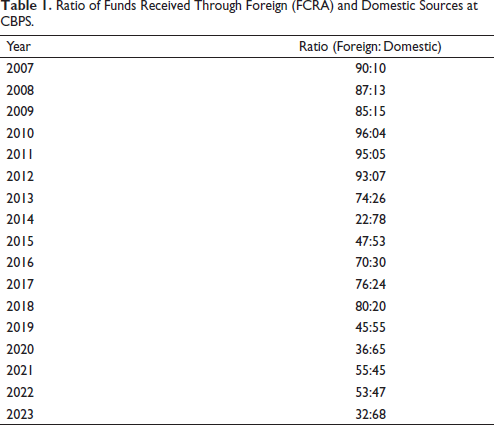
We view ourselves as an independent public-policy/ public-finance-oriented research institution committed to equity and justice; this makes the very nature of our work and existence ‘political’. Any policy research cannot be apolitical but what is political and what is not, is always subject to interpretation. The fact that a number of agencies engaged with human rights or environmental activism have been facing cancellation of FCRA after 2020 amendments 5 created an environment of fear among all NGOs and we had to be clear about our own stand. We decided to continue to undertake policy research in our priority domain areas and participate in evidence-based policy advocacy for people-centric governance while avoiding any kind of affiliation with any political party. This is how we have interpreted being non-partisan and non-political, in response to the institutional laws that we were subjected to. In addition, we also noticed that a number of FCRA cancellations were on grounds of violation of accounting rules and lapse in submission or uploading of requisite reports on time. This is an area in which we had never defaulted. We further strengthened our internal processes of strict adherence to accounting norms as well as complete transparency in work and record-keeping. We also consciously started looking for domestic funding and seeking projects from organisations with similar visions and goals, and largely succeeded in maintaining a balance between domestic and international funding (Table 1). This helped us in avoiding being overly dependent on one funder, with the idea that it would make (and has made) us less vulnerable to the vagaries of funding cycles.
Ratio of Funds Received Through Foreign (FCRA) and Domestic Sources at CBPS.
The identity of a research institution is also at odds with the usual perception of an NGO. An NGO is expected to be an ‘implementing’ organisation that works for people’s welfare. A research agency, on the other hand, is expected to be publishing and gain high academic credibility. We have tried to retain both the identities and, in the process, we have created a kind of dual mandate for ourselves: While we do not implement any programme ourselves, we collaborate with grassroot NGOs to build their research capacities and help them with rigorous evaluations and believe that this enhances the implementation process. Parallelly, we engage with the academic world through publishing, participation in conferences and other such routes to ensure that the grounded approach of our research has theoretical contributions as well. Both of these, we believe, is the foundational philosophy and priority of our evidence-based policy advocacy and research.
We view ourselves as independent, because no funding agency has had a disproportionate control over our budgets—the accountability is limited to project deliverables and hence, no funding agency has any say in our internal management and policies as long as we are fulfilling our contractual commitments. It is common in India for the research institutions in the area of social sciences and policy to be receiving some kind of financial support for salaries as well as capital investment from the respective state governments and/or the national body named Indian Council of Social Science Research. Corporate and philanthropy funds go more towards the implementing NGOs. In either case, we have noticed that the agency that provides regular funding also plays a role in controlling, either formally by having a seat on the Board or some such similar provision, or informally through conditions imposed. 6 Thus far, we have been successful in avoiding any such control. Complete dependence on project funding aides in avoiding such controls but creates two challenges: (a) one has to continuously look out for projects, and (b) often carries the risk of having restrictions in terms of choice following the philosophy of ‘beggars can’t be choosers’. However, we have avoided falling into the latter trap—we have always ‘chosen’ or used our agency to choose our projects and have never taken on any projects because of financial or any other duress. In fact, we have avoided being ‘beggars’ for two reasons: (a) we have credibility, earned in the certain domain areas and we continuously try hard to maintain that credibility, and (b) we have clarity regarding what we do not want to do, and say no or not seek those projects even in times of financial crisis. Three examples will illustrate this.
One example comes from a particular year when two long-term projects had ended and we were not substituted by another one, forcing us to go for a number of small projects, but we still did not respond to any calls for a survey agency with no role in the study design or data analysis and interpretation. The second example is of a contract with a for-profit corporate agency for evaluation of their education programme where at early stages itself, they asked us to modify our interpretation to suit their interests; we decided not to go ahead despite the fact that we were not paid a single penny and we lost the money spent on the first round of work. The third example is more recent: during COVID-19, we suffered financial losses due to the continued recurrent expenditure on salaries despite the fact that for all our ongoing projects we had got no-cost extensions from our funders. But we remained undeterred and continued to work hard to fulfil what we view as our mandate. Using all available channels of communication—new (internet) as well as old technology (phone and postal services), and collaborating with grassroots NGOs, we tried to make best use of our resources to understand the impact on various aspects of people’s lives and continued to generate research, disseminate those and create public opinions for policy advocacy.
The way we have managed to show resilience against external shocks and have been able to negotiate the laws and regulations reflect that CBPS has evolved into an institution, especially if we also juxtapose this with an understanding of how we have adopted policies and tried to develop a democratic culture while also striving to raise quality bars and maintaining efficiency in the way we work. The following section elaborates on these aspects.
Internal Policies, Protocols, Norms and Culture
In contemporary political economic scenario in India, where compliance to continuously changing rules and regulations determine the external environment, it is imperative for an evolving institution to have internal rules, regulations and indicators of compliance to be able to keep pace with external requirements. In CBPS, we have developed a set of policies over a period of the last decade and a half and here, we examine how this acts as a regulatory frame and also helps in establishing the desired culture and norms of functioning. This becomes especially important in view of the fact that one set of employees, the young researchers, are entering and exiting the organisation at regular frequency, and these written policies and protocols help in establishing the work culture, expectations and awareness of the rights and responsibilities that anyone entering the institution needs to know. This, in combination with the real day-to-day functioning, determines the organisational culture-cognitive environment to a large extent.
Written Policies and Protocols: The Regulatory Frame
Our policies and protocols can be broadly classified into two kinds: one relates to human resources (HR) and development while the other guides the functioning of the organisation. While some of these are routine in nature, some are critical for their implication for setting the intellectual frame and ethical boundaries for our work (Table 2). These policies and protocols have been drafted and amended over a long period of time, many of these emerging as a response to the felt need. During the initial years, the organisation was largely guided and managed by people who had come together to establish it where trust and unwritten norms determined the work culture. Even recruitments were made based on recommendations by the larger network of associates. As the organisation grew, we started hiring through open market following a rigorous process, and the need for having clear policies regarding recruitment, entitlements and other HR issues became evident.
List of Written Policies and Protocols in CBPS.
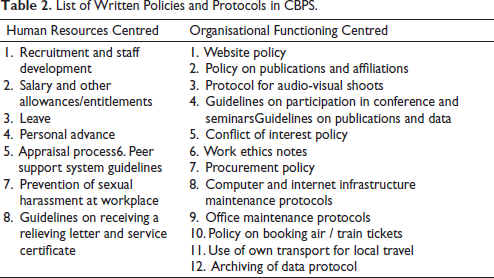
This led to the process of having written HR policies where we adopted the successful, and discarded the unsuccessful practices of the past, guided by the felt need of the employees. Our collective experiences in CBPS as well as those that people from outside the organisation brought in addition to the prevalent laws into practice, guided this process. For instance, we introduced Provident Fund and Gratuity when we became slightly larger in number and though we had still not hit the lowest ceiling that was mandatory to adopt these, we felt that these social security measures were important for those who had been serving for several years. It came handy when we grew in number subsequently and also when the law was changed to bring down the ceiling. Conflict of interest policy became important for both recruitment and procurement of goods and services in order to provide equal opportunity and avoid any partiality, which often is a characteristic of smaller NGOs started by friends and family, unless consciously avoided.
As we grew, especially coming from diverse disciplinary backgrounds, the need for greater clarity and common understanding on ethical norms pertaining to fieldwork, publication and representation also emerged. Greater use of technology, especially with increased use of mobile phones and the emergence of social media, made it essential to have policies that ensure protection of rights and identities, especially those participating in our research. With expansion, other challenges emerged in the area of day-to-day functioning. For instance, we wanted to maintain flexibility in working hours while also giving a clear message that accountability to the norms of the requisite working hours is also critical. This became important because some people responded very well and productively to the flexible hours, while some others used it as opportunities for misuse. So, we developed a work ethics document and through diverse ways of messaging, tried to communicate how certain forms of reporting can be adopted to ensure that we remain accountable to each other and to the organisation without having to compromise on the flexibility and commitment that allows us some forms of autonomy and creativity. We also created growth opportunities within the organisation by creating levels and designations that are linked with performance and experience.
As it would have been clear by now, our policies and protocols have evolved in response to emergent needs, and we have tried to develop them in a manner that we are able to fulfil our dual mandate, while also creating an enabling work environment and protecting the rights and entitlements of individuals who have chosen to work with us. This means that while our non-negotiables in terms of rigour and ethics of what we do and how we do it remain well-defined and largely non-negotiable, our employee-related policies respond to emergent and at times, previously unforeseen needs. For instance, the work from home policy and detailed norms associated with that emerged in response to an employee meeting with an accident where it was impossible for him to attend office. But he was in a position to work from home. Once in practice, it helped a number of others in similar situation. Similarly, we have introduced monthly allowances for communication and for children’s education, which is not dependent on the organisational hierarchy or individual renumeration—everyone gets the same amount for communication and the per-child education allowance.
Written policies and protocols aid to bringing order and stability. At the same time, these alone can never determine the organisational cultural and cognitive norms, which are highly dependent on how these are put to practice. Unwritten policies have also helped us to a great deal in developing a culture of care. For instance, when I started taking my five-month-old baby daughter to office everyday along with a full-time caregiver, it encouraged many others to bring their children to office on days the child had no school or no other arrangement could be made for her or him. It also encouraged young women in the organisation to make a choice of continuing to work after childbirth, as they felt confident that they too could bring their babies to the office when needed. We even started receiving more applications from young women as CBPS earned a name for itself as a child-friendly and caring organisation. We next reflect on the practices and norms that help us develop a democratic and caring culture in CBPS.
Democratic Functioning and Cultural-cognitive Norms: Practices that Helped
Two dominant dimensions of our functioning, democratic decision-making and an environment of care and trust, have perhaps played the most important role in having an open and transparent culture in our functioning. The mechanisms that have aided towards these are many, some formal and some informal.
Senior Consultative Group: In the beginning, when the organisation was small, and when I took over as the director, the middle level between director and research associates/assistants was almost non-existent. When we started hiring researchers at that level, we created a senior consultative group and I started taking all key decisions in consultation with them. This has helped in using our collective wisdom and also has made the organisation less director-centric. In addition to project management, senior researchers started sharing the administrative responsibilities as well. This also contributed towards leadership building within the organisation, as they were encouraged and trusted to take decisions in their allocated areas of administration independently. The accountability for their decisions was ensured by including that dimension also in the annual appraisal.
Staff Meeting: Periodic staff meeting is common in many organisations and we are no exception. The entire group, including administrative staff meets and discusses the new developments, policies, protocols and expectations. It allows for exchange of ideas, sometimes leading to important decisions as well. A number of organisational policies and protocols have emerged through discussions in these staff meetings and such transparent processes have helped in establishing the organisational culture without talking about it explicitly.
Open-door Policy: I have continuously followed an open-door policy where anyone and everyone can knock and come to discuss anything personal to professional. Over the years, it has tremendously helped in building trust and resolving a number of inter-personal as well as group issues. This process has also helped in communicating that mutual respect is a non-negotiable ethical practice that we would not compromise on under any circumstances. Trust is built by using both transparent practices and having a non-partial attitude for everyone—and by building strong relationships. Relationships are built through working together in a mutually respectful environment and also some informal mechanisms such as eating our lunch together.
Lunch-time Conversations: This has been a practice that CBPS has followed since inception and although now much bigger, we have kept it alive. This is the time when we share not only our food but also ideas and thoughts on a number of contemporary issues—it helps us to know each other, and also each other’s ideas, positions, interests and talents. These conversations have been very helpful in building an environment of trust and friendships. Here, we also celebrate birthdays and field experiences, including having a formal presentation once a month where one colleague makes a presentation on any research or any other topic of her or his choice.
Annual Retreat: Our annual retreat is a two–three-day long affair where we combine team building with fun activities and where our families also join. We follow a practice of fully supporting the family’s participation for staff working on lower salary slabs while only partially bearing this cost for others. The retreat has helped us tremendously in building our teams and getting to know each other better.
Expanding Domain Areas and Striving to Create a Niche: During initial years, our work has focussed much more on the public finance in general and budgets in particular, and decentralised governance. While areas such as health, education and gender had entered our work on budgets and governance, they evolved into independent domain areas of our research in the last decade or so. We also try to go for multiple projects in the same or similar areas so that we can strengthen our interdisciplinary understanding in order to be able to contribute towards both policy reform and knowledge building. Over a period of time, we have developed a rich body of work in diverse areas that cut across economic and social policy domains, and more importantly, we have also gained experience in multidisciplinary research, where we try to view one phenomenon from diverse lens, including public finance. For instance, our ongoing research on gender violence and public space combines elements of both social and economic policies by studying the forms of gender violence and notions of public spaces alongside the elements that can have implications of a more comprehensive conceptualisation of gender budgeting practices.
Organisational Hiring and Multidisciplinary Approach: We generally follow the practice of organisational hiring as against project-based recruitment, barring few exceptions. Most research staff work on multiple projects and with overlapping teams—it has helped in building multidisciplinary perspectives and develop cross-sectional skills. We have also organised a number of in-house professional development programmes, where we learn from each other—economists from ethnographers and sociologists from economists. This has helped in developing greater respect for each other’s disciplines and skill-sets though it is continuously a ‘work in progress’.
Building Relationships: We are conscious of the fact that we are relatively small in size and budget, and therefore building relationships has been an important part of leveraging resources and also for stronger collective action. Relationships with research institutions and universities have helped in accessing libraries as well as new research/knowledge, while also giving us opportunities for being part of conferences and other such avenues to share our research. Relationships with civil society organisations have helped us in adding to the collective voice for policy advocacy in addition to mutual capacity enhancement—theirs in research and ours in understanding the grassroot issues. We have also tried to building long-term relationship with donors working in particular domains, and that has helped us in sustaining the research focus in our areas of interests.
Separation of Governance from Management: The governing board of the CBPS consisting of academics, retired civil servants and policy activists bring a lot of collective experience and knowledge on governance and their role has been critical in the evolution of the institution. The members have also been keen on following ‘good governance practices’ such as periodic rotation of the board members and presidentship and following the ‘conflict of interest’ norms. In addition, what has mattered most is that they have maintained complete separation of governance and management roles; while the board has been supportive of the new initiatives, they have been non-interfering on everything that they do not view as a governance issue. As both the management and technical head of the organisation, this freedom to act combined with the guidance at hand played a vital role in the evolution of CBPS.
These mechanisms and practices work together in an organic manner: the culture of care and democratic functioning in combination with the choice of work areas and ways of working, together build the cultural-cognitive dimensions of the institution. What has also helped is that these tools and processes have also organically evolved over time and have not been imposed by anyone from outside. In addition, our research management practices also aid to these—while administrative staff is separate from research staff, they work together as a team and there have been instances of administrative staff transcending into research and researchers sharing the administrative jobs in good measure.
Although it is difficult to decide at what stage an organisation turns into an institution, the fact that an organisation is continuously evolving, establishing regulatory norms and enabling democratic cultures while also dealing with external environment of restrictive laws and stringent actions, is definitely a sign of being an institution. The CBPS is now not dependent on one individual; transparent processes and democratic functioning have made sure that institutional memory is strong, which easily withstands frequent entry and exit of researchers. CBPS has a relatively stable core or senior research and administrative staff with an outer layer of younger researchers, bound by shared values and a commitment to the organisational vision and mission, and that is what makes it an institution. It is clear that institutionalisation itself is a process of continuous struggle—struggle of various kinds —but the capacity to deal with the struggle while continuing to evolve and mature is what remains important. I next reflect on the joys, challenges and tensions that I experienced in this process of institution-building.
Leading the Process of Institution Building: Joys and Challenges
When I joined the organisation as its director, it was about one-third of its size in terms of the number of employees and the budget size. However, two unwritten norms were deeply institutionalised. One, a largely non-hierarchical work culture—first, everyone had a voice and each could easily present her or his opinion. And second, a culture of care towards employees; for instance, everyone had health insurance though it was not mandated by law, and everyone in office was served some fruit every afternoon to ensure ‘nutritional’ intake. We have continued with these two highly appreciated practices till date. As mentioned earlier, the organisation functioned more on trust following informal processes. This also meant weak institutional memory which later led to some problems for both data and project management 7 —one reason that pushed us to develop formal policies and protocols in later years. This process of institutionalisation is a continuous process and each stage brings its own set of challenges, and relate to specific context and time.
Challenges, Tensions and Dilemmas
The challenges that I have faced and continue to face are in the form of tensions and dilemmas that have no permanent solution. They need to be addressed continually taking the specific context and period into account.
Using Agency Versus Compliance: Policy research and advocacy always runs the risk of being branded as ‘politically motivated’ if it happens to be critical of a particular political regime. In a federal political system, where different political parties are in power at union (centre) and state (province) levels, any positioning on a policy can be viewed as being ‘partisan’, and therefore non-compliant. While rigour and evidence are the shields that we use to protect our positions, this calls for a continuous judgement in terms of how to position our research, where to participate, when to withdraw and so on.
Authority Versus Consensus: We have tried to imbibe a culture of democratic functioning within a hierarchical system where powers are rested with the director. The democratic process of decision-making can lead to either consensus or divided opinions. The use of authority becomes essential in cases that either call for urgent action, or in absence of consensus. This too is a continuous challenge to be able to differentiate where one needs to use one’s authority and where it is fine to allow the democracy to play and take time.
Formal Versus Informal: While we recognise the importance of having formal rules and protocols, formality at every step also brings rigidity and has the potential of killing creativity and agency. Having the balance of formal measures alongside informal norms is the solution, but balancing the two still remains a walk on the tight-rope and is highly context-dependent. For instance, while we have a norm of daily working hours, we have kept the start and end time flexible and have not opted for having a monitoring tool for in and out timing. This has been working well as most people largely regulate themselves and the cases of deviations are addressed individually. However, this does not guarantee that this would always work in all circumstances in future.
Investment in Professional Development Versus Staff Turnover: Despite the fact that we follow a fairly rigorous recruitment process and we receive applications from reputed academic organisations, the need for professional training remains high to build domain-specific knowledge and strengthen research skills. This has implications for organisational resources—both human and financial. Young researchers also tend to leave after two to three years of work for either higher studies or change of job. There is always a tension to decide how much investment one should make in view of impending turnover given two competing interests: training is required for ensuring quality in our work and hence, is required, and yet, those hours are lost to the organisation when the employees leave. We have resolved it by viewing our professional development investments as the ‘value-addition’ and therefore our contribution to the profession of research as neither professional development nor the turnover can be avoided. Nevertheless, it poses a continuous challenge because of the fact that time and resource investments do have alternative usage and starts to really pinch in short-term projects or during times of financial distress.
Self-motivation versus Monitoring: Despite a caring culture and employee-friendly measures, which almost everyone openly appreciates, the motivation levels and commitment to work does not remain universally high. There is always a need for having monitoring mechanisms that allow to gauge that everyone is working, and working well. Because we are a small organisation, even a small lapse is costly, given the quality of work that we demand of ourselves. Maintaining a balance between allowing self-motivation to play and a system of constructive monitoring is a challenge for everyone who lead projects.
Friendships versus Professional Relationships: It is natural to develop friendships within the organisation but friendships can also cause partiality or at least can be viewed as being partial. This becomes especially important in case of leaders—especially the head of organisation. For me, it has been a challenge to maintain this balance and this would perhaps apply to project leads also at least in some measure.
Networking, Social Capital and Nepotism: Another dimension of friendship is about networking and using accumulated friendships over the years, which can be labelled as social capital. The Asian culture in general is much more dependent on networking and patronage, 8 and drawing a line between what is justified and fair, and what is unfair and unethical, becomes important. For instance, we have benefited from this accumulated social capital of my predecessor and my own, collected through our alma-maters and work experiences, as we got to know about many work opportunities, and also got access to data and information because of our network of people we knew in various sectors and organisations; we have refrained from using this network for any undue favour. Nevertheless, it is a thin line and unless one exercises caution, it is easy to cross that line.
Dependence on social capital has one more dimension: the informal information that is a central aspect of social capital cannot be as easily transferred as formal information. The inability to passing on these networks as part of organisational resources unless one deliberately acts on that creates scarcity of resources when high-networked individuals leave the organisation.
Analytical Perspective and Approaches: With a team of researchers coming from diverse disciplines, the clash of perspectives and approaches is also fairly common. While it brings a richness to the understanding of an issue, it also often demands much more time and effort in developing a common understanding and agreement on the approach. At times, it has also meant inter-personal clashes due to inability of seeing the other point of view or because of an inherent belief in superiority of one or the other approach or method. For instance, some could be thinking quantitative research is always superior while someone else could be of the view that qualitative research is much superior. We have tried to address these by discussions and training but this too remains a continuous challenge.
Moving from challenges and tensions to joys, it is important to mention that joy is critical for the cultural-cognitive environment of an institution. Here, while I reflect and identify those that I have experienced the most, I reckon there would be many others in CBPS and other similar organisations whose experience would resonate with mine.
Joys of Collective Meaning-Making
Our work of policy research and advocacy in the areas of social and economic policies is essentially an art of collective meaning-making—we seek knowledge by understanding people’s lives and experiences in diverse contexts and situations, and viewing them in the light of State’s actions and responsibilities using already existing knowledge and discourses—leading to some change that makes or has the potential to make their lives better. This process of meaning-making is not easy, but when undertaken successfully, it becomes a source of tremendous joy to all involved. This joy is not only a joy of success, which it indeed is, but also the joy of togetherness and the joy of learning together and growing together, and at times even failing together. As a leader, there is also a lot of joy in nurturing others—the young researchers and young leaders in the art of research, management and institution building.
As a leader, the joy of successfully building and strengthening the identity of the institution has also been a matter of pride for me and my colleagues. There is joy in listening old colleagues repeatedly stating that though they have moved on and worked in many places, they remember CBPS for its democratic culture and rigorous research—not one, not two, several of those who have worked here have mentioned this often. There is also joy in the continuous struggle and dealing with frustrations caused by a variety of reasons, but if and when overcome, it has led to something meaningful and has taught something useful and relevant for future.
Plurality: The Art and Science of Survival and Growth
The process of writing this article has been a process of remembering and reflection. In my effort to share a reflective narrative, I have realised that the capacity to honestly reflect upon the growth of an organisation that one has nurtured passionately, is also indicative of its dynamism. One of the greatest strengths of CBPS has been the ability to respond to changing ecosystem with resilience and energy while manging to retain rigour, quality and commitment to the cause, using modest resources. Going back to Scott’s three pillar approach, I would like to argue that CBPS is a learning organisation, which uses the regulatory, normative and cultural-cognitive pillars to evolve continuously into the role of a relevant and useful policy research institution that acts independently while being cognisant of the contextual needs.
In this process, if I am asked to identify one key principle that has played the most important role in the institutionalisation process, I would say, plurality bound by the cause of equality and justice. Plurality in multiple ways and spheres: plurality of thoughts, approaches and disciplines, plurality of domain areas, plurality of research problems and areas, and plurality of contexts and situations where we have worked. Barring a few international projects, most of our work has been in India; we work in all parts of India, which is very diverse, and working on multiple kinds of problems in diverse contexts has helped us grow as an institution. Plurality is also reflected in our team. We deliberately encourage diversity and the team includes people of different religions and castes, with diverse home languages and food habits, having grown up in cities and small towns, and coming with experiences of both public and private educational institutions. Plurality brings diversity and enriches our understanding of each other, strengthens our capacity as policy researchers and allows us to move towards the kind of institution that we view as our identity: an independent public policy and finance research institution.
Public-policy and public-finance research is about dissent and democratic ethos—plurality in different spheres has taught us both the art and science of institutional survival and growth. It has helped us in dealing with the tensions and dichotomies within the organisation, as well as in addressing the external environment of surveillance and distrust that guides the legal framework within which we work.
Footnotes
Declaration of Conflicting Interests
The author declared no potential conflicts of interest with respect to the research, authorship and/or publication of this article.
Funding
The author received no financial support for the research, authorship and/or publication of this article.
