Abstract
The present study is based on primary data of 720 students from primary schools in West Bengal, India. With adherence to the Logistic Regression Model, the study investigates and analyses the factors that influence digital learning of primary students during the COVID-19 pandemic situation. Further with the application of Welch’s t-test, comparative study have been conducted based on parameters as village and city school students, private and government school students and gender discrimination. The findings conclude that the school structure; willingness of the school and teachers to conduct virtual classes; availability and accessibility of high-speed internet and economic capability of parents to bear the exorbitant internet charges are significant dimensions in virtual learning of primary section students. The study also confirms that during the pandemic girl students and students from village government schools are the worst hit in comparison to boys who are from city-based schools and private schools respectively.
Introduction
The infectious novel COVID-19 declared as pandemic by the World Health Organization (WHO) on 11th March 2020 has assumed dreadful scenario. The urge for nationwide lockdown was realised by many countries and the borders were sealed restricting movements to contain the life threatening disease. India, being a populous country, imposed lockdown measures since 25th March 2020 whereby stringently adhering to the social distancing norms as a prescribed precautionary principle to control and curb the monstrous virus has been the proposed outlook. The rigorous lockdown in India percolated through the economy and left devastating impact on all the aspects of the country at galloping speed. Due to the prolonged lockdown, organisations in various sectors suffered tremendous setback in first quarter of the financial year 2020–21 where people lost their livelihood, impoverished migrant workers left in precarious state and teachers with students from all levels of educational institution are at home confinement (Maity et al., 2021). Owing to the rapid mushrooming of the deadly virus across the globe people are prone to fear and anxiety coupled with uncertainty in future endeavours. In view of restructuring and reviving the economy, the central government and respective state governments have made ease with the lockdown mandates by unlocking the economic operations phase-wise. UNESCO holds that ‘these nationwide closures are impacting over 90 per cent of the world’s student population’.
India as developing nation has experienced grim challenges economically with spike in the number of positive corona cases and numbered at concerning position in the world. The World Bank has drafted its warning in India Development Update (IDU) that the country is at ‘risk of losing its hard-won gains against poverty’. Further, it states that many households are ‘likely to slip back into poverty due to income and job losses triggered by COVID-19’ (Vishnoi, 2020). During this crisis, though the Government has initiated to unlock phase-wise the economic activities intending that the daily wage earners are not left behind for starvation and exploitation. However, still the government is not confident to resume to normal classroom lectures in any educational institution. The teachers and students are confined at home with no scope for direct interaction between them other than virtual engagements. Unfortunately, digital accessibility is not available to all students’ communities resulting in digital deprivation or digital divide. Further as per the published available data on Wikipedia, in 2019, 54.29 per cent of India’s population have internet access which is lower compared to other developing countries like China 63.33 per cent, Indonesia 64.80 per cent, Brazil 71.86 per cent, Nigeria 66.44 per cent, etc.
COVID-19 is the monstrous crisis to hit globally with profound impact on the development landscape (Human Developments Reports, 2020). Due to COVID-19 pandemic teaching–learning process has been disrupted and witnessed procedural transformation. This has witnessed closure of schools, colleges, universities and professional institutes in all the states ensuring the continuity of education through various available digital platforms. But in developing countries like India with low per capita income and high-income inequality, affordability of online educational system with availability of smartphone, desktop/laptop, telecom infrastructure and internet connectivity seem to be distant dream for many. The student communities are witnessing immense challenges from the education accessibility parameter. Human touch regarded as significant dimension in developing children’s intellect and learning thoughts. The budding students generally meet difficulty in expressing and sharing their problems or issues with their parents rather find ease with their friends and siblings. With limiting movements to maintain social distancing, virtual engagement has been saviour in critical hour but psychologically unable to withstand the fulfilment of their requirements. Thus, the students are undergoing high stress, monotony and loneliness as an outcome of such imposed restrictions. Due to prolonged closure of educational institutions, online teaching–learning has been the new normal trend but substantial portion of vulnerable section are debarred due to unavailability of proper infrastructure, paucity of funds, technical glitches and ignorance. Unlike the schools and colleges in villages, online teaching in metro or urban locations has geared up. Due to job loss and reduction in family income during the lockdown phase (Maity et al., 2020b); people are sceptical to spend on smartphones or high-speed internet for attending uninterrupted online classes. Further, innumerable instances of children to be out of school as their parents are sending them to work for contributing towards family income are vivid.
The lockdown and school closures implemented during COVID-19 have been an onslaught on students as they are presently restricted to interact with their teachers on one-to-one basis. The structure of schools, pattern of teaching–learning and method of assessment are significantly affected during the crisis. As flipped classroom has gained momentum in India during the pandemic holds significance to assess its success story and to infer whether such initiative is paving way for students to achieve their expectations from virtual classes. The present study is therefore designed to investigate the influencing factors of e-learning on primary level students. The results of the study will motivate the administrators to implement new regulatory norms for sustainable development.
The Review in Light
The world is toiling through crucial challenges posing threat to life and economy as an outcome of the pandemic. Intending to curb the spread of the virus through ensuring social distancing, the Government has announced phase-wise lockdown in the states. The pandemic has left scars on all corners of life including education too; therefore, e-learning supports the educational system that encourages work from home scheme under the present situation (Budi et al., 2020). The students are in dilemma concerning the examination and its pattern of the current academic session. The lockdown has accelerated adherence to various digital modes for effective accessibility of the teaching–learning process without compromising the quality imparted. According to Mishra (2020), COVID-19 induced crisis have compelled universities and higher educational institutions to shift to online mode of teaching, which has reported considerable success in such transformation.
In a study, Arora and Srinivasan (2020) have analysed the impact of lockdown on the teaching–learning process. The study assessed the adaptation rate of virtual classes and determined the benefits, challenges and issues pertaining to non-adaptation of online mode. The study accounted responses from 341 teachers of higher educational institutions from Ghaziabad region. A set of respondents adhered to virtual classrooms while the other set did not resort to virtual platform. In another recent study of Alharbi (2020), efforts were pursued to analyse the possible effects of COVID-19 induced pandemic on higher educational institutions in Jordan. The study attempted to measure the perception of different actors involved in higher educational system by using five-point Likert scale. Most of the respondents approved that COVID-19 has considerable impact on the economic graph of the higher educational institutions. Moreover, majority opined that universities in Jordan are not well-prepared strategically to manage and cope with the transformational consequences. The study highlights lack of infrastructure and absence of strategic management in the universities of Jordan to meet with uncertainties exposed.
Further, Bond et al. (2018) studied the digital transformation in higher education from both students’ and teachers’ perspective while taking into consideration the modus operandi of the German University teachers and students on their use of technology in education. In another study, Campos et al. (2020) have reviewed on simulation-based education that aims to train students accordingly with analytical skills required while designing, implementing and using the system-based operations. Online education also has critical challenges including proctored exams (Mishra, 2020).
According to Budi et al. (2020), out of total 142 respondents; 10 per cent of the sample had no laptops or personal computers, 16 per cent with no internet access and 49 per cent were unable to attend the classes due to limited capacity of different online mode and unstable internet access. Further, Arora and Srinivasan (2020) recorded that less attendance, lack of personal touch and minimal interaction due to connectivity issues are significant drawbacks of virtual mode. In another study, Moorhouse (2020) opined that trainings should be imparted to the course tutors to make them well versed in delivering lectures online. According to Qian-Hui and Ying (2020) stress was involved in the period of ‘suspension of classes and non-stop learning’ where teachers actively helped and extended guidance to the students.
Tech-enabled learning not only counts the transformational change in online education experience but also enhances and supplements regular classroom-based pedagogy. It offers more flexibility and learning support than traditional forms (Mishra, 2020). Ponomarenko et al. (2019) have studied the trend for open access higher education online courses in Russian Universities to upgrade university’s performance. In this study, authors have analysed data from Russian Universities on foreign language involving massive open online courses and developed recommendations for promotion in international market. This is consistent with the findings of Marcelo and Yot-Domínguez (2019), where the survey and semi-structured interviews of teachers in Spain reveal teaching–learning processes as teacher-centric with most frequent use of digital technology being assimilative. Likewise, the study by García et al. (2015) relates to assimilative uses of technology noticed frequently regardless of instructor’s age or technical ability. The authors have identified use of technology by the university lecturers in their different respective domains at the as studying learning activities hold predominance in their learning designs. The study reveals poor integration of information and communication technology with teaching–learning processes defending such practice as teacher-centric learning activity. Teachers, using technology sparingly, limits the range of tech-driven modes. Thus, nothing surprising as the top three digital competencies found by Parkes et al. (2015) list downloading and uploading information/resources, responding reverentially to others and seeking information through one’s own query. Present generation learners often referred as ‘digital natives’ because of their ease and familiarity with digital technology. However, the crux of the issue is adaptability of the students to the novel e-learning environment of universities.
Psychologists and mental health experts speculate the impact of COVID-19 on mental health of the population with hike in cases of depression, suicide and self-harm apart from other symptoms reported globally (Moukaddam & Shah, 2020). A recent survey by Loiwal (2020) reveals that since the corona virus outbreak in India rolled out, there has been an increase of 20 per cent in mental illnesses. Psychologists have even opined that such distressful situation would have an intense global impact on psychological health of the population at large. Liu et al. (2020) studied the somatic symptoms of primary school goers and college students of Sichuan Province using somatic self-rating scale and novel questionnaire methods. The study recommends Governments and other stakeholders to initiate and implement guidelines to prevent and control mental health disorders among primary school and college students. In another study, Chang et al. (2020) analysed the state of mental health during COVID-19 crisis and the influencing factors affecting college students. According to the study, depression and anxiety are intertwined but the factors contributing to such emotions are variable in nature and the colleges felt the urge to design mental health educational sessions for college students.
According to Bai (2019), Fox (2019), Khan et al. (2019), Gil (2019), Lim et al. (2019) and Romero-Rodríguez et al. (2020) use of mobile devices in educational dimension counts demand due to its self-regulating feature. With the same perception, the study of Díez et al. (2017), Alexander et al. (2019), Arain et al. (2019) and Boude (2019) indicated due to its lightness in terms of mobility, low cost, connectivity and ubiquity the device can easily be introduced in education in a short span of time. In this way learning through mobile devices contribute to transformation in teaching practice. In contrary Gay et al., (2020) pointed out the preference of students and teachers in digital textbooks with presence of demand for print format also. After analysing results, Lall and Singh (2020) reported 74 per cent of students voted in favour of studying through online classes. The supporting statement (49%) cited the flexibility of study hours with dedicated study time as per their wish. Any co-curricular activity finds no place (34%) in online classes as reported by the students. Majority students seem satisfied with the content and procedure of online teaching and only 30 per cent of the students preferred lectures being delivered through power point presentation (PPT) with an audio recording. The study revealed that maximum students were in favour of online classes but lack of co-curricular activities in digital mode of teaching raised an alarm.
Large numbers of research are available on digital teaching–learning mode in higher educational system in developed and developing countries but, however, studies on the impact of prolonged lockdown resulting in adherence to digital modes in primary level educational system remains unexplored. The stringent lockdown confines the kids at home during their normal classroom hours and the various aspects that influence e-learning for these tender age school goers have not been attempted. The new enrolled primary students who recently stepped into schools for basic foundational learning are hit hard in an unprecedented manner. The previous studies are mostly qualitative in nature with focus on implementation of online teaching–learning in academics. To elaborate, the methods resorted by the developed and developing nations in implementing digital teaching–learning and its acceptability by the stakeholders were concerning dimensions of previous studies. But in present scenario the world being posed to distinct challenges with regulatory norms of home confinement to contain the deadly virus and the educational institutions required to implement digital teaching methods to engage students in routine classwork, timely course completion and relaxing the stress level of the kids by assigning regular homework. As a result of such situation, the teachers and students may be the first-time users of digital educational tools with major challenges in sharing knowledge. Unlike the previous theoretical and conceptual studies, the present empirical study attempts to sketch the impact of flipped education on primary school students in COVID-19 pandemic.
Objective and Hypothesis of the Study
The monstrous corona virus disease has grasped the stability across all sectors around the globe. The current crisis witnesses high stress whereby anxiety levels up among the population (World Health Organization, 2020). Though the students are at home confinement but unable to concentrate on studies to keep pace with the online classes. Closure of educational institutions has far-reaching detrimental impact on students, teachers and families of stakeholders while limiting socio-economic progress of the nation as a whole. The compromise in gaining knowledge by the students’ seems irretrievable. Among the student segment, students from primary classes with tender age, playful mind are the worst affected for restraints imposed on their movements. Neither the kids are meeting their school friends or teachers whose company they longed for nor allowed to move out in playgrounds but are digitally confined to attend the routine classes regularly. The electronic gadgets induce addiction resulting in monotony and limiting the creative thinking ability of tender minds in the restrictive days. It is really important to understand that these students of primary classes are concentrating on studies irrespective of closure of schools, restrictions imposed and detaching from outdoor recreational activities. The present study attempts to investigate the influencing factors of digital learning on primary level students. Further, comparative study was initiated based on dimensions as village and city school students, male and female students in terms of gender discrimination and private and government school students.
Based on previous discussion and research objective, the first Null Hypothesis (H01) is that the selected factors considered in this study does not hold any significance in influencing digital learning of primary level students and the second Null Hypothesis (H02) is that there is no significant difference in online learning based on dimensions as location of the school, gender of students and structure (government or private) of the school.
Data and Research Methodology
Sample Design
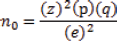
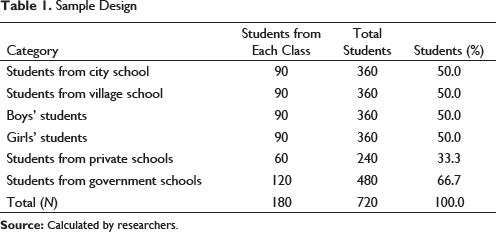
The study based on primary data of students from Standard III–VI. The study takes into account 720 students with 360 boys (50%) and 360 girls students (50%) with total 180 students from each Standard. Among 180 students from each standard; 90 students (50%) are from city-based schools and 90 students (50%) from village schools. The selected city and village regions include Kolkata, Howrah, Paschim Mednipore and Purulia districts in West Bengal. The data collected directly from students in presence of their parents. From total 720 students; 240 students (33.3%) are from private schools and 480 students (66.7%) are from government schools. Due to less number of private schools in villages, the number of students is comparatively less than government schools in the sample. The design of the sample is represented in Table 1. The questionnaires framed in unambiguous language for primary level students to answer easily without any ambiguity. The structured questionnaires are collected during January 2021 to March 2021 by maintaining proper social distancing norms. With regard to sample size; the larger is the sample size, the greater is the representativeness of the sample with more reliability of results (Saunders et al., 2009). The study uses Cochran’s formula for determination of the sample size. According to Cochran’s (2007) formula; for an infinite population the calculation for representative sample is as follows:
Sample Design
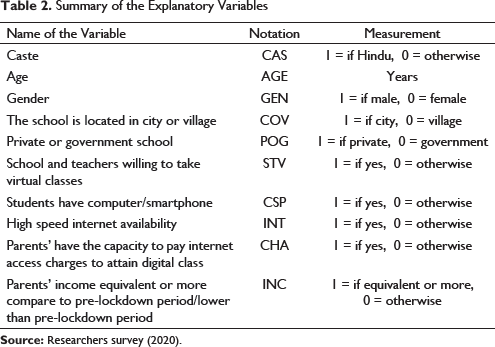
Variables Used in the Study
Summary of the Explanatory Variables
Statistical and Econometric Tests Used
In order to identify the influencing factors, of virtual mode of learning by primary school students’, binary logistic regression adhered. Logistic regression refers to regression model with categorical dependent variable and output takes two values ‘0’ and ‘1’ referred as binary logistic regression or logit model. Total 720 primary students from Class III to VI have been accounted from selected regions. In Logistic Regression Model, estimation made according to maximum likelihood method (Amemiya, 1984; Maddala, 1986). A logistic model has flexibility of incorporating both qualitative and quantitative factors and is more effective and accurate than linear regression probability model. The study estimates coefficient with the following equation:

Pi = probability that dependent variable accepts value of 1 (i.e., students have attended virtual class). 1 − Pi = probability that dependent variable accepts value of 0 (zero).
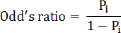
where α represents intercept in the model, βi is coefficient of ith independent variable and ei is error term.
Multicollinearity property has been tested by using variance inflation factor (VIF). Goodness of fit of the model is verified by Hosmer–Lemeshow test. Researchers used Welch’s t-test to investigate significant difference in various dimensions as city- and village-based school students, male and female students and private school students and government students. The test is more accurate than t-test when variances or sample size are unequal. Assuming unequal variances, the test statistic is calculated as follows:

To check the critical value, degree of freedom (d.f.) is calculated as follows:

where X1 = mean of first sample; X2 = mean of second sample;
S12 = variance of first sample; S22 = variance of second sample;
n1 = first sample size; n2 = second sample size; and W = Welch’s t-test
The study has used ratios, mean, standard deviation to analyse the data. Before analysing data, reliability has been verified with Cronbach’s coefficient alpha.
Analysis and Discussions
Descriptive Statistics
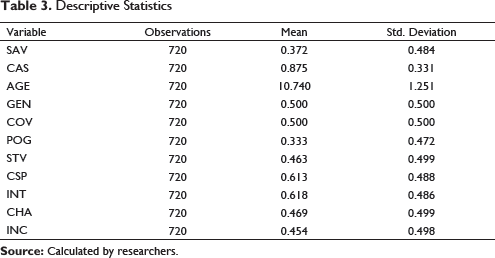
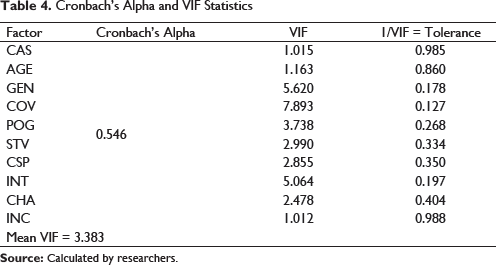
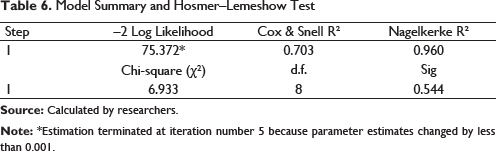
In the wake of COVID-19 pandemic Indian Government imposed rigorous lockdown regulations to contain the virus. Considering various challenges during lockdown the researchers investigated influencing aspects on digital learning of primary students. Initially to analyse influencing factors logistic regression model has been considered. In order to describe data property, the study measures mean and standard deviation in Table 3. Further, reliability verified with Cronbach’s coefficient alpha. The value worked out to 0.646 clearly establishing reliability of the constructs (George & Mallery, 2003). According to different theories of reliability, value above 0.5 signifies appropriate reliability while below 0.5 denotes inappropriate. Before using logistic regression, it was checked if there exists any multicollinearity among explanatory variables in terms of VIF. The same is represented in Table 4 and mean VIF is 3.383, which is even less than 4.
Cronbach’s Alpha and VIF Statistics
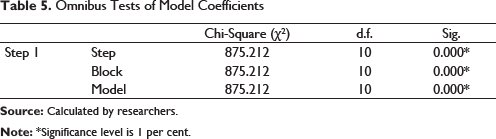
Omnibus Tests of Model Coefficients
Model Summary and Hosmer–Lemeshow Test
Classification Table
Variables in the Equation
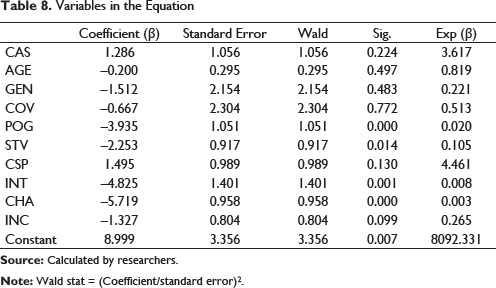
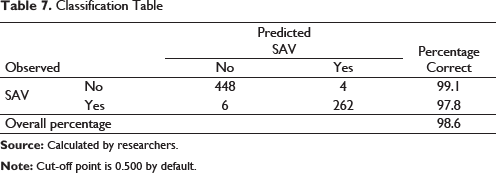
The result of logistic regression confirms that POG, INT and CHA significant at 1 per cent level of significance (Table 8). Further, STV and INC are significant at 5 per cent and 10 per cent level of significance respectively. Though possessing computer system/smartphone seems essential to access virtual class but result of logistic regression shows CSP insignificant, that is, p = .130 (>.05). Though the result of CSP is insignificant, its level of confidence is 87 per cent. In addition to the research by Budi et al. (2020), the present study observes significant number of respondents unable to attend online classes due to unavailability of smart phone or computer system and internet access. Arora and Srinivasan (2020) explained internet connectivity as the worst threat to virtual classes. Further Moorhouse (2020) suggests specialised trainings to be imparted to teachers for expertising technically in virtual classes. The present study cites various supporting facts with figures considering students from primary section as substantial group to witness immense challenges in accessing virtual learning. The crux of the issue lies in motivating and initiating them to bypass the threats in the form of challenges that remain associated with online learning during the prolonged period of lockdown. Undoubtedly, the findings of the study have several significant implications that require immediate address from government’s end to regulate examination of the current academic year that in turn would be beneficial for new academic session.
Result of Welch’s t-Test
Conclusion
The global crisis caused by corona virus has raised alarming concerns about its long-lasting impact on agriculture, industries, foreign market, education, human health, mental health, etc. Large population of the society is dreading towards an uncertain future. The socio-educational approach of schools, colleges and universities have been drastically affected by COVID-19 pandemic. The chalk-talk teaching model has undergone transformation while digital model for ensuring continuity of teaching–learning process is in vogue. The propensity of students for online classes has elevated dramatically. The pandemic has transformed learning pattern of students, compelling them to adjust and adapt to studying in isolation and sharing knowledge online.
In this study, an effort made to determine the influencing factors on digital learning for primary level students. The result of logistic regression infers school structure (private or government), willingness of school authority and teachers to conduct virtual classes, availability and accessibility of high-speed internet and economic capability of parents to incur internet charges as significant influencing factors to conduct successful virtual classes of primary section students. Due to suspension of traditional classroom sessions, the course needs to be imparted online exclusively (Moorhouse, 2020). The online live classes assumed the role of ‘live guide’ to motivate students in their learning process and rendered psychological support in stress hours of stringent restrictions. During pandemic, Qian-Hui and Ying (2020) suggested network course resources, network teaching platform, live broadcast system and synchronous classroom to actively conduct online teaching. Technology plays pivotal role in upgrading educational processes and outcomes while defining the relationship between technology and education as bidirectional (Mishra, 2020).
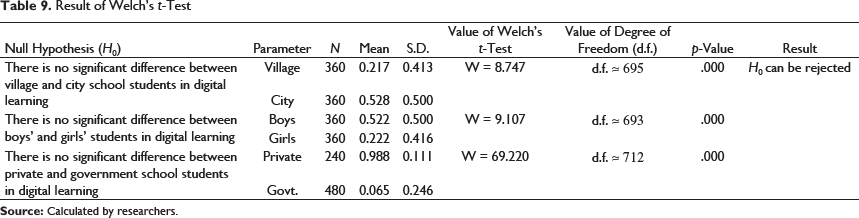
In second phase of the study results of Welch’s t-test indicate significant differences in digital teaching–learning mode adhered by primary school students between boys and girls, city-based school and village school students and private and government school students. According to mean score the male city based private school students are placed in better and comfortable position for digital classes in comparison to female village-based government school students. Terry Durnnian, Chief Education, UNICEF, India Office, remarked that families facing economic hardships during pandemic days held back their girls at home to manage household chores leading to rise in early marriages (Punj, 2020). Thus, crisis led inaccessibility to physical classroom has further aggravated gender-based digital divide in our society. In particular, students from remote locations are constantly exposed to issues of electricity, mobile network, internet glitches, which seem to be intense challenges posed before them in comparison to the city-based students.
Many schools are creating pressure for online classes where students are glued to laptops, smartphones and computer screens causing health hazards. The kids are constantly exposed to digital gadgets for learning assignments raising concern for their eye sights. The digital learning system restricts imaginative, intellectual capacity and sociability of tender minds. Indian poor villages majorly lack electricity, server system and transmission towers with no or poor accessibility of high bandwidth or strong internet connection required for digital teaching–learning process. Students from disadvantaged communities unable to afford high-end gadgets or smart handsets or internet facilities are in deplorable state. Further, using internet for prolonged hours in online classes incur high expenses as cost of use. Thus, the rural students are not much benefited from e-learning solutions. The education sector as critical determinant of the country’s economic future suffered significant disruption in the well-sketched system as turbulent effect of the pandemic.
Task Ahead
On account of COVID-19 pandemic induced prolonged lockdown stipulating closure of schools there remains tendency in students, mostly primary section kids, to forget the lessons learned in pre-pandemic session of the academic year. It is quite vivid that new admission of students in schools with reference to primary section may confront hardship to navigate and follow this new terrain of transformation from classroom to digital learning. Further, developing countries like India exposed to immense challenges from infrastructure to income inequality find them in deep soup (Maity et al., 2020a). To combat with such steep challenges and sustain skill enhancement of students during closure of schools calls for proposed solutions sketched as measures to contain monstrous wild fire of the deadly virus.
During lockdown local governments initiated limited online classes through television broadcasted educative programmes and poor rural families with no television set were extended support from institutions (schools, NGOs, welfare associations) for students to attend regular online classes without interruption. Students, deprived from access to technology, are often unable to view the broadcasted video lessons through mobile handsets, computer systems, television sets and radio programmes, should be provided with physical printed chapters of textbooks through learning packets. The elite private school authorities while conducting digital classes combine two sections of the same standard together and, however, during digital lectures teachers often find 50 per cent attendance of students. To urge an absentee student for virtual classroom teachers may contact guardians to know and understand the reasons and thereafter take appropriate initiatives if required.
Further, prolonged lockdown have paved way for large segment of migrant workers absorbed in various unorganised sectors to return to their hometowns. The viral outbreak has shut down businesses and left millions unemployed with recent surge in unemployment. According to the Centre for Monitoring Indian Economy (CMIE), nearly 5 million salaried employees lost jobs in July 2020 taking the toll to 18.9 million due to COVID-19 pandemic followed by lockdown (Vyas, 2020). The situation of job loss in the second wave of the pandemic is almost the same. The data further shows that employment in farm sector’s rose to 39.4 per cent in 2020–21 compare to 38 per cent in 2019–20 though wage rate is lower for labour employed in agriculture. This may enhance the chance for more dropout of children from schools as their parents are engaging them to work for earning livelihood. The educational institutions and regulatory bodies should take missionary initiatives to control the dropout rate of students by proposing engagement practices between schools and parents so as to stimulate and support parents in guiding their children’s learning. Visualisation predominantly rules the minds of primary students that should be considered while engaging in online sessions.
Infrastructure and technological set up of government schools needs improvement while benchmarking standard private schools for development. Reports from unaided private schools reveal spike from 3 per cent to 35 per cent in overall enrolment during 1978–2017. However, enrolment in government schools declined from 74 per cent to 52 per cent (Kaushal, 2020). Initiatives to be sketched from government’s end to magnify fund allocation to primary and higher education segment for infrastructural improvement and technological advancement. Need for designing stringent regulatory norms in order to compel school authorities and teachers to conduct virtual knowledge sharing classes on regular basis with accountability.
In villages the most challenging issue seems to be universal accessibility to infrastructure (hardware and software) along with internet connectivity. The regulatory authorities may direct telecom service providers to facilitate mobile telecom tower while upgrading bandwidth designed especially for underserved regions. In the lockdown phase when schools are all closed with no school bus plying on streets but halted in queue in garages can be utilised as internet caravan for rural remote locations to provide easy accessibility of internet to village students with strong socio-economic vulnerability.
Periodical trainings on digital resources and technical advancements for pedagogical practices in conducting online classes with special focus on PPT, recorded audio-video lectures should be initiated for teachers to ensure maximum adherence to wired network. Setting technology as priority while recruiting or appointing teachers or qualified educator the appointing authorities may set mandatory selection criteria as technically well-versed candidates eligible to apply. However, if any unfavourable situation arises in future students may not be victims of teacher’s incapability. DIKSHA platform should be professionally standardised to ensure accessibility of academic knowledge by all segments of students in the society.
India stepped into innovative era of digitisation in the wake of COVID-19 pandemic outbreak that drove a wedge between the haves and have nots. Longstanding digital divide has been witnessed among rich and poor states of the country (Zee Media Bureau, 2020). Central and state-level initiatives to be geared to establish study centres assisting students with limited accessibility to online learning at home. This relates to the need to be ensured that no student is being left out from the ambit of governmental assistance to education. The Government may take initiative to distribute television sets, tablets, computer systems or laptops at subsidised rate to Government-aided school students and schedule trainings to make them tech-savvy as circumstances and trend demands. The policymakers should figure out maximum inclusive e-learning solutions to foster learning and frame policies to tackle the galloping digital divide in the society.
The sudden radical remodelling to virtual mode of education has landed primary level students in tech-based culture to accustom to the fast-growing IT enabled society. The COVID-19 crisis has paved way for tectonic shift in our educational system (Mishra, 2020). During pandemic the students are adjusting and adapting to the novel flipped classroom concept that should promote online socialisation opportunities through learning for these primary kids to keep them engaged in virtual classes without any intervention. The government must frame strategies and initiate guidelines wherein online academic activities can be mandated along with regular lecture and PPT sessions in post-pandemic times. In the present scenario of pandemic crisis technology seems to be the panacea in the teaching–learning process in phased manner to ensure capacity building of tender minds and assure its acceptability by all the stakeholders involved.
Annexure
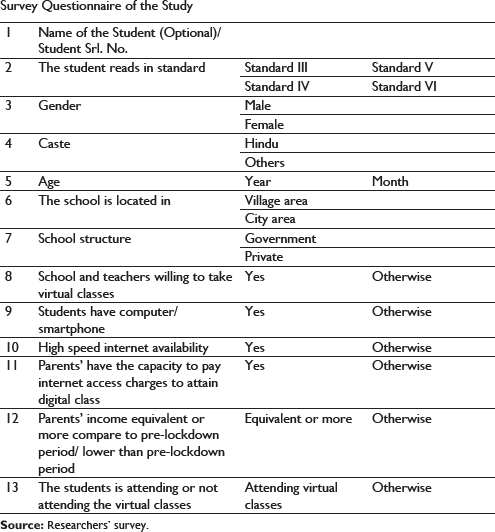
Survey Questionnaire of the Study