




Abstract
Drawing on an advanced analysis of individual longitudinal register data of school careers of four cohorts of children in Amsterdam, this article suggests that school advice is highly differentiated between children of different migrant and socioeconomic backgrounds. Moreover, apart from these individual characteristics, we demonstrate that the socioeconomic composition of neighbourhoods and schools is important for understanding differences in school advice. The analysis shows that neighbourhood and school socioeconomic disadvantage negatively affects the school advice of children with highly educated parents, while socioeconomic advantage positively affects all children and especially children of lower- and intermediate-educated parents. The positive neighbourhood effects are, however, mediated by primary school context. We suggest that while most of the educational inequalities may be explained by individual characteristics, residential and school segregation intensify these inequalities, especially through the beneficial effects of neighbourhood and school advantage.
Introduction
Education plays a crucial role in shaping people’s opportunities in life; thereby, it may also be an important factor in reproducing social inequalities. Besides the impact of family socioeconomic background, geographical differences in access to education and educational opportunities are important for understanding the reproduction of social inequalities in educational outcomes (Holloway et al., 2010). Neighbourhoods and schools are particularly important contexts for young people’s social as well as academic development, and the influence of these contexts on educational achievement (i.e. performance) as well as educational attainment (i.e. obtained level) has been widely recognised among scholars and policy-makers (Leventhal and Brooks-Gunn, 2000).
An important way in which neighbourhoods are related to education is through structural differences in concentrated (dis)advantage and residential segregation, producing different educational outcomes (Butler and Hamnett, 2007; Sykes, 2011). Several studies have shown that neighbourhood characteristics, especially the socioeconomic composition, influence educational outcomes (for a review, see Leventhal and Brooks-Gunn, 2000; Nieuwenhuis and Hooimeijer, 2016). Schools may be important contexts for mediating the way in which these differences between neighbourhoods affect educational outcomes in several ways (Kirk, 2005). Although the interrelatedness of neighbourhoods and schools in explaining spatial and social differences in educational outcomes has been widely recognised, few studies have examined these multiple contexts simultaneously. Moreover, these studies mainly examine the secondary school context as a potential mechanism through which neighbourhoods affect educational outcomes (Ainsworth, 2002; Brännström, 2008; Garner and Raudenbush, 1991; Kauppinen, 2008; Pong and Hao, 2007; Sykes, 2011). The current study contributes to research on neighbourhood effects by focusing on the neighbourhood and primary school context and their simultaneous effect on the advised educational track during the transition to secondary education. By focusing on the impact of neighbourhood and school contexts for students of different ethnic and social backgrounds, this study aims not only to investigate the potential mediating role of the school for neighbourhood effects but also to understand for whom these contexts matter. Multilevel analyses are applied using longitudinal educational career data of students in Amsterdam who started secondary education between 2007 and 2010.
The Dutch context serves as a particularly good case through which to analyse neighbourhood and school effects on educational transitions because of the highly stratified educational system and relatively early tracking. In the transition from primary to secondary education, Dutch students are sorted into different educational levels, largely determining their educational career (Jacob and Tieben, 2009). Since stratified educational systems are found to reproduce social inequalities (Brunello and Checchi, 2007), the relation of neighbourhood and school socioeconomic composition to educational differences during the transition to secondary education is crucial for understanding inequalities in educational opportunities between children of different social and ethnic backgrounds. Furthermore, by focusing on primary–secondary school transitions in Amsterdam, this study sheds light on context-specific processes of neighbourhood and school effects on these transitions.
Theory
Neighbourhood effects and mechanisms for educational outcomes
Neighbourhood effects research studies the effects of structural and social differences between neighbourhoods on several individual outcomes. Concerns about these neighbourhood effects largely derived from Wilson’s (1987) study on concentrated poverty in ghettos in the United States. Wilson (1987) argued that the concentration of poverty and social isolation of disadvantaged neighbourhoods created major social problems for the urban poor. This led to a renewed interest in the impact of structural dimensions of neighbourhoods on a wide range of individual outcomes.
With the seminal review of Jencks and Mayer (1990) on theoretical models for neighbourhood effects, a number of scholars moved beyond the focus on structural dimensions to a focus on neighbourhood social processes. Jencks and Mayer (1990) identified five theoretical models as most important social mechanisms through which neighbourhood composition might affect individualoutcomes: (1) the availability and quality of institutional resources in a neighbourhood, such as libraries, community centres and schools; (2) collective socialisation, influencing individuals through the social organisation of a neighbourhood (adult role models, social control and social values); (3) the role of peers in influencing attitudes and behaviour (i.e. the contagion or epidemic model); (4) competition between neighbours and peers for scarce resources; (5) the relative deprivation of residents compared with neighbours and peers.
Largely inspired by these theoretical developments, a wide range of studies on the effects of neighbourhood disadvantage on several individual outcomes have been conducted since (Sampson et al., 2002). One of the most consistent findings across these studies is the association between neighbourhood socioeconomic composition and educational outcomes (for a review, see Leventhal and Brooks-Gunn, 2000; Nieuwenhuis and Hooimeijer, 2016). Regarding this relation, it is argued that different social processes might account for the effect of concentrated disadvantage and concentrated affluence (Kauppinen, 2007).
Regarding the negative effects of concentrated disadvantage, three social mechanisms are identified as being especially important for educational outcomes. Social isolation theory postulates that the geographical isolation of residents in disadvantaged neighbourhoods isolates them from society. From this perspective, it can be argued that children in disadvantaged neighbourhoods are deprived of beneficial social networks (Kauppinen, 2007) and cultural values (Crowder and South, 2011), which might affect their educational opportunities. Secondly, social disorganisation theory argues that the absence of social norms and social control in disadvantaged neighbourhoods might result in anti-school and deviant behaviour among youth (Ainsworth, 2002). Finally, children might be influenced by anti-school attitudes and deviant behaviour of peers in the neighbourhood, which might negatively affect their educational outcomes (Crowder and South, 2011; Kauppinen, 2007; Leventhal and Brooks-Gunn, 2000).
For the positive effect of concentrated affluence on educational outcomes, three mechanisms are identified as being especially important. First, the process of collective socialisation, the exposure of youth in affluent neighbourhoods to more positive adult role models exercising more social control, might positively influence youth behaviour and educational outcomes (Kauppinen, 2007). Secondly, in affluent neighbourhoods, high-status youth might have a more positive attitude towards education, which might also increase pro-school behaviour amongst peers. Finally, social capital theory assumes that children growing up in more advantaged neighbourhoods often have a more beneficial social network providing ‘positive resources, information, and opportunities that may be educationally beneficial’ (Ainsworth, 2002: 120). On the other side, it has been argued that concentrated affluence might negatively affect educational outcomes for some children. Following relative deprivation theory, children with a lower socioeconomic background might actually perform worse in an affluent neighbourhood where they compare their abilities with those of more advantaged peers. Similarly, a higher share of advantaged neighbours might reduce the opportunities for the less advantaged in the competition for resources in an area (e.g. quality schools). Finally, cultural conflict theories argue that the presence of affluent peers and neighbours might increase the likelihood of forming subcultures with anti-school attitudes (Crowder and South, 2011; Kauppinen, 2007).
These neighbourhood effect theories suggest that the relation between neighbourhood composition and educational outcomes is mainly caused by internal neighbourhood processes. However, neighbourhood effects are more complex and influenced by the broader institutional and social structures in a city (Sampson, 2019). These macro structures are important in determining where people live (Slater, 2013), and structural stigmatisation of low-income and often coinciding ethnic minority neighbourhoods might result in discrimination against its residents in access to education and employment (Kauppinen, 2007). While in recent decades urban policies are aimed at creating socially mixed neighbourhoods, these policies have been argued to directly or indirectly (with rising housing prices) exclude lower-class residents from neighbourhoods and schools (Lipman, 2008). Although internal neighbourhood processes might thus be important for educational inequalities, broader societal forces of segregation and stigmatisation are important in maintaining social and educational inequalities.
The link between neighbourhood and school effects for educational outcomes
The school is often perceived as an important context mediating the effects of neighbourhood socioeconomic disadvantage and affluence. There are several ways in which the neighbourhood and school contexts can be perceived to be interrelated in influencing educational outcomes (Kirk, 2005).
First, the school is often conceptualised as the most important institutional mechanism through which neighbourhoods affect educational outcomes (Ainsworth, 2002; Sykes and Musterd, 2011). Neighbourhoods differ in the availability of and access to educational facilities (Butler and Hamnett, 2007). An unequal distribution of educational provision might result in a relative advantage in educational opportunities for children residing in well-served neighbourhoods over children living in more poorly-served areas (Sykes and Musterd, 2011). Neighbourhoods differ in the quality of available schools (e.g. school resources and teacher performance), affecting a child’s educational opportunities (Ainsworth, 2002). Internal school processes might in turn be influenced by the composition of neighbourhoods; the challenging context of disadvantaged neighbourhoods makes it for instance more difficult for schools to achieve high-quality education (Lupton, 2004). Areas furthermore differ in their provision of types of education; children residing in areas with limited educational programmes available (e.g. higher educational tracks) might be disadvantaged in their educational opportunities (Sykes and Musterd, 2011).
Secondly, the neighbourhood plays an important role in selecting children into schools, hence informing school compositions and social processes (Kauppinen, 2008). This is especially important since the school is identified as one of the most important local sites where social interactions between young people take place (Sykes and Musterd, 2011). Social processes identified in neighbourhood effects research might partially be taking place in the school context (Sykes and Musterd, 2011). Two social mechanisms can be argued to be especially important in the school context: the influence of peers’ attitudes and behaviour in school; and collective socialisation, with adults (e.g. school teachers) who serve as role models and exercise social control. The competences of teachers may in turn be related to the neighbourhood in which the school is located, since schools in disadvantaged neighbourhoods may be unable to attract qualified teachers (Lupton, 2004) and teachers might adjust their practices according to the composition of pupils in the school, which is in turn informed by neighbourhood composition (Kauppinen, 2008). Besides this, lower-class and ethnic minority children might be disadvantaged due to the white Eurocentric pedagogical climate in schools, which might contribute to discrimination and exclusion in the educational system (Stam, 2018).
Although it is now widely recognised that neighbourhood and school contexts are interrelated in affecting educational outcomes, only a few studies have examined the effects of these contexts for educational outcomes simultaneously. Schools and neighbourhoods may work together in intricate ways in which the relative advantage or deprivation of pupils depends on the interaction between school and neighbourhood (Owens, 2010). Wodtke and Parbst (2017), who analyse school and neighbourhood characteristics simultaneously, find no evidence that neighbourhood effects are mediated through school poverty, and suggest that other mechanisms must be at work, such as ‘neighborhood subcultures, violent crime and environmental health hazards’ (Wodtke and Parbst, 2017: 1672). Ainsworth (2002), on the other hand, finds that the positive effect of neighbourhood high socioeconomic status (SES) for educational achievement is partially mediated through school atmosphere. Similarly, Pong and Hao (2007) find that neighbourhood SES is positively related, and the proportion of foreign-born negatively, to the grade-point average of secondary school students – and that this association is mediated by school conditions.
Examining educational attainment in a school district in Scotland, Garner and Raudenbush (1991) find that neighbourhood deprivation is still significantly related to lower educational attainment after taking into account individual ability, family background and variation in the schools attended. For the Swedish context, Brännström (2008) finds that secondary school characteristics explain more of the variance in educational achievement than neighbourhood characteristics (SES and immigrant density). Furthermore, the variance explained at the neighbourhood level was strongly reduced after inclusion of the school context, indicating that neighbourhood effects are mainly transmitted through the school context. Similarly, Kauppinen (2008) finds for the Finnish context that the relation of neighbourhood composition to secondary school choice is in large part mediated by the socioeconomic composition of the school. For the Dutch context, Sykes (2011) finds that the association between neighbourhood SES and educational achievement is largely transmitted through the secondary school. These empirical findings all seem to indicate that the school is an important pathway through which neighbourhood effects on educational outcomes are transmitted.
Finally, it is important to realise that neighbourhood (and school) effects do not work in the same way for everyone. Sharkey and Faber (2014) called for a more flexible and sensitive analysis of when, why and for whom the context becomes salient. This also resonates in the work of Sampson, who in a recent paper reiterates his critique of too narrow and dichotomous definitions of neighbourhood effects, explicitly including sorting mechanisms of who lives where as part of the broader contexts that shape life chances (Sampson, 2012, 2019).
Geography of education
An important challenge in the research of neighbourhood and school effects is to capture the selection bias, referring to the problem that residential patterns and school choices are not random. Selection bias might result in an overestimation of neighbourhood and school effects on educational outcomes (Galster, 2003). The geography of education literature focuses on these non-random residential patterns and school choices. An important argument within this research area is that residential patterns of, especially middle-class, families can partially be explained by the availability and quality of schools in neighbourhoods (Boterman, 2013). From this perspective, Butler and Robson (2003: 10) argue that the middle class use education strategies to maintain and reproduce their social position and are ‘active choosers compared to working-class parents’ of their children’s schools. In this respect, ‘primary schools are seen as “preparatory schools” for accessing appropriate circuits of secondary education’ (Butler and Robson, 2003: 10).
Working-class parents, and parents of colour of both middle-class and working-class backgrounds, are demonstrated to pursue different educational strategies from those of white middle-class parents (Lareau and Goyette, 2014; Reay et al., 2011; Rollock et al., 2014). For parents of colour, navigating exposure to racial bias is often inherent in their residential and school choice strategies, leading to different choices of both neighbourhood and school. School strategies of parents of colour may therefore rely less on residential relocation into better performing – often suburban – school areas, which are generally predominantly white. The link between residential patterns and educational choices, however, is highly context-specific, and depends partly on the geographical constraints in this choice (Harris, 2013). Most studies on middle-class strategies for ensuring access to secondary schools focus on contexts with a strong link between residential location and school access; due to the relatively free school choice in the Netherlands, the availability of quality schools in a neighbourhood is expected to be less important in residential decision-making processes (Boterman, 2013).
The context of Amsterdam
Residential and school segregation
While residential ethnic and socioeconomic segregation for all households in Amsterdam is relatively low (Musterd, 2005), residential segregation of school-aged children is much higher (Boterman, 2018). Moreover, school segregation based on class and ethnicity is even higher than residential segregation (Boterman, 2019; Ladd et al., 2009). Although ethnic school segregation levels seem to be stabilising or even going down a little, segregation by income is going up (Boterman, 2019).
The continued high levels of school segregation are explained by the specific educational landscape of Dutch cities (Boterman, 2019). The system is quite egalitarian in financial terms, but highly differentiated in religious, pedagogical and cultural terms. Moreover, parents constitutionally have the right to freely choose schools, allowing them to select a school fitting their preferences within and outside of the neighbourhood. This right, however, is not exercised equally by different parents. Especially, the active engagement of middle-class parents in school choice, and their preference for white middle-class primary schools (Boterman, 2013; Karsten et al., 2006), has resulted in increasing homogenisation of particular primary schools: especially very homogeneous white middle-class schools, with very few lower-class children and also almost no non-white ethnic minorities.
Educational system
The Dutch educational system is highly stratified and characterised by relatively early tracking. By the age of 12, Dutch pupils are sorted into different, hierarchically stratified levels of secondary education, marking one of the most important transitions in their educational career. The decision about the educational level of the secondary school track is based on what is euphemistically referred to as ‘the advice’ of the primary school teacher in combination with standardised tests (most commonly the Cito-test) at the end of primary education. In practice, the primary school ‘advice’ is in fact the most decisive factor selecting children into educational tracks in secondary education, since most secondary schools will not accept children who apply for a higher level of education than ‘advised’. 1 The Cito-test forms an independent test of a child’s achievement at the end of primary school, and mainly functions to support a teacher’s advice. For the years studied in this article (pupils starting secondary education between 2007 and 2010), the primary school advice could be adjusted if the test score did not match the initial advice. Children were free to choose their preferred secondary school offering the advised educational level. 2
In their transition to secondary education, children are tracked into different educational levels (De Graaf et al., 2000); at the end of primary education, pupils are advised to follow one of those tracks or a combination of two adjacent tracks. The educational levels offered at secondary schools are:
basic or advanced pre-vocational education (vmbo-b/k); lasting four years and providing access to senior secondary vocational education (mbo);
combined or theoretical pre-vocational education (vmbo-g/t) lasting four years and providing access to general secondary education (havo) and senior secondary vocational education (mbo);
general secondary education (havo) lasting five years and providing access to higher professional education (hbo);
pre-university education (vwo) lasting six years and offering access to universities (wo).
Although transitions between the different levels are possible, mobility between those different tracks is limited (Jacob and Tieben, 2009). Therefore, the decision made during the primary–secondary school transition is very important for a child’s educational career.
One of the major concerns regarding such a stratified educational system is that ‘tracking into separate schools appears to sort students to a very substantial degree on the basis of social characteristics’ (Holdaway et al., 2009: 1391). Cross-national research has shown that highly stratified educational systems reinforce inequalities of educational opportunities by social class (Brunello and Checchi, 2007). For the Netherlands, it is indeed found that tracking reinforces socioeconomic and ethnic educational inequalities (Crul and Holdaway, 2009; Kloosterman et al., 2009; Van de Werfhorst and Van Tubergen, 2007). Children of lower socioeconomic backgrounds are much less likely to be selected into the higher tracks than children with a high socioeconomic background (Kloosterman et al., 2009). Especially in urban contexts, children with non-Dutch backgrounds are predominantly in the lower educational tracks (Inspectorate of Education, 2016), while pre-university education tracks including the prestigious gymnasia are in majority white, native Dutch neighbourhoods (Merry and Boterman, 2020). Although lower educational attainment of ethnic groups in the Netherlands is found to be mainly driven by the lower SES of these groups (Van de Werfhorst and Van Tubergen, 2007; Van Ours and Veenman, 2001), there is a growing body of literature that links these inequalities also to racial bias in teaching practices and school advice (Stam, 2018; Timmermans et al., 2015).
Data and methods
Data and sample
The study builds on two data sources: the longitudinal dataset of the Educational Careers Research (Schoolloopbanen) of the municipality of Amsterdam (Onderzoek Informatie en Statistiek, 2017) contains information on the educational careers of pupils in Amsterdam from the start of secondary education (2007/2008–2016/2017) until their graduation from secondary education (last measurement 2016/2017). 3 This study focuses on 30.276 children starting secondary education between 2007 and 2010. The dataset is complemented with individual-, school- and neighbourhood-level register data derived from the System of Social Statistical Datasets (SSB) of Statistics Netherlands. For the school and neighbourhood characteristics, individual-level data of the population for the years 2008–2010 were aggregated and averaged for the three years. 4 Primary school characteristics were matched to the dataset using each school's unique identifier, and neighbourhood characteristics were matched using the 99 administrative neighbourhoods in Amsterdam, based on a child’s residential neighbourhood at the start of secondary education. The final sample was reduced to 16.137 children nested in 202 primary schools and 87 neighbourhoods.
Operationalisation
Dependent variable
This study analyses primary school advice, which is the advised track for secondary education operationalised in six ascending categories: (1) basic/advanced pre-vocational 5 ; (2) theoretical pre-vocational; (3) combined pre-vocational/general; (4) general; (5) combined general/pre-university; (6) pre-university education.
Independent variables
Two levels of analyses are specified with two non-nested level-2 units. Level 1 consists of individual children (N=16.137); level 2 consists of the residential neighbourhoods (N=87) and primary schools (N=202). To account for the cross-nested structure of the dataset with children nested in schools and neighbourhoods, an additional level-2 unit is constructed containing the grouped neighbourhood and school level (N = 2.218).
Level 1: Individual children
Several individual characteristics are controlled for in the analyses: year starting secondary education, age and sex. 6 Migrant background is included as a categorical variable for the groups: (1) Native Dutch, (2) Surinamese/Antillean, (3) Moroccan/Turkish, (4) Other non-western and (5) Western migrant background. 7 Socioeconomic background is measured using a child’s standardised household income as a continuous variable and parental educational attainment as a categorical variable categorised as: (1) low (max. lower vocational education), (2) intermediate (max. higher vocational or secondary education), and (3) high (professional/academic higher education).
Level 2: Neighbourhoods
The children in the sample reside in 87 neighbourhoods in Amsterdam. Based on previous studies on the effect of neighbourhood SES on educational outcomes (Brattbakk and Wessel, 2013; Kauppinen, 2007; Owens, 2010; South et al., 2003; Sykes, 2011), neighbourhood SES is measured as a composite variable of the aggregated parental education and household income of all primary and secondary school students residing in a neighbourhood. Principal component analysis is applied to generate a factor variable of neighbourhood SES based on five indicators: proportion of students with lower-educated parents, proportion of students with highly educated parents, median household income, proportion of students with a low household income and proportion of students with a high household income. The factor variable is calculated as the weighted sum of the standardised variables and divided into five equal categories ranging from (1) very low to (5) very high neighbourhood SES.
Level 2: Primary schools
For the 202 primary schools, the same five indicators were combined through the same PCA procedure into one factor variable, primary school SES. Again, this factor variable is divided into five equal categories ranging from (1) very low to (5) very high primary school SES. Two other primary school variables are included: the number of pupils and the school denomination.
Analytical strategy
Multilevel models are used to analyse the educational careers of pupils, acknowledging the cross-nested structure of the dataset in which pupils are nested in neighbourhoods and schools. Separate two-level hierarchical models are first specified, recognising that children (level 1) are nested within residential neighbourhoods (level 2) or in primary schools (level 2). Additionally, two-level models are specified for the simultaneous analysis of primary schools and neighbourhoods. Since the primary schools are not necessarily nested in the residential neighbourhoods, a grouped neighbourhood and school level is used for this final analysis. 8 Multilevel ordered logistic random-intercept models are used for all the analyses of primary school advice and are estimated using meologit in Stata.
The analysis starts with estimating the unconditional models for primary school advice. These models are used to estimate the variance in primary school advice that is attributable to the neighbourhood level and primary school level calculated by the Intraclass Correlation Coefficient (ICC), measuring the proportion of unexplained variance at the neighbourhood and primary school level. Subsequently, four hierarchical models are specified (see Table 1 for the variables included). Model 1 includes only individual-level variables; in model 2 and model 3 respectively, neighbourhood- and school-level variables are added; and model 4 includes neighbourhood- and school-level variables simultaneously. Finally, models 2–4 are estimated with the additional inclusion of cross-level interaction effects of parental education with neighbourhood as well as school SES.
Descriptive statistics outcome variable and explanatory variables.
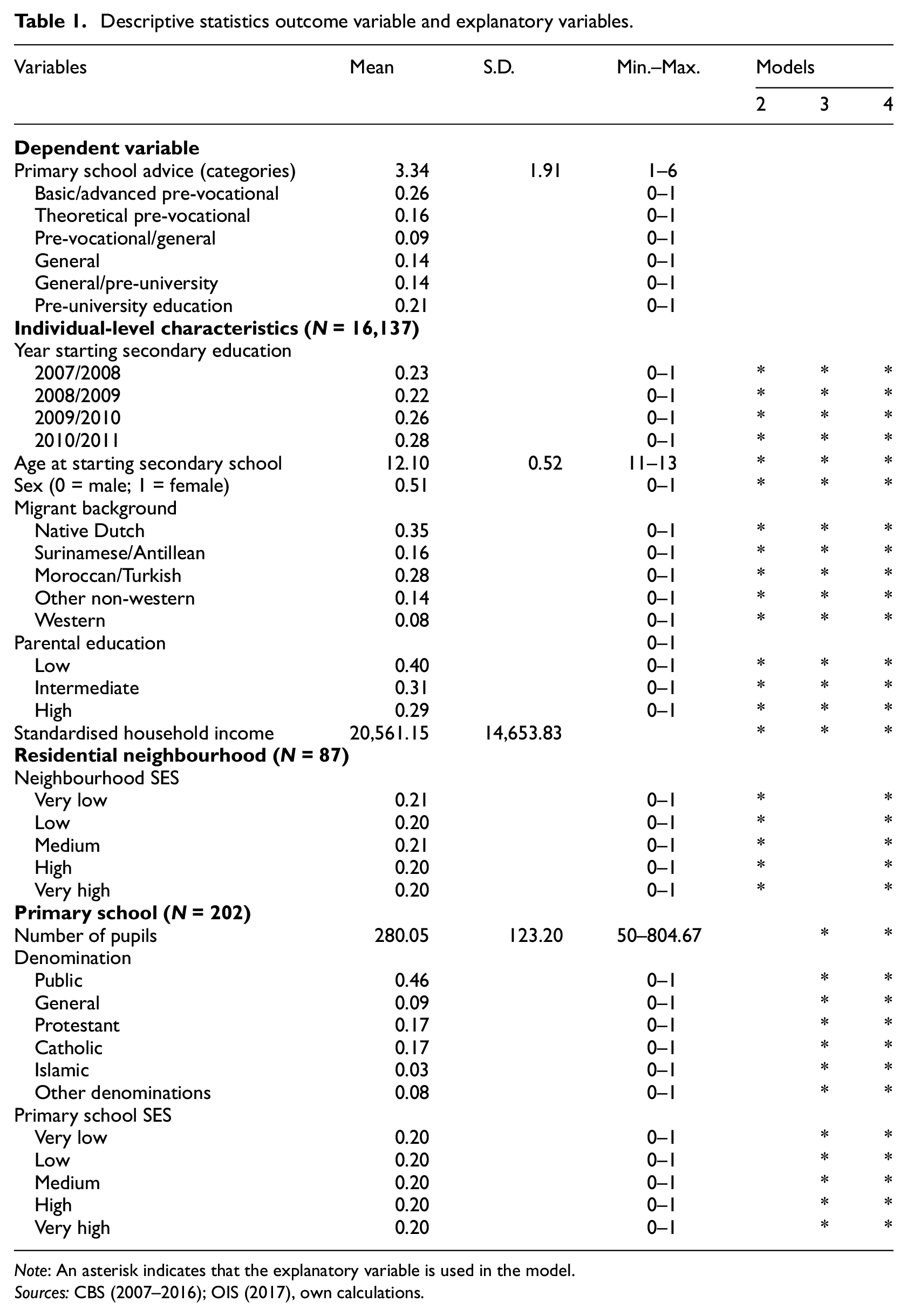
Note: An asterisk indicates that the explanatory variable is used in the model.
Sources: CBS (2007–2016); OIS (2017), own calculations.
Results
Descriptive statistics
Descriptive results (Table 1) show that a relatively large proportion of children received advice for basic/advanced pre-vocational (26%) and pre-university education (21%), while a relatively small proportion received combined advice for theoretical pre-vocational/general education (9%). About half of the children are female (51%). Only a minority of children have a native Dutch background (35%); children with a Moroccan or Turkish background make up another third (28%), and 16% have a Surinamese/Antillean background. Most children have low-educated parents (40%); while about 29% have parents with at least a bachelor’s degree. Nearly half the primary schools are public (46%) and they have on average 280 pupils. Neighbourhood and primary school SES are equally divided into five categories, making up about 20% of the neighbourhoods and schools.
As expected, the children are unevenly distributed across the neighbourhoods and schools in terms of parental education (Figure 1). Within neighbourhoods and schools with a very high SES, the majority of children have highly educated parents (respectively 55% and 62%). Conversely, within neighbourhoods and schools with a very low SES, the majority of children have lower-educated parents (respectively 62% and 70%). The segregation of the children seems somewhat sharper in schools compared with neighbourhoods. This distribution shows the importance of separating effects of the family, school and neighbourhood to understand for whom neighbourhood and school contexts matter.
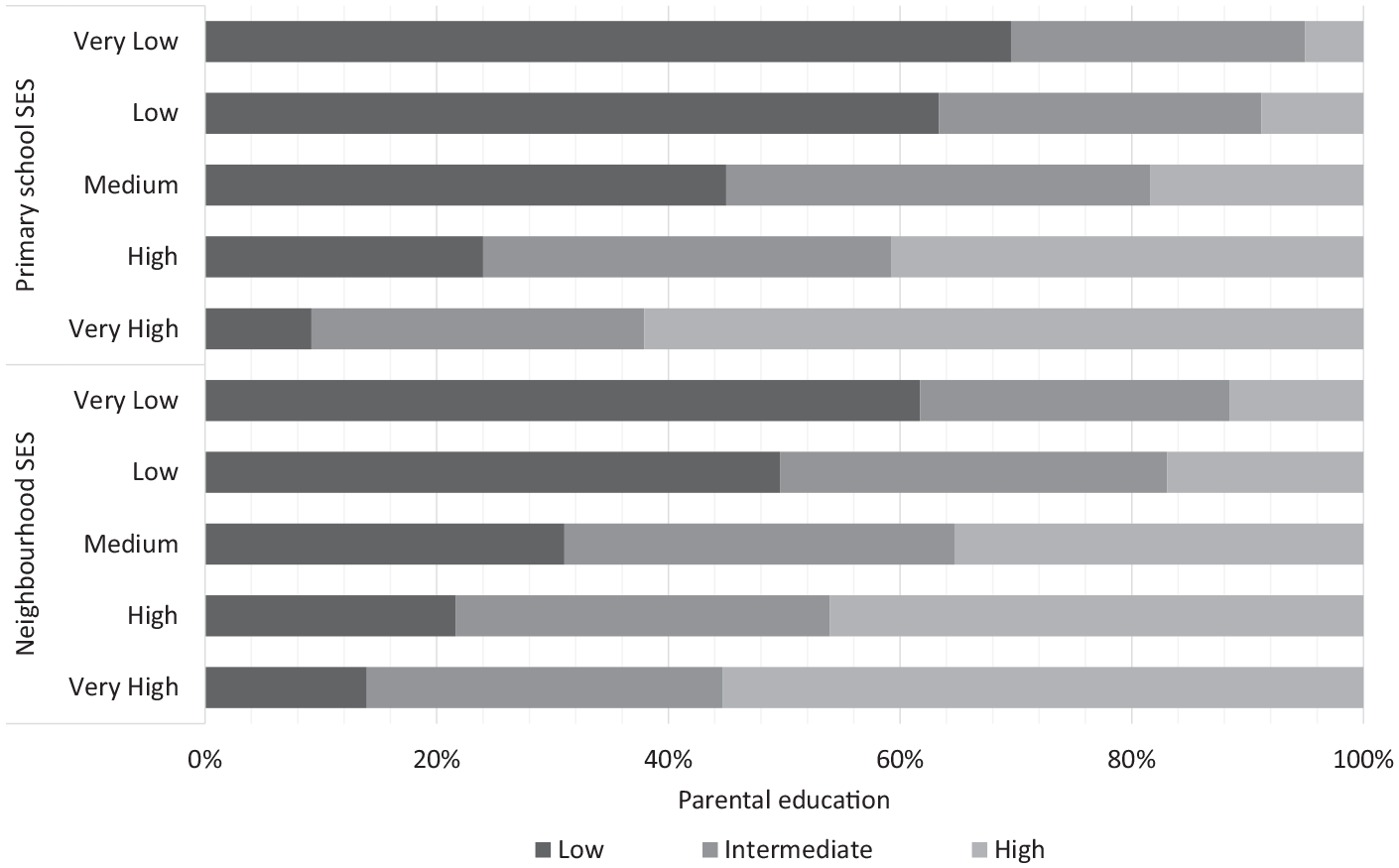
Distribution of children by neighbourhood and school SES, and parental education.
Neighbourhood- and school-level variance
First, we analyse to what extent differences in school advice are attributable to the neighbourhood and primary school context, calculating the ICCs for the unconditional models. Eighteen per cent of the variance in school advice is attributable to differences between neighbourhoods, and 23% to differences between primary schools (table given in Supplemental material). This indicates that there are substantial differences in primary school advice between neighbourhoods as well as between primary schools. When grouping the neighbourhood and school level, 29% of the variance is attributable to a combination of the neighbourhood and school contexts. However, when both contexts are added in a cross-classified model, the proportion of variance attributable to the neighbourhoods decreases to 3%, while the variance attributable to primary schools is only slightly reduced to 17%. This gives a first indication that the primary school mediates neighbourhood effects.
Neighbourhood and school effects for primary school advice
Table 2 shows four models for estimations of school advice given at the end of primary school (full table in the Supplemental material). Model 1 only includes individual characteristics as explanatory variables. It demonstrates that girls, children with a non-western migrant background, children with lower-educated parents and children with a lower standardised household income have a lower probability of obtaining advice for a higher educational level compared with boys, native Dutch children, children with highly educated parents and children with a higher household income, respectively. Surinamese/Antillean Dutch children in particular have a lower probability of receiving higher school advice, and especially children with highly educated parents have a higher probability of receiving higher school advice. These results remain consistent when neighbourhood and school characteristics are included (models 2–4).
Multilevel ordered logistic models of individual, neighbourhood and primary school effects on primary school advice.
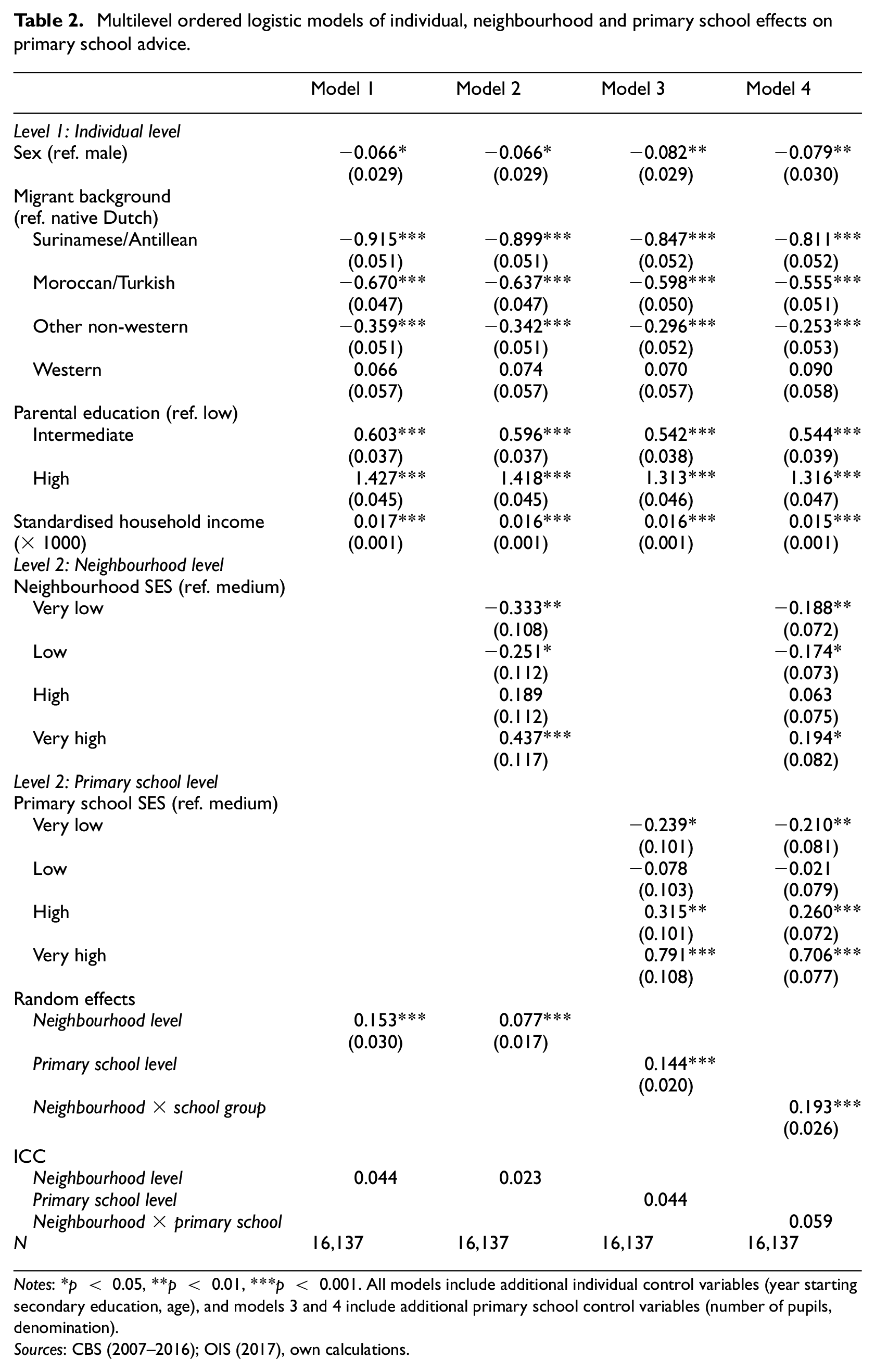
Notes: *p < 0.05, **p < 0.01, ***p < 0.001. All models include additional individual control variables (year starting secondary education, age), and models 3 and 4 include additional primary school control variables (number of pupils, denomination).
Sources: CBS (2007–2016); OIS (2017), own calculations.
When neighbourhood characteristics are added to the model (model 2), it appears that neighbourhood SES is positively related to primary school advice. More specifically, children living in a very high SES neighbourhood are significantly more likely to receive advice for a higher educational level than for basic/advanced pre-vocational education compared with children living in a medium SES neighbourhood (Odds Ratio, OR: 1.5). Conversely, living in a very low or low SES neighbourhood significantly decreases the odds of receiving higher advice, with respectively 28% and 22%, compared with living in a medium SES neighbourhood. These associations remain significant when school and neighbourhood characteristics are included simultaneously (model 4), albeit that the effect is reduced. The largest reduction appears to be on the effect of living in a very affluent neighbourhood, indicating that, especially for children residing in those areas, the school mediates neighbourhood effects for primary school advice.
In model 3, school characteristics are added to the individual model, showing that there is mainly a positive effect of attending an affluent school. Attending a high or very high SES school significantly increases the odds of receiving advice for a higher educational level compared with attending a medium SES school (OR respectively 1.4 and 2.2). On the other hand, attending a very low SES school decreases the odds of receiving higher advice, with 21% compared with attending a medium SES school. Again, these associations remain significant in the full model (model 4), although slightly reduced.
In sum, the models indicate that individual characteristics are strongly related to the educational level when entering secondary education. Moreover, both the neighbourhood and the primary school context seem to have a direct effect on a child’s educational level when making the transition to secondary school, without taking away much of the effect of the individual factors that play an important role. Primary school SES mediates part of the neighbourhood effects on the educational level of the school advice; in particular, children residing in a very affluent neighbourhood seem to benefit mainly from the school context.
For whom do neighbourhood and school contexts matter?
Results thus far indicate that the socioeconomic composition of the neighbourhood as well as of the primary school are affecting a child’s primary school advice, but it remains unclear for which children this matters most. Therefore, additional cross-level interaction effects of parental education with neighbourhood as well as school SES are estimated. Table 3 shows the interaction effects for the neighbourhood-level model (2a), school-level model (3a) and full models with cross-level interactions for neighbourhood SES (4a) and school SES (4b) (full table given in the Supplemental material).
Multilevel ordered logistic models of individual, neighbourhood and primary school effects on primary school advice, including cross-level interaction effects.
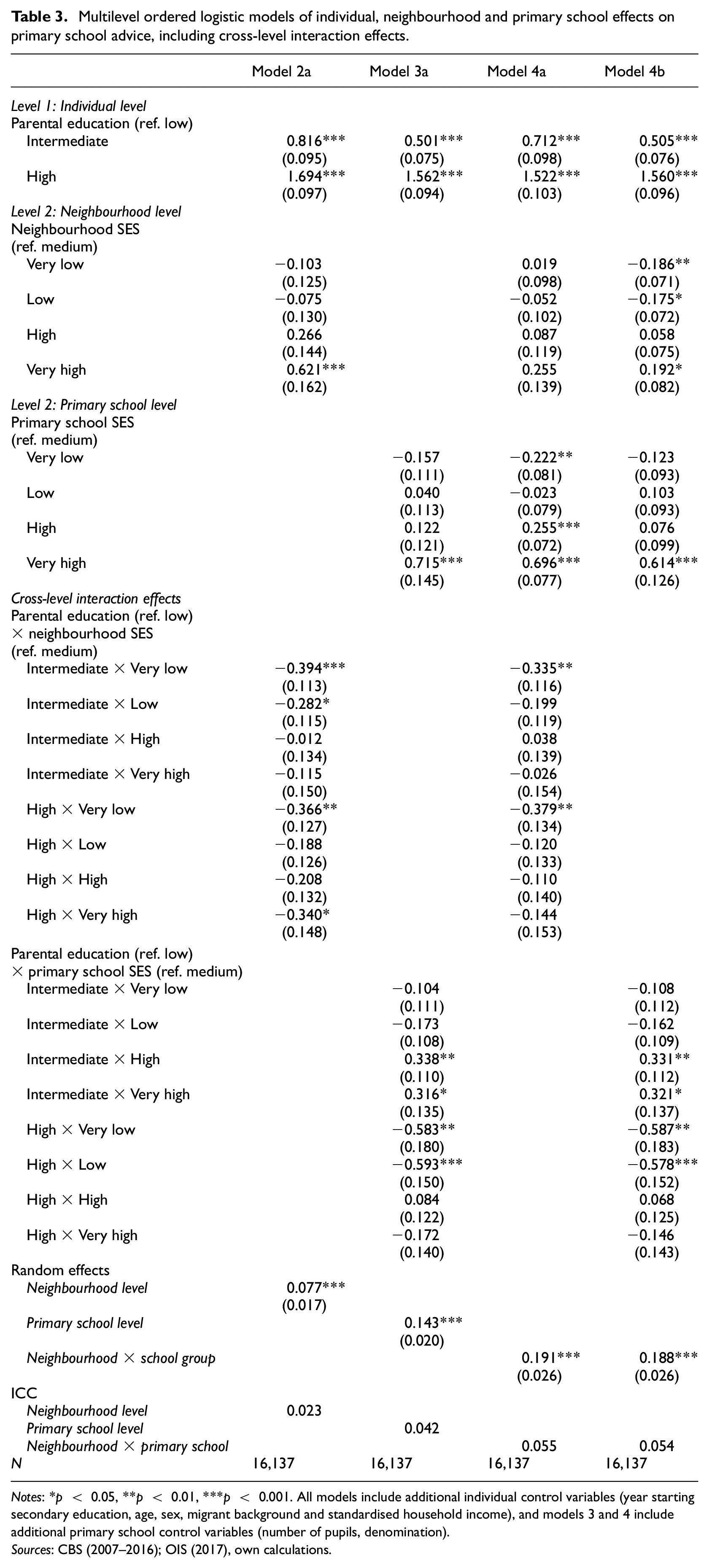
Notes: *p < 0.05, **p < 0.01, ***p < 0.001. All models include additional individual control variables (year starting secondary education, age, sex, migrant background and standardised household income), and models 3 and 4 include additional primary school control variables (number of pupils, denomination).
Sources: CBS (2007–2016); OIS (2017), own calculations.
Results show significant negative interactions for children with intermediate- or highly educated parents residing in a very low SES neighbourhood, indicating that the negative effect of residing in a very low SES neighbourhood compared with a medium SES neighbourhood for primary school advice is stronger for children with intermediate- (OR: 0.61) or highly (OR: 0.63) educated parents compared with those with lower-educated parents (OR: 0.9). In other words, while we found that residing in a very disadvantaged neighbourhood decreases the odds of receiving advice for a higher educational level, this seems to be especially the case for children with intermediate- or highly educated parents. These interaction effects remain significant when school-level variables are added to the model (4a). A similar negative interaction effect is found for children with intermediate-educated parents residing in a low SES neighbourhood. However, this interaction effect is reduced to non-significance when school-level variables are added (model 4a), indicating that the effect for this group is mediated by primary school characteristics.
Focusing on affluent neighbourhoods, we find a significant negative interaction for children with highly educated parents residing in a very high SES neighbourhood. This indicates that although children living in a very affluent neighbourhood are more likely to receive higher advice compared with those living in a medium SES neighbourhood, this positive effect is less for children with highly educated parents (OR: 1.3) compared with children with lower-educated parents (OR: 1.9). Considering that the main effect of residing in a very high SES neighbourhood remains significant with the inclusion of interaction terms, it appears that residing in a very affluent neighbourhood to some degree benefits all children. However, both the main effect and interaction effect are reduced to non-significance when primary school characteristics are added in the full model (4a), indicating that the primary school explains most of the difference in primary school advice.
The primary school SES (model 3a) results show a significant negative interaction of having highly educated parents and attending a very low or low SES primary school. In other words, the negative effect of attending a school with a lower SES compared with an intermediate level of SES for primary school advice is stronger for children with highly educated parents (respectively OR: 0.48 and 0.58) compared with children with lower-educated parents (respectively OR: 0.85 and 1.04). When neighbourhood-level variables are added to the model (4b), these interaction effects remain significant.
Focusing on the effect of affluent schools, we find that for children with parents with intermediate levels of education, attending a high or very high SES school is associated with significantly higher school advice. The positive effect of attending a very high SES school compared with a medium SES school is even stronger for children with intermediate-educated parents (OR: 2.8) compared with children with lower-educated parents (OR: 2). When neighbourhood-level variables are added to the model (4b), the main effect and interaction effects remain significant. Furthermore, the main effect of very high school SES remains significant with the inclusion of interaction terms, and thus appears to be beneficial regardless of parental background.
Figure 2 shows the predicted probabilities of receiving a particular school advice for the cross-level interactions of parental education with neighbourhood SES (Figure 2a) and primary school SES (Figure 2b) for the full models (models 4a–b). It illustrates that children with intermediate- or highly educated parents have a declining probability of receiving a higher primary school advice when the SES in neighbourhoods and primary schools goes down, and that this decline is stronger for school SES than neighbourhood SES when both contexts are modelled simultaneously. Meanwhile, children with lower-educated parents have a similar (low) probability of receiving a higher school advice, regardless of the socioeconomic composition of their neighbourhood or primary school, with the notable exception of attending a very high SES school. It furthermore shows that attending a very affluent primary school is associated with high levels of advice for all groups, but a stronger effect of school SES for children with intermediate-educated parents compared with children with lower-educated parents.
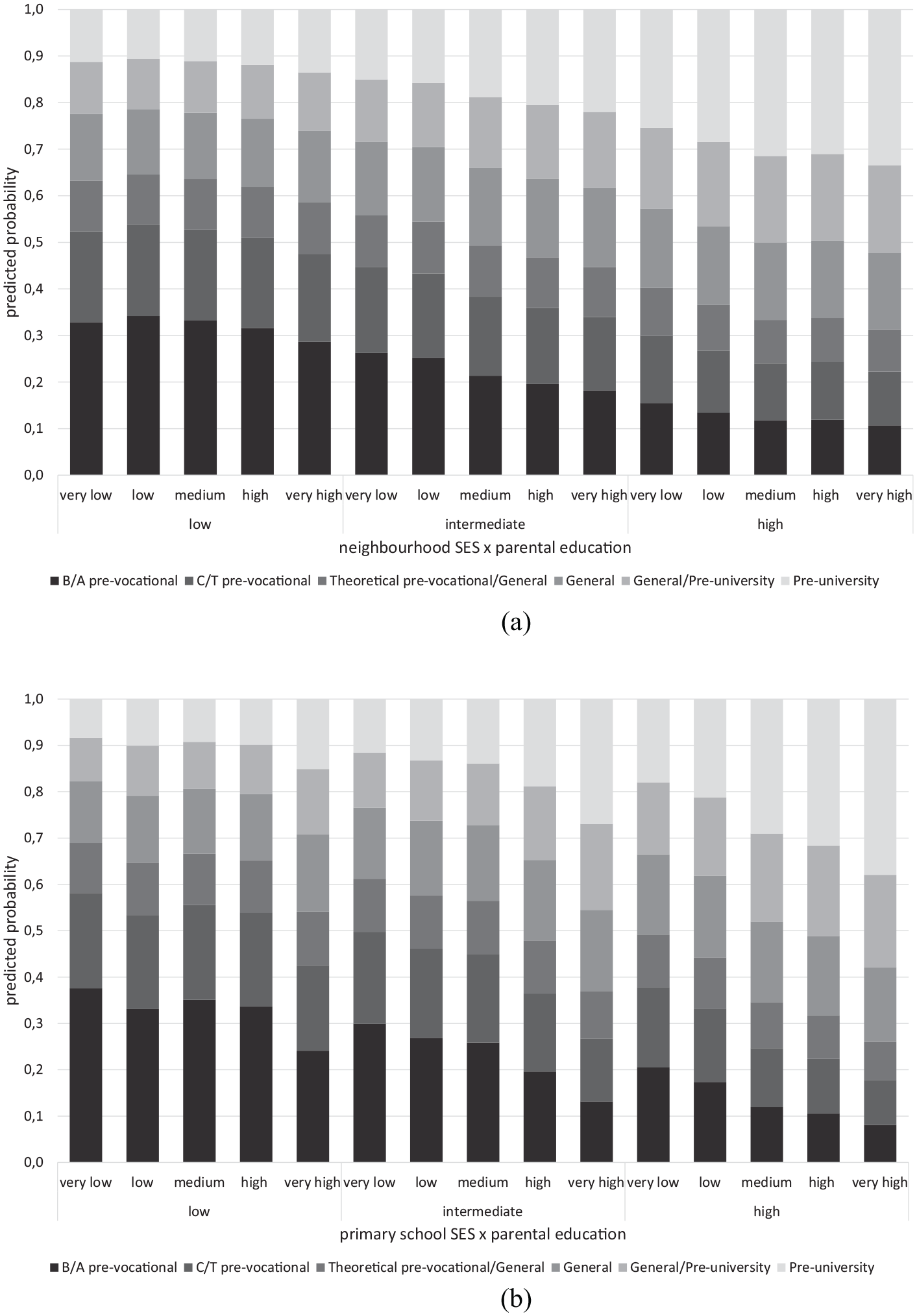
Predicted probabilities for interaction effects parental education × neighbourhood SES (a) and parental education × primary school SES (b) for full models (4a–b).
In sum, both the neighbourhood and primary school contexts seem to affect the advised educational level for some groups. Neighbourhood and primary school socioeconomic disadvantage seems to be particularly detrimental for the advised educational level of children with higher-educated parents compared with their peers in more affluent neighbourhoods and schools. Although there does not seem to be an additional negative effect of neighbourhood and primary school disadvantage for children with lower-educated parents, they retain a lower probability of receiving higher advice compared with children with higher-educated parents in disadvantaged neighbourhoods and schools. On the other hand, living in an affluent neighbourhood seems to benefit all children to some degree, but especially children with lower-educated parents compared with their peers in more socioeconomically mixed neighbourhoods and schools. Since this interaction is reduced to non-significance when primary school variables are added, it seems that children with lower-educated parents in affluent neighbourhoods benefit especially from the schools they attend. However, since primary school affluence seems to be mainly additionally (as manifest in the interaction effect) beneficial for children of parents with intermediate levels of education, it appears that children with lower-educated parents do not necessarily benefit from the school composition but rather from another school characteristic (e.g. school quality, teaching methods, teacher performance). In other words, the neighbourhood effect might be mediated by the school, but not so much through its SES status. Although the results indicate that there is no reason to fear a compounded effect of neighbourhood and school contexts on inequalities, it should be noted that both neighbourhood and school advantage are positively associated with higher advice. Moreover, children from different backgrounds are already largely segregated across those contexts (see Figure 1). Especially, the selection into very affluent schools seems to exacerbate inequalities, considering its effect on primary school advice regardless of parental background.
Conclusion and discussion
Drawing on an advanced analysis of individual longitudinal register data on school careers of four cohorts of children in Amsterdam, this article demonstrated that, as well as individual characteristics, the school and neighbourhood context are factors that affect school advice. In the Dutch educational context, where children at a young age (11/12) are tested and sorted into different, hierarchically stratified tracks of secondary education, school advice is a crucial moment that determines an important part of children’s futures. Children with lower-educated parents are advised lower levels than children with highly educated parents. What is more, although positions of class and ethnicity are strongly intertwined in the Amsterdam context, children with a non-Dutch background, particularly whose parents were born in Surinam, Antilles, Turkey or Morocco, receive lower school advices than children without a migrant background, correcting for their socioeconomic background. This provides quantitative backup for studies suggesting that educational inequalities in the Netherlands are due to ethnic/racial bias too (Merry and Boterman, 2020; Stam, 2018; Timmermans et al., 2015). The demonstrated effect of both ethnicity and SES confirms the international literature linking most educational inequalities to individual characteristics, of which class and ethnicity/race, and their intersections, are the most important (Van de Werfhorst and Van Tubergen, 2007).
However, this study aimed to go beyond individual factors and examine the association between the socioeconomic composition of neighbourhoods and schools and educational inequalities as they appear through differentiated school advice in the transition from primary to secondary education. We demonstrated that the SES status of both schools and neighbourhoods are independently positively related to school advice, also when they are taken into account simultaneously. It is, however, important to note that most of the effect of the neighbourhood is taken away when school characteristics are introduced. This confirms earlier work finding that much of the neighbourhood effects are mediated by the school context (Ainsworth, 2002; Kauppinen, 2008; Sykes, 2011). Notwithstanding, it appears that both contexts independently still explain a significant part of the variation in the advice that primary schools give to pupils. Given the limited mobility between tracks in the Netherlands (Jacob and Tieben, 2009), these findings have important implications for the effect of neighbourhood and school segregation not only on track allocation but also on future opportunities. This is especially salient in the Dutch context where students are selected into tracks at an early age. Our study suggests that the inequalities in educational opportunities that arise due to such a tracked system are not only influenced by a child’s socioeconomic and ethnic background, but also by the socioeconomic composition of the wider context of their neighbourhood and school.
In our second part of the analysis, we estimated cross-level interaction effects to gain a better understanding of for whom the neighbourhood and school composition matter for their school advice. While the image is complex, our analysis reveals that socioeconomic disadvantage in the neighbourhood and school negatively affects the educational advice of children with highly educated parents but not of lower-educated parents. While children with lower-educated parents overall have a lower probability of receiving a higher educational advice, neighbourhood and school disadvantage does not seem to exacerbate this. This differential impact of neighbourhood and school disadvantage could indicate that children with highly educated parents are especially prone to certain social processes in disadvantaged neighbourhoods and schools, and calls for further research on how social processes in disadvantaged neighbourhoods and schools differently affect children with various socioeconomic backgrounds.
Moreover, it appears that socioeconomic advantage in the neighbourhood and school positively affects the advised educational level for all groups, but especially that of children of lower- and intermediate-educated parents. Most of these positive neighbourhood effects, however, disappear after introducing primary school characteristics. This suggests that especially neighbourhood advantage is mediated through the access to specific primary schools, where the neighbourhood might serve to provide access to quality schools (Butler and Hamnett, 2007) or inform school composition and with it a child’s social environment and socialisation (Kauppinen, 2008). Although it seems that it is not necessarily the socioeconomic composition of the primary school that benefits children of lower-educated parents residing in affluent neighbourhoods, further research is needed to gain a better understanding of this mechanism. Residential and school segregation thus seems to intensify especially the potential beneficial effects of neighbourhood and school advantage.
Educational inequalities in the Netherlands are to a large extent related to ethnicity and class. Owing to the early tracking in the Dutch educational system, existing inequalities of social class and ethnicity/race are formalised in test scores and school advice at a relatively young age. International comparative research suggests that this early tracking and also its rigid application are exacerbating educational inequalities (Kloosterman et al., 2009; Van de Werfhorst and Van Tubergen, 2007). This article suggests that school advice, which is the formal start for differentiation according to cognitive abilities, is not just about individual factors, although they continue to be very important. The residential neighbourhood and school composition also seem to intensify these inequalities. Children of lower-educated parents and those of non-Dutch descent are also overrepresented in socioeconomically disadvantaged neighbourhoods. The high levels of school segregation are indicative of the concentration of those pupils in specific, often disadvantaged schools (Boterman, 2019). Correspondingly, the concentration of highly educated, often native Dutch ‘white’ parents in advantaged schools and neighbourhoods may be adding to their advantage in the educational system (Butler and Robson, 2003). Our study hence also points to important intersections of socioeconomic status and ethnicity in the intricate ways in which neighbourhood and school contexts are implicated in the reproduction of educational inequalities.
Supplemental Material
USJ959011_Supplemental_Material – Supplemental material for Neighbourhood and school effects on educational inequalities in the transition from primary to secondary education in Amsterdam
Supplemental material, USJ959011_Supplemental_Material for Neighbourhood and school effects on educational inequalities in the transition from primary to secondary education in Amsterdam by Joeke Kuyvenhoven and Willem R. Boterman in Urban Studies
Footnotes
Acknowledgements
The authors would like to thank Lotje Cohen, Merel van der Wouden and the anonymous referees for their valuable comments and suggestions on earlier drafts of this article.
Declaration of conflicting interests
The authors declared no potential conflicts of interest with respect to the research, authorship, and/or publication of this article.
Funding
The authors disclosed receipt of the following financial support for the research, authorship, and/or publication of this article: This research was supported by NWO, Dutch Research Council (grant number 016.165.183).

Supplemental material
Supplemental material for this article is available online.
Notes
References
Supplementary Material
Please find the following supplemental material available below.
For Open Access articles published under a Creative Commons License, all supplemental material carries the same license as the article it is associated with.
For non-Open Access articles published, all supplemental material carries a non-exclusive license, and permission requests for re-use of supplemental material or any part of supplemental material shall be sent directly to the copyright owner as specified in the copyright notice associated with the article.
