




Abstract
Although the Academy Award for Best International Feature Film is often promoted as a celebration of world cinema, its record tells a different story. By mapping every nomination and win since the category adopted a competitive format in 1956, this study exposes a sharp geographic imbalance. A proportional-symbol cartogram shows Europe ballooning to dominate the visual field, while much of the Global South, especially Africa, nearly disappears. Four of the five most-honoured countries are European, together with Japan accounting for more than half of all victories. This pattern is interpreted as a geographic expression of cultural hegemony, explained partly by the theory of ‘cultural proximity’, where Academy voters may gravitate towards narratives reflecting familiar cultural values. The cartogram thus visualizes more than just awards; it depicts a durable geography of cultural influence.
The Academy Award for Best International Feature Film is often hailed as a celebration of global cinema. However, as South Korean director Bong Joon Ho questioned upon winning for Parasite, does the category’s name truly reflect its scope (Ugwu, 2020)? First awarded in 1947 and adopting a competitive nominee format in 1956, the award (renamed from ‘Best Foreign Language Film’ in 2020) now attracts submissions from around the world. Yet, a persistent geographical imbalance challenges its internationalist claims.
To visualize this imbalance, we compiled nomination and win data from the official Oscars database (AMPAS, 2025; Petterson, 2025) and linked each film to its country of origin via Esri’s World Countries dataset (https://hub.arcgis.com/datasets/esri:world-countries). Using the R package cartogram, we created a proportional-symbol map: each nation is a circle whose area reflects total nominations, while colour intensity marks total wins. The result is a dramatic distortion of the world map, revealing the spatial signature of a systemic bias. While nominations have arrived from 59 countries, Europe swells into a dense cluster of large, dark circles, powerfully illustrating its dominance with nearly 80% of all awards (Freedman, 2023). Italy, France, Spain, Japan, and Sweden together secure over half (53%) of all wins, whereas the African continent is rendered almost invisible, a scattering of small, pale circles that speaks to its profound lack of recognition.
This pattern is not simply a matter of taste but a geographic expression of cultural hegemony, where specific cultural products are privileged within global media circuits. The disparity can be partly explained by the theory of ‘cultural proximity’, which posits that audiences and Academy voters gravitate towards media reflecting familiar languages, values, and narrative structures (Straubhaar, 1991). The visual weight of Europe on the cartogram thus reflects a greater cultural legibility for a predominantly Western voting body, inadvertently marginalizing films from different cultural viewpoints.
Furthermore, international film awards are not neutral arbiters of artistic merit but key sites in the geopolitics of culture, acting as instruments of national ‘soft power’ (De Valck, 2007; Nye, 2008). The cartogram therefore visualizes more than just a list of winners; it depicts a durable geography of cultural influence that has changed little in over 60 years. It raises critical questions about the institutional structures that grant visibility and prestige, and whether the Academy can truly celebrate a world of cinema when its gaze remains fixed so firmly on a single continent (Figure 1). A proportional-symbol cartogram of wins and nominations for the Academy Award for Best International Feature Film (1956–2024).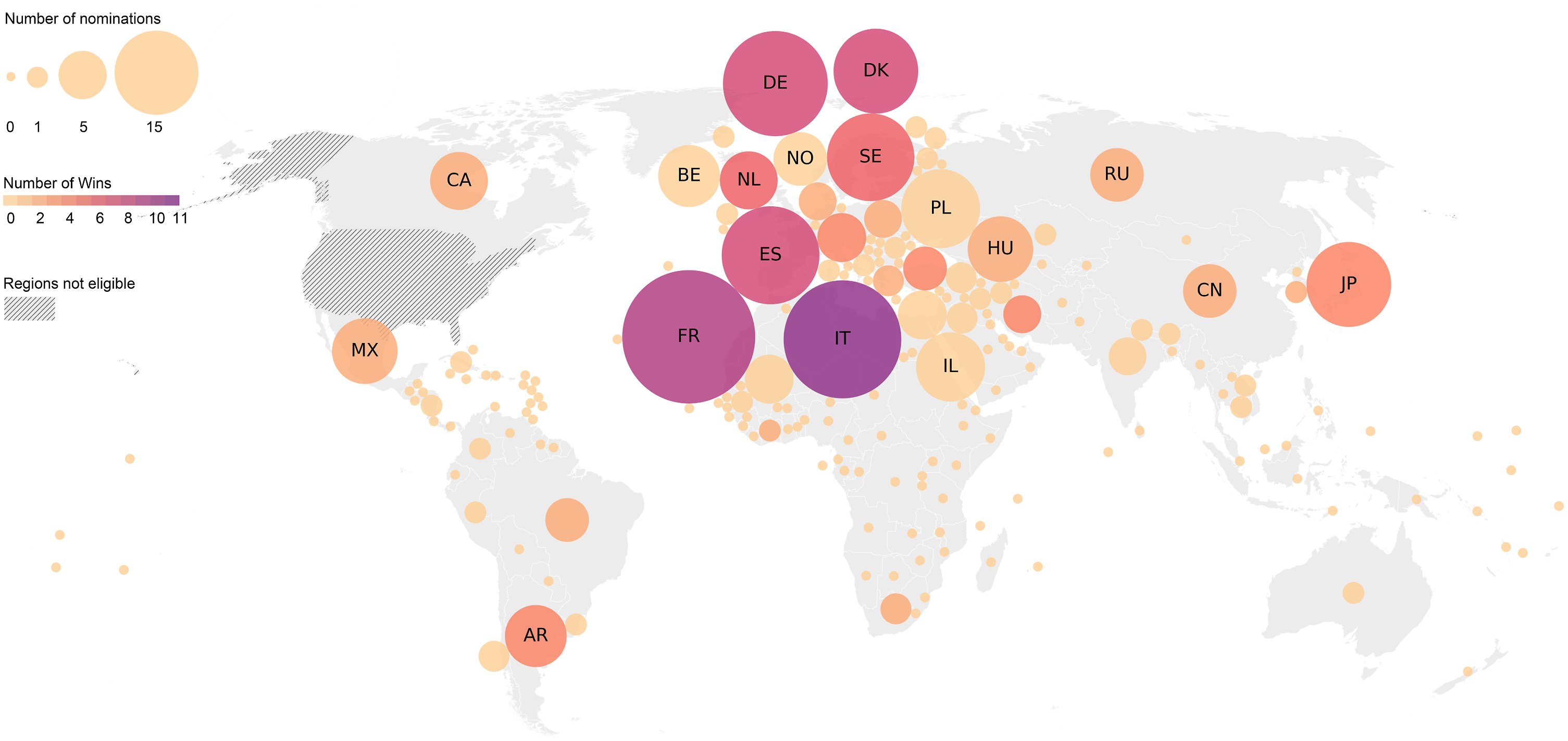
Footnotes

Funding
The authors disclosed receipt of the following financial support for the research, authorship, and/or publication of this article: The authors acknowledge funding from the Alan Turing Institute 2024 Enrichment Scheme Community Award.
Declaration of conflicting interests
The authors declared no potential conflicts of interest with respect to the research, authorship, and/or publication of this article.