




Abstract
Since 2017 a debate has been ongoing in Germany around a proposal by the Green Party to introduce a ‘climate passport’ that would confer citizenship-like rights to people most likely to be displaced due to climate change. The debate, ranging from solidaristic work to open hostility, is highly Eurocentric, with the German border and affected people’s potential interactions with it providing a central ordering node in the debate. German voices and perspectives are foregrounded, and Germany is placed in a problem-solver position in relation to affected communities. By doing so, the positioning of Germany as able to control and define future acceptable human mobilities is centred. Affected people are positioned as the ‘other,’ which oscillates between Pacific Islanders and Africans depending on the speaker. Inhabitants of Pacific Islands are identified as recipients of the climate passport, as vulnerable individuals whose countries will inevitably be erased from the map by climate change. Africans, on the other hand, are portrayed as economic migrants waiting to take advantage of climate-related residency permits to migrate to Europe. Based on this analysis, I argue that the Eurocentrism of well-intentioned policy proposals to protect people forced to move in the context of climate change is a blind spot in policy circles and research that demands further attention.
Introduction
Over the years, academics, international organisations, think tanks and non-governmental organisations (NGOs) have generated a raft of earnest proposals to protect people displaced due to climate change. These range from the grand solutions of amending the Refugee Convention (Republic of the Maldives Ministry of Environment Energy and Water, 2006), creating a separate legal regime (Biermann and Boas, 2010), or a regime anchored in the United Nations Framework Convention on Climate Change (UNFCCC) (Williams, 2008) to more fragmented approaches drawing on existing regional best practices (The Nansen Initiative, 2015) or focussing on knowledge generation (UNFCCC, 2010: 14(f); see also Nash, 2018). Lively debates have ensued about the feasibility and consequences of proposed solutions. Introducing a multilateral treaty is critiqued as not taking into account all kinds of mobilities seen in the context of climate change or the wishes of affected people (McAdam, 2011) and infeasible due to ratification and implementation challenges (Geddes et al., 2012). Warnings are repeatedly made against amending the Refugee Convention, as it could devalue existing refugee protections (Keane, 2004).
These analyses are often structured around an instrumental understanding of the policy process, whereby knowledge and policy recommendations should be unproblematically translated into policy and law. As a result, the processes of debating, negotiating, passing, ratifying, and implementing policy proposals is often left underexplored. Exceptions to this rule are analyses conducted in recent years of international policymaking (Nash, 2019; Hall, 2016; Simonelli, 2015; Mayer, 2017; Jakobsson, 2021). However despite a turn in recent years towards a stronger focus on the nation state in climate policy since the anchoring of Nationally Determined Contributions (NDCs) in the Paris Agreement (UNFCCC, 2015), and a number of states already including references to human mobilities in their NDCs and National Adaptation Plans (NAPs) (Mombauer et al., 2023), this has not been mirrored by a focus on national political arenas in climate change and human mobilities research. Despite the importance of the respective national political settings for developing positions on climate change and human mobilities that flow into documents such as NDCs and NAPs, the discourses in these national political arenas are seldom studied.
There are reflexive questions to be posed about why these analyses are absent. On the one hand they can be uncomfortable to carry out; the international arena is often bureaucratic or technocratic, the tone formal, and consensus can be taken as given around fundamentals such as the existence of anthropogenic climate change. However, in conducting this analysis of a national political arena, I have had to confront xenophobia, misogyny and climate change denial and more immediately visible prejudices and fears to untangle in comparison to my previous work on international policymaking. On the other hand, practically speaking, debates on climate change and human mobilities are not as regularised within national political arenas so material is scarcer. Furthermore, while English dominates in international policymaking, analysing national discourses requires language skills for the respective study area.
Set against this background, this article is an analysis of a debate ongoing in Germany since 2017 around a proposal to introduce a so-called ‘climate passport.’ It provides a key opportunity to analyse a discourse in a national political arena as it gives a rare insight into a proposed policy measure addressing displacement in the context of climate change being debated in a formal political institution of a European nation state. As such, it provides an example through which to explore discourses on climate change and human mobilities not just of broadly supportive policy elites but a range of political actors. The focus here is not on the suitability (or not) of the proposal, and indeed I concur with and applaud the intention of extending additional rights and moving towards less closed borders for people whose lives are affected by the impacts of climate change. Nevertheless, this analysis also takes a critical approach, calling into question the set of discourses on which the proposal rests. In doing so, I build in particular on the work of Andrew Baldwin on othering and racialisation in the climate change and migration debate (see Baldwin, 2022).
In the following section, I sketch the concept of Eurocentrism, which theoretically underpins the analysis, as well as outlining the methods. The third section contains a brief history of the climate passport debate in Germany before this debate is analysed in detail in sections four and five. In a penultimate section I touch on a discourse of opposition to the proposal propagated by far-right politicians, before concluding.
Epistemic Eurocentrism
A question I have frequently been posed while carrying out this study, is whether approaching the nexus between climate change and human mobilities via its discursive construction in Europe is not a very Eurocentric perspective? The question is usually motivated by underlying feelings of fairness and justice, based loosely around the argument that those in the Global South are feeling the brunt of climate change and we need to know more about how Global South mobilities are affected to provide solutions. Indeed, most research focusses on movements of people within and originating from the Global South, whilst the majority of researchers are located in the Global North (Piguet et al., 2018). However, as Zeynap Gülşah Çapan has pointed out, “Eurocentrism is not a geographical question, but an epistemic one” (Gülşah Çapan, 2018: 1). Therefore, a geographical focus on Europe does not alone indicate Eurocentrism and indeed inversely, a geographical focus on the Global South cannot rule out a Eurocentric analysis. As Elena Fiddian-Qasmiyeh has argued, “far from assuming that ‘recentering the South’ must entail conducting more research in and about particular geographies associated with the global South, challenging Eurocentric approaches to migration studies can also be grounded on critical writing vis-à-vis migration to the North” (Fiddian-Qasmiyeh, 2020: 5).
I therefore turn the critiques on their head and use Eurocentrism in the epistemic sense as a theoretical lens guiding this contribution. In doing so, the intention is twofold: this piece is in itself an attempt to counter Eurocentrism in research on climate change and migration, provincializing Europe (Chakrabarty, 2008) by examining one particular European case study as another case study among many conducted in regions all over the world. At the same time, this article identifies and interrogates the Eurocentric logics that structure the German ‘climate passport’ discourse. This is a valuable exercise, as it exposes problematic dynamics in the discourses surrounding presumably well-intentioned policy proposals that undermine these very intentions.
In doing so, I broadly follow Meera Sabaratnam’s definition of Eurocentrism as “the sensibility that Europe is historically, economically and politically distinctive in ways that significantly determine the overall character of world politics” (Sabaratnam, 2013: 261). In the words of Juliette Tolay, “within a Eurocentric worldview, Europe is always visualised as being ahead, at the centre, and at the top all at once” (Tolay, 2021: 3, emphasis in original). These hierarchies by which Europe is situated as separate and superior are supported by spatial and temporal binaries, by which the ‘West’ is depicted as “rational, modern, developed” and the ‘non-West’ as “spiritual, traditional, underdeveloped” (Gülşah Çapan, 2018: 1). Progressive development is identified as having occurred in isolation in Europe and along a temporality that locates European modernity at the end of an aspirational development trajectory.
Naturalisation of the knowledge system of Eurocentrism is central to its reproduction, disguising Eurocentric perspectives by assuming their universality. Drawing on Felix Mantz’s critique of knowledge (re)production in International Political Economy, “rather than correctly identifying itself as provincial, [Eurocentric] knowledge claims universality, assumes a God’s-eye view and the ability to explain the entire world and its realities” (Mantz, 2019: 1364). An important, somewhat counter-intuitive aspect of Eurocentrism is therefore a lack of (critical) attention to the construction of European knowledge. For climate change and human mobilities, this is significant given that, following Andrew Baldwin, categories such as ‘climate migrant’ or ‘climate refugees’ “reveal more about those who use them than about the people they are meant to describe” (Baldwin, 2017: 4). Nevertheless, in academic literature and policy circles alike, there is a crucial lack of critical analyses of the origins of many policy proposals and what they can tell us about those making them.
I begin to close this gap by analysing the German debate surrounding the proposal for a so-called ‘climate passport.’ Three aspects of the debate are particularly interesting and will be addressed in the three empirical sections. First, I draw out pre-meditative categorisation of future displacement in the debate as an example of an attempt to assert control over future mobilities. Second, I analyse two concrete examples of othering in the debate, and the respective positionality of the German saviour. Third, I analyse the specific arguments of the far right, setting them in a context of far-right positions on climate policy more broadly.
Document corpus.
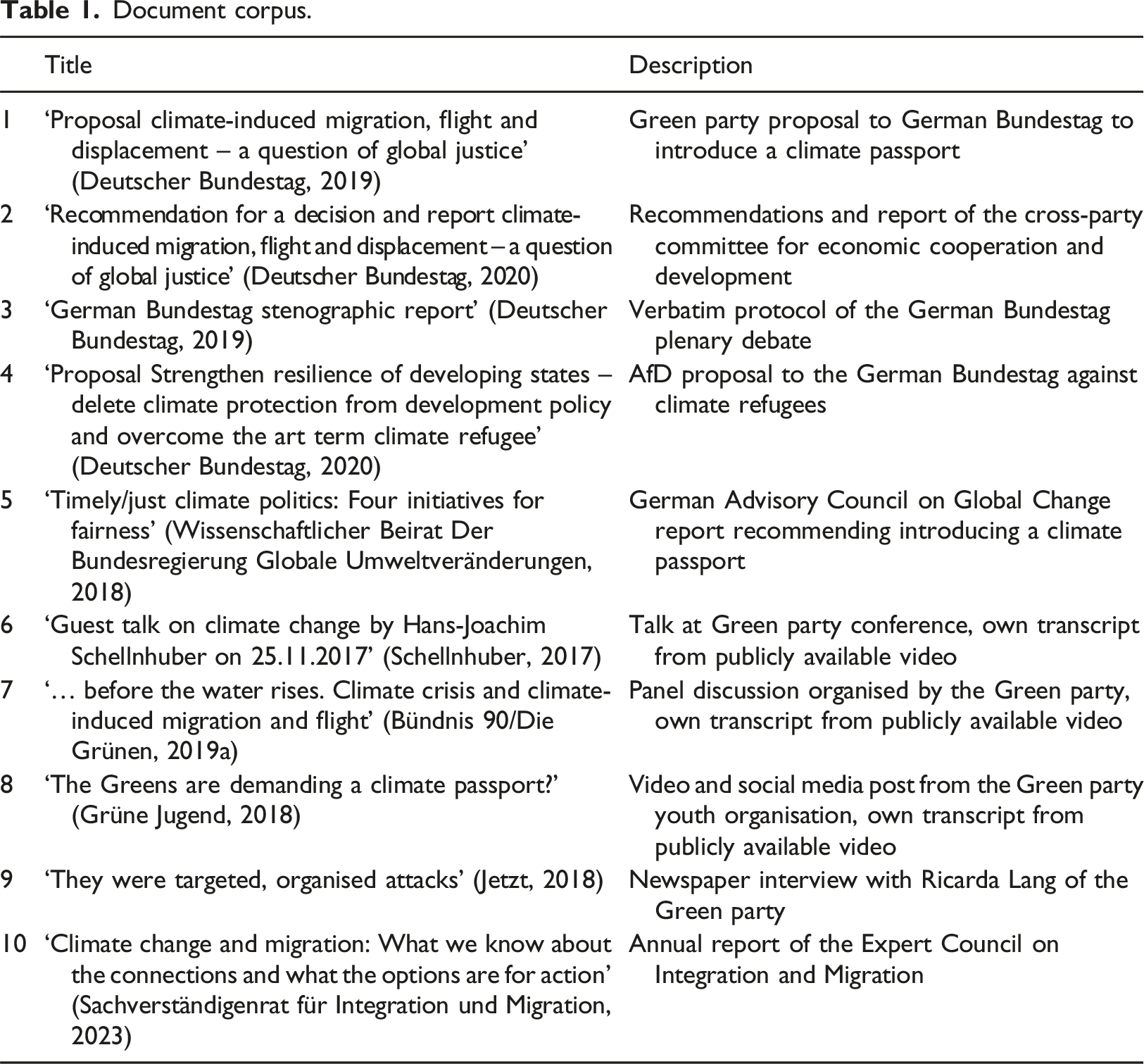
A brief history of the German climate passport debate
Although similar proposals have been made in academic literature on climate change and displacement, in the form of “a free movement passport for the territorially dispossessed” (Heyward and Ödalen, 2016: 209) or more recently for “territorially displaced collectives” (Wündisch, 2021: 855), in the German political context the climate passport traces back to climate scientist Hans Joachim Schellnhuber. In a speech at the 2017 Green Party conference, Schellnhuber sketched some consequences of climate change, including the claim that even if the goal of limiting global warming to 2°C is achieved, “hundreds of millions of people” (Schellnhuber, 2017) will be displaced. His proposed solution is a climate passport inspired by the Nansen Passport for stateless persons that “gives people whose homes are disappearing access to all of the countries that are responsible” (Schellnhuber, 2017). The proposal is set out in more detail in a 2018 policy paper from the governmental advisory body, the German Advisory Council on Global Change (WBGU), of which Schellnhuber is a member.
Although in his conference speech, Schellnhuber acknowledged that “such a vision naturally cannot be implemented in the coming years” (Schellnhuber, 2017), the idea gained traction within the Green Party. At the 2018 conference, the Green Party youth organisation “fought for” the proposal to be included in the party’s 2019 European Parliament election manifesto (Grüne Jugend, 2018). The manifesto states that “the EU should, together with other industrialised countries, lead the way and, in a common ruling, offer climate passports to the inhabitants of threatened island states that will become uninhabitable due to the climate crisis” (Bündnis 90/Die Grünen, 2019b: 18).
The umbrella organisation for the left-wing faction of the German Green Party has also argued for the proposal (Roth and Lang, 2018) and the party’s Future Laboratory events series hosted a panel discussion in early 2019 (Bündnis 90/Die Grünen Bundestagsfraktion, 2019c). This was followed by an attempt to anchor the policy at the national level in a German Bundestag motion on “climate induced migration, flight and displacement – a question of global justice” (Deutscher Bundestag, 2019). The motion’s specific policy calls are broad, ranging from supporting existing international agreements to an intersectional approach to climate policy, but also “calls for the introduction of a climate passport nationally, Europe-wide and internationally and to offer it in the first stage to inhabitants of small island states whose territory will become uninhabitable due to climate change” (Deutscher Bundestag, 2019: 26). The motion unsurprisingly failed to pass but gained significant traction in the German media (Piatov et al., 2019; Solms-Laubach, 2019; Die Welt, 2019; Ladurner, 2018).
After the Bundestag debate two prominent Green Party politicians, Claudia Roth and Ricarda Lang, were subjected to a “shitstorm” level of abuse (Jetzt, 2018). In September 2020 the populist, far-right party Alternative für Deutschland (Alternative for Germany, AfD) submitted a motion to the Bundestag calling for removing climate protection from development politics and attacking the use of the ‘climate refugee’ term. This motion can be interpreted as a direct counter to the Green Party proposal, although it doesn’t include explicit references to the climate passport. This motion was also ultimately unsuccessful.
In 2022, the WBGU proposal was picked up by the UN Special Rapporteur on the human rights of migrants as one of a series of “promising practices aimed at expanding and facilitating pathways for safe and regular migration in the context of climate change” (United Nations General Assembly, 2022: 18). In May 2023, the proposal resurfaced in Germany, this time in the annual report of the Expert Council on Integration and Migration. It explicitly takes inspiration from the WBGU proposal (Sachverständigenrat für Integration und Migration, 2023: 115) but in this iteration, the climate passport is one of a trio of proposed policy measures, being joined by a ‘climate card’ and a ‘climate visa’. The climate card, also a humanitarian programme, differentiates itself from the climate passport in that “the requirements for the card are significantly lower, and correspondingly the pool of people who potentially qualify for the climate card is considerably bigger and the residency rights it guarantees are less comprehensive” (Sachverständigenrat für Integration und Migration, 2023: 117). The climate visa, on the other hand, is designed as a temporary work visa, therefore once more open to a larger pool of people and conferring fewer rights.
The climate passport proposal sits against the background of German migration and refugee politics more broadly, which has undergone a series of shifts since the early 2000s. Previously a self-styled non-immigration country, Germany has seen a deterrence logic replaced with a “selective, economically-oriented logic, and proactive integration policies” (Laubenthal, 2019: 11). Seen in employment policy, these logics have also spilled over into refugee policy, especially following the major juncture of German refugee policy in 2015 when 1 million asylum seekers arrived in Germany, and the centre-right conservative Chancellor Angela Merkel gained the unlikely reputation as the ‘refugee chancellor’ after her famous motto ‘we can do this’ (Wir schaffen das). However, after a period of openness, more restrictive policies were also introduced in tandem with more policies aimed at integration, including reforms that “implicitly divided refugees into wanted and unwanted migrants” through the designation of ‘safe states,’ tightening of residency rules, ruling out cash benefit payments for asylum, putting more limits on family reunification, and increasing criteria for detention prior to deportation (Laubenthal, 2019). These measures coincided with the AfD gaining more traction with their anti-migrant and anti-refugee rhetoric.
The climate passport as pre-meditative categorisation and control of future displacement
The Eurocentrism of the climate passport proposal is visible in intertwined ways. Most obviously, Europe (in this case, Germany specifically) is placed in the centre of the policy as the destination for climate passport holders, connected intrinsically to the assumed desirability of Germany as a country of destination and as such of the suitability of the climate passport. Second, the discourse surrounding the climate passport puts Germany at the top in a hierarchical position of control by setting up a policy instrument whereby Germany is entitled to designate who can move where and by what logics. Thirdly, the climate passport is intrinsically connected to Eurocentric conceptualisations of (dis)order, which become highly visible in the climate passport’s pre-mediation of future displacement, which tries to imprint order onto perceived chaotic future mobilities. This section will consider each of these facets of the climate passport proposal in turn.
The proposal centres Germany as a destination for migration, indeed setting it apart as the only specified destination country in the proposal. The most recent iteration of the proposal sets the document out as “a passport or equivalent and with it indefinite residency rights, to which no further conditions apply” (Sachverständigenrat für Integration und Migration, 2023: 116). Previous versions tie the proposal directly to the idea of citizenship. For example, the youth wing of the German Green Party demand that “European States […] offer citizenship […] to the inhabitants of endangered island states” (Grüne Jugend, 2018), while the WBGU has called for holders to be provided with “access to, and citizenship-like rights in, safe states” (WBGU, 2018: 4). The proposal is therefore based on a presumption that people moving in the context of climate change would want citizenship or similar rights, or at the very least permanent residency in Germany. While the specific legislative proposal applies to Germany, the proposers articulate the hope that other countries, especially other EU Member States will follow suit and adopt similar proposals.
Despite the positive depiction of Germany and the climate passport, the discussion around providing the possibility to live in Germany for people who are forced to move due to climate impacts reads very counter-intuitively, as speakers also emphasise that the potential beneficiaries of a climate passport do not want to migrate: “In the Pacific whole islands are in danger of sinking. There it is easy to draw slightly panicked threatening images, as is common since 2015. Threatening images, which in this case have nothing to do with the reality of the affected people. As naturally the fisherman from the Bahamas doesn’t want to come to Bayern, rather if possible, move in his region, if he has to move at all. Naturally it is therefore in the first instance about supporting the affected states to develop solutions in situ” (Bündnis 90/Die Grünen, 2019a).
This is dismissive of potentially affected people by acknowledging the bad fit of the proposed solution but continuing to propose it as self-determining and dignified regardless.
The EU has a history of disregarding migration that is not towards Europe, in particular South-South migration (Casas-Cortés and Cobarrubias, 2019). Here, in proposing a migration instrument for migration to Germany when this is identified as not being the preferred solution for affected people, the debate around the climate passport reproduces this blind spot and normalises a centralisation of German borders within the migration policy debate, even when it is recognised that these borders are not those most relevant for affected people.
The discourse surrounding the climate passport also situates Germany in a position of control, whereby Germany has the power of definition over who is allowed to move and can choose on what expertise to base this definition. A particular aspect of Germany’s position of control positively emphasised by supporters of the climate passport is the resulting ability to bypass (potentially corrupt) governments: “[…] the charming thing about the climate passport is that it will be offered to precisely those who are affected and not the governments of these countries who possibly pocket the money and act corruptly. That is the charming thing” (Bündnis 90/Die Grünen, 2019a). With this assertion, the discourse not only removes the agency of affected people but also of their governments.
A combination of scientific and legal logics is drawn on in the discourse to take on the role of identifying people eligible for the climate passport, therefore removing this decision-making to an apparently more objective level but at the same time excluding the voices of affected and potentially affected people from the decision-making process. For example, the WBGU recommends a concrete procedure for identifying people eligible for a climate passport, “with the help of a scientific commission and including the expertise of the Intergovernmental Panel on Climate Change (IPCC), identifying particular (groups of) island states that are objectively especially affected by the potential loss of their territory” (WBGU, 2018: 29). This suggestion for how to identify people eligible to receive a passport therefore does so on the basis of scientific expertise, without building in the perspectives of potential recipients.
A more complex system of determining eligibility is contained in the most recent proposal, which adds two further instruments to complement the climate passport and is therefore faced with the task of not only determining eligibility but also differentiating between the three separate instruments. Here, the three policy instruments of the climate passport, climate card, and climate work visa have different target groups. The climate passport is intended for “a distinct and tightly defined group of people: citizens of countries that are directly affected by climate change and because of it lose their entire territory (e.g., sinking Pacific islands)” (Sachverständigenrat für Integration und Migration, 2023: 15). The climate card is proposed for a broader group of “people from countries that are significantly affected by climate change but not threatened in their existence” (Sachverständigenrat für Integration und Migration, 2023: 15). The final instrument, the climate work visa, is aimed at “people from countries that are affected by climate change to a much lesser extent” (Sachverständigenrat für Integration und Migration, 2023), who would require an employment contract to be eligible.
The necessity of differentiating between these groups is set out in legal terminology: “[…] in the interests of political realisability, care should be taken that the facts of the case and the legal consequences are in the correct relation to each other. In the case of extensive legal consequences, the requirements for the facts of the case need to be understood strictly, and accordingly, the other way round, in the case of low requirements, the legal consequences this causes need to be limited” (Sachverständigenrat für Integration und Migration, 2023: 116).
Aligning with Eurocentric perspectives on how order should be upheld, the proposal also strives to establish order upon movements of people perceived as threatening to become disorderly and overwhelming. As Andrew Baldwin has argued, the debate around climate change and migration therefore follows a pre-mediative logic, not in a predictive way, but allowing for “the future to become actionable in the present” (Baldwin, 2016: 82), the most striking marker of which is the overwhelming use of future conditional tense (Baldwin, 2012). By setting up climate change and human mobilities as a problem to be solved, the discourse premediates “a potentially disordered, heterogeneous global future in which the Other will circulate more and more,” inaugurating a “pre-discursive sense of the normal,” where normal is not “defined as routine, unchanging, banal or predictable” but rather “marked by the ever-present possibility of disruption or transformation” (Baldwin, 2016: 84).
Potential disruption is presented as problematic in two ways. The first problem set-up is as a protection gap: “People who are fleeing from sudden extreme weather events, whether temporarily or permanently, fall therefore into a legal protection gap” (Deutscher Bundestag, 2020: 2), for whom “only inadequate protection and support” exists (WBGU, 2018: 4). Inadequacy persists despite increasing attention: “Unfortunately it can be seen that climate-induced migration has indeed received increasing attention from the international community, but the legal and political solutions are inadequate to provide the increasing number of affected people with adequate, timely, and just help” (WBGU, 2018: 24). In contrast, migration itself is also painted as a problem: “human and environmentally just answers are needed to every form of migration, although so-called climate-induced migration sets out one of the biggest challenges that one has to solve” (Deutscher Bundestag, 2020: 5). The climate passport, on the other hand, is argued to address this problem by providing holders with choices and agency in their migration decisions. It is described variously as opening up “early and humane migration routes for the populations of small island states” (WBGU, 2018: 25), creating “humane migration options for people who lose their home due to climate change” (WBGU, 2018: 6) and allowing affected people “to make decisions about their migration early and self-determinedly” due to its individualistic approach (Deutscher Bundestag, 2019: 3). Furthermore, migration with the passport is supposedly dignified, designed as “a people-oriented, liberal instrument to make this dignified migration option possible” (WBGU, 2018: 27). As the climate passport would allow for orderly migration using official channels, the proposal is described as “acting preventatively, by way of precaution” (Bündnis 90/Die Grünen, 2019a). In this overly optimistic understanding of (international) migration, challenges facing migrants and violences to which they are exposed after completing their migration journeys, such as racism in society and in the institutional bureaucracy, are overlooked.
Locating the Other: The Pacific Islander who doesn’t want to come here, the African who (allegedly) does, and the German problem-solver
In the debate, displacement is presented as originating exclusively outside of and with a destination in Europe. While in this binary here/there set up, the ‘here’ remains a stable conception of Germany or Europe, the other side of the binary has two different iterations that vary depending on the speaker. ‘There’ oscillates between Pacific Island States and Africa. This is in line with the hegemonic Eurocentric discourse on South-North migration (Fiddian-Qasmiyeh, 2020), which tends to foreground South-North migration and assumes a high development value of these migration flows. Both portrayals are also united by an absence of voices from either Pacific Island States or Africa, with both spoken about by exclusively German speakers. In this section I analyse construction of Pacific Island and African migration in turn, before turning to how Germany is positioned as the problem-solver.
Low-lying small-island states in the Pacific play a central role in the argument for a climate passport (Deutscher Bundestag, 2019; Schellnhuber, 2017). The argument rests upon a dramatic portrayal of the inevitability of climate impacts that will confront these states, described as “literally sinking in the sea” (Deutscher Bundestag, 2019: 16,872), with 2° of warming already “enough to make whole states in the Pacific such as Tuvalu disappear” (Deutscher Bundestag, 2019: 2), meaning that the inhabitants “are directly confronted with the necessity of relocation in the medium-term” (Deutscher Bundestag, 2019: 8–9). The complete disappearance of the entire territory is underlined by a link drawn to statelessness, firstly through the inspiration of the Nansen Passport (Schellnhuber, 2017) and questions posed in relation to islanders’ citizenship: “what does the disappearance of the entire territory of Kiribati mean for the citizenship of the affected people?” (Deutscher Bundestag, 2019: 16,867). These narratives of anticipated displacement are utilised despite being contested by affected people themselves, and literature is increasing that problematises the “dominant climate displacement regime that assumes moves will be unidirectional and experienced as forced” (Farbotko, 2022: 7; see also Yates et al., 2023; Weatherill, 2023).
Pacific Island States are used as an allegory for things to come: “52 island states are in danger of flooding and these 52 island states are just a symbol for lots of other things that will lead to it becoming the case in many other regions of the world” (Bündnis 90/Die Grünen, 2019a). This argument is not new, with small island developing states (SIDS) in particular long depicted as “icons” of climate impacts (Kelman, 2018: 149). Indeed, as Carol Farbotko has argued, “a new mythology of Tuvalu as the climate canary is produced in the pursuit of other interests: to save Earth or to create newsworthy accounts of the disappearing islands” (Farbotko, 2010: 58).
In a counter-narrative, politicians opposing the climate passport have depicted the situation of the Pacific Island states as “exceptional cases” (Interview 1). Migration due to climate change is grudgingly accepted as a reality for these states but at the same time shut down as a potential reality for other locations: “So apart from the islands described, a climate-induced migration away from traditional places would not take place, such as from desert regions or the polar or tundra regions, as there a life for the inhabitants is inhospitable but by all means possible” (Deutscher Bundestag, 2020: 6).
For those who hold up the Pacific Island States as a victim of rampant climate change, the lens through which they are most frequently viewed is one of climate (in)justice. The “massive injustices” are that “those who are currently the most affected, did the least to cause global warming” (Deutscher Bundestag, 2020: 5). Another aspect is that there was no way for the inhabitants of these islands to prevent their inevitable disappearance: “the people of Tuvalu could have voted for whoever they wanted in the last 20, 30, 40, 50 years, that would have had no impact” (Interview 4). In being portrayed as helpless, the inhabitants of these Pacific Island states are stripped of the agency the climate passport purports to give them: “the fact is that people will, so to say, be robbed of their options for action through our lifestyle” (Interview 2). This extends to the islanders wishes regarding their mobility. Despite the emphasis placed on the lack of a wish to move, this is the proffered policy solution.
Africa is portrayed very differently. While the continent does not feature as prominently in original proposals for a climate passport, African migration to Europe is frequently discussed. The debate is loaded with assumptions that Africans: (1) want to migrate on a large scale; (2) for economic reasons; and (3) that their destination will be Europe. As one politician argued “a considerable part of Africa’s population, according to Afrobarometer 37%, is thinking about emigrating, mostly due to economic reasons. Many gaze longingly towards Europe” (Deutscher Bundestag, 2020: 4).
While the focus on climate drivers in the Pacific is generally accepted as legitimate (if extremely exceptional), migration from Africa is overwhelmingly identified as economic migration: “Climate and environmental conditions play basically no role in the motivation of African migrants. To summarise, most people migrate because they believe the economic and professional possibilities are more promising in their destination country than in their home country.” (Deutscher Bundestag, 2020: 4). In more toned-down versions, the multicausality of migration is emphasised, with climate change only potentially playing a minor role: “That people look for perspectives and opportunities somewhere else, is mainly down to the fact that there where people live there are not enough jobs, opportunities and perspectives. It may well be that climate change contributes to this a bit; but to presume that the lack of opportunities for people in Senegal or Chad is mainly down to climate change is fairly absurd!” (Deutscher Bundestag, 2019: 16,867).
The necessity of economic migration for Africans and a dream of coming to Europe is intertwined with critique of development politics, which is deemed to have failed: “we can hardly see a difference” after 60 years of development cooperation (Interview 3). These general critiques of development politics are tied up in clichés and stereotypes about Africa, as uneducated (Interview 2), violent with the Sahel in particular described as a “combat zone” where people fight to survive (Interview 1) and incapable of governing, affected by “bad social security and bad governance” (Deutscher Bundestag, 2019: 16,869).
The trope of overpopulation due to uncontrolled population growth is alarmingly present and acts as a scapegoat for deteriorating environmental conditions, as “the main cause of such environmental impacts is strong population growth” (Deutscher Bundestag, 2020: 2). The overpopulation narrative is also utilised by climate passport proponents: “The size of the problem still has not been recognised, regardless of who I speak to. It is not really recognised. When I was born, there were 200 million people in Africa, 1950. Now it is a billion, the projections are for 3–4 billion by the end of the century. At the same time, we know that in the case of undampened climate change it might well be the case that through famines and violence this number doesn’t grow that much. I wouldn’t suggest that as a solution.” (Bündnis 90/Die Grünen, 2019a).
The presence of this argument is not particularly surprising, given the “assonance between the discussions on resource availability/scarcity and population that animated classic political economy, and the current concerns on climate change, displacement and conflict” (Bettini, 2017: 194) as well as the Neo-Malthusian undertones pervading much of the discourse on climate change and displacement (Hendrixson and Hartmann, 2019). However, strategic mobilisation of the overpopulation discourse is concerning due to its potential to “deepen existing stereotypes based in gendered and racialized tropes of global South violence and scarcity” (Hendrixson and Hartmann, 2019: 257). While the debate portrays potential migrants from the Pacific and Africa very differently, it is undeniable that race plays a role. The climate passport debate is, as the climate and migration discourse more broadly, “racial while shorn of any explicit reference to race” (Baldwin, 2016: 79).
The illustration of arguments for the climate passport using Pacific Islanders compared with the use of Africans to illustrate arguments against makes for a striking comparison. While supporters of the passport use the geographical distance from Germany and relatively low numbers of Pacific Islanders as a supportive argument, opponents draw on Africa, a geographically closer and more populous continent. This gives insights into what mobilities are presumed to be more or less desirable in a German context, with the spectre of uncontrollable migration from Africa tapping into fears (presumed to be) present among the German population.
The portrayal of Germany and the EU functions very differently, with Germany becoming the potential problem-solver. Germany is positioned as being able to speak for affected populations at the international level: “sometimes it is also helpful when a state such as Germany demands something like this because naturally the small island states or also other countries don’t necessarily have a representation of interests at the international climate negotiations that represents the entire population” (Interview 2). This statement both suggests that Germany is capable of providing broad representation, a characteristic that is strongly linked to the concept of liberal democracy, and makes a blanket assumption that other state delegations are not representing their populations’ interests, bringing the validity of their voices on the international stage into question.
Germany is portrayed as powerful, both in emissions terms and being able to lead in climate action: the impacts of climate change are depicted as “a side effect of our lifestyle in Germany” (Interview 2), however Germany is also a “worldwide influential multiplicator” (Deutscher Bundestag, 2019: 2) that is “very much in demand to lead by example and become an international leader in climate protection” (Deutscher Bundestag, 2019: 2), while in migration and refugee politics worldwide “an unbelievable amount depends on Berlin” (Bündnis 90/Die Grünen, 2019a). It is not intended that Germany provides the solution alone, but rather seeks partners within the EU (Interview 4). However, Germany should not wait for a common EU solution, while “people are simply dying at the EU external borders” (Interview 4) and Germany “has a different receptiveness than many other countries” (Interview 4). A glaring omission in the positioning of Germany within the discourse is how German society may be perceived by potential climate passport holders should they choose to settle in Germany. Indeed, in the discourse the journey ends with the provision of a travel document and doesn’t consider anti-migrant prejudices with which its holders may have to contend.
Climate denial, racism, and sexism in opposition to the climate passport
The most vocal opposition to the climate passport has come from the AfD. The climate scepticism of the party is well-documented (Forchtner, 2019; Forchtner et al., 2018). They deny the existence of anthropogenic climate change and frequently make connections between climate denial and their populist, radical right-wing, free-market ideology (Küppers, 2022). The climate scepticism of the AfD has also been present throughout the debate on the climate passport, with parliamentarians arguing that “people are not able to purposefully control climatic conditions” (Deutscher Bundestag, 2020: 2). As a result, AfD politicians have also denied any scientific evidence of a link between climate change and displacement, which from their perspective therefore reduces “climate flight” and “climate refugee” to “political buzzwords” (Deutscher Bundestag, 2020: 1). Drawing on Trumpist rhetoric, one AfD politician stated in parliamentary debate: “There aren’t any climate refugees. That’s green fake news” (Deutscher Bundestag, 2019: 16,869).
This is not to say that the AfD does not rhetorically link climate change and migration. Indeed, as Andreas Malm and the Zetkin Collective identify, “every time a European far-right party denies or downplays climate change, it makes a statement about immigration. It says: the problem facing our societies has nothing to do with climate – forget about that hoax – the real danger is the presence of too many non-white foreigners and, to be more precise, too many Muslims in our land”
Although set out in very different tones, the far-right share a preoccupation with the German border with the proponents of the climate passport. However, instead of considering the ways in which the German border can be made more porous for people affected by climate change, the far-right are concerned with ensuring that it becomes even more impenetrable and that the integrity of Germany the nation is subsequently upheld. Germany and its border therefore become central organising components of the discourse.
Migration is therefore functioning as a ‘funnel issue’ for the AfD through which all issues (even issues they conceive to be non-problems) much pass. Following Andreas Malm and the Zetkin Collective’s understanding of Michelle Hale Williams’s concept, this “emphatically does not mean that a far-right party is a single-issue party – only that immigration is the narrow pipe through which all other aspects of the world must be guided” (Malm and The Zetkin Collective, 2021: 41; see also Williams, 2006). Proponents of the climate passport have tried to take advantage of the priority given to immigration by the far-right in order to garner support for climate policies. As Schellenhuber argued in a speaking event on the climate passport, “I don’t think that it [the climate passport] will ever come about but even if it would just scare right-wing populists so that they suddenly enthusiastically support climate protection, we would already have achieved something. *APPLAUSE*” (Deutscher Bundestag, 2019). A similar hope that a negative view of potential immigration could be made to correlate with supporting climate policies was also articulated by the WBGU: “should states be of the opinion that accepting migrants is too large a burden, the incentive to increase their ambition for emissions reduction grows and as a result fight causes of flight and migration in the long-term” (WBGU, 2018: 29).
This strategy mistakenly casts the AfD and their ilk as single-issue parties, whereby all other areas of policy give in to anti-immigration aspirations. However, when immigration policy is understood as a funnel through which other issues pass, a range of other potential reactions (other than increasing support for climate protection) from the far-right come into focus. In this case, the argument of the AfD is as follows: anthropogenic climate change is imaginary, therefore climate change cannot possibly be causing displacement or migration, instead this is a conspiracy by the Green Party to further their open borders immigration agenda. Given similarities between the AfD’s reification of the German nation and of the fossil economy, defence of the two become tied together (Malm and The Zetkin Collective, 2021), highlighting the impossibility of using the spectre of future mobilities to Germany as a motor for climate protection.
There is also a very present danger of green nationalism resulting from trying to mobilise anti-immigration agendas in the name of climate protection. Joe Turner and Dan Bailey have identified a discourse among European far-right political parties that “casts immigration (of which migration from the Global South is made hyper-visible) as a threat to the local or national environment and consequently presents borders as forms of environmental protection,” which they have labelled ‘ecobordering’ (Turner and Bailey, 2021: 2).
A further component of the AfD’s discourse of opposition to the climate passport is a combination of xenophobia and misogyny, which runs throughout. Although gender considerations are dismissed as irrelevant, dangers to women’s rights supposedly posed by refugees are emphasised, for example referencing New Year’s Eve 2015/16, when women were sexually harassed and assaulted in Cologne. The climate passport is described as granting “so-called climate refugees a worldwide right to migration so that in future they don’t only dance in Cologne’s cathedral square on New Year’s Eve, but all year round” (Deutscher Bundestag, 2019: 16,869).
Although AfD politicians purport to be concerned with protecting German women, the discourse is marked by misogynistic practices. The politicians Claudia Roth and Ricarda Lang, the most prominent proposers of the climate passport, were subjected to a “shitstorm.” As Ricarda Lang outlined: “…three things come together: a young, left woman who confidently expresses her opinion. Then of course the topic of migration. And ultimately our shared responsibility for climate change – the right doesn’t like to hear this either. This combination apparently not only made people angry. It prompted them to give free rein to their hate. It wasn’t frustrated individuals. It was targeted, organised attacks that were meant to stop me and other left politicians from expressing our political opinions” (Jetzt, 2018).
Many attacks were via social media and included hate mail, death threats and highly gendered insults, referring to Lang as a “girl,” “aunt” and “little Ricarda,” painting her as naïve and making derogatory comments related to physical appearance (Grüne Jugend, 2018: comments).
Conclusion
It is a truism that just because a proposal is well-intentioned, does not mean that it hits the mark. This article therefore in no way questions the intentions of the proposers of the climate passport to help people most affected by the very material condition of climate change. However, this article has highlighted that the discourse surrounding the climate passport – both in supporting and opposing it – is highly Eurocentric. I therefore consider it highly unlikely that the proposal, conceptualised and set out in the terms it is, will be able to achieve its proposers’ aims. In bypassing the voices of affected people and structuring the ideas by means of people’s interactions with the German border, the proposal is neither emancipatory nor self-determining. Despite this, the creation of a policy instrument that is recognised as not aligning with affected peoples’ preferences is touted as a humanitarian and progressive step that addresses Germany’s historical responsibility for climate change.
In the way it is set out and discursively framed, the climate passport (and in its most recent iteration, the two further complementary instruments) becomes a means by which people affected by climate change can be categorised and their mobilities controlled. Potential recipients are othered and their agency overlooked, whereas Germany is positioned as a saviour and a pioneer in establishing rights for people impacted by climate change. At the same time, a shitstorm of opposition erupted in the national political arena around the politicians who made the formal proposal in the German parliament, highlighting the unlikelihood of the proposal being adopted.
With this analysis, I am not coming to a policy prescriptive conclusion by which I decree the climate passport to be per se positive or negative. Indeed, travel and residency documents might end up being key elements in allowing people affected by climate change to be mobile. However, what I am arguing is that the ways in which climate change and migration is being understood in national political settings needs a shake-up. For policymakers, this might mean including the voices and wishes of affected people in their considerations. For researchers, there is a clear need for more critical analyses of our own backyard.
Footnotes
Acknowledgements
I would like to thank the participants of the ‘Change in Motion’ workshop convened by Sarah Earnshaw and Samantha Maurer Fox in April 2021 as part of a collaboration of the Pacific Regional Office of the German Historical Institute Washington and the Zolberg Institute on Migration and Mobility at the New School for Social Research for their insightful comments on a first draft of this article. I would particularly like to thank Andrew Baldwin for the thoughtful conversations that continued after the workshop. I would finally like to thank two anonymous reviewers for their excellent comments, which contributed greatly to the further development of the paper. The research for this paper was completed as part of my Marie Sklodowska Curie Individual Fellowship project ‘Climate Diplomacy and Uneven Policy Responses on Climate Change and Human Mobility' (grant agreement No. 840661) and was conducted during my employment in the Institue of Forest, Environment and Natural Resource Policy at the University of Natural Resources and Life Sciences in Vienna.
Declaration of conflicting interests
The author(s) declared no potential conflicts of interest with respect to the research, authorship, and/or publication of this article.
Funding
The author(s) disclosed receipt of the following financial support for the research, authorship, and/or publication of this article: This work was supported by the European Commission under the Marie Skłodowska-Curie grant agreement No 840661.
