




Abstract
Densification is a key concept in contemporary urban planning. Yet, there are widespread concerns about densification causing displacement and gentrification. This paper examines densification around train stations—a prevalent form of transit-oriented development (TOD) in cities with established public transit systems—in the Canton of Zurich, Switzerland. We assess the effects of densification around train stations on the socioeconomic population composition in these areas and investigate three different potential displacement effects. Leveraging 1.8 million linked person-housing unit observations for all individuals within our study perimeter, we provide a more nuanced understanding of densification’s effects on the population composition and displacement than prior research. Our findings reveal that even though densification increases the absolute number of low-income residents, it primarily benefits middle- and high-income households. Specifically, there is a decline in the share of low-income residents, attributed to the influx of younger high-income individuals. Moreover, incumbent low-income residents experience an increased risk of direct displacement due to housing demolitions. These outcomes highlight the limitations of TOD strategies in mitigating persistent socioeconomic disparities in public transit access, emphasizing the need for more comprehensive measures to address the challenges of equitable housing and public transit accessibility.
Introduction
Densification—the process of increasing the density of structures and/or inhabitants in a given area (Dempsey et al., 2012)—is a key paradigm in urban planning (e.g., Dembski et al., 2020; Wicki et al., 2022). It is commonly implemented by replacing older housing stock with newer, taller buildings or through brownfield development. Densification and public transport planning thereby often go hand in hand, making transit nodes hotspots of densification efforts to ensure public transportation access for new residents. This logic is prominently reflected in the concept of transit-oriented development (TOD). TOD refers to creating compact, mixed-use, walkable communities centered around high-quality public transit systems (Papa and Bertolini, 2015). Therefore, high-density apartment building construction plays a key role in TOD (Cao and Fan, 2012; Papa and Bertolini, 2015). Yet, the socioeconomic implications of densification around train stations and its consequences for the public transit accessibility of various socioeconomic groups are not well understood. Access to transit has been shown to be especially important for low-income households (Bunten et al., 2023; Lucas et al., 2016) and densification alters the social stratification of access to public transit (Bittencourt et al., 2021). Therefore, this paper investigates how densification around train stations impacts the presence and possible displacement of low-income individuals close to train stations.
While densification aims to increase environmental sustainability by reducing urban sprawl, increasing public transit ridership, and encouraging walkability (Jabareen, 2006), it also promises to enhance social sustainability. By allowing for more housing construction, densification may improve housing affordability in high demand urban areas (e.g., Saiz, 2010). Similarly, TOD aspires to advance social equity as “increased density would also mean increased affordability, more housing options for underprivileged households, and the development of inclusive, mixed-income communities in TOD neighborhoods” (Chapple and Loukaitou-Sideris, 2019: 22). Yet, many scholars and activists are concerned about densification and TOD sparking gentrification and displacement (e.g., Cavicchia, 2023; Davidson and Lees, 2010; Freemark, 2020; Padeiro et al., 2019).
Existing studies on whether densification causes displacement reach different conclusions. The sustainability and housing studies literature has long argued that promoting environmental sustainability via densification may undermine social equity goals (e.g., Quastel et al., 2012). Research in Vancouver (Quastel et al., 2012), Oslo (Cavicchia, 2023a), and Zürich (Kaufmann et al., 2023) shows that densification can be associated with the displacement of low-income residents. Densification can lead to displacement when replacement construction occurs and existing old buildings with relatively low rents are demolished (Debrunner and Hartmann, 2020). Moreover, densification may also undermine the ability of low-income households to move into a given area (Cavicchia, 2023a). Yet, other studies find that densification protects incumbent low-income residents against displacement. For example, Asquith et al. (2023) and Li et al. (2022) find that densification can absorb the influx of wealthier residents into gentrifying neighborhoods, thereby lowering rents in buildings adjacent to the new constructions. Regarding TOD, a recent review by Padeiro et al. (2019) highlights that most empirical studies on whether TOD causes gentrification and displacement conceptualize TOD as the construction of new transit stations rather than densification around existing stations. Therefore, little is known about the specific case of densification around train stations.
Given that displacement takes various forms (Marcuse, 1985; Slater, 2009), this paper conceptually and empirically distinguishes between three different forms of displacement to disentangle and compare their importance (Figure 1): First, we investigate demolition-induced displacement, that is, direct displacement occurring when housing is demolished, and incumbent residents are evicted. Second, neighborhood change-induced displacement refers to increased out-migration of densifying areas of low-income incumbents who do not live in demolished buildings. Third, we use Marcuse’s (1985) concept of exclusionary displacement, that is, a decreasing ability of new low-income households to move into a neighborhood. By using detailed administrative data, we can quantify the effect of densification on these different forms of displacement. Therefore, our analysis moves beyond studies that evaluate the impact of planning strategies simply by looking at the number of low-income households or focusing on just one form of displacement. Effects of densification on socioeconomic population change.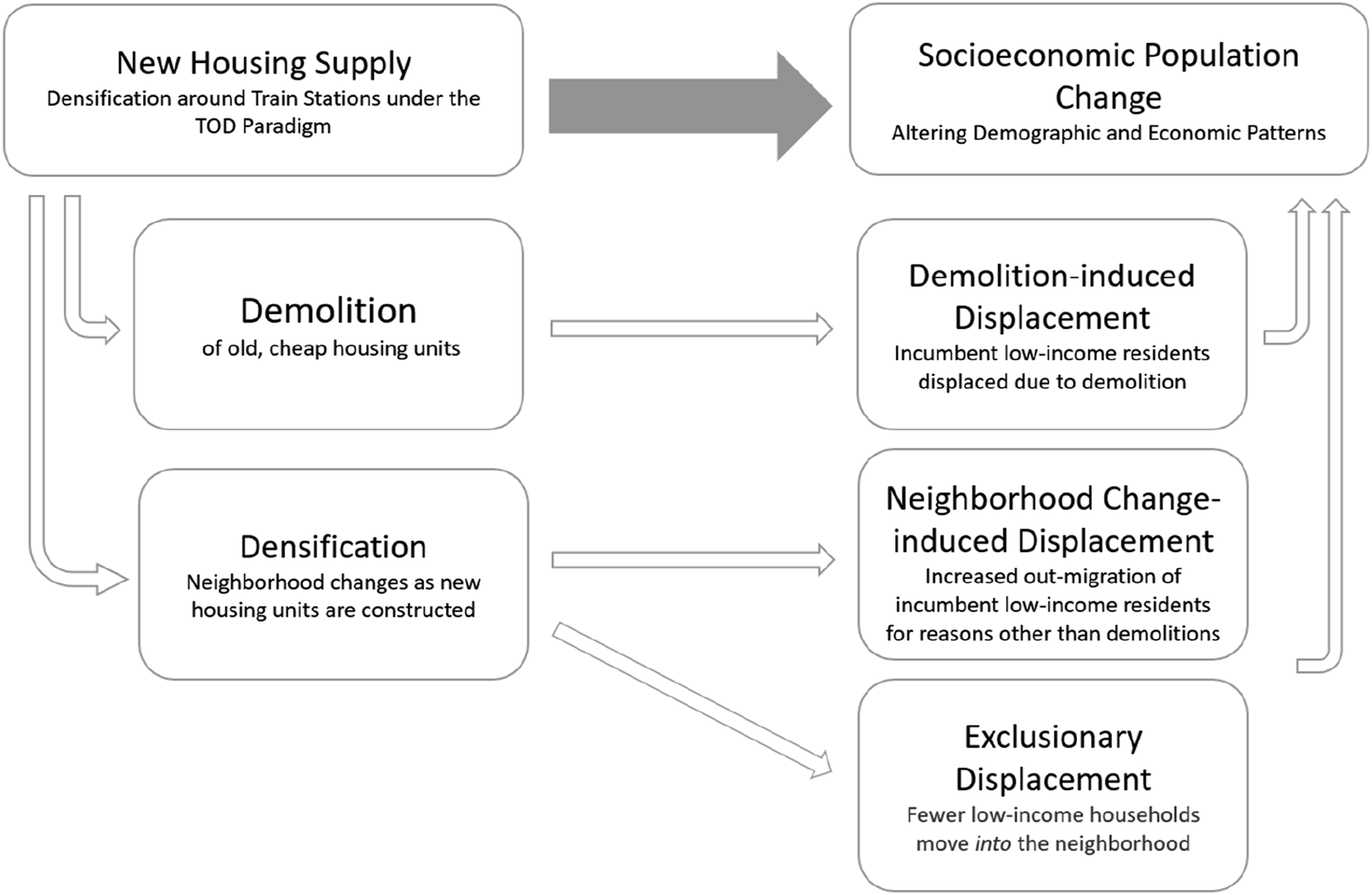
This paper investigates densification around train stations in the Canton (i.e., “State”) of Zurich, Switzerland. Specifically, we study the impact of Zürich’s strategic land use planning, which integrates housing and transport planning and aims to densify areas around major train stations (Canton of Zurich, 2023). The strategy was rationalized by TOD, as it aims to encourage public transit usage by allowing more people to live within walking distance of major public transit nodes. Since Zurich already has a well-developed transit network, TOD is implemented by allowing for more housing density close to existing train stations (e.g., through upzoning), rather than building new stations. This case is interesting as implementing TOD via densifying the area around train stations is increasingly popular (Silva et al., 2014). Leveraging comprehensive administrative panel data on housing and resident characteristics, we use two-way fixed effects regression to estimate whether this TOD strategy lowers the number and share of low-income residents around train stations undergoing densification. After finding that densification increases the number of low-income residents, but decreases their relative presence compared to other income groups, we focus on different forms of displacement. Thereby, we also shed light on how this strategy affects the spatial access of different socioeconomic groups to public transit.
This paper contributes to the literature in three ways: First, our detailed panel data of 1.8 million person-year observations links every person to their exact housing. To our knowledge, this makes this study the most comprehensive on the effects of densification on socioeconomic population composition and displacement to date. Second, while most existing studies focus on only one type of displacement, this data allows us to (1) simultaneously investigate different forms of displacement and (2) understand the importance of replacement construction for displacement. This can help to design better policy support for low-income residents when densification occurs. For example, it could help decide whether to focus on directly supporting residents who are displaced after demolition or whether to focus on stabilizing rent prices. Third, our paper also contributes to the literature on TOD which is often implemented by building public transit infrastructure and simultaneously densifying its surroundings. Yet, it has been difficult for existing studies to understand whether observed changes in the socioeconomic population composition are driven by the amenity effect of better public transit availability or by changes to the built environment as new denser housing is constructed (Chapple and Loukaitou-Sideris, 2019). Since we study a case in which TOD was implemented only via targeted densification around train stations, we can disentangle these two effects and highlight the effect of densification in TOD. This is important as densification around existing stations is increasingly popular.
Related literature
Gentrification and displacement
Gentrification and displacement are key objects of interest in urban scholarship with various definitions proposed in the literature. Regarding gentrification, we follow Smith’s understanding of gentrification as “the transformation of inner-city working-class and other neighborhoods to middle- and upper-middle-class residential, recreational, and other uses” (Smith 1987: 462). Thus, gentrification refers to holistic changes in neighborhood characteristics reflected in new housing, rising house prices but also new shops or restaurants. A term of particular relevance in our article is “new-built gentrification” because it refers to gentrification initiated by constructing new high-end buildings, often a part of densification efforts (Davidson and Lees, 2010).
Gentrification and displacement tend to go hand in hand (Davidson and Lees, 2005), yet displacement can manifest itself independently of gentrification (Hepburn et al., 2023). At its core, displacement refers to various forms of “un-homing” (Elliott-Cooper et al., 2020). As elaborated in Marcuse (1985), this un-homing occurs in different forms. He proposes four types of displacement: “Last-resident displacement” and “chain displacement” refer to direct forms of displacement when incumbent low-income residents move out because they are forced to leave or because they chose to move out early due to anticipation of displacement, respectively. Second, he also conceptualizes two forms of more indirect displacement: “Exclusionary displacement” refers to the inability of low-income individuals to move into an area they could have moved into before due to rising house prices. “Displacement pressure” refers to incumbent residents fearing displacement and feeling increasingly out of place in their own neighborhoods. While we use Marcuse’s (1985) concept of exclusionary displacement, we develop two concepts of direct demolition-induced and neighborhood change-induced displacement (see Figure 1). The latter two concepts are helpful in our context of densification to highlight the role of demolitions in displacement.
Densification, TOD, and displacement
Existing literature suggests that densification likely leads to displacement induced by demolitions if applied to already built-out areas (e.g., Debrunner and Hartmann, 2020). This is because older and hence more affordable rental units are a common target of replacement construction (Lutz et al., 2023) as replacement constructions are most profitable in these cases (Slater, 2009).
Moreover, densification alters neighborhood-level demand and supply patterns. New units built due to densification can change the demand for housing in the area. As more high-income households move into an area the image and desirability of the neighborhood can change, making it more attractive for higher-income households to move into existing units in the area (Asquith et al., 2023). On the other hand, densification also affects the supply of housing in an area. Strong densification of the built environment means that more units are constructed. This increase in the supply of housing can alleviate pressures on the housing market in areas with high demand (Asquith et al., 2023; Li et al., 2022). Consequently, densification may leave rent prices unchanged or even lower rents in buildings adjacent to the new construction (Asquith et al., 2023; Buechler and Lutz, 2021; Li et al., 2022). This can protect incumbent low-income households and enable new low-income households to move in.
Given these opposing conceptual forces of demand and supply, the effects of densification on neighborhood change-induced displacement (increased out-migration of incumbents, e.g., due to rent increases) and exclusionary displacement (decreased in-migration of new low-income individuals) are less clear. Regarding exclusionary displacement, Cavicchia (2023a) finds that densification led to exclusionary displacement in Oslo as housing became more expensive in neighborhoods adjacent to densification. Work on “new-built gentrification” highlights similar patterns, for example, in London (Davidson and Lees, 2005; Rérat and Lees, 2011). Literature is scarce on the effects of densification on neighborhood change-induced displacement, but Liu et al. (2017) show that residents in buildings adjacent to densification are afraid of being displaced, which indicates that neighborhood change-induced displacement may take place.
Conceptually, the effect of new transit infrastructure is different from the effect of densification. Most empirical work measures TOD as the opening of new transit stops, which is equivalent to adding new amenities to a neighborhood (Padeiro et al., 2019). Local amenities—and thus also TOD—are capitalized into house prices and rents (Gibbons and Machin, 2008). These increased housing costs can result in gentrification and displacement. Yet, the empirical evidence on whether TOD results in gentrification and displacement is mixed: While, for example, Chava and Renne (2022), or Zheng and Kahn (2013) find transit-induced gentrification, other studies, such as Delmelle and Nilsson (2020) or Rodnyansky (2018), find no evidence of increased out-moving of low-income residents. A recent review by Padeiro et al. (2019) concludes that most studies find no evidence of TOD causing gentrification or displacement.
Based on the existing literature, we hypothesize to find demolition-induced displacement due to replacement construction. Second, exclusionary displacement is to likely occur, while the effect on neighborhood change-induced displacement is unclear.
TOD in the Canton of Zurich
The Canton of Zurich consists of 168 municipalities, is 1,729 km2 large, and had 1.58 million inhabitants in 2021, which is, 20% of Switzerland’s population (Statistical Office of the Canton of Zurich, 2021). It consists of a dense network of cities and small-and-medium-sized towns (Kaufmann and Meili, 2019), centered around the City of Zurich, Switzerland’s economic center and home to many firms in the financial and IT sector. These high-paying jobs attract high-skilled residents. Thus, Zurich’s population is growing, and rents are rising.
An important difference to other geographical contexts is the high share of renters: in the City of Zurich 92% of the population rents, and in the Canton over 70% (Statistical Office of the Canton of Zurich, 2023). Rental contracts are long-term and tenant protection measures make it difficult to raise rents in existing contracts. Housing is mostly provided by private landlords but in cities, there is also not-for-profit housing. Yet, most housing is market-rate, and our results should be interpreted in this context (see Supplementary Materials 1).
Zurich’s public transit network is very well-developed. In 2019, 73% of the population stated that they use public transit regularly (City of Zurich, 2020). At the heart of the public transit network is the commuter rail, the S-Bahn, connecting suburban municipalities to Zurich’s city center. Therefore, commuter rail stations are the focus of TOD in the region. Areas close to the stations are sought-after places to live, also for higher-income households.
TOD is an explicit goal of the government of the Canton of Zurich and is connected to its densification efforts. The Canton of Zurich outlines this strategy in its Cantonal Development Strategy (Raumordnungskonzept) in the Cantonal Structure Plan (Canton of Zurich, 2023: 14, Figure 1) It specifies that 80% of population growth should happen in defined already dense urban areas and that urban development and transport systems should be connected (Canton of Zurich, 2023: 11). The Cantonal Structure Plan is the key document in Swiss spatial planning and is binding for all authorities. Thus, this spatial strategy encourages densification within walking distance of large existing train stations (Walczak, 2021). The exact implementation of TOD is then left to municipalities and therefore differs across municipalities. The area around the train stations is often already built up, consisting of residential buildings and some office space and retail. Increasing the housing supply around the train stations is therefore mainly done by demolishing existing houses and replacing them with new ones (Lutz et al., 2023). Simultaneously, Zurich has kept the commuter rail system relatively unchanged since 2005 and has not opened new stations. Thus, Zurich relies on densification around existing stations as a strategy for TOD.
Data
We use detailed geo-coded panel data of almost 1.8 million person-year observations on all buildings, all households, and property tax assessments from 2010 to 2020 (see also Supplemental Materials 2). The data links all inhabitants of the Canton of Zurich to their housing units and follows them over time. It contains information on, for example, income, age, or household size. Note that Swiss law mandates to report addresses and notify the government about moves within 2 weeks, ensuring the accuracy of our address information.
For buildings, we have detailed information on all buildings, for example, year of construction and demolition, the size, or number of rooms. From 2016 onwards, we also observe whether a unit is for profit and hence rented at market-rate or not. Since our data only contains this information since 2016, our main results are based on the full sample of both profit and not-for-profit units. We use imputation and provide a separate analysis of market-rate only buildings in Supplemental Materials 3A. However, of 19,790 buildings in our study area, only 804 are not-for-profit. Therefore, our results should mainly be interpreted as the effects of densification via the construction of new market-rate housing.
Empirical strategy
We focus on the 49 large train stations of the Canton of Zurich in Figure 2, defined as having two or more lines.
1
This is where the Cantonal government encourages densification. Given the focus of Zurich’s TOD strategy on areas within walking distance of train stations, we focus on the area of 500 m around the center of each train station shown as gray circles in Figure 2. As a robustness check, we vary this threshold to 805 m (i.e., 0.5 miles) and 300 m (Supplemental Materials 3B). Study area. Notes: This figure shows the location of the 49 train stations in our study area. Gray polygons show the 168 municipalities of the Canton of Zurich. Beige dots correspond to buildings (both residential and non-residential) as of 2020. The small map in the upper left corner shows the location of the Canton of Zurich in Switzerland.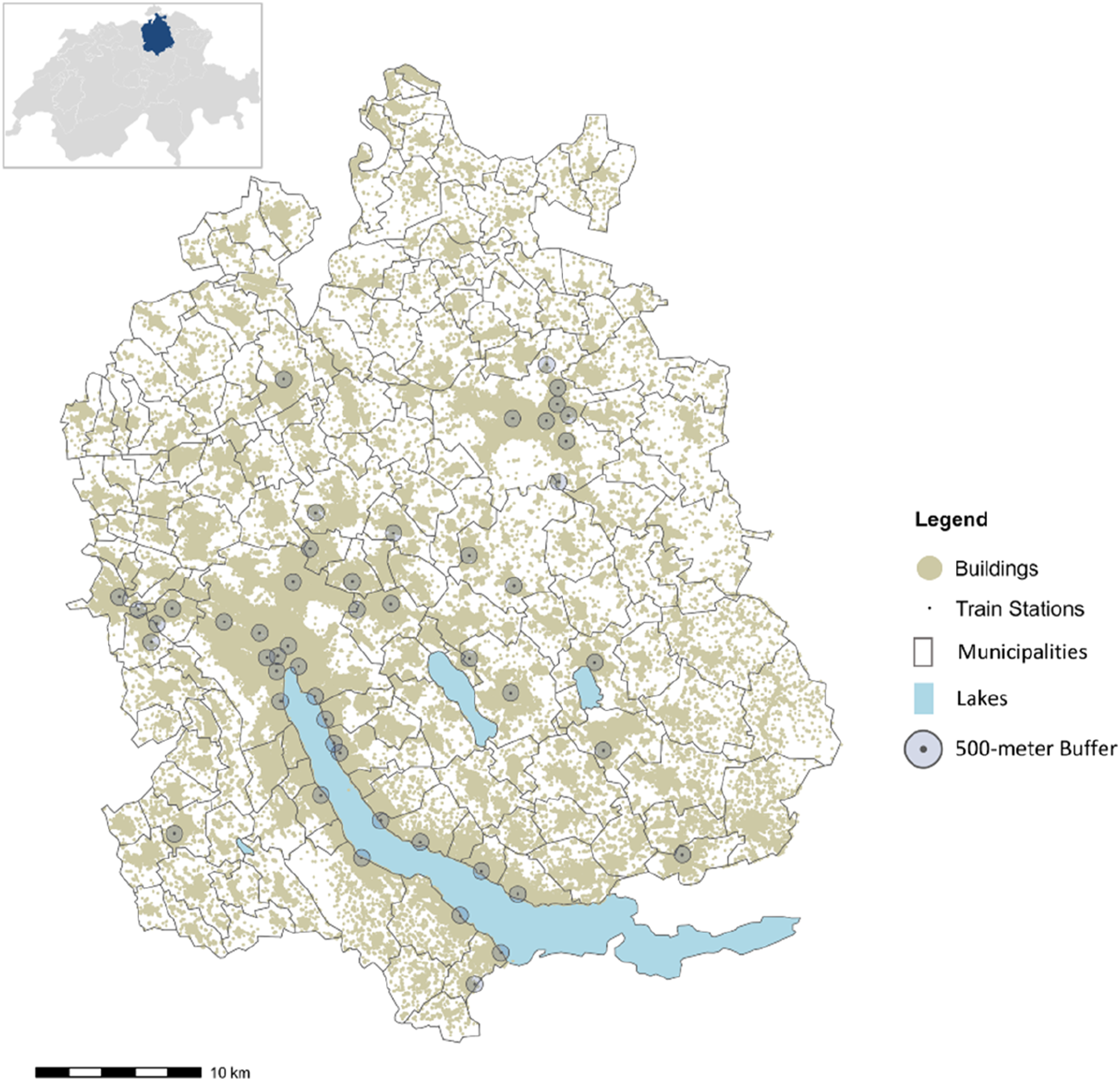
Operationalization
Conceptually, the independent variable is TOD via the densification around train stations. We measure this as the total residential floorspace around a train station, summing the square meters of residential floorspace of all buildings within 500 m from each station for each year (Table S1). We assume that densification occurs if this variable increases.
We use different dependent variables: First, we are interested in how densification affects the absolute and relative presence of low-income individuals in the area around train stations. This is helpful to understand how densification changed the socioeconomic population composition and whether it led to gentrification. To measure this, we use (1) the number of inhabitants, (2) the number of low-income individuals and (3) the share of low-income individuals within 500 m of each train station in each year. Supplemental Materials 4 shows the evolution of these variables over time. We interpret a decreasing share of low-income individuals as a sign of gentrification.
Individuals are “low-income” if they earn equal to or less than 60% of the median income of the Canton of Zurich in a given year. This definition is based on widely accepted measures of relative poverty used by both Eurostat and the OECD (Eurostat, 2023; Garroway and De Laiglesia, 2012). The share of low-income individuals y at a train station i in year t is then defined as:

Next, we use a second set of dependent variables to measure displacement. These variables are measures of in and out-moving of different socioeconomic groups. To measure demolition-induced displacement, we use the number of individuals who lived in a building, that is torn down and replaced, and who are unable to move into another building around the same train station. Second, we measure neighborhood change-induced displacement as the number of individuals moving out of a train station in a given year who did not live in a demolished building. This measure bundles various motives for moving out, which are both voluntary (e.g., finding a new job) and involuntary (rent increases, feeling out of place due to neighborhood change). Third, we measure exclusionary displacement by comparing the number of low-income and middle-/high-income individuals moving into the area around a train station.
Estimation strategy
Methodologically, we use two-way fixed effects regression to estimate the effect of densification on our different dependent variables. Intuitively, this technique relies on variation in the independent variable over time, which in our case means observing train stations with a lot of densification and train stations with little to no densification. Indeed, the increase in the square meters of housing floorspace from 2010 to 2020 varies across the 49 train stations from practically zero to 448% (Supplemental Materials 5). This approach allows for a comparison without imposing an artificial grouping of train stations.
Given the panel structure of our data, we can use year and train station fixed effects. Year-fixed effects control for everything year-specific, such as immigration or changes in the overall economic situation. Train station fixed effects control for any time-invariant train station-specific factors, such as the centrality of a train station within the Canton of Zurich. Moreover, changes in amenities, such as the construction of new schools or parks, could bias our estimation as this would cause a change in the socioeconomic population composition but it would not be driven by densification itself. Therefore, we use property tax data as a control variable. Property tax categories in the Canton of Zurich are on a scale of 1 to 7, with values reflecting, for example, proximity to schools, shopping or greenspace, and noise. They are updated whenever changes occur that could affect the value of a property, which also accounts for changes in land values. Thereby, we control for changes to a neighborhood for reasons other than new housing construction, which could also affect the share of low-income individuals in an area.
Our main specification is the following model:

Results
We first quantify the effect of densification on the number and then on the share of low-income individuals. We then continue our analyses by presenting the results of the three different forms of displacement we conceptualized in section 2 and operationalized in section 5.
Effects on number of low-income individuals and inhabitants
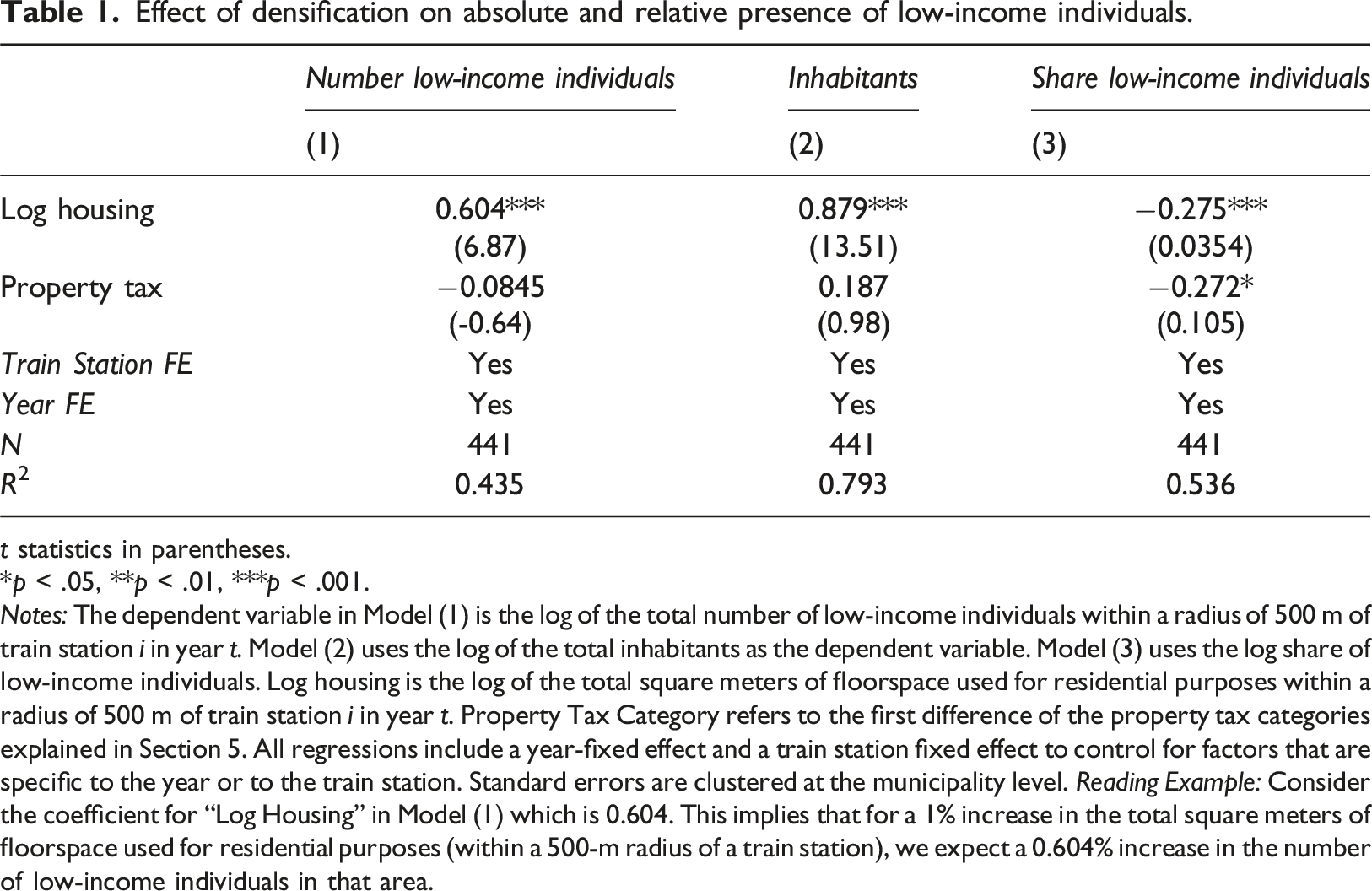
Effect of densification on absolute and relative presence of low-income individuals.
t statistics in parentheses.
*p < .05, **p < .01, ***p < .001.
Notes: The dependent variable in Model (1) is the log of the total number of low-income individuals within a radius of 500 m of train station i in year t. Model (2) uses the log of the total inhabitants as the dependent variable. Model (3) uses the log share of low-income individuals. Log housing is the log of the total square meters of floorspace used for residential purposes within a radius of 500 m of train station i in year t. Property Tax Category refers to the first difference of the property tax categories explained in Section 5. All regressions include a year-fixed effect and a train station fixed effect to control for factors that are specific to the year or to the train station. Standard errors are clustered at the municipality level. Reading Example: Consider the coefficient for “Log Housing” in Model (1) which is 0.604. This implies that for a 1% increase in the total square meters of floorspace used for residential purposes (within a 500-m radius of a train station), we expect a 0.604% increase in the number of low-income individuals in that area.
However, the number of inhabitants in general increases much more strongly than the number of low-income inhabitants after increasing the housing supply. Model (2) in Table 1 shows that an increase of housing floorspace by 1% is associated with 0.88% more inhabitants in general. This effect is much larger, showing that the number of high-/middle-income individuals increases more strongly after densification than the number of low-income individuals.
Moreover, the fact that densification of the built environment increases population density is interesting in itself, given current discussions on whether densifying the built environment increases population density, or whether it mainly leads to the construction of more spacious units without actually increasing population density.
Relative presence of low-income individuals
Next, we investigate the effect of densification on the relative presence of low-income individuals compared to other socioeconomic groups. This is important because even though densification increases the number of low-income individuals, it may still lower the share they make up in the total local population. Our results show that on average across all train stations, increasing the housing floorspace by 1% decreases the share of low-income individuals by 0.28% in the same year (Model 3, Table 1). To ensure that this effect is not only short-term (e.g., driven by temporary construction works), we also use the 3-year lag of the housing floorspace as the independent variable (Supplemental Materials 6). We assume that 3 years after the finalization of new construction, most renters have moved in, and changes in the socioeconomic population composition are relatively permanent (Pagani et al., 2021). When doing so, the coefficient of interest remains largely unchanged at −0.21. The property tax category is significant at the 10% significance level, indicating that improvements to local amenities are associated with a lower share of low-income individuals. Overall, increasing the housing supply leads to a lasting decrease in the number of low-income individuals relative to the total population, thereby increasing inequality in access to public transit.
Additionally, we study the impact of increasing the density of the built environment on population characteristics other than income. We focus on changes in nationality, average household size, and age, as existing literature suggests that “gentrifiers” are often young singles or couples rather than families with children (e.g., Paul and Taylor, 2021). We describe the results in detail in Supplemental Materials 7. We find that increasing the housing supply indeed leads to meaningful changes in the age composition and household size toward younger, richer single and two-person households. This further illustrates the change in the population composition toward better-off socioeconomic groups. This raises questions about possible displacement taking place, even though we find that densification increases the number of low-income residents.
Demolition-induced displacement
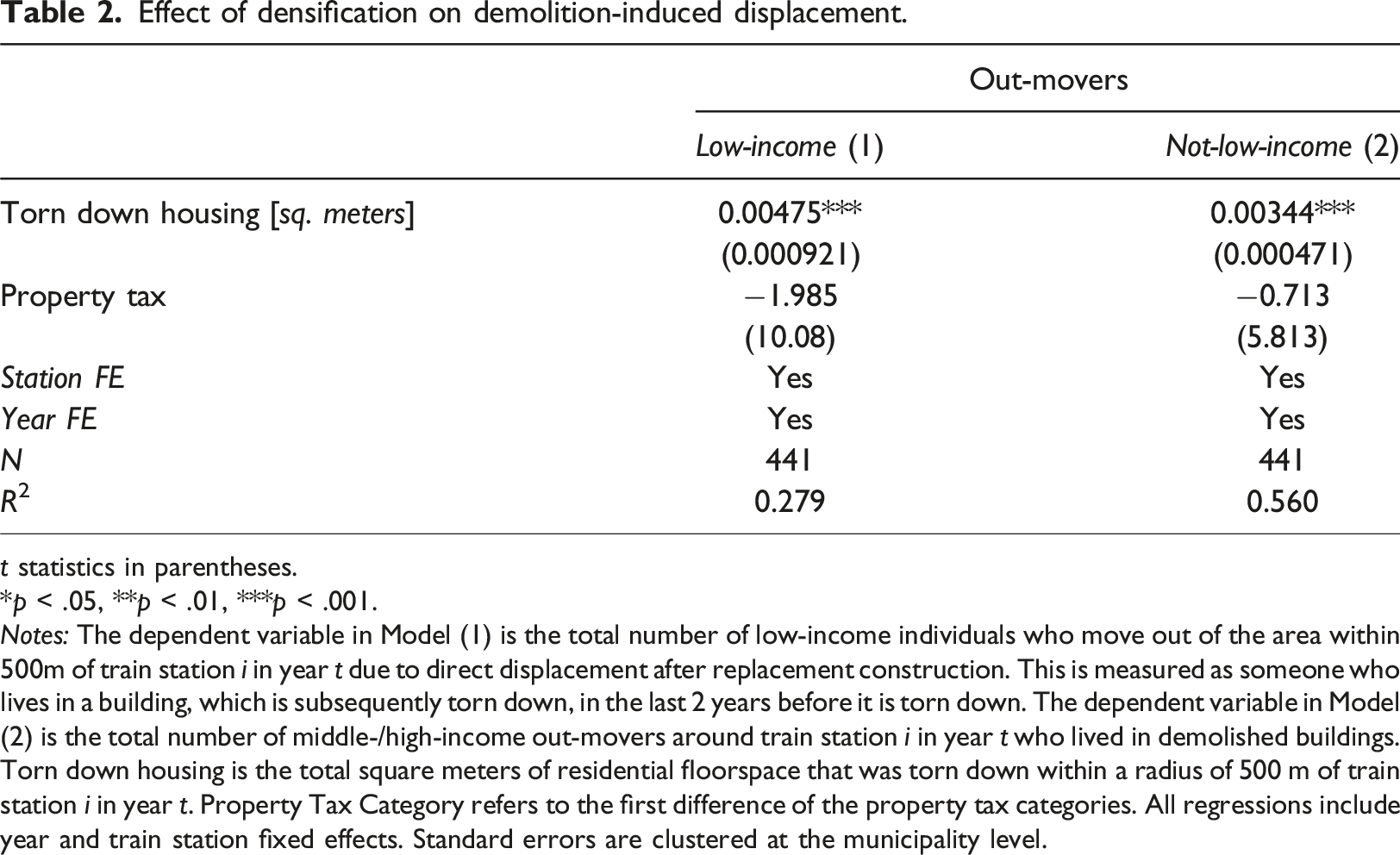
Next, we present our results on displacement, starting with demolition-induced displacement. During our study period, 791 buildings of a total of 19,791 buildings were demolished. These buildings were home to 3,640 people before they were demolished. 2,768 of the inhabitants left the area after the destruction. Most of them are low-income: the median per capita household income of inhabitants of demolished buildings was only 2948.51 Swiss Francs per month compared to 4308.77 CHF for all individuals in the study area. This descriptive fact already highlights that demolition-induced displacement is socially stratified.
Effect of densification on demolition-induced displacement.
t statistics in parentheses.
*p < .05, **p < .01, ***p < .001.
Notes: The dependent variable in Model (1) is the total number of low-income individuals who move out of the area within 500m of train station i in year t due to direct displacement after replacement construction. This is measured as someone who lives in a building, which is subsequently torn down, in the last 2 years before it is torn down. The dependent variable in Model (2) is the total number of middle-/high-income out-movers around train station i in year t who lived in demolished buildings. Torn down housing is the total square meters of residential floorspace that was torn down within a radius of 500 m of train station i in year t. Property Tax Category refers to the first difference of the property tax categories. All regressions include year and train station fixed effects. Standard errors are clustered at the municipality level.
Neighborhood change-induced displacement
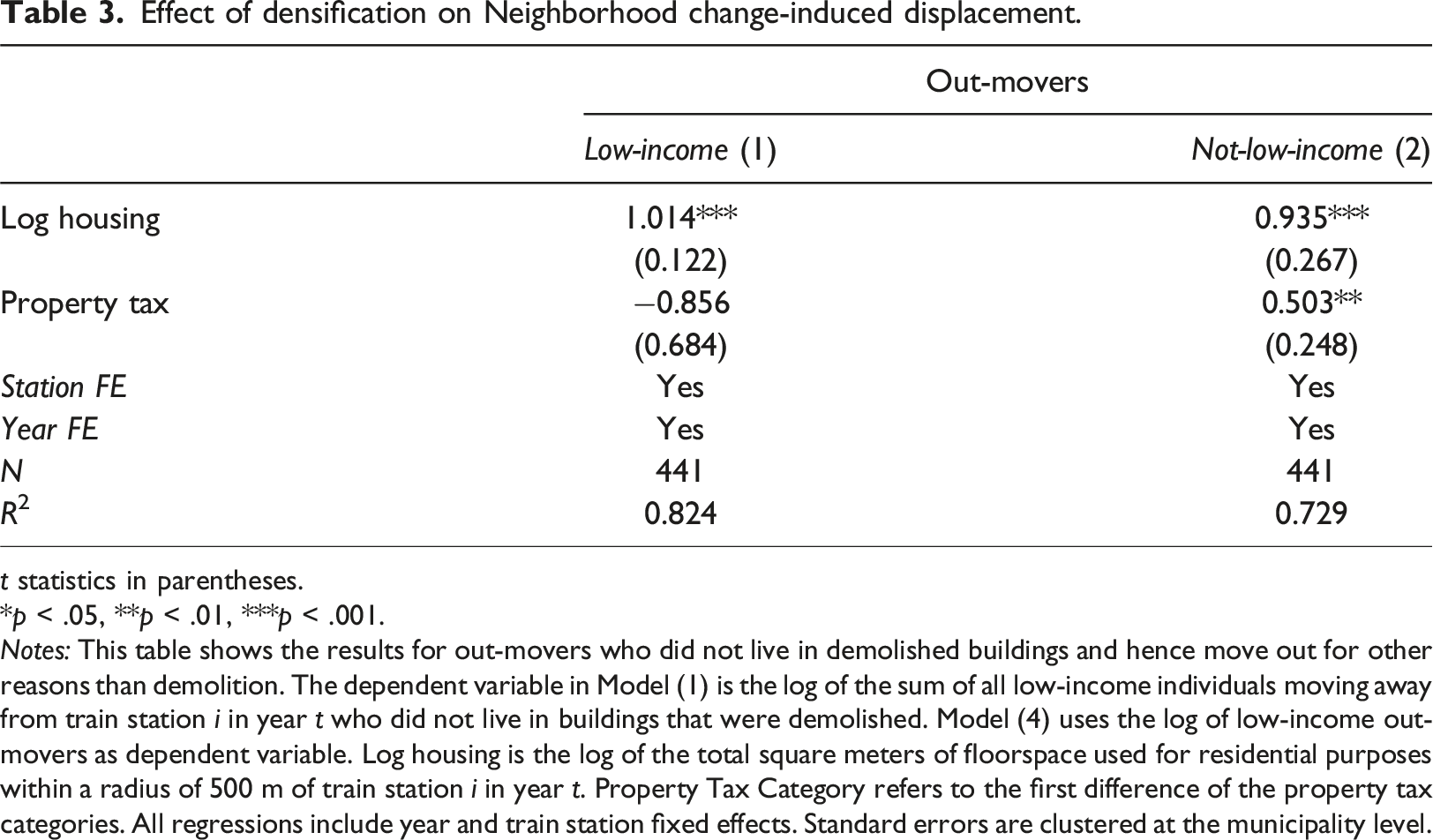
Next, we estimate the effect of increasing the housing floorspace on neighborhood change-induced displacement. Clearly, not every low-income out-mover experiences displacement. However, if we were to find that densification is associated with a pronounced, statistically significant increase in the number of low-income out-movers, we would interpret this as an increase in displacement as densification is unlikely to change the number of voluntary out-movers. This approach is similar to Delmelle and Nilsson (2020), who study whether opening new train stations in the US increased the out-migration of low-income residents.
Effect of densification on Neighborhood change-induced displacement.
t statistics in parentheses.
*p < .05, **p < .01, ***p < .001.
Notes: This table shows the results for out-movers who did not live in demolished buildings and hence move out for other reasons than demolition. The dependent variable in Model (1) is the log of the sum of all low-income individuals moving away from train station i in year t who did not live in buildings that were demolished. Model (4) uses the log of low-income out-movers as dependent variable. Log housing is the log of the total square meters of floorspace used for residential purposes within a radius of 500 m of train station i in year t. Property Tax Category refers to the first difference of the property tax categories. All regressions include year and train station fixed effects. Standard errors are clustered at the municipality level.
Exclusionary displacement
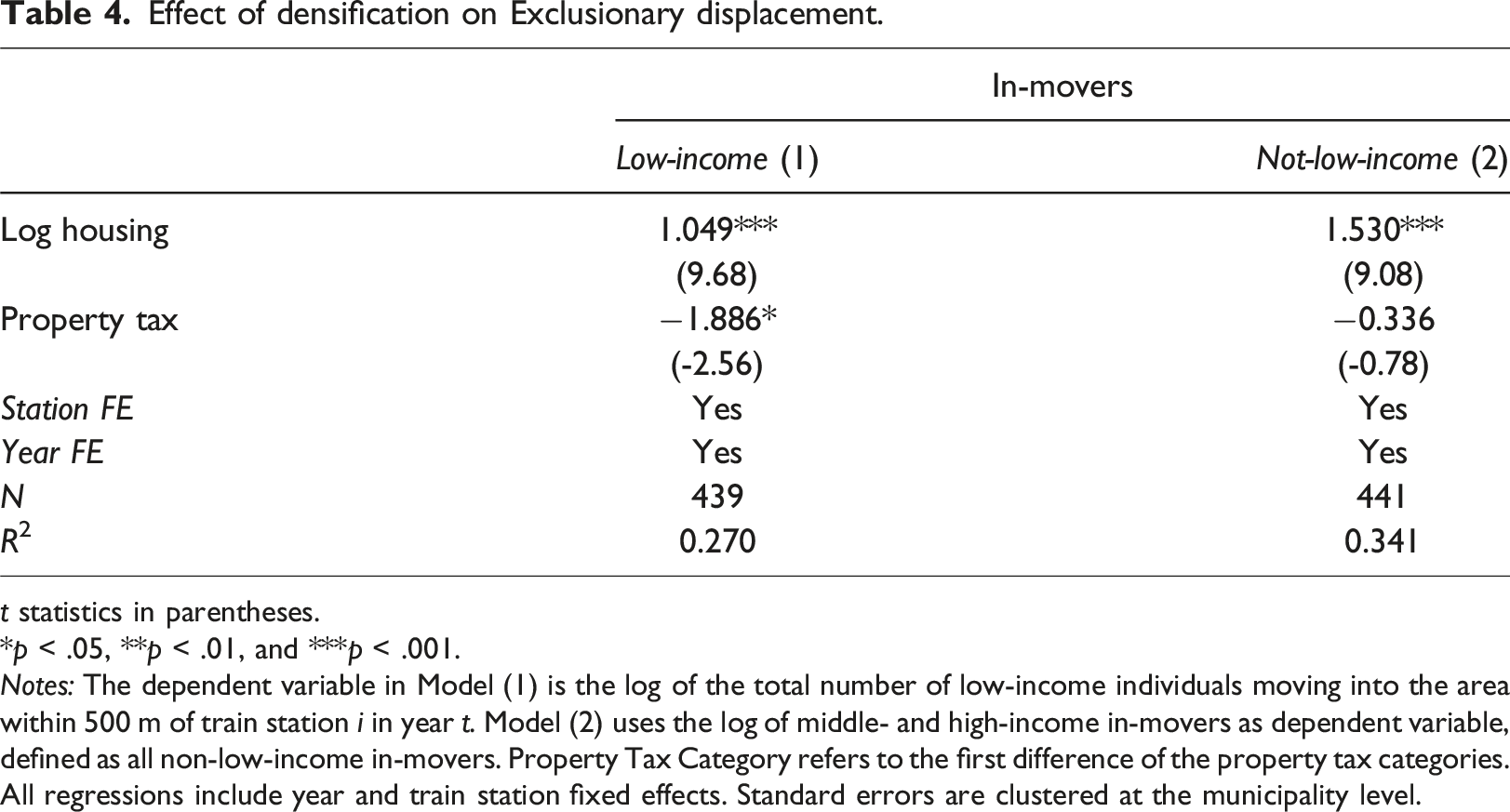
Effect of densification on Exclusionary displacement.
t statistics in parentheses.
*p < .05, **p < .01, and ***p < .001.
Notes: The dependent variable in Model (1) is the log of the total number of low-income individuals moving into the area within 500 m of train station i in year t. Model (2) uses the log of middle- and high-income in-movers as dependent variable, defined as all non-low-income in-movers. Property Tax Category refers to the first difference of the property tax categories. All regressions include year and train station fixed effects. Standard errors are clustered at the municipality level.
However, there is a pronounced difference between low-income individuals and middle-/high-income individuals: The effect on in-moving is approximately 45% stronger for middle-/high-income individuals. This shows that there is an inequality in who can move close to train stations after densification. Additionally, descriptive analyses show that the newly built market-rate buildings are mostly inhabited by middle-/high-income individuals, while low-income in-movers mostly move into other existing housing stock. Therefore, while low-income individuals cannot afford to move into newly built homes, they can still move into existing buildings around the train stations as shown by the positive coefficient in Model (1) of Table 4. Therefore, we find exclusionary displacement at the level of the buildings, which are replaced, but not at the level of the 500-meter radius around the train station.
Thus, our findings differ from Cavicchia (2023a) who finds exclusionary displacement in areas adjacent to densification by showing that median incomes increased disproportionately. Our study does not indicate this dynamic in Zurich but highlights that in Zurich the problem mostly is demolition-induced displacement of low-income individuals. Nevertheless, our findings are similar to Cavicchia (2023a) insofar as we also find that middle-/high-income individuals are more likely to move into densifying areas. Moreover, we explicitly measure the in-moving of new low-income individuals rather than changes in the median household income, which may also explain differences to Cavicchia (2023a). Yet, our results show that densification in Zurich did not lead to pronounced exclusionary displacement in areas adjacent to newly densified parcels, but rather to socioeconomic inequality in who moves in.
Robustness
Results are robust to alternative radii around train stations, different definitions of low-income, including the municipality-level share of low-income individuals, and using market-rate housing only (Supplemental Materials 3). Supplemental Materials 3E investigates differences in the effects across sub-markets, finding no significant effect for train stations in wealthy suburbs.
Discussion
Our findings present a nuanced and mixed picture of the effect of TOD implemented via densification. Densification slightly increased the number of low-income individuals living close to train stations. Additionally, while densification is associated with increased out-migration in general, this effect is not much stronger for low-income individuals who live in non-demolished buildings within 500 m of the train station compared to other socioeconomic groups. It is worth noting that the latter finding may be specific cases with legal limits to increasing rents within existing rental contracts. Nevertheless, densification increased the absolute access of low-income individuals to public transit.
Despite these positive findings, our study shows that densification led to a pronounced change in the local socioeconomic population composition toward higher-income households and harmed incumbent low-income residents. First, we show that densification led to demolition-induced displacement of low-income incumbents. They are more likely to live in the older housing stock, which is demolished during densification, and demolitions cause them to be evicted and forced to leave their neighborhood. Second, low-income individuals are less likely than middle-/high-income individuals to move into a neighborhood undergoing densification. If they move in, then they do not move into the new-built housing but predominately into the older existing housing stock. This potentially exposes them to a risk of demolition-induced displacement in the future. Moreover, even when living in non-demolished buildings, low-income residents are also somewhat more likely to move out due to densification than middle-/high-income households. We also show that newcomers are younger and live in smaller households than the incumbent population—findings in line with Rérat and Lees (2011) and Taylor and Fink (2003). Given that gentrification is a slow process, this increase in wealthier households may cause neighborhood change-induced displacement in the long run beyond the 11 years of our study.
Our findings show that the planning strategy of densification around train stations mainly benefits middle- and high-income households: They can move into the new housing stock close to train stations and are much less affected by any form of displacement that we investigated. Conversely, low-income households experience demolition-induced displacement and cannot afford moving into the newly constructed units. This reduces their relative presence in transit-rich neighborhoods, perpetuating long-standing inequalities in access to public transit for those who rely on it the most. High-income individuals rely less on public transit and often continue owning and mainly using cars (Taylor and Fink, 2003). Paradoxically, this likely also reduces the environmental sustainability impact of this TOD strategy as wealthier households tend to make less use of the new opportunity of living close to public transit (Rérat and Lees, 2011).
Overall, our study highlights the benefits of simultaneously investigating different forms of displacement by using different dependent variables for quantitative analyses of displacement and gentrification. Given that analyses using different dependent variables came to different directions of results, focusing on just one outcome increases the risk of over or understating the effects of planning strategies on social equity.
Conclusion
This paper contributes to the continued debates on the connection between densification, gentrification, and displacement and on how cities can overcome long-standing inequalities in access to public infrastructure. We study the effect of densification around train stations in the Canton of Zurich in Switzerland. We provide evidence that increasing the housing supply close to essential public transit infrastructure is beneficial insofar as more low-income individuals and individuals in general get to live within walking distance of public transit. We also find no clear evidence of neighborhood change-induced displacement of individuals living in non-demolished buildings. Nevertheless, the benefits of densification are unevenly distributed across different income groups and mainly captured by middle- and high-income households. In line with the expectations derived from the literature, incumbent low-income households face an increased risk of demolition-induced displacement. Moreover, middle- and high-income households can disproportionately more often move closer to train stations and are the ones to move into the newly built units, which hints at a subtle form of exclusionary displacement. Overall, implementing TOD via an increase in housing supply close to existing train stations exacerbates long-standing inequalities in access to public transit for low-income households.
These findings call for caution regarding TOD strategies, which rely mainly on market-rate housing construction. A more equitable approach to city planning could be achieved through targeted measures to secure affordable housing. One example is inclusionary zoning, which mandates developers to provide a certain percentage of affordable units in new developments (Schuetz et al., 2011). Another example is active land policy, meaning that municipalities acquire land to develop housing themselves or work with not-for-profit developers or housing cooperatives through long-term building leases (e.g., Debrunner and Hartmann, 2020). This would allow accompanying TOD—but also other urban planning paradigms such as superblocks and the 15-min city—with regulations or incentives to achieve intended social and environmental goals, ensuring that these well-meant urban development paradigms do not fall short (Cavicchia, 2023b). We hope that this work catalyzes further discussions and actions toward achieving more equitable cities, where access to critical public infrastructure like public transit is a right shared by all, not a privilege for the few.
Supplemental Material
Supplemental Material - Creating inequality in access to public transit? Densification, gentrification, and displacement
Supplemental Material for Creating inequality in access to public transit? Densification, gentrification, and displacement by Elena Lutz, Michael Wicki, and David Kaufmann in Environment and Planning B: Urban Analytics and City Science.
Footnotes
Acknowledgments
The research for this paper was part of the transdisciplinary project “Co-Creating Mobility Hubs (CCMH)” by EPF Lausanne, ETH Zurich, and the Swiss Federal Railways (SBB CFF FFS).
Author contributions
Elena Lutz: Conceptualization; data acquisition; data cleaning and analysis; empirical design, writing—original draft, and writing—review and editing.
Michael Wicki: Conceptualization; project administration; supervision; writing—original draft; and writing—review and editing.
David Kaufmann: Conceptualization; funding acquisition; resources; supervision; writing—original draft; and writing—review and editing.
Declaration of conflicting interests
The author(s) declared the following potential conflicts of interest with respect to the research, authorship, and/or publication of this article: The authors Elena Lutz, Michael Wicki, and David Kaufmann hereby declare that there is no conflict of interest with regard to the project “Creating Inequality in Access to Public Transit? Densification, Gentrification, and Displacement.”
Funding
The author(s) disclosed receipt of the following financial support for the research, authorship, and/or publication of this article: This research was funded mainly by ETH Zurich and partly by the Swiss Federal Railways (SBB CFF FFS).

Data availability statement
The data sets used in this paper are administrative social security data provided by the Federal Statistical Office of Switzerland and the Central Compensation Office (Swiss Social Security Agency) under contract number 220519. This data contains highly sensitive information. In particular, it allows to identify every person in Switzerland including, for example, children or asylum seekers, and allows to identify their exact address as well as their exact income and residence status. This information cannot be shared or made publicly available as it would violate privacy concerns, as well as the terms and conditions of the agreement between the research team and the Federal Statistical Office. Therefore, we are unable to upload the data.
Supplemental Material
Supplemental material for this article is available online.
Note
References
Supplementary Material
Please find the following supplemental material available below.
For Open Access articles published under a Creative Commons License, all supplemental material carries the same license as the article it is associated with.
For non-Open Access articles published, all supplemental material carries a non-exclusive license, and permission requests for re-use of supplemental material or any part of supplemental material shall be sent directly to the copyright owner as specified in the copyright notice associated with the article.
