




Abstract
Walking is an outdoor mobility. Understanding how urban environments influence the experience of walking enables walking to be supported through urban planning and design. This research demonstrates that the effect of a stimulating walking environment is a measurable factor. Psychological knowledge provides a background for quantifying the amount of visual stimulus that pedestrians receive unconsciously from the surrounding environment. While walking, people capture the visual environment through frequent head movements. By looking downwards to the walking surface, pedestrians turn away from what surrounds them. Socially active urban squares and pedestrian streets are highly stimulating. Head movements increase by 71% and looking down decreases by 54%, compared to environments designed for cars. Underpasses are the least stimulating. Head movements drop by 64% and time looked down increases by 164% in an underpass, compared to the busiest urban square in the study. A second analysis introduces a method to quantitatively represent the visual walking environment. Two multiple linear regression statistics uncover the environmental features that attract pedestrians’ visual attention. If not crossing streets, pedestrians do not look at cars; they look at other people, non-monotonous facades and green features. Shop windows receive prolonged viewings, to inspect what is going on behind transparent facades. Narrower streets are more stimulating, as more details are closer to the eyes. The distance at which human sense organs can collect sensory information from the environment is limited. Walking environments that do not fit with this human scale are less stimulating.
Introduction
Walking is an important part of urban mobility but is often not considered as a form of transport (Pooley et al., 2014). Over 90% of public transport journeys in cities include at least two walking trips, and travellers spend 45–50% of their travel time as pedestrians (Hillnhütter, 2016: 8). In many cities, walking and public transport remain the most used mobility alternatives to car driving. The positive effects of more walking on urban challenges, such as noise levels, air pollution and CO2 emissions, as well as traffic safety and societal health, have increased the interest in walking, in fields like planning, transport and the health sector.
Walking is an activity that takes place outdoors in urban environments. The character of the urban environment influences the experience of walking. Many researchers have investigated the relationship between walking and the characteristics of the urban environment (Boarnet and Crane, 2001; Boarnet et al., 2011; Ewing and Cervero, 2010, 2001; Ewing and Handy, 2009; Giles-Corti et al., 2009; Guo, 2009; Saelens and Handy, 2008). The questions of whether and how we can encourage more walking through planning and designing urban environments unite most research on walking environments. Protected only by their clothes, pedestrians are directly exposed to the physical and social environment in which they are mobile.
Fruin understands walking as a means of transport “[…] by which we can dramatically experience the sensory gradients of sight, sound, and smell that define a place” (1979: 188). The collected sensory information influences the experience of any journey on foot (Monheim and Monheim-Dandorfer, 1990: 187). Having observed pedestrian behaviour over many years, Whyte finds that sensory streets with a high degree of stimulation are the most attractive for walking (1988: 66). Walking speeds result in highly detailed and multisensory environmental stimulation. Human sense organs continuously collect information from the surrounding environment (Maderthaner, 2008: 133). Pedestrians cannot switch off the constant flow of environmental information to their brain. Continuously collected sensory information can be pleasant or unpleasant but is often necessary for navigation. Having to interact with moving cars requires pedestrians to take notice of what surrounds them, as vehicles can be a fatal threat. Meanwhile, a busy urban square can attract pedestrians’ attention, simply because whatever goes on appears exciting and appealing.
This research focuses on three questions: How can we investigate the amount of stimulation that pedestrians receive from their walking environment? Does the level of stimulation vary between differently characterised walking environments? Can we identify environmental features that attract pedestrians’ attention while walking?
Why are answers to these three specific questions relevant? First, to provide clues on which walking environments appeal to pedestrians’ senses: the ability to measure the level of stimulation provides an indicator of the intensity of an environmental experience. Second, understanding which environmental features attract pedestrians’ senses informs the planning and design of walking environments.
How can we measure the level of stimulation that pedestrians receive from walking environments?
The five human sense organs establish a link between the human mind and the surrounding reality. Of the total amount of information that the human brain receives from all sense organs, 80% is visual (Maderthaner, 2008: 133). The visual walking environment plays a central role in the sensory experience of walking. Measuring the amount of visual stimulation that pedestrians receive from urban surroundings would provide a good approximation of the total amount of stimulation that people receive from walking environments.
Gibson explains how humans perceive their visual surroundings. While we move forward, the visible objects of the environment shift in a constant flow from the centre of our visual field to the side (Gibson, 1982: 222–223). Appleyard et al. (1964: 12) analysed the visual impression of urban environments from the perspective of a fast-moving car. Apart from gravitational forces, the perception of velocity is derived from the apparent movement of environmental objects in the visual field. Details of the environment only become visible at lower speeds, for example when walking.
While walking, a pedestrian’s eyes collect visual information. Eyes move inside the head. The head can turn on the body. The body can bend, and legs carry the body, enabling it to be mobile. During walking, eye movements detect the details within the visual field. Body- and head turns change the visual field, and the legs alter the point of view. Collecting visual information while being mobile requires frequent head and eye movements. Long fixations on one point are rare and indicate rather that a person is lost in contemplation (Gibson, 1982: 221–235). While exploring the visual surrounding, the centre of eye vision can change about 100 times per minute. Complex situations can even increase the number of eye movements (Gibson, 1950: 155). Visual information, collected through eye and head movements, is assembled in the human brain into a panoramic picture of the surrounding environment (Gibson, 1950: 157–158).
Independently of psychological research, urban researchers study how people pay attention to and interact with urban surroundings. Hass-Klau et al. (1999: 128) investigated streets as living space, through observations and interviews, and concluded that ‘things to look at’ are an essential feature of social activity in squares and streets. Jacobs (1993: 282) interviewed street users and design professionals and analysed a wide variety of urban streets. He found that an attractive street results in many head movements. Gehl et al. (2004: 9) reported on an observational study investigating the behaviour of people in front of differently characterised building facades, through counts and behavioural mappings. They found that 3.5 times more pedestrians turn their heads to detailed facades with windows and entrances, compared to monotone and closed facades. These experiences from urban researchers indicate that the character of urban surroundings might influence how often pedestrians turn their heads. Counting head movements seems to provide a good indicator of the level of visual stimulation that walkers receive from what surrounds them in cities.
Initial observations of pedestrians’ head movements
Initial observations are less structured and serve to define behavioural patterns for a more structured in-depth investigation (Whyte, 1980: 110). Observing pedestrians’ eyes and faces uncovers what might be a pattern. I gained the first impressions at two sites in Copenhagen. 1 On the pavement between a carriageway and the large-scale facade of the Danish National Bank in Copenhagen, pedestrians do not turn their heads very often. This is unsurprising, as there is not much to see. Many pedestrians tilt their heads slightly downwards, focussing on a point on the pavement 3–5 m in front of them. The downward tilted visual field seems sufficient to collect information to avoid collisions.
While uneven walking surfaces, stairs and curbs require many pedestrians to look down, pedestrians walking on the smooth pavement along the Danish National Bank seem to choose to look down. Middleton investigated the experience of walking, through in-depth interviews and diary data. She found a form of ‘autopilot walking’. In trying to maintain an unbroken stride, pedestrians seem to detach from the physical activity of the legs (Middleton, 2010: 583). My impressions are congruent. With no steps or obstacles on the walking surface, looking down at the pavement appears a strategy to reduce environmental information to the bare minimum for safe navigation. The length of time pedestrians look down may be an interesting indicator of walking environments that appear repulsive to their senses or simply are unattractive for walking.
When walking in the lively urban square, Amagertorv, in the city centre of Copenhagen, pedestrians move their heads differently. There is enough space for walking, and pedestrians could easily navigate by only looking down at the walking surface. However, few pedestrians do so. Instead, shop windows, picturesque facades and numerous social and mobile activities seem to attract their eyes while walking in the square. Heads frequently turn to catch whatever is going on. The impressions from these initial observations reflect Gibson’s explanation well. People collect environmental information through eye and head movements.
I gained the impression that the walking speed might also influence how pedestrians pay attention to their visual walking environment. As an indicator of walking speeds, I measured the frequency of steps. Heel strikes are visible with the naked eye and occur in a regular rhythm. I adjusted the beats of a metronome (usually used by musicians) to the rhythm of pedestrians’ heel strikes. This metronome method provides an indicator of walking speeds at the very moment of an observation. 2
Walking speeds vary for many reasons. Fast pedestrians walk with step frequencies of over 120 steps per minute. They appear more focused and seem to participate in their surroundings less frequently than slower walkers. Faster speeds require more energy, can increase exhaustion and may indicate that pedestrians are under time pressure. Energy use, fatigue and time pressure possibly influence how pedestrians pay attention to the visual walking environment. Strollers walk slowly and stop frequently. They walk mostly with step frequencies of below 90 steps per minute. Strolling is a combination of mobility and stationary interactions with the urban context (Sauter and Wedderburn, 2008: 7). To me, the variation in walking speed did not appear to be the only difference between strolling and walking. Strolling appears to be a different form of walking. The head movements of strollers might not be comparable with those of pedestrians that walk preliminarily for the purpose of getting from A to B.
An essential feature of walking is the possibility to simultaneously perform other activities. Pedestrians rummage in bags, purses or jacket pockets. They count money, smoke, sort their hair, fiddle with sunglasses, put on lipstick and sort their clothes while walking. Some eat an apple, while others fork in pots containing fast food or even manage to eat burgers while walking. All these activities do not generally restrict pedestrians’ ability to pay attention to their surroundings, but many seem to focus on whatever else they are doing while walking. People walking in pairs or groups are often engaged in conversations. While walking and talking, pedestrians more frequently direct their gaze towards their companions. The social aspects of walking and doing things while walking are likely to influence how pedestrians visually consider urban surroundings.
On the basis of the initial unstructured observations, more structured observations allow head movements to be counted and the time pedestrians look down in different walking environments to be measured.
Collecting data on head movements in 18 urban environments
This investigation aims to understand whether differently characterised walking environments show differences in head movements and looking down. The study observed 924 randomly chosen pedestrians at 18 sites in four cities (Table 1). Walking behaviour was captured by video camera. Observations at sites 01–12 in Table 1 investigated the variation in head movements between car-dominated and pedestrian-oriented walking environments. Sites 13–18 showed head movements under more specific conditions. Observations took place either between 10.00 h and 12.30 h or between 15.30 h and 17.30 h on weekdays between May and September in 2013. The weather was sunny and comfortable, with temperatures between 16 and 24°C. Slightly overcast weather occurred only at two sites in Brighton (sites 05 Gloucester Pl. and 09 New Road). Wind did not make walking uncomfortable during the observations. Walking surfaces at all sites were well maintained, smooth and without any steps or obstacles. Pedestrians had enough space to walk unhampered at the fastest desired speed.
Eighteen pedestrian observation sites in four cities, CPH – Copenhagen (DK), Z – Zürich (CH), BR – Brighton (UK), BI – Biel (CH).
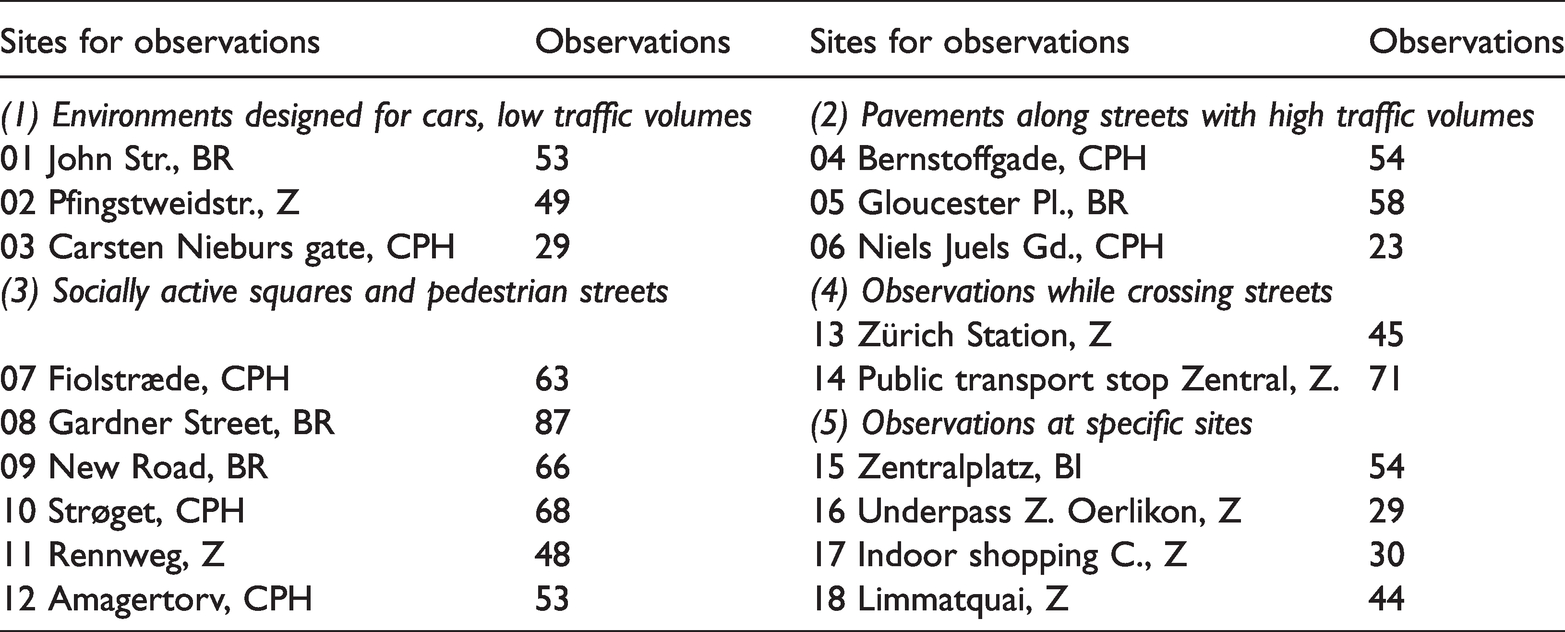
All videos were filmed from a position with a good view of pedestrians. Head movements are countable from the video footage. Tilting the head downwards to the pavement does not count as a head movement. Looking at a phone screen while walking or any other activities requiring visual attention count as time looking down. Data collection registers further whether pedestrians walked alone or in pairs and groups and whether pedestrians performed any activities during the observation.
Only fast and determined pedestrians walking with step frequencies of over 90 steps per minute were observed. To filter out the effects of the more particular walking behaviour, children, strollers and impaired pedestrians were not observed. The supplementary file, available online, provides more details on how observations were conducted, their context, the choice of observation sites and their environmental characteristics and discusses possibilities for improving the method.
Analysing the effect of seven environmental characteristics on head movements
Counting head movements in different environments may only support the assumption that urban environments affect head movements and thereby the amount of stimulation that pedestrians receive from what surrounds them. More interesting is to understand whether and how features of walking environments, like trees or building façades, increase pedestrians’ visual attention. Such understanding provides information on how to plan and design stimulating walking environments in cities. To enable a quantitative investigation of the effect of environmental characteristics on head movements, I established a matrix that defines four different conditions for seven environmental features. This environment matrix (Figure 1) enables the status of the seven environmental features to be described quantitatively, with a value between 1 and 4.
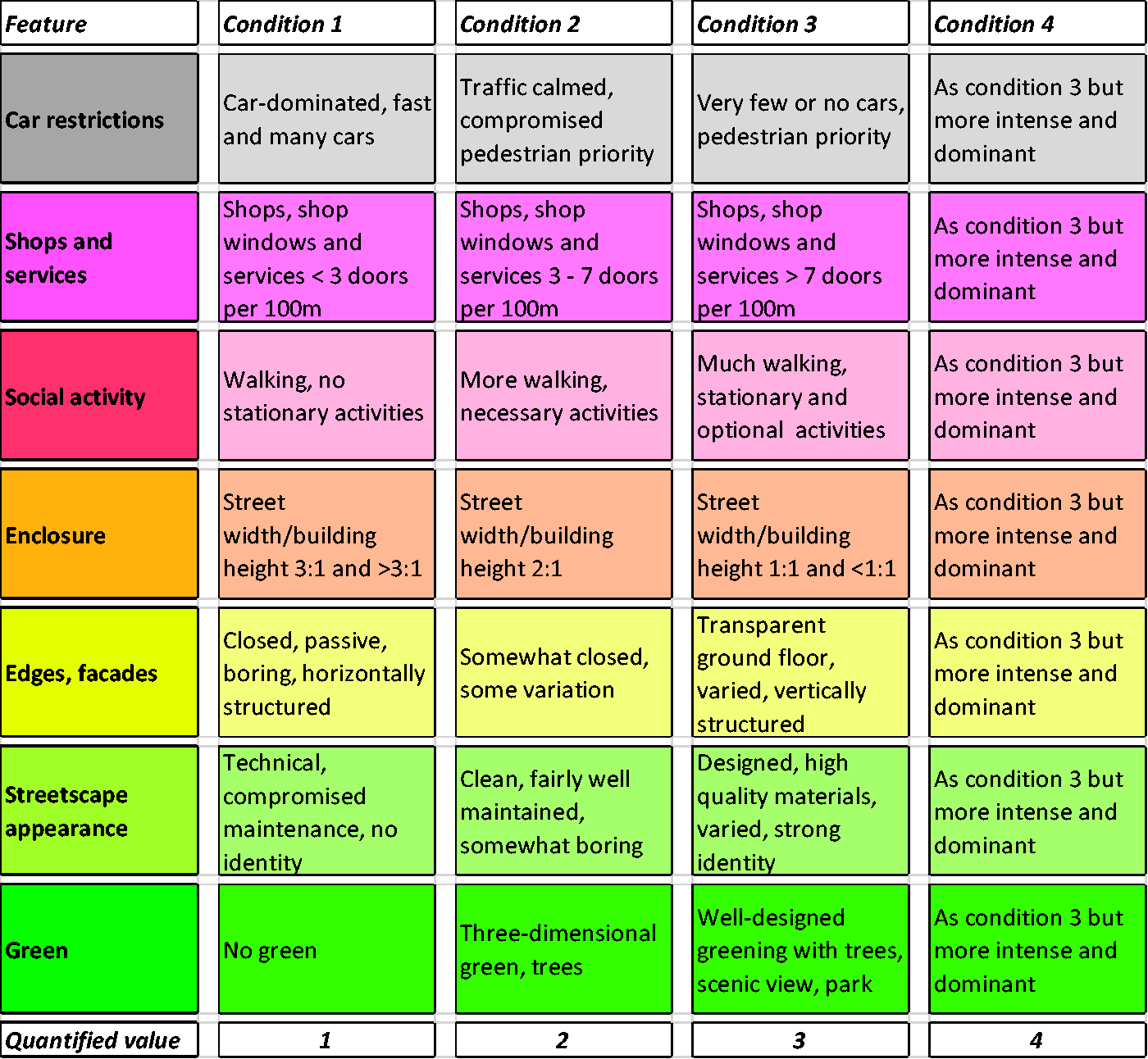
Environment matrix, describing four conditions for seven features of walking environments.
The environment matrix is best suited to describing the characteristics of urban areas where pedestrians walk between buildings in streets and squares. The conditions that the matrix defines are not relevant everywhere for head movements. When pedestrians have to interact with cars, head movements are derived from looking at moving vehicles (Sites 13, 14 and 15). Underpasses (Site 16) and indoor walking environments (Site 17) are narrower and not well described through the matrix. To catch the scenic view while walking along the Limmatquai (Site 18) requires few head turns. The analysis of the seven environmental features uses only data from observation sites 01 to 12.
Figure 2 shows a quantitative description of the visual environment at the 12 sites that are well described by the environment matrix. The table indicates defined conditions 1, 2, 3 or 4 for the seven environmental features at the 12 sites. The environment matrix defines these four conditions for each environmental feature. The quantitative presentation of environmental characteristics enables a statistical investigation. The supplementary file provides more explanations on the environment matrix.
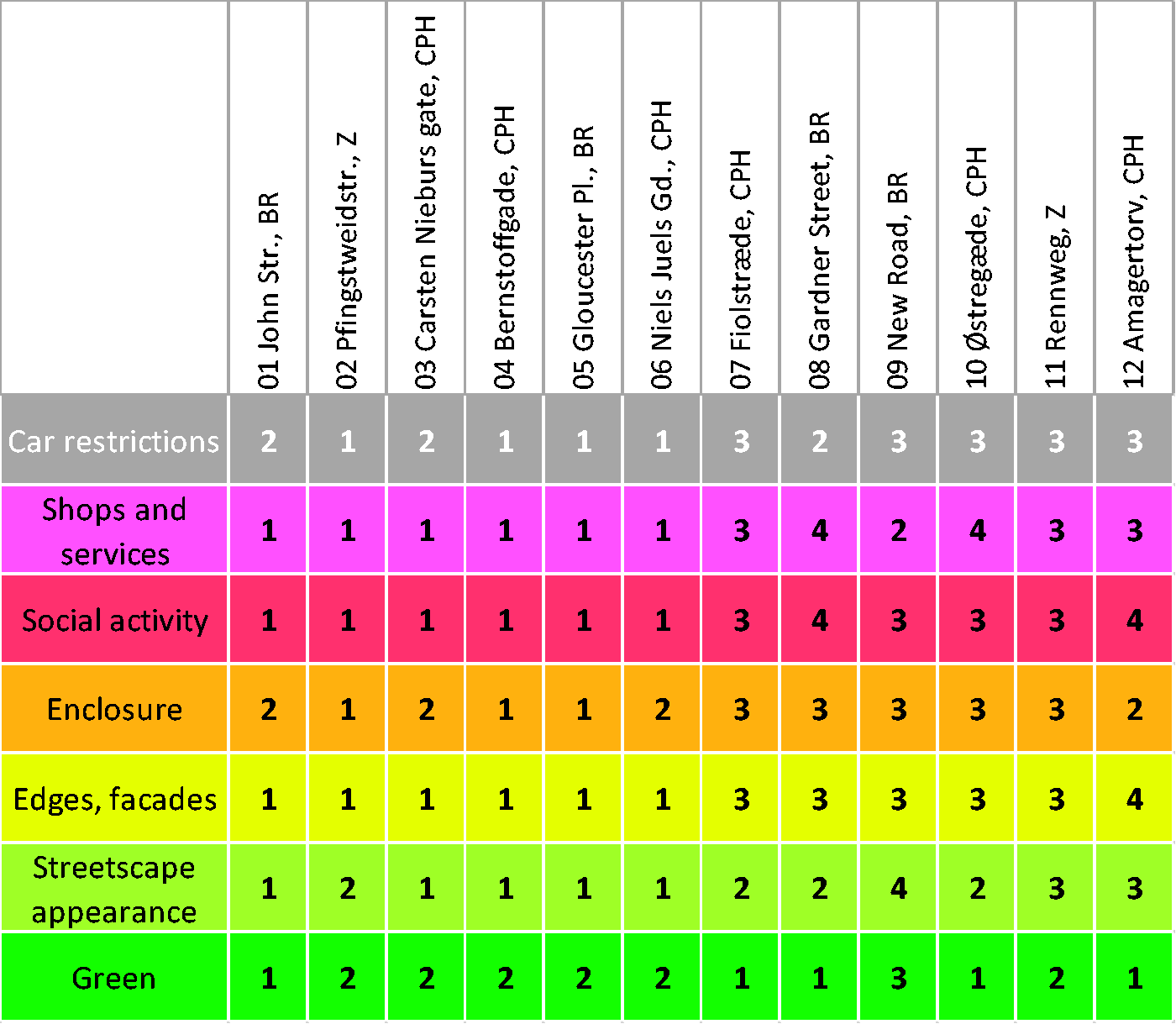
Quantitative values for the seven environmental features for the 12 walking environments. The numerical values indicate the condition 1, 2, 3 or 4 for the seven environmental features, as defined in the environment matrix in Figure 1. The table represents a quantitative description of the walking environment at sites 01–12.
Two separate multiple linear regression analyses, with head movements and time looked down as dependent variables, uncover the influence of the seven environmental features on head movements. The analysis comprises data on head movements from the 12 sites in Figure 2. As independent control variables, the statistics include (1) the step frequency, (2) social aspects of walking and (3) performing activities. These variables filter out the effect of specific walking behaviour. The measured step frequency from each observation serves as a linear (independent) control variable that ranges between 93 and 141, with an average of 117 steps per minute. Social walking and performing activities function as dummy variables (yes/no). The time pedestrians look down at the pavement influences the number of head movements they perform per minute. The number of seconds people looked down per minute is included as a linear control variable in the regression for head movements.
Results 1: Variation in head movements in 18 walking environments
Figure 3 shows a difference in head movements and looking down between environments for cars (observations from sites 01 to 06) and urban areas used predominantly by pedestrians (observations at sites 07–12). Head movements and the time looked down vary inversely between car-dominated and pedestrian-oriented environments. People look down more and perform fewer head movements in car-dominated environments. In pedestrian-oriented environments, heads move more frequently, and the time looked down decreases. In car-environments with few cars (sites 01, 02 and 03 in Figure 3), there are fewer head movements and less looking down, compared to pavements along streets with much car traffic (environments 04, 05 and 06). The difference is not substantial but may indicate that pedestrians are more relaxed with less car traffic. Results demonstrate that the character of walking environments influences how pedestrians pay attention to their surroundings and the amount of stimulation that they receive.
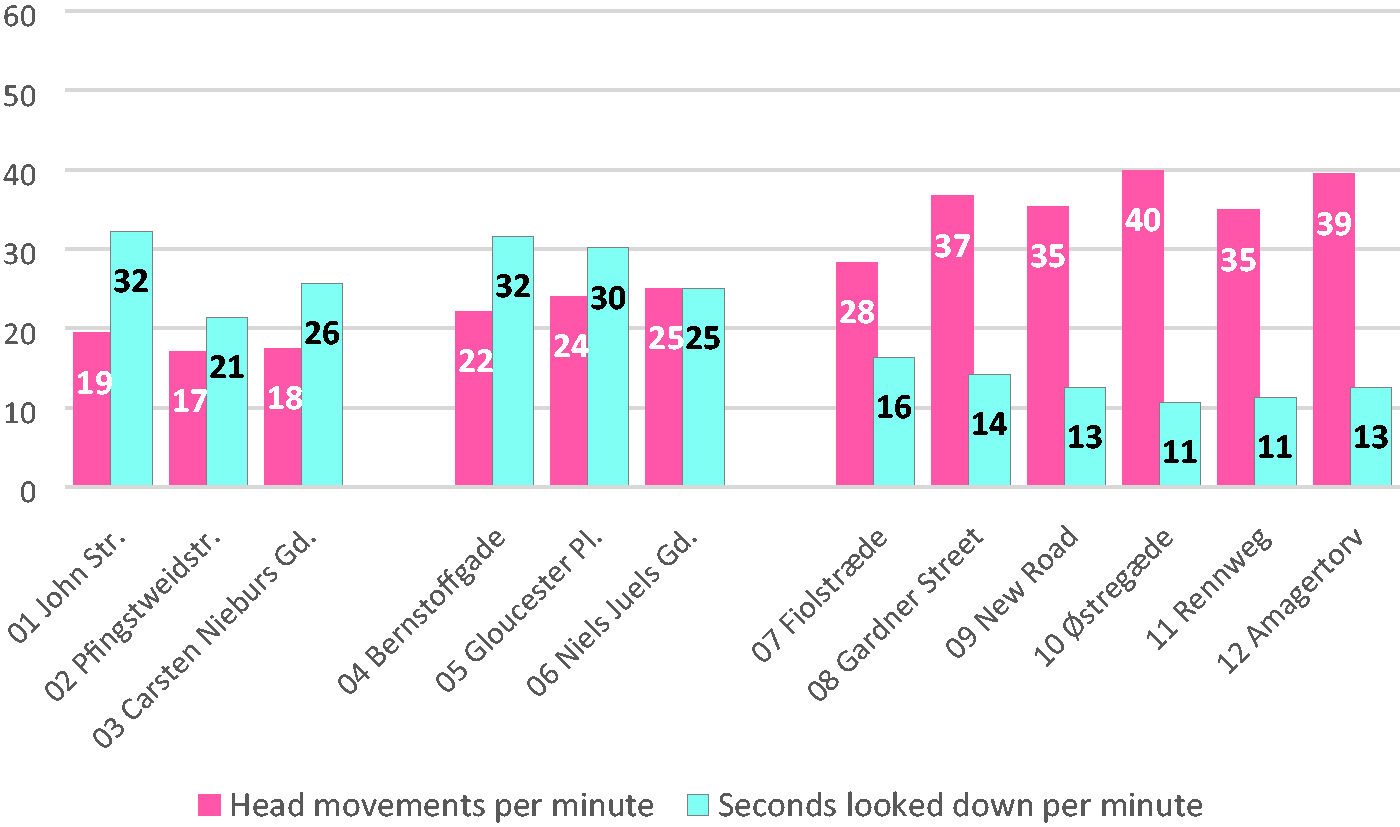
Average of counted head movements per minute (red bars) and average seconds looked down per minute (light blue bars) at locations as defined in Table 1 (1) environments designed for cars (sites 01–03), (2) pavements along streets with high traffic volumes (sites 04–06) and (3) socially active squares (sites 07–12).
Figure 4 shows head movements at sites where pedestrians cross streets at zebra crossings and step over tramlines (sites 13 and 14). Crossing here is complex. Not paying visual attention to moving vehicles is dangerous and not an option. With their first step on the carriageway, most people look in the direction of approaching vehicles. Second and third head turns quickly follow, to check for approaching vehicles from both directions. The angle of head-turns increases at street crossings, and the number of counted head movements rises to a maximum of 48 and 54 head movements per minute (sites 13 and 14, respectively, in Figure 4). So many head turns occur only for a short period, between 5 and 10 seconds, while pedestrians cross carriageways. Paying attention to car traffic at street crossings is necessary to ensure safe navigation and unlikely to be the result of a pleasing attraction.
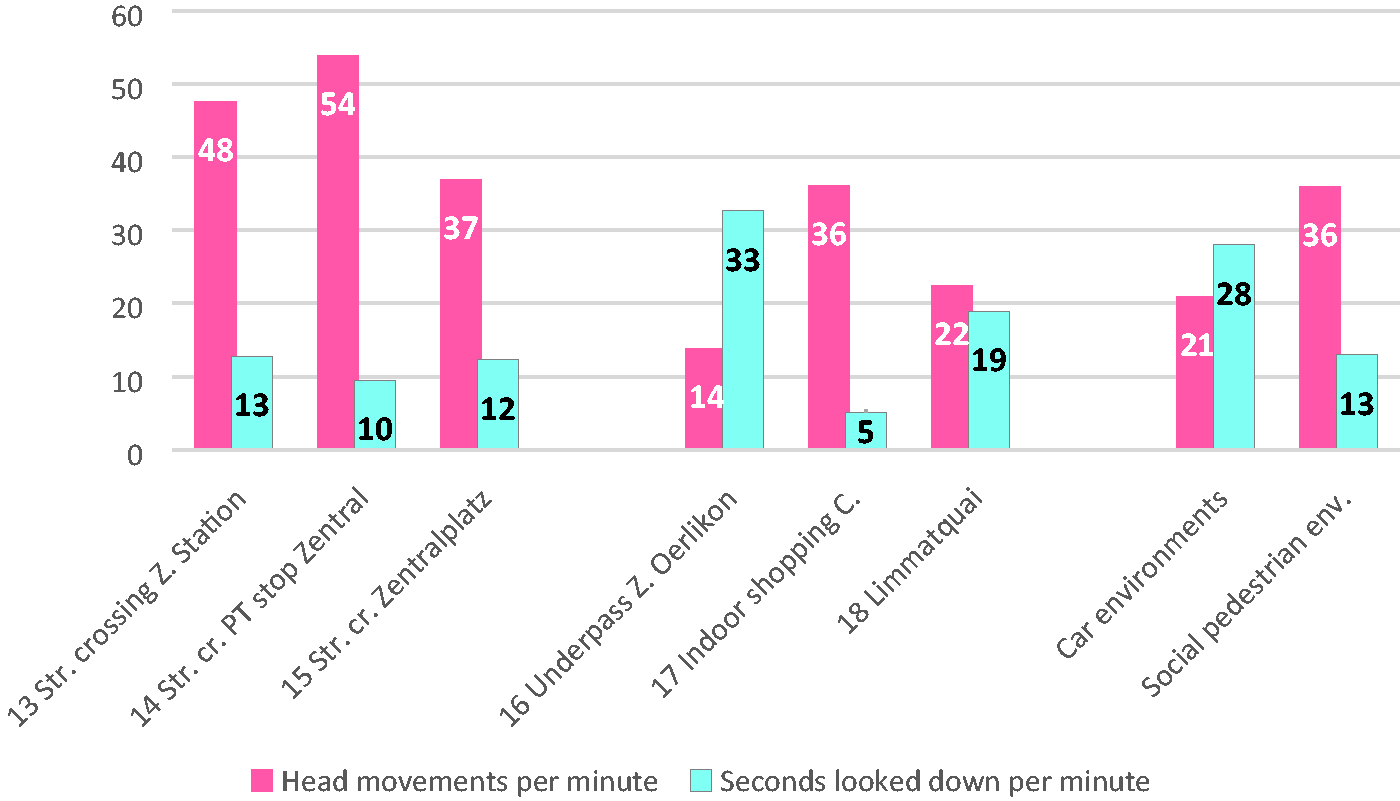
Average of counted head movements per minute (red bars) and average seconds looked down per minute (light blue bars) when crossing carriageways (13, 14, 15); in an underpass (16); in an indoor passage (17) and along the river Limmat (18); and averages for all car environments (01–06) and social pedestrian environments (7–12) as presented in Figure 2.
At site 15 (Figure 4), pedestrians walk across a marked carriageway in a large urban square that is regulated as shared space. Pedestrians have the right of way on the marked carriageways. About 10,000 vehicles cross the square per day, meaning frequent movement of cars and buses. The measured instances of head movements and of looking down are very close to the averages that we see in social pedestrian environments (sites 07–12 in Figure 3). Having right of way when interacting with cars still requires attention but seems to ease walking.
When walking in an underpass (site 16 in Figure 4), head movements decrease to the lowest level in the study, and the time looked down is the highest. Underpasses are clearly unattractive walking environments. Walking in an indoor shopping centre under the railway station in Zürich shows comparable numbers of head movements with those in other pedestrian-oriented environments (sites 07–12 in Figure 3). Only the time looked down drops to a low level.
The Limmatquai in Zürich (site 18 in Figure 4) is a pavement between the river Limmat and an urban street. Vehicular access is restricted to delivery vehicles and two tramlines. The dominating environmental feature of the pavement is the scenic view across the river, with historic facades and green features on the other side of the river. The riverbank opposite attracts visual attention but requires fewer head movements, due to its further distance from the point of view. Time looked down rises slightly (19 seconds/minute), compared to social pedestrian environments (13 seconds/minute), but remains significantly lower than in car-dominated environments (28 seconds/minute). I consider the absence of cars and the scenic view to be relaxing conditions for walking that result in a levelled ratio between looking down and head movements. The level of stimulation is not as high as in busy pedestrian streets but appears comfortable and peasant.
The graphic presentation of the data in Figures 3 and 4 shows that pedestrians react to walking environments. A substantial variation in head movements and the time looked down indicates where pedestrians pay attention to their surroundings with their eyes and where they turn away from it. These results may not appear very surprising, but the investigation shows that we can quantify the amount of stimulus that pedestrians receive from walking environments. The variations in head movements are likely to reflect different environmental experiences while pedestrians are en route.
Results 2: The influence of seven environmental features on head movements
The results of this second analysis show which environmental features of the walking environment draw pedestrians’ visual attention or, in simple words, what people look at while they walk. The environment matrix (Figure 1) describes seven environmental features with four conditions. The results of the statistics in Figure 5 show the influence of the four conditions on head movements and the time looked down. For example, in environments where social activity is characterised according to condition 2, the statistics predict that pedestrians perform 5.8 more head movements than in environments where social activity is characterised as defined for condition 1. The precondition is, of course, that all other environmental features are equal. The interpretations of the statistical results derive from gained impressions during observations. The supplementary file provides more details on the regression statistics.
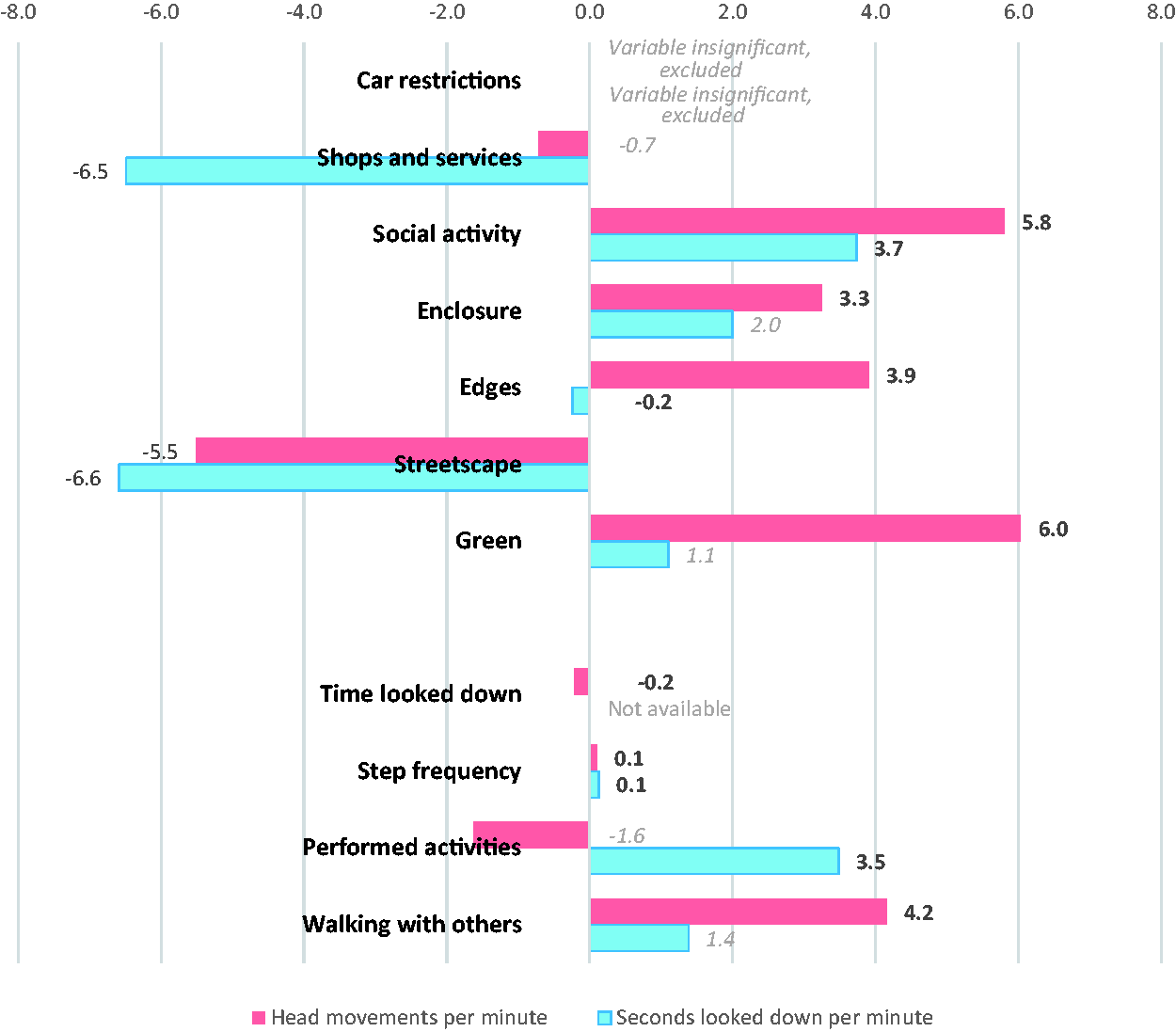
Results from the regression statistics: 11 factors and their influence on the number of pedestrian head movements (per minute) and the seconds pedestrians look down (per minute); cursive grey values indicate insignificant results.
Car restrictions indicate the amount of car traffic present in the walking environment. When pedestrians do not have to cross streets, they do not look at cars. The effect of cars on head movements remains insignificant and the statistical calculations exclude the variable.
Pedestrians perform 6.5 more head movements when the density of shops and services with shop windows and entrances increases. The influence on looking down remains insignificant. Whatever becomes visible through shop windows and entrances can be explored by eye movements and does not require the head to be turned.
Where necessary activities such as delivery and maintenance work take place, pedestrians perform 5.8 more head movements than at sites where there are only other pedestrians walking. Places with optional social activity, such as sitting or playing, result in a further increase of 5.8 head movements. With more people around, the time looked down also rises by 3.7 seconds per minute. Navigating in busy environments requires frequent information on other people’s movements; observing others also appears entertaining, and head movements increase. At the same time, people avoid prolonged eye contact with strangers. Many look down for a short period when passing others closely, and time looked down increases.
Enclosure describes the ratio between building height and the distance between the buildings of a street or square. When closer to pedestrians, details of facades become more visible and attract eyes. With increasing enclosure according to the definition in the environment matrix, pedestrians perform 3.25 more head movements per minute. The influence on the time looked down remains insignificant.
The environmental feature, edges, describes the amount of visual detail of, for example, the facades of buildings on both sides of a street. When walking along facades with some variation, pedestrians perform 3.9 more head movements per minute than when walking along closed and horizontally structured facades. Head movements increase further when walking along vertically structured facades with larger windows on the ground floor. The characteristics of edges influence looking down insignificantly.
Streetscape describes the character of the walking surface, lighting, benches, street furniture and all other visible elements situated on the walking surface. Clean, well-maintained but somewhat boring streetscapes reduce head movements by 5.5 per minute, compared to streetscapes with a basic functional design that creates no identity, and compromised maintenance. At the same time, pedestrians look down 6.6 seconds longer per minute. Head movements and time looked down decrease further when walking in well-designed streetscapes. With a stimulating design, the streetscape provides multiple stimuli in the direction of the walking course that become visible without head movements. Pedestrians seem to focus on these visual stimuli without looking down.
Green features in urban environments attract pedestrians’ attention. Environments with trees result in 6.3 more head movements per minute, compared to areas without trees. Well-designed greening with trees increases head movements further. The effect of green features remains insignificant for looking down. The study does not investigate parks. Green features create a contrast in built urban environments that appears visually stimulating.
To filter out the effects of altering pedestrian behaviour on head movements, the statistics include further control variables. When looking down, pedestrians cannot perform head movements. Looking down for one more second results in 0.21 fewer head movements per minute. Fast walkers perform, on average, 20 more steps per minute. An increase in the step frequency of one more step per minute results in 0.1 more head movements and 1.3 more seconds looking down. Fast walking increases head movements by two to three per minute. I find fast-walking people pay less attention to their walking environments and look down more. At the same time, higher speed requires one to look out more carefully for others and obstacles. Increased head movements to look out for obstacles and more time looked down support my impressions.
While walking, pedestrians look at their phones, sort their clothes and bags, eat food, rummage in bags, put on lipstick and so on. Some performed activities require looking down, such as looking at a phone screen, which was counted as time looking down. When performing activities, pedestrians look down 3.48 more seconds per minute, and the effect on head movements remains insignificant. While walking with others, most people are engaged in conversations. Repeated head-turns towards their companions result in 4.15 more head movements per minute. Social walking does not influence how long pedestrians look down.
Discussion of the methodology
When we investigate the influence of differing environmental characteristics on head movements, we gain some insight into the environmental features that attract pedestrians visually. Psychologists consider that human behaviour is derived from an internal context, such as individual experiences and attitudes, and from an external context, such as the social, cultural or physical environment (Cassidy, 1997: 41; Giles-Corti and Donovan, 2002). The individual experiences of a walking person influence the attention they pay to their environment. Culture may affect head movements; however, as they constitute an unconsciously performed behaviour, the effect of culture between the investigated cities may not be substantial.
Observations do not provide information on all aspects of walking. Carried items, clothes and other visual information provide an indicator of who walks and for what reason but derived from rough estimations and assumptions. In this study, these indicators always remained insignificant and have been excluded from the analysis. A general shortcoming of observational methods is the requirement to interpret what the researcher observes. Knowledge from psychology, sociology, physiology and, to an increasing extent, neurology supports the explanations of observable behaviour.
Observations do not require interference with the phenomenon of interest; nor is the method exposed to the challenges of oral communication, as, for example, interviews are. Observations can provide a real-time measure of walking behaviour that is likely to be less exposed to random variation than data from interviews. Observing human behaviour offers good opportunities for quantitative and qualitative inquiries. ‘Linking the worlds of quantitative and qualitative enables us to speak with weight about the phenomenon at hand’ explains Flyvbjerg (2011: 314).
An interesting feature of observation methods is the closeness to the phenomenon of interest. Closeness provides a high level of detail that enables explanation, according to Flyvbjerg (2001: 132–134). Details and explanations can establish a simple logic between behaviour and environment, as this investigation demonstrates. Simplicity eases the communication of results in respect of urban policymaking and the practice of planning and designing urban environments. Communicability is critical where research aims to support practical and political challenges, especially in democratic contexts.
The data do not show directly what pedestrians look at. We need to remember that the quantified characteristics of the walking environment are derived from a structured series of qualitative evaluations according to the definitions in the environment matrix in Figure 1. The resulting quantitative representation of the visual walking environment could be improved by more quantifiable information, such as the number of pedestrians present or traffic volumes on adjacent streets and so on. More quantitative data was not collected due to time restrictions. However, an objective and holistic description of a visual walking environment does not exist. More quantitative data will not change this limitation.
Conclusion
The clues from this investigation can be condensed into two fundamental design principles for urban walking environments that appeal to pedestrians’ senses. First, urban spaces in human scale are essential. The human scale is simply the distance at which the human sense organs function best. During my observations, I gained the impression that pedestrians react mostly to stimuli within a radius of 5–6 m around them. Within this distance, pedestrians can see and hear details; things are close to touch, and they gain a sense of smell. The dimensions of this human scale also explain the negative impact of cars on walking. Where cities need to accommodate cars, the physical size of the urban environment quickly exceeds the dimensions within which human sense organs function best.
The second principle is variation. Visual variation prevents monotony and boredom when walking in linearly structured urban surroundings. Facades, lampposts, trees and greening, street furniture, walking surfaces and other infrastructure or visible features can serve to structure walking environments into minor sections of differing character. This environmental variation can result in a more stimulating walking experience. Creating non-monotonous walking environments is in principle not difficult, nor does it need to be costly, but it requires consideration of the pedestrian perspective. Creating stimulating environments requires attention from all professions that shape visual urban environments.
The relevance for walking of varied, non-monotonous environments with a human scale is not new. Numerous texts discuss directly or indirectly the relevance of diversity and human scale (Gehl, 2010: 34–59; Hass-Klau, 2014: 279–281; Hass-Klau et al., 1999: 128–129; Jacobs, 1993: 282; Knoflacher, 1996: 195; Monheim and Monheim-Dandorfer, 1990: 45–251; Whyte, 1988: 79–102). In line with these texts, this research highlights the fundamental relevance of stimulating walking environments. This investigation contributes to the existing literature, by showing that we can quantify the environmental effect on walking. The character of the walking environment is not a soft factor that remains unmeasurable.
The presented investigation demonstrates that the environmental effect on walking behaviour is easy to observe with the naked eye. While some environmental characteristics appeal to pedestrians’ senses, others do not, and sometimes there is just very little to see. Where there is nothing to look at, pedestrians are not stimulated, and walking is in danger of becoming dull and boring. The logic of these findings is as simple as Whyte’s findings from investigating public urban spaces: ‘People sit where there are places to sit’ (Whyte, 1988: 110). Well-known protagonists, such as Jane Jacobs, William H. Whyte and Jan Gehl, apply observational methods. This apparently rewarding method seems, unfortunately, not to be in fashion today.
This research develops a method for quantifying the level of visual stimulation that pedestrians receive from walking environments. Psychologists find that stimulation influences people’s perception of time (Block et al., 2010). The amount of stimulation is also relevant for understanding emotions (Maderthaner, 2008: 299). The findings of this investigation establish a basis to investigate how urban environments influence pedestrians’ perception of walking distance and their emotions. Such studies can provide information on how urban environments can motivate more people to walk more frequently and for longer distances. Understanding how urban environments can encourage more and longer walking trips is one of the most fundamental questions behind any research that focuses on walking environments.
Investigating the environmental influence on walking remains a complex endeavour. Walking is deeply integrated into human life, and we can easily understand walking as a fundamental feature of human behaviour. Urban environments influence the walking experience, often unconsciously. Many pedestrians can describe the character of a walking environment and whether they liked a walking route or not. Explaining how urban environments influence the walking experience remains, however, a complex question. Existing knowledge on the human body and mind provides interesting potential for investigating walking as a human behaviour and as a mobility mode, and how urban surroundings influence the walking experience.
Supplemental Material
sj-pdf-1-epb-10.1177_23998083211002839 - Supplemental material for Stimulating urban walking environments – Can we measure the effect?
Supplemental material, sj-pdf-1-epb-10.1177_23998083211002839 for Stimulating urban walking environments – Can we measure the effect? by Helge Hillnhütter in EPB: Urban Analytics and City Science
Footnotes
Acknowledgements
Carmen Hass-Klau, Graham Crampton, Phil Goodwin, Pedestrian Mobility Switzerland.
Declaration of conflicting interests
The author(s) declared no potential conflicts of interest with respect to the research, authorship, and/or publication of this article.
Funding
The authors disclosed receipt of the following financial support for the research, authorship, and/or publication of this article: The authors received financial support for the research from The Norwegian Research Council and Asplan Viak AS.

Notes
References
Supplementary Material
Please find the following supplemental material available below.
For Open Access articles published under a Creative Commons License, all supplemental material carries the same license as the article it is associated with.
For non-Open Access articles published, all supplemental material carries a non-exclusive license, and permission requests for re-use of supplemental material or any part of supplemental material shall be sent directly to the copyright owner as specified in the copyright notice associated with the article.
