




Abstract
There is a long history of engaging citizens in planning processes, and the intention to involve them actively in planning is a common objective. However, the reality of doing so is rather fraught and much empirical work suggests poor results. Partly in response an increasingly sophisticated toolkit of methods has emerged, and, in recent years, the deployment of various creative and digital technologies has enhanced this toolkit. We report here on case study research that deployed participatory film-making to augment a process of neighbourhood planning. We conclude that such a technology can elicit issues that might be missed in traditional planning processes; provoke key actors to include more citizens in the process by highlighting existing absences in the knowledge base; and, finally, provoke greater deliberation on issues by providing spaces for reflection and debate. We note, however, that while participants in film-making were positive about the experience, such creative methods were side-lined as established forms of technical–rational planning reasserted themselves.
Keywords
Creative citizen engagement in planning
Engaging citizens in processes of planning and place governance is a long-standing and familiar challenge across the globe. We can trace the intention to involve citizens actively in planning well into the last century, broadly beginning with ideas of consultation where authorities want citizens’ views on a largely complete plan, to more recent recognition of the value of citizens’ ‘lay’ or tacit knowledge about the places they know and care about. Most recently, ideas of co-production have introduced the idea of a partnership between civil society, local government, and other stakeholders (Watson, 2014). Such alliances can allow for deep engagement in problem definition and agenda setting, the generation and testing of evidence, as well as the development of policy and ideas for action.
This thinking sits within a tradition of empowering citizens to take decisions for themselves and within critiques of technical–rational planning which highlight how plans often fail to acknowledge either the issues that citizens want to address, or the values or feelings that they attribute to such issues. Sandercock (2010) suggests that this dominant planning tradition disenfranchises citizens by producing plans and reports that are as dry as dust. Life’s juices have been squeezed from them. Emotion has been rigorously purged as if there were no such things as joy, tranquillity, anger, resentment, fear, hope, memory, and forgetting, at stake in these analyses. What purposes, whose purposes, do these bloodless stories serve? For one thing, they serve to perpetuate a myth of the objectivity and technical expertise of planners. And in doing so, these documents are nothing short of misleading at best, dishonest at worst, about the kinds of problems and choices we face in cities. (29) if traditional rationality is not sufficient to authorise plans, it is not necessary either. And if it is not, there might be space for the emergence of alternative …aesthetics, for substantively different collaborative plans, in which local participation is not relegated to methodology sections, but is central to the texts’ style, content and method of development. (340)
Developing such ‘boutique’ participation methods is open to critique (Beebeejaun and Vanderhoven, 2010) given that they exist far beyond the resources available within most planning processes. Planning practice is characterised by traditional, and not very effective, ‘consultation’ processes often because they are seen as ‘legitimate’ ways to participate (Brownill and Carpenter, 2007). These are rarely genuine processes of collaborative enquiry but tokenistic forms of participation likely to lead only to small scale changes to plans that are already largely finalised. This lack of influence negatively affects the propensity to participate and contributes to planners’ scepticism of the value of citizen engagement.
In addition, formal methods do not take account of how citizens communicate with one another in the 21st century. Some helpfully suggest that part of the answer lies in planners collecting ‘informal’ public attitudes to place that are already out there on social media (Beebeejaun and Vanderhoven, 2010). Equally, it could also be said that the methods may be less significant than the ethos of those responsible for place governance in terms of how seriously they take the views of citizens and whether the statutory mechanisms and resourcing of planning systems give them the space to do so.
Traditional methods and formal processes used in planning also require citizens to relate their concerns to ‘material planning considerations’: a set of prescribed criteria which are the issues considered when making planning decisions in the UK. As such, processes and their attendant methods fail to account for the wider contextual issues about place and space that concern citizens in the first place and that would motivate them to participate. We argue later that capturing this contextual depth is vital in developing genuinely collaborative approaches to planning. In doing so, the stories that citizens tell about the places they use and do not use, and how and why they do or do not, are vital. We suggest that digital methods offer one way of capturing such information.
In this paper, we are concerned with the use of moving images, participatory film-making and production, as one such method. Through the re-purposing of a video commissioning platform as a participatory media commissioning tool, we explore how capturing citizen narratives can contribute to community-controlled participatory planning process. Through the discussion below we highlight how participatory video (PV) can, in particular, provoke greater deliberation on issues by providing spaces for reflection and deliberation.
We next outline the neighbourhood planning (NP) process in England, an example of which constituted the case for our creative engagement.
NP in England
NP is one of a number of tools associated with the Localism agenda in England. Created by the Localism Act 2011, NP is promoted as a way to devolve power to citizens and away from local and central government and, indeed, potentially away from planners too (see Davoudi and Madanipour, 2015). The aim is to enable citizens to organise together to produce planning policy to shape the future development of their area.
Citizen engagement in planning at this scale is not new. For many years parish plans in predominantly rural areas have been produced as a way for Parish and Town Councils to govern their neighbourhoods (e.g. Parker, 2008). However, the fundamental difference is that NP has statutory authority and must be used in formal decision-making processes at a local authority level. It provides the first opportunity for citizens to have direct power to decide what development they do and do not want in their neighbourhood, albeit heavily framed by central government policy.
There follows a question about how communities design and implement processes for the development of neighbourhood plans. NP requires citizens to curate the process; gain input from the wider community to define problems and set agendas; develop policies and actions for the neighbourhood; and, ultimately, enable the plan to pass a community referendum. Without a strong foundation of citizen engagement, NP could be less democratic than much-criticised local authority-led plan-making, although evidence is that NP does bring more people into plan-making (Sturzaker and Shaw, 2015). Participants are, however, dominated by wealthier neighbourhoods and middle-class organisers (Parker and Salter, 2017).
Evidence also suggests that neighbourhood plans are conservative and instrumentally pragmatic. That is, they are pursued to the extent that they may make a small difference, rather than leading to a radical product (Parker et al., 2015). The demands of English statutory planning are, in part, responsible for this, as may be the involvement of the planning profession in nearly all neighbourhood plans. However, we suggest that creative methods have the potential to open up some of these conservative tendencies. We highlight this in a single case study below, before, in the conclusion, thinking through what it might take for more experimentation and alternative representations in plan-making to occur.
‘Beyond text’ methods for citizen participation in planning and place governance
Traditional methods of participation typically involve the submission, or interpretation, of text in some form, often delivered in jargon-filled language that can alienate those not in a particular community of practice. Alternatively, they may centre on speaking, often with large audiences present, at events such as town hall meetings which are unconducive to inclusive community debate. In some cases, smaller groups may be set up to deliberate planning issues, but even these are subject to an ‘aristocratic tradition’ that favours moderation, respect, dispassionate reasoning, and argumentative confidence (Cohen and Rogers, 2003). Again, such a tradition favours professional classes with the resources necessary to participate.
In response, planning and community development fields have built up a large canon of alternative methods (Wates, 2014). Beebeejaun et al. (2014) suggest ‘beyond text’ methods can extend planning work to engage citizens more readily, but that planning is inevitably text-based to some degree. Such notions connect with Horelli et al.’s (2015) ideas of an ‘expanded urban planning’ which involves, ‘identifying and mobilizing a variety of participations, whether “staged” or self-organized, not only in urban planning but also in the design-in-use of technology’ (288). Of concern to us here is how such a project utilises both physical and virtual realms to engage citizens in the making of better places.
Most of the work on digital methods and civic engagement has taken place outside of place governance realms and certainly well beyond statutory planning processes. The findings from the human–computer interaction (HCI) literature on such work are mixed. Much of it is not deeply critically evaluated and there is a tendency to report on successful deployments rather than failures. Broadly, digital technology has been seen to offer an opportunity to empower citizens and act as a democratisation of complex, elitist processes although there is a school of thought showing that digital methods can be exclusive and elitist (Craig et al., 2002). Such methods can overcome the physical, temporal, and spatial limits of traditional processes such as reducing transaction and access costs (Asad and Le Dantec, 2015; Ghose, 2001). Digital methods can provide opportunities for deeper engagement in processes through creating opportunities for storytelling (Sandercock, 2010) but the methods often struggle to reach those disengaged and provide more opportunity for the already vocal (Pettingill, 2008). Cognisant of these issues, and the history of citizen engagement in planning cited earlier, we see digital technologies as one method among a set of tools to engage citizens in creating stories about their place and share these with wider communities (MacPherson, 1999).
The most advanced area within planning for such work has been through GPS-enabled place-based mapping tools (e.g. Harding et al., 2015; Jones et al., 2015). Such work explores the various meanings that attach to place and has been useful in broadening ‘engagement in the early phases of a planning process, particularly as it appeals to participants more than text-based methods’. In addition, ‘by giving people the opportunity to talk about spaces while actually in those spaces, smartphone technologies bring with them the advantages of spatial prompting’ (Jones et al., 2015: 333). Technology which supports the capture of everyday experiences of physical space is paramount and, therefore, research which builds relationships with local citizens to work in their ‘everyday’ spaces is also essential (Johnson et al., 2016).
Using moving images as a tool for community engagement can provide ‘immediate and authentic feedback’ and can strengthen and empower communities (High et al., 2012; Sarkissian, 2010). There is a long history of using film in planning, from those which communicate the intentions of government programmes such as New Towns (Tewdwr-Jones, 2014) to more participatory approaches such as the Fogo Process initiated by the National Film Board of Canada in the late 1960s which pioneered the use of documentary for community development (Wiesner, 1992).
Latterly, film-making has been democratised first through camera devices and then through smartphones. The capability of these devices to produce cheap, high-quality film was inconceivable a decade ago. Historically PV, whether guided by film-makers or not, can be a tool for positive social change by providing the opportunity for deeper engagement (Lunch and Lunch, 2006; Sandercock, 2010), the uncovering of hidden social relations, and in provoking collective action (Milne, 2016). It can provide a catalyst for community dialogue that would not otherwise occur, is easily accessible for most people, and it can help with the formation of communities around particular issues or causes (Bartindale et al., 2016; Sandercock and Attilli, 2010). Within political processes, such as NP, PV could be scalable beyond single ‘boutique’ instances given the democratisation of mobile and web technologies as a way to produce, edit, distribute, and communicate video (Manovich, 2001; Socha and Eber-Schmid, 2014). With this in mind, Foth et al. (2008) developed a narrative resource kit to support ‘stakeholder debate; animate community engagement; and develop and display community narratives’ (15). Not only did this seek to capture vernacular experiences by the citizens themselves, but it also enabled virtual engagement by interested citizens, new ways to capture lived experience, and provided a way to contribute to the development of planning policy. Other work (Goldstein et al., 2015; Klaebe et al., 2007) has shown that such methods can maximise participation and offer the opportunity for shared community narratives and histories. In relation to PV and planning, the work of Leonie Sandercock is particularly noteworthy. Her research foregrounds PV in facilitating the telling of individual and community stories, an issue we return to in our conclusions.
The selection of video, of moving images and sound, for such authors rather than photography is significant and often left unjustified in academic writing. 1 Film allows for the capture of ‘squeals of delight, a toe-tapping bush band, the energy of children’ which help communicate how places are inhabited (Pink, 2012; Sarkissian, 2010: 154). We too were able to observe film of, for example, sea cadets and skateboarders using public spaces and often such film was overlaid with commentary from the citizens making the films about what they were seeing and their views. It is for these reasons that we adopted and felt justified in adopting PV as a method over other visual media.
Thus, in the research detailed below, we narrate how we situated ourselves in a process of NP to pilot a particular digital technology centred on the production and editing of moving images by the community itself using a smartphone application. In our case, communities filmed both matters of interest and concern to them and also sought to edit the footage. We review this entire process involving as it did a degree of deliberation about what footage should be included and what should not, and what issues and ‘voices’ might be missing in the first ‘rough cuts’.
We deployed and refined a pre-existing tool called Bootlegger (Bartindale et al., 2016), which was developed to capture live events in a structured and aesthetically higher quality way than crowdsourced video. The platform allows the use of templates and graphic overlays to plan what the community might want to capture. Bootlegger has been proven to support the creativity of citizens through engaging their inherent media literacy in the film-making process to produce high-quality videos (Bartindale et al., 2016). Our deployment narrated below explores its potential to engage citizens in NP (Figure 1).
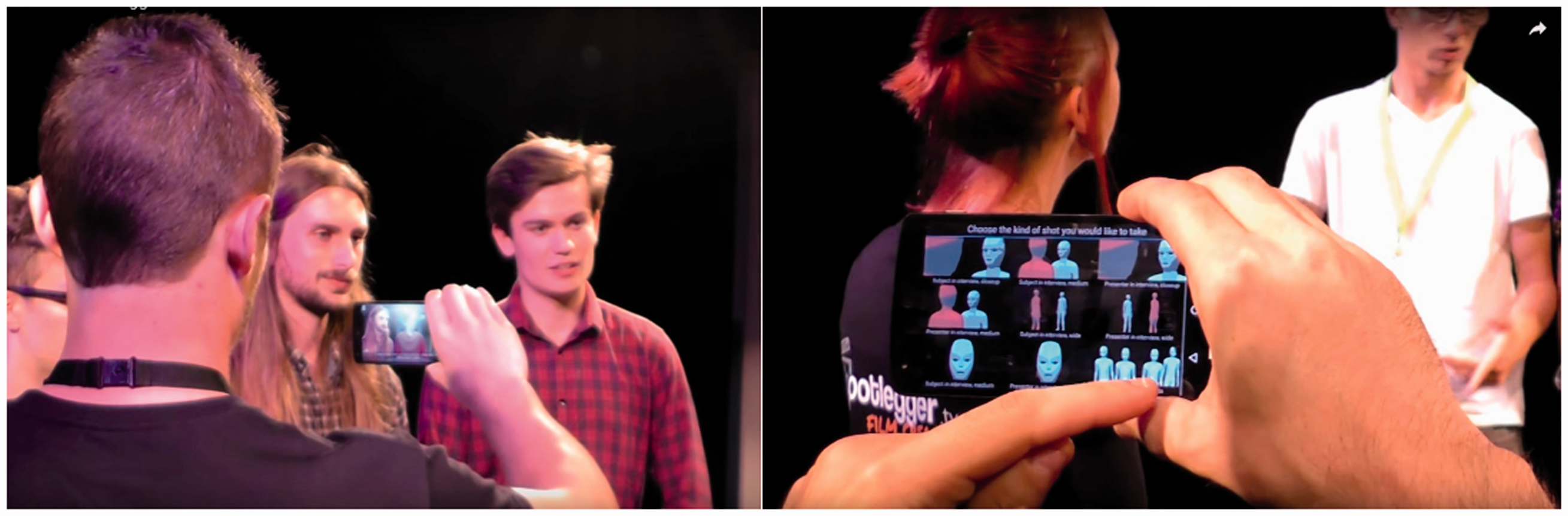
Bootlegger in use – demonstrating the templates and graphic overlays.
Bootlegger in Berwick: A PV case study
This section describes the case, the approach to the research, and the methods used to engage participants in using the technology.
Study design
Berwick-upon-Tweed is a coastal town in Northumberland, England with a population of around 12,000. In common with many small towns in England, it is governed by a multi-level system with the unitary authority of Northumberland County Council providing statutory services. A Town Council delivers a range of non-statutory services funded principally through a precept on the Council Tax which is used to promote the economy of the Town, improve facilities and encourage visitors, and improve and maintain the physical environment. In relation to spatial planning, such bodies have no statutory power but they comment on planning applications as statutory consultees and often play a role in partnerships that deliver real world, albeit often small-scale, change (Yarwood, 2002).
The Town Council was one of over 1700 local groups that by September 2018 had sought to take advantage of powers introduced through the 2011 Localism Act in England to make a statutory land use plan for their area (http://neighbourhoodplanner.org.uk/). In doing so, they formed a steering group of 14 residents, town councillors, business-owners, and workers to take forward the plan. The lead author’s involvement began through discussions with planning officers and the NP Chairperson. They felt that digital methods might reach publics that may otherwise not engage in such processes. Researcher engagement in the process lasted six months and was developed through subsequent participant observation of the plan-making process.
Method
Over the course of the participant observation, the lead researcher made various inputs into the design of the NP process. During this she suggested using Bootlegger as a way of enhancing the plan-making process.
At the time, the NP group had divided into seven topic groups, each led by at least one member of the steering group, which were gathering in-depth information on key areas that would help them to form planning policies. The working groups invited the wider community to be part of information gathering exercises and join a topic group of their interest. Following initial meetings, the lead author initiated workshops with six of the seven topic groups: tourism, transport, housing, built environment, natural environment, and youth. No systematic background data on the participants were gathered. Citizens engaged in NP, as in UK formal planning processes generally, have been noted to be more likely to be older, white, and middle class (e.g. Parker and Salter, 2017). Our participants fitted this profile, although it should be noted that this reflected the wider population of Berwick which is older and ethnically less diverse than the general population. In addition, the working groups mostly consisted of civically active citizens with members including town councillors, members of a local civic society, and activists with a keen interest in their chosen topic. To initialise the process, the lead researcher defined an initial set of shoot parameters in a template. Subsequently, citizens were able to change this to better represent what they wanted to capture. In this way, both the researcher and the media itself become ‘cultural brokers’, facilitating communication between the languages of, for example, the professional and the citizen. Our role in the process fell into three of the five categories Chambers (1985) posits for cultural brokers: facilitator, informant (about both the technology but also NP as a process), and analyst (not representative or mediator). The films from each working group were intended for use in community engagement in the future, but also as a way to communicate the progress of the neighbourhood plan. The workshops were an iterative process designed to capture media for whatever stage the working groups were at.
For each workshop, the Group and Researcher met in a café to create a storyboard using post-it notes and pens focused on capturing the key issues in a story format. Using three coloured post-it notes, the orange notes set out the order of the ‘story’, the pink notes identify key issues of importance, and the green notes identify locations in which the group would like to film (see Figure 2). Once completed, we provided a demonstration of the app before handing the technology to the citizens. We then travelled around Berwick to film places and spaces that they had planned as part of the storyboard.
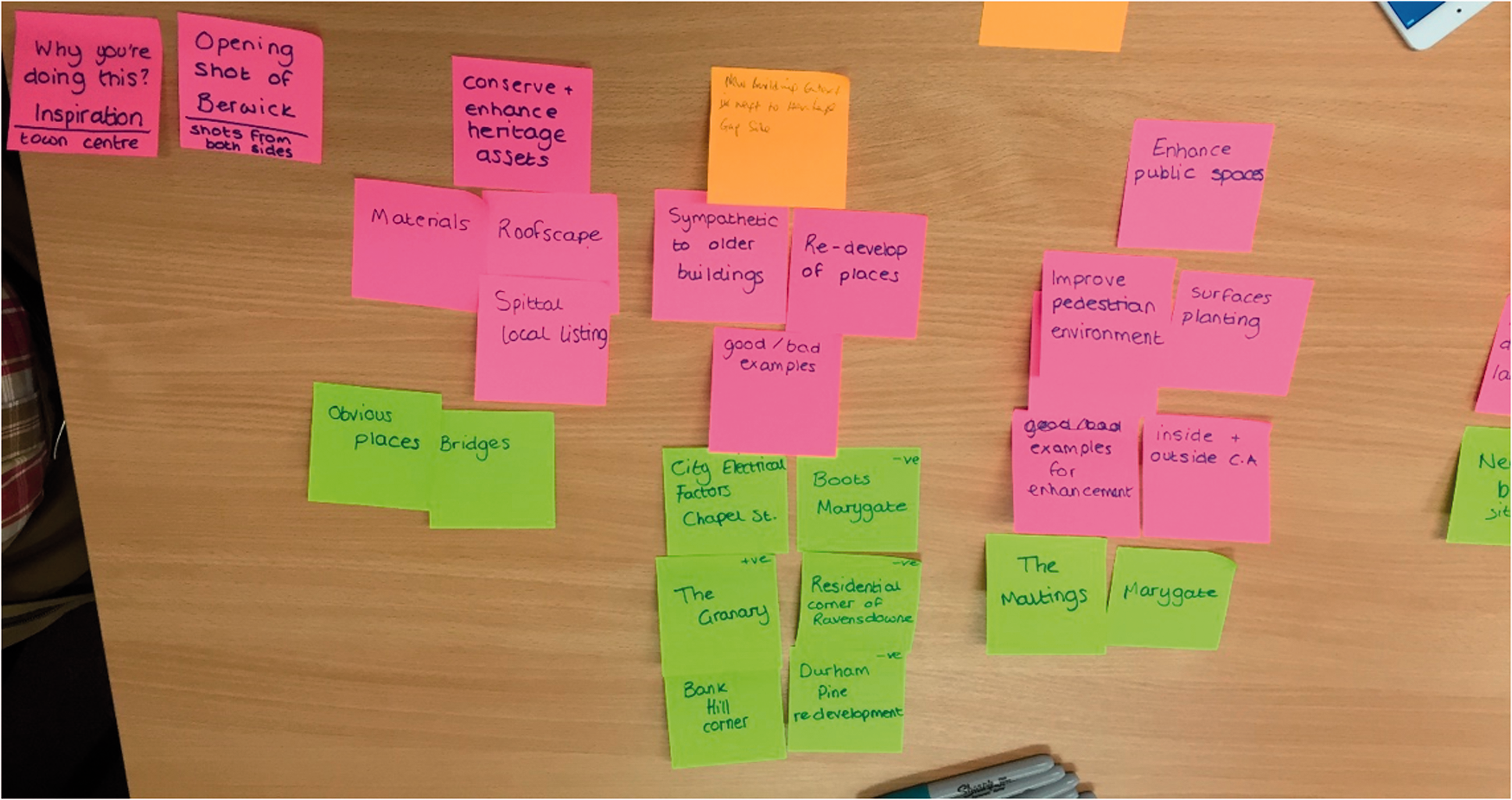
Built Environment Working Group Storyboard.
Deploying Bootlegger
We took an approach based on ideas of action research which challenges the view that research must be objective and value-free and that, as researchers, our work is already embedded in a system of values (Brydon-Miller et al., 2003). Action research encourages those values to be recognised within a framework that is genuinely collaborative and oriented towards social change. It also requires the researcher to be part of the process and so must have an ‘evolving and adaptive awareness’ of the power positions that exist (Sandercock and Attilli, 2010).
The lead author’s experience of working in the field of NP helped embed the film-making process within a wider one of NP. This wider role involved attending steering group meetings, building relationships, and becoming more familiar with the area and the issues faced. Field notes were written on this process and they form part of the ‘data’ considered here. The participants also provided feedback during the workshops through informal conversations made possible through the relationships developed with the lead author. This feedback was then included in the field notes.
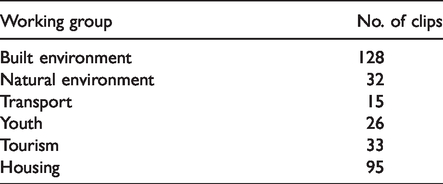
Over 300 film clips were generated from the workshops which took place over the course of one week. Clips had an average length of 27 seconds and the number of clips captured by each group differed greatly (see Table 1). Groups that recorded the most footage were those who had made fewer decisions about key messages and locations during the storyboard activity. They were less sure about the narrative they wanted to create through this filming process. Groups that recorded less footage had made more narrative decisions and were more targeted in their approach, often capturing places and spaces but choosing to add the audio at a later stage. Film clips were stored on the Bootlegger app for participants to view at their leisure and potentially to manage in relation to editing and curating a film.
Number of clips per working group.
The idea of using PV within a statutory planning process was not universally accepted at first. There were strong reservations by some citizens about using a method not normally associated with planning. Some citizens also expressed a nervousness in using the technology with most stating ‘I’m not very good with technology’ or ‘I’m not very tech-savvy’, views which are commonly associated with older adults. Despite this, almost all participants became comfortable in using Bootlegger by the end of the workshops. The confidence of participants grew and by the end of each workshop, at least one member of each group was fully sufficient in using the app. P4 said ‘Can I download this onto my own phone? Just I’d like to film some of the landscapes when I’m walking the dogs at sunrise’ and P10 said ‘This is great. Now that I’ve had plenty of practice … I’ll download it and get some more footage of the area. I’ll get others from the working group that couldn’t come today to do it as well’. All of the topic groups in Berwick said they would like to film more footage on their own, of which four groups had done so within a few months of the initial deployment. At the end of the initial workshop, P5 who was reluctant to take part in such an ‘unusual’ process said Thank you for this. It was really good. I thought it would be pointless and I couldn’t see what difference it would make. I’m used to the older ways of planning that I used to do but it was really good.
Analysis: PV creates more participatory and deliberative spaces?
The deployment of Bootlegger had a number of effects on the NP process. Our principal finding was that PV elicited issues that would have been missed in the NP process, in part by unsettling the power relations within the plan-making process.
In each workshop there were one or two actors that were either from a planning background or were well versed in planning and similar issues through previous community action, as described in the beyond text. Such citizens had been involved in planning professionally or as a local councillor, or were often involved in activist causes such as protecting the historic environment or promoting sustainable transport. These ‘expert’ citizens often had strong views and tended to dominate conversations by sharing their own stories. Using the storyboarding activity and the process of filming, these actors’ voices were moderated, allowing the stories of others to be heard and considered in the process.
For example, in Berwick, P5 was keen to portray their experience: ‘I think we should stay focused on the streetscape on the main street, it’s too busy’. When others made suggestions, P5’s response was often negative: ‘No, it’s pointless suggesting that. I know the businesses wouldn’t agree to that, they’d fight against it so it’s pointless to consider it’. P5 often positioned their narrative above others in the group. However, by the end of the workshop, there were open discussions considering the stories of all group members. In addition, P2 who was usually forceful in voicing their agenda in steering group meetings, and was initially dominant in the workshop, quieted their views to allow a more open space for storytelling to take place with other participants.
The workshops did facilitate the participation of some who would be unlikely to participate in NP and had not been engaged in the Berwick Plan previously. P10, along with the Plan Chair, thought that this particular method of filming and using mobile technology would appeal to young people. Thus, the youth working group engaged approximately 15 young people in the neighbourhood plan through the filming process. This included musicians, BMX users, and army cadets, all of whom provided their stories of Berwick (see Figure 3). Our first finding illustrates how urban space was used in the Town and brought new perspectives to the shared community story that would otherwise have gone unheard. The lived experience of being a young person in Berwick was different to what other, older citizens had imagined. In addition, the young people were comfortable with this method of participation with P10 stating ‘I think they [young people] were comfortable with being filmed. That first girl, the musician, she did it in one take. She’s used to all this technology’.
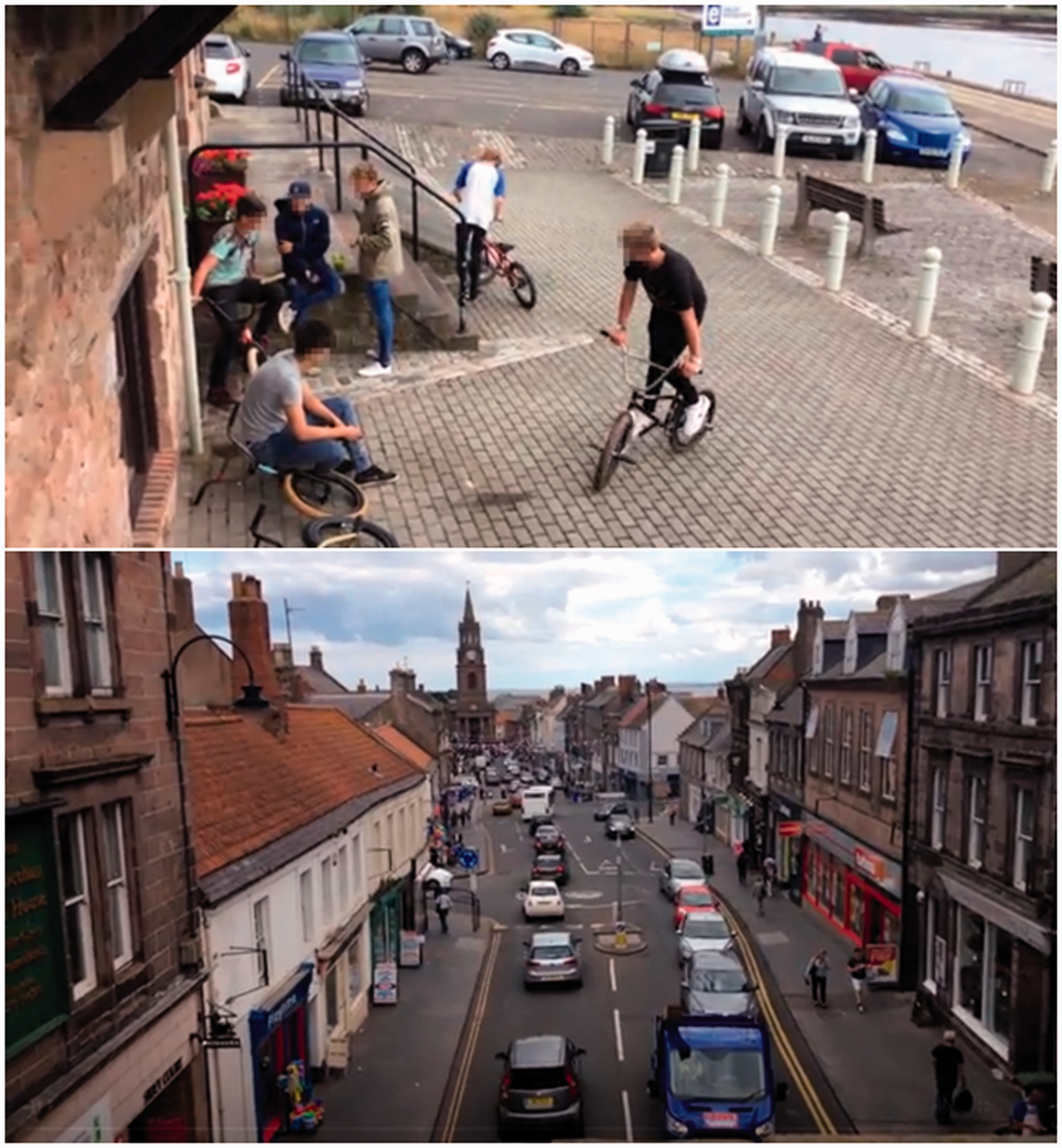
Video stills from Youth and Transport Working Groups illustrating the use of urban space.
Although these were the only instances of widening engagement at this stage, the process of film-making made participants recognise the voices that were absent from the plan-making process and the need to involve them. The working groups had previously expressed a desire to broaden participation in plan-making but it became apparent that they were unsure what widening engagement meant, what it would involve, and why it was actually necessary. Through the participatory media workshop, they recognised they were not necessarily the ‘experts’ and they would need to engage and include stories from the whole community.
Thus, our second finding concerns the widening of participation and recognition of the need for more participation by existing participants. This opening up enabled hidden parts of the neighbourhood to be made visible as well as hidden issues. Particularly with the addition of youth engagement, areas of the town which had not been discussed were brought to the forefront of the discussion. For example, when speaking to the young musicians, they said There’s nowhere for us to play and sing and record. We go to the youth centre, but that’s not just about music. There’s a tiny little place we can go to record, but that’s it and it’s not ideal. We really want to record more of our own music but there’s nowhere to practice either.
On the other hand, places in the town that were discussed by citizens were typically considered through a different lens by younger people. For example, the BMX bikers stated ‘There’s nowhere to go on our bikes. People don’t like us hanging around here [the Quay] but there’s nowhere else’. The Quayside had been discussed on a number of occasions by the Plan Steering Group but the stories of other groups had not been considered previously. However, as Figure 3 illustrates, through PV the young people were able to tell their story and contribute to a re-imagination of the future of the spaces and places in discussion.
Finally, our analysis shows that PV can provoke greater deliberation on issues by providing spaces for reflection and deliberation. The act of storyboarding and film-making required actors to engage more fully with the issues and actively debate them with others in their group. Discussion of the proposed and actual content of films allowed participants to reflect on their individual positions and consider what they meant by them when put together in a collection of narratives. They saw the value in bonding stories together to create a shared community narrative that could communicate complex messages, but they also began to identify that their own stories were often based on individual bias and assumptions, not necessarily shared among the group or supported by good evidence.
As an example, P8 and P9’s stories were framed around their everyday practices of cycling and walking. This led their focus for filming to be on the need for sustainable transport in Berwick, We need more bike routes that are safe and we need to encourage people to walk into the town centre. Like the people who work in the centre, a lot of them could walk from home to work but they choose to bring the car. We do still need to consider cars and lorries. We need a way for lorries to get into the centre for deliveries. Plus, we said we want to encourage people to come here from further afield so we need to make sure they can come here by car.
In addition, the space created also allowed for a greater reflection and deliberation of the multiplicity of citizen stories to come together to shape planning policy. That film-making was new to all participants helped in providing spaces for individuals to question their positions. When forming a more inclusive community story, created from individuals’ vernacular experiences, not all citizens agreed on others’ points of view. The ability to challenge and question all stories and to decide on a shared one became a vital part of the process. For example, one working group in Berwick had formed their community narrative based on the stories of actors present in the workshops which resulted in a strong focus on a particular space, in this case the town centre. They began to realise the narrowness of this position: P6: We need to be careful about what we’re saying and how we’re saying it. Think about it, if we’re sharing this with people, they’ll think we’ve ignored their neighbourhood. P7: Yes, we have to remember that we’re supposed to be looking at the whole neighbourhood planning boundary. What do we want to include about that? P5: I don’t think we have much information about the rest of the boundary. P7: We don’t so what do we do? People will think we’re too focused on the town centre and we’re neglecting everywhere else.
In another instance, P2 stated ‘I don’t think we’ve covered everything, I think we need to go away and think more about this’ to which P3 responded ‘I think we should get the rest of the group to have some input’. This conversation took place after 1 hour of planning the filming and 2 hours filming in various locations around the town and was typical of instances from other workshop groups. Participants felt that the clips captured told the shared story they had planned but parts of the narrative were missing, and this meant the story did not feel coherent. They recognised the need to gather more stories before completing the final, shared narrative that would recognise the multiplicity they were aiming for.
The curated narratives that were made possible through the space for reflection and deliberation were then shared via social media and thus made available to a wider citizenry for comment. This opening up happened before policies were developed, enabling contributions from a wider public to shape policies rather than react to developed ones. This allowed for feedback on issues and ideas prior to a ‘decide-announce-defend’ mentality setting in as it often does once policies are devised (Bishop, 2015).
Conclusion
The use of PV in NP can open up planning processes to a more inclusive, deeper set of narratives as others have shown (Bhimani et al., 2013; Frohlich et al., 2012; Green et al., 2015; Sandercock, 2010). Film-making is a creative practice that can, as other explorations of creative engagements for citizen engagement also show, enhance participation, in part through the generation of stories that can be subsequently debated and elaborated by citizens. Such creative methods can provoke the imaginations of participants and encourage them to communicate issues in more animated and interesting ways that capture emotion and lived experience. Therefore, we concur with others in suggesting that such technologies help to elicit issues that might be missed in traditional participatory processes, and generate greater inclusiveness and provoke greater deliberation by providing (unfamiliar) spaces for reflection and deliberation. We note also that content creation through filming and, to some extent, storyboarding, helped citizens to imagine a new future with a fresh story for their neighbourhood.
The media produced through film-making captured the stories of the citizens who created it. However, the process also revealed missing stories and rendered some issues and citizens not included in the process visible. The recognition by participants that their own pre-existing knowledge was insufficient facilitated a learning process whereby key actors learnt why broadening participation was useful to a plan, potentially extending participatory efforts beyond tokenism. It has been recognised within planning that the process of plan-making is more important than the product (e.g. Healey, 1997). NP, in putting citizens the front and centre of the process, further undermines ideas of citizen participation in planning; rather, as Frediani and Cocina (2019) suggest, we should think of participation as planning.
Thus, the act of producing film provided spaces where people participated together, forcing them to deliberate with each other and find ways of deciding on which narrative to foreground. Such deliberation does not imply the need to arrive at a singular consensus with PV enabling communities to produce a story in which ‘coherence was … an emergent quality of a … collection of plurivocal narratives’ (Goldstein et al., 2015: 1298). Thus, participatory media technology is useful in capturing multiple citizen stories in NP processes that were useful in creating a reflexively constructed repository of local conditions and lived experiences.
While all this is positive we provide a word of caution. The HCI literature is replete with optimistic examples of happy citizens adopting shiny new technologies. But researchers in this field rarely hang around long enough to see the effects of the participation, however positive, on real world outcomes. In our case, the film-making process had little influence on the actual plan beyond broadly shaping the attitudes of key participants. We confirm Parker et al.’s (2015) analysis that a great deal of conservatism exists in finished neighbourhood plans. This in large part arises from the quasi-legal position of the end plans. In our case a ‘business as usual’ plan-making process slowly reasserted itself as the process moved on. Further research might reveal why this is so, but such side-lining has been noted in relation to the deployment of participatory creative methods in other instances (e.g. Varna and Vigar, 2019). Speculatively, we suggest that citizens and their advisors unconsciously mirror past efforts of planning work, and specifically rule in certain forms of ‘legitimate’ text, and quantitative data, while ruling out visual, emotive, and deeper qualitative knowledge forms. Planning as a result is operating ‘with half a mind’ (Baum, 2015). Neighbourhood plans as executed have failed to realise the initial desire for them to be light-touch and innovative due to the need to be watertight in relation to potentially complex future legal scenarios, which in turn is reflective of the wider elevated position of property rights in English law. If neighbourhood plans and creative methods are to be genuinely inclusive and deliberative then wider structural forces need to be addressed, not least tackling the highly legalised forms planning systems typically take.
Footnotes
Acknowledgements
We would like to thank Berwick Neighbourhood Planning Steering Group for participating in this study. Data supporting this publication is available under an ‘Open Data Commons Open Database License’. Additional metadata available at:  . Please contact Newcastle Research Data Service at
Declaration of conflicting interests
The author(s) declared no potential conflicts of interest with respect to the research, authorship, and/or publication of this article.
Funding
The author(s) disclosed receipt of the following financial support for the research, authorship, and/or publication of this article: The research was funded through the EPSRC Centre for Doctoral Training in Digital Civics (EP/L016176/1).