




Abstract
Enhancing the role of citizens in shaping places has been a longstanding objective for governments, communities and the academy. Although a range of techniques has been developed by the state to give people an opportunity to get involved, these methods often struggle to create a meaningful way to communicate aspirations for places on citizens' terms. In this paper, we document the design, deployments and evaluation of a new technological device that enabled participants to share place views and aspirations beyond more traditional government engagement methods. The device, called JigsAudio, is an open-source device fabricated by the authors that encourages people to express themselves creatively through drawing and talking. The research contributes to our understanding of how accessible and free technologies can reduce barriers to participation, whilst encouraging creativity and expression when talking about the future of places. It goes on to discuss the potential of devices such as JigsAudio conceptually and practically within urban and regional change, and considers the balance that needs to be struck between utilising smart technology whilst creating accessible and meaningful opportunities that inspire citizens.
Introduction
Understanding how to enhance the citizen voice in urban and regional change has been a longstanding concern of both the planning profession and the academic discipline (Arnstein, 1969; Forester, 1982). When pursuing or undergoing urban change, citizens are vital as they experience everyday life in neighbourhoods and live with the consequential impact of changes, giving them a unique perspective to observe, comment upon and offer suggestions for the future (Baker et al., 2007). Although citizen participation in planning is recognised as important, there are difficulties with enacting opportunities (Wilson et al., 2019). These difficulties include trading off the costs and time required to participate and citizens accessing the often complex language of planning (Baker et al., 2007). For these reasons, only a small proportion of citizens actually engage with urban change through the planning system (Conroy and Evans-Cowley, 2006). Many engagement methods, often termed ‘traditional’ in the literature, include writing letters and attending public meetings but these present their own barriers (Wilson et al., 2019). Alongside these difficulties, communities are often involved too late in urban planning debates, when development plans are already in place (Baker et al., 2007).
This paper seeks to understand how alternative methods of participation can engage people in discussions around their neighbourhoods’ future. Previous work has shown the potential of creativity in providing a method for people to share their emotions, reflections and visions for their neighbourhood with an emphasis on expressiveness and artistry (Frank, 2016; Sarkissian et al., 2010). Specifically, we investigate how drawing and talking can encourage people to discuss feelings that may be too difficult or complex to communicate through traditional planning engagement methods alone.
To explore the role of creativity and expressiveness in place-making, the paper studies the design, development and use of a digital device that encouraged people to express their feelings and visions on where they live. The research project aimed to identify the degree to which digital and non-digital techniques can complement each other and reduce barriers to engagement. The paper discusses the techniques used and the methods employed to ask people to annotate drawings using digital technology. The digital technology automatically identified the drawing and allowed participants to record a message that was associated with it. To evaluate its use, we deployed the technology in several different settings with various topics concerning feelings of place and visions of the future.
Following discussion of the design and deployment, the paper considers the scope of this technique within urban planning processes. The paper ends by discussing the potential of informal consultation methods, and whether they can open up new modes of dialogue that surpass more traditional participatory methods, allowing for richer responses than are currently elicited.
Background
The context for this research is the intersection of urban planning participation, creativity and human–computer interaction (HCI), as a way of exploring opportunities to aid citizen–planner communication. Almost 60 years ago, Jane Jacobs (1961) presented a view that the construction of cities occurred through diverse and self-organising communities, one that jarred with the techno-rational systems world of professional and governmental bodies. Massey (2005) had also drawn this distinction between how citizens see cities through a lens of multi-faceted lived experiences, and how planners work through a lens of development proposals, zoning ordinances and land use allocations. As Batty (2018) notes today the world of urban planning is slowly but surely coming around to [Jacobs’] view as we continue to amass experiences of how difficult it is to try and build cities from the top down, imposing inflexible master plans that always run out of steam due to our ability to provide the organization to implement them and the control to ensure individuals do not undermine them. (6)
Bugs et al. (2010) list principles and goals that participatory planning technologies should support when developing innovative user-friendly tools. For the purpose of this review, one of these principles has been adapted to incorporate citizen-generated forms of information. The principles are: (i) Solutions through participation and transparency to ‘increase participation […and…] store, organize and display the evolution of the contributions’; (ii) non-expert public engagement and (iii) consensus building to ‘support two-way flow of information’ (Bugs et al., 2010: 175). Each will be subject to analysis.
Solutions through participation and transparency
Methodologies such as co-creation and living labs (Desouza and Bhagwatwar, 2014) have been used to encourage participation using alternative participation methods, which see people, the public and private sectors working together to identify problems and develop solutions. Opportunities for and the use of digital participation as bridging devices are not new and have been explored previously, for example, using data (Le Dantec et al., 2015), images (Al-Kodmany, 1999), mapping and PPGIS (Dennis, 2006), mobile apps (Wilson et al., 2019), collaborative displays (Hopkins et al., 2004) and interactive web technologies and social media (Web 2.0) (Hanzl, 2007). Methods, such as Sketch Planning, have also been used to mediate the use of technology, by allowing people to sketch land allocation scenarios rather than needing to use a computer (Goodspeed, 2015; Goodspeed and Hackel, 2017).
Whilst technologies such as these are useful for engaging and informing people, and providing enhanced participation through providing data and context, there is often a reliance on abstracted notions of space, such as maps and data on the expert’s terms, rather than providing opportunities for thematic, open-ended discussions of place (Healey, 1996). The use of technology for citizen participation is a mature field, with other technologies and tools being applied to make people aware of opportunities for participation in urban planning (e.g. see Hanzl (2007) for a review of planning technologies, and Ertiö (2015) for a review of participatory planning apps).
There have also been attempts at using creative methods to involve and enhance the citizen’s role in planning, and to help overcome some of the barriers associated with ‘formal’ consultation methods. For example, Al-Kodmany (1999) used imagining tools to encourage participation in neighbourhood design workshops, which ‘helped to unveil critical issues, constraints and opportunities’ (44) that were effective at communicating the community’s wishes and creating a common language; they also witnessed difficulties when people tried to make their own images. Sketch Planning (Goodspeed, 2015; Goodspeed and Hackel, 2017) demonstrated how the use of paper maps (when compared to on-screen maps) can reduce barriers to technology’s use and enhance dialogue and learning.
Although there have been advances in the usability of digital technology, it is important to be mindful that access to and usability of digital technologies are not equal (Brabham, 2009). In developing technologies, it is important to design for those that do not have knowledge of computer interfaces (Golsteijn et al., 2015), or access to computers and the Internet. Brabham (2009) states that ‘issues of access to technology are important ones, for any democratic model is problematic if it is predicated on access to something that not everyone has access to’ (255).
Whilst previous studies have found that technology creates barriers in its understanding (Brabham, 2009), tangible computing is often cited as a way to make technology more accessible by ‘coupling between physical objects and digital information’ (Ullmer and Ishii, 2000: 1). Ullmer and Ishii (2000: 4) state that tangible interfaces must have four characteristics: (i) physical representations (digital information coupled to physical objects, (ii) physical control (tangible objects as the primary means of control), (iii) the coupling of physical and digital representation (the interaction with the physical is tied to the digital interaction) and (iv) the state of the physical artefacts ‘embody the digital state of the system’. There is a rich body of research behind tangible interfaces within HCI and they are used increasingly in civic contexts. For example, Golsteijn et al. (2015) argue for a move away from digital screens for more inclusive technologies due to ‘display and interaction blindness’ (202) where issues with screen resolution and touch sensitivity are removed (Hopkins et al., 2004).
Non-expert public engagement
Non-expert forms of public engagement promote new ways in which people can get involved in planning. As noted by Healey (1996), many methods rely on evidence-based ‘material’ representations and not on how people ‘understand and value the qualities of their local environment’ (218). Exploring the role of non-material considerations has been called for to promote enhanced engagement with planning for non-experts and to provide new methods for participation.
Contributing to the recognition of the importance of citizen views and experience of place, Massey (2005) argues that space is more than a flat plane, and is rather something rich with stories and feelings, with ‘multiplicities too of imaginations, theorisations, understandings and meanings’ (89). There have been ongoing calls from Sandercock (1999, 2003), echoing Jacobs (1961), to further recognise, understand and appreciate the importance of people’s lived experience, how this can be valued in urban planning discussions and how this might inspire new forms of engagement with place-based issues. She argues for less emphasis on the material, scientific and technocratic reality of space inherent within planning. Beebeejaun (2016) also notes the emergence of grassroots community urban planning endeavours across the globe that seek to deliver local solutions in cities but also challenge existing decision-making orthodoxies.
Previous work has demonstrated that taking an approach to planning participation that embraces imagery, dialogue and creativity can aid visionary thinking about the future of places, rather than encouraging problem reporting (Al-Kodmany, 1999; Frank, 2016). Shaping and utilising visions for places is important since they inform the early stages of planning ideas to aid debate on the long-term future of areas. There is a wealth of literature surrounding the perspectives of planners towards technology, but there is a dearth of studies that explore and document the use of planning technologies for citizens.
Consensus building
A common feature of civic research over the past 20 years has been study into technology-enhanced citizen and government collaboration and communication, and how technologies can support citizens and decision-makers working together to reach consensus (Al-Kodmany, 1999; Le Dantec et al., 2015). Sarkissian et al. (2010) call for ‘open spaces where we can have the types of conversations that will bring people (especially those who tend to remain uninvited in traditional processes) close enough to engage together with an issue’ (4). They discuss the advantages of engaging people in creative activities, and how it might be an antidote to dichotomies between emotional/technical, and technical/social styles of planning, and how, through working together on issues, consensus can be built around how to deal with issues.
To aid this, non-digital methods of communicating through imagery have been common practice (Wang, 1999), with guidance stating the benefits of images to encourage dialogue and visioning in planning (Frank, 2016). Methodologies, such as PhotoVoice that encourage people to document their realities through photography, recognise the potential of imagery in promoting discussions about issues, and building understanding and relationships between diverse groups of people (Wang, 1999). In the context of planning, Locality (a network of UK community-led organisations) advocates a participation method ‘that works particularly well with school children to ask them to draw and/or describe how they would like the area to be in the future’ (Chetwyn, 2018: 16). Using drawing as a method for communicating ideas and visions for the future is also a well-established method in civic engagement activities for promoting discussion using the shared language of imagery – particularly for engaging young and hard-to-reach people (Dennis, 2006; Wang, 1999).
From this brief overview, it appears that there have been attempts to bridge the experiential world of urban communities and the institutionalised world of urban planning. This is occurring through both creative and technological methods. Creativity in particular offers opportunities for encouraging citizens to express their views and visions of their local area. However, issues surrounding the use of and accessing of digital technology have been identified, as well as the challenge of translating more creative participation methods into those that are recognised and legitimated within state planning processes.
Designing JigsAudio
Taking insights from previous research, the project team sought to develop and test a creative, visual and technological method that could be used to enhance citizen involvement in communicating their emotions towards places. The team attempted to create a technology that reduced barriers to participation and encouraged a movement away from problem reporting and towards visioning, expressiveness, creativity and interactivity. It also explored the design requirements that can influence the development of a technology and drew upon earlier studies to provide an initial framework with three issues acting as a context.
First, it was important for the technology to allow people to be expressive in how they communicate their feelings towards place (Frank, 2016). Taking Massey’s (2005) work as a design provocation, the team sought to allow people to express these feelings in ways that are more communicative than traditional consultation methods. The technology was explicitly designed to capture place meaning: rather than requiring participants to provide comments within set proforma, we asked them to share what they considered to be important; as Massey (2005) asks, ‘Where would you draw the line around the lived reality of your daily life?’ (185).
Second, it was desirable for the technology to be easily understood by participants (Goodspeed and Hackel, 2017) and not require a researcher to be present, allowing the technology to be used unsupervised and giving the respondent the time they needed to develop, reflect on and communicate their thoughts (Leong and Brynskov, 2009).
Third, the technology should be seen to be part of a larger activity. The desire was to create a ‘honeypot effect’ (Golsteijn et al., 2015; O’Hara et al., 2008) that encouraged passers-by to engage with the activity.
Taking these into account, the research team commenced design and construction of a new device that they named ‘JigsAudio’ (see Figure 1). The device encourages people to express themselves through drawing and talking. Participants are required to draw on a large card or wooden jigsaw piece on the reverse of which is an electronic tag, and then place it on the JigsAudio device to make a simultaneous audio recording that is attached to the drawing. The two components – drawn jigsaw piece and audio representation – are then brought together and displayed on a bespoke website.
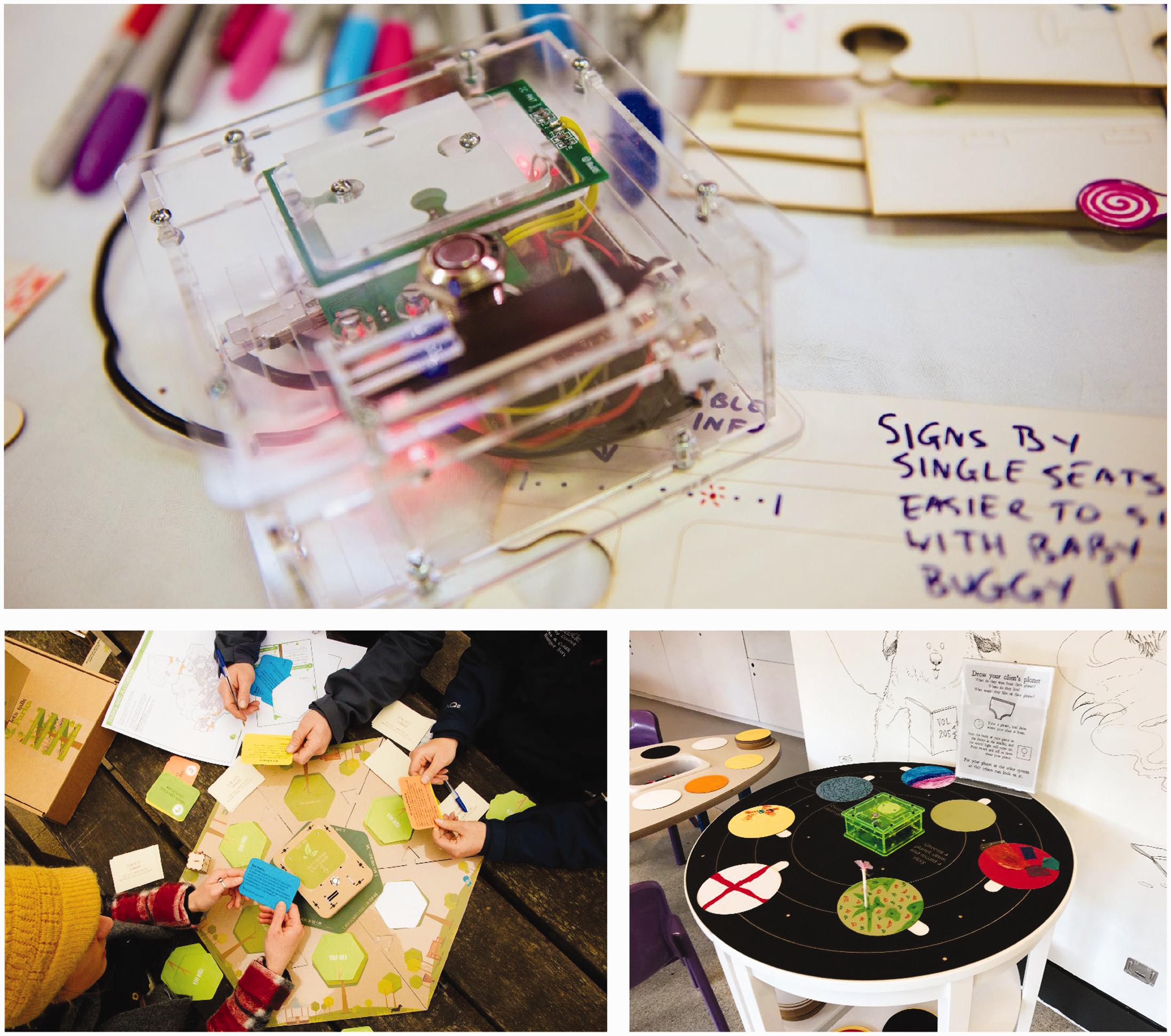
Top: JigsAudio Device; left: Let’s Talk Parks Deployment; right: Aliens Love Underpants Deployment.
The JigsAudio device reads a radio-frequency identification (RFID) tag (similar to those used in contactless bank cards) on the jigsaw piece. The participant then records an audio clip (by pressing the record button) that is associated with their jigsaw piece and the piece is then placed within the jigsaw. JigsAudio contains a Raspberry Pi (a bank card-sized computer), an RFID scanner and a microphone. The research team fabricated seven JigsAudio devices: six with built-in batteries and one mains powered. Writing media and craft material were made available during deployments. The device was designed for relative ease of use and had one button. Following the deployment, the jigsaw pieces were digitised and displayed alongside audio content on the website. The jigsaws were displayed online in the same arrangement as they were laid-out physically. A decision was taken to make the design and code for JigsAudio open source, with instructions for people to make their own JigsAudio device and generate their own webpages.
JigsAudio aimed to overcome some of the design pitfalls identified earlier through several modes. First, by utilising a technique that allowed people to draw, write and discuss their thoughts visually, the aim was to allow participants to communicate more complicated thoughts than prose alone would allow. Second, by keeping the technology easy to use, it ‘contribute[s] to users skipping over the part where they contemplate whether they should interact at all’ (Steinberger et al., 2014: 49) and encourages participation. In this sense it was hoped that participants would not require supervision and could use the technology in their own time, as well as helping to overcome an issue of one person dominating discussions (Goodspeed, 2015). Third, by displaying the resulting jigsaw it was hoped that more people would become engaged with the activity through seeing a novel approach to engagement.
JigsAudio met the earlier discussed framework for tangible technologies through four characteristics (Ullmer and Ishii, 2000: 4): (i) the design of the device uses jigsaw pieces to interface with digital information; (ii) the jigsaw pieces as artefacts are used to interact with the device; (iii) the jigsaw pieces are ‘perceptually coupled’ to the digital data on the device and (iv) the digital state of the jigsaw pieces can be determined from its physical state (if it is on the device it is ready to record onto, if it is drawn on someone has already made a recording, etc.)
To examine the extent to which JigsAudio met its objectives and encouraged visioning in the built environment, the devices were deployed with people in the community at specific occasions (see below) between October 2016 and August 2017; the deployments occurred in partnership with selected hosts in order to assess the take-up and use with several different groups of citizens.
The informal setting of JigsAudio’s use presented difficulties selecting methods that would adequately document people’s response to and experiences of the device. It was decided that a combination of systematic observations, informal discussions with participants and semi-structured interviews would be used to inform the assessment.
Observations and interviews
Bannon (2011) argues that as the role of technology changes from one person and one computer to computers in society, so must our methods of understanding it, with ‘a shift from a psychological to a sociological perspective on human work and activity, emphasizing field observation methods rather than lab studies’ (52). With this in mind, the methods chosen focused on conducting research ‘in the wild’, rather than in the controlled environment of a laboratory. This is sometimes a messy process; it is difficult to ask people to complete surveys and questionnaires when they are busy (Baker et al., 2007). Undertaking field studies helps account for ‘complex, realistic settings’ (Goodspeed, 2015: 450) within which the technologies might ultimately be used, and ‘provide a particularly important complement to experiments and surveys’ (Goodspeed, 2015) where ‘real-world participants are much more diverse than students (the typical experimental subjects)’ (Goodspeed, 2015).
With this in mind, the team chose to use systematic observations of field studies alongside other methods. Ethnography and observations are commonly used in anthropology when the underlying research question is of ‘understanding actions, roles and behaviour’ (Walshe et al., 2011: 1048) that helps to unpick these roles – ‘an interview allows someone to say what they do; an observation allows you to see directly what someone does’ (1048).
For these reasons participant observations were used as ‘a way to collect data in naturalistic settings by ethnographers who observe and/or take part in the common and uncommon activities of the people being studied’ (DeWalt and DeWalt, 2011: 2). As noted by Spradley (2016), it involves eight stages that include descriptive observations to get an overview, narrowing the research and focussing the observations, and analysing and reporting the results. Informal discussions took place with participants where there was an opportunity; field notes were kept of the observations and discussions. Interviews were conducted with the commissioners of JigsAudio: these were people that had experience of previous forms of participation exercises and were asked about whether JigsAudio changed their usual engagement processes. The observations informed both the interview schedule and the discussion of the results and were analysed alongside the interviews that were transcribed and subjected to thematic analysis (Braun and Clarke, 2008) within NVivo (qualitative data analysis software).
Deployments
Deployments were chosen around the notion of place, rather than the formal processes of planning, and where the results were likely to influence decision-making. The five deployments are summarised below.
Big Draw City Futures
JigsAudio was first deployed during The Big Draw, an international drawing festival for children held annually, at a local event devoted to thinking about the future city at Seven Stories, the National Centre for Children’s Books in Newcastle upon Tyne, UK (see Figure 1). The theme of the event was, ‘What will Newcastle look like in 2065?’ and was a collaboration between Seven Stories and Newcastle University, with a series of play activities, installations and workshops intended to engage children in thinking about what cities might look like in the future. JigsAudio was commissioned by the organisers of the festival as one of the installations and was available to be used freely by participants on each of the days.
Metro Futures
JigsAudio was also deployed in an initiative organised by Nexus, the North East England Passenger Transport Authority, and Newcastle University, called Metro Futures. This larger project was intended to engage members of the public through digital means to explore the design of the next generation of Tyne and Wear metro trains. JigsAudio was deployed at metro-themed pop-up events held at major transport hubs, shopping centres and the region’s airport. The deployment was designed to gather people’s experiences and feelings towards the current metro car design, as well as ideas relating to internal carriage design. The jigsaw pieces at this event resembled metro carriages that could be joined together to form a single train (see Figure 2). There were two designs: one with just the outline of a metro car (left), and a second with the design of the current carriage fleet (right).
Metro Futures Jigsaw and North Tyneside 2026 Jigsaw alongside the transcribed voice.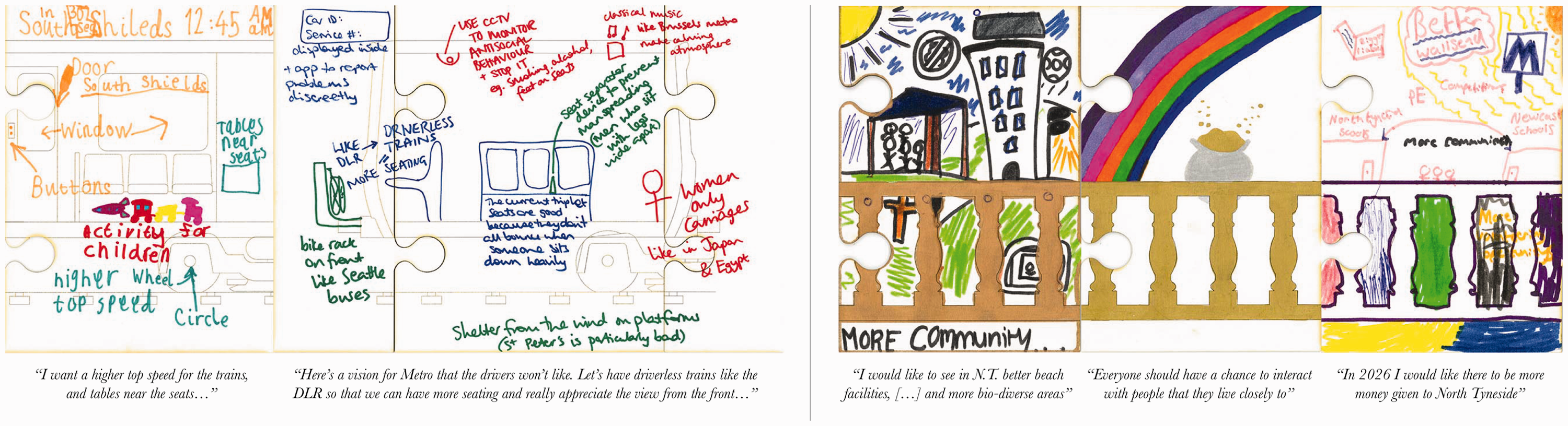
North Tyneside Youth Council
JigsAudio was deployed with the youth and children council of North Tyneside in a meeting with the local authority to assist with the development of engagement strategies. The aim of the deployment was to understand the feelings, experiences and ideas of young people in the area, and to provide and reflect on their visions for the future of Tyneside (see Figure 2).
Let’s Talk Parks
Let’s Talk Parks was a wider engagement project initiated by Newcastle City Council and partnered by Newcastle University, intended to gather citizens’ views on the use and management of green spaces in the city. JigsAudio was used as part of a turn-taking board game that facilitated the discussion of issues surrounding the future of parks (see Figure 1). Ten workshops were held across the city which explored the creation of a charitable trust to manage the parks and covered a number of topics including what they value in parks, future financing, activities, volunteering and decision-making. Rather than drawing in this deployment, people wrote their ideas and used JigsAudio to record, elaborate and explain them. The cards with pre-written scenarios were scanned and discussed. The comments generated through the game were then placed online to provoke discussion.
Aliens Love Underpants Book Exhibition
The final deployments of JigsAudio coincided with an exhibition at Seven Stories about a children’s book called ‘Aliens Love Underpants’. This deployment centred around younger children drawing and talking about the planet their alien lived on, exploring what the alien missed and liked about their own planet, and what they look forward to going home to (see Figure 1). The project’s aim was to get them to think about the places they value and what they might like. During the deployment the children were encouraged to reflect on what was important to them in their ‘world’ and think about what their alien might find important. It was hoped that by framing it around the aliens, children would enjoy the activity and provide some creative interpretations of what they value, combining play and participation.
Research findings
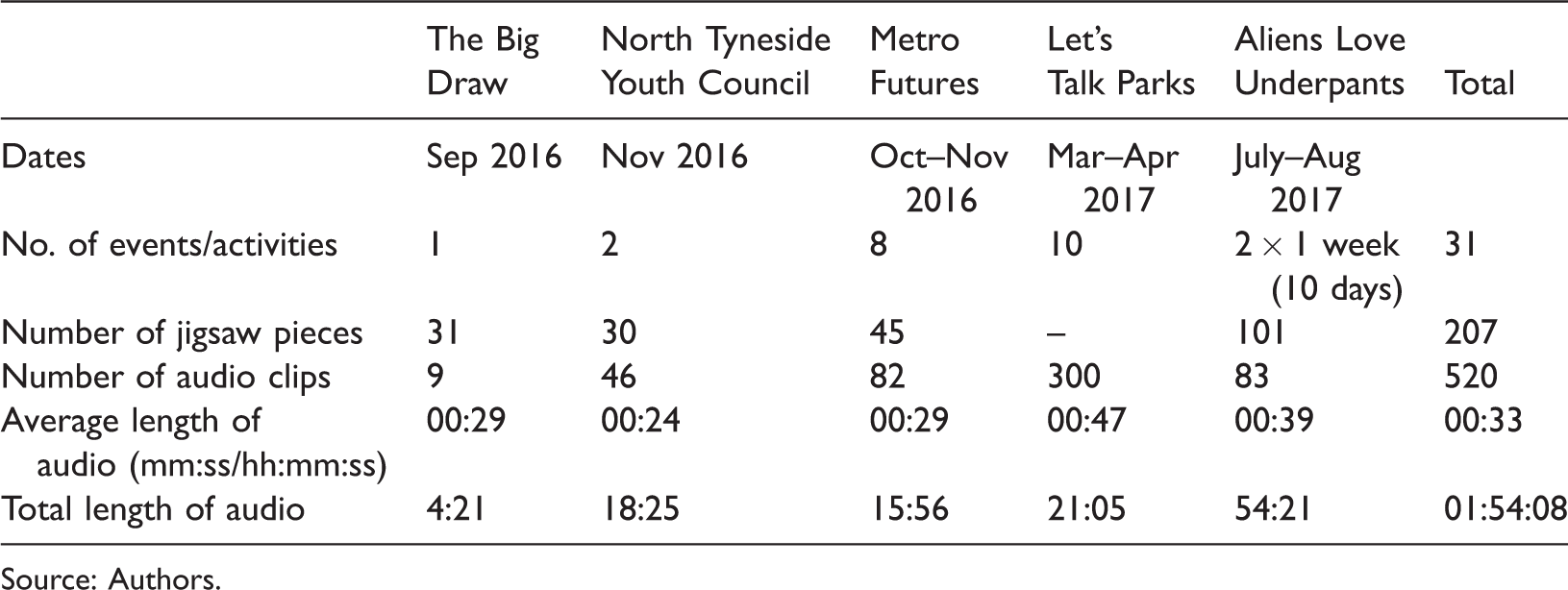
This section discusses the findings from analysing the use of JigsAudio. Table 1 shows a summary of JigsAudio’s use throughout the deployments and the number of events or activities that occurred at each deployment. Across the five projects over 11 months, there were 31 deployments of JigsAudio; 207 jigsaw pieces were drawn and 520 recordings were made.
Summary of audio and jigsaw pieces collected with JigsAudio.
Source: Authors.
The discrepancy between the number of audio clips and images was due to two factors. First, some people did not make a recording and decided that they would prefer to just submit an image; second, some decided to make more than one recording per image.
The following section presents the findings from the study and evaluates the deployments in relation to three issues: expressiveness and creativity, appearance and creating an artefact.
Expressiveness and creativity
It was found that drawing and talking was effective at getting people to communicate elaborate visions that might not be easily expressed through a single medium, with Commissioner 1 (C1) stating ‘Some people love it, some people really do get into it. Even if they’re not very good at drawing, they get it; it appeals to them in some way’ and C4 stating ‘some of those who aren’t as creative were just writing their issues over the jigsaw piece which was great; others were more interested in making their jigsaw piece look really nice’. There was an opportunity for creativity and expressiveness in people drawing and discussing their feelings and, by combining drawing and audio, a rich story behind each image was formed. A deeper connection could be made to the message, with C2 noting, ‘it’s visual and it’s audible, and it transcends all of them [audio and images used separately]’.
The imagery and audio of the jigsaw pieces were analysed for their content. The images were grouped as either being abstract (the image was representative of what they were communicating, but not literal) or real (the image was of what they were discussing). The audio was also grouped: if it described a problem or issue that was easily identified, or provided a potential solution, it was tagged as pragmatic; if the comments were less specific, or a high-level issue, they were grouped as idealistic. Around three-quarters of the drawings and audio depicted a pragmatic idea with a ‘real world’ drawing (73%), communicating something that was apparent from the drawing. The second group (13%) used abstract images and idealistic statements in their audio. In these examples, the image alone did not specify what the participant was discussing, but the audio usually did, with C4 stating ‘even if you miss the message on the jigsaw piece, you've still got the [audio] message’.
Appearance of low-tech
It was found that the initial low-tech appearance of the activity encouraged engagement with JigsAudio. Upon first viewing, participants would see other participants’ drawings, draw their own image and use JigsAudio later in the process. This was understood by commissioners, who stated: ‘It was quite good as it immediately engages people… pen, paper, not immediately confronting someone with a microphone or a video camera or a phone’ (C1) and ‘I don’t think that the recording on the device was daunting; I don’t know why [but], nobody was really nervous or put off by it’ (C4), ‘there’s literally one button on there – you can’t really go wrong – even I managed to do it [deploy and use the device]… which was amazing, because I’m not very technical in any way’ (C4). By introducing people to something that appears to be low-tech, the barriers to using technology were reduced. Technology was introduced after participants had completed their drawing, rather than them being immediately confronted with it. This allowed participants to take a jigsaw piece, think about the comments they would like to make and, when ready, make a recoding. This meant that the facilitator did not have to allocate their attention to one person at a time and, instead, could allow multiple people to create their drawings.
Using analogue materials allowed people to express themselves without needing to interact with complex computer-aided design technologies, and instead use a method that was immediately understood whilst also being novel. It was initially feared that adults may not participate in the exercise due to a perception of it being too ‘childish’; however, this was not found to be the case. Instead, adults tended to draw technical drawings on the jigsaw pieces.
Throughout the deployments, participants were interested in how the JigsAudio device worked and wanted to take part in the activity. C2 stated: ‘that’s the novelty factor; they think “ohhh, that’s interesting, I’ll do that”, rather than giving them a form and them taking it away, the same old ways of doing things’, and C4 who stated: Giving them an iPad isn’t interesting to them, but giving them a large jigsaw piece, with an image that’s something to do with North Tyneside is unique… sometimes it is quite good just to go back to using a pen, and actually drawing your own things. There is a tactile thing about this that you wouldn’t get it if you were doing this on an iPad… just the simple thing of putting the planet in the constellation - something as simple as that - they really enjoyed that bit of it, which you wouldn’t get with an App.
Creating an artefact
As shown in the figures, the use of JigsAudio created a collection of images (e.g. the youth council created a jigsaw five metres long, and the Metro Futures deployment nine metres). The physicality of the technology generated interest in the activity, and encouraged participation, with C4 stating it ‘makes it real’. These images formed a makeshift exhibition that further encouraged people to view, comment on and create their own pieces. C4 thought this to be particularly important, stating: ‘I think that the jigsaw piece becoming part of a whole thing, I think that’s really, really important. If they had just done the voice element, that whole bit would be missed.’ The artefact also caused an unexpected reaction: participants started scanning other people’s jigsaw pieces and commenting on them. Some people also stated they were ‘taking inspiration’ from the other pieces, whilst others reported on trying not to duplicate visions or ideas that others had provided.
Requests were made for people to be able to scan someone else’s jigsaw piece to listen to the audio or add a comment. This demonstrated the understanding that people gained from interacting with physical objects, and the immediacy of being able to comprehend the activity and previous engagements demonstrated through people quickly commenting on others’ drawings after joining the activity. Being aware of previous participation encouraged them to complete their own and reduced anxiety in undertaking the activity. It is common practice for situated engagement activities to take place on a screen; however, displaying the results of these engagements in an analogue format demonstrated previous engagement with the activity and encouraged others to participate.
Following the completion of several jigsaw pieces an artefact that represented a group’s feelings towards a topic took shape. Individuals contributed to interlocking views of place that increased as people contributed to them. The group then used the website as a manifestation of the group’s sentiments, usually viewing it during a later group activity, making sense of it and wanting to share it.
Drawing and talking about urban change
JigsAudio was designed as a tool and technique to engage people in thinking about the future. It demonstrated how participation techniques that use technology might encourage visionary thinking in planning. The aim of the investigation was to assess whether a new method of planning participation could overcome some of the barriers associated with more traditional methods and find a way to link community perceptions of urban issues with new planning methods (Baker et al., 2007; Wilson et al., 2019). The next section draws together the findings and discusses the implications of the pilot for planning and citizens’ involvement in urban change.
Combining digital and non-digital technology
Through the combination of digital and non-digital, JigsAudio aided understanding of how the two might be used to encourage and enhance participation in planning. It created a way for people to use familiar methods in putting their thoughts across whilst not being required to use something that they would generally consider a computer (Ullmer and Ishii, 2000), leading to the creation of a physical artefact that enticed further people to participate. The ‘honeypot effect’ allowed people to observe and understand the activity before deciding if they would like to participate. This can help overcome the self-consciousness and embarrassment associated with participation, and ‘allows groups to congregate spontaneously without specific coordination efforts [by the facilitator]’ (O’Hara et al., 2008: 68).
Through its simplicity and adaptability, the technology was easily customised for use in many scenarios. The work highlights how JigsAudio created a space for people to be expressive and creative in the way they discussed their visions for the cities of the future. Prior studies have identified opportunities for technology-mediated planning participation (Baker et al., 2007); however, these usually mirror online traditional methods and are often limited to the one-way provision of information (Evans-Cowley and Conroy, 2010; Wilson et al., 2019).
JigsAudio was non-digital at first, which allowed users to express their views in a familiar way, and they were introduced to the technology at a later stage. Through this, the research highlights how a non-digital method alongside digital technology can facilitate engagement with people who would not normally choose to use digital technology. The coupling of digital and analogue media meant that, conceptually, the audio was stored on the jigsaw piece, providing a simpler means for participants to visibly ‘add’ their comment and see how their thoughts contributed to the group’s vision.
The research highlighted how it encouraged creative thinking by allowing the time and means for people to reflect and think about their responses. By combining digital and non-digital, both modes complemented each other to enable more thorough articulation of visions and, by viewing and listening to the two together, a better understanding of the view being expressed was achieved. The use of tangible interfaces has been demonstrated to be effective when undertaking cooperative ‘work’ (Ullmer and Ishii, 2000). This research contributes to this by demonstrating the potential of physical media and technology in encouraging, evidencing and facilitating participation. Moving away from screens enabled the elicitation of views that may have been difficult to communicate through digital means (Al-Kodmany, 1999; Brabham, 2009).
Embracing the non-digital also created a physical artefact, something that screen-based technology does not. This made visible the comments people had on their local environment. Similarly, through the creation of something tangible, handmade and visually interesting, people were drawn into participating with the activity (Golsteijn et al., 2015). Unexpectedly, it also led to users wanting to listen to other people’s responses, aiding citizen–citizen communication within a group which Healey (1996) claims creates ‘chains of connection between what bothers people […] and what can be done about it’ (225).
JigsAudio gave opportunities to be agile and adaptable to suit the type of activity being undertaken. With many technologies, there are significant efforts to reconfigure the technologies for different uses. The design of JigsAudio was flexible, allowing audio to be attached to any physical objects, and for the context of its use to be changed easily. This led to JigsAudio being used in many different contexts, which is particularly valuable during a period of funding constraints for local authorities that makes it difficult to both develop new technologies and support existing ones (Conroy and Evans-Cowley, 2006).
Constraint versus open
A question that needs resolving, both as a consequence of this research and more widely within planning participation, concerns guiding discussions, and the degree of constraining opinions versus openness (both in the topic that is discussed, and how it is discussed). Given the difficulty of attempting to identify all possible place viewpoints in advance, there is an argument that all conversations around planning should be narrowly focussed only on what is relevant or ‘material’ in planning terms. But taking account of Massey’s (2005) assertion concerning relational space, it becomes questionable to attempt to narrow down choices in advance. If the case is made to create new opportunities for conversations around the future of places and where and how people live, a planning view of options is the wrong focus. Place does and should mean something more than planning alone. Within this project, we chose to take Massey’s (2005) notion of relational space and investigate the extent to which place-matters can be used to engage people, rather than choosing to undertake a strict ‘planning’ consultation.
There is a role for less formal discussions around place that do not have an instrumental purpose of procedurally serving the planning system. 1 Citizens want to discuss the future of their places but, at present, and within government, there are few opportunities creating the means or space for those broader place-based discussions. Through JigsAudio, informal discussions around place allowed people to cover topics whether development oriented or not, and demonstrated how creative digital technologies could uncover perspectives that digitised ‘traditional’ technologies struggle to capture (Wilson et al., 2019). It further confirmed that in order to enhance citizen participation in planning, it is not only the language that needs to be inclusive, but also the type of comments that people can give.
The work also contributes to understanding of how creativity and expressiveness are used to engage people, and how the various activities steered participants towards different types of response. For example, in the Metro Futures deployment, giving participants the plan of the internal layout of the metro car led to more pragmatic and realistic responses when compared to the featureless metro cars, and a commissioner (C6) reported that moving the device to a higher table changed the age of children engaging with it. That does not mean to say that there is more inherent value in one type of comment over another, but the mechanisms hidden behind participation methods determine how and which thoughts are communicated. Different types of comments will be desirable: open comments are more likely to be useful during master planning exercises, whereas if consulting on a specific issue there might be less freedom in what can be undertaken. In the former case, the abstract pieces became a generic canvas for people to communicate their views through. The more structured pieces, however, led to people commenting on issues that could be improved on, and led to suggestions that tended to fit in to an existing framework. Taking meaning from the abstracted comments requires more work to understand how abstracted comments can be integrated into the current material-based planning system (Sarkissian et al., 2010).
The deployment and evaluation of JigsAudio raised insights into combining drawing and talking as core, accessible features of a participatory platform. It demonstrated how creative digital tools can enhance citizen’s sharing and expression of their visions for their local area, but also the importance of the attention that is given to the type of comment that will be received when various modes of participation are promoted.
There remains a difficulty in how abstracted visions elicited through JigsAudio can be used within the existing framework of planning (e.g. abstracted submissions require significant effort to translate into actionable changes). Although participants were able to share their views, the challenge of translating abstracted views into actionable insights remains. In the deployments the commissioners were not the local authority planning departments, and so there was a greater degree of freedom to initiate and respond to the comments received, but moulding this into a formal planning method would require more work. As Frank (2016) documents, there is a risk that a perceived lack of response or action officially from undertaking participation may lead to frustration. There are two potential future directions: the first could involve JigsAudio data undergoing a ‘sense-making’ step, which enables groups to self-reflect and develop pragmatic actions stemming from their views. They would then be formalised with the aim of reducing the misinterpretation of the comments by the decision-makers and allowing the comments to more easily fit into existing planning frameworks. The second requires buy-in from planners, by enhancing the role that feelings and creativity have in place-making. Manzo and Perkins (2016) state, ‘this is difficult, time-consuming work, but it is essential to effective participatory planning’ (348). But the research shows the opportunities that are presented when novel interaction methods are used alongside those which are well established.
Conclusion
Looking ahead at the possibility of further research and conceptualisation, increased attention should be placed on how digital technology can facilitate different and changing types of responses from people. This is particularly pertinent as the move towards smart city sensing technology risks further reducing the role of experiential accounts in place-making (Colding et al., 2018).
Providing response forms, whether digital or analogue, does not give people a sufficient medium through which they can express themselves fully. Technologies that embrace the multiple dimensions of feelings and aspirations of places could provide opportunities for richer and more considered representations, and serve to help people express more experiential accounts (Healey, 1996; Massey, 2005).
The purpose of this work has not been to demonstrate that the technology discussed provides any solutions to problems per se. The research has shown that (i) there is a lack of discussion of tangible and creative media technologies within planning literature, (ii) by exploring the issues at play when using these technologies and (iii) there is the potential for tangible technologies in addressing difficulties of early participation with current participation methods.
Although the technology within this paper was effective, it is important to recognise the limitations of this research: those that chose not to participate were not included in the research; and it is likely the commissions already saw the value in the tool before requesting to use it. We also need to understand the implications of these technologies through theory and conceptualisation (Colding et al., 2018). Further systematic analysis is needed to understand how this technology compares to other tools used for participatory planning, both digital and non-digital, and how the perspectives may be used to shape future cities.
Footnotes
Acknowledgements
The authors wish to acknowledge the support and assistance of Andrew Dow and Samantha Finnigan, the JigsAudio commissioners, project partners and those individuals who participated in the study, and to Mike Batty, Linda Lee and the anonymous referees who provided critical comments during the writing and refereeing. Data supporting this publication is not openly available due to confidentiality considerations. Access may be possible under appropriate agreement. Additional metadata record at  .
.
Declaration of conflicting interests
The author(s) declared no potential conflicts of interest with respect to the research, authorship, and/or publication of this article.
Funding
The author(s) disclosed receipt of the following financial support for the research, authorship, and/or publication of this article: The research was undertaken as part of UK Research Council funded work through the RCUK/Innovate UK Newcastle City Futures Urban Living Partnership (Ref. EP/P00203X/1), through the EPSRC Digital Civics programme (Ref. EP/L016176/1), and through the EPSRC Digital Economy Research Centre (Ref. EP/M023001/1).