




Abstract
We explore why and how problems related to climate action emerge in specific, sometimes peripheral, places. Diverse forms of socio-political contestation over both fossil fuels and low-carbon shifts imply that the problems that climate policy is positioned against are neither singular nor self-evident. Climate action intersects with complex socio-material settings, which can produce new problems and amplify or refract existing ones (e.g. job losses, inequalities, marginalization). Understanding how this occurs is an urgent challenge which requires interrogating the emergence and evolution of problems on the ground. We examine the case of a proposed coalmine in Whitehaven, Cumbria, the UK’s commitment to ‘consign coal to history’, and what it reveals about the challenges of climate action more broadly. Drawing on 47 in-depth interviews and detailed field observations, we explain how the proposed coalmine invoked, and was inseparable from, many other issues including austerity, old and new extractivisms, environmental degradation, nuclear development, socio-spatial disparities, planning system deficiencies, and a widespread sense of being left behind. This shows how attempts towards climate action are inextricably embedded in broader problem-complexes that evade established policy domains and agendas (e.g. energy security, net zero). Other (often peripheral) problems which may or may not become policy problems nevertheless structure opportunities and/or obstacles for ambitious climate action, challenging the compartmentalization of climate policy problems and solutions.
Introduction
We examine how problems related to climate change and action emerge in specific, sometimes peripheral, places. Far from a singular problem-object or a ‘grand problem’ that can be ‘decomposed’ (Sabel and Victor, 2017, in abstract), climate change invokes a wide variety of issues that do not neatly fall into specific policy domains and agendas (Bulkeley, 2019). Consequently, proposed policy solutions such as carbon taxes (Driscoll, 2021; Velador and Herrera, 2021), carbon capture and storage (Radtke, 2023), or grid development (Veronese and Pope, 2023) may address problems (e.g. CO2 emissions) that could be seen as far removed from the problems that people face on the ground (e.g. job losses, inequalities, marginalization). Moreover, climate action could generate new problems as well as exacerbate existing ones, which is especially important for people and communities already on the periphery and who may lack the capability to assert their experiences and concerns (Brown and Spiegel, 2019; Diana et al., 2023; Sovacool et al., 2023). Therefore, understanding why and how such problems emerge is an urgent challenge which requires considering how climate action ‘moves and mutates’ (Lorne et al., 2024: 3) on the ground.
Despite increasing awareness of the ‘ubiquity’ of climate change and climate policy (e.g. Bulkeley, 2019; Livingston et al., 2018; Paterson, 2019), the tendency to separate problem(s) and solutions ‘dies hard’ (Castree, 2002: 358). ‘Policy-focused stories’ (Paterson, 2019: 30) often perpetuate a problem-solving model of policymaking (Turnbull, 2006) which assumes that problems are given or ‘out there’ (Bulkeley, 2019: 15), and that policy is positioned to solve these problems. Alternative approaches, including interpretivist theories of problem-setting and problem-framing (e.g. Mintrom and Luetjens, 2017) and (often) poststructuralist theories of problematization (e.g. Allan, 2017) break down the idea that problems are independent from policy. Instead, they show how policy itself is implicated in the making and remaking of problems, either through deliberate action (e.g. framing a problem) or through more deep-seated governmental practices that ‘[structure] the field of possible action’ (cited in Allan, 2017: 135; Livingston et al., 2018). From this point of view, policy problems ‘[emerge] from a contingent interaction between state power and the authority of scientists and experts’ (Allan, 2017: 132).
But problems may also present themselves suddenly, and in unexpected ways and places. For example, different audiences may push back against dominant policy frames, or reject the ‘solutions’ at hand altogether, as was the case with large-scale oppositions to carbon pricing/taxes in Australia, Canada, and France (Patterson, 2023). Similarly, climate action may encounter unforeseen challenges on the ground, such as fossil fuel lock-in and/or dependencies (Brown and Spiegel, 2019; Lazarus and Van Asselt, 2018). Adding to this, poor quality housing stock, ageing infrastructure, and socio-economic disparities may limit the possibilities for climate action in a particular place. This means that we need to look outward, and (re)consider how problems emerge from dynamic interactions between social processes (e.g. including policymaking) and the social and material realities on the ground (Barry, 2021). To this end, we draw on socio-material approaches, which emphasize how problems emerge in the public domain through the co-constitution of ‘matters of concern’ and concerned groups (Laurent, 2017; Marres, 2007).
We examine the case of Whitehaven, West Cumbria, UK, where a longstanding debate over a proposed new coking coalmine called into question the UK’s concurrent commitment to ‘consign[ing] coal to history’ (cited in Fearn, 2024: 2). Between 2014 and 2024, the proposal, which repeatedly attained the approval of both local and national authorities, became the subject of several socio-political campaigns, popular protest, multiple legal challenges, and a public inquiry (Willis, 2024). At the same time, it was met with a mixed response from the local community, where some welcomed the company’s promise of >500 jobs and investment into the area’s permanently decaying infrastructure and others welcomed the idea of work but were unsure whether returning to coal was the way to get there (Lewis, 2024). Throughout, it became a case-in-point for the ‘multi-layered problem-complex’ (Livingston et al., 2018: 83) that climate action is bound up in.
Drawing on 47 in-depth interviews with a diverse range of key informants (e.g. political/policy officials, public/private sector representatives, members of the public) and detailed field observations from within and beyond Whitehaven, we seek to map and make sense of the different and differently positioned problems invoked in struggles over the proposed mine, bringing to light a multilevel and multi-layered problem-complex that invokes, and is inseparable from, problems of austerity, planning system deficiencies, ecological extractivism, environmental degradation, nuclear development, socio-spatial disparities, and a widespread sense of being left behind. We thereby challenge existing problem or policy domains, which tend to separate climate change into its ‘component problem areas’ (Sabel and Victor, 2017: 18) and subsequent solutions (Oseland, 2019).
We begin by inquiring into multiple ways of understanding why and how (policy) problems emerge and emphasizing the need to look beyond policy domains and agendas alone. We then outline our methodological approach and investigate the emergence and variety of problems at multiple levels which were generated and/or brought into view through social and political struggles over the proposed coalmine. Finally, we explain how this problem-complex reveals a multitude of problems that risk slipping between the cracks of problem or policy siloes, such as net zero and levelling up in the UK. They may therefore not become policy problems but nevertheless structure the opportunities and/or obstacles for ambitious climate action. We thereby broaden the scope of problems that climate policy is – or ought to be – positioned against, challenging the ways in which climate policy currently compartmentalizes problems and subsequent solutions.
What’s the problem?
Understanding why and how (policy) problems emerge requires (re)considering how problems come into being and/or are made public. This question is central among political and policy analysts who reject the idea that (policy) problems such as climate change are given or ‘out there’ (Bulkeley, 2019: 15). Theories of, for example, problematization (Allan, 2017; Bacchi, 2012), problem definition (Brunner, 1991), and problem-framing (Mintrom and Luetjens, 2017) show how policy and governance more broadly are implicated in the making and remaking of problems. We consider these approaches and then explain how socio-material approaches further enrich our understanding of why and how problems emerge by looking outward to the multiple worlds in which climate action becomes a lived reality.
Policy problems
Pushing back against the idea that climate change is a predetermined, self-contained problem-object warranting certain types of (policy) solutions, critical approaches in policy and political sciences bring to light how policy may be implicated in the (re)enactment of problems (Lahn, 2021). 1 This either happens through deliberate action (e.g. agenda setting, problem definition, problem-framing) or through wider governmental discourses and practices that ‘[structure] the field of possible action’ (cited in Allan, 2017: 135; Bacchi, 2015). This means that (policy) problems are either perceived as products of individual and/or collective meaning-making by problematizing agents (Bacchi, 2015; Hoppe and Colebatch, 2016) or as products of deep and/or diffuse power relations (e.g. as embedded in governmental practice) that simultaneously shape problems and the subjects (e.g. politicians, policymakers) who respond to these problems (Allan, 2017; Lahn, 2021; Laurent, 2017). Understanding what constitutes a problem, then, requires that we turn to the ‘set of discursive or non-discursive practices that makes something enter into the play of the true and false, and constitutes it as an object for thought’ (Foucault, 1989: 296; cited in Barry, 2021: 95).
Studies of problem-framing (Dewulf, 2013; Mintrom and Luetjens, 2017) and its effects (e.g. for public acceptability) (Bertolotti and Catellani, 2014; Sapiains et al., 2016) bear witness to the ‘political work’ involved in the (re)making of climate change as a problem (Mintrom and Luetjens, 2017: 1373). For example, Mintrom and Luetjens (2017) show how climate policymakers engage in framing activities to affect the range and nature of responses at hand. This also goes for climate’s ‘component problem areas’ (Sabel and Victor, 2017: 18) such as biofuels (Palmer, 2015) and fossil fuels (Megura and Gunderson, 2022; Paterson, 2021). It follows that policymakers may play a decisive role in determining if and how problems reach the policy agenda, and thereby ‘[disclosing] possible responses’ (Paterson, 2021: 924). However, the problems that these agents frame do not come from nowhere – something precedes these choices (Noordegraaf, 2010). Therefore, it is useful to consider how problems may be products of more deep-seated governmental or scientific practices rather than (just) individual interpretations in policy (Allan, 2017; Lahn, 2021; Laurent, 2017).
Such approaches, often of the poststructuralist tradition, show how climate change has come to be viewed as a certain kind of geophysical problem-object through co-construction between state agencies and scientists responding to their agendas over time (Allan, 2017; Lahn, 2021), and how this now translates ‘in practical terms’ into certain forms of rationality and accounting in everyday climate governance (Lahn, 2021; Lövbrand and Stripple, 2011). For example, Livingston and colleagues (2018: 83) show how the Intergovernmental Panel on Climate Change (IPCC) has certain socio-material practices in place to produce a ‘coherent story’ of an otherwise complex and contingent reality – practices through which a ‘multi-layered problem-complex’ is translated into ‘a unitary global problem’. Consequently, Lahn (2021: 22) shows how problematizing practices such as those employed by the IPCC ‘serve to delineate between what is taken for granted, what is known and unknown, producing distinct climatic “problems” to replace or augment existing ones and distributing them between different institutions and social spheres’, such as government departments. Therefore, the problems that climate policy is positioned against are themselves products of deep and/or diffuse power relations that determine which problems become policy problems, and which do not.
Socio-material perspectives on problems
But not all (policy) problems are sung into existence in the corridors of power. They may also present themselves suddenly, and in unexpected ways and places. For example, publics may push back against dominant policy frames, and/or reject the ‘solutions’ at hand altogether, as was the case with large-scale oppositions to carbon pricing/taxes in Australia, Canada, and France (Patterson, 2023). Similarly, climate action may encounter unforeseen challenges on the ground, such as fossil fuel lock-in and/or dependencies, old (industrial) infrastructure, or socio-economic inequalities (Brown and Spiegel, 2019; Lazarus and Van Asselt, 2018). To understand how these kinds of problems come into being, we draw on socio-material approaches to problems (Barry, 2021; Marres, 2007).
Socio-material approaches emphasize how problems emerge in the public domain through the co-constitution between ‘matters of concern’ and concerned groups (Laurent, 2017; Marres, 2007). These matters of concern may involve (material) objects such as technologies, infrastructures, sites, but also policies, which are rendered problematic through the involvement of concerned groups such as citizens or interest groups (Lahn, 2021; Marres, 2007). Instead of asking how problems arise through the production of knowledge and/or practices of power, they focus on the ‘public-ization’ (Marres, 2007: 775) (i.e. the becoming-public) of problems, which arise through socio-material relations. Therefore, Barry (2021, in abstract) argues that we should think of (environmental) problems as ‘almost invariably involv[ing] an encounter between unlike or disparate materials or processes’. From this point of view, (policy) problems are not written into policy but are ‘both geographically variable and situationally specific’ (Barry, 2021: 109). They may therefore involve everyday objects and the social processes bound up with them (e.g. combustion and/or electric vehicles, household devices, and everyday infrastructures) (Bulkeley et al., 2016; Marres, 2016) and are brought into view by the people affected by them, provided that they have the capacity to do so (Barry, 2021).
These kinds of problems are emphasized in critical analyses of energy transitions and the politics of (natural) resources like coal, oil, and gas, but also wind, solar, and so on (e.g. Brown and Spiegel, 2019; Sovacool et al., 2023). Pushing back against dominant interpretations of resources as, exclusively, energy issues and/or of climate change as a ‘techno-managerial problem’ that can be overcome by cutting down on carbon emissions (Brown and Spiegel, 2019: 151), these studies emphasize how ‘lived experiences of individuals and communities remain crucial, often neglected and underappreciated considerations in the framing of energy transition debates’ (Brown and Spiegel, 2019: 164). They thereby emphasize ‘how “natural resources” come to be imagined, appropriated and contested’ through popular struggles (Baviskar, 2003: 5051; Bakker and Bridge, 2006), such as how coal is entangled in the construction of working-class cultures and masculinity, or how nuclear energy is entangled in visions of a better, cleaner, and more prosperous future (Lewis, 2024).
These meanings, and the practices surrounding them, are in turn the product of ‘historical and ongoing processes that create environmental [or energy] injustice in the first place’, such as the uneven distribution of (renewable) energy technologies or the gendered or racial ways in which fossil fuels are appropriated (Sovacool et al., 2023: 2). Therefore, conflicts over climate policy (e.g. pricing, phase-out, regulation) may invoke many other issues (e.g. extractivism, land use, local identity, economic priorities, as well as gender, race, colonialism, and neoliberalism) (Arsel et al., 2015; e.g. Jolley and Rickards, 2020; Sovacool et al., 2023). These problems may not make their way into climate or energy policy directives unless successfully mobilized by concerned groups, often drawing in strange bedfellows (e.g. farmers and environmentalists) because the problems that mobilize them cut across existing political cleavages (e.g. left/right, pro/anti climate) (Arsel et al., 2015; Jolley and Rickards, 2020).
Even though many problems do not necessarily become policy problems (Allan, 2017; Turnbull, 2006), these approaches help us see the complex of problems against which climate action is – or ought to be – positioned. While this does not disregard the importance of understanding how problems and subsequent ‘solutions’ are constructed in dominant or mainstream policy debates and practices, it also entails attention outward to the multiple worlds in which climate policy becomes a lived reality, and comes to reinforce existing problems and/or introduce new ones (Sovacool et al., 2023).
Approach
To understand why and how such situationally specific problems emerge, we examine how the proposed coalmine and decisions over it both reveal and provoke a plethora of problems linked to climate change and action. The proposed coalmine is situated on the edge of Northwest England, and was predicted to produce up to 2.8 million tons of coking coal per year (DLUHC, 2022). It became subject to (inter)national scrutiny when Cumbria County Council (CCC) approved the application in March 2019 (Fearn, 2024), after which the Australian-owned company, somewhat controversially called West Cumbria Mining (WCM) [CivSoc_26], was met with a legal challenge by Keep Cumbrian Coal in the Hole. What followed was a ‘tortuous’ route to approval (Willis, 2024: 2). It was granted permission up to three times by the CCC (which has since been abolished), called in by the then Secretary of State for Levelling Up, Housing and Communities, made subject to a Public Inquiry, and taken to court several times. At the same time, the proposal was met with a mixed response from the local population, where some welcomed WCM’s promise of over 500 jobs and further investment while others welcomed the idea of work but were unsure whether returning to coal in an environment already ‘scarred’ [NGO_32] by intensive industries (NB: including coal) would be the way to get there (Lewis, 2024). It became a focal point for climate activism in the UK and has triggered debates over orientations towards fossil fuel extraction and climate action more broadly.
Although it may seem like an unusual case, even an oddity where a new coalmine is being proposed against a wider background of thermal coal phase-out in the UK energy system and much activity on renewable projects and infrastructure (e.g. offshore wind, solar, electricity grids, home efficiency upgrades, low-emissions zones, etc.), we argue that this case has relevance to crucial aspects of climate action in many societies and places. One the one hand, it could be seen as emblematic of countless small towns and regions on the periphery, and with the relative social, economic, and political inequalities that arise as a result. On the other hand, it is precisely through its seemingly unusual features that the case helps to reveal and accentuate the complexities of climate action in specific places. This involves, for example, ambiguous and abandoned responsibilities, arbitrary policy intervention and categorization, existing material infrastructure, and economic possibilities over which different actors can have vastly different wishes, and political confusion from the outside over what it all even means. As such, the case becomes a synecdoche of climate action through both its everyday/mundane aspects as well as its idiosyncratic/extreme aspects which highlight pervasive failures (e.g. of political attention, voice, and even everyday site enclosure) with which it is shot-through, thereby revealing pervasive dynamics likely to be widespread in many places but not always readily apparent.
We take an empirical approach involving in-depth semi-structured interviews, participant and field observation, and selective review of public documents. We purposively sampled participants with relevant knowledge of and/or experience in the politics of coal and/or climate in (West) Cumbria, including residents and entrepreneurs (who watch these debates unfold in their own homes and/or workplaces), local/regional councillors, and policy experts and makers at the local, regional, and national levels. This involved 47 semi-structured interviews and broader conversations with a total of 51 participants (Figure 1). Participant and field observation involved collecting detailed field observations of the Whitehaven area, of the mine site and surrounding wards, and of public gatherings in which the coalmine and/or the past, present, and future of the area is a topic of conversation, including at the High Court Hearing in July 2024. Here we sought to employ an ethnographic sensibility committed to understanding ‘the lived expectations, complexities, contradictions, possibilities, and grounds of [social and cultural groups]’ (McGranahan, 2018: 1). It also involved attending to social meaning and ‘unheard stories’ (Fu and Simmons, 2021: 1697), that is, those which might be excluded in the articulation of public problems (Barry, 2021: 99). Primary and secondary data, which includes policy documents, public statements, and newspaper articles related to the mine and to climate and energy in West Cumbria more broadly, was collected between November 2023 and July 2024, both in-person through multiple site visits and online where preferred by the participant. This means that most of our data was collected prior to the UK General Elections (July 2024) and the court hearing in that same month, which we observed. Overview of participants and the groups/sectors they represent (labelled in-text in the following way: government interviewees [Govt_X]; Non-governmental organization interviewees [NGO_X]; Business interviewees [Business_X]; Civil society interviewees [CivSoc_X]; bs where X refers to interviewee number). NB: to protect our participants’ privacy, their placement in this figure does not correspond to their involvement with a specific group or organization.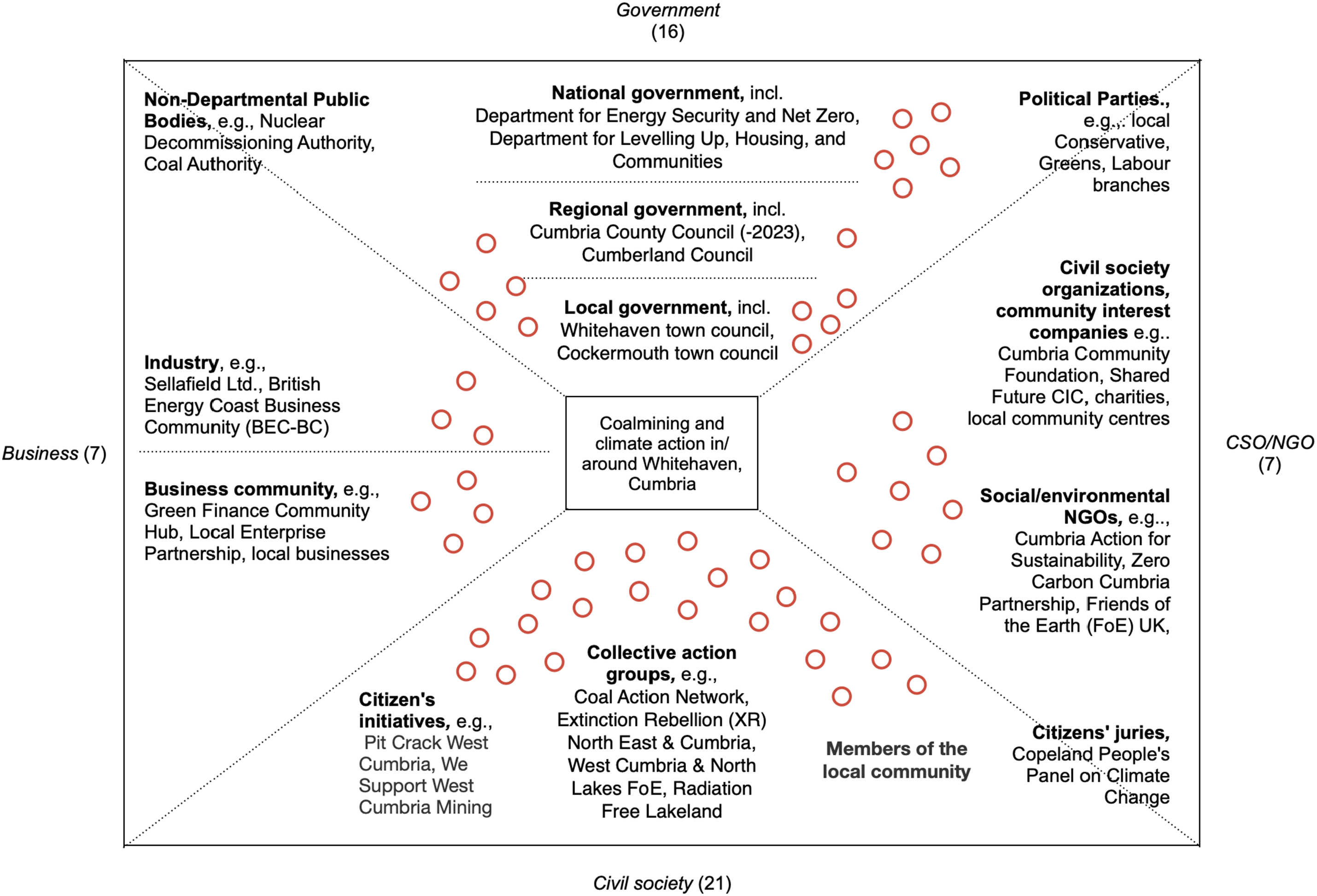
Our analysis involved a mix between inductive and abductive coding where we identified the different types of problems (e.g. social, economic, environmental, material) invoked by interviewees, as well as in the debates observed (e.g. at protests, public meetings). We paid particular attention to the spatial (e.g. place-based, scalar) and temporal dimensions of these problems and how they came into being. In our analysis, which follows next, we therefore examine why, where, and when problems related to the proposed mine, and of coal and climate action more broadly, emerged and evolved: (i) in Whitehaven, (ii) in the wider community and county/region, and (iii) nationally.
The problem-complex of coal extraction and climate action in Whitehaven, West Cumbria
We map and makes sense of the differently positioned problems implicated in debates over the proposed mine. We begin in Whitehaven and at the proposed mine site, after which we explain how the issue became politicized in the wider County of Cumbria and then ‘elevated’ to a national climate policy problem in Westminster, London. We then map the problem-complex invoked by the controversy over the mine and explain how it reveals problems which may not be elevated to matters of (inter)national concern, but nevertheless structure the opportunities and/or obstacles for ambitious climate action on the ground.
Social and ecological exploitation at the Woodhouse Colliery
We begin in Woodhouse, Whitehaven, and at the brownfield site that after years of neglect became subjected to (inter)national interference. The proposed mine, which has become known as the Woodhouse Colliery, is located in the southwest of Whitehaven, facing the Irish Sea. The site bears witness to Whitehaven’s ‘chequered past’ [CivSoc_24] in its interdependency with the coal, steel, and chemical industries. Between 1940 and 2005, the site was occupied by a chemical plant which had ‘saved a lot of people from poverty’ [CivSoc_48] but closed its doors for good in 2005 due to ‘deteriorating […] conditions’ in the UK market (Huntsman Corporation, 2006). Today, what remains is ‘a contaminated wasteland, a bleak legacy to an enterprise once so successful it won the Queen’s Award for Industry and was visited by Her Majesty during a snowstorm in the 1970s’ (The Whitehaven News, 2006b). It was in this wasteland that the option to return to coalmining ‘(re)emerged’ when in 2017 an Australian mining company requested planning permission to explore the coking coal beneath its surface (Lewis, 2024). Despite continued coal phase-out in the UK, the proposal repeatedly attained the approval of both local and national authorities. To understand why and how this happened, we must consider the socio-historical, socio-spatial, and material characteristics of the case.
The mine site is located north of Sandwith and west of Mirehouse, two wards counted among the 10% most deprived in England (Cumbria Intelligence Observatory, n.d.). The site went derelict in 2005 when the chemical plant that employed between up to 5000 people in its heyday closed its doors for good after being passed on from owner to owner (The Whitehaven News, 2006a). The site was then transferred to a liability transfer service in 2012, whose plans for ‘additional housing, small scale retail, tourism and leisure and low density commercial space’ (POS Landcare, n.d.) were never realized. Its steel palisade fences were breached by residents who sought to reclaim the land [CivSoc_6] (Figure 2), which they claim is now ‘the biggest unofficial dog walking site in the country’ [CivSoc_24] and, devoid of bins, ‘the dog poo capital of Europe’ [CivSoc_6]. It is also frequently used as a dumping ground for bulky waste [Gov_45]. ‘[It] is just a mess’, explained a Whitehaven resident, also claiming that ‘[the mine] would have tidied that area up’ [CivSoc_6]. A breach in the fence surrounding the grounds of the proposed coalmine, including a work of art (artist unknown) picturing a child looking at a deceased bird – probably a reference to the contaminated grounds below.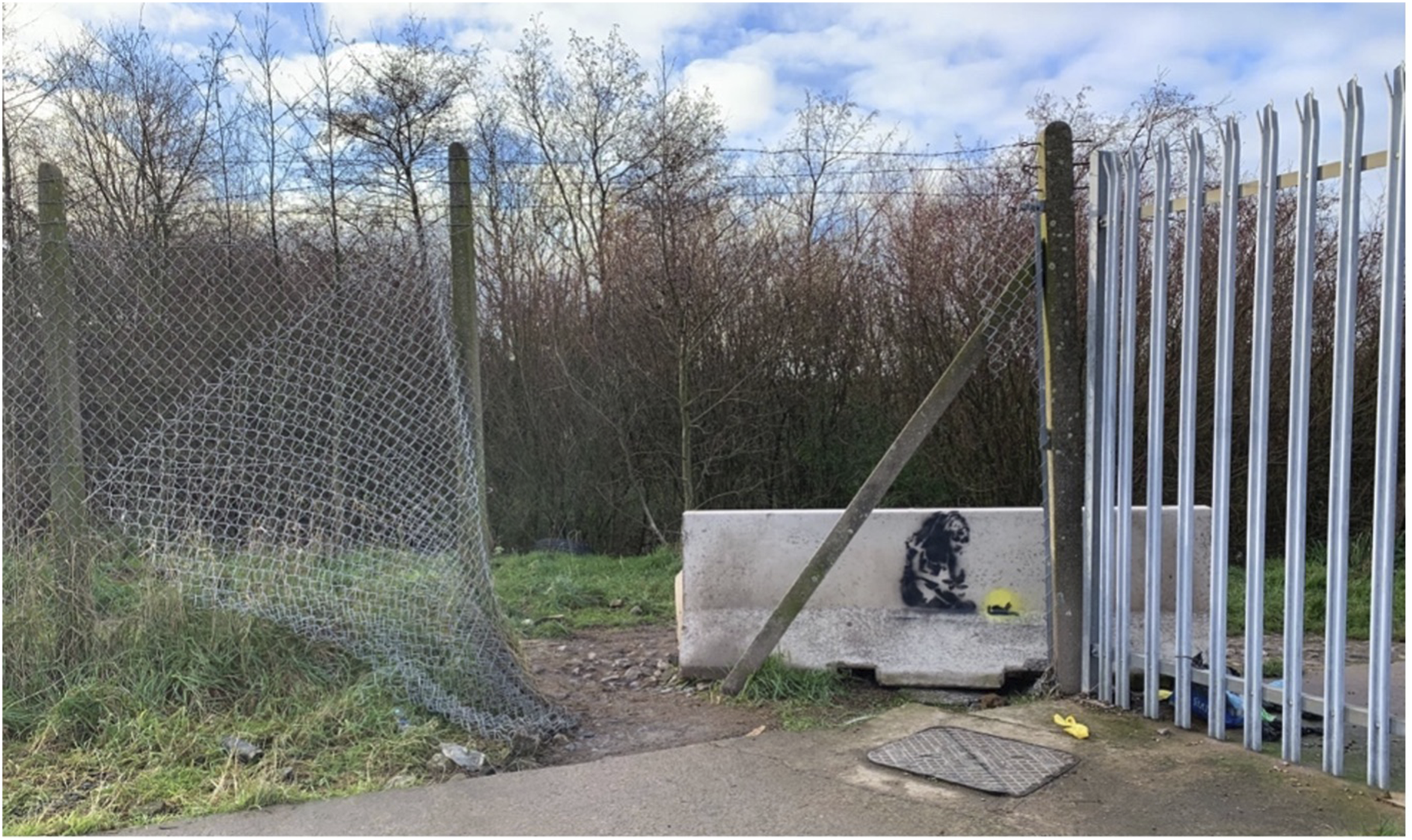
The state that the mine site finds itself in was a frequent point of reference for opponents and proponents alike. A stand-in for the ‘pockets of absolute deprivation’ [NGO_32] that populate the area, the mine site testifies to just how desperate the surrounding area is for work and investment [CivSoc_48]. WCM claimed that the mine would employ 500 people directly (up to 80% of which within a 20-mile radius) and another 1000 further down its supply chain, which would also help inject investment into the region’s permanently decaying infrastructure [Gov_8] (Woodhouse Colliery Project Update, 2020). And given the shortage of entry- or lower-level work available in the area,
2
There was a huge surge in interest around that from local people who […] were thinking about a job that they could do to support their families. You know, to live securely. I think there’s this tension between doing what’s right for the climate [and] the need, I suppose, to be in work and earning. [NGO_32]
For others, however, the proposal instilled fears of further exploitation of a landscape already ‘scarred’ by other industries that have come and gone [NGO_32]. ‘There is an aspect in Whitehaven now of people who realize that companies, industrial companies, come and go and leave pollution behind’ [CivSoc_9], explained an anti-coal campaigner. Standing on the grounds in/on which the mine was going to be built, another campaigner explained that: The old Marchon chemical factory […] already spewed out so many chemicals, [so] the ground is heavily contaminated. The idea that they will break the concrete caps and start digging and releasing all that pollution... […] It's disgusting. Especially with all the new housing. [CivSoc_26]
The area’s experiences of social and ecological exploitation fed into these fears. ‘The people of this area have put up with so much contamination and poorly paid dirty jobs for years’, said a local campaigner [CivSoc_47]. ‘There has been over 200 years of industrialization on this coast, and no reparations!’, a Whitehaven resident continued [CivSoc_50]. Adding to this is a ‘stockpile’ of nuclear waste [CivSoc_18] – a result of West Cumbria’s designation as a ‘nuclear knowledge economy’ (CLEP, 2020) or a ‘nuclear dumping ground’ [CivSoc_35] (depending on who you ask). And while the nuclear industry is generally considered a good employer and ‘a fantastic neighbour’ [Business_10], it also left part of the population ‘behind’ [CivSoc_24]. People hoped that those who would not find work in the nuclear sector would be able to work at the colliery [CivSoc_23; CivSoc_48].
Of equal importance for the emergence of this problem were the material characteristics of the coking coal in question. Coking coal, which produces the coke necessary for the iron and steel industries, is distinct from thermal coal, which does not produce coke. ‘There’s a lot of confusion about [it]’, explained a proponent of the proposed mine: ‘People use [the word] coal in the wrong way’ [CivSoc_5]. Indeed, discussions over the proposed mine were rife with (mis)perceptions about the (coking) coal in question. Proponents argued that the coal (1) is clean(er) (it is smokeless) [Business_4, Gov_25), (2) is crucial to produce iron and steel, and, therefore, (3) is a crucial for the UK’s green transition (e.g. for wind turbines) [CivSoc_5, 6, Gov_8]. Opponents, in turn, argued that coking coal is (1) far from green and (2) due to become a ‘stranded asset’ [Business_29] in the UK anyway, as ‘steelmakers are [finding] greener ways to make steel’ [CivSoc_1].
These suspicions were strengthened when government documents, revealed in 2024, predicted with ‘high certainty’ that the UK steel industry would decarbonize by 2035 (Gayle, 2024). This news, thereby, turned the conversation about the coalmine into one about the capacity of electric arc furnaces and about the quality of recycled steel. Throughout, the discussion of whether to open a coking coalmine in Woodhouse turned into a highly technical and for many incomprehensible one about the past, present, and future of British steel.
Yet, these debates kept drawing back to the colliery-to-be. ‘It's good quality coal’, explained a member of the community: ‘You can't beat [it]!’ [CivSoc_6]. ‘It’s a resource that [people] think should be used’, a local entrepreneur continued. ‘I mean, it’s literally sitting there. Millions and millions of tons of it!’ [Business_29]. And as long as the site remains a ‘wasteland’ (The Whitehaven News, 2006b), a large(r) part of the local population longs to look forward – even (or, in some cases, especially) if that means returning to coal: You know, they talk about […] insulating all the properties, fair enough, that will create jobs. [But] who's paying? […] If that's government funded, […] who's to say that would start here? You know […], this coal is only here. It's guaranteed to be here because that's where the product is. And that's where the reality is. [Gov_8]
At the outset, then, the possibility of a new coalmine did not emerge as a climate policy problem. Instead, it emerged through complex interactions between patterns of uneven development (e.g. deindustrialization, environmental planning, nuclear development) and the social and material reality on the ground, where ‘coal exists as afterlife’ – not just culturally, but also materially (Lewis, 2024: 4). At the same time, the proposed mine invoked and reinforced existing social and political cleavages across the wider County of Cumbria, which we discuss next.
Austerity and disparities in the County of Cumbria
Between the material politics of coal in Whitehaven and the politics of climate policy at the (inter)national level (see Section 4.3), we ought to consider how coal was politicized in the County of Cumbria, which was later abolished in 2023. We begin by discussing its socio-spatial characteristics, after which we explain how these, combined with recent social and political reorganizations, reinforced a politics of difference within which the proposal for the coalmine was passed and, eventually, passed on to national authorities.
The county of Cumbria, known for its UNESCO-listed Lake District which attracts over 18 million visitors a year, came into existence in 1974 when Cumberland and Westmorland were combined (Copeland Borough Council, 2020). Confronted with a county with ‘[no] single unifying functional economy, socioeconomic geography or culture’ (Copeland Borough Council, 2020), however, Cumbria’s residents did not identify with the boundaries that were drawn. The decision to split the county back into two unitary authorities in 2023 bore witness to these tensions, particularly between the post-industrial west coast (Maryport, Whitehaven, Workington) and the Lake District (Ambleside, Kendal, Keswick). ‘The two are totally different demographics, really’, explained a Whitehaven resident. ‘This this strip has always been […] hard working, coal mine, steelworks... And the Lake District is very genteel and touristy’ [CivSoc_6]. These contrasts – between ‘tranquil waters [and] rolling hils’ in the Lake District versus ‘relics of chimneys, plants, and pits’ in the West (Lewis, 2024: 6) – continue to divide the area. ‘Over there is a very different level of deprivation to what we see here’, a South Lakeland resident continued: ‘And a [very, very] different culture’ [CivSoc_12].
Importantly, it was in this socio-spatial context that the proposed coalmine became an issue of social and political identity. Split between two very different demographics, it reinforced these socio-spatial differences, and strengthened the already existing idea of the ‘Workington Man’ – an archetypal ‘leave-voting, rugby league-loving, white, working-class, jaded Labour supporter aged over 45’ (Das, 2022: 2). This phrase [of the] Workington man [is] a feature which […] [is] a kind of symbolic, uh, media created view about what [it means] to live on the edge of the levelling up project… And […] I think all of that is somehow bound up in the mine discussion. [Gov_42]
Indeed, explained a Cumbrian resident engaged in the campaign against the mine: Even when Cumbria was still Cumbria, […] the mine supporters were upset. And to be honest, you could argue that they had a point that opposition to the mine came from people who called themselves Cumbrian but who lived the other side of the county and who, you know... were more prosperous [and had] more job opportunities … [And] that's true, you know. I've been there three times. I do understand the area because I lived [nearby] for [many] years, but I'm not West Cumbrian. [NGO_22]
Against this socio-political backdrop, and within the framework of the Cumbria Minerals and Waste Local Plan and the National Planning Policy Framework (Willis, 2024: 4), the proposal was passed unanimously in a council composed of 37 Conservatives, 26 Labours, 16 Liberal Democrats, and 5 Independents (Westmorland and Furness Council, n.d.). Still grappling with the effects of over a decade of austerity (Fearn, 2024), they concluded that ‘the need for coking coal, the number of jobs on offer and the chance to remove contamination outweighed concerns about climate change and local amenity’ (cited in Inman, 2019: 8). Following contestation and subsequent amendments to the original proposal (one of which, importantly, was to remove the production of thermal coal (Fearn, 2024: 5)), the Council approved the proposal again. However, as the planning process encountered the publication of the Sixth Carbon Budget in December 2020, the grounds on which the planning proposal had been passed became subject to contestation, and the decision was eventually called in by the Secretary of State [CivSoc_5]. With that, whether the coalmine would be opened was out of CCC’s control. The Council took a neutral stance in the 2021 public inquiry [NGO_44] and was abolished in 2023. Cumberland Council, which now covers the Whitehaven area, had little to no engagement in discussions over the colliery since [Gov_42].
Throughout this ‘[tortuous] route to approval’ (Willis, 2024: 2), moreover, it became clear that the party-political consensus to which the planning proposal owed its initial success was short-lived. By the time the council voted on the proposal for a third time, three (of fifteen) councillors – one from each political party – voted against [CivSoc_9]. By the time the decision was called in by central government, party-political positions on the coalmine question became even more blurry, ‘[splitting] both major political parties’ [Gov_7]. Labour’s position in particular became a topic of debate, with local councillors reluctant to take a public position [Gov_14, 45). ‘Nobody wants to fight for a coal mine, you know’, said a Whitehaven resident: ‘It’s sort of political suicide’ [CivSoc_6]. But ‘[local councillors are] also frightened that if they [say] no to this, then they [are] saying no to 500 jobs [and] they might lose their seats’, a councillor concluded [Gov_14].
Throughout, the question of the coalmine – ‘too hot a potato’ [Gov_45] – became deadlocked in Cumbria, where it did not even make it onto the agenda of the 2021 Copeland People’s Panel on Climate Change [CivSoc_34, 35] or into any of the major parties’ campaigns for the 2024 General Elections except for the Conservatives’ (Johnson, n.d.). As they awaited the High Court’s judgement, local authorities continued to work on their Climate and Nature Strategy without a single mention of coal, coalmining, or the case that had created deep-seated divisions among its constituency [Gov_42].
Climate legislation and (inter)national commitments in Westminster, London
Following the publication of the UK’s Sixth Carbon Budget and the Secretary of State’s choice to call the decision in (March 2021), the debate became less about the sense and/or nonsense of coking coal vis-à-vis a rapidly decarbonizing steel industry and more about the politics of greenhouse gas emissions at large. This happened in three key moments.
The first was the publication of the Sixth Carbon Budget in December 2020, in light of which the decision over the coalmine needed to be reconsidered (Willis, 2024). Crucially, it provided the incentive for the Secretary of State to call the decision in and call for a public inquiry after refusing to do so on multiple occasions (McFeeley et al., 2021). During the inquiry, ‘WCM never stated opposition to the Climate Change Act or the Paris Agreement, [but] made the case that the development was compatible with the UK’s responsibilities on climate’ (Willis, 2024: 6).
At the same time, however, the UK hosted the 26th Conference of the Parties (COP) (November 2021), where UK representatives called to ‘consign coal to history’ (cited in Fearn, 2024: 2). This considerably challenged the claim that the coalmine would be compatible with the UK’s climate targets. An anti-mine campaigner stated that ‘We knew that the government was going to make an announcement about the coalmine. They should have made it before the last COP, but they obviously knew what they were going to say, so they delayed it until after’ [CivSoc_15].
Indeed, in December 2021, Michael Gove ruled in favour of the coalmine, concluding that only operational emissions could be counted towards the colliery’s carbon footprint. End-use emissions (e.g. from burning coal) would not fall under the company’s corporate social responsibility. Pointing to the inconsistencies between UK climate legislation and its National Planning Policy Framework (NPPF), this decision was then challenged by South Lakes Action on Climate Change (SLACC) and by Friends of the Earth (FoE), who would take the Secretary of State to court (Willis, 2024).
Third, and finally, another climate litigation case became implicated in debates over the proposed mine: An ongoing case against Surrey County Council over their permission for an oil well over 500 km away from Whitehaven (Rannard, 2023). Like the colliery, it was taken to court over its environmental impact assessment, which failed to take into account end-use emissions (Gayle, 2024). Awaiting legal precedent, the court hearing for the coalmine was postponed until further notice (Fearn, 2024). During this long period of delay (2019–2024), anti-mine campaigners found the passage of time on their side: The fact that we've kicked the can down the road […] you know, delayed it… Is actually really positive. […] Labour have said that if they get into power next year that they'll revoke the decision. Now, whether that is true or not… I believe that's what they've said. So, you know, the longer it takes, the better. [CivSoc_12] There’s been an approach of, if we make it last long enough, 1) the investors will get fed up, and 2) the green steel will catch up. And that's kind of where we're heading. Probably. [Business_19]
Safe to say, the decision over the coalmine landed in Westminster. ‘It’s purely a legal case [now]’, said a local councillor before the court hearing, claiming that ‘it's beyond [our remit] [and] it really doesn't matter what we say anymore’ [Gov_14]. ‘The community lost its voice when [the debate] became national and international’, a member of the community continued [Business_19]. And while they awaited the High Court hearing, faced the prospect of a new round of general elections, and the steel industry continued to take steps towards a carbon-neutral future, nothing much changed in Whitehaven or at the mine site. Consequently, There’s a lot of frustration [in Whitehaven]. You know, it's been seven years now, and people could have been at work and going on holiday, pay[ing] their mortgage… [CivSoc_6]
Instead, the case lingered until May 2024 when, following an intervention by WCM, the High Court announced that they would hear the case in July 2024 regardless of the timing of the oil well decision. Coincidentally, and in the remaining time leading up to the court hearing, the Supreme Court overruled the approval for the oil well, setting an important precedent for the Cumbria hearing (Holden, 2024). Two weeks later, and with less than 2 weeks to go before the court hearing, a new round of general elections saw the Labour party win by a landslide, replacing Secretary of State Michael Gove with a labour candidate, Angela Rayner. Only a few days before the hearing would take place, Rayner announced that the UK government would not defend itself in court, citing an ‘error of law’ in Gove’s initial decision (McSorley and Rannard, 2024). Consequently, WCM stood alone in court, and failed to convince the judge that theirs would be a net-zero coalmine (fieldnotes, 16–18 July 2024). On Friday 13 September 2024, the High Court overruled the state’s approval for the coalmine, which is now highly unlikely to come into existence (Bedendo and Lake, 2024).
The problem-complex of coal extraction and climate action
Our analysis shows how problems emerged in disparate and unexpected places, and through the mobilization of differently positioned people such as local residents, councillors, (grassroots) environmental NGOs, litigators, and political incumbents. Moreover, these problems were linked to the cumulative effects of many wider issues such as austerity, a ‘broken’ planning system [NGO_18], old and new extractivisms, environmental degradation, and a widespread sense of being left behind. It was through this ‘multi-layered problem-complex’ (Livingston et al., 2018) that certain problems came into the view of policy making, whereas others remained unseen (Figure 3), which created further problems as a result of this selective legibility not least through ongoing marginalization and frustration. The problem-complex of coal extraction and climate action in West Cumbria. Note: For the sake of clarity, problems are roughly positioned as socio-political, socio-economic, environmental, and material-infrastructural, although these categories overlap (Castree, 2002). We also distinguish between problems positioned within West Cumbria and broader social and political processes that inflected them, as indicated by the red arrows.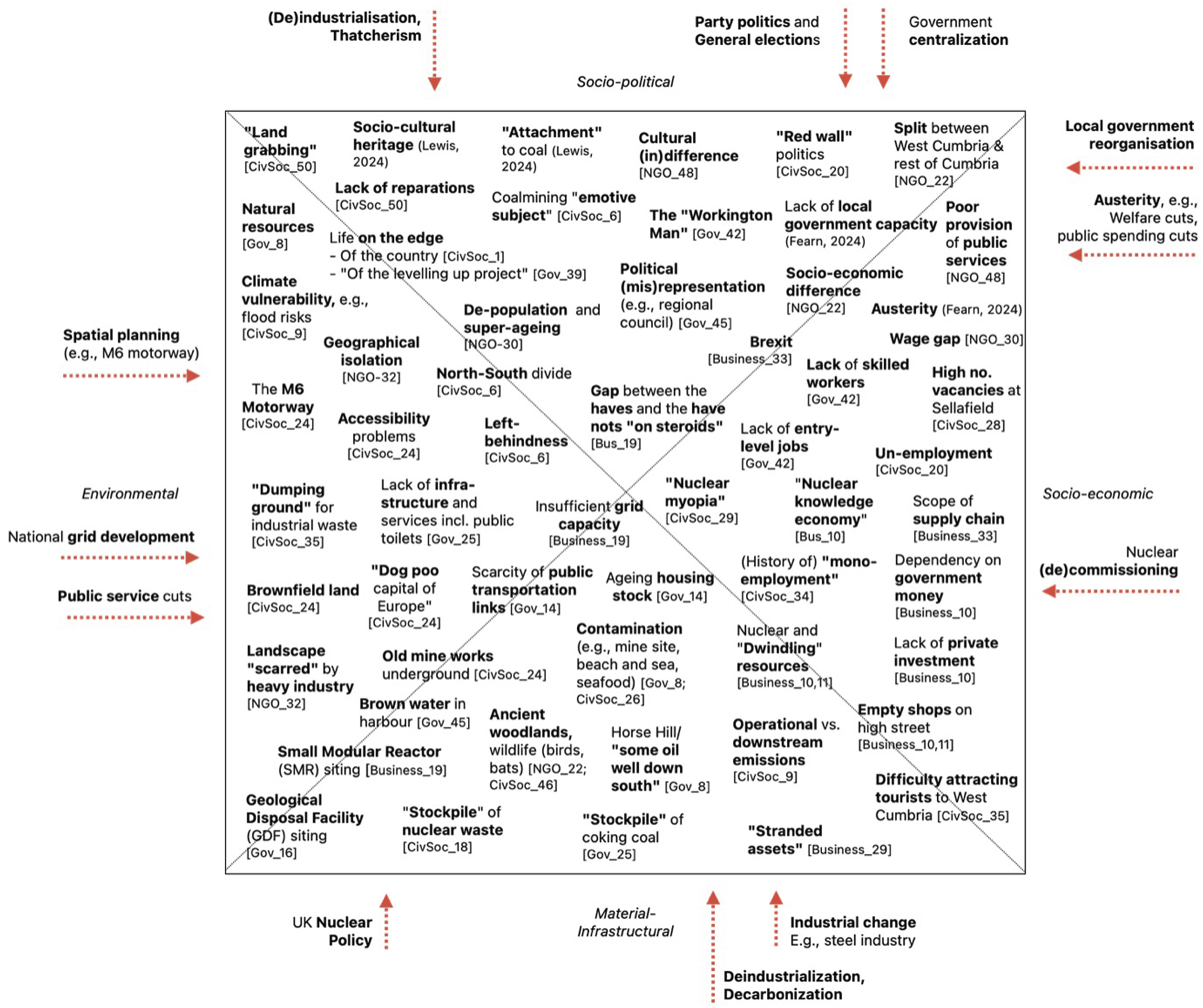
As Figure 3 makes visible, the question of the Whitehaven mine emerged in a context of both socio-economic and environmental deprivation, where a ‘stockpile’ of coking coal [Gov_25] sat unused beneath an abandoned and heavily contaminated brownfield site surrounded by a community of people who had fond memories of their coalmining past and the sense of community and ‘comradeship’ surrounding it [CivSoc_24]. In this situation, the coal that was left underground after the end of coalmining activity in the 1980s became seen as an economic opportunity more than anything. Consequently, it emerged as a planning problem which fell under the directorate of local authorities and later the (then) Department for Levelling Up, Housing, and Communities [NGO_60]. It therefore fell through the cracks of climate policy until it was mobilized by citizens and (grassroots) environmental groups who drew the connection between the mine, the UK Climate Change Act, and wider (inter)national policy developments on climate and energy (Willis, 2024).
But what this problem-complex also helps us see are the other, often peripheral, 3 problems that may be overlooked in more mainstream conversations about climate action, such as old coal reserves, new extractivisms, polluted places, birds and bats, dog poo, and the different social and cultural meanings attached to these. A climate policymaker reflected that ‘I don’t think [the Whitehaven case] impacted our directorate very much because … coal is an energy source that we don’t really deal with’ [Gov_37]. Other climate policymakers also commented that the case was beyond the scope of their directorate [Gov_36, 37, 38, 41], which centres on energy security and net zero. ‘We operate in fairly siloed ways’, stated a policymaker [Gov_41]. ‘There’s a box called the Planning Act, … and this act and the other act, and all of your decision-making is made inside those boxes … like you’re not allowed to use the Paris Agreement to make planning decisions’, a policy expert [NGO_39] explained. ‘In that sense, the [Whitehaven] coalmine isn’t remotely unique’, they continued, stating that ‘it’s just a really high-profile version of what’s happening all the time’ [NGO_39]. Real-world problems may fall between the cracks of government departments and their siloed approaches to policy and the problems that it is positioned to solve, which are reinforced through the division of tasks and responsibilities across government departments and other institutions (such as in this case, net zero and levelling up). Consequently, ‘not all problems become policy problems’ (Turnbull, 2006: 8), but they may well structure the opportunities and/or obstacles for ambitious climate action. This warrants that we expand the scope of climate action to also see, and respond to, these wider, place-specific problems which may seem far beyond those of climate alone.
Discussion and conclusions
As governments continue to pursue ambitious climate policies, it is important to ask which (kinds of) problems these policies are addressing. Our analysis of the social and political contestation surrounding a proposed coalmine in Whitehaven, West Cumbria, shows how problems related to climate change and action are contingent, contested, co-constitutive, and mutually reinforcing. They include more deep-seated, systemic issues such as austerity and the erosion of local government, but also more peripheral problems such as old and new extractivisms, polluted places, birds and bats, dog poo, and the different social and cultural meanings attached to these. Evidently, then, problems are not just sung into existence in the corridors of power (e.g. through the ‘political work’ involved in problem – and agenda setting) (Mintrom and Luetjens, 2017: 1373). Crucially, they may emerge in unexpected ways and places, and through the mobilization of different and differently positioned actors such as citizens, representatives, advocacy groups, incumbents, and/or litigators. Some of these problems may come to be ‘elevated’ as a topic of national concern, like the mine’s broader environmental and political implications (e.g. downstream emissions, climate leadership). Yet, others, like the derelict state of the proposed mine site and its role in the community, may not.
Examining the problem-complex (Figure 3) therefore reveals a much richer variety of interconnected problems that may be overlooked when we only consider how competing visions of ‘problems’ and ‘solutions’ are negotiated within the confines of existing institutions (Lahn, 2021; Livingston et al., 2018). Our findings therefore imply a need to broaden the scope of climate policy (research and practice) to these more peripheral problems that may otherwise fall between the cracks of headline policy domains and agendas, such as, in our case, environmental planning and climate policy (Di Marino et al., 2023; Fearn, 2024; Oseland, 2019; Willis, 2024). After all, although such problems may not necessarily count as ‘climate problems’ or even policy problems, they may nevertheless structure the opportunities and/or obstacles for ambitious climate action, such as in Whitehaven where coalmining became the only viable solution on offer for the derelict mine site and the state of socio-economic deprivation that surrounding communities find themselves in. In fact, this shows how problems (e.g. the ‘re-emergence’ of coal (Lewis, 2024)) may emerge as ‘solutions’ to other problems (e.g. social and economic deprivation), calling into question what (kinds of) problems climate policy is positioned to address and which it is not positioned to address. It warrants that we ‘break’ the silos around which climate policy is currently structured, notably climate, planning, and social justice (Di Marino et al., 2023; Willis, 2024).
More critically, it also implies the need to reconsider why and how, if at all, problems become policy problems (i.e. ‘about which we deliberate and search for a collective solution […] involving the state’ (Turnbull, 2006: 8). Our findings suggest that this is shaped in important ways by both discursive and non-discursive practices (such as reinforcing a coal-or-climate narrative or making the question of coal extraction one of downstream emissions) (Barry, 2021; Brown and Spiegel, 2019; Marres, 2007) which may be employed within and beyond the confines of existing institutions, such as through grassroots environmental action (Lahn, 2021; Marres, 2007). This requires closer engagement with contentious politics and social movements and the ways in which these may permeate the policy process (Verhoeven, 2021). But is also shows how other, often peripheral, problems (e.g. coking coal, chemical pollution) may be overlooked. As Barry (2021: 112) suggests, this means that we need to critically consider ‘the boundaries between what can and cannot be problematized, what can and cannot be rendered public, and what voices and arguments have and have not been heard’. For climate policy, this requires much more detailed attention to critical research on energy transitions and their cultural dimensions, which emphasizes the lived experiences and expectations of people and communities for whom climate and energy policy becomes a lived reality (e.g. Brown and Spiegel, 2019; Bulkeley et al., 2016).
But this problem-complex also opens the door to several questions that warrant further exploration. For example, how do these situationally specific problems (e.g. brownfield sites, old and new extractivisms) recast the solutions available within existing institutions, such as government departments and the division of tasks and responsibilities among them (Lahn, 2021)? And in which ways can these institutions be restructured to properly position themselves against such problem-complexes (e.g. by ‘breaking’ silos through horizontal and/or vertical integration) (Oseland, 2019)? For now, the provocation of a multiple, messy, ‘multi-layered problem-complex’ (Livingston et al., 2018: 83) should help us to at least consider the policies and politics of climate in a different light – one that puts them back in their place.
Footnotes
Acknowledgements
We are grateful for the feedback provided by Professor Harriet Bulkeley and the participants of the RGS-IBG London conferences in August 2023 and 2024 and for our conversations with the Climate Citizens group at Lancaster University in December 2023. We would specifically like to thank Pancho Lewis and Gareth Fearn for their invaluable contributions to the development of our knowledge of the case and express our sincerest gratitude to the people of Cumbria, who have given us a very warm welcome.
Declaration of conflicting interests
The author(s) declared no potential conflicts of interest with respect to the research, authorship, and/or publication of this article.
Funding
The author(s) disclosed receipt of the following financial support for the research, authorship, and/or publication of this article: This research was funded by the European Research Council (ERC) under the European Union’s Horizon 2020 research and innovation program (grant agreement 949332).
