



Abstract
Hands-on activities of shaping and maintaining urban public green spaces, in short, “stewardship,” have become a flourishing field of civic engagement. It is the aim of this article to find out how citizenship is enacted in the everyday practice of stewardship, and how such an analysis can benefit from theories of “material participation” and “practice.” It explores this theme through a case study of the greening of tree-pits in Berlin. The article asks: (1) how people, through their doing of stewardship, engage with the tangible places that they take care of, and (2) how connections between stewardship, its focal places, and other practices shape and sustain wider public concerns. Thereby, it identifies three intersecting and materially grounded “civic nexuses of practices,” which each imply specific constructions of citizenship: civic neighboring, managed volunteering, and political mobilization. It explores how each of these nexuses emerges from the convergence of practices around the tree-pit, and probes the tensions and conflicts that they entail. In contrast to authors who have either cherished stewardship as a form of citizen empowerment, or, in line with Foucauldian governmentality studies, as the formation of governable citizen-subjects, the article emphasizes the politically ambiguous dynamics through which stewards practice their citizenship.
Burgeoning interest in greening cities has manifested itself in new ways of public involvement of citizens. This includes various forms of active care-taking or “stewardship” (Fisher et al., 2015) through which residents have assumed an active role in the shaping and management of urban space. Sometimes, these are simple one-off actions such as removing litter from parks (Krasny and Tidball, 2015), but stewardship also includes longer-term projects which creatively modify urban spaces. Examples are tree-planting campaigns (Fisher et al., 2015), wetland management (Gearey et al., 2019), or community-based gardening and agriculture (e.g., Certoma, 2019; Certoma and Noteboom 2017; Corcoran and Joëlle 2017; Krasny and Tidball, 2015; Milbourne 2012; Torres et al., 2017). Stewardship can also refer to small-scale, and often illicit, forms of decorative planting which are sometimes discussed as “guerrilla gardening” (Adams and Hardman, 2014; Blomley, 2005; Pellegrini and Baudry, 2015; Reynolds, 2008).
Stewardship can be defined as “the act of an individual or an organization that takes care of the local environment” (Fisher et al., 2015: 8). Scholarly literature has claimed that the involvement of citizens in stewardship can produce a range of environmental and social benefits such as biodiversity protection, ecosystem services, and community building (Fisher et al., 2015; Krasny and Tidball, 2015; Silva and Krasny, 2016). Stewardship, however, is also an example of how the urban environment has become a site of active engagement with issues of public concern, where residents enact themselves as citizens. Existing work on stewardship has discussed these civic qualities mainly in an outcome-oriented perspective, focusing either on the capacity of citizens to produce publicly beneficial urban-environmental conditions, or, in more political terms, as either challenging or supporting dominant relations of neoliberal urban governance. This leaves unexplored how such outcomes are actually produced, and how they become a motivating concern for a wider public. As this article argues, this is a dynamic process of material-practical tinkering and meaning-making, in which different ideas of what counts as good places in the urban environment, and of how citizens should actively care for them, are locally constructed and contested.
Combining insights from Marres’ (2015) work on “material participation” and practice theory, the article advances a conceptualization of steward-citizenship as engagement in “civic nexuses of practices,” that is, dynamic concatenations of practices and tangible places through which stewardship interventions get connected with public concerns. It substantiates this perspective through a case study of Berlin which focuses on the greening of so-called tree-pits, that is, the small patches that are often left open in the pavement around street-trees. It is the aim of this article to find out how citizenship is enacted, and becomes consequential, in the everyday practice of stewardship. Therefore, it asks: (1) how people, through their doing of stewardship, engage with the tangible places that they take care of, and (2) how connections between stewardship, its focal places, and other practices shape and sustain wider public concerns.
The following two sections review existing scholarship on the relationship between urban-environmental stewardship and citizenship, and explain how Marres’ work and practice theory have inspired my use of the concept “civic nexus.” I will then introduce the case study and its methodology. The two empirical sections are each devoted to answering one of the two research questions. The conclusion will synthesize the results and discuss their contribution.
Stewardship as citizenship
Citizenship is understood here not only as the rights and obligations that are derived from formalized relations to the state, but more broadly as the active participation of individuals in public life (Dahlgren, 2006), or as what is often also expressed with the adjective “civic.” Fisher et al. (2015) have argued that stewardship engagement correlates positively with a range of civic activities, but also stewardship itself can be seen as an expression of citizenship. Thus, environmental philosopher Andrew Light (2003) has dubbed active care-taking of the local environment “urban ecological citizenship,” thereby taking citizenship to be “a virtue met by active participation at some level of public affairs” (2003: 51). Krasny and Tidball (2015) have used the term “civic ecology” to examine how stewardship initiatives transform neglected areas into valuable community spaces, and thereby nurture a collective sense of belonging. Such scholarship has also suggested that civic engagement can address urban-environmental problems more efficiently than top-down governmental policies, and that public authorities should take an active role in facilitating such activities (ibid; Fisher et al., 2015).
There is a tendency in this literature to identify citizenship with the achievement of unambiguous and scientifically measurable socio-ecological goals, which are somehow waiting for community-minded people, to be pursued. This contrasts with literature, which sees citizenship in relation to political conflicts about the production and governance of urban space. Authors who draw on critical studies of neoliberal urbanism, or the Foucauldian concept of “governmentality,” have interpreted steward-citizenship as the transfer of public tasks to communities and individuals (Brody and De Wilde 2020; Fraser et al., 2015; Pudup, 2008; Rosol, 2012). Accordingly, such politics operate through discursive and affective techniques which socialize people into citizen-subjects who accommodate themselves actively to the imperatives of governmental programs. Conversely, the term citizenship can also point to the political agency through which people claim socio-political rights (Isin 2008). Thus, work on community gardening as the assertion of the “right to the city” (Gilbert and Phillipps 2003; Purcell and Tyman 2015), “food citizenship” (Baker, 2004) or “DIY(do-it-yourself)-citizenship” (Crossan et al., 2016), has emphasized its potential to change established (neoliberal) ways of producing, using, and governing space. It has become a core question of empirical research which of these opposing modalities of citizenship certain stewardship interventions produce, or how they might overlap in politically ambiguous constellations (Certoma and Noteboom, 2017; Gearey et al., 2019; Ghose and Pettygrove, 2014; Hobsons and Hills, 2010).
There is a need for more empirical research on the pursuit of citizenship and its relation to urban governance, and also on stewardship interventions other than community gardening. Work on the political outcomes of stewardship has focused mainly on changing social relations, and has only paid little attention to the tangible material-practical content of stewardship practices, and on how this matters in the enactment of citizenship. This article therefore seeks to advance a more dynamic understanding of the materially grounded everyday processes in which engaged citizens and public concerns come into being, and of how citizens negotiate their concerns with each other and with governmental institutions.
Material participation, practices, and civic nexuses
Work on “material participation” (Marres, 2015) has offered a promising contribution for such a dynamic approach to citizenship (see also Ryghaug et al., 2018 on “energy citizenship”). In her discussion of sustainable living, Marres has argued that material objects or settings can play an active role in the performance of public engagement when they are enlisted into explicit attempts to tackle issues of a common public concern. Building on Latour’s (2004) concept of “matters of concern”, Marres describes this as a relational process in which engaged citizens, their bonding as a public, and the issue that they are concerned with, are mutually produced. Publics are thereby not only understood as arenas of discursive interaction, but as “material publics” that revolve around an object-oriented activity. Marres’ discussion has focused on technical devices that relate to abstract environmental issues, but as Certoma (2019) has shown, plants can play an equally political role when they are enrolled by community gardeners to publicly demonstrate alternative uses of space (see also Aalto and Ernstson, 2017).
It is an empirical question whether such combined social-material agency challenges or sustains established socio-political orders and governmental arrangements. As Marres has put it: “The same or a similar object may facilitate very different modes of engagement, and it may take on varying normative charges: participatory things must be understood as multivalent” (2015: 20). For the study of steward-citizenship, it is thus critical to understand how, and for whom, stewardship interventions become matters of public concerns as well as, which politico-normative understandings of the good urban environment they encode.
This article employs the concept of “civic nexuses of practices,” in short “civic nexuses,” to account for the entanglements of social practices through which such participatory meanings of stewardship come into being, and through which they are coordinated and negotiated across different situations. The concept complements an understanding of citizenship as material participation with a sociological approach which treats social life as the ongoing performance and interconnection of practices (Nicolini, 2012). Such sociological theories of practice share with Marres’ work an emphasis on the performative and material-relational constitution of social reality, but put specific emphasis on the situated meaning-making in conventionally organized practices. They thus allow us not only to understand how activities articulate public concerns, but also how these activities themselves are performed and connected. Combining considerations from different practice theorists (Nicolini, 2012; Reckwitz, 2016; Schatzki, 1996; Schatzki et al., 2001; Shove et al., 2012), we can understand practices as recognizable activities that involve embodied human “practitioners,” cultural knowledge in the form of skills and discursive understandings, and “materialities” such as instruments, objects, and socio-environmental settings. The doing of a practice is thus both at the same time: (1) meaning-making that organizes social action in recognizable cultural formats; and, (2) a dynamic entanglement of human doings with non-human materialities which either afford or constrain which course this action can take. Although practices, and their engagements with the non-human world, have often been described as routines, they also give room to creativity and variation (Knorr Cetina, 2001), and for moments of “reflexivity” (Halkier, 2010) in which the meaning and correct doing of a practice is an explicit matter of negotiation.
Practices, however, should not be treated as isolated entities with clear boundaries but as variously interconnected, and forming what Nicolini has described as “entrenched nexuses or nets” (2012: 232; see also Hui et al., 2016). “Zooming-out” and following the “trails of connections between practices” through which such nexuses form is thus as important as the focus on individual practices. Practice theorists have identified various ways in which practices can connect, including spatio-temporal proximity, the simultaneous involvement of the same “practice elements” (people, skills, or materials, understandings), and more complex relations of mutual interdependence (Hui et al., 2016; Shove et al., 2012).
An understanding of steward-citizenship as engagement in “nexuses of practices,” or more specially “civic nexuses,” leads us to an analysis in two steps which correspond to the research questions of this article. The first is an investigation of stewardship and its relations to the material environment as the engagement in a socially organized practice of caring for tangible urban places. It is to neatly describe what people actually do when they engage in stewardship, and how they thereby rely on, and reproduce, specific skills and understandings. This also includes attention to what Heuts and Mol (2013) have described as the systematic link between caring and valuing. Practices of care (in their case, of making and selecting “good” tomatoes) are always oriented to a certain “good” that they seek to sustain, and typically involve much creative tinkering to adapt these valuations to the conditions that they care of. For stewardship, this raises the question of which imaginations of urban-environmental “goods” are implied in these practices, and how their performance is dynamically entangled with the materiality (plant-life, soil, setting) of the places that they seek to make “good.”
The second task concerns the “trails of connections” with other practices, which articulate stewardship as a modus of civic engagement. Not all kinds of connections that exist between stewardship and other practices matter in this context, but only those that link the problematizations and positive imaginations of place that are enacted in the stewardship practices with a common civic concern. The focus needs to be on the practices which connect people as members of a local citizen-public, as well as on the administrative practices which seek to regulate or shape these activities and concerns towards governmentally sanctioned definitions of the common good. Tracing the situated dynamics of these connections can reveal to which extent civic concerns either challenge and transform, or are themselves formed by institutionalized governmental logics.
Others have argued before that plants and other environmental materials are not just passive objects on which society projects it values and imaginations (Gandy and Jasper, 2020), and have also applied practice theory to make sense of their co-constitutive involvement (Aalto and Ernstson, 2017; Certoma, 2019; Hitchings, 2003; Krasny et al., 2015; Maller 2018; Petersen, 2013). By taking plants and places as entangled with the practice of stewardship this article contributes to this agenda, but it also moves beyond such work by putting special emphasis on their structuring role for civic nexuses. 1 Building on Shove et al.’s (2012) conception of materials as connective elements between practices, stewardship sites and their plant-life are understood as locational “anchoring points,” around which such nexuses can form.
The study
In many cities residents and shop-owners have transformed tree-pits into beds in which they grow flowers, herbs, and small bushes, and as Pellegrini and Baudry (2015) and Strom (1990) have noted, thereby creatively engage with plants and places. This article focuses on Berlin, a city with a longstanding tradition of urban greening (Dümpelmann, 2019; Lachmund, 2013). Of its about 430,000 street-trees (Senatsverwaltung für Stadtentwicklung), many are planted in open tree-pits.
Besides direct street observations, the study relies on two types of sources. First, I collected information from websites, newspapers, and other documents that cover aspects of tree-pit planting. Second, in 2013 and 2014, I conducted 25 semi-structured interviews (lasting from 10 min to more than 1 h) with two groups of actors. For each group, I made use of a topic list, which was open enough to leave room for improvisation.
Eighteen interviewees were, or had recently been, active with planting. I asked them about their motivations, skills, practicalities of tree-pit greening, and their interaction with public authorities. Most interviewees were identified during street excursions in central neighborhoods in which tree-pit planting was common, covering both former East and West Berlin (Kreuzberg, Schöneberg, Neukölln, Treptow, Friedrichshain). They were either conducted in interviewees’ apartments, workspaces, at their tree-pit, and, in one case, per video. Getting into contact with these interviewees required some inquiry in the neighborhood. Five had either featured in media coverage, or had been referred to me by others, so that I could approach them directly. Although I had spontaneously approached most of the interviewees, it did not hinder them from talking openly about the practices that form the focus of this research. I avoided personal or status-related questions, which in this situation might have appeared too intrusive. While the interviews provided substantial insights into the practice of stewarding and its civic dimensions, this data would not be suited for an analysis of the socio-demographic composition of Berlin’s tree-pit stewards.
The other group were professionals who either were responsible for the administration of tree-pits or who gave advice to planters. It included administration officials of five Berlin districts (Kreuzberg/Friedrichshain, Prenzlauer/Berg, Spandau, Treptow/Köpenick, Tiergarten); and three representatives of the two NGOs (BUND and Grüne Liga), which promoted tree-pit planting in Berlin. These interviews focused on the interviewees’ general understanding of tree-pit planting, and on their own interaction with planters. Although I also approached other district administrations, they either did not react, or declined my request.
In addition to these semi-structured interviews, I also talked to 19 pedestrians (who I approached next to greened tree-pits) to learn about how other citizens related to these sites.
Most interviews were recorded and transcribed (in 2 cases handwritten notes were taken). An open coding of the material yielded a set of themes, which, for the purpose of this article, were further analyzed in a theoretically informed perspective. The empirical sections are structured along the resulting themes, which are substantiated through condensed descriptions and exemplary quotations. The quotations are anonymous (planters and pedestrians are individualized by their consecutive numbers of interviews) and have been translated from German to English.
Stewarding tree-pits
When trees are planted on the sidewalk, the ground above the root-area, the tree-pit as it is called in urban horticulture, is often left unpaved, forming a square-cut patch of open soil. Formally, trees and their pits fall under the jurisdiction of the 12 districts. This has not prevented tree-pits from becoming popular sites of civic greening, as the author, who lived in Berlin in that period, was able to witness from the late 1990s. Creating beds on tree-pits is almost exclusively a phenomenon of the densely built-up, yet highly appreciated, urban apartement housing areas (now partly transformed into condos) from around 1900, where street-trees have always been a major form of public green (Dümpelmann, 2019) Figure 1.
The tree-pit planters who I identified, either lived in the adjacent houses, or worked there in shops, restaurants, or street-level office-spaces. Some plantations formed part of neighborhood initiatives and/or were facilitated by an NGO or the district administrations. Men and women were equally represented among the planters, and besides a student and two elderly people, they were all in the middle of their working lives. As far as occupations were identified, these included a teacher, a lawyer, a joiner, a kindergarten assistant, a web-design intern, retailers and a restaurant owner. Seven of the 18 planters planted a tree-pit in front of their workspace. In an area with a big Turkish immigrant population, I only got into contact with one interviewee (a grocer) who happened to be of Turkish background.
2
Yet, the composition of my interviewees suggests that the population of tree-pit planters extends beyond the young, creative middle-class with which tree-pit planting is often associated. Planted tree-pit in Berlin. Photo by author.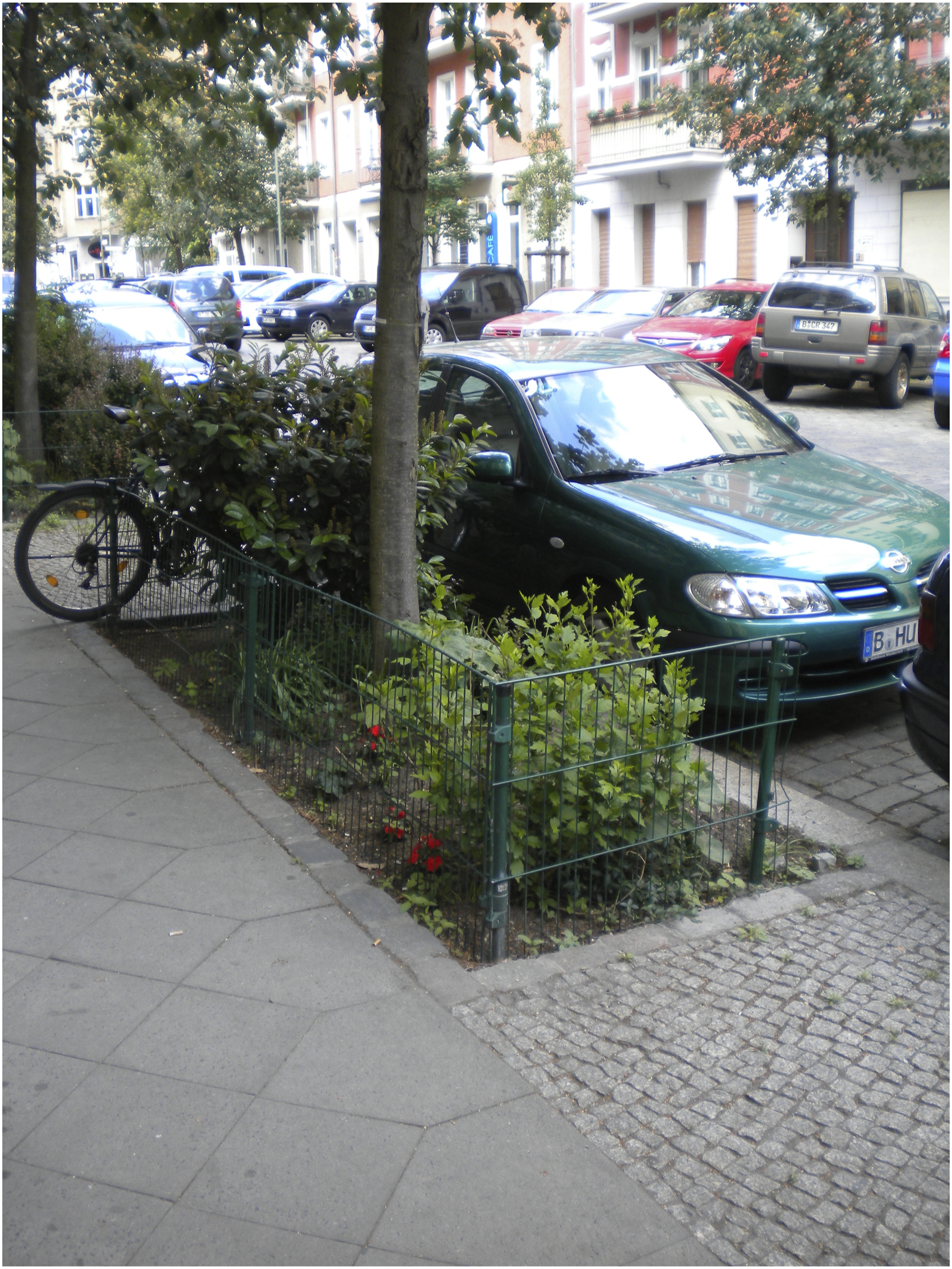
The interviewees built on, and perpetuated, a collective understanding of tree-pit greening, why it is valuable, and how it is performed appropriately. They sometimes talked about the tree-pit as a “bed,” or had become familiar with the technical terms “tree-pits” and “tree-pit planting/greening” (Baumscheibenbegrünung/bepflanzung). All this makes tree-pit greening a recognizable practice with specific elements and boundaries, but at the same time also leaves much room for individual creativity and variance. Civic concern for street-trees had articulated itself in Berlin in repeated protests against tree-cuts, and complaints about mismanagement of street-trees (Dümpelmann, 2019). It is this widespread concern for trees, but also for the valuing of order and beauty, which orients tree-pit planting and which underlines its character as a caring practice. As planter 11, a middle-aged lady, put it: I find it simply unaesthetic, these tree-pits, lying around [original: herumdümpeln] there in such a dry state. They are always covered with litter, and are dirty and full of dog-shit. (…) I actually never liked them. And it does not seem to benefit the tree either.
Interviewees complained especially about the supposed misuse of tree-pits as “dog-toilets,” and littering. They also assumed that the trees suffered from the excrement of dogs and humans, and from the habit of placing bikes against the trunk, and claimed that their beds protected the tree against such encroachments. At the same time, they considered their tree-bed as an aesthetic improvement of their neighborhood, and some also claimed that they were of benefit to bees and other insects.
Tree-pit greening can be seen as an offspring of the established practice of gardening. Some interviewees had already tended private gardens or allotments, or had kept indoor plants, and they took their skills and passion from this. Two interviewees also engaged in guerilla-practices such as “seed-bombing” or in community gardening projects. Tree-pit greening, however, does not just reproduce a ready-made practice in a new space. It rather consists of innovative ways of articulating existing and newly invented elements of gardening practices with the care-oriented valuing of tree-pits and their trees. This includes the employment of materials, plants and skills, and the accounts that practitioners produce about their actions and their object, as well as the affective relationships that connects them to “their” tree-pit. Their small size, the presence of the tree, the poor quality of the soil, and encroachments of street-life, make the tree-pit a difficult place for gardening.
Most planters engaged in preparatory groundwork before planting their bed. They cleaned and loosened the soil, or added topsoil, for example, by creating a raised-bed with a wooden surround. Many planters sought to protect their beds with fences or by placing stones around it. When they belonged to a café, or were meant to serve as community meeting points, fences were sometimes constructed as benches. Interviewees had purchased their plants from retailers or received them as gifts from friends and neighbors. Interviewees also expressed their preference for plants that were cheap, required low maintenance efforts, benefited insects, or were edible. A widely shared goal was to create sceneries that were aesthetically appealing, and which gave their tree-bed a personal touch. In general, design choices could be either more pragmatic or fastidious, depending on the effort of time and money that people were willing to invest.
Once the tree-pit was planted, gardeners remained busy with regular maintenance such as watering, weeding, removing leaves, and a more intensive replanting at each spring. One interviewee (planter 5, male) even compared caring for a tree-pit with having a “second pet” (they had a cat). The comparison with a pet also shows that planters develop a sense of ownership, and a close positive affection to their bed. Indeed, some planters live with their beds in complex affectual ways, which include, beyond the personal effort of shaping and maintaining them, also their daily experience of the beds, for example, when leaving or entering their house, or when viewing them from their windows or balconies. Another side of this same coin is that planters felt deep frustration when they experienced “theft” or vandalism. Notwithstanding these examples of strong affective bonds, tree-pit greening can also be a more occasional or temporally limited commitment. Thus, two interviewees had just given-up their tree-pit because, after an intense phase of engagement, they felt unsatisfied with the results.
Even when gardeners sought to shape tree-pits according to their preferences, these were rarely the linear outcome of a predefined design. Notably, the more fastidious gardeners were engaged in quasi-experimental processes in which their ambitions and the socio-ecological trajectories of the sites shaped each other: And a lot I received as a gift from others – a colleague who has a garden has brought me quite a lot. Also quite a lot has appeared on its own I think. I always had to pull out quite a lot. At the moment it is quite wild indeed, because it is abundant this growth of the plants, and also because, to some extent, I just want to see what is growing there. (Planter 6/female) One year for example, I planted pots with Signet Marigold (…). When they blossom, that is a dream! (…) They nicked the whole plant. Because it was so beautiful! And then I had learned: Ok (…). If it is too beautiful, then people will take it out (…). If one plants for example Mugwort or, Marjoram - Wild Marjoram, nobody will take it out and one can’t eat it anyhow because the dogs piss on it. And then we discovered that it is also good for insects. When it is blossoming, it also presents itself as a beautiful carpet. (Planter 2/female) I wanted anyone to see that something that could be eaten was growing there. I would not eat it, not eat the tomatoes that grow down there, but when there are tomatoes growing next to me, it changes my mind (...) (...) Down there I also planted some seeds of a special sort, ‘Stuttgart grapes’, which didn’t really thrive. Something that really worked there was a tomato plant, a seedling from Rewe [a supermarket], that was the strongest plant. What else did we plant there? Runner beans. But these are all things that sooner or later withered, because eventually we did not water them enough. (Planter 18/male)
It was only through their sustained engagement with their bed, that planters learned what “grew” there, and what was likely to survive the permanent threat of theft, and one’s own inobservance. This reveals markedly how its non-human components, the site and the plants, actively participate in the performance of tree-pit planting: evoking nuisances and facilitating pleasures, opening-up and closing down common pathways, and mutually shaping each other as skillful knowers and knowable urban natures. The “good” of their caring practice, the well-cared for state of a tree-bed, was not independent of this quasi-experimental dynamic, as gardeners adapted themselves continuously to the ecological restrictions and possibilities of the site.
Forging civic nexuses
In which ways can we understand this mutual engagement with tree-pits as an enactment of citizenship? To answer this question, this section follows the “trails of connections” that draw its active practitioners, and also other residents, into three distinct civic nexuses. It argues that the visible presence of tree-pits in public space, and their various experiential and politico-institutional dimensions made them pivotal anchoring points around which such nexuses could assemble. The section describes how each of these nexuses nurtures a commitment for tree-pits as a common public issue, and of their planting as a mission for some putative collective good.
Civic neighboring
“Neighboring” refers to mundane acts of sociability and mutual support between residents and regular users of an urban area (Laurier et al., 2002). It can be described as a civic nexus, “civic” neighboring, when residents do not only help each other personally, but seek to address a matter that they understand, and feel affected by, as a collective. Such a nexus forms around the visible and experiential presence of the tree-pit in the collectively shared streetscape, where sensibilities and valuations of tree-pit planters converge with pre-existing practices of inhabiting a neighborhood.
Even if tree-pit planters might be primarily interested in improving their private living environment or business, this motive co-exists with a broader normative commitment to collective care-taking for the neighborhood. Planter 12, the owner of a small curio shop, who adopted a tree-bed from a resident next door, declared quite explicitly: But I find it very nice that citizens, self-confident citizens in a city, take care of their own surroundings – (and) feel responsible for what happens in front of their doorsteps.
This sense of a common mission results not at least from the dynamic latching on, or “snowballing,” as planter 4 (female) called it, through which planters of the same neighborhood make themselves mutually visible as a public of concerned and responsibility-taking citizens. As another interviewee, who had planted a tree-pit with other residents of his apartement house, described: Right after we had started, there was something here and something there. This has obviously dropped off recently. But one felt: it is somehow continuing in the street. When one is going about it, others will also begin. (Planter 10, male)
Planters also connected through discursive neighborhooding practices, for example, when exchanging experiences, or when planting a tree-pit with other residents from their house. Some planters built quite stable networks, held meetings, exchanged tools and seeds, and represented themselves collectively in negotiations with public authorities. Planting tree-pits sometimes converged with other community activities, including for example, a so-called annual “tree-pit festival” that activists in the district of Treptow have been organizing since 2013 (Baumscheibenfest, 2017).
Civic neighboring also takes shape through the interaction with neighbors and other passers-by, who are not themselves planters, but who recognize and credit the citizenship of the planters, and thereby enact themselves as receiving co-citizens. In my interviews, pedestrians shared the uneasiness of planters about the disorderly state of unplanted tree-pits, and described their encounters with well-kept tree-pits as aesthetically pleasing. Likewise, stewards reported that they received positive comments when working on their tree-pits, and that neighbors supported them with gifts. That dog-walkers tended to “pay attention” (Planter 5) and kept their pets at bay, suggests the emergence of some protective etiquette around tree-beds.
Through its visible ubiquity, tree-pit planting has also converged with the codes according to which inhabitants value and problematize urban spaces, and identify with their common neighborhood. Both planters and supportive pedestrians cherish an alternative aesthetic of public spaces that displays individual self-responsibility and expressivity, and which contrasts sharply with the supposed “uniformity” of conventional public greeneries. As planter 4 (who tended two beds, one at her flat, one at her embellishment shop), put it: “what I also like is just the diversity, the different layouts of the tree-pits,” and pedestrian 14: “I just like it when it is not uniform.” Also, organized competitions such as during the Treptow tree-pit festival where neighbors can rate tree-beds, revolve around an appreciation of the aesthetic creativity of individual planters.
While civic neighboring connects planters and neighbors around a concern for a well-cared neighborhood, this nexus also creates tensions and conflicts. One reason is the clash between tree-pit planting and some established urban practices such as putting bikes against a tree or letting dogs defecate (see also Pellegrini and Beaudry, 2015). Tree-pit planting and the normativity of neighboring made them a form of vandalism. Planters reported fierce struggles with individual dog owners, which involved heated argument. Occasionally, I also discovered postings which planters had pinned to the tree, and with which they urged dog owners to respect their bed. The disrespectful dog-walker thus figures as the negative counterpart of the responsible neighborhood-citizen who either actively cares for, or enjoys and respects the greened tree-pits.
Another source of tension is the widespread association of tree-pit beds (both among interviewed residents and officials) with the lifestyle of a few “creative” neighborhoods with their supposedly high proportion of young and ecology-minded residents. While many interviewees obviously identified themselves with this cultural image, other residents perceived tree-pit planting as a takeover of public space by a group to which they did not belong. Thus, in a local newspaper, a journalist mocked incompetent “one-day gardeners” who were only interested in self-presentation, and who “with great words and gestures,” announced the “neighborhood-revolution” (Nestler, 2016). In my interview, an older resident of a neighborhood, which was undergoing increasing gentrification, noted that only the “new people who have moved here, put bluntly, the eco-ladies, sometimes plant something” (Pedestrian 18, male). He contrasted this to the poorer high-rise settlements at the periphery in which nobody planted tree-beds at all. In another neighborhood, planter 3 reported that their tree-beds had raised hostile reactions from people who feared that they would contribute to further gentrification. Planter 10, a lawyer, even decided to give up his tree-bed because he felt that it only benefited the ground floor apartment that, to his dismay, the owner rented out to tourists. The quoted statements make clear that changes in the social composition of the neighborhoods have made it less self-evident for whose good stewards are actually catering, and that civic neighboring, therefore, might enforce experiences of social exclusion. Although it is beyond the scope of this article to measure the actual impact on gentrification, one might wonder if similar mechanisms are at work here, as McClintock (2018) has identified in US urban agriculture, where the dominance of a socially exclusionary “eco-habitus” resulted in the cultural and economic valorization of neighborhoods with community gardens. Even if the actual socio-demographic composition of the planters is more fuzzy, their unequal distribution has made tree-beds iconic markers of trendy neighborhoods.
Managed volunteering
In managing streets and their trees, district administrations are oriented to the maintenance of “public order” of the street and of tending tree-pits in line with the state-of-the-art of professional horticultural knowledge. The competition of planters’ and administrators’ practices of keeping and claiming control on these sites, has spurred a trail of connections which has resulted in a second civic nexus: Volunteering schemes that guide the public engagement of citizens toward an administratively sanctioned common good.
Until some years ago, it was the state-of-the-art view in Berlin’s professional horticulture that tree-pits should be free of any vegetation (Balder et al., 1997: 108; GALK Berlin, 2011: 14–16). Tree-beds and the fences that many gardeners erected around them were seen as obstacles for the pedestrians, parking car-drivers, and street cleaning services. Likewise, administrative tree-inspectors who regularly checked the health of the trees could no longer examine the roots. Administrators also feared that tree-pit gardeners might damage tree roots, or that their plants would deprive the tree of light, water and nutrients. A special concern were fences that café owners constructed as seats for their clients, which allowed them to avoid the obligatory fee required for the placing of terrace seats. All this chimed with a normativity of “pedestrianism” (Blomley, 2011)—that is, the valuing of sidewalks primarily in terms of their ability to afford the unencumbered flow of pedestrians. In various cases, these tensions between administrative practices and residential stewardship practices even led to the removal of such plantations.
When I conducted my interviews, most districts accepted that tree-pit planting can have positive effects on the tree and on the neighborhood, and tolerated or even promoted it as a form of civic responsibility taking. As one district administration announced: We want to alert you, that as engaged citizens you have the possibility to contribute something to the beautification of our district by planting tree-pits in the public space of streets. Public resources are scarce, and we appreciate your engagement (…) Should we have raised your interest, please contact the green-space administration of the district and help enrich our streetscape with many planted tree-pits. (BA Treptow-Köpenick, 2015, presumably)
Such managed volunteering chimes with a political climate of neoliberalism in which public tasks are delegated to private actors, including volunteer citizens (Rosol, 2012). Already from the 1990s, the administration had to deal with budget cuts, which, as officials emphasized during my interviews, forced them to reduce the care for parks and trees. This was the reason why citizens had already been encouraged to donate for tree plantations, or to become “tree godparents,” and to take responsibility for cleaning tree-pits and watering the trees in hot summer periods. In the case of tree-pit stewardship, however, the administration did not simply delegate a pre-existing task to the citizen. They rather acknowledged and legitimized a practice that had already evolved independently from them. At the same time, the administrations engaged in practices of “formalization” (Warde, 2016: 46, 84–99), through which they sought to control the performance of tree-pit planting. As one official put it in my interview, one had to make sure “that things don’t get out of hand [aus dem Ruder laufen],” or as another said, “the tree has to be the boss in the tree-pit.” Such concerns became particularly urgent after 2013, when a tree-pit plantation was supposed to have caused a tree to fall.
Formalization occurred in the form of standards of good practice, which the administrations distributed via leaflets, websites, and direct communication with citizens. These standards restricted the choice of plants, provided for a minimal distance between plants and the pavement, and forbade gardeners to dig deep or knock piles into the ground (both to avoid damage to roots, pipes and wires) or raise the ground level (to protect the tree from dying). In order to keep the roots visible for regular inspection, it provided that the foot of the tree had to remain uncovered, and no pots and plants should be placed in the tree-pit. In 2010, the NABU (Naturschutzbund), a local NGO, had already published a list with such recommendations (NABU, 2010) The definition of these rules however, was surrounded by quite some degree of cognitive uncertainty and, although a working group had developed standards that were supposed to be used in the whole of Berlin, the various districts retained much leeway to handle these issues in their own way.
This was complemented by a formalization of the relationship to the planters who were asked to register as so-called “tree-pit godparents,” a scheme which expanded the earlier existing practice of harnessing “tree godparents.” Such formal registration eliminated the former communicative asymmetry between planters and officials where, as one official described, he “catches the people only at the moment that they complain.” At the same time, these schemes transformed their relationship into a set of rights and obligations, which were either defined in a contract or implicitly agreed upon, through registration for the scheme.
Although these administrative practices sought to purposely reshape tree-pit planting and its meaning of the common good, involvement in volunteering schemes left room for negotiation and subversion. Lack of personnel hampered the actual implementation of these strategies. Thus, during the time of my interviews the district of Kreuzberg-Friedrichshain had to cancel the registration of god-parents, although it still supported this policy. Some interviewees only learned about registration and planting rules when I asked them about this.
When it comes to standards and contracts, planter 6, who had planted a tree-pit with colleagues in front of his web-design office, explicitly rejected them as overtly bureaucratic and demotivating: I think that eventually, whatever it is that happens on the tree-pits can actually only be positive (…). Well, if the city now imposes some restrictions on people who take on god-parentship – I think than they will be shooting themselves in the foot. We simply did it. When now a fusspot [Originally: dackel] from the bureaucracy appears - my god! Then the municipality is beyond help.
Planter 12, revealed how he abided creatively with the rules by following them partly, while neglecting other aspects: ...I believe that there are certain limits that one must not transgress. And these I respect (…) For the rest I will just wait-and-see. A women here next door who has a flower shop once told me that everything seemed to be allowed which does not lignify. Thus, hortensias [he is pointing to his hortensias] are not allowed because they lignify. They could get me into trouble.
Another form of contextual negotiation has been described by the two professionals at the Berlin NGOs who consulted tree-pit planters. As they both told me, they sometimes acted as advocates of tree-pit planters who came into conflict with the administrations, and helped them reach pragmatic agreements which considered the perspectives of both sides.
As does civic neighboring, managed volunteering positions tree-pit planters as active citizens who take responsibility in the maintenance of a putative common good of their neighborhood. The bundling of tree-pit planting with administrative practices of coordination, however, works against the experimental openness and creativity that has characterized the original practice of tree-pit planting. These administrative practices did not only redefine the boundaries of the common good that was at the normative horizon of tree-pit caring, they also implied an understanding of the planters’ good citizenship in terms of their compliance with administratively organized expertise and protocols. This did not prevent the bundling of these two practices from creating tensions and conflicts, which were often only worked out through pragmatic arrangements.
Political mobilization
While civic neighboring and managed volunteering co-exist as stable civic nexuses around tree-pit planting, the third nexus, political mobilization, assembles only under particular circumstances. This happens when the encounter between planting and administrative practices at the tree-pit provokes unsurmountable confrontations, and when these tree-pits thereby, become socio-spatial anchoring points around which planters and their constituencies orchestrate their practices of public dissent.
A few interviewees drew explicitly on the imaginary of “guerilla gardening” (Reynolds, 2008) to frame tree-pit planting as an act of political resistance. For planter 18, a student, it was “a form of revolution” when he and his fellow planters, “don't care a shit about what is allowed and what is not.” Another, a young woman, had put signboards next to her bed which labeled it as a “political tree-pit,” and which declared the street a “zone planted by the citizen” (with ironic reference to the signpost that formerly marked the border between East and West Berlin) and reported on it in her blog.
When neighbors and planters witnessed repressive interventions from the administrations, tree-pit planting connected creatively with established practices of protesting. Planters experienced such interventions as encroachments into their own turf, and this kindled moral outrage, as described by planter 2, a woman who lived in a street where many neighbors had inspired each other to engage in tree-pit planting: And then these people from the administration came, and they cut down everything to this height [points close to ground]. When we came back home in the evening, we were shocked. Then I made a gigantic fuss, rounded everyone up, and said that I wanted an on-site visit to be arranged. Then the people from the district came and were really irritated as we stood there with 30 residents.
It is impossible to estimate how often such experiences resulted in frustration and disengagement. Many citizens, however, approached the administration with their complaints, and, as described in the quoted interview, mobilized neighbors or other planters to voice their concerns collectively. The tree-bed itself was thereby, not only the object of claims, but also the venue around which people and practices connected. It was at the damaged tree-bed where people assembled and collectively witnessed a common issue, where they confronted the administration, and the continued act of planting tree-pits as such became a way of asserting civic claims for spatial control. Most fundamentally, however, the shared affective relationship to the tree-pit that emerged from the involvement of residents in the nexus of neighboring practices provided the basis of collective concern and political mobilization.
Protest against clearances could spiral into broader public campaigns. For example, in Summer 2010, in the district of Treptow, the civil engineering department erased tree-beds that residents had created in their street. The planters who had already formed a loose network of neighborhood activists reacted with a spectacular action (“commando garden gnome”), which played with the ironic image of the “gardening guerrilla.” Dressed-up with camouflage caps, they drove up in front of the authorities’ building, dug-up the front lawn, and planted this with colorful flowers. Again, a gardening site, although not the tree-pits themselves, became the physical venue around which protest organized.
The administration removed the plants immediately and recreated the original lawn. However, by that time, a supportive live-report on the protest had been broadcast on TV, and sympathizing articles were published in the local press. Activists themselves spread their concern with flyers and via internet. It was not at least through the use of irony, both in the “guerrilla” action itself, as in coverage in the TV-report (“Now the terror has also reached Berlin,” “flower terror”), which ridiculed the districts’s policy as an act of stubborn and narrow-minded bureaucrats who obstructed citizens who were doing their best for their neighborhood (RBB, 2010). Eventually, the district parliament nullified the decision and declared that tree-pit plantations were accepted in Treptow (Berliner Kurier, 2010). This shows how the involvement of planters in the nexus of political mobilization forced district administrations to develop a more tolerant stance, although tree-pit clearances continued to cause public controversy (Der Tagesspiegel, 2017).
While political mobilization is more short-lived than the other two nexuses, it connects tree-pits with a much broader set of practices, including public address, spontaneous protesting, organized neighborhood activism, critical media coverage and parliamentary debate. The links thereby include both the direct connection of doings at the tree-pit (or, as a proxy, the lawn at the administration), as well as themes and values of tree-pit planting with discursive practices in the public sphere. Tree-pit planting was thereby not only understood and valued as a common public good, but also a claim, through which socially variegated publics challenged, and were partly able to transform, established modes of administrating urban space.
Conclusion
This research has sought to contribute to an expanding literature on stewardship and the ways in which it can shape citizenship, or “civic” relations. It has argued that theories of material participation and social practice provide a useful lens for such an analysis, and has proposed civic nexus as a sensitizing concept that brings these perspectives together.
The empirical case study has revealed that residents who care for tree-pits engage in a socially recognizable yet highly variable practice, which connects gardening skills, a sensitivity for the needs of trees, and understandings of street order and civic responsibility. Furthermore, it has detailed how tree-pit greening converges with three sets of surrounding practices—sharing a common neighborhood, administering public space, and political protest—to form distinct civic nexuses. In both respects, the study has identified the material setting of the tree-pit as the pivotal anchoring point that enables and connects these practices. It is the proximity to, and affective relation to, a particular tree-pit that draws planters into the practice of greening, and the performance of the practice relies on the mutual interaction of planters, users of the street, the material conditions of the site, the street-trees, and the plants which are planted at the site. For the three nexuses, it is the tree-pit where practices and people connect, where they exchange meanings and understandings and where they articulate, but also contest, wider public concerns.
The concept of civic nexus is helpful because it highlights that citizenship is not simply the result of pre-existing virtues, or the force of governmental rationalities. Rather, it sensitizes research to how public concerns emerge from, and get stabilized through the situated work of forging connections between the practices of tending sites and a number of surrounding practices. Such alignments benefited from, but were not determined by, pre-existing normative understandings about citizens’ collective responsibility for their area, the putative value of urban greeneries, and more specifically about the adequate aesthetics of creative neighborhoods. The case study has also highlighted the tensions that can occur between these adjacent practices, such as the clash, with other ways of using the street, with fears of gentrification, or with conflicting professional understandings of public order and good tree-care. The public visibility of tree-pits, however, unsettled the self-evidence of these adjacent practices and understandings, and occasioned situations of reflexivity and negotiation in which mutual alignments could be forged. Tree-pit planting, thereby, exemplifies the potential of stewardship practices to occasion shifts in the normativities of the public order of urban spaces and the public role of citizens.
These results contribute to a nuanced understanding of the relationship between urban-environmental citizenship and governance. Tree-pit planting is neither a radical “act of citizenship” (Isin, 2008) that calls neoliberal orders into question, nor does it simply execute politico-administrative agendas. Instead, it reveals that the same stewardship practice can connect in different nexuses of public involvement, which each constitute contradicting, yet overlapping forms of government-citizen relations. In this sense, tree-pit planting differs from stewardship practices such as park cleaning or watering trees, which might indeed simply reproduce existing authoritative definitions of the public good. Even if tree-pit planting emerged explicitly as a counterpart of (as civic neighboring), and occasionally involved confrontations with, political authorities (as political mobilization), it has been embraced by local authorities, and worked into administratively managed volunteering. Tree-pit planters could step in for what financially curbed administrations were no longer able to provide, and their concerns about dogs and litter resonated with governmental visions of public order. The smoothness with which tree-pit planting was incorporated into formal governance, however, should not distract from the frictions that continued to exist within and between such nexuses. At its heart, tree-pit planting remained a creative bottom-up practice and administrations could only wield limited power of control over its conduct. This has made the sponsoring of citizen stewards an ambiguous strategy, and administrations differed by taking either a more restrictive or a permissive stance. Although these uneasy relations with governance will persist, they do not seem to prevent the further reproduction of tree-pit planting as a stewardship practice, and as a way of engaging with public understandings of what makes good urban places.
Footnotes
Acknowledgements
I want to thank my interview partners for sharing their experiences with tree-pits, and all the colleagues who commented during conference sessions and workshops on earlier versions of my argument. I am particularly grateful to Ruud Hendriks, Veerle Spronck, Zahar Koretsky and three anonymous referees of this journal. I also thank Byron Evans for his help with copyediting.
Declaration of conflicting interests
The author declared no potential conflicts of interest with respect to the research, authorship, and/or publication of this article.
Funding
The author(s) received no financial support for the research, authorship, and/or publication of this article.