




Abstract
This article extends analysis of sub-regional governance dynamics, focusing on local institutions in Eastern England in the period from 2010 to 2020. Building on Third Phase Institutionalism and the growing interest in the impact of agency, the paper shows how the narratives, practices and rules of governance institutions both shape and are shaped by the varied strategic ambitions of local actors. Thus when particular objectives of ‘recognition’, ‘investment’ and ‘control’ were pursued by local actors there was a reinforcing relationship with positive narratives, collaborative practices and stable rules. Alternatively, though, institutional constraints may emphasise other strategic objectives such as preserving or advancing the power of preferred institutional structures, together with an associated limiting of narratives and practices.
Introduction
In 2015, an OECD report discussed factors that make a ‘successful city’, giving particular weight to issues of governance. It recognised the importance of “governance structures (taking) functional realities of metropolitan areas into account”, arguing that: Prerequisite for well-functioning cities are effective governance arrangements that fit the situation in a city and its surrounding areas. Good governance structures form a foundation that helps policy makers have the necessary information, the required powers and the proper incentives to make decisions that are best for a city. While good governance structures are no guarantee for good policies, it is very difficult to design and implement good policies without them. (OECD, 2015, emphasis added)
The report also notes that in many areas governing institutions often “cannot be considered fully fledged local governments because they are not a legal tier of government… although they tend to be institutionalised by national laws… they often emerged bottom up through local initiatives” (OECD, 2015). This is very much the case in the smaller city regions of England.
Sub-regions don’t necessarily match hard lines on maps, but despite being hazy in definition and outline, clearly exist in some form (Harrison, 2012). Surveys of identification with place have shown that identification with a city is as strong for those that live near as it is for those that live in it (Goess et al., 2016; MORI, 2000). Yet it is where the urban areas of cities merge into a rural hinterland that some of the greatest challenges exist in terms of planning and governance arrangements.
The Eastern Region of England provides several such places, and it is the focus of this research project. Cambridge, Norwich and Ipswich are three of the largest urban areas in the region, but in each case the boundaries of their formal governance structures are considerably smaller than those urban areas, making each examples of underbounded cities (European Commission Urban Audit Project, 2011). The result is that each has developed a larger sub-regional imaginary – Greater Cambridge, Greater Norwich and Greater Ipswich – that actors in each area promote or deprecate according to their political and strategic objectives (Valler et al., 2023).
These imaginaries are typical of such sub-regional spaces globally, meaning that the lessons from this study can be applied – with appropriate adjustments for specific local contexts (Hutchinson and Eversole, 2023; MacKinnon et al., 2019; ) – universally, mirroring the way that multilevel governance theory, for example, has been applied beyond its original focus on the European Union to other regions and as a basis for more general theories of state transformation (Tortola, 2017).
Acknowledging the increasing importance of local governance, recent years have seen the development of complex and fragmented spatial imaginaries and the theoretical tools to analyse them (Allen and Cochrane, 2007; Brenner, 2004; Cox, 1998; Harrison, 2013; Paasi, 1986; Valler et al., 2023). In England, particularly since the 1990s there has been an ongoing period of institutional upheaval in English sub-national governance, including the most recent governance experiments underway through Mayoral Combined Authorities, Devo-deals, County Deals, unitary councils, and ad hoc semi-formal arrangements such as the Oxford-Cambridge Arc (now ‘Oxford-Cambridge Pan-regional Partnership’) (see Valler et al., 2023). In parallel, studies of sub-regional institutions have formed part of the development of theoretical models, such as the ‘assemblage’ of actors that constructed the Milton Keynes sub-region (Allen and Cochrane, 2007) or the network of national, regional and local actors which formed a sub-regional growth coalition in Greater Cambridge (While et al., 2013; While et al., 2004).
Despite nearly three decades of experiments around sub-national institutional governance, however, conceptualisation of associated governance dynamics remains limited. Indeed, the processes which underpin change (or stasis) in sub-national governance remain largely hidden, in contrast to the more extensive characterisation of resulting governance configurations (Bristow, 2012; Deas et al., 2021; Johnson et al., 2023; Roberts, 2020; Waite and Bristow, 2019). While models incorporate the concept of agency to a greater or lesser extent, questions of strategic calculation and action are less clearly understood. This gap is beginning to be the subject of examination and theorising, in particular in the context of regional development studies, but the tools with which to carry out that examination are not yet fully developed (Grillitsch, 2015; Grillitsch and Sotarauta, 2020; Huggins et al., 2023; Sotarauta, 2017).
The objective of this paper is therefore to examine the interplay between emerging sub-regional institutions and the various local actors operating strategically within and through those institutions. The focus is on the reciprocal relation between the strategic objectives pursued by local actors and the pattern of institutional evolution. While actors pursue particular strategies in these case studies, the framework that is proposed can be deployed in other contexts, with distinct strategies emerging in response to particular opportunities and constraints.
Locating agency and dynamics in sub-regional governance
Analysis of institutional dynamics must be directed towards the forces at work at any given point, examining gradual as well as punctuated change, and looking for countervailing forces that might be operating in temporary equilibrium. investigation at multiple points in time allows the identification of gradual processes of strengthening or decay in an apparently stable institutional form (Bhaskar, 1989; March and Olsen, 1989; Streek, 2001).
To unpack these dynamics, Lowndes and Roberts identify in their concept of third phase institutionalism “…the existence of, and interaction between, three different modes of constraint – rules, practices and narratives” (Lowndes and Roberts, 2013); the formal rules or constitution of the institution, the way in which things are done, and the way in which things are talked about as being done (Feldman, 2004; Jackson, 2006; Jessop, 2010). The task is “…to better understand how these distinctive modes of constraint interrelate in practice, and to establish what this means for ongoing processes of institutional change and prospects for institutional resistance and reform” (2013, p. 50). More recent work explores concepts of discourse and narrative as factors in shaping regional development outcomes (Beer et al., 2023).
In assessing how these constraints interrelate both with one another and with strategies pursued by local actors it is helpful to conceptualise them as continua. For example, narratives can vary from positive to negative – using appreciative or complimentary language to describe processes, partners and their behaviours on the one hand, to critical and deprecating language on the other – but each could equally act as a constraint upon the behaviour of actors. A positive narrative may encourage co-operation just as much as a negative narrative can encourage non-co-operation. In the same way practices can range from collaborative to non-collaborative, while rules can range from stable to unstable, and each can impact on strategies and behaviours.
Following Jessop and others, it is assumed that institutions and actors are mutually constitutive, with the agency of actors and the constraints of the institution shaping one another over time (Hay, 1995; Jessop, 2013). Granting agency to actors within an institutional model means that the strategies followed by those actors must necessarily have a range of possible outcomes, albeit that the context is strategically selective. While consequences of strategic or tactical choices may be intended or unintended, for agency to be meaningful those consequences must have the potential to be different depending on the choices made by those actors (Bristow and Healy, 2014).
This is the ‘blind spot’ identified by Grillitsch and Sotarauta: the “dearth of knowledge about what actors do to create and exploit opportunities in given contexts, why they do so in some places and not in others, and why the effects of such efforts differ between apparently similar places” (2020, p. 705). It is important to differentiate between agency, or the capacity to act, and strategies, the actions (or inactions) actually followed (Jolly et al., 2020; MacKinnon et al., 2019).
It is therefore necessary to identify what objectives actors are pursuing, the actions taken in pursuit of them, and how they interact with institutional constraints. Over time the interaction of these constraints and objectives further shape one another, an important element of which is that actors may be pursuing their objectives over different timescales (Grillitsch et al., 2022; Huggins and Thompson, 2023). This requires a model that allows the examination of the reciprocal relationship between the strategic objectives that actors follow, and the institutional constraints that impact on them, and allows these interactions to be followed over time. To be useful, this model must have the potential be deployed in any situation where actors are pursuing a range of strategies within a dynamic context. The operational task is therefore to identify the different strategies that are being followed and to trace their interactions with institutional constraints over time (Bristow, 2012).
The current research project examines the activities of actors in three urban areas in Eastern England over time, looking at not just the institutions within which they operated but what strategic objectives they pursued. The process of drawing out these strategic objectives through detailed analysis of interviews and primary and secondary documentation was a key task, and is described in detail in the next section.
Method: Deriving sub-regional strategic objectives in England’s Eastern region
The structure of English local government is complex, following a series of partial re-makings of formal institutions over a period of 50 years. There is no consistent pattern of institutional organisation, and nomenclature can either be of very recent vintage or date back over a millennium. The last complete wholesale re-ordering of local government institutions came in 1974, which created a more-or-less uniform pattern of ‘two-tier’ councils across England. The upper tier operating at a larger scale and responsible for strategic planning were Counties, such as Norfolk, Suffolk and Cambridgeshire. The lower tier were District or Borough councils (Borough being an old English term for a town or city with a Mayor) who were responsible for detailed planning at a local level. Important for the context of this study is that before 1974 many larger urban areas, including Norwich and Ipswich, had been responsible for all functions in their areas, and now found themselves subservient to a larger institution.
Between this two-tier local system and national government a regional tier existed, either as an informal partnership between local authorities or for particular national government purposes, such as civil defence (created in WWII), for economic planning (from 1964) or for the collection of statistics. This system was formalised in 1994, and the Eastern Region created as a formal statistical (NUTS1) region within the European Union (see Figure 1); from 1994 to 2011 these regions were also granted some formal planning powers. Since 2011 it has largely reverted to a statistical geography. Eastern England showing local authority areas and the approximate built-up areas round the three case study areas of Cambridge, Ipswich and Norwich.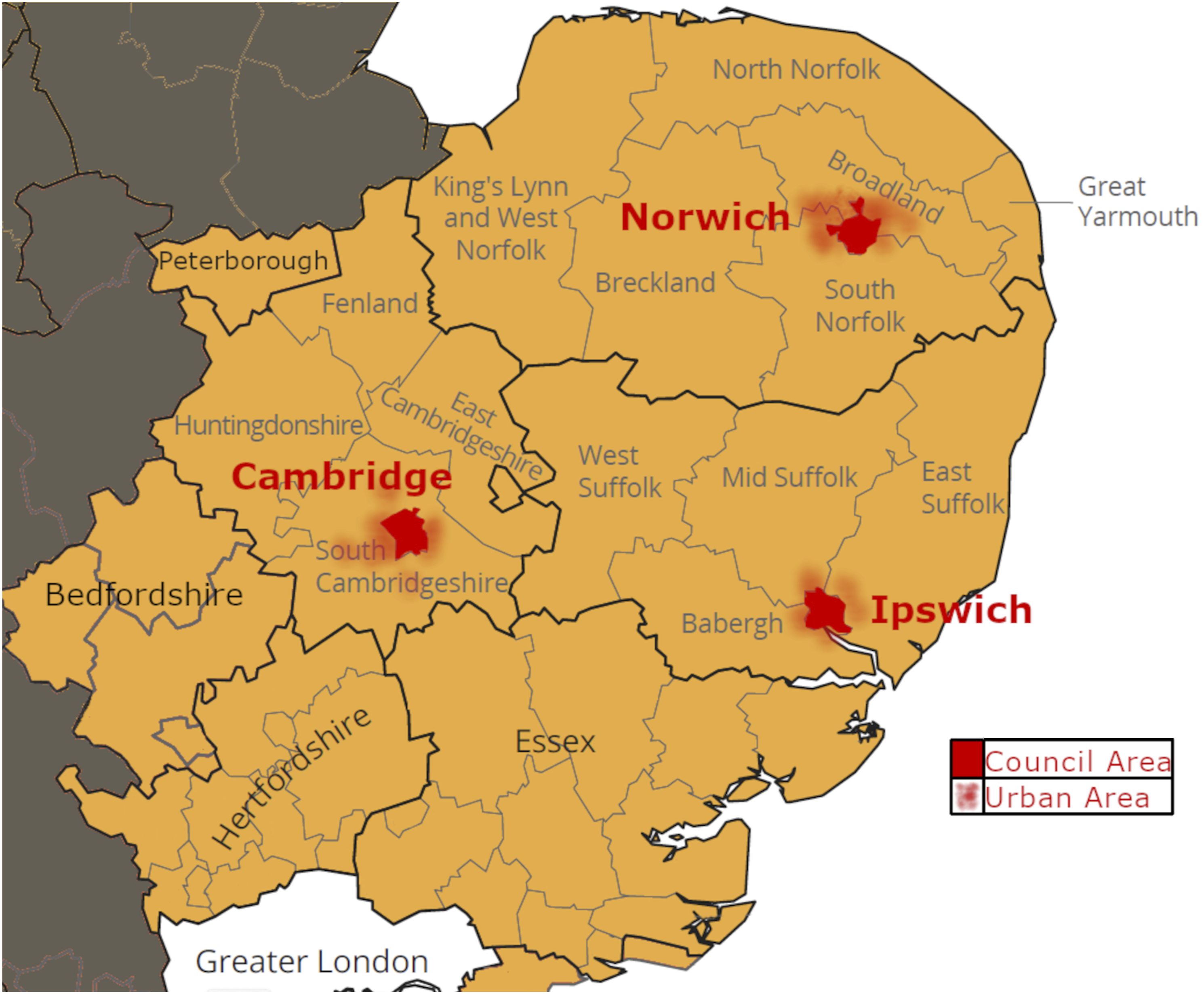
From the 1990s onwards various partial reorganisations of the two-tiers of local government have taken place, with the aim of moving to a single tier in a particular location. For example Peterborough became a Unitary Authority in 1998, taking over the functions of both tiers of local government. This process of partial unitarization and merger has continued in a piecemeal function across England since. The result is a mixture of single and two-tier structures across the country, over which have been added various formal and informal partnership arrangements and institutions.
Among these were the City Deals that form part of this study, which covered defined areas. The Norwich City Deal covered the local authority areas of Norwich, Broadland and South Norfolk (the more rural districts to the north and south of the city); the Ipswich City Deal (Ipswich itself and Mid Suffolk, Babergh and Suffolk Coastal districts) and Greater Cambridge City Deal (Cambridge and South Cambridgeshire) similarly covered the urban area and the rural district councils surrounding it.
The case studies are three of the urban areas in the England’s Eastern region: Ipswich, Norwich and Cambridge (Figure 1). While Cambridge and its historic university is the best known of the three, all have much in common, in that they are each relatively small urban areas set within a larger rural hinterland, all ‘underbounded’, and all having a complicated set of governance arrangements through which strategic objectives need to be pursued. The region is close to London, but sufficiently far away to have its own clear economic and social identity. There are wide variations of wealth, ranging from the high-tech economy of Cambridge to coastal areas with high levels of deprivation (where three MPs from the right-wing populist Reform party were elected in the 2024 General Election).
The research was carried out between 2018 and 2020 as part of a doctoral research project drawing on strategy documents, proposals from and to national government, final and draft reports, publicly available meeting agendas and minutes, and coverage in the local, regional, national and specialist press. While older material provided useful background, the primary focus of the research was the period from 2010 to 2020, following the rise of regionalist approaches under New Labour and the subsequent more fragmented and ad hoc approach of the Coalition and Conservative governments from 2010 (Labour Party, 1995; Stoker, 2002; Allmendinger and Haughton, 2010; Department of Communities and Local Government, 2010; Lowndes and Pratchett, 2012; Cabinet Office and Deputy Prime Minister’s Office, 2013; Deputy Prime Minister’s Office and Cabinet Office, 2013; Morphet and Pemberton, 2013; Swain et al., 2013).
Following review of the written sources, 28 interviews were conducted across the three cases with elected officials, senior employees of local authorities and other public bodies, business leaders and others who had taken an active role in the institutions of sub-regional governance. For each case study a representative selection of the range of roles were interviewed; in each case they made up a substantial proportion of those with first-hand ‘in-the-room’ experience. The research process was designed to encourage the interviewees to provide their interpretation of events and their roles within them (Inch, 2009). The face-to-face interviews, which followed the conversational ‘elite interviewee’ approach advocated for political and business leaders by Harvey and others, were used to collect first order lay constructs from which second order constructs could be generated and distilled as the strategic objectives for the model (Giddens, 1984; Harré, 2002; Harvey, 2011).
To identify the predominant strategic objectives of relevant actors, a bottom-up analysis was conducted including the sifting of lay terms used by research subjects during interviews (Giddens, 1984). This abductive approach took the first order constructs used by interviewees and developed a broader set of abstracted second order terms, which were then tested to ensure that a clear relationship from one to the other was established, in line with Schütz’s ‘postulate of adequacy’ test (Schütz and Natanson, 1967). This process crystallised four different strategic objectives that were being pursued by local governance actors in these cases, namely the objectives of: Recognition; Investment; Control; and Institutional Ambition. These are discussed in turn.
First, in the English governance system, key decisions are often made centrally. For a local actor or growth coalition to gain profile and visibility, therefore, it must be recognised at this national level. This is particularly important for local actors who have seen their area as overlooked, and goes beyond mere awareness-raising; strategies that demonstrate characteristics assumed to be seen as desirable by the incumbent national government – ‘modernising/modernisation’ under New Labour (Inch, 2009), ‘competitiveness and innovation’ under the Coalition Government (Ward, 2020), ‘partnership/collaboration’ under both (O’Brien and Pike, 2015), for example – are therefore often pursued alongside specific local priorities.
Second, the strategic pursuit of Investment relates to both private and public funding. The centralised nature of local governance in England makes local government highly dependent on resources received directly or indirectly from a relevant funding body. Maximising the opportunity for direct grants from a Regional Development Agency (RDA, to 2010) or Local Economic Partnership (LEP, from 2011) or a European Union structural fund, or grants, deals, or permissions for borrowing from central Government, is a major strategic priority for local actors (O’Brien and Pike, 2015, 2019). While this same centralisation means that private sector funding for local government in England is very often mediated via central government – through tightly controlled approval mechanisms or borrowing controls for example (McCann, 2021: 7) – in other contexts the direct pursuit of private investment would be a significant strategic priority.
Third, the strategic objective of Control is over both policy-making levers and infrastructure and assets with which political objectives can be pursued. In these case studies of particular importance was the desire not to lose control of the planning system, a concern that became more pressing as a result of introduction of the National Planning Policy Framework (NPPF) in 2012. This new national planning policy for England replaced a substantial volume of previous documentation, and put greater emphasis on what local councils were required to do and created consequences for not meeting those requirements. In particular the requirement for an up-to-date Local Plan and a rolling minimum 5-year identified land supply for new housing development sites, and the consequence of a greater presumption in favour of development if these things did not exist, posed the most immediate risk of loss of control over a key tool for shaping desired political outcomes for local actors (Department for Communities and Local Government, 2012).
Fourth is Institutional Ambition, both the avoidance of perceived existential threats to a preferred institution and the attempt to accumulate greater powers for it. This relates not just to formal elected institutions of local governance, such as local authorities, but also to informal or semi-formal institutions at a range of geographic scales. Institutions are means through which actors can instantiate power (Streek and Thelen, 2005; Thelen, 2009) and for many actors in local governance environments their sole means of doing so is through a particular institution. Strategies that aim to preserve the existence of, or enhance the powers of, these preferred institutions are commonplace.
Building on this overall approach, Figure 2 shows the interactions of strategies and constraints in particular environments by mapping the relative importance over time of different strategic objectives against changes in the three forms of constraint, creating a multi-dimensional tool for visualising these complex processes. Two simplified examples of possible interactions are shown for the purposes of illustration. Simplified examples of interactions between constraints and objectives over time.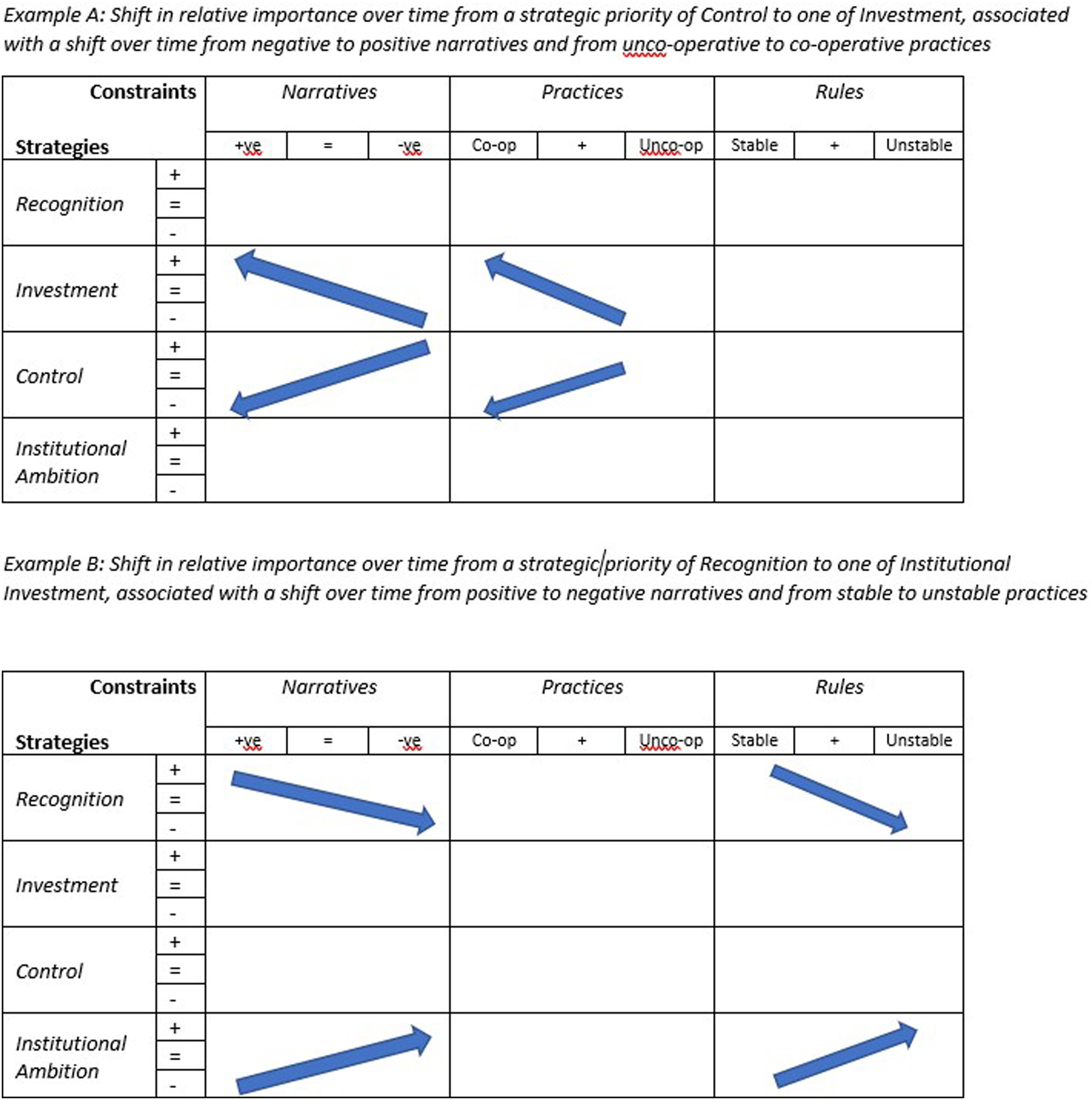
The first shows a relationship between the strategic objectives of Investment and Control on the one hand and narrative and practice constraints on the other. Over time – the direction of the arrow – the relative importance of Investment increases and that of Control decreases. At the same time narratives become more positive, and practices become more cooperative. The second example shows another simplified relationship, with the strategic objective of Institutional Ambition become relatively more important and that of Recognition becoming relative less important, while narratives become more negative and rules become more unstable.
The object of research would then be to draw conclusions from the relationships identified: in these, the first might indicate a growing level of trust between actors which might be evidence of a growing opportunity space within which to seek investment, while the second might indicate a growing distrust and conflict between strategic objectives that is leading to the closing off of an opportunity space.
Framework in action – Case studies
Eastern England during the period of study was marked by considerable upheaval in governance terms. The challenges in establishing new institutional models were exemplified in the failed attempt to deliver a Devolution Deal at a regional level in 2015–16. What began as separate county bids for additional Government funding in exchange for new governance structures, notably directly elected mayors, rapidly turned into a bewildering series of alternative geographies developed under significant pressure from leading Government figures, culminating in the announcement by Chancellor George Osborne of a Devolution Agreement for East Anglia (Osborne et al., 2016). East Anglia, the name of the pre-1066 Anglo-Saxon kingdom in this part of Eastern England, is commonly used for the area but there is not a universally agreed geography that it covers. In this instance the Deal covered the three counties of Suffolk, Norfolk and Cambridgeshire and the unitary council for Peterborough. Almost immediately opposition to a directly elected mayoralty and concerns about local interests being subsumed by regional ones led to the collapse of the project in considerable acrimony, particularly in Norfolk.
More successful were City Deals for Norwich, Ipswich and Cambridge, where additional Government funding was obtained for specific local and centrally agreed objectives (Cabinet Office and Deputy Prime Minister’s Office, 2013; Deputy Prime Minister’s Office and Cabinet Office, 2013; Office of the Deputy Prime Minister, 2014). But these projects, which varied significantly from a fairly low-key skills-based initiative in Ipswich to very significant funding for infrastructure and housing in Cambridge, also exposed and exacerbated tensions locally.
Ipswich: “Do the right thing”
While the East of England Plan (Government Office for the East of England and Department of Communities and Local Government, 2008) had identified Ipswich as part of a series of sub-regional spatial planning areas – such as the ‘Ipswich Policy Area’ and the ‘Haven Gateway Partnership’– very little happened to make these designations into anything more concrete before the whole structure was abolished in 2010 (Pickles, 2010). One interviewee described the situation as “an adventure that took 15 years to deliver a decision, let alone a development” (February 2017).
With the failure of the Devolution Deal in 2016 local actors in Ipswich increasingly sought to attract central government attention and to portray itself as a reliable partner. The overwhelming sense from interviewees in Ipswich was that the town and the area around it had long been overlooked by those with access to funding and resources. For actors in Ipswich therefore the immediate strategic objective was to build Recognition, as a precursor to Investment. When comparing the situation in Ipswich to that in Cambridge and Norwich one leading local government official noted that “they [Cambridge and Norwich] are having conversations with Government about investment, while we are learning how to have a conversation” (interview, 8th March 2017).
At the same time the provisions of the NPPF and the exhaustion of local sites allocated for housing started to pose challenges. The approval on appeal of a number of speculative planning applications on sites near the town, where the lack of a 5-year land supply was a key factor, constituted a significant risk to the Control of the local planning system by local actors. Previously there had been no negative consequences to non-collaboration on housing and planning issues for rural politicians; now one politician remarked that “...it’s marvellously concentrated … minds” (interview, 21st February 2017).
In order to pursue strategic objectives around Recognition – and ultimately Investment and Control – actors in both urban and rural parts of the Greater Ipswich area had an incentive to be seen to work together. This desire to be viewed as positive was apparent in the language that local actors used about themselves and each other. The view of a local politician was indicative of effective working across political divides, with individuals from other parties: “we work well [together] despite disagreements over the best way to do things – I kind of like him, you know” (interview, 7th February 2017). Interviewees were at pains to emphasise positive narratives about the present and future; whenever references were made to more negative narratives, they were always in the past.
There was also evidence of increasingly collegiate practices. Where previously informal and semi-formal institutions established to help shape planning and housing policies in the area simply didn’t operate effectively (a Board to manage the Ipswich Policy Area was formed in 2007, but as one interviewee confirmed, only started to meet regularly in 2011) new bodies were formed to address issues of shared concern. A forum for political leaders continued successfully despite changes of political control in member authorities, and in the aftermath of the failure of the Devolution Deal new efforts were made to co-ordinate not just between local authorities but also with key employers and the newly established University in the town.
Noticeable throughout was a concern to preserve or promote preferred institutions or institutional geographies. Officials and politicians working in different authorities repeatedly made clear that ‘their’ geographic scale was most appropriate for the pursuit of broader strategic objectives. Previous tensions over possible local government reorganisation in Ipswich were still remembered, but crucially, were presented as being in the past: “there was a time not that long ago when you couldn’t have the County and the Borough in the same room...they’d disagree over the colour of the table” (local partnership group member, interview, 21st February 2017).
There was a strong preference for informal or semi-formal partnership institutions, such as the emerging Suffolk Planning Infrastructure Framework (SPIF). This came from the failed Devolution Deal project after 2016, and aimed to produce a looser version of the strategic plan that a Combined Authority might have undertaken – local officials were at pains to emphasise that this ‘was NOT a Structure Plan’, which would have implied that a County Council geography was suitable for taking over powers held by other local authorities. Equally the Ipswich Policy Area, once a clearly delineated area for strategic planning, was increasingly described in looser and less formal terms, to avoid repetitions of earlier conflicts about possible formal boundary changes to the town’s jurisdiction.
The key objectives in Ipswich were to achieve Recognition and to retain or regain Control. In order to achieve these goals local actors believed not just that they needed to be collegiate, but that they needed to be seen to be collegiate; their narratives and practices needed to be audibly and visibly positive. The consequence was that potentially more ambitious strategic objectives were constrained; in order to retain these positive narratives and practices, actors avoided pursuing the kinds of formal structures that were seen as necessary in Norwich and Cambridge to drive greater levels of investment. In Ipswich the more limited objectives that actors set themselves of being and appearing collegiate were largely achieved, but at the expense of pursuing more significant goals that could – if realised – have had a more transformative impact on the town and the surrounding area.
Norwich: “Fear and loathing in East Anglia”
In contrast to Ipswich, there was a long-established process of addressing planning and housing issues in Norwich across formal institutional boundaries. Roughly a third of the population of the built-up area of Norwich live outside the city, and the need for housing and employment to be located both within and outside its boundaries had been accepted in successive Structure Plans and regional planning documents from the 1970s onwards.
While the East of England Plan was abolished in 2010, its housing allocations were taken forward in an existing innovative approach to collaborative planning, the Joint Core Strategy (JCS) between the three district councils – Norwich, South Norfolk and Broadland (Greater Norwich Development Partnership, 2014).
Relevant here were recent failed efforts at local government reorganisation. From the 1990s there had been repeated attempts to recreate a unitary Norwich Council (it had been abolished in 1974) on its existing or on expanded boundaries (Raine et al., 2006). One of the last acts of the New Labour government in 2010 was to approve a unitary Norwich council, and one of the first acts of the incoming Coalition Government was to reverse that decision.
An important strategic objective for actors in Norwich was Investment. In 2006 the Greater Norwich area had been designated a Growth Point, and local officials were led to believe that this could result in substantial sums of Government investment in infrastructure and housing. The disappointment when delivery fell considerably short of what had been hoped for was significant. Despite this setback, actors in Greater Norwich were happy to explore both the later City Deal and Devolution Deal schemes if it meant access to central Government resources.
However, Institutional Ambition was the dominant strategic priority. Whether it was explicit efforts to accumulate greater power to preferred institutions, such as Norwich City Council’s bid for unitary status, or fears that a preferred institution might be side-lined, weakened or even disappear as the result of the machinations of others, concerns over promoting and protecting the bodies through which actors instantiated their own power increasingly took precedence over other objectives.
Alongside these strategic objectives were changing institutional constraints, most prominent of which was a marked worsening of the narrative used to describe ‘the way things are done around here’. It was common to find local politicians and officials using scathing language about both other local actors and the area as a whole. These increasingly negative narratives were framed as a lack of trust – “[there’s] fear on both sides...everyone is paranoid about everyone else” (local government official, interview, 23rd April 2018) – or concern about how they were perceived by outsiders – “the Government will hardly talk to us anymore, they think we’re such a rabble” (local government official, interview, 26th June 2018)
Negative narratives about the present were contrasted to positive relationships in the past: efforts to develop the first iteration of the Joint Core Strategy from the mid-2000s onwards were described as “working through consensus... there was a genuine willingness to work together and solve problems”. At the same time, negative narratives were mirrored by increasingly uncollegiate practices: contentious papers were tabled at formal meetings by one partner without prior discussion with others, and reached a low point in September 2017 where a meeting of the Growth Board for Greater Norwich was abandoned because those present could not even agree if the minutes of the previous meeting were a true record (Greater Norwich Growth Board, 2017).
Coincident with the worsening of narratives and practices in Greater Norwich was increasing instability in rules, primarily around repeated changes (or threats of changes) instigated by national government to formal governance structures: the approval and then cancellation of local government reorganisation for Norwich coincided with the abolition of regional government structures in 2010; the Cities and Local Government Devolution Act 2016 explicitly invited proposals for the replacement of two-tier authorities such as those in Norfolk with new unitary authorities, something which leading politicians floated in the local media the following year; and the controversial and ultimately unsuccessful attempt to create a Devolution Deal for East Anglia in 2015 and 2016.
The strategic aim of Investment, together with associated collaborative practices and positive narratives, had initially been strong enough to counter-balance long-standing objectives of Institutional Ambition. But the disruption to the rules around the failed Devolution deal and the shift to increasingly uncollegiate practices and negative narratives meant that the Investment no longer had priority over Institutional Ambition, and in turn concerns about the loss of preferred governance forms further drove the negative cycle of practices and narratives. Structures of governance became the focus for political and personal dispute rather than the potential outcomes from collaborative working. There was not a complete breakdown of progress, but outcomes were limited and achieved only at the cost of increased mistrust.
Cambridge: Suspicious minds
Cambridge is also a tightly bounded city sitting within a larger suburban hinterland. From a post-war consensus that housing growth would ‘hinder the work’ of the University of Cambridge, over subsequent decades it was recognised that the University and city would miss out in the international competition for high tech investment (Cambridge City Council Department of Architecture and Planning and Logie, 1966; Holford and Wright, 1950; Mott, 1969).
By the late 1990s continuing tensions between economic growth, restrictions on new housing, and transport pressures led to the establishment of the Cambridge Futures forum to advocate for a new consensus about planning in the wider Cambridge area (Platt, 1999, 2000). Though the organisation began as an informal coalition of local economic interests, it received institutional backing from local authorities and the University, culminating in a well-publicised survey of local residents which showed that the current strategic approaches to planning were the least popular of a range of options (While et al., 2004).
The result was a fundamental shift in planning policy to embrace economic and housing growth supported by major infrastructure investment. The dominant strategic objective for the Greater Cambridge area was thus Investment. Concerns over Recognition and Control were present, but less significant than the pursuit of resources to support the new growth objectives. The strategic objective of Institutional Ambition began as a low priority, but as discussed, became increasingly important.
As with Ipswich and Norwich, concerns over Control were mostly relevant to the more rural local authority surrounding Cambridge – South Cambridgeshire – and stemmed from difficulties with maintaining the 5-year land supply requirement of the NPPF. The result was an engagement with the new growth-oriented consensus by South Cambridgeshire, despite an initial reluctance. Even when elections in 2018 returned a different political leadership standing on a growth-sceptic platform, the need to retain Control over the planning system led the new administration to quickly conform with the previously existing consensus “...because they knew that the biggest risk is maverick, unplanned development” (former senior local official, 7th February 2019).
Other than these occasional concerns over Control, the consistent message, repeated by multiple actors, was ‘we’ve been very virtuous by planning for growth, now help us deliver it’ (multiple interviews, 2018–2019). Though the purpose of Investment differed from actor to actor depending on their political and functional preferences – the City Council emphasising affordable housing, the County Council and later the Combined Authority highlighting transport infrastructure – the ‘single hymn-sheet’ was to frame these as investments in support of growth. From the late 2000s onwards actors in Cambridge showed themselves willing to exchange investment for new governance structures.
Typical was the response to the second wave of City Deal proposals in 2014. Championed in particular by the Liberal Democrat members of the Coalition Government, the scale of the Government funding offer was very substantial, at £500m over 15 years (Office of the Deputy Prime Minister, 2014). Opposition Labour politicians in Cambridge supported the deal as offering both money for housing and the promise of further investment in the future. Cambridgeshire County Council saw substantial sums directed towards transport infrastructure as “an opportunity that was too good to miss” (senior local politician, interview, 30th November 2018).
In exchange for funding, the Government required the creation of new governance structures to oversee the City Deal, in the form of a new executive board and associated assembly called the Greater Cambridge Partnership (GCP). The Board had three voting members, one from each of the three local Councils – Cambridge, South Cambridgeshire and Cambridgeshire County Council – and two non-voting members from the educational and business sectors. Indicative of the willingness of local actors to pool sovereignty, the new Board was granted powers over transport decision-making delegated from the County Council.
The same calculation, of the surrendering of sovereignty through the creation of new institutions in exchange for significant new investment, took place when the Devolution Deal for Cambridgeshire and Peterborough (Herbert et al., 2015) was signed in 2016: “the reason we ended up with a Mayoral Authority here was because of the acute housing crisis in Cambridge: Cambridge City Council was prepared to trade off having a weak Combined Authority, which they were pretty dubious about but could live with, in return for a decent investment in Council Housing in Cambridge” (senior local politician, interview, 30th November 2018).
Unusually for a Combined Authority the Cambridgeshire and Peterborough CA did not include statutory planning powers, which were withheld after local authorities elsewhere in the county expressed concerns. The result was that in the Greater Cambridge area there was now a complex set of overlapping institutions – two district councils, the county council, the Greater Cambridge Partnership with its Board and Assembly, and the Combined Authority with its directly elected Mayor. It was not always clear where powers lay, in particular for the critical areas of transport and highways.
Almost immediately after the first election to the Mayoralty signs of an increasing concern for Institutional Ambition became apparent, particularly following the subsuming of the previously independent Local Economic Partnership for Cambridgeshire and Peterborough into the Combined Authority, something that was seen as having been a closed doors ‘stitch up’ between the Mayor, an influential local MP and the Government. The institution which was the main object of concern was not, as in Norwich, the established local authorities, but the relatively new Greater Cambridge Partnership.
Attempts by the Mayor to put a ‘pause’ on all GCP projects in 2018 were temporarily resolved by what seems likely to have been intervention by senior political figures within the Conservative Party and ‘the Greater Cambridge Establishment’ (code for leading figures in the University). But for those invested in the success of the Greater Cambridge Partnership, the Combined Authority and Mayor was now perceived as an existential threat to that institution: “... my view for a long time was that [the Mayor] wanted to grab everything, and kill the GCP, which he saw as a problem....” (senior local politician, interview, 24th July 2018).
As tensions rose so did a reluctance to continue pooling sovereignty in the same way as before. The GCP had relied on a practice of unanimity, with splits between the three partners avoided by behind the scenes work to achieve compromises all three would support; this became increasingly difficult to sustain as the County Council in particular pushed harder to get its way in debates. This marked a significant shift in practices: from the time of the Cambridge Futures reports, actors in the region made considerable efforts to ensure that the way they did business was collaborative and collegiate. Bringing together different political and institutional views to coordinate planning policy was achieved through “lots of heavy lifting behind the scenes, lots of careful coordination between officers; ... it was a carefully orchestrated process with lots of three-way coordination” (former senior official, interview, 2nd July 2019).
However, these collaborative practices were put under stress after the creation of the Combined Authority and its directly elected Mayor. After only a year the “carefully constructed system had been trampled all over [by the Mayor and CA]” (senior politician, interview, 30th November 2018) and relationships within the Greater Cambridge Partnership were being tested by parties “flexing their muscles” (senior local and regional government official, interview, 23rd September 2019). A ‘crisis summit’ between the various GCP members created further tension after the County Council insisted that only its officials, rather than those of the other partners or those employed by the GCP itself, could be trusted to run the summit impartially.
At the same time narratives about the relationships in Greater Cambridge moved from positive to increasingly negative. Instead of using terms like ‘grown-up’, ‘far-sighted’ and praising the professionalism of fellow actors, as had been the case up to 2017, language became much more negative: the elected Mayor was described as a running a ‘crony organisation’ and the creation of the Combined Authority as a ‘terrible mistake’ (senior local politicians, 24th July 2018 and 30th November 2018 respectively). While much of the blame was laid at the feet of the Combined Authority and the Mayor personally, there was also a concern that the instability of rules caused by the repeated addition of new layers and forms of governance was an issue: “[The Combined Authority] has added yet another layer of governance congestion, and not helped the GCP deliver its mission – in fact, in some ways it’s got in the way of that” (advisory member of sub-regional partnership, 19th November 2019). The lack of clarity of powers and responsibilities for the Combined Authority contributed to this sense of congestion and uncertainty.
Local actors in Cambridge, following long-standing strategic objectives in pursuit of Investment, set new rules constraints themselves or in collaboration with central government through creating new institutional structures in return for access to funding, and in doing so altered the balance of strategic objectives followed subsequently. New institutions such as the Mayoralty and Combined Authority led to a greater emphasis on preserving existing ones including the Greater Cambridge Partnership that had been created in a previous round of institutional innovation, and a shift in focus towards a strategic objective of Institutional Ambition, alongside which came changes in the tone and form of narrative and practice.
Drawing the three case studies together, the lesson from them is that without an intensive focus on building relationships of mutual trust, the approach of ‘institution first, behaviours second’ when it comes to the creation of new forms of sub-regional governance is always likely to end up in conflict between the original intentions of the new formation – usually framed around Recognition or Investment – and a growing strategic priority for Institutional Ambition. A similar lesson might be drawn from adjoining English spatial project, the so-called Oxford-Cambridge Arc, a partnership of local authorities, universities and economic interests linking the two historic cities with the fast-growing new city of Milton Keynes. Here an inability by actors to decide on what exactly their collective strategic objectives would be, and a concern about protecting a range of previously existing institutions through which those actors individually instantiated power, have severely limited the prospects for any meaningful progress (Valler et al., 2023).
Giving meaning to agency: Bringing strategy in
Grillitsch and Sotarauta (2020) in their work on emerging regional growth paths set out a conceptual framework for the analysis of agency as containing three types – innovative entrepreneurship, institutional entrepreneurship and place-based leadership – which “locates agency not in the attributes of individual agents but in the relationships connecting agents in opportunity spaces” (Grillitsch and Sotarauta, 2020: 716).
In turn, empirical studies should examine “the ‘subjective’ stories of individuals in order to grasp their perceptions, intentions and change strategies” (Grillitsch and Sotarauta, 2020) as part of a bottom-up conceptualisation of agency and institutions (Grillitsch, 2015; Sotarauta, 2017).
Building on this, the current paper builds on their conceptual framework by proposes a further tool by which allows the interactions of actors’ strategic objectives and the constraints of the structures within which they operate to be assessed. The heuristic proposed provides a framework within which these strategies can be understood, making clearer the co-constitution of strategies and constraints, of which narrative is only one. The constraints that come from the practices and rules of institutions need also to be taken into account, but always as part of an analysis that maintains a clear focus on agency and individual strategies.
The study carried out here thereby aims to take forward the process of locating agency and giving it meaning, by showing how that agency is used in the pursuit of different strategic objectives, and creating a means by which the underlying dynamics at work can be assessed. The lesson that it offers is that studies of institutional dynamics need to prioritise the identification of strategic objectives as a necessary precursor to the understanding of the complex processes at work; ‘bringing strategy in’, as it were.
In the three case studies carried out as part of this research there is a similar pattern: when strategic ambitions around Control, Recognition or Investment are relatively high priorities, there is an incentive for collaborative practices and positive narratives, which in turn both shape the nature of governance institutions through which these objectives are pursued and set limits to the extent to which they are pursued. But that process, particularly the development of more formalised and less stable institutional layers, also tends to alter the relative importance of strategic priorities, in particular increasing the relative importance of the strategic objective of Institutional Ambition.
As this objective becomes a relatively higher priority, the practices and narratives that it engenders tend to become increasingly negative, and this in turn further fuels concerns – both unjustified and justified – of existential risk to the preferred institution, reinforcing a cycle of unstable rules, uncollegiate practices and negative narratives which further impact on strategic objectives.
For example, Figure 3 shows the application of the model to the changes in Cambridge. Here narratives move from positive to negative, practices from cooperative to un-cooperative and rules become increasingly unstable. The relative importance of Recognition (low) and Investment (high) remain steady, while the relative importance of Control rises then falls over time. Most notable is the change of the objective of Institutional Ambition from relative low importance to both relatively and absolutely high importance. Analysis of the strategic objectives and constraints in Cambridge, and their movement over time.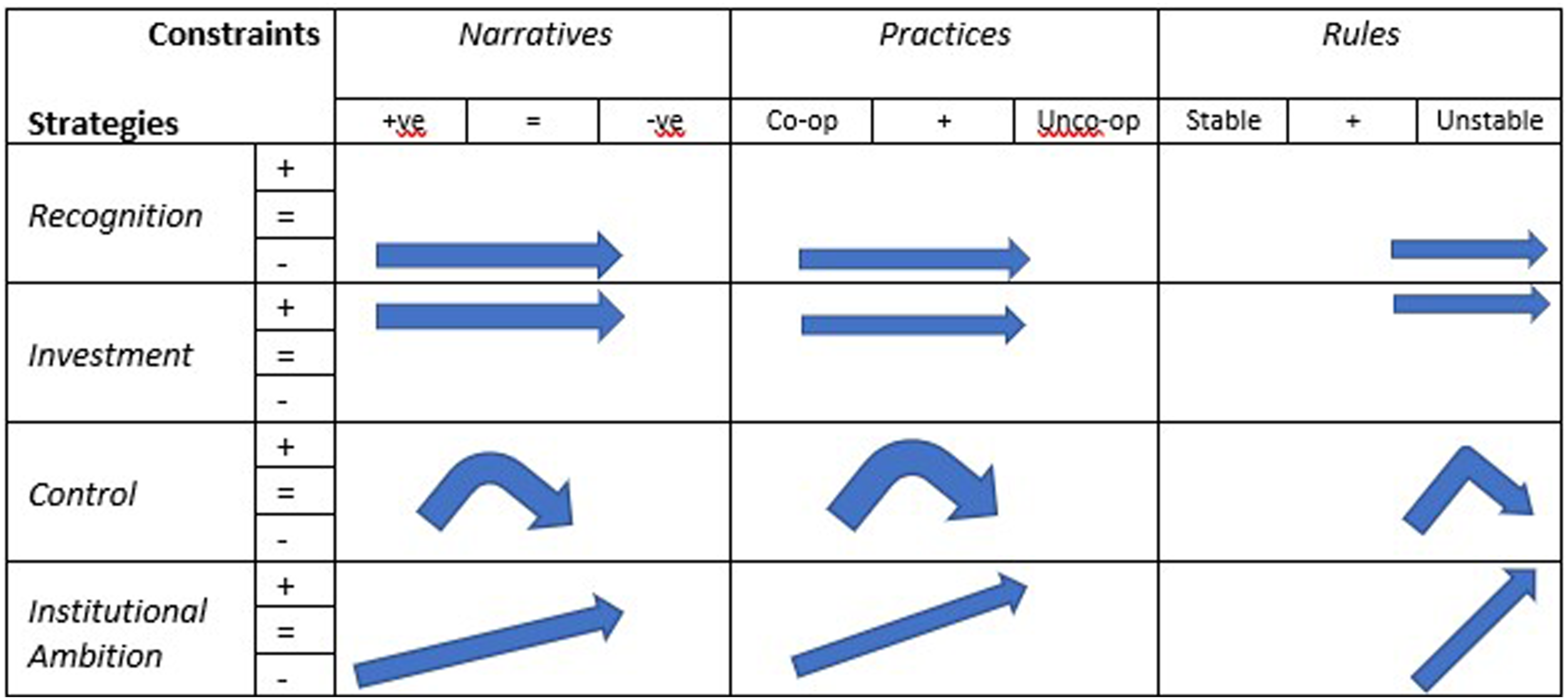
By contrast, while new formal institutions might have made the pursuit of Investment easier – the approach followed initially in Cambridge – local actors in Ipswich perceived a risk that following this route would increase tensions about Institutional Ambition, making it more difficult or impossible to retain the positive narratives and practices that had been established. The consequence was that this preference for retaining these positive narratives and practices constrained any greater strategic objectives around Investment. Meanwhile in Norwich the pre-existing strategic priority given to Institutional Ambition drove negative narratives and un-cooperative behaviours which in turn increased the priority of Institutional Ambition at the cost of other strategic priorities such as Recognition and Investment.
The lesson here is that without constant work to maintain relationships between actors – the ‘heavy lifting’ so important in the early part of the Cambridge story – there is a tendency for the opportunity space for new approaches to close, cutting off the potential for innovation and new thinking. Understanding this tendency towards stasis in sub-regional governance dynamics, and the reasons for it, is crucial for policy makers at local and national levels.
Strategic objectives are pursued by actors engaged in local, sub-regional and regional governance globally, and the objectives pursued by those actors will interact with the institutions through which they pursue them. The objectives may vary from context to context, but complex but identifiable interactions will always exist. By identifying strategic objectives, and tracing their interactions with institutional constraints over time, a deeper understanding of institutional dynamics can be obtained, and meaning can be given to the concept of agency. Examining narratives, practices and rules allows for an understanding of what is happening over time; bringing strategy in allows for reflection on how and why change takes place.
Footnotes
Declaration of conflicting interests
The author(s) declared no potential conflicts of interest with respect to the research, authorship, and/or publication of this article.
Funding
The author(s) received no financial support for the research, authorship, and/or publication of this article.
