




Abstract
How can the ‘dark side’ of urban policy and planning be transformed into a ‘light side?’ How can displaceability and exclusion of an urban minority be reversed? How can marginalized groups enter the mainstream and achieve recognition, security and a stake in urban resources? The critical literature on the ‘dark side’ of planning rarely deals with the transformation from oppression to justice for excluded groups. The story of queer (LGBTQ+) space in Beersheba, Israel, which illustrates such a process, is analyzed here through the struggle to organize a gay parade and be allocated municipal assets for community use. The paper traces the transformation of the relationships between the community, the mayor and the City Council. The analysis shows how urban citizenship became a site of struggle constructed “from below,” coupled with the ability to mobilize support from other cities and political pragmatism. In order to locate this struggle in a broader context, the LGBTQ+ struggle is compared to that of another minority, Beersheba’s Bedouin-Arab community. The latter’s plight shows that while the LGBTQ+ commrecognition and moving towards the ‘light side,’ the Arab community was experiencing the ‘dark side,’ with increasing urban oppression and displacement. The study thus shows how a liberal, gay struggle may also be used to “pinkwash” on-going displacement of other communities in the urban periphery.
Introduction
The light side is hard to see Under too many words it’s concealed Between you and me, him and her in a plateau of sadness our happy mountain is to share The light side is hard to call In a dark and cold world full of walls But your light and that of mine Through our love, will shine and shine Despite it all, the light on us shines The sky is blue, our good has no confines (From: “The Light Side,” lyrics and melody: Micha Biton, hailing from the Israeli peripheral border town of Sderot)
This paper describes, explains and critiques the convoluted story of the queer (also known as LGBTQ+) presence in the public sphere in a key medium-sized city in Israel’s periphery. We use Beersheba, with a population of 211,000 (CBS, 2021), as a case study to seek answers to the question: “How can displaceability, marginalization and exclusion from urban space be reversed?” In more conceptual language, “How can the ‘dark side’ of urban policy and planning be transformed into a ‘light side?’ How can communities who have long lived in a condition of displaceability and exclusion stabilize their urban existence and bolster their ability to make fair use of its resources?” Unlike the scholarship that usually emphasizes the reproduction of oppression and displacement, we seek to explore the opposite possibility, in which a group succeeds, through various means, to disrupt the cycle of oppression and break into the legitimate public sphere. Hence, the transition from the “dark” to “light side” of planning is the focus of this article.
These questions will frame our analysis of the process of forming a “LGBTQ+ public space” in Beersheba, after years of displacement and negation. Until 2017, all attempts to hold a high-visibility gay pride parade in the city center were rejected, and only meager public resources were allocated to the community, based on conservative arguments emphasizing the “sensitivity” of the religious population to a gay presence in the city. After a severe crisis and unprecedented protests following the cancellation of a previously approved pride parade in 2016, things quickly changed, through intensive struggle. In 2017, for the first time, the municipality actively supported a pride parade on the city’s main street. Since then, there have been six additional parades, and the city has rented, and later allocated, a spacious, renovated property for the community in a desirable area of the Old City. That said, as we will show, the process was not linear. After years of slow, cautious progress, the crisis and the accompanying protests led to a rapid, dramatic change in the conduct of the city’s gay community and its relationship with the municipality.
Our analysis begins by presenting a theoretical framework based on two main axes, one between justice and injustice in the urban space, including conceptualizing the “dark” and “light” sides of planning (broadly defined here as the assembly of urban spatial policies); and the other concerning the condition of “displaceability” and the frequent threat to marginal groups regarding their right to the city. It focuses on communal struggles for urban citizenship, presence and municipal resources, thus opening a window for understanding progressive urban transformation.
In addition, our research is anchored in planning and urban theory as they relate to sexuality. Details of the spatial-socio-political struggle over allocating resources in the city and presence in space are analyzed through the above conceptual and comparative frameworks, both nationally and locally. Further discussion considers the implications of the LGBTQ+ community’s recent recognition and safety for other minorities in the city, primarily the Arab-Bedouin community. 1
A broader view on city-state relations shows that recent times are seeing increased levels of tension can be traced in most states between urban and state authorities (Barak and Mualam, 2022). A new spatial and cultural politics is emerging from this complex tension, especially in globalization-oriented cities, which tend to adopt a more liberal identity. This enables the inclusion of urban LGBTQ+ communities, even where the local population is conservative and hostile. Conversely, in national politics, where “ethnocratic” frameworks privilege the dominant ethno-national group, the state tends to close public sphere and keep its resources from “undesirable” groups (Yiftachel and Ghanem, 2004). This tension underpins the participation of medium and large peripheral cities in the process of recognizing the LGBTQ+ community and its needs. Simultaneously, the ethnocratic situation may allow municipal recognition of LGBTQ+ communities because it helps them set up a smoke screen to conceal other injustices, such as the oppression of marginalized racial or ethnic communities.
We argue that the Beersheba case illustrates the possibility of mobilizing the LGBTQ+ community – covertly but meaningfully – through their indifference to the ethnocratic forces that continue to oppress other marginal ethnic minorities in the city, most notably the Arabs. This political-spatial reality creates a new dimension of meaning for the concept “pinkwashing,” as we will discuss towards the end of the article. This angle helps account for the breakthrough that occurred in Beersheba and facilitates understanding the struggles of other groups that remain on the dark side of planning.
The study consists of two main empirical parts. The first includes description and analysis of the changes in the queer space in Beersheba, from the consolidation and organization stage (early 1990s to 2014) to the struggle for space and a home (2014 to 2020), as seen in the relations between the LGBTQ+ community and local government. The second part offers a broader view for understanding the rise of the queer space in the city from three perspectives: (1) by examining urban citizenship for LGBTQ+ people in a peripheral city as a site of struggle; (2) by analyzing the changes as a movement from displaceability to recognition; (3) by looking beyond the LGBTQ+ space, at the declining Arab space, and the meaning of two opposite parallel processes happening at the same time in the same space.
Methodologically, the current study is based on a qualitative analysis of: (1) archival materials, e.g., photos, brochures and minutes of meetings, collected from former and current activists in the local gay community; (2) court decisions, downloaded from the Israeli Judicial Authority website; (3) participant observations by the authors; (4) minutes of city council meetings, from the municipal website; (5) summaries of meetings between community representatives and city officials, gathered from activists in the local gay community; (6) interviews and speeches by Mayor Reuven (‘Ruvik’) Danilovich, which were published in media or recorded by the authors; (7) articles in national and local newspapers, found online; and (8) five in-depth interviews with local activists.
The first key interview was conducted with the chairperson of “The Pride House in Beersheba and the South” at time of the study (in 2018 and again in 2019), followed by a key interview with the Executive Director of “The Negev Coexistence Forum for Civil Equality” (2020). Three additional interviews were conducted with different activists from the local LGBTQ+ community (2019–2020).The empirical materials were organized and analyzed thematically and historically.
From dark to light side, from displaceability to the right to the city
Our conceptual framework is built on two axes. The first stretches from the ‘dark’ to the ‘light’ sides of urban planning, and the second from displaceability to the right to the city. Due to space limitations, the present description of the philosophy behind these axes is brief; additional discussion may be found in the literature (Misgav, 2019; Tzfadia and Yiftachel, 2021; Yiftachel, 1994; Yiftachel and Mandelbaum, 2017).
Displacement from the city and its resources is becoming increasingly visible in the social sciences and humanities. This welcome development has emerged in response to the profoundly negative impact on recent urban regimes on citizenship. However, the literature is largely dominated by studies on cities of the global North-West, focusing on the dispossessive logic of capitalism and gentrification (Harvey, 2008; Lees et al., 2013; Rolnik, 2019).We emphasize here the need to account for dynamics typical of non-Western peripheral societies, with a focus on sexual identities. Subsequently, we argue that displacement from the city stems from diverse structural logics – material, political, and identity – not only from the forces of capitalist development. This approach emphasizes the importance of the interaction between urban planning (broadly defined to cover urban spatial policies and implementation), individual and collective identity, gender, sexuality, colonialism and nationalism, in addition to capitalist urban development.
The interaction between these dimensions produces new assemblages of urban displaceability, including varied threats to urban citizenship, such as violence and expulsion, rising housing prices, denial of rights, spatial and political exclusion, and incriminatory laws and regulations. Displaceability can exist even without spatial change, when accessibility, resources, power and the rights of city residents are threatened in-situ and weakened (Tzfadia and Yiftachel, 2021).
Moreover, we observe that in most urban regimes today, threats of displacement and eviction are not merely a series of policy events or local struggles, but rather a structural condition forming a foundation of urban citizenship in the contemporary city (Tzfadia and Yiftachel, 2021; Yiftachel, 2020). Hence, an in-depth understanding of the struggle by the LGBTQ+ community in Beersheba against its displacement from the city, as described below, serves as a window for a critical analysis of contemporary urban society. This understanding may also help in developing measures for alleviating the state of displaceability, and for ‘lightening’ the dark side of urban policy.
These issues lead to a broad conceptual debate concerning the questions of social justice in urban planning and policy. For nearly a century, the history of planning has been built on the assumption that urban planning is a fundamentally positive factor that contributes to a more efficient, aesthetic and just city and society. The canonical history of planning refers almost exclusively to its ‘lighter sides’ of social benefits (see Hall, 1988) and the progressive possibilities inherent in the rational design of space. These possibilities, promoted through what theorist Patsy Healey calls the “planning project,” relate not only to physical aspects of space, but also promote democratic social values (Healey, 2016). Since the 1970s, diverse studies have analyzed the act of planning more critically and realistically (see Harvey, 1973; Sandercock, 2002). They show how it can also function as an instrument of domination and oppression, especially in ethnocratic, colonial, capitalist, patriarchal and heteronormative societies.
These concepts combined into several theoretical analysis of planning’s inherent “dark sides” (Flybvjerg, 1996; Yiftachel, 1994), which are often an integral component of the modernist act of controlling and shaping space and society. Planning uses professional tools, such as land and development policy, infrastructure construction, suburbanization or urban renewal, to promote political and social goals that cause ongoing injustice to large segments of society.
Based on this critique, a literature that seeks to create a conceptual, professional foundation for the creation of a “just city” began developing. Diverse studies have added important knowledge about the possibilities for focusing planning on goals that narrow social gaps, break-down segregation, recognize minorities, and facilitate development of a more just, sustainable, and democratic space (Fainstein, 2011; Misgav, 2019; Sandercock, 2002).
These perceptions connect us to the “right to the city” and the discourse concerning struggles for belonging, resources and power in the city. We define “displacement” as the exclusion of residents from full urban rights, such as residency, accessibility, and use of urban resources. Moreover, we emphasize that displacement may also be a partial retreat or exclusion from urban rights, such as denial of recognition, development, or services that violate the right to the city (Lees et al., 2013; Rolnik 2019; Tzfadia and Yiftachel, 2021).
The writings of French philosopher Henri Lefebvre (1991) are seminal in this field, outlining the confrontation between oppressive processes of the “production of space” in the capitalist city and the constant struggle for the “right to the city.” For Lefebvre – and leading thinkers including Manuel Castells (1983), Iris Marion Young (1991) and Raquel Rolnik (2019) – this right entails the ability to produce communal space, free of the control of both state and capitalism. This struggle seeks to transform a state of displaceability to long term entitlement to safe urban space, recognition and resources.
Sexual minorities and planning theory
Two decades ago, pioneering studies in the field of planning called the field a “heterosexual project.” They argued that planning promotes spaces that exclude people on the basis of sexual orientation by using a variety of planning tools that prioritize family and heteronormative values (Frisch, 2002). Until the Stonewall events and the emergence of the Gay Liberation Movement in the 1970s, there was a reality of exclusion and discrimination that led, in many cities, to a process of spatial segregation of LGBTQ+ people and their concentration in segregated neighborhoods and areas. This was significant and influenced urban development and the urban economy (Castells, 1983; Forsyth, 2001).
While studies published during the 1980s and early 1990s (Adler and Brenner, 1992; Lauria and Knopp, 1985) dealt with gay gentrification processes in the city and the displacement of populations from neighborhoods from an essentially Marxist (or neo-Marxist) approach, the theoretical and empirical debate expanded in the 2000s, influenced by the development of queer theory and cultural perceptions of diversity. It considered broad planning issues, including housing, municipal services, and conservation, which were the subject of two pioneering books edited by Doan (2011, 2015a). Other publications focused not only on the need to ensure spatial justice and social and sexual diversity in the city, but also with the planning implications of an LGBTQ+ presence in the neoliberal city, joining the planning discourse to that concerning spatial justice (Fincher et al., 2014; Fincher and Iveson, 2008; Misgav, 2019). Of special importance was planning theorist Petra Doan’s demand that planners free themselves from “the tyranny of gender planning,” meaning heteronormative planning based on narrow and dichotomous gender definitions (Doan, 2010).
The discussion of more familiar urban-economic-social issues, e.g., gentrification, also expanded in the 2000s, becoming less descriptive, more critical and focused on planning issues (Wimark and Östh, 2014). For example, increases in real estate prices in the Western world and their effect on housing preferences of LGBTQ+ people, including the new tendency to abandon city centers and the traditionally segregated neighborhoods (known in the literature as “Gayborhoods”), in favor of areas outside the queer area (Gorman-Murray and Nash, 2014; Nash, 2013). This lead to the creation of LGBTQ+ friendly urban areas, which provided a sense of comfort, security and belonging, but also, in turn, pushed non-LGBTQ populations aside (Bell and Binnie, 2004).
The role of social movements and public protests in driving institutional recognition of sexual minorities by municipal and planning agencies is an extremely relevant issue. In 1983, Castells published a pioneering study on how spatial separation of gays and lesbians in segregated neighborhoods in San Francisco served the development of a political power center and organizing arena for social change movements. A study of planning in the city center of Manchester, England in the 1990s, especially the “Gay Village,” found that planning done in collaboration with LGBTQ+ social and political movements and considering their needs, with institutional recognition, was able to survive local political upheavals. It brought previously excluded people and communities into the local political system, meaning that planning also promoted equality and justice for the community (Quilley, 1997). Recent studies continue to discuss the relationships between sexual minorities and planners, policy makers and municipal officials (Bain and Podmore, 2023; Broto, 2021). Duplan (2023) analyzed the nuanced coalitions and struggles of LGBTQ+ communities in Geneva and its relationships with local politics and planning authorities, and claimed that this “inside activism” is not pinkwashing and has the ability to promote urban and planning equality.
When the LBGTQ+ community has the image of being relatively powerful, recognized queer spaces have primarily formed in large/global cities (especially in the Global North), while the forces of rejection remain stronger in the periphery. This is also true in Israel, where the forces of rejection retain power in the queer periphery, even if the communities there do produce inspiring phenomena of local belonging and activism (Hartal, 2015). The experience of urban queer movements struggling for recognition, resource allocation and a foothold, even symbolically, in the public sphere, shows that public presence is highly significant (Hartal and Misgav, 2021). Moreover, the separation between public and private in “thin” liberal approaches is actually discriminatory and serves the homophobic demand to limit sexual identity to the private sphere.
The last decade has brought a new wave of research focused on the connection between urban citizenship, planning and promoting spatial justice in relation to LGBTQ+ communities. A study conducted in Sydney, Australia, found that planning processes can be used to advance the rights and practical needs of LGBTQ+ people in a city (Gorman-Murray, 2011). This study shows that recognition of LGBTQ+ rights, including their spatial and urban needs, occurs mainly at the local level and in cities where the municipality (or federal government in the Australian case) promotes the “active citizenship” of LGBTQ+ people and involves them in planning decisions. Gorman-Murray argues that this recognition, based on a productive dialogue between the “active” community and the planning establishment, leads to complex recognition that acknowledges the practical needs of LGBTQ+ people in the city, which are different from – and may contradict – the needs of other communities. Adopting a more holistic perception of different communities in the city asks how they can fit together without provoking conflicts and objections. This idea, which is focused primarily on promoting liberal planning policies for the good of towards LGBTQ+ people on the local level, also emerges from Alfasi and Fenster’s research (2005) and from a recent study concerning planning policy for the LGBTQ+ community in Tel Aviv in light of the strengthening of community organizations and their political influence (Misgav, 2019). This is especially the case for the homonormative parts of local LGBTQ+ communities that adopt a more normative lifestyle and do not challenge social arrangements and norms (Misgav, 2019; Muller-Myrdahl, 2011).
Moreover, the literature on sexual citizenship (Richardson, 2017) mainly concerns legal struggles (marriage, relationship, adoption) and rarely examines what we are calling “struggling citizenship” in spatial contexts or issues of recognition and access to urban space. Struggling citizenship is also different in large cities, like Jerusalem and Tel Aviv, because their character, cultural background and social context have great significance (Fenster and Manor, 2010).
Activist struggles of LGBTQ+ movements in the city are also subjects of research, especially concerning the tension between liberal and radical political approaches when conducting such struggles (Castan, 2021; Dubrow et al., 2015). The New York experience shows that even radical struggles can ultimately contribute to increased understanding and collaboration between urban planners and community activists (Goh, 2015). In London, for example, such cooperation can be seen in the planning and preservation policy for LGBTQ+ spaces promoted by Mayor Sadiq Khan (Campkin and Marshall, 2018).
According to Shahak (2003), the Israeli case presents three possible patterns of relationships between the LGBTQ+ community and the local establishment. The first pattern includes local authorities that support the community’s activities by allocating budgets, or their equivalents, e.g., providing services, buildings and salary lines (for LGBTQ+ coordinators, social workers, etc.), producing and supporting pride events, etc. The second pattern is local authorities that cooperate with the community to some extent. They neither allocate a budget nor provide non-financial support but nonetheless allow activities to be held. The third pattern includes local authorities that do not cooperate with the community and oppose LGBTQ+ activities in their jurisdiction, demonstrating the dark side of municipal citizenship policing.
In short, LGBTQ+ activism on planning issues contributes not only to improving services for the community and realizing its practical needs, but also to assimilating spatial justice and recognizing its interaction with the municipal and planning establishment (Doan, 2015b; Dubrow et al., 2015; Misgav, 2019). These conclusions echo theoretical planning concepts from the Global South that concern the role of social movements, their criticism and political involvement in achieving better, more just planning. Marcelo Lopes de Souza, who studies social movements in Brazilian cities, calls this “urban planning from below” that has the potential to lead to social change and challenge the state apparatus in favor of local urban forces (Lopes de Souza, 2006). Ananya Roy (2017) refers to this as the “grassroots of planning” and contends that discussing justice, human rights, and recognition requires delving into the theory of the state, especially the historical point-in-time of any struggle led by a social movement. She claims that considering social movements’ role in planning expands the concept of “urban citizenship” and positions planning as an ethic and struggle against various forms of oppression, not only class. These propositions by Lopez de Souza and Roy are relevant to the Beersheba case, even though they do not directly address issues of sexuality, recognition of sexual minorities, or LGBTQ+ rights.
Queer space in Beersheba: From displacement to recognition
Consolidation and organization
Through the above theoretical and international lenses we shall now view the consolidation of the gay community in Beersheba through these international lenses. For many years, the community suffered from a state of displaceability and invisibility, as well as a lack of social or cultural activity and institutional recognition, similar to the LGBTQ+ communities elsewhere in Israel prior to the 1990s (Kama, 2011). In the mid-1990s, a “Purple Cell” for gay and lesbian students was established at Ben-Gurion University of the Negev in Beersheba, and in 2000, a local branch of the Israeli LGBTQ+ Association (“The Aguda”) was established in the city. Gortler (2010) notes that during the first decade of its activity, the branch directed most of its energies inward into the community, helping LGBTQ+ people cope with their sexual orientation and gender identity, and initiated little if any public or political activity in the city.
The first significant public event took place on August 2, 2009, the day after the murder at Bar No’ar, a youth meeting at the Tel Aviv branch of The Aguda. The March of Mourning and Solidarity, in which approximately 400 people carried pride flags and flowers, was the first march organized by the gay community in Beersheba. It launched an open, public strategy for promoting the visibility of the gay community in the city, and the decision to organize the first official Pride Parade in the city.
Community members wanted to hold the parade along the streets of the city. However, after discussions with the municipality, it agreed to hold an event in a defined area instead. The community proposed Ye’elim Park in neighborhood E, adjacent to residential buildings, because, as Gortler (2010) noted, holding a pride event near a residential neighborhood transmits the message that the city accepts the LGBTQ+ community, while holding it a “sterile” space does the opposite. In the end, it was agreed that the event would be held on the roof of the Youth Center in the Old City, an entertainment area with a relatively sparse population. After this limited event was approved, some municipal officials began to apply pressure for its cancellation. Despite the various objections, the event took place. Over the next 5 years, four more pride events were held in the city, each larger and more significant than the previous one, but all in defined, fenced spaces in the Old City.
Struggle for space and home
In 2014, The Aguda changed its policy and ended the national association’s financial support for peripheral communities. The local community was forced to find a new home – managerial and physical – and decided to establish an independent association, “The Pride House in Beersheba and the South” (“The Pride House”). At the same time, after years of limited talks between the mayor and the head of the Beersheba branch of The Aguda, the first official introductory meeting was held between the Municipality and the city’s LGBTQ+ community. The meeting took place in the city council’s main plenary hall and was attended by the mayor, senior officials in the fields of education, welfare, and community, and about 20 prominent community members (Figure 1). First meeting between the Beersheba Municipality and the city’s LGBTQ+ community, 2014. Photo: Rani Mandelbaum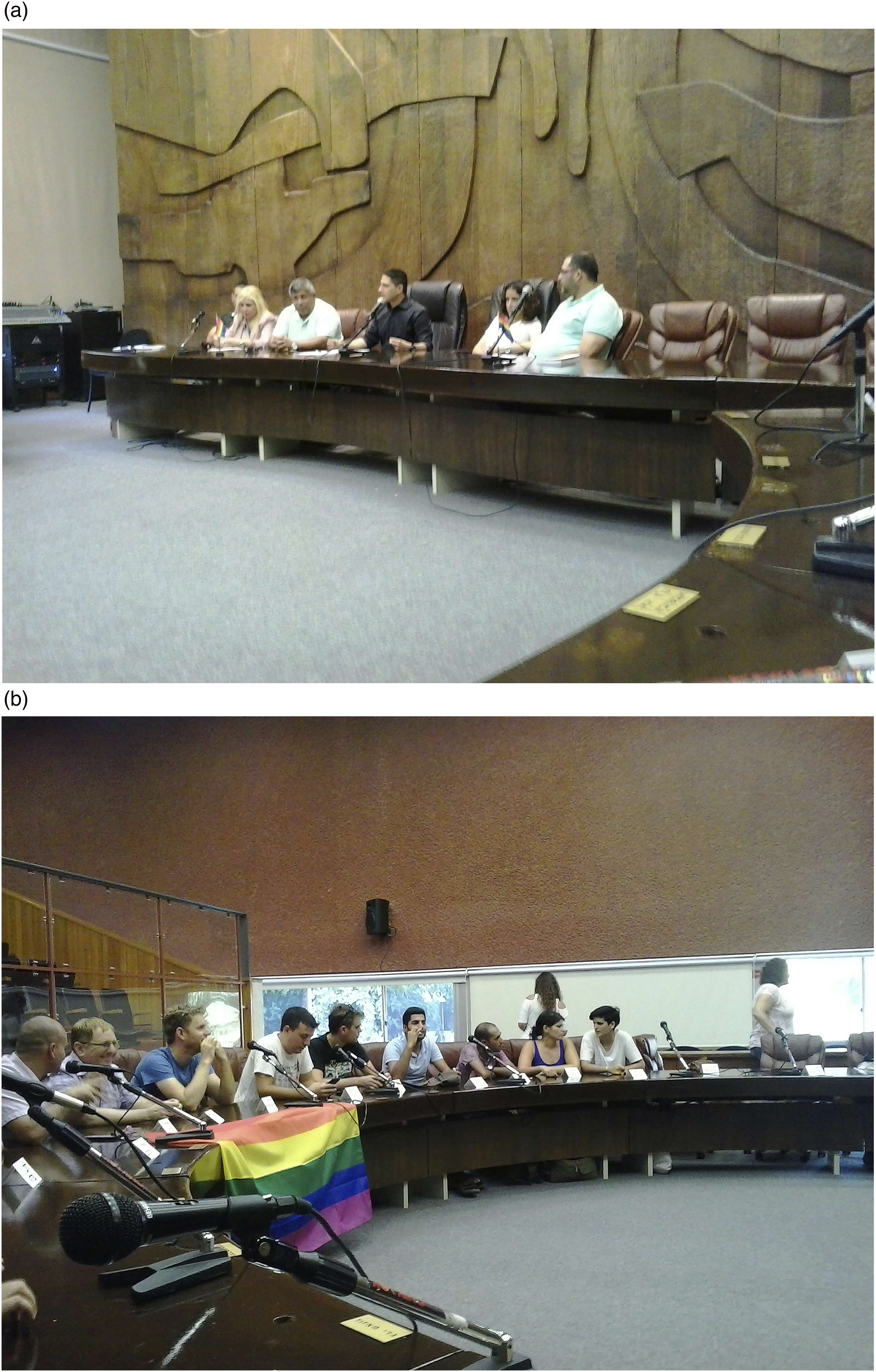
The discussion dealt with the importance of the gay community in the city, its needs, and the nature of its desired relationship with the municipal establishment. One key topic was the community’s request for a municipal building to house its activities. Its main argument was that the LGBTQ+ community, like any urban community, is entitled to the allocation of a public building. This request was inspired by the precedent of the Municipal Center for the Gay Community (“Gay Center”) in Tel Aviv (for more information about the Tel-Aviv case, see Misgav, 2015, 2019). This request was not met with strong opposition by city representatives. However, the mayor noted a number of difficulties, primarily the lack of vacant built public buildings, a point that was refuted at the meeting.
This meeting changed and formalized the relationship between the Beersheba Municipality and the local gay community. The mayor, absent from previous events identified with and organized by the community, began attending community events in the city, and even speaking at them. In January 2015, he participated in the official launch of The Pride House, and officially addressed members of the gay community for the first time, declaring their equal right to the city, “You are equals among equals, you are like everyone else, you are no different” (Danilovich, January 14, 2015). In June 2015, the mayor attended at the fifth gay pride event in the city and spoke to participants about the importance of inclusion and openness (Levy, July 2, 2015).
After years of relatively small events held in closed, defined spaces, and in light of the growing strength of the national and local gay communities, the time seemed ripe for a new phase in the local public LGBTQ+ struggle. In 2016, The Pride House decided to hold the first Pride Parade in Beersheba, and call for recognizing the needs of the city’s community. To this end, two meetings were held between the mayor, his staff and representatives of the Pride House. At the meetings, the desire for a high-visibility parade was raised, as well as the need to fund activities and allocate a public building for the needs of the community. Meetings and talks were held with the police to coordinate and secure the route of the parade on the city’s main street, Reger Avenue, ending in the main square, in front of City Hall. It seemed that the parade had been approved and would march for the first time (interview with M., May 7, 2018) (see Figure 2). The original, agreed parade route in blue and two proposed alternatives in yellow. Base-map source: City of Beersheba.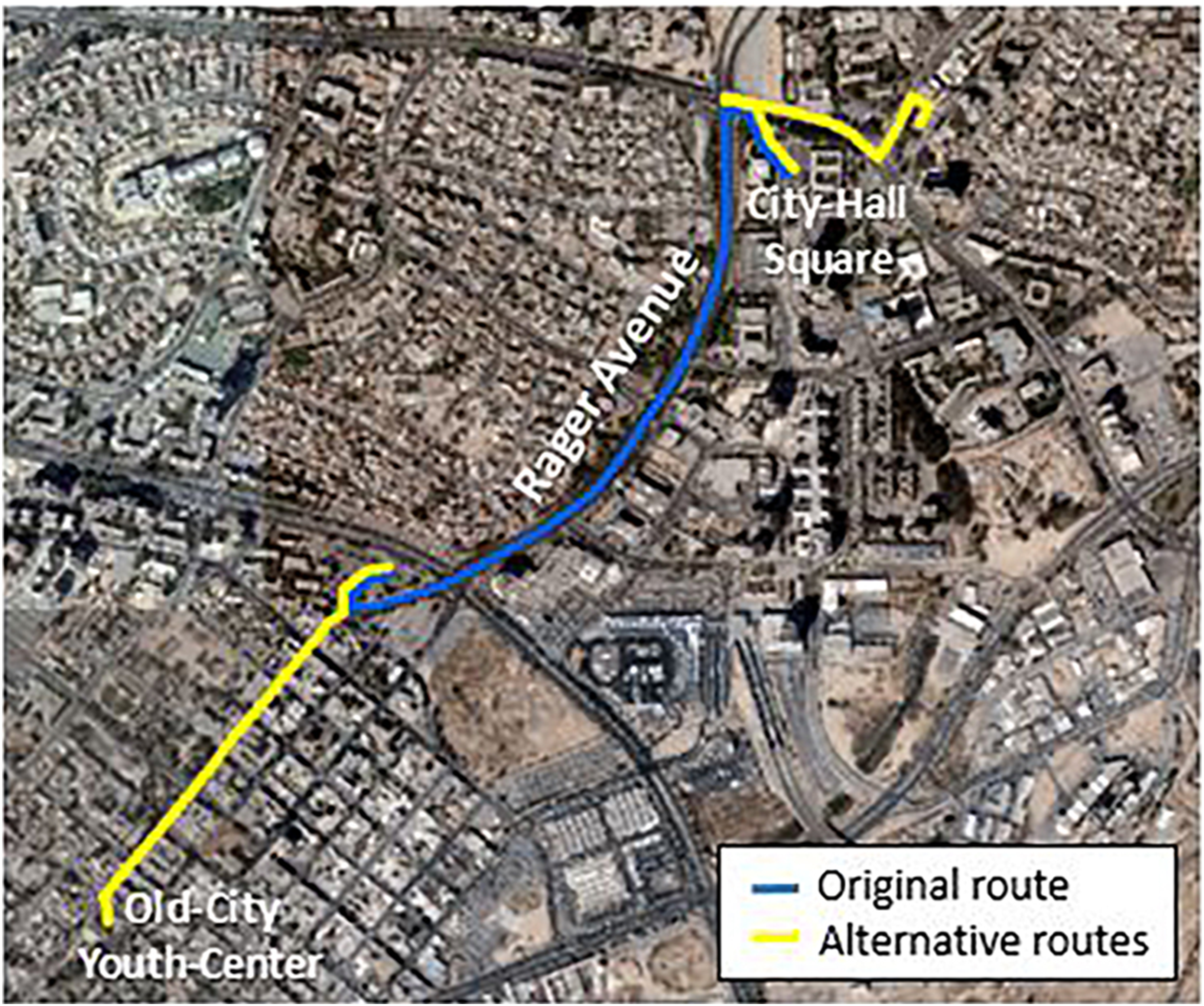
The march was opposed by a minority of conservative municipal officials, led by Beersheba Chief Rabbi, Yehuda Deri. According to the rabbi, the route passed in close proximity to eight synagogues, a yeshiva and a neighborhood with a traditional-religious character, thereby offending the feelings of the religious population in the city (Kobo, 2016).
A few days before the planned parade, the Israel Police announced that, based on intelligence reports of expected violence, the route of the march had to be changed, shortened and diverted to side streets (Figure 2). The gay community refused to accept the change, because there had been agreement on a route along the main street, and petitioned the High Court of Justice (HCJ 5546/16). The case was heard the day before the planned parade. The justices proposed a compromise, slightly adapting the route proposed by the police by adding a small segment reaching the nearest intersection with Reger Avenue (Figure 2). The Pride House board rejected the compromise route on the grounds that the proposed route would not create the required urban visibility (High Court of Justice HCJ 5546/16, 2016).
Following the ruling, the Pride House board canceled the parade in favor of a “Rage Demonstration” in the city-hall square. About 2,500 participants attended the demonstration, including members of the local and national gay community, and many additional supporters. It is important to note that this crowd was larger than the one expected at the parade. Community activists, as well as well-known public and political figures, spoke at the demonstration, calling for equality, inclusion, and pluralism (Levy, interview 2018; Alaluf, 2016) (Figure 3). Demonstration following the cancellation of the Beersheba Pride Parade, 2016. Photo: The Pride House.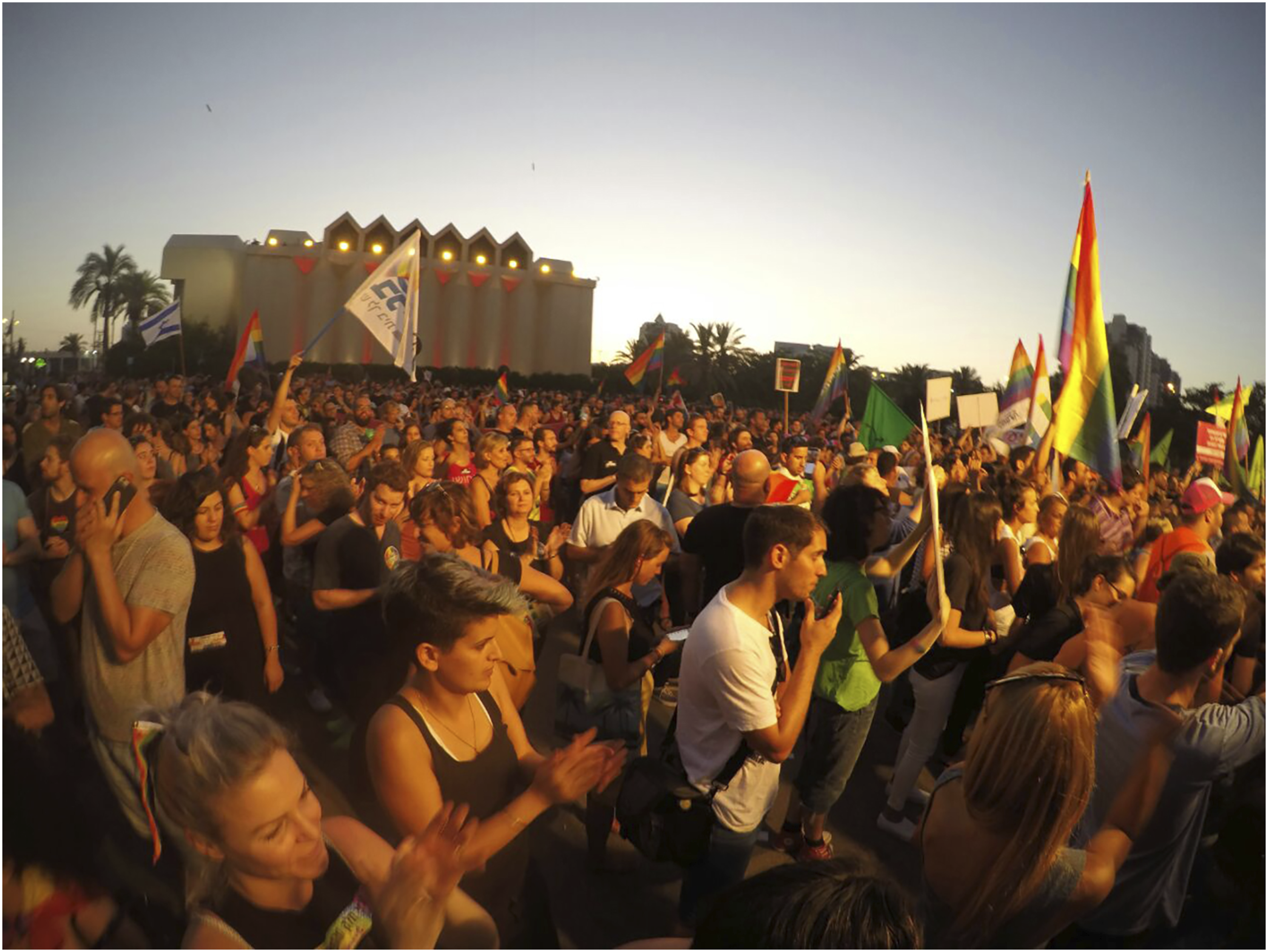
The Rage Demonstration shifted the balance of power between the city’s LGBTQ+ community, which received broad local and national support, and the municipality, which was strongly criticized for being dark and discriminatory. In an interview published on the day of the demonstration, Mayor Ruvik Danilovich was quoted as saying: “The gay pride parade should have been held on the main street in Beersheba... Beersheba is a tolerant city.... The community is very important to the city and to me personally” (Kobo, 2016). These statements indicate that the demonstration was indeed a significant show of strength against the rejectionist and oppressive forces in the city and its administration.
Throughout the following year, the board of The Pride House held a series of meetings with the mayor and senior municipal officials. At these meetings, the board presented a detailed list of demands, including a structured budget and binding requirements, including a public building for the community’s use. In the meetings, the participants constructed a work plan for each requirement. The immediate result was the allocation of a fixed municipal budget of NIS 250,000 and an agreement to allocate a structure for the community in the city (M. interview, 2018).
When they were unable to find an acceptable suitable municipal structure, the parties decided to lease a private property, with full municipal funding. The chosen property was an Arab building, dating from the Ottoman period, located in the heart of the entertainment district of the Old City, where the Arab-Palestinian population was located before 1948. Pride House Organization won the municipality’s tender for the management of the designated building (M. interview, 2018). In 2023, the House moved to another similar building that is larger and accessible to people with disabilities, on a nearby street. The new building is a city-owned building zoned for public use (Beersheba Municipality GIS).
Indeed, 2017 was the peak year in the partnership between the LGBTQ+ community and the city management. As a result, the first Pride Parade in Beersheba was held that June. Approximately 4,000 participants marched down Reger Avenue, the city’s main street, to a concluding rally at City Hall, attended by artists and well-known public figures. In his speech, the mayor declared: “Beersheba belongs to everyone, and I am everyone’s mayor… Beersheba unites, accepts, tolerates” (Curiel, 22 June 2017).
The opening event at The Pride House Center was held in late November 2017 and attended by many community members and friends. At the event, the mayor spoke of Beersheba as a city of many communities, all of whom the city desires and embraces. Prominent activists from the local LGBTQ + community also spoke at the event, including the late Dr. Yael Levi-Hazan, who welcomed the establishment of the house as a true home for all members of the community in the city (Figure 4).
2
The late Dr. Yael Levi-Hazan at the opening of The Pride House in Beersheba and the South in 2017. Photo: Noam Westerman.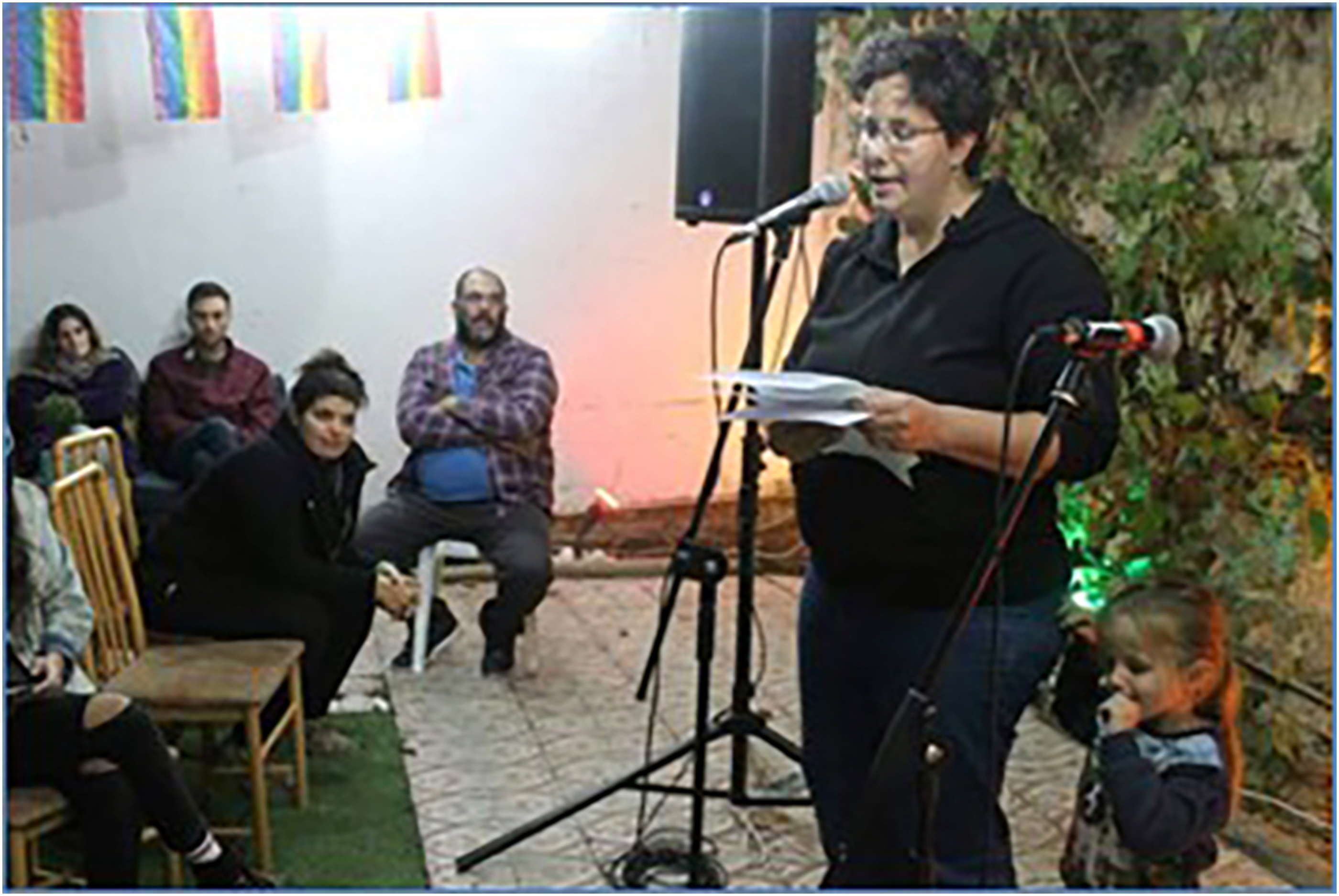
As of 2023, the Beersheba Municipality continues its principled and economic support. In addition to allocating a municipal building for community use and promoting the city’s Pride Parade, the municipality funds a significant part of the ongoing activity, provides social care services for LGBTQ+ people in the metropolitan area and employs a LGBTQ+ coordinator.
Overview
Queer urban citizenship in a peripheral city
The early years of the Beersheba case exemplifies the “dark side” of planning and municipal policy, and a state of deep displaceability, because of the desire to push the LGBTQ+ activity out of the public sphere. This reflects the limitations and challenges of sexual urban citizenship in a peripheral city, where minority communities can be left without recognition or budgets.
Our findings indicate that minorities’ urban citizenship is formed through struggle for space and public presence in urban space. As mentioned, the literature on sexual citizenship (Richardson, 2017) mainly concerns legal struggles and rarely examines “struggling citizenship” in spatial contexts. Struggling citizenship also varies in large cities, e.g., Jerusalem and Tel Aviv, because their character, background, etc. (Fenster and Manor, 2010). Despite variations particular to each place, there is a need, in all central and peripheral cities, to organize a broad movement with visibility, fundraising capabilities and broad public support, including media exposure. An activist explained: The municipality was subject to enormous pressure that we exerted... In less than a year, we found ourselves in a luxurious house in the heart of the Old City. We have proven that tough, determined and even violent struggles, including arrests of activists, achieve results, even in the periphery, which is very different from Tel Aviv. (Interview with A., Pride House activist and spokesperson, November 7, 2019)
Yet, struggling sexual urban citizenship is not detached from local contexts; it positions itself as opposed to and different from the center, which is perceived as hegemonic and privileged: Our community in Beersheba see the senior community representatives from the center as an alienated Ashkenazi elite, which is primarily occupied with raising funds for the center from overseas donors. Our culture is different…. [it] represents the periphery as experienced here, which is very different from Tel Aviv. (Interview with A., November 7, 2019).
From displacement to recognition
The development of struggling sexual urban citizenship, which includes negotiations and years-long deliberative politics between representatives of the community and the establishment, leads to varied outcomes, including community centers. The literature shows that LGBTQ+ urban community centers have been established in the Western world since the 1980s, almost all developing “bottom up” from civil society organizations, even if some receive institutional support as NGOs (Misgav, 2019).
In Israel, the two oldest centers are the Jerusalem Open House, opened in 1999 and run by an NGO, and the Tel Aviv Gay Center, opened in 2008, founded and largely funded by the municipality, in a municipal building (ibid). These centers formed the foundation for significant social and political organizations, despite their fundamental differences in organizational structure and relationship with the municipality (Hartal and Misgav, 2021). As we have seen, activists in Beersheba aimed for the establishment of LGBTQ+ community center in the city from the outset, and repeatedly highlighted this goal, until the dedication of The Pride House in 2017.
Using Shahak’s (2003) three possible patterns of relationships between the LGBTQ+ community and the local establishment – full support, partial support and opposition – we show that during the 2010s, Beersheba moved from a state of displaceability to allowing low visibility community events and allocating sparse public resources, and then rapidly became a city that recognizes the community and its needs, allows it access to the public sphere and allocates the required resources. In other words, it moved from the dark side to the light side. These findings also highlight the importance of understanding displaceability as a dynamic and ongoing situation of vulnerability that frames struggling urban citizenship. In addition, the significance of this rapid transition is twofold, for the gay community itself, and for the broader public context, as a prominent activist described: There is no doubt that there was a big change in 2016.... They understood that there is a very large community... They understood that the community would not remain silent until it got what it deserves... It was a very quick process. In a short time, we managed to get a house, visibility, a social worker and a parade. That changed a lot. (Interview with M., former chairperson of The Pride House, October 30, 2019).
Her comments indicate that the significance of the transition from displacement to recognition is clear to the community. Recognition means the possibility of moving from investing community efforts in the struggle for sexual, urban citizenship to directing their energy, with municipal support, to addressing the needs of groups within the community and organizing public events, like the Pride Parade. This connects directly to the second meaning of the transition from displacement and state of displaceability to recognition, namely harnessing the municipal establishment and its resources for the benefit of the struggle for LGBTQ+ rights that continues despite these achievements.
“Urban pinkwashing”: Queer space vs. Arab space
To understand how the regime and municipal citizenship are shaped, it is essential to look beyond a specific community. In the context of Beersheba, one of the most pressing issues is the situation of the Bedouin-Arab community in the city, which has been a historical center for the Bedouin community in the northern Negev for centuries. Our research shows that parallel to the establishment and consolidation of the queer space in Beersheba, Arab-Muslim space in the city became increasingly marginalized.
We illustrate the displacement process with three brief examples: the changes in the city’s Grand Mosque, the struggle over the Arabic-language announcements on city buses and the closure of the Multaqa club.
The Great Mosque, built during Ottoman rule in 1906, is considered the largest, most important mosque in the Negev. With the establishment of the State of Israel in 1948, it ceased be a house of prayer. For several years, it housed a magistrate’s court and detention center; in 1953, it began to serve as a municipal museum. During these years, the building was neglected and began to crumble (Luz, 2008). As a result, it was declared a dangerous structure in 1992, and all activity ceased.
Following a series of protest activities and lawsuits, in the early 2000s, the City of Beersheba decided to renovate the building, but to renew its use as a museum. The surrounding Arab population opposed this and called for its return to its original use as a house of prayer. Following legal proceedings that lasted many years, a compromise was reached: “The building will preserve its purpose as a museum... The museum will be dedicated to the culture of Islam and the peoples of the East…” (High Court of Justice HCJ 7311/02, 2002, 2011). Today, the mosque serves as a museum, in accordance with the compromise. Prayer is forbidden at there, although there is no other Muslim house of prayer in the city (Nasasra and Stanley, 2023).
In 2016, parallel to the LGBTQ+ community’s struggle, a multi-stage public transportation reform began in Israel. The introduction of announcements in Arabic was supposed to be in the second stage, but Beersheba included it in the first stage. Then, in response to complaints from city residents, the mayor asked the Arabic announcements on city buses be halted until they were required by the reform (Ben Zikri, 2016). Indeed, the Arabic announcements were discontinued until 2017, when the Ministry of Transport made them mandatory. The municipality’s prevention of the use of Arabic in public spaces appears to be part of a broader municipal policy of displacement of the Arab-Bedouin community. For example, the municipality has previously rejected requests by organizations and city council members to add Arabic text to city street signs and to give several streets in the “Old” (Arabic) City Arabic names.
In 2017, the same year that the municipality’s policy towards the gay community changed from displacement to recognition, the city also began attempts to close the social-activist center Multaqa-Mifgash (“meeting”), a Jewish-Arab cultural center, founded by the Negev Coexistence Forum for Civil Equality (“Coexistence Forum”). The center operated in a municipal bomb shelter in neighborhood D, which was first allocated to this purpose in 2006, and again in 2015. During this time, the center provided exposure to Arab culture, discussions on controversial political issues, opportunities for dialogue and holiday meetings between Jews and Arabs. In 2017, the Beersheba Municipality filed an official notice that the bomb shelter allocation agreement had been supposedly violated, stating that the space was intended for community activity, not for political activity. In early 2018, the issue was referred to the Administrative Court and later to the Supreme Court, which ruled that the allocation to the building should not be canceled (Judgment Civil Appeal 5042/18). Following the court ruling, the Beersheba Municipality decided to exert economic pressure and submitted a demand that the Coexistence Forum pay retroactive use taxes totaling half a million shekels, contrary to the usual practice when municipal buildings are allocated to non-profit organizations. The Coexistence Forum chose not to file another petition, reached an economic compromise and terminated the contract with the Municipality on its scheduled expiry date, October 31, 2020 (interview H., Executive Director of Coexistence Forum, September 24, 2020). It should be noted that out of more than 880 sites of public activity, the Beersheba Municipality does not allocate even one public building for Arab culture, despite the needs of the large Arab population in the region (Yiftachel and Mandelbaum, 2017).
While outside the scope of this paper, we note this marginalization and displacement has seemingly intensified following the October 7, 2023 massacre and the subsequent Israel-Hamas war. During this time, the city has increasingly stressed its Jewish identity and identification with the Israeli army.
One of the questions that arises from the findings asks if the growing recognition of the gay community is accompanied by “pinkwashing” the oppression of other communities? Does the transition from displacement to recognition of the LGBTQ+ community, is legitimated by displacement of the Arab community in the city? Literature shows that public and cultural events (e.g., the Pride Parade) help city leaders build a positive, desirable image (Eizenberg and Cohen, 2015). In the case of Beersheba, recognizing the LGBTQ+ community and the actual expression of this recognition, through support for events, such as the Pride Parade and the opening and budgeting of The Pride House, create a liberal, pluralistic image. We saw evidence of this in the very presence of the mayor at the community’s events and his statements there. The municipality’s support for the Pride Parade in 2017 and thereafter further reinforces the perception that the city no longer pushes LGBTQ+ people out of the public sphere, but rather visibly embraces them, while recognizing their needs. Has this liberal, pluralistic image allowed the active displacement of another community?
We do not claim that there is a direct causal connection between the exclusion of the Bedouin-Arab community from urban space and municipal resources and the rapid transition of the gay community from displacement to recognition. Nonetheless, it is apparent in the mayor’s statements at the time, Beersheba was trying to present itself as a liberal, tolerant city, containing and accepting “all communities.” Clearly the change in policy towards the gay community supports this image, certainly at a time when the mayor was criticized for his policy regarding the Arab-Bedouin community. Even if this move was not anchored in a formal policy linking various communities, we argue that the policy of displacement of the Arab-Bedouin community from the public space is largely whitewashed by the change in policy towards the LGBTQ+ community.
This process is consistent with “homonationalism”, in which LGBTQ+ inclusion is based on community members belonging to the hegemonic national group and their inclusion in the (imagined) national community (Puar, 2007), represented in Israel by the Jewish-Israeli collective. Indeed, this has been an organizing principle of LGBTQ+ politics in Israel for two decades. That said, homonational politics does take on distinct forms depending on the particular spaces and cannot be painted with a single stroke (Hartal and Sasson-Levy, 2018).
The simultaneously of the rising of the LGBTQ+ space and the fall of the Bedouin-Arab space, reveals signals of “pinkwashing”. Meaning, creating a liberal image that respects human rights and more extensive rights for LGBTQ+ people, facilitates concealing human rights violations against other minorities. The dominant argument is that national government and politicians present themselves as supporters of the LGBTQ+ community, using the community’s public events for international public relations and pinkwashing. In Israel, pinkwashing of their treatment in Arab communities (Atshan, 2020; Gross, 2015; Hartal and Misgav, 2021; Schulman, 2012).
Unlike the classic claims regarding pinkwashing on the national level, and further to Hartal and Sasson-Levy’s (2018) spatial reference, we argue that the Beersheba case exhibits a similar tendency at the municipal level in a peripheral locale. Municipal pinkwashing influences the image of a medium-sized, peripheral city and is aimed only at the local Israeli audience, as opposed to state-level pinkwashing that is aimed at an international audience.
Arab identity in Israel is ethno-national, exists in constant tension with the hegemonic Jewish society (Yiftachel, 2021). The LGBTQ+ identity, on the other hand, has global, urban characteristics. While the two communities are struggling for urban citizenship, the Arab community is also fighting for political citizenship in the face of a hostile ethnocratic reality. Therefore, LGBTQ+ identity is “easier to digest” at the municipal level, because it is less challenging to the national ethos despite challenging conservative values. Thus, recognizing the LGBTQ+ community seems possible, and even permissible, notwithstanding objections from residents and members of the city council.
Moreover, the buildings that the gay community received from the municipality are Arab homes, built in Beersheba mainly during the Ottoman period. The historical property records show that these lots are listed as “absentee property,” meaning that before 1948 they belonged to Palestinian refugees and were expropriated by the State of Israel. The willingness of the queer community to use these buildings demonstrates a lack of awareness and solidarity between the struggles of the various threatened, displaceable communities in the city.
A comparative look at these struggles for recognition and urban citizenship shows that two models of marginalization, displaceability and recognition can exist simultaneously in the same space. The comparison shines a spotlight on the difference between displacement, as an act, and displaceability, as a protracted condition of urban precarity (Tzfadia and Yiftachel, 2021). As this study shows, a state of displaceability can be replaced by recognition, as happened in the case of the gay community in Beersheba. Conversely, a similar vulnerable situation can lead to more severe displacement from public space and resources, as in the case of the Bedouin-Arab community. Either way, these cases demonstrate that this is an ongoing situation, with multiple grey stages, in which recognition and rights are never fully guaranteed or secured.
From displacement to recognition
Analysis of the struggle waged by the gay community in Beersheba presents an instance of relative success in transitioning from enduring condition of displaceability to recognition and safety. Several conclusions can be drawn from the organization of the struggle which mobilized the community for achieving allocation of municipal assets and resources, and the high visibility during the annual Pride Parade, briefly: 1. The significance of an energizing campaign with broad external support – The protest held instead of the parade in 2016 demonstrated political power and visibility. The ability to organize within the local LGBTQ+ community and recruit a large number of participants and marshal external support, testifies to the significant political power of a strong, organized community, the result of more than a decade of organization. The massive support the community received from both the gay community, especially national organizations, and local forces outside the gay community, was important and contributed to the event’s power and visibility. The ability to interest the national media in the campaign was also significant because media reports facilitated mobilizing support and participation, transforming the local protest into an event with more far-reaching impact. Activating external support, both local and national, was a noteworthy achievement and a key part of the LGBTQ+ community’s ability to demonstrate political power and visibility. Moreover, the case study above shows that the struggle for the Pride Parade (despite it being cancelled) had tremendous significance for the community’s organization and transition from a state of displaceability to recognition. This finding stands in tension with claims of other researchers that parades are a temporary, passing moments, disconnected from the peripheral urban space (Hartal et al., 2023). 2. A positive role model – is essential for a marginalized community that seeks recognition. The Tel Aviv gay community, which began developing in the late 1990s and experienced significant activist struggles (Gross, 2015; Kama, 2011; Misgav, 2019), served as key model for the community in Beersheba. In addition, Tel Aviv also drew support from LGBTQ+ communities from around the country, a step that proved effective in Beersheba, too. This contrasts with the model of marginalization, displacement, and long-standing struggle for recognition in Jerusalem, where the struggle is still in progress (Hartal and Misgav, 2021). 3. Clearly defined goals and a determined struggle – From the beginning of its organizational efforts, the community in Beersheba had clear goals: achieving rights, public presence and a home for its activities. The Beersheba case shows that the insistence on holding the parade on a central urban route, as well as the organized, detailed document of demands submitted by the community to the municipality after the protest, indicate the importance of enduring persistence and uncompromising campaign to achieve those goals. 4. “Swimming with the wind, against the current” – Since it was first organized, the gay community in Beersheba has successfully worked with the establishment, even during periods of crisis when the parade was cancelled. In a move conceptualized elsewhere as “with the wind, against the current” (Misgav, 2015), the gay community did not “break the rules.” Rather, it maintained contact with the Council’s professional and political representatives. This ability to fight the establishment while also acting pragmatically was largely responsible for the rapid transition from displaceability to recognition, and the accompanying allocation of urban status, resources and assets.
In conclusion, recognition of the gay community in Beersheba demonstrates that the “dark side” of planning and urban policy, including ignoring, marginalizing, displacing and discriminating against minorities, is never set in stone. There are situations and struggles that are able to mobilize the “light side” and transform their urban reality. The process of transition from displaceability to recognition was relatively rapid in Beersheba, but not self-evident. The mobilization constructed urban citizenship as a site of struggle that undertook several actions and prepared conditions that crystallized into a positive, rapid moment of success. Simultaneously, the Arab community in the city experienced the opposite process and was further displaced from the city’s public sphere and resources,. The authors believe that the progressive change in the city’s public image was reinforced by recognizing the gay community. The same process, however, served – at least to some extent – to “pinkwash” the racist oppression of the city’s Arab community. These simultaneous processes emphasize the importance of displaceability as a dynamic and ongoing situation of precarity that frames struggles for urban citizenship, often found on a continuum between the “dark” and “light” sides of planning policy.
Footnotes
Declaration of Conflicting Interests
The author(s) declared no potential conflicts of interest with respect to the research, authorship, and/or publication of this article.
Funding
The author(s) disclosed receipt of the following financial support for the research, authorship, and/or publication of this article: This work was supported by the Israel Science Foundation; (1622/18 and 1247/23).
