




Abstract
This article examines the increasingly conflictual relationship between ports and their surrounding communities at a time of wide-reaching infrastructural expansion. It highlights how the centralization of power and logistical gigantism produce deterritorializing frictions, decoupling inhabitants from their territories and creating the conditions for social contestation. It calls for a rethinking of the role of communities in contemporary port-city governance, with an emphasis on imaginaries of re-territorialization produced through social mobilization. I frame the increasing contestation in port cities through a critical approach to logistics, arguing that citizen engagement holds the potential to drastically readdress the port-city relationship. It examines the cases of Genoa and Venice using ethnographic methods and reconstructs a historically in-depth counter-narrative of interactions between port, city and citizen. I contextualize specific frictions between port and city through the rise in social mobilizations. The article shows how social mobilization challenges the status quo in different ways, producing changes and illuminating pathways toward more sustainable forms of coexistence between ports and cities.
Logistical frictions in port cities
Port cities have long been sites of frictions and struggles, particularly concerning historic labour struggles at the docks. Nowadays, as-yet unmapped contestations led by citizens who live near ports expose them as epicentres of different types of conflict, that reveal further socio-spatial fractures.
Processes of containerization, automatization and devolution have triggered structural changes at the port, producing spatial and social rearrangements as well a reshaping of labour conditions. Commercial and industrial expansion drove port and city apart (Hoyle, 1989), a separation that has led to a loss of connection between port and city institutions (Hein and van de Laar, 2020). The limitless expansion of ports has turned the port-city interface into a conflict zone (Wiegmans and Louw, 2010), with ports’ technological changes generating direct implications on urban congestion and waterfront redevelopment (Hayuth, 2007). This article examines the socio-spatial and the socio-political dimension of port-city conflicts, focusing on how the accumulation of logistical frictions lead to social contestation.
Dockers’ struggles have provided a history of radicalism in port cities, with strikes and other actions of logistics-disruption revealing tensions between continuity and change (Mah, 2014) as well as indicating the fragilities of the supply chains. However, while struggles at the docks have been the object of inquiry in several disciplines – producing significant documentation – the contestations led by residents against ports are rather uncharted, despite their rising occurrence globally. In this section of the article, I identify the dynamics that can explain why relationships between ports and citizens are becoming structurally more complex and more contested.
Over the last decade, critical perspectives from social sciences have explored the social and political effects of the logistics “counter-revolution”, interrogating how financial, corporeal and material movements reorganise social relations with and against profit and power (Chua et al., 2018). Significant analyses of the damaging effects of the development of supply chain infrastructure (Cowen, 2014) underline how logistics is profoundly political, driving the transformation of time, space and territory with force, and so instituting new forms of jurisdiction. Tsing (2009) argues that supply chains stimulate both global standardization and growing gaps between rich and poor, North and South, and across colour, race, class and culture, while Ziadah (2018) has investigated how economic strategies aimed at optimising logistics and transportation performance in port cities frequently subordinate democratic principles and the welfare of populations to the needs of the supply chain. Danyluk (2021) identifies supply-chain urbanism – consisting of the refashioning of urban space to facilitate the circulation of commodities – as a distinctive paradigm of urbanization. He argues that this paradigm has emerged as a manifestation of the tension between fixity and flow that characterises the contemporary circulation of commodities.
This paradigm is marked by the logistics economy’s distinctive history of acceleration, which has resulted in a transformation of ports globally. Multinational corporations started taking over port operations and port companies in the 1980s, initiating mergers amid skyrocketing international trade in the 1990s. Ports have become ‘paws’ in the world-wide transportation game, where major players are private corporations, whose interests rarely coincide with local concerns (Slack, 1993). The buying up of and investment in port terminals has since turned ports into globalised, corporatised and highly competitive environments (Robinson, 2002), with port authorities having less control over their destinies (Slack, 1993). Cooperation agreements between maritime transport companies gave rise to global alliances that facilitated the sharing of vessels, coordinating of routes and prices, and achieving larger service coverage. Between 1990 and 2017 the industry’s global capacity expanded dramatically – from 4008 million tons loaded to more than 1 billion, in parallel with the growth of global trade (UNCTAD, 2019). The shipping industry met this new demand by operating with increasingly larger ships, allowing for transport prices to decline. Container ships in the 1990s were able to transport 5000 TEU (unit of cargo capacity equivalent to 20 foot); in 2019 it ballooned to 21,000–25,000 TEU (Rodrigue, 2020).
The tendency of mergers and acquisitions reached an unprecedented climax in 2022: all major container carriers are involved in one of the three global alliances, which decide on 80% of the total geography of global trade (Laxe, 2018). This rapid evolution of maritime transport has triggered two characteristic trends that impact the port-city relationship: the emergence of a shipping oligopoly, and naval gigantism – both expressions of the industry’s centralization of power. While ports are increasingly governed by a handful of corporations driven by private interests and according to a global agenda, local communities lose agency on the territory they inhabit.
While the three alliances benefit from a tax exemption regime, ports are required to invest in expensive infrastructural upgrades to accommodate the inexorable growth of mega-ships, much of it publicly funded, owned by fewer and fewer carriers. Naval gigantism, which recently gained worldwide attention due to the obstruction of the Suez Canal in March 2021, has clear and direct territorial impacts as well as aqueous, given that they require increasing resources from local territories, producing inland congestion and pollution in the inner-city surrounding the port.
This ‘monopsony’ of the shipping industry produces critical imbalances in buying power when bargaining with ports: shipping corporations can pressure ports to adapt according to their needs, threatening to go to elsewhere if they do not obtain what they want (Merk, 2020). Alliances have a greater capacity of weakening compromise, with port authorities neglecting responsibilities towards the territory surrounding the port, which leads to local disempowerment. This is facilitated by the opacity that characterises the city-port-shipping industry relationship; a 2020 report by Port Economics revealed that the port industry is ruled by a lack of transparency, causing problems of consistency between ports and regions (Brooks et al., 2020). This evolution is characteristics of container terminals; however, cruise ship terminals have followed a similar trajectory – as ship sizes have increased, consolidated companies have absorbed smaller cruise companies, with currently 80% of their market controlled by three corporations to which ports must adapt to. (Cruise Market Watch, 2020).
Such concentration of power in the shipping and cruise industries is increasingly producing social and political frictions between the city, its inhabitants and the port as accumulation becomes a limitless goal. Such frictions can be understood as reterritorializing vectors, which decouple space and everyday life in port territories
Social mobilization in port cities
When port infrastructure expands in a manner that erodes public support and generates social discontent, frictions arise, producing antagonism, contestation and resistance. There are recent examples of this worldwide. In Doel, Belgium, a committee of citizens is fighting against the disappearance of the maritime village encroached upon by the plan of port expansion, which has caused demolition and semi-coerced relocations (Doel 2020, 2008). In Piraeus, Greece, groups of inhabitants are contesting the encroachment of the port expansion plan on spaces of public interest, such as archaeological sites and a beach, as well as connected interventions in urban spaces, such as the construction of hotels. Civic movements in Colombo, Sri Lanka and Makassar, Indonesia have been taking the streets since 2016, protesting the effects of sand-mining and reclamation for port expansion which have put at risk the livelihoods of long-time fishing communities. 1 Residents’ organizations in Durban, South Africa have also been struggling against the expansion of the port-petrochemical complex, which has caused the destruction of small-scale farming and long-standing communities, with displacements, major ecological problems in the estuary bay, climate-change cause and effects and irrational economies (Bond et al., 2016).
As the online platform ContestedPorts shows, such contestations are spreading across different geographies. 2 Even if port cities are territories where the distinction between circulation and production are blurred (Danyluk, 2022), these protests can be viewed through the lens of counter-logistics, given that different blockading tactics are implemented for countering the chronic growth of logistics through the port. Davis (2021) argues that counter-logistics blockades do not just interrupt circulation, but actively attempt to reorient social relations and material circulations within a place and across space, attempting to also produce, deploy and sustain different forms of governance. Inhabitants contesting port expansion recognise the urban effects of maritime circulation, and in these civic movements, tactics of blockade against predatorial port expansion emerge as primary actions to counter territorial extraction produced by the expansionism of logistics. Different ideas of port-city relations therefore emerge, suggesting a reshaping of material relations between logistics and the socio-spatiality of cities. Such actions can be understood as vectors of re-territorialization, where new continuities are produced through practices of social organization and forms of mobilization.
In his reinterpretation of blockades as productive happenings, Davis (2017) shows that the blockade tactics of social movements are not carried out just for the sake of logistics disruption, but for also allowing other things to move and flow – a productive reorientation of a place towards alternative regimes of governance. The lack of citizen consensus common to the cases of port infrastructural expansion mentioned produces a democratic deficit. Disruptive inhabitant-led actions against logistics, including legal actions against port stakeholders, are accompanied by the elaboration of alternative visions for their territories, in which collective priorities are (re)defined. Such renovated territorial agency produces what Davis calls a new “apparatus of governance” that aims to reterritorialise power and reinvent circulation according to a different ethics.
Some of the social mobilizations taking place in port cities can be read as counter-logistics movements, given that different tactics of blockades are implemented for interrupting the limitless logistical vocation for expansion and its effects. However, while not all contestations at the port are fully counter-logistics movements, most of them express the desire to protect their territories and the right of political inclusion. Such desires contain elements of discourses on environmental justice, as well as ‘right to the city’ according to Harvey’s expanded meaning. He states: “the freedom to make and remake our cities and ourselves is one of the most precious yet most neglected of our human rights” (Harvey, 2008). Human rights of the second and third generations – together with commons, quality of life, as well critiques of growth – are frequent discursive vectors forming the imaginaries of reterritorialization emerging from social mobilizations in port cities (Savoldi, 2022). The effective changes these civic mobilizations produce on the port-city relation is unclear and understudied.
The potential for civic mobilizations to provoke structural change and transform patterns of conflict is a crucial question in social movement studies. In the past two decades there has been extensive research on the political consequences of movements, showing that they are influential in fostering cultural changes (Ferree and Hess, 2000), institutional changes (Kelly, 1999) and political change (Amenta, et al., 2010). Della Porta and Diani (2020) have illustrated numerous cases where social movements have opened political opportunities, importing new issues into the public debate and influencing the transformation of public policies. However, these authors also underline how difficult it is to precisely attribute changes in public policies to such movements, given that institutionalized actors, social movements and pressure groups produce results together. Nonetheless, scholars from sustainability studies, drawing on social movement theorists, have documented how contentious social movements alter norms, motivating policy change on climate change and overcoming political inertia (Angel, 2017; Cheon, 2020; Piggot, 2018). Civic movements, as a manifestation of collective agency, can propel new ideas, energy and creative approaches to fighting climate crises (Temper et al., 2020).
In this article I argue that ongoing social mobilizations in port cities can potentially become vectors for reterritorialization, with the potential of producing change and readdressing the port-city relationship. In the next section, I analyze how frictions between port and citizens have been produced in the cases of Genoa and Venice, Italy, contextualizing the emergence of social mobilizations against the port. I frame their significance in the port-city relationship, looking at the nature of the transformations they have shaped.
Case studies
Counter-narrating the port city: Genoa and Venice
In this section I locate the roots of frictions between port and citizens in the cases of Genoa and Venice, in order to understand how social mobilizations have emerged and their implications on the port-city relationship. I reconstruct an historical chronicle of port-driven territorial transformations over the last century in order to understand the conflictual nature of frictions in their historical dimensions. This time span was chosen because major port reshaping projects started around the 1920s in both cities, in concomitance with the administrative centralization of power in both port territories, which was promoted by the fascist regime. Since then, both ports have been consuming more and more space and resources from the city, with new expansion plans currently under consideration. This reconstruction is carried out as a counter-narrative compiled through an ethnographic approach, which aims to highlight the critical histories of interaction between port and city. This reconstruction was carried out through analyses of relevant press and institutional documents, as well as academic publications on the urban history of port expansion in Genoa and Venice. I have also conducted interviews with residents that have been active in contesting the ports of Genoa and Venice. Inspired by Delgado (1995) whose conception of ‘counter-story’ describes the narration of realities experienced by groups as opposed to those in power, this counter-narrative aims at creating a critical reading of the port cities and their entanglement with logistics. This takes distance from dominant discourses and beliefs that normalize ports as unchallenged engines of growth.
I have conducted 14 semi-structured, in-depth interviews with active citizens in both cities, selected through a snowball method that departed from initial contacts within committees of citizens contesting the port. The interviews focused on two main topics: the relationship with the port, and the social mobilization against the port. The first topic was observed through exploring the material relationship of the interviewees with the port, the experience of the port’s disruption on their everyday life, and their framing of the role of the port as an infrastructure. The second topic was examined through exploring participation in collective actions as part of the civic mobilization, collective demands and discourses on coexistence with the port, resources that were used and produced, and the consequences of social mobilization. Some interviews have been conducted simultaneously alongside field observations, walking through the areas of the city strongly affected by port activities.
Genoa: Territorial alienation and social mobilization
The port has been a crucial element of Genoa’s urbanization since Roman times, becoming an important urbs maritima in the Middle Ages, first playing a role during the crusades, and later as a free port and maritime republic. Maritime trade fundamentally determined the socio-economic and political character of the city and its urban development, according to the changing needs of the merchant elite, as well as in the later era of port decline that started in the 18th century and stemmed from the changing needs of local family traders.
The 20th century completely transformed the port and its relationship with the city. The fascist regime, with a policy geared towards fostering grandiosity and superiority, promoted Genoa as a logistics hub for the consolidation of north-western Italian industrial development, and a node for imperial oceanic ambitions. The regime expanded the port towards the western coast, made possible by the parallel process of peripheralization. In 1926, with the idea of creating a ‘Great Genoa”, 19 independent towns were incorporated into Genoa’s municipality; turning them into suburbs that then became dependent on the city’s central administration, succumbing to a top-down culture of disregard towards the urban periphery (Gangale, 2019). Supported by the hegemonic logic of ‘excelling – whatever the cost’, between 1925 and 1933 Sanpierdarena beach became “Mussolini basin”, a port constituted of several parallel piers with colonial titles that remain today – Ethiopia, Eritrea and later Somalia and Libya. In this period the breakwaters in front of the new port were also built. The related construction of terrestrial infrastructures (roads and railways) tore the western urban fabric from the sea, structuring its contemporary spatial identity according to patterns of coastal development and degradation.
Genoa and its port were heavily bombed during the second world war. In the following phase of reconstruction, the port continued its expansion toward the west according to established zoning. This expansion went hand in hand with intense industrialization, producing a future path of spatial dependency. The spatial limitation of the city and its periphery – a densely inhabited, narrow territory nestled between land and mountain – did not affect port expansion. In the 1960s, the development plan of the port took almost all the western littoral. With the international spread of containers, Sanpierdarena – which currently has 43,000 inhabitants – was chosen as the first terminal for containers, but its capacity was soon dwarfed amid the industrial boom and the growth of international trade.
In the 1990s the port kept expanding towards the western littoral. A new container terminal for ultra-large container vessels was built on the beach of Genoa-Pra’, a former town of 20,000 inhabitants that was rendered a suburb, located 15 km west of Sanpierdarena. The creation of this terminal has been deeply contested by local inhabitants since. It was envisioned and designed in the 1970s under pressure from major industrial groups in northern Italy including Fiat, which at the time was producing cars in Turin but was also pursuing a policy of delocalization. The terminal design had to adapt to the containerization of trade and particularly to increasing ship sizes. The construction works took more than 20 years and the terminal became operative only in 1994. With a severe lack of communication from the port and city institutions, let alone public consultation, the beach of Pra’ disappeared to make space for the new port.
The beach, which originally was almost 4 km long, played an important socio-economic function for the residents of Pra’, in particular for children with working mothers. There were also 34 small resorts, including hotels, restaurants, a beach club and fishing spots. Its disappearance produced a socio-spatial trauma in terms of lost jobs – never fully replaced by the employment offered by the new port – and in terms of urban identity. A long-time site of maritime importance and tourism was now overtaken by a neighbouring industrial port and had no access to the sea. Despite the continuations of traditional maritime festivities such as Saint Peter’s Day in Pra’, the forced detachment from the sea changed the lifestyle of the inhabitants, especially for elderly people who had to readapt to different usages of public space and health routines. One of my interviewees described the territorial transformation driven by the port as a traumatic experience. “The construction of the ultra-large terminal was a socio-environmental disaster for us living in Pra’. We have been abandoned by the institutions – it was a sad and gloomy time”. 3
The container terminal was built on the beach, too close to residential buildings, producing strong negative impacts on local inhabitants. “The noise of container handling resonates between sea and mountains as in an echo-chamber. It wakes me up in the middle of the night” said one of Pra’ residents I interviewed. “We constantly breathe heavy polluted air. When I hang white clothes outside, I get them back black due to the smoke coming from the port” said another resident.
3
As an extra woe, the terminal was also named Voltri – after a nearby quartiere – instead of Pra’, without any justification given. The implications of it are uncertain, but the renaming was perceived by many residents of Pra’ as the total disconnection between port, the central municipality of Genoa and the citizens (Figure 1). Satellite image of the western coastal side of Genoa. Google Earth, captured in 22/3/2021.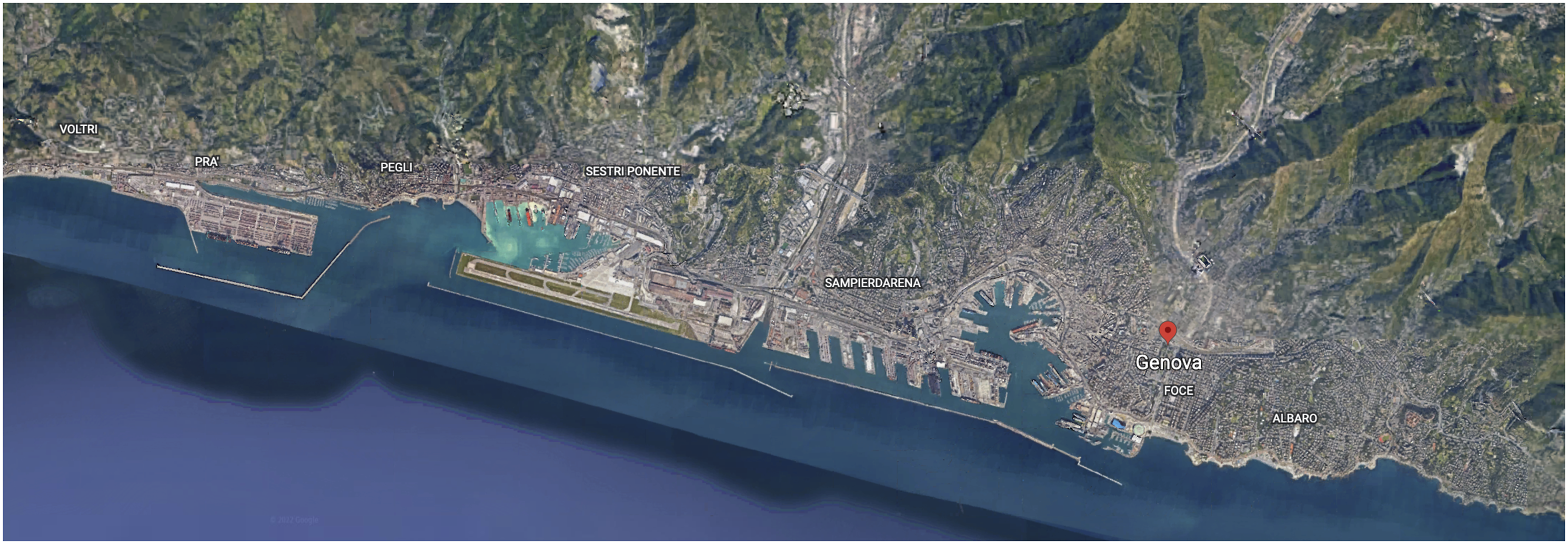
After 2010, a group of active residents of Pra’– weary of the invasive disruptions to their daily lives – began a series of demonstrations, contesting the invasiveness of the port and refusing their own alienation from their territory. Their collective discourse was framing their territory as being held “ransom” to the port. As well as the effects on local quality of life, awareness about the chasm between the profits generated by the terminal, managed by the Singaporean company PSA, and the impacts on inhabitants prompted even more anger and a collective rejection of the port. Marches in public spaces, road blockages and other disruptive actions took place in the streets of Pra’, with residents demanding to be heard by the Municipality of Genoa and the Port Authority (Figure 2). Residents of Pra’ marching against the port-driven urban plan of the western side of Genoa on 20th March 2013. Courtesy: FondAzione PRimA’vera.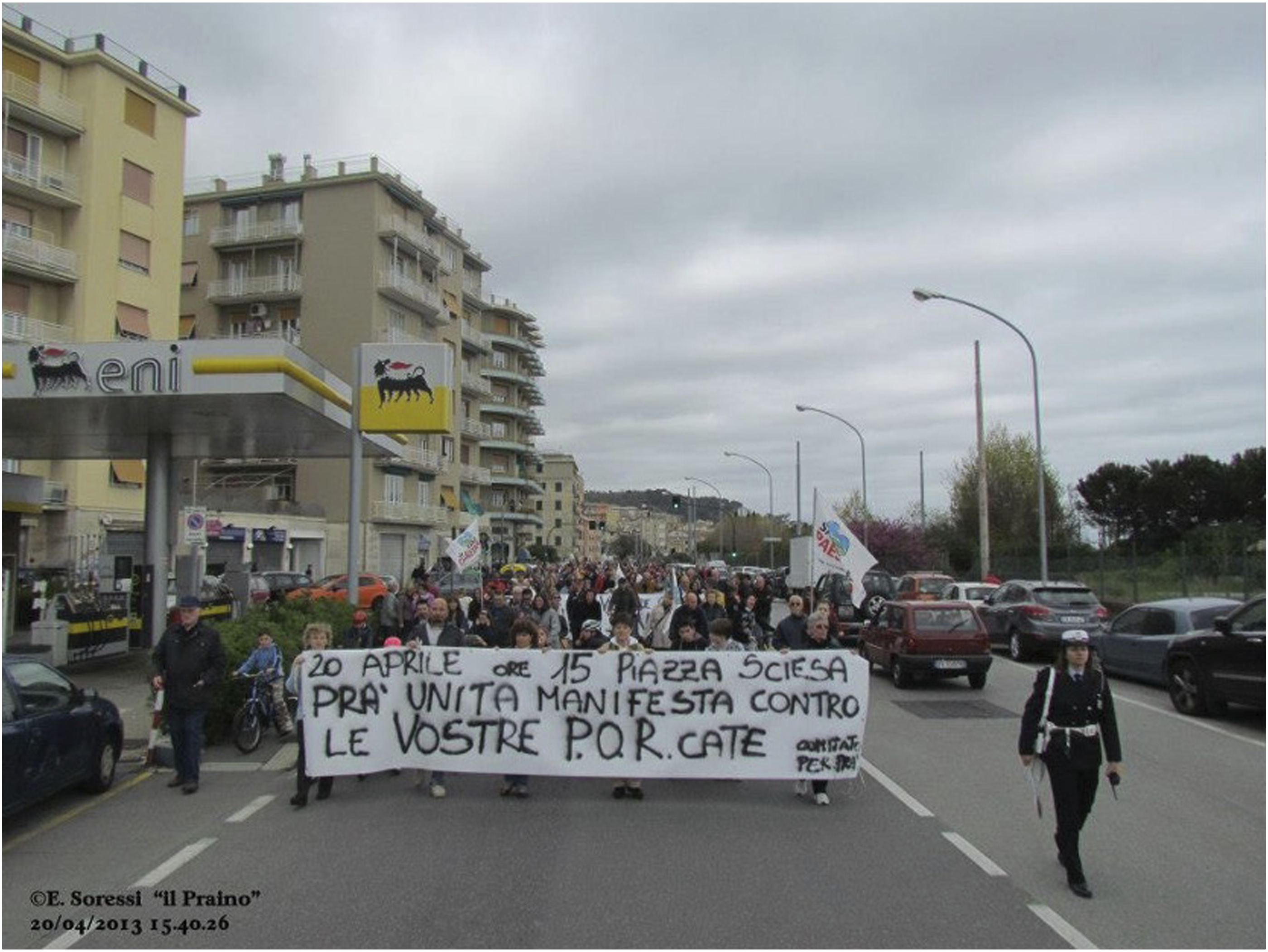
Some local active citizens took the initiative of turning social discontent into a pragmatic campaign. They created the foundation PRimA’vera, a non-party local organization, aimed at keeping local residents aware of the evolving impacts of port activity and shaping a collective claim to the port and city institutions. Between 2009 and 2013, the foundation published Il Praino, a monthly editorial journal that provided information the state of the territory, including the urban degradation produced by the construction of infrastructure, public discussions of residents on port impacts, and celebrations of local cultural identity. This editorial project helped to symbolically form a sense of community through the reassertion of collective experiences of territorial transformation and the declining quality of life resulting from port activity. This led to the shaping of a collective demand that eventually resulted in proposals articulated in some ways as compensatory. Solutions proposed by the residents took shape through the foundation; these practical proposals aimed at mitigating sonic and atmospheric pollution, creating public spaces that could replace the lost beach, and a designing an alternative for regaining public access to the water.
Despite the actions led by the foundation being initially labelled as “parochialism” at the port authority and city hall, PRimA’vera managed to open a channel of communication between inhabitants and the port and the central administration of the city. The foundation has not only triggered institutions to make emblematic decisions, such as changing the terminal’s name from Voltri to Pra’, but it has also enacted processes of participation through several initiatives. Public, collective discussions within the local inhabitants were turned by the foundation into technical proposals – discussed later with port and city institutions as well as with port stakeholders including PSA, through a series of roundtable events called Pra’ Palmarium. As a result of this process, the urban plan of the port was altered, incorporating solutions for mitigating the impacts. Some solutions were co-designed by the students of Pra’ together with the University of Genoa. Green barriers, new public spaces and a small marina have been proposed as ways to separate the port from the residential area, allowing inhabitants to regain access to the water. Funding for implementing the solution has been recently obtained by the European Commission and the Italian Ministry of Infrastructure and the interventions will finally go ahead. The president of the foundation described this evolution as “obtaining respect from institutions and bringing back self-confidence and pride to the citizens of Pra’”. 3 However, the public participation process was limited at both geographical and political scales. The participatory process involved residents of Pra’ through the foundation, and the port and city institutions, without engaging other neighborhoods along the western littoral also affected by port activity. This resulted in the negotiation of impact mitigation solutions only for the waterfront of Pra’, rather than a larger debate of the port-city relationship.
New power arrangements, old spatial paradigms
Nowadays, the port keeps growing, intensifying its impacts on the surrounding residential areas. The basin of Sanpierdarena is now scheduled for infrastructural transformation aimed at accommodating ultra-large container vessels. The new terminal is “desired” by MSC, a corporation that has been consolidating its presence and business leadership in Genoa over the last 15 years, acquiring historic local terminal operators, and obtaining full control on the cruise terminal.
MSC has recently obtained a 33-year concession for a brand-new container terminal, which will have the capacity for 400 m-long container ships up to 24,000 TEU. This project is part of a larger plan of infrastructural transformations following the Morandi bridge collapse in 2018. The new terminal for large container ships intends to replace the existing breakwater located at 160 m from the coast, with a new breakwater 5 km-long located 500 m from the coast. Its estimated costs of €1.3bn will be publicly funded; €500m will be coming from PNRR funds – the national post pandemic plan for resilience (Ports of Genoa, 2021). The new breakwater is presented by the Port Authority as grand and necessary infrastructure, without which the port would decline to the point of losing all its trade (Ports of Genoa, 2020). However, such claims are not backed up by a clear, long-term analysis of cost benefits, so its veracity remains uncertain.4,5
The magnification of growth expectations resonates with the previous logic of “excelling – whatever it takes”, expressing logistics’ natural tendency towards limitless growth. The social and environmental impacts on nearby residential areas have been neglected by the infrastructural expansion plan. If the estimated growth materializes, the neighbourhood of Sanpierdarena – separated from the port by just one road – would have to adapt to a substantial increase of traffic of ultra-large vessels, trucks and diesel-propelled trains. Citizens of this area already suffer daily disruptions by port activities, generated by levels of noise and atmospheric pollution that frequently surpass legal limits. “The situation is out of control. We have been denouncing the illegal level of air pollution produced by marine traffic for years. But we are systematically ignored” said a resident of Sanpierdarena. 3
In summary, the critical reconstruction of port-driven transformation in Genoa over the last century shows that the combination of the centralization of power and logistics-gigantism produces frictions that lead to civic mobilization. Gigantism has acted as a deterritorializing force, separating residents from the sea and alienating from their territory. Such alienation has been fostered by the centralization of administrative power through a process of peripheralization, which weakened the political representation of local inhabitants. Social mobilization in Pra’ reinvented its own form of territorial agency, performing as a reterritorializing force; processes of participation, triggering temporary citizen empowerment, have compelled the production of new ideas, new energies and creative responses. The tangible results, which can easily be attributed to the work done by PRimA’vera foundation, have a spatial and institutional nature.
However, even if the pragmatic conversion of the social mobilization in Pra’ temporarily modified the relationship between port and citizens, it did not change the modality in which port and city institutions exercise the power on the territory. Despite the collective discourse developed during the social mobilization had questioned logistics – both in its socio-spatial impacts and circulation of its financial benefits – the structural relationship of governance between port, logistics, city and citizens, remained unchallenged. Nowadays, this governance paradigm is combined with a new centralization of power – this time materialized by a persuasive corporation that influences institutions in transforming the territory according to its own needs, and which is bringing new promises of gigantism that will intensify the pressure on residential areas. This holds the potential for creating the conditions for future contestations.
Venice: Naval gigantism and political high seas
In 2021 Venice celebrated 1600 years of existence. Its long-standing permanence has for centuries been based on a delicate balance between its lagoon ecosystem and its status as a strategic commercial crossroad. The city’s maritime strength grew until the 15th century – the highest point of Venetian wealth and power – followed by a decline that continued until the industrialization of the 19th century. This slowly instigated the estrangement of the port from the city. The construction of a railway station that connected the city to the terrestrial network triggered the creation of a new port – Nuova Stazione Marittima – in 1869. It became Venice’s naval centre, but the port was born outdated after the development of the new mainland industrial hub of Marghera in 1917. This situation spawned a dilemma that is still felt today: can the city and its lagoon survive alongside the expanding ambitions of the port? The contemporary manifestation of this dilemma is at the root of a citizens’ movement concerned about the threats of naval gigantism to Venice’s survival as a lagoon city.
After years of intense and confused debate in the 1920s, the fascist minister Giuseppe Volpi promoted the creation of an industrial port in Marghera. The plan was to split Venice in two cities: a touristy, intellectual, high-class and luxury archipelago that would be a stage for the exhibitions of the regime, and an industrial, working-class conurbation on the mainland. To accomplish the plan of authoritarian modernization, the creation of “Great Venice” 1926 annexed previously independent towns into the central municipality of the city, turning Mestre and Marghera into its suburbs (Casellato, 2014). Like Genoa in the same year, this generated a process of peripheralization.
In the phase of post-war reconstruction, Marghera’s industrial activity expanded significantly, becoming a hub for oil refinery, petrochemicals and metallurgic activities. This was the beginning of a new role for the lagoon, being put at the service of industrial and port activities (Crovato, 2014). In the 1960s a new large canal was dug in the lagoon (the Malamocco-Marghera channel) to allow large oil tanks and commercial ships to reach the port. After the opening of the channel, Venice quickly became the main port of the northern Adriatic. The new canal and increase in port traffic altered the lagoon morphology, causing extensive erosion between 1970 and 2000 (Sarretta et al., 2010). Since its construction, this waterway has been dredged several times, deepened and enlarged in concomitance with the growing size of ships, with an increasing quantity of salty water from the sea entering the lagoon. Since its early days this channel has been the subject of controversy because of damage to the lagoon and worsening high tides (Figure 3). Satellite view of city and port of Venice. Google Earth, captured in 22/3/2021.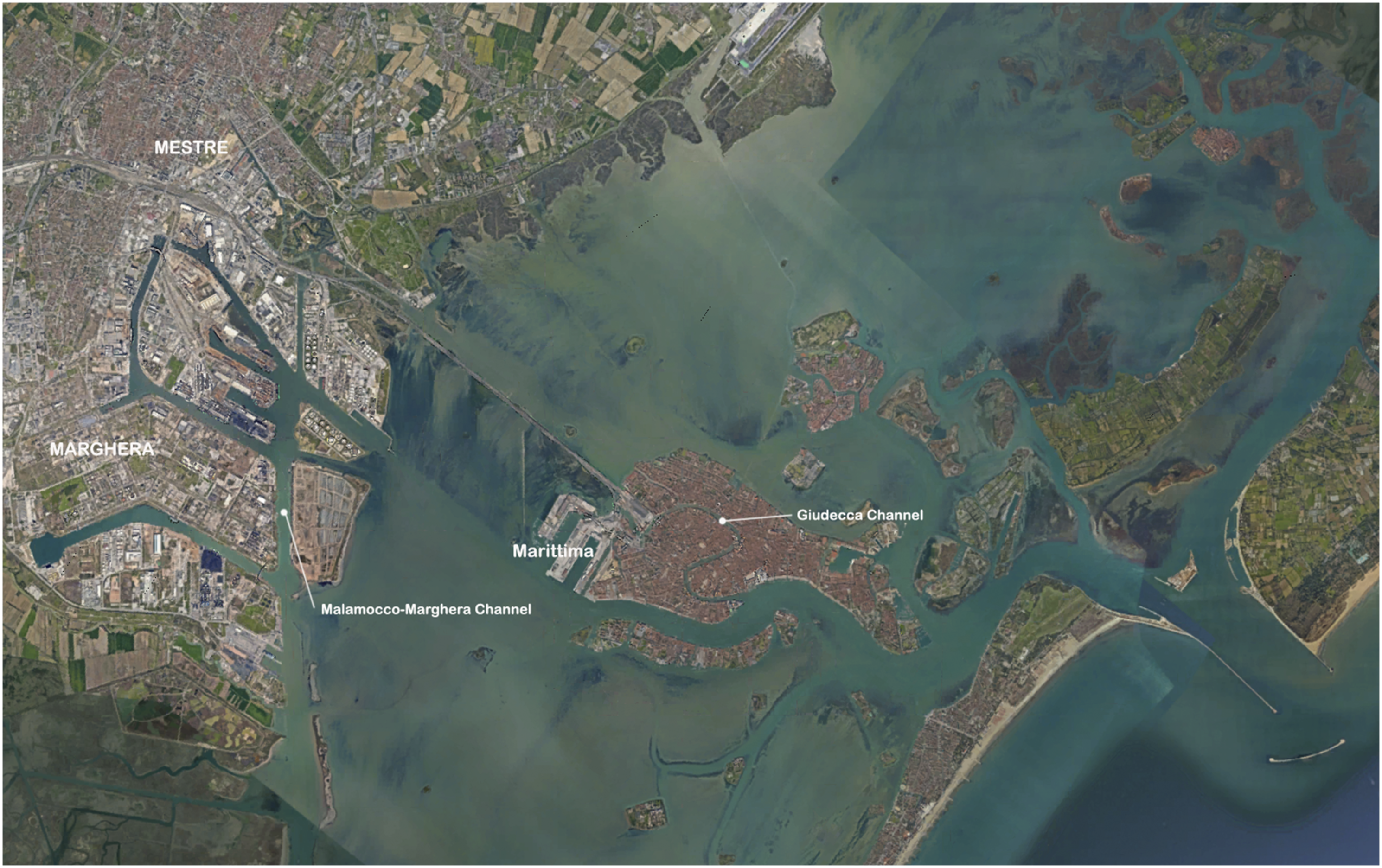
During the flooding of 1966, water levels rose by 1.94 m above sea level – triggering new public awareness about the vulnerability of the city and its position next to an industrial port with a petrochemical soul. As well as initiating a debate about how to protect the lagoon and the city from the acqua alta, the flood revealed the problem of subsidence. The progressive exploitation of aquifers, which started in 1930 and peaked between 1950 and 1970, is one of the key responsible factors for the sinking of the city. Together with eustacy and natural subsidence, heavy pumping of water for industrial use at Marghera contributed to the slow descent of Venice, which has lost 23 cm of land elevation in the last century (Carbognin et al., 2005).
After reaching its highest level of employment in the 1970s, Marghera began to decline. The oil crisis and delocalization of production, together with inadequate political decisions on industrial conversion, meant stagnation in the 1980s. While other industrial ports were gradually leaving the city, in Venice the political forces governing the territory tried continuously to revive Marghera and its port, without re-examining the port-city-lagoon relationship. These challenges of the post-industrial period remain unaddressed.
As petrochemical stagnation hit, the tourism industry took over. Compromises between the political and business classes brought a new polarization in the usage of the lagoon. Such compromises meant defining Marittima as a cruise port, while Marghera remained commercial and San Leonardo an oil port (Crovato, 2014). Embracing the global cruise boom, in 1997 the Port Authority founded Venezia Terminal Passeggeri S.p.A. (VTP) to promote cruise tourism in Venice – since then the city has become a top global destination of cruise tourism. Between 1997 and 2010 passengers increased by 440% and cruise docking by 263%, two statistics that together reveal the growth in ship sizes (Testa, 2011). Between 1997 and 2012 Venice had an average of 60,000 inhabitants and hosted 14 million cruise passengers. The expansion of the cruise industry was reflected also in the industries of Marghera, where Fincantieri – a financial holding with state participation – established its shipyards in the 1980s, specializing in building cruise ships. It is now one of the world leaders.
The giant cruise ships (up to 60 m high and 300 m long) have been crossing the lagoon of the medieval city, visibly threatening the ecosystem as well as the historical palaces and fundaments of the city, as well as disrupting everyday life. The unsustainable rhythm of cruise ships docking in Venice turned logistical frictions into urgent urban matters. Cruises fed the ‘tourism monoculture’ producing socio-spatial crisis, overcrowding the city and exacerbating stress on the inhabitants and the local ecosystem. Over the last decade, Venice has experienced all the burdens of over-tourism such as the congestion and jeopardization of local identity (Gutberlet, 2019), Airbnb-driven increases of house prices and gentrification, with the expulsion of residents towards the periphery (Chamizo-Nieto et al., 2023), and ‘McDonaldized tourism’ that standardizes products and experiences (Ritzer and Liska, 1997).
Since 2010 some active citizens began to mobilize against the passage of large ships across the lagoon, but it was only in 2011 when the social mobilization became consistent and materialized through the creation of the committee ‘No Grandi Navi – Laguna Bene Comune’ (No big ships – the lagoon is a common good).
The formal establishment of the committee happened after the Costa Concordia shipwreck off Giglio island on 13 January 2012, which caused 32 deaths and damaged a protected natural park. The accident sounded an alarm among Venetians, increasingly concerned about the disruptive power of megaships for the historical city, its monuments and millenarian lagoon. The incident also had a big impact on national public opinion, leading to legislative action by the central government, which issued a decree to limit ships above 40,000 tonnes of gross tonnage to enter the San Marco Basin and the Giudecca Canal. It also limited those ships from crossing sensitive marine areas. The Clini-Passera decree was inconsistent from the start, as it avoided setting up a deadline for its applicability. That meant the megaship could keep docking in the lagoon indefinitely. For years the Port Authority, the city administration and the terminal operator have in effect been variously working for the same interests, disregarding the damage on the city and on the lagoon, and minimising citizen mobilization as “environmental folklore” (Bernardi et al., 2014).
In the face of institutional abandonment, the committee organised multiple protests on land, with residents protesting in the streets of Venice, as well as on the water, where activists blocked the passage of giant cruise ships obstructing the canal in their rowing boats. The main collective demand of the committee has been to keep giant ships out of the lagoon. Despite legal and economic repression (fines and lawsuits), the size of the committee has grown solidly and heterogeneously over the last decade, conforming a network of groups, inhabitants and associations. It has organized many public awareness actions and debates, reaching a large and diverse consensus among Venetians on the need of keeping giant ships out of the lagoon (Figure 4). A blockade against a cruise ship on 30/9/2018. Courtesy of Comitato No Grandi Navi – Laguna Bene Comune.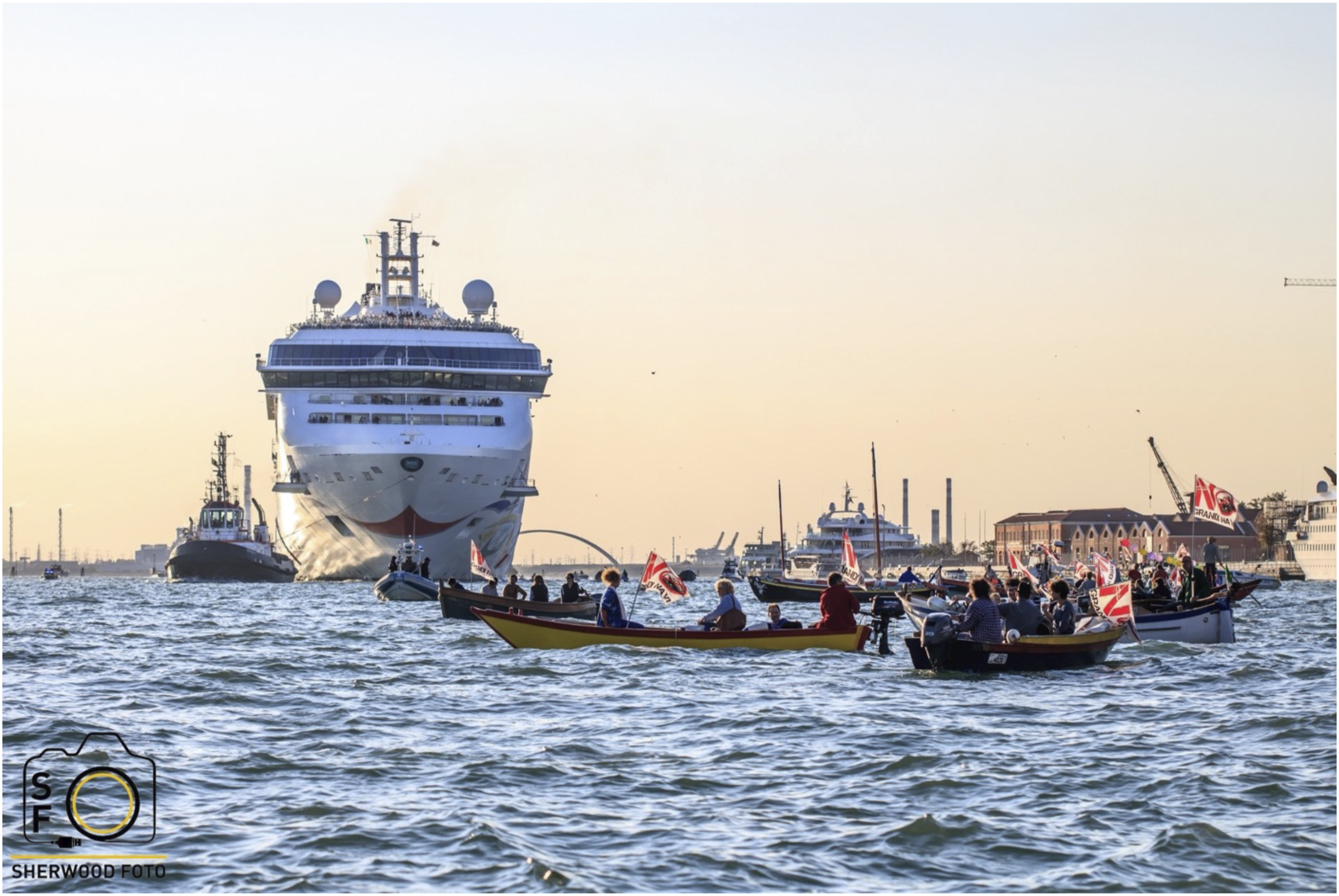
The committee has shed light on the underestimated atmospheric, sonic and electromagnetic pollution produced by the ships, and their effects on the inhabitants, the marine environment and historical built environment, from the palazzi to the underwater wooden foundations of the city. Their activities have contributed largely to expose the ecological disturbances and socio-economic imbalances produced by the cruise sector, its giant ships and the urban and ecological metabolism they trigger.
Through the committee’s network, different coalitions discuss city-related issues that are entangled with this metabolism, including housing, tourism, ecological challenges and climate crises. The work of the committee can be framed as an expression of Lefebvre’s ‘cry and demand’ (Lefebvre, 1996) for the right to the city; their concerns depart from the threats of naval gigantism, expanding towards related socio-spatial emergencies such as climate change, tourism monoculture, housing crises, demographic desertification and labor precarity. “The situation is drastic. We need to take drastic solutions, and if we are not able to do that, Venice in two decades is going to disappear. The population and the city itself is going to disappear. We are fighting really hard, but it is not time for compromising, it has to be radical and it has to be taken upside down. We always say Venice is the symbol of the climate crisis because it is the first city in the EU that is going to disappear because of the consequences of global warming, we are going literally to disappear and there is no time for talking,” said a member of the committee in our interview. 3
As well as protests, assemblies, talks, and legal appeals to the regional court, the committee has also successfully carried out a bottom-up public referendum asking institutions to stop allowing the giant ships accessing the lagoon and digging new canals. Conducted in 2017, 18,105 people voted, with 17,874 agreeing on the demand.
The committee’s dynamism also sparked different forms of knowledge production that has provided the critical discourse of the committee with solid arguments, including scientific back-up. A series of investigations on the effects of naval gigantism on the lagoon’s morphology and high tides, as well as on the social, environmental, and monetary costs of cruise ships for the city and the lagoon, was produced between 2014 and 2020. One of those studies was carried out by Giuseppe Tattara, economist and professor at a local university. His analysis demonstrated how the costs of cruise activities are much larger than the benefits for the city. Dosi et al. (2013) claimed that cruise activity generates 3.6% of the city’s GDP. Nevertheless, as Tattara (2013) has shown, the cruise economy is affected by a distribution problem: while a large part of cruise sector income is concentrated to just a few economic categories such as tour operators, all citizens bear the costs without choosing to. Tattara defines cruise ships in Venice as “free riders”: they take advantage of accessory usage of the city, but don’t bear the cost of its maintenance (Tattara, 2013). This production of knowledge and direct action has enabled the committee to establish the cruise ship as a symbol of the profound and longstanding impacts of the maritime economy on the shore (Schemmer, 2022). This has scaled up discussions, which have gained attention in the international press and produced transnational discourses. This scaling up has facilitated the formation of networks, such as ECAN – the European Cruise Activist Network.
Port-city-industry power imbalances
The Venice port authority, whose administrative core includes a city representative, has a large amount of decision-making power when it comes to the lagoon’s canals and their traffic flows, on top of controlling the container port. Marittima – Venice’s passenger port – was given in private concession in 2016 through a financially shape-shifting operation that took it out of public control, passing under Venezia Investimenti – a company created by the cruise operators MSC, Costa, Royal Caribbean and Global Limean. The public port of Maritima was conceded to a private body without a public call to tender, a controversial operation according to the national anti-trust regulatory body. These varying configurations of governance illustrate a power imbalance between the port, the city, the cruise lobbies and a lagoon widely accepted to be ecologically at risk. Considering that Venice is an aquatic city, what happens in its fragile canals cannot be separated from the city itself.
The decade-long social mobilizations have been covered by national and international media, which has contributed to the identification of Venice as an international symbol of climate crises, and the highlighting the risks of political immobility. In 2021 UNESCO warned that Venice risked entering its list of World Heritage in Danger. Images of blockades in Venice were disseminated around the world, putting giant cruise ships on the civic agenda in other cities. This process has contributed to promote change locally, producing pressure on the political process. In 2021 the central government finally passed a law according to which giant ships are no longer allowed to cross the centre of the city, through the Guidecca canal. This resonated internationally as a victory of the committee. However, the law responded only partially to the collective request that emerged from the social mobilization – giant cruise ships will still access the lagoon at different locations, which still means that new canals will need to be built, or existing canals enlarged, bringing about irreparable damage to the lagoon anyway.
According to the new law, cruise ships of more than 25,000 tons cannot transit in the city center anymore. However, they can “temporarily” dock in Marghera, where new docking points for passenger are being built, while ideas for a future offshore port will be collected. For adapting Marghera, the government allocated €157m of public funding – some of it coming from the PNRR, of which €65m is earmarked for dredging the lagoon and altering the canals (Il sole 24 ore, 24/9/21). An as-yet undefined amount of public money will be used also for compensating VTP and cruise companies, as their concession for using the Marittima port has been interrupted. The undefined character of this “temporary” solution expresses once again a political impasse that obstructs a definitive transition towards a sustainable model. Delaying the much-needed change of paradigm to save the city and its lagoon from naval gigantism generates again the conditions for future contestation.
This reconstruction of port-driven transformations in Venice over the last century shows a parallel evolution of the port-city relationship to Genoa’s in the same time period. A similar urban paradigm has emerged in both accounts: initiated during the fascist regime and driven by the goal of exponential port growth, with a lack of accountability towards potential damages to local territories and communities, through a centralised power totally disconnected from inhabitants. This mode of development has generated a spatial path dependency – a model of development linked to spatial decisions of the past that affect port city resilience (Hein and Schubert, 2021). In effect, such a path dependency has progressively deteriorated environmental conditions, as well as the quality of life of communities surrounding both ports, producing a deterritorializing effect. Such a paradigm has not been tackled by the entities governing the territory and the port, while logistics has grown in terms of size and management.
In Venice, as in Genoa, the combination of naval gigantism and the centralization of power has created the circumstances for social contestation. Social mobilization against naval gigantism in Venice strongly symbolizes the impossibility of coexisting with a logistics model based on limitless growth. A decade of social mobilization had a considerable variety of impacts, including reorientating part of the local, national and international public opinion around the damages of naval gigantism both in cruise and container ships, contributing to build more ecologically concerned perspectives. It ignited the production of scientific knowledge that support the collective’s arguments, and which highlights the contradictions of an urban economic model dominated by the cruise sector. This social mobilization has also sparked many other connected discussions on urban policies, feeding a rhizomatic dynamic of reterritorialization through renovated territorial agency. The committee has become a considerable voice in local politics (Schemmer, 2022), and has increased political influence, such as for the 2021 law for stopping large cruise ship to cross the Giudecca Canal. At the same time, it nurtured transnational connections, building solidarity networks with mobilized groups of citizens in other cities. This has established a basement on which international debates on how to readdress the port-city relationship can be developed, possibly rethinking global logistics and the cruise model on a much larger scale.
Conclusion
This article examined conflictual relationships between ports and surrounding communities of inhabitants focusing on the case studies of Genoa and Venice. It explored the roots of this expanding phenomenon through critical approaches to logistics, showing how the combination of naval gigantism and the centralization of power produces frictions. These frictions have a deterritorializing effect, alienating citizens from their territory, frequently triggering social mobilization.
Using ethnographic techniques, which combined document analyses, semi-structured in-depth interviews with active citizens and field observations, I compiled a counter-narrative of port-driven territorial transformations over the last century in Genoa and Venice. This unraveled the roots of frictions between citizens and ports, contextualizing the rise of social mobilizations against port activities and the effects of these movements on the port-city relationship. It emerged that in both cases, the centralization of power embodied by the earlier fascist reorganization of the territory and contemporary naval gigantism have produced ongoing frictions, ignoring local human agency and ecological environments. Consequent social mobilizations have produced new continuities through social engagements driven by a renewed and networked territorial agency. In both cases, social mobilizations have produced changes, curbing the effects of the centralization of power. Such mobilizations were not only contesting the port, but also the governance and corporate practices that characterize their ongoing port-city relationship, reimagining the expressions of legacies between port and city.
Nonetheless, social mobilization took different shapes in Genoa and Venice, producing different results. In Genoa-Pra’ the mobilization against the growing impact of the port was circumscribed within the spatial space of the neighborhood, without developing networks across the whole port territory, which meant obtaining a limited solution, rather than trigger a prominent shift in the port-city relationship. After organizing blockades on the streets as a form of channeling collective discontent, some local active citizens have created a foundation, which revamped the sense of community around the experience of territorial transformation. The foundation managed to converge collective desires into a pragmatic claim towards port and city institutions. This process has eventually produced a change that manifested in a modification of urban plan of the port. Interventions for impact mitigation, which have been articulated by the foundation as a form of compensation, are currently underway, and are already tangibly improving residents’ quality of life. This process has produced territorial agency within the residents of Pra’ involved in the activities of the foundation, but the modality in which port and city exercise the power over the territory – and the critical dynamics of logistics more widely – have still not been addressed.
In Venice, social mobilization was initially organized through and by a committee of citizens, which grew heterogeneously around the collective demand of protecting the city and its lagoon through keeping the giant ships out of it. Blockades, which disrupted the circulation of megaships in the central historic canal of Venice, expressed discontent about the multiple impacts of naval gigantism on the city, working as leverage for contesting the unbalanced governance configuration that allows corporate practices to damage the city and its lagoon. The committee promoted different forms of knowledge production, fostering rhizomatic networks of discussions on urban and ecological challenges related to the central collective demand. This knowledge spilled out from the geographical context of Venice, turning the city into a global symbol of the damage inflicted by cruise lobbies, within a context of climate crisis and political impasse. Discussions on the effects of giant cruise ships acquired a transnational dimension, with blockades and other forms of contestation against cruise ships being reproduced in other cities of the world. This social mobilization has fostered change through several means – creating a visible, fertile, plural and multi-scalar ground for critical discussions, that pushed the central government to shift the circulation of cruise ships in the lagoon. It also sparked transnational solidarity and collaborative ties around the issue of mega cruise ships.
Finally, the analyses of these cases shows that not all social mobilizations at the port can be considered counter-logistics movements, given that the processes and effects they seek to produce on logistics are different. The structure of the contestation, the focus on localized impacts in relations to dynamics of circulation and its expression through collective demands – as well as the way in which knowledge produced is spread across space and time – determine different engagements with logistics. Approaches that embrace elements of counter-logistics have more potential to readdress the port-city relationship structurally, challenging the status quo and producing imaginaries that locally reinvent global circulation and its politics of governance.
Footnotes
Declaration of conflicting interests
The author(s) declared no potential conflicts of interest with respect to the research, authorship, and/or publication of this article.
Funding
The author(s) disclosed receipt of the following financial support for the research, authorship, and/or publication of this article: This work was supported by the HORIZON EUROPE Marie Sklodowska-Curie Actions (101026967).
