




Abstract
This paper makes the case that conferences and award ceremonies are important means through which best practices are presented as being successful, transferable and transformative. To do this, it draws on the expanding literature on policy mobilities and a case study of the European Week of Regions and Cities conference and one of the centrepieces at the conference, the RegioStars awards ceremony. Organised by public bodies within the European Union and European Commission, these events take place annually in Brussels, and focus on best practice in regional and urban policy. The paper elaborates on its main argument in three ways. The first is that award ceremonies and conferences shape and are shaped by institutional, spatial and scalar dynamics. The second being that learning and educating are central to the performance of conferences, award ceremonies and the associated mobilisation of policies. The third argument is that such events have important consequences for those hosting the events.
Bienvenue à Bruxelles
Every October over 5000 people gather in Brussels to attend the European Week of Regions and Cities conference, an event that is regularly promoted as being the place to share knowledge and best practice about regional and urban policy. A centrepiece of the annual European Week of Regions and Cities (EWRC) conference is the RegioStars awards ceremony which rewards those deemed to be best practice in a variety of categories within regional and urban policy. Sometimes mundane and sometimes with a hint of glamour, the EWRC conference and the RegioStars ceremony are important political events. They are not, however, the only conference and award ceremony that focus on urban and regional policy, inside and outside of the EU borders. In fact, conferences and awards are ubiquitous across many social domains (Craggs and Mahony, 2014; Frey and Gallus, 2017) with the presentation of awards often central parts of conferences.
As this paper demonstrates, conferences and award ceremonies are commonly used means through which ‘best practices’ are anointed and showcased, with conferences and award ceremonies playing important roles in shaping best practice and promoting the selected few as transportable and effective. They are important events in the wider circulation of policies. It is surprising, therefore, that while a burgeoning literature has emerged on policy mobilities (e.g. Craggs and Neate, 2017; McCann, 2011; Peck and Theodore, 2015; Temenos and McCann, 2013; Temenos et al., 2018), the roles of awards within policy mobilitisation has received no detailed academic examination, and the role of conferences within policy mobilisation has only been subject to two studies thus far (Cook and Ward, 2012; Temenos, 2016). This paper begins to address this important gap by examining the staging of the EWRC conference and the RegioStars awards ceremony, neither of which have featured significantly in the wider academic literature. It will illustrate how this conference and award ceremony is staged and how as part of this staging best practice is selected, shaped and presented as successful, transferrable and transformative. Furthermore, it will make the case that place, scale and institutional context are important aspects within policy mobilisation, conferences and award ceremonies.
The paper is henceforth structured as follows. It begins by situating conferences and award ceremonies within the literature on policy mobilities. It moves on to set the context by outlining the regional and urban dimensions of EU policymaking. Following this, it explores the spatial, scalar and institutional dynamics of the EWRC conference, before examining the ways in which the organisers engage in practices of selection, showcasing and network facilitation at the conference and award ceremony. Methodologically, this paper draws on data collected through four means: (1) semi-structured interviews with six current and former organisers of the conference conducted in 2015; (2) documentary analysis of policy documents and the conference and award websites; (3) participant observation at the 2013 conference; and (4) viewing online videos of the conference and award ceremony (spanning multiple years).
Mobilising best practice
To make sense of the role of conferences and awards in anointing, shaping and showcasing best practice, it is necessary to draw on the analytical tools being developed within the policy mobilities literature. A decade has passed since Eugene McCann coined the term ‘urban policy mobilities’, a term that captures ‘the ways in which policy knowledge and policy models move from city to city’ (McCann, 2008: 2). The concept – often minus the urban prefix – soon took off within geography and cognate disciplines among scholars keen to make sense of travelling policies. We shall now explore three key aspects of this literature, which will enable us to situate conferences and award ceremonies within the wider practices of creating and circulating best practice. These are: (1) the geographies of mobile policies; (2) the educating and learning that underpins policy mobilisation; and (3) ‘transformative’ best practice models and events.
The geographies of mobile policies
The academic work on policy mobilities pays close attention to the geographical underpinnings of policy mobilisation. The emphasis of the literature is on the social-spatial relations that develop between places as part of policy mobilisation. Here scholars have explored the relational practices of networking, bonding and learning across borders. Attention has also been centred on the movement and mutation of policies through space (Peck and Theodore, 2015), as well as the travels of people (e.g. travelling consultants) and other objects (e.g. blueprints, reports) that influence the movement of policies (Temenos et al., 2019). Amid concerns about fetishizing mobility and ‘successful’ mobile policies, attention is also being directed to the immobility of policies as well as the mobility of negative policy lessons (Lovell, 2017a).
Policy mobilities scholars such as McCann and Ward (2013) and Peck and Theodore (2015) have positioned the policy mobilities ‘approach’ as being more geographically sensitive than the longer-standing work in political science on policy transfer (e.g. Benson and Jordan, 2011; Dolowitz and Marsh, 2000). They have also suggested that the policy mobilities approach is more sensitive to scalar dynamics and relations (e.g. McCann and Ward, 2013; Temenos and McCann, 2013). Here they reason that it pays careful attention to policy mobility across multiple scales. In practice, the scalar focus of policy mobilities research tends to be on cities (often in relation to other scales). The literature’s scalar dimensions has received some criticism however. Lovell (2017b: 101), for instance, argues that [i]n its efforts to distinguish itself from political science scholarship focusing on the nation state, policy mobility research has arguably gone too far in positioning urban centres and the global arena as the two core spatial scales worthy of methodological and conceptual attention.
Cities are, of course, important spaces and scales within policy mobilisation. Cities are often ‘centres of persuasion’ where best practice is formulated and promoted. Furthermore, policy models are frequently drawn from the experiences of ‘innovative’ cities and re-embedded in other cities. However, cities do not exist in a spatial and scalar vacuum and policy mobilisation is not always focused on cities. So, while we should not remove cities from the policy mobility lens, we must consider the geographies of policy mobilisation and cities more carefully. It is important to explore policy mobilisation and cities in relation to national scales, policies and institutions (Bok and Coe, 2017). More than this, we should explore policy mobilisation and cities’ interconnections with supranational and subnational regional scales, policies and institutions.
Here, an empirical focus on the European Union and its urban and regional policymaking can provide useful insights into the spatial, scalar and institutional dynamics of policy mobilisation. While a few studies in political science have examined policy transfers between EU member states and the role of the EU in transferring policies (e.g. Bulmer and Padgett, 2005; Bulmer et al., 2007), it is an institution that seldom appears in the policy mobilities literature. What is more, subnational regions have received surprisingly little attention in both the policy mobilities and policy transfer literatures. Attention to the policy mobilisation connected to the EU’s urban and regional policymaking is, therefore, empirically and conceptually necessary.
Policy mobilisation and the practices of educating and learning
Paying attention to the geographies of policy mobilisation is not enough; we also need to investigate the links between policy mobilisation and two important practices: educating and learning. To do this, we can view learning ‘as a knowledge acquisition process’ (Dunlop, 2009: 296) and educating as ‘the steering of learning towards particular desirable ends’ (de Oliveira and Ahenakew, 2013: 233). Learning and educating are closely connected, power-infused, everyday activities (McFarlane, 2011). They shape the understandings of policy actors about what is successful, transferable and transformative, and conversely what is not.
McCann’s (2008, 2011) concept ‘informational infrastructures’ improves our understanding of the links between educating, learning and policy mobilisation. Informational infrastructures are assemblages of institutions, events and technologies that ‘frame and package knowledge about best policy practices, successful cities and cutting-edge ideas and then present that information to specific audiences’ (McCann, 2008: 12). We can extend McCann’s definition of informational infrastructures to say that they are focused on educating audiences and drawn on by audiences to inform their learning.
Three particularly important informational infrastructure events are study tours, conferences and award ceremonies. The policy mobilities literature has concentrated on study tours (see Cook and Andersson, 2018; Cook and Ward, 2011; Montero, 2017; Wood, 2014) with conferences getting a small amount of attention (Cook and Ward, 2012; Temenos, 2016) and award ceremonies barely mentioned. We shall concentrate on conferences for the time being.
Conferences can be defined as ‘periodic or one-off gatherings of people – often professionals, experts and those in positions of power – drawn from diverse places and organisations, with aims of producing knowledge or agreement on particular topics’ (Craggs and Mahony, 2014: 415). As with other informational infrastructure events, conferences are situated in, and shaped by, wider social and institutional contexts. They bear the imprint of many things, not least their organisers. In turn, conferences, their organisers and their contexts contribute to the shaping of ‘best practices’ that are presented at such gatherings. As work by Cook and Ward (2012) and Temenos (2016) has shown, conferences bring ideas, policymakers and sites into relational proximity. They offer opportunities for policymakers from different places to come together and share knowledge as well as to reflect on whether what they hear about can be emulated in their own localities.
Importantly, Cook and Ward (2012) point to the benefits of being face-to-face and co-present at conferences. Their work has similarities with Lovell’s (2017a) recent intervention that calls for policy mobilities scholars to draw on ideas from economic geography. Here Lovell promotes the use of two concepts: codified knowledge and tacit knowledge. The former being ‘know-how that is transmittable in formal, systematic language and does not require direct experience’ (Howells, 2002, quoted in Lovell, 2017a: 9) with the latter being know-how that is more intangible and subtle which tends to be fostered locally and through face-to-face contact. Lovell extends this by reasoning that tacit knowledge is more likely than codified knowledge to focus on failures and less likely to be mobilised. Cook and Ward (2012) and Lovell (2017a) both suggest that informational infrastructure events such as conferences can enable the transmission of tacit knowledge especially. It is important, therefore, to consider the roles of tacit and codified knowledge at informational infrastructure events.
Moving on, a wider set of literature is beginning to emerge on the geographies of conferences. As part of this Craggs and Mahony (2014) point to several important aspects of conferences that are worthy of academic attention. These include their role in knowledge production; their relationship with the host localities; their functions as ‘symbolic locations, spaces of legitimation and as stages for political identities to be performed’ (Craggs and Mahony, 2014: 420); and the ways in which consensus, dissensus and protest are performed at or alongside conferences (see also Craggs, 2014). Elsewhere, Weisser and Müller-Mahn (2017) explore the ‘micro-geographies’ of conferencing at the Paris Climate Conference 2015. Here they explore three spaces within it – the stage, the backrooms, and the trade fair – and demonstrate how the materiality of these spaces and the rules governing them made the conference ‘post-democratic’. Such geographical insights are useful in helping us make sense of the socio-political lives of conferences and their role within the making and circulation of policies.
Transformative best practice models and events
Policy mobilisation and informational infrastructures involve the anointment and promotion of best practice. For Bulkeley (2006) best practice is both a political rationality that outlines acceptable futures and a governmental technology that defines the problem and monitors performance. Going further, we can view best practice as a social construction, a creation that involves the promotion of certain places and projects over others (Moore, 2013).
Investigating the social construction of best practice, then, requires a consideration of what and where are selected as best practice as well as the ways in which best practice is shaped and endorsed at informational infrastructure events. This is especially the case with award ceremonies whose presence within informational infrastructures has received scant academic attention. After all, if we draw on Gallus and Frey’s (2017: 76, emphasis added) definition of awards as ‘signals of recognition and distinction that are celebrated in public’, we can begin to see the role of award ceremonies – where awards winners are typically announced – as arenas through which best practices are anointed and lauded. Questions remain about the links between best practice and award ceremonies. For instance, how are award winners selected and by who? How are the winners presented as being best practice at the event and in accompanying materials and events? How are audiences encouraged to learn from them?
A related point is that transformation underpins best practice and informational infrastructure events. This is especially the case in the discursive realm as best practice models are usually accompanied by rhetoric detailing that they have already demonstrated success in transforming a place, social group, organisation or something else and that they also have a ‘built-in’ ability to deliver future transformations elsewhere if replicated (possibly with some adaptations). These ‘significant reordering[s]’ (Blythe et al., 2018: 2) are usually rhetorically constructed as being positive (for everyone), necessary and apolitical.
Focusing more on the idea of transformation, we can identify ways in which mobile best practices and informational infrastructure events can involve material changes and transformations. As the policy mobilities literature has established, mobile best practices transform as they travel (McCann, 2011; Peck and Theodore, 2015). Furthermore, mobile best practices as well as informational infrastructure events can lead to material changes – big and small, positive and negative, for many people inside and outside of policymaking circles. To give an example, Wood (2014) and Montero (2017) have shown that study tours can enhance the learning of those attending, strengthen social bonds between participants, and inform policy recommendations. One often-overlooked material impact should not be forgotten and it will be closely examined in this paper: that of informational infrastructure events on the institutions that host the events.
With all this in mind, we will now turn our attention to the staging and stagers of the EWRC conference and the RegioStars award ceremony, and how best practice is anointed, shaped and promoted as successful, transferrable and transformative at these events. To do this, it is important to first examine the scalar and institutional politics of EU urban and regional policy and, then, its relationship with the EWRC conference and RegioStars awards.
Regions, cities and the European Union
Since the mid-1980s and the signing of the Single European Act, the EU has increasingly focused on regional and urban development and collaboration. Accompanied initially by discourses about an integrated and competitive ‘Europe of the regions’, a broad spectrum of regional and urban policy programmes has emerged (Hallin and Malmberg, 1997; McCann and Varga, 2015). Emphasis has been placed on redistributing public finances aimed not only at reducing regional disparities but also at enhancing economic growth and competitiveness of regions and cities (Hallin and Malmberg, 1997).
Although there has been a recent emphasis on cities, regions have been the longstanding subnational focus of the EU. Indeed, the regional policy of the European Union – or in short, EU Cohesion Policy – is one of the biggest expenditures within the EU’s budget at approximately one third of the EU budget (McCann and Varga, 2015). The primary financial instruments of Cohesion Policy – known as structural funds – are the European Regional Development Fund, the European Social Fund and the Cohesion Fund (for critical overviews of the structural funds, see McCann, 2015 and Piattoni and Polverari, 2016). Within the EU apparatus, the Directorate-General for Regional and Urban Policy (DG Regio) is responsible for regional development and, as part of this, for allocating the funds connected to the Cohesion Policy. The structural funds are channelled through national authorities in the different member states which can be applied for by public, private and voluntary organisations on the regional level (DG Regio, 2017).
Another important institution within the EU apparatus with regards to regional policy is the Committee of the Regions (CoR). Established in 1994, the CoR is an independent consultative body to the Council of Ministers and the European Commission, and is made up of 350 local and regional representatives from the 28 member states, appointed by the Council of Ministers (Committee of the Regions, 2016; Neacsu and Petzold, 2015; Warleigh, 1997). As Hönnige and Panke (2016) note, the role of the CoR is simply advisory: to give opinions during the first reading of the ordinary legislative procedure and the consultation procedure on matters concerning regional and local government.
Rob Atkinson has argued that an implicit urban agenda has developed in the EU since the late 1980s (Atkinson, 2001, 2015; Atkinson and Zimmerman, 2016). Central to this has been the development of several non-binding policy programmes focusing on urban development (e.g. Urban Pilot Projects, URBAN, URBACT), the mainstreaming of sustainable urban development in Cohesion Policy between 2007 and 2013, and the emphasis on cataloguing and disseminating best practice in urban policy. Urban issues have been gradually incorporated in the work of DG Regio, guided by the rising urban ambitions of the European Commission (Atkinson, 2001, 2015). DG Regio has also changed its formal name from the Directorate-General for Regional Policy to the Directorate-General for Regional and Urban Policy in 2013, reflecting its increased emphasis on urban policy. However, despite these efforts, urban policy remains secondary to regional policy within the EU; it continues to be excluded from the formal jurisdiction of the European Commission and is still the responsibility of the various member states (Atkinson, 2015; McCann and Varga, 2015).
A central part of the work of DG Regio is its co-operation with CoR in trying to strengthen and empower regional and local governments within the EU (Neacsu and Petzold, 2015; Warleigh, 1997). Such institutional collaborations are part of wider attempts by the European Commission over the last 20 years or so to develop a ‘bottom-up approach’ that focuses on networking between local and regional policymakers, as well as capacity building through sharing best practice (c.f. Atkinson, 2001; Atkinson and Walliser, 2013; DG Regio, 2017). It is in this broader context of institutional co-working between DG Regio and CoR, an emphasis on sharing best practice, and the prioritisation of regional over urban policy that the European Week of Regions and Cities and the RegioStars award ceremony sits.
The European Week of Regions and Cities conference
The European Week of Regions and Cities (EWRC) began in 2003 when it was simply called Open Days. The inaugural conference was primarily a collaboration between the CoR and ten of the regional offices in Brussels. It was pitched as an opportunity for attendees to visit free-of-charge the workplaces of regional policy professionals working in Brussels and exchange ideas with them. From 2004 onwards, the CoR have been assisted in organising the conference by DG Regio and a multitude of regional partnerships (who represent different regions and cities involved in programmes co-financed by EU structural or investment funds). The conference has grown substantially, becoming a key informational infrastructure event that seeks to educate and shape the learning of those working in regional and urban policy across the EU, particularly those in receipt of structural funds. The first EWRC conference featured around 16 workshops attracting approximately 1200 participants in 2003, and by 2017 it has expanded to more than 135 workshops, exhibitions, academic lectures and other events with 6000 participants. It has become the biggest policy event in Brussels and continues to be free to attend.
The former EU Commissioner for Regional Policy, Danuta Hübner (2006), has described the conference as a ‘marketplace for new ideas and a platform for exchanging experiences in regional development’ (quoted in Open Days, 2005: 4). The former President of the European Commission, Manuel Barroso, meanwhile has suggested that it ‘represents a golden opportunity for an exchange of views on Europe’s regional contribution to [Cohesion Policy]’ (quoted in Open Days, 2010: 3). These statements by Hübner and Barroso are illuminating not simply because they promote the conference as a marketplace, platform and opportunity for exchange, but also because they reflect the de facto prioritisation of regional rather than urban policy at the conference and the European Union more generally. And while the conference organisers that we interviewed spoke of a desire to further centralise the urban dimensions at the conference, as we will show later the conference has realistically done little to centralise the position of urban policy within European Union policymaking.
Nevertheless, DG Regio and CoR view the conference as an opportunity to discuss, promote and educate attendees about ‘best practice’ in regional and (to a lesser extent) urban policy. For DG Regio the conference is a means of improving and guiding the working practices and projects of those receiving structural funds. Sharing and implementing best practice is equated with capacity building, and is seen to produce better outcomes and improved ‘value for money’. Here those interviewed stressed that the cost-efficiencies associated with learning from successful projects at the conference could out-weigh the substantial cost of hosting a free conference (although measuring the financial impact of the conference is arguably impossible). A further advantage of the conference for DG Regio is that it provides an opportunity to consult with practitioners on the ground and fine-tune elements of Cohesion Policy. As a former official at DG Regio put it in an interview: ‘it is not only Brussels who explains to the people outside how it can work better; it is also very much for Brussels to learn from what is happening on the ground’.
According to its accompanying website, the EWRC conference is ‘geared towards an audience specifically interested in regional policy’ with regional policymakers being the primary audience targeted. It is no surprise therefore that regional policymakers attend in large numbers. The conference organisers have nevertheless sought to diversify attendance by encouraging individuals and organisations, especially those from the newer member states, those involved in urban policy, as well as those in the private sector and academia. To facilitate this diversification, conference organisers introduced a venue called the Investors’ Café – beginning in 2006 and rebranded as the Meeting Place from 2009 – where attendees can discuss ideas with those in the private sector over drinks and snacks. They have also introduced the Open Days University, beginning in 2009, which takes the form of a programme of lectures and moderated panel debates between EU officials and academic researchers working on regional policy, all of which takes place during the EWRC conference. The rationale behind the formal inclusion of the private sector and academia at the conference being that this mix can foster public-private partnership working and academically informed policymaking.
Echoing annual conferences elsewhere, each year’s edition of the EWRC has a different theme as shown in Table 1. Each theme has three accompanying thematic priorities and all typically reflects current political and economic issues of the time, especially those already written into Cohesion Policy and the Framework Programmes 1–8 (the latter being research and innovation funding programmes of the EU). The institutional shadow of the EU is particularly noticeable in this respect. So while the themes seem to have little influence on future policy directions for the EU, they are used to steer what topics are discussed ‘here and now’ at that year’s conference workshops. Organisers of the workshops are told that their sessions must speak to the annual theme and all workshops are then listed under one of the three thematic priorities in the programme. Yet despite these nudges, there remains some flexibility for organisers and speakers in what they discuss.
Overview of the EWRC conference, 2014–2017.
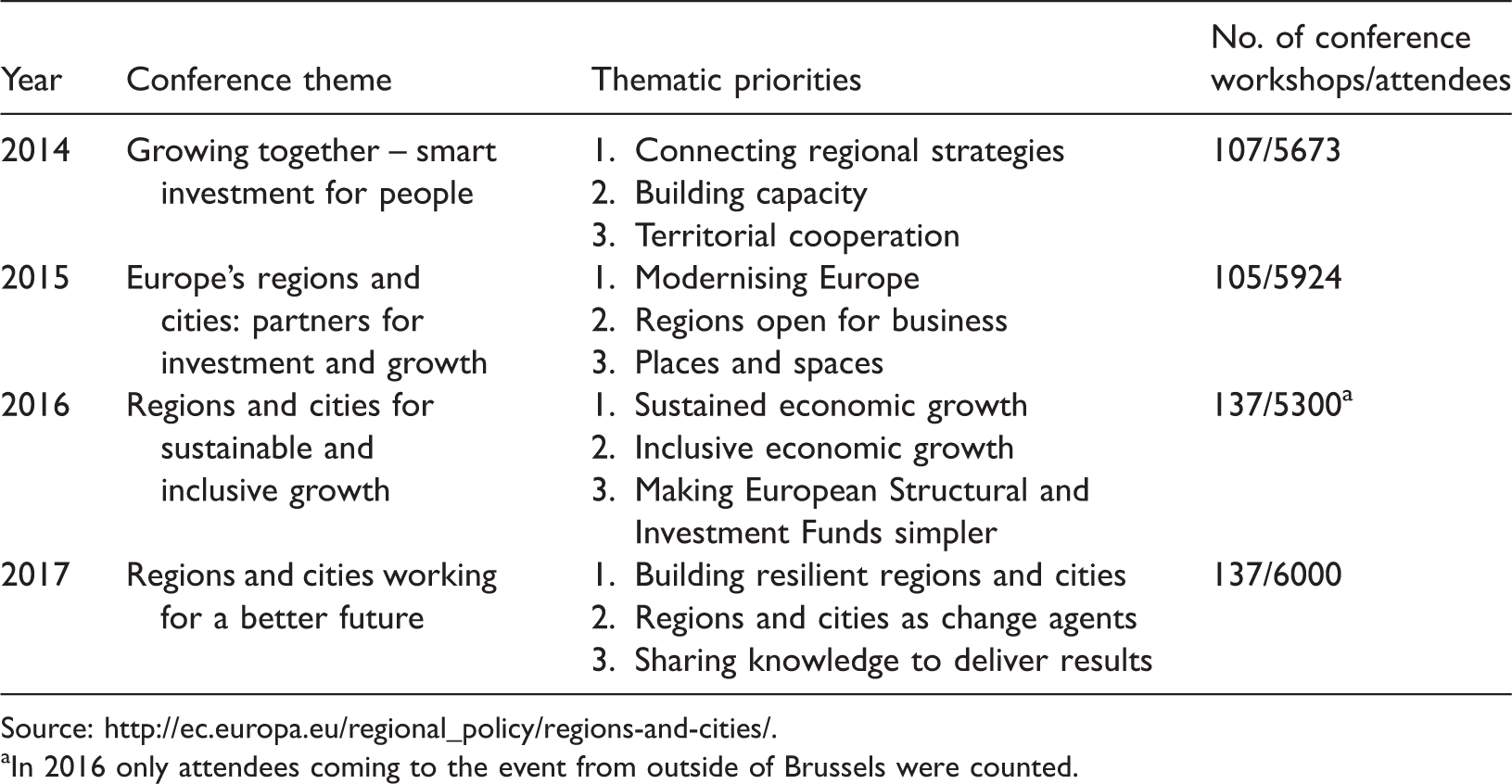
aIn 2016 only attendees coming to the event from outside of Brussels were counted.
Unlike many annual conferences, the EWRC is not an ambulatory event, travelling from city to city; instead it is held in Brussels every year. In particular, the conference is concentrated in the city’s European Quarter whose buildings and public spaces get re-appropriated as conference space around the time of the EWRC. This geographical fixity in Brussels is in part a practical arrangement. As one CoR official stated in an interview, ‘here [in Brussels] we have our facilities, we have our building, we have our internal services’. The ability of Brussels to host over 5000 participants and over 100 workshops is, therefore, a key consideration. There is also a political dimension to its Brussels location. The conference organisers are aware that Brussels is widely perceived as a place where power is centralised and seemingly somewhere you must venture to garner influence and resources. Planet Brussels, as Kuus (2014) terms it, has somewhat of a gravitational pull. Perhaps, then, the biggest influence of the host city on the conference has been its ability to attract attendees.
Since the mid-2000s the conference organisers have sought to compliment the centralised, fixed spatiality of the EWRC annual conference in Brussels with a more decentralised, ambulatory series of events every year. So, in 2006 the conference organisers arranged a series of accompanying, decentralised events under the heading ‘Europe in my region/city’, which have continued ever since. With a stated ambition by DG Regio and the CoR to ‘bring EU regional policy “home”’ (Open Days, 2006: 25), each city and region involved in a regional partnership that organises a workshop at the Brussels conference must also organise a local event in their home territory. By 2016, there were 127 local events attracting approximately 25,500 participants – a number that clearly surpassed the 5300 attendees at the Brussels conference that year (Open Days, 2016). We will not concentrate on the decentralised events in this paper. Suffice to say, there is a symbolic spatiality to the local events: by providing events outside of Brussels it is meant to convey local sensitivity and empowerment. For one former CoR official, it is also meant to avoid the negative connotations of the centralisation of power in Brussels: [Brussels] is far away for many people. It is like the centre of an empire that everybody hates. So it is better to speak in a local context about European affairs because then it makes sense to the people.
Showcasing and facilitating
As well as using the conference as a means of showcasing best practice, the organisers also view the conference as an opportunity to showcase themselves and Cohesion Policy. In terms of the latter, the conference provides an opportunity for the organisers to present Cohesion Policy as a successful and appropriate means of facilitating transformative economic development in the European Union. This is often conducted through the speeches by the President of CoR, the Commissioner for Regional Policy and other senior political elites, which usually take place during the conference’s opening session and during the RegioStars ceremony.
However, the EWRC is not designed to prevent attendees from speaking critically of Cohesion Policy whether on stage or elsewhere. Indeed, many of the presentations each year offer critical perspectives on Cohesion Policy, discussing for instance its lack of effectiveness and sharing best practice on how to handle the bureaucracy associated with the structural funds. Furthermore, as noted earlier, the organisers are also keen to provide a platform for discussions on how Cohesion Policy can be amended in future years. Nevertheless, a broader message continues to accompany every EWRC conference that while it might need some fine-tuning, Cohesion Policy works.
For DG Regio and the CoR the conference is an opportunity to showcase themselves and seek legitimacy from those in and around the venues as well as those monitoring the conference from afar. Being a relatively new EU institution with no formal power and one that often struggles to be heard by those in the European Parliament and the Council of Ministers (Hönnige and Panke, 2016), the CoR seeks to benefit from the visibility that the conference’s annual appearance in Brussels brings. Here it has been quite successful, although after a decade and a half of EWRC conferences, arguably the CoR remain somewhat marginal in the minds of many people working in and around the EU. This ambiguity is highlighted by one of the interviewees working at the CoR who noted: I mean if you ask people around here [in Brussels] ‘what is the Committee of the Regions?’ nobody knows. But if you would say that it organises the Open Days, if you say that in Brussels, everybody knows what that is.
Attendees have been encouraged to network with a purpose, with organisers attempting to steer conversations towards the transferability of best practice. In the official guidance for event partners, for instance, it tells participants that workshops must ‘focus on issues that are
Events at the conference are centred on what ideas should travel rather than what should not. Nevertheless, the attendees are reminded, on occasion, not to borrow ideas wholesale or uncritically. For instance, in the opening session of the 2016 conference, the Commissioner for Regional Policy Corina Creţu stated that the aim of the conference ‘is not to replicate experiences, nor to copy and paste projects. The aim is to give cities and regions useful means to exchange, learn and build their own ways to foster innovation, growth, jobs and quality of life’ (Creţu, 2016: 1). Our research has not explored if attendees have adhered to these occasional words of warning, but this is a useful avenue for future research.
Not only do the conference organisers try to facilitate networking and the sharing of best practice, they also try to shape and codify the best practice that is circulated in and around the conference. The main means of doing this is the selection of each year’s theme and thematic priorities as well as the instructions to workshop organisers to align their sessions in accordance with them. While there is much talk of best practice at the event, as the next section will demonstrate the conference organisers have sought to use the RegioStars awards ceremony as a means through which the ‘best of best practice’ can be officially codified, certified and anointed, and onlookers can be steered towards certain projects over others.
Anointing best practice at the RegioStars awards ceremony
Since 2008 DG Regio have organised the RegioStars awards. It was not until 2015, however, that the award ceremony became part of the EWRC conference. Prior to this the RegioStars ceremony was held elsewhere in Brussels, initially as part of a smaller annual conference called Regions for Economic Change (between 2008 and 2012) and then as a separate event in 2013 and 2014. Since their inception in 2008, the function of the RegioStars awards has remained the same: to anoint and showcase best practice in the field of regional and urban policy through the selection of finalists and winners in different award categories.
Each year the RegioStars ceremony features on average five award categories. In 2017 there were six categories and these were (i) smart specialisation for SME innovation, (ii) energy union: climate action, (iii) women empowerment and active participation, (iv) education and training, (v) cities in digital transition, and (iv) the public choice award. Across the years there has been some continuity in the titles of the award categories – as demonstrated in Table 2 – as the awards are designed to reflect the long-term priorities of Cohesion Policy. It is also noteworthy that since 2010 there has been a category focusing on cities, once again reflecting DG Regio’s increased emphasis on cities but also the dominance of regional policy over urban policy within the EU. In sum, the award categories, much like other aspects of the annual conference, have been shaped by the institutional politics of the EU.
The categories and winners of the RegioStars awards in 2016 and 2017.
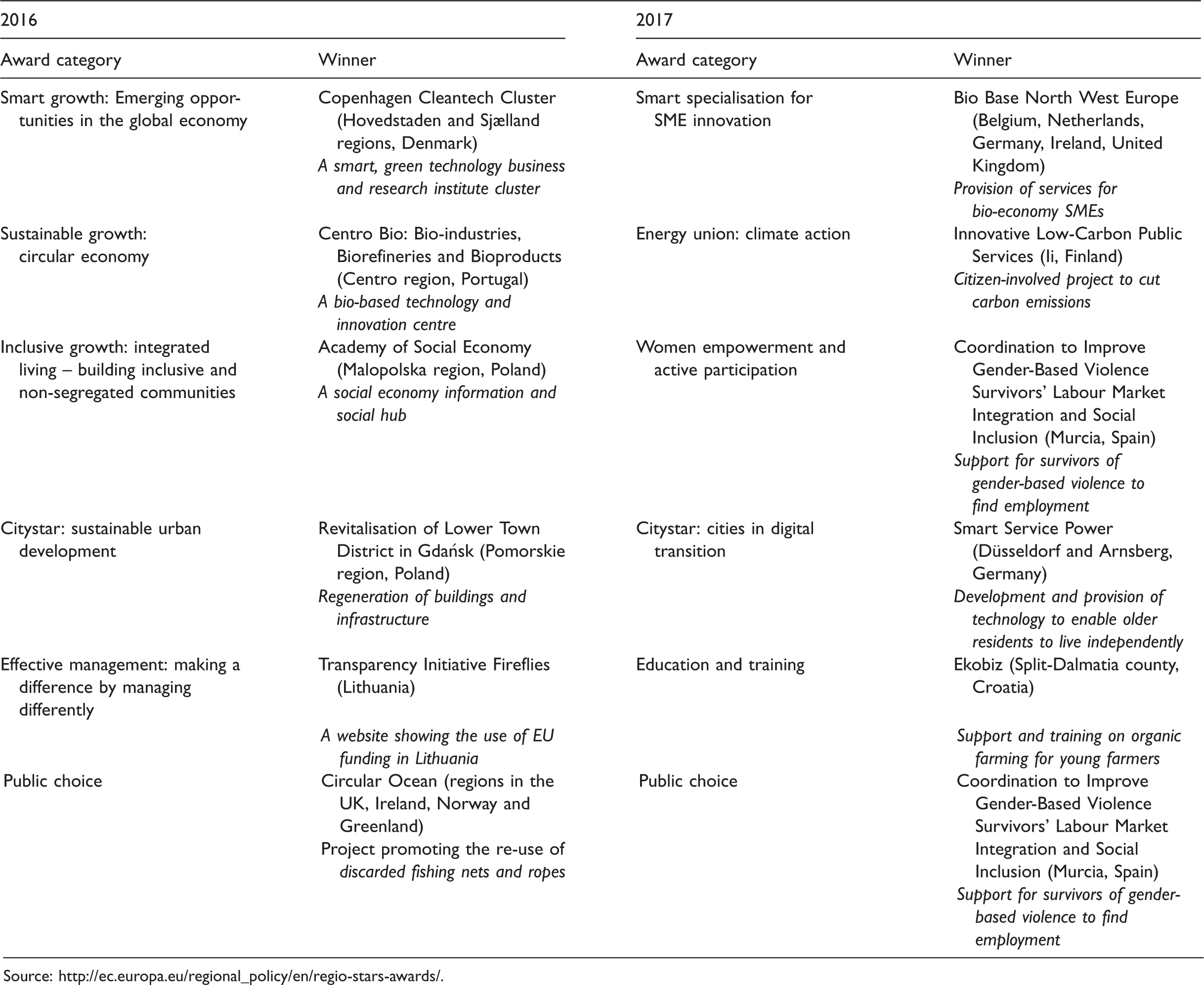
Typically, four or five finalists in each category are announced prior to the ceremony, and at the ceremony the winner is announced. Before all this, projects funded by Cohesion funds are encouraged to nominate themselves for the awards but require approval from the managing authority within the project’s region or nation state before submitting their application. The number of nominations submitted each year varies, with 105 on average being submitted each year between 2010 and 2017. An independent jury consisting of academics, policymakers and practitioners from different parts of Europe select the finalists and winners of each category. One recent exception to this is in the public choice award, included in the 2016 and 2017 ceremonies. Here, all finalists of the jury-selected categories are automatically included as finalists for the public choice award and it is decided by an online public vote. A set of criteria for all the applicants is published when the awards are launched each year, with the criteria typically calling for applicants to be innovative, impactful, financially sustainable and have best practice that can be transferred to other localities.
Echoing conventional wisdom, there is belief among the organisers that the awards require an award ceremony as this brings publicity and networking opportunities. The ceremony is an evening event and is usually held in the Centre for Fine Arts (BOZAR) in Brussels, although in 2017 it took place in the nearby Square convention centre. Accompanied by a reception, the ceremony is typically between 60 and 90 minutes long, and it is also available to watch online during and after the event. Its running order is similar each year: the host introduces the awards, guest speeches are made (usually by the Commissioner for Regional Policy and the head of the jury), and then the categories are gone through one-by-one. Each category follows the same order: the finalists are announced, an envelope is opened and the winning project is read out, a short video is shown showcasing the winning project, then representatives of the winning project come on stage to collect the trophy, pose for photographs, and answer questions put by the host.
The finalists and winning projects are also showcased beyond the ceremony itself. In 2016 and 2017 an exhibition showcasing the finalists was provided on the opening day of the conference so that attendees and the press could network with those working in the shortlisted projects. The organisers have also sought to codify knowledge of these projects through the creation of bite-sized and positive profiles of the winners and finalists that can be easily accessed online. As part of this an accompanying glossy brochure with short profiles of the finalists is published each year, and each winner has a short video made about it. The videos include a voiceover profiling the projects, at least one talking head (often individuals working for or using the project’s services) and have shots of the project or workplace in action. The 2017 winner of the ‘energy union: climate action’ award, Innovative Low-Carbon Public Services in the small Finnish municipality of Ii, for instance, centres on a local resident Heidi Takalo. Illustrating the project’s use of citizen consultation in their bid to cut carbon emissions, Heidi talks about participating in an event to redesign the town centre and her children taking part in a traffic inquiry. The visuals show Heidi attending a meeting at the municipal offices, the children engaging with a map of the municipality at the kitchen table, and the video ends with Heidi cycling alongside the waterfront. This video – alongside all the videos of all the winners – was posted on the European Commission’s InfoRegio website and the DG Regio’s YouTube channel and promoted via various twitter profiles.
Usually the winners and finalists are represented at the award ceremonies and in related materials as being successful and transformative, or at least showing considerable promise. Often the positive changes the projects have provided or will provide are stressed such as job creation, improved services and environmental enhancements, with no mention of any negatives. The video and brochure profiles of the Innovative Low-Carbon Public Services project in Ii, for instance, focus on its message that its public services are becoming ‘more citizen-focused and better value’ (European Commission, 2017b: 28) alongside considerable reductions in carbon emissions. Prominent in its narrative of transformation are the figures for previous carbon emission reductions in the locality (50% reduction between 2007 and 2015) and its future goals (80% reduction before 2020). Accompanying the successful transformation rhetoric surrounding the winners and finalists are two repeatedly used adjectives: innovative and inspiring. For instance, in a foreword to a recent brochure, ‘RegioStars: 10 years of success stories’, Corina Creţu exclaims that ‘RegioStars reward excellence in regional development and highlight original and innovative projects, inspiring others to get involved’ (European Commission, 2017a: 4). The use of the word inspiring by Corina Creţu and others is, of course, partly instructive: you should be inspired by these innovative projects (and try something similar).
There is an uneven geographical distribution of award winners that is never explicitly acknowledged in public by the organisers. Taking account of all the awards between 2008 and 2017, the UK has hosted in whole or part by far the largest number of award winning projects with 13, followed by Sweden (8) and Germany, Lithuania, Poland and Portugal (all with 5). The UK is higher than the combined total of all the 13 countries that joined the EU from 2004 onwards. The reasons for this unequal distribution are complex, reflecting among other things the willingness and ability of projects and managing authorities to engage with the awards, the destination of Cohesion funds, and the preferences of the jurors. So, while the organisers are not insisting to audiences inside and outside of Brussels to follow the ways particular nations – the UK and Sweden – use structural funds, there is an implicit funnelling of onlookers to projects in particular countries. However, this uneven geographical distribution of award winners has not impacted the national allocation of structural funds to the UK and Sweden, as the principles for distribution of structural funds are purely a mechanical function based on economic, population and geographical needs rather than previous project performances. If anything, a successful project leading to economic growth, population increase or other regional benefits reduces the likeliness to receive future funding.
DG Regio clearly envisions the awards and ceremony as serving a dual purpose. First, while the jury or public select the winners, the awards are designed to act as an advisory signpost for how to spend structural funds. Second, much like the wider EWRC conference the ceremony is intended to demonstrate the value of Cohesion Policy. ‘Our finalists’, as Corina Creţu has pronounced, ‘are once again real-life testimonies of how Cohesion Policy is a concentre engine for investment, sustainable economic growth and jobs, and for improving the lives of 500 million European citizens across our continent’ (quoted in European Commission, 2017b: 4). The winners become ‘proof’ that Cohesion Policy works.
Conclusion
Through the example of the annual European Week of Regions and Cities conference and its RegioStars awards ceremony, this paper has made the case that conferences and award ceremonies are important means through which best practices are shaped and showcased as successful, transferable and transformative. They are informational infrastructure events – temporary gatherings which frame and package knowledge about best practices – which bring people, places and scales into relational proximity (Cook and Ward, 2012) and demarcate ‘acceptable futures’ (Bulkeley, 2006). A lot of work on stage and behind the scenes goes into anointing best practice and shining the largest and most flattering light on the ‘very best’ in best practice – in this case, the winners of the RegioStars awards. They are also events where issues of failure, inappropriateness and immobility are acknowledged here and there, but are rarely dwelled upon.
In drawing this paper to a close, it is useful to make four points. The first is that learning and educating are central to the performance of informational infrastructure events and the associated mobilisation of policies. Events such as the EWRC and the RegioStars ceremony are often promoted as gatherings where audiences must learn from other people and other places, not only at the event but afterwards as well. There is a scalar dimension to the education also: the events involve supranational bodies guiding policymakers operating at smaller geographical scales. At the EWRC conference and RegioStars ceremony, emphasis is placed on face-to-face interactions and networking as these are seen to enhance participants’ learning. Being there and being co-present are viewed as being important, but not essential. Indeed, attempts have been made to facilitate distance learning (echoing other conferences and award ceremonies). The online posting of videos of RegioStars winners, brochures of the finalists, videos of the ceremony and other EWRC events, as well as live broadcasting from the conference are all designed to extend the reach of the education provided. Learning, educating and their geographies are, therefore, important aspects of informational infrastructure events.
The second point is that informational infrastructure events are shaped by institutional and geographical dynamics. In terms of institutional influences, the EWRC and the RegioStars ceremony are moulded by the institutions organising the conference (DG Regio and the Committee of the Regions) and the wider institutional politics of the EU. This influence is reflected in, for example, the selection of conference themes and award categories to reflect current institutional priorities within the EU as well as the considerable ‘stage time’ given to the Commissioner for Regional Policy (who has much less input in the organisation of the events). Yet, it is more than just institutions and institutional politics influencing informational infrastructure events; geography plays an important role too (Temenos, 2016). The location in Brussels enhances the attractiveness of the events to some attendees, for instance, and the micro-spaces of the conference are designed to encourage convivial networking and knowledge sharing. Scale, too, is vitally important, especially as the prioritisation of regional policy over urban policy within the EU encourages the organisers to concentrate on regional rather than urban policy. That said, despite constraints and influences such as these, informational infrastructure event organisers have some potential to influence the institutional, spatial and scalar structures in which they are situated.
The third point is that informational infrastructure events can have significant consequences for the event organisers. In this instance, the EWRC and RegioStars ceremony impact the finances, workloads and resources of the organisers. More than this, the organisers see this week every October as a means through which legitimacy for the organisers and Cohesion Policy can be gained. A central message runs through the events: the organisers and Cohesion Policy work effectively in delivering transformative economic development across the member states. With much of the European Quarter in Brussels being dominated by the conference and award ceremony every year it is hard for those nearby to ignore such messages. Importantly, this showcasing is intended to not only enhance the reputation and power of the organisers and Cohesion Policy but also to protect them in an uncertain political climate. If we look at the written guidance for event partners at the 2018 EWRC (Open Days, 2018: 4), it reasons that with the ongoing negotiations over the priorities and finances of the EU, the EWRC should ‘clearly demonstrate that Cohesion Policy has delivered real improvements for Europeans that has a tangible impact; and that a strong Cohesion Policy is needed’. Will the conference and the event ceremony have a significant influence over the future of regional and urban policy? It is difficult to predict this, let alone accurately measure their influence, but it is highly likely that the conference and the event ceremony will be one of many events that inform important decisions on the direction of regional and urban policy as well as the EU more generally.
The fourth point is that more academic research is required on the EWRC, RegioStars ceremony and other informational infrastructure events. Award ceremonies, especially, require more critical attention. A key area of investigation that was beyond the scope of our study but needs attention is the embodied experiences of award winners before, during and after the ceremonies. An important part of this is to explore is the effect of the awards on the winners. The ‘RegioStars: 10 years of success stories’ brochure mentioned earlier gives some hints (European Commission, 2017a). It provides very positive testimonies of 33 award winners from different years, whose accounts overview their projects, detail what has happened post-award and often point to the positive effects of award winning. Here, boosting morale, increasing the profile and bringing legitimacy are mentioned in several of the testimonies. A more comprehensive analysis is required. What, for instance, are the negatives of winning awards? Do winners actually promote their award and, if so, how and to who? How do award winners liaise with curious onlookers? Are some winners largely overlooked or forgotten about by informational infrastructures? And, of course, it is not all about the winning. So, further research must also examine the other attendees of conferences and award ceremonies, exploring their experiences at the events, their learning practices and the ramifications of their attendance on their working practices.
Footnotes
Declaration of conflicting interests
The author(s) declared no potential conflicts of interest with respect to the research, authorship, and/or publication of this article.
Funding
The author(s) disclosed receipt of the following financial support for the research, authorship, and/or publication of this article: This research was assisted by grants from the Swedish Society of Anthropology and Geography (SSAG) and the Jan Wallander and Tom Hedelius Foundation.