




Abstract
Creating borders and borderlands is a key role of the contemporary state. Drawing on an investigation of the Irish state bordering complex determining asylum and refugee claims in Ireland, this article illustrates the importance of the actions of individual state agents and the cultures of practice in state agencies in bordering and statecraft. Building on scholarship studying the state, I conceive of statecraft as cultures of practices, understood within a feminist geopolitical framework. Studying these cultures of practice reveals the ways state agencies and state agents produce knowledge and how they work within complex power-geometries of social and political geographies. I investigate the Irish asylum determination process using an archival ethnography methodology to encounter an online archive of refugee appeals decisions in Ireland. This article shows one result of this encounter: a published database of asylum decision patterns and practices of the refugee appeals tribunals and of individual Tribunal members issuing decisions to people seeking asylum in Ireland. I argue this approach: (1) addresses real needs for systematic evidence of practice of Tribunal members, as requested by asylum seekers and legal representatives; (2) investigates cultures of practice in decision-making bodies in the asylum complex of the Irish state; (3) and shows the importance of archives of asylum decision-making in the state practice of bordering and statecraft. Analysis shows an asylum determination culture heavily dependent on who is doing the deciding, the decision-maker assigned is a major element in outcomes of asylum claims. I also propose a framework for identifying statecraft and bordering as the collective project of groups and individuals embedded within the state; this framework provides productive and systematic evidence of bordering and the ways individuals and groups go about doing statecraft in the asylum determination process.
Introduction
In the context of borderlands and increasingly powerful state control of borders and border-crossings, the asylum court has become a central point of state power in the exercise/restraint of the obligations upon states to adhere to international agreements such as the 1951 Refugee Convention. Asylum seekers in these countries increasingly face restricted asylum regimes and landscapes (Coddington, 2018). Importantly, in most of Europe the job of determining the legal validity of asylum claims is allocated by states to specific agencies, often within departments of justice or analogous departments or ministries.
The cultures of inter-personal actions and constructions of the actions of civil servants, elected officials and other people key to these determinations are often captured in the archives of agencies, tribunals and ministries. When accessible to researchers, these archives can provide an opportunity to understand how these agencies are constructing the bordering of the state in the cases of asylum. Scholars work to study the state to see the position of ‘state’ in debates around bordering and the key questions that emerge from who is included in the nation-state, and included by whom (see Hyndman, 2017; Maillet et al. 2017; Minca et al. 2021 to name a few).
Those in a country as a result of forced migration are often the most vulnerable and precarious to state control. Researchers studying state practices of bordering often face obstacles, including obfuscated and absent evidence and chaotic organisational structures within state agencies. In this article I demonstrate the importance of identifying statecraft and bordering as the collective project of groups and individuals embedded within the state; this focus provides productive and systematic evidence of the kind of bordering states engage in, and the way they go about this process in the process of determining asylum and refugee status.
I investigated the refugee asylum determination process in Ireland. I demonstrate how, by conceiving of statecraft as cultures of practice, I was able to develop a praxis to investigate the Irish Refugee Appeals Tribunal (RAT) and the International Protection Appeals Tribunal (IPAT) 1 through an embodied and sustained engagement with an online archive of decisions issued by the tribunals. The archive reveals cultures of practices of the tribunals and of individual tribunal members.
In this paper I explain and describe the creation of a database of decision patterns and practices by the appeals tribunals and by individual decision-makers issuing appeals decisions. This database is one material outcome of this sustained engagement, one designed to respond to the needs and requests of asylum seekers, refugees and lawyers and also to provide a new tool for those studying border enforcement in Ireland and the EU. Analysis of this database shows an asylum determination culture heavily dependent on who is doing the deciding, as assigned by the Tribunal chair. In this way, asylum seekers in Ireland, like the process identified in other countries, face a potential unfairness in the system, a ‘luck of the draw’ (Rehaag, 2012, 2017) – in which the decision-maker assigned to determine their asylum claim is a major factor in the outcome of their appeal.
Examining this archive and other places of knowledge production situates knowledge primarily in the work and performances of those doing the asylum determination – and by extension, doing border enforcement, and in the agencies and tribunals – communities of repeated and institutionalised practice. This archive contains rituals and practices of the Irish state as the tribunals determine asylum and ‘processes’ asylum seekers through national borders. In the praxis of a sustained engagement with this archive, I worked to provide new ways of seeing these institutional practices and these practices of statecraft and bordering.
In the first section of this article, I describe how conceptions of the state are utilised in the context of this project, and the importance of recognising the fluidity and also the material impact of definitions of state. I then describe how feminist geopolitical scholarship builds off of these conceptualisations to focus on exposing relationships of power and how to transform these power geometries through inquiry into the choices of research questions, data collection, and analytical techniques (Hiemstra and Billo, 2017). I also describe previous work studying practices of refugee asylum determination in Europe, USA, and Canada.
In the second section of this paper, I set out the context of the Irish Refugee Appeals Tribunal Archive (ATA), and how it is an opportunity and resource in viewing how the Irish state treats and has treated people claiming asylum and international protection in Ireland. I give a brief history of how the archive came to be a public resource available for research, and how the archive fits within the changing refugee regime in Ireland that has consistently been opaque, hidden and defensive.
I then set out my methodology of how I have used webscraping as part of a praxis of sustained engagement with the digital online archive to gather all of the records in the ATA in a way that is legible for comprehensive social research, and how this praxis of using different methods is important to working to study state practices in the appeals tribunals, and in Irish bordering practices generally.
In the fourth section, I present the evidence from the database, including how refugee asylum determination practices are heavily dependent both on cultural practices within the tribunals and the individuals that have worked within them.
The final discussion outlines the impact and limitations of studying archives of state practice in asylum determination, and how these can be jumping off points for finding liberatory frameworks in the context of violent restrictions and control on global migration in the ‘thick’ geographical research of the archives.
Studying knowledge politics of state bordering
This article uses a feminist geopolitical framework set forth first by Hyndman (Hyndman, 2001, 2004, 2017) to study contemporary borders and bordering processes enacted by state agents. Feminist geopolitics centres security for people and those most vulnerable to state and extra-state violence through care towards bodies and interrogates scale as a normative tool of institutions and as an analytical technique. In this way, a feminist geopolitics rethinks scale in mainstream debate: it decentres the nation-state and recentres on the body and on the people both affected by and ‘doing’ statecraft.
Statecraft emerges as the defining aspect of the state. The state is the result of the practices and cultures of statecraft. Even calling anything ‘the state’ immediately gives a sense of power to that entity, even in defining what the state is.
Jones (2009: 409) very generally captures uniting themes of the use of the concept of the state in geography: “the most general feature of the state… is that it comprises a set of institutions concerned with the territorialization of political power”. A way of researching the state production of knowledge is, according to Mountz (2010), writing through the state, alongside sustained engagements with activities of state officials, state agents, and people affected by state policies. This includes writing through how state agencies and agents employ secrecy, paperwork, and bureaucratic processes to project hegemonic visions onto populations. This statecraft is especially apparent in the actions state agents and governments take on border enforcement. Coleman and Stuesse (2016: 529) studying immigration control far away from international borders in the United States discuss: The bordering practices that states engage in are not strategies of domination that emerge whole from ‘within’ the state, just as effects of these practices are not simply outcomes that emerge from ‘within’ immigrant communities.… [I]t is precisely this interface, or encounter, between ‘producers’ or ‘consumers’ of state which we understand as immigration statecraft.
Only through the actions at these encounters can ‘statecraft’ happen.
The work of border enforcement in state offices and agencies is enacted in everyday practices and in moments and places of crisis; from the point of view of a researcher looking at statecraft, some of the state actions of border enforcement are visible and some are not. In the bureaucracy of these asylum determination agencies, the violent acts of deportation and border enforcement become normalised as everyday occurrences, as paperwork or as evidence and absence (Amoore and Hall, 2010). Border control is also ‘eventualized’: state agents and other actors work to produce some border-crossings as events and not others. Recent work has also considered a rethinking of the biopolitical in bordering, in which “opacity inevitably generates disorientation for the migrants, making it hard to grasp how the EU border regime works” (Aradau and Tazzioli, 2020: 203), and multiple frameworks of state perceptions inform a ‘biopolitics multiple’ – heterogenous political technologies informing border control and border imperialism in Europe and elsewhere (Minca et al., 2021).
Archives as places of state knowledge
I propose the Appeals Tribunal Archive (ATA) as a case study in the best sense for political geography. The point of studying this archive of asylum decisions in Ireland is not to study to ‘discover a global perspective’ – to discover the ‘universal truths’ of border enforcement – but for ‘an other perspective’; in this way I am following Gilmartin (2009) and O; Tuathail (2003) in proposing that the archive is a place of ‘thick geographical knowledge’— as an “entangled place with its own ‘spaces of experience’ and ‘horizons of expectations’” (Gilmartin, 2009: 279).
The ATA is an online collection of stored asylum appeals decisions from 2001 to present issued by the RAT and the IPAT. These tribunals were created first in legislation to fulfil the Irish state’s requirement in international law to allow for appeals to asylum decisions. The chair and members of the tribunals are appointed by the Minister of Justice.
The Tribunal member (Tm) assesses the first-instance decision and issues a decision and justification granting or denying the appeal, which is processed by the DoJ. These decisions are then filed as PDFs in the online ATA database. The collection of practices and decisions issued by the tribunal and collected in the ATA are core statecraft activities, and as such are key places to look for evidence of what is happening ‘in the state.’
This project takes these places of knowledge production as key to the insights that come from examining them and situates knowledge primarily in the work and performances of people and bodies and also in the communities and institutions that come about from repeated and institutionalised practice.
Stoler’s (2009) approach of ‘studying along the grain’ of state practice in the archives echoes the tenets of feminist geopolitics I have outlined above. State archives have been indispensable for scholars studying imperial and colonial knowledge production (Hevia, 2003; Johnson, 2014; Kurtz, 2009; Stoler, 2002). In Stoler’s (2002: 87) study of empire, the archive “was the supreme technology of the late nineteenth-century imperial state”. Archives are sites of knowledge production, ‘monuments of states’, ‘sites of state ethnography’— “this requires a sustained engagement with archives as cultural agents of ‘fact’ production, of taxonomies in the making, and of state authority” (Stoler, 2002: 87). Stoler’s works in colonial archives reveal the assumptions, the beliefs, and the constantly changing ‘common sense’ logic of civil servants and colonial administrators.
Sustained engagement with the archive reveals the daily practices and productions of knowledge that produces a ‘common sense’ for the state, different from other data sources and methods. This sustained engagement includes critically examining the form of the archive, including the “prose style, repetitive refrain, the arts of persuasion, affective strains that shape ‘rational’ response, categories of confidentiality and classification, and not least, genres of documentation” (Stoler, 2009: 20). This analysis of ‘archive-as-process’ views archives as places of knowledge production, where the language of the statecraft is crafted and honed.
Contemporary state archives are now almost ubiquitously digital, and if they are accessible to the public, they are online. Weltevrede (2016) in their work on digital social research ‘scraping the social’ and in collaboration with Marres (Marres and Weltevrede, 2013) explains an approach to engaging with digital and online archives using the tools of web-scraping. Weltevrede draws a distinction between “‘scraping the medium’ and ‘scraping the social’”: [T]he difference between ‘scraping the medium’ and ‘scraping the social’ is probably best understood as a difference in degree: in some cases, digital devices play a noticeable role in the structuring of data, while in other cases a discernible empirical object cannot readily be reduced to the medium-architecture enabling it. (2016: 51)
I understand Marres and Weltevrede’s framing of digital research as similar to Stoler’s focus on studying the form and the content of the archive as rich data for sociological and ethnographic research. Scraping the medium is engaging deeply not only with the content of websites and online records but also the architecture that makes up these sites.
For this project, I engaged in this archival ethnography approach on the contemporary digital archive of the ATA. This article presents one section of this approach, and the identification of a need and means for a systematic reporting of Tribunal member international protection decision rates.
Building evidence of practice in asylum determination
Researchers in other countries have worked to provide systematic reports on the decision process and on the individuals involved in the determination process. These researchers provide models and the framework useful for a systematic publication of Tribunal member decision rates in Ireland, which in turn can become useful to geographers, legal scholars, and activists.
In Canada, Rehaag (2012) analyses the decision rates in the second-instance decisions for international protection, which are made by judicial review in the Federal Court. In 2012, in a review of over 23,000 applications for judicial review from 2005 to 2010, Rehaag (2012: 30) argues that analysis of the decisions based upon the decision-maker showed great variation among the rates of granting or refusing the appeal, and that consequently, “leave decisions hinge partly on which judge is assigned to decide the application”. Rehaag (2012: 31) writes: And of course there are extreme stakes in this decision-making process: if the Federal Court wrongly denies applications, the direct result is that refugees may, contrary to international refugee law, be sent back to the countries where they face persecution, torture or death. In short, the key finding of the study is that the leave requirement, as currently applied, all too often possess an arbitrary and unfair barrier to access to justice and for refugees, with potentially devastating consequences.
Specifically, Rehaag found that there was a linear distribution in the variation of decision-makers’ grant/refuse rate, with 36% of judges deviating from the average grant rate by more than 50%. There was no normal or consistent decision grant rate. The judge assigned had a strong effect on the likelihood that an application would ultimately succeed.
In the USA, TRAC (2020a, 2020b) provides records analogous to Rehaag in Canada of asylum determination tracked across geography and individuals, which have been used in multiple studies of bias and inconsistency in asylum decisions (Burnham et al., 2006; Chen, 2016; Eagly and Shafer, 2015). Ramji-Nogales et al. (2006: 296) utilised TRAC data in statistical analysis and found “amazing disparities in grant rates, even when different adjudicators in the same office each considered large numbers of applications from nationals of the same country”.
In Europe, a complicated diversity of legal cultures and interweaving national, EU, and international legal frameworks create a tapestry of asylum decision-making practices. Gill and Good (2019: 2) write: The asylum issue is deeply contested as a result of an inherent contradiction between the need for Western states to portray themselves as representing shared communities with common values, including recognition of basic human rights such as the right not to suffer persecution; and the discretionary right assumed by modern states to decide who can enter and reside in their territory.
Scholars studying asylum determination in Europe have also highlighted that in order for these investigations to be done, a necessary part of any call for a fair asylum determination process should include a call for a clear and transparent operation of asylum determination agencies, tribunals and judges (Campbell, 2016; Gill and Hynes, 2021).
Normative law research provides prescriptive ‘fixes’ to law and legal practices while empirical legal research focuses on the practice of laws in society (Christiani, 2016). And critical scholarship has worked to show the deterioration of asylum protections offered by international laws, and a narrowing gap between the protections offered by Refugee Convention signatory and non-signatory states (Coddington, 2018).
Sorgoni (2019) evaluates the practices of asylum judges in the context of the asylum process in Italy, criticising the positivism of asylum claims in their entirety. Sorgoni’s (2019: 234) criticisms are “not to offer ad hoc solutions to make the existing asylum system fairer to those ‘happy few’ who land alive at the external frontiers of Europe, thus supporting the positivist illusion that finding yet more technicalities, or refining existing ones, will eventually render the screening of human beings’ ‘objective’”. Instead, Sorgoni (2019) argues there must be an evaluation of the logics and knowledges of asylum decision-makers and the culture of knowledge production in these agencies in order to determine how there can be a just acknowledgement of migrants and asylum seekers. Importantly, when work is done that critiques the asylum process, then the work must also offer something beyond a critical approach; we must propose our own models of what asylum can mean.
International protection in Ireland
In Ireland, the refugee and asylum regime today is the result of emergent immigration patterns in the 1990s as well as a growing network of international and national laws. In Ireland in the 1990s, asylum seekers and immigrants became a central focus of political debates, as the economic growth of the ‘Celtic Tiger’ necessitated and attracted labour from outside of Ireland. Lentin and Lentin (2006: 11) note that with the arrival of this number of immigrants, small relative to the Irish population, the Irish state and state officials situated the country as both an accepting country, a country in need of migration to sustain economic growth, and also as a country under pressure from immigration, that necessitated its “commitment to restricting immigration and increasing deportations of those not deemed ‘useful’ to global Ireland.”
Central to understanding how the debates around immigration were framed in Ireland is an understanding of how the Irish state treated race, and the racialisation of migrants in this time. Lentin and Lentin (2006:11) highlight Ireland as a ‘textbook case’ of a contemporary ‘racial state’: Though a former colony, the Irish nation-state has imagined itself as based on a racialised notion of identity and on a desire to demonstrate that the claim to statehood was in part based on the assertion that the Irish nation was not different from other European nations and did therefore differ from subaltern non-European peoples.
This racialised context is important in understanding how Irish statecraft and bordering is similar and different from other European states.
In broad generalities, the asylum determination process in Ireland is aligned with other EU countries (Gill and Good, 2019). In Ireland international human rights law has its strongest reinforcement in law with EU agreements that placed human rights laws at the centre of its founding documents. Both the Treaty on the Functioning of the European Union (TFEU) and the EU Charter of Fundamental Rights explicitly reference the Refugee Convention and set in European law the principles of non-refoulement. The contemporary Irish refugee asylum process came about through legislation alongside EU efforts to unify and regulate states’ asylum systems in the Common European Asylum System (for more on the CEAS and Ireland's status in CEAS, see Arnold et al., 2018).
The current application process
When someone applies for international protection in Ireland the International Protection Office (IPO), an agency within the Irish (DoJ), begins a process of asylum determination. This process begins with questionnaires, interviews, and processing of documents. The IPO then issues a first-instance decision, recommending that the Minister for Justice either grant or deny refugee status. This process fits within the landscape of asylum determination in EU countries. The end effect, for a large variety of reasons, is a variation in asylum decision outcomes, with Ireland granting a lower percentage of asylum applications on first instance than most EU countries (see Figure 1). Percent of first-instance asylum decisions granted by European country. Source: Eurostat, 2020. Map by Author.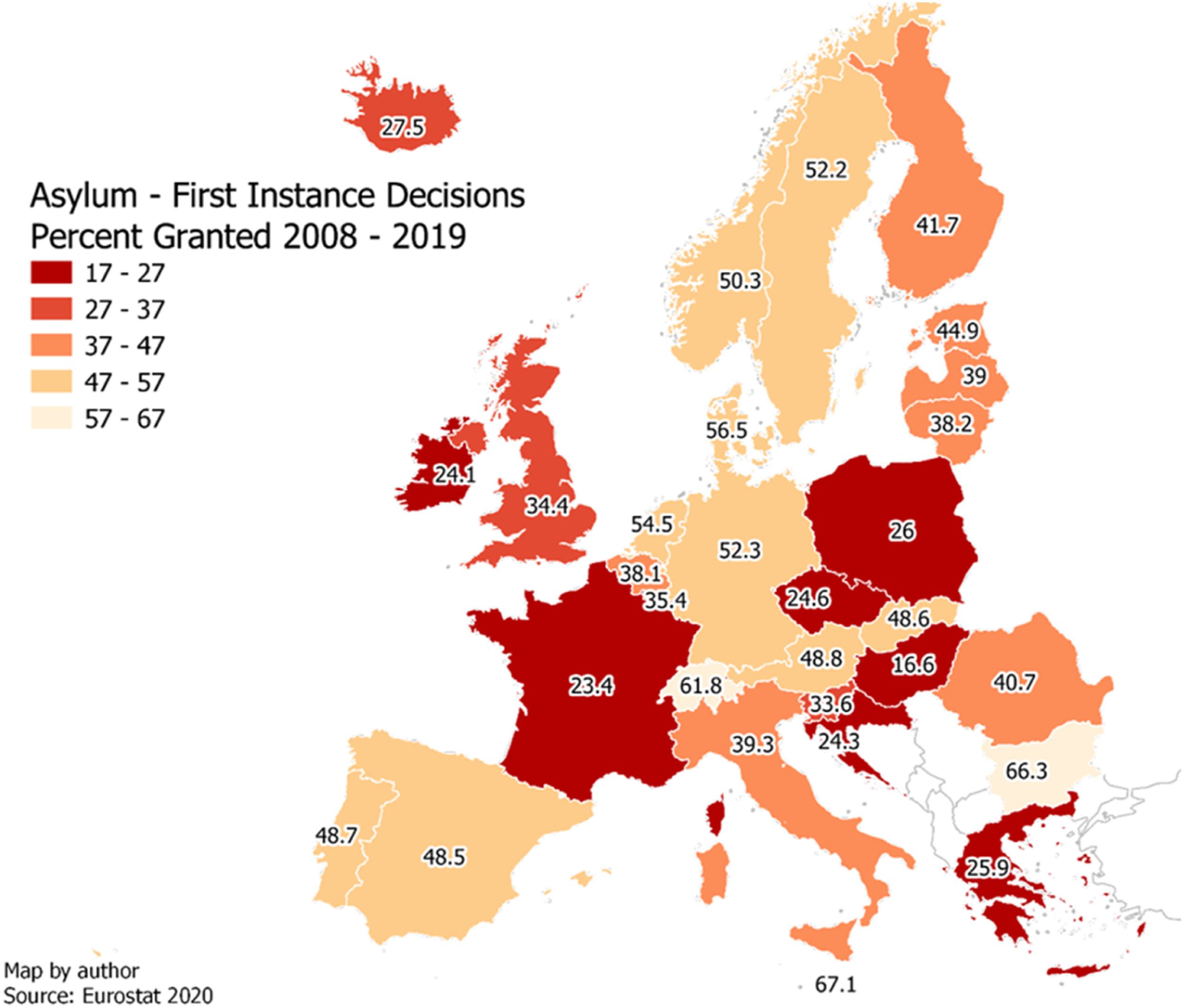
An asylum seeker may seek to appeal a negative decision to the International Protection Appeals Tribunal (IPAT). These appeals are processed by the IPAT, and the Tribunal chairperson (Tc) allocates an appeal to a Tribunal member (Tm). The Tm is required in many cases, although not all, to hold an oral hearing to hear arguments from the applicant arguing against the first-instance decision, and from the IPO. The Tm then issues a decision recommending granting or denying the appeal, which is processed by the DoJ. Tribunal decisions may be appealed for Judicial Review on technical grounds to the Irish High Court, and these reviews may be further appealed to the Irish Supreme Court and the European Union Court of Justice (EUCJ).
Although limited in scope, judicial review judgements critical of the Irish state’s asylum determination practices have often been the impetus for changes in the asylum process. While the procedural steps in the asylum process are laid out in legislation, much of the work done by the asylum agencies in processing applications for international protection and issuing decisions is hidden or obscured from view. Since 2006, there has been an active conversation about the opacity of the Tribunal, the asylum determination process and of the practices of Tms in public media, in the courts and among NGO, advocacy and community solidarity and activist groups.
Attempts to challenge the process of the appeals tribunal and to reveal the opaque decision process have brought some gradual changes, and cases in the Irish Supreme Court and the Irish High Court in 2006 and 2007 led to the opening of the Appeals Tribunal Archive (ATA) to legal representatives in 2007 (see Atanasov v. Refugee Appeals Tribunal & anor, 2006 and Nyembo -v- The Refugee Appeals Tribunal & anor, 2007) and to researchers in 2014, making this project possible. In the Nyembo case, there was tacit recognition from the courts that there should be public accountability from the Tribunal concerning Tribunal member decision rates, but the case was settled without the release of Tm decision rates that were being sought after. The work detailed in this article identifying Tm refusal rates is a response to requests to create systematic evidence of practice of Tms from asylum seekers and legal representatives in these cases and more.
Methodology - webscraping the ATA
The methods of this project used the archive as a site of investigation and also engaged with the archive as situated in the world. This approach is an ethnography of a contemporary archive, following Stoler’s (2009: 47) insistence “in treating archival documents not as the historical ballast to ethnography, but as a charged site of it,” and calling for a methodological shift to move away from extractive practices of archival research to an ethnographic praxis, engaging and immersing in the archive. For the specific outcomes for this article, this praxis involved using web-scraping tools to create an open database of Tribunal decision rates based on the entries in the ATA.
Web-scraping is a technique used to programmatically and systematically collect information hosted on the internet, and in this case was an approach to interpret and analyse the over 20,000 decisions in the ATA.
The web-scraping of the archive was done using R, the R-Selenium package, and Docker to create a virtual environment with a browser that could be programmatically controlled. This approach was used because it is necessary to have a username and password to access the archive, precluding the use of simpler scraping techniques. The included metadata on a decision was gathered at this stage using systematic searches of the database to include all decisions in the archive’s database. The metadata includes the year the decision was issued, the determined country of origin of an applicant, the type of appeal, the decision/outcome, and a reference number for the application. The metadata does not include the name of the Tm who issued the decision. Instead, this information is in the PDF document of the decision, downloadable from the database search page. In addition, the Tm name is not included as text in the PDF, but rather as an image of the text, making it further difficult to connect a decision to the issuer of that decision. To identify the name of the Tm for each decision, each decision PDF was downloaded, and a script in R employing OCR (Optical Character Recognition) from the tesselate package read the text of the image and connected it to existing Tm names from annual reports. 2
Limitations in methods
The archive of decisions is incomplete - in scraping the ATA, I was able to identify how many decisions there are in the archive for each year and compare this number with the official annual reports from the appeals tribunals. The ATA documentation states that for the years 2001–2006, only positive decisions and decisions specifically requested are included; however, even in the years after, there are many decisions not present in the ATA. For example, in 2009, according to annual reports there were 3426 decisions issued, and there were 2701 decisions found in the ATA. This means that over 21% of decisions issued that year are missing from the ATA. Additionally, I was not able to identify the issuing Tm for all decisions in the ATA. Overall, according to annual reports there were 19,134 decisions issued from 2006 to 2018, and of these decisions 13,902 (73%) were identified in the ATA and 12,749 (67%) had an identifiable issuing Tm.
What can be learned and gained from an incomplete archive? We can build awareness of what we can and cannot know based on what is publicly available knowledge so far and make initial assessments of the practices of asylum determination at the tribunals. It is unclear why some decisions are included and not others. What is missing from an archive like the ATA is also an important part of assessing the significance of the archive in the bordering regimes of the Irish state and in identifying the ways the archive does the work of and provides the evidence for this bordering.
Findings: The tribunal member decision rates database
In this praxis, I created a database of decisions in the ATA with a recording of the corresponding Tm who issued the decision. 3 The type of appeal and the decision/outcome is included in the metadata for each decision in the ATA and was obtained in the scraping process. The work outlined in the methodology created the database to be used as a public resource for further analysing the ATA and the conduct of the appeals tribunals, and also allows for observations to be made of the archive. I outline three observations I make about what is in the archive, and how this new database provides evidence of the conduct and practices in the appeals process for international protection in Ireland.
Firstly, appeals rarely succeed. Of the decisions in the ATA issued in the years 2006 – 2018, 87.1% of appeals were refused, denying international protection and affirming the first-instance negative decision. Secondly, there is wide variation in the number of decisions issued by each Tm both in the number of decisions that each Tm issued and the refusal rate between Tribunal members. Forty-six of the ninety-four Tms identified in the ATA issued 30 or more decisions in the time between 2006 and 2018, and these forty-six Tms issued over 97% of all decisions in the ATA with an identified Tm.
The 10 most prolific Tms together issued 7434 decisions, over half (58%) of all decisions in the ATA. The refusal rate among this cohort of Tms is 86.3%, similar to the overall refusal rate of 87.1%. Annual reports from the appeals tribunals confirm this overall pattern. In the years 2013 to 2017 over 50 percent of decisions were made by seven of the forty-four Tms. Annual reports before 2013 do not report the number of decisions by individual Tms. Appeals at the RAT were and at the IPAT continue to be apportioned on the discretion of the chairperson of the Tribunal, who allocates cases to each Tm. Tms are hired in a piece-meal manner, paid based on the type of case, and some Tms are apportioned many more cases than others. The reasons for this variation are not clear.
Thirdly, there is also wide variation in the refusal rate of Tms – that is, in the proportion of the decisions issued by each Tm in which they refused the appeal and international protection for the person seeking asylum (see Figure 2). Tms’ refusal rates in decisions in the ATA varies from Tm Nicholson, who refused appeals in 100% of decisions in the archive that he issued, to Tribunal chairperson (Tc) Becker, who refused appeals in only 42.9 of their decisions. Tc Becker is the current chairperson of the IPAT at time of publication since April 2017. There is also a variation in the refusal rates among the 10 most prolific Tms between 98.3% (Tm Levey) and 64.4% (Tm Gallagher). Refusal rate of Tribunal members in Tribunal decisions for Tribunal members issuing more than 30 decisions, 2006-2018, according to decisions in the Appeals Tribunal Archive. Larger circles represent more total decisions issued. The decisions issued by Tribunal members who issued less than 30 decisions account for 2.4% of all decisions assessed.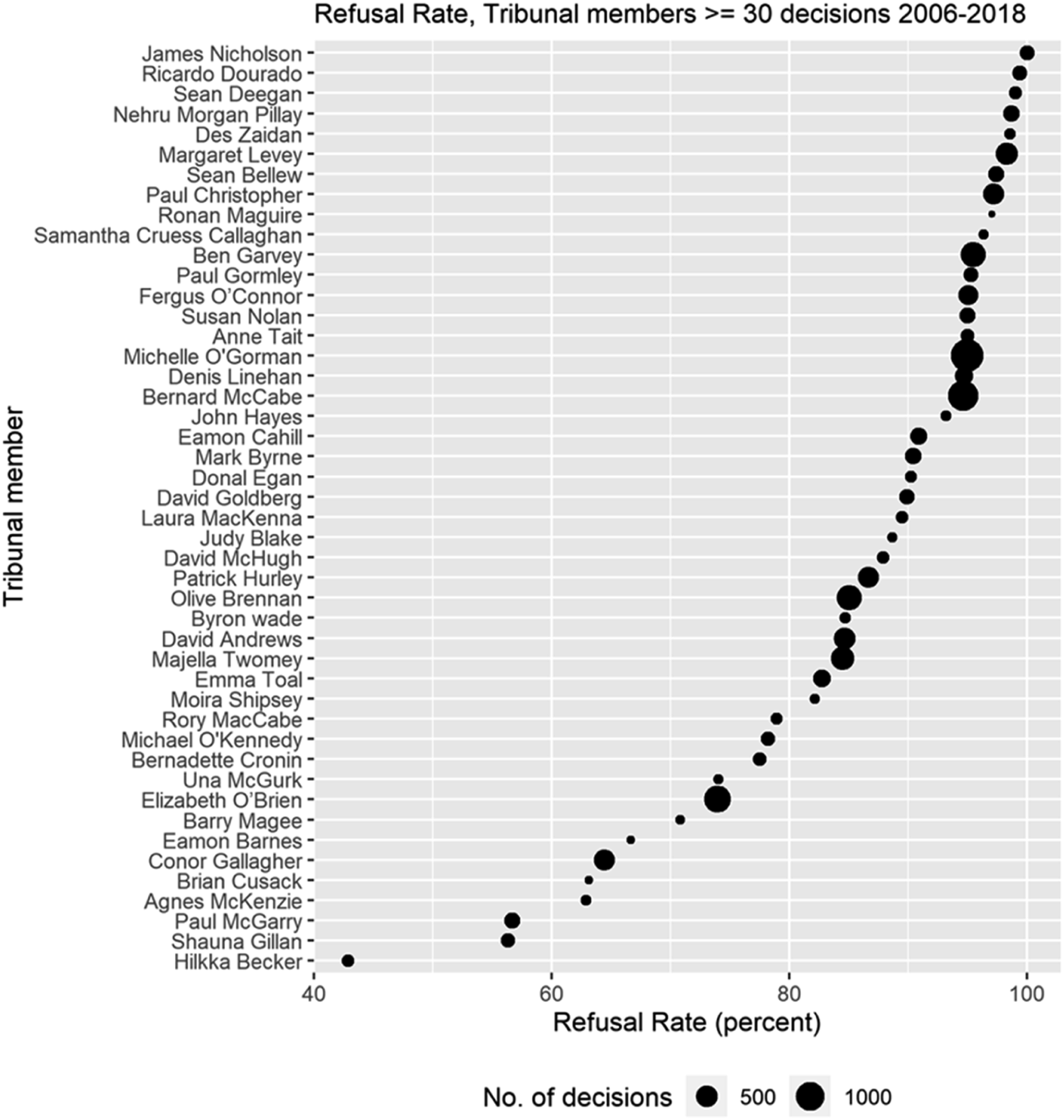
This analysis of the variation refusal rate of Tms is a normative analysis of Tribunal practice. The norm of the appeals tribunals is to refuse appeals for international protection, just as it is the norm for decision-makers to refuse applications of asylum and international protection at the first instance (75.9% refused in years 2008-2019). Within this normative practice of the appeals tribunals, the variations in individual Tm’s rate of refusal are one indication of these Tribunal members taking a different approach to assessing appeals from each other. Tm Nicholson is the only Tm with a 100% refusal rate in decisions in the ATA; however, he is not an outlier. 15 Tms who issued 30 or more decisions 2006-2018 refused appeals in 95% or more of their decisions. Tribunal chairperson (Tc) Hillka Becker is somewhat of an outlier in her decision rate, however not substantially, as the Tm with the next-lowest rate of refusal, Tm Shana Gillian, refused protection in 56.3% of decisions, to Tm Becker’s 42.9%. Similar to Rehaag’s findings in Canada (2012), the variation in rates of refusal by Tms follows a largely linear distribution (See Figure 2). Very few judges have a refusal rate close to the average refusal rate of 87.1% and a substantial proportion have rates significantly different than this average refusal rate.
Tribunal member refusal rate by country of origin
Another normative way to assess the practices of individual Tribunal members in comparison to their colleagues and the generalised practices of the appeals tribunals is to assess how individual Tms differed in their assessments of appeals for people applying for international protection who are from the same country. This technique is used by Rehaag to assess the normative decision practices of asylum decision-makers in Canada (2017). While asylum applications from people from the same country can vary widely, this type of analysis provides a strong indication of an individual Tm’s practices and indicates normative differences in judgement between Tms.
For example, for decisions in the ATA regarding people appealing with the Democratic Republic of Congo (DRC) identified as their country of origin, 66.8% were refused. However, there were substantial differences between individual Tms assessing appeals from people from the DRC. For example, Tm Garvey refused 28 out of 29 decisions on appeals by people from the DRC, a 96.6% refusal rate. Tm O’Gorman refused 25 of 26 decisions, a 96.2% refusal rate. The refusal rates of these Tms in this subset of decisions indicate that they may be taking a different approach than the normative framework in assessing appeals for people from the DRC, and may be not following general practices of the appeals tribunals in assessing appeals by people from the DRC. This approach can be generalised to create and calculate a predicted refusal rate weighted by country of origin.
Firstly, this approach does something important for geographers by investigating embodied scale as a performative act of bordering. Secondly, this approach also addresses one limitation in the dataset. The straightforward refusal rate of a Tm is one way to assess the practices of that Tm within and in comparison to the normative overarching framework and practices of the appeals tribunals; however, some Tms may be receiving substantially different types of appeals, and appeals from people in very different circumstances. One way to attempt to assess the extent of these differences and to identify the differences in Tms’ caseloads versus Tms’ approaches to decision-making is to calculate the refusal rate of each Tribunal member if they were to exactly follow the normative approach of the Tribunal and refuse appeals at the same rate as if the average Tm had the same distribution of appeals cases by country. The predicted refusal rate weighted by country of origin calculates what the refusal rate of a Tm would be if their decisions for people from a country aligned with the overall Tribunal refusal rate for appeals from that country.
The predicted refusal weighted by country of origin reflects the following calculation: For each country, calculate the average refusal rate in decisions for that country. For each Tm, list all their decisions, and assign each decision an ‘expected refusal chance’ value based on the average refusal rate for the country of origin in that decision (i.e., for a decision from a country with an average refusal rate of 50%, the value would be 0.5). Add all these assigned values together and divide by the number of decisions to complete the calculation.
Among the 10 Tms issuing the most decisions, there were considerable differences in how their decisions rates compared to this predicted refusal metric. Tm Andrews issued 613 decisions in the years 2006 to 2013 and refused protection in 84.5% (424) of these decisions. This refusal rate is approximately equal to the average refusal rate of decisions in the ATA of 87.1%. However, the predicted grant rate by country of origin shows that Tm Andrews received appeals from applicants from countries that were more often refused by the appeals tribunals, and Tm Andrews does not refuse appeals from these countries at this higher rate. Over half (361) of the decisions Tm Andrews issued were issued on appeals for protection from people from Nigeria, and Tm Andrews granted the appeals in a higher percentage of these cases than the overall refusal rate for applicants from Nigeria, refusing 88.6% of cases compared to the average of 94.3%.
Tm McCabe, in contrast, has a much higher refusal rate (94.6%) than his predicted refusal rate by country of origin (86.3%). Tm McCabe issued 1175 decisions from 2006 to 2018 in the ATA, and many of these decisions were issued for appeals from people from Georgia (248 decisions) and Pakistan (104) and Nigeria (91). Appeals from these countries are often refused by the appeals tribunals: 90.4% of cases for people from Georgia, 86.8% of cases for people from Pakistan, and 94.3% of cases from Nigeria were refused. Tm McCabe’s refusal rate for these three countries was even higher. In the extreme case, Tm McCabe heard 104 appeals from people from Pakistan and granted only one, a refusal rate of 99.0%. During Tm McCabe’s tenure as a Tm, he had a particularly high refusal rate overall, and comparing his refusal rate to his predicted grant rate by country of origin shows that his decisions are even more inconsistent with the overall practices of the appeals tribunals.
The metric of the predicted refusal rate by country is an indicator of Tms’ practices during their tenure on the tribunal(s). Comparing the predicted refusal rate by country of origin against Tms’ actual refusal rate can be a measure of the consistency of the appeals tribunals and the consistency between Tms in their decisions granting or refusing international protection. The metric can also reveal Tms who are outliers, differing at least numerically from a ‘norm’ of the approach by Tms. The full list of predicted refusal rates of Tms who have issued 30 or more decisions can be found in the full report online (see footnote 3).
Discussion
This investigation of the decision rates of Tribunal members for decisions in the ATA presents evidence of potential unfairness, Rehaag’s ‘luck of the draw’ (2012, 2017), in the Irish asylum determination process at the appeals stage – a major indicator of the outcome of an appeal is the decision-maker assigned to the appeal.
Investigations of the ATA can also go further - to help to identify the roles of individuals and the role of cultures of state agencies in bordering actions and in the processes of statecraft. The high variations in Tm refusal rates detailed in this article show that the determination of an appeals decision rests in large part on which Tm is assigned to decide the application.
The appeals tribunals are the final recourse for asylum seekers to be granted international protection, and any further appeal of a negative decision can only be reviewed on technical grounds in the High Courts, for example on the grounds that a Tm has made a serious error. Asylum seekers’ applications should each be judged equally on their merit, not by this ‘luck of the draw’.
Importantly, this type of analysis is key to interrogating what state agencies and what state agents are doing when they evaluate asylum claims. And this analysis also reveals what we are doing when we investigate and critique this state process. This type of work can provide clearly beneficial resources for geographers, legal scholars and advocates, and activists.
The database of Tm decisions has been created within the overall context of opaque agencies including the DoJ practicing secrecy and defensiveness over their practices of bordering.
Coleman and Stuesse (2016: 527) in their research on traffic policing and immigration control in the US recognize that “extraordinary violences are folded into” the routines and practices of power that are difficult to isolate as “distinct, observable events,” and look to Povinelli’s work based on the “quasi-event” where she “draws explicit attention to the operation of power at the same time as she warns that the material life of power can nonetheless be difficult to substantiate clearly in fieldwork.” This recognition allows that power with its fleetingness and fluidity does not necessarily reveal itself, that it persists or endures below the threshold of an event, and that findings for a researcher, then, can be partial or opaque, and thus can be ambiguous: this should not be seen “as a research failure per se but as all-important erasure, or invisibilisation of state power, or of the way that the state goes about its business” (Coleman and Stuesse, 2016: 527).
There are limitations in what we can learn from one archive. Working with the ATA is always engaging with the tensions bound in the divide between the act of writing, carried out by Tms, and the written work, the decisions, which end up in the ATA, creating a present tense sentiment of anxiety. The tension recognizes what remains between the decision and the events that remain below the threshold of decision. These documents are both the work of Tms but also the performative act, and act as documents themselves as the decision mechanism in the acts of state bordering that is the asylum determination process. This work is within these documents and the bureaucratic functions that are revealed, including the “policies, procedures, and risk algorithms that structure the representation of those decisions, the interpretation of the claimant’s narrative is entirely discretionary.” (Salter, 2008: 276). And it is within these tensions that any work in the ATA must reside, uncomfortably.
Archives and the organisation of state data have both productive and evidentiary roles in how we investigate the individuals, agencies, and deep-seated institutional cultures involved in bordering statecraft within and outside of the mechanisms of state agencies and offices. To study along the grain of these institutional archives, as Stoler presents, often requires sustained engagement, to recognize and examine the pulse of the archive (2009). This sustained engagement, using the tools of social research, makes doable and possible the work of tracing the production and performances of state to investigate and explore the nature of the everyday practices of a state body like the RAT and the IPAT. I have presented here in this article a unique tool for looking at and investigating practices of state bordering. I also present an example of rethinking of the archive as a productive and useful resource of changing and affecting the asylum process.
Organising data in the archive becomes a productive act, and investigating the places where organising of data happens - in archives and elsewhere - can be investigations of the ways that people and the archive are doing statecraft. The struggle over access to this data in court and outside of court continue to be the struggle over access to useful information, and a struggle to see how, in Ireland, people are included and excluded in the communities of the nation-state. This struggle is especially poignant in the historical context of race, migration and exclusion in the Irish nation-state.
As this investigation of the ATA has worked to reveal practices of the asylum decision agencies, further sustained engagement done on this project highlighted in detail what was happening in these written decisions in a way that was not possible within the remit of this article. The dissertation shows this and future articles and future investigations by this author, and hopefully others, will further delve.
Conclusion
Importantly, when work is done that critiques the asylum process, then the work must also offer something beyond a critical approach; we must propose our own models of what asylum can mean. These empirical works are central to investigating the state, which cannot be done only theoretically. It is therefore one of the aims of the work in this article to create a more transparent view of the practices of the appeals tribunals in one way, by creating a database of Tribunal member decisions and to make publicly available resources from and of previously hidden and undisclosed information.
This database is designed to be used by asylum seekers and advocates to make arguments for their cases and for reforms in asylum determination processes, and to reveal the logics and production and practice of the asylum determination by the state, government, and agencies. The creation of a database is specifically designed to allow for both practical use and for investigation of theoretical investigation by myself and other scholars.
The label of asylum seeker is a fraught category. Some individuals seek asylum at the border on their entry to Ireland, and other individuals and groups become defined as asylum seekers often as last resort. Appeals to human rights and protections in international human rights law are appeals for the last protections available against deportation, protections availed of after other attempts to be part of the community of the nation-state have failed.
In this article I have presented the legal regimes of applying for international protection in Ireland, and I have also argued that while there are some aspects that make applying for asylum in Ireland unique, it is important to critically assess the work that the state is doing to produce the bordering process of the asylum determination process. This project looks to recognise the state process of determining asylum as bordering; to recognise this bordering at an embodied scale - of the actions of individuals in the tribunals and in the archive where people work; and to recognise other scales, including local and individual circumstances, agency culture, and continental and international regimes and forces that are always also central in the power-geometries of the asylum regime, and the state constructions of refuge in Ireland. These recognitions, if accomplished, allow for an approach to archives such as the ATA as thick places for geographical research and opens up possibilities to transform the archives places with emancipatory potential.
Footnotes
Acknowledgements
Thank you to my doctoral supervisors Professor Mary Gilmartin, Professor Chris Brunsdon and Doctor Cliodhna Murphy. Thank you also to my mother, Gigi Marks.
Declaration of conflicting interests
The author(s) declared no potential conflicts of interest with respect to the research, authorship, and/or publication of this article.
Funding
This research has been made possible with support from the Maynooth University Hume Doctoral Scholarship and the Irish Research Council Government of Ireland Postgraduate Scholarship, project ID GOIPG/2017/491
