




Abstract
Focusing on the immigration of upper-middle-class Palestinian families to the Israeli town of Upper-Nazareth, originally built by the state to enhance Jewish presence in the area, this paper frames the concept of decolonising gentrification. Accordingly, it studies a unique inconsistency between economic class and ethnonational hegemony, which enables upwardly Arab minority families to overcome ethnic barriers and to exercise social and spatial mobility. Therefore, this paper explains how these socio-political dynamics challenge the local settler-colonial aspects of urban development and enable the reappropriation of colonised urban space. Focusing on the case of Upper-Nazareth and its former ‘Officers’ Neighbourhood’, we examine a distinctive contradiction between political power and economic abilities that triggers a unique case of gentrification, where the colonised minority gentrifies the colonising hegemony. At the same time, this decolonising gentrification, as we argue, takes place in restricted urban enclaves, and relies on an ethno-class price gap as it is only the minority upper-class who is willing to pay the increasing prices, due to their limited options. Therefore, as this paper shows, decolonising gentrification simultaneously challenges and recreates urban settler-colonialism, enabling limited market-oriented reappropriation while triggering ethnic-based accumulation and new forms of neoliberal exclusion.
Introduction
“Instead of correcting people all the time, the mistake should be corrected once and for all, to give Nazareth-Illit (Upper-Nazareth) a name that distinguishes it from Nazareth” (Ronen Plot, Mayor of Upper-Nazareth, November 2019).
The above, stated by Mayor Plot, is a call to change the name of Upper-Nazareth, a town erected in the 1950s in order to Judaize the Galilee Region in Israel. The attempt to distinguish the Jewish settlement-town from Palestinian Nazareth by renaming it proved to be successful when residents of Upper-Nazareth voted in favour of changing their town’s name to Nof-HaGalil (Galilee View in Hebrew). Nevertheless, as we will discuss throughout this article, this is not an anecdote, but rather part of wider demographic, spatial, and socio-political dynamics which are taking place in the Israeli urban settler-colonial context, where Palestinians, 1 who are citizens of the State of Israel form the ‘gentrifiers’ of settlement-towns that were originally built in order to control Palestinian lands and population.
We are aware that the term gentrification is commonly used to depict the societal transformation of a specific site, shifting from a blue-collar community to an upper-middle-class neighbourhood, and in contexts with ethnic\racial-based segregation the class-based transformation usually corresponds with an ethnic one, with newly coming families replacing poor dwellers or minority residents. However, while focusing on Palestinian Citizens of Israel moving to the Jewish settlement of Upper-Nazareth, which was founded to “demonstrate state sovereignty to the Arab population” (IDF Planning Department Director quoted in Forman, 2006: 350), we propose a contrary scenario to the common gentrification process. In more detail, we highlight the local inconsistency between economic class and ethno-national hegemony, which we suggest framing as decolonising gentrification. Accordingly, this paper identifies a unique contradiction between political power and economic abilities, which challenges the local settler-colonial aspects of urban development by enabling Palestinian families to reappropriate urban space and take an active part in the process of spatial production. Therefore, at first sight, we witness an exceptional case of neoliberal decolonisation, where upwardly Arab minority families are able to overcome ethnic barriers and to exercise social and spatial mobility. At the same time, this decolonising gentrification, as we argue, takes place in restricted urban enclaves, reproducing the ethnic-based segregation settler colonialism is based on while forming a new neoliberal mode of exclusion.
Furthermore, in the common example of gentrification, the social transition is triggered by a rent gap, i.e., the difference between existing and potential property values (Clark, 1988: 241). In decolonising gentrification, we further propose, this transition is fuelled also by the interests of present residents to move out of their neighbourhood, due to its increasing affiliation with minority groups. Yet, unlike the common observation of white flight, which refers to the tendency of members of the majority to leave a certain area due to the growing presence of minority families and usually corresponds with decreasing real estate prices, then this case presents a contrasting development of increasing prices. This, we argue, creates an ethno-class gap as it is only the minority upper-class families who are willing to pay the increasing prices, due to their limited options. Consequently, this stimulates a real estate bubble that benefits mainly the gentrified families, who profit from the price gap and use it to move to a hegemonic environment. Moreover, while the gentrified neighbourhoods become isolated upper-class compounds, the new minority population eventually causes the socioeconomic deterioration of the surrounding context, demonstrating an additional unique aspect of decolonising gentrification, as it relapses the city’s development instead of stimulating it further. In this regard, we suggest that decolonising gentrification constitutes a market failure that contradicts the usual alliance of neoliberal development and state interests, which is eventually mediated by special interventions directed not in order to create a “‘good business or investment climate’ for capitalistic endeavours” (Harvey, 2005: 70), but rather the contrary.
Methodologically, this article is based on data from the Israel Central Bureau of Statistics, information on real estate transactions from the Israel Tax Authority, municipal property registration and permits, ministerial reports and correspondences found at the Israel State Archive as well as architectural drawings and urban plans from the Archives of the Israel Land Administration. As this paper analyses the social and spatial transformations, we also use images and spatial schemes. Studying the options upper-class Palestinian families had, as well as the responses of the municipality, the government, and the Jewish residents, this paper illustrates the manner in which this process benefited the veteran Jewish population who profited from the rising prices that funded their flight; eventually, creating new suburban enclaves in a crawling process of deteriorating gentrification. Concluding, we present the ways in which decolonising gentrification simultaneously challenges and recreates urban settler-colonialism, enabling limited market-oriented reappropriation while triggering ethnic-based accumulation and new forms of neoliberal exclusion.
Starting with an introduction to the term gentrification, we will discuss its common uses and relevance to the study of settler-colonial cities. Then, introducing the term decolonising gentrification, the paper explains how it differs from the existing literature, how it adds to the existing academic discourse, and why it is relevant to the study of settler-colonial urbanism. Following a short explanation of the Israeli context, we examine the transformation of Upper-Nazareth and its ‘officers’ neighbourhood’ from a Jewish blue-collar community to an Arab white-collar one.
Gentrification and settler-colonial urbanism
As noted by Wolfe (2006), Veracini (2011), and many others (Barry and Agyeman, 2020; Hugill, 2017; Porter and Yiftachel, 2019; Tomiak, 2017), settler-colonialism is “a land-centred project” based on the struggle over the “access to territory” (Wolfe, 2006: 388–393), which leads the colonisers to systematically eradicate the indigenous population, physically as well as symbolically. This zero-sum game between the colonisers and the colonised population differentiates between colonialism and settler-colonialism, leading to dissimilar spatial manifestations. Nevertheless, while the colonial city has been the focus of vast research, the settler-colonial perspective on urban processes, as Porter and Yiftachel have recently noted, has been significantly underdeveloped by the existing literature, missing out on a remarkable framework for understanding global urban processes taking place in contemporary cities (2019: 177–179). The city, they claim, and the process of urbanisation, “sustain the always-present structures of settler-colonial nation-building” (2019: 178), and examining these relations thus offers relevant insights into understanding ethnic-based segregation in global urban processes (Barry and Agyeman, 2020). Moreover, as some recent scholars argue, settler-colonialism continues to influence urban development even in times of prevailing neoliberalism, evolving together with the market economy while illustrating its systematic influence (Tomiak, 2017; Yacobi and Tzfadia, 2018). At the same time, as Porter and Yiftachel notice, the “city – due to its inherent openness – is the ‘Achilles Heel’ of the settler-colonial project”, and the study of contemporary settler-colonial cities thus sheds light on “new forms of urban Indigeneity” (2019: 180). The attempt to understand the settler-colonial city as a specific analytical category inspires, indeed, our attempt to discuss decolonising gentrification and to illustrate gaps in the settler-colonial project while simultaneously demonstrating its ever-present influence.
Gentrification, in its essence, is a class-based urban phenomenon that refers to the change in the population composition of a given area, caused by upper-class families moving into a working-class neighbourhood. The gentrifiers are usually attracted by the relatively low real estate prices and location, the price gap, whereas the original inhabitants, the gentrified, are usually pushed away by the ever-increasing rents and the overall rise in costs of living. This, in a nutshell, describes the common use of the term, first introduced by Ruth Glass in the 1960s, which ties the process of gentrification to urban regeneration, witnessed in the transformations of urban slums into attractive middle and upper-class residential neighbourhoods (1964). While deriving from analysing the economic changes in London, the current scholarship discusses various aspects of gentrification (Werth and Marienthal, 2016), in urban, rural, and global contexts (Atkinson and Bridge, 2004; Phillips, 1993; Sened and Gyanesh, 2018), incorporating various issues concerning race, ethnicity, gender, and conflicts (Ghertner, 2015; Sassen, 2018). Moreover, while the early literature referred to gentrification as a collection of post-industrial individual choices, based on accumulation and cultural consumption (Hamnett, 1991; Zukin, 1989), then recent research discusses the state’s role as a key agent (Lees, 1994), and the manner in which gentrification forms a neoliberal tool ‘to solve’ issues of crime, neglect, and urban decay, by generating growth and attracting the ‘strong’ (upper)middle-class to city centres (Atkinson and Bridge, 2004; Smith, 2002).
Therefore, while gentrification was popularly portrayed as a process initiated by artisans and bohemians moving into an urban slum, transforming its image and then facilitating its economic-led development, then the current literature explains how these initial steps were endorsed by states and municipal authorities to encourage the following waves of upper-middle-class families that completed the transformation process (Grodach et al., 2016; Harris, 2012; Ley, 2003; Pratt, 2018; Smith, 1987). Accordingly, gentrification demonstrates the way in which institutional intervention is directed in order to create spatial fixes that ensure further accumulation, as described by Harvey, Brenner, Peck, and others (Brenner, 1997; Brenner et al., 2003; Elden, 2004; Harvey, 2014; Molotch, 1976; Peck et al., 2013), contradicting the myth of neoliberal development as a process directed by the ‘free market’.
The settler-colonial perspective provides an ideal framework for understanding ethnic tensions and urban gentrification. Taking Wofle’s aforementioned account of setter-colonialism as a struggle over the access to territory, then in cases with racial or ethnic tensions, gentrification forms an institutional tool intended to replace the dominated ethnic group with members of the dominating one. This, as Shmaryahu-Yeshurun and Ben-Porat recently explained (2021), derives either from the initially low-socioeconomic class of ethnic minorities and indigenous populations (Goetz, 2013; Khare et al., 2015; Wyly and Hammel, 2004), their stigma and reputation (Uitermark et al., 2007), and/or the state’s territorial desires to promote ethno-national domination (Blatman-Thomas and Porter, 2019; Clarno, 2017; Yacobi and Tzfadia, 2015). In the US, for example, where socio-economic relations are also a question of colour, the threefold motives of gentrification are more evident, as it usually defines the movement of upper-middle-class white families to working-class African American neighbourhoods (Smith, 1996). In a way, it constitutes a counter process of white flight, which described the movement of the white middle-class from the city to the suburb during the 1950s, instigated by the growing percentage of African Americans that reached a “tipping point” (Giles et al., 1975: 85), encouraging white families to leave behind the urban centres, which turned into black ghettos while forming segregated white suburban communities.
No wonder that gentrification increased during the 1990s and 2000s’ back to the city phenomenon, where the white middle classes that left the cities began returning, pushing away the lower classes they initially ran away from and promoting a new ethnic-based socioeconomic spatial segregation (Lay, 1996; Sturtevant and Jung, 2011). Both processes are inseparable from Logan and Molotch’s space stratification model, which describes the ability of privileged groups to manipulate the production of space for their socioeconomic benefit (1987). And while white flight defined the ability of middle-class white families to create their secluded and segregated suburban communities, gentrification is a continuation of this process, yet in an urban context. Thus, forming a spatial manifestation of settler-colonialism by continuously promoting a “rigid hierarchy of places” (Logan et al., 2015: 1058), intended to serve the members of the dominant class while ensuring their separation from “groups they view as undesirable” (Pais et al., 2012: 261).
The framework of decolonising gentrification explores gaps in the settler-colonial city. If the discussion of settler-colonial cities assumes consistency between the ruling hegemonic group and the dominant economic class, then this paper, as mentioned, examines a different scenario. In more detail, the ideas of white flight, tipping point, and state-led territoriality, receive a different meaning as the colonised become ‘the gentrifiers’ and the colonisers are gentrified. Accordingly, the concept of decolonising gentrification examines the counter-nationalist aspects of neoliberalism and the inclusive potential of the market economy. At the same time, while framing the concept of decolonising gentrification this paper also examines how eventually the hegemonic group maintains its power, even if it is economically disadvantaged.
Importantly, in this article we do not advocate the alleged liberating potential of the market economy. We do insist on using the term decolonising gentrification, despite, if not even due to its inherent contradiction. For Frantz Fanon, the “colonized intellectual” and their emphasis on “individualism”, which they adopted to form the “colonialist bourgeoisie”, hinders the “struggle for liberation” that ought to be based on collective self-recognition (Fanon, 1961: 11). And according to Coulthard, in his recent book Red Skin, White Masks, which explicitly builds on Fanon’s earlier work (Fanon, 1952), it is precisely the rejection of collective Indigenous self-recognition that leads the Canadian attempts of reconciliation to eventually reproduce the colonial framework and adapt it to the current political-economic climate (Coulthard, 2014: 120–125).
In the Palestinian context, Karim Rabie in analysing the Palestinian new-town of Rawabi, demonstrates the way in which privatised real estate development in the West Bank, which is branded as a process of market-led nation-building, affirms the Israeli occupation and the Palestinian Authority’s reliance on it (Rabie, 2021). However, relying on Bhabha’s interpretation of Fanon’s idea of violence, which he describes as a survival struggle and a “search for human agency in the midst of the agony of oppression” (Bhabha, 2002: xxxvi), we argue that the gentrification process triggered by bourgeoisie Palestinian families in Upper-Nazareth is a concrete manifestation of decolonised agency, despite its individualistic nature. We claim that the decolonising aspects are manifested in the coloniser’s individual and institutional responses to this process, which, as this paper shows, include active prevention, containment, mass departure, and divestment; thus, constituting a unique coupling of gentrification and white flight, which usually refer to opposing processes. Therefore, the socio-economic and ethnic transformation examined in this paper comprise a decolonising form of gentrification, even if only in a confined context that eventually sustains the general settler-colonial dynamics.
Note on the Israeli settler-colonial city
The settler-colonial perspective provides a leading framework for analysing the ethnic-oriented spatial development process. As all urban, rural, and suburban developments since the inception of the State of Israel in 1948, and even the pre-state Zionist settlement campaign of Palestine, revolved around the desire to promote territorial Jewish dominance, settler-colonialism forms an essential part of the state’s spatial policy, both within Israel’s official borders and the occupied Palestinian Territories (Braverman, 2021; Schwake, 2022a; Yacobi, 2009; Yacobi and Tzfadia, 2018; Yiftachel, 2006). This zero-sum territorial game is mainly visible in the West Bank and the numerous Israeli settlements constructed there since 1967 (Allegra, 2013; Segal and Weizman, 2003), or in what Yiftachel referred to as the state’s internal frontiers (1996) - areas with an Arab majority like Galilee and the northern Negev. In urban contexts, Israel’s territorial aspirations followed similar lines. While this commenced following the 1948 War as Israel began promoting spatial dominance by settling Jewish families in former Palestinian neighbourhoods depopulated from their original inhabitants, it continued with similar efforts to replace the remaining Palestinian population in so-called ‘mixed cities’ like Lydda, Jaffa, Acre, and Jerusalem, by constantly attracting additional Jewish families (Yacobi, 2009; Yacobi and Tzfadia, 2011). Appropriately, what began as direct state-led settlement initiatives, gradually adapted to the privatising neoliberal economy, turning into state-directed market-oriented interventions that promote ethnic dominance through economic means; thus, harnessing socio-cultural and economic shifts, demonstrated in increasing individualism and private investment to the state’s territorial enterprise (Allegra and Maggor, 2022; Schwake, 2022a).
As the privatisation of Israel’s spatial policy continues its territorial agenda, the local gentrification processes usually correspond with its settler-colonial aspects. Accordingly, the past four decades have witnessed several occasions of members of the dominant socioeconomic hegemony, which consists of the veteran Jewish Ashkenazi sector, moving into non-hegemonic neighbourhoods, transforming their socioeconomic composition and altering the built environment. 2 This process affected two main groups, the urban Mizrahi and Palestinian Citizens of Israel, continuing the power relations inside the Israeli Jewish community, as well as the territorial struggle and appropriation of the local Palestinian built space. However, while the gentrification of both groups derived from their low socio-economic status and their negative stigmas, it was mainly Palestinian citizens that were gentrified due to Israel’s settler-colonial characteristics. In that sense, gentrification forms a neoliberal version of territoriality (Yacobi and Tzfadia, 2011), proceeding with the local turf battle, yet in economic means. Correspondingly, the move of upper-class Ashkenazi families into Arab neighbourhoods in Jaffa (Monterescu, 2015), or into Mizrahi neighbourhoods in Jerusalem, which originally were also Palestinian (Zaban, 2016), illustrates the local hegemonic and ethnic-based spatial relations. This as well, usually began by so-called artists and nonconformists directed by the state, who cleansed the area of its negative affiliation (Makdisi, 2010), facilitating its appropriation by other members of the ruling hegemony. However, market-oriented development could also function as a double-edged sword, as profits do not always correspond with national agendas as seen in the attempts of Palestinian families to take part in the local process of spatial production.
The Palestinian Citizens of Israel are the surviving remnant, who remained in their houses after the establishment of the State of Israel in 1948, which separated from the Palestinians living in the Occupied West Bank and the Gaza strip, or the ones in the numerous refugee camps around the Middle East. They are official citizens of the State of Israel, constituting around 20% of the local population, formally receiving the same rights as their Jewish compatriots. However, being members of an ethno-national minority, with whom the ruling majority has been holding a century-long territorial struggle, Palestinian Citizens of Israel are constantly disadvantaged, politically, culturally and economically, especially with regard to spatial development (Yiftachel, 2006). Losing their main cities in 1948, like Jaffa, Lydda, and Haifa that were almost completely Judaized (Khalidi, 1992), and being cut off from the Palestinian cities of the West Bank like Ramallah or Nablus, Palestinians in Israel lack any substantial urban centres, retaining the traditional settings while limiting internal immigration (Yacobi, 2009). Consequently, Palestinians in Israel suffer from a severe lack of housing opportunities and their localities have witnessed extreme growth, turning from small villages into developing towns in a mere few decades (Yiftachel and Kader, 2000). However, being simultaneously Palestinians and Israeli citizens, they constantly challenge Israel’s settler-colonial aspects and thus constitute an intriguing case study for examining decolonial processes (Plonski, 2018).
The past decades have witnessed the formation of a new Palestinian bourgeoisie that contradicts the usual consistency between ethnic and economic class. Socioeconomically mobile, the Palestinian bourgeoisie is less willing to stay within the traditional spatial setting and are reluctant to continue living in ill-developed localities. Consequently, this new class began looking for better living standards outside its towns and villages (Abreek-Zubeidat and Ben-Arie, 2014; Schwake, 2022b; Shtern and Yacobi, 2019). This corresponded with the local neoliberal turn, which shifted the focus of the Israeli geopolitical project to territorial suburbs and real estate development. As part of this turn, members of the ruling hegemony were able to use their status in order to form secluded and isolated suburban communities. These usually included an admissions committee, which limited the possibility of outsiders to join (Schwake, 2021; Shafir, 2018), preventing the Palestinian upper-middle-class from fulfilling its suburban dream while directing it to Israeli urban settlements. The latter perhaps did not suit the demands of privileged hegemonic families, yet for the Palestinian upper-middle-class it formed an unusual opportunity to improve its conditions. This new form of space stratification created a new ethnic-based hierarchy that directed a steady stream of Palestinian Citizens of Israel to cities like Karmiel, Upper-Nazareth, and Ma’alot (Blatman-Thomas and Porter, 2019), initially built by the establishment near Arab localities in order to Judaize space, and now enabled upwardly Palestinian families to seek better living standards while staying in the vicinity of their hometowns.
Not surprisingly, in 2018, alongside the national neoliberal turn, the Israeli parliament, the Knesset, found it necessary to predicate Israel as the nation-state of the Jewish people by adopting a Basic Law with a constitutional status that defines it as such. Though the law is largely symbolic and declarative (and in many ways reflects years of ethno-national superiority), it could also be understood as a reaction to the challenges Palestinians in Israel posed to the state in the last three decades and the fact that the new law mentions “the development of Jewish settlement as a national value” which the state should “encourage and promote” (Knesset of Israel, 2018), augments this claim and highlights the institutional attempts to prevent and limit Palestinian spatial agency.
With the above background in mind, let us discuss the case of Upper-Nazareth, demonstrating how this process takes place, and illustrating how the Palestinian bourgeoisie simultaneously challenged settler-colonial geographies while reproducing neoliberal exclusion.
Lower and Upper-Nazareth: decolonising gentrification?
Nazareth is a city with religious significance and since 1948 also an increasing political role. Mostly known for being the town of Jesus, historically, Nazareth did not form a central ruling or administrative focal point and the local urban centres until the mid-20th century were mainly Jaffa, Haifa, Nablus, Acre, Ramleh, Lydda and Jerusalem. However, the 1948 War and the Palestinian exodus it included (known as the Nakba), changed the spatial hierarchy inside the newly formed State of Israel. This resulted in the depopulation of the main Arab urban neighbourhoods and cutting off the Palestinians living inside the new Israeli borders from the urban centres in the West Bank, which was annexed to Jordan, and from their former connection to Lebanon and Syria (Khalidi, 1992). Unlike most Palestinian cities, Nazareth was not depopulated, probably due to the fear of the international community that would not have remained silent to a forced evacuation of a city with significant importance to the Christian world (Morris, 2004). Ironically, the occupation of Nazareth turned it from a small town with less than 20,000 inhabitants and a few church institutions and monasteries into the largest Arab city inside Israel and the cultural and political centre of its Palestinian citizens (Rabinowitz, 1997: 25).
Jewish Nazareth is an adjacent locality established by the Israeli Government during the 1950s as a means to enhance Jewish presence in a predominantly Arab area. Nazareth-Illit, or Upper-Nazareth, was planned to house thousands of Jewish families on the hills surrounding lower Nazareth, forming a spatial manifestation of social hierarchy and territorial control, as implied by its name. Originally called Qiryat Nazareth, or Shikun El Yahod (the Jewish project) by Arab Nazarenes, Upper-Nazareth was planned with a clear strategical mindset, as explained by Israeli Prime Minister David Ben-Gurion who claimed that “the new settlement must be a Jewish one that will assert a Jewish presence in the area” (quoted in Rabinowitz, 1997: 6). Ben-Gurion went forward, stating that “The Jewish settlement in Nazareth will reside on the mountains, while the Arab community is located in the valley and this gives an enormous military advantage” (CEO of Ministry of Defence, 1955). Correspondingly, Edward Said described this spatial dominance as an integral part of the efforts to prevent Palestinian citizens of Israel from any “political significance” and a “territorial base” (1979: 105). In Overlooking Nazareth, Dan Rabinowitz describes a similar situation, yet, he also analyses the immigration of Palestinian families into the Jewish colony on the hill, in what he referred to as “counter penetration” (1997: 8), threatening the raison d'etre of Upper-Nazareth.
As a new urban-colonial settlement, Upper-Nazareth followed the Israeli development town model. These were initiated by the young government and its strategic decentralisation plan, which sought to disperse the local Jewish population, and the waves of newly coming Jewish immigrants, in a hierarchal system of medium-scale industrial towns. This lattice structure of new towns was planned to stimulate the development of the local industry, provide Jewish immigrants with proper housing, and enhance the state’s control over its new borders. These new towns were meant to function also as regional hubs, providing the needed commercial and public services to smaller settlements around them, forming a continuation of the pre-state Zionist rural settlement efforts, and an integral part of Israel’s territorial project and quest for spatial dominance (Sharon, 1951).
Over the years, Upper-Nazareth would suffer from the same problems as other Israeli development towns. Peripheral, with limited means of production and populated mainly by groups of newly coming immigrants living in reproduced housing estates, Upper-Nazareth fitted the profile of a neglected and ill-development industrial town. Therefore, it matched other contemporary precedents like Hatzor Haglilit, Dimona, Yeruham, Netivot and many others, which were all based on the national decentralisation efforts, and eventually turned into synonyms of alienated residential environments (El-hanani, 1983; Shenhav, 2006), consequently, witnessing increasing negative immigration since the 1970s. Suitably, it was mainly the upwardly members who could afford to relocate that began leaving, leading to the development towns’ further decline. Their target was mainly the big cities of Haifa and the Tel Aviv area, or the newly developed Community Settlements, which began emerging during the late 1970s and offered their members better living standards in small-scale and secluded ex-urban locations. To halt the continuing desertion the state sought to answer the needs of these upwardly families for a better quality of life within the framework of the development towns, mainly in the Build Your Own House neighbourhoods, which consisted of larger parcels enabling the construction of private detached houses. Nevertheless, these towns, and Upper-Nazareth with them, continued to decline.
At the same time, lower Nazareth, which turned into the central Palestinian Metropolitan area inside Israel witnessed positive immigration and an overall increase in population. By the late 1970s, the city’s population was twice as large as in 1948, while its land reserves were significantly limited, especially by the construction of Upper-Nazareth. The absence of infrastructure and any strategic plans, as well as a continuous supply of new dwelling units, all prevented the development of a proper metropolitan city, turning Nazareth into an oversized village, which needed to function as the cultural and political centre of the local Arab sector, yet could not practically do so. Moreover, as Nazareth followed a somehow strict patriarchal and religious spatial setting, with Muslim and Christian areas and several neighbourhoods dominated by a single clan, the lack of public land reserves limited the spatial mobility of both families inside the city and those coming in, putting additional pressure on the urban system (Khamaisi, 2003). Therefore, the two adjacent towns began functioning as a system of communicating vessels, and as Jewish families from Upper-Nazareth began immigrating in search of better living standards in other Jewish localities with improved employment prospects and cultural facilities, they were slowly making place for Arab families from lower Nazareth, who were highly interested in retaining their connection to the Arab city yet were not able to find proper housing opportunities. Consequently, the neighbourhoods at the fringes of Upper-Nazareth, which were located adjacent to lower Nazareth, such as the officers’ neighbourhood, began witnessing an increasing influx of Arab families, especially from the upper-middle-class, who had the economic ability to purchase a house from its Jewish owners.
The officers’ neighbourhood
The officers’ neighbourhood of Upper-Nazareth is a socially and morphologically distinct compound. The plans for Upper-Nazareth, drafted by Arieh Sharon and Benjamin Idelson in 1955, perhaps the main architectural figures of the Israeli nation-building years, were similar to the aforementioned new development town model implemented in Israel at that time. Accordingly, they consisted of an array of single-use compounds, connected through a series of curving and winding roads, comprising reproduced housing estates sharing an open public space (Sharon and Idelson, 1956). The curving layout suited the local topography, integrating the new buildings with the local landscape while providing the new settlement with a wide panorama observing lower Nazareth, giving a spatial manifestation to the coloniser-colonised relationship between both entities (Sharon and Idelson, 1955). Besides the usual residential estates that would house Jewish immigrants, mainly from Romania, Sharon and Idelson designed a separate and unique compound, intended to house the families of officers from the newly established Northern Command of the Israel Defence Forces (IDF) (Rabinowitz, 1997). The officers’ neighbourhood (Shikun Anshei Keva’a) was planned as a series of patio houses, forming an assemblage of three-room single-story units, which included a significantly more detailed design, in comparison to the spartan Israeli socialist housing of the 1950s. The houses, which besides the common use of concrete included also local stones, were connected by a series of pedestrian paths and terraced along the topography, blending with the site and producing a unique housing project (Sharon, 1976). Unique, small-scale, and located adjacent to lower Nazareth, the officers’ neighbourhood would become the target of many upper-middle-class Palestinian families and an ideal case study of decolonising gentrification.
Arab families began moving into the Upper-Nazareth and its officers’ neighbourhood already in the mid-1970s, starting a long process of social transformation (Upper-Nazareth construction committee, 1974, 1975, 1978). This was far from being a smooth and easy-going issue as the veteran population began voicing its discontent and objection. Media coverage from those years demonstrates this opposition, with reports and interviews with residents voicing their “fear of living” in Upper-Nazareth, already in 1975, when Arab presence was marginal. The newly coming families were of a significantly much higher economic class (Mazori, 1975: 8), and the fear the veteran population felt thus did not derive from worries regarding their neighbourhood’s potential socio-economic deterioration, but rather from the stigma their new neighbours brought with them. Correspondingly, Jewish residents complained that the new Arab owners were willing and able to pay more than the usual asked price, leading them to adopt conspiracy theories regarding organised Arab purchases (Ben Horin, 1980).
This discontent continued to grow during the following decades, including several demonstrations, and even the formation of a local civilian organization named MENA, acronym of Magenei Nazrat-Illit (Davar, 1983); literally meaning the protectors of Upper-Nazareth and/or prevention. The conception was that with Arab families moving in, Upper-Nazareth would slowly start losing its identity and eventually reach a tipping point, which would encourage additional Jewish families to leave. While this might resemble a classic case of white flight, it is worth noticing that the prevention efforts did not only focus on scaring off Arab buyers but mainly on pressuring Jewish homeowners not to sell their houses to Arab families. Jewish owners, who usually believed in the importance of settling the area did not want to be seen as ‘traitors’ indeed preferred selling their properties to Jewish hands. However, they would agree to sell their house to an Arab family for a substantially higher payment, as Yacobi and Shtern have shown elsewhere (2019), creating an ethnic-based price gap, where Arab families were expected to pay more (Ben Zvi, 1986). It is not possible to a draw direct conclusion from the reported opposition, but Palestinian families continued to move into the neighbourhood. This, however, was far from being a coordinated process, and consisted of sporadic individual initiatives of predominantly bourgeoisie, and largely Christian families from a significantly high economic class (Upper-Nazareth construction committee, 1981a, 1981b, 1981c, 1981d, 1995a, 1995b).
The gradual process continued to develop leading to the Arabisation of the officers’ neighbourhood. During the 1990s, dozens of Palestinian families moved in and the early 2000s formed the tipping point, after which the former premises of the Israeli northern command turned into a bourgeoise Arab neighbourhood (Land Registry and Settlement of Rights, 2021a, 2021b) (Figure 1). The timing is not incidental, as it was during these years that the tensions between the Arab and Jewish population in Upper-Nazareth reached a boiling point, triggered by the violent events of the Second Intifada and the October 2000 riots which included the death of 13 Palestinian Citizens of Israel (Adalah, 2006). These tensions accelerated Jewish immigration from all across Upper-Nazareth and Arabs became 15% of the town’s population (Ministry of Economics, 2016: 23). The post-2008 housing crisis and the surging real estate prices, triggered additional sales, adding further incentives for the remaining veteran Jewish population to sell their housing with significant profits to bourgeoise Palestinian families whose options were much more limited (Land Registry and Settlement of Rights, 2021c, 2021d). The social transformation of the officers' neighbourhood (Blue: Jewish, Purple: Arab). Illustrated by the authors based on data collected from the Land Registry and Settlement of Rights and a physical survey of the site conducted in December 2021.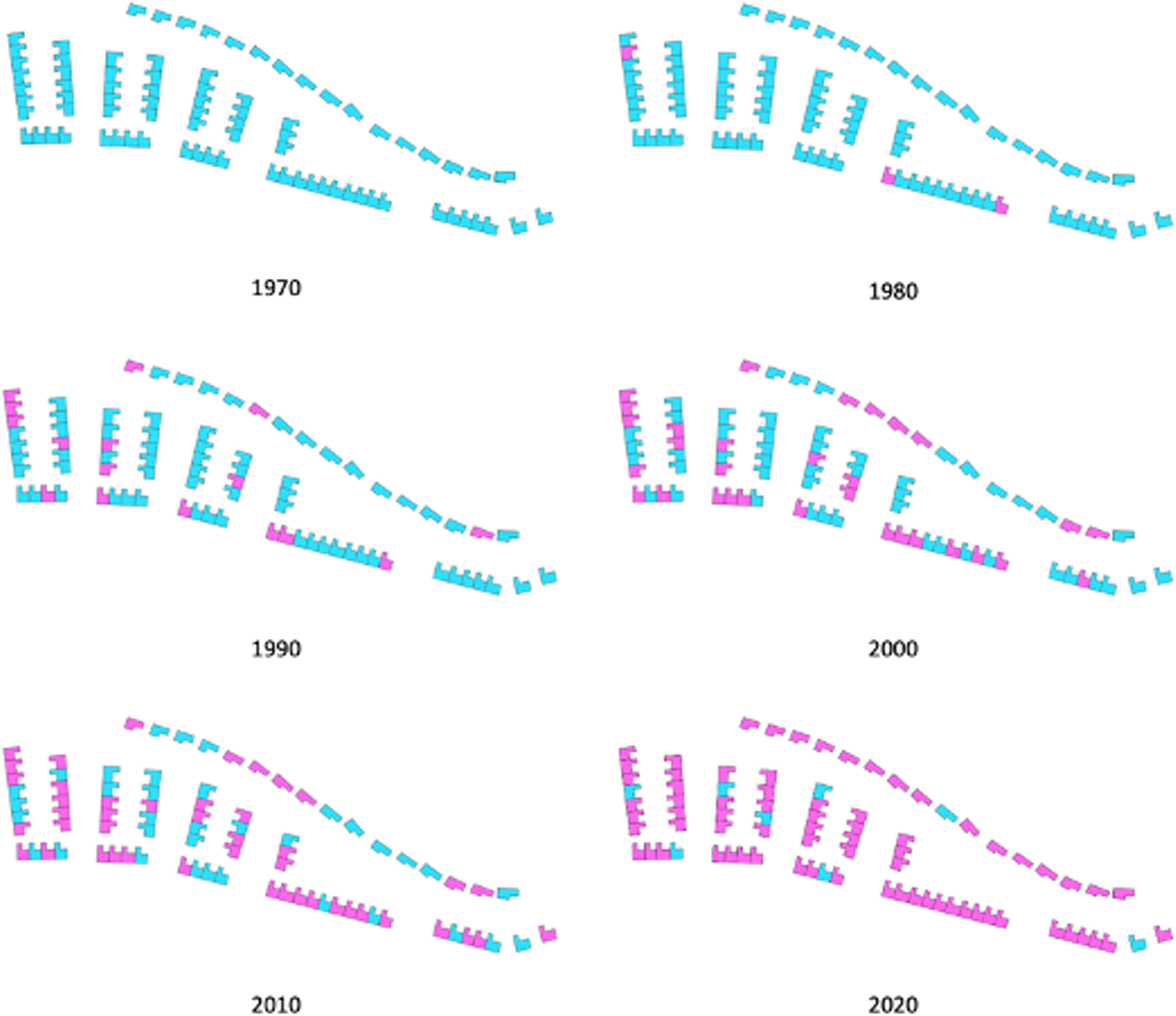
The surging real estate prices in the officer’s neighbourhood portray an exceptional case of socio-economic transformation. Analysing sales documented by the Israel Tax Authority we see that the prices in the officer’s neighbourhood had been significantly higher than in other parts of town. However, while prices in the neighbourhood were lower than the national average, a reasonable condition due to the town’s peripheral and marginal location, we see that in the past fifteen years this began to change, as reported sales were considerably more expensive than the national average (Israeli Tax Authority, 2023). 3 Therefore, the social transformation of the officers’ neighbourhood, which turned it from a hegemonic environment of Jewish families to an Arab community, was paradoxically accompanied by an astonishing increase in real estate prices, the opposite scenario that would usually depict a transformation from a hegemonic to a non-hegemonic population.
The social makeover also included a physical transformation. While originally planned as a series of small low-rise portico houses, with two bedrooms in an overall area of less than 100m
2
, the new residents were interested in larger houses, fitting their demands for better living standards, and representing their socioeconomic status. Therefore, by the early 2000s, the neighbourhood would consist almost entirely of two-story cottages, decorated by a pitched red roof. Furthermore, while the original buildings consisted mainly of plastered walls, some concrete beams and sporadic use of local stones, the new two-story villas were almost always cladded by rustic limestone, a building material that is far from being affiliated with the Israeli hegemony and is usually regarded as a ‘nouveau riche’ element used in Arab buildings or Mizrahi Build Your Own House projects (Peled, 2012). Correspondingly, the enlarged houses included orientalist decorations like free-standing columns and arches (Upper-Nazareth construction committee, 1995b, 1997, 1999, 2004, 2019), which are usually scorned by the hegemonic Israeli architectural scene, regarding them as ‘tasteless’ ornaments, yet in this context they form a tool of self-expression, conveying the ability of the new residents to overcome their disadvantageous status while completing the transformation of the Israeli territorial settlement into an Arab neighbourhood and reappropriating the colony on the hill. Other distinctive changes include religious (Moslem or Christian) decorations and inscriptions, and the presence of double-feed satellite dishes, enlarging the supply of television channels from the Arab world (Figure 2). Decorative elements and building details in the Officers' Neighbourhood (Right-Left) — Islamic inscriptions above house entrances in Meggido St; A house in Iris St - Note the arches, the rustic stone cladding, the board over the main entrance citing the Quran, and the double-feed satellite dishes, which receive channels also from the Arab world; Christmas decorations in front of houses in the ‘Officers' Neighbourhood’. (Photographed by the authors. 2021).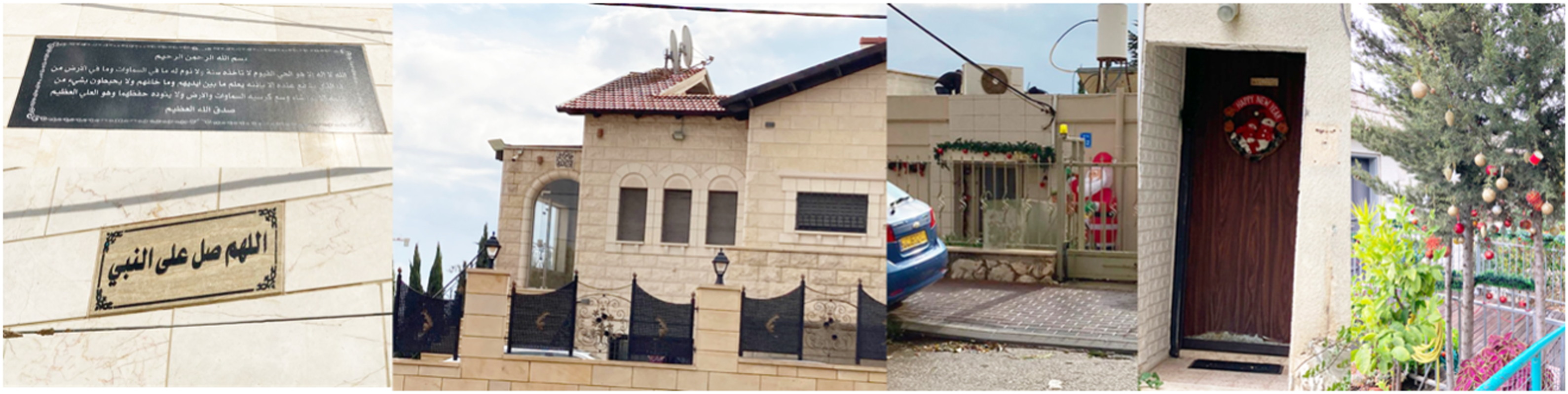
One might wonder whether the individualistic act of an upwardly bourgeoise family being able to fulfil its desires for a luxurious house could be considered an act of decolonisation, or whether this is a pure act of self-fulfilment. However, when focusing on the zero-sum logic of settler-colonialism, and the emphasis on replacing the local population by a new one, and especially century-long turf battle in the case of Israel, then this seemingly individualistic act challenges the ethnic-based segregation the local context relies on, and thus forms an exceptional case of decolonisation. While the entire process was instigated by the ‘free market’, what implies the liberal and inclusive aspects of neoliberalism, then it is worth remembering that it is not only the rising prices that promoted the Arabisation of the officers’ neighbourhood, as the stigma, fear, and contempt the veteran population felt towards their new neighbours played a leading role as well. Therefore, the combination of a price gap and white flight causes the decolonial aspects of this unique case of gentrification to be much more evident.
The gentrification of officers’ neighbourhood promoted decolonisation on the local scale, yet it enhanced the settler-colonial aspects on the regional scale. Since the late 1970s, the area surrounding Nazareth witnessed the construction of new Jewish suburban localities, like Hoshaia, Shimshit, Timrat and Giva’at Ela, that were intended to promote Jewish presence in the region. Defined as community settlements, they all maintained an admissions committee, screening potential new members while preventing Palestinian families from joining. Therefore, while upper-class Jewish families were able to join one of these attractive new communities and build their own lavish houses with the financial aid of the government, the officers’ neighbourhood in Upper-Nazareth functioned as one of the only options for upper-class Arab families (Ministry of Economics, 2016). This expanded the price gap once again and ensured larger revenues to Jewish homeowners, who were already interested in leaving the Arabizing development town. This process of gentrification was thus a continuation of the Israeli ethnic-based space stratification, as by selling their property to an Arab family, Jewish homeowners were able to receive a price that was substantially over the [Jewish] market value, enabling them to move to new lucrative suburban settlements, which Arab families had no access to. Paradoxically, prices in these gated suburban settlements are lower than the ones in the officers’ neighbourhood, despite their favourable conditions (Israeli Tax Authority, 2023), 4 depicting how neoliberalism might apparently give minorities better options, yet at a much higher price. Therefore, the unique gentrification of the officers’ neighbourhood continued the ethnic-based space stratification and created an enclosed real estate bubble, encouraged by a captivated clientele that simultaneously stimulated and funded the societal transformation.
Arabising and de-Arabising the colony on the hill
While the literature on gentrification depicts it as a state-directed initiative, then in the case of decolonising gentrification, it is the state that tries to limit and prevent the transformation process. If the interests of Palestinian families were initially in the low-rise neighbourhoods adjacent to lower Nazareth, by the early 1990s this began including other parts as well. Primarily, this included Build Your Own House neighbourhoods on the other side of town, built during the 1970s to attract upper-middle-class Jewish families (Upper-Nazareth construction committee, 1981a, 1981b, 1981c), and slowly continued to all other parts of town. To fight this process, the municipality first thought of attracting upper-middle-class Jewish families that would improve its image and facilitate further development. As the new Build Your Own House projects (MCH, 1992), eventually, attracted Palestinian families the municipality thought of a more exclusive marketing system. Therefore, it designated the site for the use of military housing personnel, developed by the IDF housing administration and marketed to serving officers at affordable prices, as long as they commit to self-occupancy and refrain from selling their house for a period of five years (IDF Housing Administration, 2019). Nevertheless, soon, this neighbourhood went through an Arabisation process as well, and by the early 2010s, ten years after its completion, the neighbourhood was predominantly Palestinian (Upper-Nazareth construction committee, 2009a, 2009b, 2009c, 2010a, 2010b, 2010c, 2010d, 2010e, 2010f, 2011, 2012, 2013a, 2013b, 2014a, 2014b). 5
The economic benefit of this unique gentrification process is clearly seen in the rising real estate prices, and while the military officers were able to purchase a detached private house in a relatively low price of around 200,000 US dollars, less than ten years later they were able to sell it to an Arab family for more than 800,000 US dollars - an unprecedented yield for a mid-level officer (Israeli Tax Authority, 2023). 6 A special critique was pointed towards Major General Ela’azar Stern, a high ranking IDF officer that belonged to the national-religious sector, who allegedly sold his house in this project to an Arab family while moving to the adjacent community settlement of Hoshaia (Ehrlich, 2010); demonstrating the outreach of decolonising gentrification as apparently even the most ideological group, religious Zionists officers, is unable to stand to the simultaneous temptation of profit and better quality of life in a place with a Jewish majority.
Until the early 2000s the state was still able to overcome Jewish departure by bringing in new Jewish families instead, mainly newly coming immigrants. However, the national real estate recession of the late 1990s, the decline in immigration from the post-Soviet bloc and the escalating tensions between the Jewish and Arab populations, all had their negative effects on Upper-Nazareth. Subsequently, the anti-Arab sentiments led to the election of Shimon Gapso as mayor, who led a fierce anti-Arab campaign that included the slogan “Upper-Nazareth forever Jewish” (Ashkenazi, 2013). As mayor, he focused his efforts on limiting Arab presence in town and even ordered placing an oversized Israeli flag in all entrances to Upper-Nazareth, so that “anyone who comes from the [Arab] villages will understand that he is entering a strong Jewish community… there is nothing greater than waving the flag” (Gapso in Toker, 2012).
The changing demographic balance created a development trap for the municipality and the state. With the Jewish sector being less interested in buying dwelling units in town, all new residential projects had the potential of leading to further Arabisation. Therefore, if since the 1980s the government has been continuously encouraging market-oriented development to stimulate the continuation of its territorial control, Upper-Nazareth proved to be a market failure, which needed state involvement to prevent private initiative from turning it into an Arab city. Accordingly, while the attempts to attract upper/middle-class Jewish families had proven to be less successful, as we have seen in the low-rise developments of the 1990s, and with mass Jewish immigration reaching a standstill, the municipality tried to attract other Jewish clienteles. Therefore, it approached the only community with the potential of bringing in hundreds of Jewish families if promised low prices and the ability to establish closed communities – the Ultra-Orthodox sector. This technique has already proved to be a safe bet in the attempts to rapidly settle areas of so-called national interest with a stagnating real estate market (see Cahaner, 2017 on the West Bank; and Schwake, 2020 on Harish). Fittingly, Mayor Gapso, who claimed that “only the Ultra-Orthodox sector will save Upper-Nazareth”, cooperated with several spiritual leaders to attract religious institutions and to promote the construction of new residential projects, designated for the exclusive use of Ultra-Orthodox families, though he himself was not religious (JDN editorial, 2012). The intentions were quite clear, with its high fertility rates, adherence to its leaders and the preference of living in closed communities, the Ultra-Orthodox sector formed the last resort to maintaining a Jewish majority. The line was continued by Gapso’s successor, who might not have been as openly anti-Arab as his predecessor, yet proceeded with the same tactics, promoting a new Ultra-Orthodox neighbourhood with around 3000 dwelling units (Magdilim, 2018).
Fighting decolonising gentrification, the local authority enacted a dual process of altering the supply of dwelling units and selective marketing. As customary private-led development would eventually attract more Arab families, by constructing residential compounds that suited the demands of the Ultra-Orthodox sector, the municipality developed new dwelling units that Arab families would not be interested in buying nor able to purchase; creating strict and closed religious communities that would be able to resist any attempts of Arabisation. Turning to this sector, which comprises significantly large families of extremely low socioeconomic background, the municipality enacted a unique approach which sought to worsen the appeal of Upper-Nazareth to the general real estate market, hoping that it would stop attracting additional upper-middle-class families, which socioeconomic wise might elevate the town’s status, yet ethnically they would cause it to deviate from its national objective. Therefore, decolonising gentrification could also be seen as a process of deteriorating gentrification, which began with rising sales and property values and ended with the town’s decline. The new spatial strategy enacted by the municipality proves that it gave up on low-rise upper-middle-class neighbourhoods as it prefers focusing on ethnically exclusive mass-development, which limits further Arabisation by turning all other parts of town into lower-class, religious, and less attractive environments.
Changing the town’s name in 2019 and opting for a more neutral façade forms a continuation of the anti-Arabisation efforts. Choosing to become Nof HaGalil the Upper-Nazareth municipality decided to adopt a new name that would distinguish it from Arab Nazareth. Interesting though, is that the Arab residents of Upper-Nazareth did not object the change, and the municipality of lower Nazareth even supported it, seeing it as a chance to revert the historical act of cultural appropriation. Nevertheless, this was a clear attempt to cleanse the town from its Arab residues, and by dropping the term Nazareth, the municipality made sure that if the town was de facto Arabised, then at least on paper it would be de-Arabised, hoping that this would enable its Judaization and prevent any decolonial aspirations in the future.
Conclusions
The idea of decolonising gentrification relies on an inherent contradiction, which, as this paper shows, encapsulates the tension on the one hand, and the harmonising relationship on the other, between the geopolitical and the geoeconomic, i.e., state and the market. As described in the literature mentioned in this article, gentrification is rarely the outcome of a spontaneous development, but rather a coordinated development, supported by the establishment and other hegemonic elites, through investment, regulations, and branding. In that sense, the seemingly market-oriented socioeconomic transformation is actually a product of institutional intervention. However, in our case, the institutional intervention was aimed at preventing the socio-economic transformation, eventually even supporting socioeconomic regression. Therefore, if in classic gentrification the ‘free market’ is directed by the establishment in order to promote the process, then in our case the ‘free market’ is manipulated specifically to block it; illustrating how neoliberalisation has not eroded state control nor has it led meaningful changes in the hegemonic structure. In that sense, the decolonial aspect of the case study analysed in this paper is demonstrated by the fact that gentrification is taking place despite the state’s interests. In these circumstances, while the individual agency practised by a limited number of bourgeois Palestinian families might seem to hinder the call for collective self-recognition, the reactions it triggers prove that it should not be ruled out as assimilation. Therefore, it is the socioeconomic transformation that enables us to define the processes taking place in Upper-Nazareth as gentrification, and it is the institutional response to them that enables us to grasp their decolonial aspects.
In associating our gentrification process with colonial practices we do not limit the discussion to historical practices that served empires in remote colonies (King, 2003), but rather, examine how the implementation of power over space and society has changed throughout the years (in our case in the form of reappropriating space), the colonial logic has maintained its hegemony, through legislation, planning and design. Indeed, with reference to Glenn’s seminal article (2015), we suggest that settler-colonial urbanism is a structure rather than a set of arbitrary events where planning, territory, and space are an ongoing arena of struggle. Hegemonic structures have indeed become more flexible with the emergence of neoliberal policies and opened some ‘cracks’ for mobility to Palestinians searching for housing, which, rephrasing Hakim Bey (2003), created a temporary decolonised zone. Yet at the same time, the veteran Jewish families’ drive to leave town, the significantly higher prices the newly coming Arab families had to pay, and the creation of an enclosed upper-class minority compound, all demonstrate that despite the rapid move to a neoliberal economy social relations are still embedded in ethno-national consideration that subordinate the “free market” to state’s geopolitical interests.
In several aspects, Upper-Nazareth is an exception that proves the rule. However, it is by examining and analysing this exception that we are able to further explore the entangled relationship and the internal contradictions in capitalism and settler-colonialism, the way in which these contradictions are contained and overcome, as well as the destructive potential these contradictions might pose to existing power structures. Accordingly, the framework of neoliberal decolonisation should form the focus of future research.
Supplemental Material
Supplemental Material - Decolonisation, gentrification, and the settler-colonial city: Reappropriation and new forms of urban exclusion in Israel
Supplemental Material for Decolonisation, gentrification, and the settler-colonial city: Reappropriation and new forms of urban exclusion in Israel by Gabriel Schwake and Haim Yacobi in Environment and Planning C: Politics and Space.
Footnotes
Declaration of conflicting interests
The author(s) declared no potential conflicts of interest with respect to the research, authorship, and/or publication of this article.
Funding
The author(s) received no financial support for the research, authorship, and/or publication of this article.

Supplemental Material
Supplemental material for this article is available online.
Notes
References
Supplementary Material
Please find the following supplemental material available below.
For Open Access articles published under a Creative Commons License, all supplemental material carries the same license as the article it is associated with.
For non-Open Access articles published, all supplemental material carries a non-exclusive license, and permission requests for re-use of supplemental material or any part of supplemental material shall be sent directly to the copyright owner as specified in the copyright notice associated with the article.
