




Abstract
The past decade has seen a growing engagement of tech companies in conflict settings to develop multifaceted technological innovations, including digital biometric identification to register refugees, commercial drones to deliver cargo, and big data-fuelled algorithms to predict the spread of crises. Humanitarian technology has been largely acclaimed as a way of making aid more effective and of triggering a paradigm shift in humanitarian governance by putting crisis-affected communities in what is claimed to be the driving seat of aid programmes. Critics are however wary about the negative impacts these innovations have on humanitarian practices and crisis-affected population. This paper contributes to this debate by assessing whether technological innovations fundamentally alter the politics and spaces of humanitarian governance. To do so, it analyses the way public private partnerships (PPPs) mediate between the interests of the various stakeholders of tech experiments and distribute power among them. Drawing upon the exploratory analysis of 22 tech projects in crisis settings, a typology of PPPs is formalised based on the way they distribute power and resources among their stakeholders. The results show that only one type of PPPs - community-based digital humanitarianism – has the potential of increasing the ownership of crisis-affected communities over aid programmes and localising projects in so-called Global South societies. The two other types – technologising the humanitarian business and externalising the lab to crisis settings – appear as a continuation of neo-colonial practices with a digital touch.
Keywords
Introduction
Citing their expertise and alleged interest in ‘stable economic markets, strong institutions, healthy and safe consumers’ (United Nations Secretary, 2019), businesses are increasingly perceived as ‘force multipliers’ in ‘global investments for humanity’ (ibid.). Although market dynamics have long been a defining feature of humanitarianism (Cooley and Ron, 2002; Weiss, 2013), business engagement in aid programmes has reached a new scale as technological innovations bring together NGOs, UN agencies, businesses and governments in cross-sectoral public-private partnerships. New technologies such as iris scan payments piloted in the Zaatari and Azraq refugee camps in Jordan, drones for cargo delivery in remote crisis-affected areas, or the use of artificial intelligence algorithms in humanitarian supply chain management (Capgemini Consulting, 2019) have captured the imagination of the humanitarian innovation agenda (Sandvik, 2014). The rapid deployment of this ‘digital humanitarianism’ has polarised scholars and practitioners. On the one hand, techno-optimists celebrate the enabling tools that increase the effectiveness of aid programmes (Capgemini Consulting, 2019; Corps, 2020; Meier, 2015). In a 2013 report, the UN Office for the Coordination of Humanitarian Affairs (OCHA) emphasised that ‘everyone agrees that technology has changed […] how power is distributed’ (OCHA, 2013: 2), embodying the hope in the unique potential of new technologies to change the power asymmetries and inequalities that characterise the governance of humanitarian aid programmes by putting crisis-affected communities in the supposed driving seat of aid programmes.
On the other hand, many scholars have warned against the mirage of techno-solutionism - the desire to rely on technological devices as a perfect and neutral way to solve complex social problems (Morozov, 2013) and techno-chauvinism - the belief that technological systems are always the solution, despite the fact that many of them are poorly designed (Broussard, 2019). Building on the impact of tech hype in other sectors (Johnston, 2020; Milan, 2020; Rosner, 2004), existing critical scholarship has revealed that humanitarian technology agendas replicate the political and spatial hierarchies that structure the field (Roisin et al., 2016) and give rise to techno-colonialism (Madianou, 2019). Concerns have been raised about the disabling effects of the current technological onslaught on governance structures (Duffield, 2016; Jacobsen, 2015), with new forms of global connectivity leading to growing societal polarisation, anger and political backlash (Duffield, 2018).
This article aims to contribute to such debates by responding to calls for a critical examination of the governance structures of technological innovations (Sandvik et al., 2014). Such innovations are predominantly organised through public-private partnerships (PPPs) - broadly understood as voluntary agreements between public actors (IOs, states or sub-state authorities) and non-state actors (non-governmental organisations [NGOs], corporations, foundations, etc.) on a set of governance objectives, norms, practices or implementation procedures (Andonova, 2017: p. 2). Although the rise of tech humanitarianism has generated a substantial literature, less attention has been paid to mapping how technological innovations are governed through the establishment of different types of PPPs. To fill this gap, this paper argues that the impact of technological innovations on humanitarian governance depends on how PPPs distribute power and resources among their stakeholders (for a similar analysis applied to sustainable development, see Caloffi et al., 2017). Following Boardman and Vining (2012), I provide an analytical map of key stakeholders in technological innovations and identify the incentives they have to engage in such projects. I then apply this analytical framework to 22 examples of humanitarian technological innovations, using document analysis combined with key informant interviews. This allows me to develop an initial typology of PPPs. Of the three types of PPPs identified, only one - community-based digital humanitarianism - has the potential to increase crisis-affected communities’ ownership of aid programmes and to localise aid programmes. The other two types - technologising the humanitarian business and externalising the laboratory to crisis settings - appear to be a continuation of asymmetrical aid practices, but with a digital twist. Although exploratory, these results further inform research on digital innovation in humanitarian action by documenting the conditions under which humanitarian technologies can increase the participatory nature of the humanitarian enterprise (Read et al., 2016). They therefore contribute to the assessment of what technologies should do, rather than what they can do (Broussard, 2019). Section 1 details the interests of technological innovations stakeholders in engaging in humanitarian aid. Section 2 presents the exploratory research design used. Section 3 develops of typology of PPPs in technological innovations. Section 4 discusses the implications of the research results for humanitarian governance and humanitarian technology.
The goals and incentives of PPPs stakeholders in humanitarian technological innovations
As noted by numerous scholars (Duffield, 2016; Read et al., 2016; Sandvik, 2017), technological innovations in humanitarian governance have a history ‘as old as humanitarianism itself’ (Read et al., 2016: 1315). While these innovations have enabled new actors to enter the humanitarian arena, they have more often reinforced existing spatial and power inequalities than challenged them. This section first discusses some critical junctures in the structuring of humanitarian technological innovation as a multi-stakeholder field, and then examines the strategy and interests of five key stakeholder groups.
Humanitarian technological innovations as an old multi-stakeholder’s field
For decades, humanitarian organisations have relied on innovative information technologies to collect data and manage crisis-affected communities. Advances in humanitarian medicine have been fuelled by the modernisation ambitions of colonial powers. The development of modern statistics by colonial administrations allowed them not only to experiment with new forms of treatment - for example, against famine - on indigenous populations, but also to govern them (Barnett, 2011). In colonial states, however, the documentation of war casualties was an attempt to make governments accountable and to ‘economise human life’ (Read et al., 2016: 1316). Although such early forms of innovation were already supported by a burgeoning private sector - whether non-profit NGOs or bankers supporting the colonial enterprise - the patterns of innovation were largely driven by the colonial administration and national military services, while the implementation of such techniques relied on missionary groups, churches and Red Cross volunteers.
The situation changed during the two world wars and later in the sixties and seventies. Humanitarian NGOs became central players in the humanitarian industry, developing a symbiotic relationship with the global media to raise awareness and funds. The ideology of sans frontièrisme - the idea of negating state sovereignty - in the name of humanity was fuelled by advances in freight and transport services, which explicitly called for a retreat of the state in the name of global integration of production and financial markets.
Hopes of greater protection for the victims of the crises at the end of the Cold War were quickly dashed by the dark decade of the 1990s. In Bosnia, Rwanda and Somalia, the global humanitarian project was challenged by large-scale moral and operational failures, which triggered a humanitarian reform agenda - only implemented in 2005 - that focuses on the need to ensure greater effectiveness of humanitarian action in a context of increased insecurity for aid workers. Attempts to mitigate security risks gave rise to various remote sensing technologies (drones, mobile apps) aimed at ensuring the continuity of the humanitarian interventionist agenda while minimising the presence of ‘visible expatriates’ in crisis settings (Duffield, 2012; Donini and Maxwell, 2014). The reform also introduced new governance arrangements - the so-called cluster system - aimed at maintaining the dominance of UN agencies and Western donors over an increasingly diverse humanitarian industry.
As Sandvik (2014: 26) points out, ‘the Haiti earthquake was the much-heralded ‘game changer’ for the use of technology in humanitarian action’. The crisis gave rise to a wide range of data initiatives, platforms and technological innovations that have continued to evolve ever since. The current ‘technological turn’ of the humanitarian sector appears to be a continuation of old innovation practices: it emerged in the ruins of a country that had long disappeared from the radar of Western humanitarianism and offered a deregulated space for experimenting with new forms of partnership - with a strong role for multinational corporations - and aid practices in which the relationship between aid workers and crisis-affected communities is mediated by technological devices. The following analytical framework seeks to disentangle the interests of the various actors involved in this new phase of humanitarian technological innovation.
Tech companies’ interests in humanitarian settings
A distinctive feature of current technological innovation in the humanitarian field is the role it gives to for-profit private actors. Following the focus of this thematic issue, I distinguish between two groups of technology companies. The first group is made up of small to medium-sized tech start-ups, whose involvement in technological innovation takes place over a short period of time (5 years on average). As entrepreneurial experiments, tech start-ups are usually focused on the development stage (Slávik, 2019). In terms of spatial dynamics, the specific set-up of tech start-ups and their initial relatively low capital requirements allow them to operate in both so-called Global North and Global South countries, but very rarely in transnational or multinational projects. In contrast, the second group of tech companies includes powerful tech giants such as Google, Apple or Microsoft, which operate across national boundaries and technological frontiers while having their headquarters in “Global North” countries.
Although the strategies they pursue are diverse, I argue that, despite altruistic intentions, tech companies pursue a profit-maximising objective. When deciding to engage in crisis response, companies assess the costs and benefits of such engagement. Benefits are estimated in terms of future cash flows, and costs are assessed taking into account the risks associated with any type of technological innovation and those associated with crisis contexts (Boardman and Vining, 2012). As a result, technology companies focus mainly on product innovation in the humanitarian sector, while humanitarian actors (see following sections) take a broader view of the concept.
On the one hand, tech giants are driven mainly by corporate social responsibility. Branding the use of ‘tech for good’ alongside its use for commercial gain is a way of securing markets and attracting new consumers, especially in the “Global North”. Tech giants may be particularly cautious about their image in the context of growing concerns about the misuse of consumers’ private data, hegemonic control of information processes, alignment with government surveillance agendas, and lack of ethics in the dissemination of harmful or unverified information (for a comprehensive critique, see Foroohar, 2019). As a result, companies may wish to project a more positive image by engaging in relief efforts in high-profile humanitarian crises that receive significant media attention (Drury et al., 2005; Olsen et al., 2003; Potter and Van Belle, 2004).
On the other hand, companies can use humanitarian settings as a testing ground to pilot new products that could then be scaled to larger global markets. This strategy should be particularly attractive for start-ups, which are more in need of a strong use case to signal their credibility to donors, partners and customers (McDonald and Eisenhardt, 2019). Technological innovation can also serve to secure patents by using crisis-affected countries - characterised by lower regulatory barriers - as decentralised laboratories, following a long tradition of innovation in global humanitarianism. For example, national laws regarding the collection and protection of private data are much less restrictive in these countries, allowing multinational corporations to outsource the risks of technological innovation to crisis-affected communities (Awan and Nunhuck, 2020). In addition, crisis-affected communities may be less reluctant than “Global North” consumers to engage with potentially life-saving technological innovations in the face of a life-threatening crisis. I expect that large tech companies will also be attracted to this strategy, but to a lesser extent, as they have the capital and expertise to engage in copycat behaviour, leading them to early replication of startup innovations that are not yet fully protected by patents (Teixeira, 2020).
The choice of one or the other strategy depends not only on the capacities of technology companies, but also on their assessment of the risks associated with engagement in humanitarian settings. While technological innovation inherently is a risky process, it is even more so when projects are implemented in crisis contexts. Humanitarian crises - particularly those triggered by conflict or acute social inequality and institutional failure - are characterised by high levels of violence, particularly targeting foreign interveners in crisis settings (Choi and Piazza, 2017; Stoddard et al., 2020). To mitigate these risks, large tech companies can use their network and influence to partner with governments or intergovernmental organisations to gain access to protection services. Start-ups, on the other hand, may want to subcontract the implementation of their projects to humanitarian NGOs, which have relevant expertise in crisis contexts and can gather information about clients’ needs and preferences for technological tools. Investing in humanitarian technological innovation is also risky due to the complex and rapidly changing nature of humanitarian crises. These characteristics make it difficult to design and monitor investment plans. The uncertain and risky nature of such investments may make tech companies more willing to develop technological innovations that are co-funded by another stakeholder. Sharing costs results in lower benefits but exposes companies to less risk of failure.
Donor governments’ strategies in humanitarian technological innovation
Over the past decade, humanitarian donors have increasingly provided funding to support technological innovation in crisis settings. Building on political economy accounts of humanitarian donorship (Drury et al., 2005; Peterson, 2017; Strömberg, 2008), I argue that - despite a rhetoric focused on making aid meaningful to affected communities - such investments are mostly driven by the foreign policy objectives of donor governments. My argument is consistent with research showing that private actors’ engagement in crisis settings ‘follows the flag’, i.e., the self-interest of their donor governments (Fuchs and Öhler, 2021).
Donors may support their national technology company’s innovation strategy in the hope of capturing new global markets and increasing future national revenues. Although China is often seen as the typical case of such behaviour, other donors - such as the Netherlands - have been found to provide aid based on trade partnerships ( Strömberg, 2008). The higher the prospect of gains and the lower the risks, the less reluctant donor governments will be to fund such investments. More risky ventures may lead governments to opt for co-financing, sharing the investment risks and rewards with their national technology company. Technological innovation can also contribute to donors’ security objectives in crisis situations, a strategy regularly pursued by intervening powers such as France, the United Kingdom, the United States or Saudi Arabia. For example, the development of digital biometric IDs allows for better tracking of refugee flows (Cheesman, 2020), while the use of drones can provide new mapping data on hard-to-reach conflict zones. However, engaging in such a strategy may be particularly risky for national technology companies, which may fear being targeted by actors who oppose such a strategy. This reluctance may lead donor governments to foot the entire bill for the development of technological innovations.
Finally, donors can invest in technological innovation to support an allied government affected by a crisis, a strategy observed for post-colonial governments such as Belgium. Technologies can mitigate the disruptive effects of crises for allied governments by allowing them to collect more accurate and comprehensive data on crisis dynamics, or by supporting post-crisis economic recovery. In the latter case, donor governments can support the involvement of host government companies in technological innovation. Policy documents supporting investment in PPPs in humanitarian settings make no secret of the fact that such partnerships can strengthen the economic capacity of host countries, thereby expanding and stabilising global economic markets (United Nations Secretary, 2019). However, this strategy reduces donor governments’ control over technological innovation and makes the return on investment more uncertain than a technological innovation involving a donor country and one of its national technology companies with global reach and expertise.
Host governments’ objective function
Not all governments are created equal. While donor governments largely dominate global humanitarian agendas, crisis-affected governments at the receiving end rarely have a say in such programmes. Technological innovations are likely to be no exception to this rule, although in practice the room for manoeuvre of crisis-affected governments depends on the nature, severity and dynamics of the crisis at hand, as well as their own crisis management capacities. However, a key role of crisis-affected governments is to authorise and facilitate the implementation of technological innovations.
While donor governments are concerned with using technological innovation to support their foreign policy agendas, crisis-affected governments have an overarching interest in limiting foreign interference in their domestic affairs. As a result, they can be expected to be particularly supportive of technological innovation involving national firms or national NGOs. Localised technological innovation also allows host governments to maximise their political and economic gains. The increased resources of national companies increase the host government’s revenues, while demonstrating to national constituencies that the government can manage crises. The use of aid programmes as a means of securing political support from crisis-affected constituencies has already been observed in the case of traditional aid projects managed by host governments (Francken et al., 2012).
International humanitarian organizations’ objectives
Global humanitarian organisations - be they non-governmental or inter-governmental organisations - have normative preferences regarding the management of humanitarian crises (Dijkzeul and Moke, 2005; Stroup, 2012). Despite differences in how such normative preferences are formulated, I expect humanitarian organisations to be primarily concerned with developing programmes that effectively address the needs of crisis-affected populations and communities. Such a normative stance also applies to the very definition of ‘innovation’. As noted by UNOCHA (2013), “humanitarians have used the term ‘innovation’ to refer to the role of technology, products and processes from other sectors, new forms of partnership, and harnessing the ideas and coping capacities of crisis-affected people”. Their approach to innovation is therefore much broader than that of technology companies.
However, humanitarian organisations are particularly constrained in maximising their preferences. These constraints stem from their lack of autonomy in managing transnational issues. As international organisations, both actors can be conceptualised as agents of more powerful actors in global politics (Hawkins et al., 2006). Intergovernmental organisations are given the authority and capacity to act in humanitarian aid by a group of states acting as a collective principal. Although the relationship between government and NGOs is more distant, the structure of the humanitarian market leads NGOs to rely on a handful of donors to fund their activities in crisis situations (Banks et al., 2015; Cooley and Ron, 2002; Hulme and Edwards, 2013). As a result, the involvement of international humanitarian organisations in technological innovation results from trade-offs between the pursuit of their normative preference (more effective and relevant aid programmes) and the need to secure resources in humanitarian markets.
Therefore, humanitarian organisations may be more likely to engage in technological innovation if it promises to improve the effectiveness and relevance of aid programmes. Faced with pressing needs and limited resources, humanitarian organisations may prioritise projects that have the greatest and least uncertain potential impact on crisis-affected populations. When selecting partners, humanitarian organisations also consider how crisis-affected communities use technology in their daily lives. The relevance of technological innovations may appear stronger for projects involving technologies - such as mobile apps - that are already widely used and accepted in crisis-affected communities. Finally, the normative preference of humanitarian organisations may also lead them to be particularly cautious about the reputational costs of PPPs. They may be particularly reluctant to partner with large tech companies that have poor human rights records or are perceived as particularly politicised in crisis settings. By contrast, start-ups may be more receptive, especially if they emphasise the social, rather than the business, case for their innovation.
Given their combined need to secure resources and the overall scarcity of humanitarian funding, I argue that humanitarian organisations are more likely to enter technological innovation PPPs if they are free or if financial compensation is provided. The competitive nature of the humanitarian market may also lead humanitarian organisations to support innovation funded by their main donors. In the latter case, concerns about the futility of technological innovation in terms of reputational costs may be offset by a signaling strategy in which NGOs present themselves as reliable and credible partners to their main donors.
Crisis-affected communities involvement in technological innovations
The entire humanitarian tech turn is justified by the will to put crisis-affected communities in the driver's seat. Given the long history of innovation practices and narratives in the humanitarian arena, as well as the accumulated evidence on the negative impacts of humanitarian technological innovations on crisis-affected communities (Sandvik, 2020; Taylor and Broeders, 2015; Taylor, 2021), and the power and spatial inequalities that structure such innovations (Madianou, 2019; Wang, 2020, 2021), I argue that crisis-affected communities would prefer tech projects that distribute life-saving resources that are aligned with their needs and pose low security risks. This general preference - which is likely to interact with context-specific attitudes towards emergency aid - is consistent with studies showing that disaster survivors value aid as long as they perceive it to be in line with their needs and customs (Paul et al., 2017).This may lead communities to refuse to engage with corporate and donor-led innovations that are negatively perceived by political opponents or rebel groups in highly polarised or conflict-ridden settings.
Partnerships in ‘traditional’ humanitarian programmes tend to be donor-driven. At the spatial level, decision-making spaces and resources are concentrated in the “Global North”, while “Global South” societies are seen as mere recipients and implementers of such decisions, with little influence on the strategic direction of such programmes. Overall, the power and influence of actors from crisis-affected societies is limited and their preferences rarely taken into account. To be the ‘game changer’ that technological innovations claim to be, they should redistribute power and resources in the hands of crisis-affected communities and further transfer decision-making to crisis-affected actors. The following empirical analysis assesses whether they achieve these goals.
Technological innovations in humanitarian settings: an initial mapping
In the absence of a repository of technological innovation projects in humanitarian action, the empirical analysis is based on examples of humanitarian technological innovation collected through an analysis of key humanitarian technology funding initiatives such as the Humanitarian Grand Challenge, the Humanitarian Innovation Fund (ELRHA, 2020), the World Food Programme Innovation Accelerator (World Food Programme, 2020) and the European Commission's Directorate for Research and Innovation (European Commission (2020)). The analysis is exploratory and web-based: the aim is to provide a first analytical map of the spatial and power dynamics structuring technological innovation PPPs.
Two selection criteria were used to select examples. First, technological innovations focused on disaster preparedness or post-crisis recovery were excluded from the analysis, as they represent only a marginal share of aid programmes implemented in crisis settings (Capgemini Consulting, 2019) and are sometimes considered development projects rather than strictly humanitarian ones. Second, only projects involving at least one public and one private actor were included. This led to the exclusion of some projects implemented internally by international humanitarian organisations.
Based on these criteria, a list of 22 technological innovations is identified and presented in Appendix A1. As the data was collected through websites that promote initiatives that have been deemed successful or have received financial support through a competitive bidding process, the research sample is biased towards the most successful and visible initiatives that the sector is keen to showcase. Nevertheless, the research has the merit of providing a first transparent list of humanitarian technological innovations in a context where tech companies, humanitarian organisations and donors are secretive about their technological innovation practices.
The number and type of actors involved in each project varies. The smallest consortia involve two actors - often a government aid donor and a tech company - and the largest four. The median number of partners in a tech project is three: a tech company, a (inter)governmental donor and a public or private humanitarian organisation. Note that some project reports are quite vague about the actual number of actors involved in tech initiatives, some referring to a “large group of associated NGOs” without listing them.
Figure 1 below illustrates the type of technological innovation used in the project, which aims to address three core objectives. The first is to enhance the access of crisis-affected communities to humanitarian assistance and protection in a context of scarce human and financial resources, or in hard-to-reach locations. Here, as noted by Duffield (2016), technology is expected to compensate for the physical withdrawal of humanitarian workers from emergency sites and maintain some form of humanitarian presence. Examples include the use of mobile technology to provide digital legal aid to forcibly displaced people, or the use of drones in de-mining programmes. The second objective is to more systematically register and identify people affected by crises. This involves the use of digital biometric identification, often combined with blockchain technology to ensure the protection of the data collected and to track the movements of forcibly displaced people. Such innovations continue a long history of data collection by humanitarian workers, with the aim of documenting and tracking the movements of people affected by crises (Read et al., 2016). Third, technologies are also being used to support the organisational processes of humanitarian organisations. In the latter case, technological innovations are seen as a way to overcome the lack of data infrastructure and government capacity in crisis-affected societies in the “Global South”. For example, artificial intelligence algorithms are used to analyse humanitarian contexts and actors more comprehensively in the absence of comprehensive data. Type of technological innovation used in humanitarian settings. Source: Research corpus compiled by the author (see Appendixes A1 & 2).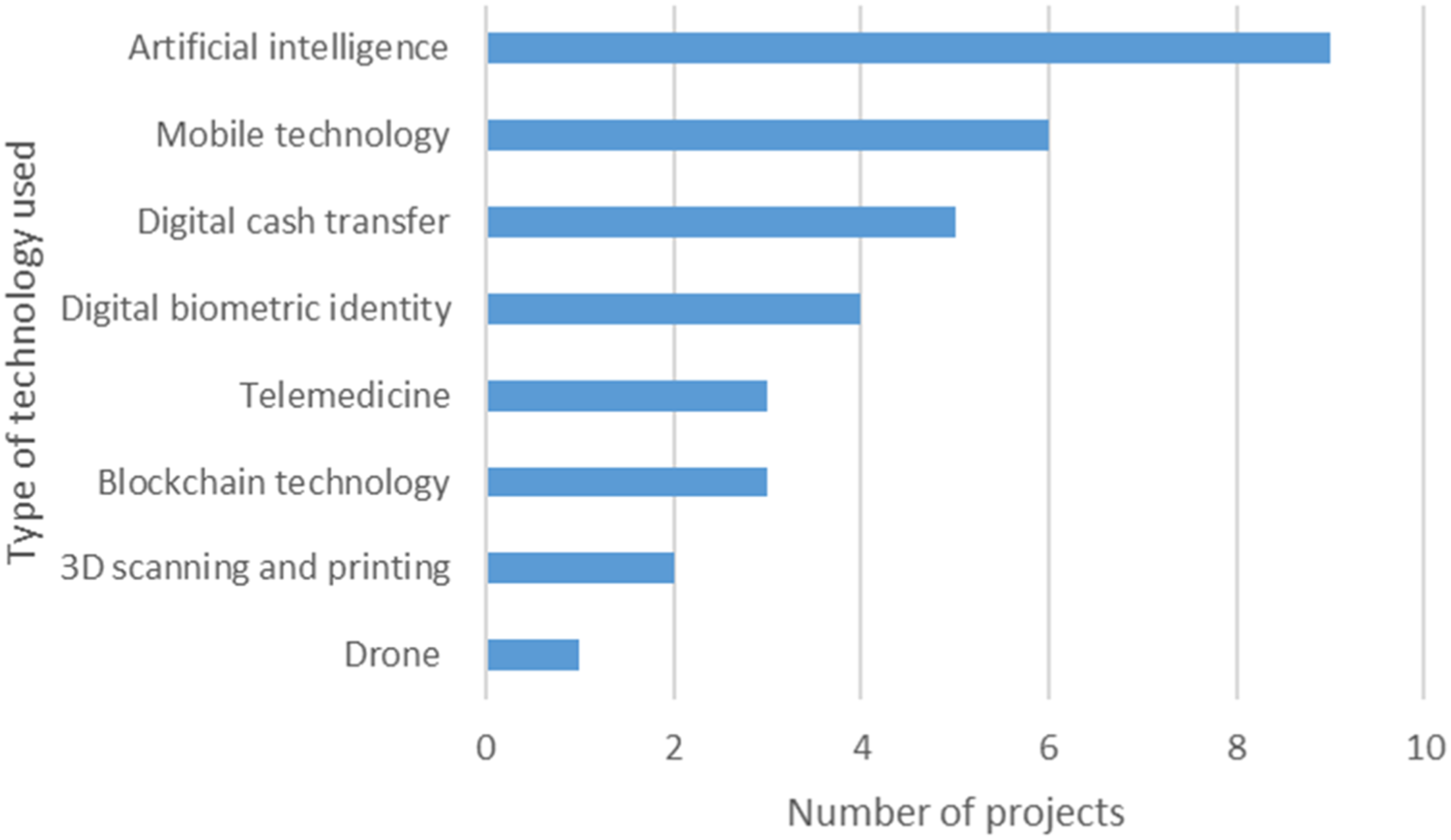
The empirical analysis is based on secondary sources such as project websites, reports or presentation videos, complemented by key informant interviews. Table A2 in the appendix shows the corpus of data used. Relying on these data sources only allows for an exploratory analysis of technological innovations and provides a rather partial view of their institutional set-up, especially as data on the identity of donors and partnership modalities between PPP actors are often lacking.
The data analysis strategy allowed the development of a typology of PPPs based on the way in which their institutional design arbitrates between the conflicting objectives of technological innovation actors by providing incentives to some actors over others. To do so, I followed Andonova (2017) and adapted key concepts from principal-agent theory to analyse PPPs as a chain of contractual relationships involving stakeholders characterised by different levels of power and located in different spaces. I use the following set of criteria to comparatively screen the projects in the research sample: (1) Which stakeholder expressed a demand for technological innovation? Is there an identity relationship between this stakeholder and the end user of the project? (2) Which stakeholder originally decided to set up a PPP to meet this demand (acting as the principal of the technological innovation)? Where is the decision on the objectives and the establishment of the PPP made? (3) Which stakeholder is financing/sponsoring the PPP? Are there any explicit conditions attached to the funding? (4) Which stakeholder(s) is/are responsible for implementing such PPPs in crisis situations (the agent(s) of the PPP)? What is the room for manoeuvre of these actors? Do the decision-making and implementation spheres coincide? (5) Which actors decide on the evaluation criteria of the technological innovation? Who is rewarded in case of success?
A typology of public private partnerships in humanitarian technological innovations
Three ideal types of PPPs are identified: community based digital humanitarianism, technologising the humanitarian business and externalising the tech lab to humanitarian contexts.
Community-based digital humanitarianism
I refer to the first type of PPP as community-based digital humanitarianism. Such partnerships represent a marginal share of technological innovations (3 projects - 11%). In this case, the demand for a technological innovation comes from a humanitarian agency claiming to represent crisis-affected communities. When presenting the origins of the Action Aid UK Mobile App to Combat Sexual Violence, Rachid Boumnijel, project consultant, claims to have “put women at the centre of the project” because “women have the power to make decisions and design their own solution” (Action Aid, 2019). Needs assessments were conducted with women's centres and women's protection groups in the Middle East to determine the most effective way to address gender-based violence. Similarly, the Norwegian Refugee Council (2020) argued that it based the development of its information, counselling and legal aid programme on the needs of vulnerable forcibly displaced persons expressed in focus groups and surveys. However, such statements should be taken with a pinch of salt, as they are part of a broader narrative aimed at justifying the legitimacy and added value of technical innovations. However, other dimensions of the project support the fact that such projects are tailored to the needs of the communities they target.
The limited scope of the technological product developed is one such element. Technological innovations are primarily based on the use of technology by crisis-affected communities in a stated attempt to increase their ownership of aid programmes. Action Aid UK's mobile app and NRC's legal aid chatbot build on the extensive use of mobile phones by women in Jordan and South Africa, and among refugee communities in Iraq and Ukraine. The Open Street Map team's Humanitarian Branch's Missing Maps in Africa's Great Lake Region project addresses the need for mapping data in humanitarian aid delivery by involving community leaders in the design and sharing of mapping data. Such maps can then be used to address other economic and societal needs beyond the crisis response phase (Humanitarian Open Street Map, 2020; Humanitarian Open Street Map, 2020b). A key feature of these technologies is their open-source nature: the technology products developed are not patented and serve to further develop the crisis preparedness and response capacities of such communities.
The humanitarian organisation acts as a principal in setting up PPPs, largely continuing existing aid practices. In all identified projects, the principal first develops a detailed product development idea based on its interpretation of the needs expressed by crisis-affected communities, and then seeks to attract the most relevant partner to (a) ensure the technological development of the product, (b) finance the piloting and scaling-up of the project. As a result, the client exerts strong control over the different stages of technological innovation. On the technological side, the tech agents are called upon to implement the project idea in a rather discrete manner. In fact, it is rather difficult to find information about the identity of the tech partner. Action Aid UK stated that it was working with Orange to develop its mobile app to combat gender-based violence, while ICLA's NRC project involves a wide range of multinational tech companies such as Microsoft, Accenture Development Partners, Fjord and Cisco Foundation. The multinational companies involved develop the technology product as part of their corporate social identity programme, sharing solutions developed for other industries with humanitarian organisations. In the case of the Humanitarian Open Street Map project, the technology solution is being developed with humanitarian organisations (Médecins Sans Frontières and the International Committee of the Red Cross), building on the start-up's expertise. In all community-based digital humanitarianism projects, the role and power of the technical implementer is limited, with the community representative acting as the central stakeholder of such a project. In line with these objectives, donors are approached to fund a clearly defined project based on proximity of interest. Their ability to influence its scope and objectives is then more limited than in traditional humanitarian programmes. The evaluation criteria for the project are also defined at the community level, and technological innovations are considered successful if the technological product developed is used and owned by the crisis-affected communities. This is particularly true for the Missing Maps project, as maps can't be produced without strong buy-in from crisis-affected communities.
In many ways, community-based technological innovation is no different from other types of humanitarian “community-based” projects. Most of the credit for success goes to the client, i.e. the NGO or start-up that initiated the project. As a result, the politics of such technological innovations give a central role to NGOs representing crisis-affected communities. Although such projects aim to empower crisis-affected communities and, as argued above, make credible claims in this sense, humanitarian NGOs use such projects to signal their innovative capacity and effectiveness to donors. In contrast, technology companies play a more limited role, but are still incentivised to participate because of the expected reputational benefits.
Spatially, these PPPs give a strong role to crisis-affected communities and stakeholders. Although the partnerships are formalised in the headquarters of NGOs and technology companies in the “Global North”, community-based groups are involved in the different stages of project development (needs assessment, product development and evaluation).
Technologising the humanitarian business
I refer to the second type of PPP as the ‘technologising the humanitarian business’, as it merely seeks to support the standard operating procedures of the humanitarian industry with technological tools. Such partnerships represent the majority of the projects studied (9 out of 22, 40%). As in the previous case, the demand for this type of PPP comes from an international humanitarian agency. However, in these partnerships, technological innovation is used to solve organisational or logistical problems that hinder the effective delivery of aid programmes in the field. The potential gains in effectiveness may ultimately benefit crisis-affected communities, but their role in such partnerships is remote to non-existent. Indeed, none of the projects in this category use technology to improve the accountability of aid programmes or to better map the needs and capacities of crisis-affected communities. On the contrary, the projects seek to achieve four overarching goals: (a) to strengthen coordination between the various actors involved in humanitarian settings (Needsbot by Needslist), (b) to conduct contextual analysis in a more reliable manner (HELP and HOPE projects by Humanity Data System), (c) to register people in need (i.Respond), (e) to facilitate the delivery of aid projects (Mastercard Send).
In a techno-solutionist logic, humanitarian organisations start by identifying a broad organisational/logistical problem and then call on technology companies to solve it. The problem definition may be accompanied by a plan to develop a solution, as in the case of the World of Relief app, a joint venture between the US humanitarian NGO Translators Without Borders and a number of multinational companies to develop artificial intelligence translation tools for frontline humanitarian workers. In this case, the partnership gives strong agency and power to the NGO client, which selects partners based on its own normative preferences. Technology companies - as agents - are involved in the concrete implementation of the programme. However, the difference with community-based digital humanitarianism is that the same humanitarian organisation is involved in commanding and using such innovation.
As a result, the innovative nature of the technology solution developed is limited to ensure strong and rapid ownership of the product by non-technical humanitarian experts.
In most cases, however, the humanitarian agency's requirements are quite vague and the partnership is driven by the willingness of tech companies to apply their technology to ‘complex’ humanitarian settings. A typical example is the Humanitarian EyeBank® project, a digital cash transfer tool developed by Iris Guard in partnership with the UN High Commissioner for Refugees and Cairo-Aman Bank to facilitate cash transfers to refugees in Jordan using iris scans. Iris Guard, a UK-registered technology company, was approached by the UNHCR, which needed a secure solution for its cash transfer projects in refugee settings (Iris Guard, 2020). Historically, this technology was developed - according to Iris Guard, 2020 - at the request of the government of the United Arab Emirates to identify ‘over 650,000 people who were inadmissible’ at airport border controls. The transfer of such technology from border security to humanitarian protection has raised concerns among human rights activists, who describe the innovation as a “dystopian scenario [that] is completely unnecessary” and regret that “we have no idea what data they are collecting, what they are doing with that data, or if any attempts are being made to keep it secure” (Access Now, 2021).
The partnership between Mastercard's US headquarters and Word Vision, the American Red Cross and Save the Children US to develop electronic cash transfers in crisis situations follows a similar logic. The technological solution developed in this case mainly applies technological innovations developed for other sectors to crisis situations. Most of the products are based on a (limited) fee for service or corporate social responsibility initiatives. Setting up a PPP is often a way for the humanitarian agency to retain ownership of the innovation product developed. The PPPs that fall into this category are all designed and agreed in the “Global North”, where the humanitarian agency is based. Setting up a PPP may also be a prerequisite for obtaining external funding, although in most cases the costs of the innovation are shared between the humanitarian organisation - using specific research and development budget lines - and the technology companies.
As these projects seek to technologise humanitarian processes, they are usually evaluated on the basis of humanitarian agencies' performance criteria. These criteria are usually based on the benefits that technological innovations bring to the effectiveness of aid programmes. These may include reaching more crisis-affected people for the same programme cost, or reducing such costs through gains in programming capacity. Spatially, these PPPs are a continuation of long-standing humanitarian practices, with decision-making spaces and power concentrated in “Global North” societies and economies. Meanwhile, crisis-affected communities are not seen as stakeholders in such partnerships, although crisis-affected governments can strengthen their monitoring capacities through such programmes. “Global South” societies appear as mere implementation spaces, and such PPPs do not fundamentally challenge the way aid programmes are governed.
Externalising the lab to humanitarian contexts
The final type of PPP - Externalising the Lab to Humanitarian Contexts - aims to use humanitarian settings to develop technological innovations that can be successfully applied to other sectors. More than a third of the projects in my research sample fall into this category.
In this latter type, the demand for technological innovation comes from technology start-ups that have an innovative idea, either based on previous experience in humanitarian settings or on an analysis of perceived needs in the sector. A key feature of such innovations is not only their immediate relevance to humanitarian aid, but also their potential wider impact on other sectors. In such partnerships, the technology company acts as a client looking for a use case to pilot and later scale up its innovation. Relying on humanitarian organisations to implement such innovations has three advantages for tech startups. First, as noted by the project managers from start-up companies I interviewed in January 2021, crisis-affected countries are characterised by lower regulatory barriers to the establishment of technological innovations compared to “Global North” countries, which are characterised by stricter procedures for the implementation of research and development projects involving human participants. Second, crisis settings provide an extremely challenging context that, if successful, offers the hope of successfully scaling up the proposed product in other contexts. Finally, engagement in such contexts allows tech start-ups to develop a “tech for good” narrative, in which technologies are developed to address global problems of humanity. Such a narrative, according to the companies’ project leaders interviewed in December 2020, is key to gaining the trust of humanitarian organisations. Telemedicine embodies such innovation practices. A typical example is the PathVis Cholera Detection App, developed by the startup OmniVis, which “developed a smartphone platform diagnostic device that uses DNA amplification to detect cholera at the source in less than 30 min. The data is then uploaded to a cloud server to automate the data analysis process. The data storage technique allows the device to work in areas with poor connectivity before getting wifi access in a central location. After a successful trial in Bangladesh - through a partnership with the International Centre for Diarrhoeal Disease Research - the device has been patented and will be available for pre-sale in the “Global North” in 2021. In such partnerships, the role of the humanitarian organisation is limited to recruiting suitable communities to implement the innovation.
Although their room for manoeuvre varies according to the partnership agreement in question, on average it is quite limited, especially as the largest and best-known NGOs are reluctant to get involved in such technological innovations because of their ethical implications. As a result, the NGOs involved in such PPPs are of limited size and capacity, and therefore can't really influence the path taken by the start-up. In practice, half of the projects studied are still looking for humanitarian partners to develop their innovation.
The potential to scale up the innovation if successful and develop it for other markets is a key argument used by start-ups in their communication with donors. Budget lines for technological innovations are perceived as scarce by start-up CEOs, leading them to prioritise approaching their pre-existing affinity network based in the national aid agency. Initial support from a national government can help refine the project and attract humanitarian partners. By providing funding, donors agree to share some of the costs and benefits of innovation. The reward for success goes mainly to the start-up, which can capture new patents and sell its innovation to larger humanitarian and non-humanitarian markets. This does not mean that there are no benefits for humanitarian organisations, but they are secondary. By entering such partnerships, humanitarian organisations hope to gain privileged access to the innovation developed in the future and to signal a positive image as an innovative organisation to donors. The spatial dynamics of such partnerships reflect global inequalities: The societies of the “Global South” are mainly perceived as a real-life laboratory for testing products that can then be disseminated on a larger scale. It should be noted that the history of humanitarian aid has provided many examples of such ‘open laboratories'. Early famine treatments were tested in colonial times on populations in crisis in dependent territories through colonial humanitarianism. This has led to such partnerships being termed techno-colonialism, allowing new technologies to be tested and business models to be scaled up on vulnerable people to create value from their private data.
Discussion and conclusion
Navigating polarised accounts of the use of technological innovations in the humanitarian field, this paper has sought to assess the conditions under which technological innovations can change the politics of spaces of humanitarian governance. The proclaimed ‘game-changing’ nature of such innovations is linked to their ability to put crisis-affected communities in the driver's seat of aid programmes, thereby shifting the decision-making spaces of humanitarian governance to the “Global South”. To assess whether technological innovations deliver on such promises or reinforce the neo-colonial logics at stake in global humanitarian action, the paper unpacks how the institutional set-up of such innovations - PPPs - arbitrates between the conflicting interests of their stakeholders and distributes power and resources among them. Three findings stand out.
First, in line with the critical literature on technological hype, most technological innovations are a continuation of past humanitarian practices and, as such, do not fundamentally challenge the power asymmetries that characterise humanitarian governance. Partnerships aimed at digitising the humanitarian business may allow humanitarian actors to solve their own organisational problems, but they do not necessarily serve crisis-affected populations. Worse, as observed in the case of historical innovation practices in the humanitarian sector, such innovations contribute to an agenda of control and governance of humanitarian subjects (Fassin, 2011). Technology is also key to promoting the professionalisation of humanitarian work, but it does not lead to a paradigmatic shift. “Global South” communities are still perceived as implementing spaces with low levels of power agency, and serve to restore the image of multinational tech companies. Nor is the use of “Global South” communities as a testing ground - as with ‘externalising the lab to humanitarian settings’ partnerships - anything new in the history of humanitarianism. Such forms of partnership perpetrate post-colonial practices. “Global North” technology companies invest in crisis-affected communities because they offer low regulatory barriers to testing new technological products. As a result, the lives and data of crisis-affected communities are stored, analysed and used to develop safe and controlled technological products for “Global North” societies. The parallel with the development of humanitarian medicine and its later application to the treatment of epidemics in Europe is striking (Barnett 2011).
Second, as coined by Duffield (2016), humanitarian technological innovations have a strong disabling effect on government structures. None of the projects studied play a central role for donors or crisis-affected governments. This absence raises significant accountability issues. When technological innovations fail, who should be held accountable? As private actors, the regulation of the activities of tech companies and NGOs depends on the legal frameworks of the countries in which they are based and operate. Such frameworks are often weak in crisis-affected countries, and the home government may not be particularly keen to initiate legal proceedings against its national NGO or company if it is not directly involved in such innovation and thus does not face political costs in the event of failure.
Third, a marginal proportion of projects may have transformative potential for humanitarian governance and aid practices. While community-based digital humanitarianism serves the agenda of humanitarian organisations, preliminary evidence also suggests that technologies can help empower crisis-affected communities and increase their ownership of aid programmes. Such innovations build on people's use of technology to ensure that aid programmes are tailored to their needs. The open-source dimension of such innovations has the potential to make communities more resilient to crises by giving them full ownership of the technological innovations developed.
Overall, and contrary to what tech enthusiasts claim, technological innovation does not fundamentally change the power and spatial inequalities that structure humanitarian governance. Moreover, the potential for change lies not in the technological solution deployed, but in the institutional design of such innovations. If the humanitarian sector is serious about empowering crisis-affected communities, technologies can help achieve such goals, provided that the innovations developed build on the use of technology by crisis-affected communities and give them a central role in the development of the technological solution.
Supplemental Material
Supplemental Material - The politics and spaces of public-private partnerships in humanitarian tech innovations
Supplemental Material for The politics and spaces of public-Private partnerships in humanitarian tech innovations by Clara Egger in Environment and Planning C: Politics and Space
Footnotes
Declaration of conflicting interests
The author(s) declared no potential conflicts of interest with respect to the research, authorship, and/or publication of this article.
Funding
The author(s) received no financial support for the research, authorship, and/or publication of this article.

Supplemental Material
Supplemental material for this article is available online.
References
Supplementary Material
Please find the following supplemental material available below.
For Open Access articles published under a Creative Commons License, all supplemental material carries the same license as the article it is associated with.
For non-Open Access articles published, all supplemental material carries a non-exclusive license, and permission requests for re-use of supplemental material or any part of supplemental material shall be sent directly to the copyright owner as specified in the copyright notice associated with the article.
