




Abstract
Although community project planning is widely understood as crucial to equitable wind energy infrastructure planning, involved members of the public nevertheless perceive such participatory interventions as merely pseudo-participatory. Drawing on agonistic planning literature, we argue that this disposition towards tokenism can only be tackled with a (re)politization of community project planning practices. This includes an explicit (re)integration and cultivation of dissent and the potential overthrow of traditionally consensus-oriented formats that follow the deliberative paradigm. For radically political community energy project planning, however, public discourses must be fluid and participants must be open towards dissent, which largely contradicts the typical postures of a deliberative citizen who is supposed to argue in a rational and objective way, using the best arguments to convince others. To examine the feasibility of agonistic approaches for community wind energy planning, we conducted a quantitative discourse analysis on the data set of a large regional survey of an on-going wind energy planning project in Switzerland. We focused on estimating the degree of hegemony of public wind energy discourses and the willingness of residents to engage in participatory settings that can facilitate radically political community project planning (e.g., substantive participation settings). Our results show that for planning individual wind energy projects, the potential for agonistic planning approaches is low, not only because the discourses are already too hegemonic, but also because there is no real willingness to engage in radically political community wind energy project planning. In the context of early, comprehensive, and integrated community planning, however, agonistic approaches could provide the ground for open and innovative participatory planning of renewable energies.
Introduction
Within the wind energy research community, the participation of the affected public in local energy project planning is regarded as essential for fair renewable energy implementation (Baxter et al., 2020; Carley et al., 2020; Fast and Mabee, 2015; Fiorino, 1990; Gross, 2007; Hall 2013; Turner, 2014; Walker et al., 2014; Wolsink, 2007). Not only is participation understood as a means to mitigate the burdens (e.g., visibility of infrastructure, changes in livelihood or lifestyle), but also as a way to better acknowledge and consider the concerns, needs, and preferences of the affected public (Baxter et al., 2020; Burke and Stephens, 2018; Jenkins et al., 2016; Sovacool and Dworkin, 2015). Nevertheless, rather than experiencing a “sense of justice” (Svarstad and Benjaminsen, 2020), participants of such community renewable energy project planning processes often perceive these processes as instrumental or non-participatory (Armeni, 2016; Armstrong and Bulkely, 2014; Arnstein, 1969; Calderon and Butler, 2020; Celata and Coletti, 2019; Groves et al., 2013; Leibenath et al., 2016; Tafon et al., 2019).
For proponents of agonistic planning theory, this perception of tokenism is symptomatic of the deliberative paradigm that guides most community energy project planning practices. They argue that community energy project planning practices that pursue the deliberative planning ideal of achieving consensus by communicative rationality are instrumental by default because in the pursuit of rational consensus, politics, opinions, and emotions are often perceived as obstructive and subordinated to numbers, rationality, and technical knowledge (Anderson et al., 2016; Armstrong and Bulkeley, 2014; Barry and Ellis, 2011; Celata and Coletti, 2019; Fougère and Bond, 2018; Groves et al., 2013). As a result, dissenting voices who present ideas that deviate from what the numbers or calculations suggest will be excluded in spite of their invited participation, the politics and emotions typically inherent in community project planning will become side-lined, and the community project planning will be perceived as tokenistic, despite its intended aim of being inclusive and integrative (Anderson et al., 2016; Armstrong and Bulkeley, 2014; Bell et al., 2013; McAuliffe and Rogers, 2018; Müller et al., 2022).
For proponents of agonistic planning, the neglect of dissent, politics, and emotions in the pursuit of rational consensus not only risks producing “feelings of injustice,” but also risks sedimenting the involved groups’ discourses about the subject and—in the worst case—producing a post-political (or deadlock) condition where no real exchange is possible (Anderson, 2013; Celata and Sanna, 2012; Fougère and Bond, 2018; Leibenath et al., 2016; McAuliffe and Rogers, 2018; Mouffe, 2013).
For this reason, proponents of agonistic planning argue that rather than rational consensus, agonistic moments must be the goal of community project planning (Kühn, 2021; McAuliffe and Rogers, 2018; Mouffe, 2013). An agonistic moment is achieved if participants of a participatory planning setting who position themselves in contrasting discourses encounter each other as adversaries, but crucially, not as enemies that require convincing by rational communication (Fougère and Bond, 2018; Weber, 2018). To achieve such an agonistic moment in participatory planning settings, these processes must become explicitly (re)politicized: dissent actively encouraged and passionate conflict actively cultivated (Anderson et al., 2016; Barry and Ellis, 2011; Bond, 2011; Calderon and Butler, 2020; Fougère and Bond, 2018; Groves et al., 2013).
Specifically in the case of community wind energy project planning, agonistic planning approaches, or the facilitation of agonistic moments, are essential to preventing “feelings of injustice” and to make “real” participation in planning possible. Not only is community project planning in wind energy inherently political, but the discourses regarding wind energy are highly controversial if not hegemonic in certain cases (Armstrong and Bulkeley, 2014; Bomberg and McEwen, 2012; Devine-Wright, 2009; Hall et al., 2013; Müller et al., 2022; Walker and Cass, 2007). The contentious nature of wind energy planning is visible in national and international debates and is particularly palpable in a local community wind energy project at a concrete site (Armstrong and Bulkeley, 2014; Bell et al., 2013; Carley and Konisky, 2020). At a local scale “the politics of (community) energy unfold,” becoming tangible through “socially and materially” produced (wind) energy resources (e.g., the site, landscape, and place) and their contestation (Armstrong and Bulkeley, 2014): While for some a particular site of proposed wind energy infrastructures represents an exploitable energy resource, for others it signifies a place of leisure, tourism, or home (Bell et al., 2013; Carley and Konisky, 2020; Müller et al., 2020). A local wind energy project may impact the values and meanings ascribed to a specific site, place, or landscape for some, while favoring the associations or interests of others, and may consequently elevate the importance of questions about power and politics in a community wind energy planning process—making questions like “Who controls these places, landscapes, and resources?” or “Who determines their future?” the most important ones (Armstrong and Bulkeley, 2014; Bell et al., 2013; Hall et al., 2013; Walker and Cass, 2007).
Drawing on agonistic planning theory (Barry and Ellis, 2011; Fougère and Bond, 2018; Groves et al., 2013), we propose that community wind energy project planning must become radically political. By “radically political,” we mean a community wind energy project planning setting that is not only inherently political, but one that is explicitly designed as a political arena (see Sant et al., 2020). In this political arena, the different discourses around the wind energy project can be radically questioned as can the political landscape in which the socio-technical transformation is embedded (Celata and Coletti, 2019). This political arena may take different forms, however, we conceptualized it as a setting where substantive public participation takes place, where the subject of planning is fundamentally discussed, and where (totally) different, temporary, or “zero-solutions” may be possible outcomes.
The engagement with agonistic planning literature discloses that agonistic moments are only possible within a short period of time in the planning process. When post-political processes (e.g., the exclusion of dissent) are already too advanced and discourses have already become too hegemonic, agonistic moments are almost impossible and radically political community project planning can—such as deliberative participatory planning —lead to deadlock situations (Fougère and Bond, 2018; Kühn, 2021; Weber, 2018; Yamamoto, 2018). Thus, before designing and implementing community renewable energy project planning processes that are radically political, a deep understanding of the nature of (contrasting) discourses is required.
Furthermore, agonistic moments can only be achieved if participants are willing to engage in such radically political community project planning processes. As recent literature on agonistic citizenship suggests, willingness often depends on the prevailing political culture (Bengtsson and Christensen, 2016; Bond, 2011; Inch, 2015; Janes, 2016; Kraff, 2020; Leiviskä and Pyy, 2021; Machin, 2012; Sant et al., 2020; Van Leeuwen, 2015). Whereas in most traditional planning settings participation presupposes a share of deliberative citizens (persons with a “closed” posture that argue in rational and objective ways to convince others), participatory settings that can facilitate radically political community project planning require persons with an “open” posture that embrace “dissensus and conflict as an opportunity to think in a different way.” Participants of radically political community project planning must have the willingness (or capacity) to deal with strong emotions and conflicting points of view and bring a radical openness to the process and outcome (Bäcklund and Mäntysalo, 2010; Bond, 2011; Inch, 2015; Machin, 2012; Pløger, 2018).
In this article, we present the results of a feasibility study of a radically political community project planning approach for an ongoing local wind energy project in the Swiss midlands. We used the data of a regional survey that was conducted for the wind energy planning project and analyzed those data using a quantitative discourse analysis, framed by Ernesto Laclau and Chantal Mouffe’s discourse theory (Laclau and Mouffe, 1984/2013; Mouffe, 2016). According to the requirements for agonistic moments outlined above, we (i) determined the degree of hegemony of the wind energy discourses in which different attitude groups (extreme supporters, moderate supporters, extreme opponents, moderate opponents) position themselves; and (ii) estimated the willingness of these groups to engage in radically political participatory settings.
Based on these results, we critically examined the implications for the intended community wind energy planning approach in the specific case as well as the potential and limitations of radically political community planning in general.
Methods and materials
Study area
Our research study was situated in Vechigen, east of the Swiss capital Bern and located in the Central Swiss Plateau, where a wind energy planning area had been designated. Vechigen is classified as a suburban municipality, although large parts of Vechigen are rural, characterized by dispersed hamlets located within a hilly landscape mainly used for agriculture.
Based on a local initiative in 2007, the regional planning authority examined the feasibility of a wind park located between the two hill tops of Mänziwillegg and Dieboldshusenegg in the Vechigen municipality (Figure 1) and approved its implementation. This resulted in its entry in the cantonal strategic plan of spatial development (Kantonaler Richtplan) and in the municipality administration’s obligation to foster its concretization at the local scale. The local authorities assigned these tasks to an external planning company. The map shows the research site where the study was conducted. The research site encompasses Vechigen, the municipality where the wind energy farm is planned, and its neighboring municipalities. The municipalities are located in two administrative districts: (i) Bern-Mittelland and (ii) Emmental. They differ depending on their distance from the designated wind energy planning area. Zone A refers to the inner area and is located within 2.5 km from the designated wind energy planning area. Zone B refers to the outer area and is located within 5.0 km from the designated wind energy planning area. In this article, zone A also is labeled as “Close” and zone B as “Far.”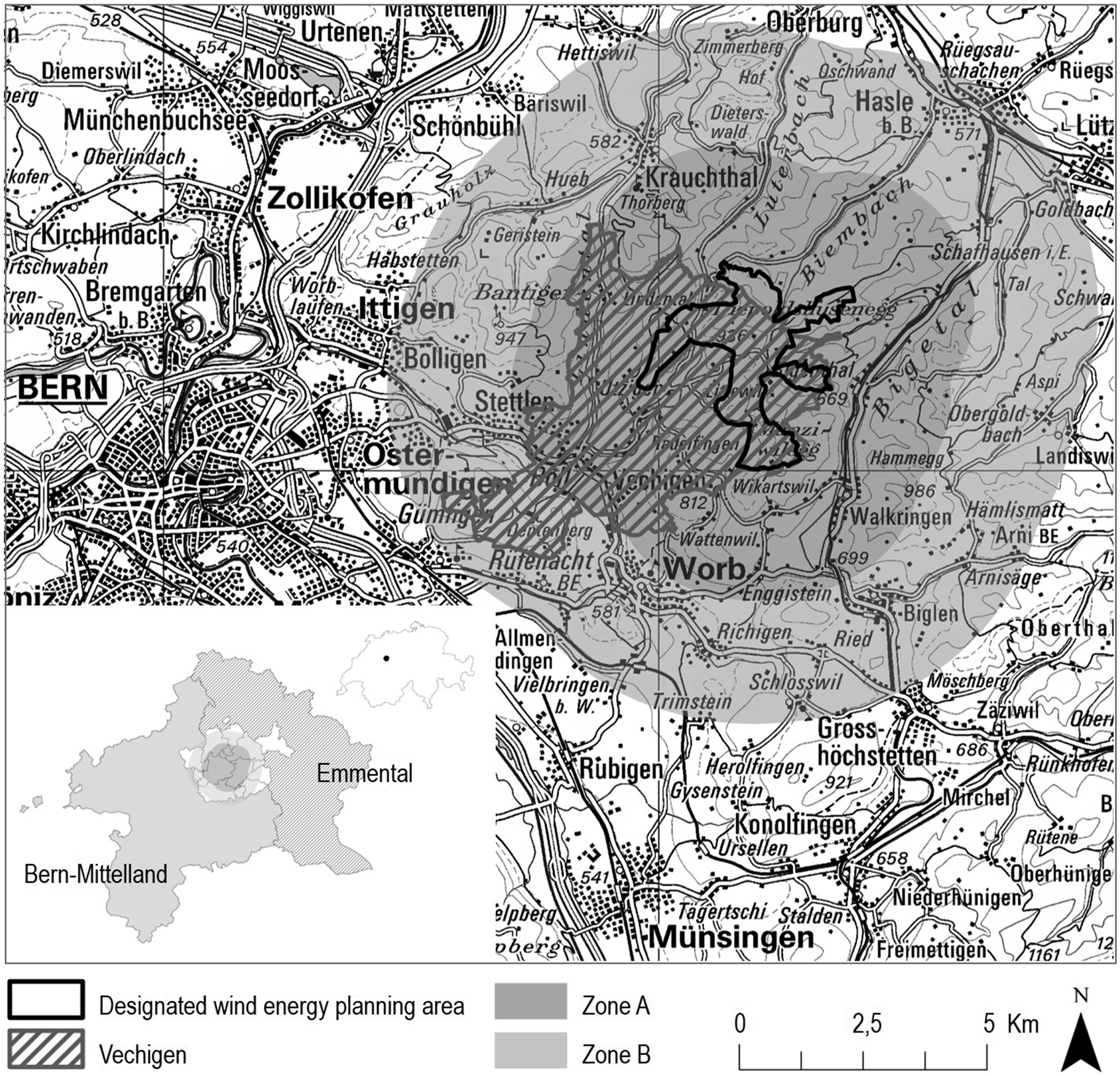
We got involved in the local planning process in fall 2016, at the beginning of the wind speed measurements conducted by the external planning company. We initially intended to contribute a participatory intervention to the community wind energy planning process (Müller et al., 2020), and as such first wanted to investigate the local situation using a standardized survey that we sent to the regional population affected by the project.
We had hoped to conduct the survey before the public release of the wind speed measurement results and the site selection for the wind turbines. However, due to concerns expressed by local authorities and the external planning company, the survey was postponed twice, and only conducted after the release of this information. Shortly before the survey was conducted, local authorities decided to temporarily suspend the final decision of whether or not the wind energy project should be pursued. To date, a final decision has not been made.
Procedure to determine the potential for agonistic moments
To examine the potential for agonistic moments for wind energy community project planning in Vechigen, we used data from our survey in the study region to (i) determine the degree of hegemony or fluidity of the wind energy discourses, as well as to (ii) estimate the willingness of the survey participants to engage in radically political community wind energy project planning.
The survey included a set of arguments concerning participatory planning preferences (substantive, traditional, or no public participation settings). Based on this information, we estimated the willingness of the survey participants to engage in radically political community wind energy project planning.
To determine the degree of hegemony of the wind energy discourses, we applied a procedure based on Laclau and Mouffe’s discourse theory (Laclau and Mouffe, 1984/2013; Mouffe, 2016). In the following three subsections, we will explain this procedure in detail.
Theoretical framework to determine the degree of hegemony
Central to Laclau and Mouffe’s discourse theory is the term “chain of equivalences,” or dynamic networks formed by interrelations between discursive elements. According to Laclau and Mouffe, discourses can be conceived as chains of equivalences that constitute a (social) reality (Kühne and Weber, 2018; Leibenath and Otto, 2013; Müller, 2010; Weber, 2018). A (social) reality, according to this concept, is principally understood as something that is always contingent and fluid and thus can never be determined (Glasze and Mattissek, 2009; Kühne and Weber, 2018).
Nevertheless, discourses (including their chains of equivalences) can temporarily become stable. Stability occurs when the chain of equivalences and their discursive elements remain unquestioned and unopposed or when the constructed nature of a specific (social) reality is forgotten. According to Laclau and Mouffe’s discourse theory, this happens when a discourse has become hegemonic (Glasze, 2008; Kühne and Weber, 2018; Mattissek, 2007; Müller, 2010).
Discourse theories (e.g., normative-deliberative discourse theory) understand a hegemonic discourse as the result of a communicative practice that determines “one specific constitution of (social) reality based on rational argumentation”. In Laclau and Mouffe’s discourse theory, by contrast, “a plurality of legitimate discourses” about the same reality exist, and all of these can become hegemonic. Indeed, it is possible that one single discourse (or a specific reality) becomes hegemonic for everyone, but it is also possible for a variety of different discourses to become hegemonic for different groups of people (Glasze and Mattissek, 2009; Kühne and Weber, 2018; Weber, 2018; Weber et al., 2017).
Hegemonic discourses within diverse groups of people are not understood as strategic or as an expression of group identity. Rather, a specific group identity is understood to emerge from individuals (or subjects) who position themselves within the same discourse—which can eventually become hegemonic and exclusive—but not vice versa (Glasze, 2008; Glasze et al., 2012; Leipold and Winkel, 2017; Mouffe, 2016; Weber, 2018).
Operationalization
Usually, discourse analyses based on Laclau and Mouffe’s discourse theory use textual or linguistic methods to discover narrative patterns in qualitative data that point to existing discourses around a specific (social) reality (Glasze, 2008; Mattissek, 2007). However, using the data of a large, standardized survey allows for larger coverage, which is especially interesting for a wind energy project that affects residents of a large spatial area.
Since the survey contained sociopolitical and spatial arguments related to the discourses around the local wind energy project, we used this information to determine distinct attitude groups within participants’ wind energy attitudes (Aronsson et al., 2014; Bécares et al., 2011; Höfer and Madlener, 2019). This resulted in four distinct groups: (i) extreme supporters, (ii) moderate supporters, (iii) extreme opponents, and (iv) moderate opponents.
The degree of hegemony for each attitude group’s wind energy discourse was then determined using Laclau and Mouffe’s concept of chain of equivalences (Laclau and Mouffe, 1984/2013; Mouffe, 2016). We did this (i) by statistically comparing the strength of approval/disapproval of the arguments related to the local wind energy discourses, as well as of arguments related to discourses around the Swiss energy transition, renewable energy planning in the municipality, and local and future place perceptions; and (ii) by determining whether members of the same attitude group position themselves differently depending on the proximity to the designated wind energy planning area.
Statistical execution
Using a principal component analysis and a reliability test, we began by testing the relationship of the arguments/variables (all of them have been scaled by a five-point Likert scale or quasi-interval scale [Brown, 2011]) that we considered related to the local wind energy discourses. Cases with missing values were not considered for analysis, and one variable was excluded because of inconsistent item construction. The principal component analysis confirmed the affiliation of nine variables to the local wind energy discourses with a Kaiser-Meyer-Olkin of 0.958 and a highly significant Bartlett’s Test of Spherity (Chi2 (36) = 3554.065; p = .000). The reliability test (using Cronbach’s Alpha) resulted in a value of 0.955.
Based on these nine variables of the local wind energy discourses, we determined four attitude groups using k-means algorithm. K-means algorithm is a statistical partitioning method that divides a large set of data into clusters with a high similarity of the data within the clusters and a high difference of the data between the clusters. The k-means cluster algorithm thereby divides the data set by a default number of clusters based on theoretical assumptions (Backhaus et al., 2011). We chose this method because (i) we aimed to compare attitude groups that were as homogenous and distinctive as possible; (ii) our data set was large; and (iii) we were able to define a cluster default number based on our theoretical groundwork. A subsequent test of formal validity by comparing the mean square (variance between the clusters), mean square error (variance inside the clusters), and F-value of two-cluster to five-cluster solutions confirmed our four-cluster solution (best ratio between homogeneity inside the groups [low mean square error] and heterogeneity between the groups [high mean square]).
To determine the degree of hegemony of the group-specific wind energy discourses, we calculated the mean values of related aspects (e.g., attitudes towards the Swiss energy transition or future municipal development preferences) and their corresponding arguments/variables for each attitude group, and tested them for group difference significances (Kruskal-Wallis test and Dunn-Bonferroni post-hoc test for quasi-interval data and Chi2-test for nominal or categorial data). We then calculated the alteration of mean values of these aspects according to the attitude group members’ place of residence using Chi2 tests (place of residence is located within [In] vs outside Vechigen [Out] or place of residence is located within a distance of 2.5 km [Close] vs a distance of 5.0 km [Far] from the designated planning perimeter).
Background information on survey data
Survey development
The survey was developed based on a large qualitative dataset (64 interviews conducted within three wind energy planning contexts in Switzerland: a wind energy project in Vechigen, a wind energy project in Schwyberg, and a wind energy project in Surselva), which was analyzed using grounded theory (Müller et al., 2020). Based on the results of this qualitative analysis, a set of arguments related to local discourses around the wind energy project were identified. This set of arguments further included arguments concerning the Swiss energy transition (such as perceived urgency or anticipation of successful implementation), local renewable energy planning performance, and the municipalities’ development (general and energy-related), as well as
arguments concerning participatory planning preferences (substantive, traditional, or no public participation settings). The finalized survey therefore consisted of four subthemes: (i) respondents’ “place image” (Michel et al., 2015) or respondents’ perception of place and the quality of the immediate residential area as well as the present and future development of the municipality; (ii) their attitude towards the present and future production of renewable energies in Switzerland, in particular within their local environment; (iii) their participatory planning preferences (substantive, traditional, or no public participation settings); and (iv) personal information.
We conducted a pretest of the survey with participants of different ages and backgrounds (including a high variability in knowledge about renewable energies and the Swiss energy transition) to ensure its comprehensibility and to improve its measurement validity.
Sampling procedure and resulting sample
Since we were interested in the spatial pattern of local wind energy discourses, we included not only the residents of Vechigen, but also the residents of the 11 neighboring municipalities of Vechigen in our sample. Our study area thus incorporated two administrative districts: the urbanized Bern-Mittelland and rural Emmental (Figure 1). Six of the 11 neighboring municipalities can thereby be classified as rather urban, and five as rather rural (Figure 1).
To select our sample, we applied a spatially stratified sampling method. We did this for two reasons: first, to ensure that all survey participants were equally distributed in space that would enable spatial comparisons, and second, to overproportionally represent the most affected zone. This overproportion was applied at the request of the authorities of the municipality of Vechigen, who were particularly interested in the preferences of their residents.
We categorized the study area in two zones: (i) a zone highly affected by the proposed wind energy project (zone A—also labeled here as Close), and (ii) a zone moderately affected by the proposed wind energy project (zone B—also labeled here as Far) (Figure 1). Zone A involves all residents living within 2.5 km from the designated planning area of the wind energy project, and zone B involves all residents living between 2.5 km and 5.0 km from the perimeter. Each zone contains municipalities of urban and rural types. The sample of zone A to zone B was overproportioned by (a share of) 5:2.
After two invitation rounds, we achieved in total a response rate of 8% (534 participants). This low return rate was anticipated because of the length of the online survey (30 minute average inquiry time) and the demanding mapping tasks that were involved (Brown and Kyttä, 2014).
Characteristics of Attitude Groups.
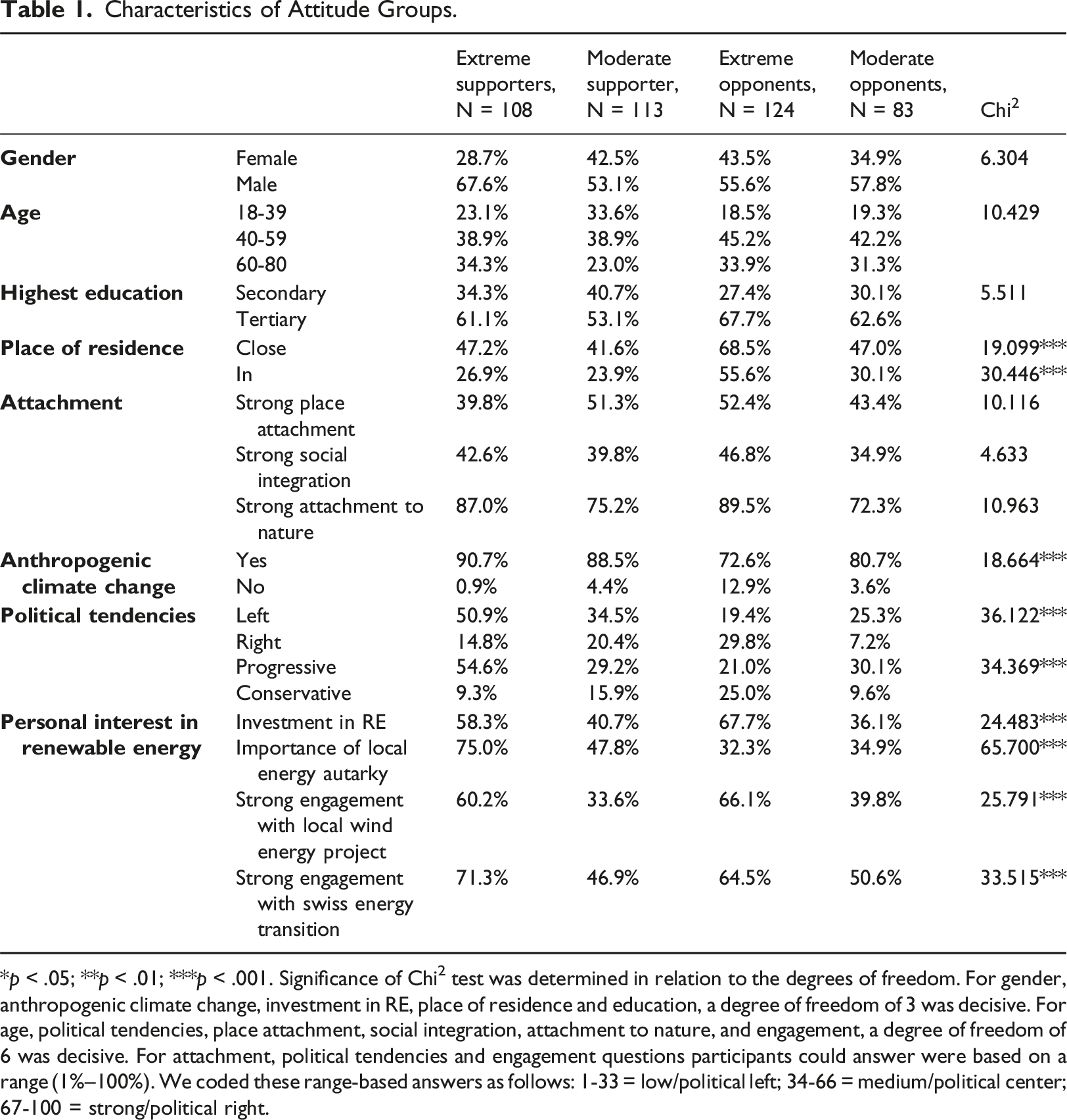
*p < .05; **p < .01; ***p < .001. Significance of Chi2 test was determined in relation to the degrees of freedom. For gender, anthropogenic climate change, investment in RE, place of residence and education, a degree of freedom of 3 was decisive. For age, political tendencies, place attachment, social integration, attachment to nature, and engagement, a degree of freedom of 6 was decisive. For attachment, political tendencies and engagement questions participants could answer were based on a range (1%–100%). We coded these range-based answers as follows: 1-33 = low/political left; 34-66 = medium/political center; 67-100 = strong/political right.
Indeed, for an ideal participatory process, the overrepresentation of a particular group of people—as it is the case in this sample—should be prevented. This is because it excludes the voices of those who typically are meant to be empowered by interventions such as these, including marginalized populations (e.g., minorities, women, children, low-educated, or low-income people) and those who—often for structural reasons—have limited influence on decision-making or planning processes (Haggett and Aitken, 2015; Lane, 2005; Vortkamp, 2003).
However, the case of community wind energy planning is unique in this regard, because as demonstrated in the introduction, it is already highly political (Armstrong and Bulkeley, 2014; Bomberg and McEwen, 2012; Devine-Wright, 2009; Hall et al., 2013; Müller et al., 2022; Walker and Cass, 2007). This existing politicization is why we argued for a radically political participatory process. Since a radically political process explicitly aims to confront the groups of people who are producing the politics of wind energy at the local scale, we did not consider this overrepresentation to be a disadvantage (Anderson et al., 2016; Barry and Ellis, 2011; Bond, 2011; Calderon and Butler, 2020; Fougère and Bond, 2018; Groves et al., 2013). In contrast, we were particularly interested in the overrepresented people in our sample, because it can be assumed that they are the ones who particularly dominated the politics of wind energy in the wind energy project in Vechigen (see Bell et al., 2013).
Results
Group characteristics
Significant differences among the attitude groups were found in (i) their place of residence, (ii) their attitude to climate change, (iii) their political tendencies, and (iv) their personal interest in renewable energies. There is a low proportion of support for the local wind energy project from those living in the municipality or with immediate proximity to where the wind energy farm would be installed. These supporters are more convinced overall that climate change is anthropogenic, and compared to the wind energy project opponents, they tend to prefer left and progressive politics. Despite their strong interest in regional energy autarky, supporters show less tendency to invest in private renewable energy installations as compared with opponents. While 67.7% of extreme opponents indicate a willingness to invest privately in renewable energy installations, this is only the case for 58.3% of extreme supporters. However, both extreme supporters and extreme opponents express strong engagement with the local wind energy project and the energy transition, whereas the moderate groups express significantly lower engagement.
Another statistically insignificant yet notable difference between the attitude groups is the reported attachment to physical and social places. Participants who tend towards support for the local wind energy project report less attachment to the place and/or the community than people who oppose the wind energy project.
Group chains of equivalences
As expected, all four attitude groups (extreme supporters, moderate supporters, extreme opponents, moderate opponents) engage in homogenous and distinctive discourses concerning the local wind energy project (Figure 2). However, in contrast to the discourses of the two moderate groups that show commonalities regarding the related aspects of the wind energy discourse that we examined, the discourses of the extreme groups (extreme supporters, extreme opponents) show significant and distinctive chains of equivalences with almost every related aspect, but especially with place and technology. Figure 2(a) illustrates arguments related to wind energy discourses and the corresponding mean values (5-point Likert scale, coded as follows: 1=strongly disagree, 2=somewhat disagree, 3=cannot decide/don’t know, 4=somewhat agree, 5=strongly agree) of the respective attitude groups (extreme supporters, moderate supporters, extreme opponents, moderate opponents) for each argument. Figure 2(b) displays the group mean values in dependence of their place of residence (in, out, close, far) for each argument. Statistically significant values are indicated with bold markers. Tests of significance for extreme and moderate supporters living in/out and extreme opponents living close/far are statistically invalid, due to unequal group size.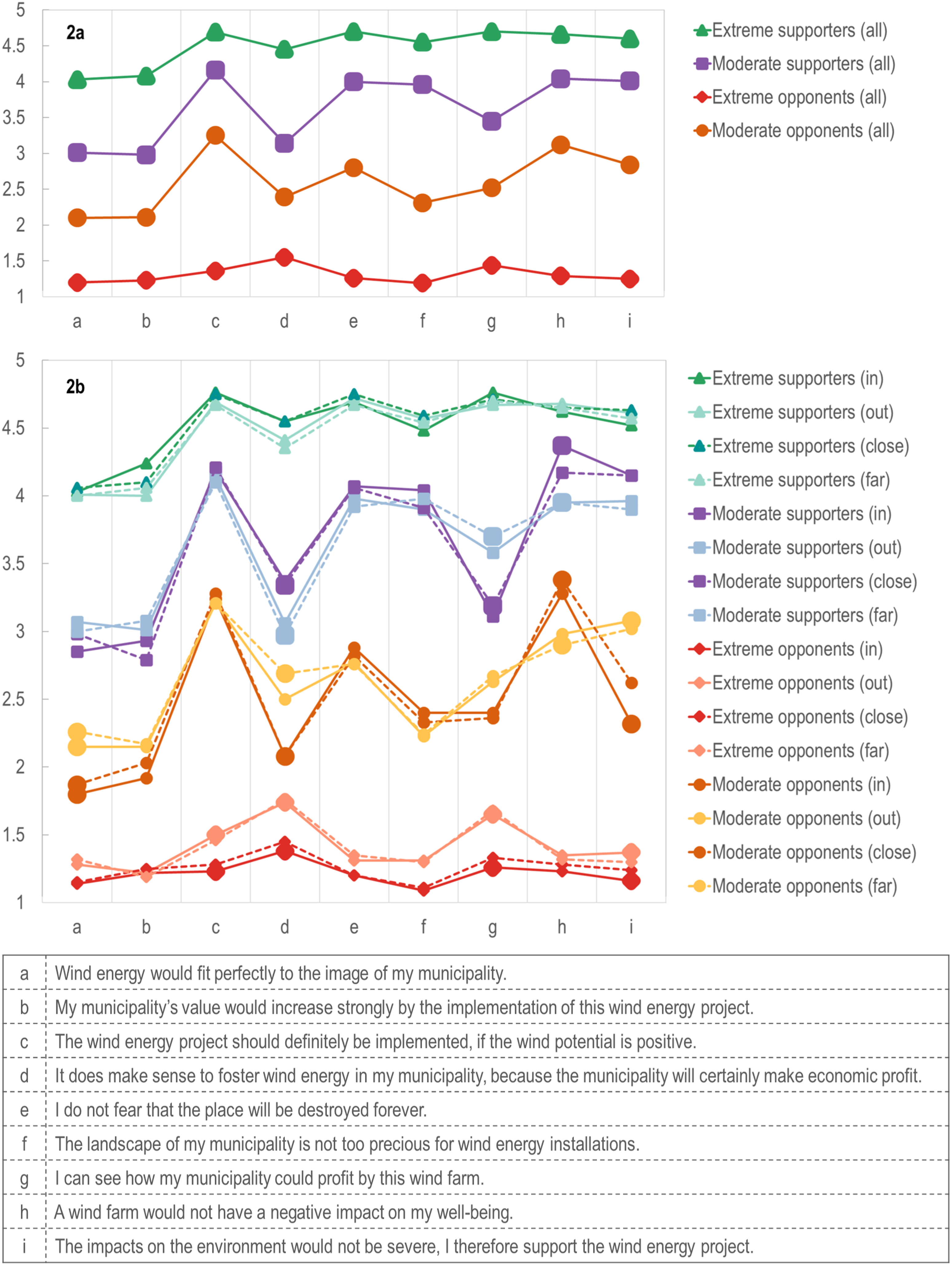
Current and Future Place Image (See Michel et al., 2015).
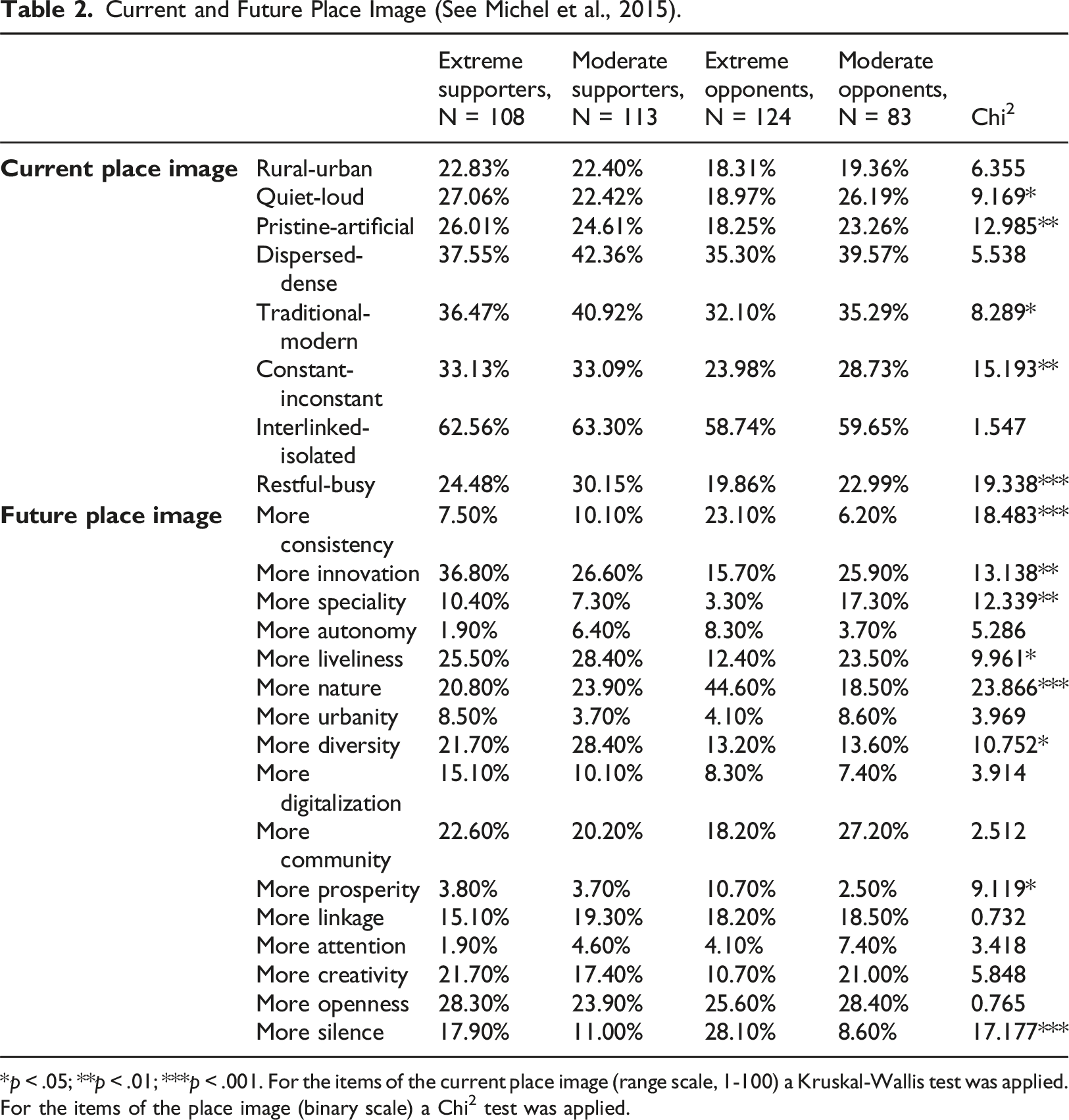
*p < .05; **p < .01; ***p < .001. For the items of the current place image (range scale, 1-100) a Kruskal-Wallis test was applied. For the items of the place image (binary scale) a Chi2 test was applied.
Moreover, while extreme opponents are strongly convinced that a wind energy project will have an irreversibly negative impact on landscape and environment, extreme supporters do not perceive the wind energy project as destructive, neither for the environment and landscape nor for their own well-being (Figure 2). Extreme supporters see a wind energy farm as beneficial to the municipality and as an infrastructure project that would improve the image and value of the place, increase the prosperity of the municipality, and support regional (energy) autarky (Table 1; Table 2).
Nevertheless, all four attitude groups perceive the Swiss energy transition as a necessity. They express their support and personal contribution to its implementation, whereas personal economic profits seem to be of secondary relevance (Figure 3; Table 1). Their engagement seems to be driven by their personal conviction that the climate is changing and that humans have significant impact on it (Table 1). Figure 3(a) illustrates arguments related to the discourses of the Swiss energy strategy and the corresponding mean values (5-point Likert scale, coded as follows: 1=strongly disagree, 2=somewhat disagree, 3=cannot decide/do not know, 4=somewhat agree, 5=strongly agree) of the respective attitude groups (extreme supporters, moderate supporters, extreme opponents, moderate opponents) for each argument. Figure 3(b) displays the group mean values in dependence of their place of residence (in, out, close, far) for each argument. Statistically significant values are indicated with bold markers. Tests of significance for extreme and moderate supporters living in/out and extreme opponents living close/far are statistically invalid, due to unequal group size.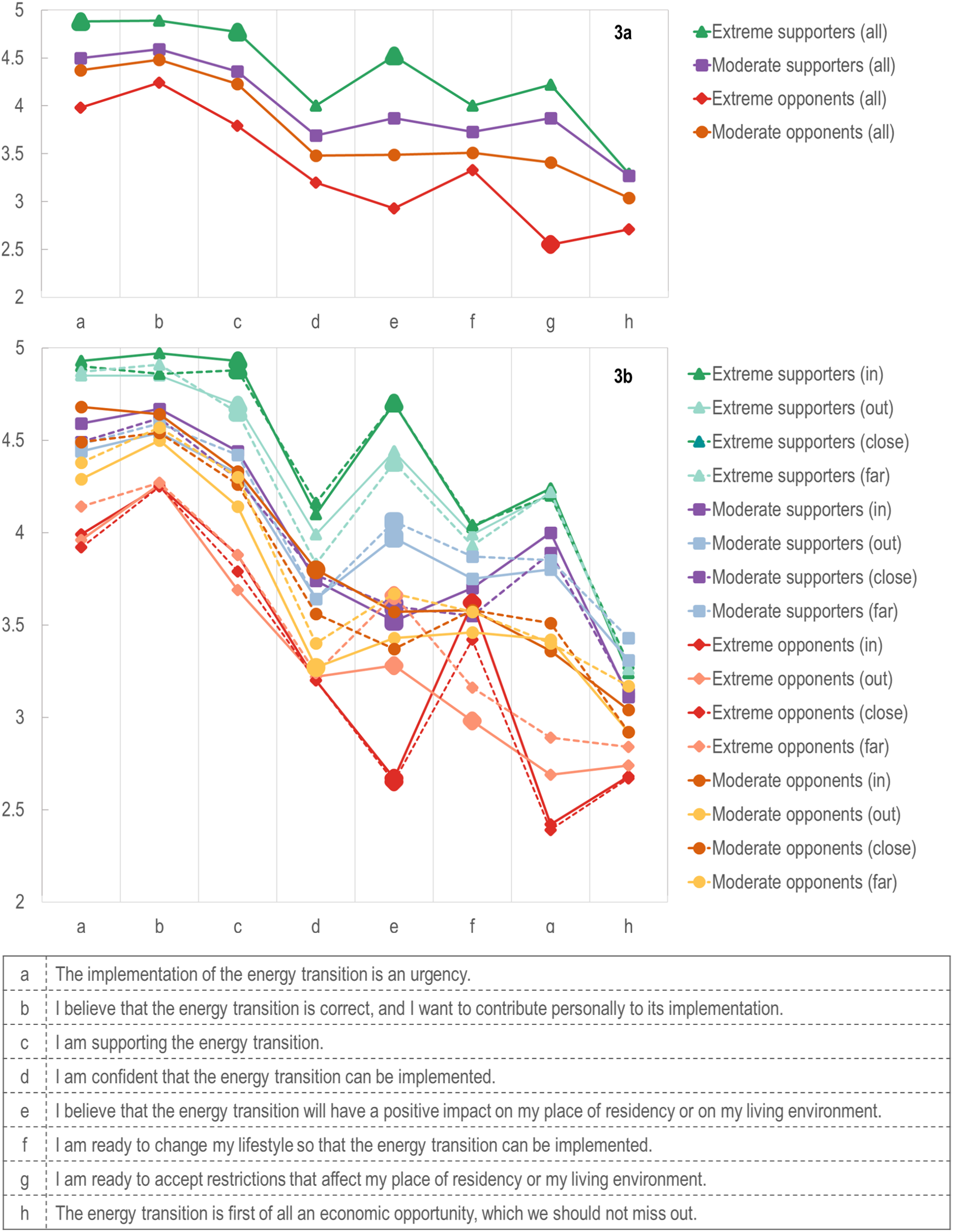
Preferences of National and Local Energy Production.
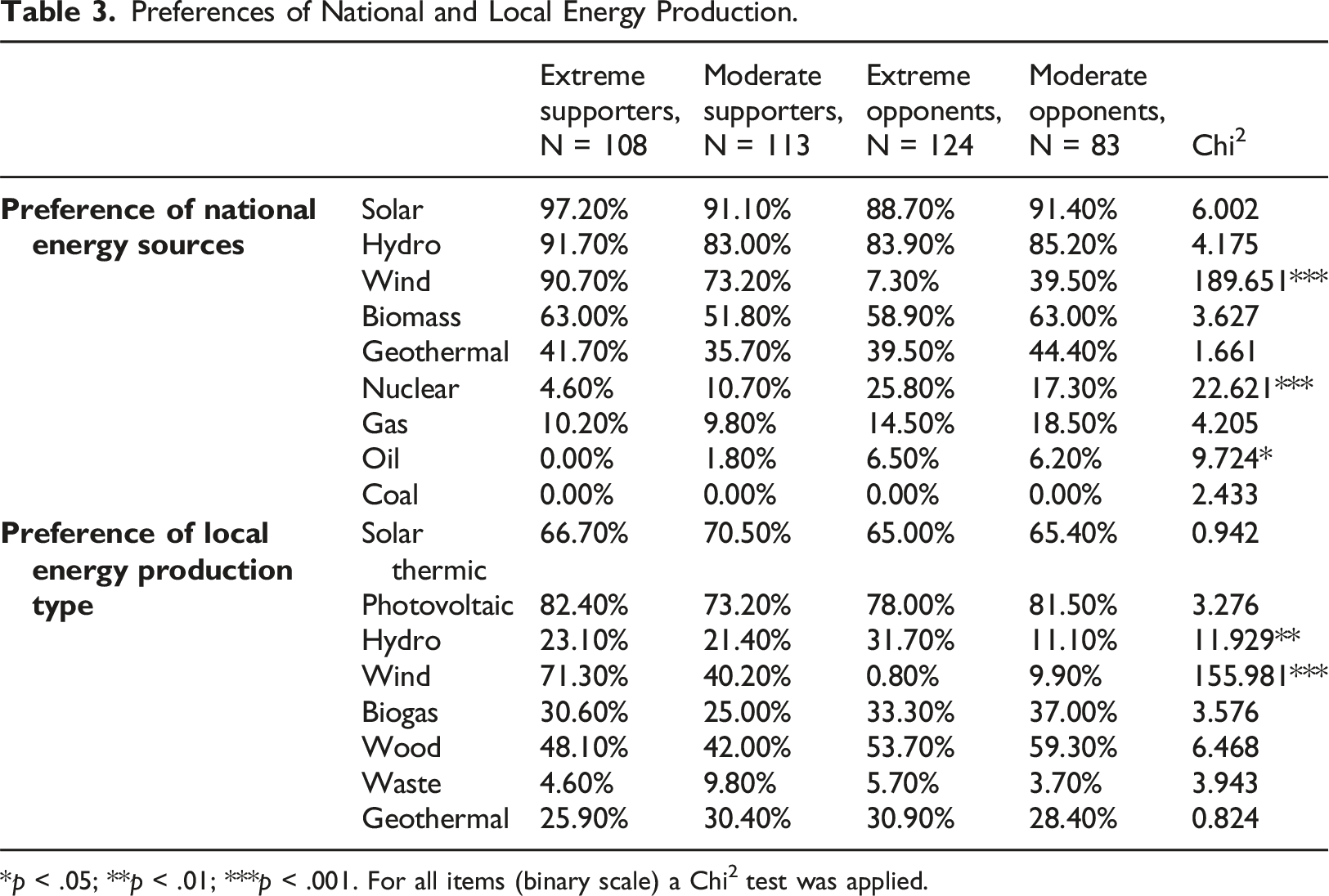
*p < .05; **p < .01; ***p < .001. For all items (binary scale) a Chi2 test was applied.
Consistency of group chains of equivalences
If differentiated based on their place of residence the extreme opponents’ and the moderate groups’ discourses show significant discrepancies, in particular concerning the Swiss energy transition in general (Figure 3). However, concerning the specific local wind energy project, they show only few discrepancies (Figure 2). By contrast, the discourses of the extreme supporters remain largely consistent in scale, no matter the topic.
The largest group-internal deviations within the extreme opponents and moderate groups appear related to the perceived profit of the wind energy project for the municipality (Figure 2). Extreme opponents or moderate residents living outside Vechigen or far from the designated wind energy area) are significantly more optimistic about the potential economic profits that may emerge from the implementation of a wind energy project. Furthermore, the more moderate a person is and the further they live from the potential site, the more they accept personal restrictions due to the implementation of the Swiss energy transition (Figure 3).
However, discourses around place characteristics and wind energy technology remain largely consistent within the groups independent of place of residence. Particularly within the extreme opponent and moderate groups, no significant group-internal differences were visible regarding the impact of wind energy turbines on place, place image/value, or landscape destruction/enhancement (Figure 2).
Group public participation preferences
Public participation in renewable energy planning is generally approved by all survey participants, independent of attitude or place of residence (lowest mean value = 3.16) (Figure 4). Participatory interventions, such as the substantive involvement in the design of the local renewable energy project (e.g., number of plants, size of plants), including the initial choice of energy type and the location of production site(s), are also generally approved by all participants. All survey participants, furthermore, express high interest in being personally involved in the participatory planning of renewable energy projects in their municipality. Figure 4(a) illustrates arguments related to participatory preferences and the corresponding mean values (5-point Likert scale, coded as follows: 1=strongly disagree, 2=somewhat disagree, 3=cannot decide/do not know, 4=somewhat agree, 5=strongly agree) of the respective attitude groups (extreme supporters, moderate supporters, extreme opponents, moderate opponents) for each argument. Figure 4(b) displays the group mean values in dependence of their place of residence (in, out, close, far) for each argument. Statistically significant values are indicated with bold markers. Tests of significance for extreme and moderate supporters living in/out and extreme opponents living close/far are statistically invalid, due to unequal group size.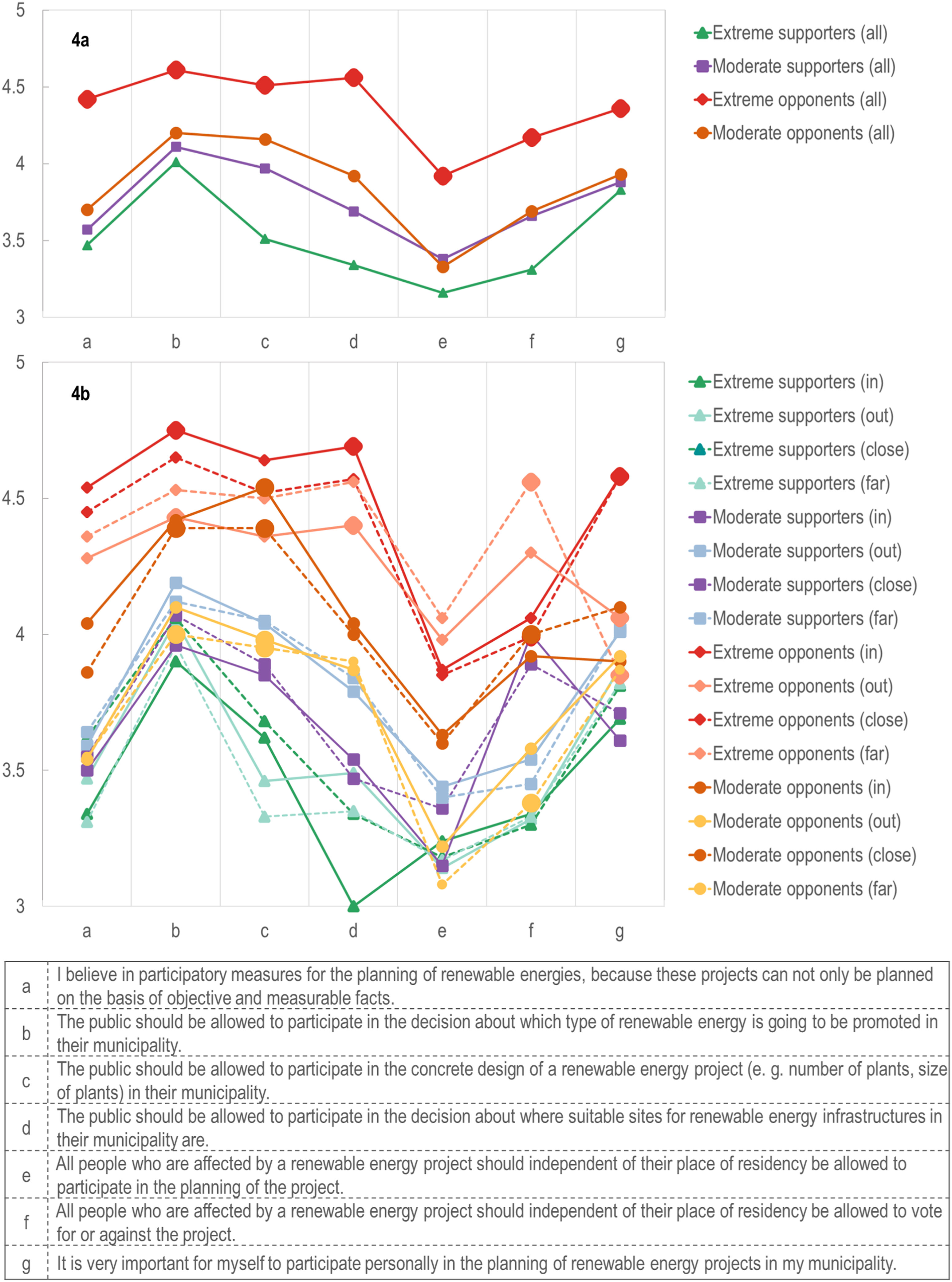
However, the more supportive a person’s attitude towards the wind energy project and the further a person’s place of residence from the designated site, the less that person approves participatory community wind energy planning settings (Figure 4). Extreme supporters, independent of place of residence, are the most critical about public participation interventions in renewable energy planning. Overall, they prefer top-down planning based on objective and measurable facts; if public participation must take place, they prefer it to be small-scale and exclusive to the residents of the affected municipality (Figure 4).
In contrast, extreme opponents who live close to the designated wind energy planning area show the strongest approval for substantive public participation interventions in the planning of local renewable energy projects and the strongest disagreement with top-down planning approaches. Most important for extreme opponents is the chance to participate early and in fundamental decisions, such as in choosing the type of renewable energy technology or in the concrete design of a renewable energy project (e.g., number of plants, size of plants, sites of plants). Similar to extreme supporters, extreme opponents show particular skepticism towards large-scale participatory settings, in which those who live outside of the municipality where the project is planned may also participate (Figure 4).
Willingness to participate in radically political community project planning and potential of agonistic moments
Our discourse analysis suggests that for the local wind energy project in Vechigen, the potential for agonistic moments is low. Not only do the wind energy discourses of supporters and opponents exclude each other, as the strong chain of equivalences between place and technology show, but neither the supporters nor the opponents show willingness to engage with dissent.
Although we did not directly ask about their willingness to participate in radically political community project planning, the participatory preferences of the four attitude groups provided us with a number of indications.
For supporters, their unwillingness is more evident. Most of the supporters of the wind energy project—especially the extreme supporters—show clear preferences for traditional participatory planning settings or top-down planning. According to supporters, site selection and other project-related decisions should be made by planners and the involvement of the public should remain limited to information or consultation events and the subsequent vote on the project (Figure 4). Their willingness to participate in radically political participatory planning setting can therefore be estimated as low.
By contrast, the position for opponents is not so clear at first glance. Indeed, opponents express high overall approval for substantive participatory planning settings (Figure 3). According to opponents, the public needs to be involved from an early stage in planning, including the design of renewable energy projects, inter alia the energy production type, location, and amount. However, considering the decline of opponent approval, the further away their place of residence from the planned wind energy project site is, and the rather exclusive view on participation (e.g., exclusion of those who are not directly affected) of extreme opponents who are living close to the designated wind energy planning area, the participatory preferences of opponents seem to be of strategic nature. Considering their particular hegemonic discourses on wind energy (Figure 2; Table 1; Table 2; Table 3), it becomes clear that for opponents, substantive participatory settings do not necessarily represent an opportunity to engage with a diversity of discourses that might challenge their beliefs or enable the creation of something new, but rather an opportunity for bringing down the planned wind energy project.
Discussion
To examine the feasibility of agonistic planning approaches for community wind energy project planning, we explored the potential for agonistic moments for the contested wind energy project of Vechigen, a suburban municipality, located in the midlands of Switzerland. For proponents of agonistic planning theory, agonistic moments are essential to maintain fluid discourses and to prevent discourses from becoming hegemonic (Anderson et al., 2016; Celata and Sanna, 2012; Fougère and Bond, 2018; Leibenath et al., 2016; McAuliffe and Rogers, 2018; Mouffe, 2013). Such moments are especially important in contested settings with contrasting discourses about the subject of planning, as is the case with wind energy planning where a further sedimentation of contrasting discourses can lead to deadlock (Armstrong and Bulkeley, 2014; Bomberg and McEwen, 2012; Devine-Wright, 2009; Hall et al., 2013; Müller et al., 2022; Walker and Cass, 2007). However, agonistic moments in contested planning settings might only be possible for a short period of time before contrasting discourses become too hegemonic or consolidated (Fougère and Bond, 2018; Kühn, 2021; Weber, 2018; Yamamoto, 2018). They may also only occur within a political culture where participants show genuine interest in engaging with others’ discourses, in understanding how they evolved, and in why that they are at odds, not only in convincing others with the most rational argument as is the prevailing approach in deliberative participatory planning setting (Bengtsson and Christensen, 2016; Bond, 2011; Inch, 2015; Janes, 2016; Kraff, 2020; Leiviskä and Pyy, 2021; Machin, 2012; Sant et al., 2020; Van Leeuwen, 2015).
To estimate the potential of agonistic moments in the context of the wind energy project in Vechigen, we conducted a standardized survey and analyzed its data using a framework based on Laclau and Mouffe’s discourse theory (Laclau and Mouffe, 1984/2013; Mouffe, 2016). First, we determined the degree of hegemony of the wind energy discourses in four distinctive attitude groups (extreme supporters, moderate supporters, extreme opponents, moderate opponents) by analyzing their chain of equivalences (Kühne and Weber, 2018; Leibenath and Otto, 2014; Müller, 2010; Weber, 2018). Then we estimated the groups’ willingness to participate in public participatory settings that can facilitate agonistic moments (i.e., substantive public participation settings where planning can be discussed and in which (totally) different, temporary, or “zero-solutions” are possible outcomes).
The results indicate that the potential for agonistic moments in the context of the wind energy project of Vechigen is low. Not only do the results demonstrate groups’ established and strong hegemonic discourses, but they also show that neither the supporters nor the opponents are willing to engage in participatory planning settings that could facilitate radically political community project planning. The wind energy discourse of the extreme supporters is particularly hegemonic, with spatially fixed chains of equivalences concerning every related aspect that we examined. Furthermore, the extreme supporters clearly disapprove of participatory planning settings that could facilitate radically political community project planning and favor traditional participatory approaches or top-down planning. Supporters feel that site selection and other project-related decisions should be made by planners, and the involvement of the public should remain limited to information or consultation events and the subsequent vote on the project. Opponents, on the other hand, do approve of participatory planning settings that could facilitate agonistic moments, but as our results indicate, only for strategic reasons.
Regarding individual wind energy projects, our findings confirm the views of agonistic planning proponents who disagree with most renewable energy planning literature that calls for traditional (consensus-driven) participatory interventions in wind energy planning settings (Baxter et al., 2020; Burke and Stephens, 2018; Fast and Mabee, 2015; Gross, 2007; Jenkins et al., 2016; Sovacool and Dworkin, 2015; Walker et al., 2014; Wolsink, 2007). However, our findings also challenge the agonistic planning literature that explicitly calls for a (re)politization of public participatory interventions. The prevailing argument is that only with participatory planning settings that facilitate agonistic moments can wind energy planning—perceived as being inherently political (Armstrong and Bulkeley, 2014; Bomberg and McEwen, 2012; Devine-Wright, 2009; Hall et al., 2013; Müller et al., 2022; Walker and Cass, 2007)—become more just and empower all involved parties (Barry and Ellis, 2011; Groves et al., 2013). The wind energy project of Vechigen indeed clearly exemplifies how deeply “political” wind energy planning settings already are. However, it also demonstrates that regardless of the applied type of participation (e.g., whether traditional or substantive), participatory planning settings—and the ideas for which they stand—are not necessarily what people have in mind when they ask for them. Instead, both counterparts (opponents and supporters), seem to perceive participatory processes as a means to enforce their interests and not necessarily as opportunities to openly engage with the interests of the others. Opponents and supporters seem to be particularly aware of the empowerment mechanism of each participatory action and prefer them according to how empowering they are. While traditional participatory approaches committed to consensus-finding often support what dominant discourses, the “status quo,” numbers, rationality, and technical expertise predefine, substantive participatory planning approaches that can facilitate agonistic moments have the potential to deeply disrupt these dominant discourses. Thus, for supporters whose discourses are in line with the status quo (e.g., the institutionalized discourses regarding the urgency of increasing wind energy in Switzerland), a traditional consensus-driven participatory planning approach empowers them, while a substantive participatory planning approach that might challenge the status quo empowers their opponents.
More thoroughly, our findings coincide with the assumption that the prevailing political cultures hinder radically political community planning (Bengtsson and Christensen, 2016; Bond, 2011; Inch, 2015; Janes, 2016; Kraff, 2020; Leiviskä and Pyy, 2021; Machin, 2012; Sant et al., 2020; Van Leeuwen, 2015). Our findings, however, suggest that further explanations are required that include both structural factors as well as agency (Anderson, 2013; Batel and Devine-Wright, 2020; Batel et al., 2015; Gailing, 2016; Leipold and Winkel, 2017). The finding that participatory planning interventions—no matter what type—represent a means to enforce the interests of opponents as well as supporters can indeed suggest that participants do not necessarily anticipate the true function of agonistic planning. When participants responded to survey questions about favorable community project planning settings, they probably did not conceive of agonistic participatory planning settings that would require participants to embrace “dissensus and conflict as an opportunity to think in a different way” (Bond, 2011). Rather, participants—no matter what their attitude—seemed to approach participatory planning settings with the demeanor of deliberative citizens, with the “closed” posture of someone who is expected to argue in a rational and “objective” way to convince others with compelling arguments, as is common (and expected) in most political cultures of contemporary democracies (Inch, 2015; Kraff, 2020; Kühn, 2021; Van Leeuwen, 2015). Nevertheless, the apparent awareness of participants about which type of participatory interventions favors which political discourse may also indicate that participants are not passive replicators of a dominant political culture (Leipold and Winkel, 2017; Stadelmann-Steffen and Dermont, 2021). Instead, participants are active actors who are aware of the potential to exercise power if the particular settings allow it (Anderson, 2013; Batel and Devine-Wright, 2020; Hall, 2013; Walker and Cass, 2007).
Although our findings suggest that agonistic moments are difficult to facilitate in individual wind energy planning settings, they nevertheless indicate that if participatory settings designed to facilitate radically political community energy planning are conducted early and enable fundamental debate about planning (e.g., about different types or sets of technology or different spatial developments in the municipality or region), agonistic moments may be possible to achieve. As the results show, wind energy discourses are indeed strongly contrasting and hegemonic between the different attitude groups—particularly between the extreme supporters and extreme opponents—but the group-specific discourses around the Swiss energy transition in general are largely supportive, regardless of attitude. Even most of the extreme opponents show a high level of interest in the successful implementation of the energy transition, and express even more interest in investing themselves in renewable energy technologies than do extreme supporters. Moreover, the moderate and indirectly affected groups show largely fluid discourses concerning the Swiss energy transition, but also the wind energy in general.
Regarding the specific situation of our study, our results may be not surprising. Perhaps the wind energy project was too concrete and narrow (the wind energy measurements and publication of potential wind turbine sittings had already been conducted) to effectively allow for open outcomes. Thus, it was possibly also due to this sitation that the survey participants have perceived participatory planning settings (no matter what type) not as means for productive engagement with dissent, but rather as platforms where contrasting opinions would clash, where polarized discourses would further consolidate, and where the rejection of the wind energy project would have been the only possible outcome (Fougère and Bond, 2018; Kühn, 2021; Weber, 2018; Yamamoto, 2018). The preferences of supporters for rather traditional participatory, if not top-down planning, could in this view also be understood as a result of the situation, as is the desire of opponents to seize the opportunity for participation.
Moreover, since our findings only hint at the potential outcome of a radically political participatory intervention in community wind energy project planning, we do not know how the dynamics would develop in a real community project planning setting. If a radically political community wind energy project planning had taken place, a different dynamic might have emerged, contrary to our predictions.
Our findings may be limitedly transferable to other planning contexts since we only considered one specific region in Switzerland (Carley and Konisky, 2020; Walker and Cass, 2007). In regions and countries in which the public does not have the same political decision-making power as in the specific region 1 that we considered, the results of our study would certainly look different. Since Swiss citizens generally have high political decision-making power, participants may by default understand participatory interventions of any type as an opportunity to “gain” more voters or to put pressure on accomplishing “their” idea on how to implement or prevent the planned energy project, rather than as a platform for open exchange, confrontation, or for the elaboration of new or unconventional planning outcomes; an attitude that the outcomes of our study reflect. In other planning contexts, where the participants in general have less political decision-making power, any type of participatory interventions may represent a possibility for greater exchange—even if only an exchange with the responsible authorities—and are therefore also understood differently. In such contexts it may not necessarily require radically political community planning to overcome feelings of “tokenism” or feelings of injustice; increased credibility of the authorities may be sufficient (Swapan, 2016).
The methodology applied in this study to estimate the potential of agonistic moments and the feasibility of radically political community wind energy planning is innovative. Historically, Laclau and Mouffe’s discourse theory has only been operationalized using textual or linguistic methods and qualitative data (Glasze, 2008; Mattissek, 2007). With our methodological approach, we not only involved many participants over a large spatial area but also considered spatially differentiated discourses in our analysis.
To improve our methodology, we suggest increasing the number and variability of the considered discourses. Particularly in broad and comprehensive community renewable energy planning, latent, local conflicts that differ from those around wind energy or the Swiss energy transition is an additional factor that could provoke a deadlock. In particular, the contrasting chain of equivalences of the (extreme) supporters and (extreme) opponents regarding the characteristics of the same place indicate that there are more factors in the wind energy conflict than the ones we have considered. Hence, it is not clear whether these contrasting perspectives are only evoked by the wind energy project and the planning approaches that have already been conducted alone, or if there is something else (such as an urban-rural rift) that has caused this conflict (Carley and Konisky, 2020; Ávila-Calero, 2017).
Moreover, we suggest using further statistical methods (e.g., regression analysis and structural equation modeling) and further qualitative analysis, possibly within different planning/research contexts. We also recommend the inclusion of survey items addressing a different or more precise conception of participatory planning settings that facilitate radically political community project planning (e.g., local or regional citizens’ juries or “deep democracy processes”) to validate results and the improve the methodology.
Conclusion
Our case study indicates that the potential of agonistic moments and the feasibility of radically political community planning interventions for the current regime of wind energy planning is low. Not only are the contrasting discourses of supporters and opponents already hegemonic, but they also led the advanced planning process to a deadlock, wherein the rejection of the wind energy project was the only option.
Nevertheless, our study clearly indicates that community energy planning—at least in Switzerland—must radically be (re)politicized. Here, wind energy project planning is not only inherently political, but the agency and political decision-making power of the citizens also condition such an approach. Our study strongly suggests that if radically political community planning takes place early and in the context of comprehensive and integrated planning (that considers not only the wind energy technology, but as well different types or sets of technology and different spatial developments of the places), it can prevent the sedimentation of contrasting wind energy discourses and provide ground for agonistic moments.
However, in order to conclusively confirm the study’s findings, radically political participatory planning interventions in the context of early, comprehensive, and integrated planning at the local scale must be implemented. To prevent any unwanted consequences in real planning settings, a better understanding of the following uncertainties is needed: (i) what further aspects shape the contrasting discourses around a local renewable energy project, beyond the specific project and possibly including latent local conflicts; (ii) how legitimacy can be established for temporary or zero outcomes of radically political participatory planning interventions; and (iii) how radically political community planning approaches can be implemented at the local level without becoming too time consuming and decelerating the speed required for the implementation of the urgently needed energy transition.
Footnotes
Acknowledgements
Special thanks go to the participants of the survey, who shared their political views and opinions on the Swiss energy transition in general and on the local wind energy project specifically, as well as their personal preferences on participation and renewable energy planning. Special thanks also go to Martina Weber, who supported us with data cleansing and data preparation.
Declaration of conflicting interests
The author(s) declared no potential conflicts of interest with respect to the research, authorship, and/or publication of this article.
Funding
The author(s) disclosed receipt of the following financial support for the research, authorship, and/or publication of this article: This work was funded by the Swiss National Science Foundation as part of COST (European Cooperation in Science and Technology) Action TU-1401 (COST Action TUI-1401), “Renewable Energy and Landscape Quality.”
