



Abstract
The resettlement of Palestinian refugees is often studied through two distinct approaches: the first uses settler colonialism as an analytical framework to explore structural violence and Indigenous transfer, expressed through counterinsurgency and urbicide; the second investigates practices of care and governance and their representations within a universalized discourse of humanitarianism. This article introduces a new approach, exploring historical (post)colonial architectural narratives—rooted in international discourses of humanitarian relief and development aid—to interrogate the complex settler-colonial conditions and practices of Israel’s resettlement of refugees. Such narratives emphasis the materialization of resettlement, in which structural violence is culturally co-produced. The article focuses on the Khan Younis refugee resettlement project in the Gaza Strip (1983-1993), drawing on archival materials and in-depth interviews to offering ‘militarized urbanism’ as a novel description of the violence of resettlement. Situated at the junction between military technologies and cultural practices, ‘militarized urbanism’ represents the transformation of the geopolitics of colonial warfare to the colonization of the everyday, where urban and architectural knowledge are reshaped by security logics in the mediation of conflicting civilian and political agendas.
Introduction
Despite international recognition of the Palestinian refugees’ ‘right of return’ (UN Resolution 194 (III) of 11 December 1948), Israel has for decades pursued the resettlement of Palestinian refugees in lieu of repatriation. Supplanting the right of return with regional economic development in the Middle East, Israel maintained, would ensure the security and demographic exigencies of the Jewish settler state (Masalha, 2003; Hazboun, 1994; Khalidi, 1994). This approach, it was believed, would secure the ideological goal of building a sovereign Jewish settler state that excluded the indigenous Palestinian population (Jabary Salamanca, 2016; Gordon, 2008; Roy, 1995).
Within the framework of settler-colonialism (Veracini, 2013, 2015; Wolfe, 2006; Yiftachel, 2006), resettlement of the refugees is understood as a reshaping of regional demographies through ethnic transfer. Indigenous peoples made refugees are then managed in camps as sites of biopolitical experimentation (i.e., Martin, 2015; Minca, 2015; Ramadan, 2013). The refugees are placed out of the bounds of law, losing their homes, rights to property and political status. Deprived of their rights and agency, the colonized may be recast as a restive poor, in which resettlement may be justified as a means to resolve ongoing hostilities. Indeed, Israeli practices to resettle the Palestinian refugees can be traced to the counterinsurgency and counter-revolutionary politics of North Africa, Southeast Asia and the Balkans (Scott, 2016; Weizman, 2007; Hazboun, 1994), enacted through urbicide—the physical, social, political and cultural destruction of a society (Abujidi, 2014; Coward, 2009; Gregory, 2004; Graham, 2003).
Notwithstanding these established theoretical positions, this article argues that the settler-colonial frameworks of counterinsurgency and urbicide are insufficient to understand Israel’s resettlement of the Palestinian refugees. Nor can resettlement discourses be reduced to the everyday provision of humanitarian aid and care to the refugees (Garnier, et al., 2018; Feldman, 2012; Hyndman, 2000). Rather, Israel’s resettlement and pacification strategies, which targeted Palestinians’ ‘hearts and minds,’ must also be conceived within a global humanitarian aid and development discourse produced through the cross-cultural exchange of knowledge. While this broader narrative is inclusive of settler colonialism, the materialization of Israel’s resettlement practices poses fundamental challenges to the study of settler-colonialism.
This article uses urban and architectural history to analyze the resettlement of the Palestinian refugees and interrogate complex settler-colonial conditions, strategies and practices. It frames the resettlement of refugees in the Gaza Strip within the Cold War era’s global ‘salvage’ and self-aid development missions prior to the Oslo Accords (1983–1993). Efforts to resettle and rehabilitate Palestinian refugees in this period fell into crisis following these plans’ direct incorporation of Jewish security and settlement priorities, which ran counter to the logics of humanitarian aid and development applied to refugees and the poor. Through archival materials and in-depth interviews with architects actively involved in the resettlement of Palestinian refugees at the time, the article discusses the materialization of resettlement, situated at the junction between military technologies and cultural practices.
The article begins with an analysis of the prevailing racial-demographic perceptions of colonial resettlement, expressed through the lexicon of counterinsurgency and doctrine of urbicide. The article then argues that resettlement practices were observably informed by logics of population management embodied in economic development, an aspect underrepresented in settler-colonial studies of Palestinian refugees. Finally, the article characterizes the resettlement of Palestinian refugees as ‘militarized urbanism’—a condition neither solely of counterinsurgency nor urbicide. Distinct from Graham’s (2011) broader notion of “military urbanism,” militarized urbanism links to specific settler-colonial contexts and military operations to probe the civilian and political agendas motivating the resettlement of refugees in Khan Younis. Militarized urbanism illustrates the conditions in which the colonization of the everyday in conflict zones is materialized through a counter-hegemonic cultural ideology inherently opposed to the military agenda. Militarized urbanism, the article argues, manifested in resettlement and the clearing of camps, serving a distinctly colonial agenda to integrate the refugees economically through their emplacement as an impoverished labor force dependent upon Israel, as well as replace the land’s indigenous Palestinian inhabitants with Jewish settlers. With respect to Israel, the latter took priority, with Jewish security and settlement expansion central to the state’s resettlement practices. Militarized urbanism, the article discusses, comprises a transition from the logics of economic development to the rule of demographic colonization. Analysis of these processes, which leveled the ground for the forcible displacement and resettlement of the refugees, surface the complex layering of the refugees’ resettlement and contributes to the recognition of resettlement-driven structural violence as a productive field of inquiry within settler-colonial studies.
Resettlement and rehabilitation as counterinsurgency and urbicide
The (often contested) considerations of settlement, security and development, which comprised the cornerstones of Zionist management of territory and populations, are clearly manifested in projects to resettle Palestinian refugees from 1948 at least until the 1993 Oslo Accords. These projects reveal two distinct approaches to the analysis of resettlement in the Cold War era within settler-colonial studies. On one hand, resettlement has been framed as part of the universalized practices of care and governance at the root of humanitarian aid and development discourses (Feldman, 2012; Hyndman, 2000; Agier, 2011). Separately, resettlement has been considered a mechanism to displace and transfer refugees—a mechanism of structural violence wielded by the settler-colonial state.
Since Patrick Wolfe (1999) coined the “settler-colonial turn” (Busbridge, 2018: 94), numerous studies have scrutinized settler-colonialism’s drive for permanence in the conquered land through violent dispossession, economic exploitation and indigenous elimination, drawing parallels between Zionist settler-colonialism and the settler-colonial regimes of the United States, Canada and Australia (Wolfe, 2006; Yiftachel, 2006; Veracini, 2010; 2013; 2015). In contrast to the settler-colonial societies developed in Australia and North America, these studies argue, the Zionist settler-state came about through an international movement that consciously disregarded the metropole in favor of “the collective motherland.” Long prioritizing land acquisition, the rapid dispossession and elimination of the indigenous Palestinian population in 1948 comprised an extraordinary acceleration of the ‘slow-motion’ dispossession of the natives heretofore practiced by Zionists in the building of their colonial state (Wolfe, 2012: 159). Through, Judaization of the land—the most impactful factor in reshaping space, wealth and political power in Israel/Palestine (Yiftachel, 2006)—the Zionists managed secured a contiguous area for exclusive Jewish settlement upon which their nascent ethnocratic state would be brought into being. Demographic security and development considerations were ensured through practices of racial territorialization. These practices, formed under British colonial rule to promote Zionist settlement in Palestine and subsequently operated within the national boundaries of the newly established Jewish state, facilitated Israel’s transition from expansionist horizontal settler colonialism to vertical settler colonialism (Yiftachel, 2021; Zureik, 2016; Khalili, 2012). Framing settler-colonialism as a structure and land-centered project (Wolfe, 2006: 402), analyses of settler colonialism have highlighted the ways in which the imperatives of settler-colonialism supersede the colonial logics of difference, demographic balance and labor independence (Sue et al., 2017; Veracini, 2010; Wolfe, 1999). Within this analytical framework, the resettlement of the Palestinian refugees may be understood as a project of removal and replacement motivated by Zionist political imperatives of sovereignty and security—the embodiment of a Jewish state without an indigenous Palestinian population (Roy, 1995: 127). Settler-colonial studies’ geopolitical approach to resettlement offers a helpful framework for distinguishing the structural violence of erasure from other resettlement practices that emerged as a response to war. In the case of the latter, resettlement may be understood as a humanitarian response to violence, as evidenced by the resettlement of refugees throughout Europe following WWII.
Masalha (2003) and Hazboun (1994), analyze the continuous efforts of the Zionist establishment to resettle the Palestinian refugees, namely the World Zionist Origination, the Land Settlement Department of the Jewish Agency and the Jewish National Fund. Efforts to transfer the Palestinian population, which began under the auspices of the British Mandate, were intensified after the 1948 Nakba (i.e., ‘catastrophe’), and continued with Israel’s occupation of Palestinian territory (oPt) in 1967. With the full support and active collaboration of the United States and its allies, the United Nations Relief and Works Agency for Palestine Refugees in the Near East (UNRWA), founded on 8 December 1949, focused on the resettlement of refugees living in camps. Large-scale regional development aid projects, based mainly on agricultural and irrigation schemes, were proposed for developing the Arab countries of the Persian Gulf hosting the refugees, as a means to promote their permanent resettlement (tawteen, in Arabic). Instead of being repatriated, Palestinian refugees were to be economically integrated and naturalized as citizens within the host countries. These proposals, however, were broadly rejected by both the host countries and the refugees themselves.
The first experiments to resettle refugees in the oPt were carried out in the Gaza Strip (see Weizman, 2007: 69-70; Hazboun, 1994: 105–108). Between July 1971 and February 1972, at the behest of Defense Minister Moshe Dayan and under the Israeli Defense Force (IDF) Southern Command Head Ariel Sharon, actions were initiated to forcibly clear the camps. Sharon’s operation aimed to brutally uproot Palestinian resistance by ‘thinning out’ the population in the Gaza Strip’s four largest refugee camps: Jabalia, Shati, Nuseirat and Maghazi. As part of Sharon’s so-called ‘Five Finger plan,’ Jewish settlement construction in the Gaza Strip was to be facilitated by de-camping projects, which entailed the resettlement and rehabilitation of refugees in new neighborhoods of the city. This de-camping should be conceived, according to Hazboun (1994: 293), as an extension of Dayan’s firsthand experience in counterinsurgency—gained in 1966 as an observer during the Vietnam War. De-camping and resettlement of refugees in the Gaza Strip, Hazboun asserts, was undertaken with explicit intention of curtailing relations between the local Arab population and the fedayeen (guerrillas). Rooted in the logics of ‘classical’ counterinsurgency, resettlement involved the relocation and regrouping of residents in order to physically and ideologically isolate insurgents from the ‘ordinary’ population. Similar efforts to socially engineer the local population had been pursued by the British in Malaya, the French in colonial Algeria and, later, by the United States in Vietnam (Henni, 2017; Collins, 2015; Belcher 2013; Beckett, 1988). 1 This logic also informed Israel’s approach to refugees in the Gaza Strip, where destruction of the camps served to dissipate guerrilla operations, followed by rehabilitation of the subservient civilian population (McCuen, 1966). These strategies, integral to the economic violence propelled, inter alia, by international aid networks, were fêted as a benign alternative to the brutality of open war (Bhungalia, 2015; Khalili, 2012). Through counterinsurgency operations masked as economic development, an established technique of racial domination in settler-colonial states (Dorries et al., 2019), the Gaza Strip was lopped in with other ‘outlaw territories’ of the global south—part of a “Third World game” that aimed to manage “rural-to-urban migration in the interest of global capital” (Scott, 2016: 280).
Counterinsurgency operations undertaken in the camps in 1971–1972, defined by Weizman (2007, 69–70) as design through the destruction of a “habitat of terror,” aimed to pacify resistance to military control through the creation of small, accessible neighborhoods. In the wake of the first Palestinian intifada (1987), this strategy was intensified to comprise ‘urbicide,’ part of late modern warfare (Abujidi, 2014; Coward, 2009; Gregory, 2004; Graham, 2002; 2003; Segal and Weizman, 2003). Urbicide replaced the narrowly focused strategies of classic counterinsurgency with regular closures, curfews, arbitrary arrest, vandalization of Palestinian property and physical destruction of the camps, all in addition to the forcible resettlement of refugees.
While Israel’s structural violence, pacification and resettlement of refugees in the Gaza Strip must be understood in light of the prevailing ‘Third World’ development politics, the de-camping and resettlement of the refugees in the 1970s and 1980s cannot be exclusively attributed to doctrines of counterinsurgency and urbicide. Historical records, discussed below, reveal a story of resettlement that was based neither upon the isolation of insurgents from civilians, nor of refugees from the incumbent community. Understanding the resettlement of the Palestinian refugees therefore requires an opening of settler-colonialism’s disciplinary boundaries to include an examination of Cold War-era cultural development discourses (Lee, 2010; Avermaete, 2010, Scott, 1998; Escobar, 1995) and their relation to settler-colonialism (King, 2004; Celik, 1997; Fuller, 2006; Wright, 1991; Abu-Lughod, 1980), as well as development plans’ aesthetic materialization in technical solutions, lower-standard infrastructure and minimum-standard housing (Abreek-Zubiedat and Avermaete, 2020; Chang, 2016; Bissell, 2011; Home 1997). As a structure, settler-colonialism is culturally co-produced, with culture playing a major role in setting terms for the resettlement of refugees. A more holistic approach to studying the resettlement of the Palestinian refugees, therefore, may shed light on the materialization of settler-colonialism more broadly.
The institutionalization of resettlement
The ‘resettlement’ of war refugees was not common parlance before the mid-1960s, when the United Nations High Commissioner for Refugees (UNHCR) defined resettlement as “the transfer of refugees from an asylum country to another State that has agreed to admit them and ultimately grant them permanent settlement” (UNHCR n.d.). This benchmark invites a temporal exploration of the resettlement of Palestinian refugees under the auspices of humanitarianism (Salih, 2018; Feldman, 2012), with the shifting of UNRWA’s role from relief aid to development, i.e., from a ‘‘politics of life’’ to a ‘‘politics of living’’ (Feldman, 2012: 157). Feldman, who focuses on everyday services and small-scale practices, illuminates the ways in which humanitarianism becomes a space for claim-making, where tawteen may be understood not from simply as a coercive form of structural violence but, in biopolitical terms, as a matter of the civil and human rights of a people long displaced (Feldman, 2012). While Feldman and Salih situate tawteen ontologically alongside questions of governance and humanity, these existential conditions, do not explain tawteen when offered by the colonizer, who would exchange the refugees’ basic human rights for the right to live anywhere but their original home. An epistemologically cultural understanding of the resettlement of the Palestinian refugees, however, reveals a more nuanced perception of tawteen—imposed through collaboration by UNRWA and the settler-colonial state—in which structural violence and humanitarian aid collide.
In the interwar period, the practice of refugee resettlement was common among the League of Nations and humanitarian bodies, who treated refugees as economic migrants and primarily pursued rural models of resettlement to promote so-called economic peace strategies. The integration and resettlement of refugees in host countries comprised part of reconstruction schemes in the Balkans, Middle East and Africa (Macekura and Manela, 2018; Fuller, 2006; Skran, 1995). These ideas first gained traction with the publication of The Transition from War to Peace Economy, published in 1943 by the League of Nations, which argued, “Relief to be effective, must not simply fill the human belly for a short period of time, but must enable the individuals who require it to continue that process themselves in the future” (in McVety, 2018: 30). The unprecedented scale and scope of the refugee crisis in Europe following WWII centered the resettlement of refugees as a critical and pressing issue (Zolberg et al., 1989: 19).
With the United States constraining short-term humanitarian aid and repatriation, the resettlement of refugees by humanitarian relief agencies became a core tenet of the Marshall Plan and quickly emerged as a political tool for host and donor states (Escobar, 1995; Sachs, 1992). Models for the provision of emergency relief were transformed to models for permanent resettlement, with refugees grouped in with vulnerable peoples more broadly as socio-economic casualties in need of protection and care. As a pillar of an emerging consensus on global development, resettlement was characterized as the only practical solution to the suffering of the refugees (Loescher, 2001; Marrus, 1985; Wyman, 1989). Established under the aegis of the United States and its allies to carry out “relief and works programmes” for the Palestinian refugees, UNRWA, operated two complementary resettlement strategies: 1) provision of financial aid to improve the disastrous living conditions of the refugees; and 2) promotion of economic development to resolve the Arab-Israeli conflict. In collaboration with Israel, numerous plans for regional development and the resettlement of refugees were drafted (Masalha, 2003; Shadid, 1981). UNRWA’s involvement in resettlement under the auspices of development aid thereby blurred the line between resettlement as a form of humanitarian assistance and population control (Garnier, et al., 2018). On the other hand, one may understand why the Palestinian refugees’ experience of resettlement is left outside studies of resettlement globally—implemented mainly by UNHCR (Garnier, et al., 2018; Hyndman, 2000)—as in the case of Palestine, UNRWA’s humanitarian practices were imbued with the logics of Israeli settler-colonialism.
Programs to resettle Palestinian refugees in the Gaza Strip illustrate both complementarity and inherent contradictions at the intersection of humanitarianism and settler-colonialism. Contradictory ideologies, embodied within two competing masterplans drawn up in 1969, reveal distinct logics underpinning the resettlement of Palestinian refugees in a contemporary settler-colonial context. The Gaza Strip and Northern Sinai Masterplan, drafted by the economists Don Patinkin and Michael Bruno, represents the culmination of efforts by academics and technocrats in the fields of economics, sociology, architecture and town planning, who approached development from the cutting-edge of American discourse on development aid. Patinkin and Bruno’s masterplan held up the tools of microeconomics as a panacea for national conflict. 2 Their masterplan couched resettlement as rehabilitation, manifested in the physical unification of camp and city, and asserted the inclusion of refugees as urban denizens with equal rights (Abreek-Zubiedat and Nitzan-Shiftan, 2020). A second masterplan, the Eshkol Regional Plan: An Overall Regional Development Plan, was the product of the settler movement. The masterplan, headed by the statistician and demographer, Professor Roberto Bachi, and the agronomist, Raanan Weitz, drew upon technocrats from the World Zionist Organization and Rural Growth and Development Division (i.e., the Settlement Division) of the Jewish Agency. Bachi and Weitz emphasized resettlement of the refugees as a means to ensure Jewish numerical dominance over Palestinians in areas to be incorporated within the Jewish state. Their modes of demographic colonization, rooted in fascist Italian racial ideologies, targeted the separation of Jews and Palestinians. Before emigrating to Palestine in 1939, Bachi was a professor at the University of Genoa. He had been trained within the modernist tradition of statistical cartography and worked in the Department of Statistics in the British government in Palestine, where he founded the Central Bureau of Statistics (CBS). Through the CBS, Bachi based the manipulation of the Palestinian population on quantitative analyses of geostatistical distributions. Weitz, who studied agronomy in the Department of Agriculture at the University of Florence, had been involved in Italy’s colonization of the rural Pontine Marshes region in Libya, planning the resettlement of Arab peasants there within cooperative farms. 3
Regarding the resettlement of refugees in the Gaza Strip, the Israeli government favored Patinkin and Bruno’s suggestion to develop the camps as neighborhoods of proximate cities, while fostering the refugees’ economic dependence on Israel. The self-help projects promoted by Israeli technocrats and planning professionals adopted American humanitarian development logics that targeted the ‘poor’ of the developing world (Muzaffar, 2007; Escobar, 1995). The projects, whose supporting infrastructure was to be subsidized by Israel, featured low-cost modular housing units built on 250 square-meter plots.
In May 1970, the Israeli government adopted Patinkin and Brunos’ recommendations and established The Trust Fund for the Economic Development and Rehabilitation of Refugees (the Fund). 4 The Fund was tasked with the gradual emptying of the camps and re-housing of two-thirds of the refugees in newly built urban neighborhoods elsewhere in the Gaza Strip. The remaining refugees were to be rehabilitated in place, within modernized camps (State Comptroller, 1986: 1236). As a target, the fund aimed to evict 45,000 families per year—with the goal of ending the ‘refugee problem’ within 8–10 years and rendering UNRWA redundant. 5 To facilitate this work, a “Refugee Rehabilitation Subdivision” (RRS) was established in the command area to carry out the management, planning and physical construction of new housing (State Comptroller, 1986: 1236). The RRS engineers and architects constructed new houses both in camps adjacent to cities, as well as in new neighborhoods within cities (Abreek-Zubiedat and Nitzan-Shiftan, 2020). These initiatives stood in marked contrast to Sharon’s counterinsurgency tactics of the previous year, which were motivated by Jewish demographic and settlement considerations. The political reconfiguration and physical resettlement of the Palestinians, the planners and military officers now reasoned, were not achievable through destruction and displacement, but through aid development and emplacement. Their opposition to Sharon eventually led to his dismissal from the military government, evincing internal struggles between the institution’s security and civil arms.
The RRS operated until the signing of the Oslo Accords. By 1981, however, pressure from Israel’s right-wing Likud party—with its policy focus on demographics as the basis for occupation instead of economic colonization—forced the military government to undertake institutional reforms. Concerned with security and the spatial management of Palestinian refugees and local Gazans, the military government was split into two authorities—a Civil Administration and a Military Administration, with the latter responsible for all security matters. The decision to separate these authorities was made by Sharon, who had been appointed Minister of Defense in the same year, nearly a decade since his dismissal from the military government. Under Sharon’s oversight, the Civil Administration operated two main subdivisions—the RRS, responsible for refugees—and a development subdivision, with jurisdiction over Gazan locals. Jewish settlers were managed directly by the Settlement Division of the Jewish Agency, but enjoyed the protection and general favoritism of the Military Administration with respect to planning and other matters.
These changes signaled a new chapter for regional development and population management, in which Israel would actively seek to Judaize the Gaza Strip through the physical construction of Jewish settlement within the territory. The Gush Katif settlement bloc was developed at the beginning of the 1980s on the western side of Gaza City. Expanding along the Mediterranean coast adjacent to the camp at Khan Younis, Gush Katif was to become the largest settlement cluster in the Gaza Strip. While planning for the Gush Katif settlement bloc had been undertaken as early as 1972—part of sub-regions C and D of the Eshkol Regional Plan: An Overall Regional Development Plan drafted by the Settlement Division of the Jewish Agency—it was shelved under then Labor government policy to promote regional economic development in lieu of Jewish settlements within the Gaza Strip. 6 With the rise of the right-wing Likud party and Sharon’s nomination to the Ministry of Defense, the plan was revived and updated as the Gaza Strip Regional Masterplan.
Resettlement within the utilization policy
In 1983, the Military Administration instructed the Civil Administration to prepare the Gaza Strip Regional Masterplan, with the principle aim of entrenching the economic dependence of the Gaza Strip upon Israel, shored-up through Jewish settlement and a range of related security measures. Central to planned economic development was the continuation of Israel’s rehabilitation projects. As the masterplan indicates, resettlement and rehabilitation were assumed to be resolved through the physical integration of the camps and cities. This integration, however, was to be subordinated to Jewish security and settlement. From a security perspective, the masterplan directed the Military Administration to designate land required for military purposes. The Military Administration was also given operational authority to supervise the articulation of centralized planning principles. As outlined in the masterplan, centralized planning was to limit the expansion of Palestinian construction in both cities and camps, thereby clearing land and facilitating military access, movement and control. Moreover, privately owned Palestinian land not designated for Jewish construction was to be demarcated for agriculture, further constraining Palestinian habitation. The masterplan advised the Jewish Agency to promote settlement activities in the northern Gaza Strip (from Erez checkpoint to the west) and the southern part of the Gush Katif bloc, but to curb settlement in the Netzarim region (i.e., central Gaza). In total, the masterplan denoted 9,000 dunams of densely populated Palestinian land to be cleared in central Gaza, including 6,000 dunams of ‘seized land’ not to be converted from military use for settlement purposes. 7
Resettlement of the refugees optimized Palestinian land to ensure the security of Jewish settlements. As indicated in the masterplan, nationalization of the territory was predicated upon the rehabilitation and resettlement of refugees in order to prevent Palestinians from building on seized land. The masterplan targeted some 172,000 people, comprising 40,780 families residing in the Gaza Strip’s eight camps, whose rehabilitation required the acquisition of 3,500–5,000 additional dunams of land. The total estimated cost of the project, around (USD) $1.225 billion dollars ($30,000 per family), was to be subsidized through utilization of camp land. 8
The architects and planning professionals commissioned to resettle and rehouse the refugees required novel strategies to deal with the density and dilapidated infrastructure of the camps, as well as to convince refugees to dismantle their homes and accept relocation. These professionals were further constrained by provisions in the Gaza Strip Regional Masterplan to reserve vast swaths of occupied land for state development.
Compelled to mediate contrasting civic and military agendas, planners, including Shimon and Roni Margolin Architects Ltd, were tasked with the resettlement of 20,000 refugees in Khan Younis (from the total of 45,000 scattered throughout the city). The rehabilitation masterplan drawn up by Margolin Architects annexed the camp within the city’s municipal boundaries, thereby demarcating it as just another neighborhood of the city. Notably, Margolin’s intervention parameters extended beyond the camp area itself to include the adjacent al-Amal neighborhood to the north and ‘Hospital’ neighborhood to the south.
9
Al-Amal neighborhood had been planned and built by Shimon Mergolin in the mid-1970s as part of the Israeli military government’s efforts to rehabilitate refugees between 1972–1979. Hospital neighborhood included some 12,000 refugee ‘squatters’ who had moved there in response to overcrowding in the camp (Figure 1). Marked area of planning and design intervention of the refugees’ resettlement project in Khan Younis, 1987 (Source: Refugees Rehabilitation Neighbourhoods in Khan Younis Masterplan’s booklet. Private collection of arch. Roni Margolin).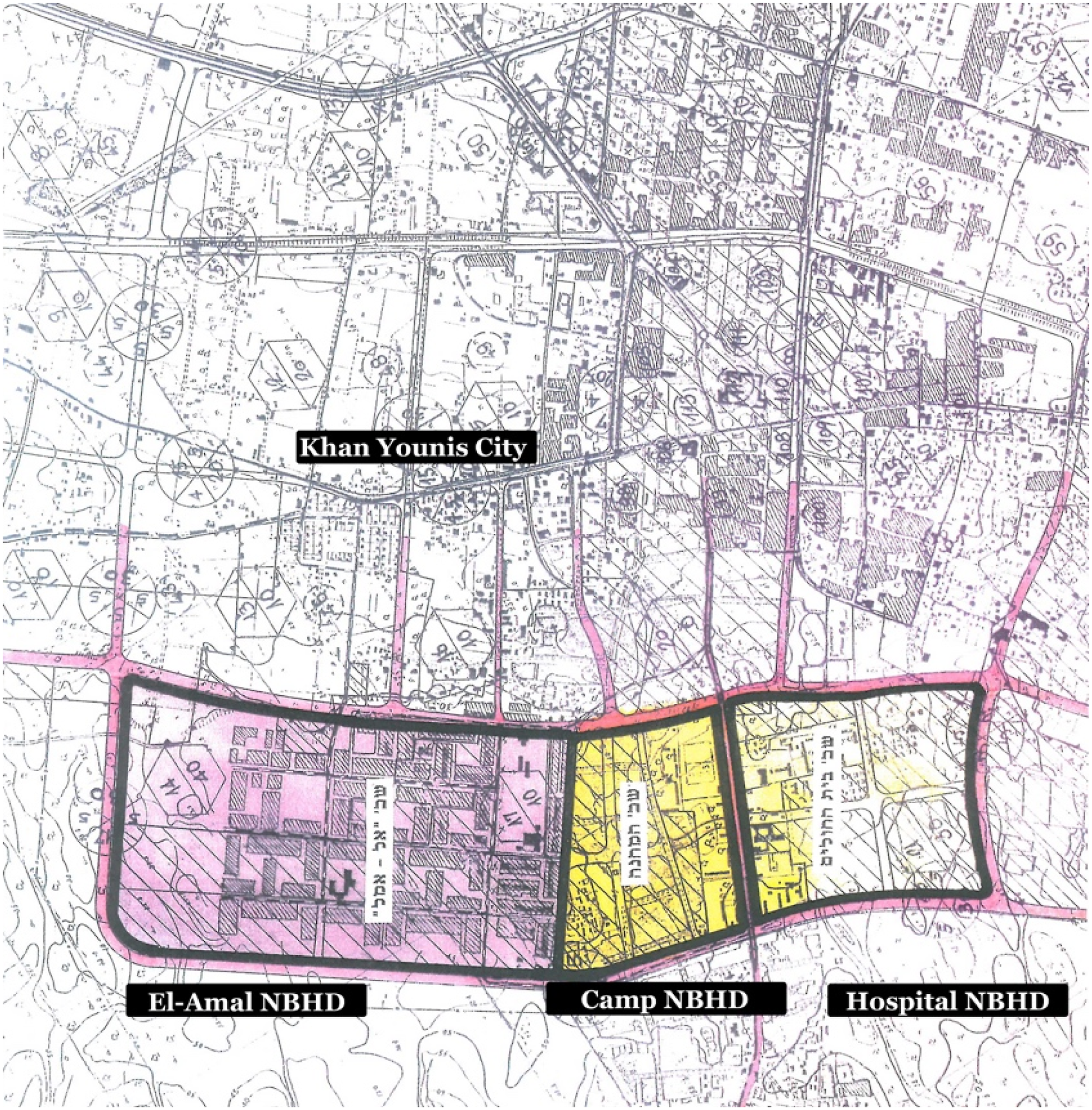
Margolin’s design for al-Amal neighborhood was based on self-help housing principles in line with the Gaza Strip and Northern Sinai Masterplan. Within self-help and self-management models, participants are mobilized through administrative arrangements to build their own houses, primarily based on various site-and-service and ‘core’ housing schemes (Muzaffar, 2007; Le Roux, 2003). Margolin adopted the same planning values and referred to Scottish urban planner Patrick Geddes’ approach to human resettlement to grapple with density and mobility. 10 Informed by Geddes’ ‘valley section’ (Geddes, 1915) concerning the relations between people, their communities and the immediate environment, Mergolin’s plan for the resettlement of some 10,000 refugees in al-Amal neighborhood was characterized by planning efficiency. A reduction in street frontage (relative to the plots’ length) allowed for an economization of infrastructure and lower overall cost of development. 11 Like other architects working under the military government in the first decade of the occupation, Margolin appealed to functionality rather than the refugees’ cultural values, favoring monotonous, low-cost, abstract modular housing. Working alongside military officers—before the military government had been split into military and civil administrations—obliged the architects to provide technical solutions to political demands. Fundamental geopolitical and administrative changes following the 1979 Israeli-Egypt peace agreement—described in this article as ‘militarized urbanism’—affected the architects’ work and their relation to the resettlement of the refugees.
Militarized urbanism in Khan Younis camp
As discussed, framing colonial practices through a historical-cultural perspective may contribute to a rethinking of the roles of the “war on terror” and “military urbanism” (Graham, 2011) in the cultural production of cities. Graham (2011: 60) describes military urbanism as the predation of far-flung recourses required to sustain western cities. Western governments’ high-tech urban counterinsurgency forces permeate the fabric of urban life—a constellation of security and military ideas, techniques and norms in the neoliberal reengineering of urbanism. In contrast to direct military intervention in cities, this article offers the notion of ‘militarized urbanism’ as the historical use of military technologies that shaped and were tacitly embedded in urbanism as a field of knowledge over time.
Margolin, like many Israeli architects and planners who engaged in the planning and design of Palestinian cities and camps in the Gaza Strip, was strongly influenced by global development discourses. After his father died in 1980, Margolin became head of the office nominated by the Civil Administration to plan Khan Younis city and the rehabilitation of refugees. Unlike his father, who had undertaken resettlement on tabula rasa and treated Khan Younis as an experimental laboratory for the design of resettlement models, Margolin had to cope with the edicts of a regional masterplans.
Grappling with the complex physical conditions (mainly) of the camp and Hospital neighborhood, Margolin proposed the building-evacuation strategy, whereby plots were to be cleared and then built anew. In the first stage, he suggested filling and building uninhabited plots in the three areas nominated for habitation by the refugees. Only after their voluntary relocation would the RRS demolish the houses of refugees in the camp.
12
Margolin’s conceptualization of self-help housing extended beyond matters of economic efficiency and technical rationality, referencing local ‘tradition’ and habitus in his modernizing mission. This focus on ‘tradition’ was introduced by Margolin employee Marina Epstein-Pliouchtch, who was responsible for design (Figure 2). Building-evacuation strategy of resettlement (from the right) and the proposed urban building plan (from the left) (Source: Refugees Rehabilitation Neighbourhoods in Khan Younis Masterplan’s booklet. Private collection of arch. Roni Margolin).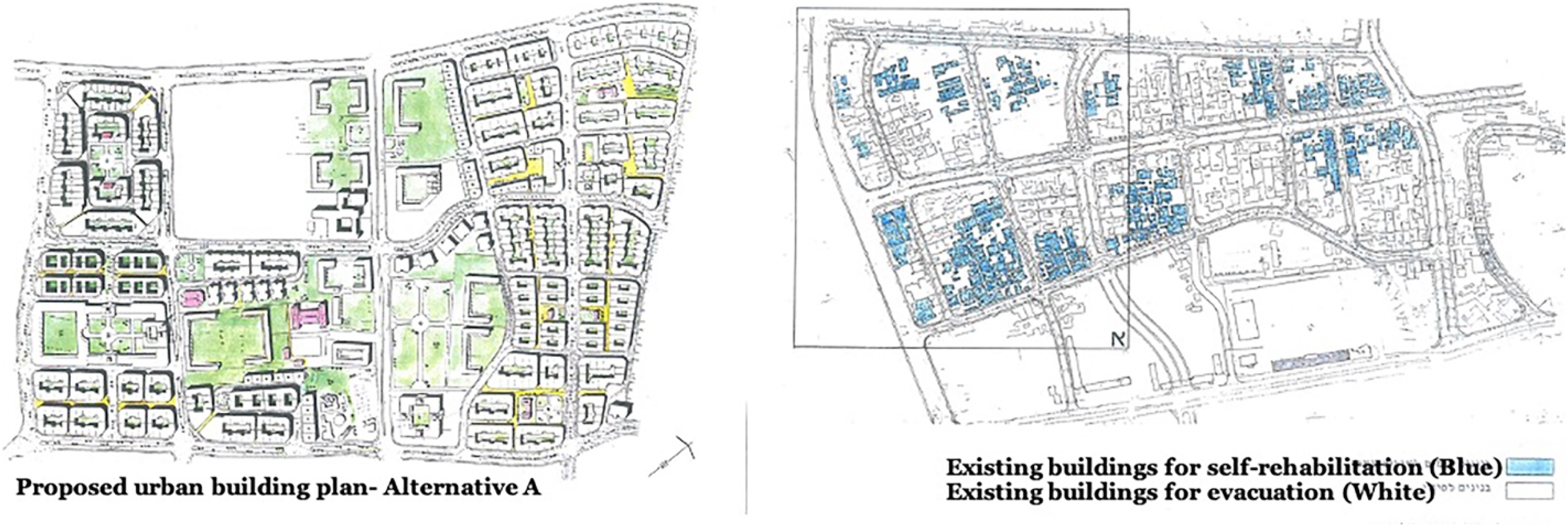
Epstein-Pliouchtch’s approach to architecture and urban planning had been shaped by her roots and education. Born in Russia, Epstein-Pliouchtch conducted part of her doctoral studies (1986–1990) at the Technion-IIT, Haifa, under the supervision of the militant Franco-Russian Jewish architect Anatole Kopp. Following his famous publication Town and Revolution (1967), Kopp had been invited to teach at the Architecture and Town Planning faculty in 1988. As his teaching assistant, Epstein-Pliouchtch became familiar with Kopp’s socialist agenda and radical communist persona. Kopp was prominent among the Hegelian-Marxist French intellectual revolutionaries who flocked to Algeria shortly after its independence. Alongside philosopher Henri Lefebvre, Kopp co-founded the magazine Espaces et Societés (1970), where his theories of urban design in the developing world were crystalized. Kopp’s recognition of freedom as an axiom and social realism in architecture and other urban fields had come about through his architectural engagement in self-management projects in the slums of Oued Ouchayah and Les Planteurs in Oran, Algeria (Crane, 2019; Falbel, 2008).
Epstein-Pliouchtch believed that social architecture could accelerate the Palestinian path to freedom, which could be achieved by turning refugees into property owners in the city, and the self-making of their lived environment. 13 Her ideas linked back to the Civil Administration’s self-management system, which subsidized 200–250 m2 plots and essential infrastructure. Epstein-Pliouchtch recommended housing typologies that fostered a sense of belonging to the new place by reconnecting refugees with their traditional way of living, embodied in the ‘hamula’ (clan) house. The ‘hamula’ house, as described by Epstein-Pliouchtch and Margolin, could resemble the core family home, developed around a courtyard as part of the traditional culture of living-in-making. Refugees would be empowered to rebuild their communities using local materials and their own traditional methods of construction. 14 Epstein-Pliouchtch pitched her ideas to Kopp in Margolin’s office, where the three discussed the resettlement projects and drawings. Kopp recalled being impressed by the Khan Yonis rehabilitation project and its demonstration of self-help planning and design strategies to resolve the problem of slums throughout the Middle East and North Africa (MENA) region.
The “vernacular of the heart,” experienced mainly in MENA’s architectural resettlement masterplans and housing projects (Avermaete, 2010: 259), was envisioned by Epstein-Pliouchtch as the right way to engage directly with the symbolic aspirations and needs of local inhabitants (Figure 3). Epstein-Pliouchtch’s approach to resettlement in Khan Younis was inspired not only by Kopp, but also the French-educated Egyptian architect Hassan Fathy, whose work to house the poor included the innovative use of traditional know-how and mass participation (practiced in Egypt, Morocco, Iraq and Pakistan after WWII).
15
Treating the self-help rehousing of low-income people as more than a managerial/organizational consideration, Fathy saw sustaining the human environment through an appeal to tradition and local knowledge as an instrument of responsive social reform. His grand articulation, expressed in the courtyard design and its relation to the community’s way of living (Pyla, 2007), was also adopted by Margolin office. A perspective drawing of the by Dr. Arch. Marina Marina Epstein-Pliouchtch for the refugee’s residential neighbourhood (Source: Refugees Rehabilitation Neighbourhoods in Khan Younis Masterplan’s booklet. Private collection of arch. Roni Margolin.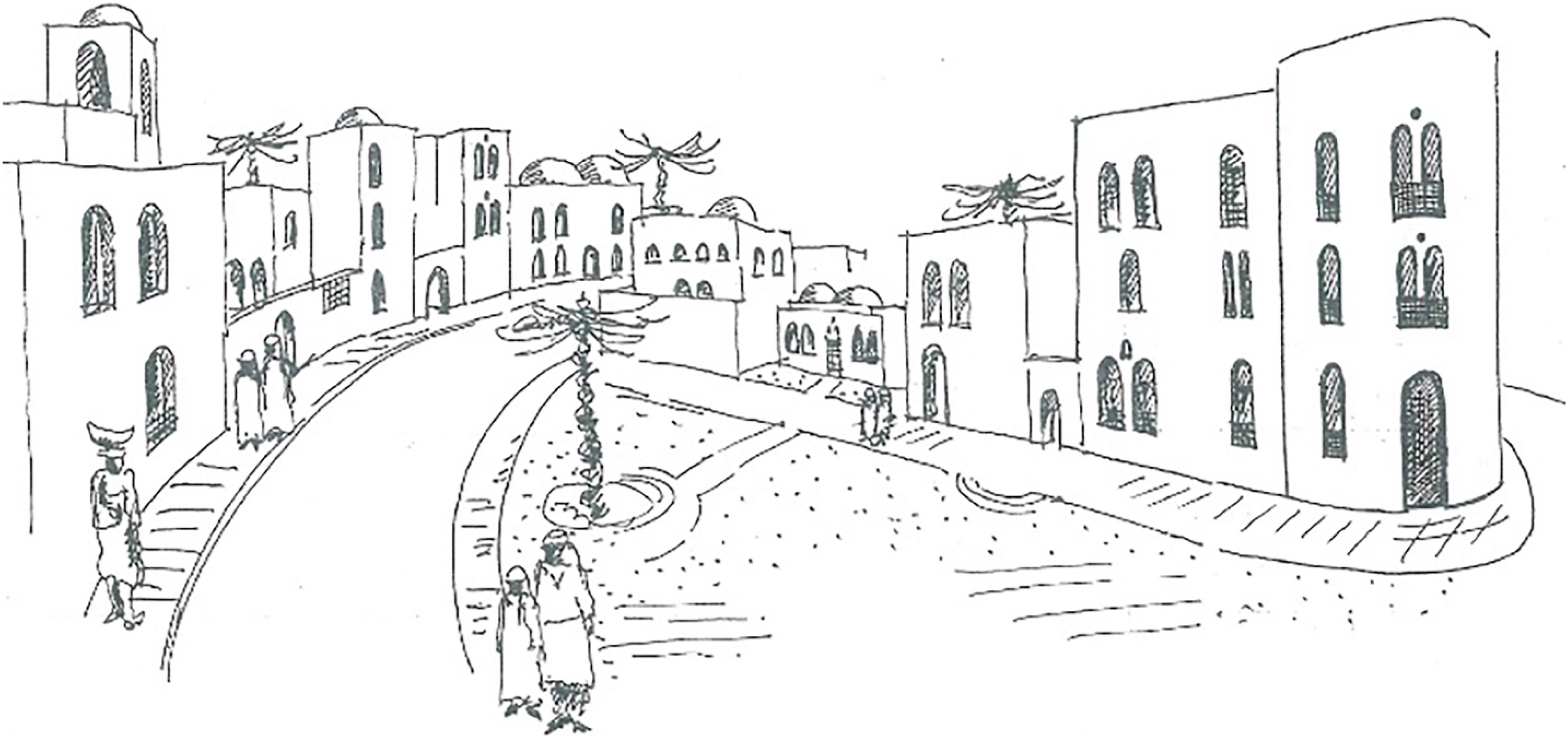
Through frequent meetings with refugees in the camp, Epstein-Pliouchtch became convinced of the role of the courtyard as an element of social reform. While undertaking a census of camp houses and practical area measurements, Epstein-Pliouchtch developed a deep familiarity with the refugees. She proposed self-help housing, based on the site-and-service model, with planned construction of residential community clusters of 6–8 floors around a shared courtyard. In turn, these clusters were to be built around a primary central courtyard, which would serve to concentrate basic public facilities. 16
Claims that imposing the values and vernacular of self-help served to improve the lives of an occupied people remain a matter of debate. In comparison to MENA’s cultural architecture, to which Israeli architects often refer, the self-help model deployed in colonial Algeria a short time before its independence, for example, was under the French declaration that Algeria is France (1958–1961). As part of the French integration policy, which treated Algerians as full-fledged French nationals in order to maximize exploitation of local land and resources, regrouping camps in the newly independent Algeria were transformed as development zones through the construction of semi-urban housing (Henni 2017). These practices, institutionalized in the (post)colonial era as a means of inclusion of the poor within national politics, purported to bring civilization to ordinary people, to reinvent the vernacular of ‘tradition’ as a novel mode of social recovery (Mitchell, 2002: chapter 6). Such practices allowed the fledgling nation, still experimenting with its cultural identity and freedom, to briefly imagine a path towards socialism rooted in revolutionary origins, in which architects were adamantly committed to Algerian autonomy (Crane 2019, 16).
As argued, the self-help projects implemented throughout decolonial MENA operated as a ‘causal’ architecture to reorganize socio-economic relations and national culture within a logic of economic development. Their imposition on colonized people, as in the case of the occupied Palestinian territory, was more a commitment to the science of planning and its representations in style, rather than to ideology or revolutionary premises. Seeking a middle ground between science and ideology, Israeli architects grappled with the intrinsic contradiction between their socialist values and the dispossessory practices of which they were a part. This intrinsic contradiction created a gap between the constitutive values of architectural disciplinary knowledge and their implementation and materialization upon occupied population to reshape militarized urbanism. Emptied of the socio-cultural values of self-determination and identity embedded in Cold War architectural knowledge, militarized urbanism emerged as another means of control. Thus, from the geopolitics of colonial warfare emerged the colonization of the everyday, where architectural knowledge is reshaped by logics of security.
Militarized urbanism in Khan Yonis, therefore, is evident in the limitation and transformation of architectural decision-making. To strike a balance between built and unbuilt spaces, the architects aimed for a density of 6–8 residential units per dunam. The actual result was as low as 2.5–3.0 residential units per dunam. 17 The decreased density, Epstein-Pliouchtch argues, was determined by military, rather than planning, professionals. Further, building height was limited to a maximum of four floors in order to ensure military control from above, particularly with respect to aerial surveillance. The skyline of the built environment, then, was shaped by an army zipline fixed near the camp to control the space from above, not by architectural considerations.
Military control was likewise asserted at ground-level. Architects had envisioned the main Sea Road, which traversed the city and camp from east to west, as a natural line of development for the seaside towers of the city and its new neighborhoods. Instead of utilizing the road as a public boulevard with commercial and leisure facilities, however, the military administration compelled the architects to keep construction back in order to secure the safe passage of Gush Katif’s Jewish settlers. 18 As state archival documents reveal, the Military Administration expropriated lands to be outlined in two, north-south ‘military strips’—one a kilometer-wide buffer along the Green Line, the other 500 m wide along the coastline. These military strips were demarcated as security zones for exclusive military use. 19 With civil construction and development prohibited, the military and Jewish Agency collaborated to convert the coastal security strip into a natural promenade, designed by the Israeli architect Saadia Mandel, for the exclusive use and welfare of Jewish settlers. 20 In this way, the military’s focus on ethnic separation and violence prevention came to compete with the planners’ civic agenda of development and self-aid. Despite the liberal values of its architectural conception, the urban fabric of Khan Younis was clearly informed by military concerns. At the same time, the architectural plans for the rehabilitation of Khan Younis comprised far more than technocratic social arrangements and are therefore irreducible solely to matters of security and military expediency.
Conclusions
The resettlement of Palestinian refugees in Khan Yonis reveals theoretical and analytical complexities with respect to civic agendas in settler-colonial contexts. Studying resettlement through the interrelated concerns of military and security, settlement and demography, and economy and development requires novel approaches to illuminate tensions between military strategies and cultural pacification practices. This article argues that the resettlement and rehabilitation of refugees in Khan Younis cannot be adequately understood through the epistemologies of colonial counterinsurgency and urbicide alone. These epistemologies omit multiple considerations and contradictions enmeshed in the colonial order and insufficiently address the accumulation of power in the exercise of cultural knowledge. With this in mind, the article demonstrates the contribution of historical and cultural perspectives to understanding the geography and geo-politics of settler-colonialism in conflict zones. The article proposes reading the resettlement of refugees in the Gaza Strip as part of specific histories of subordination and dispossession, informed by global development discourses that were rooted in the Cold War-politics of self-aid and economic development. The case of Khan Younis, for example, illuminates the United States’ approach to postwar humanitarianism in the developing world more broadly. Zionist settler-colonialism was thereby tangibly linked to and defined by western colonial models, including models of demographic colonization exercised by fascist Italy. Decolonial development practices articulated in the resettlement of refugees are therefore deeply inscribed within the discursive formations of settler colonialism.
Resettlement projects, as the article suggests, should be analyzed through the processes of their materialization, where the invisible violence of exploitation is enmeshed in these projects’ representations and forms. The urban fusion of the city and camp in the Gaza Strip introduced by the professional bodies of the colonizer must be more closely scrutinized in order to elucidate the multiple meanings of development, violence and power. Significantly, as pacification and resettlement projects in the Gaza Strip clashed with the colonizer’s security mandate, they illuminated a shift in urban and architectural cultural politics. This shift, dubbed ‘militarized urbanism,’ represents the transformation of the geopolitics of colonial warfare to the colonization of the everyday, where urban and architectural knowledge are reshaped by security logics in the mediation of conflicting civilian and political agendas. The dual mandate of architects and planners, who, though entangled in the colonial power’s politics of spatial segregation, often underscore a discourse of betterment and the right to the city, illustrates the contradictions and ambiguities of militarized urbanism. Projects to resettle Palestinian refugees in the Gaza Strip were not the causal outcome of development practices throughout the MENA region, nor the revolutionary architecture of a decolonial state. Rather, Israeli architects adopted values of self-determination and emancipation practiced by the settler-colonial state itself. Nevertheless, the scientific knowledge and cultural values these products are based upon cannot be ignored. As demonstrated in this article, the aesthetic, cultural forms employed to reshape the refugees’ built environment were in fact traditional forms repurposed to maintain Israeli dominance and control.
The investigation of refugee resettlement projects invites the question of their meaning today, when camps continue to shape the urban landscape of the Gaza Strip and refugees maintain their right of return. Moreover, Israel’s ongoing physical and economic blockade of the Gaza Strip—despite the evacuation of Jewish settlers from Gush Katif following Israel’s ‘disengagement’ from the Gaza Strip in 2005—underscores the centrality of settler-colonialism’s physical manifestations to the comprehension of its various modes more broadly.
Footnotes
Acknowledgements
I am very grateful for the valuable material provided by the interviewees, especially by architects Roni Margolin and Marina Epstein-Pliouchtch, who shared with me their personal memories and private collection. Thank for the referees for taking the time to review the manuscript and for their insightful comments and valuable suggestions on the paper.
Declaration of conflicting interests
The author(s) declared no potential conflicts of interest with respect to the research, authorship, and/or publication of this article.
Funding
The author(s) received no financial support for the research, authorship, and/or publication of this article.
