




Abstract
Critical adaptation research has documented how climate change adaptation responses largely tend to maintain rather than change the status quo. Building and expanding on these literatures, this article draws on poststructuralist discourse theory, specifically its notion of political fantasy, to explore further how these prevalent techno-managerial approaches to adaptation operate and what it might be that makes them seem appealing. Based on an exploratory, qualitative analysis of how affect (emotions) and fantasy are at play in the German government discourse on adaptation, the article discerns four specific forms that fantasy takes in official documents: (1) fantasies of control and preparedness, (2) fantasies of objectivity and reason, (3) fantasies of a shared sense of place, and (4) fantasies about ‘the good life’. These support the common narrative for how to adapt to climate change in the German context – primarily in a way that does not challenge or change the social order. The findings show that German adaptation policy is sustained and legitimised by fantasmatic elements that seek to speak to a-rational desires and provide important affective anchor points for collective identification, especially those evoking a shared sense of place. In other words, the German adaptation policy discourse is not constructed only at the level of rational argumentation, but very much so on the level of affect. In demonstrating this, the article makes the case for placing political fantasy into the analytical and theoretical vocabulary within critical adaptation research.
Keywords
Introduction
Despite increasingly clear indications about the serious and far-reaching social impacts of climate change and the need for adjusting to them, most policy and advice on adaptation to climate change to date remains surprisingly unambitious, maintaining rather than changing the status quo (Pelling, 2011; Eriksen et al., 2015; O’Brien and Selboe, 2015; Nightingale et al., 2019). There is a tendency for policy responses to portray adaptation as a (tame) technical problem that can be narrowed down with the help of scientific studies and responded to with technological solutions (paraphrased hereafter as a techno-managerial approach) (Remling, 2018; Taylor, 2015; Waller and Barnett, 2015). Such incremental approaches, which see adaptation as solvable through familiar patterns of action (Dewulf, 2013; Pelling, 2011), appear to be the norm rather than the exception, even though they have been shown to be less effective, just and sustainable than expected (Brown, 2011; Kates et al., 2012) and, therefore, contradictory of their declared goal to prepare societies for the impacts of climate change.
To understand the absence of more transformative approaches to adaptation, researchers have turned their attention to the political and material contexts in which adaptation policy is made (e.g. by drawing on political ecology, see Leichenko and O’Brien, 2008; Taylor, 2015; Eriksen et al., 2015), they have scrutinised the discursive processes which underlie them (e.g. by drawing on biopolitics/governmentality studies, see Oppermann, 2011; Cannon and Müller-Mahn, 2010; Andersson and Keskitalo, 2018), they have considered social, cultural and institutional barriers to effective adaptation (Eisenack et al., 2014; O’Brien and Hochachka, 2010), and they have argued for more ontological pluralism in order to open up for new imaginations (Keskitalo and Preston, 2019; Nightingale et al., 2019; Nyamwanza and Bhatasara, 2015). Yet so far, adaptation research–even the more critical strands–have largely ignored the role of human emotions and social passions (see Nightingale et al., 2022 for the best exception).
This article, therefore, puts forward a different, but I believe fruitful, avenue for exploring the prevalence of business-as-usual approaches to adaptation by drawing on the theoretical toolkit of poststructuralist discourse theory (Laclau and Mouffe, 2001 [1985], and beyond). Specifically, the article focuses on the affective (emotional), a-rational aspects of adaptation policy discourse, the realm of (ideological or political) fantasy. Using fantasy analytically to capture key aspects of adaptation policy discourse that are often overlooked in existing studies, it offers a first, exploratory venture into considering the operation of affect in such discourses and shows that beyond their seemingly ‘rational’ content these techno-managerial policies seek to mobilise different latent desires and emotions and are thus ‘emotionally and fantasmatically loaded’ (Kapoor, 2014: 1118).
Shedding light on these emotional support structures seeking to sustain techno-managerial adaptation, I argue, can be a productive entry point for understanding how certain official adaptation discourses operate, take hold, expand and persist, despite their apparent ineffectiveness, and therefore be used as an additional analytical category when critically examining adaptation policy.
The psychoanalytical notion of fantasy (Glynos and Stavrakakis, 2008; Žižek, 1997) captures social imaginaries and political desires that can empower or disempower specific modes of action, and by doing so connects political discourses to social identities. Using the German national adaptation policy as a ‘paradigmatic case’ (Flyvbjerg, 2001) broadly representative of techno-managerial approaches to adaptation, I ask: what are the fantasmatic elements, the narratives that are entwined with desire and emotion, that support German adaptation policy? Based on an interpretative analysis of key official documents by the German federal government, I provide four examples of how affect and fantasy are at play in the policy. These I term (1) fantasies of control and preparedness, (2) fantasies of objectivity and reason, (3) fantasies of a shared sense of place, and (4) fantasies about ‘the good life’. Taken together, the four fantasies support a common narrative for how to understand and act in German society to address climate change – primarily in a way that does not challenge or change the social order. The analysis shows how the politics of adaptation is intrinsically intertwined with identity projects and spatial imaginaries, in the sense that the German policy is supported by fantasmatic narratives that seek to play with peoples’ diverse relationships with landscapes and places, thereby attempting to provide affective anchor points for national and collective identification. As a caveat, there is no automatic link between the presence of fantasmatic narratives in a policy discourse and their success in evoking attachment in its audiences, and this article does not assess the reception of these policies by the German public or suggest the policy discourse indeed succeeds in arousing desire and channelling it to stabilising the social order. Such questions, while important, are left for future analysis.
The article contributes to two fields of research. On the one hand, drawing on the notion of political fantasy it introduces a novel theoretical perspective to the study of adaptation discourses that allows the tracing of the role of desire and affect in adaptation governance and thereby makes a contribution to critical adaptation research (Bauriedl and Müller-Mahn, 2018) at a conceptual level, and in the empirical context of Germany in particular. On the other hand, the article contributes to a new field of investigation which operates at the intersection of poststructuralist discourse theory and psychoanalysis, that Jason Glynos (2021) calls critical fantasy studies, and here specifically to a small but growing number of empirical studies on fantasy in policy discourse (Clarke 2018, Gunder, 2015, Gunder and Hillier, 2009, Fotaki, 2010).
The article is structured as follows. In the next section, I provide the notion of fantasy with more theoretical grounding. I then highlight a lack of conceptual and empirical attention to this in previous work and give an overview of my empirical material. This is followed by the analysis and discussion sections where I present the four fantasies and their potential joint affective potency. Finally, I draw some conclusions for critical adaptation studies and outline implications for future work.
Theoretical points of departure: The operation of political fantasy in policy discourses
The idea behind the notion of fantasy is that ‘political discourse [only] succeeds when we recognize ourselves as its addressee’ (Salecl, 1994: 33). Evidently, not all discourses are equally influential and effective at arousing subjects’ desire, otherwise no discourse would be more prevalent than another. Building on Lacan’s psychoanalytic theory, the idea of fantasy recognises that what enables discourses to become objects of long-term identification, and hence discursive fixity, is what ‘sticks’ to and ‘fuels’ identification processes in subjects, at the individual level and collectively (Glynos and Stavrakakis, 2008; Žižek, 1997). This is to say, that in order to become a viable political project, a policy discourse has to connect to its audience by providing an ‘attractive affective discourse’ (Bloom, 2016: 168). This suggests there to be something more to prevalent techno-managerial adaptation discourses than ‘just’ language. 1
For research that aims to understand the dominance of such discourses, the notion of fantasy suggests that it is not enough to stop at the description of such discourses’ content and contingent construction, but that its critical analysis must also offer an account of what it is that potentially makes these discourses seem appealing, what they might ‘move’ in people (Glynos, 2001). That is why the analysis of fantasy is a useful complement to existing conceptual approaches, because it may help clarify how responses to the discourse on climate change are (emotionally) organised, sustained and potentially transformed.
To grasp the notion of fantasy, it is useful to discuss the Lacanian understanding of the process of identity formation. For Lacan, subjects (i.e. people/social actors) do not have underlying or fixed identities (Laclau, 1994). Instead, in the absence, or lack, thereof subjects–and by extension the communities to which they belong–are driven to seek representation of themselves through a continuous process of identification that is ongoing throughout a person’s life (Glynos and Stavrakakis, 2008). That is to say, identities are not recognised or discovered, but socially constructed (Laclau, 1994; Stavrakakis, 2005). However, as the absence of a complete identity is of ontological nature, the subject never manages to fulfil its desire and is forever caught in a dual tension between the fundamental lack of a fixed identity and the attempt to cover over that lack (Eberle, 2017; Stavrakakis, 2005; Žižek, 1997). What forms identity in the first place, then, is this ‘ever impossible but also never-ending drive, longing, for bringing back a lost wholeness’ (Bloom, 2016: 162). This is where fantasy comes in, offering ‘points of identification’ (Glynos and Stavrakakis, 2008: 261) that ‘grip’ subjects of a discourse, promising the enjoyment of an imaginary fullness or wholeness, providing them with forms of identification and, thereby, (the promise of) seeming ontological security (Glynos and Howarth, 2007; Glynos and Stavrakakis, 2008).
Importantly, fantasy is not a synonym for illusion or falsehood (Žižek, 1997). Rather, the idea is that fantasies play a necessary and productive role in all discourses to provide anchor points for identification. Because of subjects inherent ontological lack, fantasy is correlative with our very constitution as subjects (Eberle, 2017: 252). As Glynos (2011: 73) proposes, fantasies are ‘ineliminable and essential to action’. What fantasy conceals is not necessarily some positive, ‘real’ content but rather the precarious foundations and inherent contradiction of the hegemonic social order. Fantasies help secure our consent and compliance, by helping ‘make reality smooth, coherent and harmonious, protecting us from trauma or lack, gentrifying turbulence or negativity, and promising a world that is more bearable, attractive and enjoyable’ (Kapoor, 2014: 1134). By arousing desire and channelling it towards particular objects, outcomes or particular versions of social order fantasies are ‘inevitably political’ (Eberle, 2017: 251).
Glynos and Howarth (2007) operationalise these theoretical foundations into a beatific and a horrific dimension of fantasy, which often (but not always) operate alongside one another. The beatific dimension promises an enjoyment of an idealised scenario, intended to act as a motivational ‘spur to action’. Solving climate change through technological innovations, and ‘sustainable consumption’ are two common examples of such beatific fantasies (Wright and Nyberg, 2014). The horrific dimension entails an alarming prospect about the future if a proposed path is not followed. This often describes an apocalyptic scenario, which may invoke fear and anxiety amongst its subjects.
The relevance of fantasy: Overlooked in adaptation research
While psychoanalytical notions of the subject and their implications for fantasy have in recent years gained growing interest in a number of academic fields across the social sciences including in ethnography, sociology, human geography, international relations, political ecology, spatial planning, and development studies (Eberle, 2017; Glynos and Stavrakakis, 2008; Gunder and Hillier, 2009; Kapoor, 2014; Robbins and Moore, 2013; Sjöstedt Landén et al., 2017; Warner et al., 2019), in the context of adaptation policy analysis, they have been largely underexplored, theoretically and empirically. Most analyses tend to take a rationalist approach to policy norms, discourse and meaning, assuming that adaptation happens in an ‘emotionally free vacuum’ (Clouser, 2016: 322). A telling example is Vogel and Hengstra (2015), who lay out a research agenda for comparative analysis of local adaptation policy which in no instance mentions the influence of emotions on policy development (the same goes for Dolšak and Prakash, 2018). With a few notable exceptions (see Symons, 2014; Nightingale et al., 2022; Wright and Nyberg, 2014), there is a gap in adaptation research when it comes to understanding what it might be that makes certain discourses more appealing than others, how subjects, policymakers, communities, or municipalities might recognise themselves as addressees of certain narratives and come to identify themselves with them, and how established discourses become accepted as authoritative.
Also, at a broader level in the context of climate change governance, previous research on fantasies is limited (see Methmann, 2014; Mert, 2015; and Bedall, 2015 for notable exceptions). A small number of studies inspired by Foucauldian discourse theory examine the role of apocalyptic imagery in climate change debates, especially in relation to ‘climate migration’ (Bettini, 2015; Methmann and Rothe, 2012; Swyngedouw, 2010; Symons, 2014). While studies based on Foucaultian discourse analysis offer important tools for the analysis of knowledge-power systems and insights into dominant discourses, they are less clear in providing an understanding of why these discourses manage to take hold, persist or how they change. They also fail to account for how they are mediated at the level of the individual (Kapoor, 2014). 2 This is where the psychic factors in fantasy studies go beyond governmentality studies, by homing in on the a-rational, emotional investments in powerful discourses. The notion taps into what captures political desires and can help explain both resistances to change of social practices (inertia) and the speed and direction of change (vector) (Glynos and Howarth, 2007).
Methodological strategy and empirical material
The choice of Germany as a case is based upon the country’s relatively high level of adaptation activities, its early involvement in establishing adaptation policies, and the fact that it often presents itself, and is widely seen, as an ‘adaptation leader’ (Biesbroek et al., 2010; Massey et al., 2015). As most places in the world, and despite being the largest national economy in Europe, Germany will be affected by climate change (see Brasseur et al., 2017 for details), as the devastating floods in July 2021 clearly demonstrated.
A small number of articles examine adaptation policy development in Germany, most of them published in German. These have focused on policy choices when constructing policy frameworks (Massey et al., 2015), the process and context of the policies’ emergence (Vetter et al., 2017), and the interministerial coordination within the German government around the development of the national adaptation action plan (Hustedt, 2014); they have proposed a set of criteria for prioritising federal adaptation measures (Vetter and Schauser, 2013), and examined the consideration of sustainable development trajectories in national adaptation planning (Lucas and Von Winterfeld, 2015).
Documents included in the analysis. 3
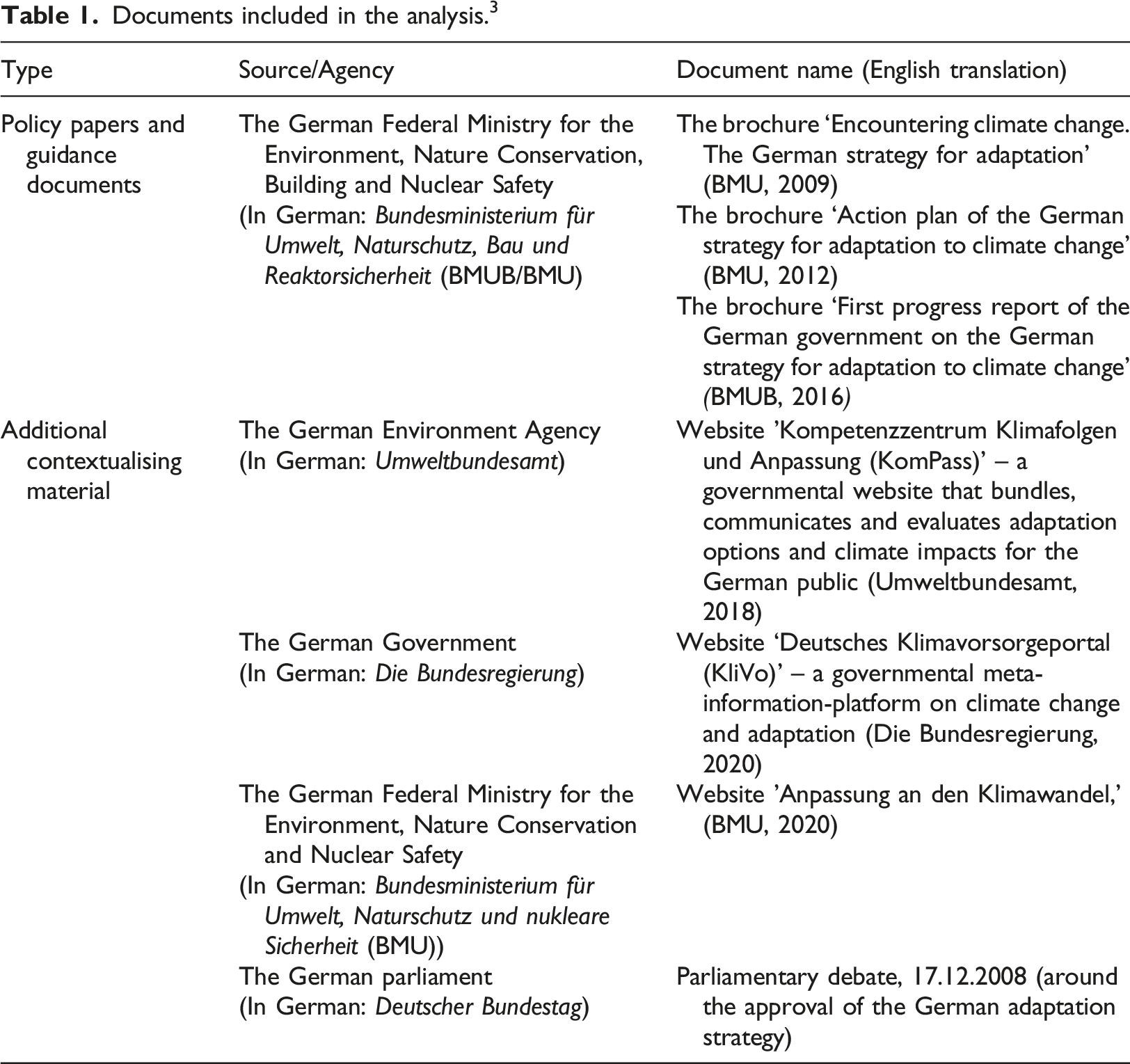
It is important to acknowledge that while this material allows me to assess the presence of fantasmatic content in official discourse (in policy texts and imagery), it does not provide insights into whether the public brochures indeed manage to engage the German public (its audience) emotionally so that it becomes invested in and identifies with the policy programme, individually or collectively. As pointed out in the introduction, from this analysis I draw no inferences about whether climate adaptation in Germany is indeed attractive and seen as authoritative by the wider public.
A number of studies have explored the fantasmatic support structures of public and policy discourses. These have focused on the health and age care sector (Fotaki, 2010; West, 2011), on education policy (Clarke, 2015), foreign policy (Eberle, 2016), transport planning (Griggs and Howarth, 2013), urban, regional and spatial planning (Gunder, 2014; Gunder and Hillier, 2009; Sjöstedt Landén et al., 2017) and the 2030 Global Development Agenda (Telleria and Garcia-Arias, 2021). These studies have often tended to use material that is ‘disproportionally charged’ or invested with affect, such as news media discussions (Chang and Glynos, 2011; Eberle, 2016; Sjöstedt Landén et al., 2017), sheer ‘unrealistic’ planning visions (Gunder, 2014) or ‘polemic’ speeches of politicians (Bloom, 2016). The language in policy discourses, that are the focus here, is generally more measured in degree, and fantasmatic clues therefore oftentimes more subtle than in media or public discourse. Accounting for this and acknowledging that the analysis of fantasies is interpretative, through a process of qualitative, retroductive coding, I identified fantasies as following three linguistic tropes: (1) promises of ‘the good life’ and ‘mythical utopian horizons’ (Glynos and Howarth, 2007; Gunder, 2015); (2) apocalyptic and emergency imaginaries (Glynos and Howarth, 2007); and, more generally, (3) animations of ‘popular desires’ and ‘Germanness’ that seek to establish anchor points for affective investment. Besides text, in my analysis I also take into account the accompanying images through which the documents seek to make meaning. I assume that these images are not added arbitrarily but with the specific purpose of providing potent emotive communicative tools that policymakers choose to address the German public, and thus contribute an important part to the making of meaning and fantasy in the policy texts (see also Eberle, 2016).
Analysing fantasies in German adaptation policy discourse
The main pillars of Germany’s climate adaptation policy are the 2008 Strategy for Adaptation to Climate Change (the so-called DAS) (Die Bundesregierung, 2008) and the corresponding Adaptation Action Plan from 2011 (the so-called APA) (Die Bundesregierung, 2011). Progress on both of these was assessed in a ‘progress report’ in 2016, which also laid out some further steps (Die Bundesregierung, 2015). A federal level policy, the Strategy was developed after the Länder (Germany’s federal states) and large re-insurance companies had requested national guidance and leadership on adaptation (Massey et al., 2015).
In the policies, greenhouse gas emissions, caused by ‘mankind’ (BMU, 2009: 12, 16) are seen as causing significant changes in the climate worldwide, including in Germany. Vulnerability to such changes is largely understood in regional terms and the policies lay out where the greatest vulnerabilities lie: in the Alpine region, south-western Germany, the northeast German plain, the southeast German basin in Thuringia and the coastal regions of the North Sea and Baltic Sea.
Corresponding to the idea of climate change affecting different regions, adaptation is primarily seen as a local or regional problem (BMU, 2009) to which people ‘on the ground’ should adapt. Accordingly, the responsibility for adaptation is delegated to the local and regional level (BMU, 2009), specifically to municipalities (BMU, 2012). Moreover, beyond this delegation downward, the responsibility for implementing adaptation is also directed away from states and institutions and on to individual citizens and businesses (BMU, 2009). Central signifiers here are ‘Eigenvorsorge’ and ‘Eigenverantwortung’, which roughly translate to taking responsibility for oneself, being self-sufficient or self-reliant (BMU, 2012). This individualisation of responsibility is what Chandler and Reid (2016) identify as a typical feature of contemporary neoliberal approaches to policy, where individuals are prescribed responsibility to change their behavior to adjust to different societal challenges (for a critique of the German adaptation policy, especially this delegation of responsibility to the local and individual level, see Lucas and Von Winterfeld, 2015).
Adaptation is never clearly defined in the DAS or the APA (see also Hustedt, 2014), but the general guidelines for concrete adaptation measures are that they should be ‘pragmatic’, ‘cost-effective’, focus on ‘no-regret measures’, be ‘based on scientific knowledge, led by the precautionary and sustainability principles’ (BMU, 2012: 12), and that adaptation be ‘mainstreamed’ into existing and future plans and strategies (BMU, 2012: 14, 15; BMUB, 2016: 27). The main contribution to adaptation by the German national government is to support research in order to ‘close knowledge gaps’ and reduce uncertainties (BMU, 2012: 21), and to support the building of capacity and understanding of responsibility of municipalities, and of individuals and businesses, to equip them so that they can adapt on their own (BMU, 2009, 2012).
By focusing almost exclusively on such ‘soft’, incremental measures that focus on knowledge generation and information provision (Vetter et al., 2017) the policy discourse implicitly suggests that previous strategies, approaches and ways of operating are compatible with a climate-changed world. Whether such an approach to adaptation will be sufficient to adjust Germany to future changes has been questioned (Vetter et al., 2017), yet it ties neatly into policy discourses at the European level (see Remling, 2018) and is typical for most EU member countries’ national adaptation policies (Vetter et al., 2017).
In what follows, I provide four examples of fantasmatic elements in German adaptation discourse, as identified from the documents. These are not the only fantasies at play in the German adaptation discourse–others not discussed here relate to increased migration flows from Africa and to Germany’s leading role in adaptation at the European and international level–but they stand out most strongly from the qualitative analysis in aiming to provide affective support for the proposed policy response. I outline what each fantasy involves in terms of its basic content and how it seeks to direct enjoyment, and (in the discussion section) outline what the collective effects of these fantasies might be.
Providing future certainty: Fantasies of control and preparedness
The German adaptation policy is firstly underpinned by fantasmatic assertions of control. The documents follow a common argumentative structure; climate change poses challenges for health, water, soils, biodiversity, fisheries and the energy sector and so forth, but this is followed by examples of actions already being undertaken by the government to ameliorate these impacts. For example, in its central chapter ‘The impacts of climate change – what can be done?’ the DAS-based brochure highlights numerous existing initiatives by federal states and the national government that serve the greater cause of adaptation, including a joint ‘climate-biomonitoring programme’ (BMU, 2009: 23), an ‘action plan against allergies’ (ibid. 24), a Government ‘programme on environment and health’ (ibid. 25), a ‘Joint Task for the Improvement of Agricultural Structures and Coastal Protection’ (ibid. 28), the ‘National Strategy for the Sustainable Use and Protection of the Seas’ (ibid. 29), a national program to promote research on ‘sustainable land management’ (ibid. 30), and working groups on ‘Crisis prevention in the energy sector’ (ibid. 38) and ‘Climate change and civil protection’ (ibid. 44). It also emphasises the competencies of existing government agencies and research institutes such as the Robert Koch Institute, responsible for disease control and prevention, and the German Meteorological Service (ibid.). The documents emphasise congruence with existing policies, such as the High-tech Strategy 2020, and the national Biodiversity and Forest strategies (BMU, 2012).
This fantasy of control and preparedness suggests to readers that even though ‘we’ now live in a climate-changed world without precedent, climate change-related troubles are manageable within current policy frameworks and approaches. This is to (re)assure the German public that the government and its federal states are already undertaking a wide range of activities that support adaptation. Emphasizing ongoing research initiatives, existing policies and actions, and the competence of involved actors, serves to affirm to the public that most of the identified climate risks are under control. Presenting adaptation as a continuation and reinforcement of business-as-usual, reassures enjoyment in present lifestyles and trust in and authority of the government. It also places the emphasis on continuity rather than change, where climate change is not seen as a reason to rethink existing policy agendas.
Scientificity as the saviour: Fantasies of objectivity and reason
The second fantasy, closely related to the first, I term objectivity and reason. Here, scientific research serves as an answer to the fundamentally political question of how to do adaptation. This is evidenced by headings such as ‘Knowing how – research helps adaptation’ (BMU, 2009: 48). Throughout the policy discourse, considerable emphasis is placed on the importance of scientific knowledge, practices of measurement, calculation, and prediction. For instance, ‘documenting’, ‘collecting data’, ‘modelling’ and ‘monitoring’ (BMU, 2009), and developing and testing ‘technologies, procedures and concepts for adaptation’ (ibid. 53) is presented as key. The national government aspires to help businesses, organisations and local administrations by providing ‘toolboxes’ and ‘checklists’ for adaptation, as well as a catalogue of ‘best practice’ examples (ibid. 54). The APA-based brochure refers to ‘computational models’, ‘observation methods and systems’, ‘multi-model ensembles’ (BMU, 2012: 13), ‘vulnerability assessments’ and ‘cost benefit analysis’ (ibid. 15).
Many sections in the documents express an inflated sense of confidence in projections derived from these exercises, which are generally subject to significant unknowns and uncertainties (for problems concerning the use of climate projections for concrete national and local-level adaptation planning, see Nissan et al., 2019). For example, the DAS in speaking about climate models and projections states; ‘At least in Germany, there are four regional models, with each of which three emission scenarios were calculated. Further calculations will follow’ (BMU, 2009: 18). Sigmar Gabriel, the BMU Minister at the time, echoed this hope; ‘By the way, we have one great advantage: unlike other countries, we have four climate models in Germany’ (Deutscher Bundestag, 2008: 21071). This suggests that having four climate models would leave Germany one step ahead compared to other countries, thereby, deriving enjoyment from being ‘better off’ than others.
Significant trust is put not only on the importance of evidence but also into the accuracy of calculations for decision making: ‘The Federal Government will take into account the entire spectrum [of climate scenarios] and uncertainties in its planning and decisions, and will not rely on the results of a single model. […] The Federal Government will plan adaptation in such a way that it will achieve its goal with high accuracy, even under different climate scenarios.’ (BMU, 2009: 18). These diverse techniques of ‘objective calculation’ are presented as having unquestionable objectivity, which is to say they give precise and clear indications of what needs to be done. For example, ‘From this [documentation of climate impacts and the impacts of adaptation initiatives on species and biotopes] it is then possible to deduce what can and must be done’ (ibid.: 33, my emphasis). To support the impression of scientificity, several images accompanying the text depict libraries (see Figure 1), stacks of books (BMU, 2012: 24), and weather stations on the North Sea and in the Alps (BMU, 2009: 48f, 53). Objectivity and reason (BMU, 2012: 14).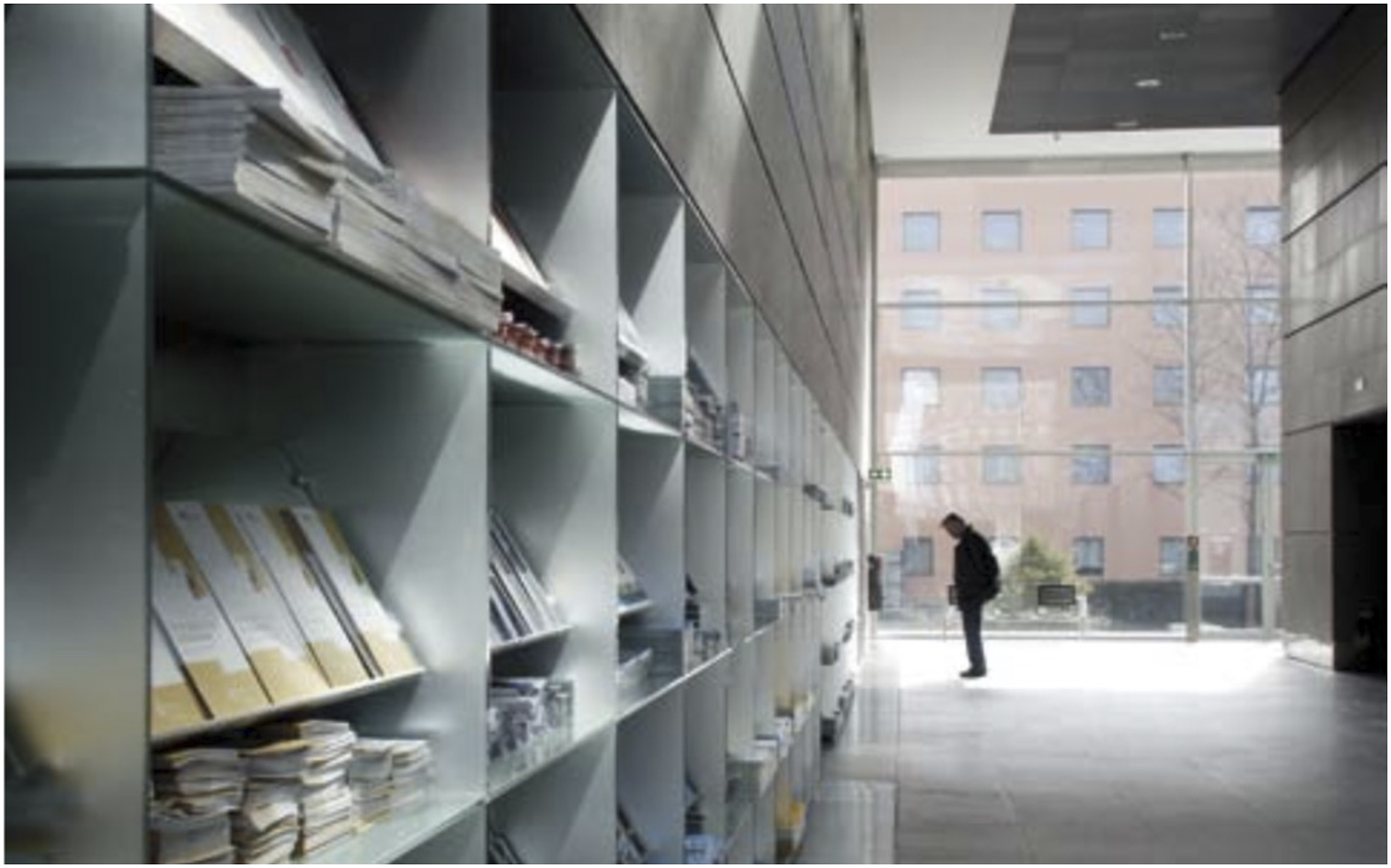
Importantly, the fantasy of objectivity and reason also articulates something about desirable personality traits of (Germans as a) people; they are–or ought to be–led by reason, be considered, prudent and factual. Decisions should be made in a ‘structured’ (BMU, 2009: 7), ‘systematic’ (ibid. 52), and ‘pragmatic’ (BMU, 2012: 14) way, based on ‘indicators’ (BMU, 2009: 52).
Premised upon the idea that more knowledge (more data and new modelling techniques) will lead to better adaptation responses, this second fantasy with science and objectivity as its–what Žižek (1997) has referred to as–sublime objects suggests that climate change and the problem of adaptation can be tamed, managed and remedied through ‘sound and continuously updated scientific research’ (BMU, 2009: 8). Its function, then, is to present adaptation as a problem soluble through objective measurement and analysis were science, not politics becomes the inventor of legitimate solutions. Relatedly, the policy discourse gives the impression that choosing adaptation responses is a relatively straightforward process, in which ‘the impacts of global climate change are identified, risks assessed, action requirements identified, and measures for adaptation are developed and implemented’ (BMU, 2012: 8). It frames the issue of adaptation as if there were no difficult choices to be made, only objective scientific assessments and evaluations to be carried out, which give unquestionable indications for what needs to be done in relation to adaptation and how. This is in contrast to growing acknowledgement that adaptation is deeply political (Eriksen et al., 2015).
The land of plenty and wilderness: Spatial imaginaries of a shared sense of place
A third fantasy, and the one arguably most ‘affectively potent’–the emotional keystone so to speak of the German adaptation discourse–centres around imaginaries of Germany as a specific place. This is strikingly operative in many of the images contained in the documents (but not so much in the written text) and features supposedly characteristic ‘German’ landscapes, places, and iconic sites. Images depict rivers and forests, snow-peaked alpine mountains, the North and Baltic Sea coasts, bogs and marshes, fields of bright-yellow flowering rapeseed, and other ‘typical’ agricultural landscapes. The way these iconic landscapes are portrayed gives the impression that Germany is a picturesque, wild, and pristine place (there are for instance comparatively few images of towns or cities). Images also depict specific places and recognisable sites that hold cultural weight for German society, such as the Donau river (see Figure 2), the city of Dresden, the Reichstag building (BMU, 2012: 18f), the Brandenburger Tor (BMU, 2012: 1), the historic ‘Fountain of Justice’ in Frankfurt am Main (BMU, 2012: 32), and Strandkörbe (BMU, 2009: 22). 4
By drawing upon this existing reservoir of somewhat cliché, but nevertheless publicly recognizable cultural signifiers, the policies seek to connect to places and landscapes that supposedly hold special meaning to German people, where they live or which they utilise on a regular basis. Invoking feelings of Heimat, they appeal to Germans’ identity of place, or ‘sense of place’ (Tuan, 1977). Essentially, speaking to a sense of belonging, they are about the question of ‘who we are’ as a people. By relating climate change to such recognisable (and desirable) objects and landscapes, the government brings the abstract issue of global climate change down to the local geography that matters to people. The land of plenty and wilderness (BMU, 2009: 19).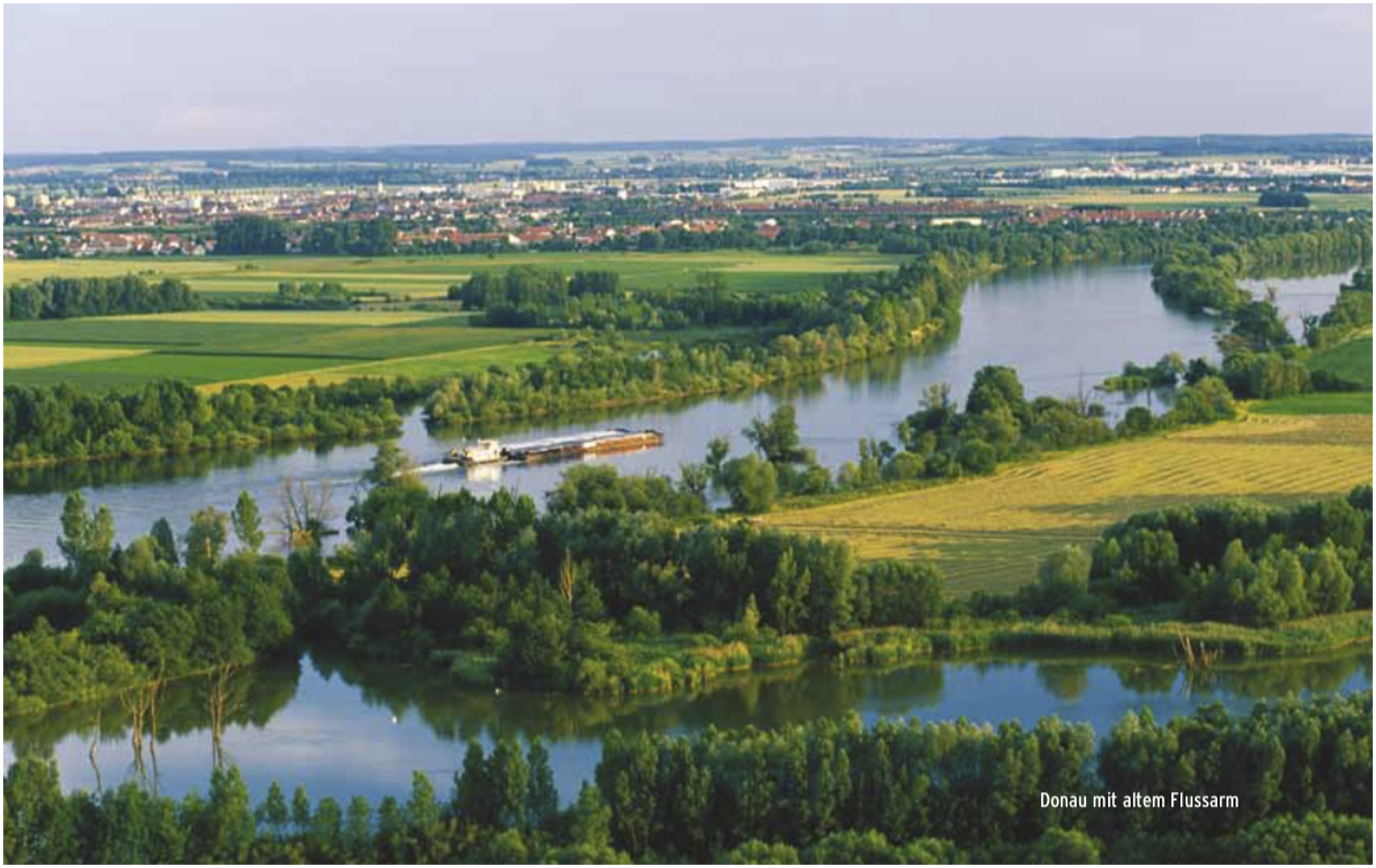
Noteworthy is that these spatial imaginaries of a shared sense of place engage in a dual play, in that they seek to play with public joy and anxiety, through a beatific and a horrific scenario. Appealing to the assumed place identity noted above, these images serve to demonstrate the threat climate change poses to places and landscapes Germans hold dear through the horrific scenario, and evoke that same place identity to motivate adaptation action (in order to protect those very places and lifestyles).
Shared joy: The beatific scenario of the leisurely life
The beatific scenario intertwined with the fantasy of sense of place is that of the ‘leisurely life’. This appeals to properties that supposedly constitute a particular ‘German’ way of life–landscapes and places that are frequented, experiences that are shared–through which ‘the German community’ organises its enjoyment (Howarth, 2013). It shows people (Germans) as enjoying themselves in their leisure time, or while on holidays. Against the backdrop of wild beaches, snow-peaked mountain tops, forests, and parks people are depicted socialising, walking, hiking and cycling, or simply relaxing. This shows people how to enjoy in the literal sense (e.g. by socialising and being active), but it also alludes to Germans as knowing how to enjoy (life) in general (this is a romanticised image of ‘German’ life: we do not see people working, shopping, paying bills, cleaning, sitting in traffic, or looking after their house, garden, kids etc.). However, this is not only some abstract fantasmatic promise, but one that hinges on concrete and lived bodily experiences that people may have had (Stavrakakis, 2005). It seeks to appeal to certain modes of feeling people may have experienced, for instance while enjoying a summer’s evening in a park with friends (see Figure 3), walking through a rainy forest protected by an umbrella (BMU, 2012: 6f), or reading a newspaper tucked in a Strandkorb on a beachside holiday (BMU, 2009: 22). The leisurely life (BMU, 2009: 25).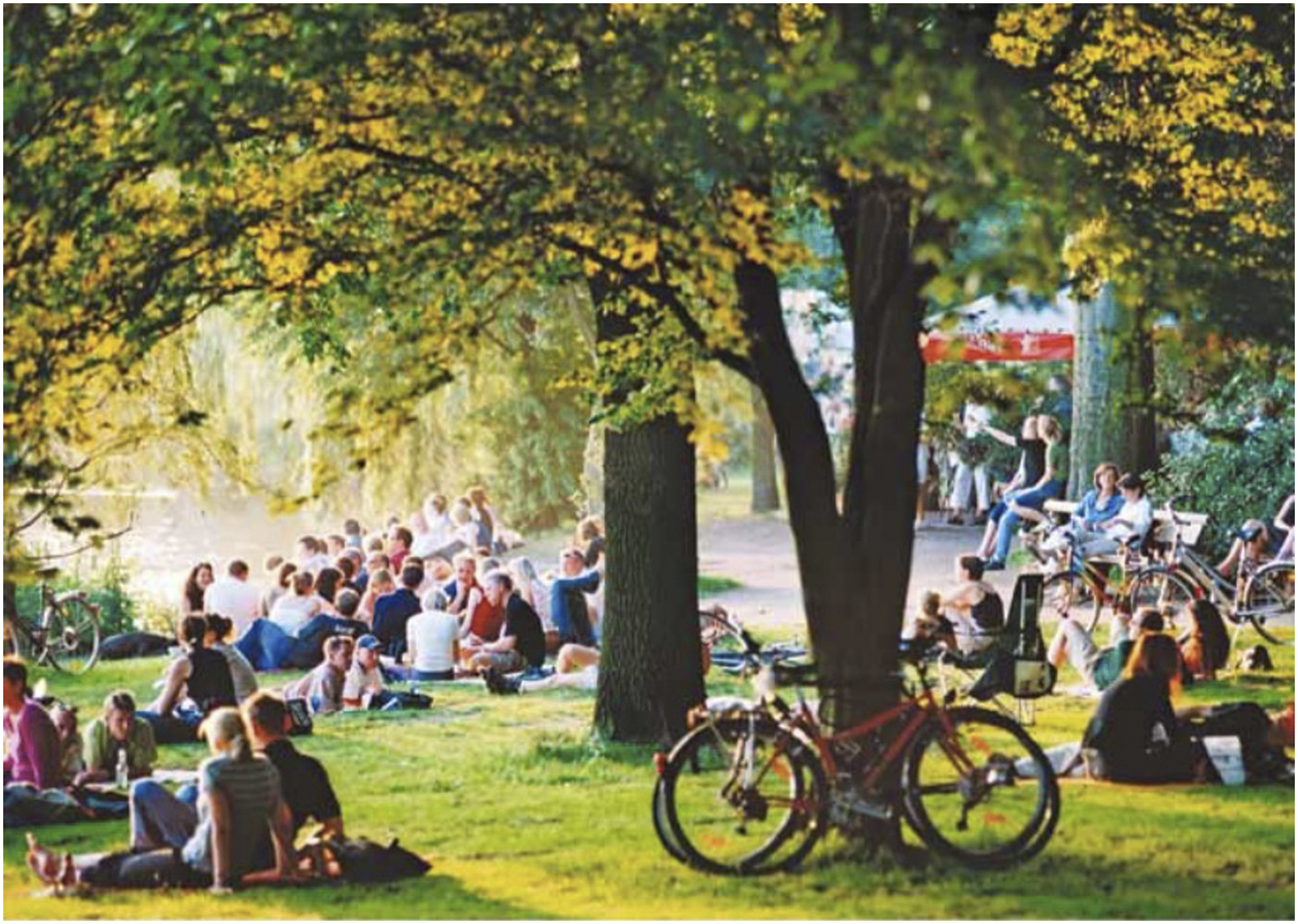
By relating to such supposedly shared ways of enjoying (or desiring), the beatific scenario constructs a collective ‘us Germans’ and provides a sense of ‘who we are’. In other words, ‘we’ know how to enjoy (life), and ‘we’ all do it in a similar way, through similar ways of passing time and practices of consumption. Differences within German society are only mentioned in a few instances throughout the documents, in relation to people who might not be able to afford insurance schemes against climate risks (BMU, 2009: 39) and in relation to the elderly, children and people with health issues (ibid.: 24, BMU, 2012: 31). Beyond that, differences for instance in socio-economic status do not feature. This demonstrates the policies’ ambition to mask divisions and establish, consolidate and depict German society as a seemingly homogenous group, with no internal antagonisms (see Telleria and Garcia-Arias, 2021 for similar rhetorical mechanisms in the 2030 Agenda). Interestingly, the beatific aspect of the leisurely life serves both as a prelude to the horrific dimension, in that it shows what is at stake, and it shows the good life German’s will have after adapting to climate change in accordance with the government’s plans.
Public anxieties: The horrific scenario of society in disarray
A second scenario intertwined with the fantasy of sense of place I termed society in disarray. Here, images that speak to a shared sense of place overlap with those that show undesirable consequences resulting from flooding, storm events, or changing precipitation patterns for seemingly culturally recognisable, ‘affectively charged elements’ (Glynos et al., 2014: 194). Examples of such disarray include flood waters rising around traditional Northern German Fachwerk houses (see Figure 4) or causing chaos on a suburban avenue (Allee in German)
5
(BMU, 2012: 36), storm clouds gathering on a Baltic Sea beach (BMU, 2009: 46), and empty ski lifts over sparsely snow-covered grass (BMU, 2009: 20f, 42). Society in disarray (BMU, 2012: 12).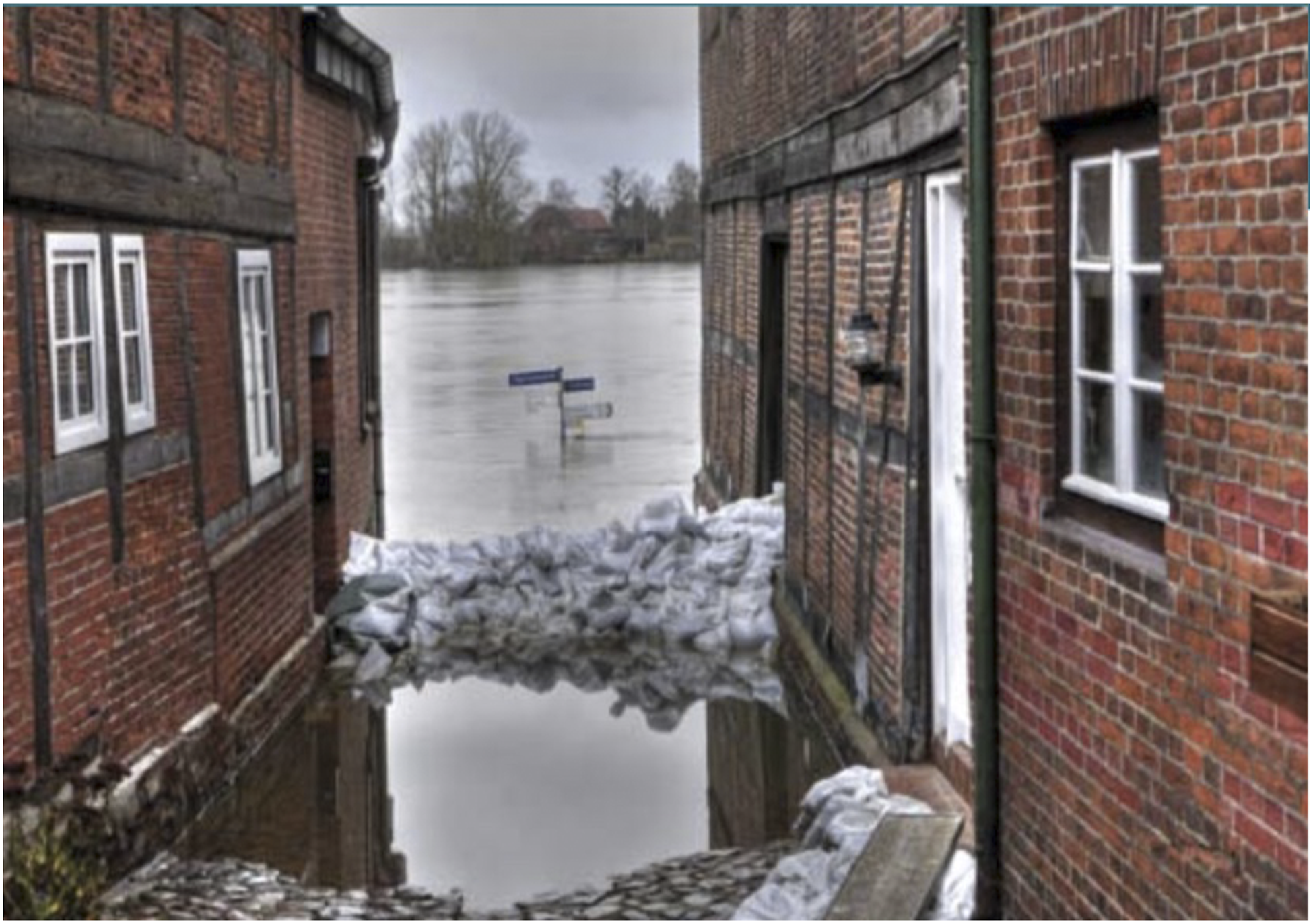
These horrific scenarios suggest that places where people live or which they utilise on a regular basis–and by extension German identities–are under threat. They connect images of catastrophe to potential public anxieties over the loss of ‘our’ homes, culture, history. This seeks to communicate that the very core of ‘who we are’ as a people, the German ‘way of life’, is in danger from climate change, where climate change acts as the abstract horrific Other stealing enjoyment.
An ideal of harmony: Fantasies of the good life in the future
A fourth fantasy weaved throughout the policy depicts playful, optimistic images, repeatedly featuring children (often girls) in rubber boots jumping into puddles (BMU, 2012: 10), playing in water fountains (supposedly during a heatwave), planting seedlings (BMU, 2012: 32, 51), a girl dangling her legs from a wall in front of the German Reichstag (featuring the slogan ‘Dem Deutschen Volke’–to the German people–in the background) (BMU, 2012: 18f), a girl out on a walk amongst green fields on the shoulders of an older man (her grandfather?) (see Figure 5) and, perhaps most iconic, a little girl on a grassy field ‘playing doctor’ with a miniature version of planet earth (BMU, 2012: 17). Others show colourful balloons rising to the sky against the backdrop of the Brandenburger Tor (BMU, 2012: 1), and a person lounging in a Strandkorb in front of the Reichstag (BMU, 2009: 47). With a focus on the younger generation, these images offer beatific visions of a stable, enjoyable and prosperous future Germany and, therefore, promise a more abstract ‘future of contentment’ (Gunder, 2015: 147). Offering optimistic visions, they seek to instil hope for a fullness-to-come, an even better and more enjoyable future – in spite of climate change. Is this the good life Germans will have in the future, after adapting in accordance with the government’s plans. The good life in the future (BMU, 2012: 64)
Intertwined with this fourth fantasy depicted in the images are promises of ‘sustainable growth’ in the written text. Contrasting with critiques that profit and environmental wellbeing cannot go hand-in-hand, the notion of sustainable growth first emerged in connection to the ‘Brundtland Report’ (WCED, 1987) and promotes the idea that continued economic growth and social and ecological well-being are mutually supportive, and that economic growth can be a driver for more sustainable living. This idea is evidenced in suggestions that German companies (and by implication society as a whole) can use climate change as an opportunity for further profit. The DAS-based brochure, for instance, expects a ‘significant increase in the demand for climate-friendly technology’ (BMU, 2009: 55) and stresses the competitive advantages for German companies from the innovation and export of ‘green’ and more efficient products, promises new jobs in the construction and technology sectors and suggests a possible 25–30% increase in the number of tourists, as the North and Baltic Sea Coasts become more attractive holiday destinations (BMU, 2009).
Here enjoyment is directed towards an unattained future ideal. Although the policies acknowledge the negative consequences of climate change, the policy discourse, through this fantasmatic narrative of a better future, in a way transforms climate adaptation into an (economic business) opportunity, a future where adaptation not only manages to avoid severe harm from climate change, but where life gets better. In that way, adaptation becomes equivalent with economic development and growth, and importantly, therefore not opposed to it. That economic growth often results in socioeconomic inequality and ecological destruction is left out.
Discussion: Re-capturing identities and building a brighter future – without changing all that much
The purpose of this exploratory analysis has been to identify key fantasies animating the German adaptation discourse–drawing on a selection of public documents–and to examine their potential purpose and significance in terms of channelling desire and emotions. This is not an exhaustive analysis, nor does it allow any claims on the success of the German adaptation discourse in gripping the public, but one that seeks to illustrate some of the fantasmatic narratives and affective content underpinning the policy. Taken together, the four fantasies described seek to garner political legitimacy for the techno-managerial adaptation policy and, in turn, the status quo, by portraying its version of adaptation as not only compatible with German identities and highly conducive to people’s sense of place, but as having ‘our’ best interests in mind. Through a web of affective anchor points for national enjoyment, the policies seek to provide individuals, possibly uncertain over their climate-changed future, with a clear sense of who they are (Germans, sharing a way of life) and course of action (to carry on as before). As such, the policies in this sample are an example of evoking a sense of place for maintaining the status quo and supporting climate action intertia, which contrasts with somewhat more hopeful views on the role of place identity in transformative adaptation planning (Fresque-Baxter and Armitage, 2012).
By providing seemingly attractive and recognisable objects of desire and ‘dancing’ between feeding public anxieties (through the horrific scenario) and providing joy (through the beatific scenario), the iconic images underpinning the supposedly ‘rational’ argumentation about evidence, objectivity and reason play a crucial role in the overall discursive potency of the policy.
At a practical level, the implication is that things can go on as before, despite climate change, and that continuing on the paths that have been laid out by the government (for instance in existing policies) is not only sufficient to buffer against future climate change but can even lead to a better and brighter future. At a more fundamental level, concerning identity formation, these fantasies discursively seek to shield their audience (i.e. the German public) from possible symbolic dislocation, that the reality of a physically changing and increasingly unpredictable climate caused by a Western, consumerist way of life may evoke, and shuffle the very real social, environmental, and economic drawbacks of continuing as before to the margins. While this may seem contradictory, Laclau (1994: 3) suggests that ‘the order [i.e. dominant discourse] with which we identify is accepted, not because it is considered as valuable in terms of the criteria of goodness or rationality which operate at its bases, but because it brings about the possibility of an order, of a certain regularity’. That means, it is not necessarily what makes most (rational) sense in a given situation that gains popular acceptance, but what is most convincing for the dislocated subject. Based on empirical work on the global financial crisis of 2008, Bloom (2016: 167) for instance found that in an attempt to ‘return to a state of normalcy’, responses to the crisis reinforced rather than dismantled the very institutions and ideologies that caused the crisis in the first place. This suggests that the confrontation with a symbolic crisis, such as climate change, does not automatically lead to transformation; quite the opposite: To acknowledge the uncertain future we are slipping into, the loss of control over it, and the need to think more fundamentally about our trajectories as a species is a dangerous endeavour, as it confronts us with our internal and primordial lack. Re-claiming identities is easier (and perhaps more affectively attractive) than facing the core of what climate change points to – the destruction of ourselves as a species.
Conclusions: Fantasy as a resource for transformative change on adaptation?
Despite the growing evidence of emerging climate change across the globe, there is little indication that adaptation policies respond in meaningful ways to avert negative impacts (Nightingale et al., 2019), with the German policy response as a case in point. Borrowing insights from Lacanian psychoanalysis, I have argued here that in an effort to understand and analyse why we might cling to such unsound conduct, the concept of fantasy can be usefully employed. Reading the German adaptation policy discourse through a ‘fantasmatic lens’ suggests that despite its apparent scientificity and technical rationality, it is deeply tied up with the operation of fantasy and affective modes of identification, directing affective investment towards specific objects and identities and to culturally shared anxieties and joys. While the four fantasies are culturally specific to the German context, the presence of such fantasmatic elements is not unique to the German case, nor is the German discourse necessarily more (fantasmatically) ‘powerful’ or ‘animating’ than other adaptation discourses and policies. This being an exploratory venture, more work is needed to examine how the policy discourse compares to others, and whether it proves attractive to the German public and is seen as authoritative.
The German case study is thought to be valuable in and of itself as a contribution to the empirical literature, however, the article’s principal value lies in its attempt at demonstrating fantasy’s analytical merit for the wider field of critical adaptation studies (and maybe even studies on action inertia on climate change more broadly). This is important for two reasons. First, thinking about processes of identification deepens our understanding of what it might be that makes these perspectives on adaptation ‘work’ and remain largely uncontested, and thereby sheds new light on the question of what it might be about incremental approaches that leaves them undisputed: possibly because they help recapture or reassure a sense of identity in an increasingly unpredictable world. Second, adaptation policy is not only a technical construction but also an ideological one. By recognising the affective, a-rational, sometimes contradictory production of adaptation discourses, we may see how it is not exclusively about ‘rational arguments’, but about affective hold and offering attractive forms of identification. In other words, political fantasy is a factor in adaptation policies that deserves to be taken seriously. Without taking such ‘unconscious energy’ (Howarth, 2013) into account, critical scholars are unable to account for the inconsistencies between governments’ scientific declarations (climate change is dangerous and action is urgent to avert catastrophe) and unsuitable responses (adaptation can be incremental). Unless we identify this important ‘force field’ behind techno-managerial adaptation discourses and come to terms with the unconscious investments that support ineffective policy discourses we have little hope of explaining, let alone changing them.
Laying open the operation of fantasy in public or planning discourses is one thing, but what practical implications for the ‘real world’ does its analysis bring? Work on fantasy suggests that looking for and ‘removing’ barriers to more transformative adaptation (Kates et al., 2012) or considering alternative knowledges (Nightingale et al., 2019) might not be the way forward – since, as pointed out above, discourses do not necessarily become dominant because they are most rational (Laclau, 1994). In the same vein, it suggests that simple critiques or deconstructions of conventional adaptation approaches do not, in and of themselves, provide sufficient affective purchase to change current trends in adaptation policy development (they may even serve to fortify existing fantasies, see Warner et al., 2019).
If critical analytical (and by extension political) interventions into adaptation practice are to overturn the focus incremental, ineffective action (O’Brien and Selboe, 2015; O’Brien, 2016; Fazey et al., 2018), they need to not only understand the fantasmatic content and potential grip of these approaches better, but also to provide alternative fantasies that can capture people’s imagination and provide them with modes of political identification, as neither a truly scientific nor a purely passionate approach to adaptation and climate change are possible (Kapoor, 2014). It is the reorientation of social desires that should be at the heart of any social adaptation policy. To that end, future research may want to investigate the fantasies contained in alternative adaptation discourses, such as those promoting a ‘deep adaptation agenda’ (Bendell, 2018), degrowth, or, at a more general level, those presented by global environmental movements such as Extinction Rebellion and Fridays for Future.
Footnotes
Acknowledgements
I am most grateful to Jenny Gunnarsson Payne for our many theoretical discussions on political fantasy and for reading and commenting on my ideas from early on. Thank you also to Ayşem Mert and Jason Glynos for their deep reading and generous feedback. I have also benefitted from helpful comments from Åsa Persson and Sirkku Juhola on earlier versions of this paper. Any error of fact or interpretation of course remains entirely my own responsibility.
Declaration of conflicting interests
The author(s) declared no potential conflicts of interest with respect to the research, authorship, and/or publication of this article.
Funding
The author(s) disclosed receipt of the following financial support for the research, authorship, and/or publication of this article: A part of the work on this article was funded by the Swedish Research Council for Sustainable Development (FORMAS) (Grant number: FR-2020/0008).
