




Abstract
Spaces for civil society participation within intergovernmental negotiations on sustainability have multiplied since the 1992 Earth Summit. Such participatory spaces are often uncritically accepted as a remedy for an assumed democratic deficit of intergovernmental policymaking. I argue, however, that civil society’s capacity to democratize global sustainability governance is constrained by the limited influence of these spaces on policymaking. The article explores the relationship between the format of participatory spaces and their influence on the negotiations of the Sustainable Development Goals. It finds that civil society is more likely to influence within informal and exclusive participatory spaces, and when these spaces are provided early in the negotiating process, at international and national level. This reveals a democracy–influence paradox, as the actors with the capacities to engage repeatedly and informally with negotiators are seldom those that are most representative of global civil society.
Introduction
Adopted by the international community in September 2015, the 2030 Agenda for Sustainable Development has been coined “a truly We The Peoples Agenda” by the Secretary General of the United Nations (UN) Ban Ki Mon, who also hailed the definition of the core element of the Agenda, the Sustainable Development Goals (SDGs), as the intergovernmental process most inclusive of civil society ever (UN, 2015a). Although there is broad agreement that civil society inclusiveness can be constructive in feeding intergovernmental policymaking with collective preferences, the inclusiveness–influence equation of civil society in global governance is eventually highly complex (Charnovitz, 1997; Scholte, 2002, 2011), and its effects on democratic legitimacy remain contested (Tallberg et al., 2013). Then, to what extent have the 10 million civil society voices gathered through different participatory spaces impacted the shaping of the SDGs? Is influence positively correlated to the degree to which negotiations are inclusive of civil society? Academic interest in the role and influence of civil society actors 1 in global policymaking has grown concomitantly to the increase of their participation in intergovernmental negotiations on sustainability. While only 250 nongovernmental organizations (NGOs) participated in the first global summit of the UN on the Human Environment in Stockholm in 1972, almost 10,000 civil society representatives were accredited to the UN Conference on Sustainable Development held in Rio de Janeiro four decades later (Bäckstrand, 2013). The latter mega-summit on global sustainability has since been hailed as a global expression of democracy (Biermann, 2013). Although national governments increasingly share powers with civil society, among other actors both nongovernmental (business) and governmental (international organizations), the making of international agreements remains the domain of states, who also have the power to establish the rules for who may participate and the nature of that participation. Besides, governments are unlikely to accept voting rights for civil society in the near future. Therefore, there is currently no formalized way for civil society actors to influence policymaking above and beyond the right to voice their views (Biermann, 2014: 139).
Civil society actors may nonetheless try to influence negotiations by persuading government representatives to accept their perspective (Holsti, 1988). They have developed activities to increase their chances of influencing intergovernmental policymaking, using participatory spaces both inside and outside negotiating hubs. I understand participatory space as an arena for the communicative generation of public preferences and a vehicle for marshaling those preferences as a social force capable of influencing the political field (Fraser, 2007). Inside negotiating hubs, civil society actors can voice their opinion in oral or written interventions, in formal or informal settings. Formal settings include speaking rights during the negotiating sessions, face-to-face consultations with governments and the co-chairs of the negotiations, and online consultations. Informal settings include side events and bilateral or multilateral meetings with governments and/or the co-chairs. For governments, the benefits of considering civil society contributions are important and include knowledge provision and political support. Yet when governments remain unresponsive to their contributions, civil society actors will also aim to pressure governments by organizing activities to influence intergovernmental policymaking from outside negotiating hubs, such as mass protests, campaigning, strategic use of, and alliances with media to raise awareness and influence the public (Rietig, 2011).
Academic research has been prolific in assessing the roles of civil society actors and the influence of their activities as a whole in intergovernmental negotiations on environmental sustainability, focusing on a specific issue area negotiated in a global event (Brosius and Campbell, 2010; Campbell et al., 2014; Corson et al., 2015) or taking a comparative approach across issue areas and policy arenas (Betsill and Corell, 2008; Chasek, 2001; Fisher and Green, 2004; Princen and Finger, 2013). Other studies focused on “moments of influence” and the relational maneuvers employed by civil society actors to shape negotiations (Witter et al., 2015). Drawing on scholars that identified, through collaborative event ethnography, the setting of negotiations as a key aspect in explaining the dynamics and outcomes of negotiations (Campbell et al., 2014), I focus on participatory spaces as specific settings in which civil society engages inside negotiating hubs to shape global sustainability governance.
In this article, I focus exclusively on participatory spaces rather than actors’ capabilities to explain influence. Recent research has indeed found that civil society actors engaging in UN negotiations have similarly high levels of capabilities (Sénit et al., 2017) and eventually express homogenous views due to disciplining processes such as consensus-building, professionalization, and the limitation of protests (Corson et al., 2015). To be better able to identify influence, I narrow down my analysis to the actors that carry the most progressive positions on sustainability issues. Despite this limitation, this article still contributes to achieving a better understanding of the conditions under which civil society exerts influence on intergovernmental policymaking, taking the negotiations on the SDGs as a case study.
What have been the impacts of civil society oral and written interventions delivered within insider participatory spaces on the intergovernmental negotiations of the SDGs? Which participatory space(s) best allow(s) civil society to exert influence?
I argue that civil society influence is greater in exclusive participatory spaces, thus indicating a tension between the competing imperatives of inclusiveness and influence, which are recognized in IR literature as important normative variables of democratic legitimacy. The article proceeds as follows. I first delineate my assessment framework, introduce the data and methodology, and provide an overview of the SDG negotiations. I then present the findings, before reflecting on the results.
Assessment framework
Influence
In political science and IR, influence is often defined in relation to power. In particular, civil society influence has mainly been studied in terms of state power, although it encompasses other aspects than their impacts on policy outcomes (Wapner, 1995). Power is the ability to achieve desired outcomes: it thus refers to capabilities and to the resources that sustain these capabilities. Scholars mainly consider influence as a means to achieve power (Holsti, 1988; Scruton, 1996). Yet, power does not necessarily guarantee that an actor will exert influence in its interactions. The key then is to understand the conditions under which an actor’s capabilities result in influence.
To exert influence, actors deploy insider tactics (comments on negotiating texts, provision of scientific information, lobbying) and outsider tactics (blaming and shaming, protests, boycotts). Both may be used inside negotiating hubs and may or may not transfer into influence, depending on various factors. Insider tactics most likely influence if civil society actors possess sufficient capabilities (economic resources, knowledge, and information), articulate feasible and concrete proposals, deploy policy-entrepreneurial strategies to build coalitions with like-minded stakeholders, in a timely manner with respect to the formulation of governmental positions. Outsider tactics most likely impact when these are framed positively, with simple demands, attract high media attention, and mobilize a critical and representative mass of people (Rietig, 2011).
Insider and outsider tactics however share the assumption that influence is only possible when communication occurs (Knoke, 1990: 3), be it in conversational (persuasion) or symbolic ways (protests). Studies on civil society influence in global policymaking rely on this communication imperative to define influence. In an extensive study of the influence of global NGOs on the climate and biodiversity conventions, Arts (1998) understands influence “as the achievement of (a part of) one’s policy goal with regard to an outcome in treaty formation and implementation, which is (at least partly) caused by one’s own and intentional intervention in the political arena and process concerned” (58). Newell (2000) complements Arts’ definition with an unintentional element, analyzing not only the observable and intentional interactions between governments and NGOs but also tacit forms of influence. Similarly, in a comprehensive theoretical and empirical work, Betsill and Corell (2008) argue that “influence occurs when one actor intentionally communicates to another so as to alter the latter’s behavior from what would have occurred otherwise” (24).
This article focuses on civil society participatory spaces inside negotiating hubs as the main communication channels through which civil society actors deliver written and oral interventions to exert influence on intergovernmental policymaking. Acknowledging that influence relies on a multidirectional flow of communication that engages a multiplicity of actors, this article understands influence as the sum of all effects on intergovernmental policymaking observable for, and attributable to, civil society interventions delivered within participatory spaces.
Building on Betsill and Corell, I qualitatively assess the influence on the negotiation process and outputs with four indicators:
Issue-framing
First, issue-framing refers to how a policy issue was conceptualized prior to and/or during the negotiations (Betsill and Corell, 2008: 33). Influence on issue-framing occurs when there is a correlation between the frames produced and/or used by civil society actors and those used by negotiators in their statements and/or reflected in the final intergovernmental agreement.
Position-shifting
Second, since government representatives ultimately decide on the text of an intergovernmental agreement, shaping and shifting the position of a key state or group of states may reflect civil society influence. Civil society influence on negotiating positions may be difficult to trace mainly for two reasons: civil society interventions alone rarely result in position-shifting, and civil society and states may have similar positions. While acknowledging such limitations, I nonetheless consider civil society as influent when specific ambitious language or ideas are reflected in a government’s position consequently to civil society interventions, should both stakeholders have akin or divergent positions.
Goal formulation
Third, influence on goal formulation occurs when the intergovernmental agreement reflects civil society positions on what should be done to address a sustainable development issue. In some cases, specific text proposed by civil society actors in their interventions may appear in the final agreement. More likely, I may find elements of proposals formulated by civil society actors or ideas consistent with their recommendations.
Issue-framing, position-shifting, and goal formulation form a sequence: if civil society is successful in impacting the framing of the issues, I expect it will more likely influence the positions of states and eventually the formulation of goals.
Influence on future procedures
Finally, influence on future procedures occurs when civil society interventions create or shape institutions and/or procedural rules that secure enhanced opportunities for civil society participation in subsequent negotiations on sustainable development. I define “enhanced” opportunities as both quantitatively, with increased speaking slots, and qualitatively, at a time within the negotiations that allows for the participation of governments.
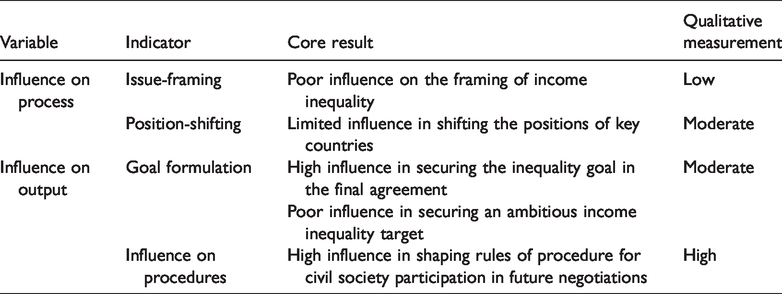
These variables were selected to allow for a comparison of influence across different moments in the negotiation cycle. I use a qualitative measurement in terms of high or low levels of influence. A change in the entire sequence of indicators reflects high influence. Influence is moderate when civil society interventions shape at least one of the process indicators (issue-framing and/or position-shifting) and one of the output indicators (goal formulation and/or influence on future procedures). Finally, influence is low if there is no evidence of change either in the process or output indicators. The precise operationalization, key results, and qualitative measurement of influence are further detailed in Table 1.
Operationalization of influence and key results.
Independent variables
If Betsill and Corell provide excellent tools to trace and evaluate influence of one or more civil society actors in intergovernmental negotiations, the framework does not allow for distinctions between different strategies and formats of interventions. Scholars using collaborative event ethnography have identified the setting of interventions in negotiations as key to understanding their dynamics and outcomes (Brosius and Campbell, 2010; Campbell et al., 2014; Corson et al., 2014). They argue that norms and structures in negotiations shape the ways actors interact and illuminate how and why certain actors are better able than others to shape policy. Drawing on these studies and on my interview data, I delineate three independent variables to further explain influence, which all relate to the format of participatory spaces.
I conceptualize format as the different ways in which these spaces are provided to civil society and operationalize it as follows (all considered equally important):
Timing
Timing is a determining factor of civil society influence identified in IR scholarship (Burgiel, 2008; Corell, 2008; Witter et al., 2015). Applied to participatory spaces, I argue that civil society influence varies according to when the participatory space is provided both in the negotiation cycle and during the negotiating session. With respect to the former, influence is likely to be high when the participatory space is set up before governments define their position. Conversely, influence is likely to be low when the participatory space is set up back to back to the intergovernmental summit that concludes the negotiation cycle. With respect to the latter, influence is likely to be high when the participatory space is organized at a time that allows for a large participation of governments.
Access conditions
Scholars studying global sustainability governance have also noted how issues of access shape the process and outcomes of negotiations (Brosius and Campbell, 2010; Tallberg et al., 2013). I apply this to participatory spaces, which can either be based on open or restricted access conditions. Rules of access are determined by the commissioners of participatory spaces or by the accreditation policy of the negotiations for which civil society input is sought. I hypothesize that the more open the access conditions, the more inclusive the participatory space. Governments are expected to be more responsive to civil society demands when these reflect the preferences of a broad and representative sample of actors.
Degree of formality
As Corson et al. (2014) argue, global sustainability governance is as much shaped by formal negotiations as by informal processes. Participatory spaces may be formal or informal. Formal spaces are intentionally and explicitly organized to invite civil society participation. They are commissioned by authoritative actors (governments, international organizations, and co-chairs of the negotiations) and participation is framed by official rules of procedure. Formal spaces include the negotiating session where civil society actors usually have the right to speak, and ad-hoc, face-to-face or online consultations. Conversely, participatory spaces are informal when participation is not the main and only objective and whereby participation is framed by unofficial rules. Informal spaces may be commissioned by governments, international organizations, and/or civil society actors. They include side events, multilateral or bilateral meetings with government representatives, and/or the co-chairs of the negotiations. I hypothesize that the more formal the participatory space, the higher the chances of civil society influence.
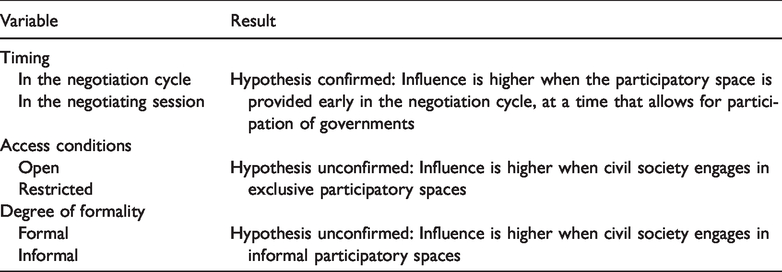
Table 2 summarizes my independent variables and assesses whether the results confirm initial hypotheses.
The participatory space as a factor of influence.
Methodology
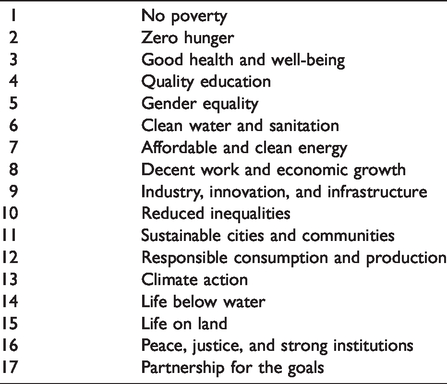
Influence is evaluated on civil society interventions within the intergovernmental negotiations on the SDGs (2012–2015). These started in the run-up to the 2012 UN Conference on Sustainable Development, where governments agreed to launch “an inclusive and transparent intergovernmental process open to the involvement of all relevant stakeholders” (UN, 2012). In January 2013, the UN General Assembly (the “GA”) established an Open Working Group on SDGs (the “OWG”), co-chaired by Ambassadors Kamau and Kőrösi and composed of 30 seats, shared by groups of two or three countries called “troikas.” The Group submitted in 2014 a proposal of 17 SDGs and 169 targets for consideration by the GA (see Table 3). Governments eventually adopted the SDGs as part of the 2030 Agenda for Sustainable Development at a UN high-level summit in September 2015 (Kanie and Biermann, 2017).
The Sustainable Development Goals.
The negotiations on the SDGs are an interesting process for the study of influence, mainly for two reasons. First, it differs from preceding goal-setting exercises at global level, such as the process that led to the adoption of eight Millennium Development Goals in 2000, regarding its inclusiveness of stakeholders (Biermann et al., 2017). In addition to existing spaces for civil society participation within the OWG negotiations at the UN Headquarters (UNHQ) in New York, the broader SDG process included, between 2012 and 2015, 11 global thematic consultations, 5 regional and 88 national consultations, as well as a global “MYWorld” survey on citizen preferences for the 2030 Agenda for Sustainable Development, each with different engagement procedures. All in all, the global, national, and regional consultations embarked more than 1.4 million participants from governments, civil society, the private sector, academia, and research institutions (Kamau et al., 2018), while the global survey gathered more than nine million voices. Second, the SDG process featured both innovative spaces for engagement (i.e. MYWorld was disseminated online, on SMS and on paper), and an increased capacity to engage in existing spaces (i.e. provision of an additional speaking slot to “other stakeholders” 2 within formal negotiating sessions).
This paper specifically focuses on the negotiations within the OWG, which convened 13 times between 2013 and 2014. Its work was divided into eight “stock-taking” sessions (March 2013–February 2014) and five negotiating sessions (March–July 2014). These negotiations provided civil society with several participatory spaces in which they made more than 877 interventions. These spaces included:
Speaking slots in the OWG sessions (13 sessions, 63 interventions delivered as statements), Hearings between the Major Groups
3
and other stakeholders, and the OWG members and co-chairs, prior to the beginning of each day the OWG convened (34 hearings, 273 interventions delivered as statements), Side events in New York (125 events), A global MYWorld survey (seven interventions delivered to provide feedback on the results of the survey during OWG formal sessions), An online platform to upload position papers (409 interventions delivered as position papers on the Sustainable Development Knowledge Platform), Multilateral or bilateral meetings with the OWG members and co-chairs.
While most interventions delivered within these spaces were visible, others could not be traced, including those delivered during side events and multilateral or bilateral meetings with OWG members or the co-chairs. However, I assume such interventions were manifold, as accredited NGOs widely participated to side events and engaged in informal talks with the co-chairs or member states after each of the OWG sessions.
The assessment of influence relies on qualitative data retrieved from three sources. First, primary documents include the final international agreement and its draft versions, the summaries of the sessions of negotiations provided by the co-chairs, and the position statements from governments and civil society. Then, secondary documents include the Earth Negotiations Bulletin (ENB), which contains summary reports from the negotiations. Third, I drew qualitative data from 68 in-depth interviews, which I carried out during two years of fieldwork (2014–2016). I selected key interviewees based on their high level of engagement in the negotiations that I identified through personal observation in the 10th OWG session and on the websites of the negotiations. These included, specifically, the Major Groups’ Organizing Partners, which are a body of facilitators belonging to accredited NGOs and tasked with coordinating inputs and streamlining interventions from their constituencies into the negotiations. I further targeted interviewees based on snowball sampling. Although this sampling method does not offer the representativeness of a random selection approach, I nonetheless accessed a broad range of participants, including 13 UN officers, 16 government representatives, and 39 civil society representatives. Among the latter category, half represented an international NGO, and half a national or local NGO. Also, 29 pertained to North-based organizations, while 10 to South-based organizations. I then transcribed the interviews from which I retrieved the key qualitative data documenting my influence indicators.
Most actors that engaged in OWG negotiations showed a high level of capabilities. Participation to the OWG Hearings was biased toward North-based INGOs with important financial capacities, with a disproportionate share of US and New York based organizations (Sénit et al., 2017). Similarly, the interviewees selected through snowball sampling all possessed an important cultural capital. Specifically, the interviewees who belonged to South-based NGOs all obtained Master or PhD degrees from a university based in the US or Europe, except for one. Therefore, I exclusively concentrate on the format of participatory spaces rather than the capacities of actors to explain variation in civil society influence on SDG negotiations.
To build a logical chain of evidence linking civil society participation in SDG negotiations with the effects of that participation, I first identified whether civil society actors transmitted information to negotiators and which participatory spaces they used for such transmission. Second, I considered whether negotiators received the information. Third, I examined whether there were changes in my indicators, and whether these changes were consistent with the information provided by civil society. Although process tracing contributes to clarify the origins of influence, the recommendations from civil society may not be the turning point over some issue. Changes in a government’s position or the final agreement may result from a combination of factors, both external and internal to civil society (e.g. civil society financial and human resources, civil society coordination, issue area and political stake, political tradeoffs, issue-linkage, i.e. the simultaneous discussion of two or more issues for joint settlement, mediatization), and scales (interventions in outsider participatory spaces, interventions in national or regional participatory spaces, “boomerang effect” 4 ). For instance, the alteration of a government’s position may result as much from an intense mobilization of civil society in outsider spaces at national level on a highly mediatized issue, or from long term consensus-building with state representatives at national level, as from civil society interventions in intergovernmental negotiations. This makes it difficult to attribute influence to one factor, scale, or participatory space, and assess their relative weight. However, triangulating the information from primary and secondary documents with interview data allowed increasing the validity and credibility of the observed correlations between civil society interventions and government positions or negotiating outputs.
Given the breadth of the 2030 Agenda for Sustainable Development and the length of the negotiations, I only applied process tracing to the first target of Goal 10, which aims to “[r]educe inequality within and among countries.” Target 10.1 endeavors, “by 2030 [to] progressively achieve and sustain income growth of the bottom 40% of the population at a rate higher than the national average” (UN, 2015b: 21). I selected this goal and target for two reasons. The first one relates to the high integration of the inequality goal across the Agenda. Research on the linkages between the 17 goals showed that inequality ranked second in terms of connectivity, with direct links to targets in 12 other goals, including goals with an environmental dominance (Le Blanc, 2015). The inequality goal is representative of the indivisibility that guided the design of the SDGs and thus holds the potential to further integrate environment and development policies, and to ultimately advance social and environmental justice. Second, the inclusion of the inequality goal in the Agenda has been a highly controversial issue, mainly because countries differ widely both in their view of what levels of income inequality are acceptable and in the policy strategies they adopt to reduce it (High Level Panel, 2013; Kamau et al., 2018). Acknowledging that consensual issues may be the result of long-lasting civil society consensus-building prior to intergovernmental negotiations, I focus on issues that were still controversial during the negotiations, as civil society influence is easily identifiable on such issues. The interviews then allowed extending my assessment of civil society influence on other substantial and procedural elements of the negotiations, including Goal 13 on Climate Change, Goal 16 on Peace and Security, and provisions for civil society participation in future negotiations.
The following section provides an overall assessment of the influence of civil society interventions on the SDG negotiations. Then, I explain the observed level of influence based on different formats of participatory spaces.
Findings: The influence of civil society on the shaping of the SDGs
Issue-framing
The influence of civil society interventions on the framing of the issues addressed by the negotiations was poor. Regarding interventions on income inequality, which were identified in the document analysis and interviews as the most representative attempt to frame the debate over the reduction of inequalities, civil society has been unsuccessful in framing the issue as a matter of reducing both poverty and extreme wealth, despite repeated interventions. In the 9th OWG formal session in March 2014, oral statements delivered by four Major Groups (NGO, Women, Children and Youth, and Indigenous Peoples) and civil society coalitions (Beyond2015) claimed that closing the gap between rich and poor also required focusing on extreme wealth reduction. In the 11th OWG session in May 2014, a broad coalition of civil society actors proposed targets to reduce income inequality from both the lowest and highest income quintiles, through redistributive policies and progressive taxation including taxes on wealth concentration (UN, 2014a). However, such interventions appeared to neither shape nor change governments’ conceptualization of income inequality, which they kept framing as a poverty alleviation issue. This is exemplified in the statement delivered by the United States, Canada, and Israel in the 10th OWG session in April 2014 that called to address income inequality through the reduction of the number of people living below national poverty lines (UN, 2014b).
More generally, the negotiations did not question the traditional vision of economic growth and industrialization as fundamental drivers for development. Although some delegations stressed that economic growth in and of itself does not necessarily lead to poverty alleviation, 5 civil society failed to move away the framing of the negotiations from a growth-oriented development paradigm toward a development model cognizant of the social and environmental limits to growth. A civil society actor reported that he faced strong opposition when he suggested the negotiations should address planetary boundaries, 6 because “influential delegations said: ‘we’re not going to participate in that discussion, we need to develop, if I can’t talk to my citizens about improving and developing, I’m out of office’” (EB, 3 April 2014). 7
In sum, neither on income inequality nor on the broader development paradigm conveyed in the negotiations have the frames used by civil society changed the knowledge and belief systems of government representatives and influenced their behavior. Does this mean civil society interventions have not influenced their position either? I examine this issue below.
Position-shifting
Overall, civil society interventions moderately influenced the positions of key countries or negotiating groups. Admittedly, civil society actors, through expertise provision, often contributed to the formulation of the positions of the delegations and permanent missions of small countries (RLH, 27 March 2015; LS, 15 July 2015). However, the positions of key countries, which had greater weight in the negotiations, were more difficult to either shape or shift. At the beginning of the OWG negotiations in March 2014, there was almost no support for a dedicated goal on climate change except for the delegations of Bangladesh, Bhutan, and the Least Developed Countries (ENB, 2014a). In April 2014, a climate goal further gained the support of the Solomon Islands, Mexico, and Peru (ENB, 2014b). Two months later, key countries moved away from opposing to a neutral position, including the Alliance of Small Island States, the United States, Canada, Israel, Norway, Denmark, Ireland, France, Germany, and Switzerland (UN, 2014b). In the last two OWG sessions, governments were still divided regarding the inclusion of climate as an SDG. In the 13th OWG session, a civil society actor reported that: In the latest hours, Korea, Djibouti, Egypt, Spain and Tanzania also supported the climate goal. Then at the final hour G77 [the Group of 77 developing countries] joined, collectively. You really could see how positions moved in the final hour, due to some tradeoff between countries. What was really important were the countries who were not supportive but who said [they] wouldn’t mind having a climate goal. These were bigger countries like Japan, Italy, Turkey, Pakistan, China, Iran, Brazil, India and South Africa. (LD, 8 September 2015)
Rather than shifting their positions, civil society interventions provided additional arguments to governments to strengthen their position. To advocate for Goal 16 on peaceful and inclusive societies, several delegations referred to the MYWorld Survey, which results showed that an honest and responsive government was ranking as one of the top priorities for citizens for the SDGs. For instance, the United States, Canada, and Israel mentioned the results of the Survey in their statement in the 5th, 8th, and 10th sessions of the OWG. The troika stated publics around the world, all our publics, are demanding new seriousness about honest, fair, and responsive governance. In the MYWorld Survey, every region of the world ranked “honest and responsive governance” among people’s top 5 priorities […]. That’s a powerful demand. (UN, 2014b)
Goal formulation
The influence of civil society interventions on the final agreement was moderate. Admittedly, they contributed to ensure the existence of several SDGs, including the goals on climate, peace, justice and strong institutions, and inequality (CK, 7 October 2014). On inequality specifically, after civil society first advocated for a dedicated goal in the 5th OWG session in November 2013, the first draft agreement released by the co-chairs on 24 February 2014 included a separate goal proposal on the promotion of equality, with a target aiming to promote differentially high per capita income growth at the bottom of the income distribution. But in two iterations of the draft agreement released by the co-chairs ahead of the 11th and 12th OWG sessions in May and June 2014, the inequality goal was merged with Goal 1 on poverty eradication and the income inequality target was integrated to Goal 8 on economic growth. As a result, major coalitions of civil society organizations (Beyond2015, Initiative for Equality, Global Call to Action Against Poverty), after circulating a draft Google document for input among their constituencies, coordinated a statement delineating arguments to reinstate the inequality goal. In 48 hours, 175 civil society organizations had signed the document, which was sent out to the co-chairs and governments (“A Stand-alone Goal on Inequality is Essential,” 2015). The lobbying of civil society contributed to ensure the existence of the inequality goal in the final agreement (NC, 15 April 2015; FD, 8 July 2015), among other factors such as the political will of key governments from developing and developed countries, including Brazil, Denmark, and Norway (GN, 29 April 2015).
However, civil society interventions failed to secure ambitious targets within the SDGs. The income inequality target does not quantify the level of growth in the incomes of the poorest 40%, whereas many civil society interventions recommended a concrete target to reduce income inequality by a said amount per year. The final target asks for any growth at all in the incomes of the poorest 40%, provided that it is higher than the national average. This implies that if, on average, incomes stagnate at national level, the target could be met with an increase of 0.01% in the incomes of the poorest 40%. In addition, the target focuses on the bottom 40% of the population but ignores the top 10%. The income inequality target allows room for greater concentration in the highest income quintiles, which research recognized as a driver of inequality (Palma, 2011). This also implies that the target could be met by an increase in the income shares of both the bottom 40% and the top 10%, at the expense of the middle (Cobham et al., 2015).
In sum, the SDGs reflect elements of the proposals formulated by civil society actors or ideas consistent with their recommendations. Civil society interventions were indeed successful in obtaining that controversial issues should be covered by dedicated goals or targets. However, these are far from reflecting the ambition of the recommendations initially provided by civil society.
Influence on future procedures
Although they did not result in the creation of new institutions, civil society interventions did shape procedural rules that secured enhanced participatory opportunities in future negotiations on environmental sustainability.
The negotiations on the SDGs were very consultative of civil society, compared to traditional intergovernmental processes carried out at the GA which usually excludes civil society from having a proactive role. An expert on civil society participation at the UN argued that civil society became highly involved in the SDG negotiations as a result of the interventions of key civil society representatives in formulating and influencing the rules of procedure of the OWG (JGS, 13 July 2015). Indeed, in March 2013, the Major Groups drafted a proposal for civil society engagement in the OWG, the Multistakeholder Advisory Group, which they submitted to the co-chairs (Stakeholder Forum, 2013). Although they did not accept all the proposals from the Advisory Group, civil society was able to access and comment on draft agreements, have regular meetings with OWG members, and seat as official observers in the OWG sessions (UN, 2013a).
In addition, following the OWG negotiations, civil society actors advocated for the provisions for civil society participation in the OWG to be replicated in the intergovernmental negotiations on the 2030 Agenda for Sustainable Development between January and June 2015 (the “post-2015 negotiations”). Major Groups, Beyond2015 and GCAP called for a non-regression of the civil society participation modalities for the post-2015 negotiations with respect to those of the OWG in a letter addressed to the President of the GA (UN, 2014c). In a subsequent decision on the modalities for the post-2015 negotiations, the GA decided that the process would be open, transparent, and inclusive, building upon the practices of the OWG (UN, 2014d).
Civil society and government representatives argued that such incremental advocacy has resulted in a normative advance in terms of participation within the UN (BG, 13 August 2014; GB, 29 April 2015; MH, 12 August 2015). In fact, the High Level Political Forum (HLPF), the UN platform responsible for the follow-up and review of the SDGs, continues with this level of engagement, whereby civil society actors can attend and intervene in official meetings, access official information, submit oral and written contributions, and formulate recommendations (UN, 2013b). In particular, paragraphs 14–16 of the resolution establishing the organizational aspects of the HLPF were the result of collaborative efforts between a few Major Groups representatives and negotiators from democratically inclined governments (JGS, 13 July 2015).
Finally, civil society interventions in the negotiations on the SDGs have resulted in the inclusion of additional civil society actors in intergovernmental policymaking on sustainable development. These actors were formally recognized by the HLPF (paragraph 16), which encourages the Major Groups and other stakeholders, such as private philanthropic organizations, educational and academic entities, persons with disabilities, volunteer groups, to autonomously establish and maintain effective coordination mechanisms for participation (UN, 2013b). It remains to be seen, however, whether the forthcoming reform of the HLPF in 2020 will backtrack on, maintain, or upgrade these procedures.
In sum, civil society engagement during the SDG negotiations has contributed to develop a culture of openness and participation in intergovernmental policymaking on environmental sustainability. In particular, civil society interventions have shaped rules of procedure that secured enhanced participation opportunities of an increased number of actors in subsequent negotiations and institutions. Overall, my results indicate that the influence of civil society on the negotiations was moderate. I found only limited evidence of influence for issue-framing and position-shifting. However, they did contribute to prevent some issues from being dropped from the negotiations and shape procedures for future civil society engagement. The findings confirm previous research, according to which the thickening of participation seldom allows to overcome the power asymmetries between states and civil society in global decision-making processes (Corson et al., 2015; Fisher and Green, 2004; Witter et al., 2015).
Explaining influence: The role of the participatory space
Despite the increasing number of participatory spaces created for civil society to provide input into global policymaking, the influence of civil society interventions on the negotiations on the SDGs remained limited. The question thus arises of how to explain this paradox. I now turn to this point, focusing on the format of participatory spaces.
Timing
Influence varies with the timing of civil society involvement in the negotiations. First, timing within a given session of negotiations is important. The OWG Hearings had no direct influence on the SDG negotiations because they were set up ahead of each negotiating session, when governments usually coordinate with their negotiating group. Similarly, civil society interventions scheduled during the negotiating session, after hours of intergovernmental debates, are inaudible by governments and have no influence (RD, 25 August 2015).
Second, civil society actors have higher chances of influence when they engage in participatory spaces provided early in intergovernmental policymaking. In the first, stock-taking phase of the OWG, many ideas from civil society were picked up by governments because at that time, they still didn’t exactly know which issues they wanted the SDGs to address. A civil society actor reported that Goal 11 on sustainable cities could be assigned to the work of the Communitas Coalition whose papers were provided early in the work of the OWG (FD, 8 July 2015). By the time the OWG reached its negotiating phase, governments had already defined their priorities and positions, leaving very little room for maneuver and influence to civil society. As a civil society actor reported, government representatives “have strict instructions which they cannot deviate from […]. Civil society can provide objectively very good insights, but it's not going to have any impact on the negotiations” (MH, 12 August 2015).
In sum, my results indicate that civil society actors have higher chances of influence if they engage in participatory spaces that are provided early in the negotiations, at a time that allows for the participation of government representatives. The influence of civil society interventions further varies with the access conditions to a given participatory space. I turn to this point below.
Access conditions
I found that influence is higher when access to participatory spaces is restricted to a limited sample of civil society actors. Influencing government representatives and the co-chairs of the negotiations requires that civil society actors attend the negotiations on a regular basis. However, not every civil society actor can have a direct physical and repeated access to the negotiations, and even less so to government representatives. Access to the participatory spaces provided within global negotiating hubs such as the UNHQ is constrained by the rules of procedure established by the UN and its member states for a given negotiation, and by the resources available to civil society for attending such process.
Access to the OWG negotiations was limited to NGOs in consultative status with the UN Economic and Social Council, and to those civil society actors that had the capacities to attend the monthly negotiations in New York. Although there were almost 4000 NGOs in 2013 with consultative status (DESA NGO Branch, 2014), such access conditions restricted participation to highly institutionalized civil society actors, with important human and financial resources. A government representative argued that the most influential NGOs are those that have the capacities to be present both in the negotiations and the corridors, and have personal contacts with the negotiators (RD, 25 August 2015). Similarly, a civil society actor reported that NGOs usually establish a presence in key negotiating hubs such as New York, Geneva or Nairobi to be able to attend the negotiations on a daily basis and get higher chances to influence their outputs. This means there is the same person sitting there at the microphone every day. (JGS, 13 July 2015)
Conversely, open access participatory spaces, allowing for higher representativeness in the sample of civil society participants, were also the least influential ones. Civil society actors could nominate themselves to participate in the OWG Hearings. A steering committee then selected among the nominations according to demographic criteria (gender, country). However, government representatives are less likely to take up the positions of civil society actors when these are outsiders. A civil society actor corroborated this in the following terms: In the SDGs negotiations, people from all around the world could nominate themselves through an online system. Even a small farmer in Africa could apply. Let’s say he is elected: he goes to the UN, says something during three minutes, and then goes back home and you will never see him again. […] It sounds very democratic and inclusive, but eventually it’s not, because the person who sits there has no connection with the negotiations or with the civil society actors that are following the process, and even less so with government representatives. (LR, 9 September 2015)
Degree of formality
The influence of civil society interventions varies substantially with the degree of formality of the participatory spaces in which these interventions are delivered. I found that the less formal a participatory space, the more influential civil society interventions. The Morning Hearings convened by the OWG co-chairs to formally involve civil society in the shaping of the SDGs had very little influence on the negotiations (EB, 3 April 2014; FG, 30 September 2014; RLH, 27 March 2015; FD, 8 July 2015). Both civil society and government representatives considered the Hearings as a symbolic space created to satisfy the principle of civil society inclusion in intergovernmental policymaking (LS, 15 July 2015). A government representative argued that many civil society groups go in these formal presentations such as the Morning Hearings [to deliver their positions]. But that’s not where you persuade governments to back up your position, it’s rather when you take them for a coffee, sit down with them and go through the issue. […] These formal discussions seldom influence. (RD, 25 August 2015) Our job is to get member states to listen to us, but a lot of these [formal] spaces intended for that fail at that, and we have to find other ways to do it [such as] creat[ing] as many personal relationships with negotiators as possible. And you leverage those contacts to pass on proposals, and have meetings with government representatives. If you are just going to these Hearings, you are not accomplishing anything. We’re going to the Morning Hearings because we are civil society actors and we appreciate the attempt, but we never consider them to be that important. What’s important is that at the end of the formal negotiations, we go and sit down with a government representative who delivered a statement and say ‘look, we really agree with this, we have several ideas that might push it’, and if it’s a good negotiator he’ll say ‘all right let me see something and I’ll get back to you’. That’s how you create a personal relationship, that’s how you get a real exchange of information, that’s how you influence. (FP, 3 April 2014)
Similarly, online consultations formally commissioned by international organizations, such as the MYWorld Survey, had low influence on the negotiations. Civil society actors themselves were skeptical about the capacity of MYWorld to influence the shaping of the SDGs. One indeed argued that he considered the survey as fluff, as theater [since] there was no attempt to take the outputs from that survey into the negotiations. […] You can’t just distribute a survey to governments who would go: “oh absolutely right, if only we’d known!” It’s not how it works. It works on personal contact. (FD, 8 July 2015)
Conclusion
With the example of the intergovernmental negotiations on the SDGs, this research showed that civil society influence on global policymaking was moderate. Specifically, civil society interventions were influential in preventing some issues from being dropped from the negotiations and in developing a culture of participation in global policymaking on sustainable development. However, they had only a marginal effect on issue-framing, on shifting the positions of governments, and on the final agreement. And yet, many hailed the SDG negotiations as the most democratic and inclusive process in UN history. While confirming previous research, this article provides an original argument to explain influence by focusing on the role of the participatory space, and reveals a reverse correlation between civil society influence, and inclusive, democratic global policymaking. In particular, the study showed that civil society actors have higher chances of influence when they engage in informal participatory spaces. Yet these spaces are also the most exclusive ones, to which highly organized, professionalized civil society actors have a privileged access, compared to the resourceless. While shedding light on the conditions under which civil society’s capabilities result in influence, further research is still needed to provide a detailed analysis of the linkages between the format of the participatory space, the types of influence exercised, and their differential effectiveness. Now, how to disentangle the democracy–influence paradox to increase both the inclusiveness and effectiveness of participation in future global processes? Given that civil society influence is positively correlated to elitism, which changes could be undertaken so that elitism would eventually benefit the inclusion of a broader sample of actors in global norm production? Drawing from theories of democratic elitism, both democratization and influence could still be achieved by democratizing civil society itself. This could encompass, for instance, periodic elections to ensure elite renewal, to which not only institutionalized (NGOs) but also non-institutionalized actors (social movements and citizens) could participate. In addition, this could include the development and strengthening of mechanisms to ensure accountability between civil society elites and their grassroots. Tackling the democratic deficits that pervade civil society would enhance its capacity to perform its functions, including the coproduction of global norms, and eventually contribute to the democratization of global politics.
Footnotes
Acknowledgements
I thank Frank Biermann, Agni Kalfagianni, Benjamin Cashore, and two anonymous reviewers for helpful comments on earlier drafts of this article. I also express my deep appreciation to all the interview respondents who made this research possible by sharing their time, knowledge, and experience on civil society participation in the formulation of the SDGs.
Declaration of conflicting interests
The author(s) declared no potential conflicts of interest with respect to the research, authorship, and/or publication of this article.
Funding
The author(s) disclosed receipt of the following financial support for the research, authorship, and/or publication of this article: This work was supported by the French government in the framework of the programme Investissements d’avenir, managed by the French National Agency for Research (ANR) under the reference ANR-10-LABX-14-01.