




Abstract
Natural disasters are becoming more frequent around the world, causing extensive damage to both the physical and social fabric of cities and towns. Reconstruction of a city’s architecture and built heritage becomes a priority to safeguard lives, livelihoods, traditions, and cultures. The process, however, is replete with conflict and mediation between different tiers of governance resulting in a complex ‘heritagescape’. Drawing on the post-disaster reconstruction of Durbar Square, one of the seven World Heritage Sites in Kathmandu, Nepal, this paper demonstrates how heritage reconstruction sites serve as a stage for broadcasting geopolitical interests, national agendas, and subnational motives. Global actors and donor agencies appropriate heritage and legitimize their actions within the context of weak institutions, informal governance, and lack of formal plans and policies. This is resisted and re-worked by local groups through the cracks in the post-disaster reconstruction landscape. The paper draws on the fieldwork conducted between 2016-2019 supported by interviews with 47 individuals representing 13 organizations involved in the reconstruction. The paper demonstrates challenges in striking a balance to situate heritage on an international platform while also adhering to local sentiments and sensibilities. It also points to three intersecting planes of existence, emphasizing the simultaneous significance of global, national, and local dimensions and forces in post-disaster heritage-making.
Introduction
Natural disasters are becoming more frequent around the world, causing extensive damage to both the physical and social fabric of the cities and towns. Between 1970 and 2014, nearly 12,000 disasters occurred, mostly in low-income countries (UNESCAP, 2015). Reconstruction of urban fabric, architecture, and built heritage becomes important to safeguard lives and livelihoods, traditions and cultures (Graham and Spennemann, 2006) and is considered to be aligned with the UN’s ‘build back better’ concept. However, heritage reconstruction, as part of the wider disaster recovery, is much hindered by poor institutional infrastructures and a lack of resources in low-income countries. Global agencies such as UNESCO, donor countries, and international aid agencies join the scene to help chart the reconstruction processes, along with various non-state and non-governmental actors. International cooperation is largely orientated to an ideological commitment to reversing the damage of the disasters. However, this is also driven by a combination of factors - “competitive compassion” (Jasparro and Taylor, 2011), “geopolitical manoeuvring” (Paudel and Le Billon, 2020), and a desire to impose a ‘uniform heritage vision’. Institutionalized patterns of cooperation emerge, with varying degrees of malleability, often extending such cooperation on issues as diverse as trade, financial relations, border control, and environmental protection and resources. The pre-existing asymmetric relationship between the donors and recipients (Nair 2013) often allows external actors to exert a hegemonic influence that emits differentiated but powerful interpretations of objects, events, or practices during reconstruction. In literature, scholars have explored the influence of global values on heritage-making at national and local levels (Harrison, 2013; Jenkins, 2013; Shepherd, 2006; Lahedmeski et al., 2019), leading to differentiated interpretations with competing outcomes (Su, 2018). The patterns of practices are significant as they impact both the ‘heritage’ in question and, ultimately, governments’ actions and behaviors. Winter (2015: 997) sees them as efforts in seeking to address the imbalance in cooperation, cultural aid, and hard power, and the ascendency of intergovernmental and non-governmental actors as mediators of the “dance between nationalism and internationalism”. Here we encounter a series of anomalies and contradictions underlying this relatively stable configuration between cooperation, space, society, and heritage.
That the global, national, and local are intersected planes of heritage practice is starting to be recognized in the international heritage discourse. It is based on the premise that cultural heritage recovery is not complete without considering the wider physical, economic and social processes by which cultural heritage is produced, used, interpreted, and safeguarded. The focus on the ‘social’ brings the local practices and sentiments to the forefront, linking into Appadurai’s (1996) “scape” which refers to a social space wherein power structures are markedly de-localized, de-structured, and de-calibrated. Questions remain, however, on the nuances of negotiation and contestations, across the three tiers of governance order– global, national, and local, and the impact generated by their individual appropriation and interpretation of built heritage and cultural practices during post-disaster recovery.
Drawing on the post-disaster 1 reconstruction of Durbar Square (also known as Basantapur Palace complex), one of the seven World Heritage Sites in Kathmandu, this paper explores how heritage reconstruction sites serve as a stage for broadcasting geopolitical interests, national agendas, and subnational motives. I frame this discussion within the context of the disaster to show how global actors and donor agencies appropriate heritage and legitimize their actions in the post-disaster reconstruction landscape of low-income countries with weak institutions, informal governance, and lack of formal plans and policies. I then demonstrate how this trend is resisted and re-worked through the cracks of the post-disaster reconstruction landscape. These co-evolutionary trends extend from the arguments of heritage subjectivities, discussed elsewhere in debates around authenticity (Su, 2018), public memory (Light and Young, 2010; Whitmarsh, 2019), and identity (Pieris, 2017). Ultimately, the paper argues that the integrative impetus behind the post-disaster reconstruction networks has given way to an emerging dynamic of fragmentation and differentiation with profound implications for the future of heritage-making. The paper concludes that even if the goals of heritage-making sought through international cooperation are deemed necessary in principle, or desirable for low-income countries, particular attempts to achieve them could have perverse effects.
The paper illustrates these arguments by discussing specific conjunctures of disaster rebuilding forged at the intersecting planes of global, national, and local dimensions. It draws on qualitative methods and fieldwork conducted between 2016 and 2019. Semi-structured interviews were undertaken with 47 individuals who represented 13 community or governance organizations. Interview data were complemented by both formal and informal conversations with residents, traders, priest groups, and heritage activists. The interview outcomes were supported by thematic analysis and field reconnaissance that spanned 4 years post-2015 earthquake in Kathmandu.
Heritagescape: Framing post-disaster heritage reconstruction in global, national, and local order
This paper approaches post-disaster heritagescape as a multifaceted and complex concept. Heritagescape is a specific idea that incorporates some of the basic constructs of landscape theory but that relates wholly to heritage sites. It defines a particular space that is distinct from but at the same time is part of the larger wider environment in which it is situated. Heritagescape in this sense is a combination of physical heritage and cultural attributes operating in the wider context. As a tool, heritagescape is treated as an arena of governance, institutions, and of space of cooperation and contestation, especially in the post-disaster reconstruction context. This space is characterized by the convergence of global, national, and local orders generating several meanings and interpretations, actions and reactions, and mediations between the past and the present. By using heritagescape as a baseline and examining how it is manifests, we can understand heritage sites as a larger concept and as a cultural phenomenon.
Heritagescape in this sense becomes an urban inquiry into the inherent disjunct across spaces of collaborations and understanding of heritage. This is especially evident in low-income countries that rely on foreign capital to fill their own domestic resource gap. Foreign aid comes in different guises such as technical support, capacity building, knowledge transfer projects, and physical sites, and it can relate to the upgrading of infrastructures, urban planning, or tourism development. It could also take the form of capital loans and grants, with the primary goal to help countries in all types of development projects including heritage. Historically, aid effectiveness is known to succeed in countries with sound institutional and policy environments (Dollar and Levin, 2006). Foreign aid always comes with significant regulatory baggage and networks of capital that requires a strong state to play a pivotal role in facilitating the process and enforcing rules of conduct. Weaker states, however, experience what Sassen (2006: 21) calls “specialized disassembling of the national” for facilitating the global. Further, international cooperation is exacerbated by an asymmetric relationship in the donor-recipient binary (Nair, 2013), which “amplifies the neoliberal [and political] objectives of aid donors and puts in place mechanisms for successful implementation that often fail to deliver the ends that aid promises” (p. 642).
The landscape is however changing with multiple actors and intersecting governance levels that allow horizontal linkages and co-production. Lord and Murton (2017: 93) describe this as “competitive dynamics manifested at different scales”. However, systematically managing, monitoring, and delivering aid remains challenging due to the multiple disaster response teams operating with strikingly different agendas and knowledge, making the response terrain exceptionally uneven and sometimes corrupt (Sharma and Donini, 2015). The apparent ‘non-linearity’ of the operation obfuscates reality, and Hutt (2020: 395) claims that this is because disaster “refracts the debate, strengthening some lines of argumentation and weakening others”. Regardless of how the institutional set-up works (or not), aid money cannot inherently be seen as good or bad, which makes it important to focus on what gets transformed rather than what part returns to the pre-disaster situation. This is where the discourse of aid and international cooperation is still helpful.
Swyngedouw (1997:148) points out that it is often capital (assets, finance) that moves upward (upscaling) while the regulations move downwards (downscaling). As Zhu (2019) argues, similar trajectories can be found in heritage governance and administration in various parts of the globe, where the top-down regulatory systems are established to administer heritage governance at lower scales. When sites are included in the UNESCO World Heritage List, their significance increases, and they find themselves at the center of global heritage discourse. They are also subject to several layers of regulatory scrutiny that accompanies a subtle demand for civic duty and commitment to the international governance order. The rules of inclusion to and exclusion from it, Lahedmeski et al. (2019) argue, have been the UNESCO’s core mechanism to gain and reinforce its global-scale authority. They also bind the national governments in accepting obligations toward their local heritage. The purpose is therefore to empower the governments rather than shackle them. However, they can, in the process, create new spaces for geopolitical manoeuvring. In reference to the Master Plan project for Lumbini in Nepal, Weise (2013) notes that the World Heritage inscription brought a deluge of donors and investors with specific ideas that were not entirely conducive to either local sentiments or the history. He claims, “these personal projects are often in conflict with the overall integrity of the heritage site” (p. 136). The complex structures and network of agencies, funding regimes, and competing interpretations lead to an à la carte selection of the past with some aspects glorified while others disappeared from the public sphere. This stance disregards the increasing role capital plays in shaping heritage and privileging specific forms of academic, expert and cultural knowledge.
Low-income countries welcome such initiatives, as the capital for research, preservation, and management of heritage is either limited or non-existent. Endorsement from UNESCO provides currency to advance their connections to the global network of agencies. They can also assist in advancing national goals (Jenkins, 2013; Jigyasu 2013; Shepherd, 2006) in economic, social, and political spheres. Boosted by the advent of neoliberalism, entrepreneurial states turn into formidable economic actors (Brenner and Theodore, 2010; Swyngedouw, 2000) exploiting the dynamic relationship between tourism, economy, and heritage-subverting local practices and religious nationalism. State actions can even go to extreme measures in exploiting heritage to curb dissent and gain control as part of wider politics, especially in nascent democracies or areas of conflict (Jenkins, 2013; Jigyasu 2013; Shepherd, 2006). Interestingly, these approaches are heavily anchored within the diplomatic exchange between the state and international agencies who then qualify objects, ideas, and places as heritage and legitimize dominant narratives about them. This is illustrated in Shepherd’s (2006) account of how UNESCO’s focus on the preservation of world cultural sites in Tibet aids state claims to authority over culture as a tool in state-building. Such actions, he claims, manifest in “the inevitable cultural decline many associate with a cultural opening to global forces” (p 256).
That the state-regional-global politics and control resonates in other spheres of the economy has been well recognized in heritage discourse. Drawing from Guizhou’s experience, Oakes (2002) argues that the ‘Open Up the West’ campaign sought to take political and economic control away from provinces that have gained considerable autonomy during the reform era in China. In contrast, Murton et al., (2016: 405) note that infrastructural aid from China (discussed in the next section) enables “a small state like Nepal to support its own state-making agenda, instead of just the other way around”. In the same vein, cultural heritage offers a soft but powerful strategy to implement a state-making agenda during conflict. Drawing from the wartime destruction and ensuing reconstruction in Spain and Bosnia, Viejo-Rose (2013: 20) argues that as “new historical sites, narratives, legends and myths are emphasized”, a new “heritagescape” emerges to support the visions of the new regimes.
The state’s alliance with global forces and the resultant heritagescape often polarise the ‘local’ from the process of heritage-making. Scholars (Daly and Winter, 2012; De Silva and Chapagain, 2013) see the lack of civic engagement in heritage management as a move to re-affirm and entrench forms of hegemonic governance and governmentality. The issue, like so many other global-local frictions, has roots in the inherent inconsistencies between the Western (or eurocentric) and non-Western approaches towards heritage and management (Byrne 2004; Chung 2005; MacKee 2009). For De Silva and Chapagain (2013), this relates to the spiritual significance versus historical and material significance. The latter is imprinted with the UNESCO guidelines on dealing with disasters, and in defining authenticity, removing the local and indigenous interpretations of their heritage (Dewi, 2017). Such practices ignore the notions of heritage being embedded in identity, memory, and in the lived experiences of the community. Referring to Shaolin Temple cultural heritage practices in Zhengzhou City in China, Su et al. (2019) note how Western authorized heritage discourses influenced local Chinese practices both in hegemonic and negotiated ways. The implication, they argue, resulted in the production of ‘traditional style’ outcomes rather than ‘traditional’ outcomes – signifying the altered interpretation dominated by commodification and external values. At the “local” level it is interpreted as an assault on the individual as well as collective identity given these buildings and spaces carry significant religious, emotional, and cultural value.
It is apparent that the relations across the three orders of heritage governance are not always cooperative and harmonious but contested and competitive. Heritage reconstruction has always been one of the most controversial issues for those with an interest in the material evidence of the past (Stanley-Price, 2009). Inevitably, the interpretative process of heritage-making will necessarily incorporate some understanding, meaning, and point of view but marginalize, ignore, or disinherit the others. The process creates a sense of dissonance characterized by different forms of politicization of principles, practices, and norms creating considerable tensions, across different tiers of governance and expectations (Cretney, 2019). Ultimately, the concern about heritage-making in post-disaster reconstruction is not really about the physical reconstruction methodologies adopted for its conservation and rebuilding; rather, it is about how such restoration attempts have sometimes become a driving force in isolating heritage from its urban, political, and social context. This is exacerbated especially in many non-Western countries that tend to have a more spiritual and less material view of built and cultural heritage. Notwithstanding there are varied practices across the world, every object or icon on the streets evokes religious sentiments and penetrates everyday life in Nepal. Households keep clay idols in their homes and worship them as a symbol and manifestation of God, essentially bringing heritage management to the local level. The age-old traditional custodians such as those related to the local priest groups, faith groups, and community bodies (such as Guthis 2 in Nepal) built, rebuilt, painted, repainted, extended, repaired, and re-made the historic buildings and temples continually for more than a millennium. There is little doubt about their indigenous knowledge, in terms of how structures should be built, where inscriptions should be placed, and in what direction shrines or deities should face. Former royal sites forbidden from excavations for a variety of reasons (such as hidden treasures, myths, and legends) add another layer to the complexity of the local heritage discourse. These are important deliberations and practices which demonstrate associated forms of power. These powers, when they intersect with national and international governance, generate tensions and contradictions, revealing how heritage-making remains an unfinished process.
Similar assumptions are built into the ‘heritage history’ in Nepal, as the developments in the 1970s were geared towards preparing to join the international movement of conservation, led by the UNESCO’s Convention for the Protection of the World Cultural and Natural Heritage. Subsequently, an influx in support, financial or otherwise, flooded the country after signing “the United Nations Technical Assistance Programme, to advise on the planning of conservation measures”. It had the heritage preservation mandate with key objectives around capacity building, training and reform of key institutions. There was a renewed focus on the Royal Palace, Durbar Square, through the establishment of a Central Conservation Laboratory at the National Museum and a Conservation Project Office at the Hanuman Dhoka Royal Palace to train staff in conservation techniques and repair work. Nepal became a party to the Convention in 1978 and, subsequently, an application to nominate seven monument sites in Kathmandu Valley as World Heritage Sites was approved by the World Heritage Committee in 1979. These initiatives represent a top-down externally engineered heritage-making process and a move away from the local management of heritage.
However, in the decade that followed, cultural heritage in Nepal was sidelined with diminishing funds leading to widespread abuse and ineffective monitoring. The World Heritage Committee at its 17th session in 1993 expressed deep concern over the state of conservation of Kathmandu Valley site. Subsequently, Boudhanath and Kathmandu (two of the seven monument zones protected under the Convention), were placed on the List of World Heritage in Danger at its twenty-first extraordinary session.
The following section discusses the post-disaster rebuilding of Durbar Square in Kathmandu to illustrate the contested and competitive relations of the three governance orders discernible in areas of geopolitics, governance gaps, and heritage subjectivities.
Rebuilding Durbar Square
Nepal emerged from two decades of political conflict in 2008, which led to the 300-year-old monarchy transiting to a secular republic state. The shift towards democratic governance expanded the space for engagement and participation; however, this transition has been slow due to capacity challenges at the provincial and municipal levels, widespread poverty, political instability, and the lack of leadership. Economically, the country is one of the poorest in the world with a per capita income at US$1,064, and nearly half of its population living in absolute poverty (World Bank, 2018). The evolving political economy is looking for rapid development with neoliberal agenda.
The 2015 earthquake provided the first major test for the new democracy and the governance to show its strength and acumen in responding to a major natural disaster. The Government established Nepal Reconstruction Authority (NRA) 2 weeks after the earthquake to oversee all aspects of relief and recovery, and to convert adversity into opportunity. The remit of NRA was to help the nation recover from the destruction with a ‘building back better concept’. It organized a funding conference on 6 June 2015 (within 2 months after the earthquake), which had representation from 60 countries and aid agencies. The international community pledged US$4.4 billion. The pledged amount was US$3 billion short of the overall cost of reconstruction, with half (US$2.2 billion) provided as loan. It was however considered “a grand success” by the then Foreign Minister (NPC, 2015). It may be worth mentioning that Nepal owed US$5.4 billion in external debt stocks in 2018 (World Bank, 2018), which is compounding because of the slow economic growth, impact of the disaster on tourism and trade, and rampant corruption. As such the external debt increased by almost US$1.5 billion within 4 years between 2014 and 2018 even outside of the disaster debts. Nepal’s heavy reliance on foreign aid is marked by increasing loans and decreasing aid, which perpetuates dependency and as Nair (2013) argues, international subjectivities creep in through foreign policy, secure borders, and domestic policies.
The earthquake caused extensive damage to the 2900 historic structures across the country (NPC, 2015), which include the three medieval Palace Squares in Kathmandu Valley –Kathmandu, Patan (Lalitpur) and Bhaktapur – that possess a remarkable concentration of temples, palaces, and monuments. The reconstruction cost of the tangible heritage was estimated at NPR 16.9 billion (US$ 169 million) (NPC, 2015). This is considerably small in relation to the cost of overall reconstruction; however, heritage reconstruction received ‘priority sector status’ due to its crucial link with the trade and tourism economy, augmented by concerns around the severity of damage to the World Heritage Sites.
The post-disaster rebuilding in Durbar Square (Figure 1), known locally as Basantapur Palace complex, witnessed intense attention, reflecting the urgency for reconstruction that represented the microcosm of the aid influx. Durbar Square’s role as the symbolic focal point of the city (Figure 2), boosted by UNESCO World Heritage Site status was instrumental in attracting international interest that included Chinese, Taiwanese, Japanese, and American governments, including aid agencies directly and indirectly. The institutional involvement extended to local NGOs, and heritage activists (Figure 3). An array of organizations
3
involved in rebuilding however were driven by their own priorities, timelines, and project plans. This is historical and not just linked to the current rebuilding. In a poignant remark, Chapagain (2008) cites an editorial in The Kathmandu Post that exemplifies everything that is wrong in heritage governance in Kathmandu. According to him, divergent approaches and ambitions of global and national actors has led to confusion and chaos. This rhetoric was an echo from the public discontent about the governmental delivery of heritage services. Aerial view of Durbar Square, Kathmandu Buildings and monuments in Durbar Square, Kathmandu: Before and after earthquake Institutional involvement for reconstruction, Durbar Square, Kathmandu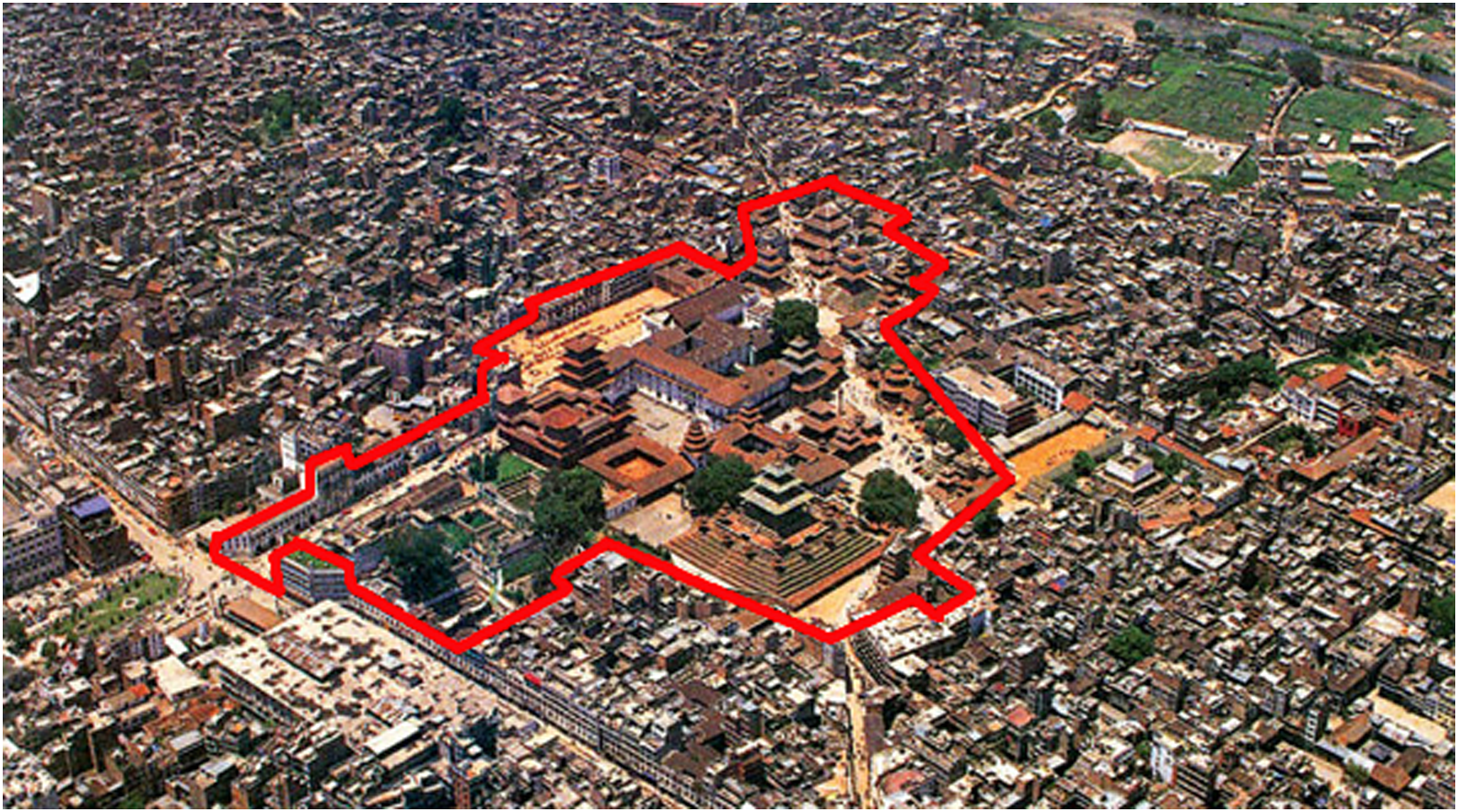
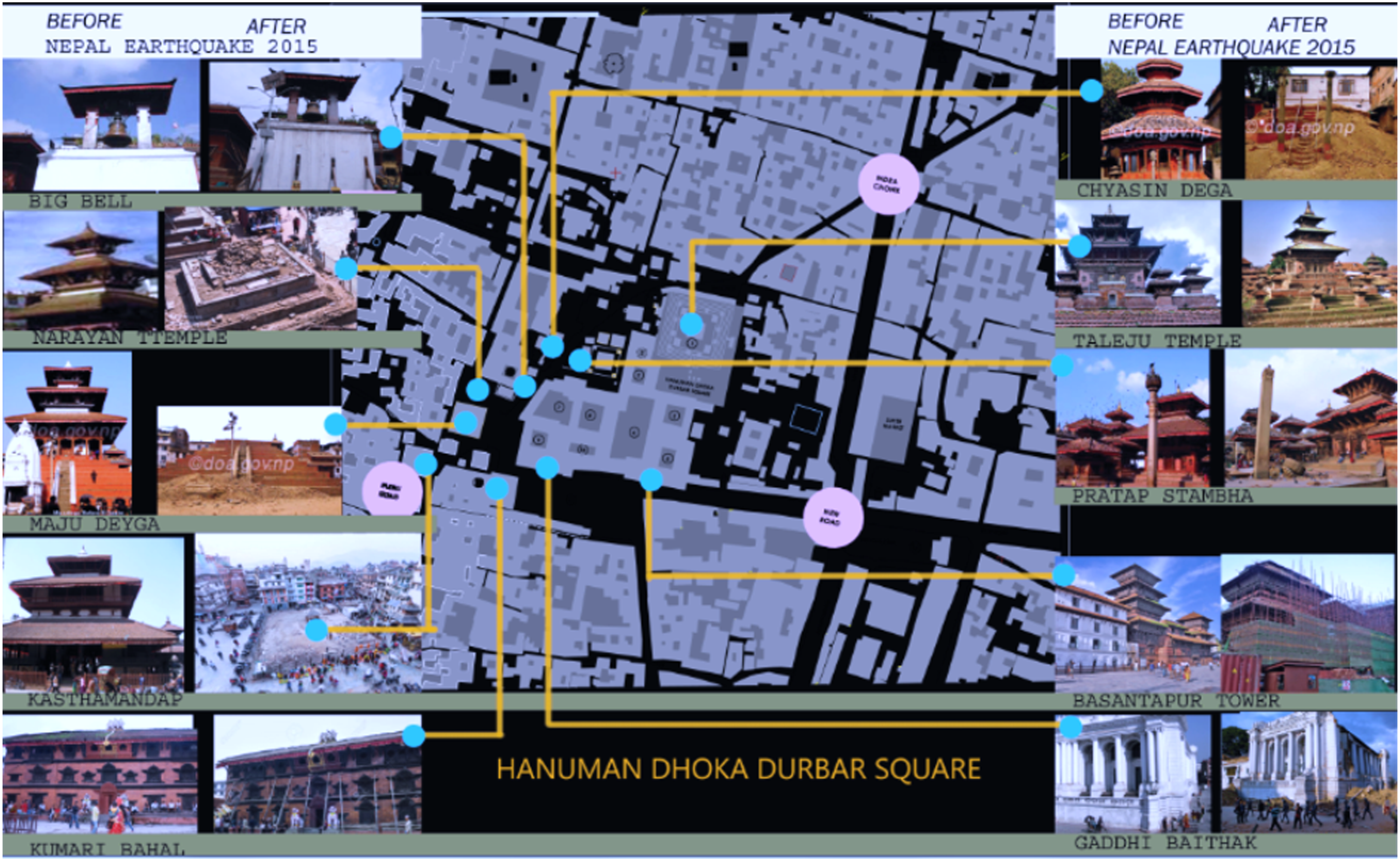
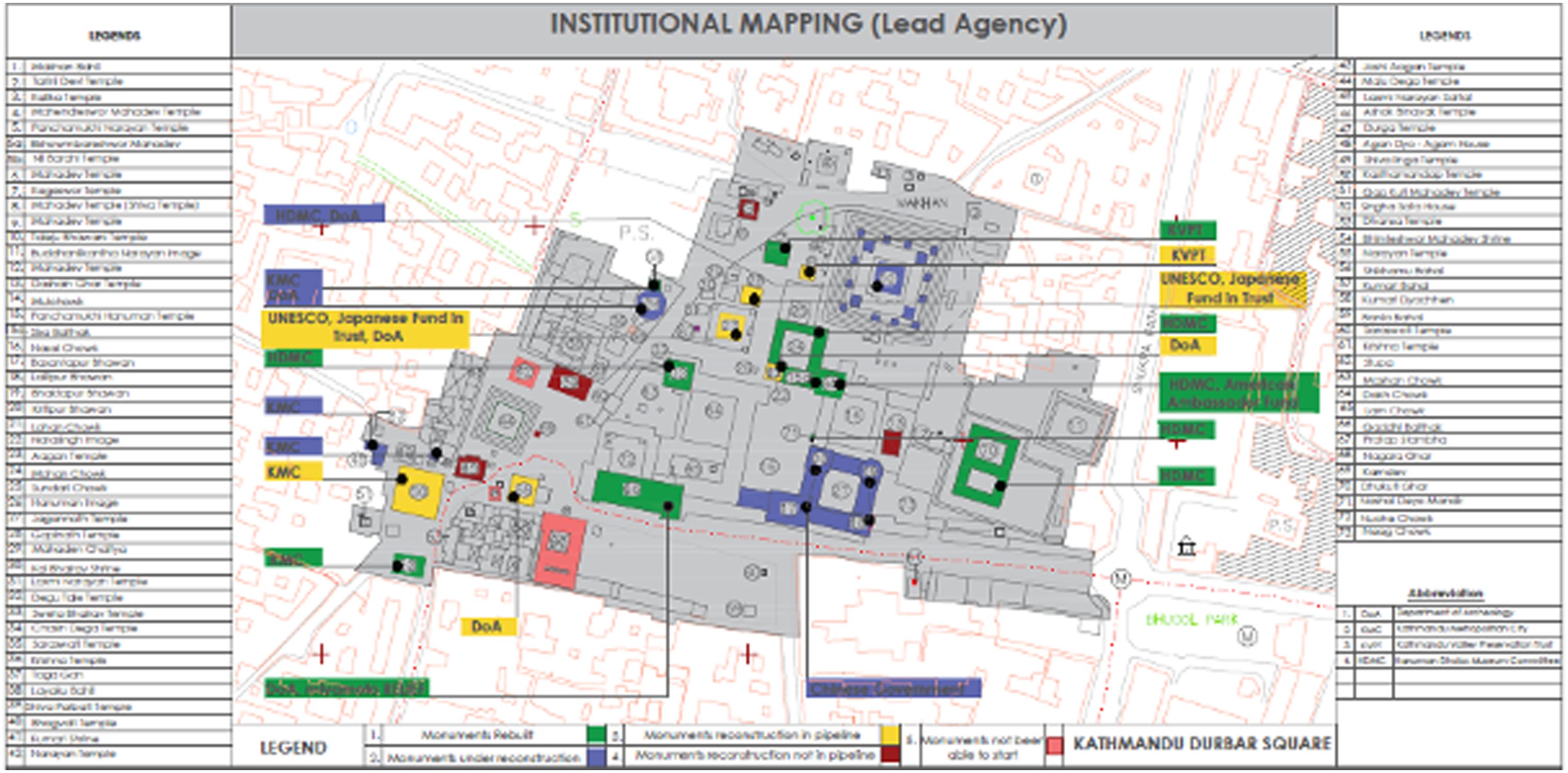
The intersecting and conflicting tiers of management of heritage remain an issue. Heritage management is covered by four different Acts that differentially empower institutions. Various entities involve in the day-to-day maintenance and operation including Trusts, Guthi Sansthan, and the Department of Archaeology. The effectiveness of their operations is restricted not just by the lack of financial and human resources but also by statutes preventing organizational freedoms. In jurisdictions such as Durbar Square, UNESCO does not share any of the development or maintenance costs, but they provide a strict set of guidelines for maintaining the site’s World Heritage site status which in certain instances is resented by the organizations for limiting their interest. For instance, Guthi Sansthan partially owns a historic building at the eastern end of Kathmandu Durbar Square that operated as a spice trading store for many centuries. It harbors a desire to turn this into a mall to generate revenue to fund its various operations. Such conflicting sentiments persist and penetrate through the reconstruction process. The post-disaster rescue and reconstruction started almost simultaneously on various buildings based on disparate set of funding and reconstruction initiatives.
Durbar Square comprises 61 structures, both small and large, loosely differentiated as temples and shrines, institutional/palace complex and sattals (rest houses). Most taller structures on elevated podiums sustained complete collapse with the rest experiencing modest to severe damage. The first structure that was restored in Durbar Square was Kageshwor temple, funded by Kathmandu Valley Preservation Trust (KVPT), a United States tax-exempt 501(c) (3) organization; followed by Gaddi Baithak Palace, constructed by Miyamoto Global Disaster Relief 4 with American funds. Nau Tale Durbar (also called nine-storey Basantapur Palace) was one of the first structures to commence with Chinese funds. Among those led by local organizations, Singha Sattal was restored by Kathmandu Municipality and Guthi Sansthan in a 60/40 partnership. 5 To facilitate reconstruction and improve coordination and consistency, the DoA set up Earthquake Response Coordination, introduced Post-Earthquake Conservation Guidelines 2072 and Manual, 2073 and conducted various training programs.
Aid politics and heritage subjugation
Nepal has been aid-dependent for much of its development history, which has continued with disaster aid added to it. The country has been the subject of intense geopolitical interest due to its strategic location between the two superpowers, China and India, that exude completely different ideologies (Upadhyaya, 2012) in their development paths. The relational and processual nature of diplomatic offensive played out by each country during the Cold War has influenced their geopolitical priorities. Over the course of history, the British occupation of India and Tibet’s struggle for autonomy caused China to become more autocratic and India more democratic. Within Nepal, these perceptions have been amplified by the rise of the pro-China Maoist party. In addition, a strong presence of countries from Europe, America, and Southeast Asia provides a balancing act. In the aftermath of the earthquake, a considerable donor interest has been seen concentrating on the World Heritage Sites. Whilst the donor motivation was largely in response to the humanitarian crisis, many of these motivations contained an element of self-interest. This is evident from the ‘cherry-picking’ of buildings or projects, which appears to be driven by the idea of increasing their own visibility and a bid to outdo one another (Peters 2020; Sengupta, 2019). 6
The reconstruction of the two prominent yet uniquely historic structures in Durbar Square using Chinese and American funds corroborates this view. The Chinese interest in Nau Tale Durbar (Figure 4) could arguably be linked to its role as a ‘monument’ that characterized the ‘geopolitical’ switch
7
in the 18th century. China’s interest is also viewed as a consolidation of incentives and investments
8
in infrastructure, cement products and mining to re-assert its influence in Nepal. Chinese footprints have been all over the development space, most of which aimed at exacting long-term conditions. The Indian press sees this as a ‘debt trap’ that China has applied across South Asia and a direct outcome of Indo–Chinese geopolitical competition
9
(Times of India, 2018). The Nau Tale Durbar construction will likely reinforce Chinese geopolitical ambitions. Nau Tale Durbar and Gaddi Baithak Palace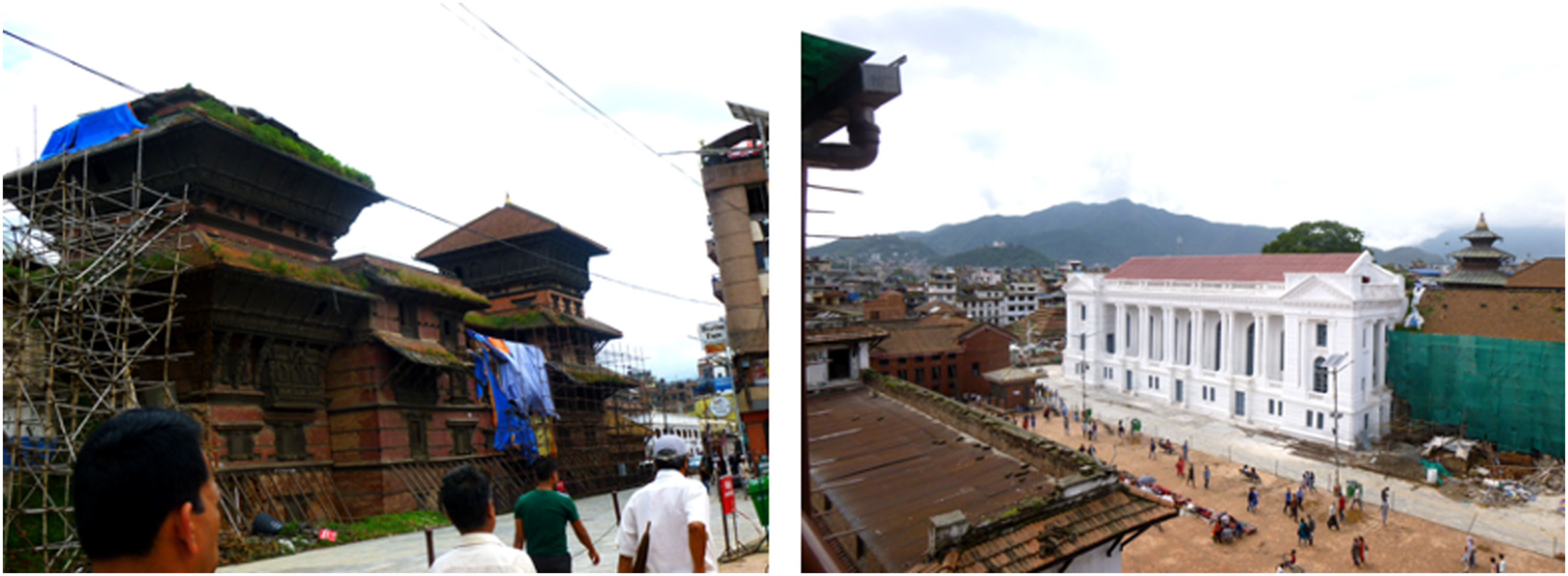
Likewise, the American interest in Gaddi Baithak Palace (Figure 4) represents an investment into the restoration of one of the most imposing imperial architectures, and an embodiment of the foreign influence 10 in the city. Together with the composition of a plain fundament, freestanding pairs of colossal Ionic columns, and the horizontal treatment of the south façade, Gaddi Baithak Palace resembles the east façade of the Louvre in Paris. The restoration of Gaddi Baithak Palace was completed in 2018 with US Ambassadors Fund for Cultural Preservation and Miyamoto Global Disaster Relief as the contractor and became the first major heritage project to be completed in Durbar Square. The reconstruction sparked a controversy over the two different aspects, technical and the reconstruction process itself. Technically, the slightly altered façade and the use of modern materials in reconstruction including steel tie rods to hold the masonry walls of the stairwells were met with formidable opposition from the public and local heritage experts. Several local heritage activists 11 “lack of involvement and participation in the reconstruction,” albeit the DoA insists that retrofitting adhered to the international practice of community engagement. A friction and a creative tension arise when we juxtapose 2 ontological conceptions of aid goals.
The official sources at the DoA claim that the aid disbursement instructions simply cascaded down to the DoA level 12 from the Ministry, depriving DoA of any say in the decision-making. The lack of internal and external transparency and absence of any deliberation is striking. There are no meeting minutes, or decision notes in the public domain, which raises a possibility of diplomatic heavy-handedness commonly observed in asymmetric donor-recipient relationship at the higher order of the governance (Nair, 2013). Even NRA, despite its key role in overseeing all reconstruction work, remained in the middle without decision-making powers (Bhandari and Hodder, 2019), its mandate reduced to managing reconstruction as instructed by the directing Ministry. That the funds were controlled by the Ministry of Finance led to as “a chaotic post-disaster fund disbursement accompanied by the pressures from diplomatic agencies to get the work off ground with little or no time for any deliberation”, according to NRA officials. 13 This was corroborated by the representative 14 of KVPT, who admits that although the Trust has a long engagement with the reconstruction of Patan Durbar Square, it was keen to mark its place in Kathmandu Durbar Square. He claims that the Trust’s proposal to rebuild Kageswor Temple was accepted with no questions and asserts that ‘cherry-picking’ is not necessarily evil at a critical juncture of post-disaster recovery. He argues that “there is no reason to discard proposals for which funds are readily available ”. These views are pertinent where local communities are allowed to exercise their agency in the reconstruction, as experienced in the KVPT’s long involvement in the maintenance of the World Heritage Site in Patan. The agency approach is more pronounced in Bhaktapur, with the Municipality taking the helm of reconstruction upon itself, rejecting external involvement. In Kathmandu, however, dis-jointed community structure hindered any meaningful agency to work. Despite the three historic cities bound by common strands of history diverse discursive heritage constructions deployed represent a prolific emergence of different forms of agency in a post-earthquake landscape that is put to work dialogically to define various heritage narratives.
These efforts are however undermined by the goals set at the national level. When the NRA was established, it pledged to complete all reconstruction work within 5 years of the disaster (NPC, 2015). Although unrealistic, the compressed timeframe created an aura of urgency and provided sufficient traction for the external actors to bypass community engagement in the reconstruction process. The rhetoric around the importance of community engagement can be found all over UNESCO and other international actors’ manifestos, but the actual practice suggests a move away from – to put it crudely – keeping the local communities at bay, leading to a complete disengagement with the local audiences. The Nau Tale Durbar currently under construction by China is a case in point, criticized for the lack of transparency in terms of reconstruction progress, techniques used, and community involvement. Chinese flags dot the perimeter fence with some drawings and excerpts displayed mostly in Chinese. This coupled with steel fences and barricades send out a strong message to keep out (Figure 5). A leading activist
15
laments, “It is unfortunate to see the flags of foreign countries and aid agencies in our heritage sites.” Flags signal relationships of dominance and subordination. Projects funded by USAID, GIZ, DFID, JICA, and a host of others have also included their national flags on reconstruction awareness posters; however, the Chinese posters appear to have a whole new meaning. Hoardings displaying Chinese presence in Nau Tale Durbar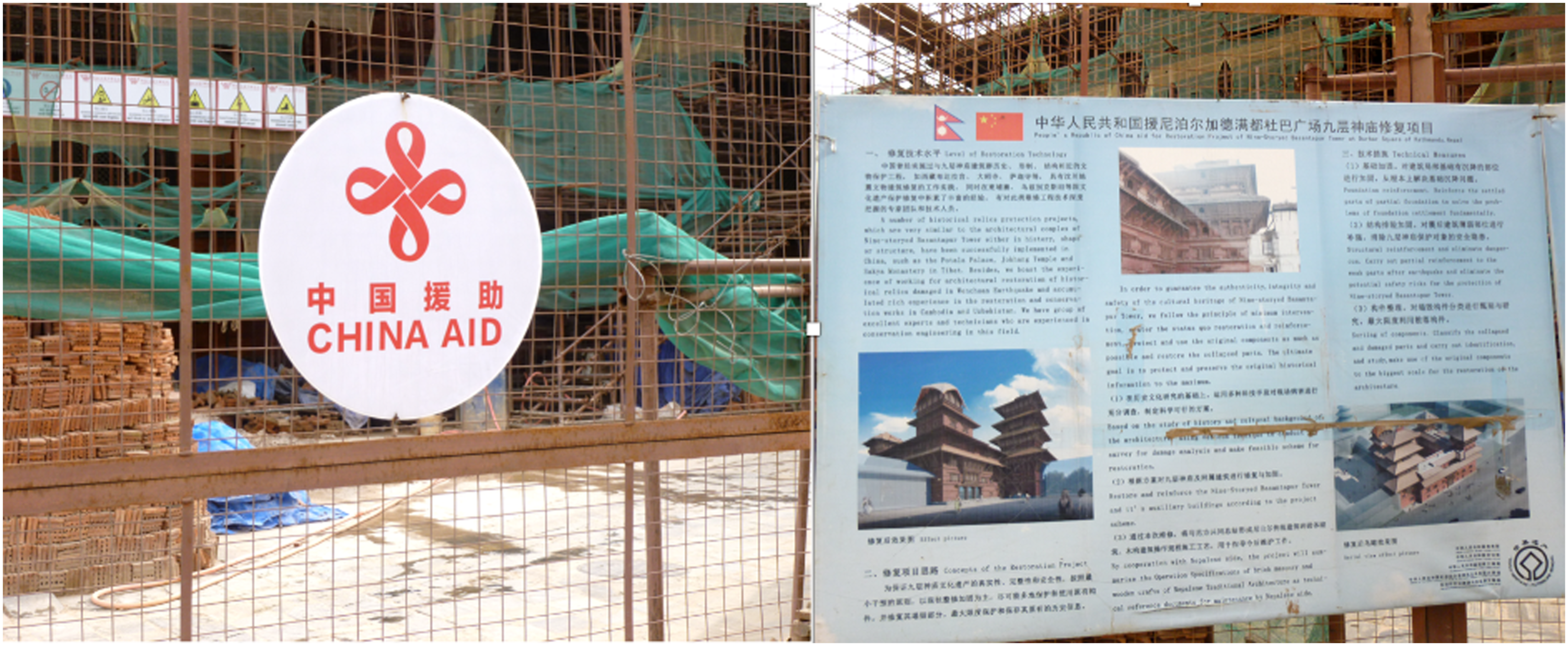
Chinese flags in heritage reconstruction sites have rekindled the criticisms labored on the Chinese investment in Nepal’s infrastructure. Nepal government signed a multi-billion-dollar loan under the Belt and Road Investment (BRI) to operate railways from China to the northern hilly areas of Nepal, which is seen burdening the country with a debt that can’t possibly be easily dealt with. In an incendiary remark, Kumar (2021) claims that through BRI the third phase of China’s grand plan to “colonize Nepal” is at play in Kathmandu with spreading “anti-Indianism” a its core. A sizeable body of literature exists, both in scholarly channels and in media that analyses the infrastructural diplomacy of Nepal’s northern frontier (Murton et al., 2016; Giri, 2016; Chand, 2017) and “power moves spatially through infrastructure and other development interventions” (Murton, 2019). Put within the context of China’s muddled experience in Africa and the apparent ‘taming’ of Tibet through infrastructural politics (Yeh, 2013), the fear around China’s growing ideological influence exerted through heritage/disaster diplomacy appears justified.
Regardless, scholars have viewed the 2015 earthquakes as a political tool for countries such as China and other foreign donors including India, to recalibrate geopolitical and financial relationships with Nepal (Chand, 2017; Murton and Lord, 2020). Historically, India and China have sought to outdo each other in terms of ideological influence over Nepal. India’s role in post-disaster recovery has been much less strategic (other than neutralizing growing Chinese influence). For China, unlike infrastructure investment in obscure northern regions of Nepal, heritage reconstruction in the capital commands high visibility. US and Europe appear to jump in to counter the regional ambitions, and engage in a geopolitical balancing act. US interest in Nepal’s heritage reconstruction is not very clear but logically can be deduced to have a two-pronged approach – introduce a balancing force in the face of regional powers and competitions, and an extension of the historical relationship with the country. This is articulated as a triangular geopolitical rivalry (Wagle 2021) on the back of Indo-Pacific Strategy (IPS), which sees Nepal, oddly enough, as a defense partner. It rhymes with Khadka’s (2000) analysis of the US interest on Nepal during the Cold War era. He sees external factors (strategic location in South Asia, proximity to Tibet and potential risk of being exposed to Communist influence) and internal (weak governments, endemic poverty etc.) influencing the US interest in Nepal.
Ultimately it is also down to the motivation for aid moneys. Aid politics has long been rife with underlying tensions between aid donors and recipients. Writing on Bangladesh, Hossain (2017) claims that the receipt of aid is not just about being handed resources and a technical blueprint to guide their use; it also requires submission to outsiders, whose claims are often those of historical domination or superior economic power. Like many other countries in Asia and Africa where Chinese interests lie, Nepal is intractably poor and under-developed, but it also strategically interesting for China. Chinese motivation therefore could not be deemed just humanitarian or altruistic but hegemonic. Whilst the government machinery appears rather unresponsive to such an outlandish display of hubris by the Chinese authorities, some of the members of the community spoken to, especially heritage activists and academics, 16 do question if something similar would be even remotely possible in China or any other first-world country.
The spaces of exclusion and inclusion in heritage-making create an environment in which spaces for democratic contestation, debate, and disagreement are narrowed (Cretney, 2019). The government disinterest can be attributed to the skewed disaster diplomacy that presents an opportunity for strengthening external ties, redirecting foreign aid, as well as consolidating its own position. Durbar Square thus situates the shifting forces and structures globally and nationally within the broad context of heritage diplomacy which provides a uniquely valuable vantage point for understanding the various ways this landscape is now changing.
Pro-heritage activists’ organizations such as SAVE heritage and their supporters resent the predominance of foreign aid in rebuilding major buildings, and the external control of reconstruction. The local groups praise the fact that reconstruction (of Kumari Bahal managed by Guthi) was carried out with its own financial resources. The local refusal to foreign aid may sound like a nationalist stance and an unpractical one, but this sentiment is based on history, religion, morality, self-determination and several other arguments that are marshalled to assert this claim. Ultimately, they view the heritage reconstruction as a responsibility of the ‘state’ vis a vis the notion of authentic Nepalese identity. This view does not necessarily appear merely as an opportunistic distraction either. It also gives a clear signal of the societal change toward heritage sovereignty that accompanied the disaster.
While those sitting in close range of the state machinery firmly believe the government is financially, politically, and ethically incapable of delivering on the reconstruction without external aid, I would argue that such views are not simply a ‘post-disaster reconstruction’ blip, but also an ongoing struggle for access to power, finance, and ownership. Disaster financialization is an integrative term through which power is being shifted around in the post-disaster reconstruction, and this penetrates through the local communities and activists as well. Le Billon et al. (2020) argue that the Nepalese government has relied on the leveraging of cash incentives by donors and government to accelerate the ‘build back better’ concept, which others argue (Rawal et al., 2021) has not benefited the low-income and vulnerable population.
These arguments not only provide ideological underpinnings but also point to operational issues. Our interviewees, regardless of their institutional alignments believe that heritage cannot be outsourced as it requires local knowledge and skills for reconstruction. This, they claim, is essentially for re-enacting intangible heritage such as festivals, processions, and religious activities that are critical for the socio-economic and psychological recovery of the community in heritage reconstruction. Lessons from the 1934 earthquake in Kathmandu proved that ritual practices enhanced the ability of the community to cope with disaster situations and revive a normal social life (Bhandari et al., 2011). As a symbolic gesture, the Indra Jatra festival was allowed to take place in the first year after the disaster. However, it was discontinued as the buildings and spaces that are critical to hosting such festivities were not repaired or prioritized for reconstruction. Maju Dega temple, which forms a podium for the spectators (see Figure 6), and Trailokya Mohan temple, where an important re-enactment ritual of god Vishnu is performed, have collapsed and remain unbuilt. There are at least five other major festivities, including Macchindranath Jatra Indra Jatra in Kathmandu Durbar Square: before and after the 2015 earthquake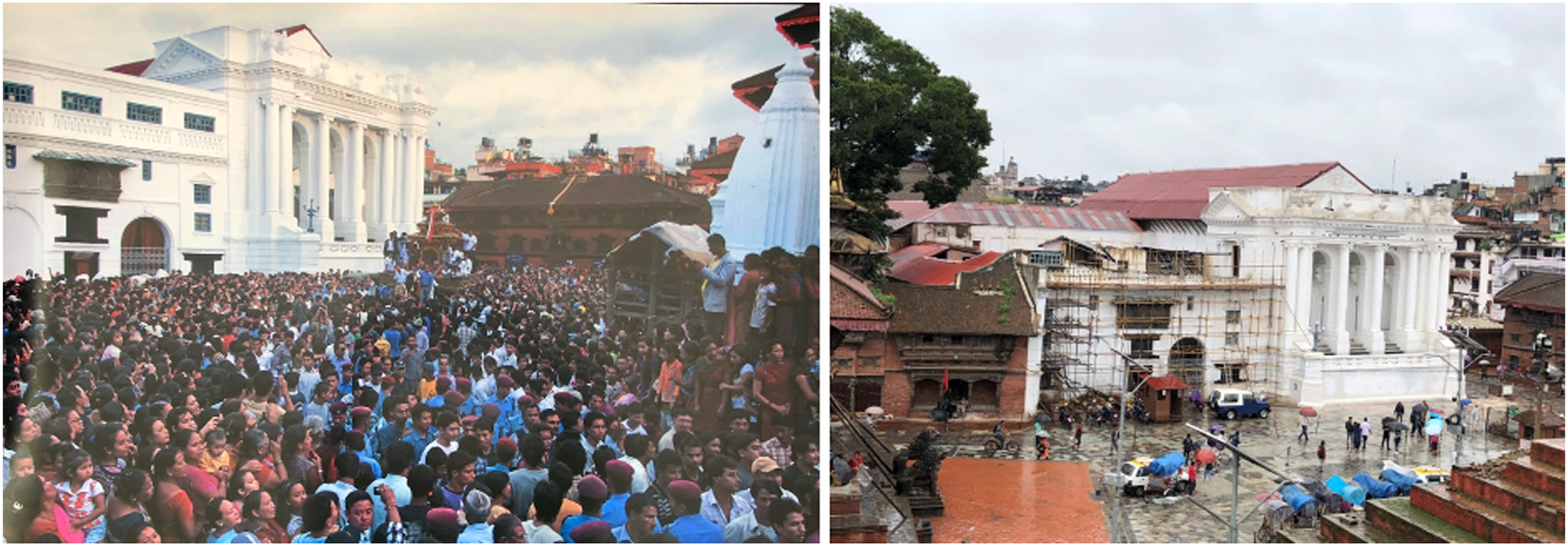
Our fieldwork suggests that most interviewees feel strongly that the temples should have been amongst the priorities for reconstruction as they are central to the spiritual and psychological wellbeing of the community. The cluster of monuments currently either completed or under construction are all institutional buildings barring Kageswor Temple. A leading historian 17 and a former Director of the DoA asserts that “these temples play a fundamental role at several different levels, as venues for formalized religious and ritual observances, and as spaces for social interaction including employment generation”. This is echoed by a representative from the Priest Association, 18 who highlights the apparent indifference of either the donor or the state for the re-construction and resumption of temple operations. As Bhatta states, “disasters do not disrupt the rituals. The priests have continued everyday worship and rituals amidst the ruins. Despite the structural risk, we opened the Temple for half-hour every morning to perform the puja”. This was a rare display of resiliency in the face of the disaster, and local recognition of the roles these temples play in the psycho-social recovery. Historically, priests are dispensed with a paltry sum of NR100 (1 US$) per day by Guthi Sansthan, for flowers, incense sticks, and other puja essentials including their daily wages. Arguing this as gross negligence on the part of the state, priest Bhatta asserts, “the budget is insufficient to allow the temple to remain open for the whole day.” To limit the role of intangible heritage would then be tantamount to undermining the local heritage.
The question of priorities depends on one’s vantage point. A counterargument is provided by the executive director of Miyamoto Relief, who claims that there was “a lot more interest from the [other] partners on the temples, and it seemed like there was a total disregard for this palace [Gaddi Baithak]. She says, “There was no funding allocated for it and it wasn’t prioritized in any way, possibly because it’s a neoclassical building rather than a religious structure.” However, because of its prominence as an external-facing building to the main square, we knew that we could probably find the funding if we threw ourselves behind it,” she says. The fact that the project was awarded the Engineering News Record (ENR)’s Project of the Year (2019) and Best Renovation/Restoration Project of the Year (2019) points to the different benefits such projects bring at both corporate and international level.
Governance gaps, institutional fragmentation and lack of plans
The Nepal government’s post-disaster reconstruction efforts in the heritage sector show the state (through DoA) outsourcing much of its responsibility to a range of stakeholders. This approach reflects a “government by proxy” and “governing by the network,” under which DoA finds itself managing contracts and a plethora of networks that stretch from the central government agencies such as Guthi Sansthan 19 to local governments and to international agencies. The extended partnerships which symbolize “systemic outsourcing” are evidenced by 12 Memoranda of Understanding signed by the DoA by June 2016 (within 1 year). Over the years as part of wider privatization agenda, such governance by proxy is considered to improve the effectiveness and responsiveness of public programs, but a closer look reveals that the issue is far more complicated. A growing coalition of new actors necessitates an effective coordination and record keeping. Plans are vital to respond to the sudden, extraordinary, and recurring burst of disasters. In this case, plans were non-existent and as a result, reconstruction attracted a fragmented and incoherent response from its collaborators. One of the most scathing criticisms of the Nepal Government’s handling of reconstruction came from the UN Reactive Mission which commented (2017: 6): “It is not clear what briefing is given by the DoA to international partners and whether they are provided with the Adopted Conservation Guidelines and other key documents. In some cases, there is almost no information available to state what scope of work the international partners have actually committed to. There is no clear method of demonstrating accountability on the part of the international donors and experts for advice given.”
Such criticisms can be viewed as a by-product of what Aparicio and Muzzini (2013) call an institutionally fragmented heritage governance. Responsibility to manage Durbar Square extends to at least four Ministries and several government departments. For example, the DoA comes under the Ministry of Culture, Tourism, and Civil Aviation. The Guthi Sansthan, which falls under the Ministry of Land Reform and Management, is the legal owner of many historic and religious buildings and manages their day-to-day operations along with religious rites and festivals. Municipal Governments fall under the Ministry of Federal Affairs and Local Development and are charged with managing the infrastructure upkeep and controlling unauthorized construction. Land use planning and implementation of building codes are overseen by the Department of Urban Development and Building Construction and falls under the Ministry of Urban Development. In essence, a three-tier governance system exists creating considerable confusion. The divided responsibility not only necessitates decisions to travel quickly across different departments and Ministries but also demands effective negotiation. Evidence from the ground shows that despite interdependence, the collaborations were an arena where interests clashed multiple and often conflicting goals. The main conflict lay in whose heritage should be preserved: society’s or its citizens’? However, the conflicts were also due to multiple roles and responsibilities across different agencies. For instance, according to the Citizen Charter, Hanuman Dhoka Museum Committee is tasked with managing the Museum operations which includes “adequate security arrangements for arts, crafts and historical, cultural monuments of the museum and timely and proper repair, renovation and maintenance of the museum”. But the Committee relies on Guthi Sansthan (the legal owner) for the restoration of any artefacts, and Kathmandu Municipality to maintain and preserve transitional areas, which also collects entry fees for visitors. For this reason, DoA has long argued that valorization of the conservation and protection of the World Heritage Sites should lie with the municipalities given they collect revenues from the entry fees. The remit of each of these organizations has been a gray area owing to the dubious physical boundaries on-site, overlapping responsibilities, and multiple ownership issues across various government departments. Interviewees representing several government departments such as Guthi Sansthan, Kathmandu Municipality, and the Hanuman Dhoka Museum Committee have been unanimous in asserting that “direct interactions between the organizations rarely go beyond individuals from each of the organizations attending meetings”. Communication is slow across the board and a communication gap exists at both vertical and horizontal levels. Decisions are made on an ad hoc basis and on the basis of shifting political priorities. The system of writing meeting minutes and record-keeping is also poor. Where it does exist, it is inaccessible to the local community. Our interview with the Director of the Museum Committee provides an interesting account 20 of Kumari Ghar reconstruction (Figure 2), where politics was entrenched into reconstruction decisions. She asserts, “The Museum Committee was initially assigned to undertake the restoration but was told to back off, and Guthi Sansthan, which seriously lacks resources, was allowed to step in. Guthi Sansthan being a local body has strong political actors as its members who call shots”. Their vested interest in the reconstruction and valorization of Kumari Ghar (ignoring other monuments) is attributed to the wealth amassed for centuries through the Kumari ritual. It can be argued that despite a dedicated legislation (1956 Ancient Monuments Act), policies are far more territorial and organizational, directed to specific organization, infrastructure (water, electricity, sewage, solid waste), and areas making co-ordination between institutions far more challenging.
The differentiated boundaries and lack of coordination have also engendered a rise of informal ‘gatekeepers’ and decisions ‘in the middle’ fraught with institutional clashes with wider ramifications. When the main earthquake hit central Nepal at 11:56 a.m. (local time) on Saturday, 25 April 2015, it triggered a series of aftershocks that led to considerable uncertainty around relief aid. People set out to save their own lives and to protect their property while helping others. Most interviewees lamented the “absence of the Government and its allied agencies for several days causing delay in reviewing the damage in Durbar Square’s Architectural heritage, artefacts and idols”. This partly prompted UNESCO to go beyond its own legal remit, to initiate in-situ activities such as cleaning the central pond, making independent logs of the inventory of artefacts and passing instructions for their safekeeping. This was vehemently opposed by local leaders, mostly acting on their own volition and without any official position. Whilst disaster recovery literature generally shows positive contribution emanating from informal gatekeepers, their decisions taken “in the middle” can also extend the risks. As Cretney (2019) argues, the community actions can sometimes disrupt and reconfigure reconstruction process following the disaster.
In the immediate aftermaths of the earthquake, the groups comprising local leaders and heritage experts were successful in applying pressures on the central government to bring the army in salvaging and safekeeping of artefacts in Durbar Square. Around 150 soldiers were deployed to prevent looting and to aid the police force guarding the sites of architectural remains and artefacts of Durbar Square temples. ICCROM, 2015: 10). This decision became quite controversial as the army transferred many sculptures and artefacts to Tundikhel, a large public ground about 1 km from Durbar Square, risking hundreds of artefacts to be unaccounted for. There were no inventories created, as none of the government agencies thought it fell within their remit. During an interview, a representative from UNESCO laments that, “trusses, idols were scattered everywhere in Tundikhel. I offered to do the inventories and went to meet the site managers, who were ex-officials from DoA, who said everything was under control. We came back after 5 months, and nothing had happened. Nobody cared.” Cretney (2019) describes disasters as political events that are integrally shaped by the order of society, both through the construction of hazard and risk and the politics that arise from the contested possibilities and constraints of recovery and reconstruction. Durbar Square demonstrates the asymmetric relationship and underlying tensions between local, state and international actors and how institutional fragmentation manifests itself in the absence of formal plans and policies.
The increase in informal decision-making at various stages of operations can be attributed to the gross absence of inventories and architectural record of the damaged buildings and monuments. Absence of plans and drawings became particularly conspicuous in the reconstruction of Gaddi Baithak Palace and the controversy surrounding its façade. In my quest to find floor plans, I was astounded by the discovery that most reconstruction work in Durbar Square has been based on photographic evidence, which in itself is sparsely available. In an interview with Kiran Chitrakar, a leading photographer revealed that he loaned photographs for the reconstruction of Gaddi Baithak Palace going back 100 years or more. He, however, claims that whilst his photographs provided valuable pictorial documentation, they have not been able to capture every detail or method of construction. The Director of the Museum cites the hasty reconstruction of the two gates (out of the four damaged) at Taleju Temple by the DoA without any photographic evidence as a showcase of poor practice and complete negligence. Such criticisms coming from an ‘insider’ within the government structure is powerful evidence of unethical practice and the severity of the problem. She goes on to claim the delay and deliberations around Kasthamandap’s reconstruction as being a good practice, where all stakeholders are coming together to rewrite history in the correct way. She notes, “A committee led by Rebuild Kasthamandap, a local body and comprising various experts has been formed to oversee the progress, with a budget of NR 5 million (US$50,000) to draw plans. During our fieldwork in 2019, Kathmandu Municipality confirmed that all drawings were being prepared based on archival evidence. The reconstruction has now been completed.
Absence of plans have posed a major barrier to capturing the exact nature of damage in the immediate aftermath of the earthquake. UNESCO stepped in to support the DoA to carry out a rapid assessment; 21 however, their survey teams did not have the benefit of floor plans and elevations. The forms filled in by the team did not provide sufficient information on the immediate risks such as those associated with out-of-plane displacement of walls or delamination at several temple sites, or damage that could be caused by heavy rain or another earthquake. There was limited or no use of technology to detect the unseen damage in the structures that were still standing. Notably, ICCROM in partnership with Kathmandu Living Labs, an IT company, developed an app to be used by 90 volunteers who walked across disaster sites documenting the damage and submitted it to the DoA.
The DoA however did not possess software and hardware to collate, analyize and visualize such externally-sourced data that incurred no costs to them. Whilst the initiative was ground-breaking in terms of potential for long-term, collective stewardship of the heritage, it remained pointless. This, coupled with the considerable confusion over who should be involved, led to ad hoc involvement lacking in forethought, or any supervision from the DoA. State agencies in general have a serious shortage of trained staff who could plan, programme, budget, project manage or negotiate with donor agencies operating on the ground. This is not unique to Nepal but common in countries with poor resources. In El Salvador, only a handful of the country’s 262 municipal governments had any professionally trained staff even after 2 years of hurricane Mitch which killed 1159 people and injured over 8000 people (Wisner, 2001). In conjunction, there were criticisms levelled against poor response from those in power in the immediate aftermath of the earthquake. Warner et al. (2015) insist the powers above delayed acting up as the Prime Minister Sushil Koirala was abroad when the first earthquake struck, learning the news from Indian Prime Minister Narendra Modi’s Twitter stream. Koirala did not make an official statement until 4 days after the initial seismic shocks, leaving many to ask: “Where is our government?”
These trends in heritage reconstruction concur with other disaster research that show how weaknesses of national and local government render any external input ineffective. Commenting on the political economy of the 2015 earthquake and its ramifications, Regmi (2016: 77) argues that the modernist top-down model of development – that both government and donors take for granted – has created roadblocks towards understanding Nepal’s contextual realities. This corroborates Dollar and Levin (2006)’s view that institutions and policies are key determinants of effectiveness of any financial assistance. Given this challenging backdrop, it is critical that a shared set of interorganizational norms regarding roles and responsibilities and internal and external capacities must be reviewed and established to succeed in reconstruction.
Local resistance and heritage subjectivities
Kathmandu is one of the few cities in the world that has retained the medieval urban culture in its architecture and spaces (Sengupta and Upadhyaya, 2016). Durbar Square, as a microcosm of the city, has that medieval spirit anchored to its materiality and traditions at the same time. The preceding discussion rekindles debates around how heritage is interpreted and at times misinterpreted in the absence of effective governance. In this regard this section seeks to understand how local priorities intersect with the competing national and global interests, and how within those intersections, the localized movements make an attempt to disrupt the dominant order to take back control.
Quite strikingly, the post-disaster heritage reconstruction shows a resurgence of heritage activism which idealizes communities either as repositories of authenticity and identity or as sites of struggle against globalization. Local communities have been particularly vocal on the authentic restoration through the use of traditional materials and techniques. The reasoning behind this is simple: if the materials and techniques are traditional and structures authentic, consequently they achieve better resilience to any future disaster shocks. This view is supported by experts. Korn 22 (quoted in Ranjit, 2016), a reputed scholar, notes that the indigenous use of woodwork applied across many heritage buildings creates a system of interlocking structures without the use of nails, which gives resilience to the entire structural systems of pagoda architecture in Kathmandu. External agencies on the other hand, are driven by the notion of gaining safety. An architect from KVPT reveals that the reconstruction of Kageswor Temple was swiftly completed with the use of steel braces in the foundation precluding any opportunity for the local groups from scrutinizing construction details. Whilst the authenticity criteria feature strongly in UNESCO guidelines, their implementation is questioned. As Lawless and Silva (2017) note, they are not fully understood or utilized within the non-Western cultural contexts. Interviews 23 with the representatives of the local communities and heritage groups show that they are not convinced that the international conventions have been followed within the donor-led projects, nor are local groups consulted. These limitations, Ganapatilal Shrestha argues, “may take away subtleties of any traditional construction techniques and architectural details which may not be substituted.” Consequently, the heritage may well lose the authenticity and powers to connect to the people.
The issue of authenticity has been a dominant tool with which the local groups have asserted their influence in heritage-making in Kathmandu. This was particularly conspicuous in the reconstruction plans of Kasthamandap (see Figure 2). In 2018, the DoA approved architectural plans submitted by Kathmandu Municipality, which drew criticism from the locals and heritage conservationists for the use of steel, industrial glue, and concrete. Local stakeholders have argued that the proposed plans went against the DOA’s own heritage conservation guidelines and had been drafted without due consideration for the reuse of structural elements salvaged after the quakes. Rebuild Kasthamandap, a lobbying group, argued that reconstruction should follow its original design and details, using traditional materials and techniques, incorporating all its surviving elements and ensuring that all the necessary rituals are undertaken throughout the reconstruction process. They also proposed to establish a modern guthi system to manage the site, which would ensure both tangible and intangible heritage attributes are maintained 24 in the future.
Kasthamandap is the oldest public building in Kathmandu Valley serving both religious and secular functions over a millennium. This wooden pavilion, apparently built from the wood from the same tree, is credited to have been built in the 12th century. A joint excavation conducted in 2016 pushed Kasthamandap’s origin back by five centuries, confirming that the foundations dated to the 7th century (Coningham et al., 2016). But more than just a physical structure, it holds immense cultural and symbolic importance for the city. It is said that Kathmandu’s very name is derived from it.
The local resistance to the initial plans of Kasthamandap caused much state-local tension for over 2 years. Ultimately the project was shelved, and new plans were drawn up in consultation with the local heritage experts. Several factors helped to build the local resistance. There was no donor interest in the building, and funding was provided by Kathmandu Municipality, a local governing body, which gave the locals the perception that these subjectivities and sentiments can be negotiated and understood. This is significant given similar concerns around the altered façade of Gaddi Baithak Palace, and speculations over the construction details of Nau Tale Durbar were suppressed under the diplomatic weight of the donor countries. The state indifference is seen as damaging to the heritage value by experts. Dixit (2017), a noted historian in Nepal, remarks that “it is an unseemly fight that has delayed the restoration, and weakened the cultural aura that Kasthamandap sheds as the centre of Nepal Mandala, and a symbolism for the nation-state”. Dixit’s view may be discounted as being parochial; however, Western scholars have also viewed Kasthamandap as a landmark opportunity to resist any form of heritage subjugation. Slusser (quoted in Risal, 2017) argues that “No other traditional building in Nepal could compete in size, antiquity or cultural impact. It must not be allowed to perish.” These views were influential in the bold attempts of Bhaktapur Municipality to refuse to allow foreign donors to enter and strive to pursue reconstruction that restores heritage to what existed during the Malla period.
Moreover, it can be argued that the local assertiveness to take back control of Kasthamandap goes beyond its symbolic importance to the notion that communities attribute its collapse to the perennial neglect by the state, lack of maintenance, and use of inappropriate materials in the previous disasters. In particular, the extensive repairs carried out following the earthquake in 1934 and subsequent maintenance and repair work have been credited with the failure to preserve the original forms and diminishing resilience of these structures (Banerjee, 1977; Korn, quoted in Ranjit, 2016). The local campaign around Kasthamandap shows how heritage brings communities together to form an effective resistance, and protect those landmarks around which their physical, social and psychological recovery coalesce.
The attempts at local appropriation of heritage forms in Kathmandu has also been seen in several other forms that are powerful to rewrite history. Specific to the city’s (mostly) neo-classical buildings, local groups have advocated that their reconstruction should be undertaken according to their original planform, taking them back to medieval times. These views emerged strongly over the controversies surrounding a visible alteration of Gaddi Baithak Palace’s façade and other important buildings across the Valley. Lal Baithak 25 made headlines with Bhaktapur Municipality going on record as actively disapproving the German proposal for the like-for-like reconstruction in favor of recreating the building in the medieval forms. UNESCO, on the other hand, was concerned about restoring Lal Baithak in the complete absence of any (pre-1858) details (UNESCO, 2017). 26
Such localized and iconoclastic actions can pose a threat to the foreign aid-dominated governance landscapes; however, they remain disjointed to build a strong resistance. Bhaktapur Municipality (unlike Kathmandu Municipality) has always shown strong alignment with local groups and local sentiments around heritage. This is reflected in their rather overt view on how DoA rigidly applies UNESCO guidelines. As opposed to the UNESCO guidelines, Bhaktapur Municipality opted for their own designs to revive the Malla-period architecture as part of their cultural identity (Limbu et al., 2019). The Municipality also refused international funding for heritage reconstruction which represents the far right. Whilst Shrestha (2021) found both communities and officials in Patan resorting to a middle path by taking active participation in reconstruction and not rejecting external intervention outright, Kathmandu on the other hand, adopting more divergent and iconoclast views, put neoliberal benefits ahead of local sentiments (Sengupta, 2018).
The connection between memory (be it distant memory) and physical heritage or between memory and capital further demonstrates that the post-disaster reconstruction is an attempt to understand the past, present, and future’s interactive social construction. Reflecting on the post-earthquake Hanwang Memorial Park, Tang (2019) argues that memorial sites allow the self to express “gratification, satisfaction, and sympathy so as to construct contemporary ontological meanings of mortality as reflected in both cognitive and affective experiences”. But the goal of heritage reconstruction in Nepal is not simply driven by memory or creating an iconic memorial object for the future generations to consume but to create what Rhodes (2020) calls ‘absent presence’ – to institute a sense of forgetting and recreate these structures to stay alive as they were in the pre-earthquake levels.
The attempt to rewrite history by peeling away the layers of the forgotten or obfuscated instantly generates contested narratives. Harrison (2013: 88) claims, “once heritage moves into the political arena it becomes a symbol of something else – nationalism, culture, class – a touchstone around which people can muster their arguments and thoughts.” Ultimately, as with the donor bias on the celebrated and visible projects, the local appropriation has also shown a strong political bias. What is right or not right, when it comes to heritage reconstruction and the opportunity that any disasters offer, therefore depends on an individual’s or group’s perspective, and it is clear that different perspectives come with different interpretations. Re-appropriation of heritage in that sense, whether initiated by the donors, state agencies, or local communities, remains inherently value-laden and therefore controversial (Stanley-Price, 2009). Ultimately, heritage reconstruction ceases to be value-neutral.
Conclusion
The paper brings together seemingly diverse concepts and practices that dominate post-disaster heritage reconstruction in low-income countries. Marked by the multi-scalar efforts from networks of countries, international agencies, national government, NGOs, and local communities, post-disaster reconstruction sites become stages of conflicts and resolution. The specific forms of post-2015 earthquake reconstruction in Durbar Square Kathmandu show geopolitical priorities and top-down approaches severing community relations and imposing certain meanings and world views. International actors focussed on the influential institutional buildings ignoring locally significant structures. Temples, squares, and congregation spaces linked to intangible heritage and everyday lives have remained in various states of disrepair even 5 years after the earthquake. Scaffoldings stand as mute spectators of the busy streets and squares kept alive by traders and informal vendors. Festivals, rituals, and religious practices that are vital for community recovery are still disrupted as the buildings and structures they are linked to remain unbuilt. The process has increased mistrust and narrowed the space for civic engagement.
Much of the controversies around local-global tensions can be attributed to the subject of authenticity arising from notable absence of floor plans and drawings in the reconstruction, and reliance on conjectures, anecdotes and photographic evidence (where available). The ‘Ancient Monument Preservation Act, 2013’ (enacted in 1956) vested prerogative powers on the DoA, but very little was done in re-creating documentary evidence. The World Heritage Sites in Kathmandu faced delisting threats at least three times – 1993, 2003, and 2017 – within which absence of floor plans and constructions details have rarely featured on UNESCO’s radar. The paper argues that key organizations like UNESCO, or allied agencies, could play a valuable role in building capacities, preparing plans, and strengthening historical records, which requires moving away from the project-based approach to a more holistic approach that aligns better with wider heritage-making agenda globally.
Concurrently, these possibilities are hampered by the inherent governance gaps marked by institutional fragmentation that emerges from organizational and territorialization issues. Responsibilities are split across several ministries, departments, areas, and categories as well as across buildings and artefacts, tangible and intangible heritage, and private and public courtyards, causing serious coordination problems. In the disaster context, the Durbar Square example affirms that a strong institutional coordination and governance is key to the aid effectiveness in reconstruction. Such conditions are not however unique to heritage but extend to much of the government machineries in Nepal, and indeed in other developing countries. As a low-income countries such as Nepal will continue to rely on international funding for their development pursuits, or for disaster response, it is important to create new interorganizational norms concerning who should lead different facets of heritage reconstruction and, in particular, for greater support for, and deference to, local cultural preferences. Such plans would enable governments to establish robust protocols to coordinate actions on this increasingly important challenge for cities.
Finally, it is rare that a single disaster would bring a paradigm change in heritage-making. After all, disasters are highly locally situated and geographically bound. However, heritage is also a global matter and a complex construct (Winter, 2015, 2009). The paper demonstrates challenges in striking a balance in situating heritage on an international platform and adhering to local sentiments and sensibilities. It also points to three intersecting planes of existence, emphasizing the simultaneous significance of global, national, and local dimensions and forces. The paper concludes that even if the goals of heritage-making sought through international cooperation are deemed necessary in principle, or desirable in Nepal, particular attempts to achieve them could have perverse effects on heritage-making. Most importantly, it needs a stronger state that can enact and enforce rules of governance and behavior. It also requires considerable analytical work to tease out the complex structure and network of local, national, and global agencies, and competing notions and sovereignty, which together may give forms to heritage-making.
Footnotes
Declaration of conflicting interests
The author(s) declared no potential conflicts of interest with respect to the research, authorship, and/or publication of this article.
Funding
The author(s) disclosed receipt of the following financial support for the research, authorship, and/or publication of this article: This work was supported by the British Academy (SG161937), Royal Institute of British Architects.
