




Abstract
Building on work in feminist geopolitics, we discuss how the governance of in/fertility affects the value assigned to different bodies and the question whose bodies and lives are considered as worthy of reproducing in Mexico. To reveal the geopolitical entanglements of past and present forms of reproductive governance, we investigate the transnational connections of Mexico’s fertility network with Spain and the United States of America. We juxtapose visual materials from political campaigns of the past with advertisements for present-day fertility clinics to trace the reproductive geopolitics of (post)colonialism that shape current developments, practices, and discourses in this transnational fertility network. Each pair of visuals exemplifies particular times and spaces of reproductive geopolitics. The paper reveals how the contemporary Mexican fertility market is shaped by transnational forms of reproductive governance. We employ visual juxtaposition to provoke readers to think about the entanglement of present-day fertility markets with past reproductive geopolitics.
Keywords
Introduction
What has the global fertility market to do with past transnational politics of population control? How does the value of white oocytes in this global market relate to the systematic control of indigenous women’s fertility in countries such as Peru or Mexico? How are colonial ideas of heredity, eugenics and health in Latin America entangled with new reprogenetic technologies?
Thinking about reproductive geopolitics across time and space facilitates to see the entanglements of current reproductive practices in private fertility markets with past politics of eugenics, heredity, health, and population control. We argue that (assisted) reproduction is a crucial and often overlooked site through which to study geopolitical relations. While biopolitical concerns about the racialized makeup of the future nation are at the center of current debates on migration, state security and family politics (e.g. Gökarıksel et al., 2019; Gökarıksel and Smith, 2016; Hansen and Randeira, 2016; Schultz, 2022; Smith, 2019; Smith et al., 2019), geography is still rather reluctant to engage with questions of reproduction (a research lacuna recently also highlighted by Coddington, 2021).
This paper studies questions of reproductive (in)justice and demographic politics through a geopolitical lens. It argues that in the past, Mexican state politics have explicitly addressed questions of reproduction in form of population politics and aimed to facilitate the reproduction of certain kind of bodies while discouraging or even restricting the reproduction of bodies that were thought of as undesirable. Our notion of reproductive geopolitics departs from the assumption that in the aftermath of global population politics (e.g. Bashford, 2014; Connelly, 2009; Hartmann, 1999), today those politics are executed more indirectly through regimes of migration, health, or sexual politics. Juxtaposing visuals from past population politics with visuals of the contemporary fertility industry in Mexico, this paper understands itself as a provocation to think about the postcolonial entanglements of past population politics and present reproductive geopolitics.
The term postcolonialism is used to describe the period following the independence of Mexico from Spain after signing the Treaty of Córdoba in 1821. In Sharpe’s words, the postcolonial notion represents “the ‘after’ to colonialism” and hence “the point at which internal social relations intersect with global capitalism and the international division of labour” (Sharpe, 1995, page 184). In our paper, we focus on the reconfiguration of colonial rule by Mexican state politics and the idea of mestizaje as a postcolonial demographic politics that informs reproductive politics and desires into the present. We use the compound term (post)colonialism to highlight that colonial rule has not ended but has been transformed and continued in present-day national and transnational projects. Building on our previous work which highlights how postcolonial biopolitics and liberal eugenics are entangled in Mexico’s fertility industry (Schurr, 2017), this paper studies the effects of past colonial and postcolonial demographic politics on reproductive (geo)politics of the present.
We develop our argument by using the method of visual juxtaposition (Metcalfe 2015). We place past and present pictures from institutional archives, webpages, political campaigns, and maps side by side to render visible the historical and geographical continuities of Mexico’s reproductive geopolitics. Through the sliding technique of the visual juxtaposition, we want to provoke readers to think about similarities, differences, and entanglements between past and contemporary reproductive geopolitics. We do not want to suggest that the visuals from archives and the contemporary ones are the same but encourage readers to think about how past discourses, practices and logics of eugenics and population control inform, influence, or contest the contemporary transnational fertility industry. We have chosen to work with visuals to highlight the importance of the materiality and aesthetics of bodies and the way bodies are racialized, gendered, sexualized, and discussed in terms of illness/health and dis/ability in both past and present. We consider this experimental fashion to work with visuals as an attempt to not only think about the materiality of bodies, but the multiple postcolonial histories of contemporary demographic geopolitics, stratified reproduction (Colen, 1995; Ross and Solinger, 2017) and (de)valuation of bodies. The paper contributes on the one hand to current debates on demographic anxieties and unperceived national and international population politics by developing the concept of reproductive geopolitics. On the other hand, it provides an example how we can weave in a historical dimension in our geopolitical analysis in a experiential way through the method of visual juxtaposition.
The article develops as follows: The next section develops the concept of reproductive geopolitics by bringing work from feminist geopolitics and demographic politics into concert. The method section provides information about the methods used to collect the data presented in this paper and presents the technique of visual juxtaposition. The empirical part of the paper consists of three sections about the making of white, modern, and healthy families in fertility clinics, exploring their analogies to past demographic politics. In the first subsection, we explore how the idea of racialized beauty circulating in Mexican fertility clinics is connected to the country’s history of eugenics. The second subsection discusses how the representation of a modern family of mother, father and two children in the advertisements of fertility clinics relates to debates on overpopulation dominating Mexican population politics for the last decades. The third subsection explores the making of healthier babies through assisted reproduction and its antecedents in populational and eugenic politics. These three sections are all designed to highlight the historically reconfigured facet of what we call reproductive geopolitics, which we will further delineate in the conclusion.
Reproductive geopolitics
The concept of reproductive geopolitics that we sketch in this paper builds on and advances the field of feminist geopolitics (for an overview see Dixon and Marston, 2011; Hyndman, 2001; Massaro and Williams, 2013; Smith, 2020). Geopolitics has traditionally focused on what in feminist circles is referred to as “big” politics or Politics: the macropolitics of nationalism and state ideologies and the production of international territories, borders, and boundaries. Yet, feminist geopolitics has introduced the everyday, the intimate, and the body as new sites and scales for geopolitical analysis (Cuomo, 2013; Laketa, 2016; Pain, 2014a; Pain and Staeheli, 2014; Smith, 2020; Swanson, 2016; Tyner and Henkin, 2015; Williams, 2020). The concept of reproductive geopolitics draws on earlier work in feminist geopolitics that studies how nationalism is embodied (Faria, 2014; Mayer, 2004; Militz and Schurr, 2016) and how geopolitical practices affect people’s intimate lives (Barabantseva et al., 2021; Brickell, 2014; Pain, 2014b, 2015; Smith, 2012). Both building on and expanding this body of literature, the concept of reproductive geopolitics we seek to develop in this paper builds on Smith’s notion of “intimate geopolitics” (Smith, 2012, 2020) but extends it by focusing on biological reproduction and assisted reproductive technologies as specific sites through which the in/fertility of different bodies is governed. We start from the assumption that reproductive technologies are entangled in geopolitics when states, international organizations, transnational corporations, and religious and nongovernmental organizations decide which body has access to what kind of reproductive technology that either enables or restricts future life.
Reproductive geopolitics relies on what Morgan and Roberts called the “reproductive governance” of in/fertile bodies, that is “the mechanisms through which different historical configurations of actors […] use legislative controls, economic inducements, moral injunctions, direct coercion, and ethical incitements to produce, monitor and control reproductive behaviours and practices” (Morgan and Roberts, 2012, page 243). We draw attention to transnational forms of reproductive governance and how these have been informed by geopolitics of (post)colonialism. The paper further argues that geopolitical interventions not only shaped the biopolitics of other nation-states in the past but inform the neoliberal practices and logics of private fertility clinics in a global bioeconomy into the present (Schurr, 2017).
While some have declared “the end of state biopolitics” (Rose, 2001) and consider “population control history” (Connelly, 2009), this paper centers on the disjunctions, continuities, and entanglements between traditional state biopolitics, global population politics and the contemporary fertility industry. Biopolitics becomes a research interest for geography when the governance of biological reproduction pursues territorial management by populating a certain territory with certain bodies (Chen, 2012; Kaiser, 2018; McIntyre and Nast, 2011; Smith, 2013; Weheliye, 2014). Programs of population control are examples of how states manage populations in a territorial fashion. International politics considered fertility control a way of not merely achieving economic security, modernization, and political stability, but also of producing a future national body that corresponded to hegemonic ideas of the nation and excluded the bodies of racialized, sexualized, and non-national others (Morgan and Roberts, 2012; Oswin, 2019; Tyner, 2013). Past population programs systematically shaped nations and geopolitics as they targeted particular bodies in the Global North (Gutiérrez, 2008; Kaufman and Nelson, 2012), the Global South (Gutmann, 2007; Hartmann and Rao, 2015), and the Global East (Greenhalgh, 2010; Kligman, 1995). Although concerns over population growth culminated in national and international politics during the Cold War, they are embedded in a much longer history of colonial, postcolonial, and imperial state politics that aimed to define normative families and control undesired populations. The recent return of global population politics within environmental debates about climate change (Hendrixson et al., 2019; Sasser, 2018) that promote family planning programs as a “’win-win’ solution for women, population and the environment” (population advocate cited in Sasser, 2018, page 3) as well as demographic anxieties fueled by right-wing populists (De Zordo et al., 2022; Dietze and Roth, 2020; Gökarıksel et al., 2019) signal the need for renewed critical reflection on whose bodies’ reproduction is considered a threat and whose is empowered.
While in the past the territorial management of populations was explicitly framed as population politics, in the present the governance of reproduction takes place more implicitly through regimes of health care, migration, and sexual politics. Policies in these regimes continue to manage populations in a territorial fashion, but they do not officially pursue population control. In this shift from explicit to unperceived population politics, older concerns about overpopulation resurface in populist discourses of a new conservative and often religious global right around the apparent hyperfertility of migrant and ethnic minority populations and the apparent low fertility of hegemonic white populations. Such discourses are complemented by often religiously motivated “heteroactivism” (Browne et al., 2018) against non-heteronormative families. “Demographic fever dreams” (Gökarıksel et al., 2019) of right-wing populists invoke fears about demographic shifts by singling out which bodies and offspring becomes threatening and which needs protection. The concept of “stratified reproduction” (Colen, 1995) helps here to see “which reproductive futures are valued while others are despised” (Ginsburg and Rapp, 1995, page 3). It reveals the power relations by which some categories of people are empowered to reproduce by facilitating their access to reproductive health while others are disempowered by controlling their access or denying their reproductive rights (Colen, 1995; Nahman, 2013; Roberts, 1997; Sifris, 2016).
Thus, reproduction has long been entangled with the political project of nation-building (Kahn, 2000; Kanaaneh, 2002; Nahman, 2006) and geopolitics of imperialism, migration, and development aid. Studying questions of stratified reproduction through a geopolitical lens, the notion of reproductive geopolitics shows how intimate desires and practices of reproduction are entangled with state and international politics as well as with (post)colonial imaginaries. Those processes eventually define whose bodies are considered desirable, and whose bodies are disposable.
Visualizing the colonial and imperial present of Mexico’s fertility industry
The paper is based on the ethnographic fieldwork of Laura and Carolin in Mexico (Cancún, Villahermosa, Puebla, Mexico City) between 2013 and 2016, and Laura’s 10 months of ethnographic fieldwork in Spain (Valencia) in 2018. The fieldwork in Mexico consisted of participant observation in private fertility clinics and more than 150 semi-structured interviews with reproductive laborers, intended parents, IVF experts, geneticists, and medical and administrative personnel. Furthermore, Pedro, a historian, collected visual data from Mexico’s family planning campaigns in the 1980s and of the eugenics movement in Mexico in the beginning of the 20th century. The images from the family planning campaigns are selected pieces of a broader corpus of advertisements that were stored in the offices of Mexico’s National Population Council (CONAPO), the institution that carried out these campaigns. They are selective in the sense that we have chosen to portray the subtopics of health and overpopulation, but these topics also represent the broader ethos that dominated these campaigns. In dialogue with Mirko, the artist running the mLAB at our Geography Department and Pedro, we placed these historical visual materials side by side with the visual material of contemporary Mexican fertility clinics that we have gathered in net-based research as well as during fieldwork in Mexico. This dialogue has also resulted in a timeline of the development of the fertility industry that represents the most important transnational connections relevant for our argument between these three countries in the past and present.
To highlight the imbrications of the past in contemporary fertility clinics, we use visual juxtaposing, “where visual proximity of images or images and text provides an opportunity for an expanded understanding of visual narratives and discourses” (Metcalfe 2015, page 151). The reader moves between the juxtaposed images and thereby explores old and new reproductive geopolitics and their mutual connections. Beyond illustrating our textual argument, our aim is to use visual representations to provide an insight into reproductive geopolitics. Mitchell’s (2011) “pictorial turn” rehabilitated thinking with and about images in the humanities and has since become an important tool to “analyze images as contextualized, historicized, and glocalized meaning making processes” (Mizan and Ferraz, 2019, page 126).
Juxtaposition is a method of analysis in which two images are processed and made comparable and displayed next to each other. It was introduced in art history by Aby Warburg and his iconology as a kind of “forensic method. […] [It] is treated as evidence supporting a particular hypothesis. […] As historic material they also bear witness to visual forms of expression in the present, and thus illuminate both past and present communication processes” (Müller, 2011, page 286). In this form, they provoke an open dialectical discourse about the similarities and differences, about new and discomforting interrelationships. “They collide and conjoin into a new experience. This new experience is a somewhat alienated one: the familiar becomes strange and, at times, uncanny, and breaks up the ways in which we […] memorize what we see” (Sørensen, 2013, page 49). The technique of juxtaposing “provide[s] the opportunity for a level of aesthetic communication that supersedes descriptive illustration” (Metcalfe, 2015, page 166) and explicitly generates spatial relationships through rearrangements of images. We consider it to be a forensic method that can illuminate both past and present transnational linkages.
Reproducing desirable bodies: imaginaries of whiteness, health, and the modern family
The following timeline (see Figure 1) shows Mexico’s economic and political interdependencies with Spain and the USA which is characterized by binational treaties and flows of commerce such as the Agreement on Economic and Commercial Cooperation between Spain and Mexico in 1980 or NAFTA in 1994. The timeline also seeks to show how developments in the field of reproductive technologies and politics in one country influence what happens in the other country. IVF physicians from the USA, for example, were fundamental in training doctors in Mexico and in opening the first IVF clinic in Mexico in 1985 which resulted in the birth of the first IVF baby in 1988 (González-Santos, 2019). Further, the first three parent baby born in 2016 in Mexico was the outcome of close collaboration and business relations between a NY based clinic and its franchise in Mexico (González Santos et al., 2018; Telles, 2014). More broadly, the USA, in the context of its cold war politics, pressured and financed Mexico’s population campaigns from the 1970s onward. With regard to Spain, the transnationalization of the Spanish IVI consortium was crucial for the training of doctors in Mexico who would then also benefit from receiving training in Spain, especially in the sphere of reprogenetics.
The following timeline makes these entanglements between the three countries visible, highlighting how (post)colonial geographies “shape consumption and labour in the global fertility market” (Schurr, 2019, page 8) in Mexico. Without claiming completeness, the timeline (Figure 1) allows to read the geopolitical relations through the lens of reproductive technologies and politics. Transnational networks of reproductive geopolitics. Source: graph made by Mirko Winkel.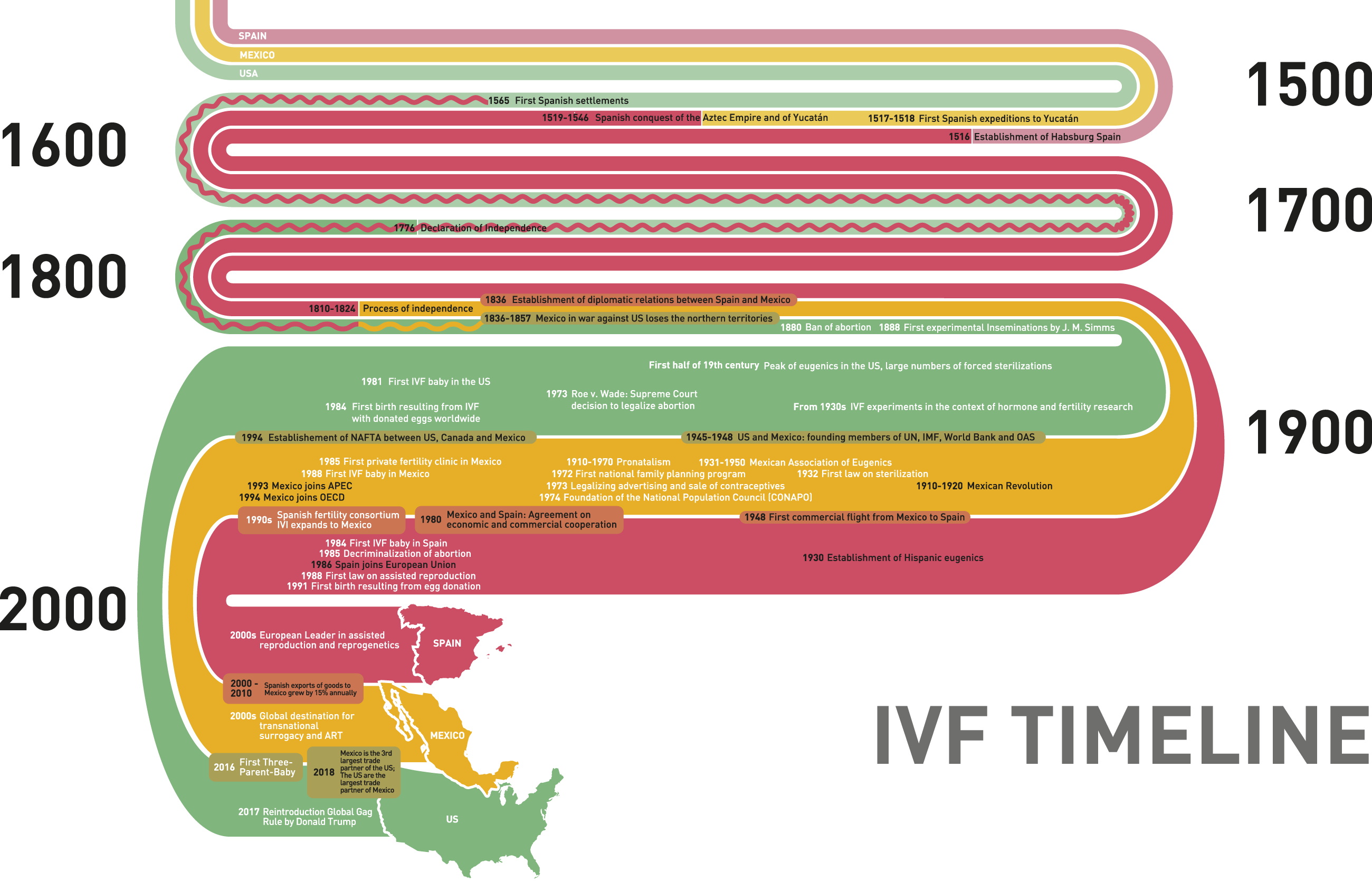
Using the timeline as a way of orienting the reader, the following section will zoom into three key logics that shape Mexican reproductive geopolitics: whiteness, modernity, and health. We argue that Mexico’s national project of mestizaje and the (post)colonial desires for whiteness, stemming from Spanish colonial politics and USA’s racialized norms of beauty shape Mexico’s demographic politics (chapter whiteness). The idea of the nuclear family with two children further turned into the ideal of modernity and was transported through global population programs and in the case of Mexico financed by US-American and international development aid (chapter modernity). Lastly, health was instrumentalized as a key argument for both eugenic policies in the context of the national project of mestizaje and for the implementation of family planning programs (chapter health). We argue that racial reproductive geopolitics of whiteness, modernist discourses of the small family leading to better health of the children all resulted in racialized stratification of reproduction in which the reproduction of white(r) bodies was considered more desirable than indigenous bodies. The juxtaposition of visuals that depict former and contemporary images seeks to make the reader think about the continuities of these racialized reproductive geopolitics but also the differences regarding the actors and institutions behind policies and their respective discourses, logics, practices, and technologies.
Whiteness: “Who are the Holywood stars?”
While the term “eugenics” was taken up in Latin America at the onset of the 20th century, it was when the former colonial centers collapsed during World War I that many Latin American countries celebrated eugenic ideas as new modes of governance within their emerging projects of nationalism (Stepan, 1991). As the 1942 visual from the Mexican Eugenic Society suggests, the main aim was to protect the “best examples of the human” and to improve the hereditary health of the Mexican population in a similar way that the Mexican Secretary of Agriculture promoted the cultivation of strong, healthy cows to ensure the alimentation of the growing Mexican population. From the onset, eugenics was a two-edged sword: Science in general and eugenic science in particular were considered as progressive and liberating to address the country’s “backwardness” (Rajão and Duque, 2014; Stepan, 1991). However, eugenics was also closely allied to racism. Eugenics appealed to intellectuals and middle classes as a science able to create “progress” by steering the racial composition of the Mexican population towards a whiter nation (Appelbaum et al., 2003; Minna Stern, 2003).
To contextualize the colonial legacy of eugenics, we have to examine how the categories of “Indians,” “Spanishness,” and “Whiteness” were created in colonial times to establish a social and political order (Stoler, 2002; Wade, 1994, 1997, 2001, 2008). Racial categories not only classified people according to their skin color but also placed them within society (Telles, 2014). The label “Indian” describes until today not only an “inferior, degraded race,” but also a “set of circumstances—poverty, exploitation, and an internalization of the colonial norm—that shaped the lives of native peoples and informed their very understanding of their place in the imposed colonial order” (Fisher and O’ Hara, 2009, page 6). The separation between a “Republic of Indians” and a “Republic of Spaniards” in the colonial novo-Hispanic society served as a solid barrier to the social upward mobility of Indigenous people (Frutta, 1964, page 228). While the Spaniards were tested for blood purity and thus for their belonging to the noble class of the colonies based on family origin and the purity of the Christian faith, blood purity tests were not conducted on Indigenous people. Their blood purity did not matter to the heredity movement of the Spanish colony because their blood was a priori considered impure and inferior (Frutta, 1964). Generations of race mixing made the Spanish caste system unsustainable in the long run, and feudal ideas about blood lineage were gradually replaced by informal discourses that related race to physical appearance, education, and class (Martinez and De la Torre, 2008)
The other reproductive politics to “solve the problem” of the “inferior hereditary race” and “improving the human species” was the project of mestizaje. Mestizaje, referring to both biological and culture mixtures, was introduced in Mexico as a new ideology with the aim of building a united nation. But although the idea of mestizaje sought to “glorify its indigenous heritage and distance itself from Spain and Europe” (Telles 2014, page 20), the project rather turned into a racialized biopolitics that sought to whiten the future body of the nation (Mallon, 1996).
As Wade (2001, page 849) observes, the postcolonial project of mestizaje promises improvement through race mixture for individuals and for the nation: everyone can be a candidate for mixture and hence racialized, morally, and socially uplifted. The (post)colonial desire of a whiter, healthier, and modern nation nurtured not only the subsequent decades of population politics in Mexico but is persistent until today. These eugenic ideals are shown in quotations from IVF physicians, as the Figure 2-quoted material about “light-skinned Hollywood stars” and the following quote of an IVF physician show: “Here in Mexico, whoever is “güero” (white, light-skinned, often considered as wealthier, from a higher social class), whoever has light eyes, he is considered like better, more precious, from a better race” (interview IVF physician, Mexico City, January 2014). Source: 2a, left side: Otro gran Amigo de la Humanidad. In: Eugenesia, 3:29 (March 1942), pp. 10–11. 2b, right side: Catalogo de ovodantes (2021, August 21). Retrieved from http://mfcsubrogacion.com/egg-donors-program. Interactive sliding images in full resolution can be found at: https://reproductivegeopolitics.ch/governing-in-fertile-bodies.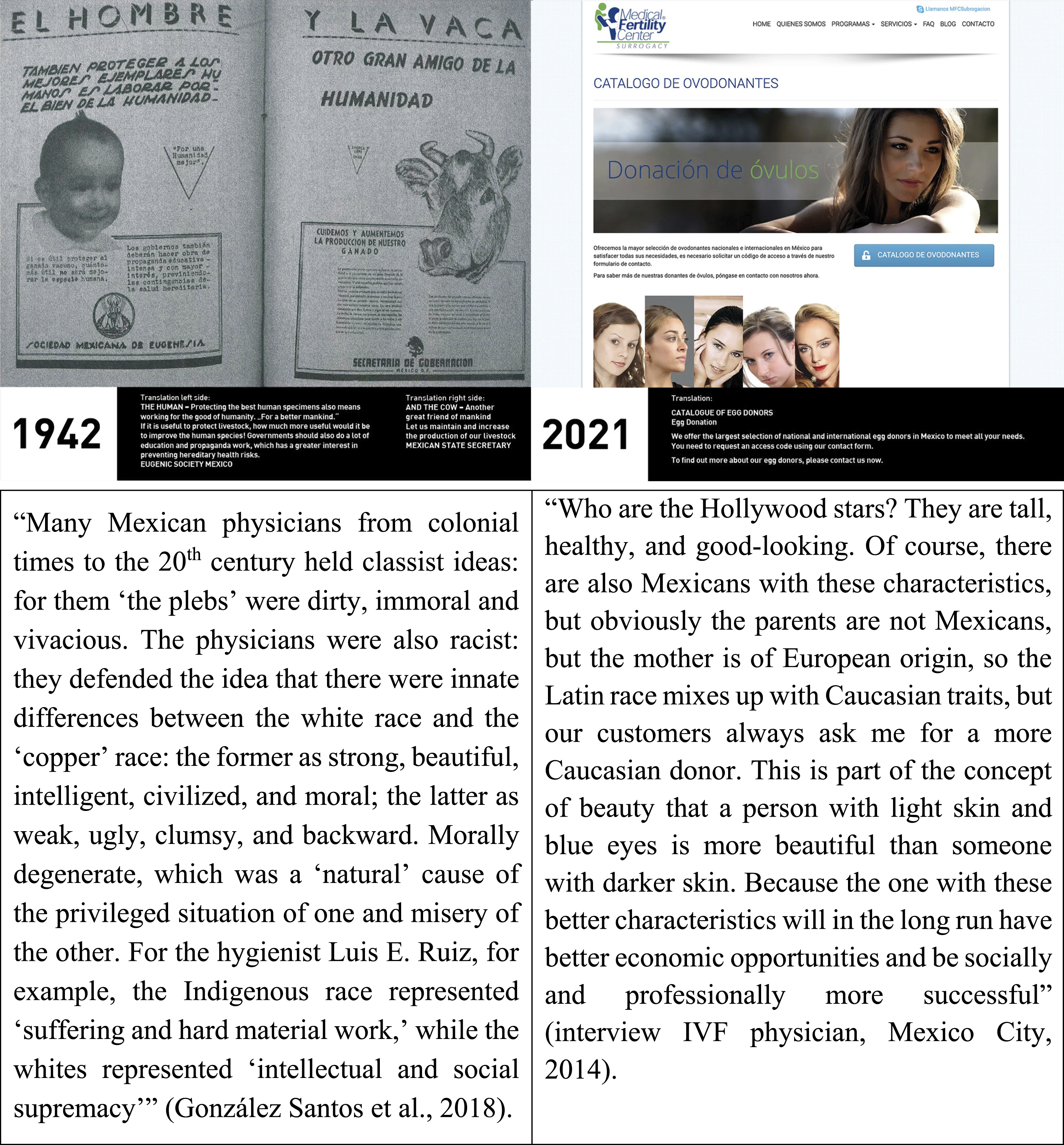
Assisted reproductive technologies and the opportunity to choose the genetic material of the baby by selecting an oocyte or sperm donor are often considered opportunities to come closer to the dream of having whiter offspring: “Let’s say, I love my children as they are, but my daughter sometimes says ‘Hey, my cousin Natalia is blond’. If I had the power in my hands to change the genes of my daughter and to make her have blond hair, I would do it right away” (interview egg donor coordinator, Puebla, August 2014).
Fertility clinics have come to be crucial new actors in facilitating this movement towards whiteness (Schurr, 2017). By offering the option to choose a donor either from a national or from international donor databases, they do suggest through the higher prices of oocytes from international donors that the future baby will be of more worth as it will be whiter and more beautiful if a donor from the USA is used and not a national one. What we can see in this example is how economic rationales of earning more money when they broker an international egg donor come together with moral beliefs in the desirability (and superiority) of whiteness. Although these individual practices of selecting donors are not orchestrated by state governance but by consumers and IVF physicians, Mexican parents’ continuous desire to whiten their offspring with the help of the fertility industry is informed by the racialized logics of (post)colonial eugenic movements, the project of mestizaje, and the cultural influence of the USA through the massive spread of media that reinforce the racialized idea of how “Hollywood stars” should look. While this ideal of the worth of white bodies can be traced back to the (post)colonial geopolitics we have highlighted in this section, actors in the fertility industry often distance themselves from past racist practices, framing the choice of white(r), international egg donors as individual consumer choices that have nothing to do with past eugenic (geo)politics. What our juxtaposition of the two images and quotes aims to suggest is that past eugenic ideas and racialized (post-)colonial discourses impregnate not only the individual choices of consumers of the fertility industry but also the logics and daily practices of donor banks and fertility clinics, which translates for example in the visual and discursive emphasis of whiteness as desirable in their egg donor programs.
The next section shows how discourses about “modernity” shaped past population politics in Mexico and the implication of (post)colonial concept of “modernity” for the contemporary fertility market.
Modernity: “Smaller families to live better”
In this section, we investigate the Mexican population politics of the 20th century. During the 1970s, pronatalism was the official state ideology in response to the deaths of millions during the Mexican Revolution (1910–1920) (Cabrera, 1994). Luis Echeverría ran his presidential campaign in 1969 with the slogan “to govern is to populate” (Braff, 2013, page 124). In 1972, Mexico experienced a spectacular 180-degree change when it introduced its first national family planning program, aiming to modernize the nation (Nagel, 1978; Rodriguez-Barocio et al., 1980). A year later, Mexico abolished Article 24 of the Mexican constitution, which had prohibited the advertising and sale of contraceptives. As Gutmann (2011, page 62) puts it: “International pressure on Mexico during the 1960s and 1970s was tied inextricably to the sordid history of imperialism and colonialism from the time of the eugenics movement in the 1920s through campaigns of sterilization in Latin America, and subsequent dire prognoses by the CIA among other agencies of the United States that argued for population control as a way to reduce revolutionary movements and protect strategic U.S. interests in the Southern Hemisphere”.
USAid, UNFPA, the World Bank, the Population Council, the Rockefeller, Ford, Hewlett, Mellon, and MacArthur foundation: they all turned family planning from an intimate and medical matter into a global enterprise involving billions of dollars (Gutmann, 2007; Hartmann, 1997). Through this enterprise, the “demographization” (Barlösius, 2007; Schultz, 2015, 2022) of social problems such as poverty and the Cold War political conflict took place. Demographization means that complex social problems and dynamics are addressed by correlating national population data with data about resources, production and consumption. The “solution” is then offered in form of demographic state interventions that control and manage in/fertility.
Demographization become a central strategy of global and political politics since the Cold War, when the USA and international organizations centered the problem of “overpopulation” as the evil of all problems – as evidenced by the quote from Babatunde Osotimehin above – and the main obstacle to societal and economic modernization. In consequence, overpopulation was centered as the main concern of Cold War reproductive geopolitics – even without any scientific evidence that Latin America had a “population problem” (Malloy and Borzutzky, 1982). Fertility control was considered a way not merely to achieve economic security, modernization, and hemispheric stability, but also “to reduce the population of specific ethnic or racial groups” (Morgan and Roberts, 2009, page 12) as a way to combat the spread of communism, which was considered to flourish especially in rural and indigenous areas. The USA orchestrated a reproductive geopolitics which targeted both Blacks and Latin Americans back home (Gutiérrez, 2008; Roberts, 1997) and Mexican indigenous women’s supposed “hyperfertility” abroad (Braff, 2009; González-Santos, 2019). Under the guise of modernization, women’s bodies and their reproductive practices were controlled, regulated, and manipulated through demographic (geo)politics. In so doing, the US-American reproductive geopolitics turned Western ideas of the heterosexual, white nuclear family into a global norm and a crucial step for a country’s journey towards modernization.
According to Connelly (2009), the turn of Mexico’s pronatalism into a politics of population control hence also stems from the pressures of the World Bank when Mexico required the Bank’s loans in 1972. In 1974, Mexico was identified as one of 13 key countries by the US-American national security council to address the “problem of global population growth” (Birke, 2020, page 207). Although a significant amount of money flew into Mexico through the UNFPA and other foundations to establish family planning programs, both the USA and the Mexican government worked hard to portray campaigns of population control as rooted in Mexico and not as imposed by the USA. In this vein, the secretary of the interior created the National Population Council (CONAPO) in 1974.
CONAPO, from whose campaigns we took the visuals for this and the next section, promoted family planning with slogans such as “Let’s become fewer, to live better,” “To grow does not mean to be many but to become better,” and “The small family lives better.” The central idea behind the public campaigns, run by a professional marketing enterprise, was to move towards a modern family model by transforming women’s reproductive behavior, reducing the ideal family size to two children, and extending the spacing between births by using contraceptive methods. González-Santos (González-Santos, 2019, page 85) writes about this campaign that Judging by the images and the texts, these reproductive messages were targeted to the population with economic limitations, since promoting having fewer children was argued under an economic logic: have the children you can afford, and because you can’t afford much, have few children.
In this quote, we see the work of demographization when solving economic issues, in this case of poverty, was addressed through demographic policies, that is the number and spacing of children. At the same time, the control of women’s reproductive lives was portrayed as the precondition for a family to become modern and participate in a modern, economically well-off lifestyle.
Some of CONAPO’s campaigns especially targeted women as those who were supposed to have the power and responsibility of deciding the fates of their families and the nation as a whole. Mexico invested heavily in training doctors to perform long-lasting contraceptive methods such as the IUD or sterilization as well as in convincing mothers to agree to use this kind of contraceptives. Until the 1990s, a total of 2.3 million women had been sterilized in Mexico, of whom one million had not signed the supposedly mandatory consent form for the operation and 500,000 had not been informed about other contraceptive methods (Liga Mexicana por la Defensa de los Derechos Humanos 1993)
The idea of responsible mothering had been present earlier, but it was the CONAPO’s campaigns that asked women to stop being submissive and take control over their reproductive lives (Soto Lavega, 2009). We find a similar message of the empowered modern woman who decides over her own reproductive fate in the marketing materials of fertility clinics who promote fertility preservation and single motherhood (Darnovsky, 2014; Ikemoto, 2015; Waldby, 2015). The fertility center’s marketing slogan “Bringing success to your most precious dreams,” for instance, makes individuals responsible for fulfilling their dreams rather than challenging social structures such as an inadequate system of health insurance, family-unfriendly work environments, societal norms of heteronormative families, and environmental pollution that leads to infertility.
A reverse form of racialized stratification takes place for those who are deemed worthy of being treated in fertility clinics. What Roberts (2012) has shown for Ecuador is also true for Mexico: because fertility treatment takes place nearly exclusively in private clinics, access to assisted reproductive technologies is typically restricted to middle and upper classes. “Regardless of their social position, their experiences with infertility and assisted reproductive technologies allowed them to self-identify as members of relatively modern, white, wealthy, and urban groups: to appear as the kind of person and citizen whose use of assisted reproductive technologies is justified, even unquestioned, in this ‘overpopulated’ context” (Braff, 2013, page 122).
The promotion material of the fertility center above portrays a happy family of three, heterosexual and with a white baby. What this PR material implies is that the small nuclear family is the path to happiness and one’s participation in modern life. The website from which this PR material is taken functions in Spanish and English. By doing so, the clinic seeks not only to attract international patients seeking for treatment as reproductive tourists, but also signals to the national clientele that it is a modern space that is equipped with the latest technology and knowledge about reproductive medicine so that patients even come over from North America or Europe as they consider the quality of the treatment equal or even better than in their home countries. The heteronormative focus of it is surprising, given that after the prohibition of gay surrogacy in India and Thailand, Mexico turned into a global hotspot for gay surrogacy (Schurr, 2017, page 5).
Even if their message is not the same, we can interpret the advertisements of fertility clinics as a legacy of earlier family planning campaigns. Whereas Figure 3 shown above speaks to neoliberal individuals who should act and choose to “bring success to their lives”; the older campaigns are more strongly characterized by civic responsibility for creating a modern nation. Both play, however, with the ideal of a small family and of quality over quantity. Source: 3a, left side: Poster: “Cada Minuto (...)” (Consejo Nacional De Población, 1992). 3b, right side: Brochure from Fertility Center Cancun, 2014). Research material from Carolin Schurr. Interactive sliding images in full resolution can be found at: https://reproductivegeopolitics.ch/governing-in-fertile-bodies.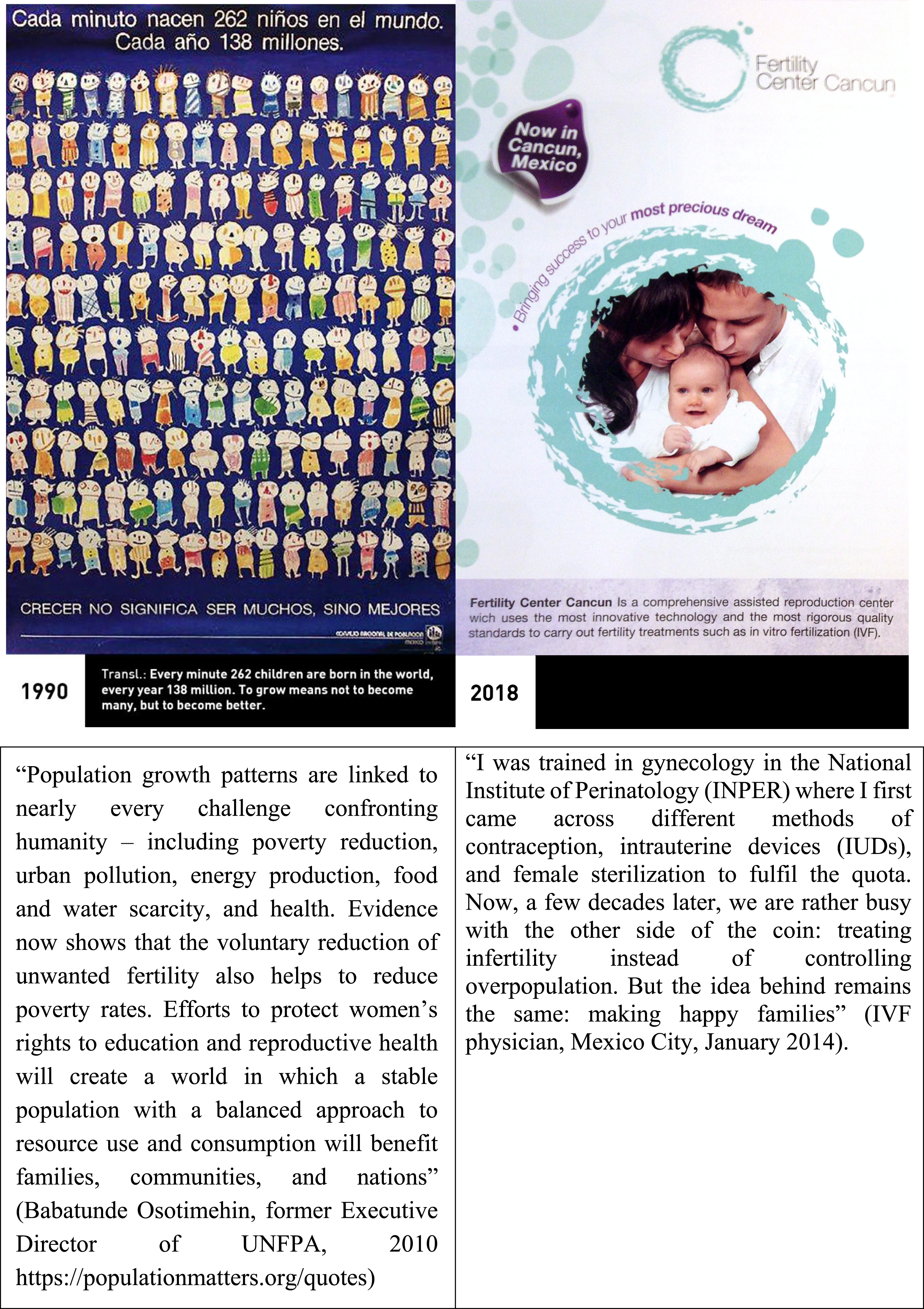
The next section builds on the reproductive geopolitics of eugenics and shows how racialized discourses about hereditary health inform and shape past and present population politics in Mexico.
Health: “Better Babies”
The family planning campaigns from CONAPO (Figure 4a) not only drew on the idea of the modern nation, but they also reinforced ideals of healthy bodies as desirable. As the previous section explained, the campaigns were set up to limit the reproduction of specific populations: the poor, Indigenous, and rural (Braff, 2009, page 126). But the main objective for such interventions into the intimate sphere was the improvement of health to be gained from “being fewer” and “being better off”. The image above exemplifies this logic that ties economic wealth with health and happiness because it portrays two well-fed, smiling siblings to symbolize a healthy family. Source: 4a, left side: Poster: Hijos más sanos si su nacimiento espaciamos(Consejo Nacional De Población, 1984). 4b, right side: Genetic Testing with IVF Mexico (2021, August 21). Retrieved from https://www.ivfvallarta.com/genetic-testing-mexico. Interactive sliding images in full resolution can be found at: https://reproductivegeopolitics.ch/governing-in-fertile-bodies.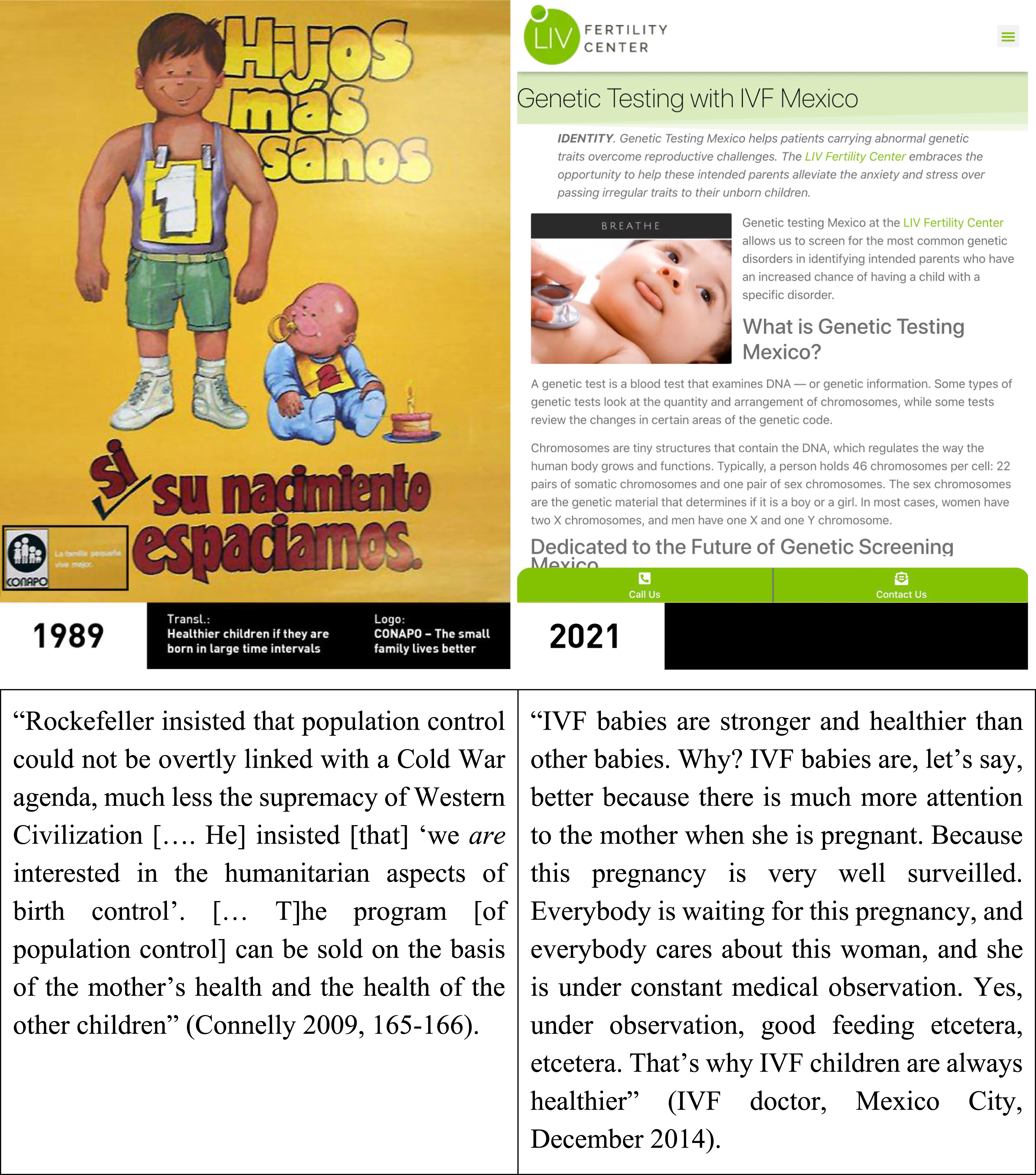
The importance of health in Mexico’s reproductive geopolitics can be traced back to the eugenicist movement at the beginning of the 20th century. Inspired by the French eugenicist Pinard, the Mexican Eugenics Society for the Improvement of Race in 1931 promoted the “right” of the child to be hereditarily “wellborn,” the instruction of potential parents on the hereditary risks of reproduction and the dangers of alcohol and other toxins to the fetus (Stepan, 1991). In 1931, the first sterilization law was authorized in Veracruz (Stepan, 1991, page 131). The law legalized sterilization in “clear cases of idiocy” and for the “degenerately mad,” the “incurably ill,” and “delinquents,” aiming at directly “controlling genetic incapacity” (Stepan, 1991, page 132).
Past debates about the importance of health are particularly interesting with regard to contemporary debates about reprogenetics and the utilitarian concept of “procreative beneficence” (Savulescu, 2001), that is, the moral obligation of parents to use genetic tests and choose the healthiest embryo to facilitate “a good life” for their offspring. Genetics was often criticized for introducing a new “flexible eugenics” (Taussig et al., 2005), which under the guise of reproductive choice reproduced racial, sexist, and ableist logics (Lippman, 1994). This geneticization of reproductive medicine is exemplified by the Spanish IVF giant IVI, a company that until recently invested heavily in the Mexican market, opening franchises in several cities. IVI was among the first to introduce genetics to reproductive medicine; a result of this development is the well-established reprogenetics company Igenomix, a spin-off of IVI. Spain portrays itself as the worldwide leader in reprogenetic technologies (Perler, 2022; Pavone, 2010; Pavone and Arias, 2012). Many of the current heads of fertility centers in Mexico have been trained in IVI Mexico, the franchise of IVI Spain, undergoing frequent training at IVI’s headquarters in Valencia. The former head of IVI Mexico estimates that of the 70 fertility clinics existing in the mid-2010s, the staff of 20 were trained by IVI Mexico. Because of IVI’s influence in Mexico, genetics have become an important field of reproductive medicine in Mexico: At the moment, we are particularly keen on incorporating molecular and genetic diagnosis. In fact, we have just sent our second embryologist to IVI Spain for training, and we are looking into the costs of new equipment for genetic screening (IVF physician, Mexico City, August 2014).
The geneticization of reproductive medicine in Mexico allows the selection of the lives considered worthy of being reproduced. This process was theorized under the term “selective reproduction,” as “practices that aim to prevent or promote the birth of particular kinds of children” (Wahlberg and Gammeltoft, 2018, page 1). Whereas eugenics and later family planning campaigns aimed to promote the births of healthy children for the sake of the nation, selective reproduction expresses an individualist ethics of choice, reproducing the same body types in terms of desirable features: white, healthy, and abled (Rose, 2007). However, these individual choices also affect nations in concrete ways. As Tremain argues, possibilities for detecting impairment in utero (or even before, as it is the case in preimplantational and genetic carrier testing) are “a form of modern government, that is, a calculated mode of influence that increasingly limits the field of possible conduct in response to pregnancy” (Tremain, 2006, page 37). This is also inextricably intertwined with the government of the maternal body. The normalization of health and abled bodies in this sense reveals neoliberal ideas of a productive body, for which a “future with disability is a future no one wants” (Kafer, 2013, page 3). Although this does not present a form of state-orchestrated eugenics, it reveals how all these deviant bodies, “the deaf and dumb, the feeble-minded, the insane” (Saleeby, 2019) are considered not worth being reproduced. Whereas blood lineages were monitored in the colonial past to ensure a racialized social order, blood today is tested genetically to ensure the outcome of a healthy baby after fertility treatment (Perler, 2022). By doing so, the transnational travelling of reprogenetics re-establishes the normativity of a “healthy society”.
The entanglements between the Mexican, the US-American, and the Spanish industries exemplify a new transnationally functioning bioeconomy that recasts former state and transnational reproductive governance under the guise of reprogenetics and the imaginary of a healthy baby. It is no longer the state alone which defines whose bodies are worth reproducing but private enterprises who discard certain donors or embryos in flexible legal frameworks that allow or even encourage such selection (Perler, 2022). It is in this regard that neoliberal ideas of health as an issue of individual and self-responsible “choices” culminate in contemporary reproductive geopolitics. Neoliberal logics of privatization and deregulation of public health services, profit making, and individual choice come to permeate the intimate lives of reproductive bodies to create healthy and abled bodies.
Conclusion: Reflecting the fertility industry through the lens of reproductive geopolitics
In the conclusion, we summarize how our concept of reproductive geopolitics contributes to current debates in the fields of geopolitics and social studies of reproduction.
First, reproductive geopolitics aims to make invisible population politics visible by provoking readers to think about the current fertility industry in relation to past population politics. Our paper shows how the racist, classist, and ableist ideologies that informed Mexico’s past colonial, eugenic, and population politics continue to shape the mindsets, everyday practices, and desires of IVF practitioners, reproductive laborers, and consumers in the present. It is in this sense that the possibility of choosing a donor or certain genetic tests are entangled with the colonial project of whitening the colonized body, the (post)colonial project of mestizaje or the attempts of the USA to reduce the population growth of rural–indigenous populations in the context the of Cold War. This paper has shown how different racialized bodies are affected differently by reproductive geopolitics. In comparison to white bodies, non-white bodies were and are more intensively governed, manipulated, and controlled, as they were and still are considered a threat to the nation’s progress, modernity, and economic prosperity. Whereas past reproductive politics were characterized by a biopolitical focus on the future of the nation, current politics of financing, subsidizing, or promoting certain reproductive technologies are built around demographic statistics about “how much and which ‘population’ a national ‘we’ needs in the long run” (Schultz, 2022, page 224). In short, in current times, demographic politics go hand in hand with biomedicine to (re)produce “biopolitical regimes of truth that socially and morally [justify] the management and administration of the reproduction of specific populations” (Krause and De Zordo, 2012, page 149).
To show the interplay between demographic politics and the global fertility industry, the concept of reproductive geopolitics has focused on the (de)valuation of bodies through past and present national and international politics. By doing so, the concept speaks to recent public and scholarly discussions about “demographic anxieties” (De Zordo et al., 2022) and “demographic fever dreams” (Gökarıksel et al., 2019). In a context of rising nationalism and populism, demographic anxieties link the decline of fertility, the postponement of motherhood and population aging with anxieties over the apparent hyperfertility of the migrant other (Alvarez and Marre, 2022; Leykin and Rivkin-Fish, 2022; Mattalucci and De Zordo, 2022). Demographic anxieties and fever dreams are part of what Susanne Schultz (2022) calls the “demographization” of social problems. By framing social problems such as poverty, precarity or mobility through a focus on demographic statistics, geopolitical interventions on the fertility of certain populations are morally justified. These geopolitical interventions seek to control and reduce the fertility of certain bodies – often migrant, racialized, religious, low-class – while encouraging financially and morally the reproduction of the desired (and apparently threatened) “majority” of the nation. We can see the trend towards “demographization” currently in different policy fields. Migration politics are for sure the most prominent in this regard. Conservative and populist politicians have generated a demographic panic over the last years, a “fear of small numbers” (Appadurai, 2006) of “being overwhelmed by foreigners and of a loss of national identity” (Hansen and Randeira, 2016, page 995). These “demographic fever dreams” (Gökarıksel et al., 2019) are often only partly supported by empirical data as they seek to frame social and political problems through a demographic lens. Right-wing populist politics across the globe evoke these anxieties specially to regulate and restrict the access of refugees and migrants into the country and to deny their reproductive desires.
Reproductive geopolitics works as a lens to pay attention how demographic politics take place in national and international politics. It looks at how geopolitics morally justify the regulation and restriction of those bodies’ fertility who are thought of as “threatening the future of the nation” through their racialization while at the same time encouraging and subsidizing the reproductive desires of those bodies who are considered “threatened majorities”. It is in this sense that traditional demographic politics are closely entangled with the biomedicalization of society and the spread of reproductive technologies. We see similar forms of demographization in COVID-19 policies across the globe (Eaves and Al-Hindi, 2020; Laufenberg and Schultz, 2021) or in recent discussions about the need to limit reproduction to counter climate change in form of so-called birth strikes (Hendrixson et al., 2019; Hübl, 2022; McMullen and Dow, 2022; Sasser, 2014, 2018; Schultz, 2020).
Second, we call for bringing the state and its geopolitical interrelations back into focus when studying current fertility networks. This move not only serves to acknowledge how current neoliberal practices of valuing and selecting certain racialized, classed, and abled traits over others have a long biopolitical history in colonialism’s purification of blood, postcolonialism’s project of mestizaje, and global population politics. It also shows how nation-states’ racist, classist, and ableist politics not only inform current practices in Mexico’s fertility network but are constantly remade, reproduced, and even reinforced in Mexico’s fertility industry (Perler and Schurr, 2020). Juxtaposing images from state campaigns that sought to govern citizens’ bodies with images from Mexico’s contemporary fertility industry literally visualizes how state ideologies continue to be reflected in the neoliberal and private logics of IVF clinics. Focusing on the geopolitical also shows that what happens in one nation’s IVF industry is closely linked to what is happening in other national IVF economies.
Morgan (2019, page 114) highlights how “[n]ow more than ever, reproduction has come to figure prominently in a global political landscape at a grand scale, in trade agreements, international human rights courts, statistical simulations, and transnational activist coalitions”. More than ever, the state is not the sole actor to intervene in reproductive matters and shape access to reproductive health but part of a larger assemblage of reproductive geopolitics in which different actors from the fields of pharmaceuticals, finance, medicine, development and humanitarian aid, religion and (feminist) activism come together. What we need are further multi-scalar analysis focusing on how global, national, local, and intimate forces are entangled in the making of what we have called reproductive geopolitics.
Supplemental Material
Supplemental Material
Supplemental Material
Footnotes
Declaration of Conflicting Interests
The author(s) declared no potential conflicts of interest with respect to the research, authorship, and/or publication of this article.
Funding
The author(s) received no financial support for the research, authorship, and/or publication of this article.

Supplemental Material
Supplemental material for this article is available online.
References
Supplementary Material
Please find the following supplemental material available below.
For Open Access articles published under a Creative Commons License, all supplemental material carries the same license as the article it is associated with.
For non-Open Access articles published, all supplemental material carries a non-exclusive license, and permission requests for re-use of supplemental material or any part of supplemental material shall be sent directly to the copyright owner as specified in the copyright notice associated with the article.
