




Abstract
This paper proposes a novel political pedagogic approach to conducting engaged research. Drawing critically on elements of Participatory Action Research and popular education, this approach - Engaged Pedagogic Research (EPR) - generates processes of collective co-learning and empowerment for local communities and activist researchers. Central to conducting EPR are five processes: generating situated learning practices, recognizing alternative knowledges, engaging in inter-cultural and inter-ethnic dialogue, deconstructing power relations, and promoting empowerment and social action. The experiences of engaging in EPR through developing and running a Diploma in Territorial Planning to support peacebuilding in Colombia are discussed. Different social groups living in conflict areas gained new knowledge and built social relationships that strengthen collaborative action, while activist academics achieved a deeper understanding of how members of these cultural groups manage their territories, relate to each other, and develop visions for collaborative futures in the context of peacebuilding. By developing participatory, decolonized and transformative bridges to connect and engage universities with communities, EPR facilitates learning that is collectively created and has the potential to contribute to more just and egalitarian societies.
Introduction
Inspired by Participatory Action Research (Fals Borda, 1979, 1987) and popular education (Freire, 1970), in this paper we propose a novel political pedagogic approach to conducting research: Engaged Pedagogic Research (EPR). Through establishing processes of collaborative co-learning between local communities and academics, EPR aims to create knowledge that is situated, decolonizing, empowering, transformative and politically engaged, leading to action that transforms social inequities. We show how EPR is framed around five core processes: generating situated learning practices, recognizing alternative knowledges, engaging in inter-cultural and inter-ethnic dialogue, deconstructing power relations, and promoting empowerment and social action. EPR thus responds to Ritterbusch’s (2019: 1313) call for ‘further thought on how to continue fighting for social justice, both from university and community spaces’.
Our approach is both epistemological and political in that we challenge the hierarchy imposed in the construction of knowledge that reproduces the denial of non-hegemonic subjects. We seek to advance the decolonization of knowledge by recognizing and contributing to the struggles of the historically oppressed (Cusicanqui, 2012; Quijano, 2000) through inclusive education that promotes solidarity within learning communities, generates alternative relations of belonging, fosters an ethic of care, and changes power relations within educational spaces (Greenstein, 2015). EPR thus advances radical social justice agendas in order to enhance inclusivity and open collective spaces for intersectional reflexivity, raised awareness and social change (Harris and Patton, 2019). It is our conviction that academia can contribute to the mobilization agendas of communities by approaching their struggles and demands not as objects of academic research but as collective processes of knowledge sharing.
Whilst it should be possible to engage in EPR in any context, this paper explores the experiences and learning processes of a multi-disciplinary international team of activist scholars (Chatterton, 2008) that organised and implemented a ‘Diploma in Territorial Planning’ 1 for participants who are normally excluded from tertiary education. Collectively designed with indigenous peoples, Afrodescendants, peasants and ex-combatants of northern Cauca, Colombia, most of the learning for this formally accredited university Diploma took place in local communities struggling to build peace. By focusing on territorial planning and peacebuilding, we are in line with Koopman’s (2019: 207) call for activist-academic work to focus on ‘what we are for’, rather than the more usual ‘what we are against’. Accordingly, despite inter-ethic conflicts having been widely documented in the region (Ospina, 2015; Vélez-Torres, 2018), we chose to see the differences between groups as an opportunity to address common challenges and develop collective ways of addressing these to promote inter-cultural and inter-ethnic planning for peace.
In this paper, we show how EPR expands understandings of critical geographies of peace (Bregazzi and Jackson, 2018; Koopman, 2011; Loyd, 2012; Megoran, 2011; Megoran et al., 2016), illustrating how peace, as a situated process that is not limited to the absence of violence (Williams and McConnell, 2011), can be practised and experienced via everyday collective learning experiences. We do not reduce our research pedagogical praxis to a tool for challenging ‘undifferentiated landscapes of war or building undifferentiated peace’ (Loyd 2012, 477), rather, EPR creates alternative ways for moving beyond state-centred peacebuilding and antagonism (Bregazzi and Jackson, 2018). As a community of collective learners, we reflect on how plural knowledges and learning experiences involving peace (and violence) in situated territories can ‘mean different things at different scales, as well as to different groups, and at different times and places’ (Koopman 2011, 194).
Drawing on our experiences of conducting EPR through facilitating the Diploma, we bring in ethnographic and reflective voices to analyse the context, processes, experiences, and challenges witnessed throughout our teaching practice and encounters. Following this introduction, we discuss the core elements of Participatory Action Research (PAR) and popular education, before showing how we draw on both to develop the conceptual framework of EPR. The aims and structure of the Diploma are then outlined before turning to explore how the five core processes of EPR were operationalised and experienced in practice. Importantly, we are not claiming that there is one universal EPR but rather that it is an innovative methodological approach, which can be collectively developed and produced by communities, engaged researchers and social organizations striving to create more just and equitable societies in any context.
Participatory action research and popular education in Latin America
Both PAR and popular education emerged in the 1960s/70s. Although distinct, they greatly influenced each other with their similar epistemological, theoretical and methodological approaches, alongside their political aims of achieving social change (Mejía, 2014; Torres, 1992). PAR was developed in the context of ‘oppression by local bureaucracies and imperial powers’ (Glassman and Erdem, 2014: 207). Strong ties to local communities were advocated to generate new understandings of modes of production and participatory rights, with the aim of redistributing wealth and power. Multiple academic disciplines, including sociology, education, anthropology, geography, law, history and political science, all contributed to developing PAR in a wide range of contexts (Latorre, 2007; Lomeli et al., 2018; Park and Salazar, 1992).
In Latin America, the work of Orlando Fals Borda has been particularly influential. An intellectual and activist, Fals Borda strived to reduce violence and injustice in Colombia until his death in 2008 (De Jong et al., 2019). He saw knowledge as power and the ‘base for increasing the participation of ordinary people in the shaping of their own dreams, their own societies’ (Hall, 2008: 442). His version of PAR aimed to promote ‘radical changes at the grassroots level’ by combining ‘scientific research, adult education and political action’ (Fals Borda, 1987: 329) in which participants are involved at every step of the process. Colombia continues to be a focal point of PAR (see De Jong et al., 2019; Ritterbusch, 2019; Vélez-Torres, 2013), and being an activist academic is not an anomaly. As Gutiérrez (2016: 72) claims, ‘participatory methodologies have become the norm among researchers [in Colombia] working together with rural communities’.
Turning to popular education, the work of the Brazilian Paulo Freire, in particular his slim volume ‘Pedagogy of the Oppressed’ published in 1970, is world renowned. For Freire, ‘knowledge and the experience of the oppressed are valued as the main basis for any meaningful education process’ (Gutiérrez, 2016: 61). Freire aimed to achieve social change through adult popular education, typically conducted outside the classroom, which by using dialogical processes enables individuals to realise they can transform their lives and communities. He emphasised sharing and reflecting critically on the knowledge and experience of learners to build new community-based, problem-solving processes and create active interventions (Freire, 1970; Puiggrós, 2016). Central to Freire’s contribution is his call for a transformation of the relationship between students and teachers, whereby teachers should not be considered bearers of knowledge but instead become learners through situated dialogue with students. Freire thus advocated for an active learning process whereby students internalize problems, link these to their contextual and situated experiences, and become transformative actors within their communities (López, 2008; Mejia, 2014).
In Colombia, popular education had its own trajectory in the 1960s inspired by liberation theology and influential priests, including Camilo Torres, René García and Domingo Lain. Their vision of popular education as social transformation, which starts with the education of the individual to promote liberation from servitude, was promoted throughout Colombia. Freire’s views subsequently guided the revision of popular education in Colombia in the late 1970s, which adopted a PAR approach and promoted education as the cornerstone of liberation and the creation of a new society (Lomeli et al., 2018).
Over the years, PAR has been widely adopted and adapted by mainstream research and practice, including by multilateral aid agencies and governments, moving the approach away from its radical roots and de-radicalising ‘participation’ (Lomeli et al., 2018; Ritterbusch, 2019). Popular education has been critiqued by feminist scholars for its sexist language (Hooks, 2002 [1993]) and for overlooking gender relations, which were considered secondary to class in the context of subaltern liberation (Castillo, 2000). While the historical and contextual basis of Freire’s contributions must be recognised, popular education should deconstruct all power relations, starting with the bodies of subjects, their senses, desires and feelings (Korol, 2007), and integrate affective, every day and personal experiences, as these shape social relations and public spheres (Castillo, 2000).
In Latin America, popular education has also been shaped by critical intercultural education and decolonial thinking (Ferrão, 2010; Walsh, 2010; Lara, 2015; Tubino, 2005; Vásquez, 2013). From these perspectives, education needs to challenge the colonial matrix of power embedded within state institutions and society, moving beyond de-politicized notions of recognition, multiculturalism and hybridity. A focus on justice and equality should include questioning processes of dispossession, displacement and discrimination (Cusicanqui, 2012; Tubino, 2005; Quijano, 2000). Tubino (2005) suggests that education cannot embrace dialogue without first questioning the social asymmetries and cultural discrimination that shape the context in which dialogue takes place. For Walsh (2010), critical inter-cultural education should not only aim to transform colonial structures, institutions and social relations but also recognize alternative knowledges and forms of being and living. We take account of these views in the formulation of EPR, to which we now turn.
Conceptualising engaged pedagogic research
In the early 1990s, Torres was already asking ‘Is it possible to launch a participatory action research process from and within the educational agencies of the capitalist state?’ (Torres 1992: 58, italics in original). He highlighted the increasingly bureaucratic nature of state agencies, which use legal norms, control levels and hierarchical communication networks. Along similar lines, more recently Ritterbusch (2019: 1301–1302) asked ‘how can we begin to carve out spaces in our universities that enable the growth of long-term, collective learning environments where … “critical conscious building” can be mutually catalysed through feeling-thinking actions and dialogue between university- and community-based members of the collective’?
We believe EPR is one way of creating participatory, decolonized and transformative bridges to connect and engage universities with communities and, importantly, facilitate learning within communities in dialogue with university-based scholars. Core to the approach is listening and learning by all, since researchers need to be aware that ‘they may not actually understand what they think they understand’ (Glassman and Erdem, 2014: 209). EPR follows Le Heron, Baker and McEwen’s (2006) call to embed geography in the culture of co-learning. We use the term co-learning to refer to a collective learning practice that not only involves a deep and mutually coordinated relationship between teaching and research practices, but aims to dissolve dichotomies between lecturers and students, and researchers and community members. Following Armstrong and Tsokova (2019), we understand co-learning as the process of creating collaborative, collective and reflective practices among teachers, learners and community members in a non-hierarchical manner.
The conceptual framework of EPR consists of five core elements presented in turn here. As spaces of learning influence learning experiences (Gough et al., 2019), EPR is based on Freire’s premise that education is best conducted in learning spaces where students can focus on ‘real’ activities and practices to generate situated learning. Situated learning approaches recognize that learning and thinking are constituted through social practices and experiences in the ‘lived-in-world’ (Lave and Wenger, 1991). Consequently, ‘effective education requires learning that is embedded in authentic contexts of practice, wherein students engage in increasingly more complex tasks within social communities’ (Besar, 2018:49). Learning and knowing through EPR are thus conceived of as actions and intentions performed within communities of practice (Arnseth, 2008).
Knowledge is socially produced and exists in many forms, including scientific, modern, experiential, traditional and local. While EPR involves the sharing of scientific/academic knowledge by researchers, it is essential to recognise alternative knowledges and for researchers to learn from participants. Following Boaventura de Sousa (2009), EPR acknowledges the interdependence of scientific and subaltern knowledge, and equally values multiple forms of knowledge production and learning, as well as coexisting ways of being, thinking and organizing the world (Lara, 2015). Decolonial approaches that involve unveiling epistemic silences (Mignolo, 2012) and the perspectives of local populations should be embraced (Grosfoguel, 2007) in order to place different knowledges in a ‘horizontal relation’ and explore their juxtaposition (Radcliffe, 2017).
Engaging in dialogue is recognised as a key way through which co-learning occurs (Martínez-Torres and Rosset, 2014). Ghiso (2000) argues that dialogue within popular education facilitates reflexivity and allows learners to recognize each other by sharing vital experiences, enabling them to express and recreate their identities, recognize the transitivity of social practices, find creative solutions and configure new links. Inspired by Freire (1970) and Ghiso (2000), EPR aims to create moments and spaces of dialogue between participants so they can learn from each other and identify and visualize concrete solutions. As we show below, when engaging in EPR we tried to ensure that dialogue between participants and researchers was non-hierarchical, with all those involved considered equally important ‘problem solvers, thinkers, and learners’ (Glassman and Erdem, 2014: 209).
In line with PAR approaches, EPR is based on the epistemological assumption that knowledge is socially constructed, hence, individual and/or group analyses of life experiences, including power, are essential (Lomeli et al., 2018). Moreover, EPR takes into account critical revisions of Freire’s approach to popular education, acknowledging the intersectionality of gender, class, race and age, among others, and hence the need to be sensitive to ‘embodied and emplaced power’ (Faria et al., 2020: 1151). Central to EPR is deconstructing power relations, both among participants and between participants and researchers, to make the learning experience as non-hierarchical as possible.
EPR aims to provide individuals and organizations with knowledge and tools to help identify the relations of oppression under which they are living and begin/continue to formulate autonomous courses of action that transform the status quo. As Glassman and Erden (2014: 214) claim, ‘oppressed adults must be educated to change their society’. Thus, one of the core goals of EPR is promoting empowerment among co-learners. Whilst recognising that empowerment is a highly contested concept, we see it as a multi-dimensional emancipatory process that supports the ‘less powerful to enhance abilities to change power relations’ (Luttrell et al., 2009:13). From a ‘power with’ perspective (Rowlands, 1998), EPR moves beyond repressive conceptions to focus on how power can be increased through collective action, social mobilization and collaborative learning to seek transformative possibilities.
In a Colombian context, public universities play a key role in local development, with a mission ‘to teach and conduct research in areas of need and potential for the region’ (De Jong et al., 2019: 185). Hence, it is not surprising that EPR has been developed in the context of a highly reputable Colombian public university, where activist academics have maintained close engagement with communities in northern Cauca, dating back to their involvement in social movements to support indigenous organisations in the 1970s. During the peace talks and the initial implementation of the peace agreement, activist academics from the Universidad del Valle participated in defending the rights of local communities. Such relationships, which are central to research on social justice, ‘take time to cultivate and keep alive’ (Ritterbusch, 2019: 1297, italics in original). Consequently, obtaining research funding increases the work local activist academics engage in but is not a necessary condition. We agree with Ritterbusch’s assertion that ‘what separates participatory bluffing from PAR for social justice initiatives is the quality of the relationships forged over time and the content and structure of those relationships’ (Ritterbusch, 2019: 1297, italics in original).
Whilst the Colombian-based authors of this paper have deep relationships with local residents and adopt culturally appropriate methodologies, the UK-based authors, most of whom have academic/personal links with Colombia, brought in alternative approaches and viewpoints. Consequently, researchers from the so-called global South and North, from urban and rural settings, and from divergent gender, generation, ethno-racial and class backgrounds co-developed EPR and the Diploma. 2 During this process, we had to negotiate our different disciplinary understandings and approaches to research and teaching. For some, the Diploma was the realisation of a long-term dream to continue the process of sustaining trust with the communities and support meaningful relationships with local organizations and their leaders at a unique point in time. For others who have been allies of feminist movements in global settings, this was a creative space to continue challenging patriarchal structures within educational experiences and social movements. Our aesthetic references were also reworked and decolonised as we learned to disobey hegemonic visual frameworks and communicate using new images, sounds and bodily movements. We embraced alternative forms of knowledge, as we collectively worked towards delinking and questioning our Western Eurocentric modalities of learning.
Throughout the Diploma, we conducted regular meetings allowing us to reflect on our own learning and transformative experiences, while also addressing critical revisions of concepts including empowerment, hybridity, nature, decoloniality, racism and sexism. We collectively reflected on our limitations to communicate in Nasa indigenous language, and our inability to ensure participation of LGBTQ participants or learners with disabilities. We constantly faced and discussed the contradictions shaping the coloniality of global North and South academic relationships, in terms of access to resources, funding and institutional expectations, as well as our everyday experiences of privilege and oppression. All our collective discussions were recorded and transcribed to allow further reflection. The involved researchers were invited to write ethnographic vignettes and a reflective piece on the most significant processes shaping their learning experiences during the Diploma, which were discussed and integrated into this paper.
Implementing EPR for peacebuilding in Colombia
After decades of violence and civil war, the Colombian government and former guerrilla movement FARC-EP signed a Peace Agreement in 2016. Central to this agreement is a territorial approach, which recognizes that socio-environmental sustainability and peace can best be achieved through the active participation of citizens (New Final Peace Agreement, 2016). It was in this context that a ‘Diploma in Territorial Planning’ was co-designed with inhabitants of three ethnically and culturally diverse municipalities - Corinto, Miranda and Buenos Aires - in northern Cauca. These municipalities were selected because they are three of the 170 locations prioritized for the implementation of the Peace Agreement and have long been shaped by violence. They have been severely affected by land and water grabbing by mining companies and the sugarcane agroindustry, as well as by the armed conflict (Vélez-Torres, 2018). Moreover, the expansion of coca crops over the past decade has resulted in the region having one of the largest number of hectares and highest annual growth rate of coca in Colombia (Vélez-Torres and Lugo-Vivas, 2021).
Researchers from the Universidad del Valle, who already had well established relationships of trust with the communities and organisations, held meetings in public spaces in the three municipalities to inform and answer questions about the Diploma. The criteria for selection of participants, agreed between the research team and local social organizations, 3 were to: include similar numbers of indigenous, Afrodescendant, peasant (campesino/campesina) and ex-combatant participants; balance participation by gender; include young people to ensure a wide representation across generations and support youth engagement in social organizations; and select those committed to sharing the knowledge and skills gained with the wider community. The success of the selection process is reflected in a dropout rate of only 5%, which in all cases were ex-combatants who had to withdraw due to increased security risks.
The Diploma in Territorial Planning was established at the Universidad del Valle with capacity for 100 students. Although the Diploma was embedded in the formal education system, the learning was conducted primarily in community settings, directed to participants who had not completed secondary education, and addressed local and regional territorial challenges in the context of peacebuilding. Diploma participants did not have to pay fees, a key element of popular education and a crucial factor for individuals who otherwise are excluded from tertiary education. Although no previous knowledge was required, and no examinations were held, participants had to attend and actively engage in 80% of the sessions to graduate. The core topics and methodologies for the Diploma were defined in dialogue with the participating social organizations, who prioritized four topics that intertwined conflict, environment and territorial transitions: evolution from illicit crops to agroecological modes of food production; control and preservation of water; delimitation of collective territories; and conservation of forests and paramo in areas where deforestation was previously controlled by FARC-EP guerrillas.
The Diploma was initiated with two types of trust-building Community Exchange workshops (Escobar-Tello et al., 2021), followed by six general sessions on territorial planning and peace. Participants then selected one of four modules to study: Agricultural Productive Planning, Conservation of Biodiversity, Spatial Planning and Geographic Information Systems (GIS), and Communication from the Territory. Upon completion of these modules, around 70% of participants voluntarily joined workshops to discuss the role of the state and issues of governance (Piccolino and Ruette-Orihuela, 2021). Figure 1 provides an overview of the structure, aims and methodology of the Diploma. Overview of Diploma in Territorial Planning.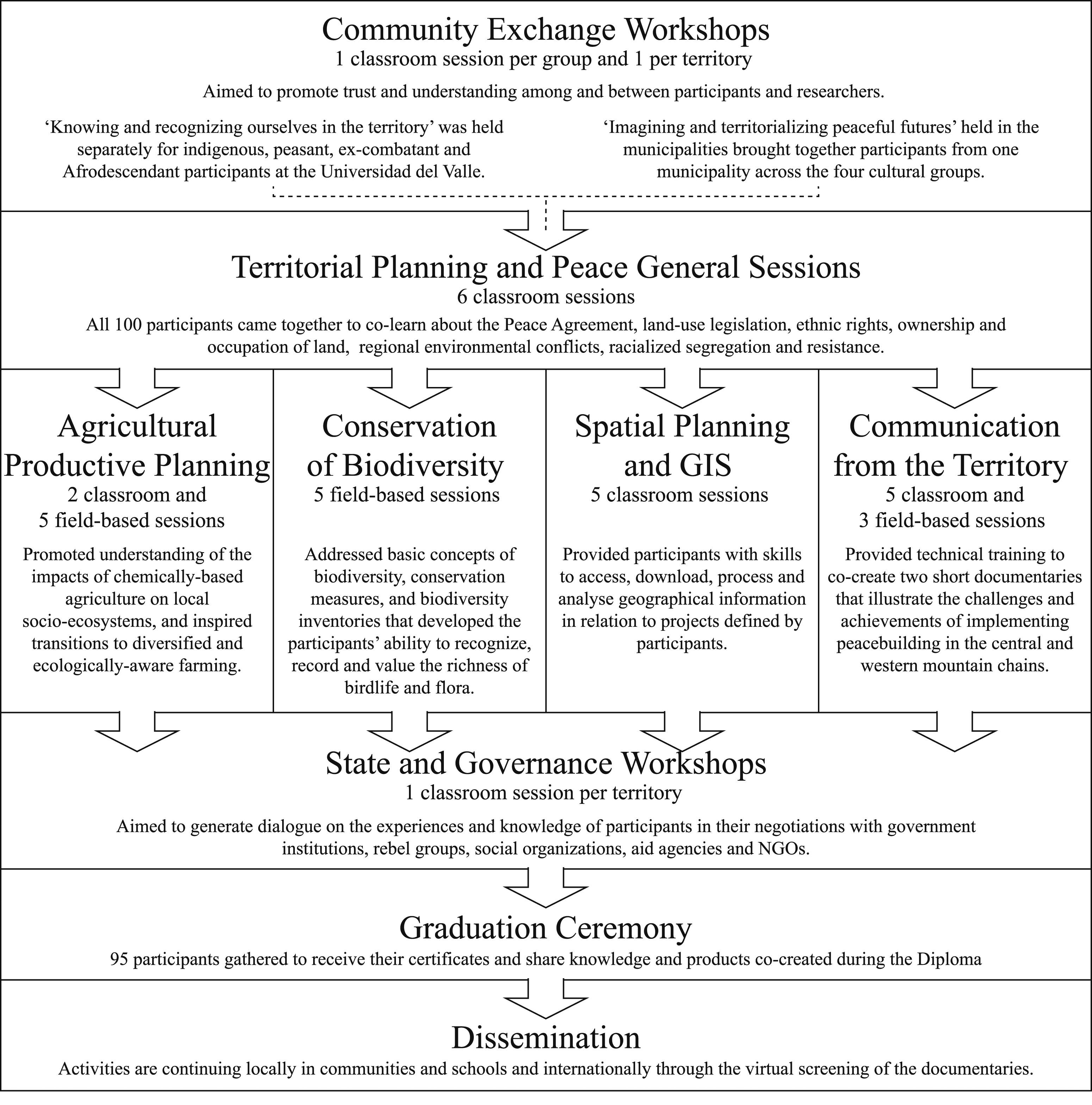
Co-learning and social action through EPR
We now turn to analyse the ways in which EPR generates co-learning for participants and researchers alike. The discussion is divided into five subsections, in line with the core elements of EPR.
Generating situated learning practices
A core element of the Diploma was to facilitate situated learning practices (Besar, 2018; Lave and Wenger, 1991), whether the learning was taking place in the classroom or in the field. During classroom-based workshops, learning was situated as far as possible in participants’ real experiences. In the Community Exchange Workshops, for example, participants discussed: their values, rituals and traditions; their purposes and goals in relation to their territories; their most important needs and aspirations; barriers and how these can best be overcome; and which organizations and institutions they can approach for support (Escobar-Tello et al., 2021). Each table of six to eight participants included one researcher to ensure the activity had been understood but who attempted to be as hands off as possible to ensure the discussions were participant led. Although the presence and positionality of researchers acting as facilitators inevitably influenced what participants chose to say, we had the sense that our presence often faded into the background and participants focussed on sharing their thoughts and experiences with each other, generating co-learning within and between the different cultural and ethnic groups.
In the classroom-based GIS module, participants gained access to GIS technology (hardware/software) on the Universidad del Valle campus. They were invited to identify the components that make up their territories, how best to represent these, and the sorts of questions that can be answered with this type of analysis. Participants combined information gained from the reports of a wide range of institutions with their empirical knowledge of the territories to create technical representations of these spaces. Through adopting a situational learning approach, participants gained critical understandings of the delayed and misguided implementation of the Peace Agreement at the local level. The projects developed included: challenges of productivity levels, threats and trends of deforestation, land access and formalization, and the fumigation of illicit crops. Participants’ understanding of these emergent local problems was enriched by their use of GIS to develop maps of their territories.
In the Agricultural module, having the opportunity to visit the other communities was a key part of the co-learning experience. Participants gained a broader vision of their respective territories and a shared understanding of their socio-environmental needs through engaging in inter-territorial dialogue. Situated and experiential learning activities took place on the farms of several participants, which served to ground and embody agricultural knowledge through social practice. Skills learnt included: how to create organic fertilizers, identify different soil types, preserve organic material, integrate water management techniques into farming systems, and prepare balanced feed for hens and pigs. Being given seeds while visiting these farms also enhanced new ways of learning and working. Similarly, in the Biodiversity module, participants visited previously unknown territories, as they sought to identify specific species of birds and plants. This process involved the negotiation and renegotiation of landscape meanings, key aspects of situated learning practices (Arnseth, 2008).
During the making of documentaries in the Communication module, participants spent most of their time in field-based learning. In addition to the interchange of knowledge about their territories, the opportunity to use rented technical equipment of professional quality in the field generated great excitement amongst participants. Through situated practices, participants learned how to interview and record. Learning in the field thus allowed participants to expand their knowledge through practice and concrete experiences within their ‘lived-in-world’ (Lave and Wenger, 1991). Despite the clear benefits of field-based situated learning practices, personal security 4 was a key concern throughout the Diploma. Consequently, while in the field, groups were accompanied by local guards who knew the territories intimately. Although it is several years since the Peace Agreement was signed, violence is still widespread in northern Cauca, as elsewhere in Colombia (Berman-Arévalo and Ojeda, 2020).
Recognising alternative knowledges
While developing and implementing the Diploma, we recognised that scientific, academic knowledge is not the only form. Consequently, we tried to remain critically aware of our positionalities and the embedded coloniality and privileges shaping our conceptual frameworks and teaching practices. The classroom-based workshops, which were informed by arts, design, social sciences, humanities and peacebuilding approaches and materials (Mazzarella et al., 2017; Schirch, 2005), were thus opened with a welcoming that included local indigenous rituals and culturally appropriate interactions of a symbolic and playful nature. With the cultural group leaders ‘opening the paths’ by calling for harmonious and respectful encounters and asking for permission from the spirits through the pouring of chirrinche (herb-flavoured sugarcane liquor) on the ground, we integrated participants’ own modalities of learning. These ritualized bodily practices sought to mobilize and value alternative non-academic forms of knowledge, in line with decolonial intercultural education (Lara, 2015).
Co-learning in the Agricultural module revealed how dialogue between traditional and scientific knowledge can result in achieving a meeting point between indigenous people, Afrodescendants and peasants around their shared territorial experiences and common agricultural practices. In this respect, experiential knowledge became as important as scientific/academic knowledge. Engaging in constant reflection regarding the interculturality of farming practices, and critiquing the influx of foreign models, enabled us to collectively identify alternative ways to exercise territorial autonomy in farm planning.
One of the clearest examples of the importance of recognising alternative knowledges, however, arose during the Biodiversity module. One of the researchers recounted his experience as follows: The first activity was to carry out a transect for the identification and inventory of plant species, hence, an area had to be selected within the forest. We left the main path taking a small trail to look for an area with more vegetation cover and little intervention. When we thought we had found a good place, one of the Afrodescendant participants, somewhat upset, said ‘No, I do not agree that we do this here’. When the guiding researcher asked him why, he replied ‘Look, it is clear an armed group has been camping here not long ago.’ After this warning, we could also see traces of tents, rations and other footprints. We immediately decided to leave. A little later, I had fallen behind the group because I was looking at a small bird that was moving among the trees and wanted to follow it, when I heard a scream from one of the participants ‘Stop, don’t go there’. He explained that a moment before he too had approached that place and felt something bad. Other participants commented that it was common for armed groups to plant explosive mines in areas close to where an opposing group might pass. Based on these two situations, we decided to conduct bird watching along the main road already known to us.
This brief account from a day in the field highlights the critical value of local knowledge for ensuring safety and the continuity of learning processes. The researchers were open to listening to and valuing other forms of knowledge and learning how these shape practices within the territories. The participants, with their culture and wisdom, taught the researchers that there are other knowledges and ways to understand and relate to life. By recognizing ourselves as part of a whole, for example, by offering a drink of chirrinche or some coca leaves to a stream, we would be repaid with well-being. Throughout the Diploma, researchers identified, valued and incorporated different forms of knowledge and recognized alternative forms of being and communicating within the territory.
Engaging in inter-cultural and inter-ethnic dialogue
The Diploma was designed to ensure that members of each group could interact in a trusting dialogic space. Especially in situations of widespread everyday violence, it is crucial to create settings within which participants can speak openly without fear of censorship or surveillance. In this sense, the process of dialogue is as important as the end result. Multiple forms of dialogue took place amongst participants, between researchers and participants, and amongst researchers. It was through dialogue that everyone came to better understand themselves and others (Freire, 1970; Ghiso, 2000). One of our important roles as researchers was to generate an atmosphere in which participants could speak openly and respect for the views of others was maintained. As well as intentional moments of dialogic learning, participants and researchers shared many informal spaces where additional learning took place through dialogue. In this way, experiential knowledge became as important as scientific/academic knowledge. During breaks in classes on the university campuses, participants shared their tales of the effort involved in attending that day, such as departing at 4 a.m. and encountering landslides, which generated an exchange of knowledge about each other’s territories. Whilst on field visits, many more such informal learning dialogues occurred due to living and working in close proximity, thus facilitating an understanding of other ways of living and being. Such unplanned dialogic encounters, alliances and entanglements can allow participants to find meaning as co-producers of knowledge (Light, 2019).
An example of learning through dialogue emerged during the final activity of the Community Exchange Workshops in Corinto, while participants were drawing their common territories on large sheets of paper to map envisioned projects for co-sustained holistic futures. Although there was considerable discussion regarding the position and shape of the mountains, and the relative importance of representing towns, roads, rivers and bridges, deeper dialogues emerged when participants were confronted with the challenge of linking their identities to specific landscape locations. At one point an Afrodescendant leader indicated, ‘Look! We are all indigenous, we are all dispersed’. This statement was followed by several comments and laughter, diffusing tensions regarding the legitimacy of territorial claims by different ethno-racial groups. A campesino added, ‘This is campesino territory. The majority are campesino but there are indigenous too’. The Afrodescendant leader then stated, ‘I know I am being stubborn but based on what I have seen and where I have been, they talk about indigenous, campesinos and Blacks but we are all indigenous’. Another Afrodescendant man added, ‘I have indigenous blood, mine is mixed. I am Black but I have all [kinds of blood] … I am also campesino. We also fit there [on the map] because there are also Black peasants’. The participants thus constructed a dialogue evoking mestizo ideology that challenged the multicultural ethno-racial legal categories of the Colombian state, as well as the analytic categories used in the Diploma to identify participants. Through such dialogue and the tangible activity of drawing on the same piece of paper, participants and researchers co-learned that the boundaries of identity categories can intersect and become more challenging to maintain when territorial claims are asserted.
A relevant co-learning experience regarding gender-based violence emerged in the State and Governance Workshops in Miranda. In response to the question, ‘Who do you go to in a situation of domestic violence?’, the discussion among women at one table proceeded as follows:
5
Fabiola (Afro-descendant feminist leader): It is up to the Comisaría de Familia and the Fiscalía.
6
They are the two entities in charge. Amelia (Afrodescendant cultural leader): As I have never had to file complaints, I do not know. Fabiola: We need to support women. Studies show how domestic violence has increased and that women are waking up slowly ... There are many women who do not know that what they are experiencing is violence. Mariana (Afro-indigenous, displaced): There has been much femicide because as you can see women are waking up. … [There was] the girl from Palmira who went to report to the Comisaría de Familia but they did not want to receive the complaint and [later] her husband killed her. Fabiola: The fact is not that femicides have increased, it is that before it was not recognized as femicide ... When Law 1257 was adopted, it became recognized as femicide. The issue is beginning to be recognized because before women did not know.
This extract illustrates how Fabiola (a feminist activist) socializes her knowledge, citing the institutions that women can go to, the new laws that protect them, and the findings of studies that confirm increasing domestic violence in Colombia (Defensoría, 2018; Pinzón, 2015). The existence of a process of collective recognition and awareness of the different forms of violence that affect women emerges through the dialogue. Fabiola points out the difficulties in recognizing attempts at femicide and Mariana reaffirms this knowledge, contextualizing it with a specific case that occurred locally. Fabiola alludes to the complicity of an institution that does not attend to the complaint of an abused woman, while Amelia and the researcher remain silent on the side-lines of the conversation but actively listening. Together, Fabiola and Mariana taught the other participants and researchers about the ways in which sexism and violence are articulated in domestic spaces and institutions. As Jokela-Pansini (2020: 850, italics in original) argues, ‘women’s bodies become battlefields through structures and governmental institutions’.
Building on the same example, the researcher asked participants around the table if they had experienced gender-based violence. Mariana immediately proceeded to narrate in detail how her mother was mistreated by her father and how having witnessed these events had marked her. Amelia (a distant relation of Mariana’s) remarked, ‘I did not know your father was like this and that your mother had lived through all that’. Sharing this experience thus raised awareness of gender-based violence in the daily lives of family networks. Fabiola also shared her story of how a former partner had inflicted her with systematic physical and psychological violence, pointing out the parts of her face that were affected. As Korol (2007) argues, dialogue not only becomes personal but is enunciated from the body, as sensory and affective elements facilitate the communication of meaningful lived experiences. This level of enunciation, based on personal and corporeal experiences, nourished the co-learning dialogue, validating the studies, public policy and laws enunciated by Fabiola at the beginning of the conversation. Moreover, it opened our ‘registers to the aesthetic, affective and mundane aspects of [women’s] life and place’ and revealed the continuation of ‘ordinary geographies of violence’ in the context of peacebuilding (Berman-Arévalo and Ojeda, 2020: 3). It is important to recognise, however, that dialogue has its limits and can lead to the denial and simplification of incidents, such as domestic violence, hence, does not always lead to such explicit co-learning (Turbino, 2005).
As a research team, we also generated internal dialogue that allowed us to systematize and integrate our co-learning process into the unfolding activities of the Diploma. These internal conversations made us aware of unexpected positionalities among participants and the more active participation of women and young people than predicted. This learning process guided the subsequent construction and design of the other Diploma activities.
Deconstructing power relations
Throughout the Diploma, we attempted to breakdown existing power relations among participants and between participants and researchers. In the classroom-based workshops, we found that drawing enabled participants who were shy or less vocal to express themselves, which helped breakdown generation and leadership hierarchies. Some tension, however, was inevitable at times. One such situation occurred early on during the Community Exchange Workshops in Buenos Aires when, during a discussion on previous land conflict in the territory, indigenous and Afrodescendant leaders sitting around the same table were keen to assert their authority. The leaders of the two different ethnic groups vied for power, while the rest of the group remained silent, resulting in the researcher having to intervene to diffuse the tension.
Making documentaries in the Communication module, usefully highlights ways in which power relations came to the fore and how they were tackled. The importance of everyone working together and listening to each other was emphasized right from the start. To witness social leaders share a room and within hours form a group committed to working together, despite different cultural backgrounds, political affiliations and other social denominators, felt like an achievement in itself. The technical expertise of the researchers was evident during the initial sessions when participants learnt audio-visual language and how to use the equipment. Most participants felt insecure due to their limited technical ability but as the training progressed, the hierarchies between researchers and learners were eroded due to the increased technical confidence of participants and the roles they adopted narrating the stories. When it came to defining characters and selecting locations, it was the participants who took the lead. An ex-combatant, for example, knew exactly where to go to film water sources, while the youngest participant, who was shy in front of older people, was able to identify leaders of the various civil guards since her mother was a member of one.
Interestingly, the dominant power relations within the Communication group were not drawn along lines of ethnicity but rather were generational. It was the older generation who were more forceful in expressing their views regarding the story to be filmed, while the youngsters appeared unwilling to engage in discussions with their elders. The researchers, however, tried to ensure that all voices were heard and aimed to minimise generation as an axis of power shaping the learning process. In one of the documentary groups, for example, we noticed untapped potential in two young women who seemed more interested in their smartphones than the group activities. While practising an interview, we encouraged these young women out of their comfort zone by asking them to reflect on how the interview was going. Their sharp observations and interesting follow-up questions suggested that their distracted attitude was a mask to cover insecurity in relation to generational and gendered hierarchies. Consequently, they were encouraged to share responsibility for interviewing on the first day of filming in the field, for which they received praise from fellow participants and researchers. Other young people, especially male, saw their opportunities on the technical side and were more eager to get their hands on the camera or boom microphone than older people. In this way, all ages and both genders participated in the co-learning process, which we attempted to make as non-hierarchical as possible throughout the Diploma.
Promoting empowerment
Empowering participants to be in a stronger position to understand and engage in planning for their territories was a key aim of the Diploma (Gore, 2003; Glassman and Erden, 2014). Increasing awareness and trust between the participating groups, each of which have particular histories, cultures and political origins, was core to their empowerment. In this respect, engaging in dialogue and forming inter-cultural relationships revealed how they all face complex but similar challenges. In particular, the reduced stigmatization of the ex-combatants by other participants was an important form of empowerment. Moreover, envisioning and collectively designing an interethnic guard for protecting the territories from legal and illegal armed groups was an innovative suggestion that sought to challenge and transform local power relations and the monopoly of violence by certain groups.
Participants and researchers alike found it an enriching and empowering experience to gain new knowledge during the Diploma activities. Deeper understanding of local flora and fauna gained during the Biodiversity module was transformative because by better recognizing the natural capital of our surroundings, we place greater value on it and biodiversity is more likely to be incorporated into future plans. Participants involved in the Agricultural module are now better able to implement nature-friendly farming practices, including recognizing the rich natural resources of the territories, and have a greater understanding of how to grow different agricultural produce. In the GIS module, participants were encouraged to form their own groups in relation to the interests of their respective organisations. Coming to know and understand their realities was shown to have the potential to promote social change within the territories. Importantly, being capable of carrying out a method that previously seemed exclusive to institutional actors and NGOs was a key form of empowerment. Similarly, producing documentaries in the Communication module was empowering in multiple ways: new skills were gained in audio-visual techniques and storytelling, and participants valued highly having produced films that told stories they had chosen.
Starting and ending the Diploma on the main campus of the Universidad del Valle in Cali was a deliberate strategy to enable participants to enter a formal space of learning that they are normally excluded from. Their pride at being given the possibility of studying in such a prestigious university setting, and receiving certificates in the graduation ceremony, was one that many expressed. Empowerment was evident during the closing ceremony when lived experiences and findings, including the documentaries, 7 were presented by participants of each module. Breaking with the usual format of formal graduations, participants had the opportunity to overcome barriers to public speaking by talking from experience and presenting the results of participatory processes, where the community was privileged as the main actor. Since graduation, Diploma graduates have shared their new knowledge and skills with others, including social leaders, through meetings and via video/phone calls. Taking new knowledge and skills into their communities is a key element of EPR and another form of empowerment, which is helping improve ways of living and envisioning greater autonomy. The learning process has thus not ended with the Diploma. This highlights how EPR is an ongoing process - it is not so much about gaining a certificate but rather a process of planting a seed that allows learning to continue and strategies to be envisioned.
The GIS work, for example, did not stop at the end of the Diploma, as some participants have continued to analyse their communities using their new skills. Another example came to light when, a number of weeks after the Biodiversity module ended, one of the researchers was sent an audio message by mistake in which a participant was explaining to a neighbour how to reduce slope runoff by planting trees to prevent erosion, rather than resort to a physical solution. This shows how a transformation in the perception of participants is continuing to be disseminated more widely. Another case of continuing empowerment emerged when two young men contacted the researchers with film expertise, requesting technical advice on software and asked about the requirements to study film at university. Two months after finishing the Diploma, one of these young men set up his own audio-visual project using his smartphone and borrowed some of our equipment. Such a move was not possible for the other young man, however, since he lives in a remote area and has more limited financial resources. This situation highlights how inequalities in access to resources can persist despite empowerment.
Not all the dissemination ideas, however, have gone to plan. Due to the worsening security situation, compounded by the impact of COVID-19, transmission of new knowledge in schools, to the wider population through community events, and to local public institutions has been less extensive than originally planned and has been replaced in part by alternative dissemination methods. As well as making a project dissemination documentary, the research team has developed other digital materials in Spanish and English (including videos, community personas, policy briefs and digital books), 8 which have been distributed to participants via smartphones, as well as in printed versions where feasible. Furthermore, one of the documentaries developed during the Diploma, which recounts the heroic role of local guards who voluntarily dedicate their life to protect their communities and territories in a situation of unresolved armed conflict, were selected to be shown at two international film festivals. This recognition highlights the intrinsic value of stories filmed by communities on their territories (Vélez-Torres, 2013) and is contributing to awareness in the communities that there are opportunities to be heard elsewhere. By moving beyond their territories, participants and their communities become empowered to draw on this visibility to build networks with potential allies to raise awareness of their situation.
Turning to ourselves as researchers, despite coming from different places and disciplines, and embracing distinct positionalities in terms of gender, age, class, and ethno-racial differences, we all found the learning experience of co-producing the Diploma transformative and empowering. At the core of the research project was achieving a deeper understanding of how communities engage in and challenge the implementation of the Peace Agreement in Colombia. We learned, for example, of struggles against long-term structural and intersected forms of violence and oppression, and how plural forms of living (human and non-human) resist the impact of conflict within the territories. Discovering how leaders continue to envision alternative forms of engagement with the state, despite mistrust and a long history of marginalization, was inspiring. Even for those of us who have been working with and alongside these communities for decades, the Diploma confirmed the importance of building long-term, deep engagements with local leaders and social organizations (Ritterbusch, 2019). For others coming into this setting for the first time, it was a unique opportunity to create new dialogues building on previous experiences from other regions of Colombia and elsewhere in the global South. The Diploma was thus an empowering space for decolonizing our teaching and research practices, and enabled the imagination of possible new futures in which to continue building broad social, cultural and political alliances across groups and organizations.
Conclusions
This paper proposes a novel approach ‘Engaged Pedagogic Research’, which draws on PAR (Fals Borda, 1979, 1987) and popular education (Freire, 1970, 2002) to generate situated co-learning and empowerment for participants and researchers alike. Participants are conceived of as political actors who learn in order to keep transforming their communities. Core elements of EPR are: generating situated learning practices both in the classroom and the field, acknowledging the existence of alternative knowledges to our scientific/academic knowledge, constantly engaging in inter-cultural and inter-ethnic dialogue, recognising and attempting to deconstruct power relations, and promoting social change through empowerment. Through presenting the conceptual framework and experiences of developing and running a Diploma in Territorial Planning in the context of peacebuilding in Colombia, we have shown how EPR can operate in practice. As participants expanded their knowledge and were increasingly empowered to facilitate change by participating in the peace process, we as researchers became co-learners better able to understand how members of different cultural groups manage their territories, relate to each other, and develop visions for collaborative futures in the context of peacebuilding.
Like all research methodologies, EPR has its strengths and limitations. We are proud that we succeeded in collectively co-constructing a unique possibility of learning for people who have been structurally excluded and silenced by the Colombian neoliberal state and the armed conflict. In their evaluations, a core benefit of the Diploma indicated by many participants was their changed perception of members of other ethnic and cultural groups, especially due to the opportunity to establish cross-cultural interpersonal relations. Learning while in the field was key to generating more in-depth dialogue and co-learning in the Agricultural, Biodiversity and Communication modules. In the GIS module, not spending time in the field limited participants’ ability to situate the maps they produced and envision their practical use.
A broader limitation of EPR, as implemented via the Diploma, was lack of time. In the classroom-based learning, we were conscious of rushing participants when they would have preferred to have spent longer on tasks. For the field-based learning, more time would have enabled a greater number of sites to be visited and experiences to be shared in greater depth. A more fundamental challenge EPR faces, however, is ensuring that participants gain effective tools and are empowered not only within their own organisations but also to engage with and challenge state institutions to create more just and egalitarian societies. Despite benefitting from the Diploma, our graduates and their communities still face difficulties interacting with state institutions in the context of successive governments’ non-compliance with the Peace Agreement and the continued presence of armed actors with economic interests in drug trafficking and territorial control (Rios, 2022; Vélez-Torres et al., 2022).
Despite the challenges of engaging in EPR, we strongly believe the benefits outweigh the limitations. It is important to stress, however, that like PAR and popular education, there is no one ‘recipe that can be itemized for future use’ (Lomel et al., 2018: 608). We do not see EPR as providing a methodological formula but rather consider it to be a political pedagogical research approach that is in permanent construction for co-learning, empowering and transforming. Our hope is that engaged researchers will be inspired to implement EPR in other contexts. Whilst the Diploma we ran focussed on territorial planning for peacebuilding in Colombia, which clearly shaped the activities and processes of co-learning, EPR can be developed in any context in which communities, activists, engaged researchers and social organizations work together. To our minds, there is no better or more ethical way of conducting engaged research to promote social change.
Footnotes
Acknowledgements

Declaration of conflicting interests
The author(s) declared no potential conflicts of interest with respect to the research, authorship, and/or publication of this article.
Funding
The author(s) disclosed receipt of the following financial support for the research, authorship, and/or publication of this article: This research was possible due to the financial support given by RCUK-ESRC (grant no. 7912017) and MINCIENCIAS.