




Abstract
Despite research questioning the beneficial effects of social mixing interventions, urban governments continue to strive for a social mix. In this paper we examine the effects of social mixing through the concept of rhythm. We paint an ethnographic portrait of a disadvantaged area in the city of Groningen, The Netherlands, which was targeted by a social mixing intervention. We analyze everyday rhythms of newcomers and long-term low-income residents in order to shed light on the effects of the mixing intervention on perceptions of social division and disadvantage. By introducing ‘exemplary’ newcomers, the social mixing intervention improves the area in terms of e.g. livability scores and socio-economic indicators. However, looking through the lens of rhythm, we found how social divisions between advantaged and disadvantaged groups become exacerbated as a result of ‘arrhythmias’ occurring. We argue that institutional actors fail to align the social mixing intervention with long-term residents’ daily rhythms, which impinges upon that group’s right to the social production of their neighborhood. On a wider scale, we assert the social mixing intervention renders the problem of socio-economic disadvantage spatially insignificant under the guise of improved livability. Therefore, we implore future urban policy to explicitly imagine the ways in which socio-spatial interventions might affect daily rhythms of inequality within neighborhoods.
Introduction
The Netherlands has a longstanding history of urban policies that aim to decrease neighborhood inequality and promote inclusive cities. Among the most prominent of planning tools to achieve more inclusive cities are social mixing interventions (Musterd et al., 2017; Uitermark et al., 2007; Van Gent et al., 2018; 2009). Such interventions aim to improve social indicators of spatially defined areas, e.g. neighborhoods, to increase livability and to mitigate inequality (Boterman and Van Gent, 2014; Galster, 2007; Musterd & Andersson, 2005; Nast & Blokland, 2014; Uitermark, 2003; Van Gent et al., 2018, 2009). Despite the widespread employment of social mixing interventions, the ways in which they address neighborhood inequality have been subject to serious academic scrutiny (Chaskin and Joseph, 2015; Lees, 2008; Smets and Sneep, 2017; Walks and Maaranen, 2008). Scholars have argued that social mixing erroneously operationalizes indicators of inequality at the aggregate level of the neighborhood, while the social production of inequality in fact unfolds within neighborhoods (Mayer et al., 2016). Some extend the critique by stating that social mixing creates new processes of inequality within the neighborhood whereby particularly disadvantaged socio-economic groups and individuals are excluded from the promised opportunities and benefits (Smets and Sneep, 2017; Van Gent et al., 2018). However, how such new processes of inequality exactly unfold on an everyday basis has been less researched.
To address how processes of inequality unfold, we use the concept of rhythm, which according to LeFebvre (2004) originates at the intersection of time, space and the expenditure of energy. Following these lines, we consider rhythm as a collective of repeated practices in particular places at particular times. In geography, the temporal-spatial concept of rhythm is viewed as a shaping factor in the social construction of spaces (see Edensor, 2010; Lefebvre, 2004). It stands to reason that social mixing, through actively altering the social composition of places, affects the everyday rhythms of these places. Although previous research has connected rhythm to socio-spatial processes such as gentrification (Kern, 2016) and ageing (Lager et al., 2016), there is a lack of in-depth qualitative investigations that approach social mix through the concept of rhythm.
This paper aims to gain insight into the ways in which social mixing affects everyday neighborhood rhythms. To achieve this aim, we paint an in-depth, ethnographic portrait of everyday life in a disadvantaged area in the city of Groningen, The Netherlands, which was targeted by a social mixing intervention. Grounded in 4 months of close observations and complemented by in-depth qualitative interviews, we describe everyday experiences of newcomers and long-term low-income residents. These experiences are analyzed through the lens of rhythm in order to shed light on the effects of the mixing intervention on experiences of social division and disadvantage.
Social mix
The principal idea of social mixing is to change an area’s social composition in order to create more opportunities and benefits for all its inhabitants, in particular for the more vulnerable community members. Its fundamental aim is to achieve more equal and inclusive cities (Blokland, 2002; Forrest and Kearns, 2001; Galster, 2007; Musterd and Andersson, 2005; Nast and Blokland, 2014). The assumption underlying social mixing is that by disassembling spatial concentrations of disadvantage and by creating mixed neighborhoods, vulnerable and disadvantaged social groups will be more easily connected to social resources that could improve their situation (Galster, 2007; Hoogerbrugge and Burger, 2018; Nast and Blokland, 2014). Another common motivation to employ social mixing interventions is as a type of emergency measure to pacify tensions that threaten the social order, i.e. criminal activity, drug and alcohol abuse, and disturbances (see Van Gent et al., 2018). There is a longstanding academic debate on whether social mixing indeed creates individual opportunities for disadvantaged groups.
Galster and Friedrichs (2015) and Galster (2012) (2007) is one of the prominent scholars who contend that there is enough evidence of beneficial effects of social mixing to perhaps justify its continuation in urban policy. Similar to the critique on social mixing, scholars that stress positive effects of social mixing also refute the notion that mixed social networks and reciprocal exchange yield the promised benefits of social mix. Instead, they argue that in the long-term, disadvantaged households benefit from the presence of more advantaged groups in their neighborhood through role model example, increased neighborhood control over social disorder, gradual decline of neighborhood stigma, and ultimately increased livability (see Fraser et al., 2013; Galster and Friedrichs, 2015; Miltenburg, 2015; Permentier et al., 2009).
Critics of social mixing put forward a variety of critiques, most commonly calling into question the assumed mechanisms of social capital building through the development of mixed networks and reciprocal exchange. Indeed, previous research has demonstrated that social mixing interventions often do not align with the interests of community members and consequently may harm the area's social cohesion (Sakizlioglu and Uitermark, 2014; Uitermark et al., 2007; Van Kempen and Bolt 2009). Furthermore, some scholars assert that social mixing is a form of state-led gentrification, not aimed to increase land rents or revenues per se, but often to pacify tensions regarding the social order and an area’s livability (see Kipfer and Petrunia, 2009; Rosol, 2015; Uitermark et al., 2007; Van Kempen and Bolt, 2009; Van Gent et al., 2018). Despite the mounting warnings against the negative effects of social mixing policies, municipal governments in The Netherlands and in most other Western countries continue to vigorously employ social mixing (Van Kempen and Bolt, 2009). Most research and theories on social mixing focus on the spatiality of neighborhood changes, or so-called ‘neighborhood effects’ (Galster, 2012; Sampson et al., 2002). However, although social mixing interventions also have temporal implications, these have received far less attention (see Schwanen and Kwan, 2012). Viewing neighborhoods as social spaces, social mixing interventions have far-reaching consequences for the dynamics of social space. Social space is understood to encompass material aspects of place such as the composition of housing, services and facilities as well as social, symbolic and affective features e.g. social cohesion, inclusion, exclusion and neighborhood identity (Kern, 2016; Mazer and Rankin, 2011).
A prominent debate has emerged identifying the process of social mixing as ‘gentrification by stealth’ (see Bridge and Butler, 2011; Chaskin and Joseph, 2015, 2013; Lees, 2012). Similar to state-led gentrification, the gentrification by stealth states that disguised forms of gentrification are nurtured in cities in the Western world. This type of gentrification is often justified through policies that, at first glance, proclaim to promote social, spatial and economic development – such as social mixing, creative cities and livability policies. Even though mixing interventions can also benefit more vulnerable socio-economic groups, e.g. through improved housing conditions and service provision, Davidson and Iveson (2015) argues mixing remains very much a class-based policy vested in politics and power relations. The capacity of newcomers in mixed neighborhoods to define neighborhood identity and control local politics, inevitably leads to forms of displacement of particularly lower income residents who generally do not possess the political, social or economic capital to influence neighborhood changes (see Marcuse, 1986). Elliott-Cooper et al. (2020) advance the notion that displacement constitutes a process of un-homing in which the connections between people and place become challenged at different speeds and scales. Following this notion, one does not have to be physically displaced in order to be un-homed (see also Davidson, 2009). Therefore, in the case of social mixing, adding new social groups to an area might cause a process un-homing for groups that do not possess the power to influence changes to their neighborhood. Looking at the impacts of social mixing on everyday practices within disadvantaged neighborhoods therefore entails looking at changing relations between residents and their neighborhood as well as the local power geometry.
Rhythm, power geometry and social mix
Many geographers have emphasized the importance of rhythm in the production of social space (see Edensor, 2010; May and Thrift, 2003; Thrift, 2003). Everyday neighborhood rhythms consist of the everyday spatial and temporal dynamics that construct social space (Edensor, 2010; Lefebvre, 2004). Everyday rhythms are constructed from repeated temporal orderings and spatial arrangements of human activity (Jarvis et al., 2016). In Rhythmanalysis (2004) Lefebvre explains how daily routines of human activities at particular times in particular places, and the interaction between these routines, construct a rhythm of everyday life. An example of rhythm is how parents go to the playground with their children on Saturday afternoons. In a neighborhood context, multiple local rhythms unfold simultaneously and interact with each other, thus giving shape to a ‘neighborhood rhythm’. For instance, the playground which is visited by parents and children during the day, can be a place for young people to hang out a night. Simpson (2008: 812) elaborates on how different rhythms within a neighborhood merge into one to produce a ‘social whole’:
( … ) multiple habitual routines accrete into a social-habitual formation in the city streets, buildings, or other social spaces—a fusing together of rhythms of various individuals' pre-discursive habitual movements and time-space routines into a general social order.
Furthermore, Lefebvre (2004) puts forward various states in which rhythms interact with each other, or the degree to which they ‘fuse together’. A state of polyrhythmia develops when multiple rhythms co-exist and are tolerated by each other. When multiple rhythms are in harmony with each other, when they positively connect or complement each other, a state of eurhythmia is achieved. However, in the case of negative interaction between multiple rhythms, such as a disruption or disturbance of any particular rhythm, arrhythmia occurs, which might cause tensions and conflicts. Returning to the playground example: as long as both parents, children and young people do not alter the spatial configuration of the playground, both their rhythms may co-exist. However, when young people leave waste or make excessive noise, this may result in arrhythmia.
In a previous section we underlined that to understand the effects of social mixing on everyday rhythms, one must look at local power geometries. Lefebvre’s writing on ‘right to the city’ deals explicitly with the political dimensions of everyday life that constitute the extent to which city dwellers have the right to shape their cities (Lefebvre, 1996). Drawing on Lefebvre’s framework, Chaskin and Joseph (2013) have closely examined how, synchronous to positive effects of mixing, new tensions occur regarding norms and expectations around the daily use of neighborhood space as a result of social-mixing. Considering these findings, it seems that various neighborhood rhythms become at odds with each other as a result of introducing new residents through mixing. Particularly low-income residents feel their ways of life become pressured (Chaskin and Joseph, 2013). In terms of the right to the city debate, it is important to ask the question as to how democratic the mixing process is as well as how daily neighborhood rhythms and perceptions of neighborhood space are affected.
We view rhythm as a process adding to the social production of space rooted in processes such as exclusion, otherness and power relations (Lefebvre, 1991; Reid-Musson, 2018; Simpson, 2008). In a study focusing on experiences of ageing in place, Lager et al. (2016) found how diverging temporal and spatial rhythms of older and younger neighborhood residents inform their experiences of place and evoke senses of division and otherness. Examining gentrification from a rhythm perspective, Kern (2016) found that through the reorganization of neighborhood social life, new rhythms are introduced which become dominant and thereby exclude and marginalize more vulnerable community members and their claims to the neighborhood. These studies show how neighborhood rhythms interact with social experiences. However, it is unknown how social mixing intersects with neighborhood rhythms and how it relates to the development of polyrhythmia, eurhythmia, or arrhythmia.
Methodology
Study setting
The housing corporations have a mandate from the municipal government to improve livability. Livability is defined in terms of objective and subjective indicators in the following dimensions: the physical environment (e.g. types of dwellings, public and green spaces), the social environment (e.g. population composition, social interactions and cohesion) and safety (e.g. criminal activity, disturbances) (Leefbaarometer, 2018). The area in which we conducted the study has long been characterized by low levels of livability. Over the years, multiple policies and interventions have been implemented in the area to improve livability, particularly aimed at the safety dimension. When looking at the 2002 to 2016 livability scores of the neighborhood in which our study area is located (see Figure 1), we see that these seem to have been effective. However, we also see an area, which – despite the surrounding neighborhood remaining stable – continues to score poor in terms of livability. It was in this area that in 2013 the mayor of Groningen issued a ban on meetings in the public spaces due to increasing reports of neighborhood disturbances pertaining to e.g. drug use, drug dealing, noise, intimidation, alcohol use, loitering and littering (Municipality of Groningen, 2013). This is also the specific area in which this study took place. In terms of spatial structure, the area breaks with the typical design of the wider neighborhood, which is characterized by cul-de-sacs with mostly terraced or semi-detached single-family dwellings, typically lining a public green space. In contrast, the studied block of streets consists of a large 5-storey gate-building containing studio apartment, a wide street with a long monotonous line of three-story tenement buildings, two back streets with terraced houses, and four semi-detached dwellings.
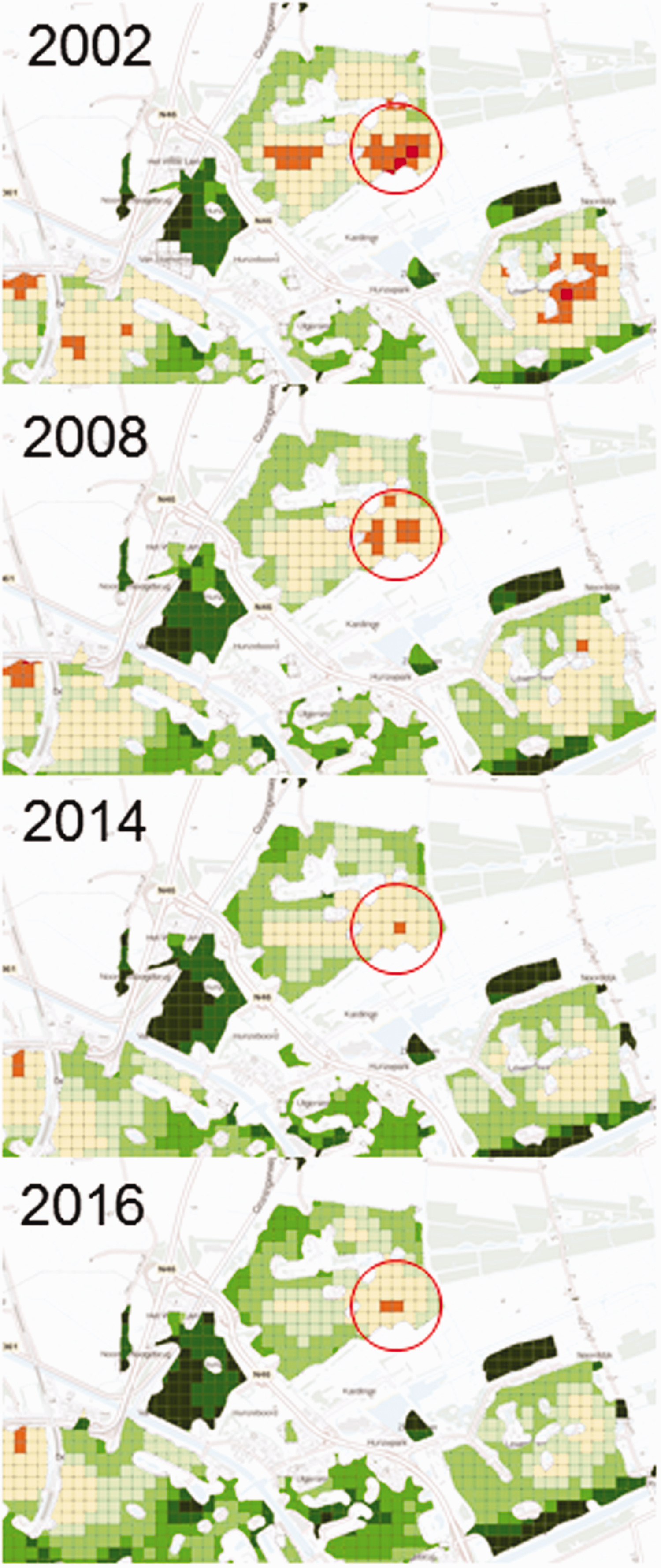
Livability scores for the study area from 2002 to 2016. Red indicates low livability, green indicates high livability. (Leefbaarometer.nl, 2018)
Over a period of two years, since 2015, the two housing companies, which own all dwellings on the block except for the owner-occupied semi-detached homes, deviated from the conventional appropriation of dwellings by applying a ‘labeling’ intervention aimed to achieve a balanced local social mix. The intervention is regarded as an emergency measure, only warranted in special circumstances such as (extreme) social disorder. As opposed to the conventional appropriation of available units according to a waiting list or special urgency, the social mixing intervention allows housing corporations to handpick new tenants according to criteria determined by the housing corporations. Over the last two years, so-called ‘strong tenants’ have been moving into available apartments. The two criteria for ‘strong tenants’ are: first, proof of steady income or enrolment in an educational program; and second, a certificate of conduct, attesting to a clean criminal record. It is important to recognize these criteria for new renters are determined solely by the housing corporations. Judging by the criteria, the mixing intervention aims to achieve a socio-economically mixed neighborhood and focuses explicitly on the safety dimension of livability.
Research methods
The data collection for this study is based on four months of field research undertaken from April to July 2017 during which the field researcher resided in the studied area. The core methods consist of participant observations involving 30 study participants, complemented within-depth interviews with residents (10) and professional stakeholders (6); two municipal government officials; an employee of the local housing corporation; a local journalist; and the two founders of a local faith-based organization (FBO) which organizes social events for neighborhood residents. The interviews were conducted in Dutch and the quotes in this paper were translated by the field researcher, who is fluent in both languages.
To get a comprehensive image of the rhythms unfolding in the area, the initial two weeks of data collection consisted of systematic observations of street activities conducted during daily walks twice a day, which lasted between 1.5 and 2 hours. The first week the walks took place in the early mornings and early afternoons, the second week the walks were done late in the morning and late in the afternoon/early evening. During these walks, street activity was counted, mapped and their nature was described. For instance, the field researcher would count the number of people that were interacting in the area, where the interaction took place and what type of interaction it was e.g. greeting, conversation or other. The systematic observations were followed by more engaged participant observations, during which the field researcher participated in daily activities such as dog walking or an Easter brunch organized by the local FBO. Repeated informal unstructured interviews with area residents were conducted, as a part of these participant observations. The participants were recruited mainly through encounters in the streets during systematic and participant observations. Through becoming more engaged in local social life by tagging along with initial participants and meeting new residents, the group of participants grew rather organically. The informal interviews conducted as part of the participant observations were characterized by their spontaneity in the sense that they resembled everyday conversations, with the important distinction that the researcher attempts to direct the conversations to themes related to the study. The field researcher consistently documented observations and discussions from informal unstructured interviews in field notes, the writing of which simultaneously acted as data collection and preliminary data analysis. This dual function of documenting observations is rooted in the observer’s role as the primary cognitive instrument of data collection, thus directing and shaping fieldwork and data and requiring constant analysis and assessment (Goodwin et al., 2003; Schensul et al., 1999). Observations, field notes and transcripts of the in-depth interviews were categorized taking a grounded theory approach. From this first categorization rhythm emerged as a relevant conceptual frame for analysis, after which a focused coding scheme regarding rhythm was used to give analytical meaning to our findings.
Findings
Newcomers and long-term residents
As a result of the social mixing intervention that had been carried out in the study area, two distinct groups of residents live in the study area: newcomers and long-term residents. These groups shaped the selection of resident interviewees. The long-term residents interviewed are Olivia, Hannah, Lucy, Claire, Harry, and Lydia. Olivia and Lucy were between 30 and 50 years old, Hannah, Claire, Harry, and Lydia older than 50. All long-term residents, except for Harry and Lydia who are retired, were on income support at the time of the study. Also worth noting is that Olivia, Hannah and Claire were recovering from drug and/or alcohol addiction. By no means should this characteristic be regarded as representative of the group of long-term renters, although the incidence of similar or related personal issues does seem to be higher in this group. The newcomers are a group of residents that has been introduced to the neighborhood through the social mixing intervention. George, Katy, Amy, and Joan make up the group of newcomers. All of them had been living in the studied area for less than 3 years and were all under the age of 30. George and Katy are a cohabiting couple and were interviewed together. Amy also lived together with her partner, but was interviewed alone. Joan, too, was in a relationship but did not cohabit. All newcomers were employed or enrolled in a degree program at the time of the study, except for Katy, who had recently graduated and was looking for employment. George was working besides his studies. The distinction between newcomers and long-term renters will be upheld throughout the presentation of the findings in this paper. Although the internal characteristics of these two groups vary – e.g. in terms of ethnicity, personal interests, and histories – contrasting them was found to be illuminating when considering the impact of the social mixing intervention on neighborhood rhythm.
Producing social space through neighborhood rhythms
From the systematic observations of street activities, it became clear that the vast majority of everyday street activities serve a clear and sole, often functional, purpose – predominantly transportation (by foot, bike, scooter, or car) through the area. Peak moments of street activities were expectedly observed during mornings and late afternoons when employed neighborhood residents would leave for and return from work. Encounters as a result of these functional street activities, which might result in social interaction, were seldom observed. The participants ascribed the lack of encounters and social interactions in public spaces to the area’s poor quality of space – in particular around the line of tenement buildings. Participants discuss a lack of places to sit or dwell, which makes it almost impossible to pleasantly pass time in the street.
Besides the uninviting nature of public space, many participants pointed out how a large share of the apartments have bedrooms (and bedroom windows) at the street side and have the living rooms, kitchens, and balconies – where people spend most of their time at home – facing private gardens at the back of the buildings. Some bedroom windows, particularly those on street level, are blacked out, to ensure a degree of privacy. Lucy explained why she has her bedroom curtains permanently closed: “That’s where I undress and try to sleep. I don’t want any people looking in.” Although understandable from the perspective of a resident, when experienced from the street, the blacked-out windows contribute to a perception of an impermeable boundary between the public street and the residential units and thus evoke a sense of abandonment – a ‘not very social’ environment, as Harry put it. Joan addresses another obstacle for pleasant neighborly interactions that has its origin in the public space of the area. Nightly social activities in the street undertaken by certain groups hamper her good night’s sleep. She recalls that during some nights scooters drive by and people have (loud) conversations, which, to her, often sound like arguments. This adds to a perceived awareness that there are activities occurring in the street that Joan does not want to take part in, thus posing a barrier for Joan to engage in local social life altogether:
I don’t exactly know what people are doing driving around on their scooters and speaking loudly with each other in the middle of the night. (…) I suppose they live in the street too. (…) I never talk to them. That’s not exactly a group I am interested in getting to know better – ha ha.
–Joan
The last one and a half months, as it’s getting warmer, it’s becoming noisier on the street … Well … I don’t spend a lot of time in my bedroom. Usually I sleep when I’m in there. (…) Anyway, I hear people at night. Yelling at each other or something. Having a quarrel. (…) I don’t know these people; maybe it’s just one wrong character that lives here. But I hear them.
–Hannah
Providing strength to the suggestion that a spatial and temporal mismatch can exacerbate perceived social divisions are observations that exhibit the opposite – how an alignment of spatial arrangement and temporal orderings in fact are able to promote local interactions. The adjacent line of tenement buildings, which are designed with the living rooms, kitchens, and balconies facing the street provide an example. Participants on this side of the street exhibit more awareness about what happens in the street. Not only do they see more of what happens, they tend to interact more with people in the street as well. Social interactions do not necessarily take place in the shared space of the street, but can also occur on the public-private interface. For example, many greetings were exchanged between people out on their balconies (smoking or enjoying the weather) and people walking or biking through the area. Such brief exchanges hardly seem meaningful – seeing how they do not usually develop into conversations or deeper, more meaningful interactions – nonetheless; they provide an important base of mutual familiarity with local residents in addition to direct interaction opportunities. Because the balconies serve as spaces used for leisure and relaxation, residents typically spend prolonged periods of time on them. Furthermore, they are in direct contact with and sight of public space. Therefore, the probability of interactions occurring – both intragroup and intergroup – is much higher. This illustrates how brief, but nonetheless repeated periods of overlap in spatial and temporal dimensions of daily rhythms – i.e. polyrhythmia (Lefebvre, 2004) – create an integral prerequisite for local intergroup socialization in the shape of a base of mutual familiarity and tolerance.
Eurythmia: Trust, support and reciprocity among local dog owners
While conducting the fieldwork, the social interactions of a network of local dog owners were witnessed. To better observe the nature of these interactions the field researchers ‘borrowed’ his in-laws’ dog called ‘Max’. While walking Max, he managed to connect to the group of local dog owners and observe the exchanges between them first hand. Striking was the level of acquaintance local dog owners have with each other. Most dog owners greet each other while passing, usually exchanging quick phatic interactions, such as: “Hey, how are you?” or “Lovely weather today, isn’t it?” Better-acquainted dog owners exhibit the habit of engaging in longer conversations on their walks, while the dogs get a chance to engage in playful interaction. The nature of some of these conversations reveals supportive elements associated with neighborhood social capital and social cohesion. For example, when one of Lucy’s dogs passed away after a period of illness, several local dog owners expressed their solidarity and sympathy toward her. Not only did they provide emotional support during difficult times, they also kept regularly checking in with Lucy to see how she was coping. Lucy has a reputation for going on alcoholic episodes in times of emotional turmoil. After the passing of her dog, she also had a string of drinking days, which was noticed by an observant dog owner and neighbor. He told her he had not seen her walking the dog for a couple of days, which made him wonder how she was getting by. Lucy responded that she was still very sad, “But not to worry” she added: “I am so shaken up that I can’t eat. I can’t even drink [alcohol]!” – specifically communicating the inability to drink to be a positive thing. The man and Lucy had a big laugh about the remark after which Lucy mentioned it also was a good thing she could not eat, because that way she could save money for the dead dog’s urn. In an earlier conversation, Lucy had disclosed that the combined sum of euthanasia and the urn for her dog would amount to around 200 euros – quite a hefty sum for a woman living off a debt-related allowance of 60 euros per week. Then, in a more serious tone, the man told her that if at any time he could help by taking her remaining dog out on a walk, she should not hesitate to ask him. Although Lucy did not seem intent on taking him up on his offer any time soon, she expressed her gratitude for the gesture. The conversation concluded with Lucy remarking that by the time she would get the urn with her dog’s cremated ashes, she would return to her normal self. “All right, take care,” the man said as he continued his walk.
Dog owners are able to overcome the spatial impediment for frequent contact posed by the limited meeting qualities of the area’s public space through the perceived moral obligation to take care of their pets – to go out and walk their dogs. As long-term resident Claire expressed:
If you want to get to know people around here, you need to get a dog. (…) People meet each other on the street walking dogs, and the next day they are drinking coffee together. (…) Like my neighbors here [points to an adjacent balcony]. They are also very social with other dog owners around here and have people over all the time.
–Claire
On an individual scale, there are signs that keeping pets can add to an individual’s capacity to engage in local social life through increased self-esteem and self-worth. In particular for the most vulnerable groups such as those with very little financial means or recovering addicts, keeping pets – through aligning them with existing local rhythms – can serve as a vehicle for social rehabilitation. Like in Olivia’s case, who owns many pets:
Interviewer: “Why do you keep so many animals if I may ask?
Olivia: [long pause] “That’s a very good question … That’s a very good question … I
don’t know … It feels like family. Something I can look after – take care of. So … They
need you. (…) That’s nice for a change.”
–Olivia
From rhythms to networks
All participating newcomers indicate that they had no trouble easing into a routine in their new neighborhood. Some of the newcomers told us that they had a number of good friends already living in the area who also opted to move to the area as part of the social mixing intervention. This resulted in daily rhythms that were partly intertwined, through social activities, as well as more practical support, as Katy explained:
We have so many friends living here now … I will ask for a casserole or a pan for soup from our friends down the street. Because … Well, I can just enter their apartment, I don’t even have to ring the bell and ask if they maybe have what I need. I already know they have it, so I can just come in and take it.
–Katy
When further looking into barriers for social interaction between newcomers and long-term residents, it is relevant to note that most newcomers feel hesitation to personally address long-term residents on – to them – abnormal or disturbing behavior. There is also no real need to do this, as disturbances are easily reported online with the relevant authorities, such as municipality and housing company: “I frequently report if there’s litter on the street by sending a message on WhatsApp to someone working for the City. The last couple of months I made a report every week.” George remarked. In this system, residents are encouraged to keep reporting, because only in the case of enough reports the problem becomes viable to address However, anonymous reporting removes the incentive to engage in efforts to collectively negotiate and uphold local social norms of, in this example, a clean street.
In contrast with newcomers who embrace anonymous reporting, long-term residents share an understanding about not reporting neighbors to institutions without first talking to the person(s) causing the disturbance in person. During fieldwork an incident occurred where Lucy, who had been drinking, made a bonfire on the patch of grass behind her (ground-level) apartment. It had rained in days before, causing a lot of smoke to emanate from the wet kindling she used. At least one disgruntled neighbor reported the fire to the police and after a while the police turned up, requesting Lucy to put out the fire. She complied with that request, but later explained how she felt resentment toward her neighbors since they had not asked her in person to put out the fire – something she claims she would have happily done. The same mechanism of anonymous reporting that equips George and the woman who reported the bonfire with the opportunity to exert indirect social control hampers opportunities for collective problem solving and the developing of mixed local networks. As a consequence, we argue, social boundaries between the two groups are reinforced.
Diverging prospects: Rhythms from a life course perspective
The diverging rhythms in the studied area are strongly represented in diverging future prospects and plans between long-term residents and newcomers. Unlike the group of newcomers, long-term residents typically do not feel they have a realistic option of moving house. Olivia, for instance, explained how she always thought her place in the area would be a stepping-stone – a transition home, much like how newcomers describe their residency in the area – to move up the housing ladder. In this sense, Olivia views her residence in the area as part of a linear rhythm, i.e. trajectory, which would lead her to a place in a better neighborhood. That transition never happened due to substance abuse-related problems and connected financial issues. Being presently unemployed and a recovering alcoholic, she perceives no viable opportunities to move out:
My mother would like to see me live elsewhere. She still thinks this is a ‘transition apartment’. She often asks me when I will move. (…) Do you have any idea how much that will cost me!? First of all, I would pay around 100 euros more in rent [per month]. Also, I’ll start with a bare house; I would have to put in floors – ha ha! – and probably a lick of paint. Minimum. That’s just not realistic. So that’s that.
–Olivia
In addition to the perceived assurance of housing mobility prospects, there is also an institutional foothold that favors newcomers to deal with potentially undesirable neighborhood situations. Joan, George, and Katy point to an example where one of their friends, who was only recently appointed an apartment in the street, has been guaranteed another house outside the study area if she experiences disturbance from a neighbor. In effect, prospective new residents are offered a free pass to try out living in a disadvantaged area without any danger of getting ‘stuck’ there. Meanwhile, residents who have lived in the area for longer often have no realistic opportunity to move away in case of serious neighborhood disturbances. As such, an already more advantaged group is further empowered, thus deeper carving out the social divisions between advantaged and disadvantaged residents.
Discussion
This article set out to gain insight into the ways in which social mixing affects everyday neighborhood rhythms in a neighborhood in the city of Groningen in the Netherlands. We conclude that in our study area, daily rhythms of long-term residents and newcomers at best coexist alongside each other. More often, however, these rhythms are in tension with each other. In particular the daily rhythms of long-term residents are subject to pressure through the introduction of newcomers’ rhythms. They feel their ways of living are not accepted by the newcomers. The newcomers are empowered to challenge the ways of life of long-term residents through online reporting methods. In addition, they receive preferential treatment. As a result, the power geometries are strongly tilting towards the housing corporation/municipality and newcomers, and the long-term residents are further disadvantaged. Overall, our findings underline that mixing social groups in a neighborhood does not result in mixed social networks, confirming earlier research on the effects of social mixing (Chaskin and Joseph, 2015, 2013; Hoogerbrugge and Burger, 2018; Lees, 2008; Smets and Sneep, 2017; Van Gent et al., 2018; Walks and Maaranen, 2008).
Systematic observations of street activities exhibited how incompatible everyday rhythms are in friction with each other and create arrhythmias. We found that, for instance, a group of residents prefers to sleep during the night, as they want to go to work or study well rested. This contrasts with the rhythm of another group of residents, who like to hang out on the streets at night. Such diverging rhythms pose major barriers for intergroup socialization. Through arrhythmias, strong senses of social division and generalized projections of ‘us’ and ‘them’ develop. Furthermore, we found how anonymous methods of reporting transgressions in the neighborhood through institutional channels have an extra inflammatory effect on the senses of division and marginalization for the group of long-term residents. By encouraging newcomers to report disturbing behavior the housing corporation to achieve its aim of quieting down the neighborhood in order to improve livability. However, because the reporting is often aimed at behavior that is considered normal by long-term residents, this group feels seriously marginalized in the neighborhood they have often lived in for many years. We argue that due to the repeated choices by housing corporations to benefit newcomers over long-term residents for the sake of livability, the latter group is confronted with a process of un-homing (see Elliott-Cooper et al., 2020).
In contrast to the arrhythmias observed between newcomers and long-term residents, we found that coinciding everyday rhythms within the two groups of participants contributed to a sense of harmony within social networks. For long-term residents, an example of such a rhythm was found in walking the dog a couple of times per day. These findings confirm that spontaneous yet repeated interactions establish complementary rhythms that harness social networks of trust, emotional support and stability (Forrest and Kearns, 2001; Galster, 2012; Lefebvre, 2004). For newcomers, this was found in borrowing cooking utensils and other items from each other, as well as in informal gatherings.
An important contribution of this article is the identification of a particular manifestation of rhythm represented in the group of newcomers that has a significant effect on the social dynamics of social mix. Viewing rhythms from a life course perspective, the sense of division between long-term residents and newcomers, becomes even more prominent. The newcomers are typically in a life stage where they are looking ahead, for instance to their first job, to buy a house, to establish a family. Their rhythms are characterized by a plethora of opportunities and an upward trajectory in terms of socio-economic status. To cap it all, newcomers are even given guarantees by the housing companies to move out in case the neighborhood is not to their liking. This is in sharp contrast with the rhythms of the long-term residents, that spiral around unemployment, financial difficulties and (recovering from) substance abuse. Their rhythms are characterized by a lack of opportunities, and often a sense of being ‘stuck’ in the neighborhood. We argue that the advantaged mobility prospects of newcomers contribute to the neighborhood’s transitory character. This is important, as research has shown that a transitory character of a neighborhood is disadvantageous for local social stability (Bergström et al., 2010; Bolt et al., 2008). Furthermore, we assert that through the social mixing intervention, newcomers are systemically advantaged over the group of long-term residents, whose mobility prospects are very limited.
Our findings show various scales at which neighborhood rhythms are affected through the social mixing intervention. In turn, changing neighborhood rhythms were found to highlight senses of social division between groups of newcomers and long-term residents through various forms of arrhythmia. Zooming out, by introducing ‘exemplary’ newcomers, the neighborhood as a spatial unit might improve in terms of the livability indicators used by housing corporations and the municipal government. Even inequality between neighborhoods might seem adequately addressed at an aggregated scale. However, looking through the lens of rhythm, we found how perceptions of social division between advantaged and disadvantaged groups are in fact exacerbated as a result of the social mixing intervention. In this sense, the social mixing intervention renders the problem of socio-economic disadvantage less significant in a spatial sense under the guise of improved livability. We argue this is problematic because we found the struggles and hardships of the group of long-term residents remain unaddressed. Among the housing corporations and municipal government, a widespread assumption exists that by increasing safety a more livable neighborhood is achieved. Ultimately a more livable neighborhood is regarded as better for all. However, in this case the social mixing intervention is completely imposed on long-term residents, which entails they are sidelined by more powerful institutional actors in finding an answer to the question what would improve their neighborhood for the more disadvantaged groups, i.e. long-term residents. We argue that institutional actors failed to make an effort to align the social mixing intervention with long-term residents’ daily rhythms thereby impinging upon that group’s right to socially produce their neighborhood. Even though, as a consequence of social mixing, the neighborhood is perceived as quieter and perhaps safer, through the concept of rhythm we found clear signs that long-term residents feel more alone in and alienated from their neighborhood. Therefore, we implore future urban policy to explicitly investigate the ways in which socio-spatial interventions will affect everyday rhythms of inequality within neighborhoods, and make serious efforts to restore the right of disadvantaged groups’ (i.e. long-term residents) to socially produce their neighborhood.
Footnotes
Acknowledgements
The authors would like to thank Wouter Marissen (Noord Language Services) for proofreading and correcting various versions of the manuscript.
Declaration of conflicting interests
The author(s) declared no potential conflicts of interest with respect to the research, authorship, and/or publication of this article.
Funding
The author(s) received no financial support for the research, authorship, and/or publication of this article.