




Abstract
This article explores infrastructures of subaltern resistance in Pakistan through a focus on spatial and performative modes and across a number of historical and contemporary examples. I start with the figure of the puppet, tracing it historically as an example of how culturally specific modes of dissent have evolved from a colonial to a postcolonial context, and further into a neoliberal space. I then analyse the practice of ‘wall chalking’, which could be considered a local form of graffiti that also embodies debates over religious and ethnic identity through the contested status of script in the country. In narrating these examples, my aim is to show how a specific form of resistance has developed in the country through the displacement of the dissenting subject. Here I conceptualise resistance as a Foucauldian counter-conduct that transforms space through a creative and embodied use of tactics. It is a form of subaltern resistance that emerges in relation to non-humans and everyday rituals and has developed in subtler (and more resistant) forms, through ways of enacting that thrive within and through the vulnerability of the subject.
Keywords
This article explores the diverse cultures of subaltern dissent in Pakistan through a focus on spatial and performative modes and across historical and contemporary examples. The relationship between subalternity and spatiality has received renewed interest within current geographical scholarship (Brand, 2018; Jazeel, 2014; Jazeel and Legg, 2019; Mishra, 2016) and here I build on this by placing an emphasis on subaltern agency as it emerges in relation to notions of vulnerability and the spiritual. I am interested in how culturally specific modes of dissent (and sometimes resistance) have evolved and I trace this transition from a resistance to colonial powers to that against violent dictatorships, to the resilience of subjects that occurs through their own enduring within an oppressive social context and a neoliberal economic order. Pakistan gained its independence from British rule in 1947 when the Muslim majority provinces of colonial India partitioned from the Subcontinent into two halves, East and West Pakistan. Following a war of liberation in 1971 East Pakistan gained independence as Bangladesh. Since Partition Pakistan’s political history has been dominated by military rule and the elections of 2013 were an important moment in the country’s sixty-sixth year of independence, constituting the first successful civilian transfer of power following a full term by the previous government. The country’s political history till that moment can be considered a more or less continuous military dictatorship punctuated by moments of democratic rule. Today many consider it to be under a form of civilian military rule. Following 9/11 and Pakistan’s support for the US invasion of Afghanistan, the country suffered numerous terrorist attacks in the form of suicide bombings and an increasing religious conservatism across society, including gendered forms of exclusion and violence. This combination of factors raises questions around the forms of resistance available to subaltern subjects, and the role that vulnerability and (in)visibility play.
I start with puppetry, tracing it historically as it morphs from a traditional performative practice to being commissioned by NGOs for social projects. I then present ‘wall chalking’, a practice that could be considered a local form of graffiti, but also signals a religious and ethnic identity through the contested status of script in the country. In narrating these examples, my aim is to show how a specific form of resistance has developed through the displacement of the dissenting subject. In doing so, I contribute towards a now flourishing literature on Pakistan that has challenged the dominant scholarly narrative (Anwar, 2012; Khan, 2017; Maqsood, 2017), which portrays the country primarily through an international relations perspective as a space of permanent crisis, but not yet becoming the failed state that has so often been predicted (Cohen, 2003, 2011; Rashid, 2013). Yet, even in the more recent scholarship that seeks to move ‘beyond crisis’, an overlooked aspect is how such thinking on, or beyond, crisis has led to a general consensus that popular resistance in Pakistan is rare and unlikely (Bajwa, 2012; Khan, 2010; Lodhi, 2011). 1 On the contrary, my examples show how everyday forms of resistance are ubiquitous in many parts of the country, if they are understood beyond simple oppositional modes.
Attuning to modes of subaltern political agency
Questions of how to define the subaltern and where to locate them are at the very heart of attempts to understand the contemporary relevance of debates that have flourished around the work of the Subaltern Studies Collective, a group of historians led by Ranajit Guha (Jong and de Mascat, 2016; Morris, 2010; Nixon, 2015). For Guha and others within the group, an early definition of the subaltern was based in Antonio Gramsci’s use of the concept to describe those peasants and workers oppressed under the fascist regime in Italy during the 1930s (Gramsci, 2010; Guha and Spivak, 1988). Guha’s aim in mobilising the subaltern subject within Indian historiography, was to correct some of the bias he perceived in such histories that were written from an elite perspective. An early definition of the subaltern defines it as ‘a name for the general attribute of subordination in South Asian society’ (Guha and Spivak, 1988: 35). For one of the most important critics and interlocutors of the group, Gayatri Spivak (1988), the subaltern was originally someone located on the outside and therefore with no access to hegemonic power and to lines of social mobility. Without reproducing here the intricate debates around the naming and conceptualisation of subaltern subjectivity, there was a transition from constituting an essential subject to an emphasis on competing subject positions with questions of oppression, representation and agency at the heart of these discussions (Morris, 2010; Morton, 2003; Steyerl, 2002).
In this article, I want to focus on two aspects of these ongoing debates. The first considers how we might recognise subaltern resistance through attuning to more dispersed forms of dissent, and the second highlights the importance of an entangled worldview in the politics of subaltern groups that includes gods and spirits, rather than thinking of these as mere residues of an older cosmology that is persisting in the present (Chakrabarty, 2000). This, of course, has to be thought in relation to the ways in which the subaltern’s world (and all of our worlds) have changed in the context of a neoliberal economic order. The subaltern is no longer someone with no access to hegemonic power, but whose life has become entangled in particularly exploitative relations to the centre and therefore can no longer afford a politics of negation. Instead, they are embroiled in complex negotiations with the state and often with multinational corporations over access to and distribution of resources (Chatterjee, 2015; Nixon, 2015; Spivak, 2000). This means that neoliberal policies have profound effects on the subjectivity of those who are at their receiving end (Harvey, 2005). One consequence of this is the removal of subaltern resistance from development discourses in favour of the notion of resilience (Neocleous, 2013). This celebration of innovation in the face of crisis relies on a slippage between an ahistorical way of thinking resilience as ‘making do’ and a more historicised understanding that places such acts within a ‘regime of resilience’ sponsored by neoliberal actors (Bracke, 2016: 852). Such regimes consider the neoliberal self as reflexive not to social context per se, but in relation to conceptions of itself (Gershon, 2011).
A good example from Pakistan is in the context of the devastating floods of 2010/2011, when the slow and inadequate governmental response led to humanitarian relief being mostly provided by a range of NGOs, many of whom were caught in webs of patronage related to political parties and religious organisations (Sahi, 2012). Those who received aid knew very well that they had to identify with particular groups in order to receive relief, whether this was as a practicing Sunni Muslim or a supporter of a particular political party. In the aftermath of the flood, many commentators in the West wondered why there were no large-scale protests by flood victims (Fair and Gregory, 2016), leading them to couch the subaltern as a resilient but docile subject (Jaffrelot, 2015; Strothmann, 2013). Yet, in the rural heartlands of a particular political party there is little choice but to support those upon whom your livelihood depends. Perhaps what this example shows is that ideas of resilience combine problematically with the neoliberal notion of ‘useable traits’ to actively produce subjects unable to resist.
Such a context underlines the necessity of subaltern political agency being understood beyond resistance or through solely oppositional modes. In the global South, and especially in Muslim dominated societies, when writing about politics the spectre of ‘the street’ is forever present. Whereas the phrase ‘coming out on to the street’ denotes a spontaneous event, protest is conceptualised differently in the context of the global North where emphasis is placed on organisational capacity (Regier and Khalidi, 2009). This way of denoting the street creates an atmosphere of a charged and volatile public where the citizens of Pakistan are portrayed on the one hand as a fanatical bunch, burning effigies of western politicians and the US flag, and on the other as a sort of passive mass enduring drone attacks, bombings and violations of national sovereignty with very little to say. This leads to the paradoxical situation that protest is demonised and seen as evidence of failing states, yet it is also against coming out on to the street that all other political gestures are measured. Consequently, subaltern political agency is increasingly difficult to recognise as it is only expressed through straightforward oppositional modes in exceptional circumstances. 2 But, if we were to expand our definition of resistance beyond street protests understood as large scale, often violent demonstrations, it is possible to recognise what are frequent acts of dissent and sometimes also of resistance. David Arnold (2019) has recently argued for the street as an important analytic for understanding subaltern lives in colonial India, both as an enabling space as well as one that held many dangers of violence and exposure.
Thinking subaltern resistance…
… through counter-conducts and vulnerability
Michel Foucault’s ‘counter-conducts’ accommodate some of the ambiguity of subaltern acts of resistance, as well as highlighting their material, spatial qualities and performative dimensions (Drozynski, 2016; Foucault, 2007; Sanliturk, 2019; Scott, 2016). The broader discussion on governmentality within which counter-conducts are conceptualised has focused on an analysis of the technologies of power, that is, the way in which governmental power modulates the conduct of citizens in order to make them governable (Elden, 2012; Legg, 2016; Schlosser, 2008). This emphasis on what Foucault termed the ‘art of government’ built on a now familiar critique of him as a theorist of power only (Foucault, 1991; Kerr, 1999; Taylor, 1984). In contrast, more recent debates have highlighted the reciprocal nature of such strategies of power and the forms of resistance they engender, through the relationship between ‘conducts’ and ‘counter-conducts’ (Cadman, 2010; Legg, 2019; Rosol, 2014). Foucault’s analysis of the 16th Century pastorate and its relationship to government showed how this produced ‘a highly specific form of power with the objective of conducting men’ (2007: 194), and how resistance to this power emerged from questioning practices of government. This way of thinking power is useful for my discussion on subaltern political agency as it conceptualises it in a ‘much more diffuse and subdued’ (Foucault, 2007: 200) way, 3 and as being deeply entwined with forms of governmentality. While Foucault (2007: 215) refers to counter-conducts as being tactical in nature and in a way that suggests a certain spatiality, it is important to distinguish counter-conducts from Michel de Certeau’s (1984) theorisation of tactics that has been influential across spatial disciplines. Whereas for de Certeau tactics are predicated on an outside, an exteriority that is mobilised ‘by generating a different point of view, a different way of seeing, a figuration’ (Colebrook, 2001: 557), for Foucault tactics are part of the diffuse nature of power, that is, they are always implicated. They are therefore able to account for some of the interactions and compromises between the state and the subaltern. Thinking through counter-conducts also marks a move away from the abundant literature on subaltern resistance in the global South that focuses on an analysis of grassroots political movements and their modes of organisation towards an understanding of resistance through vulnerability (Butler, 2001, 2016; Cumbers et al., 2008; Featherstone, 2008; Subramaniam et al., 2003). This is especially useful in thinking through subaltern resistance in Pakistan due to its history of the suppression of dissent and organised political action.
Counter-conducts also require a critical attitude, meaning that they are not just a form of resistance, but also ‘a problem of and for reasoned thought—that is, a governmentality.’ (Cadman, 2010: 541) These acts are embedded within a certain worldview that has the potentiality of becoming part of a subject-position, a ‘we’, that could question hegemonic forms of power. Louisa Cadman’s (2010: 548) critique of governmentality studies shows that there is a missing element within it, the fact that conducts do not only conduct others through modes of governmentality, but they are also a form of conducting the self via what she calls ‘the ethical relation of the governed subject to its own conduction.’ This means that counter-conducts ‘are risky and transfigurative because, by questioning the conduct of their conduct, they simultaneously question the relationship of the self to itself, risking the self in the process’ (Cadman, 2010: 550). 4 This risk signals the relationship between vulnerability and resistance, which can also be found in Judith Butler’s (2015) foregrounding of the performative dimension of acts that we could consider counter-conducts. The question of vulnerability arises in Foucault’s discussion of the Cynics in ancient Greek philosophy, who are voluntarily homeless, defiant against the norms of society, while bodily putting themselves at risk. This means their ‘mode of life was courageous because of its exposure of the Cynic body, in the sense of display and of risk.’ (Legg, 2019: 37) In Butler’s discussion of Occupy and the Arab Spring, the call to think agency and vulnerability together makes a similar move. Couching these as ‘demands made in the name of the body (its protection, shelter, nourishment, mobility, expression)’, Butler (2015: 129) suggests that these ‘sometimes must take place with and through the body and its technical and infrastructural dimensions.’ The agentic potential of vulnerability is thus directly linked to performativity, which ‘describes both the processes of being acted on and the conditions and possibilities for acting’ (Butler, 2016: 18). Hence, vulnerability is something that is enacted on the subaltern subject, whilst also containing within it the possibilities for their own acting through the conditions that make them vulnerable, that is, through counter-conducts. This possibility emerges out of dependent relations between the human body and what Butler (2016: 21) calls infrastructure. The human body is relational and requires certain kinds of spatial, institutional and environmental support structures to survive and to live well. These structures are thought of not only as support, but as a means of acting through the vulnerability of the subject that is embedded within all of our dependent infrastructural and spatial relations.
… through non-humans, spirits and everyday rituals
These relations are of course culturally inflected and in conceptualising these aspects of subaltern agency, I follow Chakrabarty’s (2000) suggestion that political modernity outside Europe should be understood across multiple and often discordant temporal registers, since subjects choose to resist or not for different reasons at different times. 5 Writing on protest in India Chakrabarty states, ‘every time there is a populist/political mobilisation of the people on the streets of the country and a version of “mass democracy” becomes visible in India, historicist time is put in temporary suspension.’ (Chakrabarty, 2000: 10) Such large-scale action is able to intervene in what Chakrabarty denotes as History 1, that is the dominant history of modern capital. Thinking with Chakrabarty’s notion of History 2, the subaltern subject’s agency is often mobilised not through such large-scale action but through the myriad everyday practices, rituals and gestures that point to the political in different ways and are able to put historical time in temporary suspension. This is especially important within Pakistani culture where rituals and practices to ward off spirits and bring good fortune emerge organically in the present. I am thinking here of a fairly new phenomenon in Lahore where people often leave carrion for the kites and vultures that fill the city’s skyline. They are supposed to bring good luck and prominent places for this emerge and recede regularly in the city alongside an healthy economy of people selling meat for those seeking swaab (blessings). This modern-day ritual is also a thoroughly spatial phenomenon with very particular places being viewed as favourable, such as bridges over the many new flyovers constructed in the city, or over the dried Ravi river where those leaving the city on long journeys often stop for a blessing (Pinault, 2008). How would a knowledge and understanding of such ways of apprehending the world, a world that you might occupy alongside djinns and others, change the way in which subaltern resistance is understood? 6
Something of this complex relationship can be discerned in Mohammad Hanif’s novel, Our Lady of Alice Bhatti (2012), which follows the life of a young Christian woman in Karachi working as a nurse in a Catholic-run state hospital. She belongs to a group of people who due to being part of the lowest Dalit caste, were compelled to convert to Christianity from Hinduism during British rule, but are still treated as ‘untouchables’ in contemporary Pakistan. The novel explores the various ways in which Alice Bhatti resists what she considers to be the usual fate of women from her social class and status, focusing particularly on the gendered ways in which subalternity makes the city extremely dangerous for someone like her. Throughout the novel there are accounts of miracles occurring around Alice, from her purportedly bringing a dead baby to life with a prayer, to the contents of an intravenous drip turning to milk. Upon Alice’s premature death, her father makes a case for her sainthood based on these events, although during her life Alice dismissed all talk of miracles. 7 Yet, Alice herself has her own opinions about her powers, confiding in a friend that she can tell how people are going to die just by looking at them. There is also the curious nature of her Christian father’s profession of curing ulcers by reciting Muslim prayers. That these strange occurrences are often taken at face value, and are completely entwined with Alice’s attempts at resisting her subaltern status and negotiating the gendered geography of Karachi, say something about the need to understand subaltern agency through cosmologies that allow a space for religion in all of its forms, syncretic, folkloric and tradtional. These examples see agency as emerging out of everyday practices that are deeply embedded in ways of thinking the world and that, following Chakrabarty (2000), are able to inhabit the future as it is.
If we agree with Spivak that the subaltern is the one who speaks but cannot be heard, then one political task is to attune ourselves to what the subaltern is saying, even if that task is doomed to failure (Birla, 2010, 1988). Here this attuning takes place through reading the traces of the subaltern not in the historical archive (as the Subaltern Studies Collective did), but in the popular and spatial archives of performance, reading traces on walls, and in the living archive of everyday practices. In writing about these my aim is to find moments of subaltern resistance within and through spatial relations that are able to include other worlds. These examples do not easily conform to the ‘concept-metaphors’ of western disciplinary theory (Jazeel, 2014: 95), or to the consequent binaries such as capitalism and proletariat, empire and multitude or cosmopolitan and communitarian and neither are they fully captured in the discourse around grassroots movements and protest in the global South (Rao, 2010).
The figure of the puppet
Within the Pakistani context the puppet emerges as an important historical and contemporary figure that exemplifies the displacement of the dissenting subject from the act itself. Puppets have always served as mediators between worlds, traditionally between the human and the spiritual, and in this case also between the people and their rulers. The performative act of puppetry combined with its ability to ventriloquise has made it an important mode of dissent within the Indian Subcontinent. Whilst the role of street theatre in organising dissent against colonial rule has recently been acknowledged, puppetry as a separate practice has not received much attention (Bhatia, 2010; Singh, 2009). The 1876 Dramatic Performances Censorship Act demonstrates that colonial authorities were threatened by performance as it not only brought dissenting ideas to the masses, but also did so in contexts where potentially large crowds were already assembled, similar to the protests organised around Friday prayers today. Thus, puppeteers as subaltern subjects have performed an art that is deeply embedded within traditions of dissent in the Indian Subcontinent.
Historically, putli tamashae (puppet shows) and particularly the form of folk puppetry that originated in the Indian province of Rajasthan (kathputli) provided entertainment for rural communities. The itinerant puppeteer families travelled from village-to-village, performing short plays from a set repertoire. In one of a very few scholarly articles on the kathputli tradition in Rajasthan, Poh Sim Plowright makes a link between the stratified caste and social system of India and the relationship between humans and puppets. She writes: ‘And just as puppets submit to the control of the puppeteer, humans under the ancient Indian feudal system unquestioningly yielded to the functions and regulations imposed on them from birth within a fiercely regimented, hierarchical society. In both cases there is a sense of complete submission and noticeable absence of free will’ (Plowright, 2005: 277). For those interested in subaltern agency, these sentences are difficult to take at face value and later on, in a section attempting to make sense of the way in which the puppeteers control the puppet, Plowright appears to contradict this assertion. The traditional way of controlling the puppet is directly with strings and without the aid of an intermediate piece of wood, an extremely difficult skill to master. Plowright (2005: 282) states that the puppeteers themselves cannot explain how this happens: ‘Something spiritual has occurred which transcends words.’ It would seem that the relationship between the puppet and the human (and by extension gods) is not so much of an absence of free will, as it is of a melding of the human with the material and the spiritual. This unique ability of puppets to transcend worlds gives them an agential power that fits well with the agency Chakrabarty (2000) assigns to gods and spirits.
Since Partition and independence Pakistan’s turbulent political history has perhaps been dominated more than any other figure by General Zia-ul-Haq. His eleven-year rule, which began in 1977, changed the political and social make-up of the country. Much of the general’s power base was reliant on an equation of his own authority with that of a narrow understanding of Islam based on Wahabi doctrine imported from Saudi Arabia and he introduced a series of increasingly repressive laws. I still remember the silliness of having to hide the food we were eating as we passed a police checkpoint during Ramzaan (Ramadan). 8 Dissent was not allowed; even a nine-year-old could not be seen eating in public during the month of fasting. At a time when all other voices had been suppressed, it was once again a puppet that was able to subtly intervene in the political conversation. 9 The satirical Uncle Sargam lambasted the General’s dictatorial rule throughout the 1980s in the highly popular television show, Kaliyan, broadcast by the state-run Pakistan Television Corporation. Devised by the puppeteer and satirist, Farooq Qaiser, the character of Uncle Sargam was based on his university teacher in Romania but was an altogether Pakistani figure. Although scathing of the corrupt elites that refused to stand up to the dictator, the character was not a preacher and was not above breaking the rules himself. This was also true of the many ordinary people who bent the rules in order to make a living within an increasingly unequal and highly corrupt society. A recurring theme in the programme was how low-level officials legitimated the rule of the dictator through cronyism. In a television interview broadcast during the 1980s, the host asks Qaiser whether he decided to stop producing the show or whether the authorities asked him to stop. There is silence, a mumble and a look, and then Qaiser states, ‘…you understand, don’t you?’ The audience laughs nervously as everyone is aware of the limits of what can be said directly in public (Silver Jubilee, n.d.). While the children’s programme was a scathing commentary on social issues, such as chronic shortages of everyday commodities and the lack of affordable housing, it could only provide such a critique obliquely through an innocent and admittedly flawed character. In the same show, the host later comments that Kaliyan started as a children’s programme but was banned as a show for adults, with Qaiser replying, ‘Well, the kids grew up.’ (Silver Jubilee, n.d.)
The events of September 11 and the US invasion of Afghanistan also had an effect on the fate of the putlis (puppets) and their attendant cultural and material practices, which once again came under threat. The frequent terrorist attacks led to restrictions on public gatherings, which in the provinces of Punjab and Sindh especially affected the melas. These are festivals of Sufi Islam where many of the most marginalised in society, such as the trans community (khawajasira), traditional healers and performers come together, including street theatre troupes and some remaining puppeteers (Charan et al., 2018). The melas were targeted by the terrorists as important events within a more plural understanding of Islam. Beyond this attack on grassroots performative culture, one of the more established champions of the practice of puppetry, the Museum of Puppetry and Training Institute in Lahore run by the Rafi Peer Theatre Workshop, was also targeted. The ability of puppetry to transcend worlds and to create a performative space of resistance was exactly what threatened the fundamentalists who claimed that by breathing the semblance of life into objects the puppeteers were challenging God’s authority. While the threat and violence from these groups took a direct form, another challenge to the puppet’s place within Pakistan’s dissenting culture, comes from a very different source. This time it was the civilising mission of USAID, which in 2011 commissioned the Rafi Peer Theatre Workshop to create a Pakistani version of Sesame Street (Sim Sim Hamara) and began funding open-air festivals across the country (see Figure 1). The agenda of USAID in places like Pakistan can be questioned. What complicities are played out in the funding of cultural programming based on US models and what does this do to an autochthonous culture of questioning and dissent? The stated aim of the programme was to promote religious and cultural tolerance and to provide education for the third of Pakistani children who do not attend school. While the programme had been popular in Pakistan, the connection to USAID has meant that an indigenous cultural practice and a well-respected cultural organisation became associated with the United States, a country that many Pakistanis view with suspicion. Amidst the escalating tensions both within and outside the borders of Pakistan, the main defender of the ventriloquised voice of the putli – the Rafi Peer Group – was compromised by association with implications for the survival of a threatened folk tradition and its attendant material culture. 10
This NGO-isation of puppetry can be seen in what is now left of the practice that exists mostly as shows organised around specific issues, such as child marriage, girl’s education, family planning and clean water provision (see Figures 2 and 3). In an interview with Idrees Ali Khan, a puppeteer and veteran street theatre performer based in Lahore, I asked whether there was any room left for dissent. He described how the NGOs asked for very straightforward messaging around narrow issues of interest, but that he always managed to slip something in. A standard Punjabi line in his performances goes: Here each government halts everything and blames the last Here there is no choice but to overturn the whole system.
Of traditional string puppetry there are still some remaining performers in the original puppeteer families from Rajasthan, mostly in and around the city of Multan. Their performances are based on traditional stories and include certain characters such as Patay Khan who keep returning but whose message is modified according to the times and tastes of the audience. Recent performances have chosen to poke fun at mullahs (clerics) who are traditionally always invited to important events such as weddings, birthdays, funerals etc., and as the joke goes are usually only interested in the food on offer. In the performance the narrator asks the mullah whether he would like to lose himself in a Sufi trance (haal) or listen to music. The mullah chooses haal and begins to dance rapturously with the narrator chanting: ‘Haq Allah! Haq Allah!’ Suddenly, he faints and falls over. At this point Patay Khan appears and is asked by the narrator to revive the priest, who doesn’t seem to respond to his increasingly frantic attempts. The narrator then has an idea: ‘Say in his ear, ‘meat and roti!’ Nothing happens… ‘sweet rice!’, ‘vermicelli!’ and the list goes on until at the sound of warm halva the cleric wakes up and the narrator starts chanting, ‘Hai Halva! Hai Halva!’ and the priest resumes his entranced dance (see Figure 4). In the febrile atmosphere of contemporary Pakistan in relation to the oppressive blasphemy laws, where people have been languishing in prison on death row for saying much less, this is an act of courage; few dare to poke fun at the religious establishment. 11
The changing fortunes of the puppets could also be read in parallel to the various phases of capitalism. The putli tamasha under colonial rule was a conduit through which the subaltern, cut off from lines of access to the centre, could still play a part in organising dissent by facilitating communication and the transmission of stories across villages and towns. The continuing agential power of this centuries old tradition can perhaps be attributed to the ventriloquism of the putli that in difficult times allowed the unsaid to be said, but it also resides in its access to other spiritual worlds. Whilst their ventriloquism was able to stand up to the country’s most powerful dictator, it is the same quality of displacing a voice and breathing life into a blank object that has meant that this cultural practice has been targeted by extremists. Perhaps it is also the reason that the puppet as a figure is seen to be open to US manipulation. The origins of kathputli are deeply embedded within a Hindu tradition and the refugee puppeteers brought with their art a strong sense of the entwined culture of the region prior to Partition (Brandon and Banham, 1997: 93). In Pakistan it is now a dying art that is easily dismissed for its association with these unwanted pluralistic aspects of an imagined national self (Khan, 2010). Thus, the putli as a figuration of contemporary subaltern political subjectivity encompasses many of the tensions at the heart of Pakistani subjecthood, whether these are to do with denials of past selves, tensions between the secular and the religious, or between the often-pressing need for economic aid and the baggage (perceived or otherwise) that this comes with.
Wall chalking
While the putli tamashae as a form of public performance has lost much of its popularity, there are other ways in which those without the consolidated power of political organisations are able to articulate dissent within urban space. The practice known as ‘wall chalking’ is used across the political spectrum to air grievances, provide social commentary, and often also to intimidate. It refers to the writing of messages onto public surfaces and is widespread across Pakistani towns and cities, with the term itself absorbed into local languages in English. In many ways wall chalking is similar to graffiti but it has a different aesthetic and is also widely used for advertising. It is similar to the truck art that has received recognition in Pakistan and beyond, mostly through the work of the artist and scholar Durriya Kazi who has documented and traced the origins of this practice (Hashmi, 2013; Nawab, 2016). The brightly and intricately painted trucks incorporate what Kazi considers to be a particular form of folk poetry, with humorous phrases, sayings and slogans, a style that can also be discerned in wall chalking. This witty form of social commentary is embedded within Pakistani culture, even as it morphs across different regions, and reading the walls is often a quick way of gaining an insight into what currently preoccupies people in a particular area, as well as wider national issues (see Figure 5). But this practice also has a dark edge, for example in Karachi’s politically marked neighbourhoods it often revealed the state of violent rivalry between groups, and in recent years Pakistani media and the intelligence agencies have relied on the appearance of wall chalking to track the various terrorist groups operating in the country. 12
What began as an informal mode of communication between communities, for example to publicise local gatherings and political rallies, or to advertise goods and services, has now transformed into a complex and layered practice. Whereas, traditionally its use as advertising was restricted to smaller businesses, such as a street hawker advertising the days they would be present in a particular location, or traditional healers advertising their services, today multinationals are also using it as a form of indigenous advertising (Zaidi, 2010) (see Figure 6). Additionally, wall chalking is used as an effective tool in political campaigning and in past elections the larger political parties have taken over entire underpasses, painting them in party colours and covering them in their slogans. Although compromised through its appropriation by powerful actors, wall chalking continues to provide an accessible means for ordinary people to articulate in public their political sentiments and social critique. This is especially surprising in a country with very low literacy rates, and here the difference between wall chalking and graffiti becomes clear. Graffiti relies on the individual going out with their spray can themselves, whereas wall chalking is often a second-hand endeavour. Professional sign writers are paid to write on walls and where the text moves from the wall to a vehicle, another set of artisans help articulate the thoughts of those who might not be able to write themselves (see Figure 7).
Yet, the very act of writing in Pakistan bears a heavy burden due to the complicated relationship between script and oral languages (see Jalal, 2000). In post-1971 Pakistan (after Bangladeshi independence triggered in part by disputes over language) the nastaliq script gained more weight as a marker of an Islamic religious identity. Alongside this, there was a rising interest in calligraphy across the postcolonial Islamic world, and in Pakistan this intensified under Zia-ul-Haq, where calligraphy in the Arabic naskh script came to be fetishized. As a young child I remember my school books suddenly being written in what I perceived to be a truncated and mean style, and then having to change my own writing to follow the new rules – it’s what I now blame for my horrendous Urdu writing! But rather than bolstering a Pakistani Islamic identity, such practices only revealed the fragility of the country’s founding myths (Devji, 2013). During the 1980s Pakistani artists explored script as a complex bearer of identities and, according to Ananya Kabir, turned towards indecipherability to critique calligraphy as cultural inheritance, as well as the simplified nationalism and often brutally suppressed regionalism this signalled (Dalmia and Hashmi, 2007; Kabir, 2009: 497). Thus it was in the ambiguity of script that a space for dissent and a new type of cultural production was found. Kabir makes this claim through a discussion of contemporary Pakistani visual artists, but here I apply her analysis to the ‘low’ cultural practice of wall chalking, where the continuation of calligraphy in the nastaliq script can be understood as a subversive act of resistance against the more conservative versions of Islam. In a reversal of fortunes, the imposed calligraphy that could not signal an Islamic identity for Pakistan, became in its everyday instantiation through wall chalking a bearer of a more plural reality
This transformation of calligraphy from the high cultural world of poetic and embellished texts to the dirty surfaces of public spaces might be considered by some a fall from grace. It chimes with the development of conservative attitudes towards wall chalking from the early 1990s onwards that have resulted in it being banned in Pakistan's most populous province with the 1995 Punjab Prohibition of Expressing Matters on Walls Act. Initially, this legislation had little effect but with the rise of the middle classes the law is being enforced in certain areas and later wall chalking was also banned in Sindh province and is also likely to be banned in Khyber Paktunkhwa and Balochistan provinces (Chaudhry, 2009; Islam, 2017). The appetite for enforcing these laws waxes and wanes and in many localities the practice carries on unheeded. Similar to the conversation around graffiti, wall chalking is criticised for not being civil enough and for dirtying the city but in the context of rising concerns around security, it is also often blamed for inciting violence. Particularly during the years of increased Al-Qaeda and ISIS activity in the country, extremist wall chalking began appearing regularly (see Figure 8). Yet, walls are also one of a few remaining spaces where it is possible to find dissenting voices against these views and also against the all powerful army (see Figure 9). In this case the anonymity offered by wall chalking is essential and so walls become spaces where the political conversation goes unmediated. Once again it is through displacement that dissent is able to flourish. The reaction against wall chalking, from middle-class distaste to attempts to paint over walls, attests to its power as a medium for expressing the overlapping and unmediated narratives of a society that has traditionally relied on the spoken word and poetry as a powerful form of resistance, and where script itself is seen as a site for contestation.
Infrastructures of resistance
The examples related above reveal the historical lineage of displaced forms of resistance in Pakistan, from the clandestine appearance of writing on walls that allow opinions to be expressed without sacrificing the body, to the use of puppets to distance oneself from what is being said. As a figure whose agency is assigned and enacted through a relation to the spiritual, the puppet is able to mediate between worlds and exemplifies a ventriloquised form of resistance enacted through counter-conducts. Wall chalking as practice circulates within an economy of script that is deeply imbricated within ethnic and religious identity. It also has the potential to exceed a neoliberal logic by being directly related to the production of desire, that is to say, there are other reasons for engaging in these activities than a straightforward market economy. Similarly, the practice of leaving carrion for birds of prey has ritualistic aspects, but it also demonstrates the relation between the political and the spatial. The places where offerings are left or the walls where messages are written are not picked at random, instead they emerge through particular social and spatial relations. For example, a place to write controversial messages has to be both discrete enough and public enough to be worth risking oneself. These walls and spaces, as well as the puppet as object and figuration, could be understood as infrastructures of subaltern resistance. They allow dissent to be articulated and they become a means of acting through the vulnerability of the subject who puts themselves at risk for a time at least. But the question of risk marks a point of departure from the earlier conceptualisation in relation to the Cynic’s exposed body, or in relation to Butler’s conceptualisation of a space of appearance, where protesting is theorised as an embodied practice that relies on becoming visible at certain pivotal moments. In the examples I relate invisibility is just as important as visibility and the space of appearance could be better characterised as a space of (dis)appearance, that is the efficacy and longevity of resistance is directly related to the ability to move from appearing to disappearing and to strategies of displacement that serve to protect the dissenting subject. Forms of subaltern resistance can, therefore, be found in the way that vulnerability is mobilised in a space of (dis)appearance that at times exposes and at other times protects the subject. While embodied protest transforms the urban environment, a creative use of tactics understood as counter-conducts that relate to the everyday inhabitation of space mean that powerful images can be circulated long after the bodies themselves have exited. Such acts emerge out of the everyday reality of the subaltern subject, including in the mobilisation of rituals and through deeply embedded cultural knowledge, meaning that they should be understood within such a context rather than through overarching political narratives.
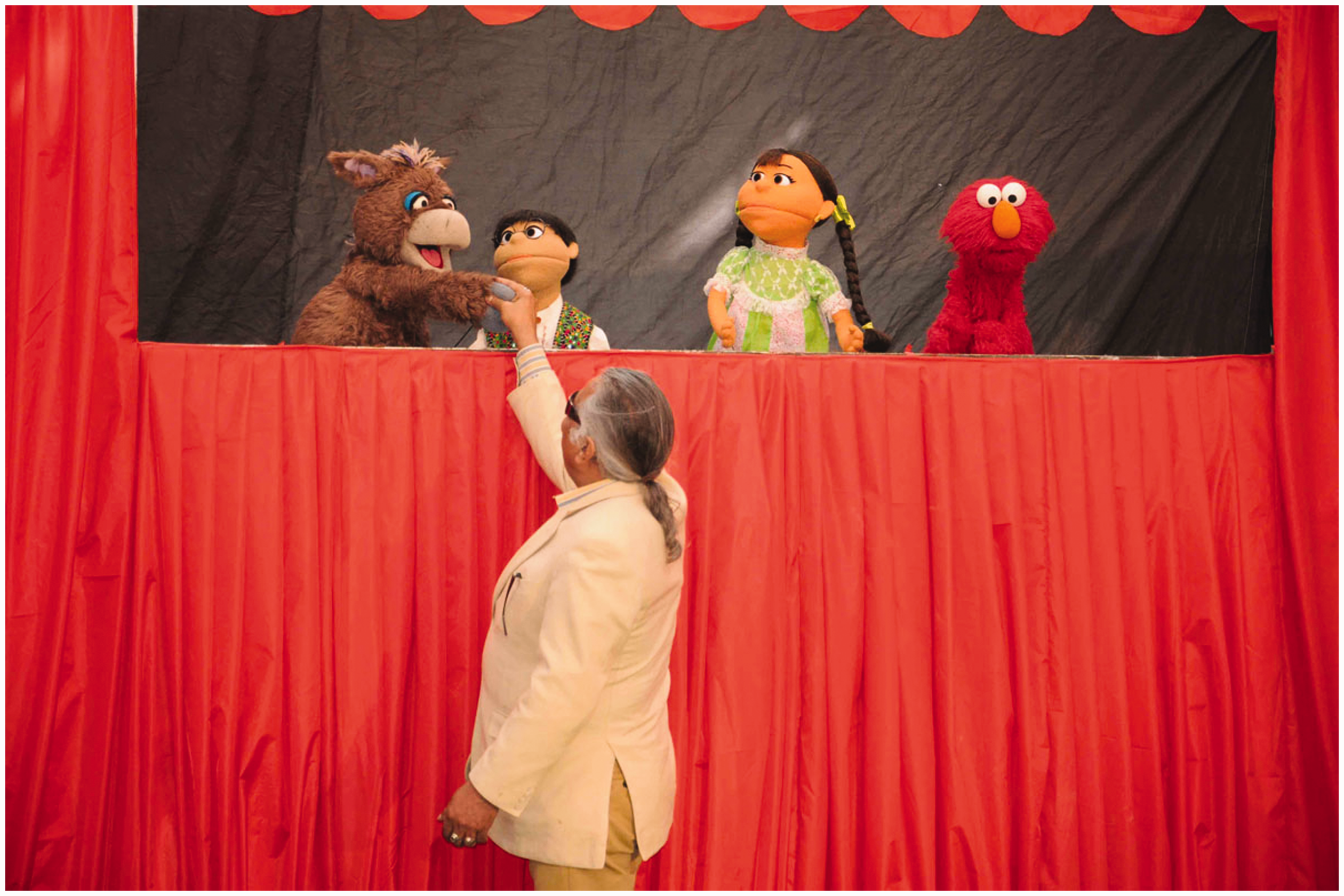
Characters from Sim Sim Hamara, the Pakistani version of Sesame Street funded by USAID. Photo: Flickr cc.
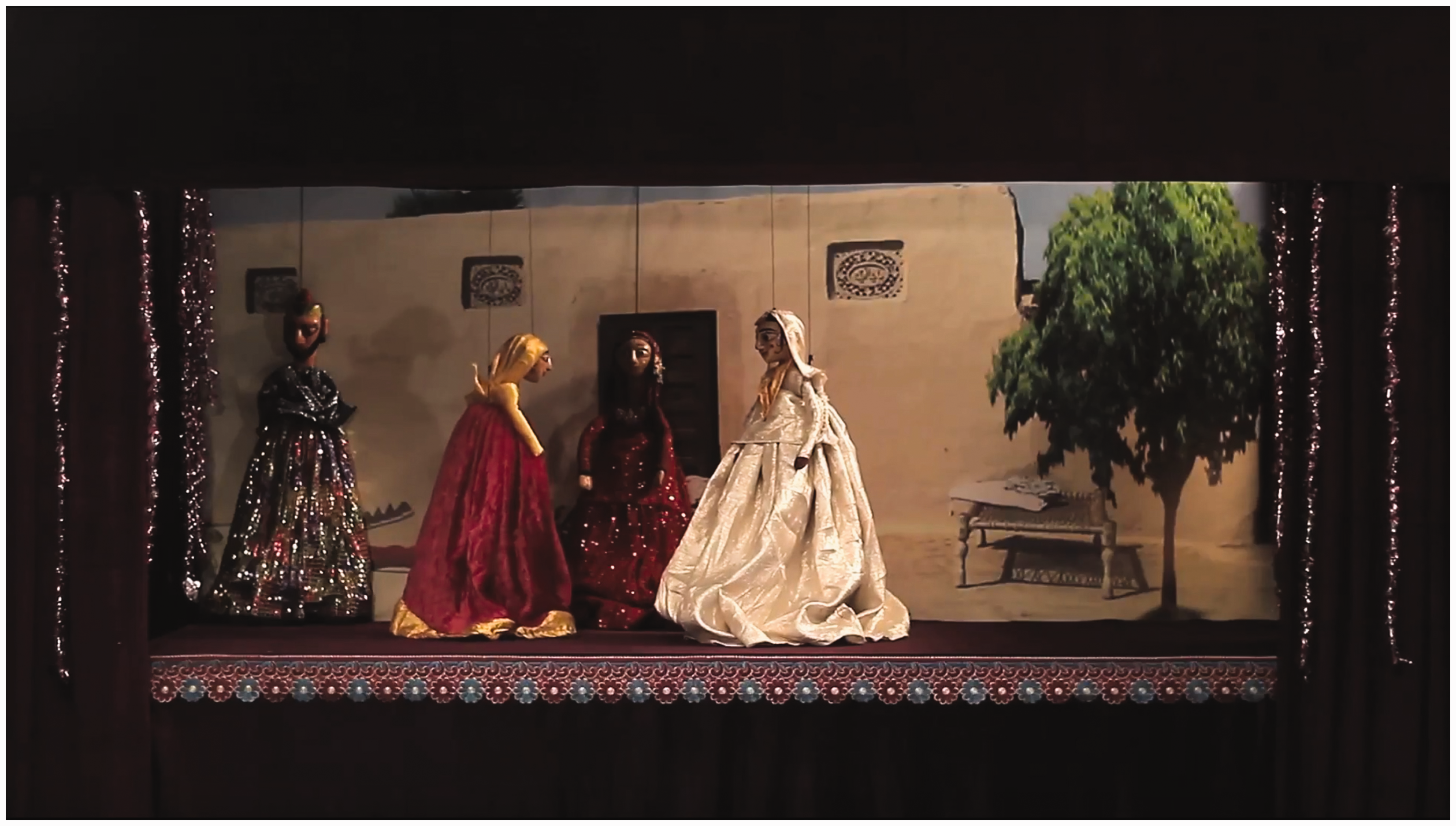
Puppet show by Rupani Foundation on marriage and women’s rights performed in rural settings in Punjab.
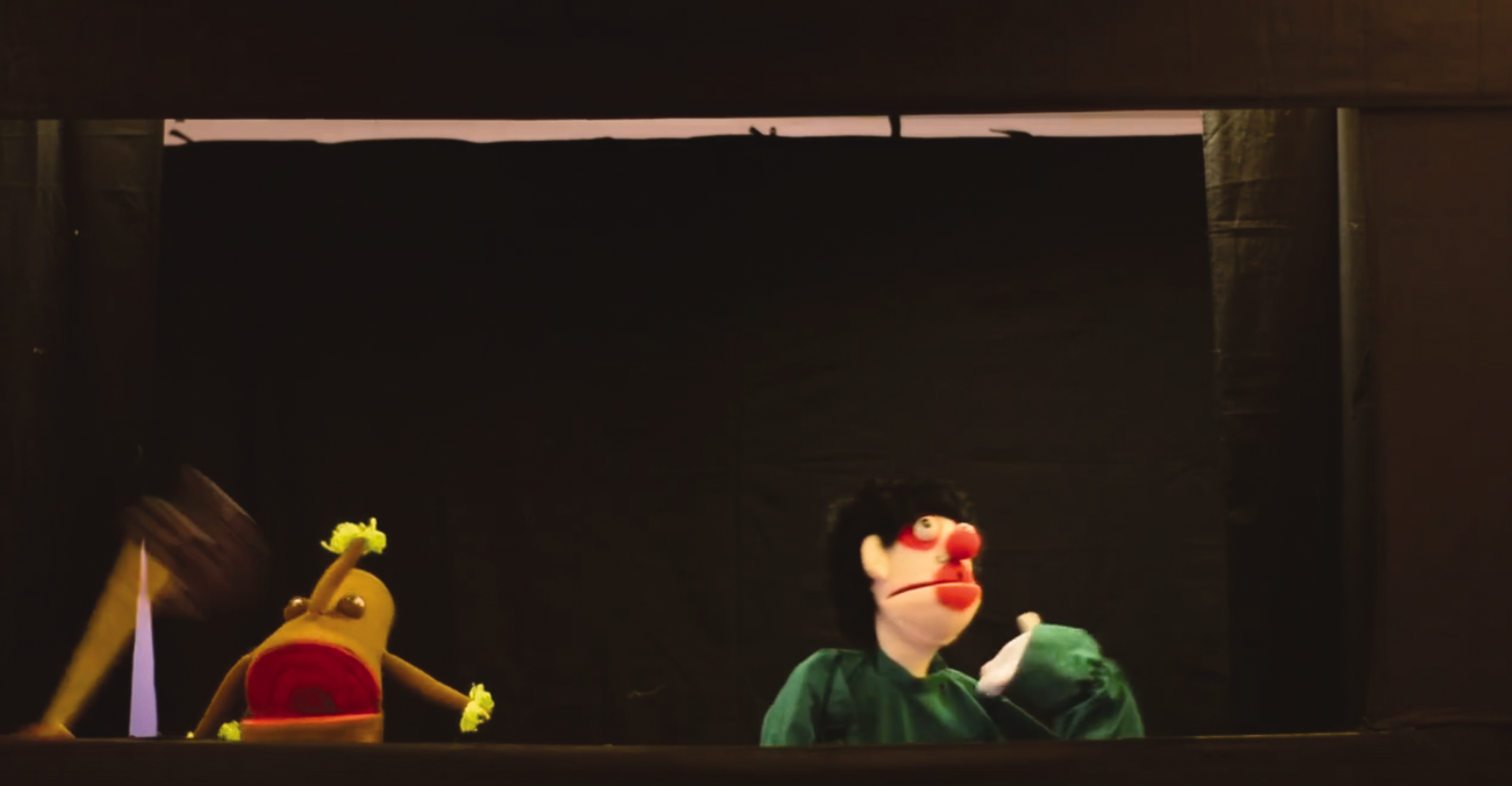
Glove puppetry by Suneha Center for Arts and Learning on the topic of environmental degradation, performed for school children in Punjab.
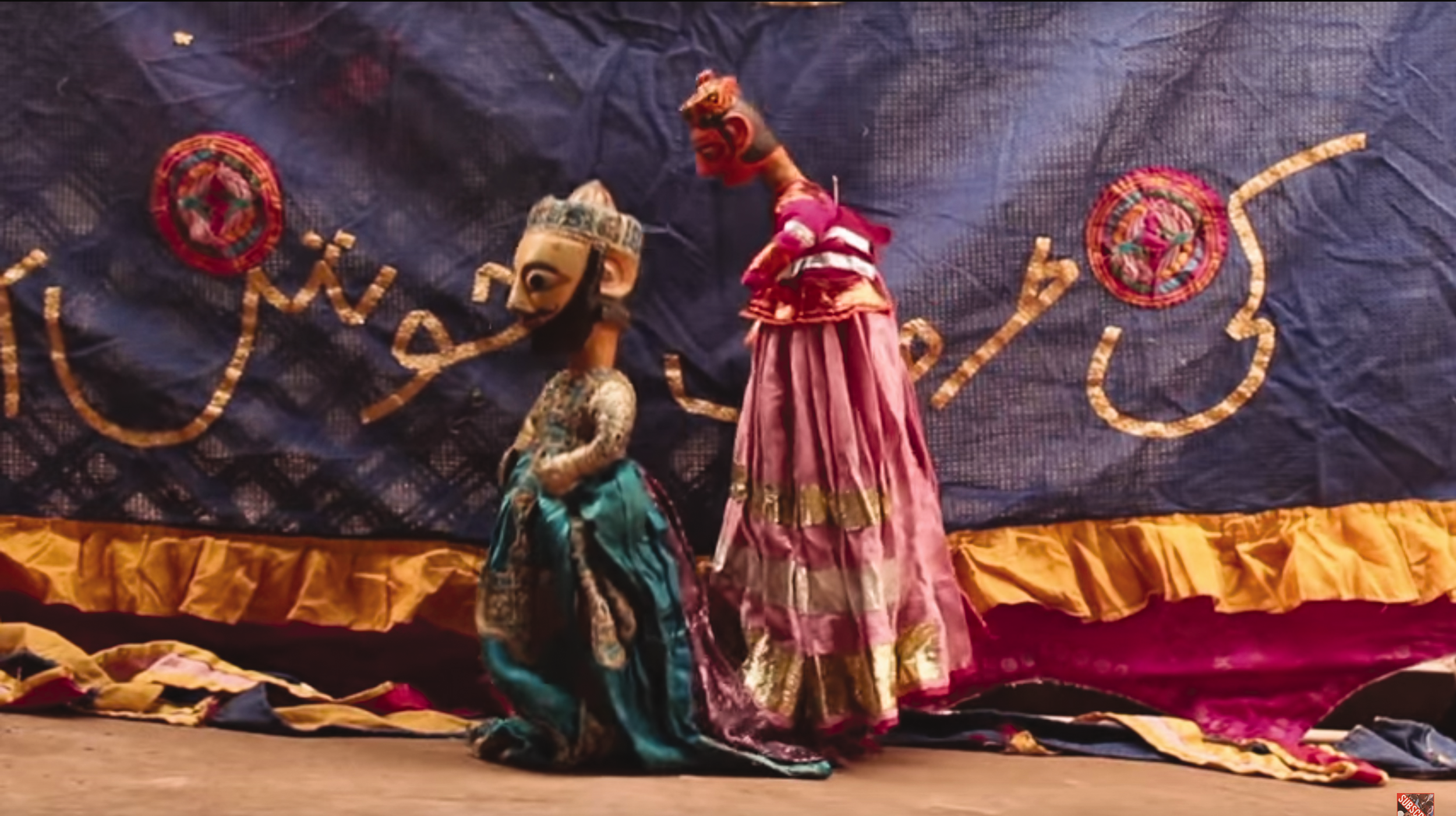
Traditional string puppetry by Ashiq Hussain of Multan, showing the moment Patay Khan manages to revive the cleric with promises of food. Photo: Adnan Hussain.
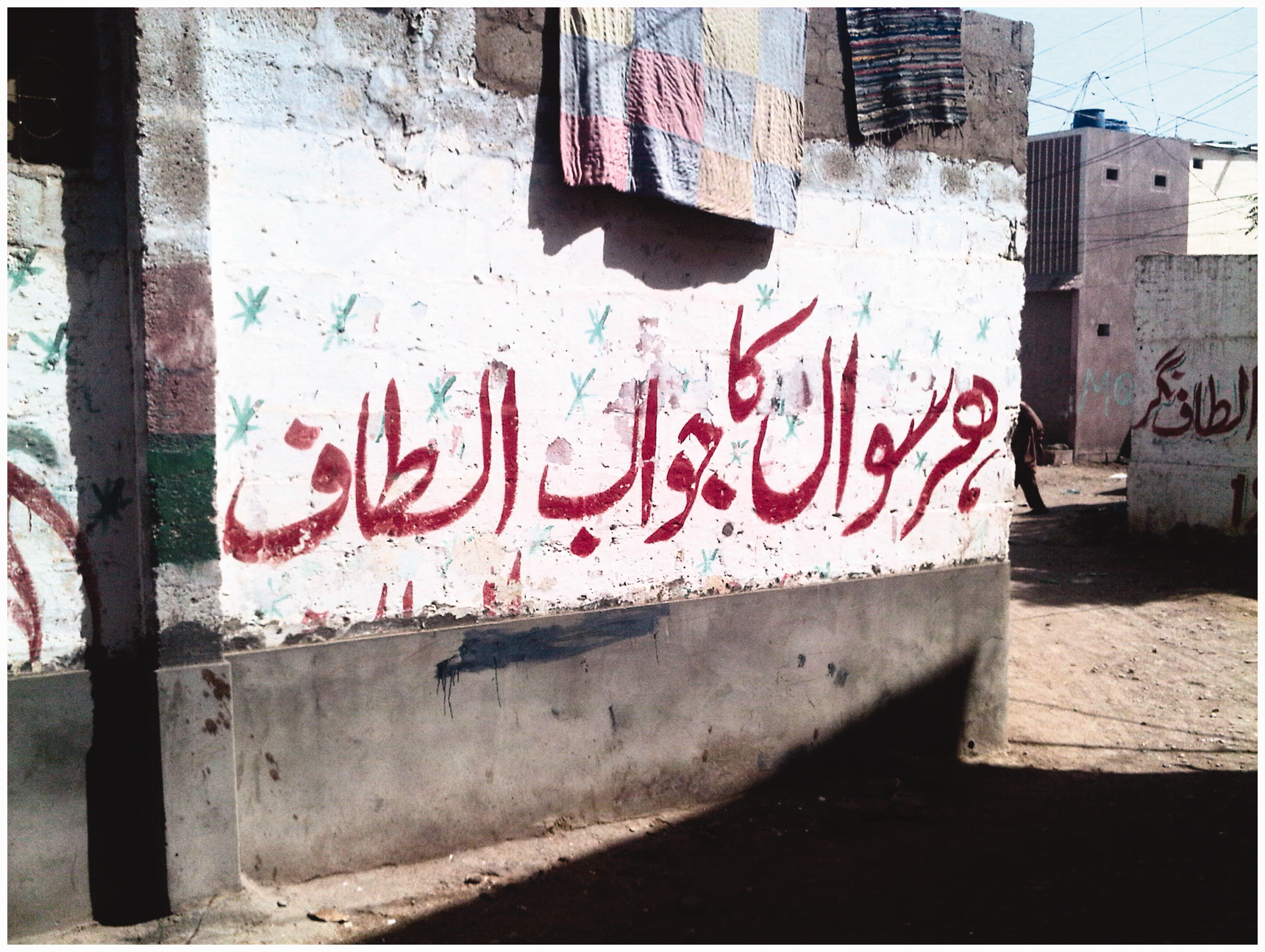
‘The answer to every question is Altaf’. This is a reference to Altaf Hussain, former leader of the MQM political party and a highly divisive yet powerful figure in Karachi’s political history. Photo: Flickr cc.
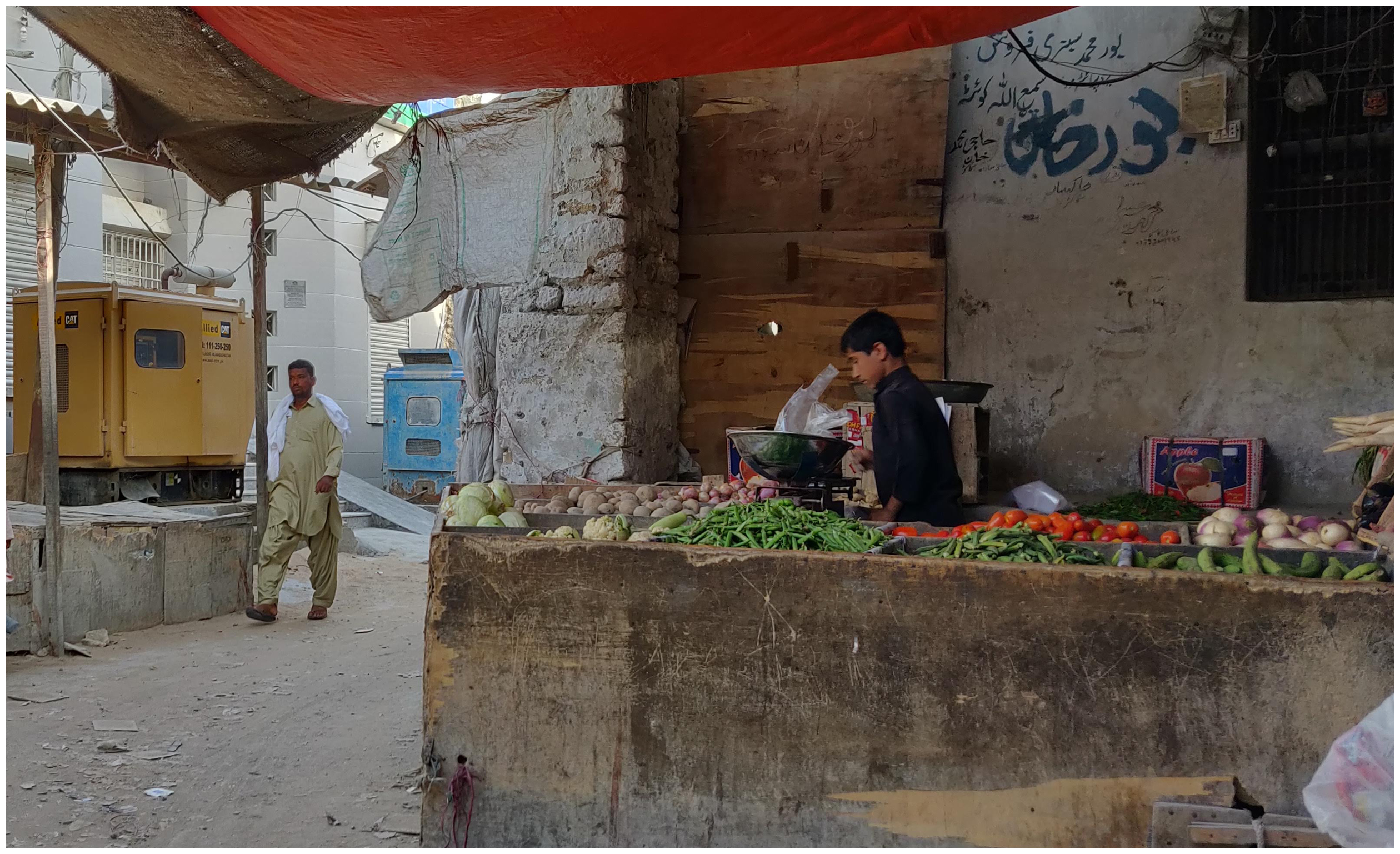
Layers of writing advertise various services including the vegetable stall in Gwadar, Balochistan. Photo: Laajverd.
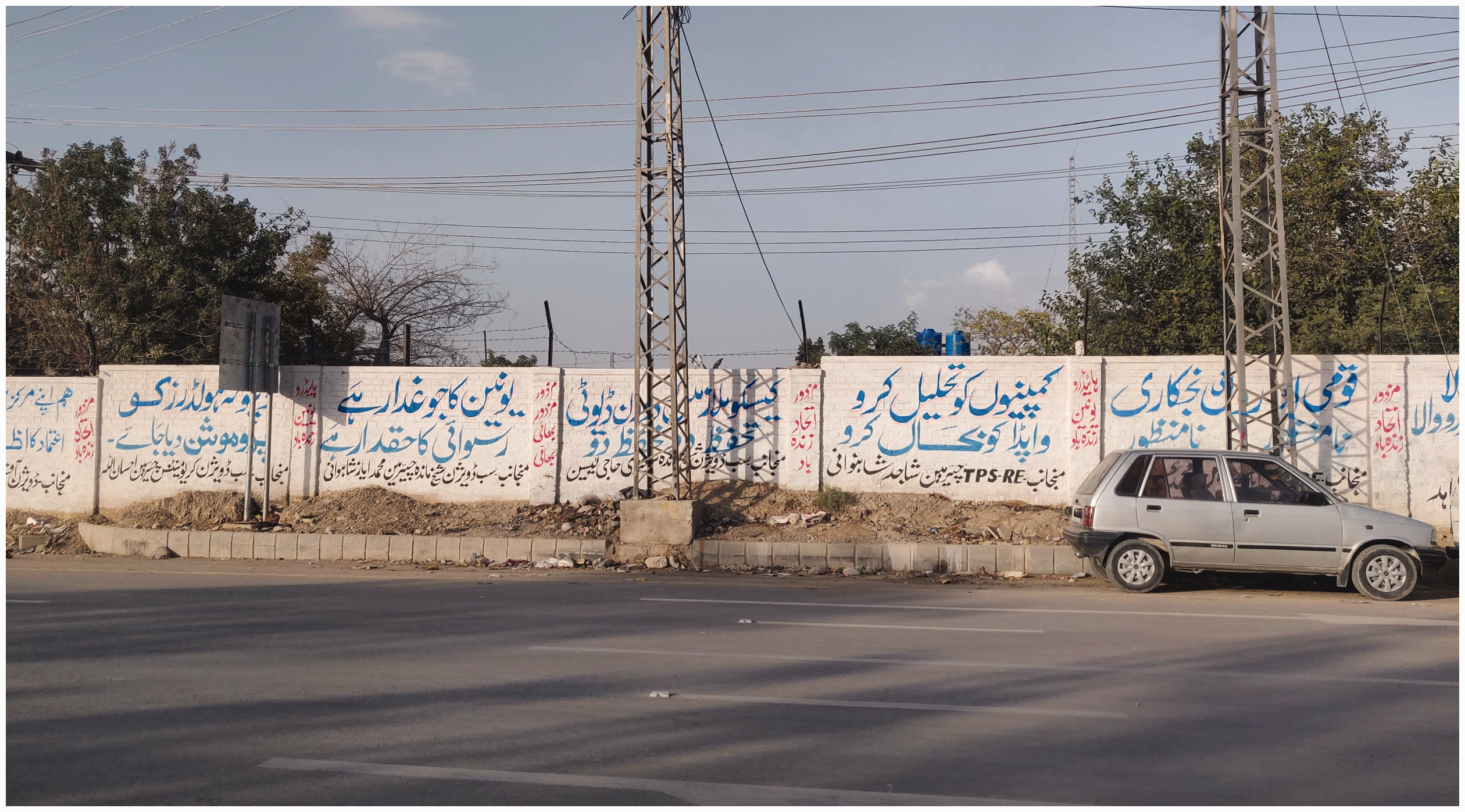
Slogans for labour rights in Quetta: ‘Dissolve all companies and reinstate WAPDA’ (Water and Power Development Authority); ‘Protect Casco employees on duty’; ‘The betrayer of unions deserves disgrace’.
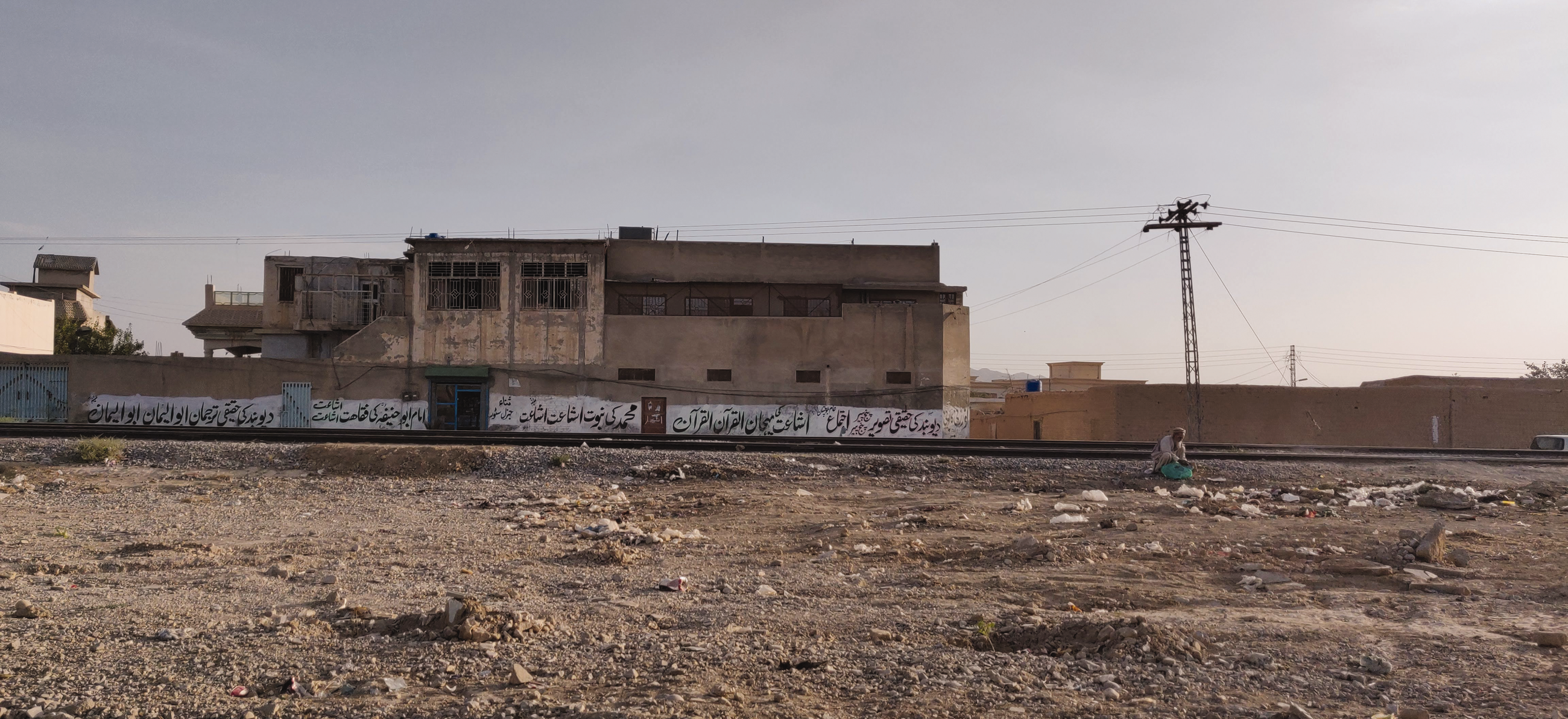
An advertisement for Panj Press that publishes Deobandi texts followed by slogans in the name of Imam Abu Hanifa. Deobandi is a revivalist movement within Sunni Islam that received sustained funding from Saudi Arabia, and is opposed to many of the Sufi and syncretic practices of Islam in the country and has been implicated in the targeting of these groups. Numerous examples of extremist wall chalking against many of the minority groups in Pakistan can also be found in a search on the internet; I have chosen not to reproduce them here.
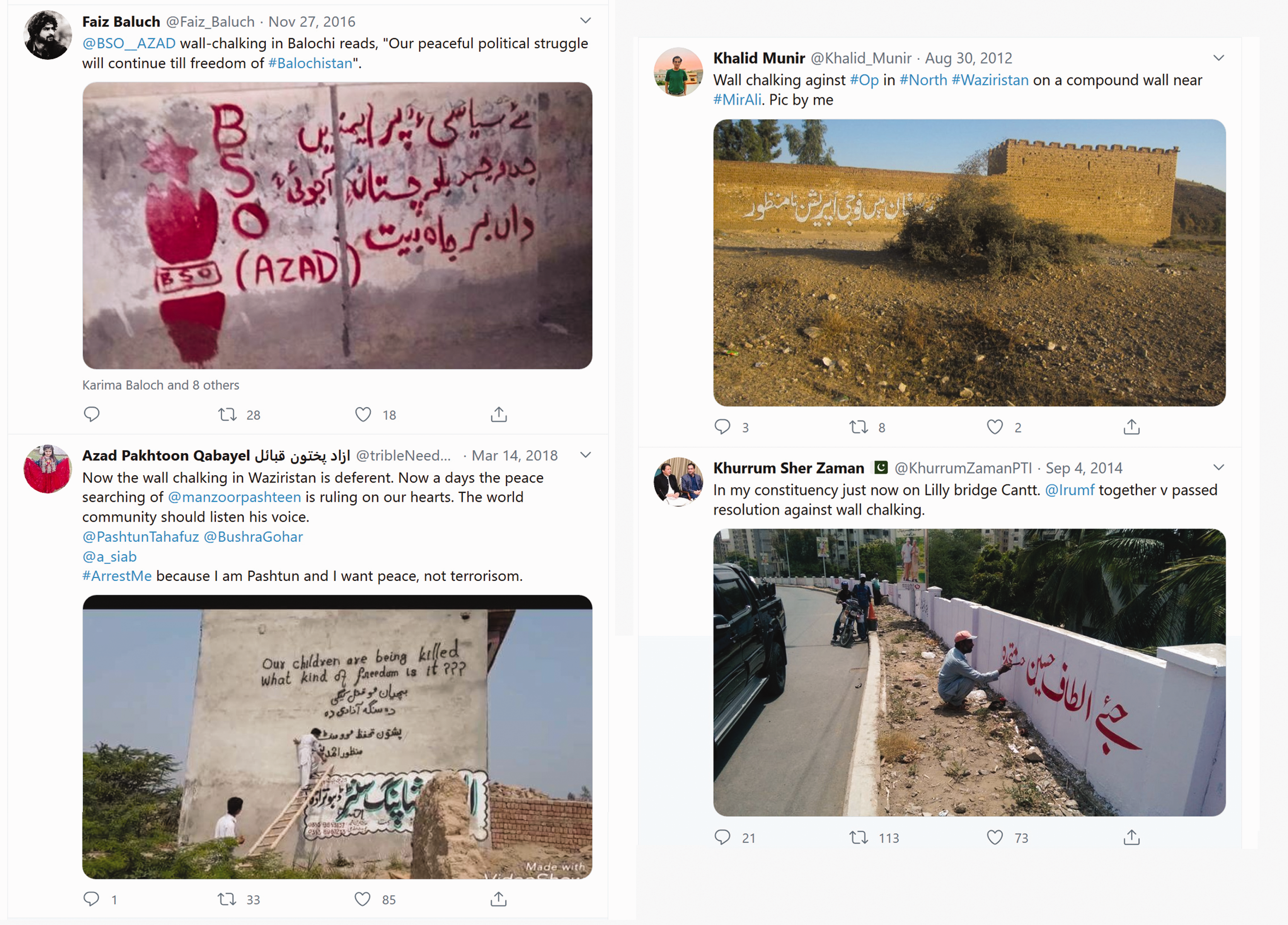
Wall chalking is often commented on in Pakistani social media. Slogan by the Baloch Student’s Organisation (BSO) against events in Balochistan, including enforced disappearances and violent military operations (Top Left). Slogans in support of Pashtun Tahafuz Movement and against military operations in Waziristan are being painted with an advertisement for a shopping centre below (Bottom Left). ‘We do not accept military operations in Waziristan’ (Top Right). ‘Long live Altaf Hussain’ (ex-leader of MQM political party) – slogan being painted in Karachi (BottomRight).
Footnotes
Acknowledgements
I would like to thank the two anonymous reviewers for their helpful suggestions as well as Cressida Kocienski for helping me think through some of the ideas presented here and Chris Moffat for his helpful comments on an early version of the article.
Declaration of conflicting interests
The author(s) declared no potential conflicts of interest with respect to the research, authorship, and/or publication of this article.
Funding
The author(s) disclosed receipt of the following financial support for the research, authorship, and/or publication of this article: This articles relates to the Topological Atlas project, which has received funding from the European Research Council (ERC) under the European Union's Horizon 2020 research and innovation programme (grant agreement No 758529).
