




Abstract
In recent years scholars have explored the geopolitics of spectacle in exciting ways. While tourism presents a rich opportunity to think about the intersection of geopolitics and spectacle, only a small but growing number of researchers have explored this area where state-society relations unfold in complex ways. This article draws on this work and other traditions in feminist political geography and non-representational theories to explore the embodied geopolitics of a festival and its tourist landscape in the city of Chiang Mai in northern Thailand. As such, we glimpse a complex set of geopolitical relations at play in the multiple spaces of the Yii Peng Festival. A closer look at the Festival with the theoretical tools proposed here helps reveal ongoing geopolitical forces that shape its many contours, including a multiplicity of difference.
Introduction
On a slightly rainy November day in 2012 in the city of Chiang Mai, Thailand, a small food stall owner hangs a sign over her booth advertising a local delicacy, khanom ciin (fermented rice noodles), along with several other dishes commonly eaten in northern Thailand. The selling of such foodstuffs is not out-of-place, although the juxtaposition of this stand to its surroundings makes it slightly more distinct, as it is located at a special night bizarre near Phratu Thae Pae (Tha Phae Gate) during the city’s annual Yii Peng Festival. Because of the location of this site, at a key centerpoint of Chiang Mai’s tourism district, the surrounding sellers advertise their products in English and sometimes Thai, which range from sushi to spaghetti to northern and central Thai delicacies. As tourists – Thai and non-Thai – enjoy the foods from around the world (eating spaghetti with chopsticks), local workers (and a few tourists) step up and order the food from the khanom ciin stand. At 30 baht a plate (or just around $1 US), the price is representative of the average street food price in the area; it is, to say, dramatically cheaper than everything else in the market. That this sign reads only in Thai suggests that the food is meant for a particular type of consumer – local Thais visiting the market. It also invokes a certain subjectivity, that of a northern Thai consumer, and situates that consumption in relation to other touristic subject positions.
The act of hanging a sign and selling some food within the confines of a designated tourism market in Chiang Mai, Thailand may seem rather banal. After all, people have to eat, including the workers who are setting up and maintaining the festival. The juxtaposition of this particular food stand to the wider context in which it was embedded, however, provides an entry-point into a larger conversation about tourism spaces as sites of geopolitical encounter (c.f., Gibson, 2010, 2011). The placement of the khanom ciin stand does more than serve a practical function for many Thais working in and around the festival; it provides an opportunity to critically reflect upon how tourism spaces are both produced by and productive of mundane geopolitical processes. Put another way, this food stand is a socio-spatial manifestation of the geopolitical tensions that are constitutive of tourism spaces, because the stand can “draw attention to the mundane practices through which something which we label as ‘the state’ becomes present in everyday life” (Painter, 2006: 753). For example, the power of the Thai state is felt in the Central Thai writing, which is a colonial language in the context of northern Thailand (written Northern Thai having been largely eradicated over the last 100 years). The food stand’s existence in this time and place is also made possible by the flows that are enabled by modern geopolitical realities – despite protests (including the occupation of Bangkok’s major international airport in 2009) and the ebbs and flows of coupes that have marked the last decade of Thai politics, Thailand has been a relatively “stable” political site for the global tourism market (Cohen, 2010). 1
Despite the fact that tourism is always already geopolitical, little has been written about the geopolitics of tourism (for exceptions, see Dowler, 2013; Lisle, 2016; Mostafanezhad and Norum, 2016; Rowen, 2016). This is perhaps a function of the fact that geopolitical theory has been dominated by “foreign policy centrism” (Coleman, 2013) rather than focused on the more mundane although no less political processes of everyday experience (Cowen and Story, 2013; Dixon and Marston, 2011; Hyndman, 2001, among others). For their part, tourism scholars have invested little energy in geopolitics, as the field has been dominated by examinations of the ritualistic practices of tourists (following from the traditions of MacCannell, 1999 and Urry, 1990) or the political economy of tourism more generally (following Britton, 1991). Recent tourism studies scholars have pushed on the boundaries of their field, interrogating the more-than-visual nature of tourism (following Crouch and Deforges, 2003; Edensor, 2001) and also situating that work within the more mundane, everyday geographies of power and authority that are part and parcel of tourism spaces (following Gibson, 2010). Urban-based tourism events, such as the Yii Peng Festival in Chiang Mai, Thailand, however, provide an ideal site through which to theoretically and empirically situate a more robust engagement of the everyday geopolitics of tourism. Indeed, the more recent work on encounter (Gibson, 2010) – on the subtle nuances of the collision and elision of human and non-human bodies and senses – affords an opportunity to think through the geopolitics of tourism as processes that juxtapose, overlay, and mash together varying subjectivities (also see Cockayne et al., 2020). This language is used intentionally, to signpost the intimate and sometimes violent nature of these encounters (e.g., Saldana, 2007; Lisle, 2016). In taking up the question of the everyday geopolitics of tourism, this paper’s larger aim is to think through tourism as an important part of statecraft, while questioning the totalizing narratives of the citizen-subject that tourism spaces often seek to reinforce.
Our approach pushes the boundaries of an embodied geopolitics of tourism by engaging another key concept relevant to the topic: “spectacle”, that term often associated with Guy Debord (1995) and the Situationists (Plant 2002) that signals the hegemony of capitalist subjectivity in modern consumer society. Once a key concept for critical human geography, spectacle is now experiencing a resurgence of interest particularly for re-imagining the politics of everyday life, neoliberal urban space, and importantly, geopolitics around the world. Natalie Koch (2018), for example, in her account of the geopolitics of spectacle in central Asia, urges a geographical approach to theorizing spectacle as a technique of governance, meaning that we examine the complex sets of socio-spatial and political relations that condition and shape any deployment of spectacle. The present article builds on this and other traditions in feminist political geography to put forward a version of the spectacle that operates not only through everyday experience, but through its embodied dimensions specifically (Laketa, 2016). Our version of spectacle, however, owes more to Jean Baudrillard’s (1994) interpretation of the spectacle as productive of “hyperreality” in the new media landscape, in which new forms of culture and society emerge through the signs that saturate advanced consumer societies. Importantly, geopolitics are also transformed under these conditions, evident in his essay “The Gulf War did not take place”, in which he claims that the conflict was transformed into a “non-event” for Western audiences who consumed a particular representation of the conflict as “high-tech” and “sanitary”, among other misleading imaginaries (Baudrillard, 1995). Recently, Miller and Del Casino (2018) have drawn on Baudrillard’s “non-event” to better understand the embodied politics of tourist spectacle in particular, while others explore Baudrillard’s relevance for the politics of sovereignty behind Brexit and the rise of Trumpism (Richardson, 2019).
Below we return to Miller and Del Casino (2018) in our elaboration of embodied geopolitics and the play of the “non-event” at the Yii Peng Festival in Chiang Mai. The festival unfolds every year to thank the lifeforce of the River and to perform other rituals, including flying lanterns as a way to release one’s burdens. As we will see, the mundane details of the festival contain within them the dynamic force of everyday geopolitics, insofar as the spectacle of the festival becomes an opportunity for complex state-society relations to unfold, particularly in the visceral and embodied domain. In the analysis below, we also track the dynamics of the geopolitical “non-event” as it makes an impact on the actual content and performance of the festival. Rather than merely shoring up theories of geopolitical hegemony, however, we insist that a Baudrillardian reading of the spectacle is also open to many alterative and oppositional inputs as well (see Smith, 2003). This approach to theorization opens up our analysis to more uncertain formations of subjectivity and the continuous play of difference (see Cockayne et al., 2017, 2020).
The next section of the paper outlines the theoretical approaches that one might take to integrating the concept of spectacle into the mundane geopolitics of tourism festivals. We suggest in this section that Baudrillard’s non-representational theory of the hyperreal and the non-event (Smith, 2003) opens us up to a more radical interpretation of spectacle as more-than an overt assertion of state authority; it provides us an entry point to think about geopolitics as an everyday set of processes that pull upon and are refracted through a flat ontological space of affect (Woodward et al., 2012). The second half of the article develops this approach through an analysis of Chiang Mai and its Yii Peng Festival. In conclusion, this paper suggests that more work can be done to open up such mundane spaces to critical interrogation of encounter as working in and through a wide range of divergent processes and practices that both stabilize authority and power while also simultaneously undermining those same regimes through plays of bodily performance.
Spectacle, tourism, and the performance of everyday geopolitics
The Marxist notion of the “Spectacle,” formulated by the Situationists and Guy Debord specifically, has long been a key term for critical human geography (Duffy, 2009; Stevens, 2009) and signals the power of capitalism to shape “appropriate” subjectivities and identities that facilitate the circulation of commodities and capitalist ideologies. While there is a long tradition that develops theories of the spectacle in relation to urban landscapes of consumption (Ley and Olds, 1988; Goss, 1993; cf. Gregson and Crewe, 1997), the term continues to have an influence in urban studies and is experiencing a resurgence in relation to geopolitical theory. Tourism spaces are also ideal for thinking about spectacle and the geopolitical potentials therein. Few, however, have explored these confluences. This article does so by elaborating a Baudrillardian approach to the spectacle (Grace, 2000; Smith, 2003) and what he saw as the transformation of the capitalist spectacle into a more widespread and distributed society of simulations that change the coordinates of everyday life and politics into a “hyperreality”. Before we explore the Yii Peng festival in Thailand to elucidate examples of how this plays out, we provide some background to this literature.
As noted above, we build on Miller and Del Casino (2018) who explore Baudrillard’s hyperreal non-event as important for understanding the embodied geopolitics of tourism at the “Titan Missile Museum” in southern Arizona. Once an underground bunker and missile silo operative during the Cold War, today it functions as a Museum re-enacting the drama of nuclear warfare through a variety of curatorial means, even going so far as to simulate the launch of a nuclear strike from the original command center, something that never actually happened. For the operators of the Museum, the play of simulations does not subtract from the dense emotional and affective capacities the curators seek to generate in this particular performance. In fact, the negativity of simulation (that it doesn’t have to actually refer to something that really took place) helps punctuate the overt geopolitical messages made by the Museum itself. The spectacle as simulation points to the capacity to enroll visitors into affective environments that are densely networked with many other social relations, including those with a militarized state. Through the performances of the Museum, the Cold War is turned into what we think is an important formation for the geopolitics of spectacle, which is the Baudrillardian “non-event” that seeks to neutralize critical consciousness around the absurdity and horror of nuclear warfare. As a space of performance and spectacle, the conflict is transformed for the visitor. Similar to the way that the “Gulf War did not take place”, the violence of the Cold War is made palpable, meaningful and even acceptable to those visiting its corridors and command centers. As such, it too remains open to unexpected responses rather than enact a neat-and-clean production of proper nuclear geopolitical subjects.
While the spectacle has been introduced into geopolitical thinking by others in recent years as well (Koch, 2018; RETORT Collective, 2005), others have focused on how the power of spectacle reproduces itself in mundane ways that are dispersed throughout the built environment, rather than classic examples of large-scale events or high-profile entertainment events. Hetherington and Cronin (2008), for instance, discuss how the spectacle informs the spaces of the “entrepreneurial city,” including its landscapes of memory and other politics of identity (see other contributions in their edited volume, as well as Chu and Sanyal 2015). Lee (2015) also points to the architectural forms of spectacle that permeate the built environment, thereby bringing spectacle into close conversation with theories of affect, emotion and performative identity. Importantly, Lee (2015) affirms the normative edge of spectacle thinking, insofar as it continues to chart power relations amid the play of spectacle and other non-representational landscapes.
Tourism is another domain where the spectacle is obviously at work. However, and somewhat surprisingly, few have elaborated on the politics of spectacle in these tourism spaces. An exception is Gotham (2005) who explores the festival landscapes of New Orleans with Debord and others as a guide. The materialities of capitalist spectacle are on display, as well as other more transgressive “counter-spectacles” that seep throughout the space as it unfolds in differentiated ways (also see Pinder, 2000). Elsewhere, the geographies of tourism have increasingly focused on the embodied aspects of encounter (Gibson, 2010, 2013) that co-constitute any tourist experience (Crouch and Deforges, 2003; Edensor, 2001). We propose a way to bring these approaches together in a way that finds the geopolitics of tourism precisely in the embodied dimensions of everyday life and performance.
Lorraine Dowler (2013), for instance, illustrates what a feminist geopolitics of tourism in a post-conflict city might look like in West Belfast. Dowler takes us through a series of theatrical performances that are deeply embedded in contemporary global tourism and a tourist “boom” in Belfast, but that also creates “counter-spaces” for new understandings of the conflict through an intimate engagement with the spaces of everyday life in the city. The performances along the walking tour, rather than offering up new opportunities for the reproduction of well-known and prevailing imaginations around political subjectivity, create the possibility for re-imagining the divides that are all too common in everyday discourse (c.f., Del Casino and Hanna, 2000, 2006). Performances in tourism can also be articulated in a way that leads to the opening up of new possibilities, forged through an emerging “hospitality” afforded by this particular kind of geopolitical tourist spectacle.
In this way, we think that attending to the mundane dimensions of tourism provides additional insight into the workings of geopolitics as an embodied experience. As such, we believe that spectacle thinking can be salvaged and can avoid earlier pitfalls (as described by Gregson, 1995), if articulated in a properly flat ontology of feelings, affects, processes, performances and ongoing interventions and fluctuations in the balance of power across space. Woodward et al. (2012: 210) imagine this confluence of forces as the “site” and argue “The site and the stuff of its composition are expressed in movements of force that repeat (as hardenings and blockages) and vary (through rupture and collapse) as they mark the situatedness of its composition and the ‘proximity’ of its components”. As we will see, geopolitics of spectacle work across different formations and micro-spaces, even as they are “missing-the-mark”, especially in moments when alternative subjectivities seem to assert themselves. We see this because of how the embodiment of the non-event, as Baudrillard describes it, “works”.
Our approach, however, also derives from a Baudrillardian interpretation of spectacle because the embodied and micro-politics of the spectacle points not only to the momentary solidification of state power – “as hardenings and blockages” – in the tourist spectacle but also attends to the infinite play of difference that also constitute the tourist landscape through “rupture and collapse” (Lisle, 2016). Again, as Woodward et al. (2012: 210) suggest, “The work of the site – those forces that enable the coming together of these bodies – engenders ‘grounded’ situations that generate a localized relation through resonant, unfolding doings and sayings”. For us, the site is manifest in Baudrillard’s notion that we live in a world constituted by a play of differences, which are, at the same time, understood in and through the idea of the non-event. For, within these plays of difference, and their embodied, everyday realities, sits the non-event, a form of power whereby authority can be formed through a temporary allegiance with the spectacle or the conditions under which that power may dissolve, or at least a temporary condition under which difference can proliferate despite the strictures of the spectacle. Following Smith (2003), as a “non-representational” geography of spectacle and simulation, alternative formations of identity and politics can potentially emerge from the melee of tourism in motion. Moreover, we come to consider non-representational theory as capable of accommodating socially and political constructed difference in geopolitics (cf. Colls, 2012), as well as the moments of slippage, resistance, and transgression that operate in the everyday plays of authority and power that spectacles seeks to forestall.
We close this section here because the non-event is a key element of spectacle that has proven to be powerful for state power and geopolitics. As we will see, in the Yii Peng Festival, state power unfolds in subtle ways that attempt to produce a non-event out of a long and complex history of colonialism by the central Thai state over the northern part of the country and its various ethnically diverse populations. In examining this festival as a “non-event” of State power and authority, we develop not only an embodied and feminist geopolitics but also work to illustrate how the spectacle also works through mundane and seemingly everyday occurrences (Painter, 2006).
Methodological note
This work raises questions about data in a hyperreal world. What are the “data” of this sort of analysis? This paper relies on participant observation for its analysis of the Yii Peng Festival in the Fall of 2012, as it focuses in upon the everyday experiences of both spectacle and the work of both consumption and production in tourism spaces (c.f., Del Casino and Hanna, 2000). Through participant observation of the Festival, the research traced not only the spoken word of the festival or the floats and parades, but also tried to capture the affective registers of the event, as well as the slippages that exist in attempts to totalize the narrative of what an appropriate Thai citizen, in this case, might be. What became quickly apparent is that while this festival is located in a heavily tourist-focused area and plenty of resources were put forth to make space for foreign tourists, the event also served many tourists from Bangkok and other parts of Thailand. The object of the event was thus local in a northern Thai sense, national in a central Thai sense, and global in a touristic sense. However, the majority of the event was narrated in Central Thai (at the main stage) and Northern Thai (at a secondary stage), not English or another linqua franca. From a Baudrillardian sense, then, what became the subject of this ethnographic analysis was not only the representational staging of the event but the nonrepresentational constitution of the citizen-subject and the idea that the internal colonization of northern Thailand by the central Thai core never existed, the ideal moment of geopolitical power through the hyperreal spectacle (Miller and Del Casino, 2018). In this moment, there is but one Thai nation and therefore one Thai citizen-subject. The parade was thus a spectacular attempt to structure these differences and the embodied materialities they are entwined with it. Before moving on to those findings, we provide brief context of Chiang Mai and the festival.
The city of Chiang Mai and the Yii Peng Festival
The city of Chiang Mai has its history in 700 years of urban development, although its growth has been contingent on its relations to the larger Burmese and Thai kingdoms to the west and south. Like many cities in this region, the leadership of Chiang Mai paid merit to these larger kingdoms throughout most of their history, while also finding themselves in conflict with those kingdoms at different points in time. Today, the city serves as the socio-cultural and political-economic hub of the former Lanna Kingdom, a kingdom that ebbed and flowed from 1296 through the early 1900s. And, because of the way statecraft worked in this region for most of the city’s history, the relative autonomy of this regional space allows Chiang Mai to still sit as the modern-day hub of the upper north of Thailand, which maintains a distinct regional identity. The regional language, northern Thai (kam muang), is still spoken throughout the upper north, even as the written language has largely disappeared. Chiang Mai also represents a spirit of disconnect from the central Thai core. This disconnect is played out in all sorts ways – through the maintenance of a Lanna regional identity, through the speaking of northern Thai language, and to the representational and performative differences that are played out in the public sphere. The naming of the Yii Peng Festival, in fact, is representative of this, as the national holiday is known as Loi Krathong. In Chiang Mai, Yii Peng has been mapped onto Loi Krathong, a water celebration, producing a unique cultural performance of regional and national syncretism.
Today, Chiang Mai is also a major international hub of global relations, connecting Thailand to its immediate neighbors as well as other East Asian countries through its international airport and the national highway system. A “superhighway” bypasses the central core, and spokes off that highway lead to different parts of the northern region. This connectivity has made Chiang Mai a site of international prestige as well as an important nodal point in the movement of peoples from within the region as well as from outside of it. The city, for example, is home to migrants and stateless peoples from Burma, Laos, China, and from other indigenous ethnic groups that are not tied to any particular current national formation. Chiang Mai is also the intellectual node for regional study – housing multiple higher education institutions, including Chiang Mai University and the Catholic, Payap University. From space, one can see the partial remnants of 700 years of occupation. Parts of the original city wall are maintained and all four gates (north, south, east, and west) are still present. Within those walls are over 300 Buddhist temples, as well as shops, houses, restaurants and hundreds of guesthouses and small hotels. To the east of the wall and near Phratu Tha Pha, larger hotels rise up to overlook the city. Urban development has followed suit, as higher end hotels and restaurants have staked out territory between the old city and the Ping River and a night bizarre, food court, and performance space has been built up in this area as well.
Yii Peng: Spectacle and citizen-subject formation
As has been suggested, tourism lends itself well to the sort of theoretical play at work in a non-representational theory of the spectacle. In tracing how festival spaces are sites through which state politics are articulated and re-imagined through everyday performance, we offer a deconstructive turn that resonates with Baudrillard’s notion of the hyperreal while also providing a way forward toward a more radical politics of difference. We suggest that through this exercise, it is possible to interrogate how the hyperreal spectacle does more than simply produce a politics of wild and unstructured play, but also presents moments of disruption to the normativities that governments seek to maintain in the face of alterity. In doing this, we organize this empirical section through four sub-sections that highlight how geopolitics is embodied and related to the emergent processes of geopolitical subject formation that are present in all such spectacles.
Materials of tourism spectacle
Let us begin then with the stage itself, the site at which the performance is first organized. The stage is situated in front of Phratu Tha Pae (Tha Phae Gate) and is distinguished by its relation to a temporary night bizarre and a variety of other activities, including the formal and informal events of Yii Peng. As the event began to take shape, though, one must ask, for whom was this event arranged? After all, the modern-day iteration of Yii Peng, with its 4-days of events and parades and parties is fairly new, having started about 20 years ago with the first major parade. It is clear that the event is mapped as a way to attract and perhaps entertain tourists. But, as one watches and listens to the event unfold, it does not appear to target non-Thai tourists. It was, instead, tied to the performance of certain citizen-subjects through a set of practices that sought to delineate appropriate forms of Thainess (khwampenthai) – the feeling of being Thai (Winichakul, 1994; cf. Kong and Yeoh, 1997). This feeling was further supported by the fact that the event was being narrated in Thai, not English or another international tourist language. Indeed, if one didn’t speak Thai, the events that took place on the stage made little difference. One wouldn’t have noticed, for example, that the narrators spoke in Central Thai or that representatives from the US Consulate accompanied other dignitaries on the stage.
As the events onstage began to roll out, the parade route was also being organized. The floats themselves come to represent important geopolitical moments that temporarily reify the meaning of the Thai state. This can be seen in the Chiang Mai military base float (Kong Bin 41), which represents the Thai state through its three colored pillars – Monarchy, Buddhism, and Nation (Figure 1). The power of the state is present, as the historical narrative of monarchy is reinforced through a supportive military apparatus. Stability is brought to bear by the presence of the physically absent king, patriarch of Thai society. The marching itself, of public servants, whose uniforms resemble those of the military, are paralleled by other citizen-subjects, including marching bands and hotel workers, all of whom represent the idealization of Thai citizenship through their participation as well as through their costume.
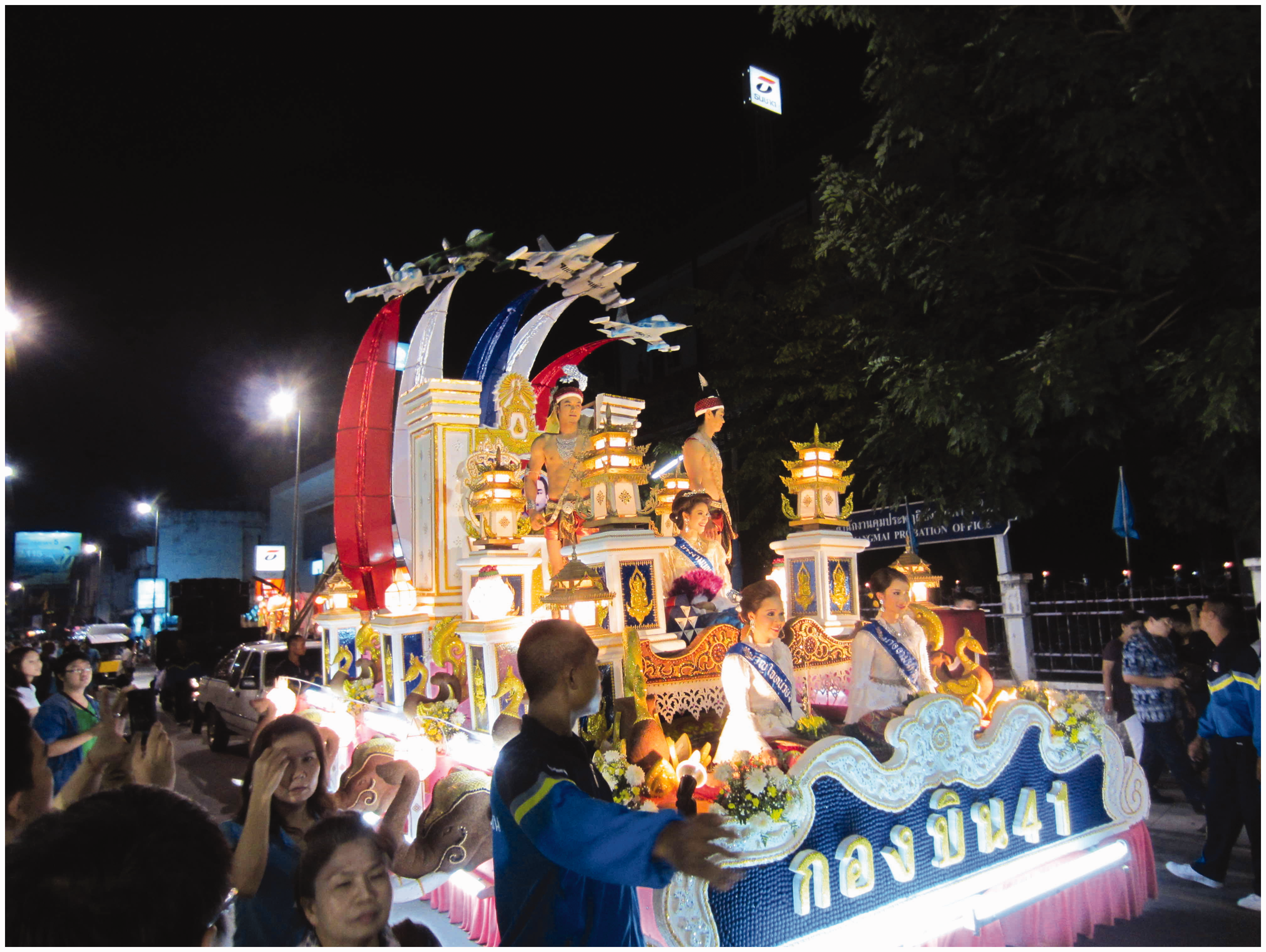
Float of the Chiang Mai Airforce Base (Kong Bin 41) (photo by author, 2013).
It is important at this juncture to take up the question of Northern Thailand, both because it is the sight of this event but also because of the contested history this region has in relation to the central core. And, northern Thailand’s unique regionality is certainly on display at this event – as exemplified by the secondary stage, which was hosted by two northern Thai speakers. At the same time, northern identities are sanitized and produced in a way as to not threaten the central Thai core or nation. Instead, northern Thailand’s uniqueness is offered up as representation of regional variation within the Thai state and not postcolonial othering of northern Thai subjects to the central Thai core. Thus, northern Thai music, dance, and dress appear throughout the events, while the history of this region’s tensions remain buried – including the annihilation of regional markers of difference, such as the written language.
Other present absences are those of ethnic minorities, many of whom are stateless subjects, even as one brief moment is captured, as non-ethnic minority women represent the region’s differences. In this moment, all minority difference is conflated – the unique dress, a symbol of the ethnic minority population. This double erasure of both the minority population in general and their differences in particular allows for the totalizing narrative of a unified state identity. And, so, there is no real attempt to incorporate that difference into this spectacle’s narrative, for to do so would destabilize the narrative of state authority and uniformity that this event is meant to undergird. The tensions, of course, run deeper than just this moment of representational violence, as much of the city’s modern-day buildings and roads have been built by both ethnic minority peoples and other stateless subjects, who have either lived in Thailand since its borders were formed as non-Thai subjects or entered Thailand to escape violence or to find work. Their erasure is completed by the floats that blend together the monarchical power of the king-god with the mundane authority of corporations, such as the Big C supermarket whose branded logo circulates through various surfaces of the Festival.
Marginalized throughout this urban display of geopolitical authority is the rural otherness that supports the city and these events. After all, the City of Chiang Mai only has a registered population of around 200,000. And, yet, at events like this, we can see the work of the rural hinterland, where the resources of Yii Peng are planted, grown, and collected. The irony here is palpable, as this is an event that serves to both release one’s burdens (through the lighting of flying lanterns) and thank the river for providing agricultural bounties (through the floating of loi kratong on the Ping River); it is not a festival that has its origins in the city itself and it certainly is not a festival that is about the city’s modernity as a center of Thai authority and corporate growth. But, the floats themselves, which make up the main part of the festival represent government, industry, local subdistricts, and the achievements of higher education. The Chiang Mai Night Safari exemplifies this doubling-down on modernity through a performance of Thai rural nature as a tamed other of performative possibility. The city, in this case, has eclipsed the rural hinterland. The rugged rural has been replaced by manicured rural, as state forces seek to remove difference from the landscape that has long posed threat to the stability of the state and monarchical order. After all, it was the rural hinterland that has posed the greatest long-term threat to national integrity – through communist insurgency in the 1970s and later rural voting blocks that have carried populist candidates to national leadership positions.
Tourism spectacle as geopolitical non-event
On the first day of the Yii Peng Festival, as the crowds were growing near the gate and the floats for the “small parade” were being set up, people wandered through the area surrounding Phratu Tha Pae. There was a diversity of people already there – television personalities, student researchers, ethnic minority women selling crafts, tourists (Thai and non-Thai), performers, beauty contest contestants, local youth skate boarding, and city workers (see Figure 2). The presence of two television personalities animated the scene, as they were dressed in ethnic minority clothing (outfits that they would wear in different versions throughout the entire four-day festival). As they posed for a group of tourists, newspaper journalists, and Thai vocational college students (who were there also collecting survey data on the festival), it was clear that this display was highly unreflexive – as Thai citizens dressed in the outfits of those who are often without citizenship were held up to reflect this region’s and this country’s identity. As these performances of difference were on display, many other people, ethnic minority women for example, were not only selling various products but were also acting subjects of photographic re-imagining. Many people (again both Thai and non-Thai) stopped these women to take pictures of them and their babies. Of this group of women, several wore headdresses that represented their ethnic groups but they also wore t-shirts and rubber flip-flops. Their children, more often than not, were dressed in ethnically-relevant clothing, producing the effect of a uniqueness of the north in relation to the rest of Thailand.
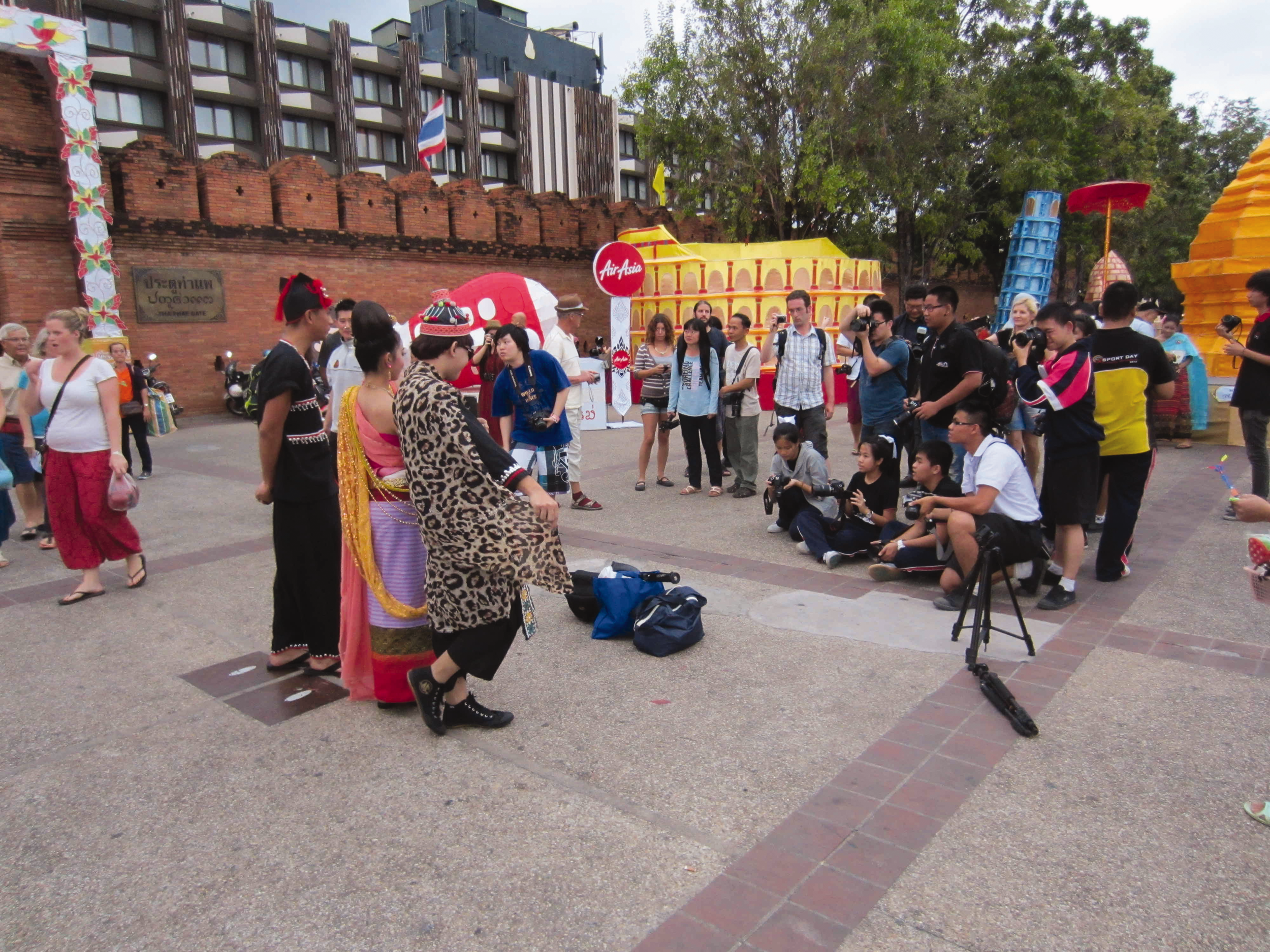
Central Thai Television Personalities in “Ethnic Costume” (photo by author, 2013).
Encounter has been taken up by tourism geographers to think through the myriad sets of relations that partially constitute tourism spaces and experiences, such as the ones described above. From the consumption of food to the relations of workers and tourists, “tourism is,” as Chris Gibson (2011, 58) argues, “visceral.” In the context of the Yii Peng Festival in Chiang Mai, the visceral responses to the surroundings, the sites, smells, tastes, and touches of tourism, are important markers of encounter. But, equally important, if less imagined (at least overtly), are how these encounters operate in relation to the circulation of hyperreal geopolitical subjectivities and the processes of subject formation. The colonial othering of ethnic minorities or northern Thailand, in general, by the central Thai television personalities engages the affective registers of the hyperreal spectacle. By making the colonialism appear benign and comedic, the history of central Thai cultural and geopolitical hegemony is displaced. The need to produce Thai empire as a non-event is contingent on the fact that while tourism spaces often bring together actors and organizations with competing interests – the Thai state, global capital, local tourism organizations, workers, tourists, non-tourists, people across generations, and so on – these spaces must be safe and readable to afford citizens and non-citizens the mobility to enjoy and take up pleasurable events and to work and earn a living in a safe space. Tourism, as a process, makes demands on the state to maintain order, to produce subjects that can deliver an encounter for tourists. Put another way, tourism relies on a stable geopolitical subject – unrest is counterproductive to state goals driving tourism as an economic development strategy. In a Baudrillardian sense, the Yii Peng Festival is productive of a hyperreality that constitutes the Thai colonial project in the north as a non-event, as something that does not always involve the postcolonial logic of othering (see above), but sometimes does in particularly affective ways that involve how bodies are represented (see Anderson, 2019).
Bodies on display
There is an obvious body politic to this spectacle. Layered within the performances of nation, Buddhism, and monarchy are the bodies of Thai citizens, on display as representations of the Thai state and a normalized narrative of Thai citizen-subjectivity and Thainess. The beauty contest is a central component of many Thai festivals, and these representations of idealized feminine and masculine form begin at a young age. The beauty contest in this context is also about geopolitical encounter and the Thai state, as the idealized bodily form is placed within the origin narrative of the birth of the nation. The performance of Thai nationhood is elevated through the performance of women who practice the appropriate way to dance and carry themselves. The women’s outfits literally map onto their bodies the values of the Thai state, as stupas are worn for hats and lotus flowers are carried to symbolize the importance of Buddhism’s place within the narrative of Thai nationhood. Similarly, a male beauty contest situates men’s bodies within the longer historical narrative of the past – normalizing the role that compliant subjects and bodies have played for king and country. Dressed as appropriate subjects of the earlier period of kingly courts, the contestants are asked in what ways northern Thai culture is unique and how they would go about marketing that culture to support the larger Thai tourism economy.
The politics of class, ethnicity, and urbanity are also worked out through the bodily performances of these geopolitical subjects. International identities are on display, as performers carry flags of other ASEAN countries while wearing a representative outfit of that place. Even as the Thai state situates itself within that trans-regional framework of internationality, other bodies perform the normalization of class difference. As men dressed in simple white clothes and wearing the headgear of an earlier era, drag the float of the elite, represented by an elite woman dressed in gold embossed clothing. In a Southeast Asian context, where the fight for bodies was almost always more important historically then the fight for land, the control over the peasantry has always been critical (and the “rural vote” remains an important part of Thai politics to this day). Such performances normalize the class differences embedded in the historical narrative of an emerging colonializing empire.
The idealization of the rural hinterland is further illustrated in the variety of ways that rurality is worn at the festival. Dressed in an animal print and holding a device that helps one manage the carrying of loads and back and forth through the fields and into the market, for example, a woman on one float is placed on a lotus flower is situated within the earth. The naturalization of her labor clearly on display, even if this bodily performance comes nowhere near to the realities of everyday rural life. Other bodily performances of rurality at least partially hint on the real work of that labor, albeit in a way that reinforces the important role that the rural periphery plays in the creation of foodstuffs for the central Thai core. The hats worn by those in the parade demonstrate the importance of protection from the sun in the fields and shirts worn by some of those in the parade reflect the simple clothing of a farmer in the north. Of course, this parade constitutes the actual displacement that has taken place in rural northern Thailand over the past several decades as suburban development and larger scale agricultural practices have made many rural farmers landless and now the content of hyperreal spectacle. The violent process of nation-building that rests at the heart of the Yii Peng Festival must first be cast as a non-event in order to maintain the affective focus on King, Nation, and Religion in a Thai context. That is what many of the parade floats not only represent certain everyday practices or elite historical images but also display images of the king and other monarchs central to the Thai geopolitical subject.
The incomplete process of geopolitical subject formation
In a Baudrillardian sense, the Festival is a site of play – there is only simulation and the hyperreal. This is quite evident not only in the performances of those involved in the parade but in the presentation of the floats and the affective strategies of the state and corporate sponsors of the festival. But, amid the clamor of the parade, more subtle activities occur that both enable and trouble the state-centric vision of what geopolitical subjectivities are in the works via these technologies of spectacle. The festival is an incomplete process and different forms of play within the festival trouble the authority of the hyperreal non-event. One can see this in the worker who passes beers along to the driver of one of the floats as it moves along the route. The subtly of handing beers to the driver of a float does more than simply signal a humorous moment. It exposes the fact that the spectacle of tourism and the processes of geopolitical subject formation (in this case the actors on the float and those taking in the spectacle) are incomplete if not for the work that is demanded to maintain them. There are also the performers of the main stage who also have to eat, and who buy food from the market and relax before participating in the evening’s events. At the same time, the networked relations that make markets possible, that bring inexpensive goods back and forth across borders that are theoretically closed but practically porous are also splayed open under a reflexive lens about the everyday practices of tourism as people at work create new affective spaces within and around the festival.
Such events also demand that the categories of citizen-subjects remain open to alterities. In the middle of this normalized ritual of glorified nationalistic performativity, for example, we can see how the normalization of the Thai narrative of nationalism – of citizen-subjects that are compliant – is turned on its head by the introduction of A Thaksin Shinawatra campaign – “We love Thaksin, We are the group that loves Chiang Mai” (see Figure 3). This campaign moment within the spectacle exposes the tensions that surround Thailand as a modern-day geopolitical subject itself. The billionaire populist, who is still in exile since a coupe ousted him from power in 2006, remains a lightning rod around what is an appropriate future for Thailand. Similarly, alternative performances of Thai youth, who find themselves blowing off fireworks and drinking beer on the parade route, or who are hanging out in the market, texting and smoking, suggest that such spectacles may do little affective work – social difference and expectation is quite variegated among upper middle-class youth, who can afford expensive sneakers, tattoos, and high-end hairstyles (see Mendes de Almeida, 2008).
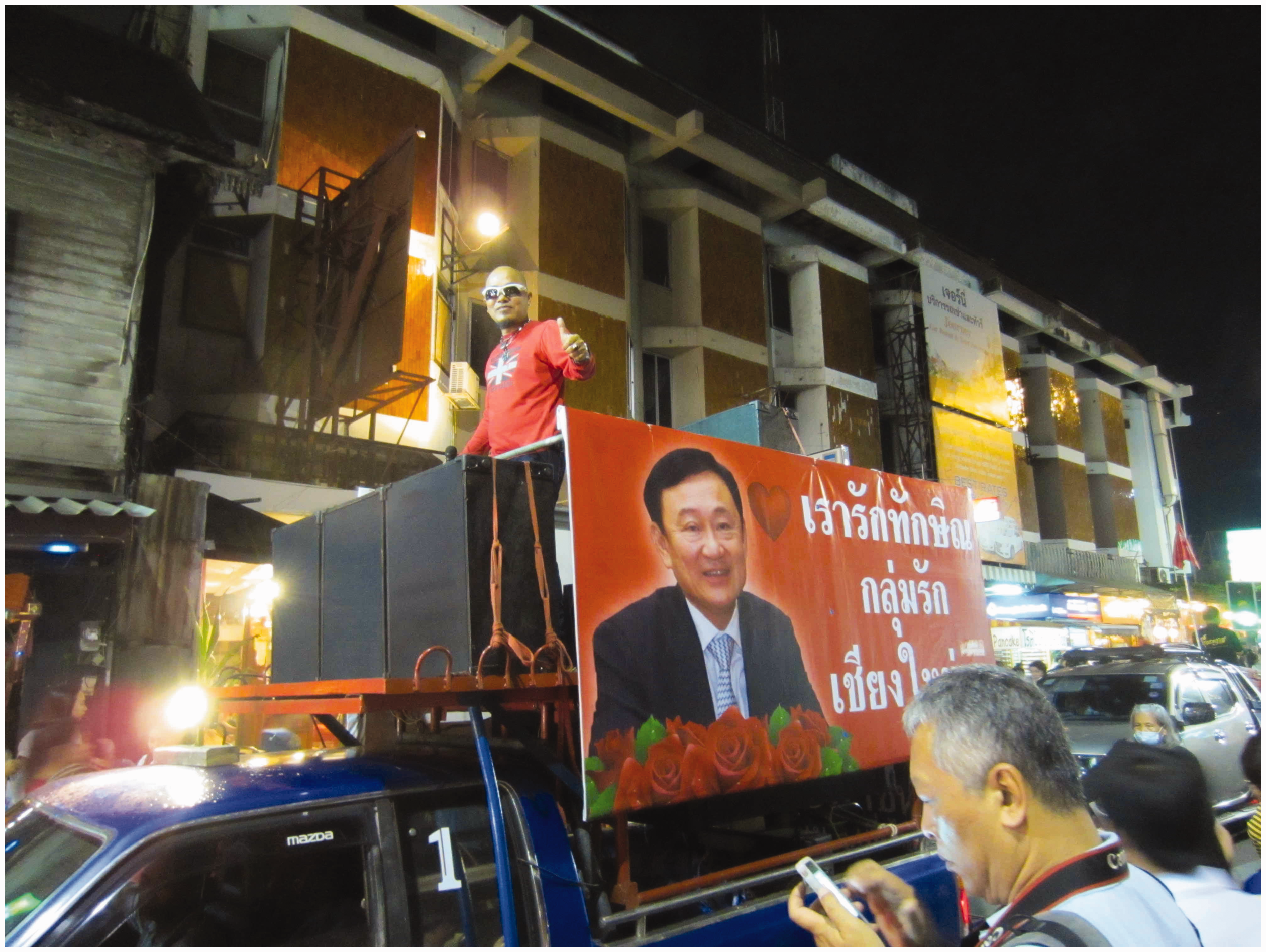
Thaksin Shinawatra Float (photo by author, 2013).
As we suggested above, geopolitical projects are always incomplete – they can never fully “close the loop” on the project of citizenship. The ways in which absences are marked out as the project of subject formation is always in process, highlighting the complexity of totalizing narratives of what is an “appropriate” Thai citizen. The project of producing geopolitical subjects is one of boundary maintenance and of constructing representational authority in ways that make bodies align to those boundaries. But, the dualities upon which the categories of “appropriate geopolitical subjects” are constructed – citizen and non-citizen, properly gendered bodies, etc. – are also destabilized by the very processes that seek to contain difference. Baudrillard’s hyperreal spectacle, then, is but one moment in a larger movement of bodies, objects, affective atmospheres and urban practices that work through differentiated subject positions always in the making. The geopolitical codes of state power circulate, but in relation to a more complex socio-cultural field that can never be entirely totalized.
Conclusion
Tourism, as an activity that tends toward spectacle, is ripe for geopolitical intervention. We agree with Koch (2018) that a geographical approach to spectacle is necessary to uncover the multiple ways that geopolitics becomes an active force in everyday life. In our article, we consider not only the spectacular aspects of the Yii Peng Festival as keys to understanding those geopolitics, but also the more mundane and everyday elements of that performance. Importantly, we build on other recent work that focuses on embodied politics of affect, emotion and performance to gather insights into the many ways that the Festival becomes an opportunity for geopolitics to unfold (namely, Miller and Del Casino, 2018). Most strikingly, we find instances of Baudrillard’s “non-event” at work in the seemingly mundane and quotidian elements of the Festival. Following the geopolitical logics of non-events, the legacies of colonial violence and intervention are conveniently concealed amid the subtle cues and spaces of the Festival – the languages spoken, the foods eaten and the bodies and objects on display. Through these spaces, the power of the central Thai state attempts to strategically code the politics of difference that have shaped the city of Chiang Mai and the entire northern highland region in recent centuries.
We are not surprised that Baudrillard’s work has had limited impact in recent years, while feminist geopolitics and non-representational geographies have instead flourished. Geographers working with Baudrillard have too rarely emphasized the full political potential of hyperreality as a theoretical approach adequate for thinking difference in more radical ways (see Clarke et al., 1994 and Smith, 2003 for example; cf. Richardson, 2019). More recently other non-representational philosophies (namely that of Gilles Deleuze) have inspired new theorizations of “encounter” that are promising for geographic thought (Cockayne et al., 2017, 2020). By drawing on this work, we can effectively flatten hyperreality and the non-event, thereby bringing them clearly within the confines of what Woodward et al. (2012) call the “site” in which encounters among difference unfold, including human bodies and their material surroundings. The geopolitics of meaning and identity, no doubt, also form part of the site, but are seen as emergent from this broader array of forces that, in our case, include parades, floats, stages, food, bodily attire and more mundane and embodied everyday practices of the Yii Peng festival and its urban contexts. If the spectacle is understood through this ontology, then it only ever “works”, or not, through this embodied materiality, rather than emanating from some transcendent source. Geopolitical landscapes of many kinds, not only those of tourism and consumption, may benefit from engaging with the philosophical roots of spectacle, particularly a flattened version of it and its hyperreal components.
Footnotes
Acknowledgments
We would like to thank Melissa Vito and Academic Initiatives and Student Success at the University of Arizona and the Northumbria University Department of Geography and Environmental Sciences who supported this research.
Declaration of conflicting interests
The author(s) declared no potential conflicts of interest with respect to the research, authorship, and/or publication of this article.
Funding
The author(s) received no financial support for the research, authorship, and/or publication of this article.
