




Abstract
The Thai aquaculture sector faces a range of production, market and financial risks that extend beyond the private space of farms to include public spaces and shared resources. The Thai state has attempted to manage these shared risks through its Plang Yai (or ‘Big Area’) agricultural extension program. Using the lens of territorialization, this paper investigates how, through the Plang Yai program, risk management is institutionalized through spatially explicit forms of collaboration amongst farmers and between farmers and (non-)state actors. We focus on how four key policy instruments brought together under Plang Yai delimited multiple territories of risk management over shrimp and tilapia production in Chantaburi and Chonburi provinces. Our findings demonstrate how these policy instruments address risks through dissimilar but overlapping territories that are selectively biased toward facilitating the individual management of production risks, whilst enabling both the individual and collective management of market and financial risks. This raises questions about the suitability of addressing aquaculture risks by controlling farmer behavior through state-led designation of singular, spatially explicit areas. The findings also indicate the multiple roles of the state in territorializing risk management, providing a high degree of flexibility, which is especially valuable in landscapes shared by many users, connected to (global) value chains and facing diverse risks. In doing so we demonstrate that understanding the territorialization of production landscapes in a globalizing world requires a dynamic approach recognizing the multiplicity of territories that emerge in risk management processes.
Introduction
The production risks that aquaculture farmers located in diverse landscapes are faced with are varied and complex (Joffre et al., 2019; Alam et al., 2019). Many risks are not restricted to individual farmers nor bound within the territory of a farm. For example, area-level production risks like disease and water quality affect multiple farmers and the surrounding landscape in shared spaces (World Bank, 2014). In turn, responses aimed at mitigating these shared risks have emerged that fall under the broad headings of ‘beyond-farm’ or ‘area-based’ aquaculture management (Bush et al., 2019; Aguilar-Manjarrez et al., 2017). While considerable attention has been given to private forms of area-based aquaculture management, including farmer collectives and market-driven initiatives (Kassam et al., 2011; Ha et al., 2012), less attention has been given to public, state-led, approaches involving spatially explicit programs and instruments. It therefore remains unclear whether state-led beyond-farm aquaculture governance can overcome individualistic behavior and foster the collective management of risks linked to the management of public resources such as land and water (Beitl, 2014; Galappaththi and Berkes, 2014).
An exceptional case of state-led governance of shared aquaculture risks is the Thai government’s ‘Plang Yai’ program; an explicitly spatial agricultural extension program initiated in 2015 by the Ministry of Agriculture and Cooperatives (MoAC). Plang Yai applies an area-based approach that encourages cooperation between farmers in specific areas. The program, chaired by the Department of Agricultural Extension (DoAE), aims to improve farm management to reduce production costs and increase productivity, and to improve product quality to enable access to new markets. It is applied for more than 70 agricultural species, and in 2018 there were 70 Plang Yai projects with aquaculture species. While Plang Yai is spatially explicit, translating as ‘Big Area’, it is unclear as to whether the program promotes the collective management of risks in public areas, or whether Plang Yai projects represent areas within which numerous individuals manage risks within the boundaries of their own farm.
Plang Yai projects are implemented using four main policy instruments. First, farmers, generally in sub-districts, are grouped on a voluntary basis. Second, these groups are encouraged to form formal cooperatives. Third, every aquaculture farmer in Plang Yai is encouraged to get Thai GAP certification. Fourth, as part of Thailand’s modern agricultural approach stimulating public-private sector engagement, farmers are matched with private companies to form small Public-Private Partnerships (PPPs), referred to as ‘Pracharat’. Plang Yai distinguishes itself from preceding programs, such as One Tambon One Product (OTOP) that focused on marketing local products (Dressler and Roth, 2011), by addressing risks throughout both the marketing and production process.
The spatially explicit nature of risk management through Plang Yai can be understood as a process of territorialization. Territorialization is commonly understood as a top-down state-led process, creating territories through the delineation of boundaries within which claims of authority and control are enacted (Vandergeest and Peluso, 1995). Territorialization has been used to examine the consequences of spatial forms of conservation, like national parks, on people and ecosystems (Adams, 2020; Bluwstein and Lund, 2018; Raycraft, 2019). Attention has only recently been given to the territorialities of more diffuse environmental phenomenon such as aquaculture production risks across more ‘fluid’ (i.e. less clearly bounded) coastal and marine spaces. Vandergeest and Unno (2012), for instance, demonstrate how the transnational eco-certification of Thai aquaculture farmers creates territories in which global certification agencies claim extra-territorial rule-making and -enforcement authority in ways that pre-empt state territorial control. Building on that, Vandergeest et al. (2015) also investigate how eco-certification remakes territory, redefining territorial sovereignty but also potentially leading to positive environmental outcomes. Together, these authors raise questions about how states engage with global markets in maintaining territories of sovereign control, as well as highlight both processes of marginalization and opportunities for addressing environmental risks within these territories.
In this paper we examine how the Thai state shapes the management of shared and spatially diffuse aquaculture risks through Plang Yai and how this is manifested through the creation of layered ‘risk-territories’. In particular, we examine the coordinating role of the state in spatially delimiting risk management through Plang Yai’s four overlapping policy instruments. By doing so we extend an understanding of how state-led territorialization of an industry like aquaculture can contribute to the collaborative management of shared risks and the public resources upon which the industry depends.
The following section presents an analytical framework for understanding the institutionalization of risk management through a territorialization lens. We then describe the methods and introduce our two study sites, before presenting the results and discussing how multiple territories of risk management are shaped through the Plang Yai program. The final section reflects on the spatial management of aquaculture risks and the state’s role in institutionalizing the management of shared aquaculture risks.
State-led territorialization of aquaculture risk management
Vandergeest and Peluso’s (1995) seminal analysis of territorialization focused on strategies by the Thai state to control natural resource users’ actions through mapping land boundaries, allocating land-use rights and designating resource use. Their work has been subsequently used to further an understanding of the powers of the state to include and exclude people under a range of resource use and conservation arrangements in Thailand and beyond (Raycraft, 2019; Roth, 2008). Others have challenged notions of territorialization that, they argue, overemphasize the structural power of the state, and examine how territorial control is resisted or shaped by resource users (Bluwstein and Lund, 2018; Rasmussen and Lund, 2018). Thus, contemporary notions of territorialization increasingly ascribe agency to local resource users (Raycraft, 2020), and to non-human actants such as fish and wildlife (Bear, 2013), to continuously negotiate and renegotiate spatial boundaries.
A dynamic and co-produced notion of territories is useful, we argue, for understanding how spatially explicit approaches for risk management are negotiated between the state and local farmers in an industry that concurrently feeds and responds to (global) market demand. Under such conditions, the state is unable to have complete control in responding to the diversity of risks facing the industry. Therefore, we suggest a more dynamic understanding of territorialization is needed that draws attention to the continual (re)negotiation and (re)production of boundaries by local, private and public actors with different objectives (Bear, 2013). This dynamic understanding also extends beyond a unilateral focus on the state to include negotiation and implementation of multiple territorial boundaries by public and private rules, standards and policies dealing with different risks simultaneously (Foley and Havice, 2016; Vandergeest and Unno, 2012). In such cases, we argue, multiple territories of risk management may emerge that contribute to the enactment of (public or private) authority and control.
Drawing on Vandergeest et al. (2015), we analyze the formation of multiple territories of risk management through four policy instruments as an active ‘governing’ process of boundary-formation that ‘assembles’ four elements – subjects, expertise, objects of concern and space. This approach also builds on a recognition of the decentered nature of boundary-formation (see Bear, 2013), to reveal the agency of both state and non-state actors to assemble heterogenous elements and in doing so co-shape these territorial boundaries. By focusing on how such instruments actively assemble subjects, expertise, objects of concern and space, we determine how they shape new territories of risk management which contribute to wider goals of ‘improved’ aquaculture production.
First, we focus on the identification, inclusion, exclusion and control over subjects of risk management (Bear and Eden, 2008). Vandergeest et al. (2015) define subjects as actors who are allocated use rights and the authority to manage objects of concern within rules set by (non-)state authorities. In this study, subjects are understood to be human actors and the institutions that guide risk management. As such, we focus on the manner in which aquaculture farmers and other actors involved in Plang Yai projects are enrolled and organized into networks, and how they react and interact to negotiate (new) forms of collaborative risk management. Our analysis also extends to the manner in which actors collaborate to manage risks at a local level and the informal institutions that may facilitate or deter collaborative risk management.
Second, we study the manner in which expertise defines boundaries. Expertise, inherently interactional (Carr, 2010), is understood as the way that knowledge is applied and transferred to produce rules that define the risks addressed (Vandergeest et al., 2015). Though studies have predominantly focused on the role of state expertise in territorialization processes (Vandergeest and Peluso, 1995, 2015), the scope of literature on territorialization has gradually broadened to understanding the interplay of state and non-state actors (Corson, 2011; Foley, 2017). Lund (2015) highlights tendencies to rely on approaches and information systems that privilege ‘professional’ forms of knowledge over local resource users’ knowledge. Hence, we acknowledge that both state and non-state expertise, for example that of farmers and processing companies, plays a role in shaping boundaries.
Third, we examine the objects of concern, translated as the risks targeted by these instruments. This focus on risk as the focal object of concern differentiates this research from previous studies applying the same framework (Toonen and Bush, 2018; Vandergeest et al., 2015). There are multiple risks associated with aquaculture, and this research focusses on production, market and financial risks (Meuwissen et al., 2001). In line with Bottema et al. (2018), this study further differentiates between individual and shared risks, as we are interested in whether and how Plang Yai addresses management of public risks. For example, water quality and input quality are individual production risks, but disease and water pollution are shared production risks, manifested at an area-level. These socially mediated risks (Beck, 2009) are influenced by the subjects (and their institutions), and the expertise used to define and mitigate them. We therefore focus on the type of risks that each policy instrument aims to manage, how farmers understand these and how farmers act (individually and collectively) through the risk mitigation strategies they apply.
Finally, we analyze the manner in which space is designated through these policy instruments. Recognizing that there are multiple co‐existing spaces and interpretations of space (Massey, 2005; Murdoch, 1998), spaces emerging through processes of state-led territorialization may not match how spaces are created in response to policy instruments at the local level. We study the manner in which boundaries are defined through the policy instruments, with specific attention for whether they address public areas within which risks are shared. Furthermore, we explore the manner in which aquaculture farmers are spatially organized, to determine what state-defined spatially delimited areas actually mean to farmers.
Methodology and study sites
Methods
Plang Yai’s four key policy instruments are analyzed using the four analytical dimensions of boundary-formation. We focus on the intended objectives of these instruments from the state’s perspective and how local actors enrolled in two Plang Yai projects contribute to the processes of boundary-formation, thereby recognizing that these actors are not simply responding to state-led territorialization, but are actively involved in this process. The first project features shrimp production in Kung Krabaen Bay (KKB), Chantaburi province (Figure 1). The second project features tilapia production in Chonburi province (Figure 2). The comparison of these projects aims to draw out commonalities from case studies that are dissimilar thanks to the different risks represented by farmed species and production systems, and the different ways in which local actors collaborated before Plang Yai.
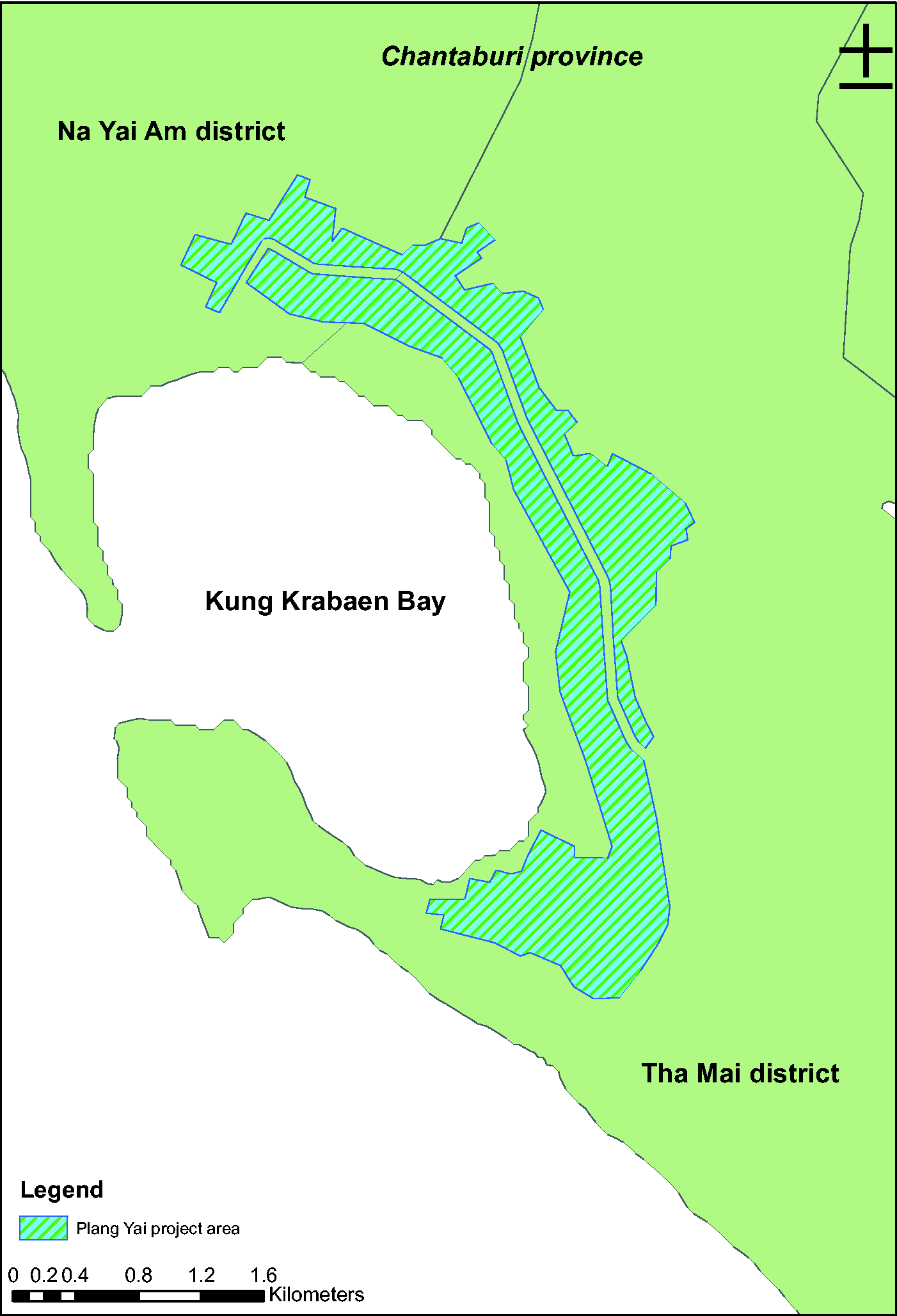
Map of Kung Krabaen Bay Shrimp Plang Yai. Sources: GADM database version 2.8, November 2015 (www.gadm.org); OpenStreetMap contributors (https://www.openstreetmap.org); extracts created by BBBike (http://extract.bbbike.org); osmium2shape-1.0 by Geofabrik (http://geofabrik.de).
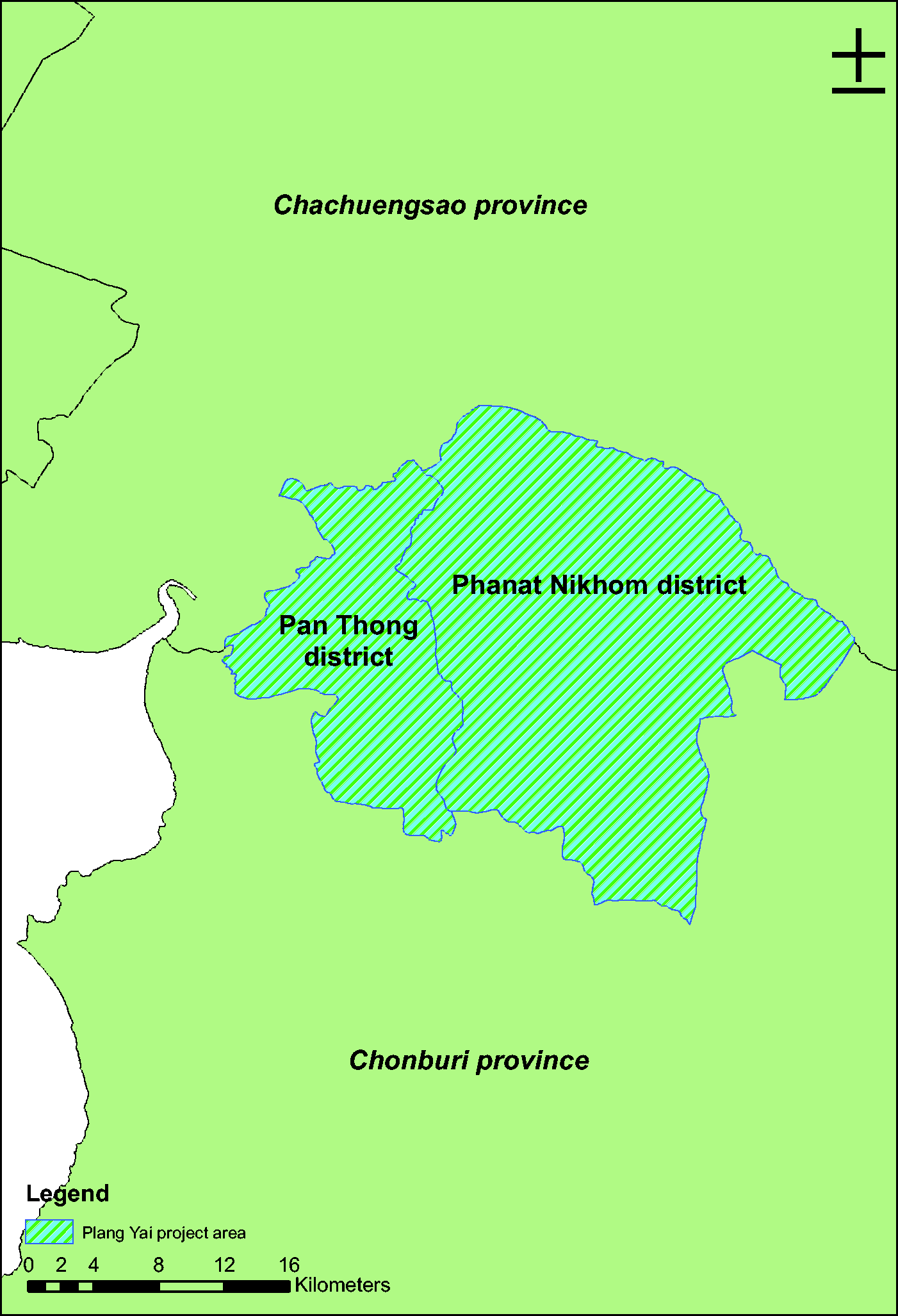
Map of Chonburi Tilapia Plang Yai (right). Sources: GADM database version 2.8, November 2015 (www.gadm.org); OpenStreetMap contributors (https://www.openstreetmap.org); extracts created by BBBike (http://extract.bbbike.org); osmium2shape-1.0 by Geofabrik (http://geofabrik.de).
Fieldwork took place between January and March 2017, with follow-up interviews in September 2018. In total, 67 semi-structured interviews were conducted at national, provincial and local levels. Eighteen government officers at national and provincial level were interviewed; officers from the DoAE, Department of Fisheries (DoF), Department of Irrigation (DoI), Land Development Department (LDD) and Cooperative Promotion Department (CPD). Seven non-governmental actors were interviewed in Bangkok, representing NGOs, researchers and processing companies.
To investigate how Plang Yai shaped farmers’ conduct in managing risks at a local level, 12 government officers and 30 local stakeholders were interviewed at the two project sites. Local stakeholders included farmer leaders, researchers, and value chain actors, including input suppliers, middle men, and processing companies. In KKB, a focus group with five, male and female, farmers was held. In Chonburi, a focus group with seven male farmers was held. In both sites, one key informant introduced the researcher to initial participants, and snowball sampling was used to find additional participants. Though the farmer leaders were to a certain extent able to present the perspective of ‘typical’ farmers, other individual farmers were not interviewed for this research paper, which poses a limitation to this study. Secondary data in the form of policy documents and websites were examined to validate the primary data collected on the objectives of the policy instruments.
Kung Krabaen Bay Shrimp Plang Yai
The KKB Shrimp Plang Yai project was initiated in 2016. The site is located in a small bay lying on the border of Na Yai Am and Tha Mai districts in Chantaburi province (Figure 1). The bay hosts 210 adjacent intensive shrimp and fish farms, located along a shared irrigation canal (Satumanatpan et al., 2011). The farmed shrimp was sold to domestic and export markets. The Plang Yai project was initiated with the KKB Fisheries Cooperative, which was in serious debt due to disease outbreaks in the 1990s. This project differs from many other Plang Yai projects because the cooperative was formed long before the implementation of Plang Yai. Furthermore, KKB was already a national example of integrated landscape management as it hosts the KKB Royal Development Study Centre, founded in 1981 to serve as a shrimp culture demonstration area (Boonsong, 1997). In 2018, 193 farmers were enrolled in the project, which covered an area of 574 rai 1 (92 ha).
Chonburi Tilapia Plang Yai
The Chonburi Plang Yai project was also initiated in 2016. The project involves tilapia farmers from Pan Thong and Phanat Nikhom districts in Chonburi province (Figure 2). The central government recognized Chonburi as a potential location for a Plang Yai project as there was a high number of registered tilapia farmers in the province and because of the presence of an informal farmer group with strong leadership in Pan Thong district. Though a small number of farmers sold to export markets in the past, at the time of data collection, tilapia produced was sold domestically. The two districts were chosen as appropriate areas to start the Plang Yai project because tilapia farmers in these districts were relatively close together, making it easier to organize them. The Chonburi Aquaculture Farmer Cooperative was registered parallel to the initiation of the project. In the first year, 120 farmers were enrolled in the Plang Yai project. In the second year, 300 farmers were registered and in the third year about 530 farmers were enrolled, covering an area of roughly 4000 rai (640 ha).
Territories of risk management in Plang Yai’s four policy instruments
Farmer groups
Farmer groups were spatially defined by the government, which was informed by ‘AgriMap’, a 160-layer Geographical Information System that classifies land in terms of suitably for cultivating particular species. The groups of, often spatially dispersed, farmers were trained primarily to improve individual production and market risk management (Figure 3(a)). However, these state-defined territories overlapped with existing social networks through which farmers collectively addressed farm-level and area-level production risks and shared market risks (Figure 3(e)). The following paragraphs further characterize how farmers were included within these territories through the assemblage of subjects, expertise, objects and space.
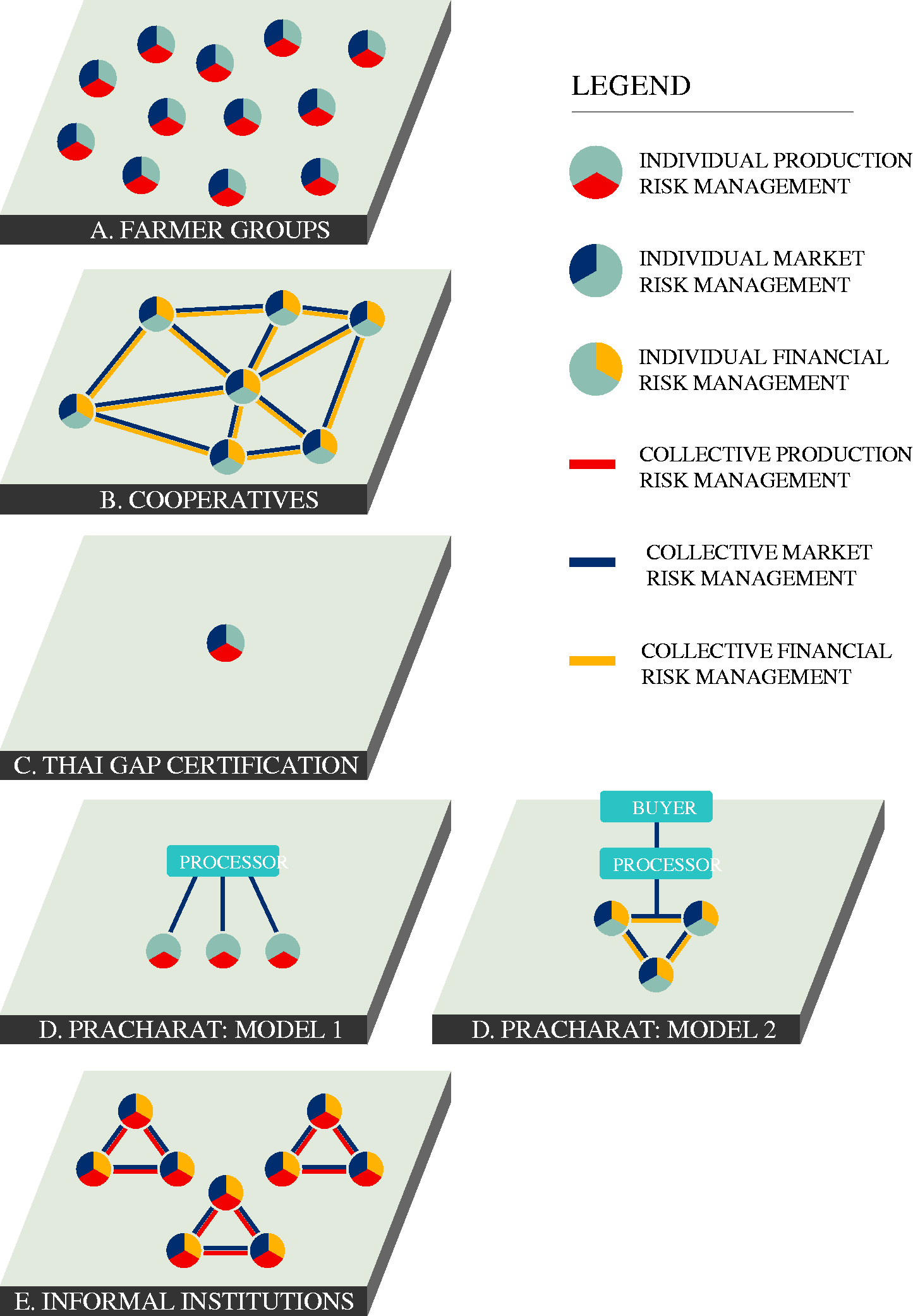
Territories of risk management shaped by Plang Yai’s four policy instruments and informal institutions. (Designer: Luc Dinnissen (studio ds).)
Farmers cultivating the same species were the subjects of these groups, brought together in order to build their capacity for improving production efficiency and farm management. Grouping was seen as an instrument to reach large numbers of farmers for capacity building, hoping these groups would eventually create more formalized institutions for shared risk management. A minimum of 30 farmers were enrolled in Plang Yai projects by local government for an initial period of three years to create the necessary capabilities for farmers to manage the groups themselves. To facilitate this, a government officer coached a farmer representative to become the group’s leader and to collect and store performance data in a centralized online database (Department of Agricultural Extension, 2019).
The farmers in the Plang Yai groups in KKB and Chonburi were concurrently a member of several existing local (in)formal institutions within which farmers had already organized collective risk management (Figure 3(e)). First, neighboring farmers in both sites communicated informally about shared and individual risks and mitigation approaches. Second, semi-formal water management institutions were already in place. In KKB, farmers were grouped into user groups for a government-built seawater irrigation system, requiring farmers to follow waste management regulations. Though these user groups did not function as groups for pro-active disease communication, farmers were required to report disease events because this entitled them to discounted membership fees. In Chonburi, a system of ‘water guards’ was in place for reservoirs in every sub-district, monitoring water levels in canals and corresponding with the DoI about water shortages. Third, there were informal groups of entrepreneurial farmers, who collaborated to learn from each other, access alternative markets and avoid middle men. For instance, farmers in Pan Thong (Chonburi), started the Bang Hak Aquaculture Farmers Club in 2003 to improve bargaining power for water with the DoI, improve market access, and share information about input quality and farm management. There were also groups in Chonburi which developed the capacity for collectively processing and selling tilapia.
The expertise to determine the suitability of an area for a Plang Yai project was informed by AgriMap. This national land-use planning tool combines soil, environmental and irrigation data to map land-use in Thailand. It classifies the suitability of land for different agricultural products, serving as a recommendation from the government. Plang Yai encourages the most efficient land-use in the hope that eventually all agricultural land is covered by Plang Yai projects. Hence, only land classified as suitable for aquaculture was suggested for new Plang Yai projects. However, AgriMap was not yet used to its full potential as data from AgriMap were not used to inform collaboration between Plang Yai projects, or for predictive disease management.
Multiple departments from the MoAC were involved in supporting the Plang Yai groups with capacity building activities, such as the DoAE, DoI, LDD, DoI, CPD and the Department of Agriculture (DoA). In aquaculture Plang Yai projects, the DoF usually played a focal role, providing farmers with inputs and knowledge about recording data, reducing costs, and managing farms and diseases. Often government officers from different departments visited farmers together, demonstrating an integrated extension approach. According to government respondents, this was quite unique since these departments tended to work independently in prior extension programs.
The central objects of concern targeted through the farmers groups were individual production risks and market risks. Farmer respondents in Chonburi confirmed that grouping improved their production practices, through it is unclear whether these improvements were attributable to grouping in Plang Yai projects or to grouping in existing collaborations. Farmer respondents in KKB appeared to be unaware of their participation in the Plang Yai project, presumably because they already received a lot of support from the DoF due to membership to the irrigation system and their participation in the KKB Royal Development Study Centre (for details, see Bottema et al., 2018). Grouping farmers in Plang Yai projects appeared to indirectly increase the capacity of farmers to address shared, area-level, production risks. Respondents from Chonburi suggested that their power to negotiate for water access had increased thanks to their status as a Plang Yai project and significantly sped up the process of water release by the DoI. More speculatively, one farmer suggested that their status in the Plang Yai project was likely to protect them from potential consequences of the development of an industrial complex in Chonburi, which involved the re-zoning of land.
The space occupied by Plang Yai projects must cover at least 300 rai (48 ha) of farms, but farms do not have to be adjacent to each other. Initially, the government aspired to only group farmers that were close to each other and shared a water source, like in KKB. According to a government respondent, this was because managing groups is easier when farmers share a water source and consequentially share risks. In practice, however, aquaculture farms were often more dispersed, like in the Chonburi Tilapia Plang Yai, where farms were located in two districts. The group was further divided by sub-district when organizing capacity building activities. Government respondents recognized that there were ‘free-riding’ non-member farmers in the districts, benefiting from Plang Yai projects, but this was not seen as a problem. Instead, the hope was that they would observe the benefits of membership and join over time.
In conclusion, the assemblage of subjects, expertise, objects of concern and spaces through the formation of farmer groups translated into territories characterized by multiple, individual farmers addressing production and market risks within the boundaries of their own farm. It did not illustrate collective efforts to addressing risks in public areas outside of farms. However, these territories overlapped existing social networks within which farmers did address shared production risks collectively.
Cooperatives
The territories of risk management shaped by cooperatives, determined by a number of membership conditions defined by the cooperatives themselves, formed a subset of Plang Yai project member farmers. These institutions facilitated collective strategies for financial and market risk management. The conditions for borrowing money from cooperatives required members to address farm-level production risks which indirectly contributed to reducing area-level production risks such as disease (Figure 3(b)).
The formation of cooperatives by farmers, as subjects, is one of the key performance indicators of Plang Yai projects. In Chonburi, 61 out of 530 Plang Yai farmers were cooperative members in 2018. Since the project in KKB was founded with an established cooperative, all 193 Plang Yai farmers in Chantaburi were cooperative members. As put forward by a government respondent, it is not possible to force farmers to join a cooperative. Instead, the cooperatives must demonstrate benefits in order to encourage membership. For instance, cooperatives facilitated access to low-interest loans and cheaper, better quality inputs. However, a number of conditions for membership potentially excluded certain farmers. First, farmers were required to pay registration fees and buy shares in the cooperative. Although not high, farmers reported these costs encouraged them to carefully consider the benefits of membership. Second, cooperatives formulated their own conditions for borrowing money and these conditions required investments, excluding farmers who could not afford this. For example, in KKB farms were required to construct ponds according to certain rules, to apply certain biosecurity measures, farm with a maximum stocking density and buy feed from the cooperative.
Communication between subjects in cooperatives focused on finances. At both sites, yearly meetings were held to discuss finances and cooperatives were further sub-divided according to administrative unit. In KKB, these subgroups met twice a year to discuss membership, monitor loans and savings, and choose leaders. These subgroup leaders made up the cooperative’s board that generally met monthly to report on profits, stocking and harvesting, and to discuss problems and solutions associated with farm management. In Chonburi, additional monthly meetings were held, which were open to non-cooperative members. This is presumably because the cooperative was still relatively small and located at the farm of one of the initial Bang Hak Aquaculture Farmer Club members. Cooperatives at both sites did not define formalized rules on how members should communicate or collaborate for disease risk management. As such, cooperatives did not appear to function as pro-active channels for collective disease risk management.
In terms of expertise, the CPD provided farmers with the capacity to develop cooperatives. This department had three main responsibilities. First, they were responsible for legal registration of farmer cooperatives and building capacity for cooperative management. They trained farmers about formal group management, accounting, buying inputs and selling outputs collectively. Second, the CPD was responsible for building capacity for financial management. They trained farmers to organize loans within cooperatives and to access funding, like loans from the Bank for Agriculture and Agricultural Cooperatives (BAAC). Third, the CPD functioned as an intermediary between farmers and buyers, to help them access new marketing channels. They linked farmers with local buyers, helped them with price negotiations and encouraged farmers to consider organizing planned production.
The central objects of concern in the cooperatives were addressing market and financial risks through collective strategies to share risk. Farmers confirmed that cooperatives facilitated market risk management and borrowing money. Farmers also said that joining a cooperative increased their bargaining power with input suppliers – although some respondents in KKB claimed that feed from the cooperative was not always cheaper than from other suppliers. At both sites, the cooperatives were not collectively selling output and negotiating prices with buyers. However, farmers in Chonburi’s cooperative planned to develop a system to sell products collectively, in which the cooperative would function as a middle man. Though the cooperatives provided an opportunity for farmers to borrow from the cooperatives, access to loans from external sources was difficult to obtain. Borrowing from the BAAC appeared to be challenging due to local conditions and risks associated with certain species. In Chonburi, tilapia farmers were unable to borrow from the government because loans had to be paid back within two years, which was deemed unrealistic for a newly established cooperative. According to an industry respondent, it is near impossible for shrimp farmers to get a loan from the BAAC because the required collateral is so high, and the common practice of using a cooperative’s leader as the guarantor for loans is deemed as too risky. Finally, an indirect consequence of cooperative membership in KKB was the contribution to reducing area-level disease risks though biosecurity measures set as conditions for taking out loans.
The space of cooperatives can be seen as a subset of Plang Yai project members that collectively address financial and market risks. Thus, cooperative membership was not concentrated in one spatial area. In both case studies, the cooperatives had a demonstration farm that acted as a place to showcase best practices promoted by the cooperative to external actors and non-members. It also functioned as an important place for sharing knowledge within the cooperative. In Chonburi, the cooperative was located at the farm of one of the initial Bang Hak Aquaculture Farmer Club members, so it was also used as a place for non-members to convene.
In sum, the territories emerging through cooperative formation resembled networks of farmers collectively addressing market and financial risks that were common to individual farmers in these areas. In some cases, these networks indirectly addressed shared production risks such as disease due to the conditions set for borrowing money.
Thai GAP certification
Thai GAP certification, a farm-level standard, created territories of scattered and individual production and market risk management. This government-defined standard addressed farm-level production risk management and did not include clauses stipulating collective management (Figure 3(c)). Though not promoted through Plang Yai, group certification provided an opportunity to foster collaboration and risk-sharing, and created overlapping territories of shared risk management. The following paragraphs further illustrate the assemblage of subjects, expertise, objects and space through Thai GAP certification.
All farmer subjects in a Plang Yai projects were required to obtain certification. Though there are three national aquaculture certification standards in Thailand – Thai GAP, Thai GAP-7401 and Code of Conduct (CoC) – Thai GAP is the focal instrument within the Plang Yai program. Thai GAP, developed by the DoF, sets minimum criteria for food hygiene, food safety and prevention of chemical residues (Prompoj et al., 2011; Samerwong et al., 2018). Thai GAP is compulsory for exported shrimp, so many shrimp farmers were already certified. Since most Thai tilapia is sold domestically (Pongsri and Sukumasavin, 2005), for which certification is not compulsory, it is arguably a larger challenge to demonstrate the value of certification to tilapia farmers. However, this is not reflected in the number of certified farmers at the two sites: in KKB, 101 out of the 211 farmers are Thai GAP certified and in Chonburi, 300 out of 530 farmers are Thai GAP certified. The DoF’s CoC, based on international environmental, aquaculture and food safety guidelines, is perceived as difficult to obtain (Samerwong et al., 2018). In the two cases, only the demonstration farm at the KKB Royal Development Study Centre was CoC certified. Thai GAP-7401, developed by the National Bureau of Agricultural Commodity and Food Standards (ACFS), combines CoC and Thai GAP principles, to meet demands for worker welfare, social responsibility and environmental conservation (Samerwong et al., 2018). In the two cases, only a group of 19 farmers in KKB were Thai GAP-7401 certified.
Though group certification appeared to facilitate risk-sharing, Plang Yai projects encouraged individual certification. In both project sites, farmer groups had piloted group certification, part of a collaboration between the DoF and the FAO Technical Cooperation Program on Certification for Small-scale Aquaculture (Yamamoto, 2013). Group certification requires a quality management system that specifies production rules and controls compliance (Kersting and Wollni, 2012). These institutions facilitate sharing and adaptive learning. In KKB, where the FAO pilot group still functioned, the group met once a month to discuss farm management, input use and record-keeping activities. Farmer respondents claimed being a member of this group was beneficial because meeting each other enabled them to learn about managing risks. Nevertheless, Plang Yai projects appeared to promote individual certification for three reasons. First, certification was free at the time of the research, so lower certification costs, a frequently cited benefit of group certification (Petersen et al., 2014; Yamamoto, 2013), was not (yet) a reason for promoting group certification. Second, group certification requires internal audits and record-keeping, which creates extra workload. Third, group certification requires trust and cooperation, which, according to a government respondent, is specifically challenging for aquaculture farmers because their farms are often dispersed.
With regard to expertise, the DoF was primarily responsible for providing farmers with knowledge about obtaining certification. The DoF provided workshops about Thai GAP certification, to illustrate how this can increase farm management standards. The district DoF prepared farmers for certification. In Chonburi, the Chonburi Centre for Research and Development for Freshwater Aquaculture audited the farmers for Thai GAP. In KKB, an officer from the DoF audited for Thai GAP while auditing for Thai GAP-7401 was outsourced to an external company (for details, see Prompoj et al., 2011).
The objects of concern addressed through Thai GAP certification were farm-level production risk management and quality improvement, to eventually increase market access. However, industry and government respondents both claimed that certification inherently also addressed area-level environmental concerns. Thai GAP-7401 and group certification presented opportunities to do so, in different ways. Thai GAP-7401 addressed a number of area-level production risks, but did not promote collaborative risk management. Environmental criteria included management of escapees, routine monitoring of on-farm and off-farm environmental quality indicators and managing impact to surrounding habitat (National Bureau of Agricultural Commodity and Food Standards, 2014). Group certification, on the other hand, did appear to contribute to risk-sharing, even though no standards contained specific clauses stipulating collaborative risk management. It is interesting to note that farmer respondents at both sites believed that Thai GAP certification improved farm management, but their expectations in terms of benefits from market access differed. A farm respondent in Chonburi suggested that the financial benefits resulting from Thai GAP only applied to farmers exporting products, because they had yet to find a local buyer willing to pay a higher price for Thai GAP certified tilapia. Farmer respondents in KKB with Thai GAP-7401 certification recognized that their certification was closer to international standards than Thai GAP, but claimed that this did not result in higher price of shrimp.
The space of risk management associated with all three standards remained the farm. Though Thai GAP-7401 contained clauses that addressed certain area-level production risks, the territory of certification remained limited to the farm. Group certification, however, did move beyond farm scale. Though farmers in these groups still applied the farm-level standards, they were certified as a group and the sharing of information about risks in these groups enabled them to learn from each other.
In conclusion, the assemblage of subjects, expertise and objects of concern through the promotion of Thai GAP translated into territories of individual production and market risk management within which farmers addressed risks within the boundaries of their own farm. However, group certification created social linkages between individual farmers and could perhaps potentially foster the management of risks in shared spaces outside the farm.
Pracharat
The territories of risk management emerging from Pracharat projects took the form of PPPs which, while facilitated by the government, enabled private sector actors to define the terms of risk management. The territories emerging from these partnerships varied from territories of individual production risk management through the application of farm management technology promoted by a private actor, to territories of shared market risk management through value chain collaborations between farmer groups and private actors (Figure 3(d)).
Pracharat projects were partnerships between three subjects; cooperatives, the government and companies. The MoAC found potential companies for cooperatives to collaborate with and cooperatives were free to decide whether they wanted to do so. The project in Chonburi illustrated challenges associated with matching demands from farmers with those of a buyer. At the time of data collection, the government had not yet been successful in making a match between farmers and buyers. Farmers wanted higher tilapia prices and access to new markets. While local retailers showed interest in working with the cooperative, their payment conditions and demands in terms of fish size did not match those of the farmers. Government respondents suggested several other reasons why farmers in general hesitated to participate in Pracharat projects. Some farmers simply prefer to work independently. Others distrust private companies because they fear that companies increase their control through programs like Pracharat. Farmers may also perceive strategies promoted by the private sector as too difficult to implement. Often companies in Pracharat projects started by working with pilot farms, to demonstrate the value of their approaches. This enabled them to present success stories to build the trust necessary for larger-scale adoption of these projects.
Charoen Pokphand Group (CP) and Thai Union Group, the two companies currently involved in aquaculture Pracharat projects, took different approaches to collaboration. In KKB, the government introduced the cooperative to CP in 2015. CP presented their Three-Clean farm management approach for addressing the Early Mortality Syndrome epidemic. CP supplied a pilot farmer with inputs on credit and helped the farmer reconstruct his farm with CP’s technology. Several other farmers followed suit after the success of the initial farmer and at the time of the research about 20 farmers were enrolled in the program. Due to the high costs associated with the technology, only a fraction of cooperative members were able to do so. In contrast, Thai Union worked with farmer groups in collaborative arrangements in which they offered discounted feed prices or guaranteed a minimum price for fish they bought for processing.
In terms of expertise, the government was responsible for making connections between cooperatives and companies. Government managers helped farmers in negotiations with companies. Though the role of the private companies in CP and Thai Union projects differed, strategically, both CP and Thai Union saw Pracharat projects as a form of corporate social responsibility, supporting smallholder farmers’ livelihoods and contributing to the sustainable development of the industry. Though margins made on these projects were minimal and projects were considered opportunities to demonstrate the value of company approaches, in the long run companies also saw these projects as opportunities to expand markets. In the field, the roles of CP and Thai Union differed. CP provided expertise in the form of technology and technicians to train farmers and monitor technology use. They also sold feed and post-larvae. Thai Union’s role was helping farmer groups address market risks by guaranteeing minimum prices for fish they processed, or connecting farmers with other value chain actors. For example, in a Plang Yai project in Chachoengsao province, Thai Union linked a group of seabass farmers with a buyer, Thai Airways.
The objects of concern addressed in Pracharat projects were reducing farm-level production risks and reducing market risks. The CP projects were aimed at reducing production risks such as disease, which had the potential to reduce area-level disease risks. However, the high costs associated with joining the Pracharat project in KKB deterred the large-scale adoption of the technology and consequentially the potential to address area-level production risks like disease. Thai Union projects demonstrated how Pracharat projects can reduce costs and increase market access for farmers, by offering inputs at discounted price, acting as a middle man buying up and processing fish, or guaranteeing a minimum price for fish.
The space of these PPPs also varied between CP and Thai Union projects. In all projects, Pracharat members could be seen as a subset of cooperative members, as cooperative membership was a condition for joining a Pracharat project. CP projects were centered around the application of CP’s Three Clean approach, which addressed individual farm management. In KKB, Pracharat members were dispersed throughout the landscape and the project did not foster linkages between farmers. Thai Union projects, on the other hand, were value chain collaboration arrangements, so they included non-farmer value chain actors and facilitated risk-sharing between farmer groups and other value chain actors.
In sum, the territories emerging through Pracharat projects were different for CP projects and Thai Union projects. In CP projects territories were characterized by independent farms within which individual farmers were addressing production risks. Alternatively, Thai Union projects led to networks of farmers and value chain actors sharing market risks.
Discussion
The results demonstrate how aquaculture Plang Yai projects led by the Thai government institutionalize individual and collective risk management through multiple and overlapping territories of risk management. Furthermore, reflecting the active nature of boundary-formation (Vandergeest et al., 2015), the results also illustrate the state’s role in assembling these territories of risk management, bringing together public and private subjects, objects of concern related to aquaculture, and expertise, in different territories. The Thai state does not exert territorial control as a means of gaining absolute authority and control over predefined subjects (Vandergeest and Peluso, 1995). Our results instead illustrate territorialization as a social and dynamic process that involves the negotiated enrolment of subjects, determines objects of concern, includes or excludes different forms of expertise and delimits the spatial extent of authority and control over risk management (building on Bear, 2013; Foley and Havice, 2016; Vandergeest et al., 2015). In ‘making’ these territories, we argue the state demonstrates the ability to foster spatially explicit collaborative risk management in the aquaculture sector that goes beyond the farm-level and traditional jurisdictions of districts or provinces.
More specifically, the results demonstrate how Plang Yai’s different policy instruments enclose aquaculture risks through dissimilar, overlapping territories of risk management. Plang Yai is therefore different to traditional extension programs that are commonly bound to state jurisdictions (Chanaseni and Kongngoen, 1992; Uppanunchai et al., 2018), or based on a priori assumptions of aquaculture zoning that commonly delineate physical boundaries based on administrative or ecological factors (see for e.g. Aguilar-Manjarrez et al., 2017; Sanchez-Jerez et al., 2016). Instead, the Thai state, under the remit of Plang Yai, institutionalizes risk management through multiple policy instruments that assemble actors (farmers, private sector and state) and risks into what could be considered a layered set of risk-territories (Figure 3(a) to (d)). Furthermore, these territories overlap existing social relations between farmers used to manage shared risks independently of Plang Yai and hence the state (Figure 3(e)). As such, the process of boundary-formation in response to risk as a central object of concern is a dynamic and relational process that can lead to the formation of multiple overlapping territories of control, which challenges the spatial fix often associated with regulation (Raycraft, 2018) and suggests cartographically bounded spaces are insufficient for understanding the processes that take place (Bear and Eden, 2008). Instead of designating exclusive areas where particular activities are controlled, state-led area management seems to allow for establishing a system of multiple relational spaces that are dynamically co-constructed or ‘assembled’ (Bear, 2013) by local (farmers) and extra-local (state and private) actors.
The results also show, however, that the policy instruments applied under Plang Yai are biased in terms of the type and scale of risks they address. Though the instruments present varying territories of risk management, they facilitated the individual management of production risks, but facilitated both the individual and collective management of market and financial risks. Hence, not unlike in economic forms of clustering, there is a tendency toward territorializing production risks individually and at the farm-level, but market and financial risks collectively (see Ha et al., 2013; Joffre et al., 2019). We question whether focusing on production risks only at a farm-level is the most effective means of ensuring effective stewardship of public resources such as water, shared risks like disease, and broader goals of landscape or ecosystem-based governance that “promotes sustainable development, equity, and resilience of interlinked social and ecological systems” (Soto et al., 2008: 3). These wider goals appear to require more direct intervention around shared production risks between farmers, either starting from existing collaboration between farmers (Bottema, 2019; Bottema et al., 2018), or as Joffre et al. (2019) suggest, more effectively (and explicitly) coordinating individual farm-level risk management activities between farms.
The results also reveal two characteristics of the role of the state in risk management. First, the state plays a supportive role, strengthening the capacity of farmers in dealing with risks in the, often globally integrated, landscapes within which they operate. In line with the national political agenda, which has long promoted decentralization and privatization (Dressler and Roth, 2011; Turner, 2002), the Thai state promotes collaboration with large multinational companies that take on roles perhaps previously carried out by the state. This focus largely explains the bias towards addressing both individual and collective market risks and only individual production risks under Plang Yai. This could also be interpreted as the reason why shared production risks aimed at the collective management of public resources are less well embedded in Plang Yai. However, the results also suggest that it would be misleading to interpret Plang Yai as an instrument to regulate farmer behavior in an attempt to strengthen capitalist markets in rural areas, because farmers in the program were granted autonomy with respect to participation and the formulation of the terms and conditions for membership to cooperatives and collaboration with private sector. We do not deny that Plang Yai exerts control over people and resources, but we have not explored the specific outcomes in these terms. Nevertheless, we argue that there are multiple drivers behind this program which move beyond control and subjugation. The government has environmental and developmental ambitions (echoing Evans, 1989) to maintain an industry important for the Thai economy. In this sense, the government maintains its policy of strengthening the position of farmers in not only the complex landscape in which they cope with multitude production risks, but also in the global market in which they are firmly embedded.
Second, the state takes up multiple and flexible roles in territorializing risk management, as evidenced by the different institutions of risk management. For example, the government builds capacity of farmer groups and facilitates Thai GAP certification to empower farmers to address risks and improve quality on their farm. However, they also promote cooperatives to stimulate the devolution of shared market and financial risk management to farmer groups, match farmers with companies and coach them to negotiate contracts. This variety of roles addresses multiple configurations of risk, which provides a high degree of flexibility in the management of risk, especially valuable in highly diverse contexts.
Widening the impact of the Plang Yai program and incorporating collective production risk management, however, requires rethinking the use of the four existing policy instruments to better orchestrate the layered risk-territories. Based on our analysis, greater attention could be given to combining these risk-territories to go beyond fostering shared financial and market risk management, to more directly address shared area-level production risks. This could be done in two steps. First, government agencies could organize Plang Yai groups based on the existing collaborative relations farmers have, thereby benefitting from local expertise for dealing with collective risks embodied in these relations (for further detail, see Bottema et al., 2018). Such an approach is already seen in the Chonburi case, given the Plang Yai project was inspired by an existing farmer group. Second, the management of area-level production risks could be incorporated into existing capacity building initiatives. By fostering more knowledge-sharing between government and farmers, co-produced risk-territories that integrate the expertise of multiple actors can be developed to address shared production risks and the management of public resources.
Conclusion
Using a dynamic lens to understand territorialization, we demonstrate that state-led institutionalization of risk management in Thailand’s Plang Yai program has led to a layering of risk-territories, each with varying assemblages of actors, risks and expertise. The Thai state institutionalizes individual production risk management, and both individual and collective market and financial risk management through aquaculture Plang Yai projects. Addressing shared production risks is at this stage, however, not a focal strategy. This leads to two main conclusions around the spatial management of aquaculture risks and the current and potential role of the Thai state in fostering collaborative aquaculture risk management.
First, the multiplicity of overlapping risk management territories that emerge from the Plang Yai program raise fundamental questions on the value of designating specific spatial areas for aquaculture risk management. Risk-based boundary-formation does not depend solely on physical boundaries. Despite translating to ‘Big Area’, the Plang Yai program does not appear to embody a process of state-led centralized control and management over one spatially defined area. Instead, and contrary to existing ecosystem approaches to area management that start from the delineation of spatial boundaries, this case of state-led institutionalization of risk management illustrates how an explicitly spatial extension program actually institutionalizes risks through multiple territories, with varying configurations of risks and actors.
Second, the results indicate an alternative role for the state in the creation of differentiated territories of risk management across landscapes. We recognize that Plang Yai builds on a long tradition of state control in Thailand (Vandergeest and Peluso, 2015; Walker, 2012). However, this research demonstrates the multiple and supportive roles of the Thai state through the Plang Yai program. This illustrates a potentially flexible approach to managing risks in landscapes shared by many users, connected to (global) value chains and facing a multitude of risks. Furthermore, though Plang Yai embodies a primarily economic approach to area management of aquaculture risks and does not incorporate the management of area-level production risks, it does appear to have the potential to adapt and incorporate these particularly complex risks.
Together, these two conclusions show a need for further debate on shaping farmer risk behavior through state-led designation of singular, spatially explicit areas. Instead, alternative, multiple and flexible roles for the state in the creation of differentiated territories of risk management across landscapes appear necessary. If states take up a relational perspective, they may be able to better cope with highly variable and globally connected landscapes of smallholder aquaculture production, by focusing on adaptability and flexibility to manage multiple land uses and complex risks. Further research should explore whether similar roles could be observed in countries other than Thailand.
This research demonstrates that understanding territorialization of production landscapes in a globalizing world requires a dynamic approach that recognizes the multiplicity of territories that emerge in processes geared toward managing risks. Traditional notions of territorialization as a rather singular strategy of state-led control do not capture what is actually happening in efforts to manage the diverse risks associated with the production of globally traded commodities like seafood. Considering the urgency to address shared food production risks in and beyond aquaculture, further research is recommended to better understand this multi-actor and dynamic process of territorializing risk management.
Footnotes
Acknowledgements
We thank all farmers and other respondents who participated in this research. We also wish to extend our appreciation to the Kung Krabaen Bay Royal Development Study Centre, the Chonburi Aquaculture Farmer Cooperative and Pornchai Buapradit for facilitating access to the communities and for logistical support. We would like to extend our gratitude to Tuanjit Sritongchuay and Pontip Vidyavrapat for their interpretation and translation during data collection. We thank Luc Dinnissen (studio ds), for designing  . Finally, we thank two anonymous reviewers for their constructive comments.
Declaration of conflicting interests
The author(s) declared no potential conflicts of interest with respect to the research, authorship, and/or publication of this article.
Funding
The author(s) disclosed receipt of the following financial support for the research, authorship, and/or publication of this article: This research was conducted within the SUPERSEAS project led by Wageningen University, funded by The Netherlands Organization for Scientific Research's Food & Business Global Challenges Programme, New Directions in Environmental Governance at the York Centre for Asian Research, and the CGIAR Research Program on Fish Agrifood Systems.