




Abstract
This paper discusses regional governance and the relationship between spaces of economic governance and notions of regional economy. The region’s prominence in state spatial strategy has run alongside tendencies for spatial reform in pursuit of optimum spatial articulation of economy. Ongoing spatial reform holds implications for structural interpretation, policy priority and intervention practice. To this extent, regional governance can be understood using a periodisation approach, a response framed through specific temporal arrangements influenced by preceding actions, approaches and outcomes. Such changes however do not occur in isolation of prior spatial iterations, presenting both regional demarcation and practice as a dynamic process. This process involves three concurrent episodes of structuring, casting and disruption, creating a periodisation framework. Focusing on the English region of Greater Birmingham and Solihull and its Southern Staffordshire sub-region, I discuss the evolution of regional governance arrangements and through these interpretation and reflection of regional economic structure. I argue periodisation occurs not in punctuated forms but as a dynamic and historically founded relationship influencing reform, appropriating policy, and selectively interpreting structure for organisational interest. These complex relationships create a form of tidal heating through which regions are in a state of constant flux.
Introduction
This paper examines regional economic governance and how the relationship between spaces of economic governance and notions of spatial economy is developed and integrated. Neo-regionalist approaches to state spatial governance have become common practice. From academic and policy perspectives, the region is a critical scale for economic policy (Harrison, 2010a; Storper, 1995). Its spatial iteration however has displayed some fluidity. In place of more static tendencies, the region has shown capacity for transformation in line with evolving concepts of spaces of economic production (Brenner, 2004; Harrison, 2010b, Jones, 2001). Such ongoing regional transformation presents several challenges for researchers and practitioners. One prominent question is on the subsequent articulation and application of economic structure and related policy priorities. Evolution of regions presents more than just spatial reconfiguration, with material effects on how constituent localities interpret economy, develop policy and distribute investment. With issues of uneven regional development prevalent among policy makers, such spatial reconfiguration presents opportunity alongside need for caution.
Regional reconfiguration is presented as a singular phenomenon yet does not occur independently. Regional spaces remain partially framed through historic relationships shaping political, social and economic interpretations (Brenner, 2004; Cooke and Morgan, 1998; Hall and Soskice, 2001). Alongside these relationships runs an evolving debate on how the state should approach regional governance, moving from managerial to entrepreneurial practices and singular to multi-scalar models (Bristow, 2010; Harrison, 2010a; Soja, 2015).
Reconciling evolving spatial and operational practice has increasingly seen spatial economy recognised as dynamic; this is reinforced through ongoing reform in the geography of regions as spatial models seek to accommodate increased network, agglomeration and evolutionary-based production systems (Bettencourt et al., 2007; Castells, 1996; Martin and Sunley, 2011, 2015). One way of understanding changing articulations of regional governance is through periodisation (Brenner, 2009). Periodisation represents an important perspective on the regional debate through its capacity to blend structure and arrangements with the influence of preceding environments. Periodisation thus frames structure-based examination alongside historical readings. This paper examines the changing nature of governance spaces and their relationship with concepts of spatial economy using a periodisation approach.
Focused on the changing geography of the English West Midlands, specifically Greater Birmingham and Solihull (GBS) and its constituent locality of Southern Staffordshire (SSt), the paper examines the periodisation of regional governance and its reflection of regional economic structure. Using policy discourse and stakeholder interviews, I argue while governance models involve distinct phases of development, this is part of a dynamic relationship involving multiple vested interests influencing reform, appropriating policy rhetoric for organisational interest while selectively interpreting relationships between regional governance and regional economy. These complex relationships and interactions create a tidal heating through which the regions’ spatial articulation is consistently challenged and framed.
Governance in the regional turn: Space, policy and scalar relations
State spatial governance has seen notable reform, influenced by evolving modes of economic production and transaction. Scalar revisions in spatial economic governance have shifted prominently toward the region. Within this scale, iterative spatial articulations have occurred as regions have been reinterpreted in response to shifting models of sub-national economy. Such tendencies present an issue in understanding relationships between spatial governance and regional spaces, evolving and challenging existing practices with implications for interpreting regional geography and structural economy.
This paper examines relationships between spaces of economic governance and notions of structural economy in the context of the regional project. Key here are three concepts: the regional mode of production, the periodisation of state spatial strategy and the networked or relational spatial economy. Drawing on state governance literature, this section discusses key concepts in state spatial governance and its role framing regional economic policy. Particular focus is given to recent developments in regional policy in England.
Regional governance and the relational turn
Regional approaches to state spatial governance have become prominent as optimum scale of intervention; that is, the point at which policy intervention is most effectively targeted to mobilise nested vertical agencies (Cox, 2013). Such a scalar reform has however run parallel to the emergence of increasingly networked or relational understandings of spatial production (Castells, 1996; Goodwin, 2013; Jessop et al., 2008; Jonas, 2012; Jones, 2009; MacLeod and Jones, 2007). Reconciling these questions of scales and network has created some challenges for researchers.
Fundamental to the differentiation between scale and relationality is orientation. Cox (2013) identifies two specific issues. The first is a seeming polarisation between scale, embedded within a hierarchy of multiple agencies, and networks, blurring spatial articulation through iterative forms of interaction. Thus ‘relationality is seen in a close relation with horizontality in social relations rather than the verticality expressed by the relations of state hierarchies’ (Cox, 2013: 48). Second is an absence of incorporating social structure into any examination, both network and scale seen as determining social relations rather than occurring on top of or alongside them.
One response to this challenge has seen increased adoption of the city-regional model. City-based economies have been positioned as both regional and relational loci (Amin, 2004; Harrison, 2010a; Martin and Sunley, 2011) through presumed concentration–agglomeration benefits (Bettencourt et al., 2007; Hall, 2003), knowledge diffusion (Boschma and Frenken, 2010; Frenken et al., 2007; Hausmann, 2016) and entrepreneurial scope (Bristow, 2010; Harrison, 2012). It is through these dynamics, as Soja (2015) argues, that new territories of governance are formed mitigating scale-network fragmentation in a ‘new regionalism’. Thus, regional governance blends vertical scalar interests with horizontal networks (Willi et al., 2018) through the re-articulation of space (Cox, 2010; Hincks et al., 2017), reinterpretation of economic structure (Lundvall, 2007) and re-evaluation of critical actors (Pugalis and Townsend, 2012).
Such a reconfiguration is particularly prevalent in the English regions. Developments since 2010 in the transition from Regional Development Agencies (RDA) to Local Enterprise Partnerships (LEP) have observed fundamental changes in function, space and practice. Functionally, new arrangements have sought greater integration of market actors in the governance process, ‘putting local business … at the helm (to) represent real economic geographies’ (HMG, 2010b: 11). This term ‘real economic geographies’ adopts the Functional Economic Area (FEA) concept as a spatial framework (Fox and Kumar, 1994). In defining FEA, partnership is explicit through increased public ownership of the governance process (Fung, 2015). Similarly explicit is the orthodoxy of city-regionalism (Harrison and Heley, 2015; Martin and Sunley, 2011), and through this a meta-governance process regulating sub-national autonomy (Allmendinger and Haughton, 2009; Bentley et al., 2010; Jeffery, 2006; Willi et al., 2018).
Of particular relevance here is the nature of the LEPs as a form of relational space. In place of the clearly structured and regulated RDA spaces, LEPs have emerged as a more pluralised entity. Here three aspects are important. First is the nature of the LEPs formation process, placing greater agency with localities to ‘enable partnerships to better reflect the natural economic geography of the areas they serve’ (HMG, 2010a: 2). Second is the integration of market actors through requiring both local business leadership and consultation in determining such geographies (HMG, 2010b). Third is the emergence of dual-LEP localities, with 22 of an initial 37 LEPs involving overlap and 29 local authorities (LAs) covered by at least two LEPs (Harrison, 2011).
The relational turn has influenced significant spatial and functional evolution for regions. Within this, privileging city-regions as optimum spatial articulation is explicit, mitigating risks of scalar-network fragmentation. Such a spatial reform incorporates changes in structural interpretation and actor integration; these similarly occur on the back of historical arrangements, incorporating a distinctly temporal element often overlooked in analysis.
Periodisation as a framing mechanism in state spatial governance
Calls for a more dynamic model of regional governance capable of responding to the demands of the relational turn has seen increased adoption of the city-regional approach. Such a transformation however does not occur in isolation, instead representing a similarly dynamic process involving both policies and policy actors and organisations involved in an ongoing adaptation. In understanding this process, the concept of periodisation offers useful insight into spatial and scalar approaches to governing spatial economy.
Periodisation conceptualises governance as an episodic process, involving periods of stasis punctuated by reforms responding to phases of economic production (Brenner, 2009). Time-bound spatial revisions infer a perpetual process, influenced through key criteria measuring regional performance (Cox, 2010). Reform is however never detached from notions of political territory. State spatial strategies are revised to conform to spatial policy requirements, yet are contextualised through inherited spatial relations (Brenner, 2004).
Periodisation thus argues state rescaling is inevitable, pursuing appropriate rather than optimal spatial articulation (Healey, 2006; Storper, 2014). It is similarly relational; for Cox (2010) this emerges through the differentiated territorial forms of scales of government. Jones et al. (2004) frame such changes through embedded personal relationships in state organisations as peopled institutions, and Harrison (2012) argues an adaptation of horizontal and vertical relations in response to fiscal policy and funding processes. It is via these interactions that periodisation manifests in spatial, scalar or sectoral forms; spatial forms revise regional boundaries, scalar redefine spatial hierarchies and subsidiarity and sectoral review industrial priorities and structural interpretation. Policy periodisation is therefore fluid, perpetually rupturing and reweaving spatial, scalar and sectoral relations (Brenner, 2009). Periodisation can thus be applied to analysis of the governance process as a relational framework; a continual process of negotiating fluid spatial articulations and priorities through mobilisation of distinct actors within the governance process.
The strategic selectivity of periodised governance
Periodisation represents an ongoing rupturing and reweaving of state spaces and scales (Brenner, 2009). Ongoing response to the challenges of effectively governing increasingly networked forms of economic production has seen entrepreneurial approaches to both spatial reconfiguration and actor integration. Critical here are two distinctive elements. First is the horizontal fluidity of the region as an enduring scale of intervention. Incorporating certain spatial transitions, of greater significance here is divestment of responsibility through the ‘sedimentation of new organisations, reconfiguration of pre-existing organisations, evolution of new relationships between different organisations, and development of new working cultures’ (Jones et al., 2005: 357). Thus, established and establishment of issue-based partnerships and multi-stakeholder collaborations run parallel to both regional arrangements and the evolution and ongoing influence of historic spatial partnerships linked to previous periods of governance.
Second is the vertical integration of the evolving regional scale between those established and enduring at local and national or supra-national levels; here interaction and dialogue are a critical component of regional governance in utilising existing resources and complying with statutory responsibilities embedded at parallel scales (Amin, 2004; Bailey, 2011; Bristow, 2013; Harrison, 2010a; Jones et al., 2005). This broadening of spaces, scales and thus partners sees regions spatially and structurally contested, as actors define protean articulations (Brenner, 2004), and congested, as a moveable cast reinterpret permutations (Harrison, 2010b) (Figure 1).
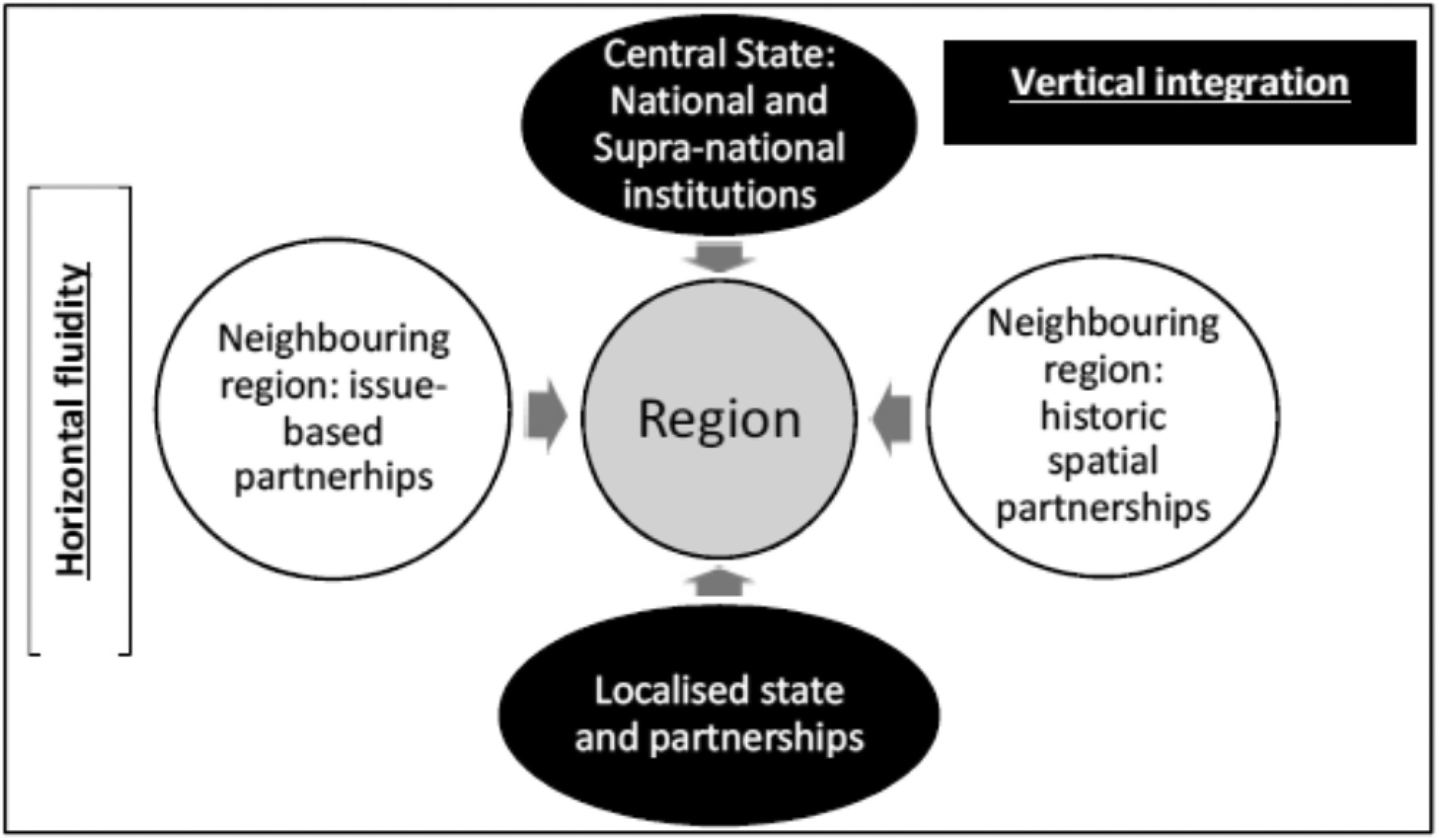
Sources of sub-national contestation/congestion.
Contestation and congestion thus position space as a framing device for progressing and privileging specific interests. Spatial articulations of the region are shaped via interactions of established or inherited geographies, embedded in local scale organisations (Brenner, 2004), and established or emerging interventions vertically applied through the strategic selectivity of the state (Jessop, 1999). These horizontal and vertical articulations emerge via a continued process of renewal, key strategic interests shaping state apparatus and iterations (Jessop, 1990, 2002). The result is a periodised framework of state spatial strategy, spatial and structural articulation in perpetual motion via concurrent episodes of structuring, casting and disruption (Table 1). Together these episodes respond to, work within, and challenge formal constructions and manifestations of spatial and issue-based policy (Healey, 2006; Jessop, 1990; MacLeod and Goodwin, 1999).
Episodes in sub-national periodisation framework.

Source: Author.
Structuring occurs as political-economic spaces are singularly transformed via vertical forces and horizontal collaboration to the most appropriate articulation for policy objectives (Jones, 2001). Current focus on the scope of city-regionalism to drive economic growth through agglomeration represents the latest such structuring of state spaces. This structuring similarly shapes policy refinements (Pemberton and Goodwin, 2010) through shifting rules and norms applied to reinterpret spatial economy (Healey, 2006) and reform a broader scalar architecture (Harrison, 2010a).
As this reform occurs, constituents are exposed to casting. State strategy formulates a common agenda (Brenner, 2004) and interpretations of spatial economy interact with key actor interests. Useful in understanding casting is the concept of intra-system hierarchies of self-organising systems (Jessop, 2007), the internal dynamics of regions uneven in nature and subject to privileging interests and coalitions through enduring structural interpretations and embedded political-economic interests. Emerging via established spatial relations (Drier et al., 2001; Swanstrom, 2001; Weir et al., 2005) or embedded cultural-economic institutions (Cooke and Morgan, 1998; Hall and Soskice, 2001; Jones et al., 2004), unevenness is reinforced as overarching policy frameworks or ascending market interests privilege specific localities (Cox, 2010; Harrison, 2012; Phelps et al., 2010).
Structuring and casting together create disruption. Despite clear boundaries, regions are not singular entities (Agnew, 2013). The legacy of previous structuring and casting episodes creates multiple, over-lain spatial articulations (Brenner, 2004; Kraemer, 2005). Applying revised spatial and structural interpretations forms underlying outsider or insurgent spaces (Jones and MacLeod, 2004). Both run parallel and peripheral to the region alongside reconfiguring pre-existing issues of territorial unevenness (Allmendinger and Haughton, 2009; Brenner, 2004). Insurgencies critique policy, projects and the legitimacy of regional distinctions, their disruption challenging regional articulation through formation of new or reconfiguration of preceding associations and alliances, either destabilising boundaries (Allen et al., 1998) or jumping scales (Smith, 1989). Such disruption is a critical aspect for further rounds of regional restructuring (Brenner, 2009; Harrison, 2010a).
Examining regional governance through a periodisation framework
Regional economic governance has seen numerous challenges emerge through recent changes. Within England, progression from a model of bounded regions to one founded on principles of agglomeration-concentration has pushed cities to the forefront. A response to growing networked tendencies in economic production, application of city-regional approaches has privileged urban accumulation in the structuring process. Such a framing however omits the multiple influences and relationships which similarly structure regions. Formal transformations are part of a dynamic process negotiating spatial articulation and policy intervention. To this extent, periodisation provides some insight into the processes of state spatial governance. The notion of policy periodisation is, while relevant, in need of further development to gain a more dynamic understanding of the governance process and the relationship between space, structure and policy. Arguing periodisation represents a framework operating in a dynamic capacity, this analysis examines how this periodisation manifests using concurrent episodes of structuring, casting and disruption, and how this process integrates spaces of economic governance with spatial economy at the regional scale.
The case study
The research focuses on the GBS LEP and specifically SSt, a locality consisting five separate lower tier LAs within GBS. The area represents an interesting case for examining the periodisation process and the shifting relationship between spaces of economic governance and spatial economy. Firstly, GBS represents a dramatic new regional space formed as administrative regions evolved into FEAs, transforming spatial demarcations within the West Midlands. Before 2010, Birmingham and Solihull formed the West Midlands Conurbation (WMC) with neighbouring Black Country authorities. SSt was within the separate Stoke and Staffordshire area. Secondly, a primary rationale for forming GBS was supporting manufacturing industry which had nationally seen a 30-year decline. Within SSt, such a decline was less significant, local manufacturing resilience repositioning SSt in policy priority terms. Finally, this spatial realignment was influenced by concerns within SSt the existing regional model could not represent their interests regarding policy objectives, structural requirements or funding acquisition. The research was progressed using discourse analysis from key policy documents from local, regional and national government alongside interviews with 20 policy makers involved in the GBS LEP.
Periodisation episodes in regional governance: Structuring, casting and disruption
Reformed spaces of economic governance in England occurred through a need to integrate sub-national administrative geography with FEAs. Explicit within this reform is the city-regional model as a means of addressing ongoing fragmentation among spaces of economic production. Simple reconfiguration of regional geography fails to recognise the complex set of emerging and inherited relationships involved in the governance process and how these influence any reconfiguration.
In this section, I unpick these relationships through examining influences reshaping the GBS area, with specific focus on its constituent locality of SSt. In my analysis, I use the periodisation framework set out in the previous section, considering the reform of regional governance arrangements through concurrent episodes of structuring, casting and disruption.
Structuring
Regional reconfiguration in England occurred in 2010 following election of a Conservative-led coalition government. Reconfiguration represented the latest round in ongoing revisions of regional geography, institutions, interventions and practices. Within this, clear periods can be identified through large-scale changes to state architecture, themselves subject to inter-term revision of support architecture, funding regimes and policy objective (Healey, 2006).
Regions were (re)introduced to the UK in 1999, aligning with requirements for a meso-level scalar architecture in EU structural policy. Formalising a political-economic relationship between sub-regional policy organisations, principally LA, this sub-regional layer also incorporated formal units largely conforming to the established upper tier structure of English local government. Through such structuring, the GBS–SSt relationship was at this point regionally integrated within the West Midlands (WM) area but sub-regionally separated.
Regional demarcation presented a similar separation to certain pre-established working relationships for the SSt authorities. Sharing a border with the East Midlands region, SSt held working relationships with localities outside the WM through Travel-to-Work Areas and issue-based policy partnerships. Regional arrangements however restricted such an engagement for being ‘part of a different region, why would we talk to them?’ (CEx, LA, 11–3-13). In place, new interventions and fiscal tools were introduced, focused first at sub-regional level but scaling up to regional control through service rationalisation and targeted intervention practices. In-period policy transitions toward city-based interventions (Harding et al, 2006) and a renewed ‘industrial activism’ focused on first a manufacturing renaissance (HMG, 2009) and later export-based growth (HMT, 2011), set the scene for SSt’s integration into GBS.
Alongside spatial revision, policy adopted partnership-based practice accommodating more market actors through strategic guidance and service delivery roles (CLG, 2006; Hefetz and Warner, 2004; HMG, 1997; HMT, 2007; Murphy, 2011). Extended partner networks incorporated several organisations only partially embedded in regional demarcations. SSt policy partnerships saw several organisations’ interests crossing regional boundaries, including Chambers of Commerce, Colleges and businesses.
Such interests were unfettered in spatial policy introducing LEPs after 2010 through the FEA and freedom of self-determination rhetoric (HMG, 2010a). Fundamental here was a rejection of administrative regionalism, although FEA interpretations were framed within a growing ‘city-first’ policy movement continuing the core-cities and city-regions model (Harding et al, 2006). SSt moved from designation via inherited geography to stronger integration with the WMC, albeit with the WMC similarly detaching Birmingham and Solihull from the Black Country. FEA implementation thus only partially addresses issues of policy separation, enforcing a new boundary between SSt and its border with Black Country areas.
Such separations are partly addressed through territorial overlaps between LEP areas. Overlaps imply a move toward more integrated and flexible spatial structuring responsive to multiple distinctions of spatial economy (Amin, 2004). Relationship formation and partner alliance cannot be separated from broader regional and local government changes. A more permissive spatial policy runs alongside changing fiscal, architecture, actor, and sectoral objectives. Through these, interpretation of spatial economy for SSt has evolved significantly.
Fiscal policy – specifically that of austerity – places pressure on local government finances. Funding replacement is thus a key objective. Birmingham’s core city status offers GBS partners ‘crumbs from a bigger cake’ (Director, FEI, 21–3-13) considering ‘Birmingham is … going to see the biggest growth. If we were to get scraps … we’d be pleased’ (Cllr, LA, 21–3-13) and ‘GBS has got … an Enterprise Zone … a City Deal … which is going to give (SSt) a lot of benefit’ (Cllr, LA, 4–6-13). Growth being driven by cities, alignment with related returns mitigates LA’s forced borrowing as ‘it will get paid back … from land sales, rental income, enterprise zones receipts’ (Officer, LA, 11–3-13). These changes similarly apply to reformed governance architecture. In place of regionally situated sponsors, patronage occurs through centrally distributed programmes. With potential to offer direct access to central government sponsors through the LEPs, here input from larger administrations such as city authorities compensates local resource limitations through a ‘range of knowledge and experience of areas … we’ve never traditionally got involved in’ (Officer, LA, 21–9-12).
This expectation extends into actor policy, with an onus on private sector engagement, and sector policy, manifesting via a privileging of certain types and forms of industry. As pivotal delivery agents, private business is expected to shape policy through detailed knowledge of local economy, representing a more intimate and influential role in defining priorities to preceding periods. In practice, this knowledge comes from LAs who understand ‘what’s happening in their area … the obstacles to growth … engaging with businesses’ (Board Member, LEP, 21–3-13). Instead, private business offers advocacy through dialogue with central government and ‘greater connectivity to … businesses outside of the LEP area’ (Cllr, LA, 4–6-13). To achieve this, both the type of firm and the sectors engaged falls within a ‘sort of core number … of business people’ (Officer, LA, 21–9-12).
Structuring episodes represent a complex set of intertwined responses linking spatial policy with associated functions applied through parallel actor, architecture, fiscal and sectoral policy. Ongoing developments in such policies present a complex, interweaving picture of the structuring process as new forms of intervention are applied within overriding policy periods (Figure 2). In the context of SSt, this structuring process has enabled its relocation from inherited political administration to city-region; this has not occurred without wider reform with implications for both interpretations of internal structure and the processes and practices adopted in its governance. In implementation, such structuring episodes create a distinct friction within and between regional spaces and their constituent localities. It is in this reconfiguration the casting process emerges.
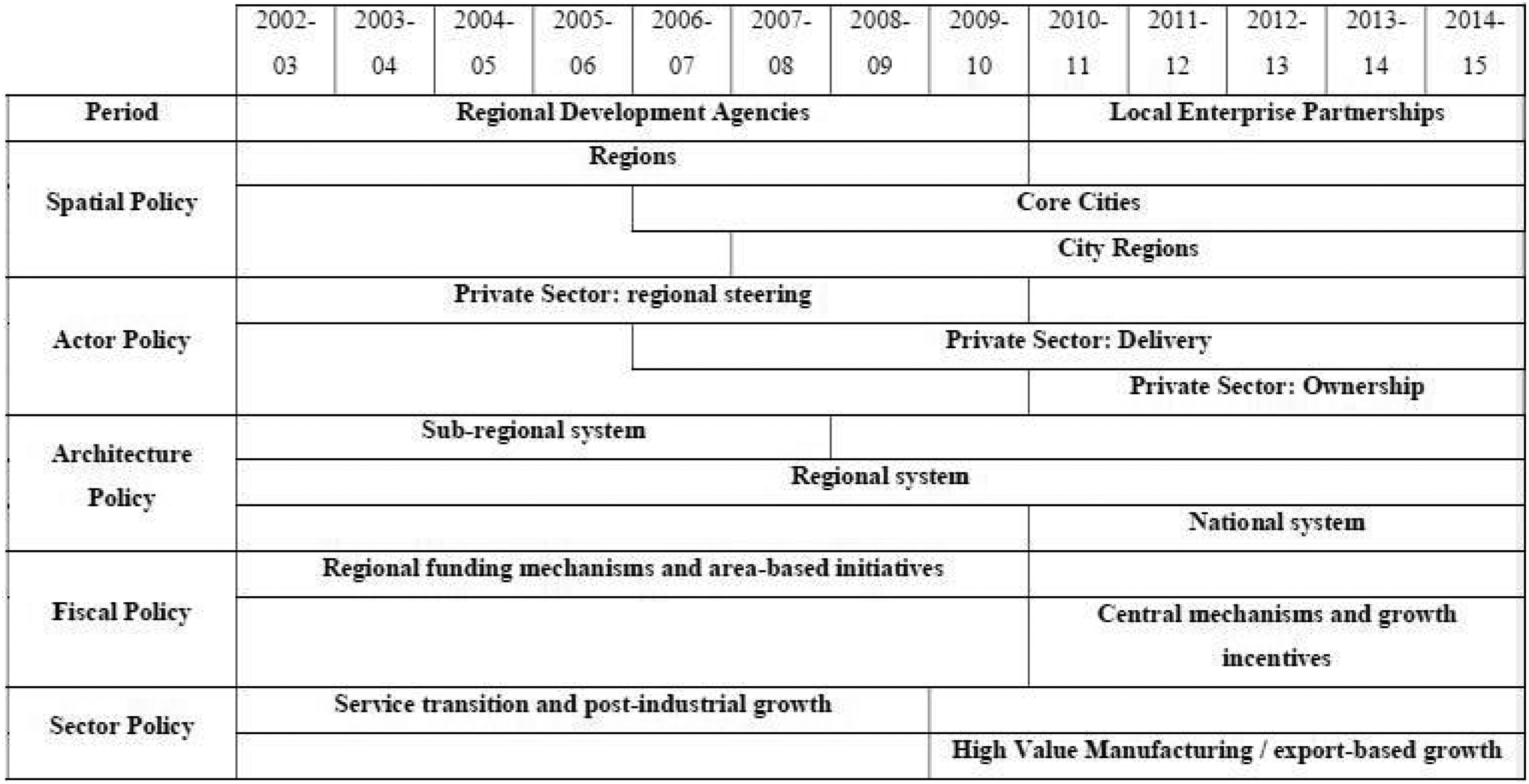
Sub-national spatial policy transition and transformation: structuring episodes.
Casting
Casting episodes occur as spatial, and spatially applied policies determine constituent localities’ role within regional arrangements (Brenner, 2004; Harrison, 2010b; Jessop, 2007). Since formalising a UK regional geography, spatial structuring and associated policy has cast regions, as part of a national growth system, and localities, as contributors toward regional objectives. This casting process creates hierarchies through which localities are interpreted and specific spaces, actors and interests privileged (Jessop, 2007). Casting therefore emerges in inter-scale, framing relationships between neighbouring or interdependent regions, and intra-scale forms, via constituent localities within a region.
As spatial units and policy are restructured, changing objectives and rhetoric exert an inter-scale casting defining regions’ and localities’ roles (Gomart and Hajer, 2003; Jones et al., 2004; Murphy, 2011). In SSt’s context, its GBS move linked national policy objectives for sustainable growth (HMG, 2010b), regional aims for ‘creating wealth to benefit all’ (AWM, 2007: 15) and SSt policy for ‘a diverse, dynamic, and sustainable … economy that underpins … quality of life’ (SSP, 2006: 1). SSt’s economic dynamism, outlined as part of a WM enterprise belt (Bryson and Taylor, 2006), separates the locality from preceding regional sectoral objectives, while setting it up for future integration. GBS city-regional integration in turn positions SSt ‘on the radar … of policy instruments’ (Officer, LA, 21–9-12).
SSt however holds dual-LEP affiliation, sitting within both GBS and Stoke & Staffordshire (S&S). SSt thus represents a pluralistic economy of fluid structural interpretation framed through consecutive yet uneven LEP designation, specifically GBSs’ privileged core city status. This uneven status allows SSt influence in S&S, intertwining the two LEP areas as GBS compliance offers ‘greater access to money and bringing in additional money to Staffordshire’ (Cllr, LA, 4–6-13). Casting for regions is thus rooted in state-sponsored investment and autonomy passed through national meta-governance (Allmendinger and Haughton, 2009) and supplemented through the flexibility of LEP’s relational nature via intersections formed by dual-affiliation localities. Uneven regional casting through application of national policy therefore reinforces central objectives, utilising dual-affiliation localities as an intersection extending this uneven rhetoric into secondary LEP policy (Figure 3).
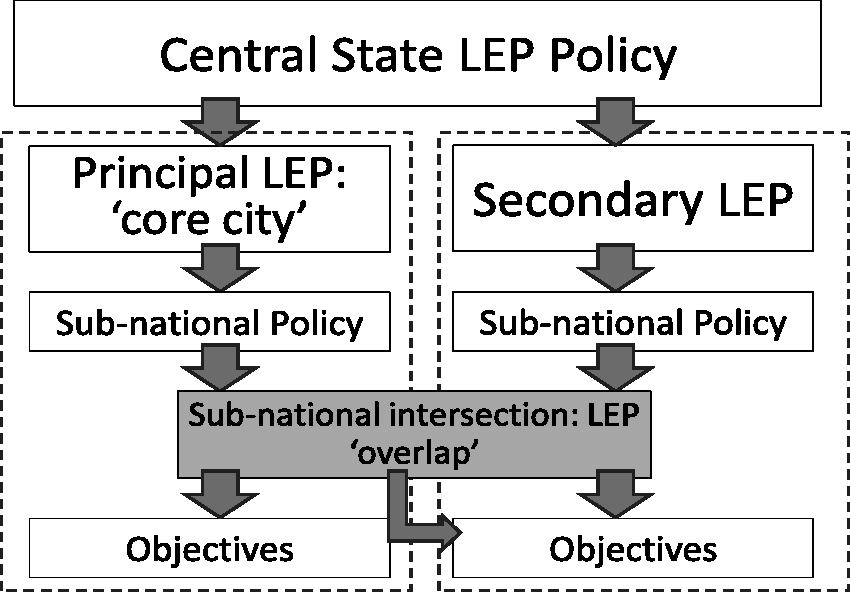
Regional policy intersection: primary and secondary designations.
Alongside this runs an intra-scale casting, where roles are reconfigured between localities and actors within regions. Compliance with central policy objectives assigns specific localities investment potential (Cox, 2010). Core city policy here translates as core-periphery (Martin and Sunley, 2011), Birmingham the ‘regional capital’ forming critical externalities (Officer, BRSO, 20–9-12). Against this, SSt provides the ‘green lungs’ (Officer, LA, 2–12-0–12) and ‘backdrop to the city’ (Officer, LA, 21–9-12). While reciprocal, this relationship remains uneven, GBS polarised between Birmingham and Solihull as economic locus and remaining localities patronised as ‘additional partners’ (Cllr, LA, 1–3-13).
Aligned to a core city, GBS localities are better positioned competing for investment (Harrison, 2012). Removal of regional state architecture here enables SSt to ‘jump scales’ (Smith, 1989) and access central government. Jumping scale is echoed in existing internal policy objectives. SSt’s structural dynamism and thus integral role in ‘rebalancing the economy’ (HMG, 2010b) is recast as supplemental, provision planning for expansion and amenity while enhancing lifestyle assets as ‘the Mercian Trail’ (Officer, LA, 4–10-12). Localised policy is thus reconfigured by peripheral influence contradicting local objectives in line with the interests of policy privileged (city) spaces (Allmendinger and Haughton, 2009; Jessop, 2007; Willi et al., 2018).
Recasting is similarly replicated among governance actors. Regional patronage from central government recasts both private sector and local state actors (Pugalis and Townsend, 2012). The private sector as policy agents and owners is fundamental for LEPs, which ‘only works if the businesses … most affected … are buying into it’ (Board Member, LEP, 14–12-12). Business roles however shift towards providing credible ratification for central government prioritisation, while a ‘core number of businesses … are fully engaged (with the LEP) … talk to the small business community there’s very little understanding’ (Officer, LA, 21–9-12). This selectivity is replicated among state actors. LAs have replaced RDAs as ‘the people … to help deliver on the wider agenda’ (CEx, LA, 11–3-13). Capacity is based on resource allocation linked to central sponsorship (Bentley et al., 2010; LGA, 2015) where compliance offers ‘power, money, and influence’ (Cllr, LA, 21–3-13) through the ‘only game in town’ (Officer, LA, 4–10-12).
Where casting really impacts is its potential for political detachment. Reconnecting the private sector with state strategy provides a ‘fantastic foil for politicians in … making difficult decisions’ (Director, LA, 11–12-12). In place of democratic accountability, private sector input shields politicians behind the LEP, protected from effective scrutiny and de-spatialising decisions for regional efficiency and performance. Place-based subtleties here become lost, the singularity of core-periphery engrained through GBS Board member interpretation – ‘People migrate to Birmingham and that means reliance on activities in this area’ (Board Member, LEP, 5–11-12); ‘The main focus is Birmingham and it will stay Birmingham’ (Cllr, LA, 4–12-12); ‘we do look more towards the conurbation’ (Officer, LA, 4–10-12); ‘whatever is going to be the economy of the UK in 2030, the pathway … will be built in the big cities. Believe anything else and it isn’t going to happen’ (Director, LA, 11–12-12). Here, intra-scale dependency focuses on income generation and organisational protection, to ‘line yourselves up with the right Authorities … to bring the biggest payback’ (Cllr, LA, 21–3-13) through financial incentives. Involvement in GBS offers SSt such benefits through Birmingham’s Enterprise Zone, financial gains ‘put(ting) things in place that … grow the economy … through increasing our business rates’ (Cllr, LA, 21–3-13). This makes explicit the link between organisational needs and economic policy.
Disruption
Through structuring and casting episodes, new understandings and interpretations of regional economy and its specific actors emerge. As regions reconfigure and policies evolve, the privileging of specific interests sees adjustment (Jessop, 2007) within a set of established and embedded political geographies (Brenner, 2004). The resulting disruption is critical in the periodisation process.
Disruption occurs in two specific forms: structure-enforced and structure-challenging. Demands for increased regional and metropolitan competitiveness (Bristow, 2010; Harrison, 2012) saw new regional spaces founded on urban accumulation models (Amin, 2004; Martin and Sunley, 2011) challenge established spatial and partnership relations (Bentley et al., 2010; Pugalis and Townsend, 2012). This change represents a structure-enforced disruption. Simultaneously, such new articulations are challenged through policy resistance manifesting via collective institutionalism (Healey, 2006), core personnel (Jones et al., 2004) and inherited geographies (Brenner, 2004). This represents a structure-challenging disruption.
Structure-enforced disruption occurred through regional reconfiguration of SSt’s internal and external relationships. Integration into GBS reinterpreted SSt’s primary economic geography, forming new dependencies led by city-regional understandings. This interpretation manifests unevenly within SSt as the WMC dissolved as part of the same regional reconfiguration. For the five LAs forming SSt, whilst spatially integrated into a new unit as part of the GBS area this structural integration is uneven and challenges SSt’s continuity as a policy unit. These spatial disruptions are replicated in policy objectives as SSt’s dynamic role jumps scale (Smith, 1989) to Birmingham, capitalising on presumptions of agglomeration value, while allowing for ongoing commitment to local ‘dynamic growth’ aspirations.
As a result, structure-challenging disruptions emerge. LEPs were progressed to deliver greater engagement with local actors, particularly businesses, yet remain dependent upon national scale policies and interventions (Bentley et al., 2010; Pugalis and Townsend, 2012). A pivotal role for business representatives is thus gaining favour with central government; ‘you’ve got high profile people … who … get through to senior members of Government’ (Officer, LA, 21–9-12); ‘The business board members are making connections with Government’ (Board Member, LEP, 21–3-13); ‘The LEP doesn’t have particular powers. It has authority and credibility through quality of the Board’ (Officer, LA, 25–9-12). Pursuing such favour occurs at the cost of integrating local firms and established localised partnerships, prioritising relationships with larger businesses; ‘LEPs are very high level … there is still a disconnect between the understanding of local business’ (Officer, LA, 4–10-12); ‘If they get a big business MD … I’m going to be listened to more than (someone) who’s got a little business’ (Chair, BRSO, 12–11-12); ‘One of the reasons we joined the GBS LEP … there aren’t many bigger businesses on the S&S LEP’ (Cllr, LA, 4–6-13).
Such business representation helps LEP engagement beyond the region; this dynamic also detaches representative organisations from locality. Austerity’s impact on LAs (LGA, 2015) demands alternative income, acquired through compliance with central incentives – ‘Home building is a priority … income from the New Homes Bonus … allows us to continue’ (Cllr, LA, 21–3-13). Incorporating non-statutory receipts into local strategy sees alignment based on resource access (Cox, 2010), a further jumping of scale detaching economic development from local economy to mitigate organisational crises.
As such disruptions emerge, diminished embedded interests (Jessop, 2007) create or reinforce relationships which function parallel to and thus challenge dominant spatial forms and policy priorities (MacLeod and Goodwin, 1999). An outcome of its own form of insurgency, SSt’s dual LEP affiliation retains links with historic articulations (Brenner, 2004). Disruption here emerges through political and functional tensions, partly around complications of funding distribution – ‘Government have found difficulty in administering … local transport funding for example … (giving) money allocated to (SSt) for transportation to S&S’ (Cllr, LA, 4–6-13) – but also resisting the city-region itself. Here the new space and priorities result in ‘a lot of discussions … not really related to us’ (Officer, LA, 2–10-12) for certain localities. Such a disruption is itself partly state-sponsored, such as additional pressures and responsibilities placed on LAs through the ‘Duty to Cooperate’ (CLG, 2011) congesting spatial collaborations (Harrison, 2010b) with disruptive potential.
Periodisation dynamics of regional governance
In the previous section I examined the creation and recreation of spaces of economic governance and the process through which these spaces are integrated with spatial economy. Using the concept of periodisation, I have argued creation of these spaces is not static, instead involving a dynamic process of negotiation and revision between multiple horizontally and vertically distributed actors. Within this process, three critical episodes are played out concurrently as regions and constituent localities are structured, cast and disrupted.
Fundamental to this dynamic is the presence of informal or insurgent spaces challenging regional articulations (Jones and MacLeod, 2004). The transition between policy periods and related spatial and structural responses occurs through increased congestion resultant of the mobilising of such insurgencies through broader interaction of scales and actors (Amin, 2004; Bristow, 2013; Harrison, 2010a; Jones et al., 2005). Here this is particularly seen in the distinctive overlaying of policy transition and transformation occurring within specific periods (Figure 2). A similar dynamic however occurs across varying scales of intervention and between separate policy components, thus replicating this structuring, casting and disruption. These broad and inter-dependent manifestations of the structuring–casting–disruption (SCD) dynamic embed a fluidity and therefore protean nature within the formation of spaces of economic governance. The result here is a constant push for legitimacy and integration in formal articulation, policy positioning and interpretation among multiple layered spatial permutations (Allen et al., 1998; Brenner, 2004; Jones, 2009; Kraemer, 2005).
Multiple permutations in spaces of economic governance represent a consolidation of the broad reaching relationships embedded within such spaces. These relationships are founded upon institutional working practices (Jones et al., 2004), transitioning spatial interpretations (Allen et al., 1998; Brenner, 2009; Jonas, 2012), and economic and cultural identity and dependence (Cooke and Morgan, 1998; Hall and Soskice, 2001). They are similarly enabled via shifts toward multi-stakeholder and multi-scalar practices (Fung, 2015; Harrison, 2010b; Soja, 2015) and the congestion and contestation created via simultaneous horizontal flexibility and vertical integration incorporated in the governance process. Localities pluralised through overlapping regional spaces present a clear manifestation of the problems such multiple permutations cause in relation to utilisation and exploitation of the status, resource and structure of specific actors to achieve and progress structural, institutional and organisational objectives (Allen et al., 1998; Cox, 2010; Jessop, 2007). SCD dynamics are rooted in the formalisation of spaces of economic governance, the spatial and functional privileging of specific interests, and a response both compliant with and resistant to a hierarchical system of spatial, scalar and structural conceptualisation.
Spaces of economic governance can therefore only be partial representations of spatial economy and economic interests; application of an SCD framework in exploring the periodisation process illustrates not only the dynamic nature of how this process both forms and frustrates governance arrangements, but also the sensitivity of this process to in-period policy adaptations and parallel interventions. The partial nature of governance arrangements makes both the region and its constituent localities points of ongoing contestation within regional spaces formal and insurgent. Within each of these, the context for its intra-regional relationship and role is plural, in this case consecutively ‘backdrop to the city’ and dynamic industrial cluster.
Regional spaces thus exert formal influences on spatial manifestation, interpretation of structural economy, policy and resource. As previously structured historic and incumbent arrangements shape these relationships, and vertical pressures and local resources cast specific roles, informal alliances with and embedding in other spatial articulations exert tangible pressure to disrupt such historic functional and cultural-economic relationships (Brenner, 2004; Cooke and Morgan, 1998; Hall and Soskice, 2001). This spatial contestation challenges sub-regional commitment to dialogue, appropriation of identity, and manifestation of objectives; its outcome is a protean characteristic, spaces hovering between articulations and interests strategically or culturally integrated. Through these influences and relationships, the alliance and integration of sub-national spaces undergoes a tidal heating of sorts (Note 1), involving formal structuring, vertical casting and informal disruption, which perpetually challenge regional integration and the shape and nature of regions and localities (Figure 4).
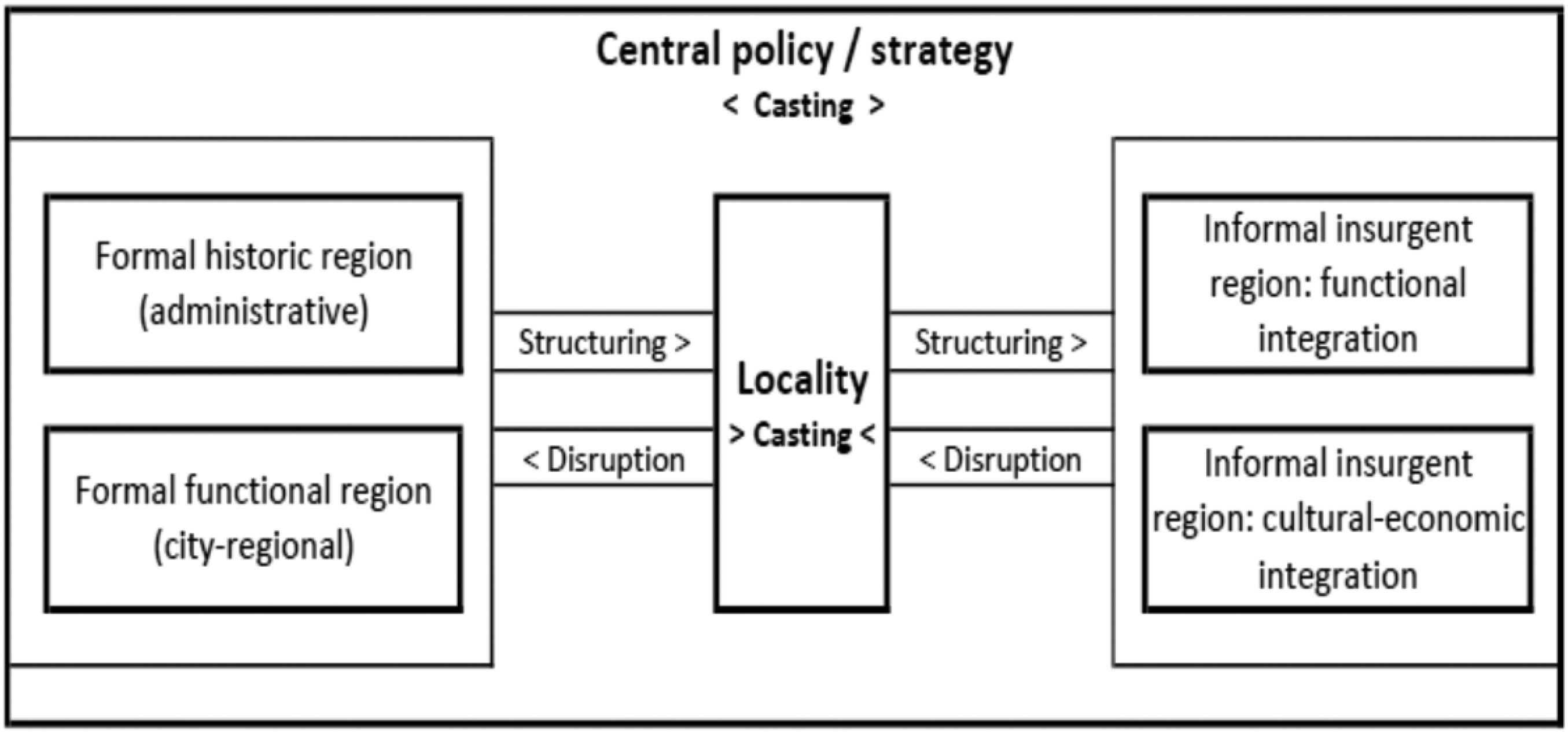
Tidal heating of regional spaces: phases of structuring, casting and disruption.
This tidal heating sees both historic and functional permutations exist concurrently. Withdrawal from any overlapping formal or insurgent spaces is never absolute. Iteration and extent evolve through the periodisation process and its SCD dynamic, steered by spatial and functional revisions of state strategy and its concomitance with structural and organisational interests. Through this transition, regions and localities refine the extent of their association and requisite practices in pursuit of critical interests.
Conclusion
In this paper I have discussed spaces of economic governance and their evolving relationship with spatial economy considering regional restructuring dynamics. Critical in this has been reading governance as a process involving complex inter-spatial relations occurring at and between multiple scales. I have argued regional spaces of economic governance are both periodised and relationally constructed (Brenner, 2009; Jonas, 2012), their transition part of a broader state spatial strategy enforced by national and supra-national shifts (Jones et al., 2005; Pemberton and Morphet, 2014). This periodisation achieves a rescaling of regions through spatial reforms to reconcile challenges of an increasingly networked economy. Such attempts to reconcile spaces of economic governance with those of economic production have arguably yielded limited results.
In place of their integration, this periodisation is subsumed in an ongoing process of contestation to determine optimal regional articulation and its economic structure (Brenner, 2004). Periodisation is in this context a framework for ongoing regional transition, identified through temporal demarcation between formal scales. Its manifestation is more integrated, involving not only spatial policy but also the influence of actors, delivery mechanisms, finances and sectors.
These influences I argue form a dynamic process involving concurrent episodes of structuring, casting and disruption. Structuring articulates both spatial and functional arrangements, casting determines roles within these arrangements and disruption challenges perception of representation or affiliation. This SCD dynamic is reinforced through ongoing scalar-network fragmentation (Cox, 2013) and the forms of new regionalism experimented with to mitigate their effects (Soja, 2015). Internal negotiations of the regional scale are thus extended, incorporating overlying scales including national policy frameworks (Pemberton and Goodwin, 2010) and resultant insurgencies of marginalised local relationships and inherited geographies (Brenner, 2004; Jones and MacLeod, 2004).
Understanding these dynamic processes is integral for regional governance. Tendencies to interpret regional spaces as singularly temporally and spatially defined are prominent within policy approaches and academic research (Agnew, 2013). Against this has emerged more abstract interpretations framing such spaces as fundamentally fluid (Jones, 2009). This analysis progresses these debates by proposing a framework to explain the dynamic process linking singular, structural arrangements with the fluid and dynamic nature of state spaces (Cox, 2013). Thus, local attachment such as that seen between SSt and GBS is only partial, occurring concurrently through formal articulation, inherited geography and functional or cultural-economic integration (Brenner, 2004; Cooke and Morgan, 1998; Hall and Soskice, 2001; Jones, 2001) as part of a process of adaptation (Soja, 2015). An ongoing set of disruptions runs with each of these relationships resulting in a tidal heating of sorts – a replication of celestial gravitational forces – regions perpetually morphing as localities are phased to varying degrees through macro-economic conditions, policy priorities and funding mechanisms.
This analysis holds significant implications for policy actors. Recent rounds of regional reform have been framed by a primary focus on city-regions on presumption of the benefits such arrangements yield. While the concept of ‘real economic geographies’ proves attractive in the context of policy-makers pursuit of an optimal scalar fix, the risk here is a continuation of a ‘one-size-fits-all’ approach rather than implementation of structurally integrated arrangements which address localised issues. The periodisation approach may here be useful in understanding localised dynamics across space, identifying potential effects of new spatial governance arrangements on key collaborations and partnerships, and reconciling the conflicting challenges of rapidly changing spatial governance arrangements with evolving local production patterns.
This paper in its analysis provides several avenues for further research. One is the continued examination of the SCD dynamic. The GBS–SSt case represents a very specific location during a period of economic instability and political change. Examination of this phenomenon in more stable contexts may provide interesting comparisons, particularly where regional geography is more consistent. A longitudinal analysis examining progress of the periodisation process at different scales may also be useful, particularly in understanding the relationship between periodisation occurring at different geographical scales.
Footnotes
Acknowledgements
The author would like to thank the anonymous reviewers for the valuable comments and suggestions made to improve the quality of this paper. Additional thanks are extended to Professor John R Bryson and Dr Julian Clark for comments on this work during its development.
Declaration of conflicting interests
The author(s) declared no potential conflicts of interest with respect to the research, authorship, and/or publication of this article.
Funding
The author(s) disclosed receipt of the following financial support for the research, authorship, and/or publication of this article: This work was supported by the Economic and Social Research Council (grant number 1650742).
