




Abstract
From imperial ‘unhappy valley’, to decapitated province, commercial capital, and 21st century megacity, this article reflects on relations of separateness and connectivity between Sindh and its capital city Karachi. These culminated in Pakistan’s post-Independence years, in official and political language, governances of national, provincial and city division, and political rhetoric and violence. The article asks what else might be uncovered about their relationship other than customary alignments and partitions between an alien urban behemoth and a provincial periphery. It develops a topographical view to refer to the physical arrangement of environments but also people’s profane, spiritual and political connections and losses involving place and dwelling. This is expanded through examples of land appropriations involving urban real-estate development, environmental migrations and displacement, the idiom of the hijra and Sufistic devotion, and ethnic nationalist and religious extremism. The article questions ways losses of ground and attachment might unite people across provincial divides in an alternative, forward motion of cohabitation. It reveals a multi-layered historical tracing of ways that Sindh, as it is lived in Karachi and vice versa, digresses and wanders through deep cross-regional dynamics and developments. These create new departures from self and place, and rebuff the tendency to centre ‘other’ knowledges as the starting-point and epistemology for studies of Karachi and Sindh. Last, Karachi is a useful optic for thinking about continuities of colonialism and postcolonialism, crisis and fracture in South Asia; ways these are infused with planetary urbanization dynamics, and local, regional and national developments that resist easy universalism.
Introduction
Foreshadowing Pakistan’s Independence, the English scholar D.H. Horley, having learnt Sindhi, published selected translations from the Shah Jo Risalo (Message of Shah), a compendium of works by the revered Sindhi poet Shah Abdul Latif Bhittai (1689–1752) (Horley, 1940). Interwoven through Horley’s translations of the sung ballads (surs) is the classical tradition of Sufi mysticism and theme of seeking God through renouncing the ego. Through evocations, laments, and joyful exultation, the poetry invokes a symbolic topography of wind, water, earth, rain, rivers, deserts, and animals that flows uninterrupted through the people and land. Horley’s selection Sur Samandi urges sailors and fishermen to sail on the waning monsoon winds and worship the Deep ocean, a metaphor for God. Horley sought, in the European tradition, to capture Sindh’s immemorial beauty in these poetic ballads about romance, suffering, and the land – his intellectual and cultural sojourn buttressed by the British conquest of Sind in 1843.
Deeply contextualised by older Sindhi histories of military invasion, cultural assimilation, and riposte, British rule saw Kurrachee leap from what militaryman Baillie (1839/2013) describes a ‘miserable native fortress into a civil town of considerable size’, forcing the ancient capital Hydrabãd to abdicate. When the British relinquished India in three parts a century later, Pakistan was born from the ‘two nation theory’ that Hindus and Muslims could not co-exist. Mohammad Ali Jinnah established Urdu, symbol of Islamic identity in Northern India, as the national language. West of the Indus Delta on the Arabian Sea, Karachi became Pakistan’s first capital until 1959. Karachi, a Sindhi-majority city, became an Urdu-speaking ‘refugee city’ of Indian Muslims who populated ‘camps’, squatter settlements, and the properties of a million fleeing Hindus (Ansari, 2005). This third largest ever-recorded refugee migration, appositely disrupts the contentious silence about refugees in urban studies, and images of refugee settlements situated in spaces of urban marginality and temporariness (Sanyal, 2014).
Sindh province is now predominantly ethnically Sindhi, home to 94% Pakistan’s Hindu community (c. 3 million) (http://www.pakistanhinducouncil.org). Its northern and central districts comprise the heartland of Sufi Islam in Pakistan. Karachi’s unruly, exponential growth from 450,000 to 1.137 million by 1951 continued. With a population of over 11 million, and much higher unofficial estimates, Karachi is also the world's largest Muslim city, the world’s seventh largest conurbation, and projected to become the world's fourth most populous city by 2030 (World Population Review 2020). Many recent large-scale infrastructural and development projects in Karachi, funded by Chinese loans and US aid and loans, disrupt ideas of imperialism and Empire as essentially Western and align with major imperial reconfigurations of urban planetary power involving China in Africa, Asia, and Europe (Sidaway et al., 2014). They reflect a complex urbanity comprised of colonial and postcolonial contradictions, fractured social scales, identity politics linked to place, and global neoliberal imaginaries of a world-class city linked to replications of Dubai or Singapore (Anwar, 2014).
This article takes Karachi as a useful optic to think topographically about continuities of colonialism and imperialism, and crisis and fracture in post-colonial South-Asia; the imperial and ecological dynamics of planetary urbanizations that infuse them; and ways analytic attention to local, national, and regional crises can resist theoretical universalism regarding the contemporary urban. Specifically, it draws examples from historical and contemporary, and real and imagined modes of connectivity and separation between metropolis and province. It builds on shifting intensities of multiple divisive nationalist claims to soil, displacement, and unrealised desires for a homeland that have largely shaped relations between Sindh’s natural (of the soil) and its unnatural (migrant and Urdu or other-speaking) inhabitants. It also addresses a wider preoccupation in Pakistani society: that is, the nervous apprehension of identity, the tentative force of the push for rights, paradoxes of national and theological idioms of finding peace or assimilating the experience of strangeness, alienation, fragmentation, and violence (Ansari, 2005; Gayer, 2014; Jalal, 1995; Shaikh, 2009; Verkaaik, 2004). The fractures that accompanied Karachi’s monstrous expansion and vexed annexation from Sindh are interwoven with complex traces of colonial and pre-colonial pasts, as were colonial rule and land dispossession textured into the very institutional form of the state (Jalal, 1995). They shaped differences between capital and ‘interior’, with capital denoting commerce and the time-clock of colonial rule and civility. The ‘interior’, like other unconquered colonial interiors, denoted a fecund place of mysticism, saints worship, fascination, and unending mystery. They also shaped sharp urban–rural and socioeconomic divides that fuelled nationalist, ethnic, and separatist politics, with Karachi dominating as Pakistan’s industrial and commercial capital, and over 75% of Sindh’s rural population living below the poverty line (UNDP, 2015).
While Pakistan avowed its identity as a postcolonial Islamic state free of British imperialism, in appropriating the ideas and technologies of sovereignty and nationalism, it acted imperially (Anand, 2012). This produced the ‘sacralization’ of party politics, incomplete and unequal development regimes, the evolution of an ‘Islamic army’, military-foreign policy approaches justified through Islam, the suppression of non-Muslims, and a lack of a consensus on Islam articulated through perpetual ethnic, nationalist and religious differences that Shaikh (2009: 8) likens to a ‘cancer in the body politic’. Notwithstanding, much evidence exists of the local syncretic realities of people’s lives in Pakistan and across South Asia (Jones, 2014). Parallel forms of internal suppression occurring contiguously across post-partition South Asia similarly established ‘postcolonial informal empires while instilling constant anxiety about the precariousness of the imperial state project’ (Anand, 2012: 83).
This analysis does not focus on these alternations, divisions, and comminglings between the borders of Sindh and Karachi cartographically, or as statistical fact. It seeks to destabilise any pre-determined arrangements of places and parts and to open an interstitial terrain between classifications and borders between territories and communities. It also eschews re-reading the city through corrective postcolonial identity politics – with its emphasis on ethnicity, rights, exclusion, sectarianism, opposition to military oppression, and the spatialised urban geography of militant ‘no-go’ areas. Instead, I propose that looking for convergences between urban life and topography can offer fresh departures for examining relations of strangeness and familiarity that characterise Karachi – as it is moved by the waxing and waning, and ebb and swell, of growth and change. Topography refers not only to arrangement of the natural and artificial physical features of an area (OED), but also to an imaginary, real, urgent, and remembered patina of connections of people to the soil, land, and dwellings they live in.
I offer a concept of ‘Sindh in Karachi’ as a topography of urban deserts, rivers, hills, and terrain; a toponymy of dwellings, communities, localities, shrines, homes, and historical traces dissolved and refracted within the present. This is a mnemonic space for the urbanised spirits of saints and repeated colonization to emerge, with all colonisation’s dissimulations and deceits of friendship and betrayal. It draws us to the emotional dimensions of topography, or topographica, and to how a place makes itself felt. It is not about reprising the colonial ethnographer’s story for the present, the national one, or one of any ethnic community. A topographical reading, I argue, can disrupt some real and imagined boundaries of history that separate Karachi and Sindh. It provokes questions about whether such a reading might become the object of other knowledges and constructions, planned and unplanned and, like the city, an alternative, fully contemporary force. Might it introduce something else within the border between two things, that is, ‘Sindh’, and ‘Karachi’? Political geographers of South Asia have deployed topographical notions to highlight the failure of national projects that determine territory and borders as symbols of postcolonial national unity. Akhter (2015) examines the case of water, specifically the river Indus, as a simultaneously unifying (national) and fragmenting (regionalist) force in Pakistan. At the Bangladesh–India border, Cons (2017: 3) employs the metaphor of ‘seepage’ to invoke, not imaginations of catastrophic inundation (of migrants or climate refugees), but quotidian movements across bordered spaces that signal changes at ‘inexorably different scales and temporalities’ between land, water, and spaces between. Capturing the temporalities of such movements, Hurd et al.’s (2017) metaphor of a tidemark describes ‘layers of embodied memories of movement and emotion’ (34). Tidemarks, intrinsic to ‘border temporalities’, are non-linear, concurrent, parallel, and synchronic; the past, lived present, and future coexist as people shape borders across which they move or are stopped (4). Correspondingly: might we, through border seepages, leakages, and tidemarks, become sensitised to the spatial and temporal rhythms of urban lives, and their lapping and overlapping histories moving between Karachi and Sindh?
This interpretive movement or exploration also describes a ‘Timely’ departure, but not in terms of the linear civilizational progress the British claimed of their arrival in Karachi (Burton, 1851). Rather, letting knowledge wander across the boundaries of existing orthodoxies can introduce unexpected incursions of critical disruption to the historical archive, and transform a view on the present. It thus evokes the silenced schisms of violence, severance and war, and the figure of the exile as constitutive of loss – that is, Sindh’s loss of Karachi, and the loss of homeland for migrants (including Sindhis) (re)settling on an alien landscape. Therein, it reveals ways the body of an exiled and migrant metropolis becomes sundered, split, and transformed into a theatre of repeated violence, wherein the conflicts, and physical and ontological displacements of strange encounters and cleavages from multiple pasts are dissipated through the city landscape. It also reveals ways such relations are cohesive and fecund with possibility.
Regarding ‘why partitions fail’ in South Asia, Jones (2014) emphasises colonial hubris, ignorance, and the disconnect between realities and views based on categorical data such as religion: It is ‘not that they drew the line in the wrong place; the problem is drawing lines in the first place’ (298). This bears on the epistemological value in a certain roving off familiar maps and borders and debates about geneaological versus motile forms of knowledge (Bergson, 2002; Holbraad, 2012; Ingold, 2011). It involves challenging false equivalences drawn between the map and the moving border, the fixed representation versus the fluvial flow of life, the assumed isomorphic relation between words and life, and taking a creative, contingent, and more kinetic approach to moving, living time. This can reveal ways that ‘Sindh in Karachi’ creates new pathways as it wanders through time and space, rather than following pre-defined space, and forms what De Certeau describes as a ‘migrational or metaphorical city’ (1984).
Within this framework of cartographic deviation or detour, Karachi and its incursions into Sindh also stand for another kind of topography: a palimpsest of localities and neighbourhoods that in their successive multiple re-inscriptions, reclassifications, constructions, demolitions, ruins, repairs, ghostly outlines, and renovations undo and remake historical time. Sites of destruction underscore the losses of social value invested in them, and the existential losses of people whose land is trampled, pleas dismissed, and voices unheard (Jackson, 2013). Arguably, the city’s concrete layout exists only in historical time, on the map or city plan before displacements and obliterations undid memories of what it might have been (Pandolfo, 2018). Pandolfo (2018) explores the idea of the city as uncovered memory. She discusses Freud’s likening of the city to a layered grid of psychic space in relation to the notion of dwelling (material and psychic) as punctuated by knots of significance, memory-work, and forgetting. She links Freud’s metaphor of the psyche as city to his mystical notion of an ‘oceanic feeling’ to refer to a merging into the unbounded, and a sensation of eternity. This is echoed topographically here in people’s habituation to ocean, rivers, marshland and waterways, a kind of primal attachment and feeling of enclosure and envelopment. It intimates ways watery landscapes nourished by the weather evince womblike or deeper psychological structures like secure attachments.
Pandolfo’s appeal to Freud reminds us that rhythms of psyche, memory, and the city are commensurable. It means we can uncover oscillations between corporeal mortality and eternal spirituality in the living memory of Shah Latif. These cadences are also present in traces of lives and communities before and after the devastations of death, exile, displacement, and Sindh’s crises of government, global capitalism, expulsion, and ethnic majoritarianism. This perspective can illuminate new interactions, problematise dominant cartographies that privilege Western or other hegemonic ways of knowing, and highlight ways that understandings of movements of assimilation and enculturation demand a certain linearity that people in Sindh might incorporate and also refuse. It can keep in view ways that knowledge emerges in movement as we go along and history, and the city, are produced ‘in the track of things’ (Benjamin, 1999: 212).
A topographical reading emphasises the continual syncretic fluidities and mobilities of relations and multiple place-making activities between people and environments. It bears on new political-economies of imperialism that connect human and non-human relations globally and locally. This does not denote the imperial transports of humans, plants, and other species for colonization/conservation schemes, but the ecology of planetary and post-colonial urbanization dynamics that distend mega-cities like Karachi (Sidaway et al., 2014). Brenner and Schmid’s (2015) planetary urbanization thesis is undoubtedly germane, with its imagery of new megacities and megalopolises, the transcontinental expansion of infrastructural networks, and the seizure of traditional hinterlands for large-scale energy and development projects. Likewise is Ruddick et al.’s (2017) critique of these authors’ neglect of local crisis, and the occlusion of a social ontology of the urban and its political capacities in favour of the spatial. Attending to ontologies of crisis and resistance in Pakistan inevitably evokes the specter of violence. Namely, several decades of brutal conflict in Karachi, 1 ongoing insurgencies in Balochistan and Kashmir, East Pakistan’s secession, three India-Pakistan wars, and India’s and Pakistan’s development as hostile nuclear powers. It also augurs the tainted birth of the nation: the foundational violence which was nurtured by Pakistan’s political powers to legitimate the very form of democracy, or military rule, by producing a sense of continuity with the violence of independence and colonial rule (Khan, 2017). Further, it points to the continuing analytic value of postcolonialism in examining genealogies of unequal urbanisms, sites, landscapes, and in placing megacities such as Karachi on a more level analytic and comparative plain (Myers, 2014).
Methodologically, in this article ‘Sindh’ refers to all provincial districts except Karachi, and Karachi to a separate administrative and political unit. I draw on 20 years of personal and academic connection with Karachi, during which I have analysed aspects of Karachi life as an anthropological fieldsite, and site of cultural, political, and phenomenological inquiry. This conceptual paper engages a critical re-reading of the historical archive that tends, not exclusively, to read Karachi’s violent fragmentation predominantly through the lenses of ethnicity, class, and language. These presumed ‘truths’ in turn are reflected in political, media and nationalist discourse. Hence, I draw on a range of these sources.
Swell and ebb
Karim (2018) estimates around 8 million people missing from the 2018 census figures for Sindh, and 5 million uncounted in Karachi. Given the census informs public funds allocations, he is deeply critical of Karachi’s cited decline in population growth, from 3.5% annual growth in the 1990s to 2.5% during 1998–2017 (a figure also disputed by the Sindh government) compared with a doubling of Lahore’s population during the same period.
In the lacuna of unanswered questions around census data, Hasan highlights substantial recent migrations of Sindhi-speakers into Karachi, and estimates around 12% Karachi citizens are now Sindhi speaking (Aug. 2018, personal correspondence). Sindhi speakers work in the fishing industry, in coastal villages, or the Gadap and Malir oasis as farmers; as middlemen in Karachi’s wholesale markets, white-collar workers, bankers, bureaucrats, estate and travel agents; as students and doctors in Karachi hospitals. Sindhi poetry recitals, music, drama, book launches, and television plays, all produced in Karachi, occur regularly; Sindhi involvement in non-Sindhi events is familiar. The children of rich waderas (landowners) are ‘Karachiized’. ‘Simple’, contends Hasan. ‘Sindhis are reclaiming their city after seventy years of Punjabi and Mohajir colonization’. Hasan’s optimism about middle-class Sindhi reclamation of native land downplays his own and others’ work on the loss of Sindhi pastoralist and village life at Karachi’s Western edges, and the forced disappearance of around 3000 goths (villages) of predominantly Sindhi and Baloch agro-livestock and pastoralist communities in the past two decades (Anwar, 2014; Hasan, 2015). Most peri-urban settlements here occupy uncultivated, state-owned land which colonial custom had made accessible for tenants’ (migrants, workers) homesteads (Anwar, 2018).
Cons (2016: 13) emphasises the permeability of India–Bangladesh borders in order to reflect on ‘questions of migration, terrorism, trade and security’. His concepts of anxious territory and elastic lands refer to the ‘strategic expansion and contraction’ of property boundaries, and legal and political regimes of governance that are continually reformatted and destabilised. These bear aptly on the regulation and expansion of the Sindh-Karachi border-zone where, despite existing land acts designed to protect the destruction of informal settlements, quasi-legal and outright illegal land acquisitions are catalysing the rapid construction of mega-residential enclaves, infrastructural, luxury and commercial projects, gated communities, luxury housing estates for overseas Pakistanis, education cities, and shopping complexes. These utopian visions are permeated with anxieties about security.
Relatedly, Anwar (2018) explores receding rurality and economic power and value struggles over Karachi’s peripheral lands, and unpicks complex relationships between law, land, municipal governance and closely interwoven legacies of pre-colonial and colonial property-relations in the ‘booming periphery’ of the city’s changing agrarian–urban frontier. She argues that much of this contemporary spatial ‘fix’ unfolds in the realm of informality wherein the state enables ‘zones of exception’, for example Defence Housing Authority City and Bahria Town Karachi (BTK), by creating special benefits for corporate investors and the military by suspending laws, altering land use, or acquiring land forcibly (49). For example, the BTK development was enabled by real-estate tycoon Malik Riaz’s long-standing partnership with the Pakistan navy. This ‘illegal’ process of land acquisitions that enables projects like the BTK is hardly external to the domain of law but constituted, Anwar argues, by the very basis of state authority and withdrawal of state regulatory power regarding land (51). Unsurprisingly, the public–private partnerships undergirding the transformation of rural lands into profitable urban real-estate developments did not profit small-scale farmers, sharecroppers and pastoralists, but rather diverse state and private actors including developers, politicians, the police, brokers and waderas themselves (54).
The incorporation of traditional hinterlands into Karachi’s official contours, and the expansion of a ‘world class’ city that is clean, safe, and erased of the poor has increased expulsions, displacements, and community protests. It exemplifies wider processes of ‘slum-free’ urbanization in South Asia that are driven by projects of postcolonial governance and power between Asia and the USA, in the penumbra of European empires (Roy, 2014). After decentralization in 2001 and US economic sanctions were lifted in Pakistan, Karachi’s landscape was remapped. Sindhi, Baloch, and Mohajir actors now co-operated around the incorporation of rural land into highly lucrative urban real estate development. Karachi’s urban renewal mirrored the revitalization of the national economy. In 2007, the city mayor, Mustafa Kamal, of the Mohajir’s Muttahida Quami Movement (MQM) party, propelled the Karachi Strategic Development Plan 2020 (Hasan, 2015). This precipitated a growth in the property market of 255% for 2011–2016 (Express Tribune, 2016). In 2013, the China–Pakistan Economic Corridor (CPEC) was launched with a predicted value of USD59 billion to come from myriad infrastructure projects, over a million new jobs in Pakistan, and economic growth produced by connectivity between China, Central Asian states, Iran, Turkey, Russia, and Europe: Gwadar port in Balochistan would facilitate trade with neighbouring countries through ‘special economic zones’ (Ashraf, 2017).
The consequences of the conflux of state, private, political and individual enterprise in Karachi’s land and development economy were demolitions of entire villages and informal katchi abadi settlements, manifold court cases, and the opposition of land rights and activist movements (Hasan, 2015). Community opposition to the demolition of formal settlements along the Lyari river to build an expressway resulted in protracted court-cases (Siddiqui, 2013), defaults on Chinese loan repayments, violence against Chinese labourers, empty buildings, and idle machinery. These displacements are interlaced with multiple layered memories of forced relocations, dispersals, and the disappearances of activists, journalists, and communities through decades of military operations: repressions which crushed people’s spirit and pushed them ‘underground’, into new neighbourhoods, and situations of subterraneity, semi-legality, and restriction.
If the map is the visual elaboration of a historical loss, break, and an exile, it is also a utopian capitalist vision driven by accumulation by dispossession. Unlike the studious recording of the displacements of Partition, one effect of dismantling and expanding Karachi’s skylines is to leave the contemporary pathways of dispossessed people comparatively uncharted. Unforgotten, these human erasures become enfolded into the contours of stories and myths that overflow messily into other knowledges. Sacrificed to the city’s expansion, the goth, with its winding gulleys, deep earth, and dark passages, must relinquish its dwellings to memory and demolition for a new urban village that will erase all traces of violence from its plans for new dwelling and life.
Soil and separatism
The migration of those who crossed the Indian borders for Karachi also belongs to the Islamic idiom of the hijra which, as a departure from oneself and one’s place, also comprises a devotional journey without possibility of return. It shapes the post-Independence story of both Mohajirs and Sindhis.
In brief, the history of the Mohajirs’ rise in the 1940s and 1950s, their relative loss of status by the 1970s and the ‘Punjabization’ of Pakistan’s civil and political institutions, and the rise of Mohajir and Sindhi nationalisms in Sindh is well documented. In the 1970s, Sindhi-Mohajir tensions culminated in riots over Bhutto’s Sindh Language Bill which forced Mohajirs to speak Sindhi in parliament and at work. Sindhis embraced an ‘indigenous revival’ of Sufism and mysticism that innovated around Islamic nationalism, ethnicity, and social justice (Verkaaik, 2004). Mohajir grievances pivoted around their disadvantages following the 1973 quota system in public sector employment, implemented in Sindh only. The nomer Mohajir became articulated as Pakistan’s ‘fifth ethnicity’ in the MQM party, founded in 1984 by Altaf Hussain. In a combative dance of mimetic escalation, antagonistic Sindhi and Mohajir nationalisms subsequently crystallised around the idioms of language, soil, and indigeneity.
Young MQM militants mobilised to arms across their neighbourhoods around opposition to the state, their traditional Islamist parties, and Partition in a total ‘war’ that dominated Karachi c. 1984–2002, forcing Sindhi grievances backstage. Karachi’s post-Partition communities of settlement became armed politically-affiliated enclaves, ‘sensitive spaces’ shaped by anxieties ‘that undergird territorial rule…. the control of space, and nationalist imaginations of territory as “blood and soil”’ (Cons, 2016: 7). Simultaneously, many parties feuding over land, political, and economic power traded weapons. MQM and Islamist militants fought across Karachi, but in their neighbourhoods spoke the same language, had been childhood friends, and co-existed amicably (Khan, 2012). Their urban encounters, amiable and violent interactions, and tacit evasions contradict the fiction that identities derived from territorial borders between insider and other, identity and hostility, ‘Islamist’ and ‘secular’, necessarily translate in reality. They urge fresh readings of the postcolonial urban through a deeper mining of quotidian neighbourhood life.
Sindhi nationalism began in the 1930s in colonial campaigns for separation from the Bombay Presidency. It re-emerged in the 1950s and culminated in support for G.M. Syed’s demands for a separate Sindhudesh which would establish the boundaries of Sindhi rights to the land and self-determination, halt the Sindh’s incorporation by the Punjabist state, the influx of hostile outsiders, and the erosion of Sindhi culture and language. After Bangladesh’s Independence (1971), Syed reconstituted the Jiye Sindh Mahaz (JSM), advocating for Sindh’s secession from Pakistan, a separate Sindhudesh, and the expulsion of all non-Sindhis from land granted to them, including the return of the Mohajirs to India (Syed, 1985). After Syed’s death in 1995, the separatist Jeay Sindh Qaumi Mahaz (JSQM) emerged. Correspondingly, the elusive map of Jinnahpur appeared, demarcating a separate Mohajir state in Sindh. Notwithstanding, in the 1980s the JSM and MQM entered short-lived alliances. Karachi saw slogans of ‘Syed-Altaf-Bhai-Bhai’ and ‘Sindhi-Mohajir-Bhai-Bhai’ raised at MQM rallies, and Syed’s birthday was celebrated annually by MQM (Korejo, 2002). Hussain’s poem Sindh Kay Basiyon Key Naam (Dedicated to the People of Sindh, n.d.) pleads Sindhis to accept the Mohajirs as fellow Sindhis, using the symbols of a Sufistic tradition.
Amidst the ethnic violence accompanying the end of General Zia’s military dictatorship (1988) a groundswell of support for the Sindhudesh movement rallied; likewise, in 2007 after Benazir Bhutto’s assassination in marches across Karachi; and in 2012, 2014 and 2017 (Business Standard News, 2017). Sindhi nationalist and separatist grievances now centre on the state’s security forces’ attempts to ban secular political organizations, depoliticise Sindhi rights to language, land, and freedom of expression; and its abduction, imprisonment, torture, and killing of secular nationalists, while simultaneously sponsoring a network of jihadist madrassas across Sindh. These struggles are strongly supported by the Sindhi diaspora, Hindu Sindhis, and the global World Sindhi Congress movement.
Sindh nationalist and separatism also re-adopted militant forms: in the political wing of the Sindhu Desh Liberation army (banned in 2013), and the Jeay Sindh Muttahida Mahaz. Encouraged by the insurgency in Balochistan, groups mobilised around the arrests, intimidation, and killings of Sindhi nationalists by the security forces; in response, intelligence officials facilitated violent extremist organizations in upper Sindh in attempts to counter Sindhi nationalist groups (Yusuf and Hasan, 2015).
If political coalitions failed, and Mohajirs killed Sindhis and vice versa on grounds of irreconcilable difference, the ‘seepage’ of bodies (Cons, 2017) through the boundaries of urban realities helps to re-conceptualise topographical notions of identity as bordered, bodied, and mobile. Neither Sindhudesh, which includes Karachi and major centres of urban Sindh, nor Jinnahpur, have offered solutions for reconciling urban mega-diversity with their separatist visions. Furthermore, Bhitshah and other centres of Sindhi culture are now fully globally connected. While many of Bhitshah’s professionalised residents have migrated to Karachi, Europe, and America, many devotees around the world travel the National Highway from Karachi to visit Shah Abdul Latif’s shrine: during the annual Urs commemoration, the refurbished shrine is full with visitors, musicians, poets, and worshippers (Ahmed, 2015). In pushing against the tide of bodies moving across old border-zones, and the deterritorialised flows of free-market ideologies propelling new ebbs and flows of human and economic capital, separatist visions with their uncompromising borders of territory and identity appear anachronistic, in need of a new formulations.
Water: Appropriation, flood, and overflow
Topographically speaking, might we next draw a wider cartography of urban living through maritime, watery or amphibious relations in order to contextualise the political conditions of governance and affectations that shape Sindh’s relation to Karachi, the Indus, and Arabian Sea region? Might this vocabulary produce critical thought around the human geography of the city-province divide, and its colonial and postcolonial connections? If the city and its borders are an exercise in fluidity, should they not also address geographies that are literally fluid and circulatory? Here I address the tendency of social and political geographies to assume the vantage-point of the enclosed, terrestrial nation without reflecting on how urban maritime, riparian and fluvial landscapes shape social borders. Sugata Bose (2006) reflects on forms of belonging in aquatic and extra-terrestrial borderlands. Mapping the inter-regional arena of the Indian Ocean as a radical space for understanding identity and society beyond continental or national identifications, he conceives shared water rims as places for political and personal affinity, new frontiers, cultural borderlands, and imaginaria. Correspondingly: the contemporary journey through and with water, the motivation for maritime trade and travel, and the journey through water, ports, and surfaces is a topography that can also offer fresh concepts for citizenry, identity, and rethinking provincial divides.
Debates about loss of self and the permeability of fragile, fluid borders occur against the enduring backdrop of the Indus, whose inconstant waters are a metaphor for Sindh’s unpredictable undulations. In the interstice between pre-colonial and colonial eras, the promise of the River Syndhu for the British East India Company proved coveted but elusive. Later, the Indus shaped the division of colonial territories into India and Pakistan, and centre-province disputes over rights, resources, and self-determination. After Independence Karachi’s civil amenities, inherited from the British, failed to keep apace with the city’s mutinous growth and burst, flooding the Indus Delta with industrial waste and raw sewage, poisoning the water, mangroves, marine ecology, and propelling the extinction of several marine species (Greenwood, 2010). Karachi’s fermenting waterways have since served as a conduit for violent confrontation, not around foreign invaders, but grievances of immigration, language, ethnicity, and confession centred on the acquisition of local power.
Regarding interrupted flows and dams built on the Indus designed to bolster Pakistan’s national unity vis à vis India, Akhter (2015) deploys a ‘hydraulic lens’ to examine some historical controversies around the Tarbela Dam. He describes how the appeal of Pakistani state nationalism to the ‘natural unity’ of the Indus basin continued Sindh-Punab hydropolitical tensions dating to British rule. The centralised diversion of water to owner-occupier households in Punjab, away from ‘feudal’, ‘unproductive’ tenanted lands downstream in Sindh, resulted in the contradictory production of postcolonial state space as simultaneously integrated and contested. Likewise, drawing on claims of the Indus as central to Sindh’s five thousand year heritage and social, cultural, and economic life, Sindhi autonomist and separatist groups argue that water rights deriving from the Indus belong exclusively to Sindh (Greenwood, 2010). Controversies centre on the 1960 Indus Water Treaty between India and Pakistan, the 1945 Sindh-Punjab Draft Water Accord, the construction of the 1955 Kotri and 1962 Guddu barrages, the 1967 Mangla and 1975 Tarbela Dams, the Greater Thal Canal, and the Bhasha Dam in 2018. In October 2018, Sindhi demonstrators from the Indus Delta marched toward Karachi in protest against dams on the Indus, their rural disempowered voices largely ignored by mainstream media (Javed Soomro, BBC World Service, personal communications).
The virtual dessication of the Indus riverbed below Sukkur in Sindh reduced the Lyari river in Karachi to a stream foetid with uncleared rubbish, its riverbanks to a scrubby plain for grazing cattle and drying laundry, its residents to lives punctuated by water shortages and electricity outages. These divided central and north Karachi from its wealthier south. After fifteen years delay, the Chinese-funded Lyari expressway finally opened, allowing drivers to speed away from delays and obstructions toward a lucrative new future. Those families who journeyed to Karachi from India no longer gazed tranquilly from their rooftops, but bared their ruined hearth for the relentless appetites of an alien new world, once again seeking new land to settle and call home (Figures 1 and 2).
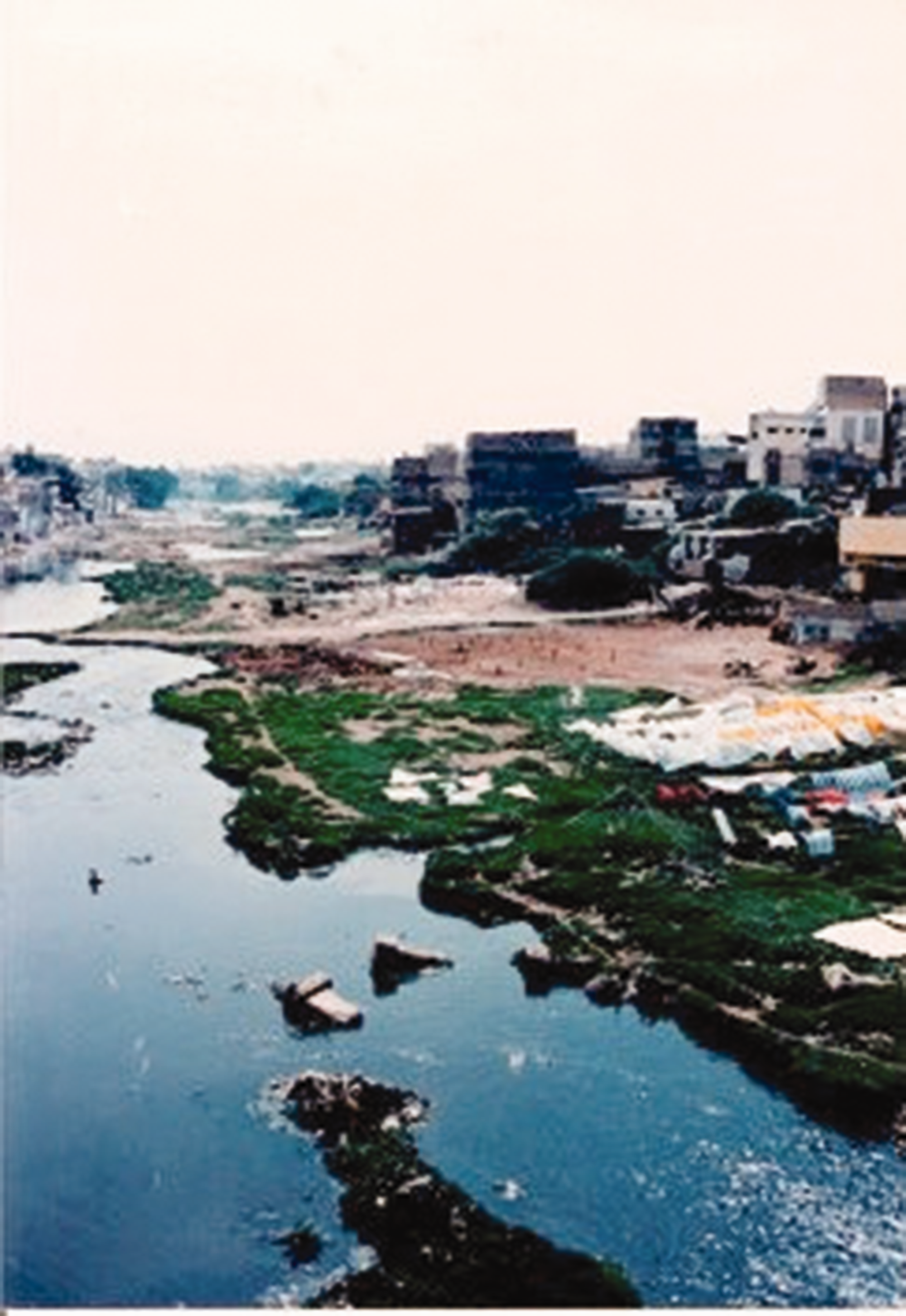
Lyari Nadi, Central Karachi 1995 (Photograph by author).
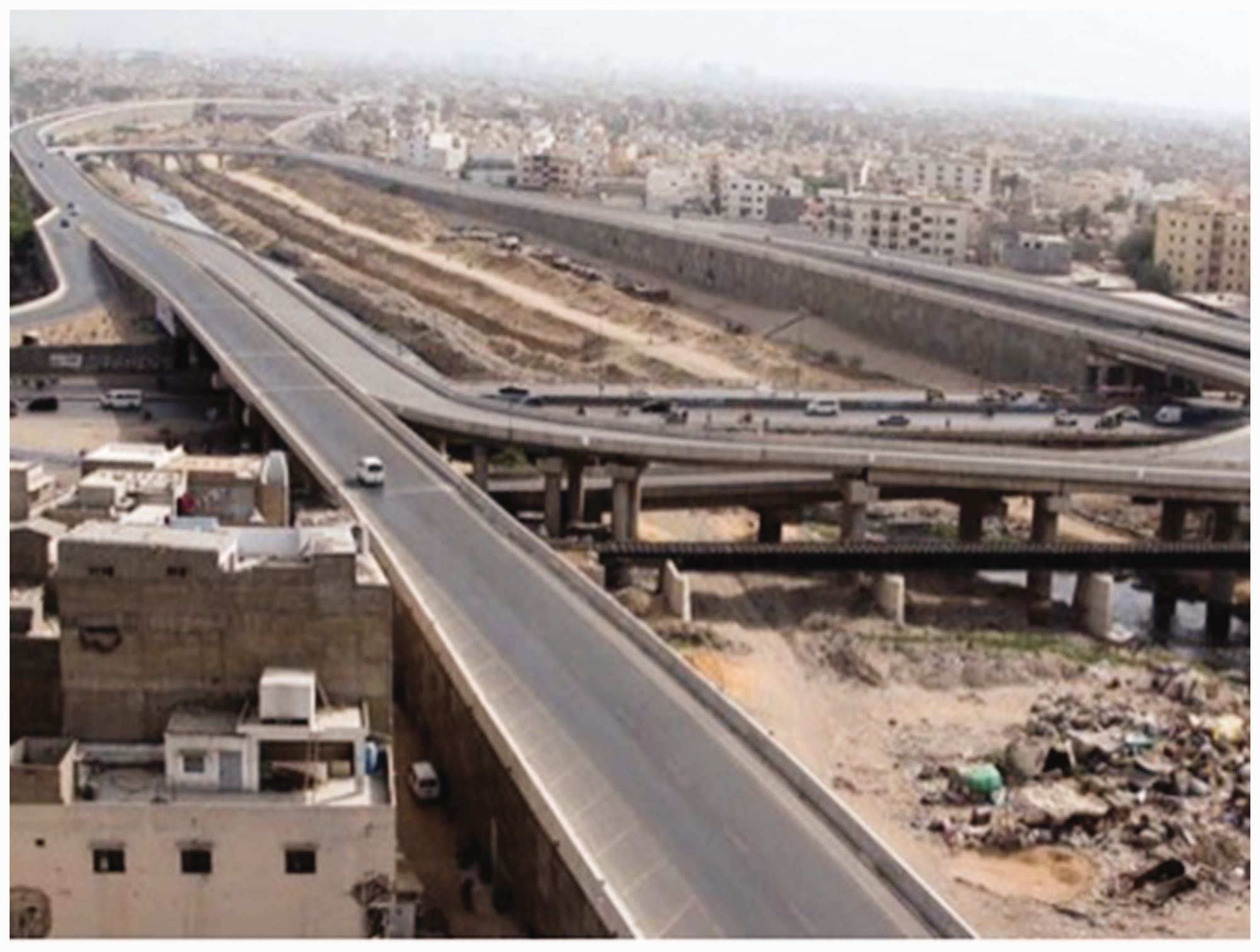
The Lyari expressway at Gulshan-e-Iqbal interchange (Courtesy Express Tribune).
Disputes over water erupted in 2010 when, during the summer monsoon rains, the Indus burst its banks the length of Pakistan, wreaking devastation and propelling the Indus to the fore. According to Pakistan’s National Disaster Management Authority, the floods constituted the worst natural disaster in national history. By September, the NDMA estimated almost 2000 people dead and the numbers of affected population in a country of around 167 million, at around 22 million, including12million needing urgent food aid and humanitarian assistance, and over six million homeless. In Sindh, where a high concentration of districts, communities, villages, settlements and rural poor people the river banks, around 7 million were affected (OCHA, 2010). The 2011 floods again affected Sindh most severely. Amidst condemnation at the institutional apathy and slow government response, state and humanitarian organizations were ill-prepared to deal with communities long-vulnerable to floods, cyclones, and displacement: still, no permanent natural disaster strategy or environmental migration policy exists (Alvarez-Quinones, 2015).
After Partition, Sindh’s Thar Desert, the world’s most densely populated desert, re-shaped new movements between borders and pastoralists, routes through harsh terrain, and regulated im/mobilities between India and Pakistan. Southern Sindh’s drylands and parts of Balochistan now face increasing desertification, land degradation, and worsening drought (SLMP, 2018). Tharparkar, Sindh’s largest district has long experienced droughts, extreme environmental conditions, and extreme food insecurity. These, combined with climate change, poverty, and prolonged government inertia, produced a famine in 2013–2014. Tharparkur, comprising 2300 villages and 1.5m people, was most severely affected; many affectees from Hindu communities migrated to nearby districts seeking work and fodder; many Muslim affectees migrated to Karachi and Hyderabad to work and send remittances (Alvarez-Quinones, 2015). Severe droughts recurred in 2018. The confluence of drought, hunger, and land degradation changed seasonal and forced migrations. These poverty and climate-induced migrations appear far from any image of proud middle-class Sindhi reclamation.
Steinberg and Peters’ (2015: 261) notion of ‘wet ontologies’ provokes thinking about the ‘volumes within which territory is practised: a world of fluidities where place is forever in formation’. Desertification, dams, and floods visibly nudge the shifting borders of Karachi in Sindh, revealing a larger regional map of shifting geopolitical uncertainties involving Pakistan, India, China, and the US. Locally, given many traumas are collectively shared, they also underscore the permanency of Sindh’s citizens unmitigated ties as both familiars and strangers. Given the violent history of the collective embrace, progress will entail, to paraphrase Shah Abdul Latif, swimming upstream. Still, time, caste, and confession are tractable. Sindhis have long embraced highly syncretic cultural and religious forms, sharing rituals, celebrations, shrines, and temples.
Let us travel through, beyond crisis (Khan, 2010), to places where manifold, miscellaneous life trajectories and displacements of compass and direction offer possibilities for capturing new connections, and ways of being, that bypass political bifurcations of native/stranger and self/other. I do not imply people can simply unbound themselves from the violent force of national politics. Rather, I reflect on the potential in the familiarities, confidentialities, and sensibilities emerging from shared crisis. That is, on the possibilities residing in crises of eviction, displacement, and migration within and into the city; in ways people are propelled into new habitations and Karachi is reconstituted as a mêlée of neighbourly unfamiliarities, forced proximities, and bodily disorientations.
Notably, in the primary struggle to rest and survive, diverse multiple climate-induced displacements and economic migrations into Karachi do not appear to be reprising earlier forms of dispossession into new political claims drawn around ethnicity, rights, and self-determination. As in other spaces of refuge, agency may indicate efforts ‘to make spaces “ordinary” through processes of squatting and building that seek to reclaim “normal life” and create places of “home”’ (Sanyal, 2014: 570). Therefore: when a politics of rights and antagonisms is devastated from people’s visions of the future, and memory can no longer be invoked to reconnect people disoriented by deluge, dessication, and dispossession to their suzerain versions of history, might a new urban politics not begin? Might people’s ruptures of attachment and losses of anchorage offer a new experiment to create other ordinary possibilities, landscapes, and entanglements – in reciprocal, mutual collaborations of living and correspondences of earth, spirit, and flesh? Might this become a political practice borne from everyday cohabition, and foreign urban oscillations that enable unexpected, unsettling practices of caring, and enduring, with each other?
Sufism to jihad
Lal meri pat raki-o ballah (Lal keep me safe from evil) Jhulelaalan, Sindhari da sehwan da, Jhulelal Qalandar.
The above verse pleads for the Sufi Saint Lal Qalandar for safety from evil. The qawwal, ‘Jhulelal Qalandar’, was popularised in Karachi by the Sindhi singer Abida Parween, by Ghulam Farid Sabri of Karachi’s Sabri brothers, and by Nusrat Fateh Ali Khan whose version of ‘Dama dam Mast Qalandar’ introduced an electronic riff and the song to Western audiences. It derives from a 13th century poem penned by the Sindhi Sufi poet Amir Khusrow in honour of the Sindhi Sufi saint Shahbaz Qalandar. It was adapted by Bulleh Shah, Mughal era Sufi poet and Islamic philosopher, who added verses in praise of Shahbaz Qalandar, references to Sehwan in Sindh, place of the shrine of Lal Shahbaz Qalandar – with lal (red) referring to the red clothes of Shahbaz Qalandar, or the young man Jhulelal.
In the 1990s and 2000s, the song Mast Qalandar was played often by MQM workers who traded naats, devotional songs in praise of Allah, and Shia Mohajirs who visited the Lal’s shrine in Sehwan Sharif. While MQM leaders published verses citing the Urdu poets and philosophers Ghalib, Faiz, and Iqbal, among young Mohajirs religion became syncretically and popularly linked with ‘Sindh’ through the musical form qawwali, practised in India and Pakistan (Verkaaik, 2004). Through qawwali music and performances listeners sought to lose themselves and eulogise their earthly struggles. The Sabri Brothers qawwal, residents of the Mohajir neighbourhood Liaquatabad No. 10, were acclaimed as descendants of India’s Mian Tansen. Their songs Allah Hi Allah, La illaha and Tajdar-e-Haram, and the qawwals of Nusrat Fateh Ali Khan were ubiquitous.
Occurring in a consciousness between trance, transcendence, and the social manners of movement and qawwali, music and performances did not intend to capsize the terms of self or other, individual or collective, Sindhi or Mohajir, secular or spiritual. Rather, they comprise what Simone (2018) calls a space of ‘besides’, in the sense of being next to the dominant take on what prevails; close enough to be familiar while seemingly out of reach. In the space of besides, Simone proposes, which occurs on the outskirts, somewhere other to the social demarcation of roles and divides between territories and sectors, differences and similarities can be enacted in the back and forth, in the continuous displacement and withdrawing of the border between incorporation and expulsion.
Qawwali, I contend, like the urban American contexts Simone (2018) speaks of, is also a gathering of life, like bodies and like histories, puncturing the night with the idea that many possibilities could sit right next to each other, be part of the same official game, a game of move and countermove, a game self constituted referring only to itself, but at the same time replete with elsewheres, and a state of being somewhere besides being besides the other players.
Also transcending ethnic and nationalist and religious divisions, thereby like the qawwal, is the Sufi practice of zikr, wherein breathing resembles the wind of the soul. Breathing is a way to align dispersed consciousness with the self, to enter the abode of God residing in the body, and transport the subject into a more primeval state of time. Baig (2015) draws unlikely concordance between Sufistic meditative practices of zikr and economic activity (currency and futures trading) in Karachi’s Bolton market. He identifies material and spiritual values for merchants for whom zikr practices and desires for accumulation paradoxically produce charitable subjects who are simultaneously self-maximising and self-annihilating. Merchants effortlessly combine Sufi moral discourse with modern financial practices and technologies. Through zikr and breathing techniques Baig describes how one futures trader cultivates his aspirations and relationship with money to the point capitalism and asceticism co-exist in unity, and God blesses his offerings. These incarnates of breath bear aptly on Billé’s (2018: 62) somatic metaphor of border-as-skin that disrupts unambiguous boundary lines between nations, territories, and moral worlds: ‘Borders like skin, are imagined as diaphanous membranes yet are interactive zones of substantial depth’ whose texture, like the city’s life-breath, are marked by state violences ranging from haptic interpellation, traumatic dislocations, and partitions.
Breath describes a topographical interplay between body and world; an emotional atmosphere of inhalation and exhaling. Breathing is our most fundamental interaction with the world. Control of breathing is learnt in infancy; crying and breathing are sometimes so entwined an infant cannot stop crying because to stop crying is to stop breathing. Breath and air are ephemeral, yet fundamental. They beg questions about urban lives suspended between the management of air through filters, conditioning generators, vacuum suctions – and spatial designation for the control of wind, ventilation, and disease. Air is a resource and a weapon with sociality in its reception and practice. Regarding air-quakes, pollution and contamination, air and breath are ineluctably political incarnates. They hold moral powers, physical elements, movement, and temperature.
Breath (saans) and terrorism
If Karachi and Sindh became familiar through the Sufistic winds of qawwali, breath of zikr, and stench of pollution they became strangers again through the fault-lines that concretise around religious militancies. Themselves born of earlier cross-border wars, these now shape another incursion into Sindh around circulatory flows of politics and capital for terrorism.
In the 1990s particularly, there was support across the city for the religious parties, especially the Barelvi leaning Jamiat Ulema-e-Pakistan (JUP), and to a lesser extent Jamaat-e-Islami (JI) and its student wing, the Islami Jamiat-ul-Tuleba (IJT). While older Mohajir generations mostly voted for the JUP, and had been party workers, younger people largely supported the MQM. Now the JUP is a distant memory with little relevance to young people, with MQM becoming so likewise (Khan, 2018).
In these groups, pro-Sufism was not characteristic (Rana, 2010). Nor are Barelvis, a majority in Pakistan, equated with militancy, except a few groups that fought in Kashmir in the 1990s. However, Sufism has more recently recrystallised around sectarianism and extremism, in Deobandi and Barelvi groups who align in their support for the blasphemy laws, and opposition to the state and judiciary (Siddiqa, 2016). While Naqshbandi, Pakistan’s major Sufi cult is mainly comprised of Deobandis, Maulana Masood Azhar, leader of the terrorist group Jaish-e-Mohammad, directs his followers to follow Naqshbandi practices (Rana, 2010). Particularly important is zikr, a daily practice involving the repetition of thousands of phrases and breathing and physical exercises, wherein followers renounce their separate existence, temper the influence of the nafs (ego); dunya (wordliness), hawa (vain desires) and shaytan (devil), and attain a concord between terrorism and spirituality.
Current jihadist groups operating in interior Sindh have a precedent in the Afghan jihad of the 80s, the Salafi and Wahhabi militancies of the 1990s, and the 2001–2014 Afghan war. They parallel the rise of the Tehrik-e-Taliban Pakistan’s (TTP) social and economic power in Karachi (Rehman, 2017). Many groups train recruits in Interior Sindh, a few hours by rail and road from Karachi. Extremist organizations are increasingly active in Sindh’s central and northern districts. Sectarian militant groups are active in rural areas. Organizations from southern Punjab including Lashkar-e-Taiba (LeT), Jaish-e-Mohammad, and Lashkar-e-Jhangvi (LeJ) recruit in Sindh. Jamaat-ud-Dawa (JuD), the LeT’s welfare wing is popular in Sindh’s central and southern districts where, following the 2010 and 2011 floods, it responded more capably than government agencies in providing relief and refugee camps; JuD has since established madrassas across Sindh (Yusuf and Hasan, 2015).
Yusuf and Hasan (2015) highlight increasing militancy, violent extremism, crime, tribal warfare, and violent nationalist and separatist groups in Sindh. While the TTP, al-Qaeda, and other Islamist groups have a limited presence, the sectarian Ahl-e-Sunnat Wal Jammat (ASWJ) and its militant wing, the LeJ, are influential in northern districts. Criminal gangs in Shikarpur, Sukkur, Larkana, Nawabshah, and Hyderabad conduct kidnapping, extortion, armed robberies, smuggling, and provide sanctuary to other criminals, fuelling concerns they could protect TTP militants (12). A kidnapping-for-ransom economy operates wherein gangs trade kidnap victims, the ransom increasing per sale, then sell them onto gangs in Balochistan or Taliban groups in FATA. Hindus are vulnerable, having significant investments in cotton and agro-business (12). The Sunni ASWJ and LeJ have taken advantage of tribal, political, and sectarian rivalries to offer their support (13). When the TTP’s Mohmand chapter, influential in Karachi, and the Punjabi Taliban claimed responsibility for the 2014 attack on Karachi’s Jinnah International Airport, investigations revealed Sindh’s central districts were key for logistical planning (8). Recruits from northern Sindh travel to North Waziristan Agency to join the TTP (9). Sindh is arguably at a tipping point, lest violent extremist and sectarian groups based in southern Punjab further infiltrate Sindh, and undermine stability in Karachi (Yusuf and Hasan, 2015; Rehman, 2018).
Through mercantilism and extremism, Sufism’s principles of selflessness are cross-cutting religious orientations, enabling complex patternings of unification, division, rendering the familiar strange and vice versa. These circulations are reconstituting Sindh-in-Karachi through a confluence of networks in finance, human trade, abduction, and terror. Repeated attempts at living are inscribed onto the landscape, bodies are enabled to incorporate the spirit of unifying or fatal knowledge, and breath is charged as the bearer of anguish or balm.
‘May you forget the trade you learnt, But yesterday I met you here, Today I see you disappear, Sailing on ocean waves!’ – Shah Latif, Shah Jo Risalo, Samudi-XIII (Mariners).
Conclusion
A topography of human, material, and environmental ontologies serves to disrupt some imposed and imagined divides between Karachi and Sindh. Displacing heterologies of colonial, national, and Karachi-centric reason, this article problematised the interplay of connectivity and separation in order to destabilise some over-determined divisions between capital and periphery, and open an interstitial terrain for new forays of critical disruption to Sindh–Karachi relations. It questioned some cartographic divisions and logics of postcolonialism and empire that organise relations of strangeness and familiarity in Karachi’s separation from Sindh; divisions between Sufism, terrorism, and Islamic state-nationalism; and ‘Pakistan’ as an imagined Muslim power in South Asia. It prioritised shared, syncretic realities linked to local, national, regional and planetary processes that are distinctly shaped by imaginings of insuperable human and areal difference, and Pakistan’s histories of postcolonialism and colonialism.
The colonial approach to religion as an essentialist category underpinning Partition visibly continued in the institution of land into postcolonial contestations over rights and belonging (Jones, 2014). This bears on ways urbanization, climate change, and related migrations are being re-routed through imperial imaginaries of classed and racialised partitions, creating new environments, planetary subjects, and hierarchies (Sidaway et al., 2014). It also brings comparative urban analytic value (Myers, 2014) to Hage’s (2016) contention that the old sentiment of ‘being surrounded by barbarians’ has re-emerged in the global crisis of borders regulating the neo-colonial exploitation of land, resources, and labor; the crisis of ecological borders of domestication that define the modern exploitation of nature; and the civilised world’s ability to control the movements of refugees.
Additionally, the article asked if creating alternative ways of relating to and inhabiting the earth might redirect passions toward new, shared visions that are instantiated in the tracks, tidemarks, volumes, seepages, and temporal flows of their own movement. Discourses about moving forward, moving backward, vacillating, being stuck, and going nowhere regarding Karachi’s crises of land, borders, climate, and migration posit mobility as a political text. They enrich the motile elements of topography. Motile thinking has contributed much to decouple theoretical sequelae from ontological ones, people from the categories that confine them, and to engage an ‘ontological reversal’: wherein motion is seen as primordial and stable entities the derivative outcomes of the raw material of motion (Holbraad, 2012). While it may be wholly correct to argue that maps for life deaden new possibilities for living, the article argued we should not miss opportunities for relating to the silent suffering of the disaffected, and to lives experienced as immobilised by their losses, or an inability to transcend their confines. The task is to slow down, not just in relation to capitalism, but enough to acknowledge encounters of feeling, and to disrupt customary barriers to mutual recognition.
The failures of the British, and Pakistani authorities, to clear Karachi’s urban mountains of accumulated rubbish gave way to chronic traffic and waste problems, air pollution, water shortages, prolonged power cuts, unmitigated heat and the reckless destruction of heritage. These co-occurred with the erection of crudely designed super-highways, mega-transport systems, and gated communities that displaced Karachi’s unwanted communities to the peripheries of its world-class vision. Notwithstanding, Burton’s (1851) elusive imperial dream of avenues of abored shade was resurrected in 2008 by city mayor Mustafa Kamal who instituted plans for a ‘Green City’ that could combat air pollution. Around 2.2 million conocarpus plants, terrestrial mangroves native to the Americas and West Africa were planted. Rather than indigenous local trees such as neem, ficus, lignum, eucalyptus, or imlee, the cheaper resilient conocarpus now borders Karachi’s major arterial roads. Related fears arose around the perceived colonization of Karachi by an alien species causing breathing problems, asthma, and effacing ecological diversity (Mujahid, 2018). If this story represents the return of an anxiety symptom around desires to enforce borders of soil and belonging that outsiders cannot have, it also represents a resignification of the threat of foreign takeover and the toxicity of city-politics for the environmental context.
In the urban prison the air is putrid, filtered, poisonous, an intense indicator of despair, and a ‘paradox’ of planetary urban development and progress (Brenner and Schmid, 2015). In imperial times, links were made between foul air and deadly diseases, and between putridity, crime, and moral dissolution. Imperial air was also murderous, as with prisoners asphyxiated in the Black Hole of Calcutta: not unlike illegal migrants who suffocate in trucks en route from Pakistan to Europe. In air, ventilation, and the struggle to control one’s breathing, imperial, colonial, and neoliberal rationalities interact.
Arguably the real post-Independence crisis was not the influx of refugees, but Karachi’s divorce from Sindh, approved in the Sindh Assembly. Similar betrayals continue in the dispossession of lands and subsistence livelihoods by waderas and developers who collude around profitable real-estate developments. These developments, occurring across the Global South, are obliterating working and poor populations through forcible evictions, and reminders of disposability. I argue they also hold possibilities for reconstituting city life and politics in the unoccupied ‘oceanic’ (Freud) spaces that nestle besides the dominant dividing lines between things.
Meanwhile, Karachi continues to swallow the hinterland, like the Indus, with its temporal and temperamental fluvial currents, flows, and enraged flooding. When through massive losses of home and certainty in the ground beneath occur through forced dislocations, flooding, drought and desertification, the self and its boundaries are lost, given to unfamiliar, random dispersals across city environs. Thinking topographically is not about repairing physical, political or imagined walls of hostile familiarity. It means re-stitching a connectivity dependent not on origin, but on new ways people can realign their shared comings and goings.
It also comprises an ethical endeavour to recover epistemological forms of effacement, and to embed deep perceptions of life into thinking about Karachi. When body and spirit are subjected to extreme losses of mooring and direction, the usual politics of sustained antagonisms is disoriented too. What emerges instead of rights and ethnic determinations is an excess of city and rural life synthesised into strange propinquities of earth, breath, air, land, and water. In these overcrowded spaces where citizens are forced into alien familiarities, life can arguably renew in a merging of people who must keep living, and striving, together.
Footnotes
Acknowledgements
For comments on earlier versions of this article, I am grateful to audiences at ‘The familiar stranger: Exploring Gujarat-Sindh Disconnections’ Conference, SOAS, organised by Edward Simpson and Mustafa Khan; and at the ‘Human and non-Human Migration and Mobilities’ symposium at the Centre for Spatial of Environmental and Cultural Politics at Brighton. Very many thanks to the anonymous reviewers and the EPC editors for constructive and valuable feedback.
Declaration of conflicting interests
The author(s) declared no potential conflicts of interest with respect to the research, authorship, and/or publication of this article.
Funding
The author(s) received no financial support for the research, authorship, and/or publication of this article.
