




Abstract
Responsibilities are a central matter of concern of environmental politics because they underpin regulatory frameworks of utility services. Yet, in scholarship concerned with sustainability transitions and governance, responsibility is reductively understood as a legal obligation or allotted task. Building on an institutionalist perspective, this paper conceptualized responsibility as a field of contention where actors negotiate, contest, and articulate what we define as subjectivist and collectivist responsibilities. Defining and using the concept of ‘fields of responsibility’, the paper analyzes how responsibilities (mis)match and contradict in controversial policymaking around the ‘circular economy’: a wide policy program for restructuring water, energy, and waste utility services and infrastructures in Amsterdam region. In so doing, it reveals the logic of contemporary environmental governance: in approaching climate targets, actors actively take on responsibilities while at the same time maintaining a conservative view of their role and responsibilities. We call these phenomena over-stretching and under-reaching.
Introduction
This paper shows how responsibilities are (re)defined in environmental governance to reveal the politics that drive contemporary reforms of waste, water, and energy infrastructures. Issues of responsibility arise whenever it becomes contentious to identify who (can or should) bear the political, legal, or economic costs of environmental governance. It is certainly difficult to know why and how the formal responsibilities of governments, private corporations, and citizens should change to address climate goals, and why these responsibilities have remained unquestioned in the political sphere. While changing responsibilities are a contentious matter in environmental governance, both scholarship and policy practice focus on the managerial and technological aspects of social and technical transitions. They rarely problematize political liabilities and structures of accountability in environmental governance (Evans et al., 2016). Transition managers reduce ‘responsibility’ to a problem of dividing ‘tasks’ among stakeholders (Mostert, 2015) and politicians often avoid discussing responsibility before decisions are made (Flyvbjerg, 2016). Most often, issues of responsibility are ‘silenced’ by actors negotiating controversial policies. This ‘neutralizing strategy’, in keeping political conflicts latent (Pellizzoni, 2004), is meant to have a liberating effect’ on negotiations. Issues of responsibility become prominent, by contrast, where existing judiciary framework prove unable to hold global corporations liable for transnational environmental impacts (Vanderheiden, 2011). Problems of responsibility often burst open only after policies have already been formulated, largely through juridical lawsuits or explicit political contestation (Ramaswami et al., 2012). In environmental policymaking arenas, responsibility remains the ‘elephant in the room’.
Responsibility is particularly crucial in how city-regions adapt existent infrastructures and utility services such as clean water, heating, electricity, and waste management (Bergsma et al., 2017; Giezen, 2018). Emerging approaches to the integration of urban resource streams – often defined as nexus approach – search for an institutional restructuring of urban services provision, yet do so from a techno-managerial perspective (Williams et al., 2018). On the one hand, utility services are currently delivered and managed by a broad network of public agencies, private corporations, and third sector agencies (Pincetl, 2010). On the other, the relations between these agents are hardly problematized as political issues of responsibility shifts. The city-region is the scale at which prototypes of new utility regulations and infrastructures are being tested (Broto and Bulkeley, 2013). Available studies on responsibility, however, still address responsibility as a macro-institutional reform, looking at European and national regulatory frameworks (see Börkey and Lévêque, 2000). To understand how responsibilities change, we argue, it is necessary to examine how responsibilities themselves are negotiated or contested in city-regional policymaking processes.
This paper has two aims. First, it moves beyond legal notions of ‘liability’ or political ‘accountability’ to explain the dynamic processes driving the change or maintenance of responsibilities in environmental governance (Giddens, 1999). We analyze responsibility as a process of political negotiation beyond existing statutory procedures and jurisdictional boundaries. Second, it builds a framework that heuristically allows grasping the interplay between different forms of responsibility in concrete cases of policymaking. We claim that responsibilities are themselves an object of contention in governance. Environmental governance does not simply enforce responsibilities, but defines and re-organizes institutions and regulations that define them.
We provide a multi-dimensional conceptualization of responsibility starting from the premise that responsibility is always a relational construct but it has a subjectivist a collectivist dimension. Responsibilities exist as relations between actors identified as subjects, but also exist as a matter of contention within a collectivity where actors mobilize prescriptive claims over future responsibilities. Our analytical distinction between two dimensions of responsibility allows studying responsibility as a ‘field’: the contentious arena where subjectivist and collectivist responsibilities mismatch, overlap, and conflict. Through this framework, our paper shows the contradictory articulation of responsibilities enacted through models of circular development. While engaging in governance, actors appear to take more responsibilities to address environmental problems. We term this logic over-stretching. At the same time, those same actors deploy conservative approaches to governance, defending their existing responsibilities and the status-quo. We name this logic under-reaching.
The research project from which this paper stems is a concept-driven study of an, ongoing process of environmental governance taking place in the city-region of Amsterdam. It focused on a particular development area, named Haven-Stad (more details below). The Amsterdam city-region – and the Haven-Stad redevelopment project – has been chosen because it has seen more than a decade of circular economy policymaking – a long time relative to other European countries. In this particular city-region, the local government has already formulated clear policy programs for integrated utility services (see next section) and given strong input for formulating and implementing a national circular economy policy package, Netherlands Circular 2015 (Ministry of IenM, 2013; Rijksinstituut voor Volksgezondheid en Milieu, 2018). Because of its systemic approach, the circular economy questions a large amount of existing regulations in utility provisions, clearly raising issues of responsibility. Today, in its national ‘climate policy package’ (Klimaatakkord), the Dutch government identifies the circular economy as a strategic sector in realizing CO2 reduction targets.
Outlining the notions of subjectivist and collectivist responsibility, the first section will lay down the philosophical foundation for our concept of the ‘fields of responsibility’, which is explained in detail just after. After presenting research methodology underlying this paper, we will illustrate the governance challenges posed by the circular economy in Amsterdam. In presenting our results, we identify three key issues of responsibility emerging in governance processes and conclude by explaining the institutional features of these governance processes.
Subjectivist and collectivist responsibility
In both law and politics, responsibility is predominantly understood in a subjectivist way. It is seen as an actual property of one subject towards another subject, both of which exist as agents. An individual, an institution, or an organization is responsible (or supposed to act responsibly) for a particular action towards a particular subject (Goodhart, 2017). This understanding requires the subjectivation of two or more actors (an individual or group), for it identifies actors’ positionality in relation to one another and provides a basis for defining mutual expectations about possible behaviors (Sena, 2014). This idea of responsibility finds its institutional roots in the normative assumption that to be responsible means to be ‘answerable’ or ‘accountable’ for a particular action towards another subject (Bvens, 1998). It assumes relations of culpability or vulnerability among subjects: one actor is responsible to the extent that it takes care of, or should take care of, someone occupying a position of vulnerability or danger. Acting responsibility, therefore, means acting in ways that avoid damaging someone.
A subjectivist grasp of responsibility is essential in constituting governance processes and ensuring the rule of law. It includes both codified, statutory, and formal responsibilities, and those based instead on tacit norms. Examples of the first category include liabilities (namely legal or financial responsibilities) that are institutionalized in juridical frameworks. They define society as a landscape of legal, financial, and political subjects operating freely towards each other (Hart, 1968). Examples of the second category include responsibilities based upon familial and friendship relations. While not necessarily codified in formal laws, particular subjects (e.g. parents) can feel responsible towards specific others (e.g. children). Whether codified and tacit, these subjectivist responsibilities are ontologically rooted in the individualist ethos of modern society, in that they identify actors as autonomous subjects acting responsibly towards others.
Subjectivist views on responsibility underpin all environmental governance processes, and actors often refer to them when arguing for responsible action from others – for example by calling on politicians to act in their constituencies’ favor (Williams, 2008). This form of responsibility is bound up with an understanding of actors as agents and the existence of discernible consequences (Giddens, 1999). It legitimates responsive law, the legal apparatus of agencies, contracts, and supervisory committees that maintain modern states’ stability by predicting and responding to possible dangers posed by legally identified subjects (Nonet et al., 2017).
Despite its relevance for the stability of social relations, a subjectivist view on responsibility is inadequate to inform socially transformative processes oriented to tackle structural socio-environmental problems. In particular, the work of Foucault set the ground for a post-subjectivist view on responsibility that understands individualization – namely the constitution of agents – as a process of subjectification. Subjectification is understood as the range of responsibilities and duties that individuals have in particular historical contexts. They are not intrinsic to individual but they are institutionalized through particular forms of governmentality, which is the power infrastructure constituted by the social norms and technologies that characterize modern capitalism (for an overview see Shamir, 2008; Soneryd and Uggla, 2015).
This particular ontology of responsibility is crucial for the study of the governance of city-regional environments, utility services and ecological infrastructures. A purely subjectivist understanding of responsibility fails to explain why and how actors contest and transform (or not) existing regulatory frameworks and their underling power relations, and are not helpful in imagining alternative social norms (Moroni, 2007; Savini, 2019; van Rijswick and Salet, 2012). As Pellizzoni (2004) puts it, when faced with situations of high uncertainty, governance processes cannot foresee the consequences of particular innovations, with the result that actors simply ignore these unforeseen consequences so to exonerate themselves from their actions’ potential long-term effects on the environment (558). A subjectivist approach to responsibility also fails to accommodate the structural injustices of existing regulatory frameworks (Kelty, 2008: 13). It requires the recognition of a potential ‘victim’ through judiciary systems, and all but ignores those groups that are not formally identified by law, but are most susceptible to environmental problems. These groups include, for example, endangered natural areas located far from jurisdictions or unborn generations (Massey, 2006). Similarly, subjectivist responsibilities simply cannot tackle global large polluters whose legal profile does not fit national jurisdictions (Evans et al., 2017).
To understand how responsibilities change (or not), we propose to add a collectivist dimension to responsibility. We define it as collectivist to stress the relational process of attribution of responsibilities that produces subjects – subjectification – enacted in specific socio-spatial contexts. It is a prospective form of responsibility because it is a claim of subjects engaging in social relations, respectively, attributing responsibilities to each other contesting their actual ones. The quality of collectivity stresses how responsibility is enacted not only among already identified subjects, but also among collectivities that are situation-specific, not yet defined in terms of formal statutory subjects accordingly to existing (tacit or codified) norms. 1 This view shifts attention from an individualist ethics – in which responsibility is a property of individualized subjects – to a moral sphere of responsibility – in which the principle of responsibility applies beyond defined subjects (see for example Sen, 2017). It allows us to grasp how actors often can and do act responsibly independently of the defined consequences that their actions may have on others. They can act according a priori moral principles, abiding by normative claims that guide action in complex situations.
There are two analytical advantages of combining subjectivist and collectivist understandings in studying responsibility in environmental governance. First, it allows considering the politics of subjectification as the power struggle around attributed responsibilities visible in context specific situations. Following Badiou (2009), subjectification entails a politics of responsibilization that unfolds through events during which the rights and duties of particular social groups are enunciated against particular power structures. These events persist in history through rules and physical sites that are by them produced. Rancière (1999) similarly specifies that subjectification is the political struggle for the capacity of ‘enunciation’ in a given field of experience by social groups that in turn redefine the same field. In sum, any legal codification of responsibilities is an historical result of political struggles situated in time and space that modify those legal codifications.
Second, this view stresses the importance of the discursive practices used to contest and reproduce responsibilities. Responsibility is the result of responsibilization, namely the practice of (self)attribution of rights and duties through which agents reposition themselves in relation to others. In contrast to subjectivist prescriptions, collectivist responsibility emerges from confrontation, dialogue, and conflict with others and it is enacted when issues of responsibility become the matter of contention around which a collectivity forms, interacts, and solidifies. Collectivist responsibility comes to the fore through processes of responsive democratic action rather than legal or political reactions to damages or decisions (Pellizzoni, 2003).
The collectivist dimension of responsibility presumes that actors are situated in particular contexts where their individualist responsibilities (attributed by formal norms) shape their position to each other. At the same time it indicates that those actors engage in a process of (self) identification as subjects with different responsibilities during interactions over contextual matters (see also Machin, 2012). Responsibilities change or are redefined, while new actors can emerge and take on responsibilities. This does not mean that all actors are equally responsible for the problems they face, only that they enter into a situation of reciprocal influence in which responsibilization towards a given problem becomes an object of contention. This is visible in how responsibility is apportioned and re-apportioned in the political (re-)organizations of power. Actors contest and re-define who bears the costs, risks, and benefits of transformative interventions in existing institutional orders. Such conflicting processes permeate social practices to such an extent that Young stresses how ‘political responsibility’ is in continuous redefinition through processes of struggle and contestation (Young, 2003). As Trnka and Trundle (2014) have also argued, responsibility should be re-conceptualized as competitive, which cuts against the individualist, static, and simplistic neoliberal idea that all subjects embody responsibility to an equal extent.
Conceptualizing the field of responsibility
We define responsibility in environmental governance as a field riven by political processes of de- and re-responsibilization. In the study of social practices and institutional change, the notion of ‘fields’ makes it possible to position agency in a relational space in which agents negotiate and contest the norms that structure their actions vis-a-vis others (Martin, 2003). A field grasps how social norms are produced by both antagonistic and cooperative relations among a set of actors that pursuing specific strategic purposes (Bourdieu, 1987). In this conceptualization, responsibility is not a property intrinsic in a given action, but emerges from contention and cooperation in a field of relations. Responsibility is the result of a normative process.
Actors enact both subjectivized and collectivized responsibilities in the field. While engaging in environmental governance processes, they relate to each other as subjects according to existing institutions, legal, and political norms. They hold particular responsibilities according to the law and their statutory roles. These responsibilities pre-define one actor’s position has towards other actors, who are also legally responsible towards the first according to legal and statutory prescriptions. Each of these actors act according to a particular understanding of others’ responsibilities, which defines their expectations about how other might address a problem at hand. In so doing, actors relationally and strategically configure their actions in pursuit of goals. This first level of responsibility is always relational because it entails interaction among actors in a system of reciprocal expectation and identification. In environmental governance, the most common example of this situation is the role of users of water or waste utilities in a city towards the water/waste supplier. Users have the responsibility to pay tariffs or connect to the network and, in return, water companies ensure basic quality standards.
These same actors, however, also engage in a political process of subjectification, which unfold through (normative) attributions of responsibility. They act based on what they think their own and other actors’ responsibilities ought to in respect to a given situation or problem (e.g. increasing CO2 emissions in a particular region). Collectivized responsibility can be enacted through self-commitment, under-commitment, or even refusal in tackling a particular problem. It builds on internalized understandings of what actors should or should not do. In the case of institutional agents, these assumptions are fundamental to how policy risks, costs, and benefits are defined and (re)distributed. They also make it possible to reconfigure those risks and gains by identifying the collectivity that bears them. Taking the above example, we may imagine that given the pressure over ecologically conscious behavior, water companies may incentivize users to invest in wastewater recovery in their building because they consider them as the responsible actors to save fresh water. Another example is environmental groups’ battle for a politics of environmental justice that recognizes, and proportionally sanctions, the responsibilities of international corporations through taxation on environmental damages. In this process, a normative claim is made – namely that the collectivity affected by pollution is larger than the community living in proximity to the polluting activity. Ideas and assumptions that some are more responsible than others might become a central political claim in environmental governance. They might inform a struggle around responsibilization and may later shape formalized liabilities or accountabilities (e.g. eco-labels or CO2 taxation).
Our analysis of how subjectivist and collectivist dimensions of responsibility overlap and clash provides important insights into the normative assumptions that drive negotiations in environmental governance. Two (or more) actors may both attribute more responsibilities to one another, asserting that others should cede some (or take more) of the responsibilities according to them by statute. This process can be defined as over-stretching: actors may claim more responsibilities, for themselves and from others, than are formally attributed to them by the law or their statutory roles. Because it is a normative position (e.g. somebody ought to do more), other actors may perceive such stretching as excessive, contesting a possible breaching of their own subjective role in the situation. On other occasions, the same actors might find themselves in a conservative position, having to defend themselves against outside claims on their responsibilities by stressing their formal subjectivist responsibilities. We define these processes as under-reaching. They occur when actors retrench formal codifications of their roles and responsibilities. Retrenching claims protect the status-quo and induce others to assume more responsibilities. In still other cases, actors may instead agree on how to apportion responsibilities that go beyond their statutory roles and thereby engage in joint responsible action. This occurs when multiple actors recognize their responsibility for a problem that surpasses their subjectivist responsibilities (see also Figure 1). This articulation of responsibility occurs when actors agree co-responsibility for a particular matter.
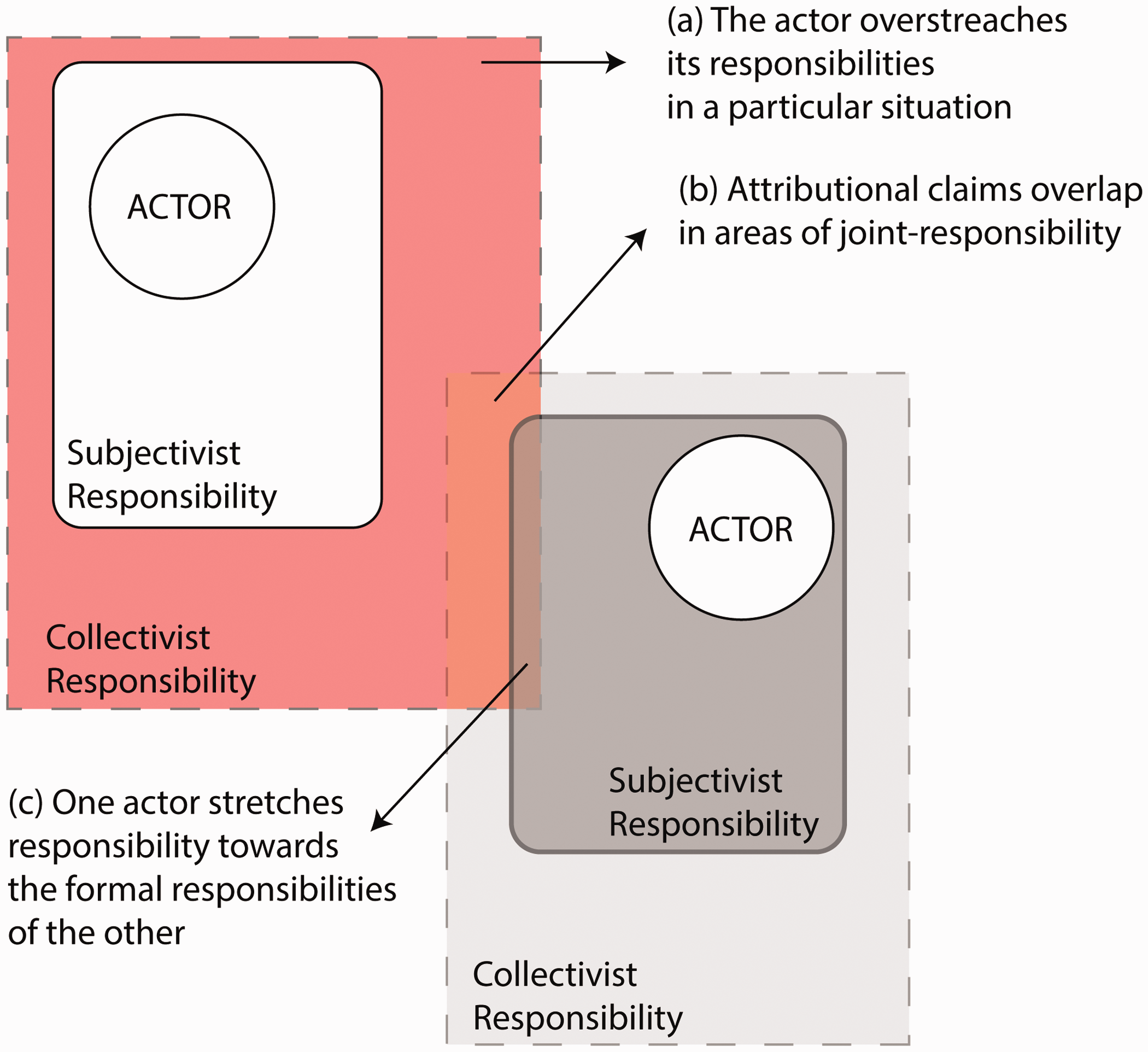
A hypothetical situation of overstretching in which two actors occupy a field of responsibility. In this case, the actors either (a) over-stretch their responsibility, (b) find agreement on a matter of joint responsibility, or (c) self-attribute responsibilities that instead actually belong to the other subject. When under-reaching (not represented in the figure), the dashed line of collectivist responsibility would retract to the firm line of the subjectivist responsibility (or even recede to a smaller space within it).
In sum, an analytical framework premised on the notion of field of responsibility makes it possible to map the tensions, mismatches, overlaps, and conflicts that drive the re-definition of responsibilities in governance processes. Taking the examples above, this framework makes it possible to understand the political conflicts that can emerge from the decentralization of wastewater treatment at the building level. Here, citizens may fear an over-responsibilization of their role as both users and consumers, a breaching of their position as taxpayers. On the contrary, it may also reveal that programs of sustainable adaptation of water infrastructures can lead to under-reaching of the responsibilities of water utility companies, that deliberately shift their responsibilities vis-a-vis both water users and the governments regulating water distribution and tariffs. The framework grasps how actors make claims on each other pertaining to subjective and collectivist responsibilities. It also makes it possible to assess how actors might subjectivize another actor, that might be absent in that particular situation, as responsible for a given problem.
The methodology of the research
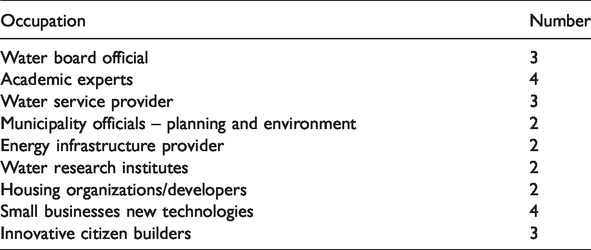
The research developed in two steps. A first round of 22 interviews (Table 1) was carried out with representatives of water, waste, and energy utilities companies and city planning departments to identify the network of stakeholders involved in the governance process of the Haven-Stad development project and to understand the broad dynamics and issues around integrating the circular economy in urban planning processes. They were selected from a wide range of expertise in order to encompass the full scope and complexity and to contextualize the structure of the workshop. This process aims to develop regional circular economy policy packages and concrete infrastructural interventions. Based on this first round of interviews and extensive desk research on Haven-Stad policy briefs and infrastructural plans, the team identified each actor’s main formal responsibilities and their view on how these responsibilities would change during and after the implementation of the utility plans envisaged by the circular economy policy programs.
Anonymized list of interviewees.
The second step was a workshop in June 2018 with one representative of each stakeholder identified in the previous step. These included representatives of the Harbor, the incinerator, the energy infrastructure provider, the energy distributor, and national, regional, and three different departments of the Municipality. The workshop was organized and moderated to allow participants to distill their subjectivist and collectivist responsibilities and make the mismatches/overlaps between the two visible and debatable. Participants were first invited to fill out two open questionnaires, in which they listed the subjectivist responsibilities of all the other actors (questionnaire 1) and indicated how these responsibilities would have to change in realizing the planned policies (questionnaire 2). We used the two questionnaires to organize and moderate two discussion tables, which were recorded and coded to identify key negotiation issues. The table discussions were moderated so as to put issues of responsibility at the center of debate while focusing on concrete interventions (e.g. decentered water management or reducing waste incineration through recycling). After the workshop, the results of the two questionnaires were combined into one grid in which the mismatch between subjectivist and collectivist responsibilities was clearly visible. This allowed us to pinpoint the three issues surrounding responsibility presented in the next section.
Responsibility at stake: The realization of circular economy principles in Amsterdam
The Amsterdam city-region is becoming a leading player in European advocacy networks for a circular economy (Eurocities, 2017). All the city’s electoral factions are currently mobilizing this term to envision a systemic approach to city-regional development that might decouple economic growth from environmental degradation, waste accumulation, and resource scarcity (Raworth, 2017). Far from being a fully worked out program, the circular economy functions as a discursive framework within which a variety of urban projects, policies, and regulatory reforms are clustered (Gregson et al., 2015). These practices mostly target key material flows in the urban economy, proposing a variety of policies: integrated decentered water and waste infrastructures; the reuse of industrial waste (agricultural, chemical, e-waste) for manufacturing; the promotion of eco-consumerism based on sharing and reuse; the transition to biomass-based energy; the improvement of post-separation facilities to increase recycling rates; the establishment of an industrial synergy between airports, harbors, and data-centers; regulatory reform to allow off-grid housing development and decentered energy systems; the introduction of green procurement rules to reuse building materials for new housing; and the promotion of a diffuse social economy of re-manufacturing sustained by a more central role of the third sector and the platform providers.
Amsterdam’s circular economy is thus a highly heterogeneous network of policies that question the institutional provision of utility services (see Municipality of Amsterdam, 2014). In a series of programmatic documents, city officials explicitly question the responsibilities of public, private, and civic stakeholders in realizing circular approaches to urban services. To govern this process, Amsterdam is taking part to several negotiation tables and signing governance covenants at different scales to promote partnerships between corporations active in waste, energy, water, and information technologies. These partnerships aim to test new technical solutions and legal frameworks in utility services, product design, waste disposal, and industrial investments.
Within this policy landscape, Waternet, the regional semi-public water agency responsible for collecting and cleaning wastewater, plays a central role, as do the energy providers and distributors, the Amsterdam Harbor Company, and the Waste Energy Company (AEB, managing the incinerator). Waternet seeks to reposition its responsibilities so as to cater for an emerging market for decentered water-energy utilities (e.g. acquathermie); waste utility providers seek national regulatory reform so as to decentralize waste management, privatize waste processing, and open new businesses in material waste recovery. Energy providers also seek to redefine their role to better engage with an incipient market of decentered or off-grid housing development, which reportedly requires more autonomy for energy cooperatives and neighborhood energy providers.
The responsibility issues raised by these policies are clear in the redevelopment of the Haven-Stad (Harbor and City) area. The Netherland’s largest redevelopment project to date, the project targets a large, 370 hectare area in the west of Amsterdam, located at the interface between the city and harbor industries, with its chemical plants, oil storage, and logistics facilities. This area’s future has become the central issue within city-regional environmental politics, for it calls into question the future of the fossil-based harbor industry, the protection of urban density, and the region’s demographic growth (see Municipality of Amsterdam, 2017; Savini, 2013). Redeveloping the harbor is expected to provide about 40,000 to 70,000 houses and 50,000 jobs by 2040. The project’s spatial and environmental impact, however, raises political issues about national and local governments’ responsibilities towards the future of the harbor industry as well as the distribution of legal and financial risks involved in developing the infrastructure of mobility, energy, waste, heating. The harbor company’s role remains central in governance processes, for it is both responsible for managing existing industrial activities and a stakeholder in the redevelopment of industrial land for residential purposes. Overall, its advocates present the project as a means of stimulating a transition from the fossil-based harbor economy towards a circular economy of integrated streams among waste, heat, water and energy, and building materials.
As we show below, the governance network of this ambitious project is driven by three main problems of responsibility, which take the form of mismatches and overlaps among three key issues: citizen responsibilities in the city’s future circular economy, the delegation of responsibility across public and private sectors, and the attribution of investment risk in the project.
The responsibilization of households and the subjectification of the future citizen
Citizens have been identified as central subjects in the reorganization of Amsterdam’s energy, waste, and water infrastructures. In defining infrastructural investments, all actors involved in our study agree that the formalization of a more responsible role for households is needed for economic and political waste-to-energy and water-to-energy networks to be feasible. This process of subjectification households involves attributing responsibility to them, mostly through homeowners being held responsible for increasing waste separation rates and the purchase of eco-houses. This is paralleled by the reconfiguration of utility companies’ responsibilities. These companies are framed as ‘enablers’ or ‘managers’ of decentered waste/energy networks. In the workshop and the documents analyzed, Amsterdam households are defined as the ‘end-point’ of investments in that they depend on the prior creation of a culture of eco-consumerism and eco-living in Amsterdam. This culture requires spreading energy labels for housing; purchasing homes catered for by district heating and freed from gas supply; and installing smart meters, solar panels, and composting facilities at the block level. Actors frame households as the ‘subject’ tasked with the ultimate moral responsibility to spark a transition across the whole economic system through practices of eco-consumption, good repair, and maintaining and sharing of goods.
These claims drive urban waste-to-energy plans and rainwater filtering. Amsterdam’s waste company, the Waste Energy Company (AEB) is formally responsible for separating and incinerating the city’s solid domestic waste. This company – currently a central player in circular economy advocacy networks in Amsterdam – points to ‘citizens’ as the ultimate driver of decentered waste management, off-grid housing, and stresses citizen’s own changing role in this process. Its representative argues: The heat net is a centralized planning system for energy but we have also a decentralized system that will provide sustainable energy. Our role will become more that of faciltators because we will increasingly have to let households and smaller grids produce our energy.
2
The mismatch between the existing subjective responsibilities of both public and private waste utility companies and the role attributed to households becomes evident when stakeholders confront issues around the security, hygiene, and economic feasibility of decentralization and waste reduction policies (as we explain in detail below). While the process of collectivizing responsibility – to achieve a more ‘sustainable’ local waste-energy nexus – requires a more central role for households, stakeholders clearly revert back to their formal liabilities when problematic issues such as the ‘quality’ of utility services, security, and financial risks arise. For instance, there is a visible conflict between the policy target of establishing decentered grids and conditions for safety and hygiene, which are mostly defined at national and regional levels. In dealing with each actor’s liabilities, stakeholders seem hesitant to cede control. Existing utility firms’ conservative attitudes are epitomized by a claim made by the municipal department Space & Sustainability’s representative during a discussion about decentralized water grids: Some households say ‘I want to purify my own rainwater … Do you approve this or not?’ If you say no, you have to think carefully why not. What is my responsibility then? I could make a deal with the citizens and say ‘yes that is fine, but if you get sick we are not liable.
3
This tension is visible in how public regulators and households define each other’s intersubjective responsibilities. Both these subjects understand that they have a collective responsibility to do ‘something’ about the energy grid with households becoming more engaged in the management of energy. However, this view clashes with the existing conception of citizens as ‘legitimate users’ of public services, whose responsibility remains to pay tariffs and reduce misuses. The chairman of the Waterboard – the statutory and elected body responsible for defining investments in regional water infrastructures – frames this tension between households as users and as producers in terms of an experimental process: We want to give people more possibilities to take actions themselves. But, I immediately say [that this should be only] for those that want to. Because it is a quite small group of citizens that want this but we still have to serve those to learn for future changes.
5
(Self)de-responsibilization through delegation
The responsibilization of citizens goes to the heart of a schism between public responsibility for utility regulation and the privatization of Amsterdam’s utility market over the last decade. In our study, we discovered that the de-responsibilization of particular subjects builds upon a system of delegated responsibilities in which one subject is held responsible for the performance of another subject, whose goals differ from the first’s. A crucial mismatch between subjective and collectivist forms of responsibility lies in misalignments among private utility providers’ position on the political accountability of public regulators as they strive to address climate and CO2 reduction targets.
Since the mid-2000s, Amsterdam’s government has undertaken a process of partial privatization of some key infrastructural services. Both the Amsterdam Sea-Harbor and the Waste Energy Company (AEB) have been privatized and turned into shareholder companies owned 100% by the city of Amsterdam. The Amsterdam Harbor Company is responsible for developing and managing the land in the harbor zone, which is leased to local companies. The AEB is primarily responsible for running, maintaining, and extending the incinerator (situated within the harbor), and for the safe incineration of separated waste, whether produced in Amsterdam or imported from elsewhere. The company generates residual heat, which is then sold to the concessionary heating distributor, Nuon, a private firm responsible for supplying the heating network.
Existing plans for integrating waste, heat, and energy networks into the current redevelopment project Haven-Stad display mismatches between the subjectivist and collectivist responsibilities among the actors involved. The private utility firms, Harbor Company, and AEB all stress that responsibilities must be ‘shared’ to develop an integrated network. Indeed, they claim that they have a responsibility to ensure that the city of Amsterdam, their formal owner, achieves its targets for CO2 reduction (a reduction of 75% from 1990 levels by 2040) and solid domestic waste separation (an ambitious target of increasing the amount of waste separated from its current level of 18% to 65% within two years), as set in its sustainability strategy (Municipality of Amsterdam, 2015). Yet, these same actors emphasize that the investments necessary for integrating the waste separation network, energy network, and biomass production (composting/gasification/incineration) does not fall within the purview of their responsibilities, neither towards the households using the heat/electricity they provide nor the city, their formal owner. The Harbor Company and AEB position themselves as ‘issuers’ with respect to their owner. To substantiate this, these private companies stress how municipal governments, as owners of their shares, have the duty to bear the political and legal risks of the infrastructural adjustments. A good illustration of this is the following claim made by the Afval Energy Company’s (AEB) representative: We develop our plans within the legal and political boundaries given to us. So if we decide to invest in decentered and integrated infrastructures, we have to stay within the boundaries presented to us by the Council […]. The collection and infrastructure development are still of responsibility of the municipality […] formally, we have no formal role in Haven-Stad.
6
In studying the Haven-Stad redevelopment, it emerged that the network of responsibilities for initiating infrastructural investments has yet to be determined, with existent regulations helping little in defining who is responsible for starting a redevelopment process. The municipality mobilizes a collectivist view of responsibility for the future. It aims to stimulate ‘joint’ action by all partners (including households) in a process often labeled ‘co-creation’ and developed through living-lab setups in which stakeholders interactively define reciprocal responsibilities. In our study, participants and interviewees see redeveloping Amsterdam energy, water, waste systems as a ‘collective’ endeavor requiring action from all ‘partners’. Yet, they often refrain from making explicit claims about who these partners are or specifying their subjective positions towards one another. And if they do make such claims, they fall back into a discourse of (self)de-responsibilization through delegation and deferral.
Economic risk attribution
Responsibilizing households and de-responsibilization through delegation are symptoms of how actors construct, negotiate, and attribute risks in relation to long-term infrastructural investments in Amsterdam. The question of who pays for these adjustments is contested by public authorities that are political accountable for meeting climate targets, and utility firms, which profit from utility fees and distribution. In our study, it became evident that attributing economic risk raises questions of ‘problem ownership’, and gives rise to processes of defining and negotiating risks and responsibilities for a particular problem among subjects.
The way risk is contested and attributed is visible wherever discussions refer to concrete investments and projects rather than strategic long-term visions of city-regional development. The redevelopment of Buiksloterham – a sub-area of Haven-Stad undergoing a transition from industrial functions to circular residential neighbourhood – shows this problem. Here, a coalition of housing developers, municipal planning offices, third-sector organization, architectural firms, and electricity-water utilities is promoting experiments in decentered wastewater treatment, localized waste-composting, and rainwater recovery. The water company, Waternet, is currently responsible for processing wastewater and issuing clean drinking water. Its representative states: Several parties argue that they find the redevelopment of ‘Circular’ Buiksloterham interesting and offer to work together in this project. However, when we plan for vacuum toilets and off-grod wastewater treatment, the housing developer refuses to take the risk in case of failure. They point at us, Waternet and the municipality, and say: if it fails will you develop the traditional system at your cost?
8
It is our moral responsibility to reduce or bear the risk. We are bigger than private parties such as a data infrastructure providers or housing developers
9
This self-responsibilization of public authorities, as regulators of private investments, becomes even more visible around issues of residual heat recovery from the data-storage facilities in Amsterdam. Within current policy documents on circular development and smart urbanism in the city, capturing the excess heat produced by numerous data centers, particularly the three largest in terms of storage capacity (AMS1, Equinox, and NDLC), is considered a prime and feasible way in which to provide non-fossil-based ‘heat’ for homes. Although the data centers are all privately owned (EvoSwitch and Datacenter group are the biggest companies), they reportedly claim no responsibility for recovering the residual heat they produce. The claims mobilized to justify investments in heat-energy networks rather stress that is excessively hard and not formally required for a private corporation to bear the risks for investments benefitting future home owners and dwellers. As a general statutory and political body responsible for achieving climate targets, the municipality sees itself as the subject that is legally, economically, and politically responsible to invest in future development.
The public authority’s logic of attributing and release risk is important for understanding contemporary environmental governance, for it raises questions regarding the meaning of the ‘public interest’ in future oriented long-term investments. In our workshop, discussion about risk attribution easily shifted from de-responsibilization towards contestation about what the ‘public interest’ is. This shows the value of enabling confrontation around responsibility issues, as opposed to issuing more technical feasibility studies. The municipal government – itself a heterogeneous subject – embodies the tensions between a subjectivist responsibility towards particular subjects (their constituency) and a collectivist responsibility towards an as-yet absent constituency (the city’s future inhabitants).
Over-stretching and under-reaching
Above we identified three processes around which subjectivist and collectivist responsibilities mismatch and overlap in governing utility infrastructures of waste, water, and energy. Households are subjectivized as responsible agents in the transition towards circularity. They are identified responsible consumers and producers of energy, engaged in managing wastewater and separating waste. Actors involved in our study discursively offload their responsibility onto the weaker parties, the households in this case, through the claim that collectivizing responsibility is a necessary step for circularity. These claims about households’ responsibility go hand in hand with deferrals and delegations responsibility among semi-private utility corporations and governmental authorities. Although utility companies recognize their role in realizing integrated utilities, they attribute more responsibility to the public regulator and, subsequently, households. Actors stress the necessity to extend responsibilities for the collectivist end of achieving circular services, while concretely avoiding extending their actual responsibilities. Finally, our study reported that both households’ responsibilization and de-responsibilization through delegation are driven by considerations around financial and economic risk and that actors are ultimately unwilling to extend their subjective responsibilities. In response to the quandaries of risk ownership, public government identifies itself as a risk-bearer to help enact policies with high uncertainty and investment risk.
These processes represent the contested character of responsibility in environmental governance. A permanent tension obtains between formal structures and political claims about the future of utilities. The articulation of two forms of responsibility – one subjectivist-factual, the other collectivist-propositional – appears to alternative between what we define over-stretching and under-reaching claims. Across sectors and scales, we have seen a broad variety of actors claim that realizing urgent climate goals requires more responsibility. However, these actors often have conservative attitudes towards policymaking, retrenching their formal, subject-specific roles as soon as economic risk becomes an issue. Calls for households to assume responsibility, and governments to bear risk, offer an easy way out of these political tensions.
When over-stretching, parties attribute responsibilities to themselves and others that exceed their formal remit. In doing so, they often encroach upon other actor’s responsibility, for which they claim joint responsibility. This overlapping manifests through claims that position all actors as responsible for undertaking more actions. This call of duty conjures a form of governance in which actors engage cooperatively, bringing multiple interests together around decision making tables in light of their common responsibility for the environment. For example, the publicly owned electricity network provider Alliander promotes investments in energy infrastructures such as smart grids and decentralized energy generation, despite their more delimited formal responsibilities as network provider and manager. Also, public governments bear the risks of private investments through start-up investments and public subsidies, with the risk of breaching market competition regulations. In our study, the over-stretching of responsibilities also drives claims that households’ should assume responsibility for producing and consuming energy sustainably, in excess of their current formal role of taxpayers and users. Consider how the Waste Energy Company takes responsibility for reducing the amount of incinerated waste and increasing waste separation, despite their formal role being limited to managing and burning waste streams to produce residual heat and thus energy. The Water Energy Company also engages in planning for water-heat networks, which will allow heating to be stored underground. In this way, they go beyond their remit of managing sewage and drinking water.
The second process we identified, under-reaching, stems from actors’ conservative response to the high levels of risk intrinsic to environmental and infrastructural policies. Under-reaching accepts existing liability systems as fact, nudging other subjects to act in their remits. Through conservative claims, actors refer to their subjectivist responsibilities as necessarily binding. Actors share an attitude of risk-aversion, creating an impasse that can be resolved only by public authorities assuming more responsibility. Under-reaching, in our view, can be explained as a reaction to over-stretching. It arises when actors negate the problem of who ‘owns’ a particular investment: in response to the risk of investing in new water-heat technologies, water companies retreat to their mandated role of wastewater managers; public governments point to their role as regulators of private action rather than investors in, and promoters of, new decentered systems; national government officials also fall back on their role of regulating energy networks, as opposed to that of investing in decentered systems; and network providers stress their role as network managers, rather than providers of alternative decentered energy solutions. Ultimately, most households would present themselves as users responsible for regularly paying tariffs, not as investors in energy networks.
One consequence of this conservative attitude is that public governments are often seen as the balancing factors and risk bearers in negotiations. Under these conditions, the political challenge remains that of determining whether and which other actors hold more responsibility for such projects; whether public authorities maintain regulatory role; or whether they should rather govern the distribution of responsibilities across market sectors.
Conclusions
A sustainable path to city-regional change can hardly avoid questioning existing legal, political, and moral responsibilities that govern waste, energy, heating, and water usage. Current judicial systems are often accused of not adequately recognizing and enforcing public governments’, private corporations’, and households’ responsibility for environmental degradation and enabling a transition towards more sustainable economies. Such systems understand responsibility as static, descriptive, or attributional property of subjects towards one another. This view, however, helps little in questioning governance processes dealing instead with future-oriented interventions that are ridden with uncertainty.
To address the limitations of subjectivist responsibility, this paper has conceptualized responsibility as a field in which subjectivist responsibilities are set in tension with collectivist forms of responsibility. The notion of collectivist responsibility recognizes that responsibilities – as any other social norm – are reproduced in social processes. According to a collectivist grasp of responsibility, actors can be held responsible towards a situation-specific collectivity that remains yet undefined in terms of formal, legal, or statutory prescriptions. The situation-specific and subject-unspecific character of collectivist responsibility sheds light on the political logics of governance, as it deals with the production of norms and rules that will govern future water, energy, waste, and electricity usage in the future. The concept of fields of responsibility allows us to understand how responsibility is a permanently contested political issue, not a matter of formal jurisprudence and statutory protocol.
By looking at fields of responsibility, we mapped how attributional claims about responsibility change and intertwine with key actors’ formal roles in the planning of infrastructural investments. The ‘circular economy’ – a comprehensive vision of a systemic change in utility services, eco-cultures, and consumption – represents a challenging political context in which to grasp how and why responsibilities are changed or maintained. Our study suggests that (a) contemporary environmental governance is increasingly relying and targeting households for responsibilization, with individuals being seen as proactive actors in eco-consumption, self-production, and utility management practices; (b) delegation becomes a means of de-responsibilization among private and semi-public utility providers and regulating governmental authorities; and (c) public governments are increasingly bearing the risk of costly and politically controversial infrastructural investments.
Today, environmental governance seems governed by a contradictory logic according to which actors simultaneously over-stretch and under-reach their responsibilities. These actors hardly contest the idea that realizing sustainable modes of production and consumption requires themselves, indeed everybody, changing their roles, performing better, taking on more tasks, proactively taking ownership of environmental degradation, and undertaking new investments in pursuit of climate targets. At the same time, they under-reach in their practice towards others, assuming an attitude of risk aversion and de-responsibilization that reinforces the status-quo. They do this by reverting back to their existing responsibilities, which they present as givens that can hardly change. This paradox distinguishes a form of environmental governance in which sustainability goals are being pervasively built into policy visions across sectors and scales. It poses clear political challenges in meeting climate targets in city-regions. Environmental governance – especially in city-regions – cannot be conceived of properly managing a sustainability transition through effective policymaking. It has to be addressed instead as a process that produces and redefines responsibilities, which will form the roots of long-term institutional change. Conceiving environmental governance in this manner also makes it possible to question the weak regulatory action taken against practices and actors that cause serious environmental damage.
Footnotes
Acknowledgements
We would like to give a special thank Ena Zametica for her help with the setting up of the empirical research at the source of this paper. We would like to also thank Maria Kaika and the Urban Planning Research Group at the University of Amsterdam for their comments on an early version of the paper. We thank Simon Ferdinand for his professional editing of the language.
Declaration of conflicting interests
The author(s) declared no potential conflicts of interest with respect to the research, authorship, and/or publication of this article.
Funding
The author(s) received no financial support for the research, authorship, and/or publication of this article.