




Abstract
Many industrial sites in developing countries and emerging economies face increasing exposure to environmental hazards, e.g. in coastal locations, while being situated within the territory of state authorities which lack in capacity to provide adaptation solutions. It is therefore relevant to ask, whether and how firms engage in adaptation, both individually and collectively, in order to reduce business disruptions, enhance their competitiveness and shape regional development. However, the literature has made little efforts to address these questions conceptually and empirically. The paper therefore develops a heuristic conceptual framework for deciphering the decision-making of firms exposed to environmental hazards and the role that they might play for shaping larger risk governance and eventually regional adaptation. In doing so, the paper builds on both an explorative empirical study in Jakarta and Semarang and the assessment of different literatures of relevance to the topic. The proposed framework argues that firms potentially fulfill a twofold role in shaping integrative adaptive regional development when exposed to environmental hazards. First, firms seek to enhance their own competitiveness through adjustments which are determined by their routines, risk behavior and the institutional setting. Second, firms act as stakeholders within broader collective adaptation. In conclusion, the framework suggests that firms’ (in-)actions can shift the trajectories of regional development into different directions, along a gradient from collapse, resistance, resilience to transformation. The framework can be used to guide empirical analysis and inspire policy making and practice of integrated adaptation governance, especially in rapidly changing developing countries and emerging economies.
Introduction
This paper addresses an important yet paradoxical gap in current scholarship: While firms are at the frontline in terms of suffering loss and damage from disasters related to environmental hazards (floods, storms, etc.), their capacity and willingness to engage in individual and/or collective action for risk reduction is little understood. Gaining a better understanding of whether and how firms drive forward adaptation individually and contribute to collective adaptation towards environmental hazards is of key importance for a number of reasons, we argue.
First, as the number and intensity of disasters related to environmental hazards is on the rise globally, especially the economic losses from disasters are growing. Data from the reinsurance industry suggest that the amount of economic losses has risen by about 36% between the decades of 1997 to 2006 and 2007 to 2016 (Munich Re, 2017). The economic impact is relatively high in many emerging economies such as Bangladesh, Vietnam or Indonesia due to their high exposure of valuable assets (e.g. critical infrastructure at the coastline) combined with high vulnerabilities and low protection levels. The average share of economic losses to the respective GDP is about 1% in emerging economies (between 2001 and 2006) and 10 times higher than the average in developed countries (World Bank, 2012). While these data mostly consider insured assets and losses in the formal economy, additional assessments suggest that the overall economic losses are even higher, when informal economies are considered (Hallegatte et al., 2016; 2017). The latter are prevalent especially in developing countries and emerging economies, i.e. lower and upper middle income countries according to the World Bank (2017) classification.
Second, with a further growth in the intensity and frequency of environmental hazards expected in the future, driven by climate change and regional to local environmental degradation (IPCC, 2014), the future economic losses from disasters can be expected to rise further. Environmental hazards such as sea level rise and an increase in storm activities, riverine flooding, heat spells and other hydro-meteorological hazards will present a great challenge to the performance and eventually survival of many firms, especially those in coastal or otherwise exposed areas and those with immovable or hard-to-change infrastructure, such as manufacturing firms.
Third, this to-be expected increase in future losses is further driven by the continued development of economic infrastructure and productive assets (e.g. industrial zones) within highly hazard-exposed urbanizing coastal zones (e.g. in and around harbor cities) or along rivers (e.g. for transport and water supply as well as discharge purposes) (Jones and O’Neill, 2016; Seto et al., 2012).
Fourth, since states oftentimes face difficulties in identifying and enacting effective adaptation and risk reduction measures – especially in developing countries and emerging economies – they leave an adaptation vacuum in which firms need to cater for their own adaptation or even drive collective adaptation strategies for entire regions.
Fifth, adaptation and risk reduction is typically a neglected – at least under-emphasized – field in economic geography. There are therefore many open questions of how firms make adaptation decisions, become actors in wider (regional) adaptation governance, balance efforts for individual vs. collective adaptation and potentially become central actors in wider (regional) adaptation governance, using their typically strong profiles in terms of innovation, finance, expertise and social responsibility.
Against the background of these five intersecting aspects, we conducted an explorative field study in Jakarta and Semarang demonstrating that firms mostly rely on individual adaptation measures such as elevating the street level or the plant and establishing pump systems which by far are not sufficient. When it comes to collective action, the firms seem to be trapped in a social dilemma. Therefore, this paper sets out to provide a framework – called integrative adaptive development (IARD) – that helps to guide future analysis and practice of firms as adaptation actors in terms of both individual adaptation for securing their competitiveness and collective adaptation for achieving adaptation of entire regions, i.e. spatial and functional entities with shared hazard exposure and/or economic profile.
The paper is structured as follows: The second section outlines the consequences of insufficient engagement of the state on adaptation. The third section presents our case studies: the Indonesian cities Jakarta and Semarang and outlines challenges of manufacturing firms and state authorities to adapt to floods. Based on these examples, we derive our conceptual IARD-framework and explain that we assume a two-folded perspective on how firms can drive adaptation and different outcomes of reconfigured pathways are possible. The fourth section about the need of firms and regions to adapt to environmental hazards decipher both perspectives, individual and collective adaptation through reviewing different approaches. The explanation of the IARD-framework is followed by a brief outlook on potential scenarios of the regional trajectories in the case studies Jakarta and Semarang. The last section provides a conclusion and an outlook for further research.
The role of the state on risk reduction and adaptation
Risk reduction and adaptation are widely and to a large part considered to be within the responsibility of states and lower tier formal public institutions. This is because tasks such as large-scale hazard mapping and risk assessment as well as the provisioning of infrastructure systems for early warning (e.g. through meteorological services), hazard protection (e.g. through dyke systems), response (e.g. through disaster response units and the military) and recovery (e.g. for emergency shelter) typically go beyond the capacity of individual agents within a society and need state organs for their planning, implementation and maintenance, following the logics of public goods and services (Aguirre, 2007; Williams, 2011; World Bank, 2010). At the same time, adaptation to environmental hazards becomes an increasingly complex challenge given that in a globalizing and diversifying world the number of stakeholders across scales and sectors that need to be involved in risk reduction is rising in most places. Against this increased complexity, a clear division of responsibilities but also the rules for the collaboration among the state actors and other actors of the civil society and the business sector is needed in order to pursue an integrative disaster management that pools the resources of all affected actors but also their specific responsibilities (Williams, 2011).
State authorities in developed countries are typically considered capable of fulfilling their responsibility for risk reduction, e.g. through maintaining adequate flood protection infrastructure, providing effective planning guidance or enabling and facilitating insurance regimes in response to environmental hazards. However, research suggests that the picture in many developing countries and emerging economies looks different. While many of these countries have implemented laws and regulation on disaster risk management or, more recently, climate change adaptation at the national level, the implementation and effectiveness of respective policies, plans and regulations are often poor (e.g. Birkmann et al., 2014; IFRC and UNDP, 2014).
The reasons behind this insufficient provision and effectiveness of state-led risk reduction in developing countries and emerging economies can be manifold. First, many of these countries experience a high population growth, rising urbanization and an impressive economic growth. The rapid growth often surpasses the capacity of adequate infrastructure development by the public sector (Garschagen and Romero-Lankao, 2015). Second, state authorities in these countries often lack financial resources, technological capacities and trained human capital even to establish standard infrastructure such as roads, housing, electricity, education (Birkmann et al., 2014; Garschagen and Romero-Lankao, 2015). Consequently, state authorities face difficulties in providing effective adaptation measures, too, which typically require even more advanced technical skills and larger financial budgets. Third, many of these countries are plagued by overall weak government effectiveness and law enforcement, driven by issues such as crony-capitalism, corruption or exploitive rent-seeking, rather than stringent checks-and-balances for securing decision-making in the interest of the common good (Williams, 2011). Fourth, authorities in many countries or local municipalities apparently have an incentive in downplaying environmental risks in order to not jeopardizing investments and economic growth (Cutter et al., 2008). Lastly, conflicting responsibilities of authorities often make it difficult to implement risk reduction measures which will unfold their potential benefits across administrative constituencies and over longer time frames – even though this challenge also appears to be very dominant in developed countries (Fuchs et al., 2011; Hallegatte, 2014).
These obstacles seriously compromise the overall capacity and effectiveness of state action for successful risk reduction and adaptation in many developing countries and emerging economies. As a result, non-state actors are often left with having to bear the major responsibility and costs for adapting themselves and the regions in which they interact and pursue their economic activity. Firms play a particularly important role in this respect since their competitiveness and survival directly hinge on the question of how well environmental hazards, which potentially threaten their performance and economic success, can be minimized through effective adaptation. As firms typically collocate in urban or rural areas, the question further arises whether and how they think and reach beyond their individual competitiveness and engage in collective action in the interest of regional adaptation – both in response to the insufficient provision of state-led risk reduction and adaptation measures.
In order to protect, for instance, their supply chain, critical infrastructure or the livelihood of their employees firms might have interest in regional adaptation. These firms’ actions to implement large-scale adaptation will have direct or indirect impacts on the regional development. Effective adaptation can strengthen the regional sustainability through competitive firms that create, for instance, jobs, tax revenues and by a more advanced infrastructure (e.g. transport ways, power supply) that is also beneficial during times of no hazard events. However, also the opposite is possible. Insufficient adaptation or the absence of any engagement on adaptation can lead to a socioeconomic downgrading (e.g. bankruptcy of firms, abandoned settlements). How firms’ adaptation and their impact on regional adaptation can be conceptualized is therefore of great relevance.
Indonesian coastal cities' exposure to floods – The examples Jakarta and Semarang
Indonesia is a prime example for the aforementioned challenges. The country is exposed to several environmental hazards (e.g. floods, earthquakes or forest fires). Especially, the coastal areas face a huge amount of damages through environmental hazards since the population and economic activities are concentrated here. At the same time, Indonesia exemplifies that state authorities face difficulties to fulfill their responsibilities on risk reduction and adaptation due to lacking financial budgets and weak government effectiveness.
The disastrous Boxing Day Tsunami 2004 that devastated the northern part of Sumatra and the earthquake in Yogyakarta 2006 can be seen as turning points reforming disaster management policy. The Indonesian government improved their legislation on disaster risk reduction particularly by the newly launched disaster management law No. 24/2007. Based on this law, the National Agency of Disaster Management (BNPB) was established and the provinces and regencies were encouraged to establish local disaster management agencies. Inspired by the Hyogo Framework for Action, partnerships in disaster management were strengthened legislatively. The law underpins inter alia the collaboration between the government, civil society and the private sector on disaster risk reduction (Izumi and Shaw, 2015). Although, Indonesia has achieved a considerable progress regarding disaster management policy and the government implemented joint activities with international organizations and NGOs to integrate the community, the business sector has mostly been neglected (Djalante and Garschagen, 2017).
Taking a regional perspective, Jakarta and Semarang well illustrate that manufacturing firms are heavily exposed to floods and that the state authorities are challenged to provide adequate adaptation measures to floods for the entire city areas. Jakarta is primarily facing pluvial and fluvial floods that affect the city several times a year. But, for instance, in 2007 and 2012 massive floods inundated more than half of the metropolis over weeks and the social and business life was paralyzed for months (Peters et al., 2015). Semarang, on the other, mainly experiences tidal floods several times per year. These flood events are not perceived as shocks, but rather as belonging to the city’s regular hydrology. In both cities, land subsidence, coastal erosion and the sea level rise add to the flood hazard in both Jakarta and Semarang (Firman et al., 2011; Marfai and King, 2007).
The manufacturing sector, which is of great economic importance in both cities, is particularly affected. Manufacturing firms are primarily concentrated in the northern coastal parts of both cities. These are also the areas with the highest number of flood events. Although this location yields economic benefits (e.g. easier transportation facilities), firms suffer economic losses due to floods and coastal erosion (Hallegatte, 2014). Therefore, it is interesting to understand how firms seek to overcome this dilemma, weigh the economic benefits and losses of their location and engage in adaptation solutions to maintain or even enhance their competitiveness despite the flooding conditions in their locations.
In order to understand whether and how manufacturing firms engage in adaptation and which role state authorities have in supporting adaptation processes, we conducted an explorative field study in both cities. Between 2015 and 2017, we interviewed 67 affected manufacturing firms, five scientific experts, four representatives from NGOs or community-based adaptation initiatives and eight political decision-makers.
Manufacturing firms in both cities were found to engage in adaptation but primarily rely on individual adaptation measures. These include, most prominently the elevation of streets or plant facilities as well as the installation of pumping capacities. In doing so, most firms established procedures of response, but often intensify them progressively, e.g. pumping capacities. In Jakarta, however, the massive losses in the 2007 and 2012 floods pushed firms to modify their adaptation and find novel solutions to continue their businesses even during floods. For instance, medium-sized and large-scale firms established emergency response teams and changed their production procedures, e.g. increasing their storage facilities. In contrast, such initiatives were hard to find in Semarang. Most of the firms rely on long-established adaptation measures (e.g. pumps). Substantial risk mitigation strategies against the increasing tidal flooding and coastal erosion are mostly not undertaken. Apparently, the firms in Semarang are unable to break their (mal)adaptation trajectories. The data suggest that this is due the firms’ comparatively low competitiveness and thus, limited financial resources for more progressive adaptation.
With regard to collective adaptation, the picture in Jakarta is again different from that in Semarang. Since the massive floods in 2007 and 2012, Jakarta’s city authority with the support of the World Bank and the Japan International Cooperation Agency undertook river normalization, uplifting of streets and the relocation of river bank settlements primarily in commercial and residential areas of the central business district. In addition, large-scale domestic and multinational firms in the northeastern district Cakung financed and executed flood risk reduction measures – a more sophisticated pumping system and a drainage canal. The initiative emerged from a multinational firm that realized that its individual onsite adaptation measures such as pump systems and elevation of plant facilities were not protecting the production sufficiently. Together with nearby firms, possible solutions were reviewed and the nearby residents were included into the final decision-making. However, the implementation was delayed for years by lacking permission of the city authorities. It was implemented just recently.
In the second largest industrial site in the Northwest of Jakarta where medium-sized domestic firms are dominant, however, no engagement in collective adaptation could be observed. These firms rather rely on individual adaptation efforts or just try to survive under the hazard-prone conditions. Due to limited capabilities many firms rather pursue a ‘wait-and-see’ strategy. There is no collaboration between the firms and other stakeholder. Also the city authorities do not have plans to implement larger pump systems or normalize the river. The interview data suggest two key reasons. First, the city budget constraints investments into large-scale adaptation measures. Second, the city plans to convert the most of the industrial area into residential and commercial areas. Consequently, manufacturing firms that are interested in collective adaptation receive no governmental support.
In Semarang, low engagement with collective adaptation was found. This is a remarkable situation since the impacts of floods and coastal erosion can be hardly tackled by individual, small-scale adaptation. In the case of Genuk, the largest concentration of manufacturing firms and most exposed area to floods, land subsidence and coastal erosion in Semarang, the city authorities do not feel responsible because the site is privately owned. However, the industrial estate management is perceived as unreliable and ignorant by the tenants. Consequently, firms, with sufficient financial resources, jointly elevated the access roads to their plants. However, this small-scaled collective adaptation is an exception and was undertaken by a few neighboring firms (less than five firms). Furthermore, it is questionable whether this adaptation is comprehensive enough to protect the industrial site in the long run. More systemic collective action by all firms, industrial estate management and the city authorities that improves the conditions at large could not be observed. Firms mostly act on their own and try to find solutions to tackle their individual exposure to floods.
These both examples indicate the need of manufacturing firms for adaptation, both individually and collectively. In terms of individual adaptation, the case studies show that many firms are trapped in their trajectories of (mal)adaptation and particularly in Semarang face difficulties to respond to the increasing exposure to environmental hazards by breaking through their routines (i.e. firms’ specific structures and actions). As the case of Jakarta has shown extreme flood events can be triggers for firms to adjust their strategies on (mal)adaptation. On the contrary, the slowly deteriorating situation in Semarang barely changed firms’ (mal)adaptation strategies.
In sum, not all the firms are adapting to environmental risks thus changing their organizational routines. This means that in order to understand firms’ unwillingness or incapacity to adapt, a better understanding of their decision-making is needed. The case studies also revealed that collaboration between state authorities, civil society and among firms is often lacking, despite the fact that it would be needed for adapting more effectively. Since state authorities are overstrained to provide adequate large-scale adaptation more engagement, for instance, by firms is needed. However, our explorative case studies indicate that the willingness to act collectively is limited. Firms’ engagement to collective adaptation is typically not facilitated by governmental support. At the same time, the firms are mostly reluctant to overcome their immediate self-interest for protecting their business against exposure to environmental hazards. Especially in Semarang, the willingness to engage in collective adaptation is limited. Hence, it is necessary to analyze how collective adaptation might take place and under which circumstances actors are willing to join collective action. Along the same line, it is then also important to ask how individual and collective adaptation will impact regional development.
Even though several scientific disciplines are interested in how firms adapt to changes, take decisions in the context of uncertainty and engage in collective action, a comprehensive framework on how firms can drive adaptation to environmental hazards is still missing. Our framework aims to understand the situations in Jakarta and Semarang, which resemble similar contexts in developing countries and emerging economies.
The integrative adaptive regional development (IARD) framework
The IARD framework is proposed here as a basis for the analysis on how and under which conditions firms engage in individual or collective adaptation, and by doing so contribute to integrative adaptive regional development (cf. Figure 1). Integrative adaptation means here the ability of firms, together with other actor groups, to utilize and/or increase their capacities to respond to change of economic, social, and ecological conditions in order to reduce the exposure to environmental hazards, individually and collectively. Adaptation is seen as an iterative path-dependent process that is shaped by the risk anticipation and decision-making of the respective actor (Adger et al., 2005; Gallopín 2006; Grothmann and Patt, 2005). However, avoiding individual or collective adaptation and engaging in failed or even counter-effective maladaptation is seen here to possibly lead to an increase in the firms’ and regions’ risk profile (Barnett and O’Neill, 2010; Grothmann and Patt, 2005).
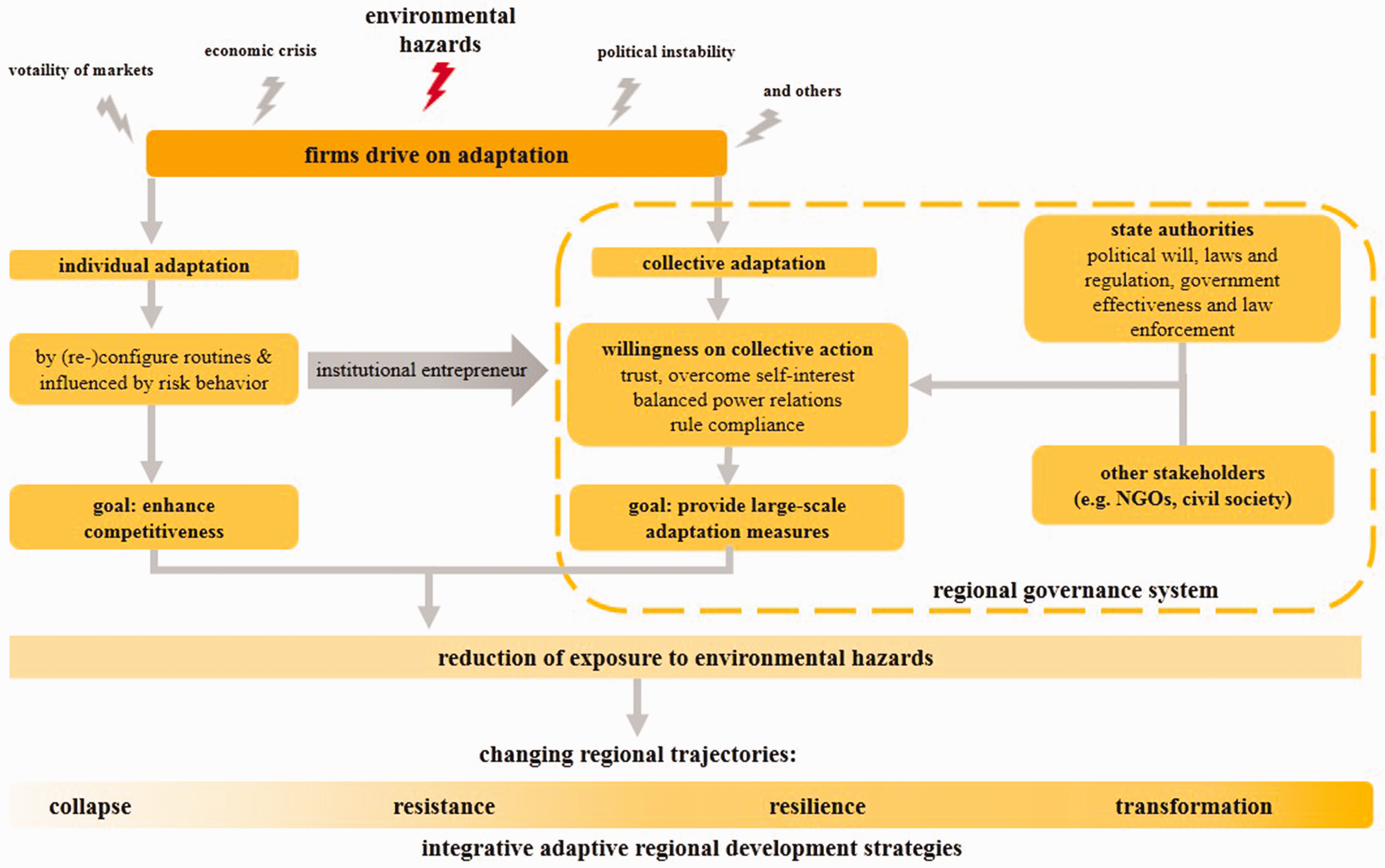
IARD framework (own illustration).
Whether and how firms drive adaptation efforts should be seen from two perspectives. First, firms need to adapt individually to environmental hazards in order to enhance their competitiveness. Research by organizational studies and evolutionary economic geography has pointed out that firms’ strive to enhance competitiveness through continuous adaptation of their organizational routines (i.e. firms’ specific structures and actions). Improving routines enable firms to respond to changing market or environmental conditions (Frenken and Boschma, 2007; Nelson and Winter, 1982). The outcome of individual adaptation will primarily affect the firms' own competitiveness, but the outcomes can positively alter other firms and stakeholders who imitate these effective activities. Additionally, individual adaptation can have positive but also negative side-effects for other actors. For instance, an emergency pump can on the one hand help to decrease the inundation for the surrounding firms or residential areas. On the other hand, the disposal of the pumped water might inundate other areas and affect firms and residential areas. Furthermore, if firms can compete well on the market, they will have positive effects on employment, tax revenues, etc. On the other side, individual maladaptation will contribute to risk and decrease the competitiveness (worst-case scenario: bankruptcy). This eventually contributes negatively to wider socio-economic effects (e.g. employment, tax revenues).
Second, firms can be important players for collective adaptation in regional governance systems, together with other stakeholders, such as other firms, the community, government agencies, civil society organizations, and international development organizations. Collective adaptation is characterized as collaborative activities that firms are initiating or within which they are participating together with these other stakeholders. The goal of these activities is to implement adaptation measures which cover broader areas, for instance entire neighborhoods. Striving for collective adaptation requires that the members of the governance system minimize their pure self-interest by negotiation and punishing free-riding (Ostrom, 2000). Engagement on collective adaptation is not cost-neutral for firms. But in many contexts joint adaptation measures will be more effective than individual ones. For instance, each individual firm will benefit from widening rivers or implementing a polder system on the base of cost sharing. Individual firms can hardly finance and legitimize such large-scale adaptation measures on their own. The outcome of collective adaptation is particularly necessary to tackle large-scale risk-causing factors such as coastal erosion, land subsidence, and clogged rivers.
Therefore, we assume that firms’ engagement on adaptation together with other stakeholders and by the legitimization of state authorities can shape different regional trajectories. In line with Solecki et al. (2017), the outcomes of integrative adaptive regional development can have diverse forms ranging from resistance to resilience and transformation or collapse as an unintended effect of inaction, or the incapacity of effective (joint) adaptation action. Resistance means that actors try to keep the current system and its configurations (e.g. power relations) stable, despite increasing external stress such as the rise in the frequency and intensity of flooding. It implies rising input resources, for instance, protecting the infrastructure and strengthening rigid institutional or bio-physical structures. Resistance often involves conventional engineered solutions with a focus on the built infrastructure, e.g. coastal defense systems. On the individual firms’ perspective resistance can be for instance the intensification of already existing options such as emergency pumps or back-up generators.
Resilience implies slight adjustments of the current regional trajectory to improve the ability to deal with external stress and crisis situations. However, the main regional configuration is typically not being questioned. Resilience can rather be understood as an ‘adjustment at the margins’, which ultimately has the aim of stabilizing the core fabric of the existing regional system in the face of potential external disturbance. The danger is that these minor changes hamper or delay essential major ones. Therefore, the resilience paradigm can in effect work against the need for more fundamental changes (Handmer and Dovers, 1996; Holling and Gunderson, 2002). Examples for resilience can be individually the adjustment of supply chains (e.g. in terms of emergency contingencies for just-in-time systems). Collective adaptation of resilience can be the upgrading of existing protection systems (e.g. for improved dykes infrastructures) or the modernization in early warning systems (e.g. through online solutions).
In contrast, transformation is viewed as a form of adaptation that fundamentally questions the set-up and fit of a current regional system, its risk mitigation strategies and adaptation patterns (Pelling, 2011). The underlying threats of hazardous events are more likely to be addressed directly. The aim of transformative adaptation is therefore to initiate a new regional trajectory, i.e. applying novel routines that increase the regional long-term sustainability by minimizing risks or rigidity traps and collapse, and by establishing co-benefits from new development trajectories. This outcome requires a more risk-prone attitude, flexibility, and a willingness to change behavior and institutional setting (Pelling, 2011). The transformative process can be painful and not beneficial for every actor within the governance system. In addition, the risk of maladaptation is higher compared to the resistance or resilience trajectory, but the potential long-term benefits of successful effective transformation can be significant. Flexibility and high adaptive capacities can reduce the risk of negative consequences (Handmer and Dovers, 1996; Nelson et al., 2007). A typical example for individual adaptation can be the relocation of production facilities. A collective adaptation can be the regional shift in economic activity from one sector to another (e.g. from manufacturing into services).
Collapse constitutes the most severe outcome, occurring if no adaptation or maladaptation is undertaken. In such a situation, the whole regional configuration can be locked-in and incapable of adapting effectively. Reasons of a collapse can include the failure of state authorities to engage in countermeasures against environmental hazards or firms pursuing a ‘wait-and-see’-strategy (Solecki et al., 2017). Consequently, the regional economic consequences might be the exodus or bankruptcy of firms, which would lead to socioeconomic downgrading in the entire region.
In order to better understand which factors influence the described outcomes, we discuss determinants for individual and collective adaptation in the two following sections.
Firms’ need and willingness to adapt to environmental hazards
The case studies of Jakarta and Semarang have shown that firms are exposed to environmental hazards and their individual adaptation is mostly shaped by long-established solutions, such as pump systems. The field study also revealed that the firms need to break through their routines since the exposure to environmental hazards is increasing and cannot fully covered by the existing routines. The interviews showed that firms, however, face difficulties to modify their adaptation due to limited resources or constraints of the business environment (e.g. increasing competition). Accordingly, it is necessary to understand how firms utilize their skills, technologies, and resources in order to adapt to environmental hazards. Moreover, it is important to understand how firms can incorporate effort on adaptation in respect to their typical business strategies for enhancing their competitiveness.
Since decades, particularly organizational studies stress that routines are crucial for firms to establish decision-making procedures and internal capabilities to respond effectively to economic, social, and environmental changes. Generally, routines are firms’ specific structures and actions which shape future behavior and decision-making. Routines incorporate stability and change and are adapted if firms experience new situations or common decision-making fails (Berkhout et al., 2006; Nelson and Winter, 1982). They are derived from former routines (e.g. experience, skills or tacit knowledge) and are determined by the institutional landscape (Frenken and Boschma, 2007). The firms’ capability to replicate or adjust its routines when market and environment conditions change, enable firms to enhance their competitiveness (Frenken and Boschma, 2007; Nelson and Winter, 1982).
Until now, research on adaptation to risks and environmental hazards – particularly on communities and households – typically stress the term ‘adaptive capacity’ which can be interpreted as organizational routine. With regard to firms, the concept of adaptive capacities provides an important emphasis on the endowment of resources and capabilities that firms hold in order to adjust or utilize their routines. In particular, the limitation of adaptive capacities and the false judgment of one’s own adaptive capacities should be taken into account to understand firms’ individual adaptation. It might explain why firms rely on their established routines because they will lean on existing competencies and are unlikely to generate new knowledge in view of an evolving and uncertain landscape, so their competencies become inflexible (Cohen and Levinthal, 1990; Leonard-Barton, 1992). Also, false judgment particularly during times of considerable uncertainty can lead to ineffective adaptation or maladaptation (Grothmann and Patt, 2005). For instance, production or storage redundancies in order to respond more flexible during shock events tie up resources that can be a financial or organizational burden during time of no shocks. This burden can limit resources for innovating new products and services. Trade-off of distributing resources is accelerated by the uncertainty when shocks will occur.
Decision-making in the context of risk
As we have seen in our interviewed firms, the impact of environmental hazards is relatively uncertain and the firms sometimes hesitated to invest in more sophisticated adaptation because the current losses by floods and coastal erosion can still be covered. This low engagement on adaptation raises concerns on how firms can still survive in view of the increasing long-term exposure, for instance, to floods. Apparently, the firms’ risk behavior play a crucial role on their engagement on individual adaptation. Some firms might be also paralyzed by the environmental hazards since their low competitiveness does not enable more investment on adaptation. Accordingly, it is important to understand how firms see environmental hazards as a threat for their viability. Environmental hazards oftentimes occur irregularly and their impact on firms’ competitiveness will just happen gradually. This means firms face a great uncertainty to what extent they should adapt to them – and when.
Behavioral economics provide several theorems of cognitive biases that determine the rationally bounded risk behavior of decision-makers. Given the huge amount of different explanatory factors that have been detected by behavioral economics and the limited scope within this paper, we focus on one of the most seminal theorems. Most of the current empirical evidence by behavioral economics on decision-making in the context of risk refers to the prospect theory of Kahneman and Tversky (1979). The most seminal contribution of the prospect theory is the loss aversion theorem. It explains that decision-makers tend to take less risky decisions (i.e. taking no efforts on adaptation) if they still see a gain as an outcome of their decision and vice versa. With regard to environmental hazards, for instance, Page et al. (2014) showed by a natural experiment after the 2011 Australian floods that homeowners in Brisbane who were directly affected were willing to accept more risky gambles than unaffected ones. Accordingly, it can be assumed that firms are more willing to adapt if the firms face considerable losses by environmental hazards. In contrast to the prospect theory, however, the risk-sensitivity theory argues that decisions are mostly made in response to need. Decision-makers prefer high-risk options in situations of great need, because safe, low-risk options are unlikely to fulfill the needs. Accordingly, decision-makers aim rather to minimize the probability of inappropriate outcomes in response to their needs than to maximize certain outcomes (Mishra, 2014; Rode et al., 1999). These equivocal assumptions and the missing research on how environmental hazards determine firms’ decision-making on adaptation underpin the need to understand the impact of environmental hazards on firms. Therefore, it is necessary to assess which magnitude or scope of environmental hazards, and their respective losses, might push firms to engage in adaptation or intensify their adaptation effort. The overall question should be to understand the careful weighing of firms whether and which scope of adaptation is needed and how firms’ decision-maker are perceiving environmental hazards as a substantial business risk.
As a consequence of this research gap, it is unclear to foresee whether and which adaptation measures will be implemented by the firms. In principle, firms have manifold options that range from hard (e.g. capital-intensive, technologically based) to soft (e.g. organizational) adaptation measures. The choice of the most effective option depends on many factors (e.g. type of hazards, affected asset, routines) and can create many trade-offs (e.g. persistent vs. flexible measure) that firms need to consider (Linnenluecke and Griffiths, 2015; Neise et al., 2017; Weinhofer and Busch, 2013). One of the most drastic adaptations is the partial or even complete relocation of businesses. Especially, when the exposure is strongly influenced by the location of the business, e.g. located in a low-lying coastal areas, relocation might be considered an appropriate adaptation option (see examples in Linnenluecke et al., 2011). If relocation is seen as too risky or costly, hard in-situ adaptation that focuses on the infrastructure such as investments on protection measures like elevating the plant or reinforcing the building presents an option. Furthermore, the organization of production processes can be modified, e.g. through changes in production capacity, storages or supply chains. A distinctive soft adaptation that addresses the business organization can be the introduction of a business continuity management which incorporates emergency response teams, back-up plans, and redundancies (Linnenluecke and Griffiths, 2015).
Moreover, the firms’ engagement in individual adaptation measures might differ based on their size (SMEs vs. large firms) and national origin (domestic vs. multinational). For instance, Haraguchi and Lall (2015) have revealed that due to the flood in Thailand the multinational firm Toshiba rather relocated to the Philippines than adapt locally to the flood exposure and investing in onsite protection. In contrast, domestic SMEs are less mobile due to their local and social embeddedness within the community and more experienced with past hazard events (Shaw and Izumi, 2015).
In sum, a better understanding of the firms’ rationales, enablers and barriers of adaptation and their role for choosing between different types of adaptation still needs to be examined.
Regions’ need to adapt to environmental hazards
The field study has also shown that firms often cannot handle the exposure to environmental hazards on their own. The impact of coastal erosion, land subsidence, or floods affects entire city areas. Hence, adaptation to environmental hazards has to be addressed at least on a regional level, too. In the context of this paper, regions are understood as spatial entities below the level of nation-states which are bound together by a common physical geography, economic system, cultural identity, or political administration. Such regions are important entities for adaptation since besides similar hazard profiles they are strongly integrated economically and provide the basis for pooled adaptation funding.
As outlined above, risk reduction and adaptation to environmental hazards are typically the responsibility of the state. However, the Indonesian state authorities – like in many developing and emerging economies – are overstrained to provide adequate risk reduction and adaptation measures. Therefore, the question occurs how affected actor groups, such as firms, might provide or endorse collective engagement on adaptation with governmental support at the regional level.
Firms of a region typically have a shared interest in the economic viability and adaptation of their joint region. However, whether and how this interest also translates into effective collaboration for collective adaptation among the firms with governmental support – and with other actors in the society – often remains unclear. Institutional approaches and governance concepts provide valuable analytical and normative perspectives to guide such an analysis.
Adaptation governance systems and the power of institutions
Several case studies about the successful development and adaptation of regions have shown that regional institutions are important explanatory factors (e.g. Grabher, 1993; Meyer and Revilla Diez, 2015). Institutions, as place-specific endowments or shared features, create the conditions to adapt more effectively. For instance, trust between regional economic actors can be strengthened, which in turn reduces transaction costs and uncertainty (North, 1994). Recent studies on the Pearl River Delta and the integration of Hong Kong with its hinterland, highlight the importance of informal arrangements between actors along the electronics value chain, enabling firms to respond flexibly to market changes (Meyer and Revilla Diez, 2015; Revilla-Diez et al., 2008). We assume that informal institutions are also important for the realization of adaptation measures because of the insufficient role of the state. Therefore, informal institutions can compensate the lack of state agency. Under these circumstances, engagement on adaptation – particularly collective adaptation – requires trust and reliability among the stakeholders and a functioning governance system (e.g. Neise et al., 2017).
Lately, many scholars stress the importance of a risk governance in order to adapt more effectively to environmental hazards and to include a wide range of affected actor groups (e.g. Folke et al., 2005; Lebel et al., 2006). Governance, as the arrangements and procedures within a formal and informal institutional landscape, can be seen as the action field where actors exercise their influence, mediate their interests, negotiate their responsibilities, and organize their common affairs at the interface of the state, the private sector and the society (Dente et al., 2005; Garschagen, 2014; Garschagen and Kraas, 2011; Lebel et al., 2006; Pelling, 2011). In terms of collective adaptation to environmental hazards, governance systems are assumed to create the institutional structures and policy processes that guide and limit collective actions (Renn and Klinke, 2013). Moreover, collective adaptation should not only comprise adjustments in the bio-physical environment (e.g. by means of dykes or resettlement programs), but also needs to incorporate adjustments in the very institutions of risk management and adaptation governance, such as planning mechanisms and legal frameworks (Birkmann et al., 2010; Djalante et al., 2011).
Research focusing explicitly on the impact of different types of governance of adaptation is only slowly emerging and is often characterized by normative requests rather than by analytic precision. One of the first seminal insights is provided by Lebel et al. (2006) who argue that deliberation, diverse participation, and open communication are useful factors to foster trust, mutual understanding, and self-organization. Garschagen (2014) showed for the case of Vietnam’s political transformation how state and non-state actors negotiate their different interests, rights, and responsibilities with regard to risk reduction. More generally, developing countries and emerging economies are particularly relevant cases for studying risk governance since the relationship between the state, the private sector, and society in their joint attempt to reduce risk and adapt to environmental hazards is changing dynamically in these settings (Garschagen, 2014).
Firm’s willingness to collective adaptation and potential regional outcomes
Nevertheless, taking a governance perspective also allows to reveal potential rifts and trade-offs when negotiating collective adaptation. In particular, the effectiveness of adaptation is determined by the willingness of stakeholders to engage in adaptation and perhaps even to change institutions. The field study in Semarang indicated that the willingness of coordinated collective adaptation is lacking. Firms mostly concentrate on individual solutions in order to protect their business. The industrial estate managers show no interest in large-scale adaptation and the state authorities do not feel responsible and are overstrained by the huge complexity of land subsidence, coastal erosion and floods that affects the entire city’s coastline.
Large-scale adaptation measures, such as constructing a dyke, will change the regional environment for the stakeholders in different ways. It might even have negative effects for some of the stakeholders: For instance, some fishermen may lose their livelihoods when a dyke is constructed. Moreover, the participation of many actors may increase the complexity of decision-making (Nelson et al., 2007), which makes flexible, rapid responses difficult. There is a danger that initiatives pushed forward by the actors of a governance system may not have full societal legitimization or that they may undermine democratic systems, if powerful actors shape the regional economic systems solely to their own benefit. Thus, political legitimacy, i.e. effective institutional processes, cost-efficient handling of public resources, and consideration of public preferences, has to be incorporated into effective governance systems in order to achieve collective adaptation (Renn and Klinke, 2013).
In this context, the role of the state in supporting collective adaptation appears to be crucial. Although state authorities lack on providing large-scale adaptation due to their limited technical skills and financial budgets they still exercise the authority (e.g. through the formulation of laws and regulations) to allow large-scale adaptation measures (e.g. dykes). Hence, firms’ initiated collective adaptation needs formal, indirect governmental support, even though state authorities will not be actively involved in the implementation of the adaptation measures. The firms’ initiated collective adaptation in Cakung, Jakarta, showed clearly that the governmental support is strongly needed if firms attempt to shoulder the responsibility of implementing large-scale adaptation measures that typically is the responsibility of the state. Such adaptation measures become a common good so that an entire neighborhood will benefit from a lower flood risk. However, the field study also detected that a strong engagement on collective action in order to implement joint large-scale adaptation is missing at large.
Research on social dilemmas and common goods has provided important insights in understanding the processes – and barriers – that shape collective action. Most prominently, this includes the seminal work of Ostrom (e.g. 1990) and the extensive empirical work of Agrawal et al. (2013), Cardenas (e.g. 2004) and Janssen (e.g. 2015) about cooperative behavior and the distribution of common goods. The respective research stresses the importance of understanding the underlying decision-making and actions of the actors in order to examine why the actors are willing to cooperate. Furthermore, the empirical research underpins that effective institutions such as rule compliance, sanction mechanisms, the constellation of the governance systems (e.g. size of actor groups, equivalent cost-benefits for all actors) are crucial points for collective actions (Janssen, 2015; Ostrom, 2011).
How can firms be active players on collective adaptation within a governance system, e.g. in our case study Semarang? Firms as stakeholders of a governance system can act as “institutional entrepreneur”. According to DiMaggio (1988), these actors intend to change established institutional arrangements and seek to set up new or at least modify existing arrangements according to their interests (DiMaggio, 1988; Garud and Karnøe, 2001). Firms as institutional entrepreneurs possess the ability to initiate institutional change proactively in order to achieve better adaptation outcomes. They take leadership to implement change, and while, they are not necessarily politically legitimized, their position in formal and informal leadership systems, and their involvement in activities give them support and de-facto legitimacy (Magis, 2010).
Hence, we suggest that firms might first have a pure business interest in implementing broader adaptation jointly with other stakeholders and second, these efforts can enhance their infrastructure and support the livelihood of their affected employees. For instance, small- and medium-sized domestic firms are often the main drivers of local socioeconomic welfare in many hazard-prone countries (Pauw, 2015). Therefore, we argue that they also might have the societal legitimacy and interest to initiate collective adaptation as an institutional entrepreneur.
However, as pointed out by research about collective action, powerful individuals or groups who are interested in maintaining the status quo can hamper initiatives on collective adaptation or poor, ineffective outcomes can be developed. The variety of different interests within the governance system can endanger effective collective adaptation if no agreement on the strategy is reached. It is crucial that the actors in the governance system are willing to overcome their pure self-interest. In governance systems, the involvement of all the stakeholders concerned may succeed in preventing uncooperative behavior. However, distinct self-interest and power relations make it highly challenging to bring about a smooth, effective collective adaptation. Therefore, enforced rules (e.g. sanction mechanisms) might be realized to limit or punish individually deviant behavior (Ostrom, 2000).
These difficulties show that IARD typically calls for changes or modifications in prevailing behavior and strategies. In particular, more self-interested behavior that firms might seek will hinder collective adaptation. By doing this and also by rearranging firms’ own routines, it might become more probable that firms act as institutional entrepreneurs and/or an active players in a governance system. However, the willingness in changing behavior and strategies might occur gradually and can be hampered by the ‘competency trap’ (Levitt and March, 1988).
In consequence, individual and collective adaptation efforts might impact regional development trajectories as described in our IARD-framework. The following scenarios illustrate how regional trajectories could evolve based on our explorative field study in Indonesia:
In Jakarta, signs that the regional trajectory might change from resistance to resilience and partially to transformation can be assumed. Formerly, Jakarta was trapped in a resistance phase and near to a collapse. Firms mostly relied on long-term established routines, such as pump systems and just expanded their capacity to respond to an increasing magnitude of floods. After the flood events in 2007 and 2012, however, many firms adjusted or intensified their existing, individual adaptation measures. Slight modifications were undertaken in order to stabilize the business strategies. These firms’ actions can therefore be understood as resilience building. Going beyond such adjustments, particularly medium-sized and large-scale firms implemented novel routines on adaptation which indicate a more transformative rethinking of risk management strategies (e.g. introducing novel emergency response teams). Such measures indicate that firms’ individual adaptation is starting to transform. Also the intensified engagement by the city authorities on large scale-scale adaptation measures (e.g. river normalization) and the partially increasing firms’ engagement on collective adaptation indicate a transformative progress on adaptation to floods. However, Jakarta’s regional trajectory still lacks a coordinated engagement by all actors that cover the entire city region. Rather engagement to floods adaptation is guided uncoordinated through different priorities of the actors (e.g. city authorities vs. manufacturing firms). Thus, in order to achieve a full transformation of the regional trajectory in Jakarta the level of coordination has to be increased and novel ways of risk mitigation have to be sought. Furthermore, firms’ initiatives on collective adaptation should be encouraged by state authorities and firms’ solutions should be integrated into the cities’ formal flood risk mitigation strategies.
In Semarang, a change of the trajectory in the future can hardly be presumed. At the moment, the firms are unable to break their organizational routines and rely on their long-term established but insufficient individual adaptation measures. Furthermore, firms’ collective adaptation is only poorly established, for instance, by the tenants in the largest industrial site Genuk. Since the industrial estate managements are unwilling to improve the poor conditions for the entire industrial parks, small groups of firms, for instance, jointly elevated the access roads to their plants. The firms primarily focus on their own benefit, but more effective large-scale collective adaptation (e.g. planting mangroves to prevent coastal erosion) that can reduce the exposure for the entire region is not envisaged. Moreover, the political will of Semarang’s city authority is also limited to improve the severe conditions of ongoing coastal erosion, land subsidence, and increasing events of tidal flooding. Consequently, one needs to assume that the regional trajectory in Semarang will remain in a resistance stage close to a collapse in the mid-term future.
Conclusions and outlook
The growing impacts from intensifying environmental hazards such as flooding, typhoons, or sea level rise make adaptation essential. While a lot of attention over the recent years has been given to the adaptation of private households or communities, the ways in which firms act as drivers of adaptation are much less understood. This is striking, given that firms have to shoulder the lion’s share of economic impacts from disasters and play a crucial role for the well-being and resilience of entire regions. Developing countries and emerging economies are of particular concern in this context, given that environmental hazards are in these countries coupled with other challenges such as rapid urbanization, low economic profitability, and weak institutional capacities on the part of states and formal institutions. Authorities in many of these countries face difficulties in providing sufficient adaptation, leaving an adaptation vacuum which needs to be filled by firms and other actors. The Indonesian coastal cities Jakarta and Semarang exemplify these challenges, most notably for manufacturing firms. The firms primarily rely on individual adaptation by long-established organizational routines. Collective adaptation can hardly be observed. Poor established regional governance systems and low support by state authorities hamper particularly engagement on collective adaptation.
Until now, little effort has been made to understand decision-making concerning adaptation at the firm level, including aspects such as strategic business decisions in the face of (increasing) environmental hazards. While valuable insights can be drawn from different theoretical and empirical streams of existing literature, a comprehensive framework with a strong focus on the role of firms as stakeholders in regional adaptation has been still missing. Based on our explorative study in Jakarta and Semarang, the paper proposes a novel conceptual framework on IARD. The objective of the framework is to provide conceptual guidance for the analysis of regional adaptation processes, especially focusing on the role of firms, and the debate and design of policy options to foster successful regional adaptation trajectories. The framework argues that exposure to environmental hazards combined with broader socioeconomic developments act as a trigger of institutional change. Firms, as stakeholders within regional governance systems, and their decision-making under risk and adaptation, are assumed to be a key factor. The concept suggests examining firms’ decision-making with regard to adaptation from two perspectives: First, firms enhance their competitiveness through adaptation by relying on their routines, which are determined by the decision-makers’ risk behavior and the institutional setting. Second, firms act as stakeholders within wider collective adaptation activities together with other stakeholders (regional governance system). Through both strands reconfigured, regional trajectories can be initiated that can have different outcomes, ranging from collapse to resistance, resilience or transformation.
While the presented framework provides a systematization based on existing literature and allowed us to assume potential future regional trajectories on adaptation to floods in Jakarta and Semarang, the implications of firm-driven adaptation processes should be further addressed. Additional steps have to be taken to validate the usefulness of the framework. Comparative case-studies might constitute a useful method. Qualitative approaches, such as interviews with firms’ decision-makers and respective stakeholders as well as the observation of decision-makers’ actions might be a promising way to assess adaptation. Field experiments, including discrete choice scenarios, with firms’ decision-makers as participants can capture the risk behavior and willingness to change regional trajectories. This mixed-methods approach may facilitate a better understanding of adaptive responses and wider socioeconomic development at the regional level in the face of environmental hazards.
Overall, risk-related environmental hazards remain a pressing issue in many developing countries and emerging economies. The success of socioeconomic transition will be determined by whether the countries are able to deal with environmental hazards, i.e. to reduce the risks and to exploit the opportunities resulting from these hazards.
Footnotes
Acknowledgements
We are very grateful for the very valuable comments by the anonymous reviewers.
Declaration of conflicting interests
The author(s) declared no potential conflicts of interest with respect to the research, authorship, and/or publication of this article.
Funding
The author(s) disclosed receipt of the following financial support for the research, authorship, and/or publication of this article: The research has been funded by the German Research Foundation (DFG) within the framework of the German excellence initiative and the German Federal Ministry of Education and Research within the TWIN-SEA project.