




Abstract
Understanding the neurocognitive impact of digital integration in education is essential, particularly in sub-Saharan Africa, where socio-economic and geographical disparities amplify the need for effective learning strategies. This study investigated how visuospatial working memory performance is affected by the modality of task presentation (screen versus print) and geographical context (urban, economically advantaged region versus rural, economically disadvantaged region) in Ivorian primary school students. We employed a behavioural approach with 222 students (aged 4–13). Students from urban (Abidjan) and rural (Man) schools were assigned to perform a visuospatial working memory task presented either on a computer screen or using printed physical materials. An analysis of covariance, with age as a covariate, revealed that students performing the task on-screen showed significantly better performance (fewer errors) compared to those using printed materials (p < 0.001). A significant interaction between presentation modality and geographical context was also found (p = 0.009). Specifically, the performance difference between screen and print modalities was larger in the urban setting, primarily due to urban students performing more poorly with printed materials compared to rural students in that same condition; rural students using printed materials outperformed urban students using printed materials (post hoc, p = 0.002). No significant difference in performance on screen-based tasks was found between urban and rural students. The main effect of geographical context was not significant. These findings suggest potential cognitive benefits of screen-based presentation but highlight a complex interplay with geographical context, which itself is intertwined with socio-economic factors and initial age differences that were statistically controlled. Future research should further incorporate direct socio-economic status controls and explore factors like motivation and task engagement, alongside neuroimaging approaches, to elucidate the underlying mechanisms.
Keywords
Introduction
Investigating the neurocognitive effects of digital integration in education is fundamental, particularly in sub-Saharan Africa, where socio-economic and geographical disparities are more pronounced. Understanding how digital tools impact brain function and cognitive processes, especially working memory, is essential in this context. In sub-Saharan Africa, these technologies are emerging as potential tools to address educational challenges, including inequalities between urban and rural areas (Bogui, 2007; Coulibaly, 2019). However, the impact of screens on students’ cognitive processes, particularly working memory, remains a critical and neuroscientifically under-researched issue in this specific context (Ouattara et al., 2024). We lack a clear understanding of the neural mechanisms by which screen use impacts working memory in African children, particularly considering the influence of geographical environment.
Working memory, defined as the ability to temporarily store and manipulate information while performing complex cognitive tasks (Baddeley and Hitch, 1974), is a cognitive system critically dependent on the dynamic interaction between prefrontal and parietal cortices (Barnes et al., 2016; Klingberg, 2006), essential for academic success. Understanding how screen use modulates the function of these critical prefrontal-parietal circuits is therefore crucial to assess its cognitive impact. Working memory is essential for reading comprehension by enabling the maintenance and integration of textual information and for mathematical problem-solving by supporting mental operations and the maintenance of intermediate results (Gathercole et al., 2004). In addition, neuroimaging research also shows that exposure to different learning environments can modify neuronal plasticity and the functional connectivity of these circuits, thereby optimising or reducing working memory performance (Wager and Smith, 2003).
However, evaluations of the Confemen Educational Systems Analysis Program (PASEC, 2021) show worrying results in Côte d’Ivoire, with a significant proportion of pupils failing to reach the threshold of proficiency in reading (59.5%) and mathematics (over 60%) at the end of primary school. These difficulties, particularly pronounced in rural areas which often face greater socio-economic challenges and limited resources (PASEC, 2016, 2020), highlight the need to examine the factors that influence these results, in particular the learning environment and deficits in working memory, a capacity that is directly involved in the performance of essential academic tasks (Holmes and Gathercole, 2014).
In terms of access to educational and digital resources, geographical contexts also play a key role. As students in rural areas face structural barriers such as limited access to educational infrastructure and digital tools (OECD, 2021), digital technologies could provide a solution to reduce these inequalities. Studies on the impact of screens on working memory, mainly conducted in Occidental contexts, showed mixed results (Delgado et al., 2018). On one hand, some research highlights the benefits of screens, including increased interactivity and enhanced cognitive engagement (Holmes et al., 2009; Sánchez-Pérez et al., 2018). On the other hand, others highlight the risks, such as cognitive overload and the distractions it can generate (Anuardi et al., 2020; Mangen and Velay, 2010; Sweller et al., 2011).
However, the influence of the geographical environment on cognitive performance, particularly in African countries, remains largely underexplored. The interaction between screen use, geographical context (urban versus rural), and cognitive performance, especially working memory, is a key issue for the design of educational policies adapted to local realities. In this context, this study aims to evaluate, through a behavioural approach, the effect of the use of screens as a learning aid on the working memory of primary school children in Côte d’Ivoire. It also aims to investigate how this effect varies according to the geographical environment. More specifically, the objectives of the study are as follows: (1) to analyse the impact of using a screen as a modality for presenting a visuospatial working memory task compared with traditional non-digital methods and (2) to explore the differences of this impact between students from urban and rural areas. This research provides essential insights into the role of screens in learning within African contexts, considering geographical disparities and the unique challenges of developing educational systems.
Materials and methods
Participants
Sample size was calculated using G*Power (Faul et al., 2007). With a conservative effect size of f = 0.1 and a statistical power of 0.95, considering an alpha of 0.05, the required sample size was at least 176 participants. On this basis, we selected 222 participants to ensure sufficient statistical power to detect an effect (Brysbaert, 2019). Thus, this cross-sectional study was conducted among 222 primary school children (96 boys and 126 girls) recruited from two contrasting regions of Côte d’Ivoire: Abidjan, in the south, in the commune of Cocody (urban, economically advantaged region, n = 102) and Man in the village of Kassiapleu (rural, economically disadvantaged region, n = 120), located in the west of the country. This choice is based on the marked disparities in socio-economic conditions, living standards, and access to education. The Abidjan region, the most advantaged, shows a mean socio-economic index of 58.6, the highest in the country, revealing better access to economic resources and infrastructure. The Western region (Man), in contrast, presents a mean socio-economic index of 47.3, the lowest in the country, indicating significant economic hardship and limited access to resources and opportunities (PASEC, 2016). Regarding parental literacy, in Abidjan, 87.1% of students have at least one parent who can read, compared to 61.7% in the West (Man) (PASEC, 2016). Participants ranged in age from 4 to 13 years, with a mean age of 8.02 years (±2.3). Thus, while participants were recruited based on geographical location (urban versus rural), it is necessary to acknowledge that these labels in our study also represent distinct socio-economic contexts. Recruitment took place in two urban and two rural schools, in collaboration with the local schools’ administrations. Each parent or guardian signed an informed consent form detailing the study procedures in accordance with the Declaration of Helsinki and recommendations from the Félix Houphouët-Boigny University Ethics Committee. None of the parents or guardians reported a history of neurological or psychiatric disorders. For parents who were unable to read, the informed consent form was read out to them (in their preferred language for those who did not understand French well). The two urban schools and the two rural schools were chosen to represent the socio-demographic and socio-economic profile of schools in Côte d’Ivoire as a whole and were close to the national average performance with respect to the indicators of the PASEC (2016, 2020). Participants within each geographical location (urban/rural) were individually and randomly assigned to one of two experimental conditions based on the learning material presentation: a Screen group (n = 110), who performed the task presented on a computer screen, and a No-Screen group (n = 112), who performed the task using printed physical materials. Randomisation was performed using a simple individual allocation procedure, ensuring that each participant had an equal chance of being assigned to either condition. To participate in the study, students had to meet the following criteria: attend a public primary school in Abidjan, an urban area or a rural area in the region of Man; have no diagnosed neurological disorders or learning disabilities; and have normal or corrected-to-normal visual acuity. Exclusion criteria were refusal by parents or guardians to participate in the study and the inability of the child to understand the instructions of the assessment task. Regarding the second criterion, all children who were recruited and agreed to participate were able to understand the task instructions, and thus, no participants were excluded on this basis.
Working memory assessment method
This study specifically examined visuospatial working memory, a core component of the broader working memory system (Baddeley and Hitch, 1974). The decision to focus on visuospatial working memory was based on its relevance in the educational context, particularly among primary school students (Gathercole et al., 2004). Indeed, this component is crucial for letter and number recognition as well as for reading and mathematics in young children (D’Aurizio et al., 2023; Fanari et al., 2019). In contrast to assessments of verbal working memory, which can be influenced by language proficiency and are therefore potentially biased in intercultural settings, visuospatial working memory provides a more robust measure that is less sensitive to linguistic and cultural variations. In our study conducted across diverse contexts, we used a visuospatial task inspired by the Corsi Block-Tapping Test (Corsi, 1972) and the visuospatial tests from the Automated Working Memory Assessment (AWMA) (Alloway et al., 2008). Our task is designed with images of familiar objects to ensure its relevance and accessibility to all students. This adaptation considers their cognitive abilities in accordance with the recommendations of Holmes et al. (2009). The task evaluates the ability to encode, actively manipulate, and retrieve visuospatial information – skills that are essential for learning in a school environment, in accordance with the visuospatial sketchpad of the Baddeley model (Baddeley, 2003; Baddeley and Hitch, 1974).
Working memory task procedure and conditions
All children were tested individually in an isolated, quiet room at their school to minimise the influence of external variables such as noise or brightness on student performance. The memorisation task consisted of remembering simple images during spatial arrangement learning tests. It occurred in two distinct phases.
Each participant had to memorise the position of nine images representing familiar objects (a key, a bicycle, a drum, a boubou, a mask, a bus, a machete, a pig, and a mango). Images were displayed one at a time in a randomised sequence within a 3 × 3 square grid, on-screen or off-screen (Figure 1).
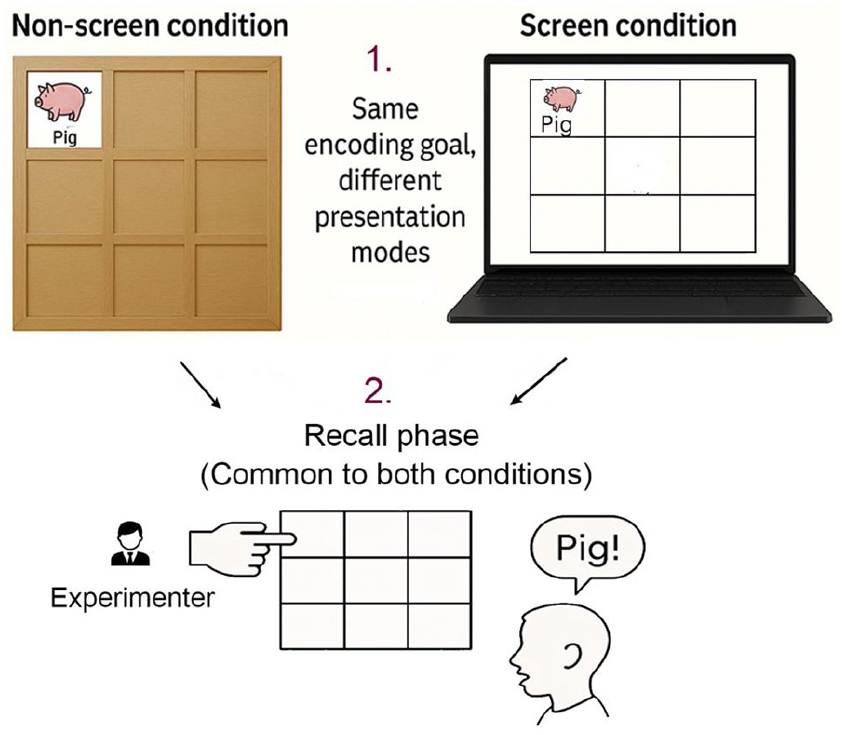
Illustration of the experimental paradigm.
The students were explicitly instructed to focus on both the name of the object and its spatial position. This step requires students to mentally maintain and manipulate the positions of the pictures (Gathercole et al., 2004). In each area, the students learned with or without a screen. Thus, the method varied according to group: in the non-screen group, the printed images were displayed one by one on a 40 cm × 40 cm square physical support, with each image remaining visible for 2 s (Alloway et al., 2008). In the screen group, the images were presented sequentially on a computer screen (15 inches) with a resolution of 1366 × 768 pixels and an identical exposure time of 2 s per image (encoding phase). During this presentation, which precedes the recall, each image was always presented in the same spatial position on the 3 × 3 grid across trials, but the sequence in which the images appeared was randomised in each trial. The overall arrangement of the nine images in the nine boxes was not presented to the participant.
After the stimuli are presented, students in both conditions must recall the position of the images by associating them with the corresponding boxes presented by the experimenter (recall phase). Specifically, the student is required to tell the experimenter the name of the image associated with the square presented to them (Figure 1). During the task, correct answers are confirmed by the experimenter, and errors are pointed out to the participant. Student performance was measured by the number of errors in each trial. Errors were manually recorded by the experimenter in both conditions. Learning success was defined as the completion of three consecutive trials without error, indicating stable memorisation of spatial arrangement. In the case of failure, the test was stopped after 10 trials.
Statistical analysis
The data collected were percentages of errors observed during a spatial memory task. This continuous quantitative variable allows us to assess participants’ performance on each trial as well as their overall performance across all trials. Each participant performed a maximum of 10 trials, especially when memory was late or not established, with a maximum of 9 possible errors per trial. The dependent variable was calculated as follows:

In each set of experiments, two groups of subjects were compared. The aim was to analyse the overall performance of the groups (with screen versus without screen) and to examine differences according to geographical context (urban versus rural). Given the structure of the data (repeated measures within each subject), a repeated measures analysis of covariance (ANCOVA) approach was chosen to analyse the evolution of the percentage of errors over the trials. This ANCOVA included trial (T1 to T10) as the within-subjects factor, group (Screen Group versus No-Screen Group) and environment (urban versus rural) as between-subjects factors, and age as a continuous covariate. The dependent variable was the percentage of errors. The assumption of sphericity was assessed using the Mauchly test, and, if it was not met, a Greenhouse–Geisser correction was applied. In the case of significant interaction, post hoc multiple comparison tests with Bonferroni adjustment were used to identify pairs of significantly different means. Statistical analyses were performed in the R programming environment, version 4.4.2 (R Core Team, 2024). The rstatix package was used for the ANCOVA test (Kassambara, 2023). Post hoc tests were performed using the emmeans package (Lenth, 2023). The threshold for statistical significance was set at p = 0.05. The generalised Eta2 (ges) was calculated for each effect to measure the magnitude of the effect (Olejnik and Algina, 2003).
Results
Characteristics of participants
The demographic characteristics of participants assigned to the four experimental subgroups (Urban Screen, Urban No-Screen, Rural Screen, Rural No-Screen) are presented in Table 1. Analysis of the age variable revealed violations of the normality as indicated by the Shapiro–Wilk test (p < 0.05) and heterogeneity of variances between groups (Levene’s test, p = 0.0157). Consequently, a non-parametric Kruskal–Wallis test was performed, showing a significant difference in age distribution across groups (H(3) = 26.65, p < 0.001). Post hoc Dunn’s tests with the Bonferroni correction indicated that the Urban Screen group (Mdn = 6.00 years) was significantly younger than the Urban No-Screen (Mdn = 8.00 years, p.adj = 0.030), Rural No-Screen (Mdn = 8.00 years, p.adj < 0.001), and Rural Screen (Mdn = 10.00 years, p.adj < 0.001) groups. No other pairwise differences were found to be statistically significant (all p.adj > 0.05).
Demographic characteristics of participants by experimental group.

N: number of participants. SD: standard deviation. IQR: interquartile range. School grade groups in the Ivorian primary system: CP (Preparatory Course, approx. Grades 1–2); CE (Elementary Course, approx. Grades 3–4); CM (Middle Course, approx. Grades 5–6).
Kruskal–Wallis test for age distribution across groups (H(3) = 26.65, p < 0.001).
Chi-square test for gender distribution (χ2 (3) = 2.57, p = 0.4633).
Chi-square test for school grade distribution (χ2 (6) = 11.35, p = 0.0781).
p-values < 0.001 are highlighted in bold.
In addition, a chi-square test of independence was conducted to examine gender distribution across the four groups. The test revealed no significant difference (χ2 (3) = 2.57, p = 0.4633), indicating a balanced distribution of males and females across experimental conditions.
Furthermore, the distribution of participants across school grade groups (Preparatory Course (CP), Elementary Course (CE), Middle Course (CM)) did not differ significantly between the four experimental conditions (χ2 (6) = 11.35, p = 0.0781), indicating a balanced distribution in terms of academic level.
Main effects and covariate (age) effects
A repeated measures ANCOVA was conducted to examine the effects of trial, group, and environment on the percentage of errors while controlling for participants’ age. The results are summarised in Table 2. The ANCOVA revealed that age, included as a covariate, did not have a significant main effect on error rates (F(1, 217) = 1.36, p = 0.247, η2g = 0.005) nor did it significantly interact with trial (p = 0.99).
Results of repeated measures ANCOVA.

DFn = numerator degrees of freedom, DFd = denominator degrees of freedom, ges = effect size (generalised eta-squared).
Significant effects or interactions are indicated with an asterisk (*).
Effect of group
A significant main effect of group (task presentation modality) on the percentage of errors was observed (F(1, 217) = 44.16, p < 0.001, η2g = 0.147). After statistically adjusting for participants’ age and averaging across the levels of geographical environment and trial, the Screen group had an estimated marginal mean (EMM) error rate of 5.37% (SE = 1.17), which was significantly lower than the No-Screen group (EMM = 16.36%, SE = 1.15). The presence of a screen therefore seems to induce a significant change in the errors made (Figure 2).

Overall performance of the groups.
Influence of geographical context
An ANCOVA, controlling for participants’ age, was used to examine the influence of geographical context (urban versus rural) and its interaction with the task presentation modality (Screen versus No-Screen) on working memory performance, as measured by the percentage of errors.
The main effect of geographical environment was not statistically significant after adjusting for age (F(1, 217) = 2.48, p = 0.118, η2g = 0.010). This indicates that, when accounting for age differences between the groups, the overall error rates did not significantly differ between urban and rural settings.
However, a significant interaction between group (task presentation modality) and environment was observed (F(1, 217) = 6.98, p = 0.009, η2g = 0.027). This suggests that the effect of using a screen versus printed materials on performance varied depending on the geographical context (Figure 3). Post hoc comparisons (Bonferroni adjusted, based on EMMs adjusted for age) were conducted to explore this interaction. These comparisons revealed that in the urban environment, the Screen Group performed significantly better than the No-Screen Group (estimated difference = −15.5 errors, SE = 2.51, p < 0.001). This advantage for the Screen Group was also significant in the rural environment, although less pronounced (estimated difference = −6.5 errors, SE = 2.22, p = 0.004). Furthermore, within the No-Screen Group, rural students made significantly fewer errors than urban students (estimated difference = −7.36 errors, SE = 2.32, p = 0.002), while no significant difference between environments was found for the Screen Group (p = 0.543) (see Table 3).

Performance in urban and rural environments of the groups.
Post hoc tests (Bonferroni) for the group × environment interaction.
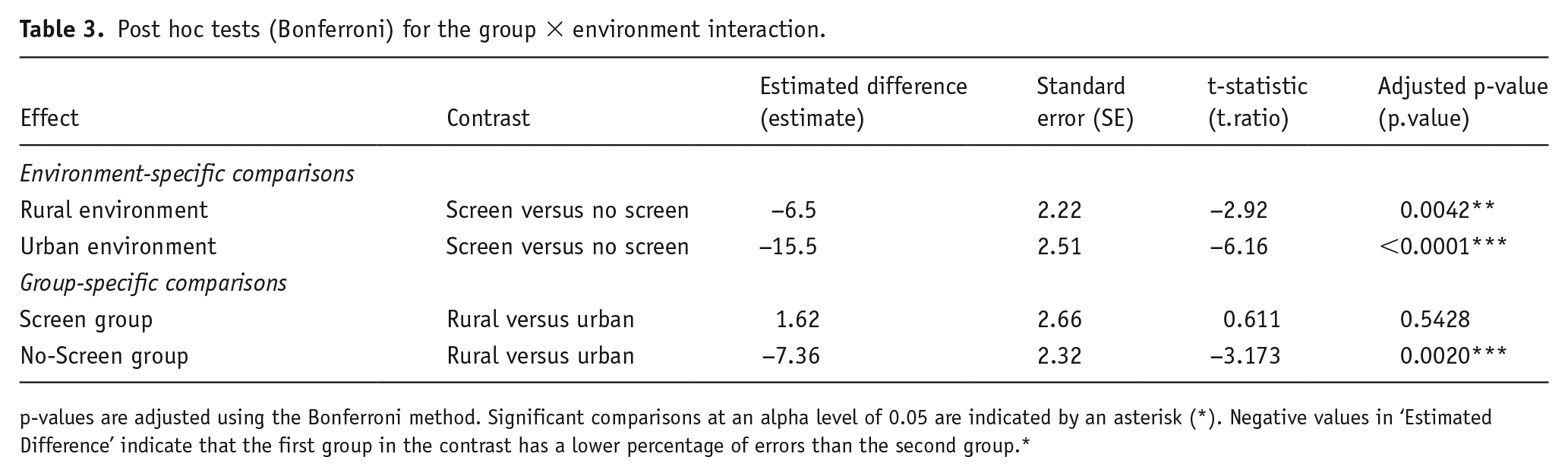
p-values are adjusted using the Bonferroni method. Significant comparisons at an alpha level of 0.05 are indicated by an asterisk (*). Negative values in ‘Estimated Difference’ indicate that the first group in the contrast has a lower percentage of errors than the second group.*
Effect of trial
Statistical analysis (Table 1) revealed a significant effect of trials on the errors committed (F(9, 1953) = 11.726, p < 0.001, η2g = 0.061), highlighting a progressive improvement in performance over the trials and, consequently, learning (Figure 4 and Appendix 1). The interaction between the trial factor and the group factor was also significant (F(9, 1953) = 16.540, p < 0.001, η2g = 0.084), indicating that performance progression differs according to the type of support used. In addition, the interaction between the trial factor and the environment factor was significant (F(9, 1953) = 2.740, p = 0.004, η2g = 0.015). However, the three-way interaction (trial × group × environment) was not significant (F(9, 1953) = 1.549, p = 0.126, η2g = 0.008). Post hoc tests with the Bonferroni correction and learning curves were conducted to dissect the significant group × trial interaction. In the screen group, error reduction was rapid and significant between trial 1 and all subsequent trials, with the mean number of errors stabilising from trial 4 onward. In the No-Screen group, error reduction was also observed between trial 1 and all subsequent trials; however, this reduction continued for a longer period and did not stabilise until trial 6 (Figure 4 and Appendix 1).
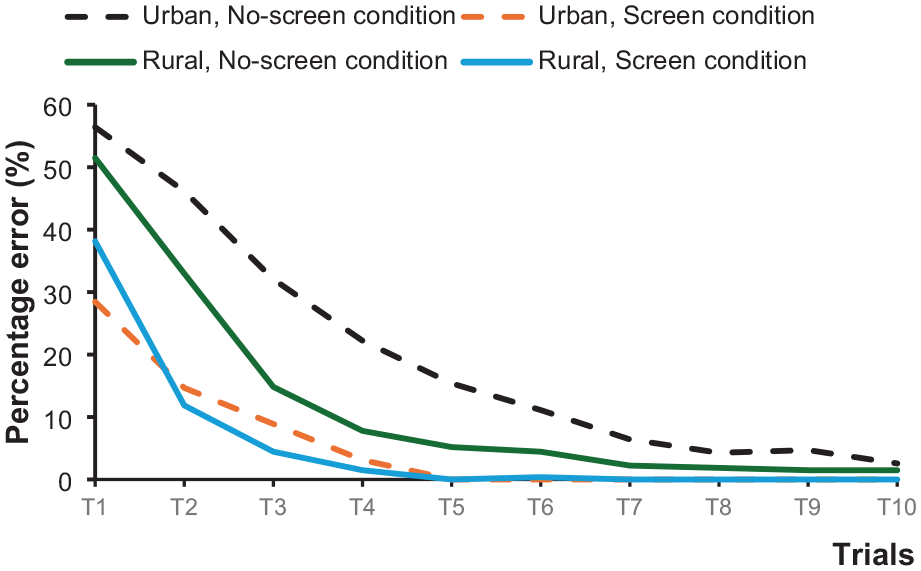
Learning curves of the different groups.
While Figure 4 illustrates the average learning curves, considerable individual variability was present in the learning trajectories. To provide further insight into these individual learning patterns, representative individual performance trajectories across trials for each of the four experimental conditions are presented in Supplementary Figure S1. These plots qualitatively illustrate the range of learning rates and performance ceilings among participants within each group.
Discussion
This study investigated the effects of screen-based versus print-based task presentation and geographical context (urban versus rural) on visuospatial working memory in Ivorian primary school children while statistically controlling for age. Our findings confirm the potential of screen-based presentation to enhance cognitive performance compared to printed materials, thus corroborating previous studies in other contexts (Clark and Mayer, 2016; Mayer, 2009; Sánchez-Pérez et al., 2018).
The observed improvement in performance with screen-based media may stem from several neurocognitive mechanisms suggested in the literature. First, digital screens can visually structure information in a way that might reduce intrinsic cognitive load (Sweller et al., 2011), potentially by aiding attentional focus and optimising resource allocation during demanding tasks (Bush et al., 2000; D’Esposito and Postle, 2015; Miller, 2000). Second, dynamic screen stimuli could promote perceptual integration via parietal regions, essential for visuospatial working memory (Bush et al., 2000). Previous neuroimaging studies suggest that digital tools may enhance frontoparietal connectivity, potentially supporting improved coordination between perceptual and executive processes (Barnes et al., 2016; Klingberg, 2006). Poorly designed digital interfaces or distracting content can also overload cognition (Anuardi et al., 2020), emphasising the need for careful design.
The performance improvement observed, particularly the faster stabilisation of error rates in the screen group, is consistent with models of adaptive learning and rapid cognitive adjustment. In other research, rapid improvements in task performance have been associated with neuroplastic changes, particularly within frontoparietal circuits (Jonides et al., 2008). While our study did not measure neural changes, the faster stabilisation in the screen group could reflect more efficient mental model building or neural network coordination for the task demands. Conversely, the relatively slower stabilisation in the No-Screen group might suggest a different pattern of adaptive stimulation.
An important consideration in this study was the potential influence of geographical environment on working memory performance. After statistically controlling age differences between urban and rural participants (given that children from urban settings were, on average, younger), the main effect of environment was not found to be statistically significant. This result highlights the necessity of carefully accounting for developmental variables such as age when interpreting cognitive differences across geographical contexts. Without such control, environmental effects may be confounded with maturational or socio-demographic factors, particularly in settings marked by wide disparities in socio-economic status, as reflected in our sample (PASEC, 2016).
Although existing literature suggests that rural environments might offer neurocognitive advantages, such as reduced cognitive noise and fewer attentional distractions (Berman et al., 2008), or that urban settings could impose cognitive overload through overstimulation and chronic stress (Evans and Cohen, 2004; Lederbogen et al., 2011), our findings do not support a direct effect of geographical environment on visuospatial working memory performance once age is taken into account. These results suggest that developmental stage may exert a stronger influence on task performance than environmental factors alone, at least in the context of the cognitive paradigm used in this study.
Despite the absence of a main environmental effect after controlling for age, a significant interaction between task presentation modality and geographical environment persisted (p = 0.009). This indicates that the impact of using screens versus printed materials on working memory performance varied between urban and rural children. Specifically, while children in both environments performed better with screens than with printed materials, the magnitude of this screen-based advantage was larger in the urban group. This larger difference in the urban setting was primarily driven by a comparatively poorer performance of urban children when using printed materials, rather than a superior performance with screens relative to rural children (who performed equally well with screens). Indeed, in the No-Screen (printed materials) condition, rural students significantly outperformed their urban counterparts. Conversely, in the screen condition, performance between urban and rural students was not significantly different, suggesting that screen-based presentation might help attenuate performance differences otherwise observed with traditional materials, possibly by providing a more standardised and engaging learning interface (Clark and Mayer, 2016; Mayer, 2009). An explanation could be related to task engagement and motivation. The screen-based task may have been particularly motivating due to its game-like nature. In contrast, urban children may have found the printed task less engaging, perhaps for reasons beyond mere familiarity with digital technologies. The superior performance of rural children with printed materials also warrants further investigation, potentially reflecting different learning experiences or cognitive styles.
The environment × trials interaction suggests possible differences in adaptation rates across settings. Urban students showed faster improvement across trials, which may reflect more efficient cognitive adaptation to the task. Although rural students also improved, their progression was slower. These differences could be partially related to varying levels of familiarity with technology and learning strategies, as suggested by Mangen et al. (2013). The three-way interaction (trial × group × environment) was not significant, suggesting that the fundamental learning mechanisms, as modulated by screen use, were broadly consistent across the two geographical contexts over the trials.
Implications, limitations, and perspectives
These findings suggest that screen-based learning may support cognitive processes related to visuospatial working memory. However, such benefits are likely contingent upon the use of pedagogically appropriate digital content tailored to learners’ cognitive capacities, promoting engagement without inducing overload.
As with all research, this study has limitations that should guide future research. First, the short-term design does not allow conclusions about long-term cognitive or neural changes. Longitudinal studies using electroencephalogram (EEG) or functional magnetic resonance imaging (fMRI) would be needed to explore how brain function and connectivity evolve with digital learning and to uncover the mechanisms behind both potential benefits and risks.
Second, although age was statistically controlled using ANCOVA, the substantial age imbalance across subgroups, particularly between urban and rural screen users, remains a potential confounding factor. Statistical adjustments may not fully capture developmental non-linearities or differences in attention and strategy use. As such, part of the observed effects may reflect maturational differences rather than purely environmental or modality-related influences.
Third, the lack of individual-level socio-economic status (SES) data limits our ability to disentangle environmental effects from SES-related variables. Given documented disparities between the two regions (PASEC, 2016), future studies should include SES indicators such as household income or parental education to better isolate contextual influences.
Finally, our exclusive focus on visuospatial working memory narrows the scope of inference. Broader assessments targeting other cognitive functions are needed to build a more comprehensive understanding of how digital tools affect cognitive development in diverse learning environments.
Conclusions
This study examined how screen-based task presentation and geographical context influence visuospatial working memory in Ivorian primary school children while controlling for age.
Screen-based presentation significantly improved performance compared to printed materials. Although no main effect of environment was observed after adjusting for age, a significant interaction emerged: the screen-related benefit was more pronounced in urban children, largely due to their lower performance with printed tasks. In contrast, performance with screens was comparable across environments.
These findings suggest that the cognitive impact of digital tools is shaped by contextual factors and underscore the need to rigorously control for variables such as age and socio-economic status. While broader educational implications require caution, this study contributes a nuanced understanding of how digital tools and environment interplay in cognitive task performance and offers a valuable foundation for developing more context-sensitive digital learning interventions in regions like sub-Saharan Africa.
Supplemental Material
sj-docx-1-bna-10.1177_23982128251356029 – Supplemental material for Effects of screen-based task learning and geographical environment on the cognitive performance of primary school students: Assessment of working memory
Supplemental material, sj-docx-1-bna-10.1177_23982128251356029 for Effects of screen-based task learning and geographical environment on the cognitive performance of primary school students: Assessment of working memory by Yacouba Ouattara, Prisca Joëlle Djoman Doubran, Koffi Mathias Yao, Niemtiah Ouattara, Taki Romaric Yian and Soualiho Ouattara in Brain and Neuroscience Advances
Footnotes
Appendix 1
Percentage error for each trial and each group.

| Trials | Urban. No-screen condition | Urban. Screen condition | Rural. No-screen condition | Rural. Screen condition |
|---|---|---|---|---|
| T1 | 56.41 | 28.44 | 51.48 | 38.15 |
| T2 | 46.15 | 14.67 | 32.96 | 11.85 |
| T3 | 32.05 | 8.89 | 14.81 | 4.44 |
| T4 | 22.22 | 3.11 | 7.78 | 1.48 |
| T5 | 15.38 | 0.00 | 5.19 | 0.00 |
| T6 | 11.11 | 0.00 | 4.44 | 0.37 |
| T7 | 6.41 | 0.00 | 2.22 | 0.00 |
| T8 | 4.27 | 0.00 | 1.85 | 0.00 |
| T9 | 4.70 | 0.00 | 1.48 | 0.00 |
| T10 | 2.56 | 0.00 | 1.48 | 0.00 |
Acknowledgements
The authors would like to thank the Ministry of Education, through the Directorate of Schools, High Schools, and Colleges, for authorising this study. The authors also warmly thank the school principals for their welcome, their support in recruiting participants, and their collaboration in obtaining the consent of parents or guardians.

Ethical considerations
The study was conducted in accordance with the Declaration of Helsinki and approved by the Institutional Review Board of Félix Houphouët-Boigny University.
Consent to participate
Informed consent was obtained from all subjects involved in the study.
Author contributions
Yacouba Ouattara: Conceptualisation, formal analysis, methodology, investigation, data curation, software, visualisation, and writing—original draft, review & editing. Prisca Joëlle Djoman Doubran: Conceptualisation, resources, data curation, and project administration. Koffi Mathias Yao: Conceptualisation, methodology, validation, supervision, writing—review & editing, and project administration. Niemtiah Ouattara: resources, data curation, and writing—review & editing. Taki Romaric Yian: data curation and writing—review & editing. Soualiho Ouattara: Validation, supervision, and project administration.
Funding
The author(s) received no financial support for the research, authorship, and/or publication of this article.
Declaration of conflicting interests
The author(s) declared no potential conflicts of interest with respect to the research, authorship, and/or publication of this article.
Data availability statement
The data used for statistical analysis are available from the authors upon reasonable request.
Supplemental material
Supplemental material for this article is available online.
References
Supplementary Material
Please find the following supplemental material available below.
For Open Access articles published under a Creative Commons License, all supplemental material carries the same license as the article it is associated with.
For non-Open Access articles published, all supplemental material carries a non-exclusive license, and permission requests for re-use of supplemental material or any part of supplemental material shall be sent directly to the copyright owner as specified in the copyright notice associated with the article.
