




Abstract
Impulsive urgency describes the tendency to act rashly when experiencing extreme emotions. This Australian study aimed to investigate the predictive utility of impulsivity, including impulsive urgency (positive and negative), across a range of problem behaviours. Data from two community samples, one retrospective (n = 281) and one current (n = 604), were analysed using hierarchical regression to determine which facets of impulsivity, as assessed with a comprehensive scale (i.e. negative urgency, positive urgency, lack or premeditation, lack of perseverance, and sensation seeking), best predicted a series of problem behaviours (i.e. problem gambling, disorderly alcohol use, online gambling disorder, obsessive-compulsive disorder behaviours, and social media addiction). The impulsive urgency facets were shown to be significant predictors across the behaviours examined. More specifically, negative urgency was the strongest predictor of disorderly alcohol use, obsessive-compulsive disorder behaviours, and social media addiction. Positive urgency was associated with problem gambling and online gambling disorder behaviours. These findings suggest that impulsive urgency is a key contributing factor in many behavioural problems and that the valence of the urgency is an important consideration when addressing a broad range of psychopathologies.
Keywords
Impulsivity can be broadly defined as ‘behaviour that incorporates a component of rashness, lack of foresight or planning’ (Dawe and Loxton, 2004: 343). As noted by Cyders (2015), impulsivity is the most common criterion in the Diagnostic and Statistical Manual of Mental Disorders (DSM) of the American Psychiatric Association (APA, 2013) and as such has clear implications for a diverse range of clinical disorders and abnormal patterns of behaviour, including attention-deficit hyperactivity disorder (ADHD; Dawe and Loxton, 2004; Whiteside and Lynam, 2001), problem gambling (Blain et al., 2015; Dussault et al., 2011; Teese et al., 2020; Whiteside et al., 2005), and substance abuse (Gullo et al., 2011; Whiteside et al., 2005). While the majority of the related empirical evidence provided is cross-sectional, prospective longitudinal studies (e.g. Littlefield et al., 2010; Thompson et al., 2015) have also demonstrated the predictive utility of impulsivity in accounting for problem behaviour/psychopathology.
While the above reinforce the importance of impulsivity to problem behaviours clinically and empirically, the understanding of its exact impact has been thwarted by a lack of consensus regarding impulsivity conceptualisation and measurement (Sharma et al., 2014). There have been a number of different conceptualisations of impulsivity resulting in conjecture over its dimensionality. Early conceptualisations such as those underpinning the Eysenck Impulsiveness Inventory (EII; Eysenck and Eysenck, 1978), noted impulsivity as a unidimensional behaviour/construct, measured alongside the continuum of venturesomeness and empathy, while acknowledging the potential role of emotional aspects impacting impulsivity. Later models of impulsivity adopted a multi-faceted understanding, eventually leading to the development of the popular Barratt Impulsiveness Inventory version 11 (BIS-11; Patton et al., 1995). The BIS-11 broadly splits impulsivity into attentional, motor, and non-planning aspects, but does not directly measure emotional impulsivity. In contrast to the BIS-11, the subsequent Urgency, Premeditation (lack of), Perseverance (lack of), Sensation Seeking, Positive Urgency, Impulsive Behavior Scale (UPPS; Whiteside and Lynam, 2001, UPPS-P; Lynam et al., 2006) introduced emotional urgency alongside both sensation seeking and cognitive impulsivity aspects.
While similar in underlying concept, the UPPS-P focuses on different variations of emotional drive than the EII. Where the EII focuses on empathy, as an externalised form of emotion (Eysenck and Eysenck, 1978), the UPPS-P focuses on urgency, as an internalised form of emotion. In that context, positive urgency (PU) refers to acting rashly when experiencing extreme positive emotions, and negative urgency (NU) refers to acting rashly when experiencing extreme negative emotions (Lynam et al., 2006). Both PU and NU have since demonstrated robust support within the literature as predictors of problem behaviour (Billieux et al., 2010), problem gambling (Teese et al., 2020), substance abuse (Cyders and Smith, 2008; Cyders et al., 2010), eating disorders (Magel and Ranson, 2021), and have also been shown to interact with pathological conditions including post-traumatic stress, whereby they exacerbated problematic alcohol consumption (Brown et al., 2021).
From a neurobiological perspective, functional changes in brain activity within neural regions associated with reward sensitivity and impulse control (Crone et al., 2016; Harden and Mann, 2015; Harden et al., 2017; van Duijvenvoorde et al., 2016) provide evidence of the importance of the prefrontal cortex in the association between impulsivity and problem behaviour. More recent evidence has provided insight into possible mechanisms by which urgency might impact on problem behaviour. For example, urgency can excessively tax response inhibition pathways (e.g. Chester et al., 2016; Johnson et al., 2020), heighten reward sensitivity across the ventrolateral prefrontal cortex and ventral striatum (Edmiston et al., 2020), and increase activity within the anterior insular when making risky decisions (Johnson et al., 2020).
Despite this emerging evidence, conjecture remains within the literature as to whether the emotional component of impulsivity is a unitary construct or whether the valence of the impulsive urgency creates two constructs (positive and negative; see Johnson et al., 2020, for a review). This debate is yet to be resolved, with some indicating that valence plays little part in the impact that impulsivity plays on behaviour (e.g. Johnson et al., 2020), proposing that it is more one’s inability to maintain control under emotional states that is the issue. Such a position is supported by strong similarity in the predictive utility of PU and NU for disorders such as post-traumatic stress disorder (PTSD) (e.g. Price et al., 2017), as well as similar effect sizes in the predictive utility of PU and NU across a number of other forms of psychopathology and problem behaviour (e.g. Johnson et al., 2017). In contrast, alternative findings imply important distinctions between PU and NU, especially when evaluating the predictive utility of NU in relation to bulimia and substance use (e.g. Cyders and Smith, 2008), or the importance of PU to problem gambling behaviour (e.g. Teese et al., 2020). In addition, those experiencing manic episodes have demonstrated elevated levels of PU but not NU (Muhtadie et al., 2014), suggesting there may be some key similarities and differences in the impact of urgency valence, and a clear need to gain further insight into the extent to which these similarities and differences impact on problematic behaviour and psychopathology, as well as the possible mechanisms underlying any differences.
To add to this area of knowledge, the present research presents findings from two studies, one retrospectively analysed (Teese et al., 2020) and a current study, exploring the utility of emotional impulsivity as predictors of problem behaviours including problem gambling, online gambling disorder, alcohol abuse, obsessive-compulsive disorder (OCD) behaviours, and social media addiction (SMA). It was hypothesised that either NU or PU would be significant unique predictors of all problem behaviours assessed within the context of a UPPS-P five-factor regression model.
Method
Participants
The participants for this study are drawn from two different studies. Study 1 comprised a sample of 281 Australian emerging adults (18–32) recruited via convenience using online media platforms in 2017. Study 2 comprised 604 all adult paid participants recruited in early 2021, sampled using Prolific (2020) in English from Australia, New Zealand, the United Kingdom, Canada, and the United States. Demographics for all studies are shown in Table 1. After cases with missing data were removed, there were fewer full responses to the Alcohol Use Disorder Identification Test (AUDIT; n = 111) for study 1. For study 2, only participants who had gambled online completed the Online Gambling Disorder Questionnaire (OGDQ; n = 241). All behavioural problem variables from these two studies were analysed and are reported below.
Demographics for all tests.

SD: standard deviation; PGSI: Problem Gambling Severity Index; AUDIT: Alcohol Use Disorder Identification Test; OGDQ: Online Gambling Disorder Questionnaire.
Measures
Urgency, Premeditation (lack of), Perseverance (lack of), Sensation Seeking, Positive Urgency, Impulsive Behavior Scale
The UPPS-P (Lynam et al., 2006) is a 59-item 4-point Likert-type impulsivity measure (1 = strongly agree to 4 = strongly disagree). This scale consists of five factors: negative urgency (NU; 12 items, for example, ‘I have trouble controlling my impulses’), positive urgency (PU; 14 items, for example, ‘I tend to lose control when I am in a great mood’), lack of premeditation (11 items, for example, ‘My thinking is usually careful and purposeful’), lack of perseverance (10 items, for example, ‘I tend to give up easily’), and sensation seeking (12 items, for example, ‘I generally seek new and exciting experiences and sensations’). Each scale is calculated as the mean of all the allocated items. A higher score represents higher impulsivity. Cronbach’s alpha for the UPPS-P ranged from 0.794 to 0.937 for the 2017 sample and 0.861 to 0.943 for 2021 sample.
Marlowe-Crowne Social Desirability Scale Short
The Marlowe-Crowne Social Desirability Scale Short (MCSD; Reynolds, 1982) is a true/false measure of socially desirable responding and was used as a control variable in both samples (e.g. ‘I like to gossip at times’). Two similar but different 10-item versions were used for the 2017 and 2021 data. Cronbach’s alpha for MCSD for 2017 was 0.569 for the AUDIT study and 0.618 for the Problem Gambling Severity Index (PGSI) study. Cronbach’s alpha for 2021 was 0.653 for the OGDQ study and 0.616 for all remaining studies.
Problem Gambling Severity Index
The PGSI (Ferris and Wynne, 2001) is a 4-point Likert-type, nine-item measure of problem gambling (0 = never to 3 = almost always; for example, ‘Have you bet more than you could really afford?’). This scale is unidimensional with a higher score indicating higher problem gambling. The current studies scored the scale as a continuous variable rather than categorical risk categories. Cronbach’s alpha for the PGSI was 0.912.
Alcohol Use Disorder Identification Test
The AUDIT (Babor et al., 1992) is a 10-item measure of disordered alcohol use. The first eight questions are scored on a 5-point Likert-type scale and the last two questions on a 3-point Likert-type scale (0 through 4 and 0-2-4, respectively; for example, ‘How often during the last year have you had a feeling of guilt or remorse after drinking?’). This scale is unidimensional with a higher score indicating an individual is more likely to have an alcohol use disorder. Cronbach’s alpha for the AUDIT was 0.752.
Online Gambling Disorder Questionnaire
The OGDQ (González-Cabrera et al., 2020) is a 12-item measure of online problem gambling scored on a 5-point Likert-type response scale (1 = Never to 5 = Every day; for example, ‘Have you ever tried to control, reduce or stop gambling online and have not been able to do so?’). Higher score indicates higher disordered online gambling, with a score of four or more in any item considered a ‘problem indicator’, and four or more problem indicators suggesting an online gambling disorder. The current studies used the scale as a continuous dependent variable. Cronbach’s alpha for the OGD-Q was 0.938.
Obsessive Compulsive Inventory–Revised
The Obsessive Compulsive Inventory–Revised (OCI-R; Foa et al., 2002) is an 18-item measure of obsessive-compulsive behaviours scored on a 5-point Likert-type response scale (0 = not at all, to 4 = extremely; for example, ‘I check things more often than necessary’). This scale is unidimensional with a higher score indicating higher obsessive-compulsive tendencies. Cronbach’s alpha for the OCI-R was 0.905.
Bergen Social Media Addiction Scale
The Bergen Social Media Addiction Scale (BSMAS; Andreassen et al., 2012) is a six-item measure of social media addiction scored on a 5-point Likert-type scale (1 = very rarely to 5 = very often; for example, ‘How often in the last 6 months did you feel an urge to use social media more and more?’). This scale is unidimensional with a higher score indicating that an individual demonstrates higher social media addiction. Cronbach’s alpha for the BSMAS was 0.887.
Procedure
University ethics approval was granted for both studies. Participants for study 1 received a link via social media platforms that took them to a Qualtrics survey. Upon informed consent, participants completed a series of digital questionnaires including the UPPS-P, MCSD short, PGSI, and AUDIT. For study 2, participants received an invitation link via Prolific that redirected them to a Qualtrics survey. Upon informed consent, participants completed a series of digital questionnaires including the UPPS-P, MCSD, mindful attention awareness scale (MAAS), OCI-R, personal wellbeing index (PWI), and BSMAS. Participants who indicated they had previously gambled online were also asked to complete the OGDQ. Upon completing the study, a reimbursement for their time was transferred to their Prolific accounts, approximately £7.50/h based on average completion time.
Analysis
With alpha set at 0.05, a series of hierarchical regressions were run predicting a range of behavioural problems from the five facets of impulsivity measured, while controlling for social desirability. In each of the presented tests, the following assumptions were met. Linearity was met through visual inspection of plots and partial plots. Homoscedasticity of residuals was met through visual inspection of plots of standardised residuals against standardised predicted values. Multicollinearity was met with acceptable variance influence factor (VIF) and tolerance levels (below 10 and above 1, respectively). No univariate outliers were present as assessed by leverage values (below 0.2 for all participants) and Cook’s values (below 1 for all participants). No multivariate outliers were present as assessed by a chi-square of Mahalanobis distance (above 0.001). Normality was met as all values of skewness and kurtosis were within acceptable range (±3). After evaluating the cost of type 1 versus type 2 errors, it was decided not to adjust alpha levels on multiple comparisons (Di Stefano, 2003). Statistical power is reported for each regression.
Results
With a minimum possible score of 1 and a maximum of 4 on any of the UPPS-P scales, Tables 2 and 3 show that both studies had participants exhibiting both higher and lower levels of impulsivity traits.
Study 1 descriptives.
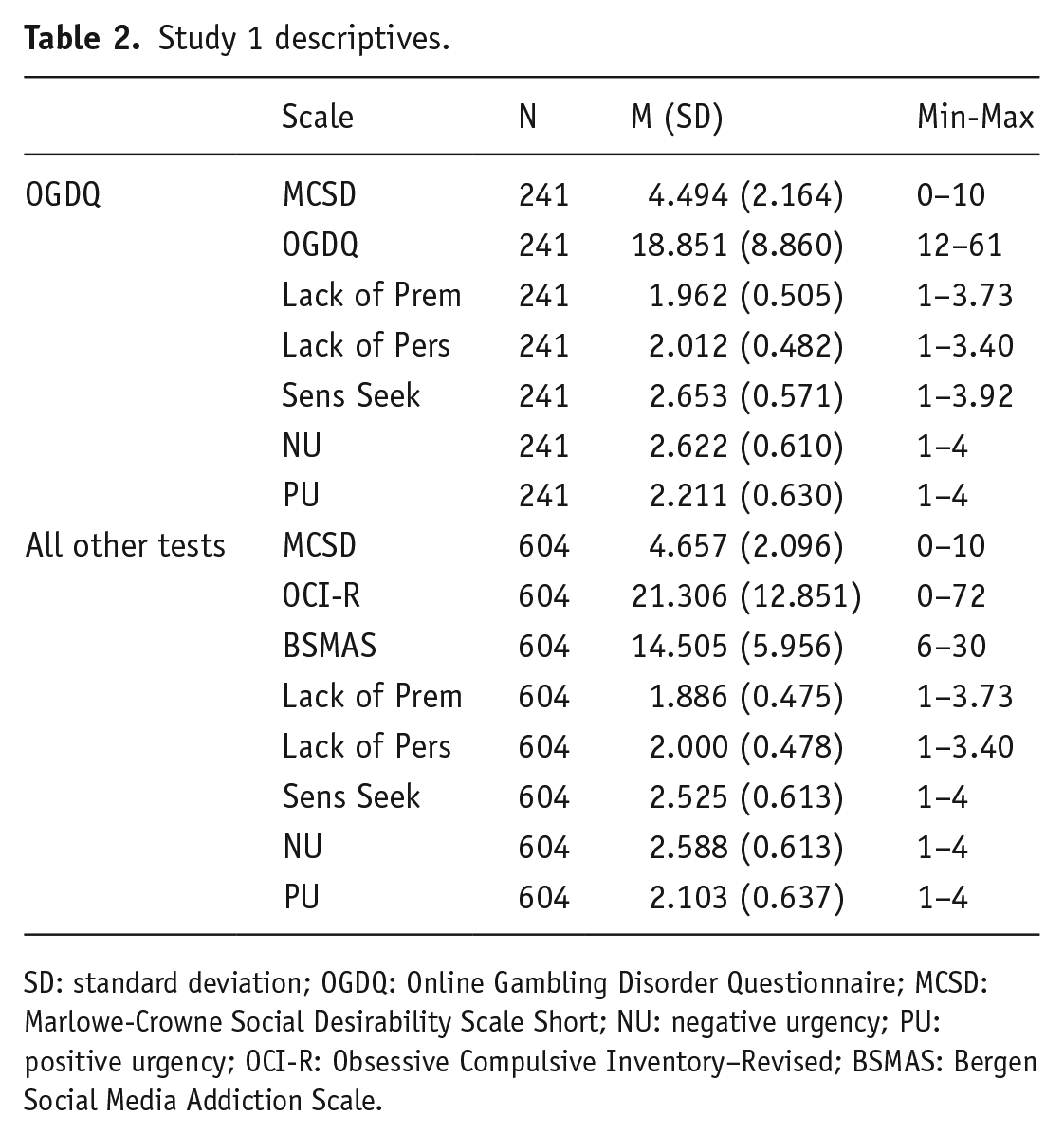
SD: standard deviation; OGDQ: Online Gambling Disorder Questionnaire; MCSD: Marlowe-Crowne Social Desirability Scale Short; NU: negative urgency; PU: positive urgency; OCI-R: Obsessive Compulsive Inventory–Revised; BSMAS: Bergen Social Media Addiction Scale.
Study 2 descriptives.

SD: standard deviation; PGSI: Problem Gambling Severity Index; MCSD: Marlowe-Crowne Social Desirability Scale Short; NU: negative urgency; PU: positive urgency; AUDIT: Alcohol Use Disorder Identification Test.
Tables 4 –8 display the main results for the hierarchal regressions of the UPPS-P impulsivity traits against problem gambling, disorderly alcohol use, online gambling disorder, OCD behaviours, and social media addiction, when controlling for participant social desirability.
Hierarchical regression on problem gambling.

CI: confidence interval; MCSD: Marlowe-Crowne Social Desirability Scale Short; NU: negative urgency; PU: positive urgency.
Bootstrapped to 5000.
Hierarchical regression on disorderly alcohol use.

CI: confidence interval; MCSD: Marlowe-Crowne Social Desirability Scale Short; NU: negative urgency; PU: positive urgency.
Bootstrapped to 5000.
Hierarchical regression on online gambling disorder.

CI: confidence interval; MCSD: Marlowe-Crowne Social Desirability Scale Short; NU: negative urgency; PU: positive urgency.
Bootstrapped to 5000.
Hierarchical regression on OCD behaviours.

CI: confidence interval; MCSD: Marlowe-Crowne Social Desirability Scale Short; NU: negative urgency; PU: positive urgency.
Bootstrapped to 5000.
Hierarchical regression on social media addiction.

CI: confidence interval; MCSD: Marlowe-Crowne Social Desirability Scale Short; NU: negative urgency; PU: positive urgency.
Bootstrapped to 5000.
As shown in Table 4 after controlling for social desirability, PU was the only significant predictor of problem gambling. The UPPS-P as a whole significantly predicted problem gambling, accounting for 15.5% of the variance, F(6, 274) = 8.425, p < 0.001, R2 = 0.155, adj R2 = 0.137. Achieved power, as computed with G*Power (Faul et al., 2009), was >0.999, indicating more than adequate statistical power.
As shown in Table 5, after controlling for social desirability, NU was the only significant predictor of disorderly alcohol use. The UPPS-P as a whole did not significantly predicted disorderly alcohol use, accounting for 11% of the overall variance, F(6, 104) = 2.137, p = 0.055, R2 = 0.110, adj R2 = 0.058. Achieved power, as computed with G*Power, was 0.774, slightly below the 0.8 standard.
As shown in Table 6, after controlling for social desirability, only PU was a significant predictor of online gambling. The UPPS-P as a whole significantly predicted online gambling, accounting for 21.3% of the variance, F(6, 234) = 10.574, p < 0.001, R2 = 0.213, adj R2 = 0.193. Achieved power, as computed with G*Power, was >0.999, indicating more than adequate statistical power.
As shown in Table 7, after controlling for social desirability, and in order of predictive strength, NU, PU, and lack of premeditation were significant predictors of OCD behaviours. The UPPS-P as a whole significantly predicted OCD behaviours, accounting for 25.2% of the variance, F(6, 597) = 33.603, p < 0.001, R2 = 0.252, adj R2 = 0.245. Achieved power, as computed with G*Power, was >0.999, indicating more than adequate statistical power.
As shown in Table 8, after controlling for social desirability, and in order of predictive strength, NU, lack of premeditation, and PU were significant predictors of SMA. As a whole the UPPS-P significantly predicted social media addiction, accounting for 13.5% of the variance, F(6,597) = 15.529, p < 0.001, R2 = 0.135, adj R2 = 0.126. Achieved power, as computed with G*Power, was >0.999, indicating more than adequate statistical power. Across the five hierarchical regressions run, the strength of the predictors is displayed in Figure 1.
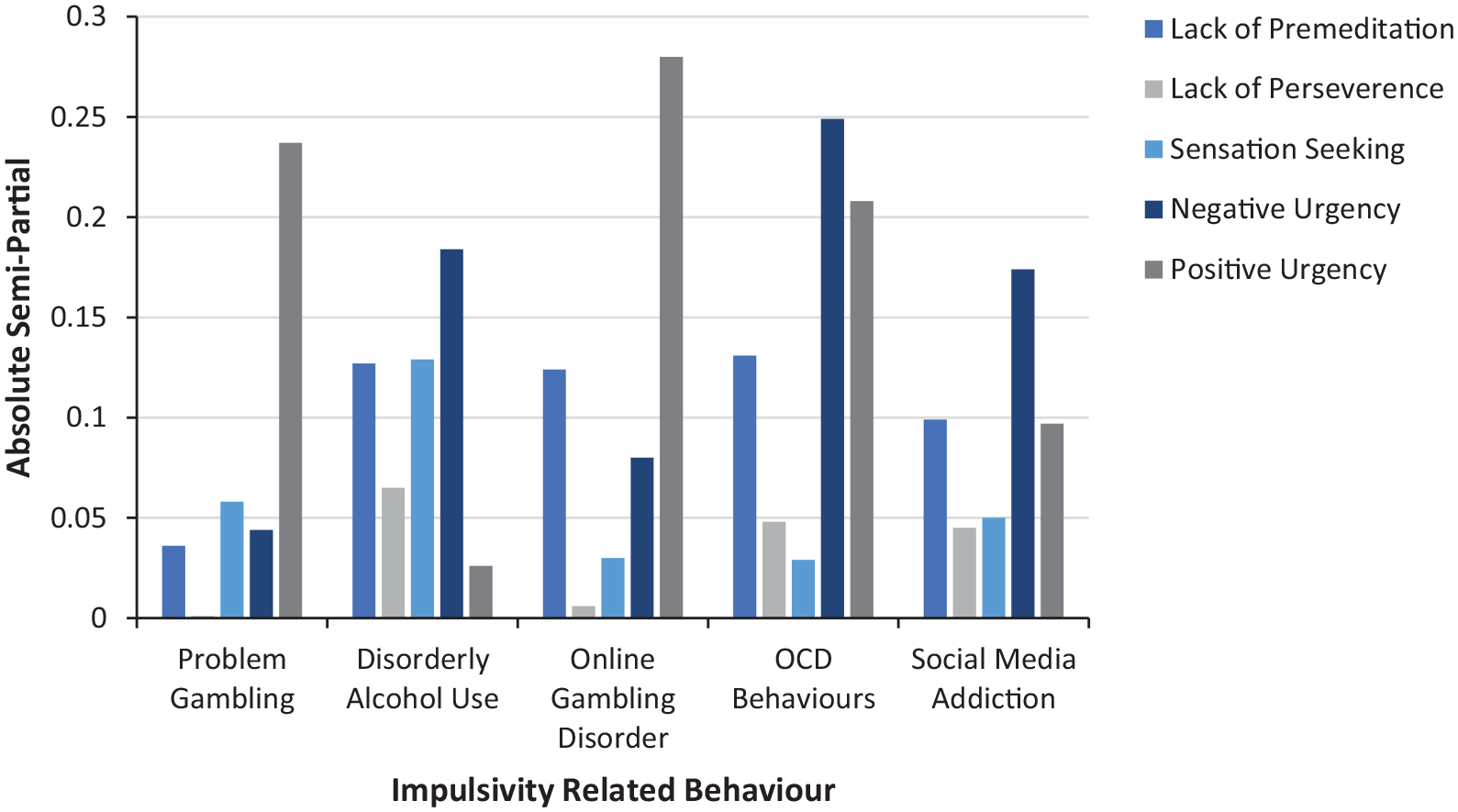
Strength of predictors summary.
As summarised in Figure 1, across the five hierarchical regression run, lack of premeditation was a significant predictor twice, lack of perseverance was not a significant predictor, sensation seeking was not a significant predictor, negative urgency was a significant predictor in three regressions, and positive urgency was a significant predictor in four regressions. Of those, negative urgency was the strongest predictor in three regressions and positive urgency the strongest predictor in the remaining two.
Discussion
This study aimed to investigate the predictive utility of impulsive urgency when compared to other facets of impulsivity, and the importance of valence in accounting for a range of problem behaviours. The hypothesis that either NU or PU would predict all behaviours examined in this study was supported. In all analyses, PU, NU, or both were shown to be significant unique predictors of a number of problematic behaviours assessed. Furthermore, for problem gambling, disorderly alcohol use, and online gambling disorder, PU and NU were the only significant predictors within the UPPS-P. NU was the strongest predictor of both SMA and OCD. These findings confirm the predictive utility of impulsive urgency in addressing a series of important problem behaviours and also the significance of considering the valence of urgency.
When comparing across PU and NU, there are some similarities and important contrasts in the results. Both positive and negative urgency significantly predicted OCD behaviours and SMA; however, NU was shown to be the more robust predictor in both cases. Similar to past studies, online gambling and problem gambling were only predicted by PU (Teese et al., 2020), where NU was the only predictor of disordered alcohol use (Cyders and Smith, 2008; Cyders et al., 2010). While similar in some aspects, these findings denote a clear difference between the predictive utility of positive and negative valences of urgency, suggesting the importance of their distinction, as noted in the original model design (Lynam et al., 2006) and by confirmatory factor analysis on the UPPS-P (Teese et al., 2020; Zsila et al., 2020).
While further research is needed in order to gain a full picture of how valence influences different forms of problem behaviour, past research provides some insight. For example, findings from Emery et al. (2014) in relation to problematic alcohol use suggest that PU may relate to reward sensitivity, whereas NU is associated with a lack of impulse control, which could imply that urgency facets may impact on behaviour via distinct neural pathways. Other research has suggested that the social context of behaviour may be important in understanding the influence of impulsivity facets on behaviour, especially in social situations that enhance sensitivity to emotional arousal (Crone et al., 2016; Steinberg, 2008). This could indeed impact on the types of behaviour associated with greater positive or negative emotions. Currently, studies are limited in the extent to which these issues have been investigated, as some studies appear to overlook the influence of one’s emotional state on their risky behaviours, despite the majority of these behaviours being more likely to occur in situations with greater emotional intensity (Millstein, 2003; Steinberg, 2004).
With clear support for the importance and valence of emotional aspects within the conceptualisation of impulsivity, a quandary arises with a few popular models of impulsivity. Some models of impulsivity, such as the popular BIS-11 (Patton et al., 1995), do not explicitly take into consideration emotional aspects of impulsivity. This is not the first criticism the BIS-11 has received, with it being recently questioned on its factor structure (e.g. Vasconcelos et al., 2012). As such, it is proposed that this research adds to a growing body of evidence indicating the need for a review of how impulsivity is conceptualised and studied/measured. Acknowledging that the BIS-11 was not part of this study, so no direct claims can be made on its structure from this study alone, future efforts should comparatively incorporate different impulsivity scales like the BIS-11 and the UPPS-P, that either do or do not explicitly address varying emotional aspects, to examine if distinct emotional qualities, such as the UPPS-P’s NU, are accounting for something uniquely different within impulsivity.
It is worth noting that as a cross-sectional study, causation cannot be inferred. The lack of a predictive model for alcohol use is also inconsistent with previous research and likely due to the small sample size for that variable (n = 111). Despite these limitations, the current study presents evidence of the utility of emotion-based impulsivity in predicting problem behaviours. It also suggests that emotional valence may be an important factor for one to consider when aiming to differentially predict/address certain problematic behaviours.
Footnotes
Author contributions
Christopher Willie: Conceptualisation, Data curation, Formal Analysis, Methodology, Writing – original draft, Writing – review & editing.
Peter Richard Gill: Conceptualisation, Data curation Formal Analysis, Methodology, Supervision, Validation, Writing – review & editing.
Robert Teese: Conceptualisation, Methodology, Supervision, Validation, Writing – review & editing.
Vasileios Stavropoulos: Methodology, Supervision Validation, Writing – review & editing.
Andrew Jago: Data curation, Methodology, Supervision, Validation, Writing – review & editing.
Declaration of conflicting interests
The author(s) declared no potential conflicts of interest with respect to the research, authorship, and/or publication of this article.
Funding
The author(s) received no financial support for the research, authorship, and/or publication of this article.
