



Abstract
Planned change can lead to asynchronicity in the participation and experiences of change initiators and recipients. This may produce suboptimal outcomes for planned change projects. The literature suggests that employee participation events may alleviate this problem; yet, research also shows that not all employee participation events have the desired outcomes. Using event system theory, we explore how the timing of employee participation events in planned organizational change impacts stakeholder asynchronicities in the change process. We interviewed 23 change consultants about one of their planned change projects. We find that different designs of employee participation events give rise to different subsequent event chains with varied impacts on planned change processes in terms of synchronicity. First, a different timing of employee participation events leads to asynchronicity experiences and determines both the amount of facilitated time for change recipients to adapt to the change and the number of change phases employees can participate in. Second, timing, in combination with the kind of employee participation, explains differences in event chains across hierarchical levels in terms of dispersion and proximity. Both design elements contribute to the degree of synchronicity and help explain why some change projects are successful while others are not, despite applying participative interventions. Third, we add to event system theory by studying proactive change events.
Keywords
Introduction
Planned change is an essential managerial task to change an organization to a desired future state (Kim et al., 2011). Managing change is difficult (Konlechner et al., 2019). Most planned changes do not deliver the expected results (Edwards et al., 2020; Hughes, 2011). For instance, a McKinsey report states that 56% of respondents achieve most of their large-scale change goals, but only 12% confirm that their goals could be sustained for more than 3 years (Armbruster et al., 2023). To better understand how and why planned organizational change succeeds is thus relevant. One debated cause of planned change failure is intraorganizational asynchronicities between change initiators and receivers (cf., Bartunek et al., 2006; Omidvar et al., 2025; Thomas et al., 2023; Whelan-Berry et al., 2003). These asynchronicities in planned change start with “[a] change agent [who] intentionally takes actions and creates interventions through a deliberate process to achieve a different state of behavior, structure, and/or conditions” (Jian, 2007: 7). When some people initiate while others receive and implement the change (Bartunek and Woodman, 2015: 171), those who initiate are involved early (mostly management) and others much later (Thomas and Hardy, 2011: 329). This creates asynchronicities between when the manager and employees get involved and what they understand about the change.
Asynchronicity between the change processes at the management and employee level can hinder progress (Whelan-Berry et al., 2003). Employees may be surprised by the change initiative, potentially raising change cynicism and decreasing their willingness to change (Brown and Cregan, 2008; Wanous et al., 2000). Also, the more fully planned the change is, the more employees feel rushed into the change initiative (Schulz-Knappe et al., 2019; Woiceshyn et al., 2020). Hence, enough time is needed for employees to cope with the change and develop individual and organizational-level change readiness (Oreg et al., 2011; Rafferty et al., 2013). Participation of employees at all organizational levels is generally considered “critically important” for successful change (Armenakis et al., 1993: 60; Bartunek et al., 2011; Sverke et al., 2008; Woiceshyn et al., 2020). To manage asynchronicities, proper timing of employee participation to involve change recipients at the right time in the planned change (Hagl et al., 2024: 16–17; Kim et al., 2011: 1689; Schweiger et al., 2018: 670) might thus be critical but is hardly explored yet.
Lewis and Russ (2012) suggest that differences in the timing of employee participation may significantly influence the participative process and alter organizational change outcomes. Others call for clarification about how the timing of employee participation could influence planned change (Hagl et al., 2024; Norris et al., 2017) to prevent planned change failure (Laine and Kuoppakangas, 2015: 347). Marchington (2015) and Dundon et al. (2023) suggest considering employee participation as something that concerns hierarchical levels (the Board, management, employees) and as an event that develops over time, across change phases. Recently, Edwards et al. (2025) and Guarin et al. (2025) call for including a temporal component of employee participation to better explore how it develops in organizations over time. Such insights may help explain why some employee participation events have a greater impact on planned change efforts than others, and how asynchronicities can be avoided.
Event system theory (Morgeson et al., 2015) considers how organizational events, such as employee participation initiatives, originate at a specific point in time and at a particular organizational level, and how these events subsequently develop and impact the organization over time and across hierarchical levels. Therefore, we use event system theory as a theoretical lens to explore how the timing of employee participation events in planned organizational change impacts stakeholder asynchronicities in the change process. To research our question, we interviewed 23 change consultants who actively designed employee participation events in the context of planned change. Based on this study, we identify four prototypical employee participation event designs: a collective early, a collective late, a selective early, and a selective late design. They show different patterns of (a)synchronicity between different organizational level processes and participants.
We firstly contribute to the planned change literature (Hagl et al., 2024; Ullrich et al., 2023) by showing that a different timing of employee participation can lead to more or less synchronicity between the phases in which management and employees participate. This means that change management can manage the synchronicities in the event chain by applying a different event design. The timing (early or late in the change process) is an underexplored dimension of employee participation, but we illustrate that the timing of employee participation matters as it impacts the planned organizational change process. Secondly, we contribute to the employee participation literature (Della Torre et al., 2021; Edwards et al., 2025) by illustrating that a different combination of kinds of employee participation (varying between broadly and narrowly targeted groups) and the timing of employee participation event designs, impacts the planned organizational change process differently. The four designs impact more or less organizational levels in the subsequent event chains and create more or less distance between those who are directly participating and those who are indirectly participating or not participating. This leads to different stakeholder experiences of change synchronicity in organizations. Thirdly, we contribute to the literature on event system theory (Morgeson et al., 2015). So far, event system theory has studied arisen events, external to the organization, with reactive responses. We show that event system theory also applies to proactively designed events, such as employee participation events. Together, these three contributions help explain why not all planned change projects succeed, depending on how employee participation events are designed.
We first review the literature to discuss the asynchronicity in planned change initiatives and how the timing of employee participation can reduce it between change initiators and recipients. We then introduce event system theory as a theoretical lens for studying our subject. Next, we discuss our research design and data analysis. The subsequent section presents our findings, revealing four employee participation event designs that influence the realized synchronicity in planned organizational change. We conclude by discussing theoretical and practical implications.
Employee participation events and chains in planned change
Planned change and stakeholder asynchronicities
Planned change consists of “a repetitive sequence of goal formulation, implementation, evaluation, and modification of an envisioned end state based on what was learned or intended by the people involved” (Van de Ven and Sun, 2011: 61). Inherent to planned change is that a small group of people takes the lead in planning and implementing a change. This is later followed by a larger group that is not involved in earlier decision-making phases, such as problem identification or solution development (Black and Gregersen, 1997; Schulz-Knappe et al., 2019; Thomas and Hardy, 2011). However, change leadership may “take action and proceed as if everyone else in their organization has participated in such preparation,” which is often not the case (Prochaska et al., 2001: 253). The resulting asynchronicity across organizational levels due to differing timing of involvement in the planned change is considered a significant pitfall for the planned change process and its outcomes (Jian, 2007; Johnson-Cramer et al., 2003; Nutt, 1998; Whelan-Berry et al., 2003).
Several issues related to asynchronicity have been reported in the literature; we list five of them. The first issue concerns the assumption that the impact of employee participation events on planned change depends on the timing or stage of the planned change in which they occur (Lewis and Russ, 2012). This suggests that an employee’s participation only “during later implementation phases” might lead to the participants’ perception that their contribution is just “marginal” (Hagl et al., 2024: 16–17). The second issue is that asynchronicity might enhance obstructive employee responses, such as decreased fidelity (Johnson-Cramer et al., 2003) or increased change resistance (Ford et al., 2008; Grønvad et al., 2024). That can happen when there are differences in what is valuable to leadership and to employees (Whelan-Berry et al., 2003: 205). The third aspect is that the time available for change recipients to respond to the planned change decreases as the timing of employee participation happens later. Management inherently has more time to adapt to the change as they take the initiative (Edwards et al., 2020: 362; Hagl et al., 2024; Prochaska et al., 2001), but they often forget or ignore that other organizational members do not have the same or sufficient time to adapt to the change (Oreg et al., 2011; Woiceshyn et al., 2020). This reinforces employees’ uncertainty (Bordia et al., 2004) and negative emotional responses (Piderit, 2000). Fourth, employee participation in those early phases traditionally reserved for management can improve the quality of change decisions (Brown and Cregan, 2008; Lofquist, 2011), making it relevant to study how the timing of employee participation can be optimized. The fifth element concerns the number of participants, which some believe cannot be too large in cases of early involvement, as it critically delays planned change processes (Schweiger et al., 2018: 670). Others argue the opposite is true (Edwards et al., 2020; Woiceshyn et al., 2020). Nutt (1998) suggests that although early timed employee participation in planned change might be time-consuming, it ultimately accelerates the change process by enabling employees to accept the change more quickly.
The purposeful timing of employee participation events in planned change, thus, might be a way to manage the discussed asynchronicities and the related pitfalls (Kim et al., 2011: 1666; Piderit, 2000: 791; Schweiger et al., 2018). However, currently, employee participation is researched in isolation (Dundon et al., 2023; Marchington, 2015). It is mainly seen as a static, one-off event, and its development over time and across and within organizational levels is ignored. This narrow, static focus on employee participation obviously overlooks the timing of employee participation in relation to asynchronicities across organizational levels. Therefore, we turn to event system theory (Morgeson et al., 2015) as a theoretical lens to link the dimensions of time (change phases) and space (hierarchical levels) to employee participation events.
Employee participation events in the context of planned change
Employee participation events are a well-known change management practice used to implement planned change in organizations (Hagl et al., 2024; Jimmieson and White, 2011; Nutt, 1998; Sahay and Goldthwaite, 2024). These events are considered as deliberately designed managerial initiatives that can facilitate the “way in which individuals (. . .) are involved in the process of change, and the extent to which they participate in various aspects of the development and implementation of the change within the organization” (Giangreco and Peccei, 2005: 1817). Deliberate event designs, such as for employee participation events, are called proactive event designs. So far, these intentional event designs have received no attention in event system theory. It has only focused on responses to arisen events that originate externally (Hochwarter et al., 2020; Hu et al., 2021; Morgeson et al., 2015; Reimann et al., 2017).
Wilkinson et al. (2010: 173) have a helpful framework for designing employee participation events by considering four components: First, the form of employee participation (direct vs indirect), where direct refers to formal mechanisms that allow for individual employee input, while indirect refers to formal collective employee representation through trade unions or consultative committees (Mowbray et al., 2022: 1056); Second, the depth of employee participation, indicating the level of influence in decision-making; Third, the scope, which concerns the subject of decision-making; Fourth the level at which the employee participation event occurs. Still, these four components together are not sufficient to place employee participation events in their dynamic context of time and space, as Marchington (2015), Dundon et al. (2023), and Edwards et al. (2025) indicated in their criticisms. Especially because the timing dimension of employee participation events has been ignored, and because the employee participation event may change organizational levels during planned change projects.
Event system theory (Morgeson et al., 2015) provides a lens for exploring employee participation events in space and time dimensions. In general, event system theory considers events as observable actions or circumstances external to the perceiver, bounded in space and time, and occurring between entities through interactions (Morgeson et al., 2015: 520). An event system concerns a complex interaction between the strength of an event (“event strength”) that subsequently determines the extent of impact the event has through an organization (“event space”) and how long the event remains impactful (“event time”; Morgeson et al., 2015: 517).
Applying this to proactive employee participation event designs and their subsequent employee participation event chains enables us to explore asynchronicities between management and employees in planned change efforts. Employee participation event chains can consist of new or changed behaviors, features like new processes, follow-up events enfolding in a space dimension (indicating at what hierarchical level it starts, how it disperses across the levels and in which direction, and to what degrees of proximity is leads between stakeholders in this space) and in a time dimension, indicating when the employee participation event chain starts, how many planned change phases it covers and how long it lasts (Reimann et al., 2017).
We apply three theoretical event system components to employee participation events in planned change projects. The first component is the strength of the employee participation event, which indicates how the event becomes meaningful for the perceivers to enable changes in individual behaviors (Hu et al., 2021: 5). An event’s strength depends on the degree of the event’s novelty, disruption, and criticality (Morgeson et al., 2015: 522). Novelty is about the extent to which the event requires “new behaviors, features, and events” to implement and deal with the change (Morgeson et al., 2015: 521). Here, “disruption” refers to the degree of change in the daily routines caused by the event. Recipients are thus more or less forced to adapt their conventional ways of working (Hu et al., 2021). ‘Criticality’ means the extent to which the event needs specific or different attention (Morgeson et al., 2015).
The second component is event space and contains four spatial facets: (i) the event origin, indicating the hierarchical level at which an event originates (e.g. manager or employee); (ii) the spatial direction, showing how the effects of the event travel down or up in the organization’s hierarchy or within hierarchical levels; (iii) the spatial dispersion, concerning the extent to which the effects of event are dispersed hierarchically; and (iv) the spatial proximity, indicating the distance between the location where the event occurs and the change recipients’ locations. The third component is event time, which consists of two facets: duration and timing. Event duration illustrates the event’s impact over time. Events have identifiable temporal beginnings and ends and evolve within an organization (Morgeson et al., 2015: 520). Event timing specifies when an employee participation event occurs. It specifically concerns the extent to which the moment of the planned change event aligns with the individual, group, or organization’s developmental stage in terms of their demands and needs. Some call this the “right time” (Albert, 2013; Bartunek and Woodman, 2015).
Morgeson et al. (2015) propose that the higher the event strength, the greater the impact the event has in the organization’s space and over time, in terms of changing or creating behaviors, features, or events. The more hierarchical levels are impacted by the employee participation event, or the earlier its timing and thus the longer its duration, the more likely it is to result in new or changed behaviors, features, and events (Morgeson et al., 2015). If not all levels are impacted in the same way, asynchronicities will result. Therefore, we follow the call of Morgeson et al. (2015: p. 530) to “advance the organizational change literature” via event system theory by focusing on how the proactive design of employee participation events in planned change projects impacts their subsequent event chains in event space and over time, and how this impacts asynchronicities and outcomes of the planned change process.
Methods
Research design
We performed an interview study to collect qualitative data (Edmondson and McManus, 2007). Our interpretive method is based on the subjective perceptions of the interviewees who reflected on the employee participation events and their impact on a planned organizational change, on which they advised (Ragin and Amoroso, 2019). We developed an exploratory, open-ended research question to develop new theory on the timing of employee participation using these data. We applied the methodology of Gioia et al. (2013) to realize methodological fit (Edmondson and McManus, 2007).
Data collection
We interviewed change consultants about one recent planned change project (see Table 1). Consultants have played a substantial role in change projects over the past 30 years (Shaw, 2019), and as such, they are likely to have frequently encountered the pitfalls and challenges associated with planned change. Consultants often have a decisive role in arranging change plans, combining client insights with their expertise (Nikolova et al., 2009; Suddaby and Greenwood, 2001). Consultants are also familiar with the steps in planned interventions (Soriano, 2004) and best practices in planned change (Werr and Stjernberg, 2003). Importantly, for our research, they are used to discussing their work and sharing their knowledge (Pries and Stone, 2004). In general, retrospection bias can affect data quality. To limit such bias, we discussed recent projects focusing on the entire process, with only a brief evaluation of the change outcomes toward the end of the interview. In these evaluations, all consultants were able to address previous change objectives that were not realized.
Sample – interviewees and change examples.
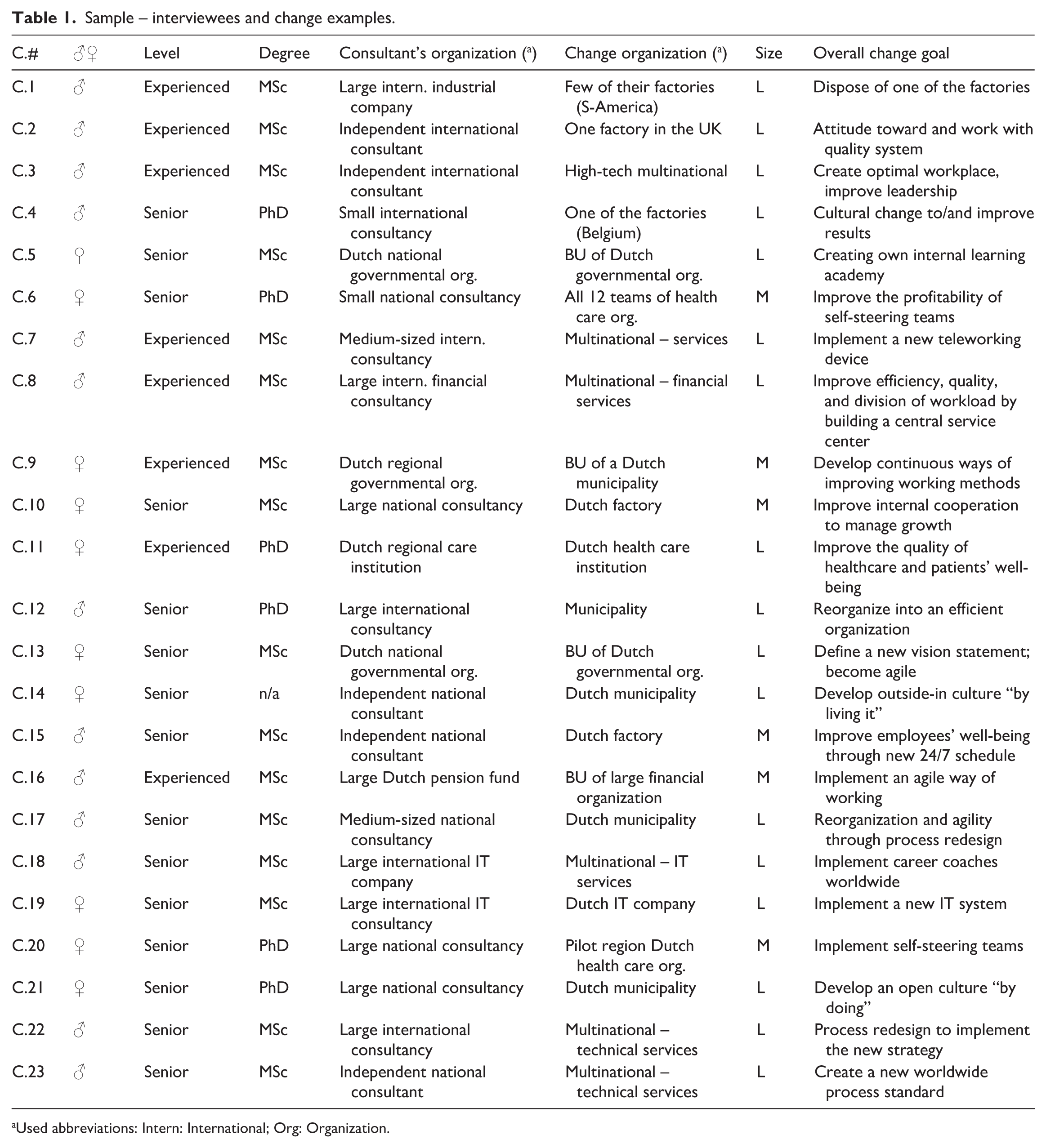
Used abbreviations: Intern: International; Org: Organization.
We used a combination of purposive and chain sampling to select our interviewees (Patton, 2002: 243–244). This study’s sample comprises 23 change consultants, which meets the common criteria for this research design (Creswell, 2007: 67). Table 1 provides an overview of the interviewed consultants, including gender, experience, educational degree, type of organization, change project’s organization, and scale and goals of the planned change project.
The first author conducted all semi-structured interviews face-to-face. The interviews included questions about the consultant’s role, the steps taken in the change process, the deliberate decision to start the planned change event, and the designed employee participation events. Interviews were conducted in Dutch and were audio-recorded and transcribed. The average duration of the interviews was 74 minutes. Interviewees were given the opportunity to check the transcript for mistakes and unclear areas; however, few took this opportunity. Some interviewees shared supplemental materials (such as testimonials or project overviews).
Data analysis
We applied a “modified” grounded approach (Le Gall and Langley, 2015: 40) to analyze the transcripts. We took an inductive approach; however, we also conducted some deductive coding of existing design components of employee participation events (e.g. Black and Gregersen, 1997; Wilkinson et al., 2010) and of event system components of employee participation event chains, as described in the previous chapter (Morgeson et al., 2015). We began with open coding (Strauss and Corbin, 1998) to identify and conceptualize the main and common themes among the interviewees (Gioia et al., 2013). Atlas.ti was used to facilitate this process. Although interviewees explicitly elaborated on some components of designing employee participation (e.g. the level of influence), their discussion of how employee participation event chains developed was less explicit. We were open to new insights or aspects of the employee participation events and the event chain, for instance, the timing of employee participation or the event’s spatial direction. The first author discussed the codes with the second author several times. This process reduced potential biases and ensured that the coding benefited from multiple perspectives. Along the way, we began applying event system theory to interpret the data. We iteratively moved between data collection, analysis, and theory development to eventually produce our aggregate constructs (Gioia et al., 2013). Theoretical saturation was reached when no new dimensions, relationships, or evidence emerged from the data (Moghaddam, 2006).
Guided by the research question, we determined the codes used to characterize the designs of the employee participation events (which are the relative number of employees and the level of influence they have on the change decisions), the timing of the employee participation events (which are early or late timing), the features of the subsequent event chains (which are the spatial direction, dispersion, and proximity), and the degree of synchronization between different organizational level processes and participants as a result of the event chain (see Figure 1). The reported degrees of realized asynchronies or synchronies between organizational levels and participants and how these develop over time are considered outcomes of the employee participation event chain.

Data-structure.
We noticed that consultants apply various moments in the planned change to start with employee participation events and their event chains. We call this new element of employee participation events the timing of employee participation events. In general, timing refers to the “positioning (..) in chronological time (the “when” of performing a particular action -like participation-)” of an event (Blagoev et al., 2024: 2161; Huy, 2001).
Also, the consultants initiated employee participation events with different relative numbers of directly participating employees. We consider this particularization of the (theoretical) component of the form of employee participation as a new way to design employee participation events. Instead of only focusing on a direct or indirect form, focusing on the relative number of directly participating employees helps to indicate the extent to which (direct) participating employees represent their indirect participating colleagues. This gives more insight into employees’ actual influence in planned change events, as consultants deliberately designed employee participation events that involved a broad group of employees, or even all of them.
We, therefore, focused on two employee participation events in the planned change projects: (1) the first employee participation event regardless of the number of employees participating, and (2) the first employee participation events where a broad group of employees participated in the planned change collectively. We grouped the discussed change projects based on the timing of these two moments and who participated in them. We further examined the spatial direction, dispersion, and proximity of employee participation along the event chain and its duration to indicate the timing of employee participation. Finally, for each change project, we analyzed the realized synchronicities between the different organizational-level processes and stakeholder groups.
This study identifies four designs for organizing employee participation events in planned change projects, each leading to distinct patterns of event chains and different levels of synchronicity as a result of the employee participation event chain. Table 2 summarizes the pattern of four employee participation event designs we found: collective early, collective late, selective early, and selective late. The first is the most collaborative employee participation event in each planned change project, and the fourth is the least.
The four-employee participation event designs.

Research findings
The four different employee participation event designs and subsequent event chains (see Table 2) help to manage the implementation of the various planned change projects (see Table 1). The employee participation event chains are characterized based on the spatial features and thus differ in spatial direction, both vertically and horizontally, the extent of spatial dispersion from top-level to lower levels, and its spatial proximity between the level at which the change occurs and the level at which the change recipients are, but also the proximity between the hierarchical layers (e.g. between management and employees). In some change projects, works councils and/or unions were active, which are also kinds of employee participation (Wilkinson and Fay, 2011). The change projects showed employee participation events initiated at the highest organizational level (e.g. top management, board, director) and had a relatively long duration. Although each change project was unique in its level of synchronicity between different organizational from the beginning of the planned change project and its development over time, four patterns of the realized synchronicity emerged as a result of the employee participation event chains. They are presented in the four quadrants of the model.
For each employee participation event design, we will present one example of how an employee participation event initiated at the managerial level, evolves during a planned change project across organizational levels (y-axis) and over time (x-axis). We illustrate each example with a figure inspired by Morgeson et al. (2015: 523, 527). The timing of the employee participation event is indicated on the upper side of the figures. For each example, we describe the change project and then elaborate on the employee participation event design, the subsequent event chain, and the realized synchronicity.
We used different elements to illustrate the examples. We distinguish between events (star) that arise or just happen and deliberately initiated proactive events. Employee participation events are considered proactive events as they are designed. We distinguish employee participation events (circle) where a broad group of employees participate directly (collective), and where a narrowly targeted number of participants participates (selective). Behavior (triangle) describes the actions of individuals, groups, or the organization, for example, when there as a change-supportive behavior. An effect (arrow) denotes the event’s effect on behavior, a specific feature, or by causing another event.
Collective early EP
Change project description
Figure 2 illustrates the employee participation event design of Change Project 4 called FoodFactory (C.4) and its subsequent event chain. It shows a pattern of collective early participation similar to three other change projects in the sample. After incorporating additional food production lines and products (Event 1 in Figure 2), the internal pressures on FoodFactory’s production lines and employees increased, resulting in a high workload and a severe drop in performance, affecting financial results and product quality (Feature 2). The factory transformed from the best to the worst-performing unit of the multinational. Then, an external consultant (C.4) was hired (Event 3), and a planned change event was initiated (Event 4) by the top management level to develop an effective behavioral culture and improve behaviors and performances at all organizational levels (Feature 5). It is a strong change event because the new culture calls for new behaviors (indicating novelty) that break existing routines (is disruptive) to collectively achieve goals for survival (indicating criticality) as currently “things went wrong on all sides” (C.4).

Example C.4 of the event chain following a collective early EP event design.
Design of the collective early employee participation event
The intensive employee participation event (Event 6) is indicated by C.4 as follows in Quote A: “[The approach consists of] several sessions [. . .] [in which] all employees are cycling through the same process step [of] making them conscious of where they stand [. . .] so they can choose to change behavior. Moreover, they have established with each other: ‘Well, what we are doing now is a mismatch on all points with how we should do it.’” (Quote A, C.4).
Based on Quote A, we can discern the components of the employee event. First, there is a direct form of participation, involving all 450 employees and managers from the plant. They participate in various change interventions. The explicit emphasis on “all employees” as change recipients going through the same process steps illustrates this. Second, the process steps refer to pre-implementation actions of identifying the need for change and how behavior should be changed, indicating an early phase involvement (illustrated by g) in the planned change process. The timing relates to the discussed change phase here, not to the point in time when the participation event happens. Although the participants did not influence the decision to start the cultural change, all had the opportunity to define the desired new behavior(s) with the intention to behave accordingly. The consultants even decided to “close down the factory for one day” (C.4) to facilitate these participative opportunities and, at the same time, emphasize the urgency of employee participation in the planned change.
The collective early employee participation event chain
Quote B illustrates how the early employee participation event design results in an event chain aiming to implement the planned changes: “In sessions with groups of 12 employees each – consisting of foreman, operators, and workers – the morning part consisted of expressing frustrations [about the current working norms and culture]. [. . .] In the subsequent sessions, the employees thought about the effects of their behavior, which makes them the owners of their behavior. [. . .] In this way, employees noted the mismatches between how we work and how we should work. The actors let every group member experience which behavior leads to solutions and how each person can effectively contribute to the transformation of the obstructive culture. An intervention actor spent two months on the workshop floor to mirror current behavior and help to bend it into effective behavior.” (Quote B, Source: Testimonial of participants of C.4)
The first element to characterize the event chain is how it unfolds in the event space. Figure 2 shows a downward spatial direction (Effect 7) and spatial dispersion to the individual and group levels in the organization (Event Chain 8 and Event Chain 10, respectively). Subsequently, during time-intensive sessions (indicated by Quote B as “in the morning part,” “the subsequent sessions,” and the “workshop floor interventions”), the participants worked in small groups (“12 employees”) under the guidance of professionals (“actors”). This resulted in individual and group level sensemaking (Events D and A respectively) to understand the urgency of changing their behavior, as illustrated in Quote B by lines like: “expressing their frustrations,” that they “thought about the effects” or “noted mismatches,” and that it “makes them owners.” These interpretive processes during the event chain helped employees to better connect with their actions. Quote B also mentions how every participant learned how to “effectively contribute” through “effective behavior” (Supportive Behavior F and C) and to transform the culture into a more effective one. Change readiness (Feature B) emerged from the cognitions and effects of individuals (Feature E) to become shared through social interaction processes (Effect 9 and Event Chain 10) and then manifested as a workgroup and organizational readiness for change (Feature 12, through Effect 11). The individual and group-level readiness for change development is a precursor for the planned organization-level change (Feature 5). Figure 2 also illustrates the horizontal (intra-level) and upward (inter-level) spatial direction of the employee participation event chain. Event spatial proximity is illustrated by the group composition of “foreman, operators, and workers” and management was also part of these sessions, as the following quote C by a manager illustrates: “I attended the sessions a lot myself. The actors were important because you can talk for a long time about the change, but when people see and experience it, that’s really different. Very powerful” (C.4).
Secondly, there is the event time of an event chain, which consists of duration and timing. The early facilitation of employee participation in the pre-implementation phases of the planned change event results in the employee participation event chain’s relatively long event duration of about a year, lasting until the cultural change has been realized. The beginning of the event chain was marked by a significant asynchronicity, as illustrated by Quote A (“mismatch”). The early timing of the employee participation event creates conditions to influence the change at the onset. This creates more time for the employee to accept and adapt to the change. The event chain facilitated the going through the phases of “becoming aware, learning new behaviors and practicing” together (C.4), and led to a mutual synchronization of behaviors across hierarchical layers, where people felt “yes, it’s just right” (C.4). The process indicates that the event timing matched the developmental stages of employees in the organization very well.
Event chain outcomes and levels of synchronicity
The consultant could see how the work culture changed during the event chain, indicating a high level of synchronicity between understandings of management and workers. They move like hand in hand. Participants reported this to him, as indicated in Quote B, how actors helped them to bend behaviors into more effective ones, while a manager assessed the interventions as very powerful in Quote C. The consultant mentioned that changing unproductive culture and behaviors could turn the losses into profits: “Within a year, they were back and with better profits than they had ever had, and structurally” (C.4).
Collective late EP
Change project description
Figure 3 illustrates the employee participation event design of Change Project 10, called Fiberglass (C.10), and its subsequent event chain, showing a pattern of semi-collective early participation similar to six other change projects. The successful acquisition of new projects (Event 1 in Figure 3) led to internal problems at a fiberglass plant. Employees were still happy with their work, but did not get it done in time. They made too many mistakes and, therefore, became demotivated. In a short time, the number of production workers had more than doubled to about 80 employees (all issues combined in Feature 2).

Example C.10 of the event chain following collective late EP event design.
An external consultant (C.10) was hired (Event 3) to start a planned change (Event 4) to better manage the growth by focusing on improving the work processes (Feature 5). It is a strong event because the process redesign aimed for new behaviors for employees to learn to “continue building expertise themselves” (indicating novelty) in order “to get where the organization is currently failing to go” (indicating disruption) to improve “self-management due to ever-changing external developments” (C.10; indicating criticality).
Design of the collective late employee participation event
To implement the planned change, the employee participation event (Event 6) followed, as indicated by Quote D of C.10: “In the beginning, we worked with a small team. . .I think about 20 people. [. . .] [We wanted to] let that be a short period so that we can work participatively. . . [We started] working with a relatively small group on ‘how exactly we will take those steps.’ And, well, that took time. [. . .] With a small group of production employees, [. . .] we planned several sessions [. . .] to map processes, [. . .] visualize the bottlenecks, [. . .] and put the processes in the right order. [. . .] Yes, the most important move was made in the sessions with all 80 [production] employees. [. . .] But we only really started working with all these employees at a later stage.” (Quote D, C.10)
Based on Quote D, we discern the components of the employee participation event design. First, the limited indirect form is indicated by the involvement of a significant number of (about 20) “production employees” who represent all other (about 60) colleagues (Event 6). The event’s kind and timing are illustrated by asking the selected group of employees the question, “How exactly are we going to take those steps?” discussed (Behavior A) “in several sessions . . . to map processes. . .and visualize bottlenecks.” Second, problem identification (“bottlenecks”) is considered an early step in planned change and refers to the early timing of the employee participation event (illustrated by “d” in Figure 3) to implement the planned change event accordingly. The “several sessions” allowed this group of employees to influence the process changes by “[putting] the processes in the right order.” Although the participants did not influence the decision to start redesigning the process, they had the opportunity to define what the new processes and cooperation between workplace employees should look like.
The collective late employee participation event chain
The abovementioned Quote D and the following Quote E illustrate how this participation event design results in an event chain to implement the planned change: Working on these processes resulted in “all kinds of discoveries: ‘Oh, I’m waiting for you every time, and that’s because. . .’ [. . .] And with that, we made - say – in those six months a huge leap in getting insight into processes, getting insight into bottlenecks. [. . .] [And], at the same time, you notice that all kinds of things are happening in how people talk to each other. So, how they actually talk about their work and that they also have very little ability on that.” (Quote D, C.10)
First, in the event space, the event chain has a downward spatial direction (Effect 7) with spatial dispersion to the group and individual level in the organization (Cycle 8 and Cycle 9, respectively), as Figure 3 shows. The event design is based on the early participation of a representative group of employees. The involved employees made “all kinds of discoveries” (Behavior C), such as “I am waiting [. . .] every time [. . .].” In several sessions, they talked about “their work” to get “insight into bottlenecks” (Behavior A). Finally, they mapped and visualized the new processes (Feature B) as indicated by Quote D. The collaboration of the workplace employees indicates the horizontal (intra-level) event spatial direction of the employee participation event chain. The upward (inter-level) event spatial direction of the employee participation event chain and the strong event spatial proximity between the planned change and the employee level, is illustrated by C.10. “So, we initially collected a lot [of information] from the employees and shared that. . .with the management team, to agree [that] ‘well, we are going to take this and this course.’” This indicates the next step of the event chain, which consists of “sharing” the collected information (Feature 11), which the management team found “confronting [but] recognizable” (as reported by C.10). They then decided on the next step in the planned change, which was a late timed direct employee participation event (illustrated by “e” in Figure 3) to involve all employees in the implementation phase of the change (Event 12), indicating the key element of the collective late employee participation event design, which is to involve a significant number of employees (but not all) in the early stages who represent their colleagues, and all employees in the later stages of the change process.
Secondly, the event time is first characterized by a long event duration, for instance, “it took time” (see Quote D), “six months” (see Quote E). Although some employees were participating earlier, other “people had a strong feeling ‘when are we really going to [work with] the [employees in the] workplace? That took a while” (C.10). This also indicates a higher degree of asynchronicity between the team of early participating employees and the rest of the organization, at least at the start of the implementation phase: the “big bang to the workshop floor” (C.10). Later, when the event chain developed and all employees were participating, asynchronicity decreased. Management got more connected to the change process when bottom-up collected input about process improvements was discussed with them.
Event chain outcomes and level of synchronicity
The consultant concluded that the 3-year change was successful on the level of employees: “The main battle we took was in the sessions with all 80 employees” (C.10). Toward the end, there was a better understanding of the work process, reduced waiting times, fewer mistakes and double work, and more ability in giving each other feedback. However, the consultant acknowledges that the root cause of the problem also originated from management: “With the employees, we had a good trajectory. With the management. . . that was more complicated. We worked with them as well. But that was not as effective. [. . .] whenever a project was a risk, they continued to send five men there” (C.10). That affected all organizational processes, causing more waiting, double work, and mistakes. Management failed to realize a sustainable and structural process of problem-solving, meaning synchronicity with the change objectives was not realized at all levels, and for the workers only later in the process.
Selective early EP
Change project description
Figure 4 illustrates the employee participation event of change project 22 (C.22) and its event chain, showing a pattern of selective early participation, similar to five other change projects. As a result of economic developments, changes in the value chain of construction work, and increased IT use (Event 1), a large construction company, ConstructComp, faced declining revenues and increased risks in executing large projects (Feature 2). To better cope with this, they developed a new strategy to centralize and integrate activities (Feature 3), and they hired an external consultancy, C.22 (Event 4), to redesign the work processes and align them with the new strategy (Event 5). Implementation of the strategy is the final goal (Event 6), of which the process redesign is one part (Feature 12). The planned change event can be considered one with high strength due to new processes (indicating novelty) that will influence the entire organization (indicating disruption) and help to cope with “high-risk projects” and the “unpleasant market situation” (C.22; indicating criticality).

Example C.22 of the event chain following a selective early EP event design.
Design of the selective early employee participation event
Quote F understands the employee participation event (Event 7) initiated by C.22 as follows: “Under the supervision of a supervisory board, we defined 16 domains [. . .], such as HR, IT, business development, etcetera, to work on, and we established 16 working groups. . .for instance, we involved all the HRM managers for their working group. And we started with describing the future, the ‘to be’ processes. . .using the ‘standard business models’ [of the consultants]. Finally, 165 people out of 22,000 were involved. [. . .] You cannot involve everybody, [. . .] participation can be much too soon, [. . .] you should involve employees only when the change is going to touch them. These round tables, as we called them, were new. . .and we organized about 90 [half-day] workshops. . . taking place in a relatively short period. [. . .] But, if I see a ConstructComp employee driving by here, and I would ask about the change project, I think that they either would not know anything about it or have heard of it only once” (Quote F, C.22).
Based on Quote F, we can discern the components of the employee participation event design. First, Quote F illustrates the selective indirect form based on the relatively few (about 165 out of 22,000) employees who were chosen based on their management roles and expertise (e.g. HRM, IT, Business Development). It is unclear to what extent they can represent the voice of all other colleagues, referring to those employees who “would not know anything about it.” There is an influence on decision-making. The round-tables work on “to-be-processes” (C.22) and have high-level influence. The number of sessions of “about 90 half-day sessions” (C.22) underlines this. Still, they worked “under supervision” (C.22) on a strategy initiated and framed by the board. Second, “describing the future” belongs to a pre-implementation phase in the planned change event and thus refers to the early timing of the employee participation event, but only for a selection of key stakeholders in the organization (indicated by “d” in Figure 4). Although the participants did not influence the strategy definition or the decision to implement the strategy through process redesign, they had the opportunity to define the new processes and learn from each other across the different country organizations.
The selective early employee participation event chain
Quote F illustrates how the participation strategy results in an event chain, as visualized in Figure 5. First, in the event space, the chain shows a downward spatial direction from the board to higher middle management (e.g. HR managers; Cycle 9) and limited spatial dispersion, excluding most employees lower in the organization. This is related to high spatial proximity between the board and the involved management but low spatial proximity with the rest of the organization, as illustrated in the following quote: “They either would not know anything about it or have heard of it only once.” The event chain’s low dispersion and low proximity align with the fact that the process redesign was “first aligned with and approved by the board” (C.22; Feature 12). However, those involved learned how colleagues in other countries worked, as a basis to set the new processes standards: “It led to many eye-openers. ‘Hey, oh yes, you can also look at the world that way. We do it that way, but why do we actually do it?’ And what happened is that people noticed, ‘Oh, but is that how you do it? [. . .] Gosh. We do it this way.’ So, you immediately get a lot of interaction” (C.22). Such learning-oriented group-level dynamics are illustrated by Group Process 9 when discussing the “future, the ‘to-be’” (Behavior A), triggering the “individual eye-openers” (Feature C) that, in turn, influence the group process (Effect 11), which, in the end, results in redesigned processes for 16 key domains (Feature B). The interactions illustrate the horizontal (intra-level) spatial direction for the higher middle and top managers involved. The control by the board emphasizes a mainly upper inter-level spatial direction of the employee participation event chain.

Example C.3 of the event chain following a selective late EP event design.
Secondly, event time is characterized by a “relatively short” event chain duration (see Quote F). Although we assume a proper fit of the event timing for those involved in the early employee participation event, given the many “eye-openers.” The early timing of the employee participation event for a few members of (mainly) upper middle management indicates low asynchronicity between the board and the involved participants. Consultant C.22 speaks of high asynchronicity before the employee participation event started. For example, because “the different unit bosses did not have much in common” and “each did his own thing,” but also because staff from different disciplines and different international units, “never actually spoke to each other, they were on their island” (C.22). Along the development of the event chain, asynchronicity decreased because of “sharing knowledge,” “learning from each other,” and all the “discoveries they made about other units they could also put to good use in their own unit” (C.22). In sum, asynchronicity decreased among the higher management levels.
Event chain outcomes and level of synchronicity
ConstructComp went through a process redesign intervention in which managers and experts responsible for the different processes participated. It was a centralization intervention aimed at aligning processes across operating companies in different countries and deciding where operating companies could make their own decisions. For instance, one ERP system should be implemented, not three, as was the case at the start of the project. The change intervention was on the level of management processes, and they improved over time: “First, when I mentioned the primary process, everyone had a different process in mind. In Ireland, it was not the same as in England [. . .] Now, slowly, the organization changes. In some key processes, that happens already, in others, not yet. But the board and top management need to stay in control now and move on, the next three years” (C.22). Therefore, due to the active participation of key process stakeholders, this organization’s process management was indeed in transition, with asynchronicities at the management level slowly reducing. The choice for a selective employee participation design made sense, as the focus of the intervention was on the management support systems.
Selective late EP
Change project description
Figure 5 illustrates the employee participation event of Change Project 3 (C.3) and its event chain, showing a pattern of selective late participation similar to four other change projects. The board’s intention at MultiChip was to encourage highly educated R&D employees to stay and deliver top performances. Therefore, they initiated a worldwide change initiative (Event 1 in Figure 5) to improve ways of working on several facets (Feature 4). The change project aimed at improving the reliability of the IT system, setting up a full-service restaurant to replace the current canteen, developing appropriate onboarding procedures, setting up open workspaces that replaced all closed cubicles, and improving leadership development (Event 3). Project execution was assigned to a small and central project team of internal staff and external consultants (Event 2).
The planned change event can be considered a strong event because it aims to “keep people on board” who are “delivering top performances” (indicating criticality) by facilitating top facilities, work circumstances, and appropriate leadership. Some changes also require new behaviors, but at a lower level of disruptiveness (e.g. open-space work spots).
Design of the selective late employee participation event
The project team designed employee participation interventions (Event 5). Based on Quote G, we discern components of the event design.
“[The central change team] made good plans, approved by executive management, and sent these down throughout the organization. [. . .] [We] then talked with the Director of Engineering to explain the whole concept, but he said, ‘Well, you already have your definition and direction of [the change initiative]; it’s already set in stone, but I see it differently, very differently.’ [. . .] So, we had to tell him that we passed that station a while back. We actually did not want to discuss or talk about that anymore. So, it became quite a difficult case.” (Quote G, C.3)
The selective indirect form is indicated by the involvement of a few individuals, namely, management and local directors. They were not formally representing their colleagues because many did not know about the change, let alone who their formal representatives were. Kind and timing of the event are illustrated by the lack of influence of (even) a local director, who saw things “very differently,” but that could only be articulated in one-to-one conversations with a representative of the project team, who aimed to “persuade” (C.3) this layer of management, by “force” and if necessary by “threatening to inform the CEO” (C.3). Thus, there was nothing to discuss anymore at that point. The late timing of the employee participation events (illustrated by “a” in Figure 5) is illustrated by plans “sent [..] down throughout the organization,” and that discussing plans was a station they had already passed.
The selective late employee participation event chain
Quotes H and I are about change communication and the lack of guidance. They illustrate how late timing, as part of the design of the employee participation event (5), influences the nature of the subsequent event chain.
“[We] simply communicated, ‘Ok, guys, these locations will be changed. Your location is on the list, so, at that time, we will be there to implement it.’ [. . .] [Because] the implementation plans were not voluntary [. . .] [the central change team] created circumstances to draw people into the change anyhow.” (Quote H, C.3) Quote I: “We should have had all those conversations in the first preparation phase, just to say, ‘Ok, we are going to make a plan. We need input from the region. We are going to involve people to write the plan together.’ Instead of writing a plan in our ivory tower and then presenting the plan [as we did]. . .[we should have] collected opinions [from individuals across] the organization and the regions about what a better way of working meant to them—how would they define it? Instead of saying: ‘Well, I need three of your team members for three days a week to implement the change plan, and, by the way, if you do not cooperate, I will inform the Board about it to make sure you will [. . .]’ [it would have been better] to let more people participate.” (Quote I, C.3)
The event chain described in Quotes H and I is visualized in Figure 5. First, the chain shows a downward spatial direction in the event space, combined with a shallow spatial dispersion due to the selective and indirect form of employee participation. The change initiative was centrally initiated, designed, and planned by the change team in their “ivory tower” (Quote I) at the headquarters and was “simply communicated” (Quote H) to be implemented. This indicates a low spatial proximity between the board and the change team on one side and the employees on the other, implying significant hierarchical distance. The limited upward event spatial direction and the limited intra-level dynamics are illustrated when the change team “talked with the director to explain the plans” (C.3), to tell “your location is on the list” (Quote H), and that “we need three of your team members to implement the change” (Quote I). These examples of one-directional communication assume no social interaction was designed, like working on the change within local teams. Lower organizational levels experience a lack of influence on the change content and the decision to implement the change. The implementation was “not voluntary” (Quote H) because the change team made “good plans,” “approved by executive management” (C.3).
Secondly, the chain’s event time consists of duration and timing. The relatively short event chain duration is due to the late start of the employee participation event. Most organizational change recipients have experienced the practical manifestation of the change as a “big bang” event (C.3). This indicates a high degree of asynchronicity. The extent to which the event timing matches most change recipients’ developmental stages is insufficient simply because they do not participate. Also, a mismatch can be assumed based on the “very, very [different]” ideas of one of the directors about the change (see Quote G).
Event chain outcomes and levels of synchronicity
That event timing was too late is indicated by C.3 when saying: “we should have had all those conversations in the first preparation phase [. . .] to involve people to write the plan together” (C.3). According to consultant C.3, there was no significant change in the end (referred to as “?” in Figure 5), despite their initial expectation that the change would be as easy as “ABC.” Only “some successes were linked to the visible, the workspace, and IT. The HR engagement part was less visible, and the involvement of employees [. . .]. If the objective was a change in direction of about 45%, only 15% has been realized” (C.3). These outcomes indicate a low level of synchronicity between the organizational levels toward the end, with many asynchronicities still remaining.
Discussion
We explored how the timing of employee participation events in planned organizational change impacts the change process, including asynchronicities between change initiators and participants. Our conceptual model (see Figure 6) captures four employee participation event designs, based on the first applied employee participation event in the studied change projects. The four distinct employee participation event designs depend on collective or selective employee participation (see the left side of the model). This design element includes the relative number of participating employees (divided into broadly or narrowly targeted) and the level of influence the participants have on change decisions (ranging from limited to substantial levels). The early or late timing of employee participation is the other design element (see upper side of the model). Early timing means employee participation starts before implementation, while late timing means it starts alongside implementation.

Conceptual model of the four employee participation strategies, their event chain features and the extent of synchronization of change processes and outcomes.
Explanation of the model
Within the first scenario (collective early EP), the common denominator in the examples is that employees were expected to change their ingrained behavior: holding each other accountable for behavior, developing a focus on (financial) efficiency in addition to work content, proactively collaborating on continuous improvement, and working according to a completely new continuous schedule. In these cases, there was little willingness to change initially, which sometimes even manifested in opposition. However, the event design allowed employees to get on board early in the change and to work together to identify and solve problems. This collective early EP event design was found in contexts where synchronization through collaboration, starting at the design stage of the organizational change, was necessary to change deeply rooted behavior of employees who were not immediately enthusiastic about it from the outset.
The second scenario (collective late EP) presented examples of changing a working process in production and care contexts, professional services, and large governmental and commercial organizations. While employees had to adapt their behavior to the new work process, such as increasing a focus on quality or externally outsourcing their own work, there was always strong facilitation through the adapted work processes and systems. In most of these cases, there was some willingness to change early on. This collective late EP event design has been applied in contexts where behavioral changes were required. Meanwhile, the work processes were also changed, so synchronicity could more easily develop through interaction and collaboration. The change in systems and work processes might have made the required behavioral change better supported than the required changes in the examples of the first scenario of collective early EP.
The third scenario (selective early EP) was applied in contexts with change related to transformation/reorganization, adjustments to the working culture, and organizational process redesign. This design has been used to involve only those employees who have the expertise and/or motivation to commit to the change. Support for change at the beginning varied from none at all to somewhat or was even strongly present in the organizations. In most cases, the support for the change program developed over time, with the representatives as a linking pin. They were able to provide clarity about what was going to happen for employees, while also translating employee concerns back to management. This selective early EP event design seems to fit in a context where broad involvement is not possible or desirable, but where selected representatives contribute to communication and synchronization from the outset, despite limited spatial distribution and proximity.
The fourth scenario (selective late EP) was found useful in situations where something instrumental needed to change and where, simply put, no one could be opposed. These change programs were mostly found in large commercial organizations, with highly educated employees. Examples were improvements within the working environment, the implementation of a new supporting software device, or the introduction of helpful HR career coaches. These types of changes did not require in-depth synchronization from the outset, because everyone was on board when implementation started. However, when employees were also encouraged to change their behavior or work culture, the fourth scenario was less effective. Examples included suddenly having to work in open-plan offices, changing from a colleague into a career coach, or demanding that new self-managing teams manage the flow of patients themselves. The selective late EP event design seems to fit in a context where broad involvement is not necessary due to the instrumental and positive nature of the change. However, a mismatch occurs when change proposals call for behavioral or cultural change, which requires more synchronization and collaboration.
Interpretation of the findings
Event system theory suggests that the impact of an employee participation event chain on the change project may be contingent on event time and event space (Morgeson et al., 2015). This is because the better the event timing matches the needs of the participants and the longer its duration, the higher the proposed impact. In addition, the higher the event origin in the organization, the deeper the dispersion, and the closer the proximity, the higher the proposed impact (Morgeson et al., 2015: 525–528). The four distinct employee participation event designs and the subsequent event chains we found differ in (1) event timing (early or late), (2) event duration (in terms of time and of the number of change phases it goes through), and (3) differences in the relative number of employees participating. Together, these factors influence the event dispersion and proximity and the experienced synchronicity. We will now discuss how these three differences may do so.
The event timing primarily influences the degree of synchronicity when the employee participation begins. With event timing, change management can attempt to synchronize (or align) the participatory intervention with the needs of employees. A good “match” (Morgeson et al., 2015: 528) implicates the “right time” (Kim et al., 2011: 1689) or “right moments to act” (Blagoev et al., 2024: 2162) for employee participation that, in turn, enables those employees who are involved in the change project with “actively supporting change,” which is considered an important element within each change project (Kim et al., 2011: 1689). Synchronicity means, for instance, that people are less surprised (Reichers et al., 1997: 53), leading to better-quality decisions (Glew et al., 1995) and less resistance (Lines, 2004).
Event timing also influences event chain duration (the earlier the timing, the longer the duration can be), but duration may also be influenced by the other event design elements like the number of participants (the more participants the longer) and the scheme of employee participation (for instance, a 2 hour Townhall session vs working group that helps to guide the change). In any case, event duration assumes the availability of “sufficient time” as being relevant (Ullrich et al., 2023: 45) and can be conditional for synchronicity experiences. According to Whelan-Berry et al. (2003: 205), to gain synchronicity between organizational levels, time is needed for employees to go through their individual processes to make sense of the change, and that occurs “within the group (..) and organizational process.” While these individual processes must take place regardless of the timing of employee participation events (Oreg et al., 2018; Prochaska et al., 2001), timely employee participation events may be more “sensitive” to the “required time” (Whelan-Berry et al., 2003: 205). For instance, a collective employee participation event design starts “as early as possible” and invokes interactions that encourage and support change and enhance synchronicity (Woiceshyn et al., 2020: 76). Contrary, late timed employee change participation may inhibit synchronicity due to less or no opportunities for personal interactions within and across organizational levels (Woiceshyn et al., 2020: 73). That is because of a combination of less participative opportunities in less change phases and with less time available.
Event duration also concerns the variety of phases that the employee participation event chain goes through. This determines the degree of synchronicity because “employees’ perceptions of change already form during the initial phase (..) [which are] essential for perception in the following phases” (Faupel and Helpap, 2021: 205; Vakola, 2016). Indeed, the early timed participation events showed higher degrees of synchronicity. As “attitudes toward change vary over time and across different stages of change” (McKay et al., 2013: 38) and employee responses to the change evolve over time (Oreg et al., 2018: 81; Piderit, 2000: 791), an early event timing may thus enhance synchronicity experiences.
The relative number of employees involved is decisive for the degree of event dispersion and event proximity, which also impacts the degree of synchronicity. The underlying logic is that the more employees participate, the deeper the dispersion to lower hierarchical levels and the closer the proximity, which leads to more interactions and collaboration. Nurick (1982) argues that direct employee participation leads to perceptions of having more influence on the change and to more positive attitudes toward the organization. Therefore, this may enhance the experience of synchronicity, subsequently increasing the individual, group, and organizational levels of change readiness (Rafferty et al., 2013).
Theoretical contributions
We have explored how the timing of proactive employee participation events in planned organizational change impacts asynchronicity experiences between change initiators (primarily management) and change recipients (mostly employees). To do so, we followed the calls of Marchington (2015), Dundon et al. (2023), and Edwards et al. (2025) to incorporate the space and time dimensions into the concept of employee participation instead of considering employee participation a one-off and static event. This leads to three contributions. First, we show that the timing of employee participation events matters in planned organizational change projects because a different timing may lead to different synchronicities between organizational levels. Second, and intrinsically connected to the first contribution, we illustrate how distinguishing between collective and selective employee participation event designs matters for the impact of the timing decision. Third, we demonstrate how, with proactively designed events, such as employee participation events, event system theory can be applied to planned organizational change, which is a new field of application, compared to the earlier studies of arisen events and their event chains (Morgeson et al., 2015).
The timing of employee participation event designs matters for planned change projects
We firstly contribute to the planned change literature by illustrating how a different timing of an employee participation event contributes to preventing or mitigating intraorganizational asynchronicities between change initiators and change recipients (Bartunek et al., 2006; Omidvar et al., 2025; Thomas et al., 2023). These asynchronicities inherently come with planned change initiatives because some (the change management) are earlier involved than others (the change recipients; Thomas and Hardy, 2011: 329). This is seen as problematic for reaching successful implementation of planned change projects (Whelan-Berry et al., 2003). Exploring how a different event timing of employee participation designs impacts the event chains in planned organizational change helps to “advance organizational change literature” (Morgeson et al., 2015: 530). Also, Tafvelin et al. (2019: 70) call for a better understanding of the impact of the timing of employee participation on change intervention outcomes.
The involvement of change recipients at the right time in the planned change process can be better managed with timing choices. This results in fewer problematic asynchronicities (Jian, 2007; Johnson-Cramer et al., 2003; Whelan-Berry et al., 2003) and helps change management respond to the specific needs of employees during certain change phases (Kim et al., 2011; Kraft et al., 2018). With the timing, choices can be made in which stages of the organizational change processes the involvement of employees is planned. This helps to facilitate the needed amount of time for change recipients to adapt to the change, for instance by making sense (Dawson and Sykes, 2019) and developing change readiness (Rafferty et al., 2013), and can contribute to better decisions and less employee resistance (Oreg et al., 2018; Van Dam et al., 2008). We thus support the claim of Hagl et al. (2024: 16) that the effects of participatory interventions depend on their timing, and we can better illustrate how timing influences change outcomes through longer or shorter event chains.
Collective or selective participation is interconnected with the timing decision
Our second contribution is to the literature on employee participation (e.g. Black and Gregersen, 1997; Edwards et al., 2025; Hagl et al., 2024; Marchington, 2015). We show that the kind and timing of employee participation event designs are interconnected. We illustrated this firstly by looking at both the number and the relative number of employees who are participating (varying from narrowly to broadly targeted), which is linked to the level of employee influence on the change decisions (ranging from limited to substantial) on process or content. Kaufman et al. (2014: 33) already stated that (in)direct employee participation and the degree of influence (varying from informing to veto rights) are inseparable dimensions. By focusing on the (relative) number of employees participating in planned change, we can illustrate how collective and selective employee participation event designs lead to different spatial dispersion and spatial proximity patterns, covering more or less hierarchical levels in the event chain. Secondly, connecting the collective and selective employee participation event designs with the timing of employee participation illustrates how employee participation events mitigate the synchronicity experiences in planned change projects. We illustrated this with the different event chains. For instance, an early employee participation event has the potential to reduce asynchronicity between change initiators and change recipients, whereby a selective event design reduces this potential and decreases the event’s effectiveness due to the limited spatial dispersion and proximity within the organization. On the other hand, an employee participation event that happens later might have less potential to reduce asynchronicity between change initiators and change recipients. However, when combined with a collective event design, the event develops later toward deep spatial dispersion and close spatial proximity within the organization. Still, the late timing may compromise its effectiveness in some change contexts.
With this second contribution, we show how the form of employee participation indeed “might have differential effects over time” (Edwards et al., 2025: 3437; Guarin et al., 2025) due to differences in how the employee participation event is designed in terms of collective or selective choices. This effect is influenced by the choice between an early and a late timing. We thus propose to add a novel component of the timing of employee participation to the more familiar employee participation elements, such as direct and indirect form, depth, scope, and level (Abildgaard et al., 2020; Black and Gregersen, 1997; Dachler and Wilpert, 1978; Wilkinson et al., 2010). Further, we illustrate that the common distinction between direct and indirect employee participation can be supplemented by a focus on the relative number of employees who can directly or indirectly participate in the organizational change (Della Torre et al., 2021; Gill and Krieger, 1999; Marchington and Wilkinson, 2000; Widerszal-Bazyl and Warszewska-Makuch, 2008). We further support the call of Guarin et al. (2025: 16) to integrate time as a central characteristic of employee participation. It enables better insight into how employee participation starts and develops over time in the organization, via the mapping of event chains.
Proactive events can enhance organizational change through its intentional design
Our third contribution is to event system theory, which so far has only focused on the impact of arisen events (Morgeson et al., 2015). We show how employee participation events can be proactively designed based on the component of timing in combination with the component of (relative) number of employees, among other components. Various proactive event designs can lead to different event chain patterns based on how they disperse across the organization’s hierarchical levels and, over time, impact planned organizational change differently. Like arisen events, proactive events cause new behaviors, features, and their own event chains. However, a major difference is that proactive events can be “created strategically,” enabling a conscious, intentional use of events by management to impact the outcome of organizational change (cf., Morgeson et al., 2015: 533).
Taken together, the three contributions show how the four employee participation event designs influence the planned organizational change differently, leading to different experiences of synchronicity based on four different event chains. Thus, while employee participation is a well-known approach for managing planned change implementation (Faupel and Helpap, 2021; Hagl et al., 2024; Sahay and Goldthwaite, 2024), it overlooks the impact of timing as well as the relative number of participating employees. We illustrate how a participative approach that varies its event design also varies in how the subsequent event chain develops over time and across organizational levels, and how it leads to differences in the experiences of synchronicity. With this, we contribute to research “about how events become meaningful and come to impact organizations” as they develop across space (hierarchical levels) and over time (through change phases; Morgeson et al., 2015: 515). The contexts described above, in which different employee participation event designs have been applied, show that a design choice has to be made depending on the planned change task. For example, changing ingrained behavior requires more collective designs, while more technical or complex changes require early designs to gather participants’ input and facilitate more time for employees to change. This way, our research opens the black box of how employee participation contributes to achieving planned organizational change outcomes via lowering organizational asynchronicity experiences (Pardo-del-Val et al., 2012; Riordan et al., 2005; Uribetxebarria et al., 2021).
Limitations and suggestions for further research
This study has its limitations, of which we wish to mention four. First, we did not measure the effects of varying employee participation event designs and the related synchronicities on the final outcomes of the planned change projects. Instead, we reported the change process and outcomes as experienced by the involved consultants. Only a few empirical studies show the complex and often unique relationship between participative change management and outcomes of organizational change (Pardo-del-Val et al., 2012: 1849; Edwards et al., 2025: 3437). We therefore suggest using longitudinal qualitative and, if possible, quantitative designs to study the effect of participative events on organizational change outcomes in more detail.
Second, our study might give the idea that mitigating asynchronicities is always a good thing. However, aside from the fact that they exist by default, due to the nature and dynamics of planned organizational change, asynchronicities shouldn’t be mitigated in every situation if possible. For instance, in cases where confidentiality is of paramount importance, it can be difficult and even destructive to involve many people at an early stage, for example, in the event of a hostile takeover or a change that is sensitive for a large group of employees (i.e. relocation). Although our research focuses on the fact that a choice can be made by mitigating the extent of synchronicity through employee participation event design, more research is needed into whether and when these different employee participation events might work or should be applied.
Third, further research could help clarify why change consultants recommend specific designs for employee participation events based on contextual factors. Different change initiatives may require distinct participative strategies (Eisenhardt, 1990; Sahay and Goldthwaite, 2024; Schweiger et al., 2018). A consultant’s rationale for a particular participative event design might depend on whether the consultant or the client leans toward a pragmatic or a more democratic approach (Black and Gregersen, 1997). Additionally, the suitability of a participative event design might be influenced by factors such as the “energy and resources of the client” (Harrison, 1970: 201), the type of client organization, or the nature of the proposed change (Dunphy and Stace, 1993). Moreover, the time available also plays a significant role in shaping the context for designing a participative event (Armenakis et al., 1993).
The fourth research direction is based on the limits of this study’s methodology. While consultants are the most knowledgeable informants to speak to when doing an interview study on designed employee participation events used in planned change projects, the study is still limited to the consultant’s perspective and their representation of the experiences of the involved parties. This study used the views of 23 consultants, telling the story of a single change project they were involved in. They included employee participation events in the planned change interventions, giving us a nice overview of different employee participation event designs.
Dundon et al. (2023) and Edwards et al. (2025) call for real-time and longitudinal research when exploring change and employee participation to capture a larger, dynamic, multilevel picture in more detail. Next to consultants’ views, employees, involved managers, and internal change agents could be interviewed. This way, the change projects could be mapped in much more detail, as well as the experiences of asynchronicity of all participants. Such extensive case studies could focus on “multiple events [that are] happening simultaneously” (Heracleous and Bartunek, 2021: 221), for instance, based on formal and informal participation (Marchington and Suter, 2013), or events based on both direct and indirect forms of employee participation (Litwin and Eaton, 2018; Wilkinson and Barry, 2016). Focusing on such combinations of employee participation event designs may result in other patterns of the subsequent employee participation event chains.
The practical implications of the four employee participation event designs may increase managers’ and consultants’ repertoire of change interventions. Instead of taking a “go to” change approach, they may be better positioned to assess the expected effect on the organization before choosing one of the event designs. Our findings may also help change initiators make informed decisions about the extent to which the change should be planned before employees are allowed to participate (Laine and Kuoppakangas, 2015). Making a choice is not without risk. The nature of event chains results from preceding choices and influences how the organization will change.
Footnotes

Funding
The authors received no financial support for the research, authorship, and/or publication of this article.
Declaration of conflicting interests
The authors declared no potential conflicts of interest with respect to the research, authorship, and/or publication of this article.