




Abstract
Employee time theft is a prevalent negative work behavior in telework contexts. Empowering employees to work independently can be an effective strategy for managers to prevent employee time theft while working from home (TTWH). However, a growing body of research has questioned whether, in all cases, empowering leadership is beneficial. Thus, the primary goal of this research is to provide greater insight into both why empowering leadership may be an effective leadership style to prevent employee TTWH and when empowering leadership may not be effective but instead promote employee TTWH. Applying a social exchange perspective, I develop a theoretical model that incorporates a beneficial mediating effect and a detrimental moderating effect between empowering leadership and employee TTWH. On the one hand, telework employees who experience leader-bestowed benefits (i.e., empowerment) are more satisfied in their job and therefore respond positively to empowering leadership by engaging in less TTWH (beneficial mediating effect). On the other hand, if telework employees experience high levels of job ambiguity, they are likely to perceive their leader as passive and unhelpful and therefore respond negatively to empowering leadership by engaging in more TTWH (detrimental moderating effect). I found support for these predictions in both a time-lagged field study (Study 1) and a scenario-based experiment (Study 2). Taken together, these findings reveal the double-edged nature of empowering leadership by demonstrating that it has the potential to prevent and promote employee negative work behavior in telework contexts. Implications for future research and professional practice on empowering leadership are discussed.
Telework, also known as telecommuting, remote work, or working from home, represents an increasingly popular alternative to working in a physical office setting for a large proportion of the workforce (Leonardi et al., 2024). This trend was accelerated over the last few years by technological advances and the unprecedented shift in full-time telework due to the COVID-19 pandemic (Bell et al., 2023; Kaiser et al., 2022). In the United States (U.S.), the number of full-time telework employees in remote-capable jobs increased from 8% before the pandemic to a peak of 70% in May 2020 and consolidated after the pandemic at around 30% (Gallup, 2025). A comparable trend can be observed in Germany (Destatis, 2024). Telework employees typically experience a greater degree of autonomy and less direct supervision from their manager due to their physical separation from the workplace (Allen et al., 2003; Gajendran and Harrison, 2007; Golden and Veiga, 2008). However, many managers express concern that telework employees may exploit their autonomy by engaging in time theft while working from home (TTWH; Holland et al., 2016). Employee TTWH is defined as “time that employees waste or spend not working during their scheduled work hours” (Henle et al., 2010: 53). For example, telework employees could spend too much time fantasizing or daydreaming instead of working, working on nonwork tasks, or start work late and leave work early without permission (Harold et al., 2022; Holland et al., 2016; Martin et al., 2010). Recent estimates indicate that employee time theft affects nearly 75% of U.S. businesses, resulting in costs of up to 7% of their annual payroll (Milenkovic, 2024).
Although time theft is a prevalent and consequential issue for organizations, there is limited insight into how managers can prevent it. Empowering leadership is recognized in management literature as an effective strategy for supervisors to encourage greater employee self-direction (Amundsen and Martinsen, 2015; Han et al., 2022; Manz and Sims, 1987). Compared to a directive leadership style, which actively structures employees' work by providing clear directions, empowering leadership aims to help employees to lead themselves by sharing power with them and allocating more responsibilities and autonomy to them (Ahearne et al., 2005; Cheong et al., 2019; Lorinkova et al., 2013). Enabling employees to take charge of their own work may be particularly relevant in a telework context where employees experience less direct supervision and monitoring (Allen et al., 2003; Andressen et al., 2012; Bell et al., 2023). However, research on the effectiveness of empowering leadership in preventing employee negative work behavior has focused exclusively on traditional work arrangements (Lorinkova and Perry, 2017). Thus, this study is the first to examine the impact of empowering leadership on employee time theft in a telework context.
The leadership literature has focused on the notion that empowering leadership behaviors are perceived by employees as positive in nature as they indicate a high-quality exchange relationship (Lee et al., 2018) and satisfy employee needs for competence and autonomy (Deci et al., 2017; Kim and Beehr, 2020). Leaders who empower their employees are providing benefits to them by demonstrating confidence and trust in their ability to perform their jobs autonomously (Han et al., 2022). As a consequence, empowering leadership increases desirable outcomes, such as employee job satisfaction, and decreases undesirable outcomes, such as employee withdrawal behavior (for meta-analysis, see Kim et al., 2018). Thus, empowering leadership may represent an effective strategy for managers to prevent employee TTWH (Lorinkova and Perry, 2017).
However, this assumption may be incomplete and inaccurate. Some researchers have questioned whether empowering leadership is always beneficial, and have begun to focus on the conditions under which empowering employees can lead to undesirable outcomes (Cheong et al., 2016; Dennerlein and Kirkman, 2022; Han et al., 2022; Humborstad and Kuvaas, 2013; Lorinkova and Perry, 2017). Job ambiguity, defined as employees' perceptions of uncertainty regarding various aspects of their jobs (Breaugh and Colihan, 1994), is recognized as one of the major challenges for empowerment initiatives (Humborstad and Kuvaas, 2013). Moreover, job ambiguity has been identified as a critical psychological enabler of negative work behaviors in a telework context (Keating et al., 2023). Telework employees who are given a high degree of autonomy tend to receive less feedback from their manager, which can lead to a lack of information and fewer cues from managers about job expectations (Allen et al., 2003). When telework employees experience high levels of ambiguity in their work, they may need directive leadership behaviors (e.g., providing guidance and clear instructions) rather than empowering leadership behaviors (e.g., providing autonomy and self-responsibility) to get the job done (Lorinkova et al., 2013; Zhang et al., 2014). Thus, if telework employees experience high levels of job ambiguity, empowering leadership may be perceived as unhelpful (Wong and Giessner, 2018). As a result, telework employees are more likely to abuse their autonomy by engaging in more TTWH as a way to compensate for the frustration of unclear job expectations (Hu et al., 2023; Martin et al., 2010).
Given the potential for empowering leadership to have both beneficial and detrimental effects on telework employees, this research addresses the following questions: Is empowering leadership an effective leadership style for preventing employee TTWH and why? In contrast, is it possible that empowering leadership may also promote employee TTWH? If so, when does this happen? To answer these important research questions, I draw upon social exchange theory as an overarching theoretical framework (Cropanzano et al., 2017). Although I do not explicitly measure reciprocity in this study, I build on the principles of positive and negative reciprocation as theoretical explanations for the beneficial and detrimental effects of empowering leadership (Uhl-Bien and Maslyn, 2003). A social exchange perspective is particularly relevant and useful for understanding the double-edged nature of empowering leadership that can evoke both positive and negative reciprocating responses. On the one hand, I argue that telework employees who experience leader-bestowed benefits (i.e., empowerment) will be more satisfied in their job and therefore respond positively by engaging in fewer negative behaviors toward the leader and the broader organization (i.e., less TTWH; Lorinkova and Perry, 2017). On the other hand, I suggest that when telework employees do not experience job clarity (but rather high levels of job ambiguity), empowering leadership is likely perceived as unhelpful and can evoke negative reciprocating responses among telework employees (i.e., more TTWH; Hu et al., 2023). Accordingly, the objective of this study is to develop a theoretical model that explains why telework employees may respond positively to empowering leadership behaviors by engaging in less TTWH (beneficial mediating effect) and when telework employees may respond negatively to empowering leadership behaviors by engaging in more TTWH (detrimental moderating effect). Figure 1 summarizes the proposed theoretical model. I tested the model in a three-wave field study and a scenario experiment.
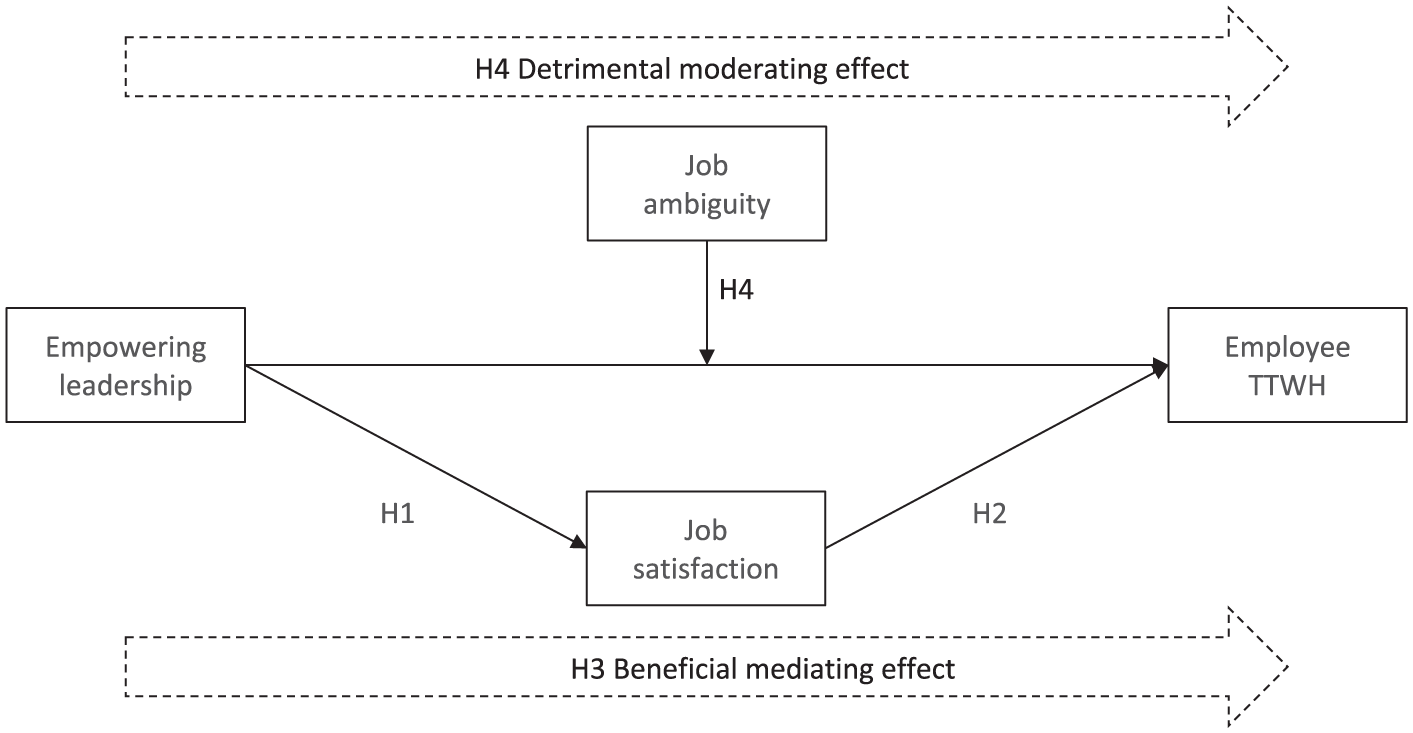
Summary of proposed relationships.
This research makes several contributions to the empowering leadership literature, as well as to the nascent literature on employee negative work behavior in telework contexts (e.g., TTWH). First, by examining the moderating role of job ambiguity between empowering leadership and employee TTWH, this study advances understanding of when empowering leadership may not be effective but instead promote negative work behavior among telework employees (e.g., TTWH). I argue that under certain conditions (high levels of job ambiguity) seemingly positive leadership actions, such as empowering leadership, can also evoke unintended negative responses among telework employees and result in more TTWH. This finding offers new insights on the potential dark side of empowering leadership (Cheong et al., 2016; Dennerlein and Kirkman, 2022; Lu et al., 2017). Second, by examining the impact of leader behavior (empowering leadership) on employee behavior (TTWH) through employee attitude (job satisfaction), this study sheds light on the mediating mechanism explaining why empowering leadership may represent an effective strategy for managers to prevent negative work behavior in telework contexts. By considering both a beneficial mediating effect and a detrimental moderating effect between empowering leadership and employee TTW, this study provides a more balanced and dialectical perspective on the double-edged nature of empowering leadership. Lastly, by focusing on the telework context, this study offers managers new insights into how their leadership behavior can facilitate and impede successful telework.
Theoretical framework and hypotheses
Telework is defined as a work arrangement in which employees and their managers are separated by physical distance (Leonardi et al., 2024). This work arrangement offers telework employees greater freedom and flexibility in choosing where, when, and how to perform their job-related activities (Gajendran and Harrison, 2007). Telework employees may also experience less direct supervision and monitoring from their supervisor due to their physical separation from the workplace (Allen et al., 2003; Golden and Veiga, 2008). Thus, telework employees should perceive more discretion over their workflow and control over how they manage their work than in a traditional office setting. Previous research indicates that telework employees perceive greater levels of autonomy in their job than regular employees, resulting in desirable outcomes such as job performance and job satisfaction (Gajendran and Harrison, 2007). At the same time, telework employees may have increased opportunities to engage in negative work behavior due to less direct supervision (Keating et al., 2023; Lu et al., 2017).
Of particular concern is the prevalence of employee time theft while working from home (TTWH). Telework employees who engage in TTWH spend at least a portion of their work hours for non-work-related, nonallowable activities, such as starting work late without permission, surfing the Internet for personal reasons, or simply daydreaming and procrastinating on tasks (Lorinkova and Perry, 2017). Thus, when telework employees waste time or don't work during their scheduled hours, they are stealing time that rightfully belongs to their company (Henle et al., 2010). It is generally considered a violation of organizational norms to intentionally accept payment from organizations for hours during which telework employees did not work or did not focus on work tasks (Lv et al., 2024). Moreover, time theft behaviors are a relatively low-risk way to deviate from organizational norms, as the chances of being detected are small, especially when working from home (Martin et al., 2010). Previous research has viewed time theft as a discrete form of deviant behavior (Harold et al., 2022; Henle et al., 2010; Kulas et al., 2007; Lorinkova and Perry, 2017). Consequently, researchers have employed relevant items from established workplace deviance measures to assess time theft (Henle et al., 2010; Lorinkova and Perry, 2017; Lv et al., 2024). According to Bennett and Robinson (2000), deviant behaviors can be divided into two categories: minor versus serious, and interpersonal versus organizational. Based on these two dimensions, employee TTWH represents a minor, organizationally-directed form of deviance in the telework context (Bennett and Robinson, 2000; Harold et al., 2022). In this study, I view deviant behavior (e.g., employee TTWH) as a subdimension of negative work behavior in the telework context (Keating et al., 2023). In prior studies, time theft has also been regarded as a form of counterproductive work behavior (e.g., Holland et al., 2016; Martin et al., 2010) or unethical work behavior (e.g., Henle et al., 2010; Hu et al., 2023). Research has shown that employee TTWH not only causes financial losses to organizations (Milenkovic, 2024), but also undermines employee motivation and organizational citizenship behavior (Harold et al., 2022).
Since telework employees are physically distant from their supervisors, it is often necessary for them to regulate their own behavior while working from home (Allen et al., 2003; Andressen et al., 2012). Empowering leadership is recognized as a promising strategy for supervisors to encourages employees’ autonomous self-direction (Amundsen and Martinsen, 2015; Bell et al., 2023; Han et al., 2022). In contrast to a directive leadership style which actively structures employees’ work through providing clear directions, empowering leaders delegate necessary discretion to employees to lead themselves without direct supervision (Lorinkova et al., 2013; Manz and Sims, 1987). It manifests through specific behaviors such as enhancing the meaningfulness of work, expressing confidence in high performance, promoting participation in decision making, and providing autonomy from bureaucratic constraints (Ahearne et al., 2005; Zhang and Bartol, 2010). Previous research indicates that empowering leadership is associated with less employee withdrawal behavior (Kim et al., 2018), such as time theft (Lorinkova and Perry, 2017).
However, there is a growing body of research indicating that empowering employees is not always beneficial (Cheong et al., 2016; Dennerlein and Kirkman, 2022; Humborstad and Kuvaas, 2013; Lorinkova and Perry, 2017; Wong and Giessner, 2018). Cheong et al. (2016) argue that empowering leadership can have both enabling and burdening effects on employees. Research has shown that empowering leadership can lead to decreased work performance due to increased job-induced tension among employees (Cheong et al., 2016). Additionally, empowering leadership has been shown to lead to poorer performance when monitoring is low (Langfred, 2004; Lorinkova et al., 2013). Recent research suggests that empowering leadership can even promote negative work behavior, such as unethical pro-organizational behavior, when employees face significant hindering demands in their job (Dennerlein and Kirkman, 2022; Sharma and Kirkman, 2015). Therefore, empowering leadership behaviors might be a double-edged sword with the potential to both promote and prevent employee TTWH.
Although I do not explicitly measure reciprocity in this study, I draw on social exchange theory (Cropanzano et al., 2017) and principles of reciprocal exchange (Uhl-Bien and Maslyn, 2003) as theoretical explanations for the double-edged effects of supervisors’ empowering leadership behaviors on employee negative work behaviors while working from home. According to social exchange theory, organizations are social marketplaces wherein individuals exchange economic and socioemotional resources (Cropanzano et al., 2017). The social exchange process between supervisors and telework employees typically begins with an initiating action of the supervisor toward a telework employee (e.g., supervisors’ leadership behavior). In response to the initiating action of the supervisor, the telework employee may then choose to reciprocate this treatment with positive or negative attitudes and behaviors toward the leader and/ or the broader organization. This process is often referred to as reciprocating responses (Cropanzano et al., 2017). Given that individuals seek balance in their exchange relationships (Uhl-Bien and Maslyn, 2003), reciprocating responses depend on individual’s perception of whether the exchange partner is providing expected resources or not. Telework employees who experience positive initiating actions by their supervisor will tend to reply in kind by engaging in more positive reciprocating responses and/ or fewer negative reciprocating responses (Cropanzano et al., 2017). This describes a positive social-exchange relationship. In contrast, telework employees who experience negative initiating actions (or inactions) by their supervisor will tend to engage in fewer positive reciprocating responses and/ or more negative reciprocating responses (Cropanzano et al., 2017). This describes a negative social-exchange relationship.
In this research, I assume positive and negative social exchanges between empowering leaders and telework employees that may explain whether telework employees engage in more or less TTWH. Drawing on social exchange theory, I develop and test a theoretical model that explains why telework employees may respond positively to empowering leadership behaviors by engaging in less TTWH (beneficial mediating effect) and when telework employees may respond negatively to empowering leadership behaviors by engaging in more TTWH (detrimental moderating effect).
Why empowering leadership prevents employee time theft while working from home
To explain why telework employees may respond positively to empowering leadership, I argue that a positive perception of empowering leadership behaviors results in increased job satisfaction among telework employees. Locke (1976) defined job satisfaction as “a pleasurable or positive emotional state resulting from the appraisal of one's job or job experience” (p. 1300). Leaders who empower their telework employees are providing benefits to them by demonstrating confidence and trust in their ability to perform their jobs autonomously (Han et al., 2022). By doing so, empowering leaders develop high-quality exchange relationships with their employees, characterized by mutual trust and commitment (Lee et al., 2018). Previous research suggests that telework employees who have high-quality relationships demonstrate high levels of job satisfaction (Golden and Veiga, 2008). Moreover, self-determination theory indicates that employees experience job satisfaction when their psychological needs are satisfied (Deci et al., 2017). For example, by expressing confidence in telework employee abilities, empowering leaders fulfill employees’ needs for competence. In addition, by providing more decision-making latitude to telework employees, empowering leadership allows employees to satisfy their need for autonomy (Kim and Beehr, 2020).
In line with these arguments, previous research indicates a positive relationship between empowering leadership and job satisfaction through psychological empowerment (Amundsen and Martinsen, 2015). A recent meta-analysis has also confirmed a positive relationship between empowering leadership and employee job satisfaction (Kim et al., 2018). Although to the best of my knowledge this link has never been studied in the telework context, I argue that empowering leadership behaviors are likely perceived by telework employees as positive in nature because they indicate a high-quality exchange relationship (Lee et al., 2018) and satisfy employee needs for competence and autonomy (Deci et al., 2017; Kim and Beehr, 2020), resulting in higher job satisfaction. Thus, I propose:
Hypothesis 1. Empowering leadership will be positively related to telework employee job satisfaction.
The level of job satisfaction among telework employees can influence their decision to engage in more or less TTWH (Martin et al., 2010). Previous research suggests that employees who are satisfied with their working conditions exhibit less withdrawal behavior (Harold et al., 2022). Kulas et al. (2007) specifically identified job satisfaction as an antecedent of employee time theft behaviors. Additionally, the results of Holland et al. (2016) indicate that telework employees who experience high job satisfaction are less likely to engage in counterproductive work behaviors while working from home. Thus, I propose:
Hypothesis 2. Telework employee job satisfaction will be negatively related to employee time theft while working from home.
Finally, with regard to the beneficial mediating effect, I argue that job satisfaction mediates the relationship between empowering leadership and employee TTWH. Drawing on social exchange theory (Cropanzano et al., 2017) and the norm of reciprocity (Uhl-Bien and Maslyn, 2003), I argue that telework employees who experience positive initiating actions by their empowering leader will be more satisfied in their job and thus will tend to reply in kind by engaging in fewer negative reciprocating responses, such as less TTWH (Cropanzano et al., 2017). High-quality exchange relationships increasingly engender feelings of mutual obligation and reciprocity (Cropanzano et al., 2017; Uhl-Bien and Maslyn, 2003). As a consequence, telework employees who are satisfied in their job are likely to reciprocate the positive treatment of the empowering supervisor by engaging in less TTWH (Lorinkova and Perry, 2017). Thus, I propose:
Hypothesis 3. Job satisfaction will mediate the relationship between empowering leadership and employee time theft while working from home.
When empowering leadership promotes employee time theft while working from home
To explain when empowered telework employees are more likely to abuse their autonomy and engage in TTWH, I propose job ambiguity as a situational factor that can evoke negative reciprocating responses among telework employees. Job ambiguity, which refers to employees’ perceptions of uncertainty regarding various aspects of their jobs (Breaugh and Colihan, 1994), stands out as a situational moderator for two reasons. First job ambiguity is recognized as one of the major challenges for empowerment initiatives (Humborstad and Kuvaas, 2013). Employees who experience ambiguity in their job may lose confidence in their ability to perform their duties effectively. Thus, removing such factors is necessary to empower employees because they can lead to feelings of uncertainty and powerlessness (Dennerlein and Kirkman, 2022).
Second, previous research has identified job ambiguity as a critical hindrance stressor and psychological enabler of negative work behavior in a virtual work environment (Keating et al., 2023). As telework employees are more physically and psychologically distant from their organization, they may experience greater ambiguity in their job than regular employees. Virtual communication can create a sense of uncertainty and ambiguity because telework employees may have fewer opportunities to seek feedback from their supervisor (Bell et al., 2023). Consequently, they may receive less information and fewer cues from supervisors about job expectations (Allen et al., 2003).
Applying a contingency perspective that specifies the circumstances and situations under which employee empowerment should be encouraged (Houghton and Yoho, 2005), I argue that under high levels of job ambiguity empowering leadership may not be effective and may have a direct negative relationship with TTWH. There are at least three reasons why job ambiguity may cause telework employees to respond negatively to empowering leadership by engaging in TTWH. First, when telework employees are experiencing high levels of ambiguity while working from home, it may be due to a lack of guidance and job clarity from their leaders (Humborstad and Kuvaas, 2013). Telework employees need clarity in their job on various aspects, such as how to schedule work, what procedures to use, or the level of autonomy in decision making (Breaugh and Colihan, 1994). When telework employees feel uncertain about how to complete their work or what decisions they can make independently, they may require clear directions and instructions from their supervisor rather than empowering leadership behaviors. Results from a study of Zhang et al. (2014) indicate that employees who are confronted with hindering workplace demands may rather need transactional leadership behaviors (e.g., specify goals, articulate expectations, and monitor progress) than transformational leadership behaviors (e.g., articulating a compelling vision, and referencing core values and ideals) in order to get the job done. They argue that employees who are facing hindrance stressors may feel that transformational leadership behaviors are incongruent or incompatible with what they need in exchange for their efforts (Zhang et al., 2014). Similarly, prior research has shown that empowering leadership can be perceived by employees as a laissez-faire leadership style that abdicates the responsibilities and duties assigned to the supervisor (Wong and Giessner, 2018). Thus, leaders who exhibit empowering behaviors under conditions of high job ambiguity may be perceived as unhelpful or inactive, as they fail to provide clear guidance and instructions. Previous research indicates that employees are more likely to engage in time theft when they perceive their leader as passive or laissez-faire (Hu et al., 2023).
Second, job ambiguity can cause stress for employees as it increases strains such as anxiety, exhaustion, and frustration (Schmidt et al., 2014). These strains are cognitively taxing and can lead to depletion. When leaders empower depleted employees to assume more autonomous self-direction, they might be overburdening their employees (Sharma and Kirkman, 2015). Telework employees may then engage in TTWH to remove themselves from workplace stressors in order to conserve their own valued resources (Hu et al., 2025). Telework employees may fantasize or daydream instead of working as a passive way to mentally 'check out' and cope with their stress (Lorinkova and Perry, 2017; Martin et al., 2010).
Third, high levels of job ambiguity may cause employees to perceive their jobs as having unfavorable personal cost-benefit ratios (Dennerlein and Kirkman, 2022). When employees are empowered but face high levels of ambiguity in their job, the costs may outweigh the benefits of empowerment. According to social-exchange theory, for telework employees who lack necessary resources from their supervisor, such as clear guidance, TTWH can be a suitable exchange behavior in order to “get even” with the organization (Lorinkova and Perry, 2017).
In conclusion, I argue that when telework employees are expected to act on their own but at the same time lack understanding of how best to complete their work tasks, they will likely feel disillusioned and frustrated by their empowering leaders. Telework employees who receive negative initiating inactions from their supervisor are likely to respond with negative reciprocation, such as TTWH, as a way to compensate for the frustration of unclear job expectations (Cropanzano et al., 2017; Lorinkova and Perry, 2017; Martin et al., 2010). Conversely, when job ambiguity is lower, employees are less likely to feel frustrated and depleted when their leaders empower them. This reduces the likelihood of telework employees engaging in time theft behaviors (e.g., Hu et al., 2023; Martin et al., 2010). Thus, I propose:
Hypothesis 4. The direct effect of empowering leadership on employee time theft while working from home is moderated by job ambiguity such that the effect is positive at higher levels of job ambiguity.
Overview of the current research
To test the theoretical model, I conducted two studies on Prolific, including a multi-wave field study (Study 1) and an experimental study (Study 2). In Study 1, I used a three-wave design to test the full model (Hypotheses 1–4) in a field setting. In Study 2, I experimentally examined the interactive effect of empowering leadership and job ambiguity on employee TTWH (Hypothesis 4). The multimethod designs of the two studies (i.e., field and experimental studies) sought to account for internal and external validity of my findings (Dennerlein and Kirkman, 2022).
Study 1 method
Participants and procedure
The sample consisted of 133 full-time employees working in various organizations of several industries (e.g., finance, information, retail, manufacturing). The participants’ average age was 39 years (SD = 10.44), and the average tenure at the organizations was 7.9 years (SD = 5.80). Forty-four percent of the sample was female. Most of the participants were located in the United Kingdom (70%) and the United States (26%).
I recruited participants through the online platform Prolific Academic. To be eligible for the study, participants had to be full-time employees of a for-profit company or business, have no student status, and speak English natively. The collected data were part of a larger data collection effort, gathered in three waves with a 4-week time lag between measurement points, beginning in February 2020. A data transparency table which specifies the non-overlapping use of variables from this dataset for other manuscripts can be found in Table S1 in the online Supplemental Material. Participants received compensation of $3 for completing all three surveys. To ensure data quality, I included five attention checks and monitored the time spent on each survey. At Time 1, employees rated their supervisors’ empowering leadership (350 responses). I excluded those participants from the sample who had failed one or more attention checks (n = 6) or who had an implausibly short response time (n = 3). At Time 2, employees rated their level of job ambiguity (313 responses; 92% response rate). I excluded those participants from the sample who had failed one or more attention checks (n = 6), who had an implausibly short response time (n = 2), or who had changed their job (n = 8). At Time 3, employees rated their level of job satisfaction and TTWH (275 responses; 93% response rate). I excluded those participants from the sample who failed one or more attention checks (n = 6), or who had changed their job (n = 14). Between Time 2 and Time 3, the lockdown due to the COVID-19 crisis began in most countries of the world, including the United Kingdom and the United States. As a consequence, employees began to work at home whenever possible. This study focuses on those 133 employees who were working from home (at Time 3) due to the COVID-19 crisis.
Measures
The measures were taken at different times to both minimize the effects of transient sources of common method bias (Podsakoff et al., 2012) and to measure the variables in a sequence consistent with the proposed causal model in Figure 1. Previous studies have successfully employed a temporal separation of 4 weeks between measurement points (e.g., Lv et al., 2024), and therefore a 4-week interval was chosen for the present study. The measures used in this study were adapted from existing validated scales. The specific items from each measure can be found in the online Supplemental Materials.
Empowering leadership
At Time 1, participants rated their supervisor’s empowering leadership. I used four subscales (Ahearne et al., 2005; Zhang and Bartol, 2010) consisting of three items each to assess the following supervisor behaviors: (a) enhancing the meaningfulness of work, (b) fostering participation in decision making, (c) expressing confidence in high performance, and (d) providing autonomy from bureaucratic constraints. Example items are “My leader helps me understand how my objectives and goals relate to those of the company” (meaningfulness of work), “My leader makes many decisions together with me” (participation in decision making), “My leader expresses confidence in my ability to perform at a high level” (confidence in high performance), and “My leader allows me to do my job my way” (autonomy from bureaucratic constraints). Participants scored each of the items on a 7-point Likert scale, ranging from 1 “strongly disagree” to 7 “strongly agree.” In line with previous studies (e.g., Lorinkova and Perry, 2017), I averaged scores across the subscales to form a single empowering leadership score (α = 0.95).
Job ambiguity
At Time 2, participants reported the level of ambiguity they experience in their job using nine items adapted from Breaugh and Colihan (1994). The measure uses three items each to assess ambiguity with respect to scheduling, work methods, and decision-making. Example items are “I know how to schedule my work” (scheduling ambiguity), “I am certain how to go about doing my work” (method ambiguity), and “I know what decisions I can make on my own” (decision-making ambiguity). All items were scored on a 5-point Likert scale, ranging from 1 “strongly disagree” to 5 “strongly agree.” Following previous research (e.g., Grant and Rothbard, 2013), I reversed and averaged scores across all facets of ambiguity to form an overall job ambiguity score (α = 0.91).
Job satisfaction
At Time 3, participants were asked to respond to a three-item measure of job satisfaction developed by Cammann et al. (2008). Example items include “In general, I like working at my job,” and “All in all, I am satisfied with my job.” Participants used a 5-point Likert scale, ranging from 1 “strongly disagree” to 5 “strongly agree.” Coefficient alpha for this scale was 0.93.
Employee TTWH
At Time 3, participants also completed a three-item measure of time theft while working from home, as adapted from Bennett and Robinson (2000). I used the following items: “I spent too much time fantasizing or daydreaming instead of working,” “I start work late without permission,” and “I find myself procrastinating on tasks that I don't like but that must be done.” Participants scored all items on a 5-point Likert scale, ranging from 1 “strongly disagree” to 5 “strongly agree.” Coefficient alpha for this scale was 0.77.
Control variables
In order to focus the current study and results on the effects of empowering leadership on employee TTWH, I considered several potentially relevant control variables. Following previous research on virtual work (e.g., Andressen et al., 2012; Golden and Veiga, 2008), I controlled for participant’s gender (1 = male, 2 = female) and age (both measured at Time 1). Further, I assessed control variables specifically related to the lockdown during Time 3. Participants were asked whether they had family responsibilities (i.e., watch children) while working from home (1 = no, 2 = yes). Participants indicated the period they had already worked from home due to the lockdown (1 = less than 1 week, 2 = 1 week, 3 = 2 weeks, 4 = 3 weeks, 5 = 4 weeks, 6 = 5 weeks, 7 = 6 weeks, 8 = more than 6 weeks) and their telecommuting tenure before the lockdown (0 = no use of telework, 1 = less than 1 month, 2 = 1 month to 6 months, 3 = 6 months to 1 year, 4 = 1 year to 2 years, 5 = 2 years to 3 years, 6 = 3 years to 4 years, 7 = 4 years to 5 years, 8 = more than 5 years). Building on prior research (e.g., Golden and Veiga, 2008), I asked participants to assess the percentage of a typical workweek they spent with their supervisor and coworkers in face-to-face interactions before the lockdown as well as in virtual interactions since the lockdown, respectively. As none of those variables impacted the patterns of results or significance of findings (see the online Supplemental Material, Table S2), I did not include any of the potential control variables in the analyses.
Study 1 results
I conducted a confirmatory factor analysis to ensure that the constructs assessed in the study were distinguishable from each other. I used the balanced item parceling technique described in Little et al. (2013) and formed parcels to represent the four facets of empowering leadership and the three facets of job ambiguity. The hypothesized measurement model with all four factors (empowering leadership, job ambiguity, job satisfaction, and employee TTWH) showed reasonable fit to the data: χ2(59) = 94.73, comparative fit index (CFI) = 0.97, Tucker-Lewis index (TLI) = 0.96, root-mean-square error of approximation (RMSEA) = 0.07. Loading any pair of these variables on one factor resulted in poorer fit (best fitting alternative model, with job ambiguity and employee TTWH combined as one factor: χ2(62) = 187.71, CFI = 0.87, TLI = 0.85, RMSEA = 0.12; Δχ2(3) = 92.98, p < 0.001). These results support the discriminant validity of the study variables.
Table 1 presents means, standard deviations, and correlations between the study variables. Notably, almost half of the sample (46%) had no experience in telecommuting before the lockdown. The majority of the participants (82%) had been working from home due to the COVID-19 crisis for 2 to 3 weeks. 34% indicated that they had family responsibilities (i.e., watch children) while working from home. Participants’ average extent of face-to-face interactions before and virtual interactions since the lockdown was 53% (SD = 33.41) and 27% (SD = 28.50), respectively.
Study 1 descriptive statistics and correlations.
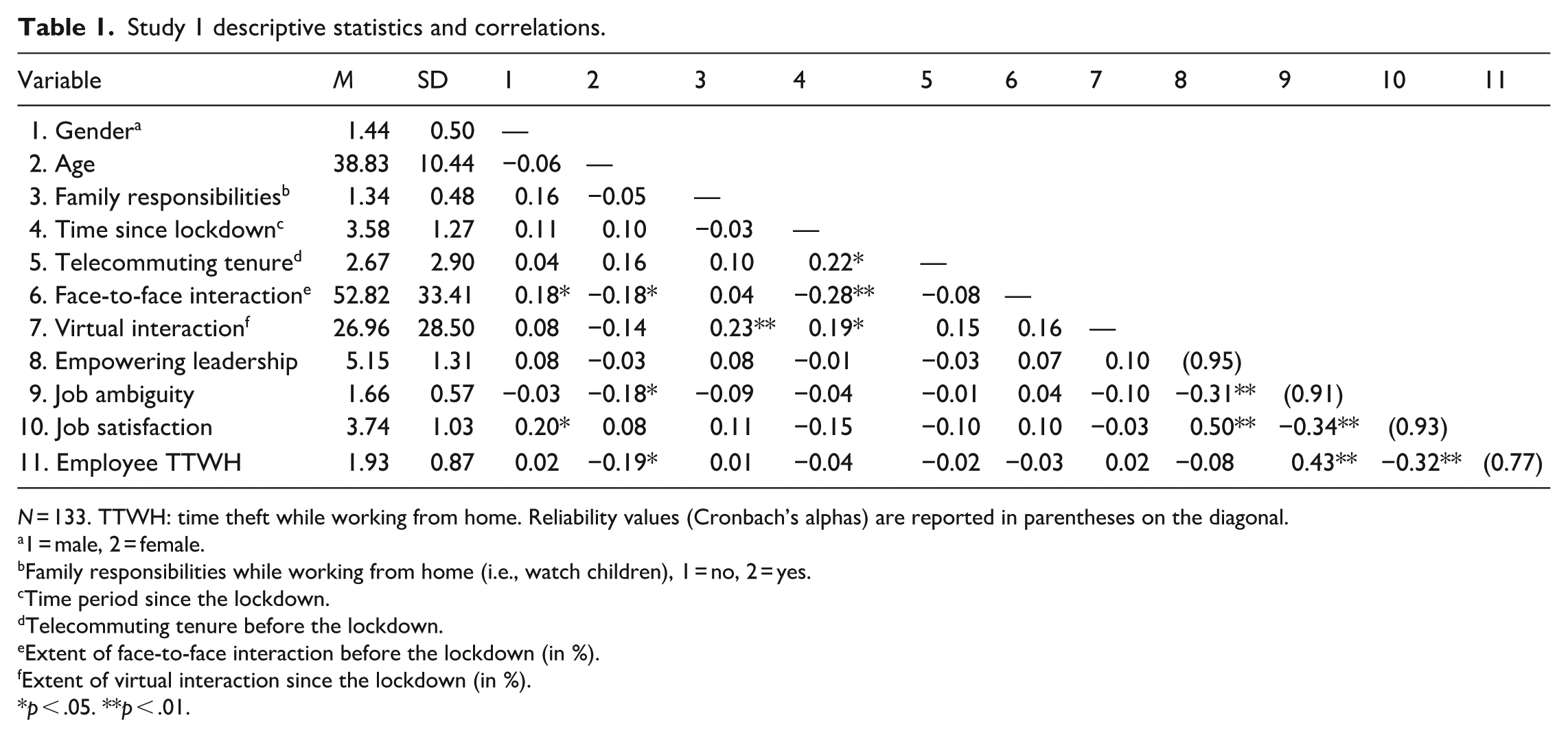
N = 133. TTWH: time theft while working from home. Reliability values (Cronbach’s alphas) are reported in parentheses on the diagonal.
1 = male, 2 = female.
Family responsibilities while working from home (i.e., watch children), 1 = no, 2 = yes.
Time period since the lockdown.
Telecommuting tenure before the lockdown.
Extent of face-to-face interaction before the lockdown (in %).
Extent of virtual interaction since the lockdown (in %).
p < .05. **p < .01.
I tested the mediation and moderation hypotheses simultaneously using Model 5 of the PROCESS macro (Version 4.0) for SPSS (Hayes, 2013) based on a mediator variable (job satisfaction) and a moderator (job ambiguity) of the relationship between empowering leadership and employee TTWH (see Table 2). All predictor variables were mean centered in the model. As predicted in Hypotheses 1 and 2, empowering leadership has a main positive effect on employees’ job satisfaction (b = 0.40, SE = 0.06, p < 0.01), and job satisfaction has a negative main effect on employee TTWH (b = −0.24, SE = 0.08, p < 0.01). For the indirect effect of empowering leadership on employee TTWH via job satisfaction, bias-corrected and accelerated 95% confidence intervals were calculated using 10,000 bootstrap samples. The indirect effect was estimated at −0.10 (95% CI = (−0.170, −0.035)). This interval excludes zero, indicating that the indirect effect of empowering leadership on employee TTWH through job satisfaction is significant. Thus, Hypothesis 3 was fully supported.
Study 1 regression coefficients and conditional direct effect estimates.
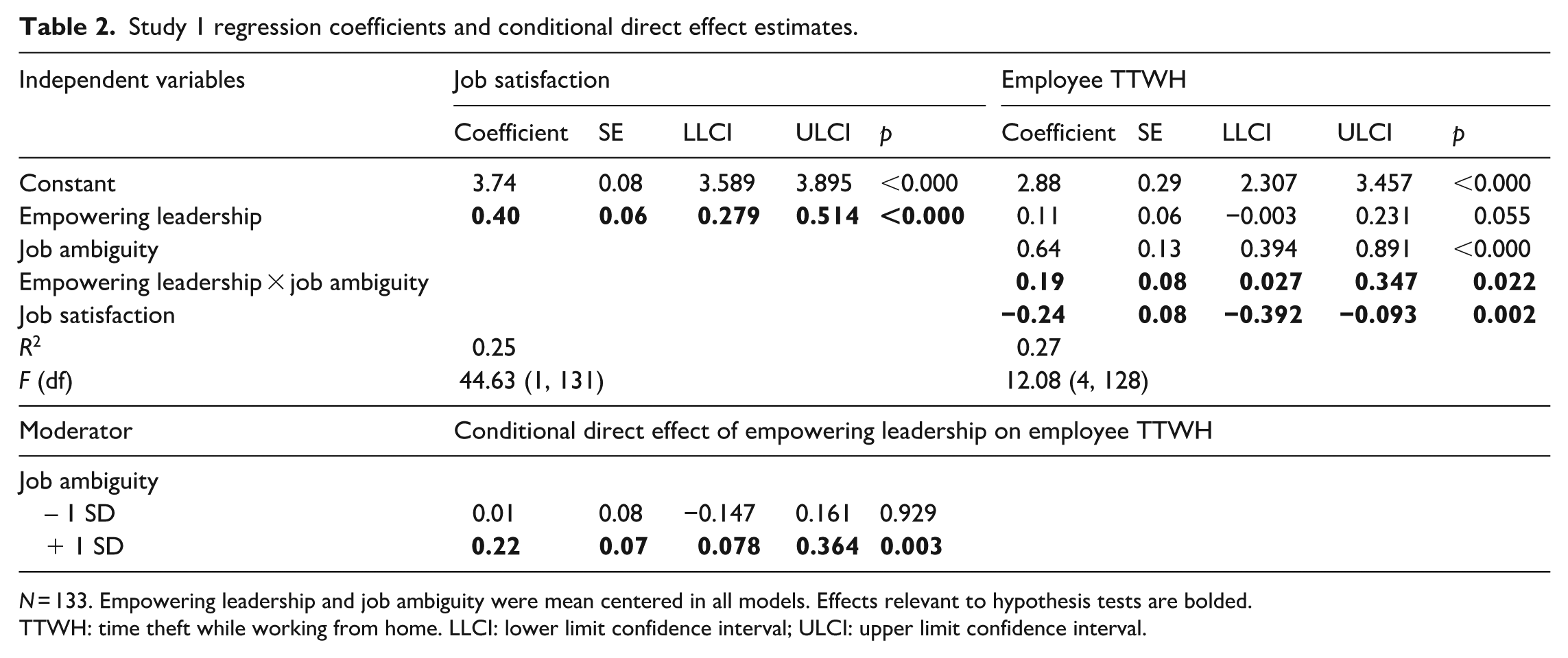
N = 133. Empowering leadership and job ambiguity were mean centered in all models. Effects relevant to hypothesis tests are bolded.
TTWH: time theft while working from home. LLCI: lower limit confidence interval; ULCI: upper limit confidence interval.
Hypothesis 4 further predicted that the direct effect of empowering leadership on employee TTWH is moderated by job ambiguity. The results in Table 2 show a statistically significant interaction between empowering leadership and job ambiguity for employee TTWH (b = 0.19, p < 0.05). Adding the interaction between empowering leadership and job ambiguity to the model significantly increased the amount of explained variance in employee TTWH (ΔR2 = 0.03, p < 0.05). To interpret the nature of the interaction, I plotted the simple slopes at one standard deviation above and below the mean for job ambiguity. As shown in Figure 2, under low job ambiguity, empowering leadership had no significant relationship with employee TTWH (b = 0.01, p = 0.93), but under high ambiguity, empowering leadership was associated with higher employee TTWH (b = 0.22, p < 0.01). Thus, Hypothesis 4 was supported.
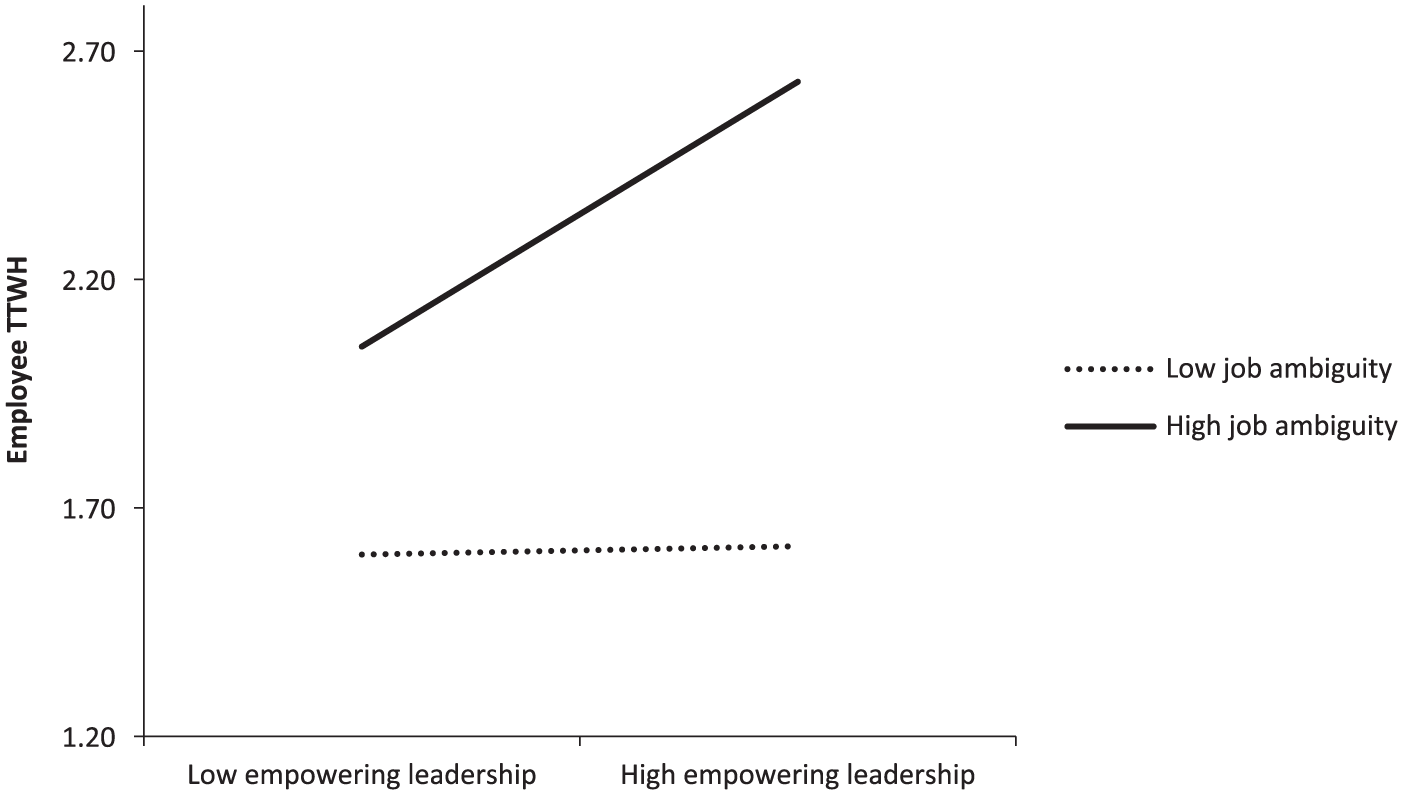
Study 1 interaction effect between empowering leadership and job ambiguity on employee TTWH.
Study 1 discussion
In this study, I used some unique data of employees that were required to work from home due to the COVID-19 crisis. It is noteworthy that the study findings show no significant bivariate relationship between empowering leadership and employee time theft (−0.08; 95% CI = (−0.243, 0.096)). The indirect effect of empowering leadership via job satisfaction (−0.10; 95% CI = (−0.170, −0.035)) and the conditional direct effect of empowering leadership under high levels of job ambiguity (0.22; 95% CI = (0.078, 0.364)) influence employee TTWH in opposite ways. This finding illustrates the double-edged nature of empowering leadership.
Furthermore, the temporal separation between the variables provides valuable insights into the factors that enabled employees to better adapt to working from home. The results indicate that employees who perceived their manager as empowering prior to the lockdown were more satisfied in their job and engaged in less time theft when they were forced to work from home. In contrast, when employees perceived their manager as empowering but also experienced high levels of ambiguity in their job (both measured prior to the lockdown), they worked less effectively from home and engaged in more TTWH. Interestingly, although nearly half of the sample (46%) had no experience with telecommuting prior to the lockdown, the results were not affected by employee telecommuting tenure prior to the lockdown or any other control variable (see Supplemental Material Table S2). Therefore, the results suggest that supervisors' leadership style and employees' job ambiguity level before the lockdown are representing important enabling and hindering forces of effective telework.
Although I employed temporal separation between the variables, all variables came from the same source, thereby leaving the possibility of common-method bias (Podsakoff et al., 2012). Moreover, the correlational nature of the study precludes causal claims. To address these limitations, I designed a scenario experiment for a second study. In this experiment, I independently manipulated empowering leadership and job ambiguity to test the interaction hypothesis.
Study 2 method
Participants, design, and procedure
For this study, I recruited an independent sample of 227 full-time employees on Prolific Academic. Inclusion criteria specified that participants needed to currently work from home due to the COVID-19 crisis, be a full-time employee of a for-profit company or business, have no student status, and speak English natively. I excluded those participants from the sample who failed one or more attention checks (n = 12) or who indicated that they deemed the scenario as highly unrealistic (n = 79; see measures below for more details). Thus, the final sample consisted of 136 participants. The sample was 50% female and the average age was 36 years (SD = 9.02). Most of the participants were located in the United Kingdom (63%) and the United States (33%).
The scenario for the online experiment was adapted from previous studies (Baer et al., 2020; Chen et al., 2011) and can be found in the online Supplemental Material. The experiment used a 2 (empowering leadership: low vs high) × 2 (job ambiguity: low vs high) design with random assignment to one of the four conditions (Ns ranged from 30 to 39). Participants first read a role-playing scenario designed to place them in the context of an employee who is currently working from home due to the COVID-19 crisis.
You are an employee at Goodman & Co., a professional services firm that offers accounting and consulting services to its clients. You have been working at the firm for about two years. Overall, you enjoy your work. Your job focuses primarily on the consulting side of the business, which means that you spend a lot of time working directly with clients. You work in an open office at company headquarters. You can do most of your work from your office, so you rarely have to travel. During your two years at the firm, you’ve had one supervisor, Jonathan Welborn. For the most part, the atmosphere at the office is good, and you generally get along well with the people at work. One month ago, a nationwide lockdown was announced due to the COVID-19 crisis. All Goodman & Co. employees were instructed to take their laptops home and to work remotely. Although you had the opportunity to work from home one day a week before the lockdown, this was a radical change. Four weeks have passed since the lockdown, and like everyone else at the company, you are still working from home. You are currently home working on your laptop. A few minutes ago, you received an email from the HR department of Goodman & Co. asking you to complete a feedback survey. This survey asks you to evaluate how well you have adjusted to working from home. As you reflect on your work situation, you focus on two things: the level of ambiguity you frequently experience in your work and your supervisor’s leadership style.
Participants were then asked to reflect on the level of ambiguity they experience in their work and their supervisor's leadership style, which were manipulated to create four conditions. These manipulations directly reflected the measures utilized in Study 1. Afterwards, participants had to complete an employee survey in the scenario, rating their job satisfaction and TTWH as if they were that Goodman & Co. employee. Following the scenarios, participants completed the manipulation and realism checks.
Manipulations
Job ambiguity
In designing this manipulation, I built on the 9-item measure of job ambiguity utilized in Study 1 (Breaugh and Colihan, 1994). Participants were asked to reflect on the work situation of the Goodman & Co. employee described in the scenario. An example statement for the high [low] condition, respectively, includes “Most of the time you feel quite uncertain [certain] about the level of autonomy you have to make decisions.”
Empowering leadership
To create this manipulation, I built on the 12-item measure of empowering leadership utilized in Study 1 (Ahearne et al., 2005; Zhang and Bartol, 2010). The participants were asked to reflect on the leadership style of the supervisor of the Goodman & Co. employee described in the scenario. An example statement for the high [low] condition, respectively, includes “Your supervisor often [rarely] makes decisions together with you.”
Measures
Employee TTWH
Participants were instructed to complete a scenario employee survey to evaluate their work-from-home situation as if they were this Goodman & Co. employee. Participants were told that if they were unsure how to answer a question in the scenario employee survey, they should choose the answer option that they thought was most likely. The scenario employee survey was introduced in the following way: Dear Goodman & Co. Employee, With this survey we want to gain a better understanding of how well all Goodman & Co. employees have adjusted to working from home. The survey is completely confidential. It won’t be possible for any manager to view results for any group of data with less than 5 responses. Please be honest about your experience of working from home. Thank you! Your Goodman & Co. HR team
The measure used for TTWH in the scenario employee survey was identical to that used in Study 1 (Bennett and Robinson, 2000). Coefficient alpha for this scale was 0.86.
Manipulation check
Participants were asked to report their agreement with whether the presented statements accurately described the situation at Goodman & Co. The measures used as a formal manipulation check for job ambiguity (α = 0.98) and empowering leadership (α = 0.99) were identical to those used in Study 1.
Scenario realism check
In line with previous studies (e.g., Baer et al., 2020), I included a scenario realism check created by Chen et al. (2011). Participants completed the following three questions on a 5-point Likert scale, ranging from 1 “strongly disagree” to 5 “strongly agree”: “It is realistic that I might experience a supervisor like this,” “It is realistic that I might experience a situation like this,” and “At some point during my career, I will probably encounter a situation like the one described above” (α = 0.78). To address concerns about the scenario's relevance to real-life situations, I only considered the results of participants who could relate to it. Those who rated the scenario as unrealistic were excluded from the sample to avoid bias (n = 79). In the final sample, the mean score across the three items ranged from 4.51 to 4.60, and an analysis of variance (ANOVA) indicated no significant differences in scenario realism across the four conditions, F(3) = 0.46, ns.
Study 2 results
Table 3 and Figure 3 displays descriptive statistics by condition. To assess the effectiveness of the manipulations and the interaction hypothesis, I performed multiple ANOVAs.
Study 2 means across conditions and ANOVA tests for differences among conditions.
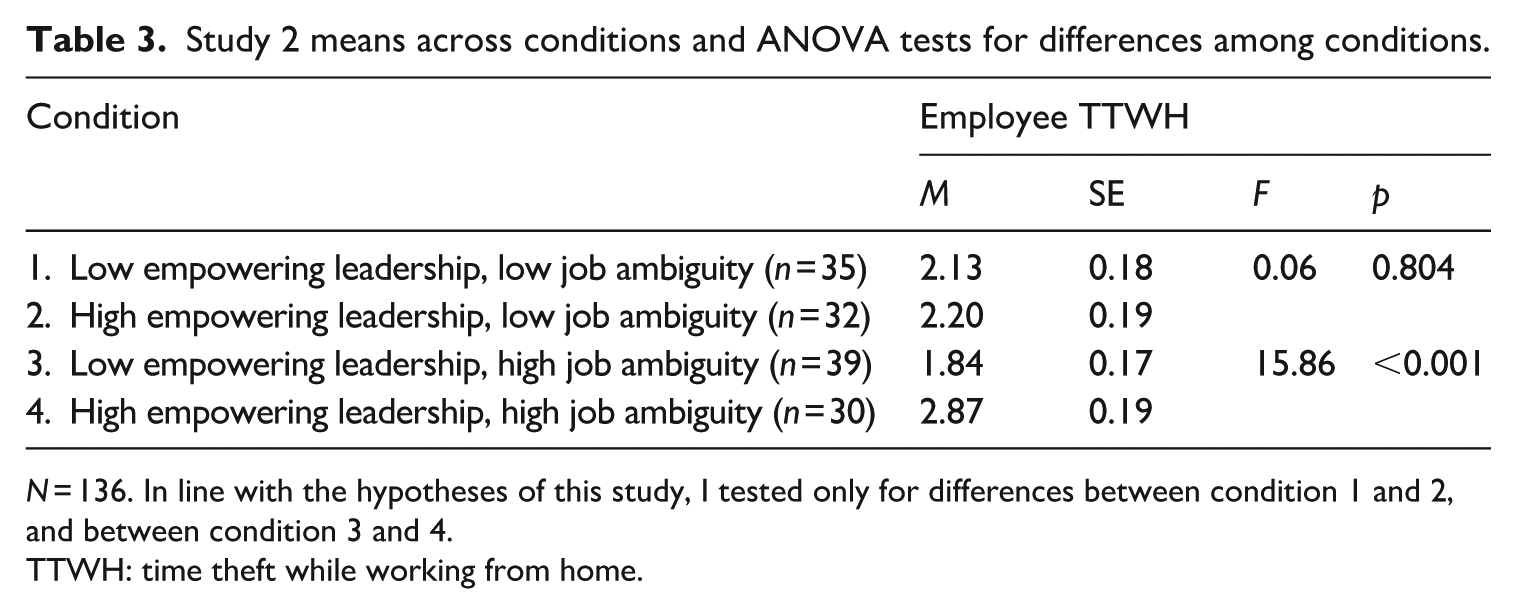
N = 136. In line with the hypotheses of this study, I tested only for differences between condition 1 and 2, and between condition 3 and 4.
TTWH: time theft while working from home.
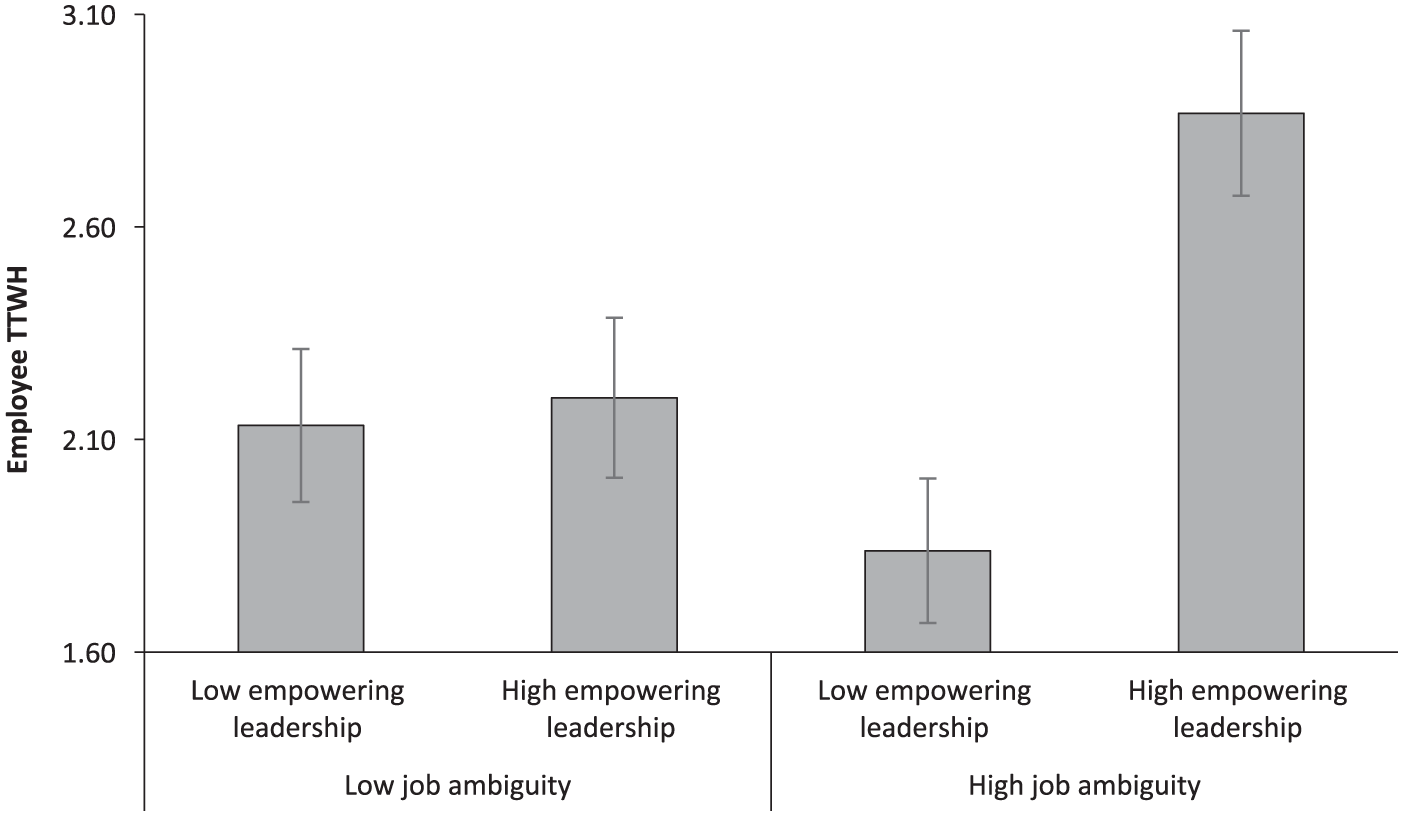
Study 2 interaction effect between empowering leadership and job ambiguity on employee TTWH.
The results of an ANOVA provided strong evidence for the effectiveness of the manipulations. Participants in the high job ambiguity condition indicated having significantly more job ambiguity than those in the low job ambiguity condition (F = 267.14, p < 0.001; M = 4.11 vs 1.63); participants in the high empowering leadership condition rated their supervisor’s empowering leadership as significantly higher than those in the low empowering leadership condition (F = 573.19, p < 0.001; M = 6.02 vs 1.89).
The interactive effect of empowering leadership and job ambiguity in predicting employee TTWH was significant, F(1) = 6.92, p = 0.01. I conducted simple effects by assessing the impact of the empowering leadership manipulations at each level of job ambiguity. Consistent with Hypothesis 4, participants with high empowering leadership showed a significantly higher level of TTWH than those with low empowering leadership under high job ambiguity, F = 15.86, p < 0.01; M = 2.87 versus 1.84, but not under low job ambiguity, F = 0.06, p = 0.80; M = 2.20 versus 2.13. Thus, Hypothesis 4 was supported. 1
Study 2 discussion
The objective of Study 2 was to reinforce the findings of Study 1 by implementing an experimental design that allows to establish causality for the interaction hypothesis. The pattern of the interaction effect was the same as in Study 1. This provides further evidence that the observed detrimental effect on employee TTWH is driven by empowering leadership and job ambiguity, and that this finding is robust across methods.
General discussion
Time theft is a significant issue for organizations, but there is limited insight into how managers can prevent it. This research focuses for the first time on the effectiveness of empowering leadership in preventing employee time theft in a telework context. Applying a social exchange perspective, I develop a theoretical model that incorporates a beneficial mediating effect and a detrimental moderating effect between empowering leadership and employee TTWH. Results from two studies support the proposition that empowering leadership has both positive and negative effects on employee TTWH. On the one hand, empowering leadership was associated with decreased TTWH via increased job satisfaction (beneficial mediating effect). On the other hand, when telework employees experienced high levels of ambiguity in their job, empowering leadership was associated with increased TTWH (detrimental moderating effect).
Theoretical implications
This research makes several important theoretical contributions to the extant literatures on empowering leadership, as well as to the nascent literature on employee negative work behavior in telework contexts (e.g., TTWH). First, by investigating why and when empowering leadership prevents versus promotes employee TTWH, this study offers a more comprehensive understanding of the positive and negative consequences of empowering leadership on employees. While previous research has mainly focused on the positive effects of empowering leadership on employee outcomes (for meta-analysis, see Kim et al., 2018), recent studies have suggested that empowering employees may not always be beneficial (Cheong et al., 2016; Dennerlein and Kirkman, 2022; Humborstad and Kuvaas, 2013; Lorinkova and Perry, 2017; Wong and Giessner, 2018). However, studies integrating both positive and negative effects of empowering leadership are rare (for an exception, see Cheong et al., 2016; Han et al., 2022). Using a social exchange perspective, I develop a theoretical model that explains why telework employees may respond positively to empowering leadership (beneficial mediating effect) and when telework employees may respond negatively to empowering leadership behaviors (detrimental moderating effect). Since the mediating effect and the moderating effect between empowering leadership and employee TTWH influence employee TTWH in opposite ways, this study offers a more balanced and dialectical perspective on the double-edged nature of empowering leadership.
Second, identifying job satisfaction as a mechanism by which empowering leadership reduces employee time theft provides a more comprehensive understanding of why empowering leadership can be an effective strategy for managers to prevent negative work behavior in telework contexts. The results support the proposition that empowering leadership may act as a benefit to employees, leading to increased job satisfaction. Satisfied employees, in turn, are less likely to engage in time theft as a way of reciprocating positive treatment from their supervisor.
Third, by examining the moderating role of job ambiguity between empowering leadership and employee TTWH, this study advances understanding of when empowering leadership may not be effective but instead promote negative work behavior among telework employees (e.g., TTWH). Given that there is a potential dark side to empowering leadership (Cheong et al., 2016; Dennerlein and Kirkman, 2022; Lu et al., 2017), it is crucial to understand the situations in which empowering leadership may result in negative outcomes. By highlighting job ambiguity as a situational factor that hinders empowerment, this study answers previous calls for a contingency approach to empowering leadership (Cheong et al., 2019; Houghton and Yoho, 2005; Sharma and Kirkman, 2015). I argue that telework employees may become disillusioned and frustrated with their supervisors when they are expected to work independently but do not have clear guidance on how to complete their tasks. As a result, telework employees may respond negatively to empowering leadership by engaging in more TTWH as a way to compensate for the frustration of unclear job expectations (Martin et al., 2010). This finding is in line with the research of Dennerlein and Kirkman (2022), which demonstrates that empowering leadership can have a reversing effect when employees encounter significant hindering demands in their job. In addition, the study's results support previous research indicating that job ambiguity functions as psychological enabler of negative work behavior in virtual work environments (Keating et al., 2023).
Lastly, this study expands on the research of time theft antecedents (Harold et al., 2022; Henle et al., 2010; Martin et al., 2010) by exploring the interaction between a positive workplace feature (i.e., empowering leadership) and a negative one (i.e., job ambiguity). This goes beyond previous attempts to understand what drives time theft from a leadership perspective. While previous research has shown that passive or laissez-faire leadership is associated with employee time theft (Hu et al., 2023), it is unclear whether positive leadership approaches, such as empowering leadership, prevent or promote negative work behavior, such as employee time theft. The results of this research indicate that empowering leadership can have beneficial and detrimental effects on employee TTWH. One potential explanation for the detrimental moderating effect between empowering leadership and employee TTWH can be that leaders who exhibit empowering behaviors under conditions of high job ambiguity may be perceived as unhelpful or inactive, as they fail to provide clear guidance and instructions. This explanation is in line with previous research that suggests that empowering leadership can be perceived as a laissez-faire leadership style (Wong and Giessner, 2018). More importantly, this finding enhances understanding of the antecedents of employee time theft by showing that it can result not only from passive or negative leadership behaviors but also from leadership behaviors traditionally viewed as positive (Dennerlein and Kirkman, 2022).
Practical implications
After the COVID-19 pandemic, many employees continued to work full-time from home (Destatis, 2024; Gallup, 2025). Physical separation from the workplace gives telework employees more autonomy, but also more opportunity to engage in negative work behavior. A common concern among managers is that employees may engage in time theft while working from home (TTWH) by spending too much time fantasizing or daydreaming instead of working, taking additional or longer breaks than is acceptable, or starting work late without permission (Harold et al., 2022; Holland et al., 2016).
Findings from this study suggest that managers can use empowering leadership to prevent negative work behavior in a telework context, such as employee TTWH. Leaders who empower their telework employees are providing benefits to them by enhancing the meaningfulness of work, expressing confidence in high performance, promoting participation in decision making, and providing autonomy from bureaucratic constraints (Ahearne et al., 2005; Zhang and Bartol, 2010). As a result, telework employees are more satisfied with their job and are likely to reciprocate the positive treatment of their empowering supervisor by engaging in less TTWH (Lorinkova and Perry, 2017).
However, it is important to note that simply exhibiting empowering behaviors may not reduce employee TTWH unless managers also provide clear job expectations. Managers should be aware that employees may respond negatively to empowering leadership and engage in time theft when they are frustrated with unclear job expectations. Therefore, it is crucial for managers to frequently interact with employees to identify signs of job ambiguity and take steps to minimize it. Empowering leaders may tend to undervalue behaviors such as specifying goals, articulating expectations, and monitoring progress (Langfred, 2004; Lorinkova et al., 2013; Zhang et al., 2014). However, the success of managers in bridging the physical distance between them and their telework employees is likely to depend on how effectively they address ambiguity and provide clarity on various aspects (Bell et al., 2023). Telework employees should have a clear understanding of their job responsibilities, including task prioritization, procedures to follow, and methods to use to complete their work. They should also be aware of when they can exercise personal initiative or judgment and make decisions. Under such conditions, employees are more likely to perceive empowering leadership behaviors positively and embrace the opportunity to work independently from home.
Limitations and future research
Although I attempted to account for external and internal validity by using data from a field study and an experiment, this research has several limitations that should be addressed in future studies. First, I analyzed data from full-time telework employees who were required to work from home due to the COVID-19 crisis. This raises the question of whether the results are applicable beyond the unique COVID-19 context (Kaiser et al., 2022). I did control for various variables related to the lockdown, but none of these variables affected the patterns of results or the significance of findings. Given that a significant number of employees continued to work from home full-time after the pandemic (Gallup, 2025), it would be beneficial for future research to replicate these findings with full-time telework employees who voluntarily work from home. Additionally, it would be valuable to investigate whether the adverse impact of empowering leadership is exclusive to telework or relevant to any work arrangement. Previous research suggests that the impact of leadership may differ significantly between virtual and traditional work structures (Andressen et al., 2012; Golden and Veiga, 2008). Therefore, new forms of leadership, such as virtual or remote leadership, are being discussed in the leadership literature (Bell et al., 2023). I thus welcome future research to explore whether the double-edged effects of empowering leadership can be replicated in other work arrangements and with different forms of leadership.
Second, although it has been argued that employees reciprocate negatively to empowering leadership and engage in time theft when they are frustrated with unclear job expectations, this study did not directly assess negative reciprocity or employee emotions and strains. Employee time theft was found to be a direct outcome of the interaction of the independent variables. Future research should aim to expand this model to include negative reciprocity or strains (e.g., frustration) as possible mediating mechanisms, explaining how empowering leadership can increase negative work behavior. Moreover, it has been argued that that empowering leadership behaviors are likely perceived by telework employees as positive in nature because they indicate a high-quality exchange relationship resulting in higher job satisfaction. However, leader–member exchange (LMX) has not been explicitly measured in this study. Previous meta-analytic findings suggest that LMX functions as a substantial mediator between empowering leadership and employee performance (Lee et al., 2018). Therefore, future research should extend this model to encompass LMX, thereby investigating the mediating role of LMX as well as the incremental variance of empowering leadership above LMX.
Third, the present study conceptualizes employee time theft as a form of destructive workplace deviance. However, recent research suggests that employees' involvement in time theft may be driven not only by self-oriented motives, but also by well-intentioned other- and work-oriented motives, such as taking care of one’s family or promoting one’s work efficiency and effectiveness (Hu et al., 2025). Thus, future research could explore the underlying motives that drive employee TTWH in response to leadership behaviors (e.g., empowering leadership). In addition, there exist different operationalizations of time theft behavior in the literature. For example, Harold et al. (2022) conceptualized time theft as a formative construct consisting of five subdimensions, including unsanctioned breaks, falsifying work hours, manipulating speed of work, excessive socialization, and spending time on nonwork tasks. In this study, I utilized three items from Bennett and Robinson's (2000) workplace deviance measure to evaluate behaviors such as arriving late to work, procrastinating on tasks, and fantasizing or daydreaming instead of working. Although this approach is consistent with recent research on time theft (e.g., Henle et al., 2010; Lorinkova and Perry, 2017; Lv et al., 2024), I encourage future research to further test and replicate the results of this study by comparing different measures and aspects of time theft. For example, while telework employees are likely to engage in time theft behaviors such as working on nonwork tasks, they are less likely to engage in excessive socializing with coworkers or clients. When it comes to taking unauthorized breaks, recent research suggests that telework employees are more likely to reduce the number and length of their breaks than to take more and longer breaks (e.g., Bloom et al., 2015). Therefore, it may be a promising avenue for future research to examine which types of time theft behaviors are more or less likely to occur in the telework context (e.g., Holland et al., 2016). 2
Fourth, Study 1 relied solely on self-reports from employees, which raises the possibility of same-source bias. Research on employee negative work behavior in telework contexts (e.g., Holland et al., 2016) often relies on self-reports. This is because observer reports may underreport negative work behaviors as they can be concealed, especially in a telework context (Dennerlein and Kirkman, 2022). Leadership styles, such as empowering leadership (e.g., Amundsen and Martinsen, 2015; Cheong et al., 2016; Zhang and Bartol, 2010), are also commonly evaluated through employee perceptions due to the lack of correlation between leader and employee ratings (Tekleab et al., 2008). Moreover, previous research has often used self-reports to collect employees' subjective evaluations of job ambiguity (e.g., Breaugh and Colihan, 1994; Grant and Rothbard, 2013). Thus, I relied solely on self-reports from employees to evaluate the relationship between empowering leadership and employee time theft, following previous research. To attenuate concerns about same-source data, I used temporal separation between the assessment of study variables (Podsakoff et al., 2012). It is important to note that when testing for interaction effects, any statistically significant findings cannot be explained by method bias alone (Podsakoff et al., 2012). Additionally, the significant interaction pattern was confirmed through an additional experiment that independently manipulated empowering leadership and job ambiguity.
Finally, it should be noted that the scenario design in Study 2 is artificial. I adapted the scenario from influential previous studies (Baer et al., 2020; Chen et al., 2011). To ensure the realism of the scenario, I conducted a realism check as described by Chen et al. (2011). Participants who rated the scenario as unrealistic were excluded to address concerns that the scenario may not be applicable to real-life situations. In addition to Study 1, Study 2 was crucial in establishing causality. However, it is important to recognize that Study 2 did not investigate causality for the mediating effect (Hypothesis 3). Future longitudinal studies are encouraged to provide greater insights into potential causal mechanisms by modeling reverse relationships and by disaggregating between-person and within-person effects. Furthermore, future research could benefit from incorporating diary designs to assess more short-term relationships between variables.
Conclusion
The objective of this study was to investigate the effectiveness of empowering leadership in preventing negative work behavior among telework employees, such as TTWH. Across a field study and an experiment, I found that empowering leadership is a double-edged sword with the potential to both promote and prevent employee TTWH. By considering both the bright and dark sides of empowering leadership, this study aims to provide a balanced perspective on this popular leadership style.
Supplemental Material
sj-docx-1-gjh-10.1177_23970022251376913 – Supplemental material for The double-edged sword of empowering leadership: Investigating why and when empowering leadership prevents versus promotes employee time theft while working from home
Supplemental material, sj-docx-1-gjh-10.1177_23970022251376913 for The double-edged sword of empowering leadership: Investigating why and when empowering leadership prevents versus promotes employee time theft while working from home by Simeon Muecke in German Journal of Human Resource Management
Footnotes
Acknowledgements
I would like to thank Tobias Dennerlein and Anja Iseke for their constructive comments in developing this article.
Funding
The author received no financial support for the research, authorship, and/or publication of this article.
Data availability statement
Data and materials for this study are available upon request.

Supplemental material
Supplemental material for this article is available online.
Notes
References
Supplementary Material
Please find the following supplemental material available below.
For Open Access articles published under a Creative Commons License, all supplemental material carries the same license as the article it is associated with.
For non-Open Access articles published, all supplemental material carries a non-exclusive license, and permission requests for re-use of supplemental material or any part of supplemental material shall be sent directly to the copyright owner as specified in the copyright notice associated with the article.
