




Abstract
Due to demographic changes and their impact on the labor market, attracting and retaining older employees plays a decisive role in organizations’ ability to maintain their workforce. This requires organizations to publicly display a work environment that fits the particular preferences of this target group. Drawing on lifespan theories, we examine how the link between employee preferences and employees’ likelihood of recommending their employer to others varies by age. To address the lack of integration between the literatures on workforce aging and employer branding, we take an empirical approach analyzing 292,429 numeric and unedited text-based employee reviews from an employer rating platform. Our findings reveal that relationship-building, fair and appreciative supervisor behavior, positive interactions with older colleagues, and location-flexible, efficient working conditions play pivotal roles in shaping older employees’ likelihood of recommending their employer. Although these age-related interaction effects are significant, they remain small, suggesting broadly compatible preferences between older and younger employees. We also demonstrate that these findings are robust across gender and different income groups. Finally, we provide tangible recommendations for the incorporation of lifespan theories in the employer branding context and highlight the value of using platform data for future research.
Introduction
From a corporate perspective, attracting and retaining older employees is of great interest for two reasons. First, labor market statistics show that the average age of the workforce has been increasing in most European countries (European Commission, 2020, 2023), prompting governments to initiate regulations to prolong employment and raise retirement ages (Noone et al., 2018). Second, research shows an ongoing shortage of skilled workers necessitating the integration of individuals who have not previously participated in the labor market, including older workers (Brunello and Wruuck, 2021; Healy et al., 2015). These trends highlight the importance of targeting employment participation among older workers, which requires helping them maintain, or regain, high levels of ability and motivation (Kooij et al., 2020).
Addressing and retaining employees are two key functions of employer branding (Backhaus, 2016). Research shows that the development and communication of an attractive external image as well as the establishment of a strong internally focused employer identity are vital in supporting employer attractiveness and employees’ intention to stay (Allen et al., 2010; Carpentier et al., 2017; Gilani and Cunningham, 2017; Moser et al., 2017; Theurer et al., 2018).
In this paper, we raise the question “Do older employees prioritize different employer attributes than younger ones?” By analyzing employee review data from the employer rating platform kununu, covering the period from July 2021 to July 2023, we examine (1) the differences in preferences for employer attributes among various age groups as reflected in employees’ online ratings, and (2) the most frequently mentioned factors that drive employees’ decisions to recommend a company, as reflected in their written comments.
Employer reviews published by employees on websites such as Glassdoor and kununu shape millions of potential employees’ opinions (Dube and Zhu, 2021). Positive recommendations about an employer reflect an employer’s internal brand strength because employees have a lived experience of employer attributes (Saini and Jawahar, 2019). Therefore, recommendations can reveal important information on the circumstances under which employees recommend their employer and thus about employees’ preferences.
The idea of person-organization fit (PO-Fit) sets out that applicants’ and employees’ preferences for particular employer attributes depend on a person’s personal characteristics, values, goals, and attitudes (Cable and Judge, 1996; Kristof, 1996; Kristof-Brown et al., 2005; Yu, 2014). Research shows that purposefully addressing an age diverse workforce improves the perceptions of PO-Fit (Ihme et al., 2016) and that PO-Fit is more meaningful for older employees’ work satisfaction, which indicates the great importance of PO-Fit and possible further consequences for older employees’ attitudinal outcomes (Rauvola et al., 2019). Thus, in order to attract and retain older employees, the development of a public employer image that particularly fits the preferences of this target group plays a decisive role.
Previous research on job preferences has already focused on the particular preferences of older workers. Research has shown, for instance, that older versus younger workers’ attitudes toward their employers and employment participation depend on factors such as work centrality and work-life conflict (Noone et al., 2018), workplace flexibility, different aspects of job insecurity (Huang et al., 2021), and on the focus of HR practices, which can refer to maintaining workers’ current level of functioning or to developing and increasing workers’ functioning levels (Kooij et al., 2013; Pak et al., 2021). Further, literature on successful aging at work focuses on theories for understanding and conceptualizing dynamics in human development (Rudolph, 2016), like the change of goals and motivations leading to different behaviors between older and younger workers (Baltes and Baltes, 1990; Carstensen et al., 1999, 2003; Rauvola et al., 2019; Zacher and Rudolph, 2017), and emphasizes the idea of person-environment fit (Kooij et al., 2020; Rauvola et al., 2019).
While previous research offers numerous important insights into how management and HR can take the preferences of older employees into account, we see two important aspects that have been neglected so far: First, there is a lack of theory testing regarding how preferences for certain employer attributes may relate to adaptation strategies associated with aging. Second, current research has yet to fully gain an understanding of which employer branding factors are most effective in attracting and retaining older employees, especially as workforce demographics shift toward more age-diverse teams.
In order to answer our research question, we integrate lifespan theories in the employer branding literature, drawing on the concepts of employer image and PO-Fit. Our age-based moderating hypotheses build on socioemotional selectivity theory (SES; Carstensen et al., 1999) and selection, optimization, and compensation theory (SOC; Baltes and Baltes, 1990), both of which have been applied in a variety of work related contexts (Cleveland et al., 2019; Kooij et al., 2020; Zacher and Rudolph, 2017).
This paper offers three main contributions. First, we integrate lifespan theories into the employer branding context by showing how certain employer attributes, reflective of employer image and PO-Fit, impact employee preferences differently depending on age. In doing so, we extend the application scope of SES and SOC, which have not been applied in the employer branding context so far. Second, we contribute to the literature dealing with antecedents of employee recommendations (Shinnar et al., 2004; Van Hoye, 2013) by highlighting the moderating role of age, thus emphasizing heterogeneity in preferences for distinct employer attributes. Third, using authentic field data and complementary empirical approaches, we underscore the potential of big data in organizational science to enrich our understanding of real-world employee attitudes and behaviors (Guo et al., 2021; Oswald et al., 2020).
Theory and hypotheses
Lifespan theories and employer recommendation
Theories on lifespan development have been used to explain a wide range of phenomena relevant to the study of aging and work, as they offer a broad conceptual basis for understanding intra-individual aspects in the process of aging (Kooij et al., 2020; Rudolph, 2016; Zacher et al., 2016; Zacher and Rudolph, 2017). Thus, they have been applied to explain a variety of work-related outcomes. Truxillo et al. (2012), for instance, applied lifespan perspectives to explain interactions between job characteristics and age regarding satisfaction, engagement, and performance. Further, Kooij et al. (2013) applied lifespan perspectives to analyze the impact of HR practices contingent on age on well-being and performance.
Lifespan theories describe individuals in their aging process as proactive actors “by applying life management strategies to cope with changes in their environment, loss or gain of resources, and success or failure in the achievement of goals” (Truxillo et al., 2012: 345). Thus, lifespan theories explain how work related strategies, motives and goals change when aging. Kooij et al. (2013), for instance, show that these shifting motives also impact the utility of different HR functions. We argue that employer attributes with high utility for older employees will also play a more important role for these employees’ intention to recommend their employer. Therefore, in the following, we apply SOC theory (Baltes and Baltes, 1990) and SES theory (Carstensen et al., 1999) to derive our specific research questions on the age-dependent impact of employer attributes on recommendations.
SOC focuses on strategies individuals apply to fit their current resources to resource requirements placed on them during the aging process and identifies three adaptive and interrelated strategies (Baltes and Baltes, 1990): (1) individuals select goals that fit their current preferences and resources during the aging process and then (2) they strive to optimize their performance by allocating their resources and efforts to these selected goals. In order to maintain an acceptable level of functioning in areas for which they experience resource losses, (3) they search for alternative means of compensating their losses.
SES focuses on shifting goals and priorities during the aging process and thereby further explains how individuals select their goals (1). An important concept in SES is the concept of future time perspective. This refers to individuals’ dynamic perception of how much lifetime is left and leads to shifts in two broad categories of goals (Zacher and Rudolph, 2017): knowledge-acquisition goals and emotional-regulation goals (Carstensen et al., 1999; Ng and Feldman, 2010). Young adults with an open-ended time perspective tend to favor future investments and focus on goals linked to knowledge acquisition, gaining new experiences and skills, career planning, and investment in relationships that appear to pay off in later times more strongly (Cleveland et al., 2019; Zacher and Rudolph, 2017). Older adults with a constrained future time perspective, in contrast, tend to prioritize emotion-regulation goals and current and emotionally important relationships (Cleveland et al., 2019). Thus, their focus shifts to present-oriented goals that have emotional meaning; for example, psychological well-being through a good relationship with their supervisor or sustaining a positive mood (Zacher and Rudolph, 2017).
To integrate the theoretical insights from SOC and SES theory within an employer branding context, we propose the following, focusing on the particular needs and preferences of older employees: Employer attributes should reflect HR practices that support the three processes identified by SOC and SES to increase older workers’ probability to recommend their employer: (1) The process of selecting such goals that involve emotion regulation and that foster current emotionally relevant relationships and well-being; (2) The process of allocating resources to those goals selected; (3) The process of striving for compensatory means to handle loss of resources.
Understanding employee preferences at different ages
Our goal is to assess the relevance of how employer attributes, depending on a reviewer’s age, influence employees’ likelihood of recommending their employer. Incorporating the three age-induced regulation processes, we offer several considerations regarding attributes that might be either linked to knowledge acquisition and long-term investments or to emotional regulatory processes. We examine the importance of four attributes that reflect employee preferences, as suggested by lifespan theories. First, leadership quality, which influences employees’ emotional well-being, supports their regulation processes, and grants them autonomy in these processes. Second, social relationships, because these have a strong influence on employees’ emotion regulation and emotional well-being. Third, factors related to working conditions, as these are pivotal in supporting emotional well-being and compensation strategies. Fourth, practices fostering employee development, which support compensation and adaptation processes and maintaining satisfying levels of functioning.
Leadership quality
Understanding employee preferences for leadership quality across age groups is complex and context-dependent. Leadership quality influences career progression, emotional well-being, and the degree of autonomy in job roles, which may hold different meanings for employees depending on age. We argue first that leadership quality is decisive for (1) goal selection and (2) optimization. The opportunity to prioritize goals and disengage from other goals requires a leadership style that allows for a high degree of autonomy. Moreover, a high-quality exchange relationship between supervisors and their employees fosters a climate of trust and thus allows for self-regulation behaviors aimed at maintaining or restoring fit with resources and demands (Bindl and Parker, 2011). In addition, research shows that self-regulation processes can be improved by participative or transformational leadership practices (Bindl and Parker, 2011). More concretely, research shows, for instance, that older employees prioritize leadership that facilitates work-life balance and values their knowledge (Fasbender and Gerpott, 2021; Van Dalen et al., 2015), while younger employees may seek strong leadership to advance their career paths and ensure supportive mentorship (Omilion-Hodges and Sugg, 2019). This nuanced understanding suggests that the role of leadership quality might differ in its importance contingent on age, leading to the following research question:
R1: How does leadership quality influence employees’ probability to recommend their employer contingent on age?
Social relationships
Improving the psychological work environment within an organization can enhance employees’ social well-being (Wright, 2005), and there is ample research supporting the importance of an age-friendly organizational climate (Finsel et al., 2024; Kunze and Toader, 2019; Zacher and Yang, 2016). We propose that positive social relationships with colleagues serve the aspect of (1) seeking current emotionally relevant relationships as well as (3) the process of compensation. Following SES, we argue that older employees focus on current and long-lasting relationships, which are of importance to their current well-being and serve the goal of seeking positive emotions. Such relationships are likely to be reflected in the interaction with colleagues. Moreover, the process of compensation involves the application of alternative means to maintain functioning. This can be accomplished by using external aid or pursuing help from others (Rudolph, 2016), such as colleagues who are easily available. Further, we argue that social relationships can be perceived via organizational climate, and that this is especially important for older employees aiming to regulate their current emotional well-being. However, while older employees may prioritize enduring social relationships to enhance stability and emotional well-being, younger employees often face unique social challenges. For instance, a growing body of research finds high levels of loneliness among young employees (Chiao et al., 2022; Wright and Silard, 2022). Moving to new cities for job opportunities, for example, can limit existing social networks, making workplace relationships particularly valuable for building positive connections and establishing support systems. Thus, we believe that there are different mechanisms at play contingent on employees’ age, and derive the following research question:
R2: How do social relationships in the workplace influence employees’ probability to recommend their employer contingent on age?
Working conditions
In line with SES, we argue that older people attach higher value to current working conditions that directly impact their psychological and physical well-being. Such working conditions can refer to environmental conditions which can help employees to (3) compensate for resource losses (e.g. health-related losses). Moreover, working conditions can relate to the work arrangement in place, comprising flexibility in work location and hours and fostering emotional well-being. This might be valued by all employees. On the one hand, younger employees may prioritize flexibility to balance work with personal interests and family life (Ng et al., 2010; Twenge, 2010). On the other hand, previous research showed that the fit with certain working conditions is particularly important to older employees. Regarding flexibility, for instance, older employees took up more flexible working practices (Earl and Taylor, 2015) and reported to be more engaged than their younger counterparts if they had the right fit between flexibility needs and offers (Pitt-Catsouphes and Matz-Costa, 2008). In a similar vein, older workers seem to put more emphasis on controlling their privacy by having a private office (Hopland and Kvamsdal, 2020), being able to adjust the indoor climate (Rothe et al., 2012) and having an appropriate level of high quality lighting and air movement (Choi and Moon, 2017; Fakhari et al., 2021). Finally, Haynes et al. (2017) reported that older workers were more positive about the impact of the office environment on their perceived productivity than younger workers. While the work environment research emphasizes that physical comfort becomes crucial for older employees, flexibility may be an important factor at all ages. Based on these findings, we analyze if and how age affects the emphasis placed on working conditions.
R3: How do working conditions in the workplace influence employees’ probability to recommend their employer contingent on age?
Development
Drawing on SES, we conclude that the initial focus on advancement decreases throughout one’s professional life. As a result, older employees focus more on the relationship level and weaker on the developmental and career level. This shifting focus is decisive for the process of goal selection (1). Accordingly, Finegold et al. (2002), for instance, found that satisfaction with opportunities to develop technical skills has a stronger negative impact on the willingness to leave for younger than for older employees. Freund (2006), looking at goal focus, found that the regulatory focus shifts from being primarily on optimization for younger adults to maintenance and compensation in later adulthood. A meta-analysis by Ng and Feldman (2012) shows that older workers are less willing to participate in training and career development activities. Similarly, Kooij et al. (2013) find a negative interaction between age and development-focused HR practices, as well as job enrichment HR practices, in relation to organizational satisfaction and commitment. Nevertheless, while both younger and older employees may value development opportunities, older employees may be less focused on upward mobility but still value development that supports skill maintenance (Kooij et al., 2013) and adaptability in a rapidly evolving work environment. This points to the usefulness of development practices such as trainings that keep older workers up-to-date with current software or feedback that informs older workers how to manage resource losses. Training and development strategies catered to senior employees increase their intention to stay through perceived organizational support (Armstrong-Stassen and Ursel, 2009). Thus, we argue that the various development-related practices can be important at different ages, leading to the following research question:
R4: How do development-focused practices influence employees’ probability to recommend their employer contingent on age?
Figure 1 summarizes the relationships discussed above:
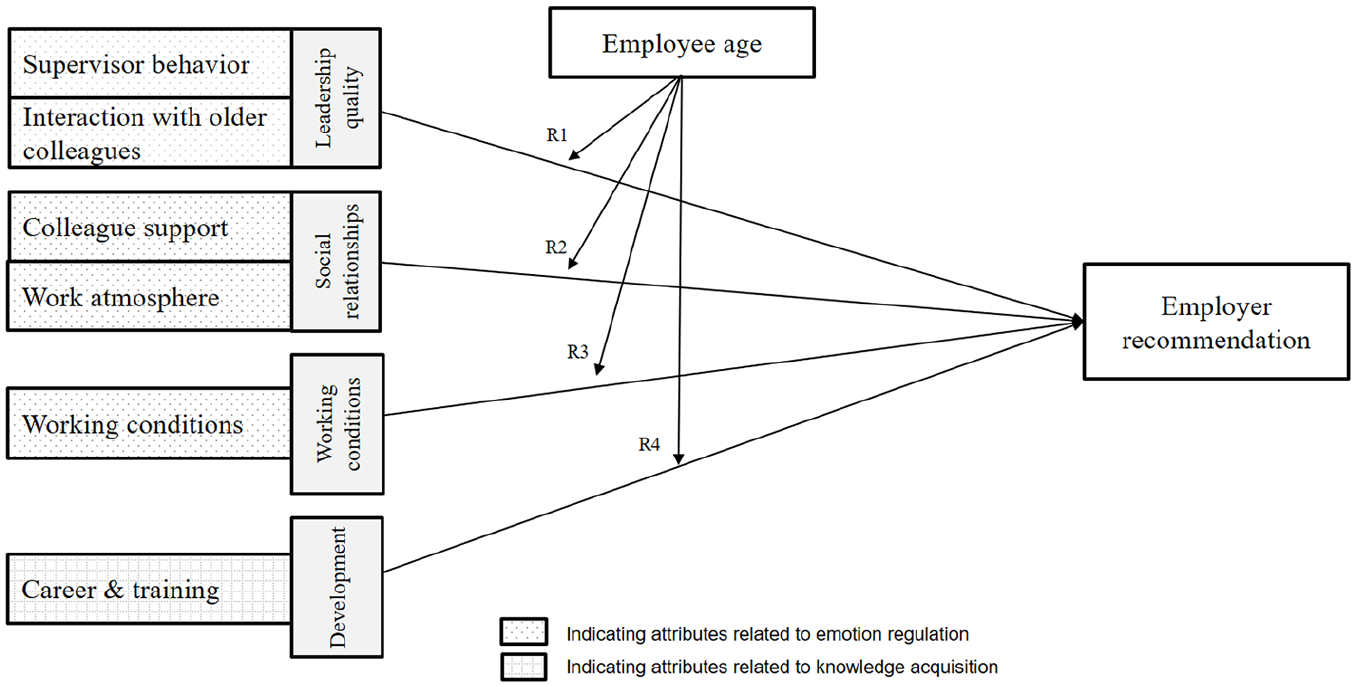
Summary figure of the proposed relationships.
Methodological approach
Data
This study is based on platform data provided by kununu, the largest European employer review platform where employees can rate their employer anonymously and free of charge. Review platforms encompass employees’ judgment of whether they would recommend their employer to other job seekers or not. While there is some criticism of platform data mentioning that ratings might be self-selective or polarized (Berger and Milkman, 2012; Marinescu et al., 2021), there are also beneficial and unique aspects of it. First, information collected via platforms reflects a wider range of individual viewpoints than information provided by the companies themselves, such as at job fairs or official websites (Cloos, 2021). The data are generated with no research purpose, representing naturally occurring data that might be less biased by social desirability (Müller et al., 2016; Schmiedel et al., 2019). Further, the data provided in this study can be regarded as raw data, as they are free of any changes made by the platform operators. Finally, experimental research repeatedly indicates that employer reviews have the power to influence the attitudes and intentions of prospective employees toward their companies (Carpentier and Van Hoye, 2021; Evertz et al., 2021; Stockman et al., 2020).
The reviews were provided by Kununu’s university partnerships department. We excluded non-German reviews and those lacking essential variables of interest (age and all controls), reducing the overall sample from 694,079 to 292,429 employee reviews from various companies and industries between July 2021 and July 2023. We chose the starting date of July 1 for our study as the covid-19 pandemic caused several lockdowns in Germany until June 2021 and all official lockdowns ended in June 2021. Therefore, the data covers some reviews during covid-19 but most reviews date from the recovery phase after the lockdowns. The cutoff for our data was July 31, 2023, marking our retrieval date. Our data covers German-speaking employees in German firms, as this ensures a more controlled analysis of preferences within a specific institutional and cultural framework (e.g. Germany’s apprenticeship system, labor laws, and age-related work policies).
Measures
Kununu uses a five-point Likert scale (1-star to 5-star ratings) for evaluating employer attributes, with higher scores indicating positive responses. In addition, each employer-related attribute offers an open text field right after the numeric rating. We argue that employees’ experiences with the four employer attributes identified as crucial factors above are likely to be reflected in positive reviews. Thus, we operationalize the employer attributes by the assessment of the different rating categories on kununu.
Employer recommendation
Raters were asked whether they would recommend the rated company to a friend. They responded with either “1” would recommend or “0” would not recommend this employer to a friend. Employee recommendations have a considerable impact on a variety of pre- and post-hire outcomes, like for instance employer image (Kashive et al., 2020), application intentions (Könsgen et al., 2018), and organizational identification and commitment (Shinnar et al., 2004).
Leadership quality
This attribute is operationalized with the more general assessment category supervisor behavior and the category interaction with older colleagues, which takes age specific leadership qualities into account. Regarding supervisor behavior, raters were asked how executives and team leaders deal with conflict, whether they make comprehensible decisions, set clear and achievable goals, and include their team in decision-making. In addition, raters indicated whether older employees were hired, appreciated, and supported.
Social relationships
This attribute embraces the review categories colleague support and work atmosphere. Colleague support prompted whether colleagues work well together and treat one another with honesty and consideration. The category of work atmosphere asked whether there is a climate of trust and fairness within the company and if the behavior of company executives fosters such a climate.
Development
This attribute is operationalized by the review category career & training. The raters indicated whether there are enough possibilities for personnel development and professional advancement.
Working conditions
Working conditions were operationalized by the review category working conditions, which refers to physical working conditions. Raters were asked whether the employer provides employees with the necessary instruments and technology to fulfill their work effectively, such as good electronic devices, and if circumstances like work location, noise, light, or ventilation ensure a comfortable work environment.
Age
Age was calculated based on the year 2023, 2022, or 2021 respectively minus the rater’s birth year.
Controls
Gender was assessed with (0) identifying as male and (1) identifying as female. Professional experience was a categorical variable in the survey: Respondents could choose between being an intern or in the company for up to 1, 3, 6, 10, or more than 10 years. The annual income was operationalized by categorizing respondents’ income into 18 categories ranging from less than €20,000 up to more than €3,000,000. Reviewers further indicated whether they have direct reports (1) or not (0). Part-time job was operationalized by considering whether respondents worked less than 35 hours a week (1) or full-time (0).
All measures from our data set are single-item measures, which precludes estimating reliability and validity measures. Nevertheless, single-item measures can reliably assess important psychological phenomena (Allen et al., 2022) under specific conditions (Fuchs and Diamantopoulos, 2009): Our research context requires a global assessment of employer attributes to identify their general importance across target groups. Further, our measures refer to employees’ satisfaction with various employer attributes, comparable to constructs such as work or life satisfaction, which are well suited for single-item assessment (Wanous and Hudy, 2001). To enhance clarity, our items each include a variety of examples to ensure the respondents consider the construct’s multifaceted nature (Fuchs and Diamantopoulos, 2009). This approach allows respondents to take those facets into consideration which are of high importance to them and weigh them correspondingly. Our natural language analysis allows us to capture these individual priorities to explore group-specific differences. Alternative multi-item measures for the constructs of interest often include redundant items, which can lead to boredom, fatigue and scale bias, particularly when used for a variety of constructs and thus leading to extensive questionnaires. In contrast, single-item measures offer high face validity (Connell et al., 2018). This allows for collecting answers to a variety of constructs in a given time, increases willingness and motivation to complete the questionnaire and supports diverse sample structures by minimizing selection effects (Fuchs and Diamantopoulos, 2009).
Empirical framework
Our empirical framework consists of two mutually informative methods of analysis. We applied logistic regressions and topic modeling to assess the importance of global attribute preferences in recommending an employer among employees of different ages. While the regression analyses offer the classic approach of testing the significance of relationships, the topic modeling provides us with more detailed insights into which factors precisely the respondents considered when making their assessments of the various attributes. Such a mixed method approach has been used, for example, in interactive marketing and employer branding studies (Backhaus, 2004; Könsgen et al., 2018).
Regression analyses
First, we used the numerical five-star ratings of our employer attributes and tested whether the respective review indicated to recommend the rated employer or not. We conducted logistic regressions using the standard maximum likelihood estimator to examine workplace preferences among employees of different ages. Logistic regression analysis was the most appropriate method for the first part of the analysis, as the dependent variable, employee recommendation, was measured in binary form.
For missing data listwise deletion was applied. All regression analyses are done with Stata (version 17). We used the margin command and visualized the interaction results to determine how these preferences differ over the lifespan. Finally, we examined our interactions following the procedure proposed by Karaca-Mandic et al. (2012) to account for the complexities of interpreting interaction effects in non-linear models.
Natural language analyses
With our two-part empirical framework, we aim to offer more detailed insights into what exactly was mentioned. To gain insights into this, we use topic modeling based on the text reviews. Topic modeling helps identify the themes and keywords most frequently discussed in employee reviews, which provides a more detailed, explorative understanding of the underlying preferences (Schmiedel et al., 2019). For example, numerical analysis may show that working conditions significantly influence recommendations for older employees. However, topic modeling reveals what aspects of working conditions are most important, such as flexible schedules, ergonomic equipment, or remote work options. This deeper level of analysis enables us to move beyond broad categories and capture the nuances in employee preferences, which is critical for human resource practitioners and employer branding strategies. Previous human resource management and operations research explored online employee reviews using topic modeling (Joshi et al., 2024; Symitsi et al., 2021).
The preparation and analysis are done with the Python toolkits nltk (Bird et al., 2009) and scikit-learn (Buitinck et al., 2013). Written language consists of many idiosyncrasies and is not always easily recognizable or classifiable. Therefore, the first step in analyzing natural language is to preprocess the data. We followed all recommended steps for topic modeling in organizational research (Schmiedel et al., 2019): We converted the raw Excel text columns into a readable csv format, constructed numeric metadata attributes, tokenized (reduced sentences to individual words), removed uninformative stop words, and cleaned the data with normalizing lowercase tokens, removing white space and punctuation (Banks et al., 2022; Schmiedel et al., 2019). We did not apply stemming, which reduces words with different endings to their word stem, as it turned out to make the German keyword stems harder to understand and interpret.
In the next step, we applied topic modeling. Methodologically, this can be compared to factor analysis as both break down the text (a collection of words) into different dimensions known as topics (Vayansky and Kumar, 2020). Topic modeling is suited for questions of understanding the latent variables in text-based interest (Banks et al., 2022), offering insights into the comments mentioning subcategories of our employer attributes assessed.
To find the optimal number of topics, we built multiple models by using Non-Negative Matrix Factorization (NMF) with different values of the number of topics (k). The k value was set from 1 to 10, as we believed that more than 10 topics were neither interpretable nor meaningful. We determined this by building a random forest model for feature importance and assessing the models’ accuracy to predict recommendation as well as the topics’ highest interpretability. Model accuracy and topic coherence led us to determine the most appropriate k values for different themes: supervisor behavior (k = 5, accuracy = 0.731), interaction with older colleagues (k = 2, accuracy = 0.690), colleague support (k = 2, accuracy = 0.699), work atmosphere (k = 2, accuracy = 0.709), career and training (k = 1, accuracy = 0.711), and working conditions (k = 4, accuracy = 0.687). We complemented the quantitative model accuracy test by qualitative coding of the topics (Schmiedel et al., 2019). Five researchers of whom three were naïve to the purpose of the research study independently labeled the most frequent words for a topic and assessed the interpretability of the different models. Ambiguous themes were discussed to arrive at a consensus label.
Results
Descriptive results
An overview of the sample assessed is displayed in Table 1. To describe our sample, we draw on comparative figures characterizing the German workforce.
Sociodemographic sample characteristics of the Kununu reviews assessed (July 2021–July 2023).
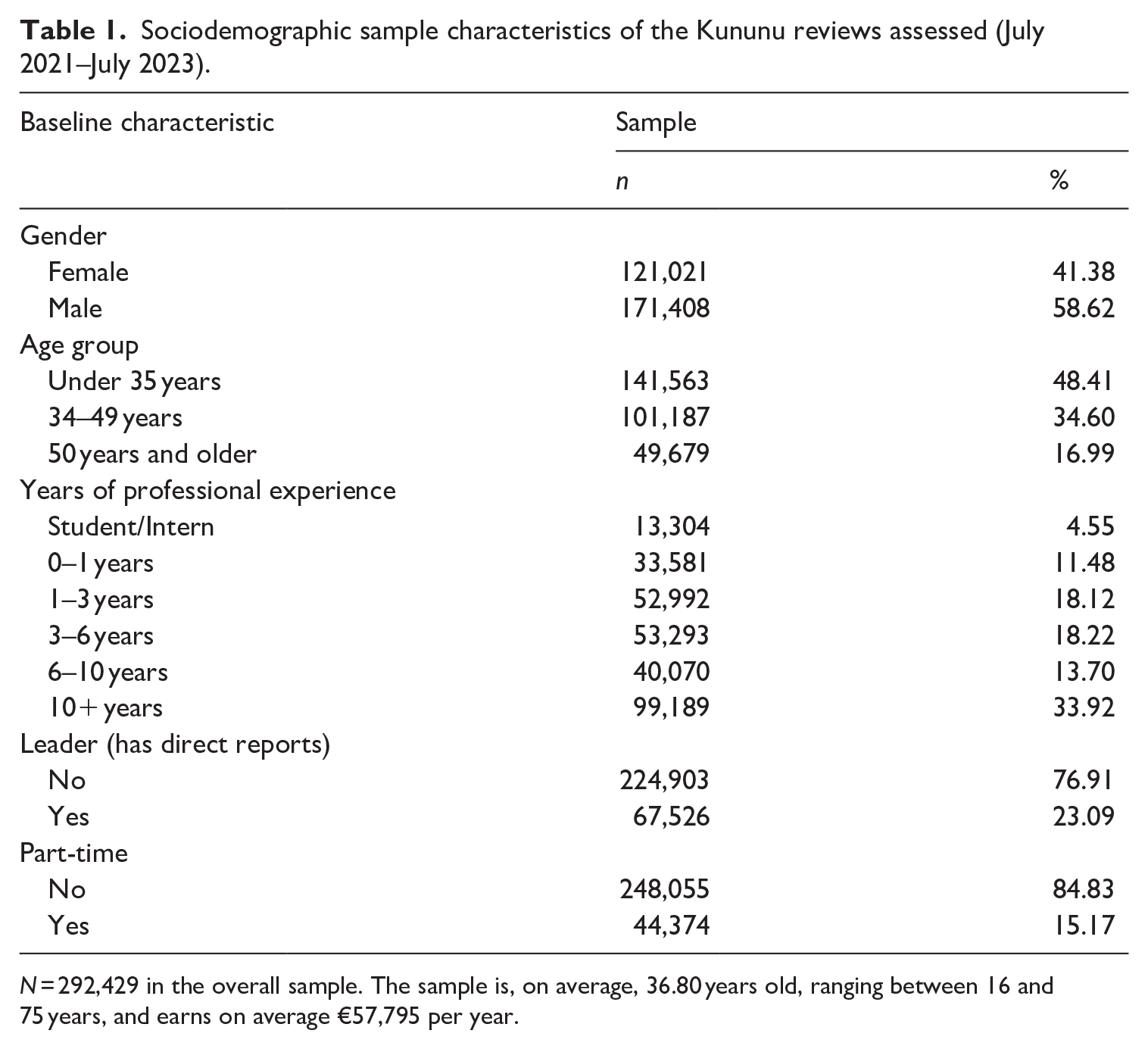
N = 292,429 in the overall sample. The sample is, on average, 36.80 years old, ranging between 16 and 75 years, and earns on average €57,795 per year.
Our sample of 292,429 employees consists of 58.6% men, aligning closely with the German workforce, where 53.1% are male (Federal Statistical Office, 2024c). The average income in our sample is €57,795, comparable to the German average of €53,760 (Federal Statistical Office, 2024d). Regarding professional experience, raters have 3.27 years of experience on average, while the group of inexperienced employees with less than 3 years of professional experience (including student workers) comprises 99,877 raters and the group of employees having 10 years or more of professional experience comprises 99,189 raters.
Regarding employment type, 15.2% of our sample work part-time, considerably lower than the national average of 30.9%. Specifically, 36.7% of women and 6.8% of men in our sample are part-time workers, compared to national averages of 49.9% for women and 13.3% for men (Federal Statistical Office, 2024a).
The average age of the sample is 36,80 years. The age distribution shows an overrepresentation of younger employees aged ⩽35 years (48.4% vs 30.3%) and an underrepresentation of older employees ⩾50 years (17.0% vs 37.9%) compared to the German workforce (Federal Statistical Office, 2024b). While the group of younger workers comprises 141,563, the group of older workers comprises 49,679 employees. This skew aligns with social media usage trends, where younger individuals dominate (Müller, 2024), thus explaining younger employees superior number using the employer rating platform kununu.
In sum, while our sample is representative of the German workforce regarding gender and income, part-time employees and workers aged 50 and older are underrepresented. Still, the group of older workers in our sample comprises almost 50,000 employees.
The standard deviations, mean values, and bivariate correlations between all variables assessed are shown in Table 2. The strongest correlations with recommending are supervisor behavior, work atmosphere and working conditions, all ranging between 0.700 and 0.780 (p ⩽ 0.001). Age shows a weak negative correlation with recommending. We tested for multicollinearity by calculating the variance inflation factor which was below 3.79 for all explaining variables and thus clearly below the critical threshold of 10.
Bivariate correlations of the main variables. Pairwise correlations.
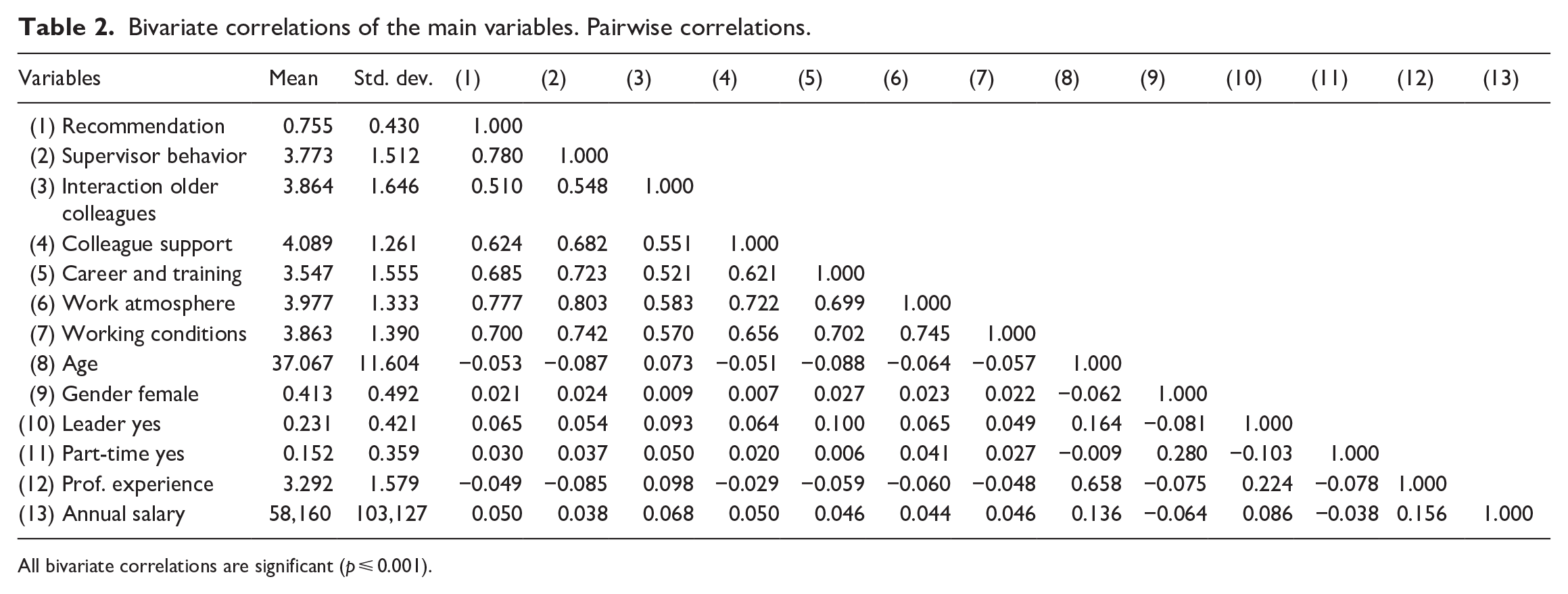
All bivariate correlations are significant (p ⩽ 0.001).
In order to assess whether the evaluations of the employer attributes might be biased by preceding extreme experiences or sentiments, we conducted a closer examination of the evaluations included in our sample. The average standard deviation of all 13 employer attributes in our sample is 1.24, with a mean value of 3.69, indicating a moderate positive bias. These results are comparable to those reported by Könsgen et al. (2018), who analyzed a dataset from 2016 comprising over 25,000 evaluations and found a mean standard deviation of approximately 1.20 and a mean value of 3.45. Könsgen et al. (2018) further examined intra-firm variance in numeric evaluations and textual sentiments, concluding that a considerable number of discrepant reviews exist within each company. Based on these findings and the heterogeneity observed in our sample, we conclude that while there is a slight trend toward positive evaluations, there is no indication of systematic bias.
Regression results
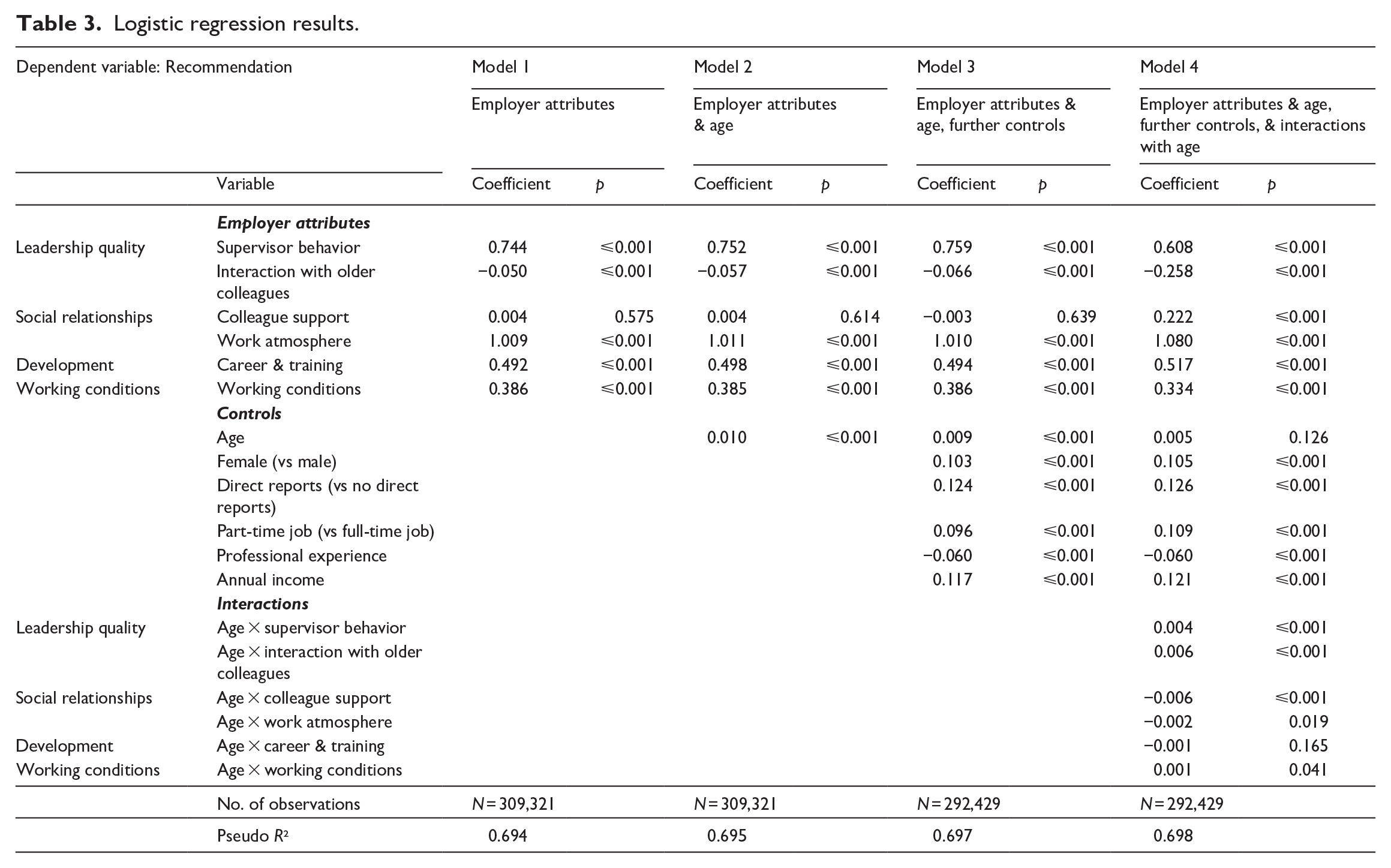
An overview of our logistic regression results is presented in Tables 3 and 4. Table 3 presents the coefficients of our models; Table 4 presents the estimated average marginal main effects. In the first model, we only analyzed the employer attributes, in the second model, we added age, and in the third model gender, whether the reviewer had direct reports, professional experience, part-time work, and annual income as control variables. Finally, in the fourth model, we added the interactions with age and employer attributes, as discussed before. Looking at Table 3 the results show that all employer attributes show significant coefficients over all models, despite the attribute colleague support, which is only significant in model 4. Age also shows a small positive effect on recommendation, which is significant in models 2 and 3. Regarding the control variables, we see that women on average have a higher probability to recommend, and that having a higher annual income, working part-time and having direct reports lead to a higher probability to recommend. A higher professional experience, on the contrary, decreases the probability to recommend. We further shed light on the direct effects of the main variables by calculating average marginal effects for model 3 (Table 4). The results show that work atmosphere, followed by supervisor behavior, and career & training, with average marginal effects of 0.049 correspondingly 0.037 and 0.024 (all p ⩽ 0.001) show the strongest effects on the probability to recommend. If work atmosphere, for instance, is assessed by one unit higher on a five-point scale, the probability of a recommendation increases by 4.9 percentage points (p ⩽ 0.001). The marginal effect of age is smaller than 0.001 percentage points.
Logistic regression results.
Logistic regression: Margins for the main effects (model 3).
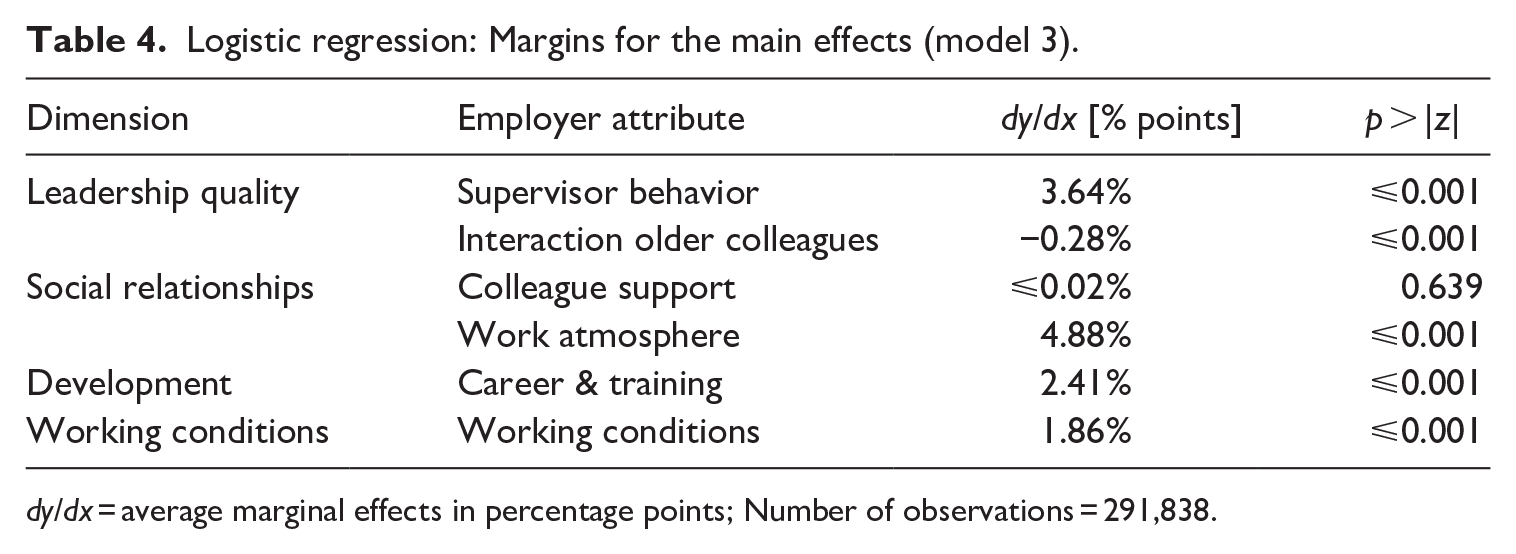
dy/dx = average marginal effects in percentage points; Number of observations = 291,838.
The inclusion of the interaction terms in model 4 (see Table 3) leads to considerable changes in the coefficients of the employer attributes, which indicates that the interaction terms lead to a further explanation of variance. We see significant interaction coefficients for all interactions except for the interactions between age and career & training.
We visualized the marginal interaction effects which are presented in Figure 2.
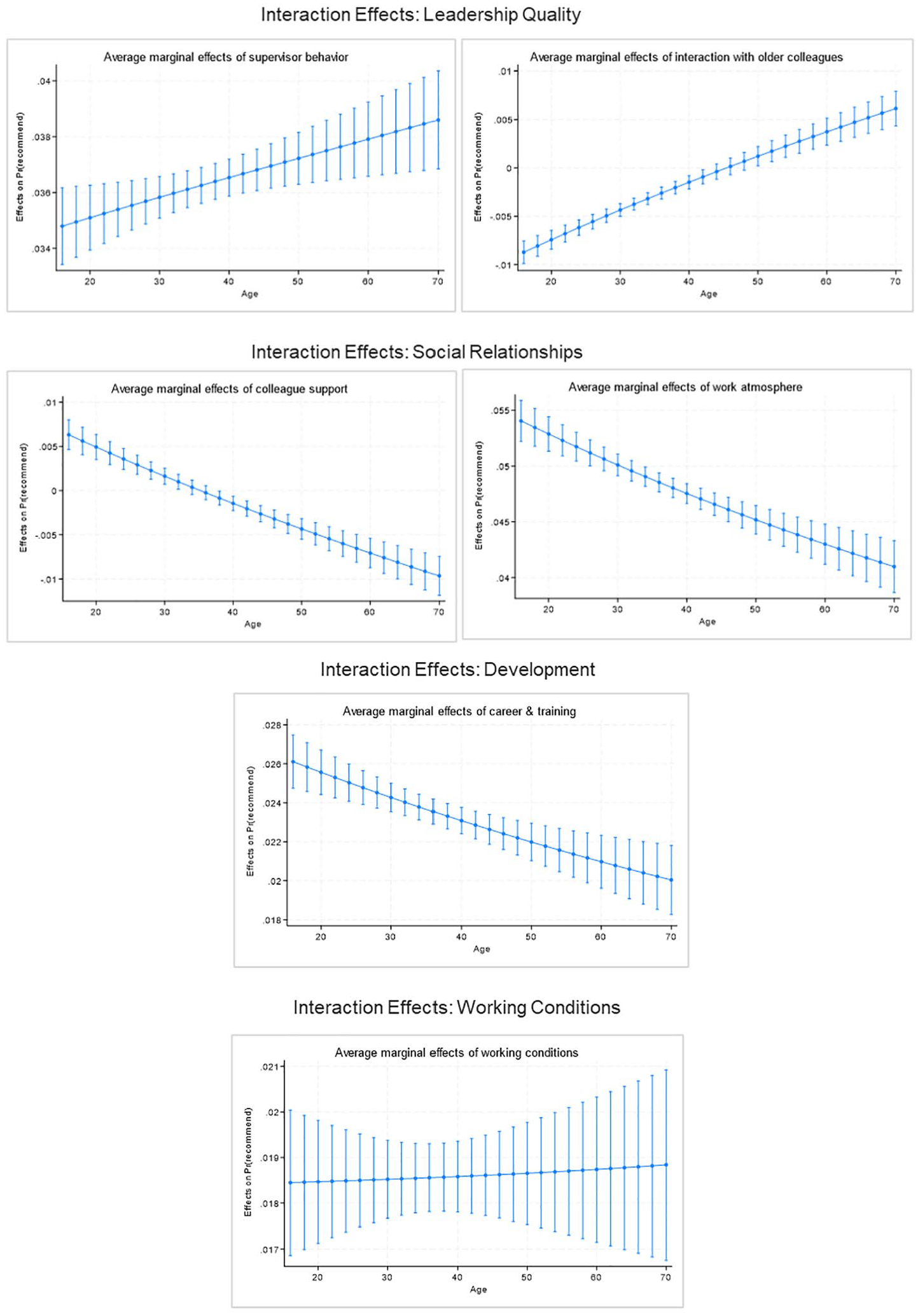
Marginal effects of interactions.
Looking at leadership quality, the graphs show the positive average marginal effect of the interaction between supervisor behavior and age. While supervisor behavior at the age of 16 has an average marginal effect of 0.035, it has an effect of 0.039 at the age of 70, the interaction being significant over the full age span (p ⩽ 0.001). For the interaction between age and interaction with older colleagues the results also show a positive average marginal effect, ranging from −0.009 with 16 to 0.006 with 70. This interaction is significant from 16 to 46 years (p ⩽ 0.05) and from 54 to 70 years (p ⩽ 0.05). These results indicate that leadership quality has a stronger impact on employees’ probability to recommend with increasing age (R1).
With regard to social relations, we find a negative interaction effect between colleague support and age, indicating a lower relevance of colleague support for older employees than for younger employees. The results are significant for the age span between 16 and 32 years and 38 until 70 years (p ⩽ 0.05 for both). The marginal effects range between 0.006 at the age of 16 and −0.010 at the age of 70 (p ⩽ 0.001 for both). We also find a significant negative interaction between work atmosphere and age. Work atmosphere has a marginal effect of 0.054 at the age of 16 and 0.041 at the age of 70 (p ⩽ 0.001 for both), the effects being significant over the whole age span. Thus, our results show that social relationships are less important for the probability of a recommendation with increasing age (R2).
Looking at the working conditions, we find a positive interaction between age and working conditions, which is highly significant over the full age span (p ⩽ 0.001). The effects range from 0.018 with 16 to 0.019 with 70 years and demonstrate that working conditions become more important for providing a recommendation with increasing age (R3).
The results for development do not show significant average marginal interaction effects for career & training, though the coefficient being negative. Consequently, based on these results, age does not impact the meaning of development-focused practices for making a recommendation for one’s employer.
As a robustness check for our logistic regression model, we estimated a linear probability model, using the same variables as in our logistic regression model 4 (see Table 3). The results confirm our previous findings with two exceptions: For the interaction between career & training and age we find a significant negative interaction while the interaction between working conditions and age turns out insignificant, though indicating a positive direction of the coefficient.
In the following analysis, we acknowledge that interpreting interaction effects in non-linear models directly from estimated coefficients can be challenging (Norton et al., 2004) and follow the procedure by Karaca-Mandic et al. (2012) for computing and interpreting marginal effects of interactions. This approach involves calculating the derivative with respect to one variable (e.g. supervisor behavior) at different values of the interacting variable (e.g. age group). The interaction effect is then determined considering the difference in the marginal effect of, for example, supervisor behavior on recommendation across age groups. This method also accounts for the possibility that age effects follow a non-linear pattern.
To follow this procedure, we firstly transform age into a categorical variable with three values: Young employees (16–34 years), middle aged employees (35–49 years), and older employees (50 years and older). Previous relevant literature has used the age category of 50 and older to classify the group of older workers (Boehm et al., 2014; Kooij et al., 2013; McCarthy et al., 2017). We stick to this categorization and offer insights into two further age groups as a means of comparison.
The results of the logistic regression model are reported in Table 5.
Logistic regression results: Age as categorical variable (three age groups).
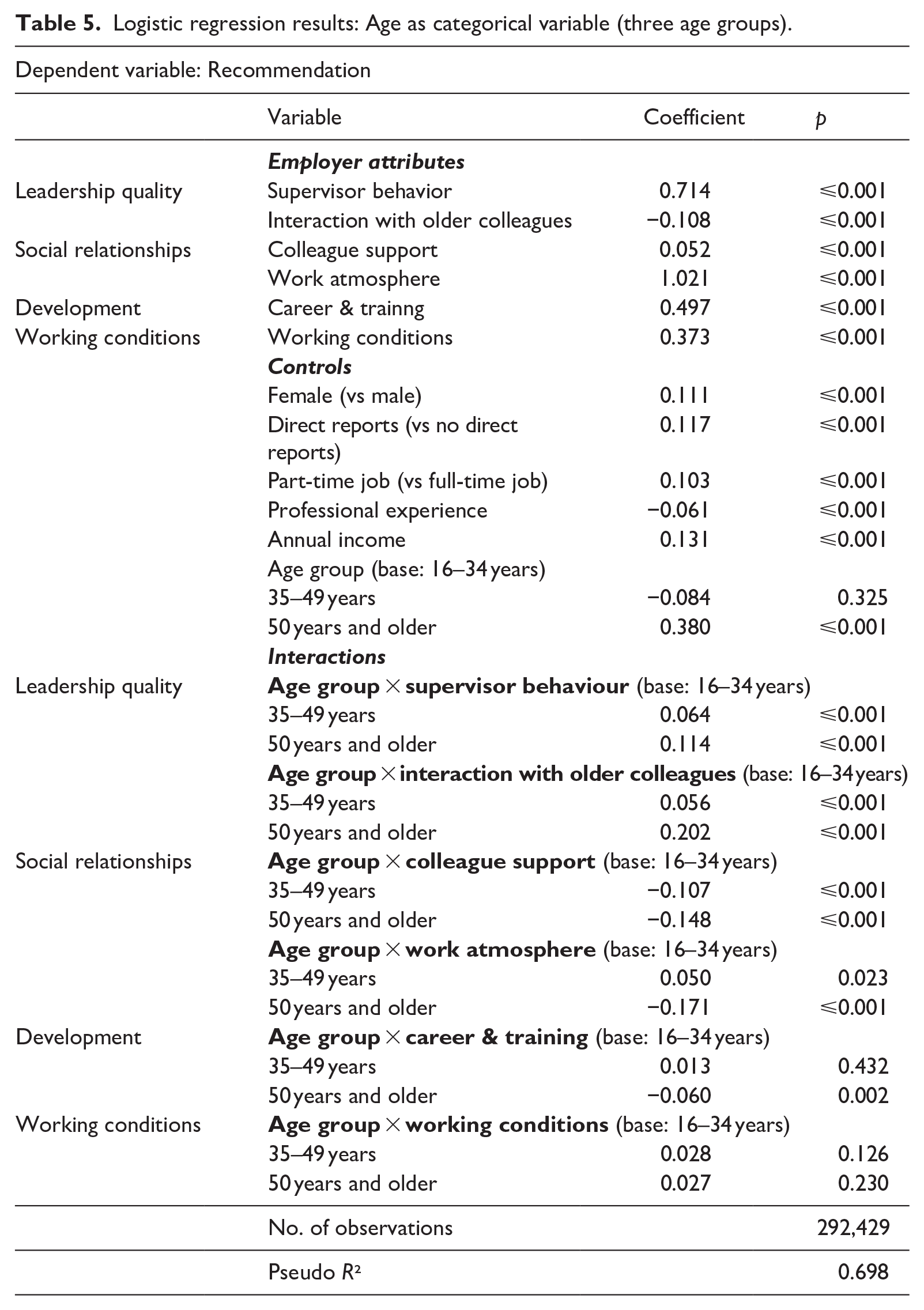
The results of this model confirm our previous results, as we find positive significant interactions between age and supervisor behavior and interaction with older colleagues, a positive insignificant interaction between age and working conditions, and negative significant interactions between age and colleague support, work atmosphere and career & training. Interestingly, we do not observe a clear linear course of the interactions between age and work atmosphere and career & training. For both attributes we see a positive interaction for the middle-aged group, meaning that work atmosphere and career & training are more important for the group aged 35–49 years as compared to the group aged 34 years and younger. For the group aged 50 years and older, we find a negative interaction, demonstrating that the two employer attributes are less important for the older age group as compared to the two younger groups.
In order to further analyze those attributes showing positive joint effects with age, we shed light on supervisor behavior, interaction with older colleagues and working conditions. After estimating the logistic regression model, we conduct pairwise comparisons and visualize the marginal effects of the employer attributes contingent on age group contrasting the results for the young, middle-aged and older workers in Figure 3.
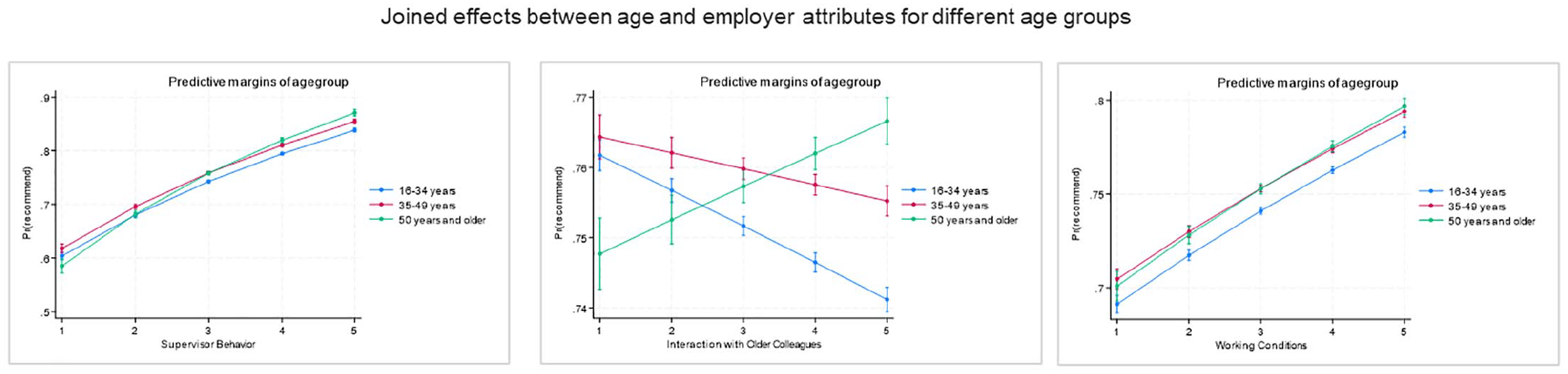
Group comparisons of joint effects between age and employer attributes.
We observe the strongest effects for supervisor behavior. While for young workers, the estimated probability to recommend changes from 61.6% to 83.4 % (∆ = 21.8% points), when the assessment of supervisor behavior increases from one to five stars, for older workers we see a change from 58.8% to 87.1% (∆ = 28.3% points). For interaction with older colleagues, we find that for younger employees the recommendation likelihood decreases from 76.2% to 74.1 % (∆ = −2.1% points), while for older people we see an increase from 74.8% to 76.7 % (∆ = 1.9% points), when the assessment of interaction with older colleagues increases from one to five stars. For working conditions, we see positive marginal effects for younger and older workers, albeit stronger for the group of older workers. For younger workers, we see an increase of the estimated probability to recommend from 69.1% to 78.3 % (∆ = 9.2% points), for older people from 70.1% to 79.7 % (∆ = 9.6% points). These figures demonstrate a small but significant difference in the increased likelihood to recommend for older versus younger workers.
To further account for the non-linearities identified for the joint effects of age and the attributes work atmosphere and career & training, we estimate an additional model with a finer age division of the groups: 20 years and younger, 21–30, 31–40, 41–50, 51–60, 61–65, 66 years and older. This age division allows us to delve deeper into the age group specific difference and to explicitly distinguish the preferences of the groups of apprentices and interns (aged 20 years and younger), as well as of the so-called silver workers, aged 66 and older.
The results broadly confirm the previous model. As before, we find a clear positive interaction with leadership quality. Using the youngest group as the reference category, we observe a significant increase in the effect of supervisor behavior for individuals aged 41 to 65 (the coefficient being insignificant for the group aged ⩾66 years), as well as a positive coefficient for interaction with older colleagues that consistently strengthens with age. For working conditions, the coefficients are not significant for individual age groups. However, we note that the effect increases in distinct jumps, first from age 31 onward, then from age 61 onward, with the most substantial increase occurring at age 66 and above. Interactions with colleague support are consistently negative and become more pronounced with age. For work atmosphere and training, we observe an increasing effect up to age 50, followed by a decline. Notably, training shows a strong negative interaction for silver workers.
In summary, we do not find distinct preferences for the two extreme age groups (20 years and younger, and 66 years and older). However, silver workers exhibit a strong preference for leadership quality and working conditions, reinforcing our previous findings.
To conclude, we find that older workers can be stimulated to recommend their employer most strongly by supervisor behavior. At the same time, supervisor behavior also shows considerable positive effects for younger workers, however, weaker than for the group of older workers. Further, the way employers interact with their older employees positively and in moderate strength impacts older employees’ motivation to recommend their employer.
The relevance of work atmosphere is higher for younger employees, particularly for the middle-aged group, but shows strong positive effects for all age groups. Conversely, colleague support only resonates with younger employees, though its overall impact remains relatively low.
Moreover, we find that, in moderate strength, older employees can be motivated to recommend their employer with positive working conditions, an attribute which also shows small positive effects for the group of younger workers.
Career & training shows positive effects for all age groups, having highest importance for the middle-aged group and lowest for the group of older workers. Further, our results on the non-linearities indicate that an age cut for older employees around the age of 50 years, as also applied in previous studies, seems to be reasonable.
Further analyses on heterogeneity
In order to account for characteristics of the sample that might have impact on the effects identified, we conduct further analyses on the role of income, gender, professional experience, and the year the review was provided. Regarding income, the lowest 25% of employees in our sample earn €28,800 or less, while the highest 25% of the sample earn €60,000 or more. We use the upper and lower 25th percentile to conduct a comparison between these income groups and test whether the interaction effects between age and the employer attributes are stable over different income levels. We estimate the logistic regression model with age as continuous variable (as model 4 in Table 4) separately for the two income groups. The results confirm our main finding that leadership quality (supervisor support and interaction with older colleagues) and working conditions are more important for older than for younger employees, independent of income group. For career & training we find a negative interaction for both groups. For colleague support and work atmosphere, the results are less clear. For colleague support, we find a significant negative interaction for the low-income group and a positive insignificant interaction for the high-income group. For work atmosphere, the model shows a significant positive interaction for the low-income group and a significant negative interaction for the high-income group.
To test whether gender impacts our results, we estimate two models separately for men and women and do not find any systematic differences.
Further, we account for the fact that professional experience and age show a high correlation and estimate our model without professional experience as control variable. This omission does not alter our results, suggesting that distinguishing between “age effects” and “experience effects” is challenging in cross-sectional data.
Finally, we test whether the year the review was provided impacts our results. The reviews we consider in our sample were provided between July 2021 and July 2023. Thus, the first reviews were given shortly after the last lockdowns, while the latest reviews show a significantly longer gap to the lockdowns and the cuts caused by the pandemic. This might have impacted on employees’ attitudes and preferences and therefore the conditions under which they would have given a positive or negative review. For this reason, we test our main model including review year (2021, 2022, or 2023) as a control variable in our model. The results show that the coefficients for the attributes and the interactions do not change in any considerable way. However, we find a significant positive coefficient (b = 0.091, p ⩽ 0.001) for the review year 2022 as compared to the year 2021.
Topic modeling results
We conducted topic modeling to approach the numeric results from a different, more exploratory and qualitative angle. Table 6 breaks down employer attributes into mentioned topics in the review fields. As we were interested in differences between employees of different ages, we explored the topics for the three subgroups again: employees up to 34 years, those between 35 and 49, and those 50 years and older (Table 6). We report the topic composition, a topic weight that displays the probability that the topic is prevalent in the review comments of the respective employer attribute, the most frequent keywords, and their respective topic labels. For each topic, its relative weight (importance) is provided for different age groups. Keywords associated with each topic help capture the essence of what employees in different age groups emphasize.
Age-differentiated topic modeling composition.
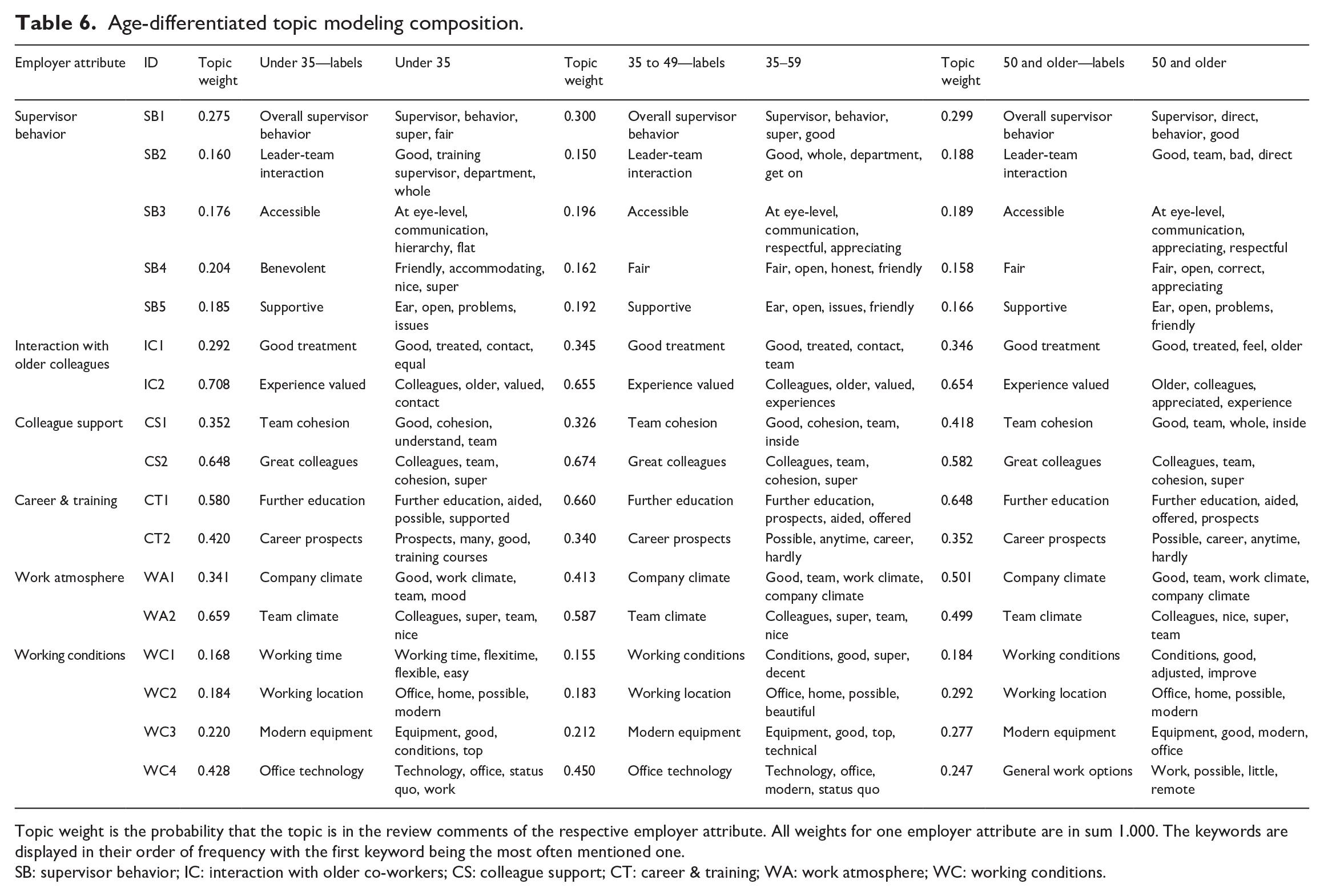
Topic weight is the probability that the topic is in the review comments of the respective employer attribute. All weights for one employer attribute are in sum 1.000. The keywords are displayed in their order of frequency with the first keyword being the most often mentioned one.
SB: supervisor behavior; IC: interaction with older co-workers; CS: colleague support; CT: career & training; WA: work atmosphere; WC: working conditions.
First, we found that four topics differed only marginally between the age groups: employees of all ages mentioned similar topics regarding good interaction with older colleagues, colleague support, and work atmosphere. Nevertheless, we find variation in the topics mentioned regarding supervisor behavior, career and training, and working conditions.
Delving deeper into the mentioned supervisor behaviors, the results show that older workers value accessible leaders with “appreciating” and “respectful” communication whereas, for example, younger workers mention “flat” and “hierarchies” more often. Older and middle-aged workers emphasized “fair” leadership which cannot be seen in younger workers’ comments.
Further, the career and training employer attribute can be divided into options for further education and career prospects. While older workers often mention further education prospects, career prospects seem to be less present in their comments (same for the middle-aged group). Career prospects remain significant for younger employees, as they often mention “prospects.”
In addition, we could differentiate between four topics prevalent in the working conditions reviews: working time/conditions, working location, modern equipment, and office technology. While older workers highlighted the possibility of remote work, younger employees emphasized “flextime” and “flexible.” Good and modern working conditions, mentioned most often as “office equipment,” garnered universal importance among all age groups.
Discussion
Main findings
This study sheds light on the factors influencing employee recommendations based on age. Overall, leadership quality is significantly linked to recommendations for both younger and older employees. Appreciative and fair supervisor behavior is especially important for older workers, and has a greater impact on their likelihood of recommending their employer relative to younger workers. We also found a positive interaction for the attribute interaction with older colleagues. This substantiates our theoretical considerations based on lifespan theories suggesting that older workers seek leaders who respect their needs and enable them to carry out age-specific regulation processes. Moreover, it highlights older employees’ preference for emotionally positive relations (Cleveland et al., 2019; Zacher and Rudolph, 2017), reflected in emphasizing appreciative and respectful supervisor behavior. Younger workers mention flat hierarchies when it comes to supervisor behavior. Flat hierarchies are an important aspect for quick career advancement, which again aligns with our theoretical considerations.
With regard to social relationships, we found a negative interaction for the attribute colleague support, indicating a slightly higher importance of this attribute for younger employees. This could indicate that good cohesion and great colleagues are also important for advancement and learning, being of higher importance for younger employees. Moreover, it substantiates our considerations that younger employees are often challenged by having to build new social relationships and networks when starting their careers (Chiao et al., 2022; Wright and Silard, 2022), whereby a special significance could be attributed to the collegial environment. From a theoretical perspective, older colleagues likely focus on long-lasting and emotionally relevant (personal) relationships and therefore put less weight on work relationships among colleagues.
Regarding working conditions, the results show that favorable environmental and technical working conditions are more motivating for older employees, indicating that these support older workers’ compensation processes. Younger employees highlight flexible working hours, while older ones emphasize flexible work locations, including remote work. Being flexible in work locations allows for effectively adapting the work environment to personal needs, which helps to compensate for resource losses, for example, diminished physical well-being.
For the development-related factors, we do not observe a linear pattern of the interaction between career and training options and age. Rather, development-focused practices show an increase in importance until the age of 50 years, decreasing in meaning for the older age groups. The topic model shows that younger employees rather mention career prospects while older employees mention education more often. Thus, both groups expect different HR practices: While younger employees put their focus on career advancement, older employees express a preference for education in general. Training practices can either tackle elements that are functioning-maintaining or elements that are functioning-enhancing (Beier, 2022). Thus, depending on the focus of training, it might rather meet the preferences of older or younger workers. This also connects to Pak et al. (2021), who found positive effects of training practices, which cannot be clearly categorized as either maintenance- or function-enhancing practices, on the perceived work ability of older workers. Training practices appear to lose importance after the age of 50, indicating that maintenance practices carry less weight than development practices.
Theoretical contributions
From a theoretical standpoint, our study makes three primary contributions. First, we test lifespan theories in the employer branding context, highlighting the varying influence of employer attributes based on an individual’s age. Although these effects are small, we show that leadership quality and working conditions are important when targeting older employees. Thus, these factors seem crucial in establishing an employer image and identity that integrates the needs and preferences of older employees and, thus, leads to increased PO-Fit with this group. Developmental factors seem to play a role when focused on maintenance practices. Furthermore, we demonstrate that the adaptive processes associated with lifespan theories, particularly those related to future time investment, offer an explanatory framework for understanding employee recommendation behaviors across significant dimensions. We show that the preferences for the attributes identified might be partly explained by the adaptation strategies applied when aging. Attributes being reflective of activities that strengthen emotionally relevant links as well as a work environment that contributes to current well-being seem to be of major importance for older employees. Lifespan-related adaptation strategies might also explain our result regarding career and training, which show an equal meaning of this attribute for all age groups, however with different emphases.
Second, our contribution extends the discourse on precursors to employee recommendations (Shinnar et al., 2004; Van Hoye, 2013) by empirically showcasing the significance of distinct employer attributes and age within this context. Overall, we find that a large part of the attributes assessed only differs marginally depending on age. Previous research concluded similarly that the marginally small age effects regarding predictors of workers’ commitment and turnover intentions show the overblown popular and managerial attention given to age group differences (Finegold et al., 2002). Regarding working conditions, other research found only small differences in what office users of different ages prefer in their work environments (Rothe et al., 2012). We identified flexible work practices as an important topic in the reviews. Previous research showed that older employees attached more value to flexible work practices than their younger counterparts (Huang et al., 2021; Pitt-Catsouphes and Matz-Costa, 2008). Interestingly, our results might offer a more granular insight into this finding as they indicate that middle-aged and older workers put more emphasis on working location flexibility while younger workers emphasize working time flexibility, thus, pointing to different kinds of flexible work practices. Regarding supervisor behavior, all topics refer to socio-emotionally relevant behavior, underlining the significance of these behaviors for older workers, as supported by Raab (2020). Therefore, our results emphasize the importance of relationship-oriented leaders instead of task-oriented leaders.
Third, we analyzed the impact of varied employee preferences using authentic field data (Schmiedel et al., 2019). Our large dataset, based on actual lived employee experiences and resulting recommendations, offers different insights from stated preferences such as intention to stay or intention to recommend. Using logistic regression coupled with topic modeling, we respond to the call for progress in using big data for organizational science (Guo et al., 2021; Oswald et al., 2020).
Practical implications
First, our results indicate that there are several employer attributes that companies could focus on to attract and satisfy a large and age-diverse group of employees, namely relationship-oriented supervisor behavior, interaction with older colleagues, attractive work atmosphere, and efficient and flexible working conditions. Our age differences are of small size and might indicate that most aspects have a universal importance independent of employees’ age.
Further, this study highlights that the age-related regulation processes hold in the employer branding context analyzed and thus should be considered by employers—also with regard to HR practices which were not part of this study. Companies should reassess whether their current work environment attracts the talent they seek to hire or retain, for example, older employees who often mentioned the option to work remotely in their reviews.
In addition, this research encourages organizations to adopt a heightened awareness of crowdsourced employer branding, utilizing it as a valuable asset to gain insights into their workforce’s status quo and identify potential areas for enhancement.
Limitations and future research
Despite this study’s importance in exploring the employer attributes influencing recommendation behavior contingent on age, working with an online review platform entails limitations. First, providing a company review is a voluntary act that could go hand in hand with a self-selection bias. In addition, the current sample consists, on average, of relatively young employees, compared to the average German workforce. Still, our sample with almost 50,000 review writers who are 50 and older remains large enough to offer adequate statistical power. In addition, earlier research indicated that individuals with strong positive or negative experiences are especially likely to share those experiences online (Berger and Milkman, 2012; Marinescu et al., 2021). However, the analysis of our sample characteristics shows that the sample is similar to the average German workforce in important characteristics, and we had access to the raw data provided by kununu. Moreover, on the similar employer rating platform Glassdoor, the distribution of positive and negative reviews seems balanced (Landers et al., 2019; Marinescu et al., 2021), indicating honest reviews.
Further, the dataset used is large but cross-sectional, which makes the interpretation of significance and causalities more difficult. Methodological considerations, such as large samples driving p-values toward zero, must be carefully evaluated (Combs, 2010; Lin et al., 2013). Acknowledging that our effect sizes are small yet statistically significant, we discuss the relatively minor differences observed between age groups. Future research should therefore assess the findings with experimental or field samples and attempt to conduct longitudinal studies on the effect of certain employer attributes in relation to age, which would allow the identification of unambiguous causal effects.
In addition, future research might use other review platforms or further text resources to examine employer attribute preferences among subgroups of the workforce. In-depth qualitative research might offer even more context-specific rich data on employer attribute preferences contingent on an employee’s age. Future research should also examine intersectional dimensions like gender, educational levels, job types, and industries to understand variations in employer attribute preferences.
Conclusion
In response to demographic shifts and their implications for the labor market, creating a positive work environment for older employees is imperative. Building on lifespan theories, our findings reveal modest effect sizes and largely reconcilable preferences of employees of all ages. In particular, supportive supervisors, appreciative treatment of older colleagues, conducive work atmospheres, and flexible working conditions emerge as critical factors for employees’ willingness to recommend their employers. Older employees in particular value appreciative, respectful supervisors, and flexible work locations, especially remote work. These insights, drawn from real-world data, bridge employer branding with the literature on successful aging, offering valuable guidance for HRM strategies that accommodate and engage an aging workforce.
Footnotes
Funding
The author(s) disclosed receipt of the following financial support for the research, authorship, and/or publication of this article: Funded by the Deutsche Forschungsgemeinschaft (DFG – German Research Foundation) under Germany’s Excellence Strategy – EXC-2035/1 – 390681379.
