




Abstract
What drives individuals to work until late at night or during holidays, and how do they stop work or keep work commitment in its place? This qualitative study examines boundary work between the professional and the personal life domains. Drawing on interviews with 26 academics employed at a university, we identify various boundary work drivers and tactics. Norms prevailing in the professional field, career requirements and high workloads, as well as strong intrinsic passion for science drive individuals to work long hours and to blend the professional–personal boundary. At the same time, individuals try to establish boundaries to ensure productivity and one’s health, or meeting family and personal life needs. Furthermore, our research reveals three patterns of the relationship between integration and segmentation. Firstly, individuals utilize segmentation to restrict integration, employing sophisticated tactics such as self-deception or self-isolation to shield themselves from the negative repercussions of excessive integration. Secondly, segmentation tactics can not only restrict integration but also enable it, for instance through the creation of ‘free’ times and spaces. Thirdly, individuals sometimes also utilize integration to enable segmentation. Our findings expand boundary theory by identifying manifold boundary-work drivers and tactics and by revealing that integration and segmentation are not just two opposing poles of a continuum but they are mutually connected, restricting or enabling one another.
Keywords
Some people like to strictly separate their work from their private lives while others prefer to blend the professional and the personal. Recently, when the Covid-19 pandemic forced many employees to work from home, not only research but also the general public became aware of how important it is for individuals to actively engage in boundary work (Cho, 2020; Haun et al., 2022), which is defined as individual activities aimed at creating, maintaining or disrupting borders between professional and personal life domains (Kreiner et al., 2009; Reyt and Wiesenfeld, 2015).
In her influential work, Nippert-Eng (1996) proposed that individuals vary in their boundary work preferences and behaviours on a continuum between integration and segmentation. Integration means that individuals make no distinction between the professional and the personal, but see them as ‘one and the same, one giant category of social existence’ (p. 567). Segmentation, by contrast, means that individuals separate between professional and personal life domains as mutually exclusive categories, without any overlap or perforated borders between them. Since Nippert-Eng’s work, scholars have produced ample knowledge about different types of boundary work and how people manage to enforce their preferences for a certain shape of the professional–personal boundary (Clark, 2000; Kossek, 2016; Kreiner et al., 2009).
However, we still know little about what drives individuals to choose one form of boundary work or the other. As boundary work relates to both personal well-being (Sonnentag et al., 2010) and organizational success (Dumas and Sanchez-Burks, 2015) it is crucial to better understand what factors motivate or constrain individuals’ boundary work, and what tactics individuals use to navigate between integration and segmentation. A particularly powerful constraining factor for individuals’ boundary work are the social norms associated with ‘ideal worker norms’ (Kossek et al., 2021) and an ‘imperative of work primacy’ (Dumas and Sanchez-Burks, 2015: 804). Individuals who perceive pressures to work extreme hours often internalize these pressures and ‘deliberately’ decide to work beyond their limits risking mental and physical breakdowns (Michel, 2011). Previous research revealed some ‘paradoxes’ or ‘double-edged effects’ regarding the impact of boundary work on individual well-being (Mazmanian et al., 2013; Reinke and Ohly, 2021; Sonnentag, 2018). Hence, we need to know more about factors driving boundary work and how individuals handle different – maybe also contradicting – requirements stemming from different sources.
Furthermore, previous literature emphasizes mismatches between individuals’ preferences and their social environment (Kreiner et al., 2009; Ramarajan and Reid, 2013), while it neglects possible conflicts, tensions or ambivalences among demands or preferences within either individuals or the environment. Moreover, it considers integration and segmentation taking a more-or-less or an either-or perspective assuming that they are two independent poles of a continuum. However, these perspectives conceal the possible interplay between the two approaches, which we need to consider to better understand individuals’ boundary work.
Addressing these research gaps, our study examines various drivers and tactics of individuals’ boundary work and it scrutinizes the relationship between integration and segmentation. We focus on knowledge work and use the example of academia which we consider as an appropriate professional setting for two reasons. On the one hand, academics enjoy relatively high degrees of autonomy in deciding when and where to work (Dowd and Kaplan, 2005), so that they have discretion to live out their personal boundary work preferences. On the other hand, the academic environment is well known for strong traditional norms related to the ideal worker imperative of full commitment to work (Beigi et al., 2017), which will probably drive academics’ boundary work as well. We adopted a qualitative approach based on interviews with 26 academics allowing a deep understanding of boundary work drivers and tactics.
We contribute to the literature on boundary work theory in two ways. First, by demonstrating how conflicting constellations within an individual’s set of preferences or within the social environment complicate boundary work we challenge previous conceptualizations of boundary work as being based on clear individual preferences and environmental demands. Second, we advance boundary work theory by showing how integration and segmentation are interrelated. Rather than being two poles of a continuum that are mutually exclusive, we show that they can also constitute a functional relationship. Individuals use segmentation tactics also to counteract negative side effects of integration or, on the contrary, to enable integration. Vice versa, integration tactics can serve as an enabler for segmentation.
Theoretical background: Boundary work theory
Scholarship on boundary work analyses how people create, maintain, change and dissolve borders between professional and personal life domains (Clark, 2000; Kreiner et al., 2009). Clark (2000) argued that boundaries can be more or less flexible or permeable and have various dimensions: a temporal one referring to when, a spatial dimension referring to where individuals engage in professional versus personal activities and a psychological dimension, which entails individuals’ thoughts, behaviours and emotions. Furthermore, boundaries can be asymmetrical, which means that they can be flexible or permeable from the one side and rigid or impermeable from the other (Ammons, 2013; Kossek, 2016). For example, individuals who prioritize work may allow professional tasks to intrude into their personal life domains (e.g. by taking documents home or by checking work-related emails on weekends and during holidays), while preventing personal matters from intruding into the professional work domain (e.g. no phone calls from/to friends or family members during work hours). Others may shield their personal life domain while allowing private interruptions during work hours (Methot and LePine, 2016). Whereas most research on boundary work focuses on boundaries between the professional and the personal, there is evidence that boundary work can also take place within a domain (Kreiner et al., 2006). Ylijoki (2013), for example, shows that individuals use boundary work to prioritize more important work tasks over less relevant work duties.
A key question of the literature on boundary work regarding the professional and personal life domains has been which form of boundary work – integration or segmentation – is more beneficial for individuals and organizations (Creary and Locke, 2021). On the one side, there is evidence that organizations profit from fully dedicated workers who prioritize work and blur professional–personal boundaries (Dumas and Sanchez-Burks, 2015). On the other side, segmentation is discussed to be beneficial for individuals’ recovery and well-being as it helps them to psychologically detach from work (Haun et al., 2022; Sonnentag et al., 2010; Wendsche et al., 2021). However, Creary and Locke (2021) show that integration can also help workers dealing with overwork. Dumas and Sanchez-Burks (2015) conclude in their review that integration and segmentation fulfil different professional and personal aims and both forms can have advantages or disadvantages for individuals and/or organizations.
Research drawing on the person–environment fit theory stresses the importance of the congruence between the needs/requirements of individuals and organizations, showing that a good fit is optimal for both (Ammons, 2013; Choroszewicz and Kay, 2020). Thus, individuals with poor person–environment fit search for strategies to bridge their own needs and environmental ones. For instance, Kreiner et al. (2009), in their influential study on Episcopal priests, found that priests perceived boundary violations through other people, to which they responded using manifold boundary work tactics according to their preferences.
There is wide agreement among researchers that social norms prevailing in an organization, a professional field or the wider society affect individuals’ boundary work (Mazmanian et al., 2013; Piszczek, 2017). Choroszewicz and Kay (2020), for example, show how organizational norms regarding high individual work performance and constant availability in combination with societal norms constrain the boundary work styles of lawyers in Canada and Finland. Similarly, Capitano and Greenhaus (2018) show that the relationship between individuals’ boundary work preferences and behaviours is affected by pressure from supervisors to prioritize work over home.
However, scholarship on boundary work tends to suppose that individuals are clear about their preferences. Likewise, scholars assume that social norms and more generally, environmental factors affecting individuals’ boundary work are relatively consistent. However, environmental pressures often stem from different sources and may thus contradict each other. As sociological research suggests that social conditions are inscribed in individual preferences (Bourdieu, 1988), we assume that conflicting environmental pressures are reflected in individuals’ ambivalences and struggles regarding choices of their boundary work behaviour. Taking this perspective, we extend prior research which assumes that individual and environmental drivers for boundary work emerge independently from each other.
Moreover, previous research tends to take an either–or perspective on integration and segmentation, often categorizing individuals as specific types of boundary work styles (Ammons, 2013; Choroszewicz and Kay, 2020). More recently, however, some authors claim that individuals’ boundary work is multifaceted and dynamic so that a clear categorization of individuals based on their forms of boundary work is misleading (Cruz and Meisenbach, 2018; Reissner et al., 2021). Following this line of reasoning, in this study, we are less interested in categorizing individuals into types along an integration–segmentation continuum, but we focus instead on the interplay between integration and segmentation – an issue that has been neglected in prior research.
Research context: The academic field
We use academics as examples for typical knowledge workers (Reissner et al., 2021). Knowledge work environments usually provide workers with some degree of autonomy in defining the boundary between the professional and the personal and are, at the same time, often highly competitive which might enforce the impact of social norms on individuals’ boundary work. Examples include the fields of law (Choroszewicz and Kay, 2020), accounting (Lupu and Empson, 2015) or the focus of this study, academia (Hart and Rodgers, 2023).
Although academic systems vary across countries, they share many commonalities worldwide. For example, the well-known imperative ‘publish or perish’ already described by Caplow and McGee (1959) in their analysis of The Academic Marketplace in the United States, is still a forceful norm around the globe (Hart and Rodgers, 2023). Bourdieu (1988), in his important book Homo Academicus, shows how the competitive academic system in France works and that a high time investment is necessary to accumulate scientific capital in the form of valued scientific publications that determine academics’ advancement in the field. Similar characteristics have been described for many academic systems (Kalfa et al., 2018; Lund, 2012), also the German-speaking context (Ortlieb and Weiss, 2018), in which this study is situated.
Concerning the professional–personal boundary, many academics enjoy flexibility in deciding when and where they work (Dowd and Kaplan, 2005). However, several factors in this highly competitive context drive academics to work long hours, which is associated with blurring the professional–personal boundary. Prevailing norms in academia are discussed very critically in the literature, not only because they bear the risk of overwork and exhaustion (Acker and Armenti, 2004; Cannizzo and Osbaldiston, 2016), but also because they exclude individuals with less flexibility or time resources (who are often women) from academia (Fotaki, 2013).
Next to competition, intrinsic motivation (Beigi et al., 2017) or even ‘love’ (Clarke et al., 2012) for science leads academics to blend professional and personal life domains. Nippert-Eng (1996) presents ‘John, who is an experimental scientist’ as an ideal-typical example for an integrator who ‘loves’ his work and therefore ‘intermingles the time and space of home and work along so many dimensions’ (p. 565). This passion for science is also reflected in traditional academic norms. Already Weber (2009[1918]), in his famous speech about Science as a Vocation, defined the ideal of a scientist as a person who freely dedicates a whole life to science. In line with this work, Ylijoki (2013) claims that the ‘traditional academic culture’ is one where individuals do not distinguish between work and life, but where ‘work is life’ (p. 247).
Our study takes a closer look at this complex interplay between individual preferences and environmental demands, taking academia as an example. Concerning generalizability of boundary work data gathered in a specific professional context, Kreiner et al. (2009) led the way in showing how the study of priests’ boundary work tactics is highly insightful for boundary work behaviour of individuals in general. We assume that our findings are in particular relevant for professional fields of knowledge work with strong ideal worker norms, competitive career systems and still with considerable leeway for workers to define their professional–personal boundaries – and for contexts where people love what they do sensing a passion for their work (e.g. Sandiford and Green, 2021). Furthermore, with the increase of remote work triggered by the Covid-19 pandemic, many individuals working from home struggle to create, maintain and defend boundaries (Haun et al., 2022). The insights of our study should be interesting for this group as well. Focusing on academia, we address the following research question: What are the drivers and tactics of academics’ professional–personal boundary work; and how do integration and segmentation relate to each other?
Methodology
Data
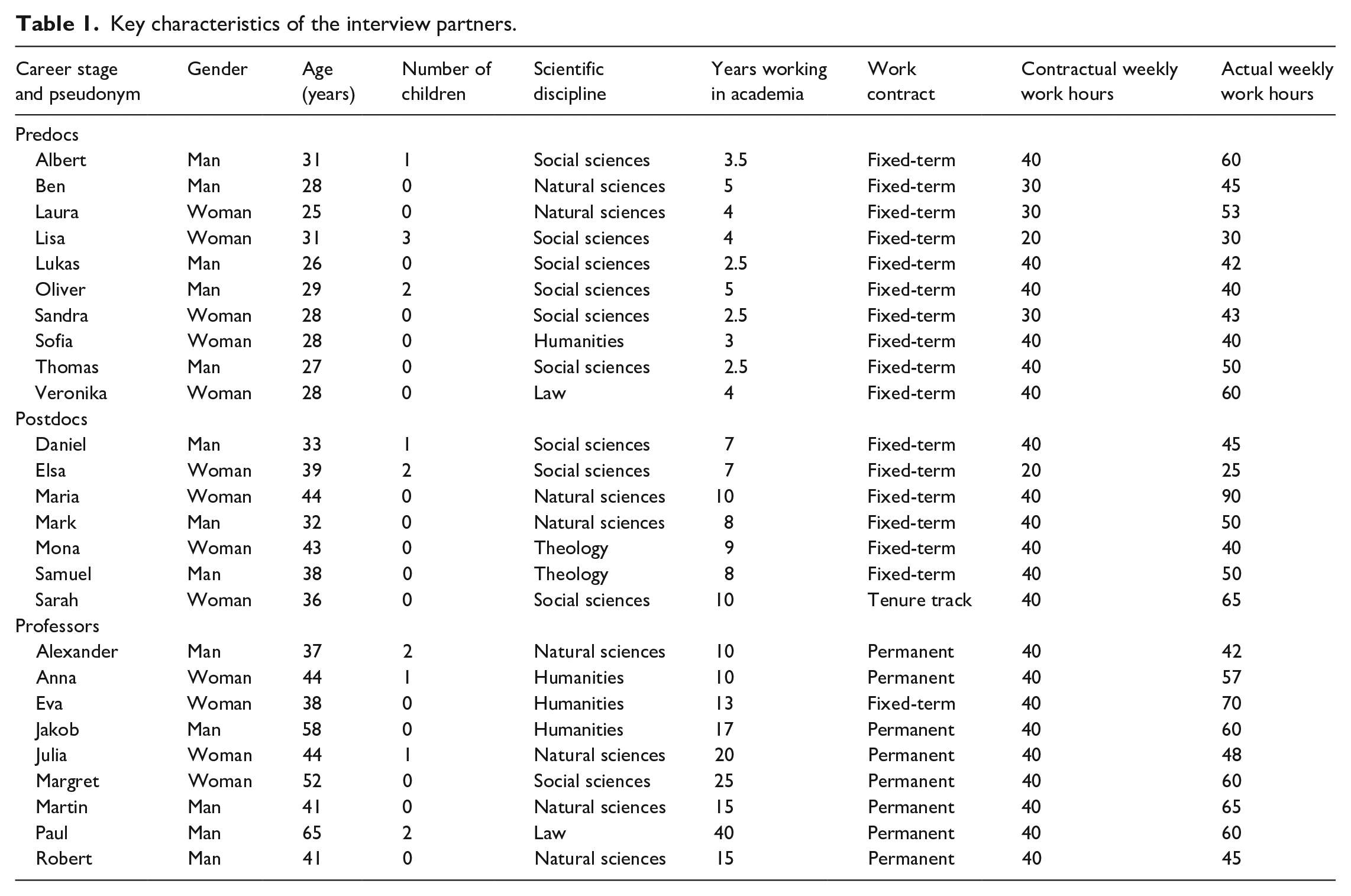
We draw on semi-structured interviews with 26 academics employed at a large public university in Austria – representing a typical institution of the Germanic higher education system. We sampled study participants purposefully, aiming at a balanced sample in terms of career stages (professors, postdocs, predocs), scientific disciplines, nationality, gender and kinship responsibilities. Participants – including those at the predoc or postdoc stage – hold employment contracts with the university. Typically, their work duties comprise research, teaching and administration. Study participants were partly recruited through the first author’s personal network and partly identified using the university’s public information management system. Table 1 presents key characteristics of the interviewees. For anonymity, we aggregated subdisciplines (e.g. chemistry, philosophy) into broader scientific disciplines (e.g. natural sciences, humanities) and used pseudonyms for interviewees.
Key characteristics of the interview partners.
The first author conducted the interviews face-to-face. Prior to each interview, participants signed an informed consent form in which anonymity was guaranteed. The interview guide focused on topics such as boundary work, daily work routines, work hours and individuals’ success factors in academia. During the entire interview, the interviewer remained open for unexpected topics. After each interview, the interviewer wrote a detailed reflective memo about the interview setting (e.g. specifics of the location, timing, disruptions) and recollections on the interview situation (e.g. atmosphere, personal relation to interviewee, assessment of interviewees’ openness, potential power asymmetries between interviewer and interviewees). As we study a field we are personally involved in, we two authors critically reflected on our subjective positions coming from diverse disciplines and belonging to different status groups. We often mutually challenged our subjective interpretations and regularly discussed our findings with other researchers to ensure reliability and credibility of our findings.
The interviews lasted between 40 and 108 minutes, averaging 76 minutes. They were recorded and transcribed verbatim. One interviewee preferred not to be taped. The interviewer took notes during this interview and reconstructed the content immediately after the interview took place. The final material consisted of about 286,000 words, roughly corresponding to 820 pages. The interview excerpts presented below were translated from German to English by the authors with the support of a bilingual native English speaker, with the exception of one interview that was conducted in English.
Data analysis
Following the suggestions by Gioia et al. (2013), we coded the interviews in an iterative process, thereby moving back and forth between the data and the literature. Both authors carefully read through all interview transcripts multiple times. The first author started coding using the MAXQDA software and discussed the identified first-order concepts with the second author. Afterwards, both authors, drawing on existing literature, collaboratively extracted more abstract second-order notions and grouped them into aggregated and overarching dimensions. The resulting data structure is presented in Figure 1.
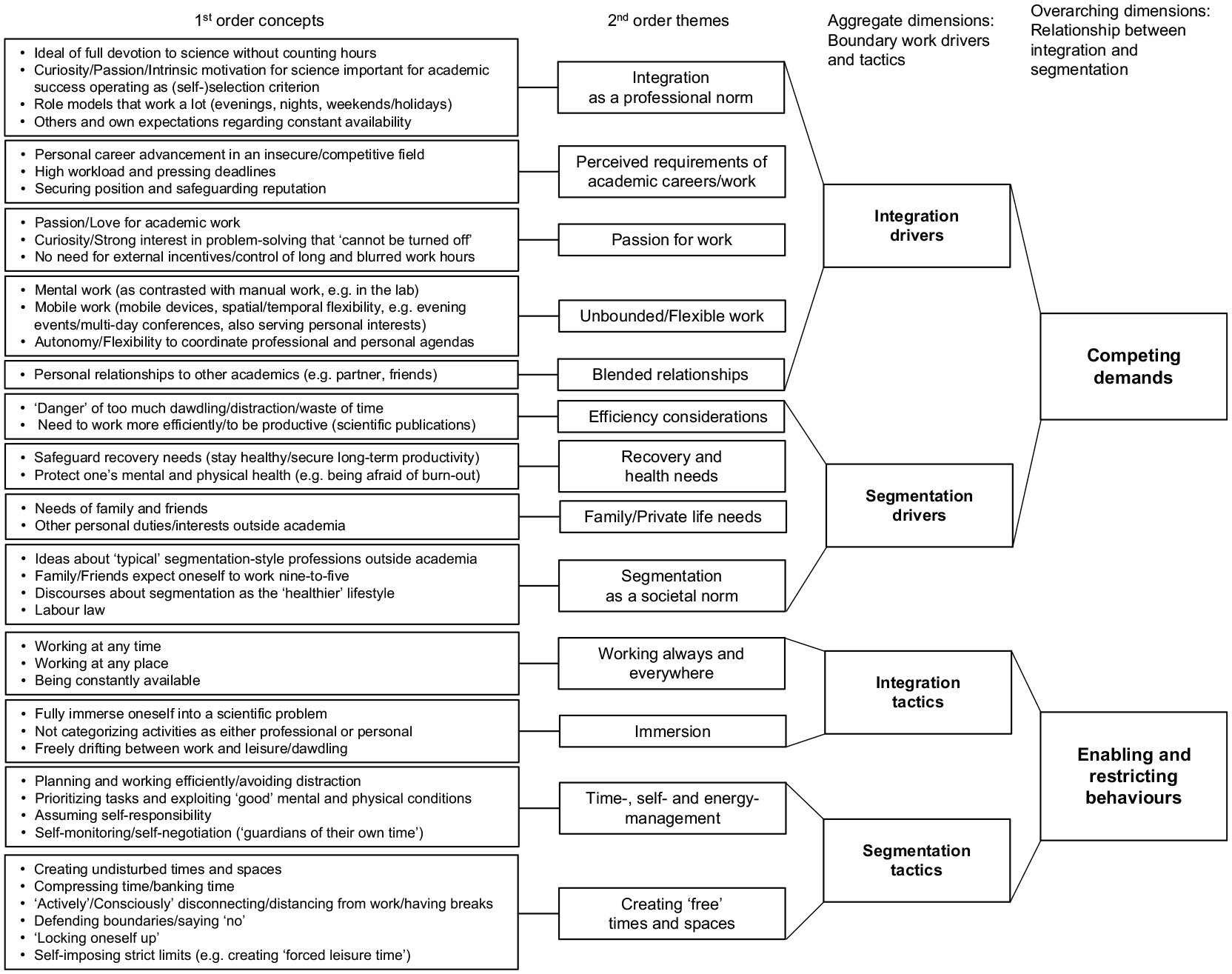
Data structure.
In a first step, we identified a number of first-order concepts related to boundary work. Most interviewees talked about boundaries, integration or segmentation in an indirect manner as these concepts are not very common in daily language. We noticed that long (or ‘unlimited’) work hours and temporal boundary blurring (e.g. working in the evening, at night, on the weekend, on holiday) are often interrelated (see also Mullan and Wajcman, 2019). Therefore, we considered long work hours that intrude into traditional non-working times as a marker for (temporal) integration (see also Reyt and Wiesenfeld, 2015). In a similar vein, we considered work completed outside the university walls (e.g. at home, in bed, on the train) as a marker for (spatial) integration. We recognized that these theoretical dimensions often intermingle in practical boundary work of individuals. For example, we noted that ‘working at any time,’ ‘working at any place’ and ‘always thinking about work’ often go hand in hand (see also Mustafa and Gold, 2013). Therefore, we did not structure our data around the three dimensions (temporal, spatial, psychological) proposed by Clark (2000) but they only informed us to identify markers for integration and segmentation in the interviews. Furthermore, we noticed that academics not only refer to boundary work when talking about boundaries between the personal and the professional, but also when they describe how they organize different tasks within their professional domain. Following Kreiner et al. (2006), we thus considered boundary work related to ‘internal’ boundaries within subdivisions of the professional work (e.g. research, teaching, administration activities) as well.
In a second step, we aggregated the first-order concepts related to boundary work into second-order themes. We found that some concepts reflect individuals’ rationales and motives for a certain form of boundary work and refer to the question why academics choose integration or segmentation, while other concepts refer to concrete behaviours and how academics engage in boundary work.
In a third step, we clustered these rationales and motives into drivers and aggregated concrete behaviours into tactics of integration and segmentation, thereby understanding tactics in a broader sense, also including non-strategic or unintended behaviour. We also noticed that interviewees often talked about integration as self-evident, using wordings like ‘natural’ or ‘automatic’ when referring to it, whereas they used expressions like ‘I actively try’ or ‘I consciously decided’ when they described segmentation drivers or tactics. Although we consider drivers and tactics as conceptually different, in the empirical material they often overlap. Interview excerpts illustrating tactics often also contain reflections on drivers for this behaviour (and vice versa).
In a final step, we explored the relationship between integration and segmentation in more detail. We specifically looked at text passages that contain both descriptions for integration and segmentation tactics and examined potential interactions. These analyses revealed that individuals often experience both integration and segmentation drivers simultaneously, and they adopt integration and segmentation tactics to enable or restrict each other. Accordingly, we grouped the aggregated dimensions into two overarching dimensions: competing demands and enabling and restricting behaviours.
Findings
Aligned with our research question, the presentation of the research findings starts with a detailed description of the drivers influencing individuals’ integration and segmentation between their professional and personal life domains. The second sub-section specifies the boundary work tactics employed by individuals. The final sub-section focuses on the relationship between integration and segmentation. While there are individual peculiarities, in the following we concentrate on common patterns in the interviews.
Drivers of integration and segmentation
Integration drivers
Various factors lead individuals to not draw a strict line between the professional and the personal, with some originating from the social environment and others being internal(ized).
Integration as a professional norm
Most interview partners sensed expectations of full dedication to work prevalent within academia. While some vehemently criticized such norms, others embraced the ideal of a fully committed scientist. For instance, Samuel, a postdoctoral researcher, described this ideal as follows: I believe that a successful scientist needs a passion that goes beyond normal work and which leads to the point that you can no longer clearly distinguish between work and the rest of the time.
Early career researchers often attentively observe their professional environment, like Veronika who learned that ‘realistically, one can have a very strict boundary, but this is noticed rather negatively at work – so you have to be careful’. Established professors apply and sustain these norms, for instance by serving as role models to colleagues, recruiting those PhD students who show the highest levels of commitment or expecting constant availability from others. As articulated by Eva: This is a mélange: my own expectation and the anticipated expectation of the scientific community . . . The expectation of the institution is, I believe, a maximum dedication to work . . . I feel the same way when I have an important request and I cannot reach someone and then an email comes in, ‘I’m on holiday’. If you don’t actually get an answer all the time, that’s irritating. Somehow, it is expected that you are also available during holidays sooner or later.
As this excerpt shows, expectations prevailing in the field shape academics’ personal integration drivers and vice versa – in a kind of ‘mélange’. Furthermore, this quote illustrates that there are colleagues who deviate from the norm concerning full dedication and constant availability, thereby rendering this norm even more visible.
Perceived requirements of academic careers/work
In particular before academics secure tenure, many put in long hours to complete their PhD or Habilitation (a degree above PhD level often required for professorship in the German-speaking academic context), or to apply for funding for future employment. Looking back, Anna described the final months before completing her Habilitation as follows: I was in the office every weekend, Saturday and Sunday, often till three or four in the morning. I knew that I have to achieve this; otherwise, an academic career is effectively no longer possible . . . if I don’t complete my Habilitation on time. There was a strong, strong pressure to perform and time pressure. That was bad. Waking up with it on my mind. Always remembering, always knowing you’re late. One should actually [just] write. That was really sad . . . Then I worked until three or four in the morning until I fell asleep, sometimes in the office as well. Until I really couldn’t continue. Then the security guard would arrive, at three or four in the morning, and say: ‘Well, now it’s time to go home.’ Then I went home again and continued working there.
Like Anna in this quote, other interview partners also expressed having internalized the pressure to work extensively. They perceive the pressure to publish or produce high-quality work not necessarily as external expectations from the academic field, but rather as emanating from within themselves. As Samuel articulated: The pressure that I put on myself, of course I produce it mostly myself. It’s not that a certain pressure comes from above, it’s just more than the diffuse pressure. You have to publish and to perform . . . The pressure comes largely from within me.
Passion for work
Academics’ strong inner interest in science, their curiosity, enthusiasm and desire to conduct research is another important driver of integration. It leads academics to perceive no psychological boundary between the professional and the personal. Lukas described this phenomenon as follows: This endeavor to solve problems and answer questions haunts you. You cannot turn it off when you leave the office. Yes, it always haunts you. And yes, in that respect, I am not interested in separating this.
In this quote, integration carries a slightly negative undertone, as Lukas feels ‘haunted’ by work-related thoughts. Nevertheless, Lukas also emphasized his preference for integration, echoing other interview partners who highlighted the immense pleasure they derive from doing research.
Driven by this passion, academics are intrinsically motivated, requiring no external incentives or oversight, yet they work a lot, also during their personal hours. ‘It all flows automatically,’ as Martin remarked. Finding joy in their work, it hardly feels as ‘work’ at all. Jakob pointed out that some of his work tasks lacked discomfort, so he asked: ‘Is it work when it’s fun?’
Unbounded/flexible work
As academics are primarily brainworkers, in principle, their professional duties provide ample opportunity to work anytime, anywhere (though not all tasks allow for integration – for instance, laboratory work requires physical presence). Furthermore, the interview partners regularly use mobile devices like mobile phones and computer laptops, which enable constant availability and flexible work, thereby also fostering integration (Mazmanian et al., 2013). The nature of academic work not only allows for the possibility of taking work home, thus letting the professional intrude into the personal sphere, but also enables integration in the opposite direction. For example, individuals can be available for personal messages or calls during office hours, take a day off during the week after working on weekends or flexibly work from home when needed, such as when a child is ill.
There also are distinct academic activities that foster integration, such as field trips lasting from a couple of days to several months, evening lectures followed by social gatherings and conferences spanning multiple days, often featuring socials events, joint meals, musical shows, sports activities, city walks and similar leisure pursuits. Elsa, for example, described her last conference trip abroad as feeling ‘partly like holidays’. Paul explained how professional and personal interests can intertwine within academic events as follows: If I attend a guest talk in the evening which is interesting for my profession but also for myself, drawing a distinction [between the professional and the personal] is not possible or useful, as my personal interests and the professional align.
Blended relationships
A final driver of integration stems from the social relationships that academics often cultivate, where colleagues are friends, partners or spouses. Ten of the interview partners were married or in relationships with other academics, some of whom even worked at the same university. Hence, the professional–personal boundary become blurred through the physical presence of these individuals in both domains and the intermingling of conversations across domains. For example, Julia mentioned that she and her husband work at the same institute, which leads to frequent discussions about their research at home, yet ‘this does not feel like work’. Similarly, Laura noted that her friendships with colleagues often prompt integration tactics, like ‘philosophizing’ about science over a beer after official working hours.
Segmentation drivers
Factors that lead individuals to establish a temporal, spatial or psychological boundary between the professional and the personal relate to health, work efficiency, personal life circumstances and societal norms.
Recovery and health needs
The majority of the interview partners expressed awareness concerning the fact that a lack of detachment from work can negatively affect their health. Some reported on too much work and integration in the past. One example is Anna, whose above quote illustrated how she worked until 3 or 4 o’clock in the morning at the university and then continued working at home, and who said in retrospect: I realize that currently, I’m running out of energy. I now need some recovery.
Similar to Anna, many interview partners noticed the necessity of reducing their workload and establish boundaries in their lives. Some shared experiences of burn-out in the past (Jakob), felt close to that (Lisa and Sarah) or were afraid of burn-out in the future (Veronika and Eva). As a response, they developed segmentation tactics to stay mentally and physically healthy.
Efficiency considerations
The interview partners associated integration with ‘dawdling away too much time’ (Sandra). They seek to combat waste of time through better planning and adopting a more focused and efficient work style. Many believe in the importance of distinguishing between varying types of activities and prioritizing them based on their recognition within the scientific community rather than solely on personal interests. For instance, Sarah previously engaged in numerous projects that did not always lead to scientific output. However, upon securing her tenure-tracked assistant professorship, where meeting specific goals is essential for a permanent position, she realized that she must concentrate on projects that result in high-quality publications and forgo other projects driven solely by personal interest.
Family/Private life needs
Factors in the academics’ private lives, such as kinship responsibilities, caregiving responsibilities, household chores, volunteering commitments or hobbies are further segmentation drivers. For example, interview partners stated that they are unable to focus on academic work while being with their children, which drives them to adopt segmentation tactics. Alexander, a father of two children, articulated this sentiment as follows: You cannot concentrate on work while at home, I totally abandoned that, therefore there is a clear spatial distinction now. I could not work properly when children are around. Conversely, [the children] help me to disconnect very quickly [from work].
In a similar vein, Sandra explains that her involvement in a sports team often motivates her to conclude her work in the evening.
Segmentation as a societal norm
Whereas integration is commonly regarded as the predominant type of boundary work in academia, the interview partners sensed social norms of segmentation outside of it. On one hand, they contrasted their own attitudes and behaviours with those of individuals employed in sectors such as manufacturing, retail, crafts, clerical jobs or teaching. For these people, in our interviewees’ opinion, work ‘is over when it’s over’ (Martin). On the other hand, academics learn from people outside academia that they, too, should separate professional and personal spheres. For instance, Sandra noted that some of her friends, who typically finish work around 3 p.m., do not understand why she continues to work in the evening. Sofia remarked: ‘I’ve heard that you should not mix your place to sleep and your place of work’. Eva assumed that a life coach would deem her highly integrating boundary work as ‘suboptimal’.
Labour law reflects societal norms and drives segmentation as well. Although some interview partners tend to ignore legal regulations, such as those regarding work breaks, holidays, maximum work hours or the documentation of work hours, the statutory entitlement to non-working hours nevertheless drives segmentation. As Robert said: ‘I am entitled to 6 weeks of vacation, which I try to take’.
Tactics of integration and segmentation
Integration tactics
Academics’ behaviours that lead to the blurring of professional–personal boundaries often coincide with working extended hours. Integration tactics often occur ‘automatically’ (Martin), reflecting what Julia characterizes as a ‘natural research mentality’.
Immersion
Academics with a passion for science often fully immerse themselves in their work and let the work absorb them. For instance, they continue thinking about their research after regular workdays, like Lukas illustrated in the following quote: On the way home, I usually think about something. I am someone who always wants to solve problems as quickly as possible. They won’t go out of my mind. Mostly it is some kind of math problem. They won’t go out of my mind. I just want to solve them, so I sit down at home and take a piece of paper and ponder the problem. It happens that this can last late into the night. But it is not an option for me to say I’ll leave this for today and move on tomorrow.
Such a willingness to be personally captured by scientific problems is typically accompanied by a tendency to forget time at work (‘timeless time’, Ylijoki, 2013) and to not distinguish between professional and personal activities. Rather, academics categorize many activities as both professional and personal. For instance, Anna explained that she ‘privately’ reads novels that she finds interesting, but which she also uses for student theses or teaching. Sofia said that experiences from her personal life feed into her research and vice versa. Other interview partners highlighted that they prefer activities that align with both their professional and personal interests, classifying these pursuits as ‘sort of in-between’ (Ben) or existing within ‘a grey area’ (Thomas).
Furthermore, academics assume that good ideas usually require not only hard work but also moments of leisure, as Weber (2009[1918]) in his early work postulated. As Eva said with a laugh: ‘Thoughts come when they want, Nietzsche said, and not when they should come.’ Academics therefore intentionally create opportunities for leisure to invite work-related thoughts. Common activities include taking walks or engaging in relaxed reading, during which good ideas can emerge – often at unpredictable times. The interview partners enjoy these instances when they can freely drift between work and leisure without clear boundaries.
Working always and everywhere
The interview partners named all conceivable times they dedicate to work, spanning all hours of the day and night, including weekends and holidays. Likewise, they listed a large variety of places at which they work, such as trains, buses, trams, airplanes, parks, beds or even while taking a shower or ‘sitting on the toilet’ (Sarah).
Relatedly, many interview partners make sure that they are constantly available for colleagues ‘without limitations’ (Margret), as well as for family and friends. Some maintain a single email account for both work and personal communication, a classical marker of integration (Nippert-Eng, 1996). Also, regularly checking emails while waiting for the bus, during holidays or immediately upon waking in the morning is a common practice among them.
Segmentation tactics
Behaviours that lead to a separation between the professional and the personal are usually much more conscious and intentional compared to integration tactics. In addition to common time management strategies, academics also engage in more sophisticated activities.
Time-, self- and energy-management
Acknowledging academics as ‘guardians of their own time’ (Margret), who are responsible for what they get out of their time, the majority of the interview partners pro-actively structure their workdays in such a way that it ensures minimal interruption from personal matters and prioritizes high-impact tasks. For instance, Alexander deliberately organizes his desk to avoid the temptation of reading less important texts.
The interview partners have designed their priorities to maximize scientific output, also aligning their work plans with their biological rhythm. As Lukas described: I have my power phase between eight and one or one-thirty. It is then that I do my research, my papers. For this I need my full cognitive capacity. In the afternoon, when my cognitive capacities weaken, I do other things, like administrative tasks, marking exams, advising students.
Several interview partners indicated that they attentively watch their performance and energy levels, as such monitoring is important to prevent exhaustion or burn-out.
Creating ‘free’ times and spaces
The behaviours subsumed under this segmentation tactic aim at creating zones where academics can attend to personal matters or immerse themselves freely in research. They involve compressing work tasks into certain days or half-days, allowing for more self-directed activities for the remainder of the week or day. For instance, Lisa squeezes all her work tasks into the morning, working diligently to ensure she can dedicate the afternoon to spending time with her children.
Sarah is another case in point. She deliberately opted to have no Internet access at home and only a tiny desk in order to prevent herself from working at home and thus, to create a space where she is forced to give her brain the necessary rest. Interestingly, it was insufficient to simply chose not to work at home; Sarah needed these technical barriers, underscoring the pervasive influence of integration pressures within the academic field. To resist pressures to work always and everywhere, Sarah implemented a robust external boundary by shifting the burden of boundary work to a technical device.
The challenges encountered in establishing boundaries prompt academics to resort to increasingly drastic behaviours and language. For instance, Martin carves out dedicated free zones for writing at home due to the hectic environment at his institute, what he described as follows: I have to lock myself up at home. I have to crudely lock myself up at home, there is no other way: simply ignoring emails and everything around me. . . You can only achieve a lot of [scientific] output if you somehow clear yourself of all the duties you have there [at the institute], if you are free for at least two or three hours at home – under quotation marks ‘free’– for those things on which you can concentrate.
This excerpt addresses a paradoxical activity, as the professor locks himself up to be ‘free’. Likewise, Julia created the oxymoron ‘forced leisure time’ (‘Zwangsfreizeit’), describing how she strategically imposed an obligation on herself to finish working: I bought my forced leisure time by spontaneously buying a horse a few years ago. That means. . . I actually have to spend a few hours a week with the horse. Otherwise, the animal would suffer and of course I don’t want that. And if, for example, I did not have the horse now, I would not do anything else to the extent that I like, because that could be postponed. Because I do not have to go for a walk today, I can go for a walk next week (laughs). But today I have to go to the horse.
Julia’s example illustrates the sophistication and self-discipline required by academics in adopting segmentation tactics to create free times and spaces in otherwise jam-packed days. In general, our findings on segmentation tactics indicate that they are also employed as a reflexive and proactive countermeasure against integration. We further elaborate on the interplay between integration and segmentation in the next paragraph.
The relationship between integration and segmentation
All interview partners reported on experiences with both integration and segmentation. As they perceive drivers of integration and segmentation in a context characterized by competing demands, they find themselves torn between these two approaches. Consequently, instead of adhering to a single form of boundary work, they alternate between integration and segmentation tactics. This alternation can be a simple cycling (cf. Kossek, 2016), for example, between segmentation during the lecture period and integration during the semester break. Furthermore, integration can be nested in segmentation and vice versa. For example, Lisa strictly limits her working hours, but during these times, she also works at home in various places like lying on the couch or in the kitchen while cooking. Other individuals regularly work from home, but restrict themselves to specific tasks, such as evaluating student theses or preparing lectures on weekends.
Even more interesting than this cycling or nesting, however, is that there is also a strong functional relationship between integration and segmentation. Individuals consciously choose one approach in order to minimize the disadvantages of the opposite approach or to enjoy its benefits. That is, with the alternating between integration and segmentation, they also aim to enable or restrict the respective other boundary work approach. Three patterns of such interrelated, mutually enabling or restricting relationships between integration and segmentation emerged from our data. Figure 2 illustrates these patterns, which we will describe in more detail in the next paragraphs.
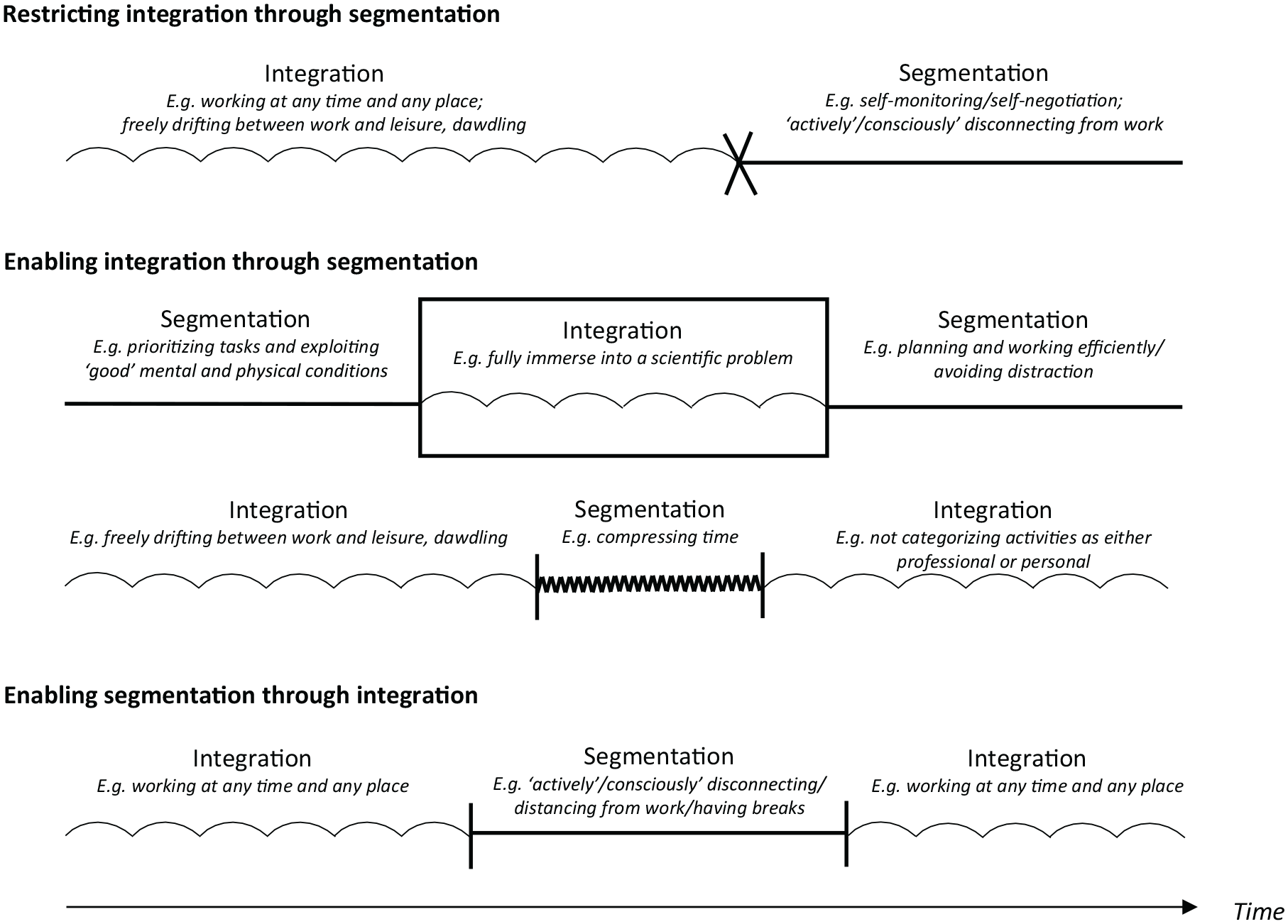
Patterns of the relationship between integration and segmentation.
Restricting integration through segmentation
The first pattern already surfaced in some of the examples presented above. Individuals initially employ integration as a kind of default mode, and once they notice negative side effects and integration becomes too overwhelming for them, they end it by adopting segmentation tactics. As integration drivers are typically strong in academia, establishing strict boundaries between the professional and the personal is extremely challenging. Many individuals must engage in elaborate negotiations with others, or even with themselves, or outwit themselves to stop integration. For instance, Sarah adopted two segmentation tactics in response to what she perceived as ‘too blurred boundaries.’ First, she affixed a sticky note to her computer screen to remind herself to stop work and to dedicate sufficient time to her family and friends. Second, she has firmly decided not to work 1 day at the weekend. If something arises that threatens her day off, she ‘enter[s] into a tough dialogue’ with herself.
Similarly, Anna strives to resist the impulse to constantly check work-related emails, regardless of time and place. As she recounted: I just check my emails and I do this totally reflexively at the bus stop or on the way home. So, somehow, I’m always taking out my mobile phone and it even happened to me at a funeral where I almost had the feeling in church that I have to touch it again. I think that needs treatment (laughs).
In this excerpt, Anna self-critically reflects on her bad habit, and how she tries to focus on the private setting she is in at the moment and resist the ‘temptation’ to blur the boundary between the professional and the personal, as she has realized that she overly integrated the two domains. Another example is Maria who said: Because if you work for a public university this absorbs your life. Even if you go shopping, your work is with you all the time. Work is with me all the time, so it’s basically everywhere. So, well, one of my friends told me: ‘You should stop!’ Because I always think. He told me a couple of times: ‘You should stop thinking about work!’ So, it’s part of my job perhaps to try to use a little more time – rather than working to socialize or to go around.
Enabling integration through segmentation
In the second pattern, individuals also employ segmentation tactics to deliberately influence integration. However, unlike the first pattern, the aim here is not to limit integration, but instead to enable it. One underlying rationale is the immense satisfaction and enjoyment individuals can derive from academic work, especially when it occurs without time pressure and encapsulates elements from the personal sphere. This pattern can take two forms.
First, some individuals have developed a habit of ‘playing integration free’ by creating times and places for integration through segmentation tactics. Jakob, for example, employs self-monitoring and task prioritization as segmentation tactics throughout the week to ensure he has enough spare time during the weekends. During this time, he completely refrains from self-monitoring to immerse himself in activities like reading books or contemplating scientific problems, which he categorizes as both professional and personal. In a similar vein, Samuel considers it a kind of ‘freestyle’ (Kür, as opposed to compulsory work tasks) when he has the weekend ‘free’ to enjoy slow work at home (i.e. employing integration tactics) after efficiently working at the office throughout the week (i.e. utilizing segmentation tactics). As he put it: I enjoy that when I have more time and can work from home, my working hours spread throughout the entire day, without having to be here in the office. It’s more of a freestyle; a time of freestyle, in a way.
A similar example, which we have already presented above, is Martin, who spoke of isolating himself (‘I have to lock myself up at home’) to fully immerse in science. Also, the previously mentioned research retreats are a typical case of this pattern of segmentation tactics that enable integration tactics.
The second form of this pattern involves individuals not only employing segmentation tactics but also striving to keep these periods as short as possible to allow for longer periods of a more integrative working style. An example is Sofia, who compresses the time she needs for teaching to less than 2 days per week, allowing her to reserve the other days for freely drifting between work and leisure. The following quote illustrates this squeezing of segmentation: I only slept two hours today. That was because now I always make sure that I don’t invest more than a day and a half in teaching. . . I start so late that I certainly don’t spend more than a day and a half. Then I must struggle through, but if I did it slow style like I used to do, it would just take me too long. That’s why I’ve developed this way, that I always work through to the finish . . . Afterwards I sleep and have a day off, and the other days are kind of relaxed.
This excerpt illustrates at the beginning how Sofia – in line with the first pattern outlined above – has chosen segmentation tactics to restrict integration due to her negative experiences with ‘slow-style’ working and dawdling in the past. For this purpose, she strictly limits (and cleverly, by starting late) the time for focused teaching activities, in order to then be able to drift relaxedly between work and leisure again. In other words, Sofia restricts integration by segmentation in order to enable integration.
Enabling segmentation through integration
Whereas integration, as emphasized earlier, is a kind of ‘default mode’ in academia, and many individuals value integration for its own sake, integration tactics can also serve to enable segmentation. In particular, many individuals choose to work extensively, at different times and various places, to enable themselves to completely disconnect from work afterwards and have a break for a certain period of time. Some also intentionally put in extra hours and work under all circumstances to ‘deserve’ holidays, free weekends or other breaks. Thomas, for instance, often works until late at night during the week to keep the weekend free from work. Martin does it the other way around; he works extensively on weekends to earn a break on Monday. In his own words: I have the freedom to say at some point, ‘okay, now I’ve done this on the weekend, and I’ve put in hours and hours, and if I have something planned for Monday at 3 o’clock, then I have plans at 3.’ So, I do take the liberty to do something else for half a day.
Thus, blurring the professional–personal boundary during a certain period allows Martin to set a strict boundary at another point in time.
Discussion
The aim of this study was to better understand drivers and tactics of individuals’ boundary work and the relationship between integration and segmentation. Drawing on interviews with 26 academics, we extend knowledge on boundary work in two ways. First, we show that a simple person–environment division falls short in explaining individuals’ boundary work which is driven by various enforcing and conflicting drivers stemming from different sources. Second, we show that integration and segmentation complexly interact with each other – sometimes as opposing, other times as enabling forces. Figure 3 depicts these findings.
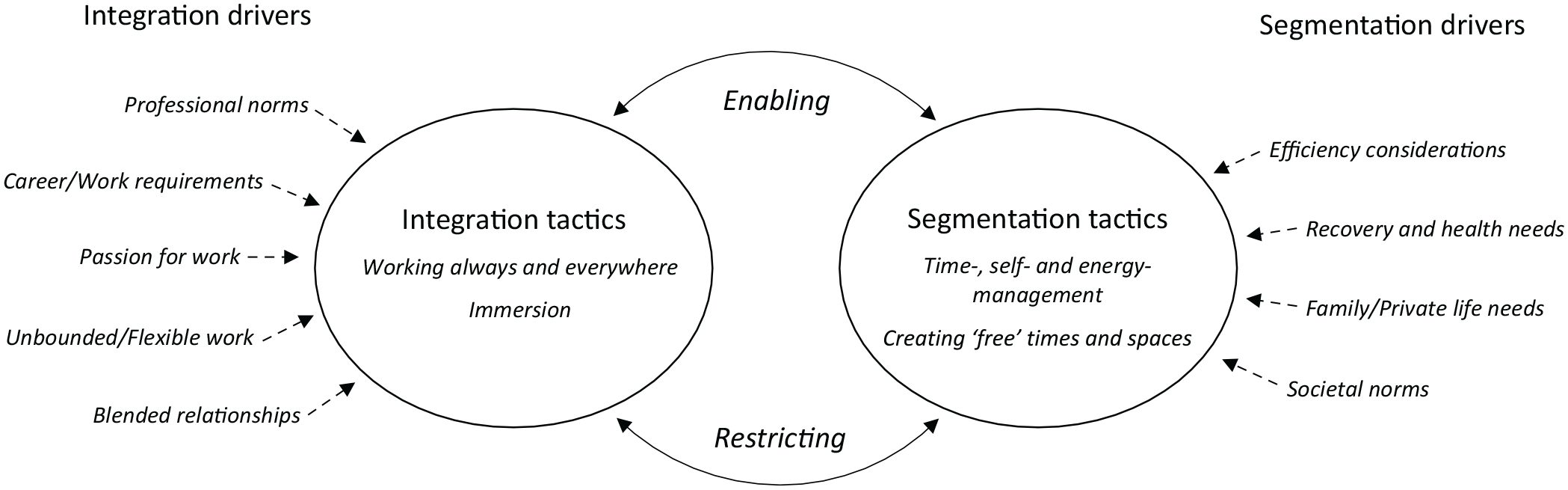
A model of professional–personal boundary work.
Simultaneity of various drivers of integration and segmentation
Our study advances boundary work research by identifying manifold individual and environmental drivers that affect academics’ boundary work. Previous research supposes that individuals’ preferences regarding boundary work is clearly situated on a specific point of an integration–segmentation continuum (Nippert-Eng, 1996), determined by assumingly non-ambiguous personal traits (Hunter et al., 2019). However, the focus on potential mismatches between individuals and environments reflected in the person–environment fit theory (Ammons, 2013; Dumas and Sanchez-Burks, 2015; Kreiner et al., 2009) neglects ambiguities or mismatches within persons or environments. Our study shows that individual, organizational and societal drivers can weaken or support each other and move individuals towards both integration and segmentation, simultaneously.
We identified various integration drivers. Whereas certain career requirements are perceived as external pressures that drive integration, academics also themselves play a role, as their personal wish to advance in academia leads them to put ‘unlimited’ effort into work and thus, to integrate. In other words, it is their decision to take part in the ‘academic game’ and accept its rules (Kalfa et al., 2018) that leads academics to let professional work perforate into personal life. In a similar vein, it is not only mere work necessity, such as completing high workloads or adhering to important deadlines that drives academics towards integration, but again, it is their desire to make ‘good’ work that fuse these professional requirements with personal goals. The ‘ideal worker’ norm (Dumas and Sanchez-Burks, 2015) thus is both, an external and an internal(ized) driver of integration.
This becomes in particular visible in the passion for work. Captured by this passion, academics are often not interested or able to distinguish between the professional and the personal. Sandiford and Green (2021) also show that passion for (volunteer) work strongly leads individuals towards integration. In our study, we show that this passion also functions as a (self-) selection criterion for (junior) academics. For example, many professors report that they usually choose highly motivated junior academics. Likewise, Beigi et al. (2017) show that high intrinsic motivation for academic work is a central factor for career success in academia.
However, our study reveals that this passion for work also has some darker sides. Being captured or even ‘haunted’ by scientific problems reduces opportunities to detach from work which can lead to exhaustion or burn-out (Sonnentag et al., 2010). Furthermore, it sometimes competes with personal relationships outside academia that also demand time, space and passion. Bourdieu (1988) introduced the term libido sciendi to emphasize this affective and sometimes unbridled force and theorized it as a sort of shared illusio in the academic field that ensures academics to willingly follow the rules of academia. In this way, libido sciendi operates simultaneously from within individuals (as part of academic habitus) and without (as a rule in the field) which makes it extremely difficult for academics to resist. In our study, we found that individuals have to invent sophisticated segmentation tactics, such as tricking or even locking themselves in, if they want to counteract.
Furthermore, we identified a number of segmentation drivers originating again from different sources. For example, protecting family (Ammons, 2013) is a strong motive for not working outside traditional work hours. But also societal discourses about segmentation as the ‘normal’ or ‘healthier’ boundary work style have some effects on the reflections of academics. This way, segmentation drivers operate as counteracting forces against integration norms prevailing in academia. However, segmentation drivers also back professional goals and support ‘ideal worker’ norms in academia (e.g. Creary and Locke, 2021). Efficiency considerations lead academics to strategically set boundaries within the professional domain prioritizing tasks related to career success in academia.
This segmentation within a domain is so far only rarely considered in boundary research. Kreiner et al. (2006) acknowledged this issue, however, they only focus on boundaries within multiple individual and organizational identities without specifying particular tactics. Ylijoki (2013) showed that academics clearly differentiate between different tasks, but her research only loosely relates to boundary work theory. Kreiner et al. (2009) identified a boundary work tactic they labelled ‘invoking triage’ which means that workers prioritize urgent and important work or home demands. As the naming suggests, they see this tactic mainly as a coping strategy for severe problems or crises. However, our study shows that academics engage in this form of segmentation in a frequent and mundane manner.
Our study reveals that various drivers originating from different individual and environmental sources – often operating concurrently – lead to conflicting individual boundary work choices. Torn between competing demands academics often not only negotiate boundaries with others but also with themselves. This phenomenon of self-negotiation or even self-outwitting adds new insights to boundary work theory. Obviously, workers’ preferences are not always that clear as it is suggested by previous literature (Kreiner, 2006) and far away from being stable personal traits (Hunter et al., 2019). They are moulded by environmental conditions and vice versa, which is reflected in individuals’ internal ambivalences or even conflicts regarding preferences for one or the other. Future research on boundary work should examine this mutual influencing in more detail.
Complex interplay between integration and segmentation
As a second contribution, our study shows that integration and segmentation not just represent independent poles on a continuum of boundary work but are also functionally interrelated. This exceeds knowledge from previous studies that classified individuals as either integrators, separators or cyclers, who are individuals that alternate between phases of integration and segmentation (cf. Kossek, 2016). Our findings suggest that this alternating or cycling is not always simply a sequential living out of different preferences, but academics utilize one form of boundary work to restrict or enable the respective other. So, they engage in various forms of boundary work to deal with the competing demands stemming from different integration and segmentation drivers.
One pattern of integration–segmentation relationships is that academics use segmentation tactics to counteract too much integration. Being fully absorbed by science or freely drifting between work and leisure may correspond with an ideal academic lifestyle, but it might not always lead to a scientific output. By efficiently structuring days, compressing or ‘banking’ time (Kreiner et al., 2009) – so by setting strict boundaries – academics try to enhance efficacy, but also to fulfil personal needs. As integration is the ‘default mode’ in academia, segmentation tactics require strategic and active effort. This becomes also visible in a recent study of Mols and Pridmore (2021) who show how a messaging app blurs boundaries by default and that individuals actively have to engage in boundary work to recreate boundaries. However, the phenomenon we observed in our study by far exceeds the effect described in their study. Internalized social norms and pressures are sometimes so difficult to fight, that academics have to use rather strict tactics to keep integration in check. Whereas these self-disciplinary tactics can highly stress workers, they may also help to safeguard their health and productivity in the long run and provide times and spaces for personal life matters.
This is in line with recent research on boundary work showing that segmentation supports ideal worker norms as well, whereas integration tactics can also provide opportunities for recovery (Creary and Locke, 2021). Our findings suggest that the question which form of boundary work – integration or segmentation – is more beneficial for workers cannot be answered by looking for an either–or solution. Obviously, both forms of boundary work go along with opportunities and pitfalls. Furthermore, the two forms are not always antagonists but also allies as individuals also use integration or segmentation to enable each other. For example, they use segmentation to create free times and spaces for integration and the other way around.
We therefore consider integration and segmentation as complementary opposites being both contradictory and interdependent in nature (cf. Smith and Tracey, 2016). First, segmentation defines integration and is defined by it (or its absence), and vice versa. Second, individuals employ the two approaches both as a remedy and to mutually support each other, aiming to meet the competing demands they perceive in their environment and to balance costs and benefits of each approach. Future research on boundary work could provide more insights on this complex integration–segmentation interaction.
Limitations and avenues for future research
While our research makes valuable contributions to boundary work theory, it is not devoid of limitations.
The entanglement between long working hours and integration, which is not only a characteristic of work in academia (Acker and Armenti, 2004) but a more general phenomenon (Mullan and Wajcman, 2019; Reyt and Wiesenfeld, 2015), makes it analytically difficult to sort out which drivers directly fuel integration and which mainly impact long working hours and cause integration as a practical consequence. Future research that investigates drivers in professional fields with norms fostering integration but shorter working hours or, on the opposite, work environments that strongly encourage segmentation with long working hours could provide interesting insights.
Furthermore, our sample has two peculiarities. On the one hand, our informants build a rather homogeneous group being employed at the same university. On the other hand, our sample is rather heterogeneous, including academics belonging to different status groups, disciplines, genders. With the latter we intended to get a broader picture of boundary work, with the former we sought to have a common frame. However, both aspects also entail some drawbacks.
The homogeneity of our sample limits the transferability of our findings to other professional settings inside and outside academia. However, despite peculiarities of specific universities, academic systems share many commonalities around the globe (Kalfa et al., 2018). Baruch (2013) understands academia as a ‘global labor market’ that also has a number of commonalities with other professional contexts (see also Baruch and Hall, 2004). In a similar vein, Reissner et al. (2021) regard academics among other professionals as typical knowledge workers.
The heterogeneity of our sample relates to the fact that academic norms and requirements often vary depending on disciplines and status groups (Bourdieu, 1988) as well as gender (Allen et al., 2024). So, even academics who are employed at the same university might actually enjoy different degrees of autonomy in defining boundaries or perceive different professional or personal requirements. For example, individuals may perceive different signals from their supervisors regarding their expectations of availability (Heissler et al., 2024). Furthermore, doing time-critical experiments in a laboratory might allow less flexibility for individuals, whereas activities like contemplating a philosophical or mathematical problem or writing texts are more unbounded in nature. However, all our informants claim to have some leeway regarding boundary work. Nippert-Eng (1996), for example, showed that also scientific work in the laboratory can go along with extreme integration.
Generally, we observe many commonalities across disciplines, status groups and genders concerning drivers and tactics for integration and segmentation and we focused on common patterns. Future research, however, could place between-group differences regarding boundary work at the centre of attention. For instance, it is widely recognized that various societal and professional norms – key drivers of boundary work – are closely intertwined with gender (Acker, 1990; Cohen et al., 2023; Fagan and Teasdale, 2021; Grotto and Mills, 2023; Williams, 2001). Emslie and Hunt (2009: 153) see gender as ‘integral to any discussion about intersections between paid work and family life’ and understand ‘different ways of doing work–life balance’ as gendered practices. To better grasp these dynamics, we encourage scholars to conduct in-depth, gender-sensitive analyses that explore patterns in boundary work through a gender lens.
Conclusions
Our study shows that navigating between integration and segmentation is a complex and challenging endeavour. Individuals adopt sophisticated boundary work tactics to cope with different drivers stemming from various sources – some of which enforce each other, whereas others are conflicting. Boundary work tactics help people creating times and spaces for professional and personal needs. However, some of these tactics, like locking oneself in, are highly radical in nature and limit people’s personal scope of action. So, engaging in boundary work implies a careful balancing between integration and segmentation.
