



Abstract
Limitless connectivity enabled by Information Communication Technologies (ICTs) has aided organisations to keep their employees linked to work even after hours. Drawing from work boundary theory and sociomaterial theory, this study explores what leads to technology-assisted supplemental work (TASW) expectations and how these expectations are managed in organisations. In the analysis of qualitative data collected from 20 senior-level managers from two organisations in Sri Lanka, we found that organisational norms developed through top management influence led to TASW expectations among lower-level managers. These expectations are then imposed by managers, and nonresponses are controlled by means of confrontations and punishments. These punitive regimes could especially create discriminative effects on married female employees if they cannot meet the after-hour expectations due to gender roles associated with the home domain. However, having formal policy guidelines on TASW could reduce the negative consequences on employees. This study contributes to the literature by including the managerial perspective on TASW expectations.
Keywords
Introduction
Workplaces today have become increasingly technology-driven, making employees available for work every day, everywhere (Koslowski et al., 2019; Matusik & Mickel, 2011). Accordingly, employees are now expected to be available and work after hours at home, in transit and even on vacations (Eichberger et al., 2021; Mazmanian et al., 2013; Mellner, 2016; Usmani & Das, 2021), blurring the boundaries between work and nonwork domains (Duxbury et al., 2014; Elbaz et al., 2022). There is a vast empirical base on the effects of after-hours technology use on employees. These studies have revealed that after-hours engagement with work via ICT devices can significantly elevate work–life conflict and reduce the well-being of the employees, which can then increase employee turnover and absenteeism (Belkin et al., 2020; Eichberger et al., 2021; Kao et al., 2020). Further, employees who are less receptive to after-hour communications seem to be labelled as less committed compared to those who are receptive to such communications by their supervisors and colleagues (Fenner & Renn, 2010). This perception has caused a more challenging situation for female employees than male employees, especially in cultures where traditional gender roles are prominent (Carvalho et al., 2021; Nsair & Piszczek, 2021). In such cultures, women will be less receptive to after-hour communication due to other responsibilities they are expected to perform (De Alwis et al., 2022). Ultimately, such perceptions could create a discriminative effect on female employees in terms of their career progression (Bogler et al., 2019; De Alwis et al., 2022).
Although studies discuss after-hour expectations and how they affect employee behaviour, there is a clear gap in research related to the factors that would lead to the development of such expectations from employees and how they are managed by organisational leaders (Capitano et al., 2019). Further, most studies in this area have explored employee perspectives rather than organisational or supervisors’ perspectives on after-hour expectations. However, investigating after-hour work expectations from an organisational and managerial perspective could also contribute to understanding why such expectations are developed and how such expectations are enforced in organisations (Capitano et al., 2019; Piszczek, 2017). Such knowledge is invaluable, in light of increased technology use in workplaces around the world in recent years, especially with the advent of the COVID-19 pandemic and the resultant change in work settings. Such insights would also assist practitioners in developing more organisationally relevant and specific guidelines to manage after-hour availability expectations in the post-COVID-19 era.
Accordingly, this study used the insights of work–life boundary theory to study (a) which factors lead to the development of technology-mediated after-hour work expectations in organisations and (b) how such expectations are imposed and managed with work teams by respective managers. By answering these empirical questions, the current study will contribute to the discourse on work–life boundaries and technology by expanding managerial/organisational perspectives on the after-hours availability of their employees via ICT devices.
Moreover, the study is based on a developing country in South Asia, which is significantly socially and culturally different compared to developed western countries. Sri Lanka is also considered a collectivist country where people strongly uphold their commitment to groups such as the workplace (Allen et al., 2020; Kengatharan & Edwards, 2021). Further, Sri Lanka is high in power distance where the hierarchical authority is not challenged or questioned (Kengatharan & Edwards, 2021). Sri Lankan society still follows the traditional patriarchal values where females are expected to take care of the domestic sphere while men are expected to bring home an income (Kailasapathy et al., 2014). Further, upper management positions in organisations are still predominantly held by men in most organisations (Strachan et al., 2015). In this milieu, the findings of this study would help to understand how after-hour availability expectations are imposed and managed in collectivist, power distance cultures like Sri Lanka and how females are challenged when balancing such organisational expectations with gender norms in a society such as taking care of domestic responsibilities.
Further, Sri Lanka underwent significant changes in working practices with the advent of the COVID 19 pandemic. The country went into a sudden lockdown imposed by the government in March 2020, which continued for almost two months. These restrictions imposed by the government led organisations to implement remote working strategies, which they had never employed before. However, when the country opened after two months of restrictions, most organisations reverted to old ways of working, reducing the opportunity for remote working and flexibility of work scheduling (Adikaram et al., 2021). However, empirical evidence suggests that the remote working strategies adopted during COVID-19 restrictions led to an increase in technology-assisted supplemental work (TASW) of employees (Carvalho et al., 2021). Hence, the findings of this study will also reflect how the sudden implementation of remote working strategies during COVID 19 has influenced the after-hour availability expectations on employees in the Sri Lankan workplaces.
Theoretical Background
Work–Life Boundaries
Boundaries represent mental models or rules that would be established to define and manage different life roles (Allen et al., 2014). Often these boundaries do not solely represent individual preferences. Boundary construction is a collective process of individual and social circumstances such as work, family and cultural factors (Rothbard & Ollier-Malaterre, 2015). Accordingly, some individuals manage segmented boundaries between work and nonwork life where they do not allow any interaction between the different domains. Individuals who manage segmented boundaries will not prefer to work after working hours and will not use working hours for personal needs (Ashforth et al., 2000; Kreiner et al., 2009). By contrast, some individuals allow their different life domains to interact. These behaviours are often called integrated boundaries. Integrators will not mind engaging in work after office hours. However, in turn, they expect to invest their time and effort in personal needs during working hours (Kreiner et al., 2009). Thus, segmentors will attempt to separate the work mentally and behaviourally from their other life roles through rigid boundaries, while integrators will manage more fluid boundaries to keep different life roles more integrated (Ashforth et al., 2000; Kreiner et al., 2009).
Individual boundaries between work and nonwork domains are often impacted by organisational or managerial expectations on boundaries (Mellner, 2016; Piszczek, 2017). Today, due to sophisticated devices such as smartphones and high-speed internet capabilities, anyone can be contacted anytime, anywhere (Duxbury et al., 2014). This phenomenon is often termed in literature as TASW (Fenner & Renn, 2004). TASW defines work engagements occur outside the formally contracted working hours via technology, often without additional remuneration (Fenner & Renn, 2004, 2010).
Technology-Assisted Supplemental Work
A recent study by van Zoonen et al. (2021) found that the TASW of employees significantly depends on the technologies used by organisations and the responsive expectations of management. Responsive expectations mean that organisations expect their employees to respond to after-hour communication via ICT devices (Mellner, 2016; van Zoonen et al., 2021). Such expectations often encourage employees to engage in work-related activities even after-hours when they are physically away from the workplace (i.e., TASW). In a conceptual review presented by Capitano et al. (2019), authors discuss that human resource policies, leadership and organisational norms can influence employees’ ability to control their work–nonwork boundaries. Thus, employees will feel obliged to maintain more blurred boundaries between work and nonwork roles if such organisations’ leadership, norms and HR practices are complementary to TASW.
Although the TASW are often not formally recognised in organisations, these are inculcated into organisational norms by the management, creating an ‘always on’ culture in organisations. These norms are then used to define the commitment levels of employees, making employees adhere to TASW in order to exhibit their commitment and loyalty towards their employers. Such effects would be more prominent in collectivist and power distant cultures where employees do not challenge the collective norms and expectations of people in power (De Alwis et al., 2022). Especially, the expectations and behaviours of managers/supervisors in managing TASW will be significant on the after-hour connectivity level of employees if TASW requirements are not formalised in the organisations.
Consequences of TASW
Many empirical studies have examined the effect of TASW on various employee outcomes such as work–family conflict, employee well-being, job satisfaction, burnout, stress and work engagement (Eichberger et al., 2021; Kao et al., 2020; Terry & Mathews, 2021). Many of these studies have discussed how TASW blur the boundaries between work and nonwork domains, often creating adverse outcomes to employees’ well-being and work–life experiences. Such adverse impacts may be more severely experienced by female employees if they belong to cultures where traditional gender norms are strongly upheld.
Gender norms represent the roles and behaviours expected of each gender by society (Rajadhyaksha et al., 2015). These cultural norms often dictate the accepted and nonaccepted behaviours of each gender. The traditional gender norms dictate the role of females as taking care of the well-being of the family while men are expected to provide bread and butter (Barnett, 1999; Kailasapathy et al., 2014). Further, gender norms would also develop around how females and males should interact. In traditional cultures, females have certain limitations in interacting with unrelated males (Adikaram, 2014). Such norms then affect how female employees would manage their work and nonwork life (Kailasapathy et al., 2014). A recent study conducted by De Alwis et al. (2022) found that female employees experience more work–life conflict due to the after-hour connectivity expectations of their employers. This phenomenon is especially applicable to cultures where traditional gender norms are upheld (De Alwis et al., 2022). In such cultures, married females are expected to take care of domestic responsibilities irrespective of their employment status (Kailasapathy et al., 2014). In addition, female employees in traditional cultures may not respond to after-hour communications (especially at night) if they come from unknown parties (De Alwis et al., 2022). Ultimately, these social norms around female behaviour will lead to low responsiveness from female employees to TASW requirements in the workplace. Such low responsiveness of female employees could also contribute to a lack of female representation in higher echelons of management which could then create a rippling negative effect on female career advancement (Bogler et al., 2019). As the top-level management is male dominated, they may not find responding to after-hour work expectations a challenge as they are often not burdened by domestic responsibilities after hours. These male dominated values would also create stereotyping effect female employees as they are not responsive to after-hour work (Acker, 1990).
Technology and Sociomateriality
As TASW expectations are contingent upon various collaborative ICT tools the organisations use, it is important to understand the role of ICTs in this phenomenon (van Zoonen et al., 2021). Many studies investigating after-hour work expectations have assumed technology (i.e., ICTs) as an exogenous factor that independently affects human behaviour. However, recent past scholars suggested that technologies alone cannot impact human behaviour and that the role of technologies on human lives depends on how such technological capabilities are used in practice. Moreover, human practices are influenced by individual differences and sociocultural factors. Hence, the conceptualisation of ICT should carefully recognise this relationship between social and technological elements.
Under the theory of sociomateriality, Orlikowski (2007) explains the role of technology in organisational discourse as sociomaterial. Sociomaterial theory assumes technology and human elements as interlinked and inseparable. It is thus considered that technology or social elements alone do not create meanings, as meanings are created through the entanglement of technology with different social elements of the organisations. In sociomaterial practices, the materiality of technology includes devices and all the capabilities, including software, hardware and networks. Social aspects include symbols, meanings, desires, fears and cultural discourse (Moura & Bispo, 2020; Orlikowski, 2007). More importantly, sociomaterial theory suggests that technology and human elements have no inherent properties but acquire them through the interpretations given in practice (Moura & Bispo, 2020). For example, ICTs do not blur the boundaries between work and nonwork domains automatically. Blurring only happens if people use ICTs to communicate with another domain. Essentially, the usage of ICTs by managers to contact employees after hours is a choice of individual managers. However, without the ICTs, managers won’t be able to make such decisions.
Technology and humans are inextricably entangled in practice, creating a complex web of relations (Moura & Bispo, 2020). The nature of these relations is not universal but depends on the context. Hence, the same technological constellations would have different meanings in different sociocultural settings. Therefore, to understand an organisational phenomenon like after-hour expectations, it is crucial to explore sociomaterial practices (Leonardi, 2013; Orlikowski, 2007). Such theoretical assumption would assist researchers in uncovering the complex relations between technology and social elements, which is difficult to understand at a surface level.
Accordingly, this article argues that after-hour expectations of connectivity and its effect on work–life boundaries are sociomaterial. Hence, to understand how after-hour expectations are developed and enforced in organisations, we use the lens of sociomateriality (Orlikowski, 2007). Through the lens of sociomateriality we can uncover the entanglements between ICTs and socioorganisational factors that influence the development and implementation of TASW expectations in organisations. Further, using a sociomaterial lens to study the after-hour expectations will also help to understand the role of ICTs in TASW expectations in organisations.
Method
Under the broader interpretive research paradigm, the study employs the qualitative approach to understand the formation and management of TASW expectations in workplaces. The relational ontology associated with sociomaterial theory also coincides with the interpretive paradigm and qualitative research approach. Within the qualitative research approach, the multiple case study strategy (Yin, 2013) is used.
Research Context
Under multiple case study strategy (Yin, 2013), data for the study were collected from two organisations in Sri Lanka. Organisation 1 is a service organisation with a 50-year history as a main player in the insurance industry. Organisation 2 is the Sri Lankan subsidiary of one of the world’s largest multinational corporates engaged in the Fast-Moving Consumer Goods (FMCG) industry. Organisation 1 is a local organisation following more traditional Sri Lankan values. The organisation is more hierarchical and follows a bureaucratic approach to people management. Further, Organisation 1 has more males in senior-level management. In contrast, Organisation 2 is influenced by its global management practices. Hence, in Organisation 2, more western-oriented and modern people management practices are seen compared to Organisation 1 (e.g., flex working, equal opportunity policies, work–life balance guidelines). Further, Organisation 2 is less hierarchical and follows a matrix organisational structure. Moreover, Organisation 2 have an almost similar level of gender distribution in the senior management levels. Organisation 1 has rigid working hours, which employees must adhere to as a rule. Organisation 2 has implemented flex working since 2012, and they do not have standard working hours for knowledge-level workers. Organisation 1 has 24-hour customer service for particular business requirements such as hospital bill settlements and onsite inspections of motor vehicle accidents. As a multinational company, employees of Organisation 2 need to work with their global teams aligning to international time zones. On such occasions, employees would have to work outside regular hours. In both organisations, there were no formal regulations that governed TASW. Still, in Organisation 2, there were some explicit guidelines which discouraged employees from engaging in work-related communications during night-time and holidays. However, both organisations use modern ICT capabilities to communicate and connect with their employees and other stakeholders.
As highlighted above, two diverse cases provided us with the opportunity to gain more insights into the TASW phenomenon as it facilitates the exploration of the research problem using different organisational characteristics (Seawright & Gerring, 2008). Further, Capitano et al. (2019) suggested that HR policies, practices, organisational culture and leadership are important aspects that determine work–nonwork boundary control of the employees. Hence, selecting two contextually different organisations in terms of HR policies, practices, organisational culture and leadership will help us perform a sociomaterial analysis more effectively by exploring in-depth how the material capabilities of ICTs are entangled with socio-organisational factors in the development and management of TASW.
Data Collection
Data for this study were collected through a set of semi-structured interviews with 20 middle-level managers from the two companies. Interview questions were developed to understand how TASW expectations are developed and managed in selected organisations from organisational perspective (or managerial perspective). Hence, in the interviews, we did not focus on how these managers perceive TASW expectations as employees of the organisation but on how they perceive this phenomenon as a manager representing the organisational domain. The questions mainly focused on the areas of after-hour work and connectivity expectations of the interviewed managers and how they are developed in the organisation. Further, we explicitly questioned how female employees respond to such expectations and the existence and use of explicit guidelines or policies to manage after-hours work or connectivity expectations. Probing questions were used where it is necessary to gain a clear understanding of participant responses. At the final stage of the interview, we presented a set of vignettes representing different TASW scenarios to elicit how managers perceive nonresponse to TASW expectations. These vignettes are developed based on previous literature and tested in a previous study (De Alwis et al., 2022).
Usage of vignettes is frequently seen in social science, health and psychology research to uncover how participants perceive cultural and social norms related to a given phenomenon (Azman & Mahadhir, 2017; Barter & Renold, 1999; Finch, 1987; Jackson et al., 2015; Lowcock et al., 2017). As suggested by Hughes and Huby (2012), the vignettes that were used in this study were developed based on the previous literature on work–life boundary and technology, such as Kreiner et al. (2009), Rothbard and Ollier-Malaterre (2015), Hunter et al. (2017), Allen et al. (2014), Orlikowski (2007) and Mazmanian et al. (2013). The use of multiple sources (interviews and vignettes) to gather information increases the credibility and robustness of the study. At the end of each interview, managers were presented with the vignettes and asked if they had experienced such a situation and how they would react if they faced such a situation. An example of a vignette is given below (refer De Alwis et al. [2002] for more information):
Mahesh is an assistant marketing manager at XYZ limited. On Sunday morning, he received a Viber message on his personal smartphone from his boss, Ms. Yamuna, about a work-related matter. Since it is a holiday, Mahesh did not bother to reply. After 10 minutes, Yamuna sent another message saying, ‘Why don’t you reply to me? I can see that you are online, posting photos on Facebook’. Mahesh has two smartphones; one he uses for his personal matters (though he has shared this number with his boss and some close colleagues). The other smartphone was provided by the company, as he has to contact clients. Nimali is Mahesh’s girlfriend, one night when Mahesh was on a call with an important client, Nimali was trying to get through to Mahesh simultaneously, via his personal mobile. Mahesh quickly ended the discussion with the client and answered Nimali’s phone call. The next working day, Mahesh received an e-mail from his boss about a complaint received from the same client about low-quality service. Mahesh understood that the reason for this complaint was ending last night’s phone call with the client abruptly, in order to answer his girlfriend’s call.
Participants
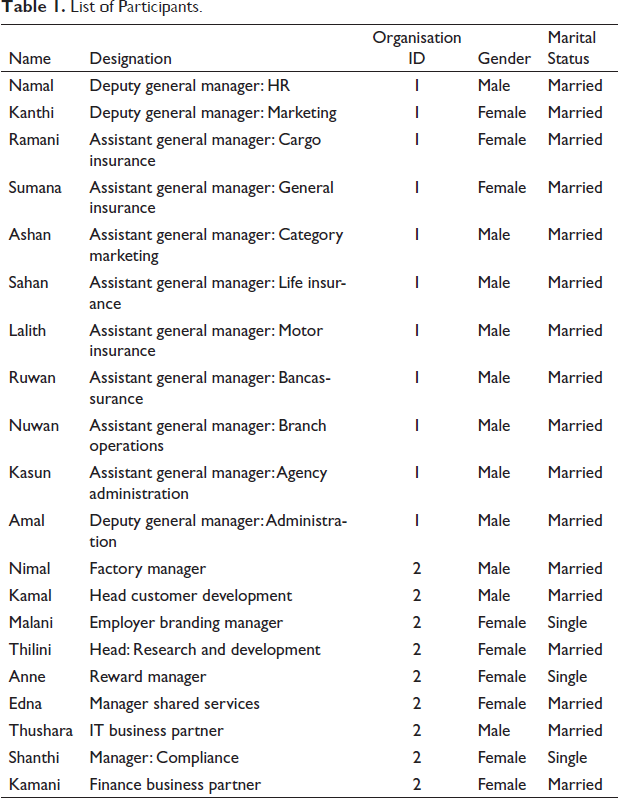
The 20 middle-level managers from the two companies were selected through an invitation process gaining their informed consent. First, all middle-level managers in two organisations were contacted and provided all necessary information about the study. Those who voluntarily agreed to participate in the interviews were then selected, ensuring functional variation. These managers were the key leaders in their respective functional areas of the organisation and were mainly responsible for managing their work teams and implementing strategies as directed by the top management. Accordingly, in company one, eight male managers and three female managers participated in interviews, while in company two, it was six female managers and three male managers. In Organisation 1, all selected participants were married, and in Organisation 2, three participants were single out of the nine interviewed. The names of the participants were pseudo-coded to protect their anonymity (see Table 1). All interviews were conducted in English.
List of Participants.
Data Analysis
Data were analysed inductively using the thematic analysis process introduced by Braun and Clarke (2006). First, we read all the transcripts to familiarise ourselves with data. Then, we developed the initial codes through a rigorous reading and analysis process. Once the initial code set was finalised, all three of us discussed and checked for the reliability of the initial codes. As a result, some codes were revised through a repetitive reading process. This process was carried out until the final set of codes was agreed upon. Then, the initial themes were developed linking the agreed set of codes to the empirical objectives of the study. These themes were then again discussed and revised collectively until the final set of themes was agreed upon. Accordingly, codes were finalised and categorised into five main themes.
Findings
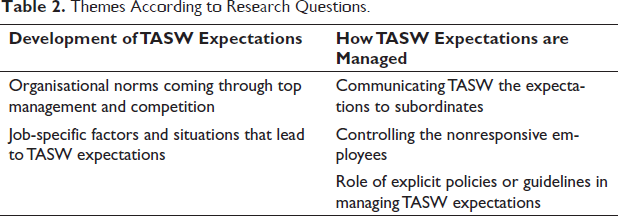
In the analysis of interview data, five main themes were identified (Table 2). Namely, (1) organisational norms coming through top management and competition, (2) job-specific factors and situations that lead to TASW expectations, (3) communicating TASW expectations to subordinates, (4) controlling the nonresponsive employees and (5) role of explicit policies or guidelines in managing TASW expectations. The first two themes primarily discuss how TASW expectations develop in an organisation, while the latter three discuss how these expectations are managed within the organisation. The verbatim excerpts that are presented below have been edited to correct grammatical mistakes where necessary.
Themes According to Research Questions.
Development of TASW Expectations
In both organisations, managers expected after-hour connectivity from their employees at varying levels. Even in the same organisation, different managers had different perceptions around after-hour work expectations (i.e., TASW) due to different contextual factors such as job role and situations they face. However, the primary factor leading to TASW expectations was the organisational norms developed through the influence of organisational leaders and market conditions.
Organisational Norms Coming through Top Management and Competition
Organisational norms related to TASW have a clear link to the development of TASW expectations in managers’ minds. In Organisation 1, TASW has become a part of organisational norms. As such, the managers believe that employees need to be available whenever they are required to do so. Such norms appear to be developed due to the competitive market conditions and top management influence on after-hour communications. In the modern world, customer expectations are rising, and to retain the customers organisations need to offer a higher value proposition to their customers. Hence, customers are considered as ‘kings’ within the organisational culture, and the formal and informal rhetorics are developed to respond to customer requirements anytime, anywhere:
Sometimes customer gives calls to us, anyway customer is king, they expect a favourable response from us. So, we can’t say we will [provide the] information tomorrow. They need the information now. If that’s the case, we need information now. In such a case, we need to contact subordinates after office hours. (Sahan, Organisation 1)
Subsequently, these market conditions would lead top management to promote after-hour work expectations. As top management is responsible for overall business success, they will highlight the importance of being responsive to customer needs as and when it arises. It was also clear from the participant responses that the top management attitude towards TASW will be a decisive factor in creating TASW norms at lower levels of the organisation:
If Chairman visited the branch during the weekend, so if he wanted to know when we are completing a project, If I don’t have the details. So, no choice. I have to contact my manager—branch operations [even during the weekend] … so it is a chain. (Amal, Organisation 1)
However, not all organisational leaders appear to believe after-hour communication is crucial to business success. For example, in Organisation 2, the top leadership does not set such expectations and managers also tend to follow the same behaviour:
As the leadership team, our directors don’t message you at the weekend. If she [director] is on leave, she keeps her phone switched off. She won’t call you, or she won’t allow you also to call her during her weekend. Some of the examples are set currently at the leadership level, which we also can follow. (Edna, Organisation 2)
These differences in participant responses clearly show that top management expectations and attitudes on after-hour communications play an important role in organisation-wide expectations of TASW. If the top management expects their next in line to be responsive to after-hour communications; in such a case, it may create a cascading effect on lower-level managers as the senior managers need the help of the lower-level employees to cater to the needs of the top.
Once these expectations start to cascade from top management to lower levels, it becomes part of the organisation’s normal routine, which will then be embedded into the organisational culture as norms. These norms will then be institutionalised in the organisational culture pushing all managers to adhere to such organisational norms without challenging them:
Sometimes we send a text requesting some information asking to check on [a] matter [saying] ‘please indicate a suitable time to contact you’. Then they contact you. Because it all depends on the culture you create. I firmly believe in that of course, it is the responsibility of the leader to create that culture. (Namal, Organisation 1)
However, in Organisation 2, where TASW is not promoted, it was evident that top management was not encouraging such behaviours from lower-level managers. In contrast, they were discouraging such behaviours actively. This attitude of the top management has developed an organisational culture, which discourages TASW norms within the organisation:
But I see a huge shift in that culture and also in the employees. Because [of] that culture, employees are reminded more of that culture through workshops [and] various sessions that we do. And also, the leaders are asked to kind of ‘walk the talk’ are making sure that they take charge. They set an example for their subordinates … in terms of making sure that employees are not disturbed after working hours. They don’t feel that obligation to respond after working hours. (Anne, Organisation 2)
TASW norms developed within the organisation have a clear link to the top management’s expectations, attitudes and behaviours towards after-hour responsiveness. These attitudes could vary from person to person based on their individual differences, such as the generation they belong to:
We have baby boomers as well who believe if someone sends an email at night, he is a great guy [and] committed, or if someone sends an email at morning 4 or 5 they believe he is a committed guy. (Kamal, Organisation 2)
The organisational norms promoting TASW will be further aggregated if the company has provided ICT devices to employees. Many companies today provide ICT devices such as mobiles, smartphones, laptops and cloud-based systems to employees to increase the efficiency and effectiveness of their work. Such facilities have reinforced the organisational norms on TASW or after-hour responsiveness:
Assistant managers and managers are given official smartphones, they are expected to respond anytime, any moment. Especially this has enhanced during this covid situations, and even other employees are given VPN connection to their personal laptops. (Ramani, Organisation 1)
TASW expectations from the employee will accumulate if employees are given the necessary ICT facilities to engage in TASW. Although both organisations have provided ICT facilities to their employees, it was only in Organisation 1 where managers assumed that providing ICT facilities means employees need to be responsive to after-hour communications.
Nature of the Job Role, Tasks and Situations That Lead to TASW Expectations
The development of TASW expectations in an organisation may vary according to the job role and the situational importance of the tasks performed by different employees. This means that even though all the employees use the same technological constellations in their organisation, the development of TASW expectations will depend on their job responsibilities and situational factors. Indeed, all managers will not expect their employees to be available via ICTs after hours, and the nature of the manager’s TASW expectations will depend on the situation and the job roles played by their team members. It was evident that some job roles will have more TASW expectations than others even in the same organisation and even in the same functional area:
It’s like this we are in the marketing function, and as you know, when we sit for interviews, when I faced interviews, I was clearly told it is not an 8 to 5 job. Marketing is not an 8 to 5 job, it is not a desk job. That [marketing profession] requires your attention substantial hours … there are times marketing team need to be alert … in case I need to reach them … they need to be available. (Kanthi, Organisation 1)
Jobs responsible for handling clients, marketing or sales would mostly require after-hour availability. Hence, managers in such departments expect their employees to be available to them even after-hours via ICT devices. Some jobs do not need TASW expectations as their work does not require 24-hour attention like marketing or sales functions. ‘In my area it is [a] bit different because we are not working 24 hours a day. For some of the other departments, this is relevant’ (Kasun, Organisation 1). Although both Kanthi and Kasun represent the same organisation, their expectations on after-hour connectivity are different.
In addition, the expected level of responsiveness of after-hour communications via ICTs depends on the importance and urgency of the task. Irrespective of the job or department you are attached to, if an important or crucial event takes place, managers will expect the employees to be responsive to communications even after hours. Such expectations will further aggregate if the situation needs to be managed immediately without delay:
If it is [a] very urgent case, we will send an email, and we will see whether we will receive a reply within 10 minutes or 15 minutes based on the matter; if you do not reply surely, I will give you a call. That’s how we are working. If it is a very urgent matter. (Sahan, Organisation 1)
Sometimes, if the employees are working with third parties, they need to adapt their protocols, leading some employees to engage in TASW. For example, these expectations would occur when they have system limitations related to shared systems with third parties:
My subordinate and my boss have to log in around 10 pm every day to release some orders. Not because they were working from home. That has been the case throughout. It is a system limitation we have. Because we are sharing a system. (Kamani, Organisation 2)
These are only applicable to employees associated with such parties and systems. For example, in Organisation 1, reinsurance teams need to be available after hours due to time zone differences with overseas reinsurance companies. However, it is important to note that even though such employees are required to be involved in TASW, they are not given flexibility in terms of formal working hours. Employees have to report to work during formal working hours, even though TASW is a mandatory part of their job role. ‘No specific flexibility as such, but that role has other benefits. They get to travel, they get to meet people, there is [a] difference in that sense’ (Sumana, Organisation 1).
There was a standard agreement among participants that during and after COVID-19 outbreaks in the country, TASW expectations increased significantly in their workplaces compared to the pre-COVID 19 era:
I clearly informed my staff that you have to answer anytime because this is a pandemic situation & you got the bonus and salary without any deductions. So, my idea is you have to answer the phone due to the present situation, but not earlier. (Kasun, Organisation 1)
Participants expressed they expected their employees to be more responsive towards work-related communications than before due to the unprecedented nature of the pandemic. Participants explained that they wanted more work from their employees than usual due to the lockdown and team members being infected with COVID-19. Further, the new technologies they adopted, such as Zoom, and MS Teams, have also enabled them to have meetings anytime they need, which they did not practice before the pandemic. Further, the COVID-19 restrictions forced organisations to move into work-from-home mode instantly without a proper plan or implementation policies, and employees had to decide how they put up boundaries between work and home:
Actually, that was a concern that arose as soon as the pandemic hit, where the employees had to move to a virtual environment. And certain teams were struggling with working hours, and specially if you have a family at home, it was difficult to define working hours. So, there was concerns that were brought up in terms of working hours and working on weekends and meetings running till late, sometimes 7 or 8 in the night. (Anne, Organisation 2)
As there were no guidelines for employees in deciding working hours and how to keep the communication lines, many employees had decided on their own working hours and boundaries between work and nonwork domains, which created a tense situation when different choices did not match.
How are TASW Expectations Managed?
The discussion thus far explained how after-hour technology-mediated expectations are developed in organisations. The next research question we need to answer is how these expectations are imposed and managed by the managers. Imposing TASW expectations starts when managers communicate such expectations to their subordinates. Once these are communicated, managers will monitor and control violators of TASW expectations. However, managers controlling behaviours will also depend on explicit guidelines on TASW within the organisation. However, the two organisations differed on how they managed the TASW of their employees. In terms of communicating TASW expectations, participants from both organisations expressed that they are communicating such expectations to their employees. However, the managerial approaches to control the nonresponders significantly differed in the two organisations due to the existence of explicit guidelines and the absence of organisation-wide TASW norms.
Communicating the TASW Expectations to Subordinates
Once the expectations of TASW are developed, managers seek to implement such expectations within their work teams. First, managers will communicate their TASW expectations either explicitly or implicitly. The communication process will start at the point of recruitment, where the potential candidates would be informed that they need to be available even after hours, setting the expectations of the newcomers. ‘Definitely. We are informing them. “This is a tough job, and you have to work after working hours. You have to be stand—by always” …’ (Kasun, Organisation 1).
Managers will further strengthen these expectations during day-to-day meetings and interactions with their employees. Some managers expressed that they explicitly communicated the requirements of after-hour availability to their subordinates. In contrast, another set of managers said that they do not directly communicate TASW expectations to their subordinates. They show the need for TASW requirements through their behaviour and implicitly indicate to their employees that this is the expectation of the job via team meetings and other discussions:
I won’t say ‘you have be online, you have to pick up my call anytime’. One thing I am saying to my team is [that] ‘I am a 24*7 guy, so if you have a problem, you can call me anytime’, so I am indirectly telling them, I might also call anytime. (Nimal)
These direct or indirect communications of expectations are often informal and not tied to formal policies of the organisation. However, the communication of TASW can be considered the first step of imposing TASW in a workplace. Such communications were visible in both organisations. Although TASW is discouraged in Organisation 2, managers expect their employees to be available when there is a requirement.
Controlling the Nonresponsive Employees
Once TASW expectations are communicated, managers of Organisation 1, expect their subordinates to follow the given tasks irrespective of the time and place. Further, if employees do not respond to after-hour work-related communications, managers will immediately develop a negative attitude towards them and then attempt to control their nonresponse by confronting and punishing nonresponsive employees. ‘My impression would be [that] they are a little bit not committed to work, I mean not attentive to their responsibilities and duties’ (Ramani, Organisation 1). Comparatively, in Organisation 2, many managers did not express that they would confront or punish the nonresponders, as seen in Organisation 1. Participants’ reflections on vignettes also revealed these attitudinal differences in managers. For example, in Organisation 1, managers expressed that nonresponse to after-hour work as a negative behaviour when they reflected on the employee nonresponse explained in the vignettes:
I would be disappointed, in the sense, I would feel he is not giving his due commitment to his job. Being he is a marketing guy and normally they should be contactable any time. (Ramani)
However, the reflections on the vignettes by the managers from Organisation 2 pointed out that they do not consider responding to after-hour communication immediately as an essential characteristic of a committed employee:
If I am the line manager. No. I won’t evaluate [performance negatively] because always line manager must understand … the family or the responsibilities that person will have. (Shanthi)
Once the subordinates do not comply with their supervisors’ expectations frequently, it could adversely affect their relationship with their supervisors as well as their performance appraisals. This strained relationship then leads to more negative consequences. However, if subordinates follow TASW expectations, they will be regarded as more committed towards their jobs. Nevertheless, the level of expectation depends on the organisational norms of TASW. In Organisation 1, where TASW norms exist, managers believe committed workers should always be available to the organisation. However, in Organisation 2, where TASW expectations are discouraged, a committed worker is not defined based on his or her responsiveness to TASW. For example, in Organisation 2, managers stated that they might not be negative if their subordinates are not responsive enough. Still, they attribute the nonresponse to the extra-role behaviour of the employee. These managers do not consider the TASW a core responsibility of the employees. Nevertheless, they consider employee responsiveness to after-hour communication as a means of showcasing organisational loyalty.
As soon as negative impressions are developed, some managers would confront the violators in order to re-establish their expectations of TASW. Hence, in the event of nonresponse, many managers of Organisation 1 will question the employees why they have not replied to after-hour communications:
I waited for 30 minutes. In WhatsApp you can see whether the receiver has read the message or not. So, I just kept on checking the message, the WhatsApp, whether they had read the message or not. So, until 30 minutes, they didn’t read it. So, what I had to do was I had to call them personally. Then I had to inform them that I had sent a message. (Amal, Organisation 1)
The above response from Amal shows how the materiality of ICTs has entangled with human aspects. The capability to monitor the recipient’s behaviour towards a message has reinforced the manager to confront the violator when expectations are unmet. However, it was noted that managers did not immediately move into punitive regimes for random nonresponsiveness. They will provide verbal feedback when employees are not responding to after-hour communications first. ‘First what we do is we advise them, we do not contact you frequently after office hours if there is an urgency matter only we contact you. in such case we advise them that’s the procedure we follow’ (Sahan, Organisation 1).
Managers will move into a punitive regime if the nonresponse becomes a pattern. Some managers explicitly mentioned that habitual nonresponse would be noted in the next performance appraisal. Employees who are less responsive to after-hour communications will receive a lower performance rating if their managers establish and communicate such expectations:
If the staff member does not respond to something urgent that I have asked him or her to respond to, and that would have dire consequences to the company, then, of course, I will give chances, but definitely, it will be a KPI in the appraisal. (Kanthi, Organisation 1)
Further, nonresponse could lead to more severe repercussions such as nonrecommendation for promotions and transfers. ‘It will affect them in a way when they face promotion interviews also. I have to comment on their performance. It will come into light in such instances when they are facing a promotion interview’ (Ramani, Organisation 1).
The above remarks of Ramani and Kanthi show that noncommitment towards TASW requirements of the managers could lead employees to face severe negative consequences. In the absence of formal guidelines, these consequences could vary from manager to manager based on their level of expectations towards TASW and leadership styles. Such consequences could be more challenging to employees who have domestic responsibilities, as they may find it hard to respond to after-hour communications due to commitment in nonwork domains.
Further, most male managers perceive that female employees tend to be in the nonresponsive category if they are married. This perception may lead managers to engage in discriminatory practices against married female employees. When managers hold traditional gender norms, they appear not to expect female employees to engage in TASW, as they inevitably appear to expect married female employees to give priority to chores of the household and family. These stereotypes were more visible in male managers of Organisation1 compare to Organisation 2:
Especially, if they are married, most of the husbands, they don’t like to see their wives connected to the office, after office hours because [they are engaged in] day to day activities, what they do after office hours, stuff at home [domestic responsibilities]. (Nuwan, Organisation 1)
Not only married female employees, but also in general, participants agreed that the response level of female employees is less compared to male employees after-hours. Further, male managers tend to contact female employees less after hours due to cultural norms related to night-time communications between opposite genders. These attitudes will lead female employees to be perceived as low performers by the managers and face negative consequences of nonresponsiveness to after-hour communications (e.g., low performance ratings during performance appraisals).
At the same time, the participants seemed to believe that if females want to keep up with managerial expectations, they need to work as males without considering their family responsibilities. ‘Because my only female supervisor, she works as a male’ (Nimal, Organisation 2).
If females’ ‘work as men’, managers will develop a positive attitude towards them. Such female employees would not face any negative consequences related to nonresponsiveness, such as lower performance ratings and nonrecommendations for promotions. Hence, female employees will have to face a dilemma when attempting to balance careers and family under these expectations of their managers. The above gender stereotypes of managers will also lead them to recruit more male employees to their teams than female employees, especially if their job roles involve significant TASW. Hence, it will create gendered discrimination towards female employees in the recruitment process as week as during performance appraisals. ‘If I am recruiting people for my department, most of the time I try to recruit male employees’ (Kasun, Organisation 1).
From the above response, it is clear that TASW expectations could be challenging to female employees. They would be automatically treated as a nonresponsive category by managers, and such perceptions would lead to discriminative practices in the workplace. However, it is interesting to note that these discriminative perceptions were mostly held by male managers compared to female managers. In fact, female managers expressed that they don’t see much difference between the two genders when it comes to responding to TASW.
Role of Explicit Policies or Guidelines in Managing TASW Expectations
One of the most critical findings in this study is how explicit policies or guidelines will affect the overall management of TASW. It seems that managers are expecting some clear guidance or policy implementation as a vital requirement in managing TASW expectations of their employees. Such policies seem to clearly influence employee well-being and reduce negative consequences associated with nonresponse to TASW requirements. According to participant responses, Organisation 1 does not have any explicit policy or guideline about TASW. However, Organisation 2 has developed explicit guidelines to assist employees and managers in managing TASW expectations:
I think this is there, recently, our organisation landed three rituals related to work–life balance … and we landed another ritual to work on our well-being. So right now, more and more employees take this [TASW] as well-being matter, and you need to respect the privacy and time of the employees. (Malani, Organisation 2)
Further, it was clear that Organisation 2 has also developed policy guidelines to ensure gender equality at workplaces, which has mitigated the challenges associated with female employees. This was also visible in participant reflections. In Organisation 1, managers were outright in expressing their preference for male employees over female employees, which was not observed in the responses of participants from Organisation 2.
Having formal policy guidelines helps managers establish parameters related to TASW requirements within the organisation. This leads managers to adopt a more consistent approach to managing TASW requirements in their work teams. Organisation 2 has also ensured that these guidelines on TASW are effectively implemented. The company has also developed monthly well-being surveys to allow employees to voice their work–life balance issues, such as TASW. These surveys are also used to measure the performance of each departmental head or team lead. Due to this follow-up process attached to the policy guidelines, managers seem reluctant to impose punitive regimes in case of nonresponse:
Because we have to monitor emotions and work–life balance, people’s attitudes towards the company and work as well. We have our monthly surveys, if someone is not happy or not really happy with the work–life balance due to work that I am giving, they can report and also it will not be a good mark to the department as well. (Kamal, Organisation 2)
Clear guidance on TASW makes managers reconsider how they impose after-hour communications and connectivity requirements within their respective teams. Thus, policies will also discourage managers from engaging in any discriminatory practices towards employees who do not respond to after-hour communications. Further, policies in the long-term would lead managers to reduce their TASW expectations.
According to participant responses, Organisation 1 has not established similar policies or guidelines as Organisation 2 in managing after-hour TASW expectations. Organisation 1 managers iterated that having such a policy would help them to manage TASW expectations more effectively. Especially, they mentioned that without a policy, these expectations are interpreted by different managers in different ways. A policy would help the organisation have a more unified approach to managing the TASW expectations:
If we have a policy or a guideline, I believe that will definitely help. Because otherwise, people can interpret it in a different manner. When things are black and white, of course, it always gives the same meaning. (Namal, Organisation 1)
The need for specific policies on managing TASW is crucial, especially in a context where TAWS expectations are rising with the pandemic-induced remote working regimes.
Discussion
Using 20 senior-level managers of two organisations in Sri Lanka, this study investigated how technology-mediated after-hour availability expectations (i.e., TASW) are developed in an organisation and how managers in their respective workplaces manage these expectations. We found that top management influence fuelled by competitive market conditions has created organisational norms, which leads to TASW expectations at workplaces. These norms are then imposed within respective work teams by managers where nonresponses will be controlled by means of confrontations and punishments.
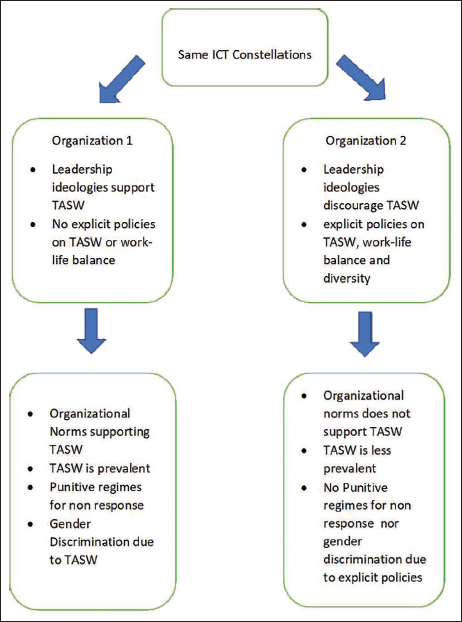
As society has entered an information-driven era, ICTs are playing a vital role in the world of work. ICT devices such as smartphones have enabled people to stay connected without time and place barriers, making boundaries between work and nonwork domains blurred. However, it is not technology alone that contributes to these blurred work–life boundaries; technology is entangled in social elements such as leadership, organisational norms and expectations of organisational stakeholders and situational factors, creating a more complex web of relations resulting in more after-hour work engagements (i.e., TASW) (Orlikowski, 2010). Our thematic analysis showed that TASW expectations had become a common phenomenon in workplaces today. Many managers expect employees to be available to the organisation virtually, even after hours, at varying levels according to their departmental needs. Further, the findings showed that the two organisations we selected significantly differed in terms of TASW expectations and how they manage such expectations though both organisations use the same technological capabilities (Figure 1). These findings corroborated with the theoretical underpinnings of sociomaterial theory. Hence, TASW is sociomaterial phenomenon and depends on the constitutive entanglement of organisational elements and ICTs. These findings further support the propositions of Capitano et al. (2019) that leadership, culture and policies of organisations influence the boundary permeability of employees due to after-hour work expectations.
Sociomaterial Nature of TASW Experiences.
Fierce competition is inevitable in the modern business world due to globalisation and information technology (Paul & Rosenbaum, 2020). In such market conditions, organisations need to be customer-focused, as the slightest dissatisfaction can cause customers to move into competitors. Accordingly, organisations need to be highly responsive to customer requirements than ever before. Many customers expect organisations to give them a timely service. Such expectations are further strengthened due to enhanced connectivity created by ICT devices such as smartphones and will push organisations to expect their employees to connect with the organisation/customers even after-hours. Findings of this study also revealed that customer expectations could create after-hour work expectations in organisations.
Once responsiveness becomes essential to serve customers anytime and anywhere, top management will indicate such needs to their next managerial levels. Participants of this study agreed that the top management played a vital role in TASW expectations. This may be especially applicable to high power distance and collectivist cultures like Sri Lanka (Kailasapathy et al., 2014; Kailasapathy & Metz, 2012). In such cultures, people unconditionally accept the expectations stem from hierarchy, and often individuals who disobey such expectations from higher authorities would be regarded as disrespectful (Allen et al., 2020). Once these expectations are grounded by the leadership, consequently these expectations become norms of organisational culture (Capitano et al., 2019).
However, it was apparent in the findings that if organisational leaders focus on the employees’ well-being and believe that 24-hour responsiveness does not lead to business success, TASW expectations will become much lower and less institutionalised as norms in the organisational culture. In such organisations, we will see fewer TASW expectations cascading down to lower levels of management. In this milieu, it is important to highlight that the differences in individual attitudes and beliefs of the organisational leaders could play an important role in TASW. Especially, individual differences among leaders, such as the generation they belong to, gender, and work ethics, could lead to how they see their employees’ work–family balance and the organisation’s business success.
Our analysis of participant responses pointed out that TASW expectations will also significantly depend on the job role, even within the same organisation. For example, jobs such as marketing and sales where they need to engage with customers directly will have more after-hour communication expectations than other jobs. This also applies to job roles that deal with external stakeholders such as suppliers. In such circumstances, they have to align with the requirement of such stakeholders, which may lead to TASW. In addition, TASW norms will be further strengthened if organisations have provided mobile ICT devices and facilities to employees. Moreover, our analysis showed that TASW expectations have significantly increased due to the remote working modes adopted due to the outbreak of the COVID-19 pandemic.
As TASW expectations become a part of organisational norms, our analysis suggests that managers seek to impose such requirements on employees by communicating such expectations to their subordinates during the recruitment stage or day-to-day conversations. Accordingly, managers expect employees to be responsive to after-hour communications without hesitation. Employees who violate such norms are regarded as less committed to their job. Hence, the violators of TASW expectations will build a negative impression in their managers’ minds, leading to negative outcomes for employees such as lower performance ratings and fewer recommendations for promotions. Such punitive regimes could pressure employees to engage in TASW even if they do not prefer to do so. Ultimately this will elevate work–life conflict and reduce the well-being of the employees (Eichberger et al., 2021; Kao et al., 2020; Terry & Mathews, 2021).
Our analysis further revealed that such actions by managers could create a discriminative effect on female employees due to gender stereotypes. Such effects would be more prominent on married female employees. In traditional countries like Sri Lanka, married females are expected to perform household duties even when they are employed. In such circumstances, on one hand, female employees will be less receptive to after-hour communications from the workplace as they are expected to devote their time to home, especially after working hours. This could lead female employees to experience more work–family conflict than male employees (De Alwis et al., 2022). On the other hand, managers may not contact married female employees due to the gender stereotypes they hold, even if married female employees are willing to respond to TASW requirements of the organisations. Accordingly, married female employees will be at a disadvantage compared to male employees, as they could not meet the TASW expectations of managers or the perception that they may not meet such expectations. This is reflected in participant responses, especially male managers who explained that they are reluctant to recruit female employees due to the family responsibilities of female employees. Further, due to gender norms of the culture, contacting female employees after-hours seems to be perceived as inappropriate by male managers, which could again contribute to female employees being perceived as less responsive to TASW irrespective of their marital status. Eventually, female employees may have to intentionally show that they are also ready to work anytime, anywhere like their male counterparts. These cultural and social norms could also be a substantial reason for the declining female labourer participation in Sri Lanka. Nevertheless, findings showed that if an organisation has policies to protect workplace diversity, such discriminative effects could be minimised.
The institutionalisation of gendered norms is a key factor that decides a manager’s behaviour; in organisations where masculine values are upheld and maintained, managers tend to follow the norms that create inequalities between genders (Acker, 1990; Martin, 2004; Risman, 2004). In such organisations career progression of female employees depends on how female employees uphold masculine values in the organisation. This means that female employees in a male dominated organisation are required or forced to adhere to the masculine values institutionalised in the organisation in order to progress in their career ladder (Risman, 2004). Hence, female managers will display similar masculine values when they reach the top level in order keep up with their male counterparts. Our findings also showed that irrespective of their gender, managers follow the after-hour expectations of the organisation as such values have been institutionalised by male dominant hierarchy. However, male managers seem to be more outright in expressing their gendered norms compared to female managers.
One of the most important findings of the study is the role played by explicit policy guidelines related to TASW expectations at the workplace. It is apparent that the existence of policies and guidelines within the organisation could help managers to handle TASW expectations more carefully. In fact, such policy guidelines will have a controlling effect on TASW expectations of managers and any negative consequences towards employees. Moreover, such policy implementation should be supported by top management. The active engagement of top management in TASW policy implementations will ensure that such policies transfer into organisational norms and become part of organisational culture.
Theoretical Implications and Avenues for Future Studies
Theoretically, this study enhances the knowledge base of work–life boundary research by providing insights from a managerial perspective. We specifically examines how technology has influenced work life boundaries of employees through after-hour work engagements. The result of the study shows that technology alone cannot influence the after-hour work engagements (i.e., TASW) of employees. The same constellation of technologies in the same organisation can have a varying effect on employee TASW experiences based on different contextual factors (Cecez-Kecmanovic et al., 2014; Ollier-Malaterre et al., 2019; Orlikowski & Scott, 2008).
Our results further indicate that factors such as competitive market conditions, organisational norms, top management influence, job roles and situations could contribute to developing TASW expectations in organisations. Future research in this area can study these factors more in-depth, using diverse organisational settings. More specifically, future studies in this area could dig deeper into the role of leadership in the development of TASW expectations, taking bases such as leadership styles, work values and generational differences. Moreover, more specific studies could focus on situational factors that lead to TASW expectations. Specifically, future research could look into how TASW varies in situations such as organisational change taking place (e.g., mergers, takeovers, etc.).
Further, this study uncovers how managers impose TASW expectations on their teams and how they react in case of nonresponse to TASW expectations. As many of the studies have uncovered employee experiences regarding TASW experiences (Carvalho et al., 2021; Eichberger et al., 2021), this study advanced the current knowledge base on the work–life boundary area by providing how managers behave and react towards the TASW behaviours of employees. Further, the results of this study are also crucial to gender discourse in work–life boundary studies. More studies are needed to focus on how females are experiencing TASW expectations at the workplace and how such expectations could affect their career progression. More importantly, this study also opens a new research avenue in work–life studies on the application of organisational policies in technology-mediated after-hour work engagements. Policy studies in this area are very limited and could be of significant value if such research could be done in various organisations operating in different contexts.
This study also reiterates that technology is not an exogenous factor that can independently affect the work–life experiences of people. Hence, technology has entangled with human factors such as culture, preferences and choices, creating a complex web of relations (Orlikowski, 2007). The findings of the study reflect that even though the same constellation of technologies are used in both Organisation 1 and 2; how TASW expectations are developed and managed are different due to organisational differences such as leadership ideologies, norms and explicit policies to protect the work–life balance of the employees. Even within the same organisations, based on different job roles and situations, TASW expectations differ. Yet, TASW will not be in existence if ICTs are not there. Hence, TASW experiences of employees are an outcome of the constitutive entanglement of ICTs with socio-organisational factors. These findings reiterate that the work–life experiences of employees today are sociomaterial.
In today’s workplaces, technology is an inevitable factor that influences organisational functioning. Hence, researchers cannot assume that technology does not influence organisational practices and experiences. As such, work–life boundary studies need to inculcate the omnipresence of ICTs in employee work-boundary experiences. Assuming technologies are absent in work–life boundaries and studying the social, organisational and institutional contexts will not give a clear picture of work boundary experiences. In such a milieu, sociomaterial theory could help researchers uncover more vital knowledge about organisational discourses such as work–life boundary practices and the impact of national and organisational cultural elements in work–life boundary research. The findings of this study showed organisational and social norms have changed due to the entanglement of technologies. Our findings further support the suggestions by Ollier-Malaterre et al. (2019) on the importance of culture in work–life boundary experiences and the concept of digital cultural capital. Further research in these areas would be vital to enhance the knowledge of work–life boundary experiences in a technology-driven era.
Practical Implications
The findings of the study provide interesting insights to organisational leaders on TASW requirements of organisations. It seems that it is important to consider TASW requirements of employees formally in the people management agenda of organisations. This is especially applicable to a post-covid situation; many organisations now have implemented work-from-home arrangements to cope with health restrictions imposed by health authorities. However, many organisations seem to have implemented such arrangements without proper planning and consultation with employees. The findings of this study revealed that establishing formal policies and guidelines would help organisations reduce the negative influences of TASW engagements on employees’ work–life experiences. These formal policies could cover which circumstances and for what extent after-hour work-related communications or TASW could be used by managers. Further guidelines could cover how managers should treat nonresponse for after-hour communications. More importantly, formal guidelines should also specify how TASW will be recognised in the organisation’s performance evaluation.
Such policy guidelines will assist managers in managing the TASW expectations on their respective teams more effectively. In addition, when developing such policy guidelines, organisations need to consider all stakeholders and create a win-win situation for all stakeholders of the organisation. In such an approach, organisations can break the possible gender discrimination that could arise due to TASW expectations of the organisations. In implementing such practices, it is vital to gain the support of top management, as top management attitudes play a vital role in organisations’ overall TASW engagement levels. On a more macro level, governments should also rethink the applicability of labour laws related to working hours; many of these legal enactments support physical working conditions and do not account for any virtual work engagements.
Conclusion
In conclusion, through the perspective of managers, this study attempted to understand how TASW expectations are developed and managed in organisations. The findings of this study emphasise that formal recognition of TASW engagements at workplaces are important as virtual work arrangements are increasing over the years. Due to punitive regimes associated with nonresponse to TASW expectations, employees seem to have no choice but adhere to after-hour work. Thus, the TASW expectations force boundaries between work and nonwork domains to be blurred, thereby increasing the work–life conflict of employees. Theoretically, this study expands the empirical base on work–life boundaries by uncovering potential antecedents that contribute to developing TASW expectations in workplaces and providing insights into how these expectations are imposed and managed in organisations. Moreover, this article gives insights about TASW and how it is managed in collectivist and power distant cultures in South Asia, as much of the literature in this area is coming from western cultures this paper is valuable addition to current empirical base. Furthermore, these contextual insights from South Asian region would assist HR practitioners in the region to take TASW as an important issue in their people management agenda.
However, these findings should be applied carefully, as this study has only focused on two Sri Lankan organisations. Although the researchers have clearly informed the anonymity of the organisations and participants in the study, some participants may not have revealed the factual situation of their organisation in order to protect themselves and the organisation. However, it is noteworthy that most participants were enthusiastic and openly engaged in the interview process, sharing their perceptions and experiences in their respective organisations. Although the organisations we studied belong to two different sectors, we did not investigate industry differences in this study per se as our sample mainly represented managers who primarily handle office employees. Hence, it did not represent the full picture of the two industries’ unique features.
Footnotes
Authors’ Note
The author Sulakshana De Alwis is now affiliated to Division of Accounting, Business & Management, Abertay University, United Kingdom.
Declaration of Conflicting Interests
The authors declared no potential conflicts of interest with respect to the research, authorship and/or publication of this article.
Funding
The authors received no financial support for the research, authorship and/or publication of this article.
