



Abstract
Apprenticeships are crucial in the ILO’s decent work agenda and align with sustainable development goals. While existing scholarship underscores the relevance of specific programme features for stakeholders’ outcomes, scant attention has been paid to the HR actors’ agency in shaping the programmes. Our process study delves into a customised apprenticeship programme for temporary workers in an Austrian manufacturing firm, aiming to uncover how HR actors influence apprenticeship outcomes. Adopting a convention theory approach, we examine HR actors’ evaluations during the programmes’ realisation and their implications for consolidation or conversion of programme features. The findings reveal a range of gains and unfulfilled aspirations, particularly for employee representatives. We attribute these outcomes to HR actors’ commitment to convention-based practices, which are more salient during the recruitment and training phase than after the exam. We conclude that how HR actors value apprenticeship shapes for whom an apprenticeship programme is valuable.
Keywords
Introduction
Apprenticeship refers to all remunerated training programmes consisting of both on-the-job and off-the-job learning that enable employees to acquire the competencies to work in an occupation and lead to recognised credentials (ILO, 2023: 58). While apprenticeships are traditionally discussed as measures for fighting youth unemployment and advancing national development and competitiveness; (Cooke, 2005; Streeck, 1989) they experience increasing attention in connection with reskilling and upskilling in human-centred HRM and decent work (DW) debates (Cooke et al., 2022; ILO, 2019). Apprenticeships can significantly contribute to realising the DW agenda (Streeck, 1997, 2005) and thus to United Nation’s Sustainable Development Goal (SDG) No. 8. Up and reskilling means capacity for employees to increase their prospects for higher pay and better work conditions. This additionally implies portable competencies that enhance employees’ career opportunities in an occupation beyond a single employer and protection from unemployment (e.g. in case of workforce reduction). The remuneration during training programmes helps low-income employees to invest in competence development, which is fundamental for promoting ‘life-long learning for all’ (SDG 4).
It is well documented that the features of actual apprenticeship programmes differ considerably. For example, some programmes focus on employer-relevant competencies while others focus on general competencies (Brockmann et al., 2008). Single employers can manage training or involve other institutions (Imdorf and Leemann, 2012), and funding can range from employer responsibility to public financing (Markowitsch and Wittig, 2022). Against this background, it is essential to understand to what extent specific apprenticeship programmes can contribute to the realisation of DW. Current research suggests that outcomes of apprenticeship programmes vary across national skill formation systems (Busemeyer and Trampusch, 2012), administration (Rauner et al., 2010) or training logics (Markowitsch and Wittig, 2022), assuming that institutional frameworks define particular purposes for apprenticeship.
This paper aims to understand how HR actors influence apprenticeship outcomes and contribute to DW agenda and SDGs. We specifically ask a two-pronged question: First, how do HR actors’ coordination and evaluations shape features of apprenticeship programmes? Second, what are the implications of the programme’s contribution to the DW agenda and SDGs.
We apply a convention theory approach to vocational education (Imdorf and Leemann, 2023). This approach conceptualises conventions as principles that allow actors to agree on the classification and interpretation of situations and enable the valuation of actions taken in those situations. We apply this approach to analyse the case of an apprenticeship programme in Austria tailored for temporary workers trained at the production site of a manufacturing firm and focus our analysis on the actors’ responsibility for the programme conceptualisation and realisation: human resource managers of the manufacturing firm, temporary work agency manager, the training institute and employee representatives referred to collectively as HR actors. Convention theory assumes the coexistence of a plurality of conventions (Brandl, 2023), thus allowing us to understand the mechanisms (called ‘valuations’) through which institutional actors consolidate or change consequential programme features and to shed light on the implications of the choices for programme’s realisation. On this basis, the study shows how actors’ situated agency triggers dynamics and influences the programme outcomes, DW agenda and SDGs.
We organise the article as follows: We first outline the DW agenda and the role of apprenticeship in reskilling. Second, we elaborate on extant explanations for apprenticeship outcomes and the rationale for focussing on institutional actors. Then, we present our theoretical approach and how we apply it to the case setting. Building on a chronological presentation of the programme, we theorise the activities to present an empirically grounded model to show how actors situated agency shapes outcomes and long-term consequences. We conclude by highlighting the study’s contributions, research implications and take-aways for practitioners.
Decent work agenda, sustainable development goals, and the role of reskilling
DW refers to work that respects the human rights of workers through the provision of fair wages, safe working conditions, and social protections and offers development opportunities (Zambelli et al., 2023). The International Labour Organisation (ILO) adopted the DW agenda as an institutional initiative to counteract the decline of work and employment. To this aim, ILO defined that its primary purpose was to ‘promote opportunities for women and men to obtain decent and productive work, in conditions of freedom, equity, security and human dignity’ (ILO, 1999: 3). The agenda outlines four strategic objectives; (a) employment creation, (b) social protection (c) rights at work and (d) social dialogue. These objectives orient actors, directing their efforts and initiatives towards advancing the DW agenda. The United Nations (UN) 2030 agenda has integrated the DW objectives and underscored the significance of (decent) vocational education across multiple SDGs, particularly SDG 8 (Decent work and economic growth, e.g. targets 8.5, 8.6 and 8.8) and SDG 4 (Quality education, e.g. targets 4.3–4.5).
A fundamental element of the DW agenda is the ILO call for a human-centred approach with ‘people and the work they do at the centre of economic and social policy and business practice’ (ILO, 2019: 11). The approach outlines three pillars of action; increasing investment in people’s capabilities, in institutions of work and decent and sustainable work. This approach recognises reskilling and upskilling as a significant measure for lifelong learning and crucial for achieving the DW agenda and SDGs. Apprenticeships, due to their bridging capacities between education, training systems and the world of work, are increasingly conceptualised as an applicable solution to the reskilling of existing workforces (Cooke et al., 2022; Markowitsch and Hefler, 2018; McCoshan and Markowitsch, 2022). In the next section, we review the institutional context for apprenticeships and elaborate on variations in apprenticeship features.
The institutional context for apprenticeships
There are two major approaches to defining the institutional context of apprenticeship programmes. The first approach conceptualises institutions as regulatory frameworks at the national level (Busemeyer and Trampusch, 2012; Rauner et al., 2010). In this tradition, outcomes of apprenticeship programmes are understood as ‘deeply embedded in the national production, labour market, industrial relations and status systems’ (Bosch and Charest, 2008: 430). For example, drawing on varieties of capitalism literature, Trampusch (2010) distinguishes between knowledge-based and skill-based apprenticeship systems to identify cross-national differences in the primary purposes of apprenticeship. The emphasis of knowledge-based systems associated with the DACH countries (Germany, Austria and Switzerland) is on enabling education for a lifelong career and leading to transferable competencies (Busemeyer and Trampusch, 2012). In contrast, skill-based systems prevalent in the Anglo-Saxon world place primacy on the qualifications defined by employers that enhance an individual’s company-specific skills (Brockmann et al., 2008). The second, more recent approach draws on the institutional logics research tradition (Thornton and Ocasio, 2013). In their typology of apprenticeship programmes, Markowitsch and Wittig (2022) suggest four training logics that differ in key purpose and responsibilities with regard to content, organisation and financing of apprenticeship programmes. Depending on the training logic, the key purposes for learners can be (a) integration into a professional community, (b) fulfilment of enterprises’ skill needs, (c) personal development and citizenship or (d) reintegration into the labour market. The logics are ideal models, meaning that the framework offers analytical space for capturing the empirical variety of programme features and outcomes across and within one national setting (Markowitsch and Hefler, 2018).
While both approaches view institutional actors as integral elements of their frameworks, they pay limited attention to the activities of these actors in shaping the purposes and outcomes of programmes. This is surprising because the multilateral governance of apprenticeship systems requires the coordination of multiple actors whose perception and interpretation of their space for manoeuvre can differ fundamentally. Coordination of actors involves the navigation of overlapping and divergent aspirations (Bosch and Charest, 2008) and coalitions (Busemeyer, 2012). It can involve conflict and even failure of programmes (Peliz et al., 2021). In addition, the coexistence of several apprenticeship logics (Markowitsch and Hefler, 2018) and changes in traditional institutional models (Thelen and Busemeyer, 2012) can reveal opportunities for change exemplified in Austria opening up and institutionalising an alternative pathway to higher education (‘lehrausbildung’) for young people without regular apprenticeship positions (Pernicka and Hefler, 2015). Acknowledging these possibilities, apprenticeship research has given greater attention to the institutional actors’ purposeful activities, referring to concepts of institutional work or entrepreneurship (Nicklich and Fortwengel, 2017) and the circumstances permitting these activities. For example, studying the transfer of apprenticeship to the United States, Fortwengel and Jackson (2016) suggest consideration of the role of networks in understanding the manoeuvring space of institutional actors.
Through a convention theory approach, we can integrate institutional models of apprenticeship and the agency of institutional actors to understand how coordinating actors influence the outcomes of apprenticeship programmes through their valuations. This approach is explained below.
Conventions, valuations and the dynamics of apprenticeship programmes
Convention theory’s approach to explaining outcomes of apprenticeship shares the pluralist underpinnings of the Harvard model that actors operate in a complex world with multiple stakeholders and outcomes (Beer et al., 2015; Brandl, 2023). Convention theory recognises the coexistence of conventions and thus provides actors with a repertoire of legitimising systems for their actions. The approach revolves around two interacting concepts: convention and valuation. A convention is a set of established principles that allow individuals engaged in collaborative projects to agree on the characterisation of situations and (judge the quality of) things and people involved in these situations (Chiapello and Gilbert, 2019: 119). For vocational training, where a plurality of ways to act fairly and evaluate programmes’ quality are possible, a convention constitutes a set of internally consistent components, that is, principles and valuations (Imdorf and Leemann, 2023). A principle defines the nature of quality and justice and instantiations of this principle, such as knowledge relevant to realise the principle, the nature of relationships between actors, and appropriate forms of learning and training. Valuation refers to the mechanism through which actors seek to affirm or question the convention in a given situation (Bourguignon and Chiapello, 2005). They can be performed as practices by actors making an explicit judgement on the situation (e.g. critique) or by interacting (e.g. with tools) in ways that the convention materialises for coordination. There are two types of valuations: reality and normative valuations. In the reality valuation, actors evaluate whether an established convention is appropriately applied because involved actors assume unanimous consent about applying said convention. In contrast, for normative valuations, actors assess whether the established convention is appropriate to a situation, thus challenging this convention.
The two types of valuations are useful for understanding how actors seek to influence outcomes throughout the execution of collaborative activities. With the reality test, they can consolidate the convention in a given situation by removing features that hinder delivering a desirable outcome. Conversely, with the normative test, actors can promote the inclusion of features (e.g. tools, assessment criteria) into collaborative projects that expand or replace the established convention in the situation. Principles and valuation thus provide deliberative space for analysing how features of apprenticeship programmes that go beyond the emphasis on labour market, welfare state, etc., evolve.
How do we apply these conceptual tools to our study? We understand an apprenticeship as a chain of interlinked situations equipped with convention-based practices and related ways of defining fairness and quality. The convention enables actors to handle uncertainties regarding the nature of criteria and tools suitable for the recruitment and selection of candidates, who ought to be involved in conducting training and what a proper examination looks like. In addition, the convention allows them to evaluate their activities and tools at any time of the programme’s realisation. The specific convention is informed by the toolkit of convention-based practices available to actors and accepted principles. For Austria, key principles embodied in apprenticeship have traditionally been occupational expertise (industrial convention) and social fit (domestic convention). For instance, they are manifested in employers’ central role in selection and training and confirmation of qualification based on standardised exams. However, convention theory insists that principles and their associated practices are always fragile (Brandl, 2022). Convention-based practices create a specific hierarchy among actors, and actors can reflect their status in this hierarchy (Brandl, 2023). Here, valuations come into play: By how actors approach a situation, they can influence the outcomes of apprenticeship for stakeholders. The critical question is, therefore, what type of valuations actors perform and whether these valuations influence outcomes.
In convention theory, a central question concerns the enabling mechanism for valuations. The pragmatist standpoint of convention theory (Diaz-Bone, 2011) suggests that actors can use different valuations depending on what they consider to be practically useful. For instance, when actors regard convention-based selection practices as crucial for the quality of an apprenticeship programme, they may withdraw from changing or softening these practices. Conversely, if actors have fewer concerns with meeting the convention-based practices, they may seek to modify these practices. Hence, the agency of actors is conceptualised as situated. Adopting this pragmatist stance to our study, we aim to enhance our understanding of the mechanisms for maintaining or altering conventions.
Research setting
The research setting is an apprenticeship programme for the Process Technician vocation in Austria tailored for employees of a temporary work agency (hereafter Temp R) on assignment at an incumbent manufacturing company (FutureCo). The initiative for the programme emerged as Temp R sought to strengthen its business relationship with FutureCo, which increasingly faced shortages of skilled workers for the three-shift work schedule in production departments. A key challenge was the duration and remuneration of the regular apprenticeship programme for Process Technicians (at FutureCo), which would have been impossible for Temp R’s employees to attend. It led Temp R and FutureCo to propose a customised programme. Table 1 shows differences between FutureCo’s regular apprenticeship programme and the customised programme from the perspective of apprentices.
Differences between the regular and customised apprenticeship programme from the perspective of an apprentice.
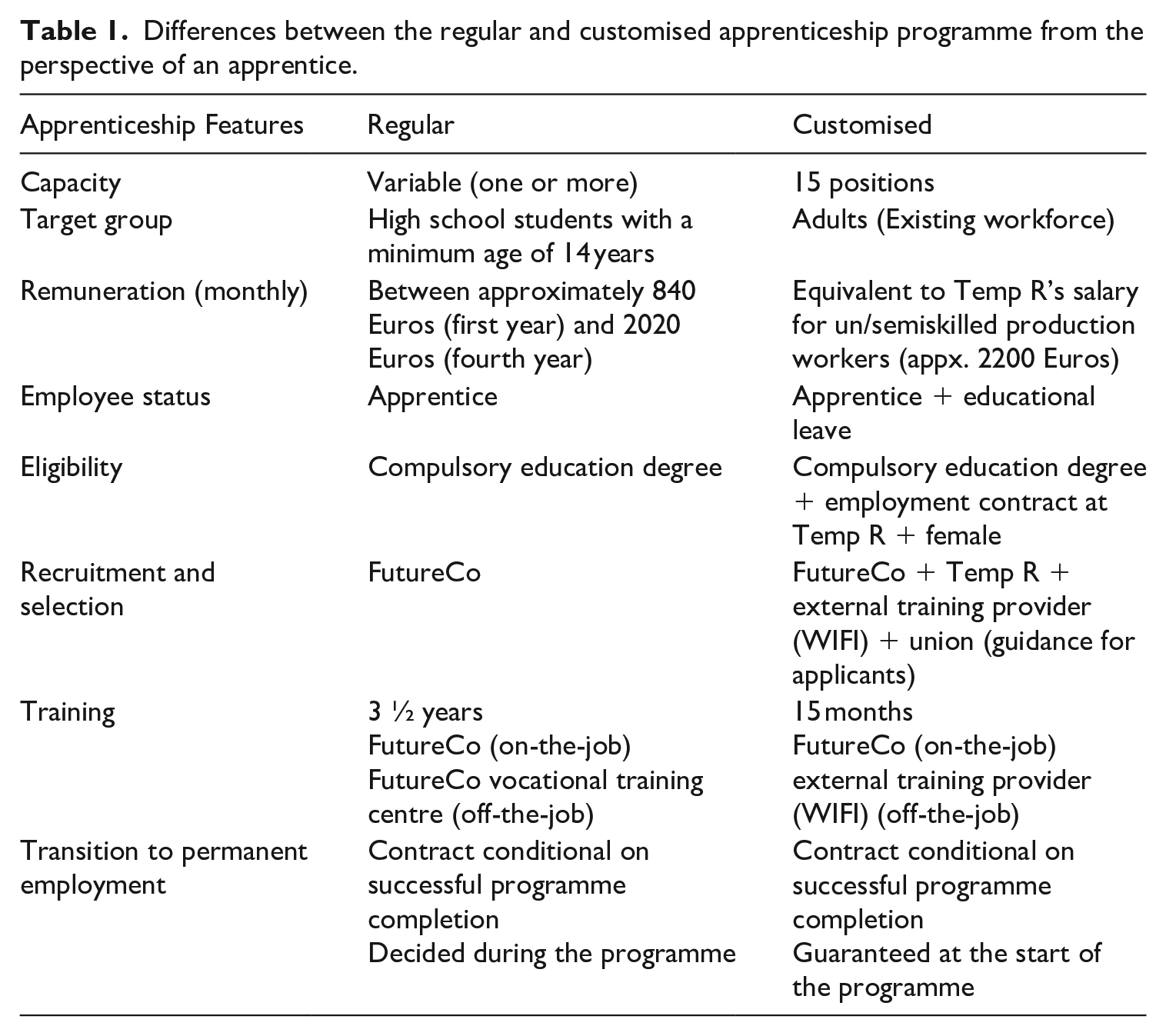
A key difference for participants is that the training duration is condensed and that they retain their current significantly higher remuneration. This is because programme participants would be entitled to unemployment benefits from the National Employment Service Agency (‘Arbeitmarktservice’, commonly AMS) while being on educational leave (‘Bildungskarenz’) and supplementary allowances from the Social and Further Training Fund (SWF). The SWF is a national fund by social partners that receives contributions from temporary work firms for every individual employed as a temporary worker in Austria. SWF provides unemployment benefits and supports temporary workers seeking further development through short-term education. The SWF commonly grants smaller amounts directly to individual employees (e.g. course fees). The SWF covered the costs for the special curriculum for off-the-job training from the external training provider (‘Wirtschaftsförderunginstitut’, commonly WIFI) and the remuneration not covered by the unemployment benefits for educational leave. Benefits for educational leave are limited to a fixed amount (approximately 1000 Euros per month in 2023) for a maximum of 12 months. The condition for reimbursing expenses for the curriculum development and providing off-the-job training to WIFI was that programme participants attend the final examination (LAP). Securing funding from SWF was facilitated by the local representative of the production union (PRO-GE), who also acts as an advisor to the SWF. The programme was additionally aligned with FEMtech, the national initiative for promoting the inclusion of women in technical occupations. As such, the focus was hiring female candidates to increase the representation of female employees in this particular vocational profession.
The particular case, having not existed previously, offers a unique and valuable setting for analysing how actors’ ways of coordinating and evaluating features can either consolidate or change programme features because – except Temp R, a peripheral actor- the local actors were experienced with the conventions for apprenticeship in Austria. The case also implied uncertainties about whether the customised features of the programme would produce the desired outcomes, as noted by FutureCo HR manager 1, ‘we had this initial uncertainty whether it was going to work. We were wondering if we would find enough interested people and whether it was all going to work out’. In such settings of institutional experimentation (Wright et al., 2019), tests of convention-based practices are more salient, and therefore, actors’ evaluations of practices become relatively easy to observe.
Methodology
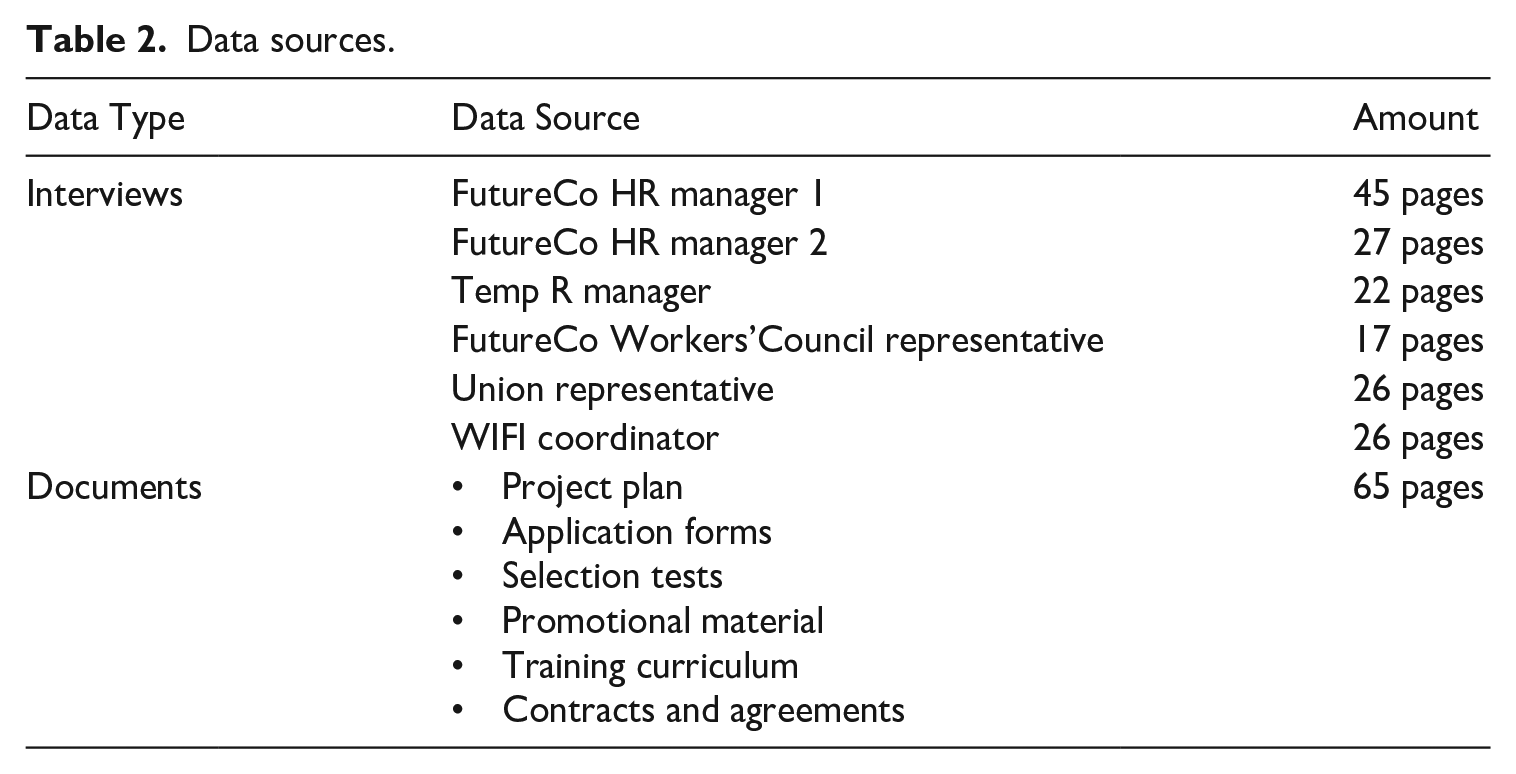
The study follows the tradition of evolutionary process research (Abdallah et al., 2019; Langley, 2009). One of our authors belonged to the actors who conceptualised and realised the programme between 2016 and 2019 and gave a presentation at the university that caught the other authors’ attention. Reskilling for temporary employees is relatively uncommon, especially in Austria (see Table 1). Since the other authors learned about the programme after the project was completed, studying how the activities unfolded in real-time was impossible. This is a common challenge for process research designs and led us to a ‘retrospective data collection’ (Abdallah et al., 2019: 98). To obtain data on the evolution of the project, we decided to combine multiple data sources. We gathered first-hand observations, interviews and documents, including agreements, curricula designs and programme flyers. Our study aimed to understand how institutional actors shape programme outcomes and the implications for DW. Due to convention theory’s affinity for analysis of coordination, we therefore conducted interviews of the institutional actors involved in the coordination. While this is a limitation of the study, we argue that institutional actors’ more profound knowledge of the institutional environment and space for manoeuvre are well-placed to shape consequential features and outcomes. Moreover, engaging multiple data sources, such as internal documents, helped strengthen the accounts given, such as the retention throughout the programme. The combination of several data sources (summarised in Table 2) allowed us to obtain information on the chronology of the project events and how the actors subjectively perceived the project, that is, what they aspired to and how they evaluated their activities and outcomes. The interview guideline in the appendix shows how we obtained insights from the local actors.
Data sources.
Analytically, our focus was on how coordination entities of the project change over time (are adjusted or affirmed) due to the actors’ activities, thus allowing the achievement of particular outcomes (and not of others).
First, drawing on Langley’s (1999) temporal bracketing strategy, we coded our data to build a chronological sequence of programme events. The step sought to ‘macroscopically’ reconstruct the multiple institutional actors’ activities, interactions and behaviours in realising the programme. The aim was to build an understanding of the events, themes and facets actors needed to manage and the materialising problems linked to the requirements of realising apprenticeships. We engaged multiple data sources to build a comprehensive reconstruction that captured the themes, interpretations, feelings and behaviour of actors in the evolution of the programme. In other words, the step enabled us to establish ‘what happened and who did what, when’ (Langley, 1999: 692). In doing so, we temporarily ordered bundles of activities and behaviours into three progressive phases labelled recruitment, training, and exam and after the apprenticeship (Abdallah et al., 2019: 97). The decomposition of data into temporal phases allowed us to examine the interweaving of activities and decisions from a preceding phase and how these shaped the context affecting the progression of subsequent phases (Langley, 1999).
Second, we dissected each phase, focussing on the interlinked situations with the conventionalist understanding that everyday HRM activities and practices are imbued with moments of valuation. Bourguignon and Chiapello (2005: 673) identify these as critical ‘moments of confrontations’ in which something happens and transforms the programme’s trajectory. We discovered eight moments of valuation during the programme and examined the data to explicate how actors responded (solutions) and how they articulated justification for responses taken. Specifically, the activities and themes in the interactional (exchange) relationships and the involved actors (who take the initiative). Finally, in line with Boltanski and Thévenot (2000: 218), we reconstructed the nature of valuations and the role of conventions involved in identified situations. We reviewed our empirical material of the situations and valuations for actors’ utterances focussing on grammars or objects of a particular convention, in other words, vocabularies and grammars of conventions (Boltanski and Thévenot, 2006; Imdorf and Leemann, 2023). Actors’ use of grammars ensured that we understood the dynamics of coordination and outcomes from the their perspective. The analysis process evolved through constant iteration of data and theory and was strengthened by the ‘interactional expertise’ of the involved author (Langley et al., 2013: 6)
The case of apprenticeship programme realisation
The chronology of the case is presented in the three phases of recruitment, training and exam and after the apprenticeship from the perspective of the local institutional actors. Leading the participants to the exam was linked with reimbursement of the expenses for the curriculum and filling job vacancies and was therefore always present on the actors’ agenda. As we will show, practices during the recruitment and training phase are consolidated to make the certification possible; practices and aspirations in conflict with enabling the certification are therefore abandoned.
Phase 1: Recruitment
After the training institute, WIFI, finalised the curriculum design and the SWF had accepted to finance the proposal, the local actors commenced communicating the programme. Information sessions at FutureCo’s production site played a key communication role in the programme. These sessions were planned in line with the convenience of the employees whose work is scheduled on shifts. They included the participation of the involved HR actors (including the trade union and workers’ council). The sessions introduced the programme targeting female temporary employees for their upskilling to meet the ‘factory of the future’ skills needs. The planned apprenticeship was described in detail using a PowerPoint presentation, and an open space for questions and clarifications was provided. Attendees also received a brochure with all the necessary information, including contact information and logos for the facilitating stakeholders. The event culminated with inviting interested participants to submit their applications and for those with further questions to approach the actors.
‘We always had the closing [during the session] and answered questions directly during the Q and A session. We summarised everything that was unclear [. . .] that is almost always the financial situation. We confirmed that the programme has a solid foundation [. . .] and what the workers’ council say is trusted [by employees]’. (FutureCo workers’ council)
Restricting eligibility
Although the project was only communicated to temporary employees, it generated interest beyond the initial target group. Internal FutureCo employees (non-temporary workers) were also apprised of the appealing opportunity through the day-to-day interaction of employees. Actors thus faced their first eligibility challenge: A group of FutureCo employees, through the workers’ council, inquired about the ‘possibility of taking part’ in the project. Despite this desire and expression of interest, FutureCo HR manager 1 elaborates: ‘We had to tell them no, that it was unfortunately impossible because of the limitations of the funding institution [SWF funds are limited to temporary workers]’.
Obstructing visibility
A central feature of the arrangement between the institutional actors was the guarantee to grant the newly trained apprentices permanent employment contracts at FutureCo. This guarantee was negotiated by the trade union representative who regarded temporary work critically as ‘dirty business’. Acknowledging that the prevalence of temporary work is inevitable, he invoked the union’s role as a ‘social partner’ working with temporary work agencies to improve workers’ conditions. To endorse the project, the union representative advocated for the ‘creation of something that gets people out of this hamster wheel [temporary work]’, hence the guarantee by the other actors. The union’s support for the apprenticeship was critical for assuring the employees that the promise would be upheld and for the funding institution, the SWF, where the union is an advisory board member. Despite the crucial role played, the union representative was puzzled by the omission of the union logo in the promotional materials. The union representative recounts, ‘Yes, I was there [at the informational sessions]; the Works Council was also there with us. They [other actors] made an information folder. I was a bit disappointed because they didn’t put my [PRO-GE] logo on it; I’ll never forget that [. . .]’.
Selecting participants
The apprenticeship was initially positioned as a ‘FEMtech programme’ to increase women’s distribution in production departments. That is, ‘a lighthouse tower’ (FutureCo HR manager 1), encouraging younger girls to consider technical apprenticeships. FEMtech is the Austrian Ministry for Climate Action, Environment, Energy, Mobility, Innovation and Technology initiative to promote and support women’s careers in research and technology. Under the FEMtech banner, companies have initiated and are recognised with the ‘Equal Opportunities Award’ for targeted projects that promote and support female employees, including FEMtech internships and developmental training (FEMtech, 2023). FutureCo conceived the programme as an opportunity to promote the inclusion of women with diverse social backgrounds in predominantly male departments – a choice aimed at developing a diversity-friendly setting for attracting more women in the future.
To select the candidates for the project, a rigorous multi-step selection process comprising pre-screening, aptitude and language tests, formal assessment by WIFI and a final interview with a work psychologist was executed. FutureCo’s HR manager 2 explained that candidates had to ‘meet certain basic physical and mental requirements. Whether it’s organisational, family, etc. everything has to fit together so that they can conceptualise it [the apprenticeship] in this very tough time of 15 months’. During the pre-screening and initial tests, Temp R manager, a former mathematics teacher, noticed ‘that mathematics was very difficult for a lot of women’. Yet process technicians’ tasks involve evaluating and adjusting equipment parameters, therefore, a sound mastery of mathematics is essential. This realisation came laden with implications for the entire project. Despite generating interest, reaching the target number of (15) female participants would be difficult, uncovering another challenge related to the eligibility restrictions.
In addition to assessing the learning capacities of the participants, the pre-screening interviews conducted by Temp R and FutureCo also probed the cultural profile of participants to ensure ‘everything fit together’. FutureCo Manager 2 recalls the significance of ascertaining that the participant’s cultural background would not present additional obstacles to an already challenging programme. The manager noted, ‘If a young lady with a headscarf is sitting in front of me, I’d like to know whether it’s accepted in her background that she’s doing an apprenticeship in a [predominantly] male profession. We don’t want to make things difficult for anyone’.
The selection tools served different purposes and were weighed differently by actors when making decisions for the programme. Screening for arithmetic capacities or cultural background was crucial in informing actors of programme features that might compromise the desired outcome. In the end, actors emphasised the participants’ demonstration of learning capacities over the participants’ cultural profile and social environment. Therefore, institutional actors abandoned the FEMtech categorisation (and the associated narrow target group) in favour of a broadened target pool encompassing five male and nine female participants. This decision informed the repositioning of the programme as a reskilling for all temporary workers and the selection of 14 participants.
Union’s support was not limited to the information events and was sought by participants as they navigated the selection process. The union representative explained that participants perceived the ‘milk and honey offer’ with a level of scepticism and thus approached the union seeking assurances. He elaborates, ‘I took them [participants] for coffee and advised them on various things like labour law [. . .], and it was also important to give them a certain self-esteem so that they [believe] they can do it [the apprenticeship]’.
Phase 2: Training
Recall that participants ought to receive a fraction of their monthly income as unemployment benefits during the training. Participants needed to apply for educational leave at the AMS. This had to be accomplished before the training started since there was no retrospective approval. This process is bureaucratically structured and entails appending various documents, including those demonstrating eligibility for the particular education to be undertaken. The individual employee is responsible for personally submitting their own application to the respective administrative district office.
Supporting administrative issues
The Temp R manager contends that the application for educational leave is a demanding process, especially for employees with a migration background who might not have the requisite documentation: ‘All the bureaucratic stuff is a lot of work, and an employee can’t do it themselves [. . .]. They are overburdened by it’. (Temp R manager). To lessen the burden on the employees and secure the approval for all participants within the programme’s scheduled start, Temp R received permission to manage the process on behalf of the employees. A designated Temp R manager provided requisite information and clarifications to the participants, collected, reviewed and submitted required documents to AMS, including assuming official communication with AMS: ‘And then our colleague, who is not normally responsible for that, passed it [the applications] to the [AMS] education department and told them that some would be dealt with in district A others in district B’. (Temp R manager). Furthermore, the Temp R manager emphasised the extent of the support given through her intensification of contact points and broadening of communication channels to include informal channels with the employees. ‘I personally took care of the group. I came there [at WIFI] every fortnight and was available to everyone by mobile phone and WhatsApp. That means I was personally there one-on-one for the staff’.
Supporting participants socially
The HR actors knew that condensing the training from 3.5 years to 15 months implied considerable strain for participants. They had been out of school for a long time, and there were uncertainties about their learning capacities, especially in mathematics and in understanding the technical terms of process technology. In addition, many of the participants had responsibilities (e.g. family), making it challenging to prioritise learning in their social environments. Temp R recognised the challenges and the extra commitment the training demanded of the participants, consequently, intensified the amount of support. WIFI organised and integrated tutoring and coaching at various stages of the training as part of the curriculum to ensure participants progressively conceptualised their learning. Furthermore, participants were organised into small groups of ‘buddies’ to ensure they had a trusted other to go through the experience together.
‘Yes, who learns with whom, who is good at it, who can support the other and then there were also small groups. Then a few got together again with a WhatsApp group, exchanged results, and then voluntarily stayed in the learning room in the afternoon and supported each other; as you know from school, the faster one supports the other’. (Temp R manager).
These buddy groupings were instrumental in knitting the participants together beyond the training (self-organised learning, revision, and extracurricular activities): ‘And our [HR actors’] goal was that the group remains homogeneous, that they belong together, that the group supports each other and that if 50% were to drop out in the first month, that would be a great frustration for the others and a burden’ (Temp R manager) for the successful conclusion of training.
In addition, FutureCo HR managers maintained ongoing support throughout this phase of the programme, exemplified through material (functional and symbolic) and social tools. FutureCo HR manager 2 recalls dispensing functional materials (stationary) to kickstart the programme, visiting participants with symbolic presents during Christmas and offering to coach ‘to support them [participants] at any time’. According to the manager, maintaining visibility during the programme was important for strengthening participants’ commitment to FutureCo: ‘We are only the potential employer; we are not the definite employer. You can already see that we are scrambling for workers’.
Phase 3: Exam and after apprenticeship
These supportive activities proved successful, with all the 14 apprentices attending the final examination LAP, 12 of whom emerged successful in their first attempt. FutureCo, in collaboration with Temp R, organised an event to celebrate the programme’s culmination and award the qualification certificates to the successful apprentices. One month after receiving the vocational qualification, the planned transition of the Temp R employees to FutureCo was concluded. The two unsuccessful candidates had the chance to retake the exam, as in all apprenticeship programmes in Austria.
Retaking LAP or not?
According to the WIFI coordinator, one of the unsuccessful candidates ‘lost her nerve during the oral exam’ but retook the examination, which was done successfully. The second unsuccessful apprentice, however, decided not to retake LAP. According to the Temp R manager, the apprentice explained that the potential new job opportunities with certification did not interest her. Although admitting that she learnt and took a lot from the training, she found the ‘job description was too difficult’ and would not enjoy the responsibilities of a Process Technician. Due to the voluntary condition to attend LAP stipulated in the governance of apprenticeships, the Temp R manager accepted the candidate’s decision:
‘She [the candidate] realised that [certification wasn’t important to her]. I had to accept that, but she was very motivated, took a lot with her, and could do everything. She can still be a team leader. Not everyone has to implement this training one-to-one. You can take something else with you’. (Temp R manager).
Offering permanent contracts
Despite only 13 apprentices gaining the vocational certificate, FutureCo offered contracts to the 14 who participated in the examination: ‘She [the participant who failed the examination] [. . .] was taken on [as a full-time employee] anyway, interestingly enough, but then as a semi-skilled employee. Not a skilled worker’ (FutureCo HR manager 2). The FutureCo managers, through interaction with the employees in the training phase, for example, regular visits and coaching, observed the diversity of interests of the participants and the challenges, particularly the learning challenges experienced by the 14th participant without the certificate and understanding the commitment and input made during the training upheld the offer for a full-time position albeit with a lower classification as semi-skilled worker: ‘Because at the end of the day, it is also about remaining flexible or acting flexibly, that is, training staff that we [FutureCo] can apply as needed’. (FutureCo HR manager 2).
How HR actors shape the value of apprenticeship programmes
In this study, we have been concerned with how HR actors shape the value of apprenticeships and the contribution of the customised programme to the DW Agenda and SDGs. We have described the three phases through which the apprenticeship was realised and highlighted critical moments where HR actors confront previously installed practices and decide whether to accept or challenge them. As we have shown, some practices were challenged by actors while others were not; nevertheless, all actors expressed satisfaction with the collaboration process and the resulting outcomes. Synthesising our observations and drawing from the stakeholder approach to HRM, which posits that choices by a plurality of actors in HRM affect outcomes and long-term consequences (Beer et al., 1984), we propose Figure 1, which illustrates how actors handled conventions and evaluated the outcomes. Our subsequent discussion will describe the generic process in Figure 1 and then elaborate on the manifestation of the observed mechanisms (consolidation and conversion) to the case.
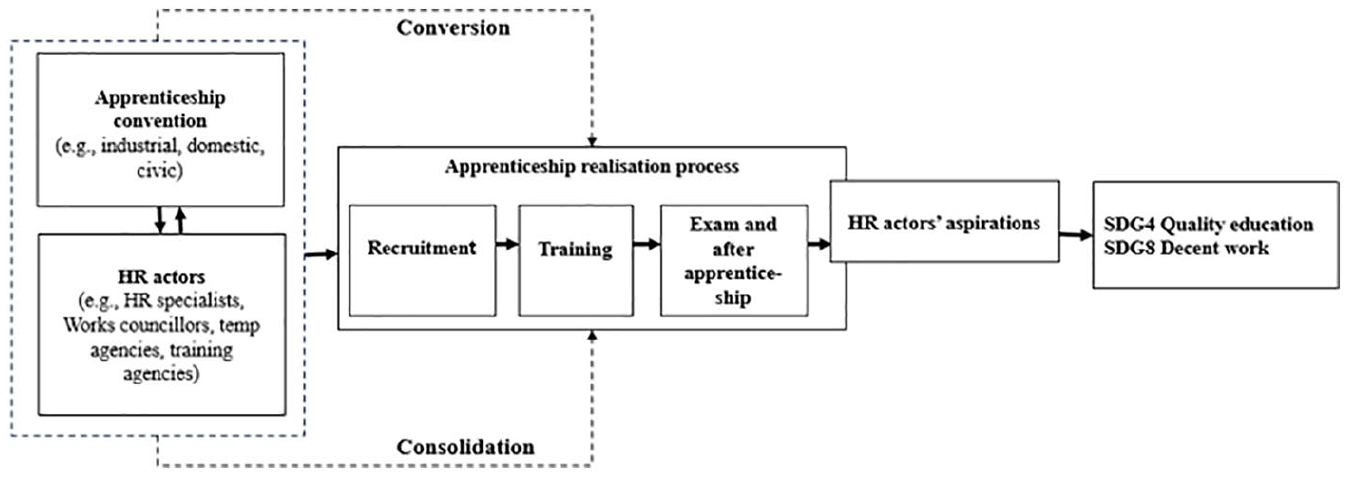
How actors shape value of apprenticeship programmes.
A combination of the apprenticeship convention and HR actors characterises the initial conditions for the apprenticeship programme. The apprenticeship convention represents the appropriate features and requirements (established rules) that underpin coordination for executing apprenticeships (Imdorf and Leemann, 2023). It informs the HR actors in the realisation of the programme. We stated previously that conventions are frameworks that enable agreement over situations and people, which allows for agreement on what is necessary to implement the programme. The HR actors, with varied expertise and knowledge, have different aspirations for engaging in the programme. Brandl (2023) suggests that conventions facilitate cooperation despite converging and diverging aspirations. They enable managing actors to solve emerging uncertainties by providing a common evaluative framework for the elements constituting the situation.
The second box denotes the apprenticeship realisation process, which unfolds in three phases (described above). In the realisation process, HR actors consider various factors and activities (critical moments) that confront the conventions characterising the specific situations. According to Beer et al. (1984), HR actors consider their choices and how these could affect the programme's desired outcomes. We recognise mechanisms of reasserting, contesting or introducing an alternative convention, resulting in the strengthening or weakening the convention (Imdorf and Leemann, 2023). We classify mechanisms of maintaining a convention, consolidation, and altering a convention, conversion. Consolidation involves practices that stabilise programme features to enhance the achievement of desired outcomes. Conversion refers to the expansion or replacement of the established convention through the installation of new regularities.
The third box designates the spectrum of aspirations (goals, objectives, etc.) held by HR actors. In the context of apprenticeship programmes, these actors commonly aspire to enhance development opportunities for workers in precarious conditions and facilitate their acquisition of relevant skills that foster future employability. These actors share the overall objective of running a successful programme addressing labour market challenges, specifically, the shortage of skill. Despite variations in specific aspirations among coordinating actors, they skillfully and pragmatically balance their goals with the overall objective of reskilling temporary workers and facilitating their transition to permanent employment at FutureCo. It is crucial to emphasise that the outcomes of this customised programme carry long-term societal consequences for SDG 4 and SDG 8. We will delve into a detailed elaboration in the following section, specifically focusing on the application of Figure 1 as manifested in our specific case.
Consolidation and conversion of apprenticeship features
Consolidation and conversion occur during the realisation process. Some features of the prevalent apprenticeship convention can be converted while others are consolidated. We previously suggested that the predominant features of the apprenticeship programme reflect the industrial and domestic conventions.
In our case, we observe the consolidation of both conventions by ‘enacting convention-based tools’ (Chiapello and Gilbert, 2019). By tools, we refer to management techniques for the selection of participants in recruitment (e.g. math test, interview), supporting them during training (e.g. learning groups), and procedures for evaluating the quality of the training (e.g. LAP). Specifically, the features of the industrial convention consolidated were selection tools, that is, maths tests and interviews, while the domestic convention was supportive activities during the training instantiated in regular visits, career coaching and symbolic gifts. We established that institutional actors’ aspiration was to ensure all participants completed the programme and acquired the apprenticeship certificate. This objective accounts for actors maintaining the selection criteria despite female candidates performing dismally in the math tests. Stabilising the selection tool would demonstrate the selected candidates’ efficient learning capacities, analytical capabilities, reliability and motivation to work as a process technician. Furthermore, the additional support in the training encouraged participants’ commitment to the programme, strengthened by the enhanced familiarity and relationships. FutureCo HR manager 2 recalls, ‘Because a 15-month training in a technical apprenticeship is a challenge. It’s not something that everybody can do’. maintaining a strong presence throughout the programme was essential, ‘it was important for us [FutureCo] to bring them [participants] Christmas presents or stationary and also offer coaching. To support participants at any time’. Consolidating the industrial and domestic conventions resulted in all participants completing the programme and transitioning to full-time employment at FutureCo.
We suggest that the conversion of convention-based features occurs through practices of ‘form-giving’ (Thévenot, 1984), which refers to the development of a shared cognitive framework and corresponding material equipment to establish regularities in a production process. It means that actors establish new rules for the coordination and evaluation and tools that can support actors to work in line with these rules (Brandl, 2023: 11). In our case, we observed conversion when FutureCo offered a permanent contract to the participant who opted not to repeat LAP. FutureCo had initially provided a formal agreement that guaranteed the participants who passed LAP the transition to permanent employment, a practice which reflects the industrial convention where certificates are vital in establishing the value of an employee, and formal agreements are the foundation for the relationship between firms and apprentices. The emerging practices that we observed reflected the domestic convention, where value is constituted in community building and social fit, education aims to develop physically grounded experiential knowledge, and training focuses on the job (Imdorf and Leemann, 2023). Underlying FutureCo’s decision for the job offer was the assumption that employment offers ought to be managed based on the present demands for employees. As such employee value is not necessarily dependent on certified competencies but on firm-specific knowledge and social fit developed throughout the practical training at FutureCo. While conversion implied that the participant lacking the certificate gained secure employment, she is more vulnerable than the others since other employers may not equally value her competencies, reducing her opportunities for choosing other employers.
Consolidation and conversion of convention-based features were instrumental in shaping the programme’s features and influencing the outcomes. In other words, consolidation and conversion were crucial for the realisation of the programme outcomes, specifically reskilling temporary workers, promoting education opportunities for women and workers of migration backgrounds, addressing skills shortages, enhancing relationships with social partners and building favourable images to existing and potential employees. Apprenticeship literature conceptualises these outcomes as increased job mobility through the acquisition of transferrable skills (Deissinger, 1997), the establishment of occupational identity, improved remuneration and secure employment conditions (Brockmann et al., 2008). HR actors additionally expressed profound concern with ensuring participants complete the programme and attain the vocational certificate that would guarantee permanent employment at FutureCo. They, therefore, consolidated and converted programme features since they valued the certificates, which would result in reimbursements of programme costs by SWF. Achieving these varied aspirations in the short-term bears long-term societal outcomes contributing to the SDGs (specifically goal 4, quality education and goal 8, decent work and economic growth). The observed outcomes directly reflect the specific targets of these SDGs and strategic objectives of DW outcomes fostered by the programme.
Non-conversion of apprenticeship features
The variety of unsuccessful valuations helps to understand why the programme outcomes fell short of the HR actors’ aspirations to promote apprenticeship opportunities for women and enhance the visibility of employee representatives. We found two unsuccessful valuation practices that we term ‘closing eyes’ (Thévenot, 2011) and ‘avoiding requests’.
‘Closing eyes’, as described by Thévenot (2011), refers to the approach where actors consider convention-based practices as reality and ignore other conventions. When actors shut their eyes and principles conflict with these convention-based practices, actors withdraw their aspirations to coordinate in line with these principles. In the case study, the insufficient test results of the female applicants were interpreted as a key indicator of a lack of individual learning capacity. In response, institutional actors withdrew their plan to fill only the initially designated 15 positions with female candidates. They closed their eyes to the potential for empowering more women and contributing to gender equality (SDG 5), instead expanding the target group to male employees: ‘And what we saw after the filter [selection process] was that there were several male colleagues still left, and one of these colleagues was over 50 years old’. (FutureCo HR manager 1).
Avoiding requests, the second testing practice was evidenced by the employee representatives withholding further questioning during recruitment to prevent delays in the execution of the programme and to maintain a favourable social climate among institutional actors. For example, FutureCo’s works council sought to open the programme to regular FutureCo workers reflecting the value of equal opportunity inherent in the civic convention and the social responsibility of firms to invest in training (Imdorf and Leemann, 2023). However, the target group remained limited to Temp R employees due to funding limitations for the customised programme that did not offer remuneration for interested FutureCo employees. FutureCo HR Manager 1 recounts, ‘we told them that, of course, we try to help them in terms of their education, but we can’t give them the full package [. . .] We could make it somehow happen with the educational leave. [. . .] the disadvantage of the educational leave is a low monthly salary’.
Another example of avoiding requests is the union representative’s unarticulated critique after discovering that the union logo was not included in the programme promotion material. This is a missed opportunity for proactively showcasing that unions champion training programmes with qualification certificates. The union representative, in his reflections, expresses profound disappointment and frustration with the programme administrators: ‘I was still angry with them because our logo was missing [in promotional material] [. . .] But it didn’t matter, never mattered. All I wanted was for people to get a very coherent offer’. In both examples, avoiding requests contributes to reduced visibility of the employee representatives’ engagement with employees interested in apprenticeship. In the union’s case, their engagement remains visible in its one-to-one consultation for employees, which was used to win new union members. However, consultation was only used by those employees who considered the offer and still had questions. Although the request was unsuccessful, the works council still perceived the advisory role in the programme as a positive duty amidst their often-challenging daily tasks.
‘Employees only come to us when they have problems. Normally, we listen and deal with problems experienced by employees, so it is always great for us [workers’ council] when we participate in [positive] projects like this’. (FutureCo Workers’ Council representative).
In conclusion, not all aspirations were achieved during the realisation. In the spirit of realising the programme and achieving the desired outcomes, HR actors made choices that advanced the programme forward but also made trade-offs that minimised some of the aspirations and potential outcomes. Closing eyes to the original target diminished the empowerment of women while avoiding requests downplayed the acknowledgement of the critical role of employee representatives (union). This study demonstrates two important issues that confronted actors: prioritising the numerical target over the specific effort to boost women into technical fields, and second, limiting the influence of institutions that advance social protections and equal opportunity. Therefore, non-conversion showcases the manifestation of challenges that the development agenda towards a more DW oriented environment faces and the issues that HR scholars need to overcome to reach the SDGs (Brewster and Brookes, 2024).
Long-term consequences for sustainable development goals
Our evaluation of the programme outcomes highlights that through securing SWF funding and curating the customised apprenticeships for temporary workers, the programme fostered access to SDG 4 specifically, quality vocational education for participants (SDG target 4.3), advanced acquisition of relevant skills and improved jobs (SDG target 4.4) and fostered equal access to training for participants of migration backgrounds and in precarious employment conditions (SDG target 4.5). Similarly, the programme focussed on reskilling temporary workers advanced several targets of SDG 8. First, promoting development opportunities and advancing permanent employment for all participants involved, therefore increasing remuneration (SDG target 8.5). Second, the aspiration of reskilling workers with technical and transferrable skills contributed to SDG target 8.6, which promotes education and training to meet the needs of the future of work. Finally, transitioning temporary workers to permanent employment enhanced the participant’s job mobility. It contributed to SDG target 8.8, advocating for protecting labour rights for all workers, including those in precarious employment (ILO, 1999). Conversely, non-conversion of apprenticeship features also had implications for SDG 5 that is, in closing eyes and expanding the programme eligibility to male participants, actors limited the opportunity to advance equal opportunities and empower women in a predominantly male profession.
Discussion, implications and conclusions
We began this paper by establishing that reskilling, specifically apprenticeships with adults as a target group, is instrumental to ILO’s DW agenda – and thus to achieving SDGs 4 and 8. We then underscored that there is an acknowledged HR actors’ role in shaping the benefits of apprenticeship programmes for stakeholders. However, this remains underexplored in current vocational education literature. We moved beyond existing conceptualisations of actors as elements of national institutional frameworks or training logics. We proposed an approach that offers analytical space for studying the dynamics in day-to-day activities during the realisation of joint projects and their implications for stakeholders. We suggest that HR actors not only draw on elements of established institutional frameworks and thereby help to consolidate these frameworks, as prevailing literature suggests but that actors may also seek to change these frameworks.
The rationale for highlighting conversion is that vocational education research tends to overemphasise the common interests of HR actors, such as life-long careers, competence development or fighting youth unemployment. This neglects evidence that HR actors have diverse and sometimes conflicting aspirations (Busemeyer, 2012; Busemeyer and Trampusch, 2012). Therefore, we suggest that the outcomes of apprenticeship programmes cannot be understood without analysing the mechanisms through which actors try to realise their aspirations and consent to the programme features.
In this study, we built on the notion of valuation practices, which we defined as an individual’s fairness (or quality) principle used for evaluating a situation in a collaborative project and the impact of this evaluation on the situation. Valuation practices constitute mechanisms through which actors either consolidate or convert elements of an apprenticeship programme and help to explain the dynamics of the training logics of apprenticeship systems (Markowitsch and Wittig, 2022: 605). The case of a customised apprenticeship programme in Austria demonstrates how these mechanisms can be applied to delineate the successes and failures of HR actors in influencing specific programme features and thus explain how actors influence outcomes. In establishing the specific consolidated or converted features, we have demonstrated how stabilising or changing features informs the actor’s aspirations and how the employed mechanism contributes to DW in general and specifically to SDG 4 and 8. Moreover, the non-conversion of conventions shows the trade-offs actors – especially employee representatives – contend with as they balance their established roles as advocates for employee needs and social partners. The result of these trade-offs, as seen in the programme outcomes and consequences, is the hindrances in advancing gender equality (SDG 5) and minimisation of some DW objectives, for example, instituting alternative tools or support systems to advance the intended target group. The process research methodology that we applied highlights that valuation practices are present in many situations of apprenticeship and, therefore, useful for other research on how apprenticeship changes unfold (Thelen and Busemeyer, 2012).
Our study sought to uncover the implications of reskilling programmes on DW agenda and SDGs. We have illustrated that actors’ choices and practices during the realisation phases exert long-term societal consequences. Securing funding for the entire programme, supporting participants socially and administratively and offering permanent contracts upon successful completion collectively fostered an environment that enabled participants to focus exclusively on reskilling and successfully passing the exams. These practices, as taken on by the HR actors, collectively facilitated consequences for SDG 4 and SDG 8. The observed outcomes notably advanced three targets under SDG 4: target 4.3 (equal access to affordable vocational education), target 4.4 (increased proportion of adults with relevant skills) and target 4.5 (ensuring equal education access to all). Similarly, our findings demonstrated that SDG 8 target 8.5 (full and productive employment for all) was promoted through the offer of permanent employment, target 8.6 (reducing the proportion of those not in employment or training), and target 8.8 (equal labour rights). Our empirical study contributes to the discussion on the SDG-HRM relationship by illustrating that to contribute to SDGs HRM actors need to broaden their role. Specifically, HR actors need to actively curate development opportunities for employees in collaboration with other stakeholders to effectively contribute to SDGs. Individually, none of the actors could have realised the programme and the outcomes we observed. A collaborative and concerted effort is an essential prerequisite for the success of the programme, aligning with the principles of SDG 17 on fostering partnerships for the goals.
This study suggests several avenues for future research. A natural starting point is exploring conventions for managing apprenticeship across settings, focussing on investigating differences in stakeholder outcomes. Where the industrial convention is established in current apprenticeship programmes, between-firm mobility and occupational careers for participants can be expected. However, when apprenticeship programmes are expanded to different target groups (e.g. adults) or peripheral institutional actors (e.g. temporary work firms) co-manage these programmes, we may also see other practices. Research on entrepreneurial activities by temporary service firms (Ofstead, 1999) and by employee representatives (Durazzi and Geyer, 2020) is a promising source for inspiring investigations on linkages between conventions and the benefits of apprenticeship.
Our study also offers avenues for human resource management (HRM) research, particularly in the pluralist tradition. Building on conventions for coordinating and evaluating HR activities and valuation practices is a fruitful way to understand the local emergence of societal consequences of HRM, especially their roots in HR actors’ aspirations and the impact of managers on HR activities. Research looking at the varied aspirations of actors with HRM appears highly promising. Scholars might draw from stakeholder frameworks (Guerci et al., 2014) as a starting point to identify relevant institutional actors. Process research methodology (Abdallah et al., 2019; Langley, 1999) that we used for this study enables scholars to develop an account of the plural nature of HRM aspirations and the varied gaps inherent in HRM implementation. The insights gained from such research are relevant for a fine-grained understanding of ‘less-than-optimal impact’ (Boxall, 2021: 841) and ‘win-win-lose’ situations in sustainable HRM (Bush, 2020: 1). Examining how actors using valuation practices can help to connect different levels of analysis in HRM research. For instance, national institutions can be rhetorical building blocks for actors to frame the justification of HR practices or request changes (Pernkopf-Konhäusner and Brandl, 2011). Similarly, the legacies of actors in national settings like unions (Durazzi and Geyer, 2020) might help them to promote their positions to realise aspirations in HRM. Scholars might draw from related work on employee voice and silence (Mowbray et al., 2015) to further explore the nature of valuation practices and the social conditions that stimulate these practices. The questions in this area – voice and silence in influencing HRM – have implications for conceptualising the varied influence of HR actors on societal consequences of HRM. Our study offers ideas for SDG-HRM researchers examining the role of HR actors in facilitating or hindering contribution to SDGs. Scholars could further explore real-time projects to understand how private-public partnerships contribute to the effectiveness of reskilling initiatives and the support mechanism that fosters stronger engagement for participants and SDG outcomes.
Our findings have relevant implications for policymakers and practitioners regarding the design of apprenticeship and reskilling programmes. When targeting the existing workforce, four things need to be considered: (a) the duration of the programme, (b) increasing flexibility and adaptability, (c) broadening stakeholder participation, and (d) increasing scope for financial support. In the study, we highlighted the shortening of the programme, intensified support during training, coordination of various actors, and a combination of unemployment benefits and SWF funding. These measures enable participants to participate in the programme while managing personal responsibilities. Practitioners can learn from this study that reaching benefits from apprenticeships, such as the realisation of DW and strengthening of social partnership, depend on the day-to-day decisions of the local actors during the execution of apprenticeship programmes. The notion of valuation reminds practitioners that programme features are not natural, and their day-to-day interactions with these features can have substantial consequences for stakeholders’ benefits. The study also underlines the importance of financing rules and the operation of funding institutions for implementing the current policy agendas of lifelong learning and inclusion of marginalised groups in collective education.
Some limitations need to be mentioned. The case study shows how convention-based practices are linked with benefits but cannot answer which practices are suitable for improving stakeholder outcomes. Future research on this issue could look beyond the firm-level into policy measures for inclusive apprenticeship (Durazzi and Geyer, 2022). Our focus was on those who define rules and practices. First-hand accounts from apprentices in future research is essential for broadening the understanding of aspirations with apprenticeship programmes, valuation practices and actual benefits. As with all qualitative research, the accounts we presented result from our interpretation of the case, and others may have produced a different account. Based on our pragmatist standpoint, we suggest to judge the account by what those who encounter a similar setting can learn about the constraints and opportunities for their activities.
To conclude, when recognising that HR actors can experiment with apprenticeship programmes, national institutional systems and training logics are insufficient for explaining the dynamics and outcomes of apprenticeship programmes. The objective of our paper was to analyse how institutional actors influence the apprenticeship programme outcomes and what implications there are for DW agenda and SDGs. By highlighting the practices for consolidating and converting the features of apprenticeship programmes, this study showed that attending to the valuation practices of local institutional actors during the realisation of an apprenticeship programme is instrumental in understanding what benefits emerge and what unrealised opportunities exist. Overall, we suggest that how institutional actors value apprenticeship shapes for whom an apprenticeship programme is valuable.
Footnotes
Appendix
Acknowledgements
We are grateful for the time HR actors dedicated to sharing their experiences and providing material to us. Special thanks to Nadine Suhr and Martina Kohlberger for their support in data collection. Additionally, we extend our gratitude to the participants of the 2023 EGOS Sub-theme 65-Reimagining the Institutions, Actors and Practices of Good Work-and the anonymous reviewers for their valuable feedback.
Funding
The author(s) received no financial support for the research, authorship, and/or publication of this article.
